Article

Hydroxyl Functionalization Effects on Carbene–Graphene for Enhanced Ammonia Gas Sensing

by
Athar A. Hassanian
1,
Kamal A. Soliman
2,
Tawfiq Hasanin
3,
Abdesslem Jedidi
4,5,* and
Adnene Dhouib
1,*
1
Chemistry Department, College of Science, Imam Abdulrahman Bin Faisal University, Dammam 31113, Saudi Arabia
2
Department of Chemistry, Faculty of Science, Benha University, Benha P.O. Box 13518, Egypt
3
Department of Information Systems, King Abdulaziz University, P.O. Box 80203, Jeddah 21589, Saudi Arabia
4
Department of Chemistry, Faculty of Science, King Abdulaziz University, P.O. Box 80203, Jeddah 21589, Saudi Arabia
5
FEMTO-ST Institute, CNRS, Université de technologie de Belfort Montbéliard, 90010 Belfort, France
*
Authors to whom correspondence should be addressed.
Molecules 2025, 30(24), 4726; https://doi.org/10.3390/molecules30244726

Submission received: 15 November 2025 / Revised: 2 December 2025 / Accepted: 5 December 2025 / Published: 10 December 2025
(This article belongs to the Special Issue Density Functional Theory: From Fundamentals to Applications)

Abstract

DFT study of graphene functionalized via carbene was performed to identify the preferred –OH adsorption sites and to assess how hydroxylation affects adsorption of NH3 gas. The carbene attaches to the graphene basal plane through a [2+1] cycloaddition, producing a local cyclopropane-like motif with a C–C bond. This modification introduces localized mid-gap states and asymmetric charge redistribution that create chemically active anchoring sites for –OH groups. We systematically scanned possible –OH adsorption sites and identified site-dependent binding energies. NH3 preferentially anchors at the carbene center and is further stabilized by multidentate hydrogen bonding with neighboring –OH groups. Calculated NH3 adsorption energies range from moderate values (single –OH and some two –OH symmetric sites, Eads ≈ −0.64 to −0.75 eV) to strong interaction for selected through-plane two –OH pairs (Eads ≈ −1.78 to −1.83 eV), where synergistic hydrogen bonding amplifies the NH3 interaction. Charge density difference and Bader analyses indicate polarization-dominated binding with minimal net charge transfer, consistent with hydrogen bonding rather than covalent bond formation. Desorption time estimation shows that moderate binding motifs provide rapid recovery at room temperature. We conclude that targeted placement of paired –OH groups on carbene-functionalized graphene offers a tunable route to balance sensitivity and reusability for NH3 sensing.

1. Introduction

Ammonia plays a vital role in the global nitrogen cycle. Atmospheric dinitrogen (N2) is biologically converted into reactive nitrogen through microbial nitrogen fixation, transformed through soil and water processes, and returned to the atmosphere as N2 or nitrogenous gases. This natural progression from N2 to NH3 and subsequently to oxidized nitrogen species supports ecosystem productivity and regulates the movement of reactive nitrogen within the environment. However, human activities have significantly elevated reactive nitrogen levels, increasing ammonia emissions and intensifying their effects on air quality, water eutrophication, and public health. Viewing NH3 within both its biogeochemical origins and its large scale industrial production highlights the importance of developing highly sensitive and selective ammonia sensors for environmental, agricultural, and industrial applications [1].
Ammonia (NH3), a pungent gas, widely used chemical in agriculture, fertilizer production, refrigeration, and many chemical industries, it is naturally found in soil and air [2] and poses serious health and environmental risks at elevated concentrations. Inhalation of NH3 above ~ 25 ppm can irritate the eyes, skin, and respiratory tract, and long-term exposure may lead to more severe health problems. Monitoring NH3 in ambient air, industrial exhaust, and even biological exhalations is therefore critically important. The release of high concentrations of ammonia also contributes to atmospheric pollution and deteriorates air quality, so there is an urgent need for gas sensors with high sensitivity and selectivity toward NH3. A wide range of sensing materials has been explored, including metal oxides [3,4,5,6], resistive sensors [7,8], and various two-dimensional (2D) nanomaterials [9,10,11]. Among these, 2D materials have attracted particular interest because of their very large specific surface area [12,13], excellent electrical conductivity [14,15], and high thermal conductivity [16,17], all of which are favorable for fast, sensitive gas detection. The isolation of single-layer graphene from graphite by Geim and Novoselov in 2004 marked the beginning of a new era for 2D materials research [18], and since then researchers have investigated a broad family of 2D systems to further expand sensing capabilities and application prospects [19,20,21,22,23,24,25].
Solid-state gas sensors based on changes in electrical conductivity when gas molecules adsorb onto a surface are promising for compact, low-power, real-time detection. Among sensing platforms, graphene- and graphene-derived materials are particularly attractive due to their ultra-thin structure, high carrier mobility, large surface area, and strong sensitivity to changes in surface adsorption [26]. However, pristine graphene (pure sp2 carbon sheet) interacts only weakly with small gas molecules like NH3, yielding low adsorption energies, limited charge transfer, and thus modest sensing responses [27]. To overcome that limitation, a variety of functionalization strategies have been explored: introducing defects, doping with heteroatoms, anchoring metal or metal-oxide nanoparticles, or grafting organic functional groups onto graphene or graphene oxide [28]. Among those, covalent functionalization (i.e., forming chemical bonds to the carbon lattice) can introduce local binding sites and perturb the electronic structure, thereby enhancing adsorption energy and sensitivity [29].
One particularly interesting functionalization route is via carbenes (divalent carbon species) or their precursors. Graphene functionalized by activated carbenes can produce covalent adducts on the graphene basal plane via [2+1] cycloaddition, thereby creating localized sites with chemical reactivity [30]. In a DFT study, Aldulaijan et al. used diazomethanes functionalized by –OH, –OMe, and –OEt, which after carbene attachment to graphene gave derivatives that showed significant adsorption affinity toward toxic gases (including NH3) via hydrogen bonds [31]. The same work emphasizes that the –OH functional group (hydroxyl) can act as a hydrogen bond donor/acceptor, thus enabling stronger interactions with NH3 [31]. Other computational studies have also explored substituted carbene grafting to graphene. For example, Baachaoui et al. simulated thermodynamics of graphene functionalization via substituted carbenes and assessed the resulting graphene adducts for gas adsorption, concluding that the nature of substituents plays a key role in modulating adsorption characteristics [32]. The controlled grafting of carbenes thus offers a tunable palette of functional sites on graphene surfaces. Once –OH groups are incorporated, there is potential for hydrogen bonding with NH3. Hydroxyl groups on graphene or graphene oxide are known to increase sensitivity and selectivity for NH3 detection [33]. For instance, plasma treatments of graphene can introduce oxygen-containing functional groups (hydroxyl, epoxide, carbonyl), and the modified graphene shows enhanced NH3 sensing performance compared to pristine graphene [34]. In particular, Iwakami et al. demonstrated that oxygen plasma treatment (introducing hydroxyl groups) enhances NH3 adsorption and sensor response [35]. Furthermore, the presence of –OH groups may affect not only binding strength but also kinetics and reversibility of adsorption/desorption, sensor recovery, and even selectivity [36]. Indeed, some works have shown that tuning the density (or selective removal) of hydroxyl groups influences gas sensitivity [37].
In the current study, we explored the sensing behavior of an –OH group functionalized carbene–graphene surface toward ammonia (NH3) gas using first-principles calculations. The aim of this work is to design and model a graphene–carbene-OH-functionalized surface and to evaluate its potential as a highly sensitive and selective NH3 gas sensor. To achieve this, we computed the adsorption energies, charge transfer, density of states (DOS), and optimized binding geometries of NH3 molecules on the proposed surface.

2. Results and Discussion

2.1. Graphene Functionalization with Carbene and Hydroxyl Groups

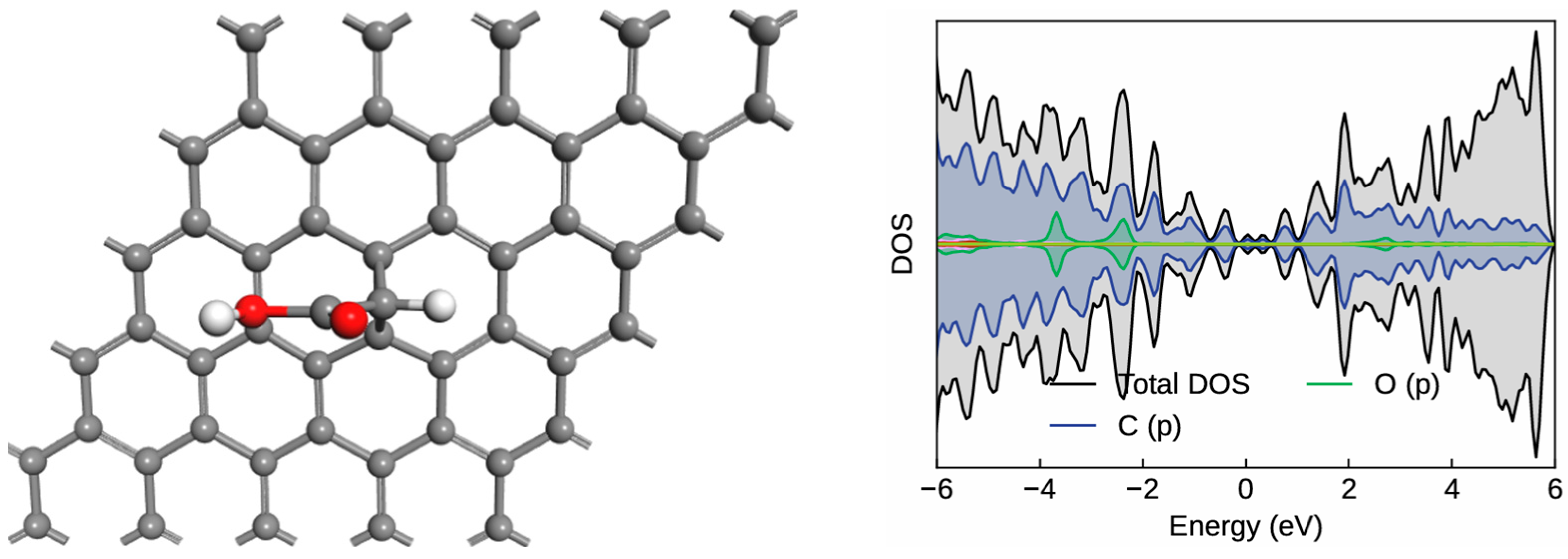
The functionalization of graphene with carbene and hydroxyl groups was investigated systematically to understand the structural stability and electronic behavior of the resulting nanostructures. The initial step involved studying the interaction of the carbene moiety with the graphene surface through a [2+1]-cycloaddition reaction, as shown in Figure 1. In this configuration, the carbene functional group reacts with the π-conjugated carbon network of graphene to form a cyclopropane-type structure, confirming successful attachment of the carbene fragment. The optimized geometry of this configuration reveals C–C bond lengths ranging from 1.53 Å to 1.56 Å, which are characteristic of sp3-sp3 carbon–carbon single bonds. These bond distances are notably longer than the C=C bonds in pristine graphene (1.42 Å), indicating the partial transformation from sp2 to sp3 hybridization at the carbene attachment site. The calculated adsorption energy of −1.67 eV further confirms that this modification is energetically favorable and in agreement with previously reported values for carbene–graphene cycloadditions [27,28].
The graphene–carbene nanostructure consists of 52 carbon atoms, 2 hydrogen atoms, and 2 oxygen atoms, forming a nearly planar configuration with localized distortion near the carbene site. The density of states (DOS) profile, also shown in Figure 1 and Figure S1, reflects the metallic or semi-metallic nature of the system. Pristine graphene displays a finite band gap, whereas carbene-functionalized graphene becomes metallic as new defect states emerge near the Fermi level (Figure S1). The electronic states near the Fermi level are primarily derived from the p-orbitals of carbon atoms, which maintain the conductive π -network typical of graphene. The introduction of the carbene moiety slightly perturbs this delocalized π -system, giving rise to localized mid-gap states and asymmetric charge redistribution around the carbene site. This perturbation creates electronic inhomogeneity, enhancing the reactivity and adsorption potential of nearby carbon atoms. These localized regions of charge density serve as ideal anchoring sites for further surface functionalization, such as hydroxyl (–OH) attachment.
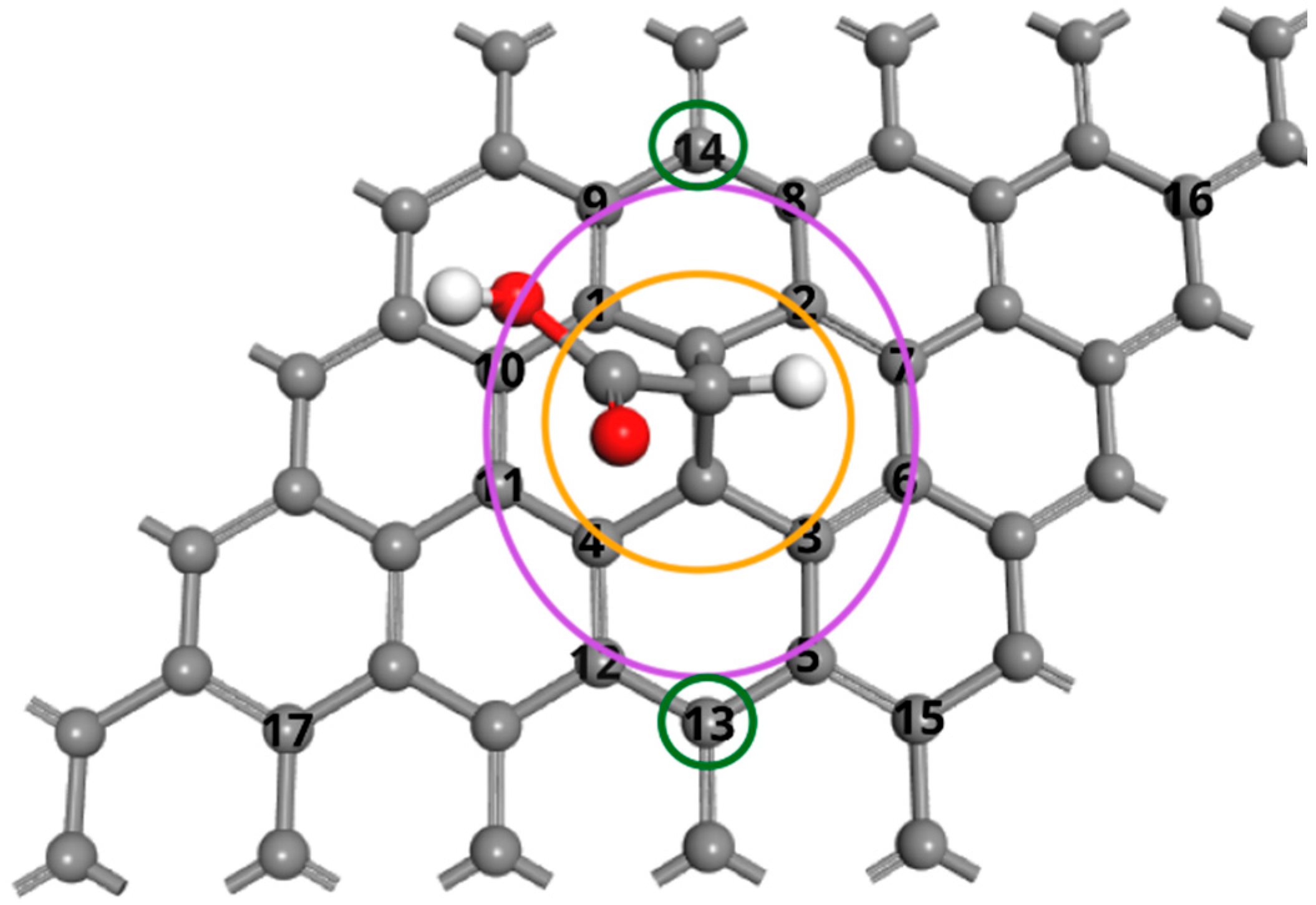
Building upon this structure, the adsorption of a single –OH group on various carbon sites of the graphene–carbene surface was systematically investigated. Figure 2 displays the seventeen possible adsorption sites of the –OH group, both above and below the graphene plane. For clarity, the positions were divided into three coordination zones based on their spatial relationship to the carbene center. The first coordination (C1–C4) is closest to the carbene, second coordination (C5–C12) is intermediate, and the third coordination (C13–C14) is farthest from the carbene (Figure 2). This partitioning reveals how local geometric strain and electronic perturbation produced by the carbene control adsorption energetics and geometry.
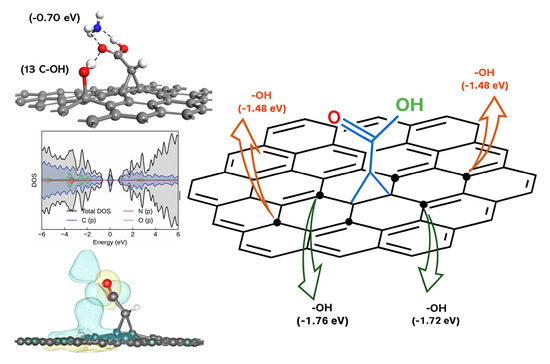
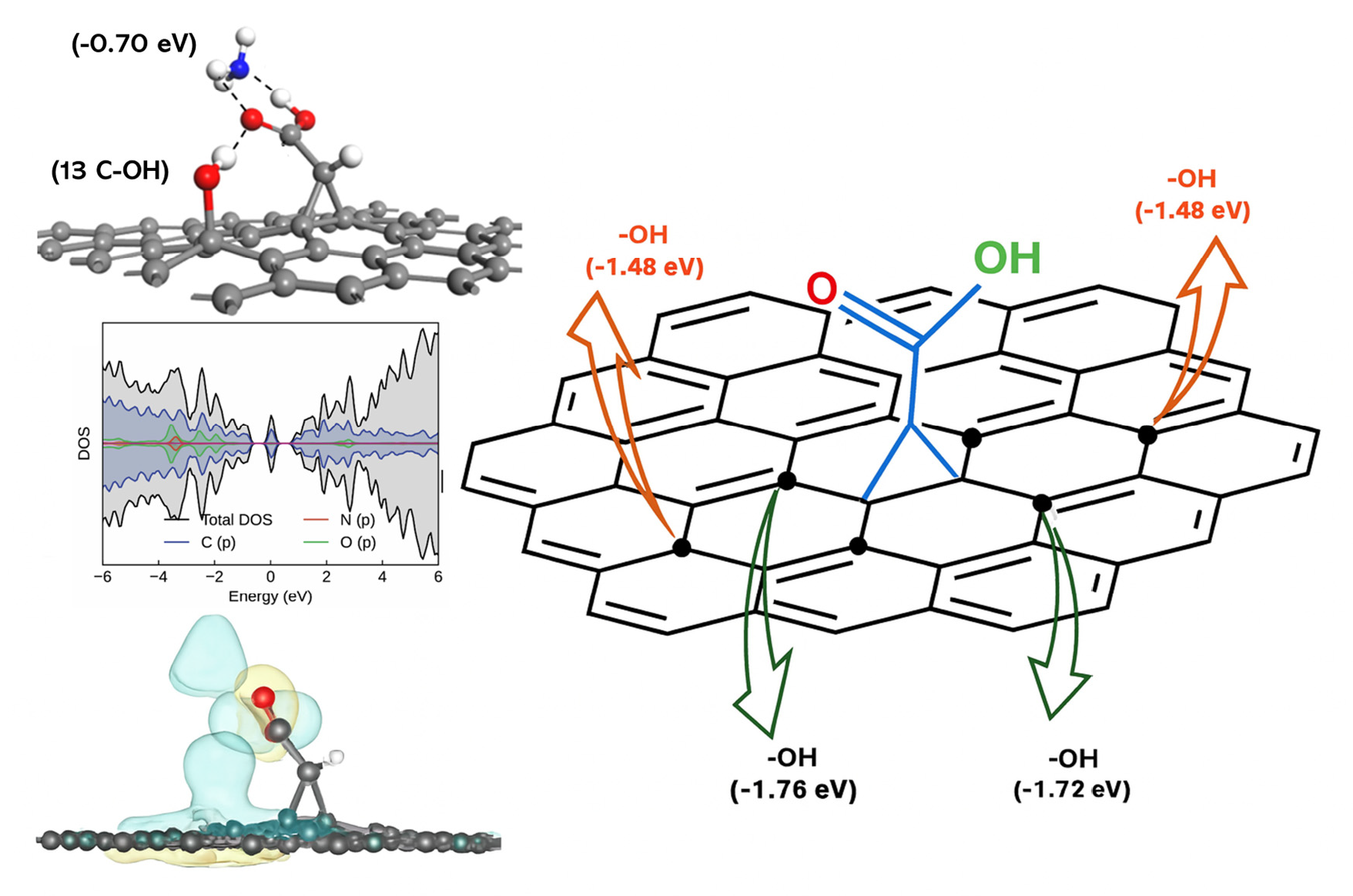
When the –OH group was placed above the graphene plane, the lowest (most negative) binding energies were found at the third coordination sites C13 and C14 (Eb ≈ −1.48 eV), showing that these distal sites are the most favored for single –OH binding (Table 1). The first coordination sites (C1–C4) are the next most favorable (Eb ≈ −1.24 to −1.31 eV), whereas most second coordination positions give substantially weaker binding (≈ −0.8 to −1.02 eV). The reduced lattice strain and fewer local constraints at the third coordination carbons make them energetically preferred, even though they are farther from the electronically perturbed carbene center and proximity to the carbene does not always increase stability; instead, a balance between electronic activation (favoring nearby sites) and local steric determines Eb.
Table 1 also shows binding energies for below-plane placements; several below-plane values are more negative than their above-plane counterparts (the Eb of –OH group below C3 is −1.76 eV, but above C3 is −1.31 eV). This systematic strengthening for some sites when the –OH is placed below indicates that the three-dimensional orientation of the –OH relative to the carbene moiety can favor stronger H-bonding or improved overlap with the graphene π -cloud when the group is beneath the sheet. In particular, below-plane geometries often place the hydroxyl hydrogen in a geometry that better complements the lone-pair/partial negative site on the carbene oxygen, yielding stronger intramolecular hydrogen bonding and thus more negative adsorption energies.
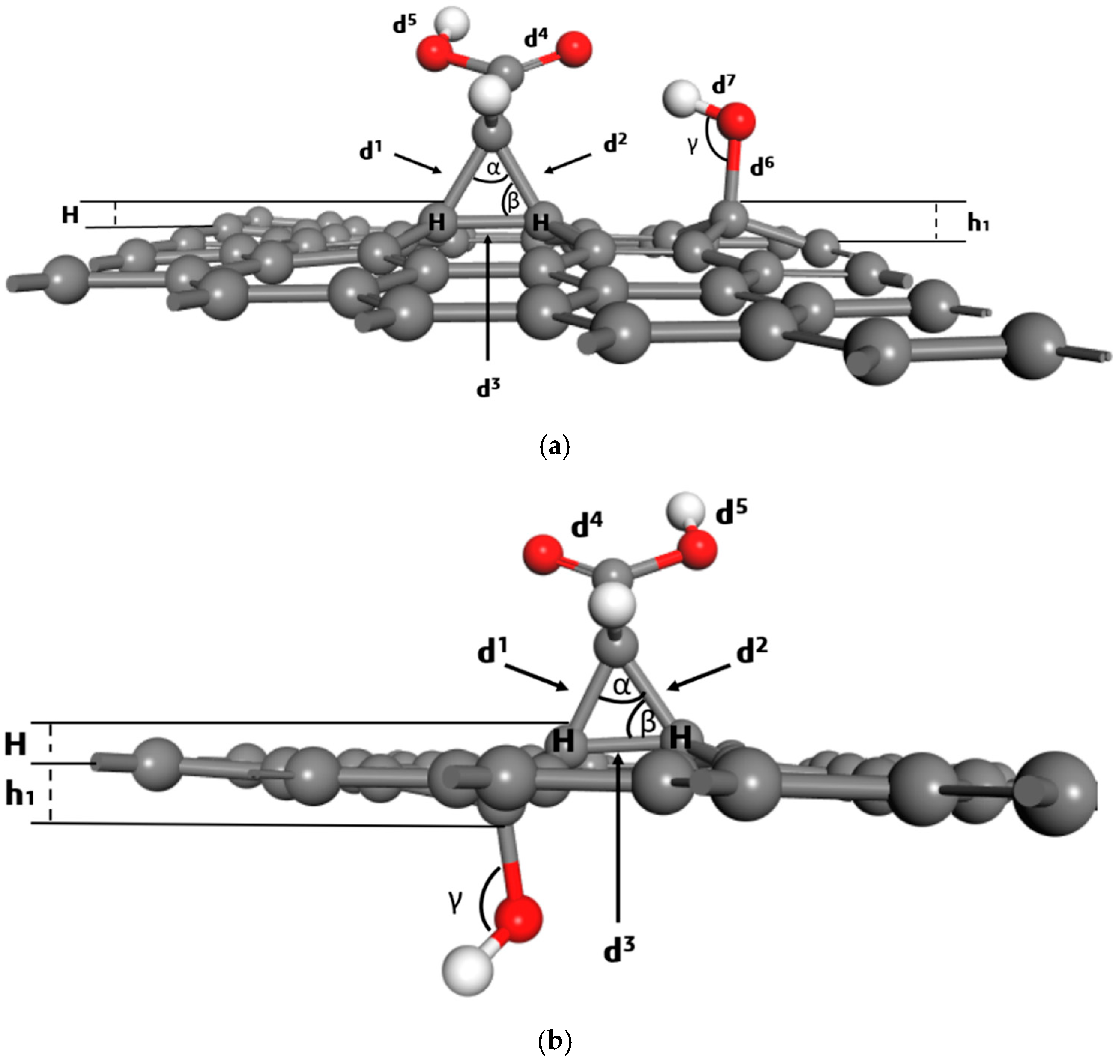
The most stable single-OH adsorptions above the plane occur at C13 and C14 (Eb = −1.48 eV); the most stable below-plane example is C3 below (Eb = −1.76 eV). Structural parameters extracted from the relaxed geometries (Table 2) reveal the microscopic origin of these stabilities. The covalent C–O distance for the adsorbed hydroxyl is ~1.48 Å (d6), as seen in Table 2, while the O–H bond is ~0.98 Å (d5) in all most stable configurations. The presence of a hydrogen-bond-like contact between the hydroxyl hydrogen and the carbene oxygen contributes significantly to stabilization for the third-coordination sites (C13 and C14). This intramolecular interaction is geometrically feasible at distal sites because the graphene sheet can relax locally without excessive strain. The C–O–H angle at the stable third-coordination sites is 108.6°, consistent with sp3-like geometry around the oxygen and with minimal angular strain. The angles α , β , and γ 1 reported in Table 2 change only mildly between C13 above and C14 above, indicating only small local distortions despite the formation of a new covalent bond. Also, Table 2 lists vertical offsets that quantify how far the functionalized carbon and substituent sit relative to the graphene plane. For above-plane binding, the local atom carrying the –OH is displaced outward by 0.56–0.66 Å, whereas for below-plane adsorption, the corresponding displacement can be negative (h1 ≈ −0.31 Å), reflecting the group’s orientation beneath the sheet. These values show that local puckering accommodates the adsorbate and is larger for above-plane bonding than for some below-plane geometries. This out-of-plane relief is an important component of the adsorption energy balance because it mediates strain in the sp2 lattice.
Top and side views of the representative stable geometries (Figures S2 and S3) for above- and below-plane confirm the numerical interpretations; at C13/C14 above the –OH adopts a nearly upright geometry, forming a favorable H-bond to the carbene oxygen (Figure S2e,f). At C3 below the –OH can approach the carbene oxygen from beneath, enabling even shorter H-bond contacts and a slightly more negative adsorption energy (Figure S3c). The geometric symbols labeled in Figure 3 help to visualize the measured distances and angles summarized in Table 2. These images corroborate that combination of optimal bond determines why certain distal sites outperform closer ones energetically. This site sensitivity implies that selective functionalization of graphene–carbene could be guided for designing sensors or catalyst supports where defined placement of polar groups controls the adsorption of probe molecules (NH3) or modifies local electronic properties. The local DOS perturbations introduced by the carbene and by the adsorbed –OH will also influence charge transfer with adsorbates and thus the surface’s chemical selectivity.
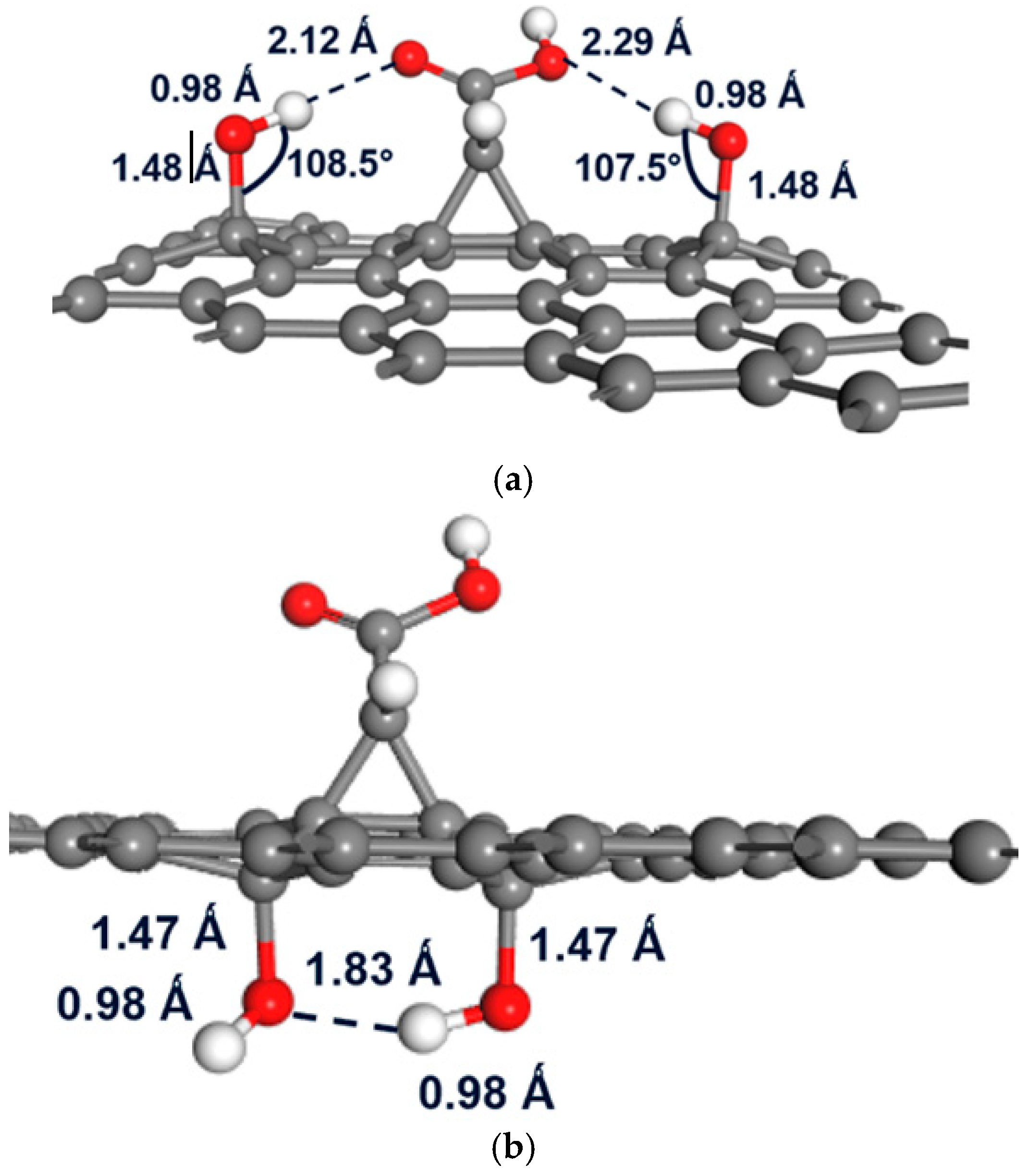
When a second hydroxyl is introduced on the graphene–carbene surface, the binding landscape changes markedly compared with the single –OH case. Tables S1–S3 show three different two –OH scenarios: first, both –OH placed above the sheet (C13 and C14), as presented in Table S1. The second case is one –OH fixed above (C13 or C14) and a second –OH explored below over all other sites, as shown in Table S2. The third case is one –OH fixed below (C3) with the second –OH scanned below over all sites, as seen in Table S3. Stronger binding energies are obtained for many two –OH combinations versus the single –OH results. For example, placing –OH at both C13 and C14 above yields Eb  −1.97 eV (Table S1), which is significantly more stabilizing than a single –OH at C13 or C14. When one –OH is fixed at an above site (C13 or C14) and the second –OH is placed at below sites, the Eb values often reach ~−2.09 to −2.14 eV for the most favorable combinations (Table S2), demonstrating cooperative stabilization between the two substituents. In the case where the first –OH is fixed below (C3), scanning the second –OH below (Table S3) gives an extreme stabilization at C2 (Eb  −2.50 eV), marking the strongest binding reported across these scans. The corresponding optimized geometries are depicted in Figure 4 and Figure S4.
Figure 4 highlights the dominant –OH group above-plane pairing at C13 and C14 (Figure S5 labels the geometric parameters that define this symmetric configuration), and emphasizes the exceptionally stable C2 with C3 below configuration, where the through-plane complementarity between the two –OH groups produces the strongest binding energy of −2.50 eV.
Figure S4 illustrates how fixing one –OH above the surface (C13 or C14) biases the electronic environment toward nearby carbons, such as C1–C4, enabling cooperative stabilization through electronic and hydrogen-bond interactions.
The markedly enhanced stability of two –OH functionalization on graphene–carbene arises from three cooperative effects, short O···H contacts ( 1.8–2.2 Å) and C–O–H angles (~108°) that produce inter-/intra-molecular hydrogen bond networks, charge redistribution that polarizes neighboring carbons and lowers the barrier for a second binding event, and strain sharing between adjacent sp3 centers that reduces the lattice distortion penalty, together explaining why paired motifs are far more stable than isolated OH (single –OH/carbene reference −1.67 eV). This mechanistic picture is reflected in the structure energy correlations; the symmetric above-plane C13/C14 pair (Table 3 and Table S1; Figure 4a and Figure S4) exhibits C–O distances of 1.52–1.53 Å, O–H 0.98 Å and nearly equal out-of-plane displacements (h1  h2  0.56 Å), accounting for the additional   0.5 eV stabilization (Eb  −1.97 eV); fixing one OH above (C13 or C14) and placing the second in nearby below-plane sites (Table S2 and Figure S4) yields directional cooperativity with Eb down to −2.09 to −2.21 eV as dipole alignment and local bending favor specific partners; and the extreme case of fixed C3 below with a second OH placed below C2, as seen in Table S3 and Figure 4b, achieves Eb  −2.50 eV via a through-plane O–H O “handshake” that simultaneously optimizes dipole coupling and minimizes strain (h1  < 0, h2  > 0). These computed magnitudes and motifs are consistent with prior DFT reported by Baachaoui et al. [28] for carbene cycloaddition energetics. Tran et al. [38] demonstrated that neighboring –OH groups on graphene stabilize each other via hydrogen-bonded networks with O⋯H distances of 1.8–2.1 Å, mirroring the short contacts calculated in this study. Similarly, Mouhat et al. [39] reported multi-hydroxyl arrangements in graphene oxide sheets that yield strong cooperative stabilization, comparable to the 0.5–1.0 eV gain per group seen for the C13 and C14 pair. Prasert et al. [40] and Boukhvalov [41] further highlighted that clustering of oxygen functionalities reduces local strain and minimizes puckering energy, mechanisms that explain the nearly equal out-of-plane displacements (h1  h2  0.56 Å) found in Table 3. The exceptionally strong binding of the C3 below and C2 below configuration (Table S3 and Figure 4b) is analogous to the cooperative adsorption patterns observed in DFT simulations of hydroxylated graphene oxide layers, where dipole alignment across the sheet lowers total energy. Overall, these comparisons confirm that the enhanced stabilities computed in Table 3 and Tables S1–S3 arise from the same synergistic effects, hydrogen bond networking, charge polarization, and strain redistribution that have been consistently identified in theoretical and experimental studies of oxygen-functionalized graphene systems, implying that the strategic placement of paired OH groups can be used to tune local DOS, enhance charge transfer, and optimize performance in applications such as gas sensing.

2.2. NH3 Gas Sensing on the OH-Modified Graphene–Carbene Surface

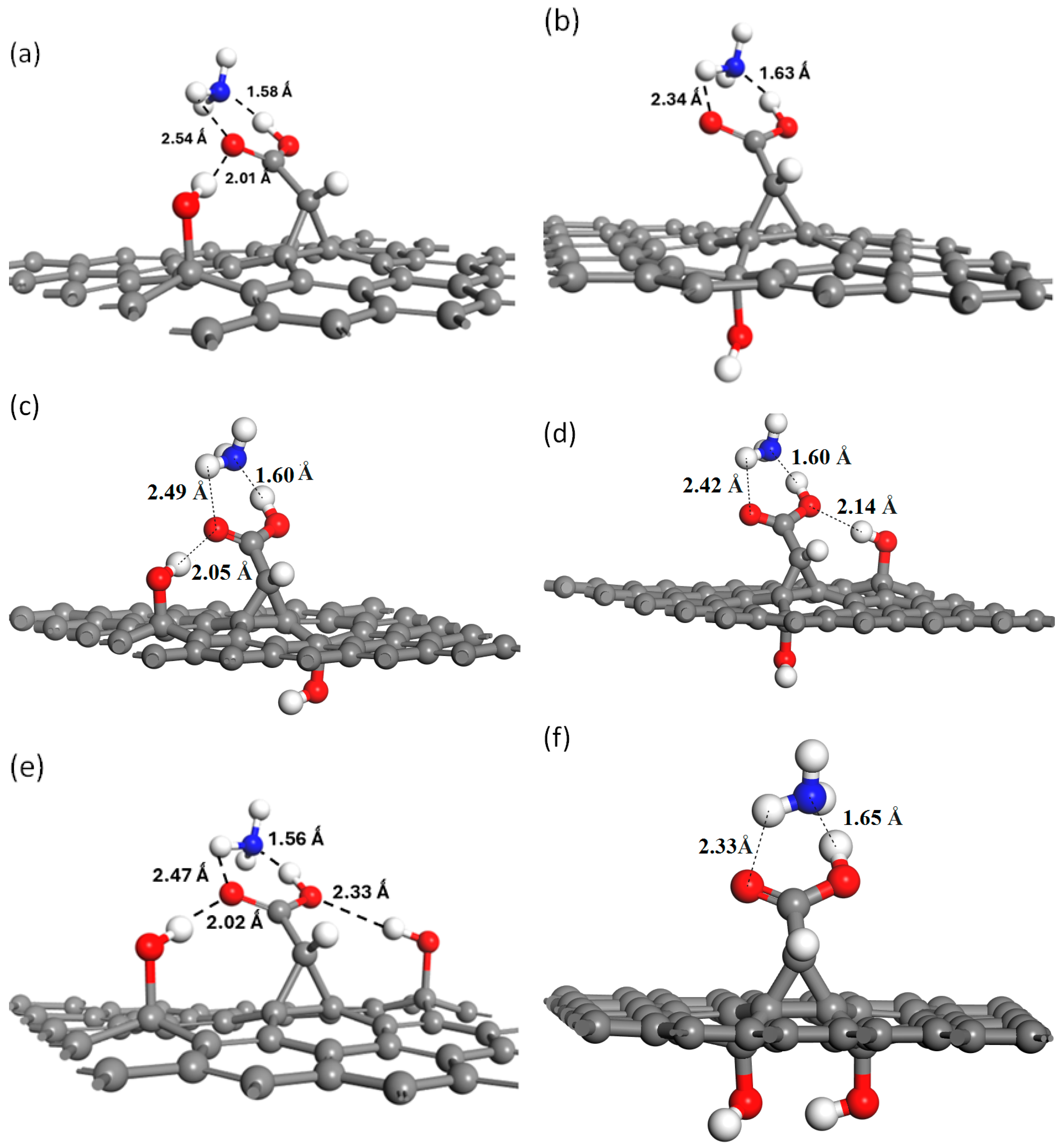
The adsorption and sensing behavior of NH3 on the –OH-functionalized graphene–carbene surface was systematically investigated, as presented in Table 4. A full structural optimization was performed as seen in Figure 5, for each configuration to identify the most energetically favorable arrangement of NH3 molecules on both single –OH- and two –OH-functionalized graphene–carbene surfaces. NH3 preferentially adsorbs on the carbene center of the OH-functionalized graphene–carbene surface because of the unique combination of electronic, structural, and chemical properties introduced by both the carbene moiety and the adjacent hydroxyl groups. The carbene site in graphene–carbene possesses a highly localized and partially empty p orbital, making it electron-deficient and chemically active. This orbital can interact directly with the lone pair of electrons on the nitrogen atom of NH3, forming a weak coordinate bond. Such an interaction is analogous to Lewis acid–base behavior, where the carbene carbon acts as a Lewis acid and the NH3 molecule serves as a Lewis base. This explains why the carbene site provides a natural anchoring point for NH3, resulting in stronger adsorption than on pristine graphene, which has delocalized π-electrons and lacks localized reactive centers. In this arrangement the nitrogen lone pair is oriented toward the hydroxyl group of the carbene-functionalized graphene moiety, producing a clear N H–O interaction, while simultaneously one of the N–H hydrogens of NH3 forms an H O contact with the oxygen atom of the same carboxyl group. At the same time, the oxygen atom of the same carboxyl group of the carbene-functionalized graphene moiety engages with the neighboring surface –OH group (from the functionalized graphene–carbene), forming an O–H O interaction that links the carbene moiety and the surface OH into a cooperative scaffold. These three contacts create a multidentate binding pocket that both locks NH3 in a favorable orientation and distributes the interaction energy across several directional bonds. Table 4 shows that NH3 adsorption on the OH-modified graphene–carbene surface is highly site-dependent. A single OH (above C13 or below C3) binds NH3 moderately (Eads  −0.70 to −0.64 eV), whereas certain two-OH arrangements produce dramatically stronger adsorption; the pair above C13 and below C2 and the pair above C14 and below C3 give Eads    −1.78 and −1.83 eV, respectively (Table 4). By contrast, the symmetric pair above C13 and C14 and the pair below C3 and C2 show weaker NH3 adsorption (Eads ≈ −0.75 and −0.62 eV). These trends indicate that NH3 interacts most strongly with two-OH geometries that provide a complementary, through-space interaction geometry. The distance data (Table 4) and the top/side views in Figure 5 show that NH3 is held by true hydrogen bonds rather than weak physisorption, the N H contacts lie very short ( 1.56–1.65 Å), while the H O contacts to carbonyl/hydroxyl oxygens fall in the ~ 2.0–2.5 Å range, all consistent with moderate–strong H-bonding.
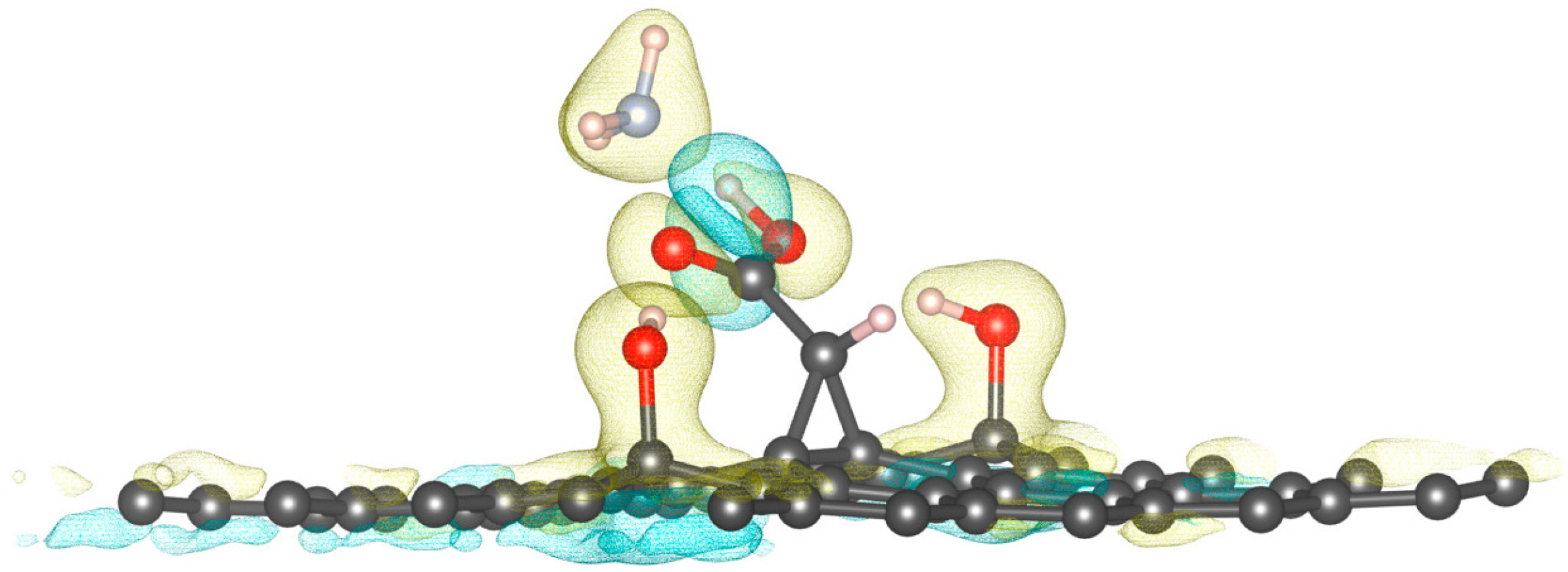
The charge density difference (CDD) analysis further supports these findings for the two–OH-functionalized graphene–carbene system, which exhibits an adsorption energy of approximately −0.75 eV and a relatively short desorption time, confirming a reversible physisorption-type interaction suitable for sensing applications. The CDD plot (Figure 6), where yellow areas represent electron accumulation and cyan areas represent electron depletion, reveals localized regions of electron accumulation around the nitrogen atom of NH3 and depletion near the oxygen atoms of the hydroxyl and carboxyl groups, indicating polarization-driven charge redistribution rather than covalent bonding. Correspondingly, the Bader charge values listed in Table 4 (Q −2.88 to −2.92 e) remain nearly constant across adsorption motifs, showing that no significant electron transfer occurs between NH3 and the substrate. This suggests that the adsorption mechanism is dominated by hydrogen bonding and electrostatic polarization, consistent with the moderate adsorption energy and fast desorption observed. In essence, NH3 binds through localized, multidentate hydrogen bonds (N H–O and H O=C) while maintaining electronic reversibility, an essential feature for a sensitive yet easily recoverable gas sensor.
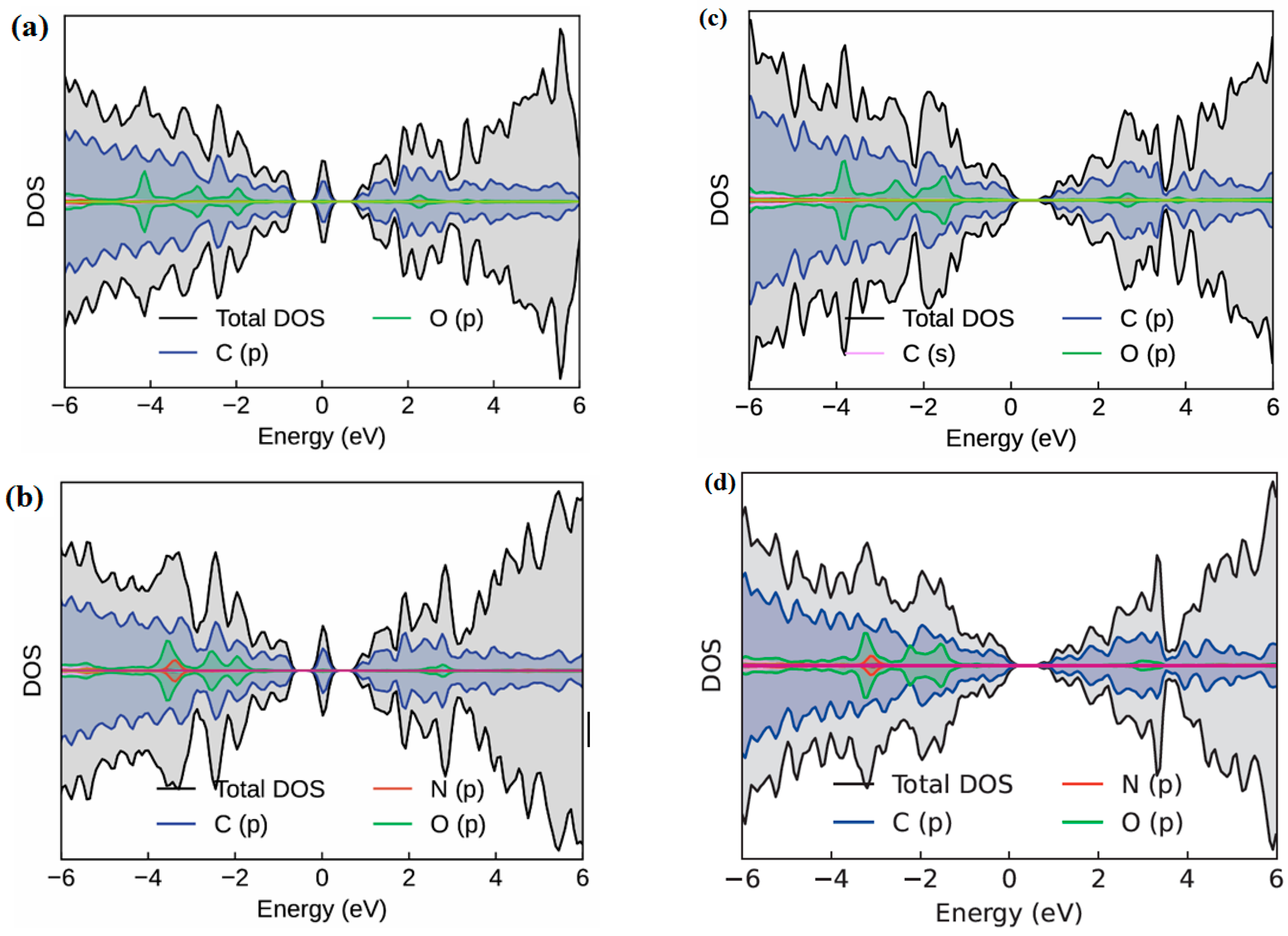
The DOS analysis of OH-modified graphene–carbene (Figure 7) shows how NH3 adsorption alters the local electronic structure in ways that directly connect to sensor response and to expected desorption behavior; for the single OH (above C13) case (Figure 7a,b) NH3 adsorption produces small but clear spectral changes, peaks associated with O-p and nearby C-p states shift slightly, and weak, localized molecular states from the NH3 lone pair appear just below the Fermi level. These changes are consistent with modest donor–acceptor coupling (NH3  surface), a small upward shift in electronic density near EF, and only minor broadening of the bands, which together explain the moderate adsorption energy ( −0.64 to −0.70 eV) and the relatively fast desorption/recovery expected at room temperature. In contrast, the two OH cases show a split behavior; the symmetric above-plane pair (C13 and C14) (Figure 7c,d) induces somewhat larger DOS perturbations than the single OH, and new features near EF become sharper and slightly more intense, yet remain moderate in magnitude (Eads −0.75 eV), implying enhanced sensitivity but still facile desorption. The through-plane, multidentate arrangements produce the largest DOS modifications and pronounced new peaks, and greater hybridization between NH3-derived states and O-p/C-p orbitals appear near the Fermi level, indicating stronger orbital overlap and larger polarization. Charge density difference maps (Figure 6) corroborate this picture by showing localized electron accumulation on the NH3 lone pair and complementary depletion on the donor oxygens, which explains the DOS signatures. Practically, single-OH and symmetric two-OH sites provide measurable but reversible electronic signals, whereas through-plane two-OH pockets give much larger DOS perturbations.

2.3. Desorption Time (τ)

The desorption time (τ) represents the duration required for NH3 molecules to detach from the surface and for the sensor material to return to its original state, a key indicator of reusability and sensor recovery speed. Desorption time was calculated using the Arrhenius-type relationship as follows [42]:
τ =   ν 1 e x p E a d s k B T
where Eads is the adsorption energy, ν is the attempt frequency ( 10 12   s ) , k B is the Boltzmann constant (8.62 ×   10 5   e V / K ), and T is the Temperature (300 K). Based on this expression, the computed desorption times for NH3 on different OH-functionalized graphene–carbene configurations are summarized in Table 4. The results demonstrate that single OH and some two-OH configurations (below-plane pairs) exhibit short desorption times, ensuring high reversibility and reusability as NH3 gas sensors. Conversely, configurations with through-plane OH pairs (above C13, below C2 and above C14, below C3) exhibit excessively long desorption times ( 1018 s), indicating nearly irreversible adsorption at room temperature. According to Xiong et al. [42], τ decreases exponentially with temperature, so increasing the operating temperature would dramatically reduce τ to practical levels. Therefore, moderate binding motifs such as single OH and the two-OH configurations (above C13, above C14) pairs provide the best compromise between sensitivity and reusability for NH3 gas sensing on graphene–carbene surfaces.

2.4. Comparison with Previous Studies

Several DFT studies, as seen in Table 5, show that pristine graphene binds NH3 only very weakly (Eads ≈ 14.7–30.8 meV), explaining its low intrinsic response. The interaction of NH3 with pyridinic nitrogen-doped graphene reported that the introduction of pyridine-type N defects enhances the chemical reactivity of the graphene surface. Density functional calculations show that NH3 adsorption becomes energetically favorable at these defect sites, with adsorption energies falling in the weak to moderate range, stronger than pristine graphene but still well below the chemisorption range. Functionalizations that introduce O-containing groups (hydroxyl, epoxide, COOH) or covalent anchoring sites (carbenes, carboxylated edges) markedly increase adsorption through hydrogen bonding and local electronic perturbation; reported behavior ranges from moderate (Eads ≈ 0.2–1.0 eV) to strong (Eads ≥ 1.0 eV). The present work provides the following results: Eads ≈ −0.64 to −1.83 eV (see Table 4). The single-OH motif remains in the moderate adsorption regime and thus maintains practical regeneration at near-room temperature, while the multidentate pocket shows strong adsorption and amplified sensing signals but requires elevated temperatures for desorption. This behavior is fully consistent with earlier DFT reports on covalently modified graphene, nitrogen-doped graphene, and carbene- or oxygen-functionalized graphene, all of which show that increased chemical anchoring leads to enhanced sensitivity at the cost of slower kinetics.

3. Materials and Methods

Electronic structure calculations for the –OH-functionalized carbene–graphene surface were performed using the Vienna Ab-initio Simulation Package (VASP, version vasp.5.4.4.pl2). The interaction between core and valence electrons was described by the projector-augmented wave (PAW) method [46], and spin-polarized density functional theory (DFT) calculations were carried out employing the revised Perdew–Burke–Ernzerhof (PBE) exchange–correlation functional within the generalized gradient approximation (GGA) framework [47]. The vdW interaction was performed using Grimme dispersion correction [48]. A plane-wave cutoff energy of 450 eV was used to accurately represent the valence electrons of the constituent atoms. A vacuum spacing of 20 Å was introduced along the z-direction to eliminate spurious interactions between periodic images. Structural optimization was performed until the forces on all atoms were less than 0.01 eV/Å, ensuring full relaxation of the geometry. The charge redistribution upon –OH functionalization and NH3 adsorption was quantified using Bader charge analysis, as implemented by the Henkelman Group [49]. The total and partial density of states (DOS) were generated using the Sumo package, while structural models and charge density difference plots were visualized through the VESTA software (ver. 3.90.5a) [50]. To investigate gas sensing behavior, NH3 adsorption was simulated at various high-symmetry sites of the –OH-functionalized carbene–graphene surface using the VESTA software [50]. A Monkhorst–Pack grid of 5  ×  5  ×  1 k-points was applied for structural optimization, and a denser 7  ×  7  ×  1 grid was employed for the electronic structure calculations. The binding energy (Eb) of OH groups on the carbene–graphene surface, the adsorption energy (Eads) of NH3 molecules on the –OH-functionalized system, and charge density differences (CDD) were calculated using the following equations [51]:
E b = E s u r f + O H E s u r f E O H
E a d s = E s u r f + O H + N H 3 E s u r f + O H E N H 3
ρ r = ρ s u r f + O H + N H 3 r ρ s u r f + O H r ρ N H 3 r
where E s u r f , E s u r f + O H , E O H , E s u r f + O H + N H 3 , and E N H 3 are the total energy of the relaxed clean carbene–graphene surface, the total energy of the relaxed carbene–graphene surface with the adsorbed –OH group, the total energy of an isolated OH fragment, the total energy of the fully relaxed system with NH3 adsorbed on the –OH-functionalized surface, and the total energy of an isolated NH3 molecule, respectively. ρ r   is the electron density of the corresponding relaxed system positioned in the same supercell and alignment.

4. Conclusions

Carbene functionalization of graphene generates highly reactive anchoring sites that profoundly alter both its geometry and electronic characteristics. Subsequent hydroxyl (–OH) adsorption on the carbene-modified surface displays strong site and spatial dependence. Below-plane –OH configurations on carbene–graphene are generally more stable than above-plane ones because they allow better hydrogen bonding and less lattice strain. When two –OH groups are added, they interact cooperatively through hydrogen bonds, further stabilizing the surface. The symmetric above pair (C13 and C14) increases stability by about 0.5 eV, while through-plane or below pairs can reach stronger binding of around −2.50 eV. NH3 adsorption on the –OH-functionalized surface is configuration-dependent, forming hydrogen-bond networks with nearby COOH groups. The adsorption energy varies from moderate (−0.64 to −0.75 eV) to strong (−1.78 to −1.83 eV), depending on site geometry. Charge analysis shows that hydrogen bonding and polarization dominate, with minimal charge transfer, confirming reversible physisorption. Desorption time calculations reveal that weak to moderate sites enable quick recovery, while strong through-plane sites bind almost permanently. Hence, configurations with computed longer desorption times will require explicit regeneration, such as multidentate carbene–OH pockets, which need hundreds of °C to thermally desorb NH3; therefore, practical implementations must include microheater or photo-assisted regeneration, or else use the weaker single–OH motif for continuous room temperature sensing to balance sensitivity and reversibility.

Supplementary Materials

The following supporting information can be downloaded at https://www.mdpi.com/article/10.3390/molecules30244726/s1. Figure S1. The optimized geometry and density of states of (a) pristine graphene and (b) carbene graphene surface. Figure S2. Top and side views for the most stable structures –OH group on above carbene graphene surface. Figure S3. Top and side views for the most stable structures –OH group on down carbene graphene surface. Figure S4. The highest binding energy positions for two OH group modified carbene graphene surface. Figure S5. Symbols of the geometric parameters after modification carbene graphene by two OH group in positions 13 and 14 above the surface. Table S1. Binding energy (Eb) for the 17 positions of two –OH group with (a) position 13 (b) position 14 modified carbene graphene surface. Table S2. Binding energy (Eb) for the 17 positions of two OH group above and below carbene graphene surface with (a) fixed position 13 above (b) fixed position 14 above. Table S3. Binding energy (Eb) for the 17 positions of two OH group modified carbene graphene surface with fixed position 3 below the surface.

Author Contributions

Conceptualization, A.J. and A.D.; Software, A.A.H. and T.H.; Validation, A.J.; Formal analysis, K.A.S. and A.D.; Resources, T.H.; Data curation, A.D.; Writing—original draft, A.J.; Writing—review and editing, K.A.S. and A.J.; Visualization, A.A.H. and K.A.S.; Supervision, A.J. and A.D.; Funding acquisition, A.A.H. All authors have read and agreed to the published version of the manuscript.

Funding

This research received no external funding.

Institutional Review Board Statement

Not applicable.

Informed Consent Statement

Not applicable.

Data Availability Statement

The original contributions presented in this study are included in the article/Supplementary Material. Further inquiries can be directed to the corresponding authors.

Acknowledgments

A.A.H. is grateful to the deanship of scientific research (DSR) at Imam Abdulrahman Bin Faisal University for the support. The computation for the work presented in this paper was supported by the Aziz Supercomputer operated by the High-Performance Computing Center (HPCC) at King Abdulaziz University in collaboration with Bassem Jamoussi (http://hpc.kau.edu.sa, accessed on 15 November 2025).

Conflicts of Interest

The authors declare no conflicts of interest.

References

  1. Threatt, S.D.; Rees, D.C. Biological nitrogen fixation in theory, practice, and reality: A perspective on the molybdenum nitrogenase system. FEBS Lett. 2023, 597, 45–58. [Google Scholar] [CrossRef] [PubMed]
  2. Dopazo, J.A.; Fernández-Seara, J.; Sieres, J.; Uhía, F.J. Theoretical analysis of a CO2–NH3 cascade refrigeration system for cooling applications at low temperatures. Appl. Therm. Eng. 2009, 29, 1577–1583. [Google Scholar] [CrossRef]
  3. Tang, W.; Wang, J. Enhanced gas sensing mechanisms of metal oxide heterojunction gas sensors. Acta Phys.-Chim. Sin. 2016, 32, 1087–1104. [Google Scholar] [CrossRef]
  4. Pashami, S.; Lilienthal, A.J.; Trincavelli, M. Detecting changes of a distant gas source with an array of MOX gas sensors. Sensors 2012, 12, 16404–16419. [Google Scholar] [CrossRef]
  5. Liu, Y.; Yang, Z.; Huang, L.; Zeng, W.; Zhou, Q. Anti-interference detection of mixed NOX via In2O3-based sensor array combining with neural network model at room temperature. J. Hazard. Mater. 2024, 463, 132857. [Google Scholar] [CrossRef]
  6. Li, G.; Zhang, H.; Meng, L.; Sun, Z.; Chen, Z.; Huang, X.; Qin, Y. Adjustment of oxygen vacancy states in ZnO and its application in ppb-level NO2 gas sensor. Sci. Bull. 2020, 65, 1650–1658. [Google Scholar] [CrossRef]
  7. Wang, Z.; Bu, M.; Hu, N.; Zhao, L. An overview on room-temperature chemiresistor gas sensors based on 2D materials: Research status and challenge. Compos. Part B Eng. 2023, 248, 110378. [Google Scholar] [CrossRef]
  8. Jung, G.; Jeong, Y.; Hong, Y.; Wu, M.; Hong, S.; Shin, W.; Park, J.; Jang, D.; Lee, J.-H. SO2 gas sensing characteristics of FET-and resistor-type gas sensors having WO3 as sensing material. Solid-State Electron. 2020, 165, 107747. [Google Scholar] [CrossRef]
  9. Rumyantsev, S.; Liu, G.; Shur, M.S.; Potyrailo, R.A.; Balandin, A.A. Selective gas sensing with a single pristine graphene transistor. Nano Lett. 2012, 12, 2294–2298. [Google Scholar] [CrossRef]
  10. Hu, Y.-J.; Jin, J.; Zhang, H.; Wu, P.; Cai, C.-X. Graphene: Synthesis, functionalization and applications in chemistry. Acta Phys.-Chim. Sin. 2010, 26, 2073–2086. [Google Scholar]
  11. Wu, H.; Zhong, S.; Bin, Y.; Jiang, X.; Cui, H. Ni-decorated WS2-WSe2 heterostructure as a novel sensing candidate upon C2H2 and C2H4 in oil-filled transformers: A first-principles investigation. Mol. Phys. 2025, e2492391. [Google Scholar] [CrossRef]
  12. Huang, Z.; Zhou, A.; Wu, J.; Chen, Y.; Lan, X.; Bai, H.; Li, L. Bottom-up preparation of ultrathin 2D aluminum oxide Nanosheets by duplicating graphene oxide. Adv. Mater. 2016, 28, 1703–1708. [Google Scholar] [CrossRef]
  13. Chen, C.; Li, N.-W.; Wang, B.; Yuan, S.; Yu, L. Advanced pillared designs for two-dimensional materials in electrochemical energy storage. Nanoscale Adv. 2020, 2, 5496–5503. [Google Scholar] [CrossRef]
  14. Tang, Y.; Wu, D.; Mai, Y.; Pan, H.; Cao, J.; Yang, C.; Zhang, F.; Feng, X. A two-dimensional hybrid with molybdenum disulfide nanocrystals strongly coupled on nitrogen-enriched graphene via mild temperature pyrolysis for high performance lithium storage. Nanoscale 2014, 6, 14679–14685. [Google Scholar] [CrossRef]
  15. Tang, X.; Guo, X.; Wu, W.; Wang, G. 2D metal carbides and nitrides (MXenes) as high-performance electrode materials for Lithium-based batteries. Adv. Energy Mater. 2018, 8, 1801897. [Google Scholar] [CrossRef]
  16. Wu, F.; Tian, H.; Shen, Y.; Zhu, Z.Q.; Liu, Y.; Hirtz, T.; Wu, R.; Gou, G.; Qiao, Y.; Yang, Y. High thermal conductivity 2D materials: From theory and engineering to applications. Adv. Mater. Interfaces 2022, 9, 2200409. [Google Scholar] [CrossRef]
  17. Mu, M.; Wan, C.; McNally, T. Thermal conductivity of 2D nano-structured graphitic materials and their composites with epoxy resins. 2D Mater. 2017, 4, 042001. [Google Scholar] [CrossRef]
  18. Novoselov, K.S.; Geim, A.K.; Morozov, S.V.; Jiang, D.-e.; Zhang, Y.; Dubonos, S.V.; Grigorieva, I.V.; Firsov, A.A. Electric field effect in atomically thin carbon films. Science 2004, 306, 666–669. [Google Scholar] [CrossRef] [PubMed]
  19. Zhang, C.; Yu, L.; Li, S.; Cao, L.; He, X.; Zhang, Y.; Shi, C.; Liu, K.; Du, H.; Fan, X. High conductivity of 2D hydrogen substituted graphyne nanosheets for fast recovery NH3 gas sensors at room temperature. Carbon 2024, 225, 119090. [Google Scholar] [CrossRef]
  20. Banu, A.A.; Sinthika, S.; Premkumar, S.; Vigneshwaran, J.; Karazhanov, S.Z.; Jose, S.P. DFT study of NH3 adsorption on 2D monolayer MXenes (M2C, M = Cr, Fe) via oxygen functionalization: Suitable materials for gas sensors. FlatChem 2022, 31, 100329. [Google Scholar] [CrossRef]
  21. Al-Hasnaawei, S.; Altalbawy, F.M.A.; Kanjariya, P.; Kumar, A.; S, K.K.; Shit, D.; Ray, S.; Kamolova, N.; Sinha, A. Adsorption properties of N containing N2O, NH3, NO and NO2 gas molecules on the novel TiO2 doped MoSe2 heterostructure system: A systematic DFT study. Comput. Mater. Sci. 2025, 258, 114039. [Google Scholar] [CrossRef]
  22. Zhang, J.; Li, T.; Zhang, H.; Huang, Z.; Zeng, W.; Zhou, Q. Ni decorated ReS2 monolayer as gas sensor or adsorbent for agricultural greenhouse gases NH3, NO2 and Cl2: A DFT study. Mater. Today Chem. 2024, 38, 102114. [Google Scholar] [CrossRef]
  23. Saadh, M.J.; Basem, A.; Hanoon, Z.A.; Al-Bahrani, M.; Mgm, J.; Jie, J.C.; Muzammil, K.; Hasan, M.A.; Islam, S.; Zainul, R. Adsorption of NH3, HCHO, SO2, and Cl2 gasses on the o-B2N2 monolayer for its potential application as a sensor. Diam. Relat. Mater. 2024, 147, 111356. [Google Scholar] [CrossRef]
  24. Badran, H.M.; Aal, S.A.; Ammar, H.Y. Detection of XH3 gas (X=N, P, and As) on Cu- functionalized C2N nanosheet: DFT perspective. Surf. Interfaces 2025, 58, 105858. [Google Scholar] [CrossRef]
  25. Hu, Q.; Liu, W.; Li, D.; Wu, Q.; Chang, Y.; Wang, J.; Xia, Q.; Wang, L.; Zhou, A. Hf3C2O2 MXene: A promising NH3 gas sensor with high selectivity/sensitivity and fast recover time at room temperature. Mater. Today Commun. 2024, 40, 109467. [Google Scholar] [CrossRef]
  26. Iwakami, S.; Yakushiji, S.; Ohba, T. Graphene Functionalization by O2, H2, and Ar Plasma Treatments for Improved NH3 Gas Sensing. ACS Appl. Mater. Interfaces 2025, 17, 1992–1999. [Google Scholar] [CrossRef]
  27. Aldulaijan, S.; Ajeebi, A.M.; Jedidi, A.; Messaoudi, S.; Raouafi, N.; Dhouib, A. Surface modification of graphene with functionalized carbenes and their applications in the sensing of toxic gases: A DFT study. RSC Adv. 2023, 13, 19607–19616. [Google Scholar] [CrossRef]
  28. Baachaoui, S.; Aldulaijan, S.; Sementa, L.; Fortunelli, A.; Dhouib, A.; Raouafi, N. Density Functional Theory Investigation of Graphene Functionalization with Activated Carbenes and Its Application in the Sensing of Heavy Metallic Cations. J. Phys. Chem. C 2021, 125, 26418–26428. [Google Scholar] [CrossRef]
  29. Baachaoui, S.; Sementa, L.; Hajlaoui, R.; Aldulaijan, S.; Fortunelli, A.; Dhouib, A.; Raouafi, N. Tailoring Graphene Functionalization with Organic Residues for Selective Sensing of Nitrogenated Compounds: Structure and Transport Properties via QM Simulations. J. Phys. Chem. C 2023, 127, 15474–15485. [Google Scholar] [CrossRef]
  30. Zhu, S.; Sun, H.; Liu, X.; Zhuang, J.; Zhao, L. Room-temperature NH3 sensing of graphene oxide film and its enhanced response on the laser-textured silicon. Sci. Rep. 2017, 7, 14773. [Google Scholar] [CrossRef]
  31. Li, Q.; Xu, M.; Jiang, C.; Song, S.; Li, T.; Sun, M.; Chen, W.; Peng, H. Highly sensitive graphene-based ammonia sensor enhanced by electrophoretic deposition of MXene. Carbon 2023, 202, 561–570. [Google Scholar] [CrossRef]
  32. Kodu, M.; Pärna, R.; Avarmaa, T.; Renge, I.; Kozlova, J.; Kahro, T.; Jaaniso, R. Gas-Sensing Properties of Graphene Functionalized with Ternary Cu-Mn Oxides for E-Nose Applications. Chemosensors 2023, 11, 460. [Google Scholar] [CrossRef]
  33. Barkov, P.V.; Glukhova, O.E. Carboxylated Graphene Nanoribbons for Highly-Selective Ammonia Gas Sensors: Ab Initio Study. Chemosensors 2021, 9, 84. [Google Scholar] [CrossRef]
  34. Tang, X.; Debliquy, M.; Lahem, D.; Yan, Y.; Raskin, J.-P. A Review on Functionalized Graphene Sensors for Detection of Ammonia. Sensors 2021, 21, 1443. [Google Scholar] [CrossRef]
  35. Song, M.G.; Choi, J.; Jeong, H.E.; Song, K.; Jeon, S.; Cha, J.; Baeck, S.-H.; Shim, S.E.; Qian, Y. A comprehensive study of various amine-functionalized graphene oxides for room temperature formaldehyde gas detection: Experimental and theoretical approaches. Appl. Surf. Sci. 2020, 529, 147189. [Google Scholar] [CrossRef]
  36. Chen, S.; Cai, W.; Chen, D.; Ren, Y.; Li, X.; Zhu, Y.; Kang, J.; Ruoff, R.S. Adsorption/desorption and electrically controlled flipping of ammonia molecules on graphene. New J. Phys. 2010, 12, 125011. [Google Scholar] [CrossRef]
  37. Cadore, A.R.; Mania, E.; Alencar, A.B.; Rezende, N.P.; de Oliveira, S.; Watanabe, K.; Taniguchi, T.; Chacham, H.; Campos, L.C.; Lacerda, R.G. Enhancing the response of NH3 graphene-sensors by using devices with different graphene-substrate distances. Sens. Actuators B Chem. 2018, 266, 438–446. [Google Scholar] [CrossRef]
  38. Tran, T.T.; Vu, T.C.; Hoang, H.V.; Huang, W.-F.; Pham, H.T.; Nguyen, H.M.T. How are Hydroxyl Groups Localized on a Graphene Sheet? ACS Omega 2022, 7, 37221–37228. [Google Scholar] [CrossRef]
  39. Mouhat, F.; Coudert, F.-X.; Bocquet, M.-L. Structure and chemistry of graphene oxide in liquid water from first principles. Nat. Commun. 2020, 11, 1566. [Google Scholar] [CrossRef]
  40. Prasert, K.; Sutthibutpong, T. Unveiling the Fundamental Mechanisms of Graphene Oxide Selectivity on the Ascorbic Acid, Dopamine, and Uric Acid by Density Functional Theory Calculations and Charge Population Analysis. Sensors 2021, 21, 2773. [Google Scholar] [CrossRef]
  41. Boukhvalov, D.W. DFT modeling of the covalent functionalization of graphene: From ideal to realistic models. RSC Adv. 2013, 3, 7150–7159. [Google Scholar] [CrossRef]
  42. Xiong, H.; Liu, B.; Zhang, H.; Qin, J. Theoretical insight into two-dimensional M-Pc monolayer as an excellent material for formaldehyde and phosgene sensing. Appl. Surf. Sci. 2021, 543, 148805. [Google Scholar] [CrossRef]
  43. Leenaerts, O.; Partoens, B.; Peeters, F.M. Adsorption of H2O, NH3, CO, NO2, and NO on graphene: A first-principles study. Phys. Rev. B 2008, 77, 125416. [Google Scholar] [CrossRef]
  44. Peng, Y.; Li, J. Ammonia adsorption on graphene and graphene oxide: A first-principles study. Front. Environ. Sci. Eng. 2013, 7, 403–411. [Google Scholar] [CrossRef]
  45. Fujimoto, Y.; Saito, S. Adsorption of molecules on nitrogen-doped graphene: A first-principles study. In Proceedings of the International Symposium “Nanoscience and Quantum Physics 2012” (nanoPHYS’12), Tokyo, Japan, 17–19 December 2012; p. 012002. [Google Scholar]
  46. Blöchl, P.E. Projector augmented-wave method. Phys. Rev. B Condens. Matter. 1994, 50, 17953–17979. [Google Scholar] [CrossRef] [PubMed]
  47. Perdew, J.P.; Burke, K.; Ernzerhof, M. Generalized gradient approximation made simple. Phys. Rev. Lett. 1996, 77, 3865–3868. [Google Scholar] [CrossRef]
  48. Grimme, S. Semiempirical GGA-type density functional constructed with a longrange dispersion correction. J. Comput. Chem. 2006, 27, 1787–1799. [Google Scholar] [CrossRef] [PubMed]
  49. Henkelman, G.; Arkel, A.D.; Becke, A.D. A Two-Dimensional Grid-Based Algorithm for the Voronoi Dissection of the Charge Density. Phys. Rev. B 2001, 63, 064103. [Google Scholar]
  50. Momma, K.; Izumi, F. VESTA 3 for three-dimensional visualization of crystal, volumetric and morphology data. Appl. Crystallogr. 2011, 44, 1272–1276. [Google Scholar] [CrossRef]
  51. Zhang, Y.-H.; Zhou, K.-G.; Xie, K.-F.; Zeng, J.; Zhang, H.-L.; Peng, Y. Tuning the electronic structure and transport properties of graphene by noncovalentfunctionalization: Effects of organic donor, acceptor and metal atoms. Nanotechnology 2010, 21, 065201. [Google Scholar] [CrossRef]
Figure 1. The optimized geometry and density of states of carbene–graphene surface. The red, white, and gray balls indicate oxygen, hydrogen, and carbon atoms, respectively.
Molecules 30 04726 g001
Figure 2. The adsorption positions (1–17) of the –OH group for the carbene–graphene surface. Orange circle for position first neighbor to carbene, purple circle is second neighbor, and green is third neighbor.
Molecules 30 04726 g002
Figure 3. Symbols of the geometric parameters after OH group adsorption in (a) position 14 above and (b) position 3 below the carbene–graphene surface.
Molecules 30 04726 g003
Figure 4. Highest binding energy for a two –OH group (a) on top (position C13–C14) and (b) below (position C2–C3) the carbene–graphene surface.
Molecules 30 04726 g004
Figure 5. NH3 adsorption on the most stable sites for –OH groups on the modified carbene–graphene surface with 1OH (a) above C13, (b) below C3, and 2OH (c) above C13 and below C2, (d) above C14 and below C3, (e) above both C13 and C14, (f) below both C3 and C2.
Molecules 30 04726 g005
Figure 6. Charge density difference of NH3 on two –OH groups, above C13 and C14, on modified carbene–graphene surface. The yellow regions represent electron accumulation, whereas the blue regions indicate electron depletion.
Molecules 30 04726 g006
Figure 7. DOS of –OH groups modified graphene–carbene surface before and after NH3 adsorption: (a) –OH group above C13 before NH3 adsorption, (b) –OH group above C13 after NH3 adsorption, (c) –OH group above C13 and C14 before NH3 adsorption, (d) –OH group above C13 and C14 after NH3 adsorption.
Molecules 30 04726 g007
Table 1. Binding energies (Eb) of the 17 positions for OH groups above and below the carbene–graphene surface.
Above OH GroupBelow OH Group
Eb (eV)Eb (eV)
1−1.24−1.72
2−1.31−1.72
3−1.31−1.76
4−1.24−1.72
5−0.88−0.93
6−1.00−0.86
7−1.00−0.88
8−0.83−0.93
9−0.89−0.93
10−0.81−0.91
11−0.81−0.90
12−1.01−0.93
13−1.48−1.25
14−1.48−1.26
15−0.80−0.95
16−1.02−0.96
17−0.90−0.94
Table 2. The geometric parameters after modification on the carbene–graphene surface by –OH groups in the most stable case.
Geometric Parameters–OH Above C13–OH Above C14–OH Below C3
Eb (eV)−1.48−1.48−1.76
d1 (Å)1.521.541.5
d2 (Å)1.541.521.55
d3 (Å)1.541.541.53
d4 (Å)1.231.221.22
d5 (Å)0.980.980.98
d6 (Å)1.481.481.48
d7 (Å)0.990.990.98
α (°)60.260.360.2
β (°)59.560.358.3
γ1 (°)108.6108.4106.6
h1 (Å)0.650.66−0.31
H (Å)0.600.560.50
0.570.600.52
Table 3. The geometric parameters after modification of the carbene–graphene surface by a two –OH group in positions 13 and 14 above the surface.
Geometric ParametersValue
Eb (eV)−1.97
d1 (Å)1.53
d2 (Å)1.53
d3 (Å)1.52
d4 (Å)1.22
d5 (Å)0.98
d6 (Å)1.48
d7 (Å)0.98
d8 (Å)1.49
d9 (Å)0.98
α (°)58.8
β (°)58.9
γ1 (°)108.2
γ2 (°)107.8
h1 (Å)0.56
h2 (Å)0.56
H (Å)0.50
0.52
Table 4. The adsorption energies (Eads), bond distances (d), and Bader charges of NH3 (Q) adsorbed on modified graphene–carbene surface: (a) –OH group above C13; (b) –OH group below C3; (c) two –OH groups above C13, below C2; (d) two OH groups above C14, below C3; (e) two OH groups above C13, above C14; and (f) two OH groups below C3, below C2.
SystemPositionEads (eV)d (Å)Q τ (s)
1OHAbove C13−0.701.58 (N-H), 2.54 (H-O)−2.895.7 ×   10 1
1OHBelow C3−0.641.63 (N-H), 2.34 (H-O)−2.916.5 ×   10 2
2OHAbove C13, below C2−1.781.60 (N-H), 2.49 (H-O)−2.897.82 ×   10 17
2OHAbove C14, below C3−1.831.60 (N-H), 2.42 (H-O)−2.905.41 ×   10 18
2OHAbove C13 and C14−0.751.56 (N-H), 2.47 (H-O)−2.883.94
2OHBelow C3 and C2−0.621.65 (N-H), 2.33 (H-O)2.922.58 ×   10 2
Table 5. Comparison adsorption of NH3 on 2D materials.
Modification/Functionalization
Position
Reported NH3 Adsorption RangeSensing ImplicationReference
Pristine grapheneWeak
(physisorption)
Very low intrinsic sensitivity; rapid recovery[43]
Graphene oxide
(epoxide/hydroxyl)
Moderate to strongImproved sensitivity; some GO sites show near-chemisorption[44]
N-doped grapheneWeak to
moderate
Better sensor response than pristine; still often reversible at room temperature[45]
Carboxylated graphene
nanoribbons
Moderate to strongImproved sensitivity via engineered binding sites[33]
Carbene functionalized
graphene
Moderate to strongImproved sensitivity via engineered binding sites[28]
Graphene with functionalized carbenesModerate to strongPotential selectivity[27]
Disclaimer/Publisher’s Note: The statements, opinions and data contained in all publications are solely those of the individual author(s) and contributor(s) and not of MDPI and/or the editor(s). MDPI and/or the editor(s) disclaim responsibility for any injury to people or property resulting from any ideas, methods, instructions or products referred to in the content.