Article

Can Aquatic Plant Turions Serve as a Source of Arabinogalactans? Immunohistochemical Detection of AGPs in Turion Cells


1
Department of Plant Cytology and Embryology, Institute of Botany, Faculty of Biology, Jagiellonian University, 9 Gronostajowa St., 30-387 Kraków, Poland
2
Institute of Botany of the Czech Academy of Sciences, Dukelská 135, CZ-379 01 Třeboň, Czech Republic
3
Department of Vascular Surgery and Angiology, Medical University of Lublin, 16 Staszica St., 20-081 Lublin, Poland
4
Department of Botany, Physiology and Plant Protection, Faculty of Biotechnology and Horticulture, University of Agriculture in Kraków, 29 Listopada 54 Ave., 31-425 Kraków, Poland
5
Bioimaging Laboratory, Faculty of Biology, University of Gdańsk, 59 Wita Stwosza St., 80-308 Gdańsk, Poland
*
Authors to whom correspondence should be addressed.
Molecules 2025, 30(24), 4689; https://doi.org/10.3390/molecules30244689 (registering DOI)
Submission received: 31 October 2025 / Revised: 28 November 2025 / Accepted: 2 December 2025 / Published: 7 December 2025

Abstract

Turions (overwintering buds) as modified shoot apices constitute specialized vegetative structures that enable many aquatic vascular plants to withstand adverse environmental conditions such as low temperature, desiccation, or limited light availability. Turions serve as major storage sites for organic reserves, including sugars, proteins, fatty acids, and polyamines. Owing to their high content of energy-rich and nutritionally valuable compounds, turions represent a potential renewable resource for applications in biofuel production, animal feed, and the food industry. We investigated whether arabinogalactan proteins (AGPs) occur in aquatic plant turions and localized these compounds within specific tissues or cell types. This work was designed to evaluate whether stress-resistant storage organs may constitute a practical reservoir of AGPs. Considering the central role of AGPs in plant responses to abiotic stress, we hypothesized that turions, which routinely encounter cold, anoxia, and intermittent dehydration, would exhibit particularly high AGP accumulation. Mature turions of aquatic species (Aldrovanda vesiculosa, Utricularia australis, U. intermedia, and Caldesia parnassifolia) were used. Immunofluorescent labeling with AGP-specific antibodies (JIM8, JIM13, JIM14, LM2, MAC207) and confocal laser scanning microscopy were employed. In Aldrovanda vesiculosa and Caldesia parnassifolia, AGP epitopes were abundantly presented in cytoplasmic compartments. AGP epitopes occurred in secretory structures in turions of all examined species (trichomes of Aldrovanda and Utricularia, secretory ducts of Caldesia). In analyzing turions of four different species, we identified Aldrovanda vesiculosa turions as the most promising potential source of AGPs, also noting their high reserve potential for use in animal feed or the food industry.

1. Introduction

Turions (dormant buds) are morphologically distinct, vegetative overwintering, or stress-resistant organs produced by many aquatic vascular plants in response to unfavorable environmental conditions, such as low temperature, reduced irradiance, short photoperiod, and desiccation [1,2,3,4,5,6]. However, turions function not only as dormant organs but also as vegetative dispersal propagules [1], which can be transported by water currents or, analogously to seeds, by animals, attached to fur or feathers, or even following passage through the digestive tract [7,8]. Although the term turion has sometimes been applied to various plant structures, Adamec [5] emphasized that it should refer exclusively to modified, above-ground, detachable, green aquatic shoots capable of photosynthesis. Turions typically develop through condensation of shoot apices with abbreviated internodes and modified leaves, scales, or phylloclades, and they always detach from the maternal plant sooner or later [1,5].
Turion formation has evolved independently across multiple lineages of aquatic angiosperms. According to Adamec [5], at least 14 genera spanning nine families, including Ceratophyllaceae, Potamogetonaceae, Araceae, Cabombaceae, Hydrocharitaceae, Lentibulariaceae, and Droseraceae, possess this trait. Therefore, turions represent a case of convergent functional adaptation, although they differ considerably in ecological strategy. Most turions overwinter submerged in dark, hypoxic, or anoxic sediments and resume growth when favorable environmental conditions return [5,9].
Turions also serve as storage organs, accumulating diverse organic compounds—most prominently carbohydrates such as starch and soluble sugars [10,11,12,13,14]. Starch and free sugars have been identified as the principal reserve substances in mature turions of 21 aquatic plant species [14]. Starch functions as the main energy reserve for overwintering metabolism: during dormancy, respiration continues at a low rate sustained by gradual starch degradation [9,15,16]. It also influences turion buoyancy, as starch density affects sinking and floating behavior [17]. Partial hydrolysis of starch into soluble sugars (sucrose, glucose, fructose) provides cryoprotection, increasing osmotic potential, lowering the freezing point, and enhancing dehydration tolerance. When temperatures rise, starch is rapidly mobilized to support early growth before photosynthesis resumes [5]. Owing to their high starch content, turions have even been proposed as a novel biomass source for biofuel production [18].
Turions may also contain polyamines [19] and lipids, typically in the form of lipid bodies [13]. Lipid metabolism in turion cells is particularly notable. Strzemski et al. [20] demonstrated that turions of Utricularia species contain approximately 50% fatty acids, suggesting potential use as a source of oil rich in unsaturated fatty acids beneficial to humans. Furthermore, turions contain storage proteins, often in the form of protein storage vacuoles (PSVs), as observed in Utricularia turions [13]. Proteins have also been reported as crystalline inclusions within the nuclei of turion cells [13,21,22].
The high content of reserve compounds makes turions a valuable food resource for aquatic birds [5]. In summary, due to their significant content of proteins, starch, and fatty acids, turions may have potential applications as animal feed or in the food industry. However, current knowledge of the diversity and composition of organic storage substances in turions remains limited and warrants further investigation. Therefore, we aimed to examine whether arabinogalactan proteins (AGPs) are present in turions.
Arabinogalactan proteins (AGPs) are glycoproteins featuring a PAST-rich (proline, alanine, serine, threonine) protein domain with repetitive dipeptides, covalently linked type II arabinogalactans, an N-terminal secretion signal, a C-terminal GPI anchor for membrane attachment, and the ability to bind the β-Yariv reagent, which recognizes the β-1,3-galactan backbone of their arabinogalactan chains. They are localized mainly at the plant cell membrane and within the extracellular matrix, including the cell wall, intercellular spaces, and soluble secretions [23,24,25,26].
Functionally, AGPs play critical roles in plant growth, development, and cell communication. They are involved in cell expansion, embryogenesis, xylem differentiation, pollen tube guidance, somatic embryogenesis, and responses to abiotic and biotic stress [27,28,29,30,31]. AGPs are also essential for sexual reproduction, participating in both male and female gametophyte development [32,33,34,35,36,37]. Moreover, AGPs have been implicated in fruit ripening and post-harvest physiology, influencing texture and shelf life [38,39,40,41]. Beyond plant physiology, AGPs attract an attention for their nutritional and pharmaceutical potential; for example, wheat AGPs have demonstrated prebiotic activity [42]. In the case of animals and humans, arabinogalactan proteins have been reported to exhibit a range of biological activities, including anti-diabetic, immunomodulatory, antioxidant, and antitumor properties, e.g., [43,44,45,46,47,48].
The objective of the present study was to determine whether AGPs occur in mature aquatic plant turions and to localize these compounds within specific tissues or cell types. In our study, we wanted to identify storage-resistant organs as a potential source of AGPs that could be used in practical applications. Since AGPs play an important role in plant responses to stress, we propose the hypothesis that organs such as turions (which are exposed to stress related to cold, anaerobic conditions, or temporary drying) will be rich in AGPs. Immunofluorescent labelling with AGP-specific antibodies and confocal laser scanning microscopy (CLSM) were employed to visualize their distribution at the cellular level. As AGPs play essential roles for plant growth and development and as turions represent storage organs with high reserve potential, we also consider whether turions might be a source of AGPs or serve as an animal feed or for the food industry. Of the four species tested, Aldrovanda vesiculosa turions appeared to be the most promising potential source of AGPs.

2. Results

2.1. Characterization of Turions in Aquatic Plants

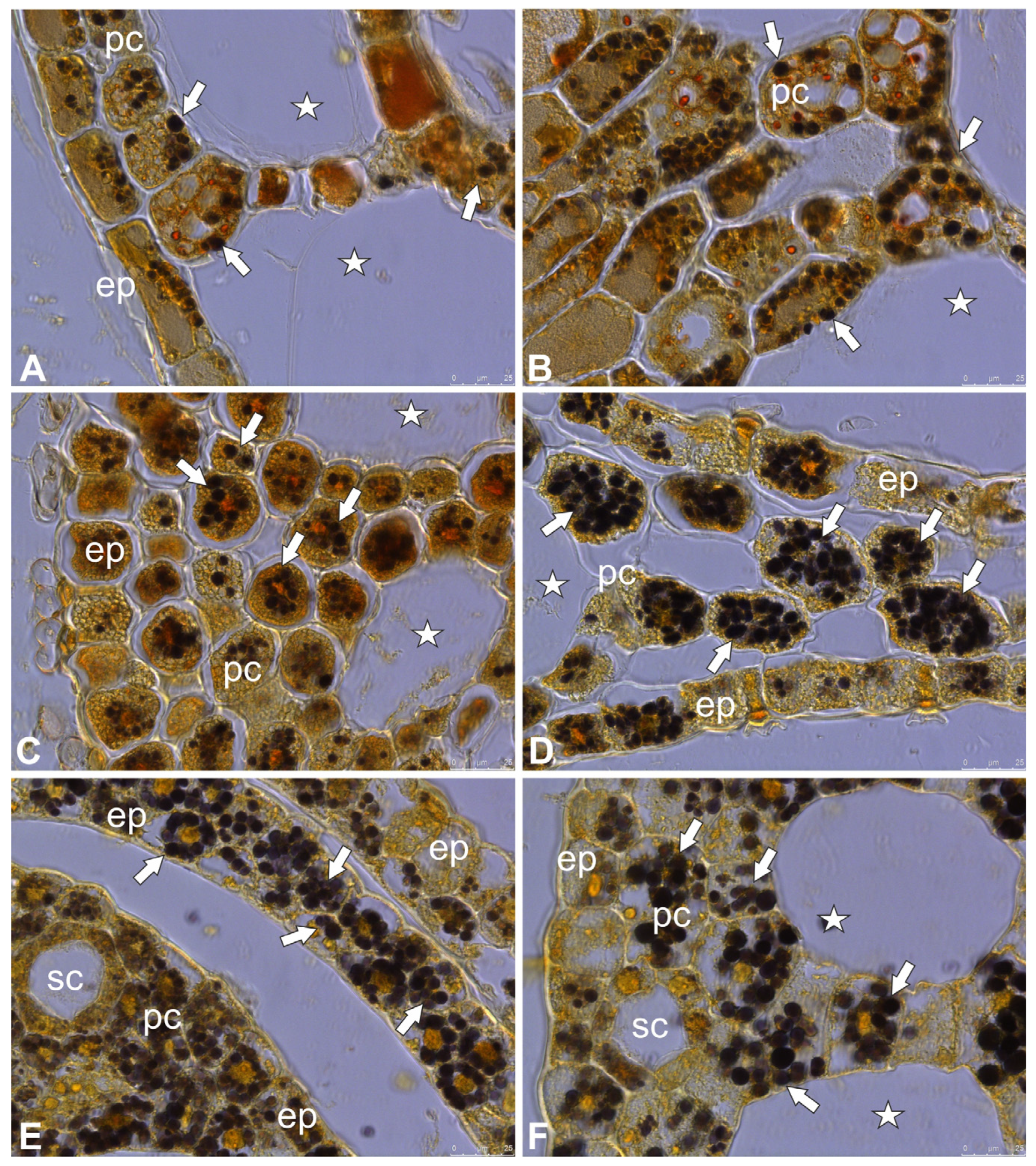
Turions (Figure 1A–D) were formed in apical parts of the vegetative shoots and the on flower stem in the case of Caldesia parnassifolia. Aldrovanda vesiculosa turions consist of a shortened shoot with leaves with immature traps. Utricularia turions consist of a shortened shoot with phylloclades with immature traps. Caldesia parnassifolia turions consist of a shortened shoot with scaly leaves. Lugol’s iodine staining showed that the cells of turions in all species studied contained amyloplasts (Figure 2A–F) (compared with the results in [13]).

2.2. AGP Detection in Aldrovanda vesiculosa

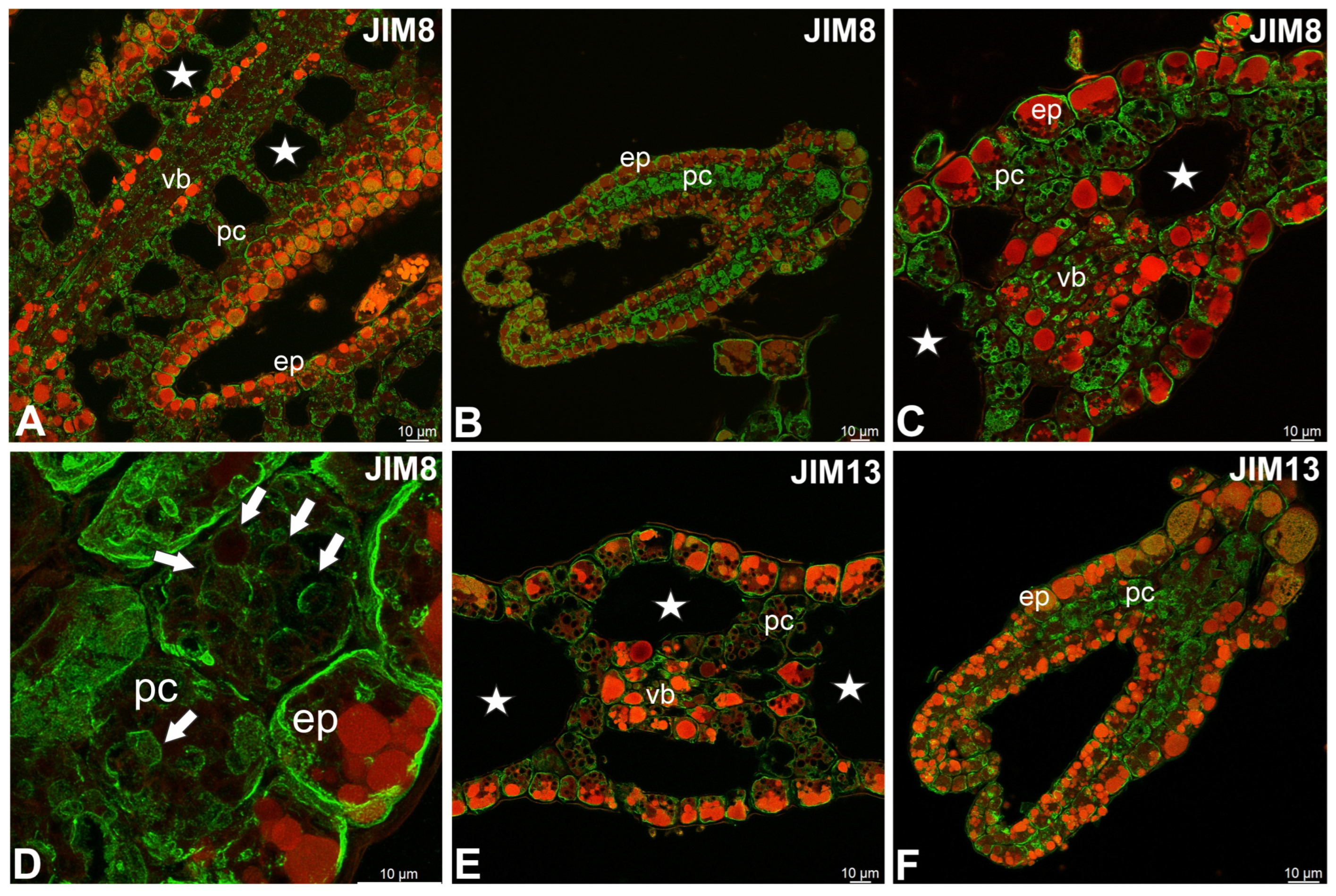
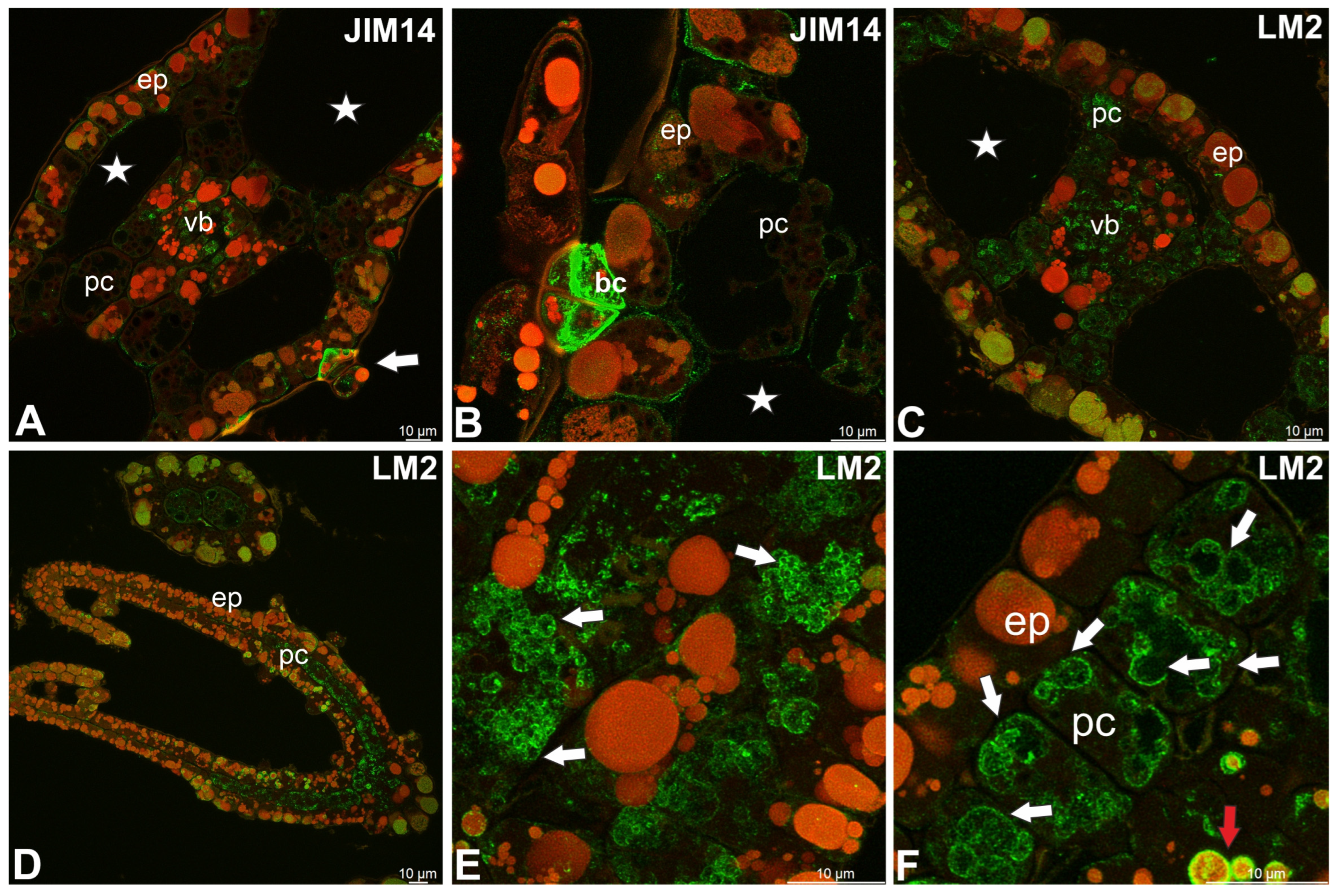
JIM8 epitopes were recorded in epidermal cells, glands, parenchyma cells, and vascular tissues (Figure 3A–C). JIM8 epitopes were associated with cell walls and intracellular compartments, such as plastids (amyloplasts) and some vacuoles (Figure 3D). Similar labeling was observed in case JIM13 epitopes (Figure 3E,F). JIM14 epitopes were present in the wall/plasma membrane in both epidermal and parenchymal cells (Figure 4A,B). JIM14 epitopes were especially abundant in basal cells of glandular trichomes (Figure 4B). These epitopes also occurred in vascular tissue (Figure 4A). The LM2 epitopes also occurred in vascular tissue (Figure 4C) and in the cytoplasmic compartments of various cells (such as plastids and some vacuoles) (Figure 4D–F). MAC207 epitopes were not found.

2.3. AGP Detection in Utricularia australis and U. intermedia

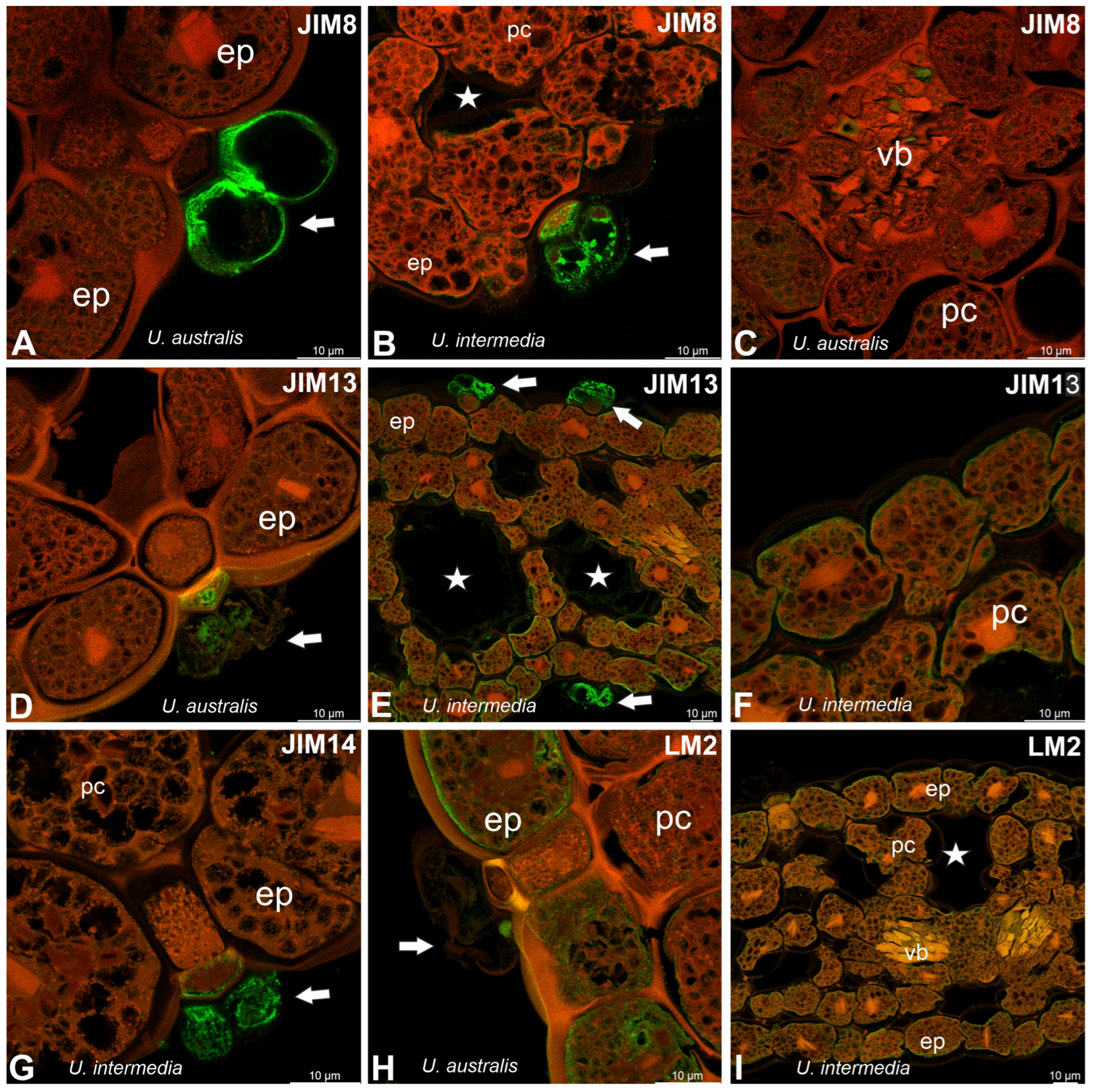
In both species, JIM8 epitopes were recorded in glandular trichomes (Figure 5A–C). In U. australis, JIM8 epitopes were recorded in cells of vascular tissues (Figure 5C). In both species, JIM13 epitopes were recorded in glandular trichomes (Figure 5D,E). In Utricularia intermedia cells, which were plasmolyzed, the JIM13 epitopes were presented in the plasma membrane (Figure 5F). The JIM14 epitopes occurred especially in glandular trichomes cells and as small dots on plasma membranes of epidermal cells (Figure 5E).
LM2 epitopes were present in the plasma membrane (Figure 5H,I). MAC207 epitopes were not found.

2.4. AGP Detection in Caldesia parnassifolia

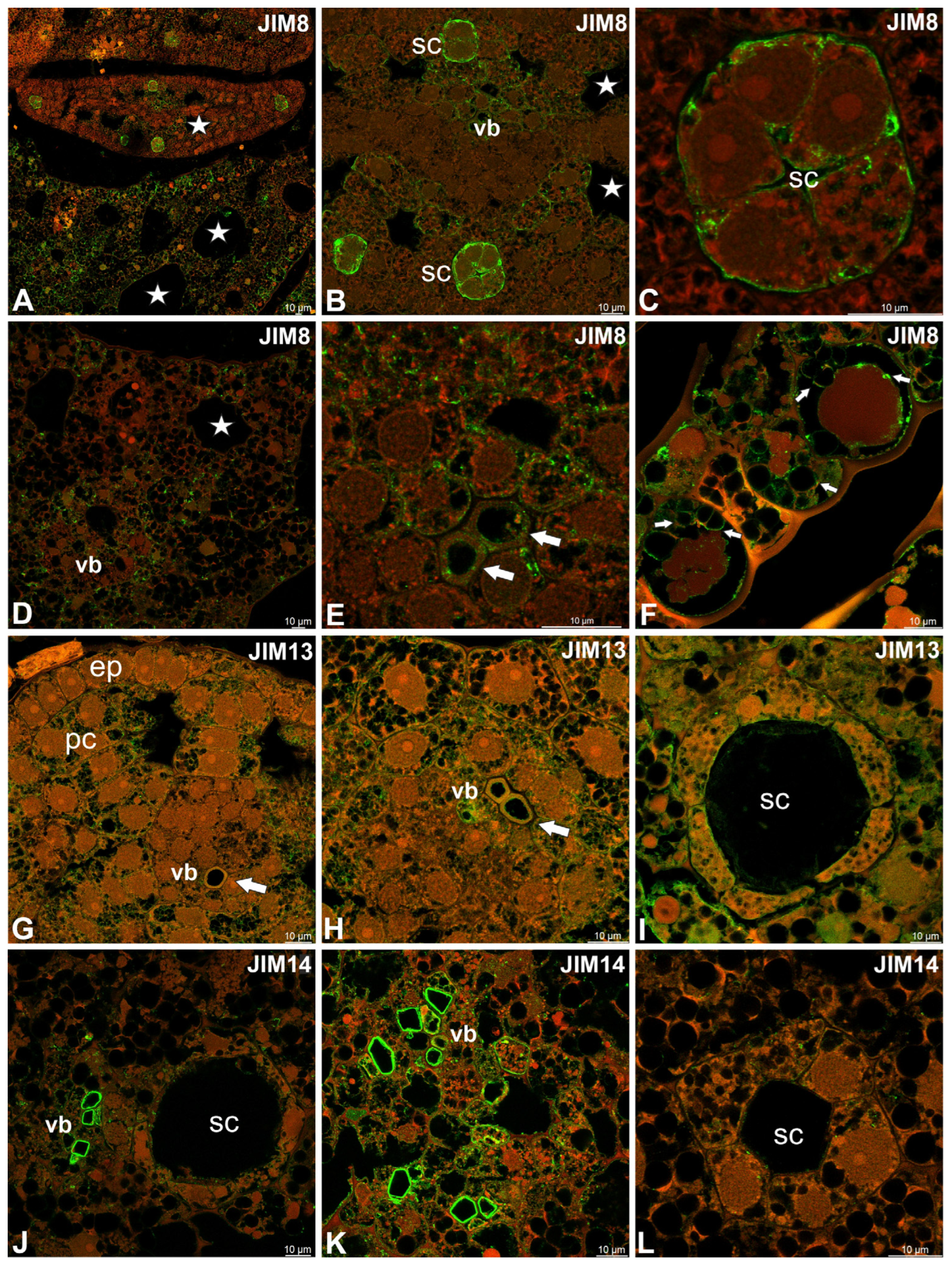
The AGP epitopes that are recognized by JIM8 were present in epidermal and parenchyma cells (Figure 6A,B). A very intensive signal of JIM8 was in the cell walls of secretory duct cells (Figure 6B,C). JIM8 epitopes were recorded in cells of vascular tissues and in xylem elements (Figure 6D,E). JIM8 epitopes were abundantly present in the cytoplasmic compartments (Figure 6F).
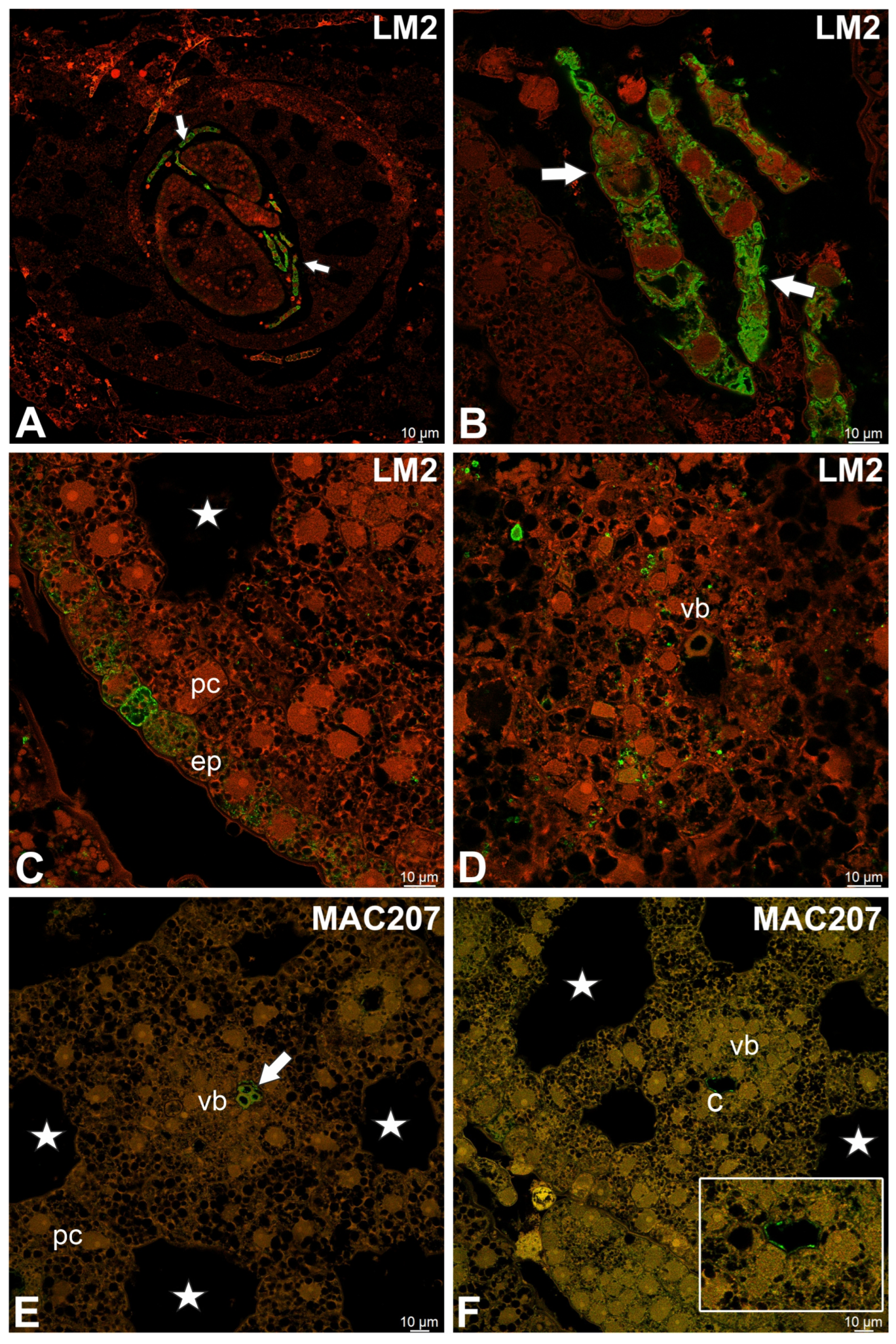
JIM13 epitopes were present in parenchyma cells in the cytoplasmic compartments (Figure 6G) and in some cells in vascular bundles (Figure 6H). JIM13 epitopes also occurred in the secretory duct cells (Figure 6I). JIM14 epitopes were mainly present in vascular bundles (Figure 6J,K). However, the JIM14 epitopes also occurred in the cytoplasmic compartments of various cells (signals seen as dots), including secretory duct cells (Figure 6L). LM2 epitopes occurred abundantly in epidermal outgrowths (Figure 7A,B). LM2 epitopes also occurred in epidermal cells (Figure 7C) and in the cytoplasmic compartments of various cells (signals seen as dots) (Figure 7D). MAC207 epitopes were in xylem elements (Figure 7E) and in canals (Figure 7F).

2.5. Summary

The results of immunocytochemical patterns across species is given in Table 1.

3. Discussion

Our study demonstrated that arabinogalactan proteins (AGPs) in aquatic plant turions show a complex pattern of tissue and subcellular localization that is consistent with, yet extends beyond, previous observations in a range of plant taxa. AGP epitopes were recorded not only in cell walls, where their presence is expected due to their association with the plasma membrane or secretion into the apoplast [28,49], but also in multiple intracellular compartments. This intracellular localization aligns with the biosynthetic route of AGPs, whose glycans are assembled in the Golgi apparatus and transported in secretory vesicles [50,51,52]. Comparable patterns were previously observed in integument cells of Taraxacum, where JIM13-reactive AGPs occurred within the endomembrane system [53], and in Arabidopsis thaliana embryos and explants, in which LM2- and JIM4-reactive epitopes were detected inside storage-rich cells [54,55]. Similar to those systems, turion cells, also rich in storage materials [13], contained AGP epitopes in plastids, including amyloplasts, and in protein storage vacuoles.
The association of AGPs with vacuoles appears to be a recurring theme across taxa. Earlier studies documented AGP epitopes in vacuoles with calcium oxalate crystals in Fragaria × ananassa [56,57] and in parenchyma cells of Pilosella officinarum ovules [58], suggesting potential roles in crystal formation or stabilization. In our material, JIM8 epitopes were likewise found in vacuoles of Aldrovanda vesiculosa and Caldesia parnassifolia. Reports of Trithuria submersa, where JIM8, LM2, and JIM13 epitopes occurred on the outer surfaces or even within starch grains of multiple tissues [59], further support the notion that AGPs participate in organizing storage-related compartments. Although this intracellular presence may reflect secretory or trafficking pathways, ultrastructural analyses would be essential to confirm whether AGPs are embedded in the starch–grain matrix or only associated with surrounding membranes.
A substantial proportion of AGP localization in our study concerned secretory structures, particularly glandular trichomes. Turions of both Utricularia species contained AGPs in these specialized cells, consistent with earlier findings from stolons and leaf-like shoots of Utricularia neottioides [60], as well as from quadrifid trichomes and external glands of U. dichotoma traps [61,62]. In Aldrovanda vesiculosa turions, AGP epitopes detected with the JIM14 antibody were present in trichomes homologous to bifid trichomes found in Aldrovanda traps, where AGPs had already been documented [63]. Integrating our observations with studies on carnivorous genera, such as Drosophyllum [64], Dionaea [65,66,67], and Drosera [55], suggests that AGPs may play consistent functional roles in both mucilage-producing and digestive glands. Their abundance in these structures likely reflects extensive wall remodeling associated with secretion, including wall ingrowth deposition and secondary wall development. This interpretation accords with demonstrations that AGPs are associated with the endoplasmic reticulum and Golgi apparatus of actively secreting cells [55] and that they coordinate cell wall ingrowth formation in transfer cells [68].
AGP epitopes were also detected in internal secretory ducts of Caldesia parnassifolia turions. Such ducts, previously described for this species [68] and typical for the Alismataceae family [69,70], produce exudates containing lipids, alkaloids, proteins, and polysaccharides, including mucilage. Comparable AGP localizations have been reported in other internal secretory systems, including LM2-reactive epitopes in resin–duct sheath cells of Pinus pinaster [71], JIM13 epitopes in mucilage cells of Araucaria angustifolia [72], and various AGP epitopes in mucilage cells of Taraxacum officinale [60]. AGPs also occur in seed mucilage of Arabidopsis thaliana [73,74], further underscoring their widespread involvement in secretory processes.
Our data also show that AGPs occur in the vascular tissues of turions, which aligns with reports from diverse angiosperm and gymnosperm species. In Populus trichocarpa, LM2 epitopes were present in all tissues of secondary roots, including cells with primary and secondary lignified walls, whereas in primary roots, AGPs were absent from xylem [75]. Other species exhibit different patterns: AGPs were recorded in protoxylem of Ceratopteris richardii, Picea sitchensis, and P. trichocarpa, while in Zea mays immunolabeling was strongest in xylem parenchyma surrounding metaxylem vessels [76]. By contrast, herbaceous Arabidopsis thaliana lacked detectable AGPs in xylem [76]. Additional studies showed LM2 epitopes in metaxylem and JIM13, JIM14, and MAC207 epitopes in metaphloem sieve elements and companion cells [77]. In Pinus pinaster, LM2-reactive epitopes accumulated in the phloem [71]. Collectively, these findings suggest that AGPs participate in vascular differentiation, autophagy, and wall modification processes [76,78], and our observations extend these roles to aquatic overwintering organs.
Altogether, the results indicate that turions of aquatic plants, particularly those of Aldrovanda vesiculosa, harbor AGPs across a wide array of tissues and intracellular compartments. This broad distribution has implications not only for developmental biology but also for the search for new sources of arabinogalactans. At present, the principal commercially exploited sources of arabinogalactans include gum exudates of Acacia senegal and A. seyal [79,80], gums of Rosaceae, such as Prunus spp. and Amygdalus scoparia [81], and conifer wood, particularly Larix species, which produce well-characterized, water-soluble arabinogalactans with beta-(1→3) backbones and beta-(1→6) side chains [82]. While herbaceous plants and their organs can also serve as sources [43], aquatic turions have not been explored in this context. Our findings suggest that Aldrovanda turions, owing to their rapid multiplication in in vitro culture [83] and the species’ known production of diverse secondary metabolites [84], may offer a promising alternative resource. However, our study only demonstrates the presence of specific AGP epitopes; subsequent research must address the quantities, extractability, and biochemical properties of turion-derived AGPs.
Future work should therefore include comprehensive extraction and structural analyses, ultrastructural verification of subcellular AGP localization and functional assays evaluating potential applications. Such efforts will help determine whether aquatic turions can be considered a viable, sustainable source of arabinogalactans for biotechnological or industrial purposes, while also contributing to a deeper understanding of AGP biology in aquatic plants.

4. Materials and Methods

4.1. Plant Material and Sample Collection

The plant material, mature turions of Aldrovanda vesiculosa L. (voucher PL 0 HBT 2017.04079, Droseraceae), Utricularia australis R.Br. (CZ 0 HBT 2017.04057, Utricularia intermedia Hayne (CZ 0 HBT 2017.04058, Lentibulariaceae), and Caldesia parnassifolia (L.) Parl. (DE 0 HBT 2017.04000, Alismataceae), were collected from outdoor containers of the collection of aquatic plants in the Institute of Botany CAS at Třeboň. At least four turions of each species were fixed and processed.

4.2. Immunolocalization of AGPs

The turions were fixed overnight at 4 °C in 8% (w/v) paraformaldehyde (PFA, Sigma-Aldrich, Poznan, Poland) with 0.25% (v/v) glutaraldehyde (GA, Sigma-Aldrich) in a PIPES buffer (Sigma-Aldrich). They were then embedded in Steedman’s wax (PEG distearate and 1-hexadecanol; Sigma-Aldrich) and sectioned into 7 μm sections, which were blocked with 1% BSA (Sigma-Aldrich) in PBS buffer and incubated with the primary antibodies against arabinogalactans (JIM8, JIM13, JIM14, LM2, and MAC207 [85,86,87]) overnight at 4 °C. All of the primary antibodies were purchased from Plant Probes (Leeds, UK) or Kerafast (Newark, CA, USA), and the secondary antibody goat anti-rat conjugated with FITC was purchased from Abcam (Cambridge, UK). The samples were then cover-slipped using a Mowiol mounting medium: a mixture of Mowiol ®4-88 (Sigma-Aldrich) and glycerol for fluorescence microscopy (Merck, Warsaw, Poland), with the addition of 2.5% DABCO (Carl Roth GmbH, Karlsruhe, Germany). They were viewed using a Leica STELLARIS 5 WLL confocal microscope with Lightning module deconvolution. Negative controls were created by omitting the primary antibody step, which caused no fluorescence signal in any of the control frames for any stained slides (Figure S1). Confocal z-stacks were acquired using identical imaging parameters for all samples of a given antibody channel. Images were collected in Lightning acquisition mode at a line scan speed of 400–1000 Hz. The FITC channel (antibody labelling) was excited at 494 nm with a detector gain of 2.5 and laser intensity of 9.79%. Turion autofluorescence was recorded using excitation at 540 nm with a detector gain of 2.5 and laser intensity of 3.74%. For each species, four turions were processed and labelled with each antibody, and all biological replicates displayed consistent staining patterns. Each immunolabeling was performed twice. Sections were prepared for light microscopy and stained for starch and protein using Lugol’s iodine stain and later were viewed using a Leica DM6000B microscope (KAWA.SKA Sp. z o.o., Piaseczno, Poland).

5. Conclusions

Our study is the first report providing data on AGP occurrence in aquatic plant turions. After analyzing turions of four different species, we identified Aldrovanda vesiculosa turions as the most promising potential source of AGPs. Particularly interesting is the finding of AGPs in the cytoplasmic compartments, which may indicate the role of these compounds in the storage function of turions. Since turion cells are filled with starch, protein bodies, and contain secondary metabolites, the presence of AGPs makes them even more interesting organs in terms of their use in the pharmaceutical industry and food production. Our results may serve as a guide for expanding future research directions on turions as a source of AGPs and potential applications, such as quantitative AGP analysis, extraction feasibility, and industrial or biotechnological applications.

Supplementary Materials

The following supporting information can be downloaded at https://www.mdpi.com/article/10.3390/molecules30244689/s1. Figure S1. Control reactions of cell wall components after immunolabeling (green color—signal of antibody, red-brown color—autofluorescence), (A) Turion of Aldrovanda vesiculosa. (B) Turion of Utricularia australis. (C) Turion of Utricularia intermedia. (D) Turion of Caldesia parnassifolia.

Author Contributions

Conceptualization, B.J.P.; methodology, B.J.P. and M.K.; investigation, B.J.P. and M.K.; resources (plant material), L.A.; data curation, B.J.P. and M.K.; writing—preparing the original draft, B.J.P.; writing—review and editing, B.J.P., L.,A., M.F., P.S. and M.K.; visualization, M.K. and B.J.P.; supervision, B.J.P.; project administration, B.J.P. and M.K.; funding acquisition, B.J.P., M.F., M.K. and P.S. All authors have read and agreed to the published version of the manuscript.

Funding

This research has been partially supported by the Ministry of Science and Higher Education of Poland, within the statutory activities of the Institute of Botany, Faculty of Biology, Jagiellonian University (N18/DBS/000002) and Bioimaging Laboratory, Faculty of Biology, University of Gdańsk. This study (plant material) was partially supported by the Long-Term Research Development Project of the Czech Academy of Sciences, No. RVO 67985939.

Institutional Review Board Statement

Not applicable.

Informed Consent Statement

Not applicable.

Data Availability Statement

Dataset available on request from the authors.

Acknowledgments

The authors gratefully acknowledge the Hortus Botanicus Třeboň, Department of Experimental Garden and Collection of Aquatic and Wetland Plants, Institute of Botany CAS at Třeboň, Czech Republic, for providing experimental plants.

Conflicts of Interest

The authors declare no conflicts of interest.

References

  1. Sculthorpe, C.D. The Biology of Aquatic Vascular Plants; Edward Arnold: London, UK, 1967. [Google Scholar]
  2. Maier, R. Das Austreiben der Turionen von Utricularia vulgaris L. nach verschiedenen langen Perioden der Austrocknung. Flora 1973, 162, 269–283. [Google Scholar] [CrossRef]
  3. Maier, R. Wirkung von Trockenheit auf den Austrieb der Turionen von Utricularia L. Österr. Bot. Z. 1973, 122, 15–20. [Google Scholar] [CrossRef]
  4. Winston, R.D.; Gorham, P.R. Turions and dormancy states in Utricularia vulgaris. Can. J. Bot. 1979, 57, 2740–2749. [Google Scholar] [CrossRef]
  5. Adamec, L. Ecophysiological characteristics of turions of aquatic plants: A review. Aquat. Bot. 2018, 148, 64–77. [Google Scholar] [CrossRef]
  6. Ziegler, P. The Developmental Cycle of Spirodela polyrhiza Turions: A Model for Turion-Based Duckweed Overwintering? Plants 2024, 13, 2993. [Google Scholar] [CrossRef] [PubMed]
  7. Figuerola, J.; Green, A.J. Dispersal of aquatic organisms by waterbirds: A review of past research and priorities for future studies. Freshw. Biol. 2002, 47, 483–494. [Google Scholar] [CrossRef]
  8. Green, A.J.; Lovas-Kiss, Á.; Reynolds, C.; Sebastián-González, E.; Silva, G.G.; van Leeuwen, C.H.; Wilkinson, D.M. Dispersal of aquatic and terrestrial organisms by waterbirds: A review of current knowledge and future priorities. Freshw. Biol. 2023, 68, 173–190. [Google Scholar] [CrossRef]
  9. Adamec, L. Dark respiration and photosynthesis of dormant and sprouting turions of aquatic plants. Fundam. Appl. Limnol. 2011, 179, 151–158. [Google Scholar] [CrossRef]
  10. Reimann, R.; Hippler, M.; Machelett, B.; Appenroth, K.-J. Light induces phosphorylation of glucan water dikinase, which precedes starch degradation in turions of the duckweed Spirodela polyrhiza. Plant Physiol. 2004, 135, 121–128. [Google Scholar] [CrossRef]
  11. Appenroth, K.-J.; Ziegler, P. Light-induced degradation of storage starch in turions of Spirodela polyrhiza depends on nitrate. Plant Cell Environ. 2008, 31, 1460–1469. [Google Scholar] [CrossRef]
  12. Appenroth, K.J.; Keresztes, Á.; Krzysztofowicz, E.; Gabrys, H. Light-induced degradation of starch granules in turions of Spirodela polyrhiza studied by electron microscopy. Plant Cell Physiol. 2011, 52, 384–391. [Google Scholar] [CrossRef] [PubMed]
  13. Płachno, B.J.; Adamec, L.; Kozieradzka-Kiszkurno, M.; Świątek, P.; Kamińska, I. Cytochemical and ultrastructural aspects of aquatic carnivorous plant turions. Protoplasma 2014, 251, 1449–1454. [Google Scholar] [CrossRef] [PubMed]
  14. Adamec, L.; Kučerová, A.; Janeček, Š. Mineral nutrients, photosynthetic pigments and storage carbohydrates in turions of 21 aquatic plant species. Aquat. Bot. 2020, 165, 103238. [Google Scholar] [CrossRef]
  15. Harada, T.; Ishizawa, K. Starch degradation and sucrose metabolism during anaerobic growth of pondweed (Potamogeton distinctus A. Benn.) turions. Plant Soil 2003, 253, 125–135. [Google Scholar] [CrossRef]
  16. Adamec, L. Respiration of turions and winter apices in aquatic carnivorous plants. Biologia 2008, 63, 515–520. [Google Scholar] [CrossRef]
  17. Weber, J.A.; Nooden, L.D. The causes of sinking and floating in turions of Myriophyllum verticillatum. Aquat. Bot. 2005, 83, 219–226. [Google Scholar] [CrossRef]
  18. Xu, Y.L.; Fang, Y.; Li, Q.; Yang, G.L.; Guo, L.; Chen, G.K.; Tan, L.; He, K.-Z.; Jin, Y.-L.; Zhao, H. Turion, an innovative duckweed-based starch production system for economical biofuel manufacture. Ind. Crops Prod. 2018, 124, 108–114. [Google Scholar] [CrossRef]
  19. Villanueva, V.R.; Simola, L.K.; Mardon, M. Polyamines in turions and young plants of Hydrocharis morsus-ranae and Utricularia intermedia. Phytochemistry 1985, 24, 171–172. [Google Scholar] [CrossRef]
  20. Strzemski, M.; Adamec, L.; Dresler, S.; Mazurek, B.; Dubaj, K.; Stolarczyk, P.; Feldo, M.; Płachno, B.J. Shoots and Turions of Aquatic Plants as a Source of Fatty Acids. Molecules 2024, 29, 2062. [Google Scholar] [CrossRef]
  21. Genevès, L.; Vintejoux, C. Sur la présence et l’organisation en un réseau tridimensionnel d’inclusions de nature protéique dans les noyaux cellulaires des hibernacles, d’Utricularia neglecta L. (Lentibulariacées). C. R. Acad. Sci. Paris D 1967, 264, 2750–2753. [Google Scholar]
  22. Vintejoux, C. Inclusions intranucléaires d’Utricularia neglecta L. (Lentibulariacées). Ann. Sci. Nat. Bot. 1984, 6, 203–205. [Google Scholar]
  23. Silva, J.; Ferraz, R.; Dupree, P.; Showalter, A.M.; Coimbra, S. Three decades of advances in arabinogalactan-protein biosynthesis. Front. Plant Sci. 2020, 11, 610377. [Google Scholar] [CrossRef] [PubMed]
  24. Showalter, A.M. Arabinogalactan-proteins: Structure, expression and function. Cell. Mol. Life Sci. 2001, 58, 1399–1417. [Google Scholar] [CrossRef] [PubMed]
  25. Seifert, G.J.; Roberts, K. The biology of arabinogalactan proteins. Annu. Rev. Plant Biol. 2007, 58, 137–161. [Google Scholar] [CrossRef]
  26. Showalter, A.M.; Basu, D. Extensin and arabinogalactan-protein biosynthesis: Glycosyltransferases, research challenges, and biosensors. Front. Plant Sci. 2016, 7, 814. [Google Scholar] [CrossRef]
  27. Willats, W.G.; Knox, J.P. A role for arabinogalactan-proteins in plant cell expansion: Evidence from studies on the interaction of β-glucosyl Yariv reagent with seedlings of Arabidopsis thaliana. Plant J. 1996, 9, 919–925. [Google Scholar] [CrossRef]
  28. Ellis, M.; Egelund, J.; Schultz, C.J.; Bacic, A. Arabinogalactan-proteins: Key regulators at the cell surface? Plant Physiol. 2010, 153, 403–419. [Google Scholar] [CrossRef]
  29. Pereira, A.M.; Pereira, L.G.; Coimbra, S. Arabinogalactan proteins: Rising attention from plant biologists. Plant Reprod. 2015, 28, 1–15. [Google Scholar] [CrossRef]
  30. Lamport, D.T.A.; Tan, L.; Held, M.; Kieliszewski, M.J. Pollen tube growth and guidance: Occam’s razor sharpened on a molecular arabinogalactan glycoprotein Rosetta Stone. New Phytol. 2018, 217, 491–500. [Google Scholar] [CrossRef]
  31. Ma, Y.; Johnson, K. Arabinogalactan proteins—Multifunctional glycoproteins of the plant cell wall. Cell Surf. 2023, 9, 100102. [Google Scholar] [CrossRef]
  32. Cheung, A.Y.; Wu, H.M. Arabinogalactan proteins in plant sexual reproduction. Protoplasma 1999, 208, 87–98. [Google Scholar] [CrossRef]
  33. Coimbra, S.; Almeida, J.; Junqueira, V.; Costa, M.L.; Pereira, L.G. Arabinogalactan proteins as molecular markers in Arabidopsis thaliana sexual reproduction. J. Exp. Bot. 2007, 58, 4027–4035. [Google Scholar] [CrossRef] [PubMed]
  34. Leszczuk, A.; Szczuka, E.; Zdunek, A. Arabinogalactan proteins: Distribution during the development of male and female gametophytes. Plant Physiol. Biochem. 2019, 135, 9–18. [Google Scholar] [CrossRef] [PubMed]
  35. Lopes, A.L.; Moreira, D.; Pereira, A.M.; Ferraz, R.; Mendes, S.; Pereira, L.G.; Colombo, L.; Coimbra, S. AGPs as molecular determinants of reproductive development. Ann. Bot. 2023, 131, 827–838. [Google Scholar] [CrossRef] [PubMed]
  36. Silva, J.; Moreira, D.; Ferreira, M.J.; Pereira, A.M.; Pereira, L.G.; Coimbra, S. Arabinogalactan proteins: Decoding the multifaceted roles in plant reproduction. Curr. Opin. Plant Biol. 2025, 88, 102800. [Google Scholar] [CrossRef]
  37. Kapusta, M.; Narajczyk, M.; Płachno, B.J. Arabinogalactan Proteins Mark the Generative Cell–Vegetative Cell Interface in Monocotyledonous Pollen Grains. Cells 2025, 14, 1549. [Google Scholar] [CrossRef]
  38. Peng, Q.; Song, J.; Lv, X.; Wang, Z.; Huang, L.; Du, Y. Structural characterization of an arabinogalactan-protein from the fruits of Lycium ruthenicum. J. Agric. Food Chem. 2012, 60, 9424–9429. [Google Scholar] [CrossRef]
  39. Leszczuk, A.; Chylińska, M.; Zięba, E.; Skrzypek, T.; Szczuka, E.; Zdunek, A. Structural network of arabinogalactan proteins (AGPs) and pectins in apple fruit during ripening and senescence processes. Plant Sci. 2018, 275, 36–48. [Google Scholar] [CrossRef]
  40. Tsumuraya, Y.; Ozeki, E.; Ooki, Y.; Yoshimi, Y.; Hashizume, K.; Kotake, T. Properties of arabinogalactan-proteins in European pear (Pyrus communis L.) fruits. Carbohydr. Res. 2019, 485, 107816. [Google Scholar] [CrossRef]
  41. Leszczuk, A.; Kalaitzis, P.; Blazakis, K.N.; Zdunek, A. The role of arabinogalactan proteins (AGPs) in fruit ripening—A review. Hortic. Res. 2020, 7, 176. [Google Scholar] [CrossRef]
  42. Harris, S.; Powers, S.; Monteagudo-Mera, A.; Kosik, O.; Lovegrove, A.; Shewry, P.; Charalampopoulos, D. Determination of the prebiotic activity of wheat arabinogalactan peptide (AGP) using batch culture fermentation. Eur. J. Nutr. 2020, 59, 297–307. [Google Scholar] [CrossRef] [PubMed]
  43. Saeidy, S.; Petera, B.; Pierre, G.; Fenoradosoa, T.A.; Djomdi, D.; Michaud, P.; Delattre, C. Plants arabinogalactans: From structures to physicochemical and biological properties. Biotechnol. Adv. 2021, 53, 107771. [Google Scholar] [CrossRef] [PubMed]
  44. Wang, H.; Shi, S.; Bao, B.; Li, X.; Wang, S. Structure characterization of an arabinogalactan from green tea and its anti-diabetic effect. Carbohydr. Polym. 2015, 124, 98–108. [Google Scholar] [CrossRef] [PubMed]
  45. Tang, S.; Wang, T.; Huang, C.; Lai, C.; Fan, Y.; Yong, Q. Sulfated modification of arabinogalactans from Larix principis-rupprechtii and their antitumor activities. Carbohydr. Polym. 2015, 215, 207–212. [Google Scholar] [CrossRef]
  46. Dai, J.; Zhou, Z.; Chen, L.; Cao, S.; Luo, K.; Zhang, J.; Dinnyés, A.; Wang, D.; Sun, Q. A novel arabinogalactan extracted from Epiphyllum oxypetalum (DC.) Haw improves the immunity and gut microbiota in cyclophosphamide-induced immunosuppressed mice. eFood 2024, 5, e70002. [Google Scholar] [CrossRef]
  47. Dai, K.Y.; Ding, W.J.; Li, Z.T.; Liu, C.; Ji, H.Y.; Liu, A.J. Comparison of structural characteristics and antitumor activity of two alkali-extracted peach gum arabinogalactans. Int. J. Biol. Macromol. 2024, 279, 135407. [Google Scholar] [CrossRef]
  48. Li, N.; Xu, T.; Wu, Z.; Zhao, Y.; Ruan, M.; Xu, H.; Chen, W.; Wang, H.; Wang, S.; Wang, Y.; et al. Arabinogalactan from Cynanchum atratum induces tolerogenic dendritic cells in gut to restrain autoimmune response and alleviate collagen-induced arthritis in mice. Phytomedicine 2025, 136, 156269. [Google Scholar] [CrossRef]
  49. Liu, Z.; Persson, S.; Sánchez-Rodríguez, C. At the Border: The Plasma Membrane–Cell Wall Continuum. J. Exp. Bot. 2015, 66, 1553–1563. [Google Scholar] [CrossRef]
  50. Rose, J.K.C.; Lee, S.J. Straying off the Highway: Trafficking of Secreted Plant Proteins and Complexity in the Plant Cell Wall Proteome. Plant Physiol. 2010, 153, 433–436. [Google Scholar] [CrossRef]
  51. Hijazi, M.; Velasquez, S.M.; Jamet, E.; Estevez, J.M.; Albenne, C. An Update on Post-Translational Modifications of Hydroxyproline-Rich Glycoproteins: Toward a Model Highlighting Their Contribution to Plant Cell Wall Architecture. Front. Plant Sci. 2014, 5, 395. [Google Scholar] [CrossRef]
  52. Nibbering, P.; Petersen, B.L.; Motawia, M.S.; Jørgensen, B.; Ulvskov, P.; Niittylä, T. Golgi-Localized Exo-β1,3-Galactosidases Involved in Cell Expansion and Root Growth in Arabidopsis. J. Biol. Chem. 2020, 295, 10581–10592. [Google Scholar] [CrossRef] [PubMed]
  53. Gawecki, R.; Sala, K.; Kurczyńska, E.U.; Świątek, P.; Płachno, B.J. Immunodetection of some pectic, arabinogalactan proteins and hemicellulose epitopes in the micropylar transmitting tissue of apomictic dandelions (Taraxacum, Asteraceae, Lactuceae). Protoplasma 2017, 254, 657–668. [Google Scholar] [CrossRef] [PubMed]
  54. Potocka, I.; Godel, K.; Dobrowolska, I.; Kurczyńska, E.U. Spatio-temporal localization of selected pectic and arabinogalactan protein epitopes and the ultrastructural characteristics of explant cells that accompany the changes in the cell fate during somatic embryogenesis in Arabidopsis thaliana. Plant Physiol. Biochem. 2018, 127, 573–589. [Google Scholar] [CrossRef] [PubMed]
  55. Šamaj, J.; Šamajová, O.; Peters, M.; Baluška, F.; Lichtscheidl, I.; Knox, J.P.; Volkmann, D. Immunolocalization of LM2 Arabinogalactan Protein Epitope Associated with Endomembranes of Plant Cells. Protoplasma 2000, 212, 186–196. [Google Scholar] [CrossRef]
  56. Leszczuk, A.; Szczuka, E. Arabinogalactan Proteins: Immunolocalization in the Developing Ovary of a Facultative Apomict Fragaria × ananassa (Duch.). Plant Physiol. Biochem. 2018, 123, 24–33. [Google Scholar] [CrossRef]
  57. Leszczuk, A.; Wydrych, J.; Szczuka, E. The Occurrence of Calcium Oxalate Crystals and Distribution of Arabinogalactan Proteins (AGPs) in Ovary Cells during Fragaria × ananassa (Duch.) Development. J. Plant Growth Regul. 2019, 38, 1028–1036. [Google Scholar] [CrossRef]
  58. Płachno, B.J.; Kapusta, M.; Świątek, P.; Stolarczyk, P.; Kocki, J. Immunodetection of Pectic Epitopes, Arabinogalactan Proteins, and Extensins in Mucilage Cells from the Ovules of Pilosella officinarum Vaill. and Taraxacum officinale Agg. (Asteraceae). Int. J. Mol. Sci. 2020, 21, 9642. [Google Scholar] [CrossRef]
  59. Costa, M.; Pereira, A.M.; Rudall, P.J.; Coimbra, S. Immunolocalization of Arabinogalactan Proteins (AGPs) in Reproductive Structures of an Early-Divergent Angiosperm, Trithuria (Hydatellaceae). Ann. Bot. 2013, 111, 183–190. [Google Scholar] [CrossRef]
  60. Płachno, B.J.; Adamec, L.; Świątek, P.; Kapusta, M.; Miranda, V.F.O. Life in the Current: Anatomy and Morphology of Utricularia neottioides. Int. J. Mol. Sci. 2020, 21, 4474. [Google Scholar] [CrossRef]
  61. Płachno, B.J.; Kapusta, M.; Stolarczyk, P.; Feldo, M.; Świątek, P. Cell Wall Microdomains in the External Glands of Utricularia dichotoma Traps. Int. J. Mol. Sci. 2024, 25, 6089. [Google Scholar] [CrossRef]
  62. Płachno, B.J.; Kapusta, M.; Stolarczyk, P.; Feldo, M.; Świątek, P. Do Arabinogalactan Proteins Occur in the Transfer Cells of Utricularia dichotoma? Int. J. Mol. Sci. 2024, 25, 6623. [Google Scholar] [CrossRef]
  63. Płachno, B.J.; Kapusta, M.; Stolarczyk, P.; Wójciak, M.; Świątek, P. Immunocytochemical Analysis of Bifid Trichomes in Aldrovanda vesiculosa L. Traps. Int. J. Mol. Sci. 2023, 24, 3358. [Google Scholar] [CrossRef] [PubMed]
  64. Płachno, B.J.; Kapusta, M.; Stolarczyk, P.; Świątek, P.; Lichtscheidl, I. Differences in the Occurrence of Cell Wall Components between Distinct Cell Types in Glands of Drosophyllum lusitanicum. Int. J. Mol. Sci. 2023, 24, 15045. [Google Scholar] [CrossRef] [PubMed]
  65. Płachno, B.J.; Kapusta, M.; Stolarczyk, P.; Świątek, P. Stellate Trichomes in Dionaea muscipula Ellis (Venus Flytrap) Traps: Structure and Functions. Int. J. Mol. Sci. 2023, 24, 553. [Google Scholar] [CrossRef] [PubMed]
  66. Płachno, B.J.; Kapusta, M.; Stolarczyk, P.; Feldo, M.; Świątek, P.; Miranda, V.F.O. Immunocytochemical Analysis of the Wall Ingrowths in the Digestive Gland Transfer Cells in Aldrovanda vesiculosa L. (Droseraceae). Cells 2022, 11, 2218. [Google Scholar] [CrossRef]
  67. Płachno, B.J.; Kapusta, M.; Stolarczyk, P.; Świątek, P. Arabinogalactan Proteins in the Digestive Glands of Dionaea muscipula J. Ellis Traps. Cells 2022, 11, 586. [Google Scholar] [CrossRef]
  68. McCurdy, D.W.; Patrick, J.W.; Offler, C.E. Wall Ingrowth Formation in Transfer Cells: Novel Examples of Localized Wall Deposition in Plant Cells. Curr. Opin. Plant Biol. 2008, 11, 653–661. [Google Scholar] [CrossRef]
  69. Schweingruber, F.H.; Kučerová, A.; Adamec, L.; Doležal, J. Anatomic Atlas of Aquatic and Wetland Plant Stems; Springer Nature: Cham, Switzerland, 2020. [Google Scholar]
  70. Leme, F.M.; Bento, J.P.S.P.; Fabiano, V.S.; González, J.D.V.; Pott, V.J.; Arruda, R.D.C.O. New Aspects of Secretory Structures in Five Alismataceae Species: Laticifers or Ducts? Plants 2021, 10, 2694. [Google Scholar] [CrossRef]
  71. Michavila, S.; Encina, A.; De la Rubia, A.G.; Centeno, M.L.; García-Angulo, P. An Immunohistochemical Approach to Cell Wall Polysaccharide Specialization in Maritime Pine (Pinus pinaster) Needles. Protoplasma 2025, 262, 979–991. [Google Scholar] [CrossRef]
  72. Mastroberti, A.A.; Mariath, J.E.D.A. Immunocytochemistry of the Mucilage Cells of Araucaria angustifolia (Bertol.) Kuntze (Araucariaceae). Braz. J. Bot. 2008, 31, 1–13. [Google Scholar] [CrossRef]
  73. Haughn, G.W.; Western, T.L. Arabidopsis Seed Coat Mucilage Is a Specialized Cell Wall That Can Be Used as a Model for Genetic Analysis of Plant Cell Wall Structure and Function. Front. Plant Sci. 2012, 3, 64. [Google Scholar] [CrossRef]
  74. Ajayi, O.O.; Held, M.A.; Showalter, A.M. Two β-Glucuronosyltransferases Involved in the Biosynthesis of Type II Arabinogalactans Function in Mucilage Polysaccharide Matrix Organization in Arabidopsis thaliana. BMC Plant Biol. 2021, 21, 245. [Google Scholar] [CrossRef]
  75. Marzec-Schmidt, K.; Ludwikow, A.; Wojciechowska, N.; Kasprowicz-Maluski, A.; Mucha, J.; Bagniewska-Zadworna, A. Xylem Cell Wall Formation in Pioneer Roots and Stems of Populus trichocarpa (Torr. & Gray). Front. Plant Sci. 2019, 10, 1419. [Google Scholar] [CrossRef] [PubMed]
  76. Michalak, K.M.; Wojciechowska, N.; Marzec-Schmidt, K.; Bagniewska-Zadworna, A. Conserved Autophagy and Diverse Cell Wall Composition: Unifying Features of Vascular Tissues in Evolutionarily Distinct Plants. Ann. Bot. 2024, 133, 559–572. [Google Scholar] [CrossRef] [PubMed]
  77. Marzec, M.; Szarejko, I.; Melzer, M. Arabinogalactan Proteins Are Involved in Root Hair Development in Barley. J. Exp. Bot. 2015, 66, 1245–1257. [Google Scholar] [CrossRef] [PubMed]
  78. Michalak, K.M.; Wojciechowska, N.; Kułak, K.; Minicka, J.; Jagodziński, A.M.; Bagniewska-Zadworna, A. Is Autophagy Always a Death Sentence? A Case Study of Highly Selective Cytoplasmic Degradation during Phloemogenesis. Ann. Bot. 2025, 135, 681–696. [Google Scholar] [CrossRef]
  79. Defaye, J.; Wong, E. Structural Studies of Gum Arabic, the Exudate Polysaccharide from Acacia senegal. Carbohydr. Res. 1986, 150, 221–231. [Google Scholar] [CrossRef]
  80. Lopez-Torrez, L.; Nigen, M.; Williams, P.; Doco, T.; Sanchez, C. Acacia senegal vs. Acacia seyal Gums—Part 1: Composition and Structure of Hyperbranched Plant Exudates. Food Hydrocoll. 2015, 51, 41–53. [Google Scholar]
  81. Bouaziz, F.; Koubaa, M.; Ghorbel, R.E.; Chaabouni, S.E. Recent Advances in Rosaceae Gum Exudates: From Synthesis to Food and Non-Food Applications. Int. J. Biol. Macromol. 2016, 86, 535–545. [Google Scholar] [CrossRef]
  82. Babkin, V.A.; Neverova, N.A.; Medvedeva, E.N.; Fedorova, T.E.; Levchuk, A.A. Investigation of Physicochemical Properties of Arabinogalactan of Different Larch Species. Russ. J. Bioorg. Chem. 2016, 42, 707–711. [Google Scholar] [CrossRef]
  83. Parzymies, M.; Pogorzelec, M.; Świstowska, A. Optimization of Propagation of the Polish Strain of Aldrovanda vesiculosa in Tissue Culture. Biology 2022, 11, 1389. [Google Scholar] [CrossRef]
  84. Wójciak, M.; Sowa, I.; Strzemski, M.; Parzymies, M.; Pogorzelec, M.; Stolarczyk, P.; Płachno, B.J. Phenolic Secondary Metabolites in Aldrovanda vesiculosa L. (Droseraceae). Molecules 2025, 30, 3746. [Google Scholar] [CrossRef] [PubMed]
  85. Knox, J.P.; Linstead, P.J.; Peart, J.; Cooper, C.; Roberts, K. Developmentally Regulated Epitopes of Cell Surface Arabinogalactan Proteins and Their Relation to Root Tissue Pattern Formation. Plant J. 1991, 1, 317–326. [Google Scholar] [CrossRef]
  86. Yates, E.A.; Valdor, J.F.; Haslam, S.M.; Morris, H.R.; Dell, A.; Mackie, W.; Knox, J.P. Characterization of Carbohydrate Structural Features Recognized by Anti-Arabinogalactan-Protein Monoclonal Antibodies. Glycobiology 1996, 6, 131–139. [Google Scholar] [CrossRef]
  87. Smallwood, M.; Yates, E.A.; Willats, W.G.T.; Martin, H.; Knox, J.P. Immunochemical Comparison of Membrane-Associated and Secreted Arabinogalactan Proteins in Rice and Carrot. Planta 1996, 198, 452–459. [Google Scholar] [CrossRef]
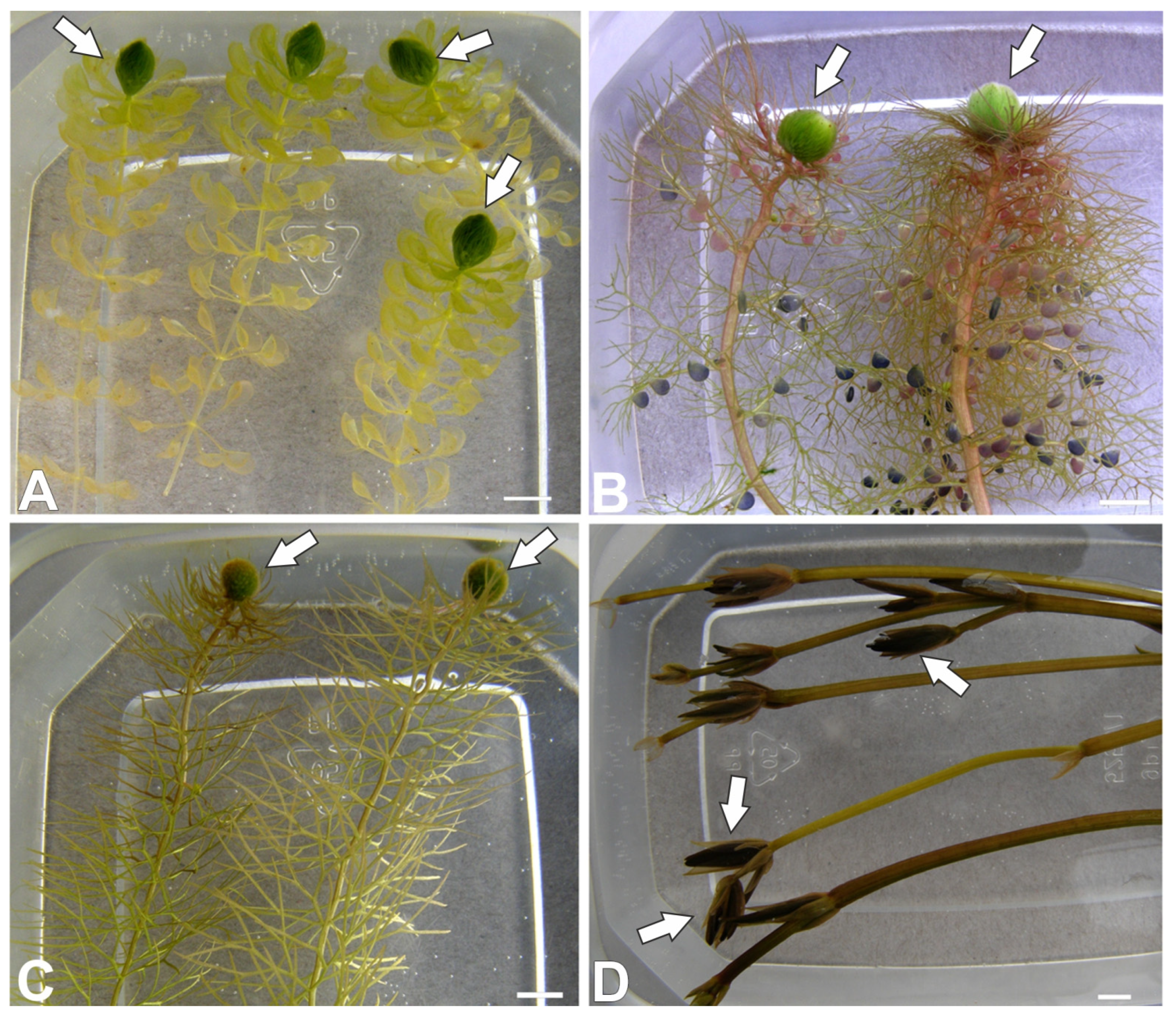
Figure 1. Examined plant species forming turions. (A) Aldrovanda vesiculosa plants with turions (arrows). (B) Two Utricularia australis shoots with turions (arrows). (C) Two Utricularia intermedia shoots with turions (arrows). (D) Caldesia parnassifolia shoots with turions (arrows). All bars 5 mm.
Molecules 30 04689 g001
Figure 2. Bright-field images of turions, Lugol’s iodine staining. (A,B) Cross section of leaf of Aldrovanda vesiculosa; epidermal cells (ep), parenchyma cells (pc), starch grains (arrows), air duct (star). (C) Cross section of phylloclade of Utricularia australis; epidermal cell (ep), parenchyma cells (pc), starch grains (arrows), air duct (star). (D) Cross section of phylloclade of Utricularia intermedia; epidermal cell (ep), parenchyma cells (pc), starch grains (arrows), air duct (star). (E,F) Cross section of leaves of Caldesia parnassifolia, epidermal cells (ep), parenchyma cells (pc), starch grains (arrows), secretory canal (sc), air duct (star).
Molecules 30 04689 g002
Figure 3. Distribution of arabinogalactan proteins (JIM8, JIM13) detected in the turion of Aldrovanda vesiculosa (intense green color—antibody signal; red-brown color—autofluorescence); epidermal cells (ep), parenchyma cells (pc), vascular bundle (vb), air duct (star). (A) Occurrence of JIM8 epitopes in stem. (B) Occurrence of JIM8 epitopes in trap; note intense signal in the parenchyma cells. (C) Occurrence of JIM8 epitopes in parenchyma cells and vascular bundle cells. (D) Occurrence of JIM8 epitopes in intracellular compartments (white arrows) of parenchyma and epidermal cells. (E) Occurrence of JIM13 epitopes in leaf; note that signal occurred in epidermal and parenchyma cells and vascular bundle cells. (F) Occurrence of JIM13 epitopes in trap; note intense signal in the parenchyma cells.
Molecules 30 04689 g003
Figure 4. Distribution of arabinogalactan proteins (JIM14, LM2) detected in the turion of Aldrovanda vesiculosa (intense green color—antibody signal; red-brown color—autofluorescence); epidermal cells (ep), parenchyma cells (pc), vascular bundle (vb), air duct (star). (A) Occurrence of JIM14 epitopes in leaf, trichome (white arrow). (B) Occurrence of JIM14 epitopes in glandular trichome; note intensive signal in basal cells of trichome (bc). (C) Occurrence of LM2 epitopes in leaf. (D) Occurrence of LM2 epitopes in trap. (E,F) LM2 epitopes in intracellular compartments (white arrows) including vacuoles (red arrow).
Molecules 30 04689 g004
Figure 5. Distribution of arabinogalactan proteins (JIM8, JIM13, JIM14, LM2) detected in the turion of Utricularia (intense green color—antibody signal; red-brown color—autofluorescence); epidermal cells (ep), parenchyma cells (pc), vascular bundle (vb), air duct (star), glandular trichome (arrow). (A) Occurrence of JIM8 epitopes in glandular trichomes of Utricularia australis. (B) Occurrence of JIM8 epitopes in glandular trichomes of Utricularia intermedia. (C) Occurrence of JIM8 epitopes in vascular bundle of Utricularia australis. (D) Occurrence of JIM13 epitopes in glandular trichomes of Utricularia australis. (E) Occurrence of JIM13 epitopes in phylloclade of Utricularia intermedia; note positive signal in glandular trichomes. (F) Positive signal in parenchyma cells of Utricularia intermedia. (G) Occurrence of JIM14 epitopes in glandular trichome of Utricularia intermedia. (H) Occurrence of LM2 epitopes in epidermal cells of Utricularia australis. (I) Occurrence of LM2 epitopes in phylloclade of Utricularia intermedia.
Molecules 30 04689 g005
Figure 6. Distribution of arabinogalactan proteins (JIM8, JIM13, JIM14) detected in the turion of Caldesia parnassifolia (intense green color—antibody signal; red-brown color—autofluorescence); epidermal cells (ep), parenchyma cells (pc), secretory canal (sc), air duct (star). (A) Cross sections of turion leaves, showing occurrence of JIM8 epitopes. (B,C) Occurrence of JIM8 epitopes in young secretory ducts. (D,E) Occurrence of JIM8 epitopes in vascular bundles (vb), with xylem tracheary elements (white arrows). (F) JIM8 epitopes in the cytoplasmic compartments (white arrows). (G) JIM13 epitopes in cells of turion leaves. (H) JIM13 epitopes in cells of vascular bundle (white arrow) and parenchyma cells. (I) JIM13 epitopes in secretory ducts. (J,K) JIM14 epitopes in vascular bundle; note intensive signal in some cells. (L) JIM14 epitopes in secretory ducts.
Molecules 30 04689 g006
Figure 7. Distribution of arabinogalactan proteins (LM2, MAC207) detected in the turion of Caldesia parnassifolia (intense green color—antibody signal; red-brown color—autofluorescence); epidermal cells (ep), parenchyma cells (pc), vascular bundle (vb), air duct (star). (A) Cross sections of turion leaves; note strong antibody signal (LM2) in epidermal outgrowths (white arrows). (B) Epidermal outgrowths (white arrows); note AGPs (LM2) detected in the cytoplasmic compartments. (C) AGPs (LM2) detected in epidermal cells. (D) AGPs detected in the cytoplasmic compartments in various cells. (E) AGPs (MAC207) detected in tracheary elements of xylem (white arrow). (F) AGPs (MAC207) detected inside canal (c); see magnified in the panel.
Molecules 30 04689 g007
Table 1. Immunocytochemical patterns across examined species.
AntibodyJIM8JIM13JIM14LM2MAC207
Species
Aldrovanda
vesiculosa
Epidermal cells, glands, parenchyma cells, vascular tissues showed epitopes associated with cell walls and also with intracellular compartmentsEpidermal cells, glands, parenchyma cells, vascular tissues showed epitopes associated with cell walls and also with intracellular compartmentsEpidermal cells, parenchymal cells, basal cells of glands, vascular tissues showed epitopes associated with the wall/plasma membraneParenchymal cells, vascular tissue showed
epitopes associated with intracellular compartments
Was not found
Utricularia australisMainly glandular trichomes and
vascular bundle cells
Mainly glandular trichomesMainly glandular trichomesEpidermal cellsWas not found
Utricularia
intermedia
Mainly glandular trichomesMainly glandular trichomes, epidermal cells, parenchymal cellsMainly glandular trichomes, with a weak dotted signal in epidermal cellsEpidermal cellsWas not found
Caldesia parnassifoliaEpidermal and parenchyma cells, vascular tissue. Intensive signal in secretory duct cells;
epitopes were abundantly present in the cytoplasmic compartments
Parenchyma cells, vascular tissue, secretory duct cells
in the cytoplasmic compartments
Mainly present in vascular bundle cells
Cell walls, cytoplasmic compartments of various cells
Abundant in epidermal outgrowths, present in epidermal cells and
cytoplasmic compartments of various cells
Xylem elements and canals
Disclaimer/Publisher’s Note: The statements, opinions and data contained in all publications are solely those of the individual author(s) and contributor(s) and not of MDPI and/or the editor(s). MDPI and/or the editor(s) disclaim responsibility for any injury to people or property resulting from any ideas, methods, instructions or products referred to in the content.