Article

From Biomass to Efficient Lipid Recovery: Choline-Based Ionic Liquids and Microwave Extraction of Chlorella vulgaris

by
Daniela A. S. Agostinho
1,
Andreia F. M. Santos
1,
José M. S. S. Esperança
1,
Patrícia M. Reis
1,
Ana Rita C. Duarte
1,* and
Márcia G. Ventura
1,2,*
1
Laboratório Associado para a Química Verde e Tecnologias Sustentáveis-Rede de Química e Tecnologia (LAQV-REQUIMTE), Departamento de Química, NOVA School of Science and Technology, Universidade NOVA de Lisboa, Campus da Caparica, 2829-516 Caparica, Portugal
2
Escola Superior de Tecnologia do Barreiro, Instituto Politécnico de Setúbal (ESTB/IPS), 2839-001 Lavradio, Portugal
*
Authors to whom correspondence should be addressed.
Molecules 2025, 30(23), 4611; https://doi.org/10.3390/molecules30234611 (registering DOI)
Submission received: 9 October 2025 / Revised: 21 November 2025 / Accepted: 21 November 2025 / Published: 1 December 2025
(This article belongs to the Special Issue Extraction and Analysis of Natural Products in Food—3rd Edition)

Abstract

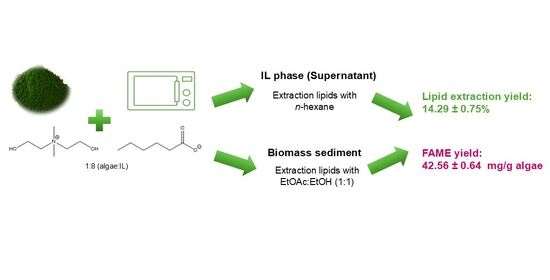
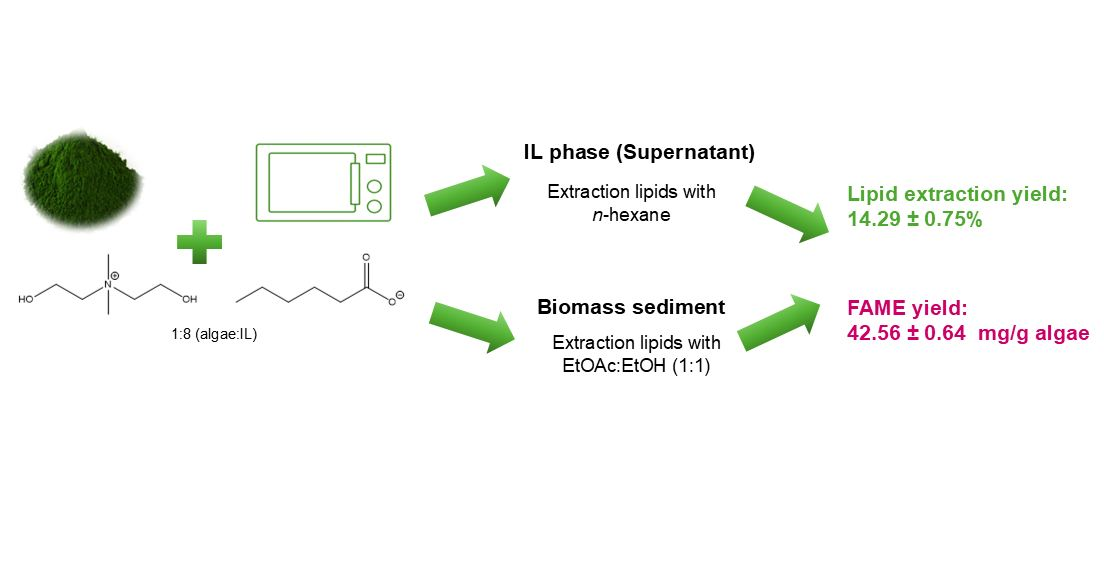
The sustainable extraction of microalgal lipids represents a critical step toward the valorization of biomass for nutraceutical, pharmaceutical, and biofuel applications. In this study, a microwave-assisted extraction approach using a biocompatible ionic liquid (IL), [N1 1 2OH 2OH][C6H11O2], was investigated for lipid recovery from Chlorella vulgaris. Conventional methods (Soxhlet, Folch, and Bligh & Dyer) were first evaluated for benchmarking. Optimization of microwave power, extraction time, and algae-to-IL mass ratio demonstrated that a 1:8 (m/m) ratio under 5 min and 750 W microwave pretreatment achieved the highest lipid yield, with 10.61 ± 0.39% lipids recovered from the supernatant alone. Subsequent extraction of the pretreated biomass using an environmentally benign solvent mixture (ethyl acetate/ethanol, 1:1 v/v) raised the total lipid recovery to 14.29 ± 0.75%, surpassing Soxhlet extraction with chloroform/methanol (13.04 ± 0.16%). Importantly, the IL was efficiently recovered (≈85%) and reused without significant loss of performance or structural integrity, as confirmed by NMR, DSC, and FTIR analyses. The combined process yielded up to 42.56 ± 0.64 mg FAMEs/g algae, comparable to conventional Soxhlet extraction but with superior environmental compatibility. The relative distribution of FAMEs (in weight percent, wt%) was as follows: C16:2 trans 6.05%, C16:3 trans 13.99%, C16:1 cis 1.85%, C16:1 trans 0.82%, C16:0 16.72%, C18:2 cis 13.74%, C18:3 trans + C18:1 cis + C18:2 trans 26.91%, C18:1 trans 1.67% and C18:0 3.61%. These findings demonstrate that microwave-assisted extraction with choline-based ILs offers an efficient, recyclable, and greener alternative for lipid and fatty acid recovery from microalgae.

Graphical Abstract

1. Introduction

The growing demand for health-promoting and environmentally friendly products has intensified interest in natural bioactive compounds with antioxidant, antiviral, antibacterial, anticancer, anticoagulant, anti-inflammatory, antihypertensive properties and other beneficial activities. These compounds, commonly extracted from plants, algae, and fish must be consciously explored and sustainably utilized [1,2,3,4,5].
Microalgae are promising renewable feedstocks, capable of producing lipids, proteins, polysaccharides, pigments, and other valuable molecules for applications in food, feed, cosmetics, pharmaceuticals, and biofuels [2,6,7,8]. Among them, Chlorella vulgaris (C. vulgaris) stands out for its rigid cell wall, high chlorophyll, protein, vitamin and mineral content, and its ability to accumulate lipids and carotenoids under specific conditions [1,4,9]. Rich in fatty acids, such as palmitic (C16:0), oleic (C18:1), linoleic (C18:2) and linolenic (C18:3) acids, C. vulgaris represents a potential alternative source for marine lipids [2,9].
Lipids are generally classified as reserve (neutral or non-polar) lipids, being stored as lipid droplets in the chloroplast and cytoplasm and membrane (polar or complex) lipids that are present in the cell wall and organelle membranes [1,2,10,11]. Among the different types of lipids are fatty acids, which differ in chain length and degree of unsaturation, ranging from saturated to monounsaturated and polyunsaturated fatty acids [12]. While, microalgal lipids and fatty acids exhibit diverse bioactivities, including antioxidant, antibacterial, antifungal, anti-inflammatory, antihypertensive, and immunomodulatory effects, also contributing to cardiovascular, neurological, and metabolic health [2,13,14,15,16,17,18,19,20,21,22,23,24,25,26,27,28,29], polyunsaturated fatty acids from microalgae have high nutritional value and are used in health products, functional foods, and dietary supplements. [30,31]. Microalgal oil is therefore considered a promising alternative to fish oil [2]. Essential omega-3 (ω-3, e.g., eicosapentaenoic acid (EPA), docosahexaenoic acid (DHA), and α-linolenic acid) and omega-6 (ω-6, e.g., linoleic acid, γ-linolenic acid, and arachidonic acid) are crucial for human health; fatty acids must be balanced in the diet, with a preference for higher omega-3 intake [32].
Over time, researchers have developed extraction methods for microalgal oils that reduce solvent and energy consumption and minimize environmental impact and cost, while improving yields and preserving lipid quality [33]. Microalgal cell walls are composed of complex polysaccharide (e.g., cellulose) and protein matrices, which makes them resistant to mechanical disruption and limits solvent penetration [34,35]. Having this in mind, efficient extraction requires suitable pretreatments to disrupt the cell wall and solvents with a polarity compatible with the target compounds [2,33].
Traditionally, lipid extraction from microalgae has relied on the Soxhlet [36], Folch [37], and Bligh & Dyer [38] methods, all using organic solvents. The Soxhlet method employs hexane at high temperatures, leading to high energy consumption [35]. In contrast, the Folch et al. method operates at room temperature with a chloroform–methanol mixture, while the Bligh & Dyer method, a modification of Folch, extracts total lipids using chloroform, methanol, and water. Both Folch and Bligh & Dyer methods efficiently recover neutral and polar lipids [10]. Hexane is preferred industrially due to its low polarity, which minimizes co-extraction of polar contaminants and its recoverability through fractional distillation. However, hexane is unable to extract lipids stored in lipid droplets, since it cannot penetrate the polar phospholipid membrane nor break protein bonds, resulting in inadequate lipid extraction [7,33,34].
Organic solvents are highly volatile, raising concerns for both human health and the environment. Chloroform is metabolized into reactive compounds like phosgene, causing liver and kidney toxicity, central nervous system damage, and potential carcinogenicity while persisting in air, water, and soil [39,40,41]. Methanol is converted to formaldehyde and formic acid, leading to metabolic acidosis, neurotoxicity, and severe retinal damage [40,42]. Hexane’s metabolite 2,5-hexanedione induces peripheral neuropathy, reproductive toxicity, and multi-organ oxidative damage [41,43]. Moreover, solvent-based extraction is often time-consuming, requires large solvent volumes, and frequently demands heating to high temperatures, which increases costs, energy consumption, and environmental impact [10,44]. Greener and more efficient extraction strategies are therefore needed, along with the recovery and reuse of solvents when replacement is not feasible. Pretreatment of biomass to weaken the robust microalgal cell walls is commonly employed to enhance lipid release under milder conditions [10,45]. The use of less harmful alternative solvents is crucial to reduce disposal costs, legal liabilities, and environmental impact [44,46]. In this context, “green solvents”, such as ionic liquids (ILs), have emerged as promising alternatives, demonstrating the potential to replace conventional solvents like chloroform, methanol, and hexane for extracting lipids and other bioactive compounds from microalgae [6,7,34,35,44,45,46,47,48,49,50,51,52,53,54,55,56].
ILs are organic salts with low melting point, typically below 100 °C, composed of organic cations and organic or inorganic anions. They offer unique properties, including high thermal and electrochemical stability, low vapor pressure, non-flammability, high conductivity, wide miscibility, excellent microwave absorption, and the ability to be recycled and reused. Many ILs also exhibit relatively low toxicity and can be synthesized in a cost-effective manner [2,6,7,34,46,53]. Their structural flexibility allows them to be “designer solvents,” with tunable melting points, viscosity, polarity, and miscibility to suit specific applications [8,44]. However, not all ILs are truly “green”: some are toxic, poorly biodegradable, or rely on fossil-derived reagents [2,10]. The environmental impact of ILs can nonetheless be minimized by the above-mentioned careful molecular design and efficient recycling. ILs based on imidazolium and pyridinium cations are generally toxic and poorly biodegradable, whereas choline-based ILs are safer and more sustainable [57,58,59]. ILs containing hydrolyzable esters, oxidizable alcohol groups, or carboxylic acids may exhibit enhanced biodegradability due to these functional moieties [10]. Nevertheless, the ultimate fate of the degradation products, including the central cation and anion, remains uncertain and may vary on a case-by-case basis. Long alkyl chains in the cation are generally associated with increased toxicity. Therefore, preparing ILs from inherently safer compounds, such as carboxylic acids, amino acids, and choline derivatives is essential [50,57,58,59,60,61,62,63,64,65] and their environmental footprint can be further reduced through effective reuse and recycling [66].
Currently, the application of ILs in microalgae lipid extraction, particularly from Chlorella species, has been investigated mostly for biodiesel production, with a predominant focus on commercially available imidazolium-based ILs [6,46,53,54,55,67,68,69,70,71,72,73,74,75,76,77,78]. Comparisons have been made with ILs derived from ammonium [34,35,44,79,80], phosphonium [35,81,82], pyridinium [35], pyrrolidinium [34,80], guanidinium, and DBU (1,8-diazabicyclo [5.4.0]undec-7-ene) [83] cations, while fewer studies have explored ILs exclusively from non-imidazolium cations [45,84,85,86,87,88,89,90], notably choline and its derivatives [87,88].
In the present work, lipid extraction was performed using a microwave-assisted ionic liquid (MAE–IL) approach. Microwave-assisted extraction (MAE) is an efficient technique to recover bioactive compounds from microalgae, as it uses microwave energy to heat the solvent in contact with biomass, ensuring uniform internal heating [2,34]. The rapid temperature rise and resulting pressure gradient disrupt hydrogen bonds and weaken or even rupture cell walls, facilitating solvent penetration and enhancing lipid release. Heating occurs via two mechanisms: dipole rotation and ionic conduction [91,92]. Thus, the efficiency of microwave absorption largely depends on solvent polarity, with strongly polar solvents showing greater absorption capacity [2]. Compared to conventional extraction methods, MAE provides higher extraction yields, fewer degradation products, greater efficiency, shorter extraction times, lower solvent consumption, and does not require prior sample drying [34,46,54]. Nevertheless, this technique also presents limitations, including relatively high energy demand, the need for post-extraction separation steps, and limited applicability for heat-sensitive compounds [92].
This study explores the use of IL and MAE, both individually and in combination, to enhance lipid extraction from Chlorella vulgaris. Their performance was compared with the traditional methods: Soxhlet, Folch, and Bligh & Dyer. The ionic liquid chosen features a choline-derived cation, part of the B-vitamin complex [58], providing biocompatibility and a hexanoic acid anion, a low-toxicity carboxylic acid. The recyclability of the IL was also addressed, as well as some critical parameters including solvent composition, biomass-to-solvent ratio, extraction time, microwave power, operating temperature, and water content. Combining MAE with ILs offers several advantages, including higher extraction yields, shorter extraction times, and reduced energy consumption [93].

2. Results and Discussion

2.1. Lipid Extraction Using Conventional Methods

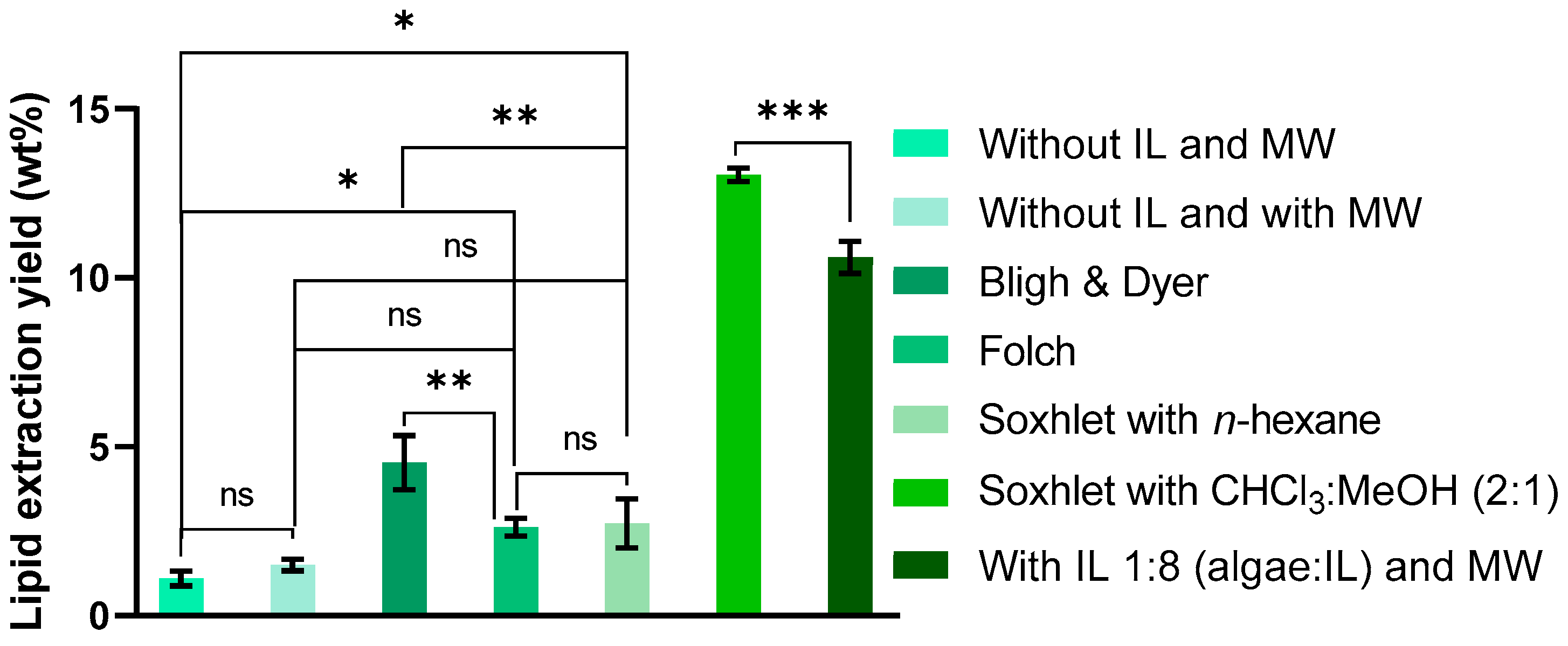
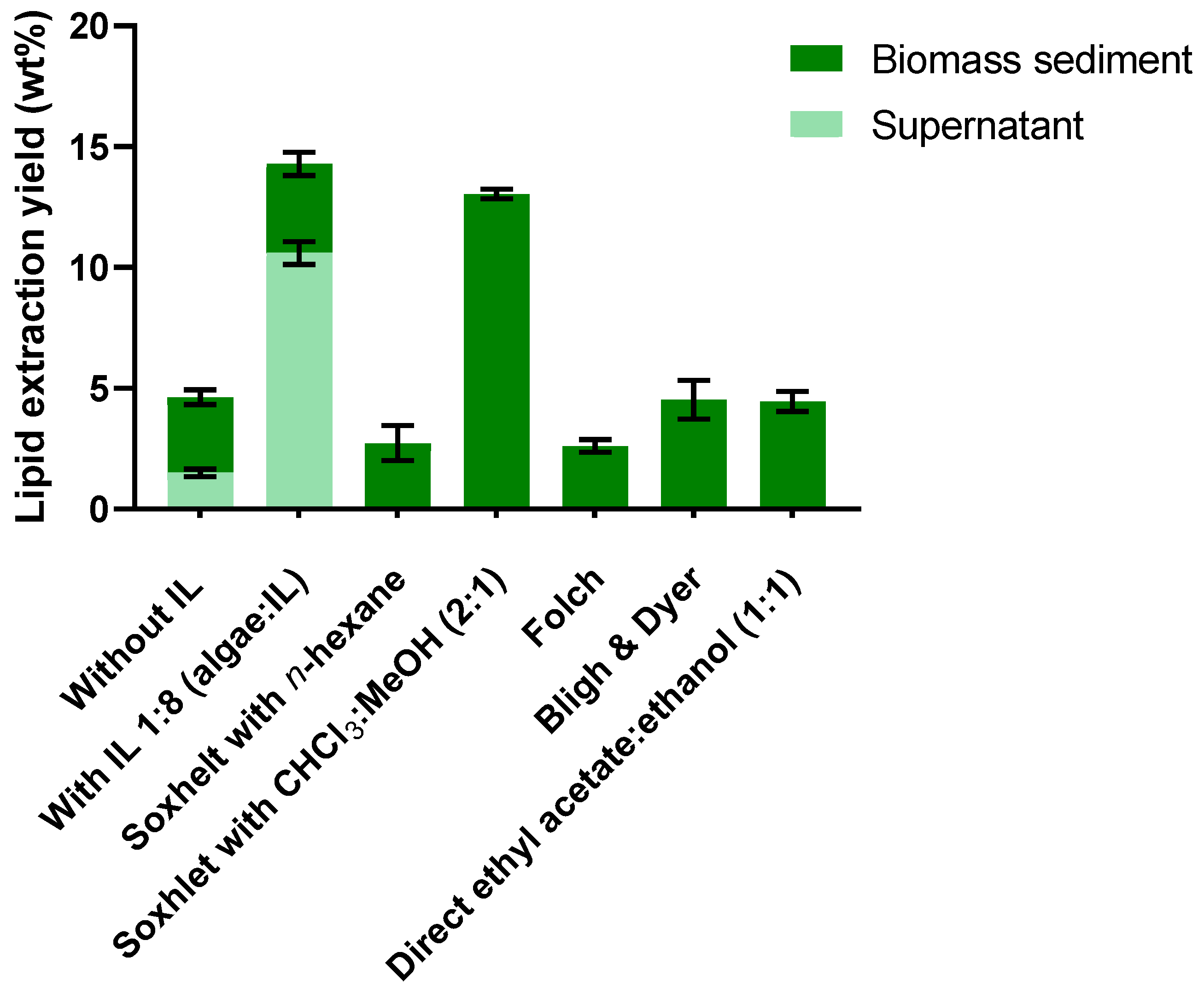
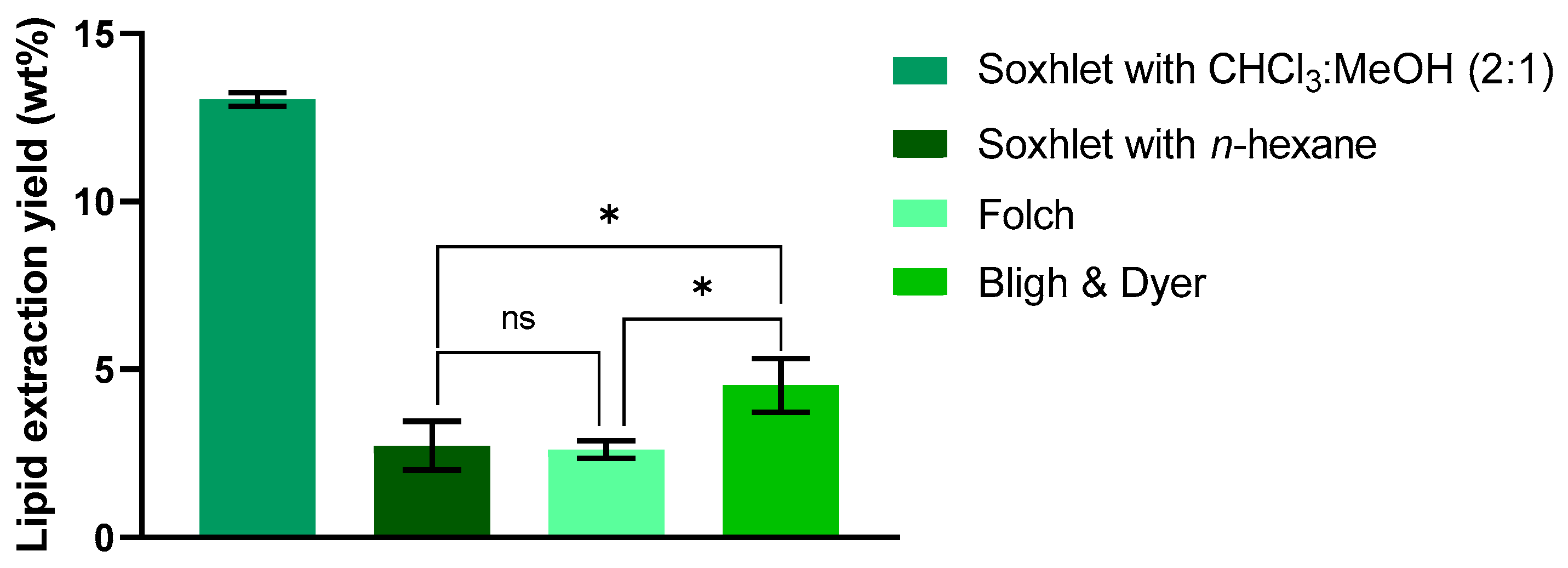
In order to isolate the total lipid fraction from Chlorella vulgaris and to rigorously assess the performance of the proposed optimized protocol, three well-established lipid extraction methodologies, Soxhlet, Folch, and Bligh & Dyer, were employed for comparative evaluation. As shown in Figure 1, lipid extraction yields varied considerably depending on the conventional method employed. The Soxhlet method with chloroform/methanol (2:1 v/v) achieved the highest yield (13.04%), approximately 4.8-fold greater than the obtained with Soxhlet using n-hexane.
This difference can be explained by solvent polarity. While hexane selectively extracts neutral lipids and minimizes co-extraction of polar compounds, resulting in a purer extract, polar solvents or mixtures such as chloroform/methanol can penetrate the polar phospholipid membrane (associated with proteins), breaking protein–lipid bonds and effectively extracting both neutral and polar lipids stored in lipid droplets. However, this broader solubilization also promotes the co-extraction of pigments and proteins, which may not be desirable in the final product [7,33,34,35]. Consequently, lipid yields obtained with chloroform/methanol (2:1) Soxhlet extraction may be overestimated. This is not only due to the presence of unwanted polar compounds but also to the fact that direct evaporation of the solvent mixture, without prior solvent separation (unlike the Folch and Bligh & Dyer protocols), leads to the retention of non-lipid polar compounds in the final extract.
Furthermore, both Folch and Bligh & Dyer methods produced lower lipid yields compared with Soxhlet extraction using chloroform/methanol. This discrepancy might arise from two main factors: (1) the use of an aqueous 0.88% NaCl solution to separate the chloroform and methanol phases, effectively removing polar impurities, and (2) the milder extraction conditions (room temperature, 10 min) relative to Soxhlet, which operates for 12 h at >70 °C.

2.2. Lipid Extraction from Biomass Residue (Sediment) with Chloroform/Methanol (1:1)

After evaluating the performance of the traditional methods for extracting lipids from algae, a more sustainable and improved procedure was developed using an ionic liquid with and without microwave-assisted extraction. The chemical and thermal characterization of the tested IL, [N1 1 2OH 2OH][C6H11O2], including 1H and 13C NMR, FTIR-ATR and DSC analyses, is presented in the Supplementary Materials (Figures S1–S4).
The synthesized IL [N1 1 2OH 2OH][C6H11O2] was selected due to its intermediate alkyl chain length, which provides a balanced polarity, avoiding the excessive polarity of shorter chains and the reduced polarity of longer ones, thus promoting lipid affinity while facilitating subsequent separation from the IL. Microwave irradiation was combined with this solvent to enhance cell wall disruption, thereby improving lipid extraction efficiency and enabling recovery of others bioactive compounds. For the extraction procedure, a mixture of chloroform and methanol (1:1, v/v) was used to obtain the results presented below, as detailed in Section 3.6.1. The overall extraction process is illustrated in the schematic provided in the Supplementary Materials (Figure S13).
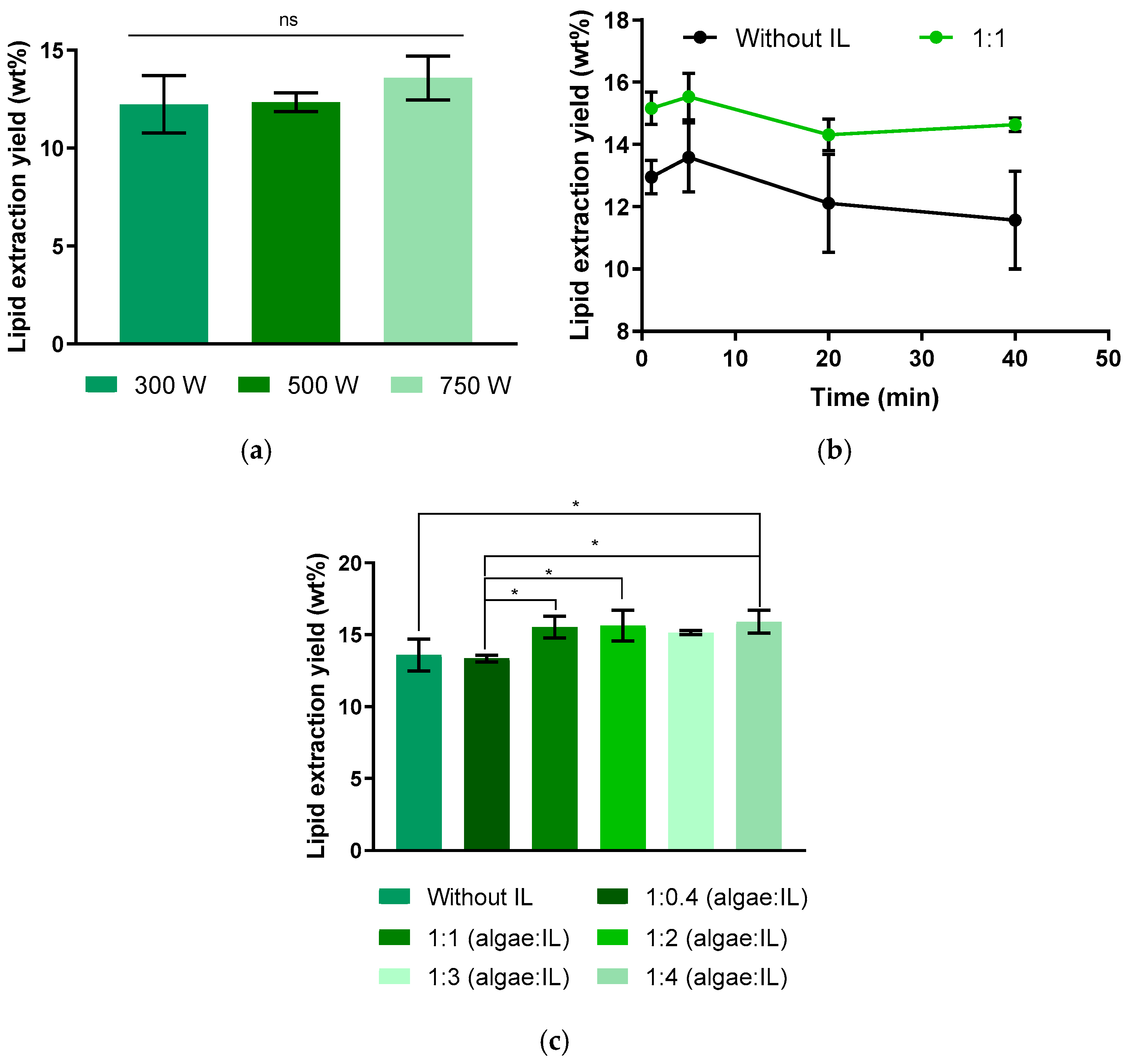
Initially, the power parameter was optimized, with tests conducted without the incorporation of IL and a sample treatment time of 5 min in MW. As shown in Figure 2a, the results obtained revealed that there was no significant difference in the lipid yield when the power was varied. For the subsequent tests, 750 W was defined as the optimum power, which was also the approximate power used in other studies [34,46,54,68]. Furthermore, the ideal time for the sample to remain in the microwave was evaluated in the absence or in the presence of IL at a mass ratio of 1:1 (algae/IL). Figure 2b indicates that 5 min was the optimal extraction time. Finally, the mass ratio between Chlorella vulgaris and IL was investigated. The results obtained for the proportions 1:0.4, 1:1, 1:2, 1:3, and 1:4 (algae/IL) (m/m) are shown in Figure 2c. Although the yields show small but statistically significant differences as the algae/IL ratio increases, a modest rise in lipid yield is observed at the four highest IL concentrations.

2.3. Lipid Extraction from IL Phase (Supernatant)

The amount of lipids found in the supernatant obtained during biomass pretreatment was also quantified. This lipid fraction, extracted solely through the combined action of microwaves and the ionic liquid (IL), was considered as the lipid extraction during pretreatment.
Lipids were isolated from the supernatant using n-hexane, as illustrated in the schematic provided in Figure S14 (bottom) and further experimental details are provided in Section 3.7. The contact time between the two phases, during which vigorous stirring was applied, was evaluated. According to Figure S5, the optimal stirring time was determined to be six hours, and this duration was subsequently adopted to maintain phase contact under agitation.
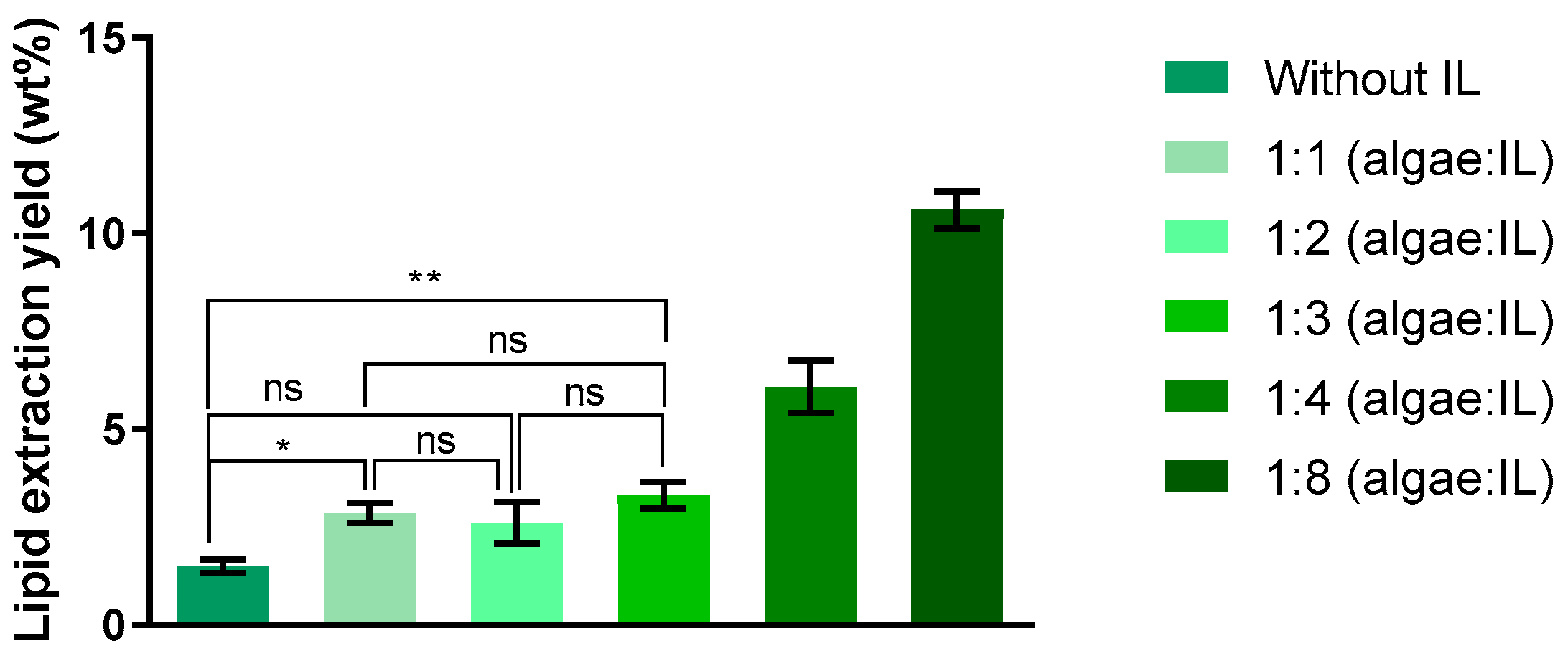
The results obtained clearly demonstrate the actual influence of the mass ratio (algae/IL) in the microwave pretreatment of Chlorella vulgaris on lipids extract obtained from supernatant (Figure 3). As there was an increase in the lipids present in the supernatant when going from a mass ratio of 1:3 to 1:4 (algae/IL), the biomass was also treated with 1:8 (algae/IL). When using mass ratios of up to 1:3 (algae/IL), the increase in lipid extraction yield is minimal or nearly negligible compared to the yield obtained without IL in pretreatment. However, when IL is added to the pretreatment at a mass ratio of 1:4 and 1:8 (algae/IL), the lipid content increases fourfold and sevenfold, respectively, compared to the pretreatment without IL. By using a 1:8 mass ratio (algae/IL), the highest lipid content is observed, reaching approximately 10.61 ± 0.39% (percentage of the total mass of algae used).
The results obtained reveal that a significant amount of lipids, or compounds with lipid affinity, is extracted from the algal biomass during the pretreatment. This suggests that these extracted components should be considered as part of an integrated process for the overall extraction of lipids from the algae.
To assess the impact of MW and IL, tests were performed with and without MW, as well as with and without IL, using algae/IL ratios of 1:1 and 1:4 (m/m). Figure S6 provides a direct comparison of lipid content with and without microwave radiation, both in the absence or in the presence of IL at two different mass ratios. The results indicate that, as the algae/IL ratio increases, the impact of microwave radiation on lipid yield becomes significantly more pronounced. When a mass ratio of 1:4 (algae/IL) is used, microwave pretreatment leads to an approximately 1.7-fold increase in lipid extraction yield compared to pretreatment without microwave application.
Figure 4 illustrates a comparison between the results obtained using the 1:8 mass ratio (algae/IL), which provided the highest lipid extraction yield, and those from various conventional extraction methods and control conditions, including pretreatment without microwaves and IL, as well as with microwaves and without IL.
Compared to the Bligh & Dyer method, which is the most widely used in the literature for total lipid extraction and method comparison, the 1:8 (algae/IL) ratio resulted in an increase in lipid yield from 4.53 ± 0.65% to 10.61 ± 0.39%.
It is important to note that the method tested here accounts solely for lipids present in the supernatant itself, without direct solvent extraction (e.g., hexane or chloroform/methanol) from the algae, as performed in the conventional methods. This suggests that the 1:8 (algae/IL) ratio could potentially extract even more lipids, since pretreatment facilitates cell wall disruption and IL penetration. However, some lipids may remain within the microalgae and not fully transfer into the IL during pretreatment. Results for the extraction of residual lipids still present in the pretreated algae will be presented in the following section. The tested IL, composed of a polar cation and a significantly less polar anion, enables the extraction of both polar and non-polar lipids, like mixtures of polar and non-polar solvents [7,33,34,35].

Characterization of the Extract by 1H NMR

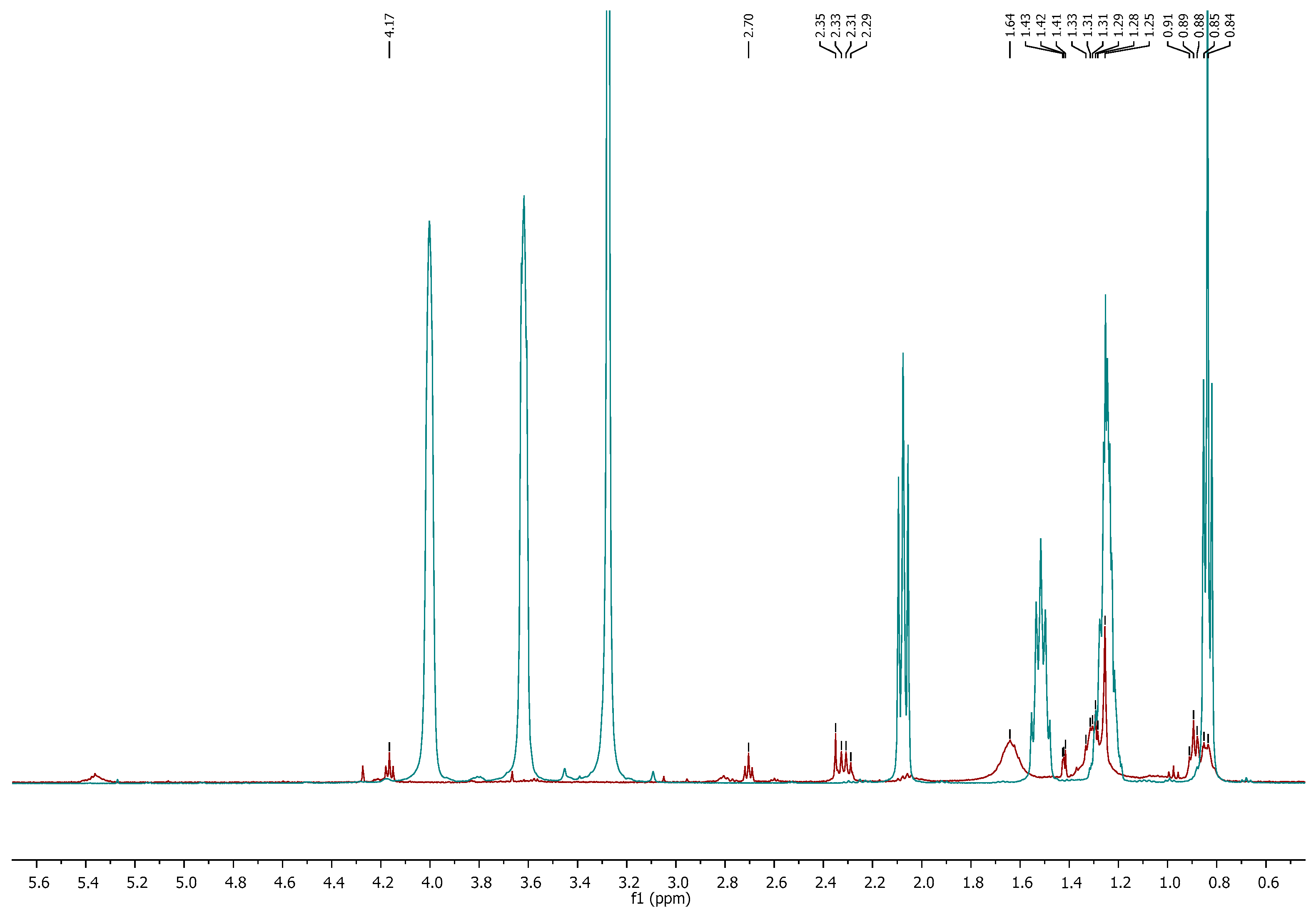
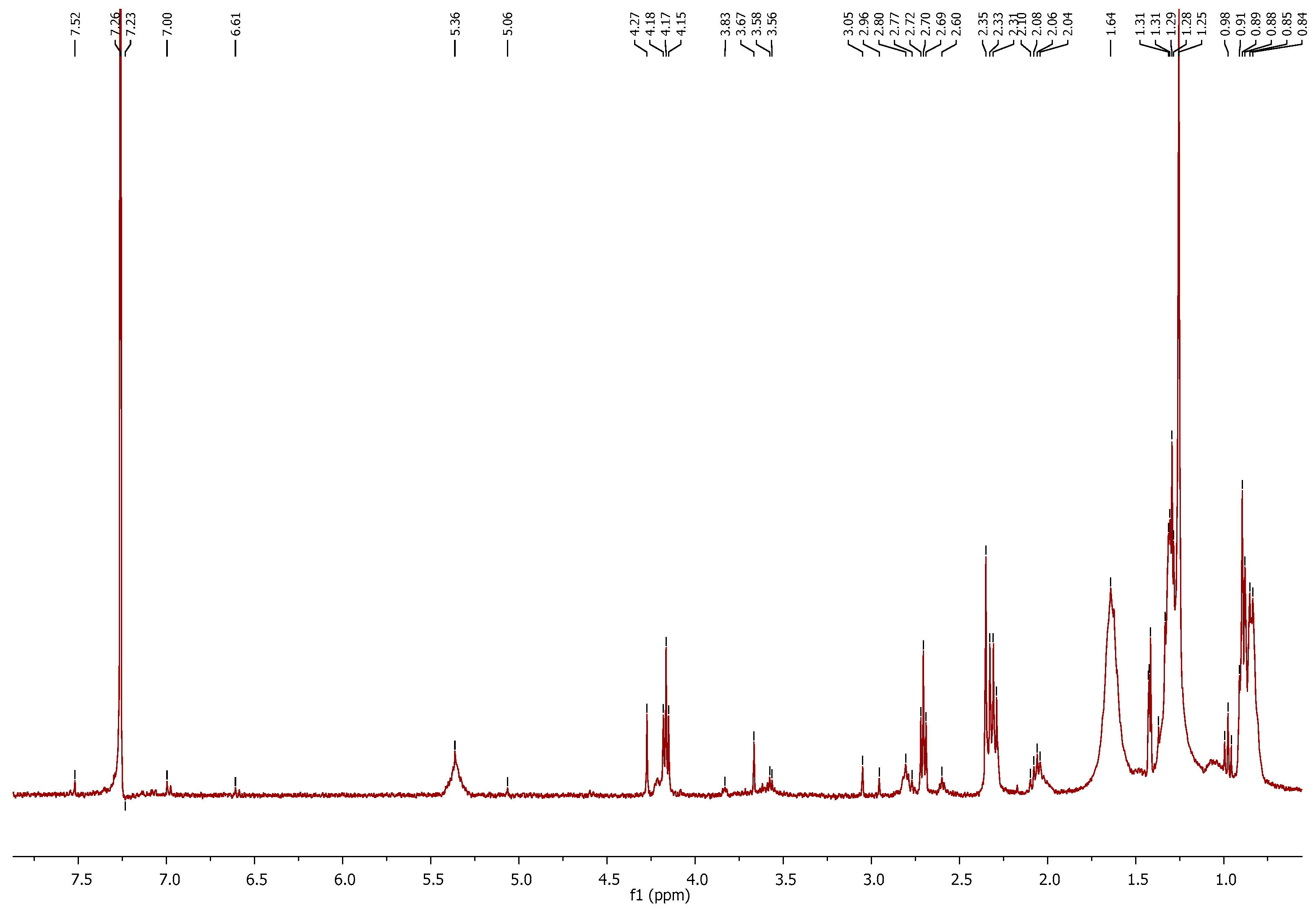
The analyzed extract, being the crude extract obtained directly from the extraction process, consists of a complex mixture of various lipid compounds, including triglycerides, diglycerides, monoglycerides, and free fatty acids. Figure 5 shows the spectrum obtained, which is in accordance with the NMR reported for other complex lipid mixtures [94]. Briefly, the chemical shift between 0.81 ppm and 0.86 ppm corresponds to the protons of the methyl group (CH3) in saturated and monounsaturated ω-9 and/or ω-7 acyl groups and fatty acids (FA). The peaks between 0.88 ppm and 0.91 ppm also correspond to the CH3 group but are associated with unsaturated ω-6 acyl groups and FA, while unsaturated ω-3 acyl groups and FA appear at a chemical shift of 0.96–1.00 ppm. The chemical shift between 1.25 ppm and 1.43 ppm corresponds to the -(CH2)n- protons of acyl groups and FA. At a chemical shift between 1.59 ppm and 1.69 ppm, the protons (-CH2CH2COOH or -CH2CH2OCO-) corresponding to the acyl groups in triglycerides, diglycerides, monoglycerides, and fatty acids can be observed. Around 2.06 ppm, the spectrum reveals the presence of -CH2CH=CH- protons associated with acyl groups and fatty acids. Between 2.28 ppm and 2.35 ppm, additional protons (-CH2CH2COOH, -CH2CH2OCO-) linked to the acyl groups in triglycerides, diglycerides, monoglycerides, and fatty acids are detected, further confirming the composition of the lipid extract. The chemical shift at 2.70 ppm (well-defined triplet) corresponds to the protons (=HC-CH2-CH=) of diunsaturated ω-6 acyl groups and fatty acids. Meanwhile, the peaks observed between 2.77 ppm and 2.84 ppm represent the protons (=HC-CH2-CH=) of polyunsaturated ω-6 and ω-3 acyl groups and fatty acids, respectively. The peaks corresponding to chemical shifts between 3.56 ppm and 3.84 ppm are associated with the protons (ROCH2-CHOH-CH2OH; ROCH2-CH(OR′)-CH2OH; HOCH2-CH(OR)-CH2OH; ROCH2-CHOH-CH2OH) of the glycerol group in 1-monoglyceride, 2-monoglyceride, and 1,2-diglyceride. Peaks around 4.15 ppm and 4.27 ppm correspond to protons (ROCH2-CHOH-CH2OR′; ROCH2-CHOH-CH2OH; ROCH2-CH(OR′)-CH2OR″; ROCH2-CH(OR′)-CH2OH) from the glycerol group in 1-monoglyceride, 1,2-diglyceride, 1,3-diglyceride, and triglycerides. The barely visible peaks around a chemical shift of 5.06 ppm correspond to protons (HOCH2-CH(OR)-CH2OH; ROCH2-CH(OR′)-CH2OH; ROCH2-CH(OR′)-CH2OR″) of the glycerol group in 2-monoglyceride, 1,2-diglyceride, and triglycerides. Finally, the chemical shift around 5.36 ppm is associated with protons -CH=CH- of the double bonds in acyl groups and free fatty acids. Due to the complexity of the sample, a more exhaustive NMR analysis would be required to accurately identify the fatty acids and determine their specific forms.

2.4. Total Lipid Extraction (Supernatant and Biomass Sediment)

With the objective of extracting lipids from the biomass after pretreatment with MW and IL, the conventional chloroform/methanol system previously tested was substituted with a more environmentally benign solvent mixture, ethyl acetate/ethanol (1:1 v/v). This choice was motivated by the fact that both solvents are considered suitable for use, according to solvent selection guides, based on safety, health, and environmental criteria aligned with the Globally Harmonized System and European regulations, whereas chloroform is classified as highly hazardous [95]. The overall extraction process is illustrated in the schematic provided in Figure S14 and further experimental details are provided in Section 3.6.2.
Figure 6 presents the total lipid extraction yield for C. vulgaris, including both the lipids recovered from the supernatant and those extracted from the pretreated biomass. Direct ethyl acetate/ethanol (1:1) represents the lipid yield obtained through direct extraction from the microalgae using an ethyl acetate/ethanol (1:1 v/v) solvent mixture, without any prior pretreatment. For comparative analysis, the results obtained using four conventional extraction methods tested in this work for C. vulgaris are also presented in Figure 5.
Analyzing the results in Figure 6, the lipid yield extracted from biomass pretreated (extraction in the biomass sediment) without IL was 3.12 ± 0.25%, a value like that obtained from extraction in the supernatant. In the case of algae pretreated with IL, 3.69 ± 0.40% of lipid compounds were extracted. The total lipid yield (from both the supernatant and sedimented biomass) obtained with IL treatment was 14.29 ± 0.75%, more than twice that achieved with MW treatment alone. It was also slightly higher than the yield obtained using the Soxhlet method with CHCl3:MeOH (2:1) (13.04 ± 0.16%), and significantly superior to the yields from all other methods tested.

2.5. Recovery of Ionic Liquid

On average, 84.80 ± 7.18% of the IL employed in the extraction was successfully recovered across. When reused, IL [N1 1 2OH 2OH][C6H11O2] exhibited no significant difference in lipid extraction yield compared with pure IL (11.22 ± 0.73% vs. 10.61 ± 0.39%).
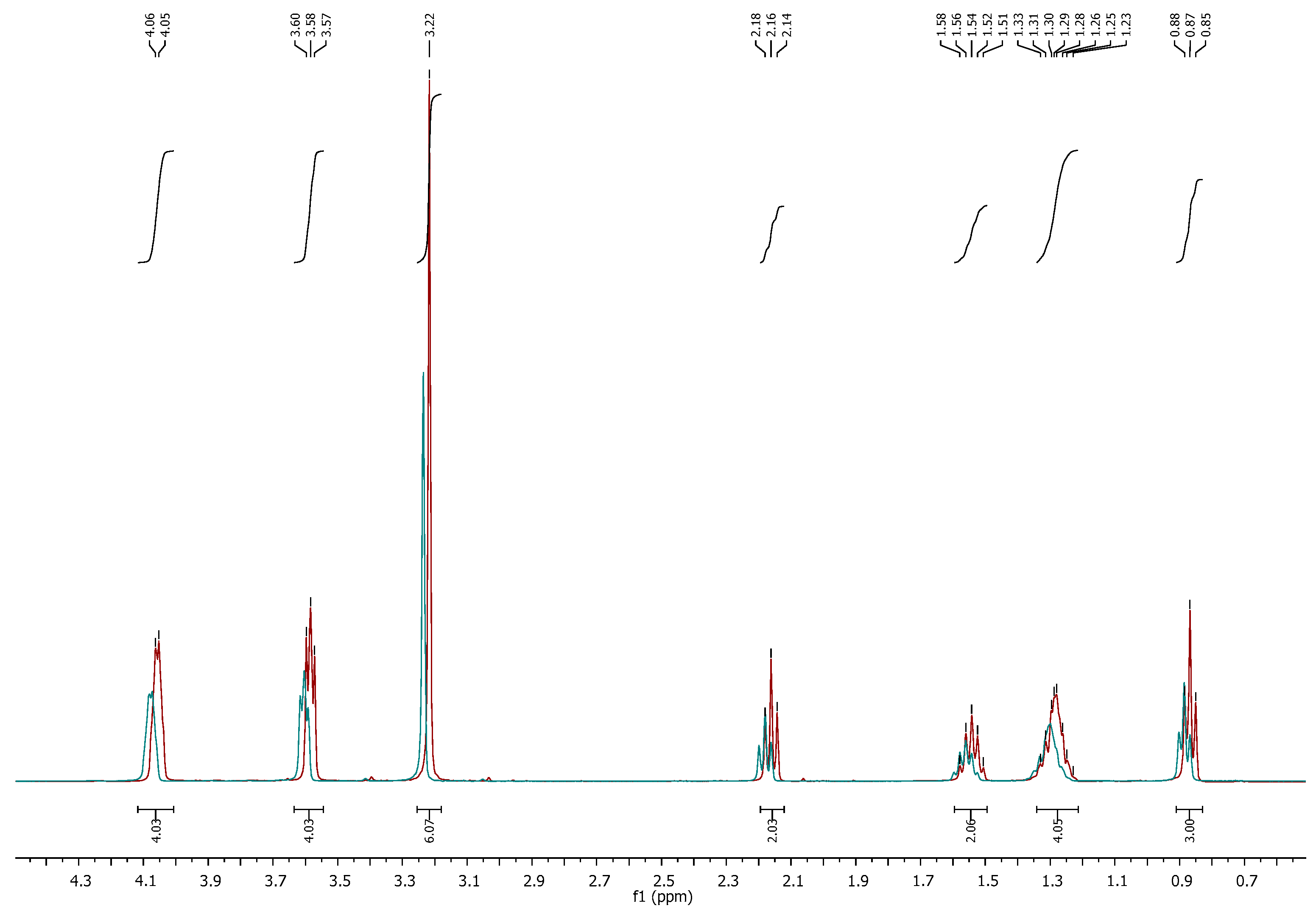
Characterization of the recovered IL by 1H NMR, DSC, and FTIR confirmed that it maintained its structural integrity despite a slight coloration, likely attributable to residual pigments such as chlorophylls [35]. As shown in Figure 7, the 1H NMR spectrum of the reused IL (red) overlapped with that of the pure IL (blue), demonstrating the absence of relevant contamination and confirming its suitability for reuse.
The glass transition temperature of the recovered IL [N1 1 2OH 2OH][C6H11O2] (−78.52 °C) was nearly identical to that of the pure IL (−80.07 °C), confirming the preservation of its physicochemical properties (Figure S7). Similarly, the FTIR-ATR spectra (Figure S8) demonstrated that IL recovered from extractions performed at different mass ratios (1:1, 1:4, and 1:8, algae/IL) displayed the same characteristic vibrational bands as the pure IL, further validating its structural integrity.
To confirm the effective separation of lipids from the IL, the obtained extracts, from the supernatant, were analyzed by 1H NMR and FTIR-ATR. As illustrated in Figure 8, the 1H NMR spectrum of the lipid extract obtained after MW-assisted pretreatment with IL at a mass ratio of 1:8 (algae/IL) showed no detectable IL signals. This result, further supported by FTIR analysis (Figure S9), confirms the absence of [N1 1 2OH 2OH][C6H11O2] in the lipid extract, demonstrating the effective separation of lipids from the IL.
FTIR analysis of the extracts obtained at algae/IL ratios of 1:4 and 1:8 (Figure S9) revealed no evidence of residual [N1 1 2OH 2OH][C6H11O2]. Although some spectral similarities were expected due to the presence of hexanoic acid in the IL, the results confirm that the extracts were free of IL contamination. The weak peaks around 3000 cm−1 and 1658 cm−1 correspond to C=C stretching vibrations, while the broad OH band near 3200 cm−1, prominent in the IL spectrum, was markedly reduced in the extracts, reflecting the absence of the hygroscopic IL. In contrast, the stronger band at ~1740 cm−1, attributed to C=O stretching, further distinguished the lipid extracts from the IL [96,97,98,99,100,101].

2.6. Fatty Acid Methyl Esters (FAMEs) Composition Analysis

The results of the FAME composition analysis for the species tested, as well as for the different methods and conditions evaluated, are presented below.
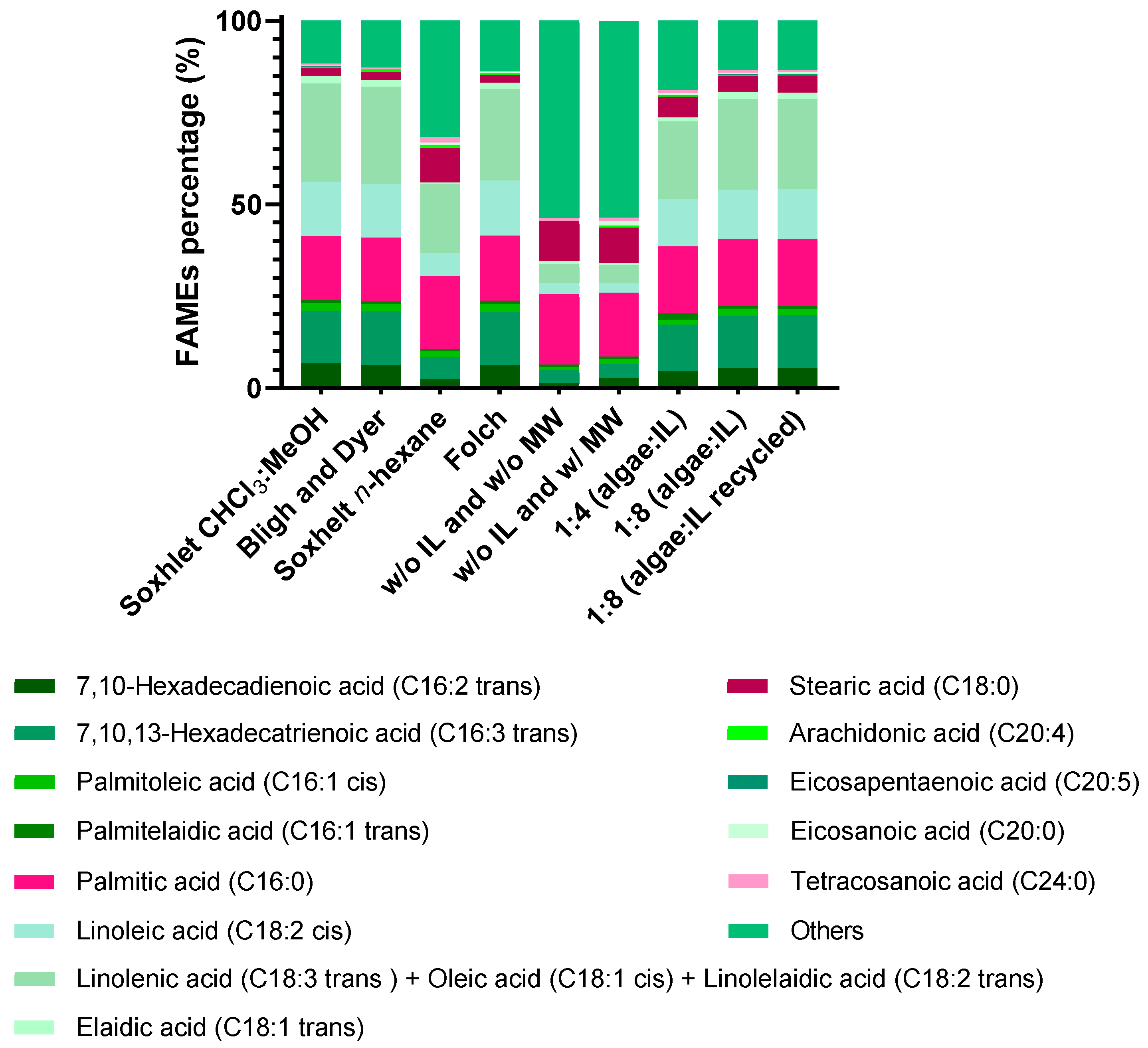
In the following figures, “Others” refers to a group that includes the following methyl esters of the compounds: butyric acid (C4:0), caproic acid (C6:0), capric acid (C10:0), lauric acid (C12:0), myristic acid (C14:0), pentadecanoic acid (C15:0), 15-Methylpalmitic acid, a mix of compounds to C17-derived FAMEs, Cascarillic acid, 8,11,14-heptadecatrienoic acid, (C17:3 cis) and margaric acid (C17:0).

2.6.1. FAMEs Composition Obtained from IL Phase (Supernatant)

Figure 9 illustrates that increasing the algae-to-IL mass ratio results in a FAME profile (relative percentage of each FAME) that more closely resembles that obtained through conventional methods, particularly at a 1:8 (algae/IL) ratio. Additionally, when recycled IL is used, the FAME profile remains largely unchanged compared to pure IL.
At a 1:8 mass ratio (algae/IL) combined with MW for just 5 min as a pretreatment, approximately 57% of the FAMEs obtained by the Soxhlet method with chloroform/methanol (2:1) (43.10 mg/g; Table 1 and Figure S10) were extracted from the supernatant phase, corresponding to 24.46 mg/g (Table 2 and Figure S10). In comparison, the Bligh & Dyer method, traditionally used as a benchmark, yielded 17.41 mg/g (Table 1 and Figure S10). The use of recycled IL at the same 1:8 mass ratio slightly increased the FAME yield to 25.08 mg/g (Table 2 and Figure S10), indicating that recycling the IL does not significantly affect extraction efficiency.
The amounts of each FAME obtained by conventional extraction methods and those recovered from the supernatant of C. vulgaris using different conditions are reported in Table 1 and Table 2, respectively.

2.6.2. FAMEs Total Composition Obtained (Supernatant and Biomass Sediment)

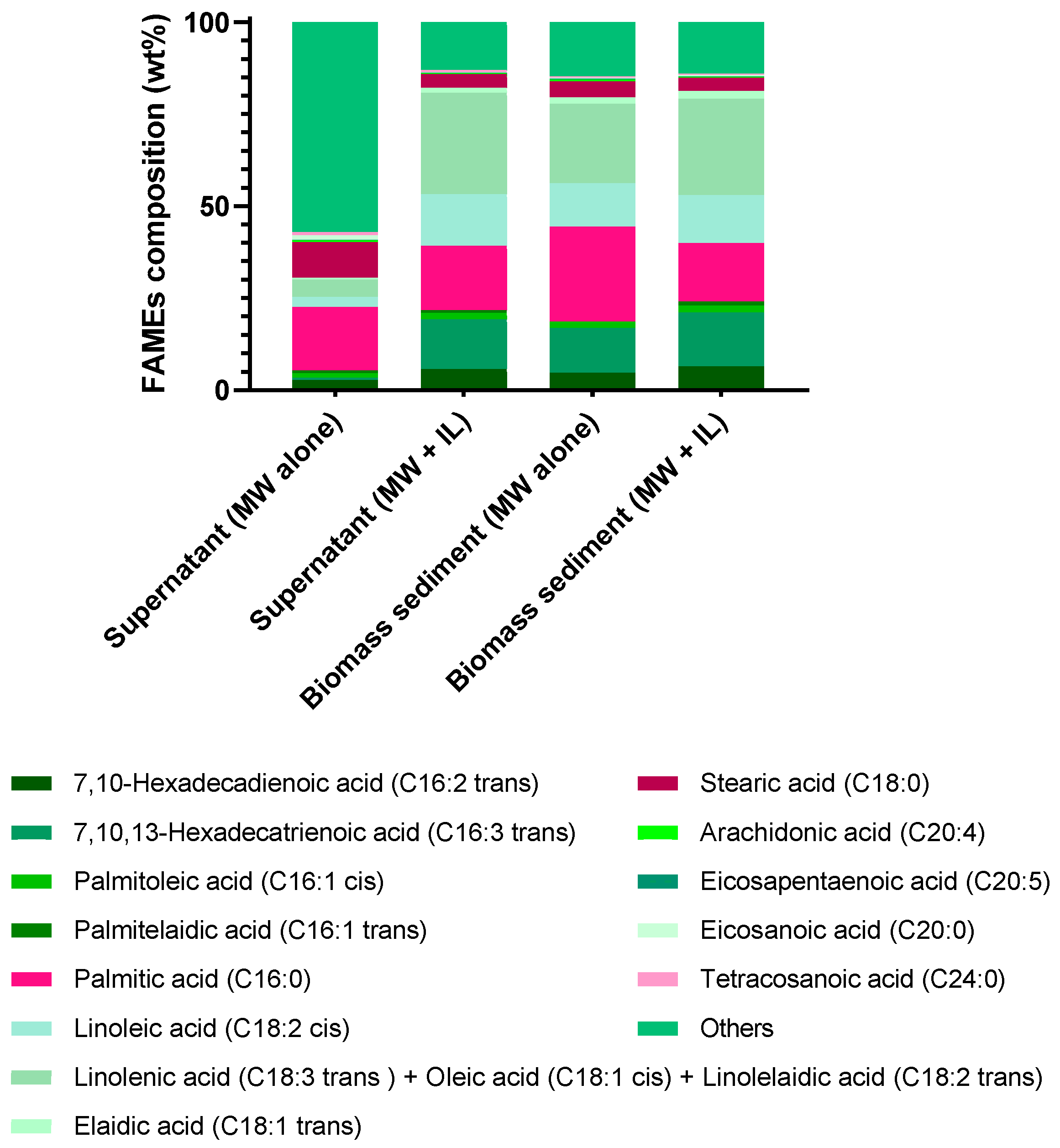
Figure 10 and Figure S11 present the FAME profiles and yields, respectively, obtained from the supernatant and biomass sediment of C. vulgaris after MW pretreatment in the presence or absence of [N1 1 2OH 2OH][C6H11O2] at a 1:8 mass ratio (algae/IL). The FAME profile in the supernatant obtained without IL differed substantially from that obtained with IL and from the profiles in the sedimented biomass. By contrast, the FAME profiles of the biomass sediment showed high similarity between treatments with and without IL. Importantly, the use of IL resulted in consistent FAME profiles in both supernatant and biomass fractions, indicating that IL does not alter lipid composition but enhances extraction efficiency. Quantitatively, 18.09 ± 0.35 mg FAMEs/g algae were recovered from the biomass sediment after MW pretreatment with IL, compared with 16.32 ± 0.45 mg FAMEs/g algae without IL (Figure S11 and Table 3).
A distinct FAME profile observed in the supernatant obtained without IL (first bar in Figure 10) can be attributed to differences in compounds affinity during the pretreatment. In the absence of IL, only water interacts with the algae, favoring the extraction of more hydrophilic compounds, which are predominantly shorter-chain FAMEs categorized as “others” in the figure. In contrast, when IL is used, it enables the extraction of less polar compounds with higher affinity for the IL, such as longer-chain FAMEs (C18 and above). Consequently, in the biomass fraction after water-only pretreatment, most short-chain compounds have already been removed, resulting in a FAME profile that is more like that obtained with IL-assisted treatment (third and fourth bar in Figure 10).
The total FAME yield obtained from both phases (supernatant and biomass sediment) after MW pretreatment combined with [N1 1 2OH 2OH][C6H11O2] reached 42.56 ± 0.64 mg/g algae. This value is comparable to that achieved with the conventional Soxhlet method using chloroform/methanol (2:1) (43.10 ± 0.21 mg/g algae) and exceeds the yields obtained with the Bligh & Dyer method, direct extraction with ethyl acetate/ethanol (1:1), and MW pretreatment alone by 2.4-, 2.7- and 2.0-fold, respectively (Figure S12). The detailed distribution of individual FAMEs extracted from the biomass sediment of C. vulgaris is provided in Table 3.
Based on the results of this study, it can be concluded that microwave irradiation and ionic liquids act synergistically to improve lipid accessibility through the simultaneous acceleration of cell-wall deconstruction and mass transfer. Microwave pretreatment is one of the most effective methods for disrupting microalgal cells prior to lipid extraction. Microwaves interact directly with polar molecules, such as water, converting electromagnetic energy into heat through dipole rotation. This leads to rapid and uniform volumetric heating within the biomass, generating localized pressure and temperature gradients that rupture the cell walls and enhance lipid release. The process increases solvent penetration, reduces extraction time, and minimizes solvent use while avoiding significant thermal degradation of lipids [102].
Beyond these thermal and physical effects, the presence of ionic liquids further enhances the disruption process through chemical interactions. ILs can disrupt the hydrogen-bonded polysaccharide network of the microalgal wall via strong Coulombic and hydrogen-bonding forces. These interactions can, in some systems, promote partial hydrolysis or dissolution of wall components without added catalysts at 100–140 °C, thereby facilitating the release of intracellular contents [73].
In the work by S Rezaei Motlagh et al. [103], IL-microwave-assisted extraction studies on Nannochloropsis gaditana evidenced cleavage of glycosidic linkages and marked surface disruption of the cell walls, consistent with increased IL penetration and lipid diffusion. The same work reported multi-fold gains in total lipid and EPA yields versus Soxhlet, aligning with the above physicochemical picture.
As previously mentioned, the lipid and FAME content in Chlorella vulgaris is highly influenced by cultivation conditions, which makes direct comparisons with results from the literature challenging. However, the results obtained in this study were significantly higher than those reported by Kim et al. [74], in which biomass pretreated with [Bmim][MeSO4] combined with ultrasound yielded only 74 mg/g dry cell weight of lipids. In contrast, under optimal conditions in the present study, it was possible to extract approximately 143 mg/g. The FAME content was also superior, reaching 42.56 mg/g (total), compared to 33.3 mg/g dry cell weight reported in the referenced study. In the study by Olkiewicz et al. [85], the lipid yield obtained using [P(CH2OH)4]Cl treatment (8.1%) was lower than the yields achieved in the present study (14.29%). Additionally, the FAME content reported in their study was comparable to that obtained in this work. In the study by Krishnan et al. [68], the FAME yields obtained using three different ILs ([Omim]Br, [Omim][OAc] and [Omim][NTf2]) in combination with MW radiation were markedly lower than those achieved in the present study. Moreover, the lipid contents achieved by those authors (~13.5, 19.5 and 8.5% for the respective ILs) were also inferior to the total lipid recovery observed here, considering both supernatant and biomass sediment fractions (14.29%). Kim et al. [55] reported that ILs [Bmim][CF3SO3], [Emim][MeSO4], [Bmim][MeSO4], and [Emim]Cl exhibited higher selectivity for FAME extraction, ranging from 73.09 to 111.36 (mg/g DW), as evidenced by greater FAME yields compared to the present work. However, total lipid recovery was lower than that obtained here. Furthermore, ILs with imidazolium cations are generally more toxic and less biodegradable than ILs with choline-derived cations [50,57,58,59,60,61,62,63,64,65]. In the work of Krishnan et al. [71], some of [Omim]Br (~24% lipids recovery at an IL concentration of 2.5%) and [Omim][OAc] (~22% lipids recovery at 2.5%) tested led to higher lipid extraction efficiency than observed in this study. Choi et al. [6] demonstrated that treatments based on other imidazolium salts resulted in superior lipid (~40–250 mg/g cell) and FAME (~940 mg/g lipid) recoveries compared to those achieved in this study. Nevertheless, it is noteworthy that their process was performed at higher temperatures (120 °C) and for longer time (2 h), which may account for the enhanced extraction performance.
Table S1 summarizes the mass balance for the lipids and FAMEs obtained in this study, allowing a direct comparison between the traditional methods and MAE-IL approach. Overall, using the ionic liquid as a pretreatment enabled the valorization of the supernatant, a fraction rarely explored in the literature but notably rich in lipids (10.61 ± 0.39% of the total 14.29 ± 0.75% obtained at a 1:8 (m/m) ratio, 5 min, 750 W, 60 °C) and in FAMEs (24.46 ± 0.48 mg/g algae). This approach clearly outperformed the conventional methods, yielding higher lipid extraction (14.29% vs. 2.61–4.53%). Although Soxhlet extraction with chloroform and methanol provided the best lipid yield (13.04 ± 0.16%) in a single step, the overall procedure requires the use of hazardous solvents whose use is increasingly discouraged.

3. Materials and Methods

3.1. Materials

Chlorella vulgaris was supplied by ALLMICROALGAE—Natural Products, S.A. (Pataias, Portugal). The microalgae used in this study were cultivated under sustainable autotrophic conditions, relying on sunlight and carbon dioxide (CO2) as energy and carbon sources, respectively, while releasing oxygen as a byproduct. Diethyl ether (≥99.8%), chloroform (99.0–99.4%), methanol (≥99.8%), and sodium sulfate (≥99.0%) were purchased from Honeywell—Riedel-de-Haën (Seelze, Germany). 2-chloroethanol (99.0%), tetradecane (≥99.0%), nonane (≥99.8%), boron trifluoride–methanol solution (14% in methanol) and Supelco 37 Component FAME Mix standard (CRM47885) were acquired from Sigma-Aldrich (Darmstadt, Germany). Hexanoic acid (>98%) and 2-dimethylaminoethanol (≥99.0%) were achieved from TCI chemicals (Zwijndrecht, Belgium). Acetone (for analysis), acetonitrile (for analysis), and n-hexane (≥99.0%) were purchased from Carlo Erba Reagents (Val-de-Reuil, France), deuterium oxide (99.9%), dimethylsulfoxide D6 (99.8%), and chloroform D (99.8%) were achieved from Eurisotop (Saint-Aubin, France). AmberliteTM IRN-78, n-hexane, sodium hydroxide, and sodium chloride (for analysis) were obtained from Alfa Aesar (Ward Hill, MA, USA), Valente e Ribeiro Lda. (Alcanena, Portugal), LabChem (Zelienople, PA, USA), and PanReac Applichem (Barcelona, Spain), respectively.

3.2. Synthesis of Ionic Liquid

3.2.1. Synthesis of [N1 1 2OH 2OH]Cl

2-Dimethylaminoethanol was mixed with 1.1 equiv. of alkylating agent, 2-chloroethanol, and n-hexane in a 100 mL pressure reaction vessel. This mixture was kept at 80–90 °C for 24 h. The ionic liquid was thoroughly washed with diethyl ether to remove the unreacted alkylating agent. Ionic liquid was then dried in the vacuum for 1–2 days, and its purity confirmed by 1H and 13C NMR. This IL was obtained in 95–99% yield. Chemical structure of [N1 1 2OH 2OH][C6H11O2] is shown in Figure S15.

3.2.2. Synthesis of [N1 1 2OH 2OH][C6H11O2] via Metathesis Reaction

An aqueous solution of N-alkyl derivative cholinium chloride was slowly passed through an anion exchange column AmberliteTM IRN-78 and the corresponding hydroxide solution was added and stirred at room temperature to a solution of hexanoic acid (1.0 equiv.) diluted in a mixture of water and acetone. The water and acetone were then removed from the reaction mixture by evaporation. Ionic liquid was washed with diethyl ether and dried in high vacuum for 2 days at 40–50 °C to guarantee minimum water content. Moreover, AgNO3 test was used to confirm the absence of halogen presence in the final IL. IL was characterized by 1H and 13C NMR, FTIR-ATR, and DSC (Figures S1–S4).

3.3. Analytical Techniques

3.3.1. Nuclear Magnetic Resonance (NMR)

1H and 13C NMR spectra were recorded on a Bruker Avance III 400 MHz spectrometer (Bruker, Bremen, Germany) using DMSO-d6, CDCl3-d, or D2O as a deuterated solvent. Chemical shifts (δ) are given in ppm and coupling constants (J) are given in Hz. The multiplicities of signals in 1H NMR are given with chemical shifts (s = singlet, t = triplet, qt = quartet, and m = multiplet).

3.3.2. Attenuated Total Reflectance-Fourier Transform Infrared (FTIR-ATR)

Fourier transform infrared (FTIR) spectra over the range 400–4000 cm−1 were collected at room temperature using a Cary 630 FTIR spectrometer equipped with a diamond attenuated total reflectance (ATR) of Agilent Technologies (Santa Clara, CA, USA), with a thermoelectrically cooled dTGS detector and KBr standard beam splitter. All the spectra were recorded via ATR method with a resolution of 1 cm−1, 16 scans.

3.3.3. Differential Scanning Calorimetry (DSC)

The calorimetric experiments were carried out with a DSC Q2000 from TA Instruments Inc., New Castle, DE, USA (Tzero DSC technology) operating in the Heat Flow T4P option. Measurements were performed under anhydrous high purity nitrogen at a flow rate of 50 mL/min. The DSC Tzero calibration was carried out in the temperature range from −90 to 200 °C. Roughly, 10 mg of IL was encapsulated in TA Tzero a hermetic aluminum pan with a lid. The procedure consisted of 3 consecutive cooling and heating cycles: (a) cooling ramp to −90 °C at 10 °C/min; (b) heating ramp at 10 °C/min to a temperature of 160 °C. Glass transition temperature (Tg) was determined on the second heating run.

3.4. Lipid Extraction Using Conventional Methods

To extract the total lipids from the studied Chlorella vulgaris and to evaluate the efficiency of the optimized method proposed, three conventional lipid extraction methods were employed: Soxhlet, Folch, and Bligh & Dyer.

3.4.1. Soxhlet Extraction Method

Soxhlet apparatus was used for the oil extraction from microalgae using hexane or chloroform/methanol 2:1 (v/v) as solvent [36]. Oil was extracted from 0.5 g of dried biomass placed in a cellulose thimble using 50 mL of either hexane or chloroform/methanol (2:1, v/v) as solvent. The system was refluxed for 12 h (~70 cycles). After extraction, the solvent was evaporated at 40 °C using a rotary evaporator (BUCHI Rotavapor R-300, BUCHI, New Castle, DE, USA), and the residue was dried under vacuum until constant weight for gravimetric lipid quantification.

3.4.2. Folch Extraction Method

Lipid extraction was performed following the Folch method [37,104]. Briefly, 0.5 g of dried biomass was vortexed with chloroform/methanol (2:1 v/v; 20:1 solvent-to-sample ratio) for 10 min. The mixture was filtered and rinsed twice with the same solvent. The combined filtrate was transferred to a separatory funnel and a final chloroform/methanol/water ratio of 8:4:3 was achieved by adding 0.88% NaCl solution. The mixture was stirred for 10 min and allowed to separate into two phases. The lipid-rich chloroform phase (lower layer) was collected and concentrated by rotary evaporation at 40 °C. The extract was transferred to a pre-weighed flask and dried under vacuum at 40 °C to constant weight. Lipid content was determined gravimetrically.

3.4.3. Bligh & Dyer Extraction Method

Bligh & Dyer extraction was performed following the original procedure [38]. Briefly, 0.5 g of dry biomass was mixed with chloroform, methanol, and Milli-Q water at a ratio of 1:2:0.8 (v/v/v) and homogenized for 5 min. Additional chloroform was then added, and the mixture was homogenized for another 5 min. The mixture was filtered, and the biomass was re-extracted twice under the same conditions. The combined extracts were transferred to a separatory funnel and 0.88% NaCl solution was added to achieve final solvent proportions of 2:2:1.8 (chloroform/methanol/water, v/v/v). After phase separation, the lipid-rich chloroform phase (lower layer) was collected and concentrated by rotary evaporation at 40 °C. The extract was transferred to a pre-weighed flask and dried under vacuum at 40 °C to constant weight. Lipid content was determined gravimetrically.

3.5. Pretreatment of Chlorella vulgaris with IL and Microwave-Assisted Extraction

A microwave digestion system (Milestone Ethos 1600 Microwave Labstation, Milestone, Sorisole, Italy) equipped with a six-vessel carousel was used for the experiments. One vessel was fitted with a built-in temperature probe to monitor and control the reaction temperature throughout the process. Each poly(tetrafluoroethylene) (PTFE) vessel was provided with a single-port lid equipped with a pressure relief valve to regulate any excessive pressure. The system operated at a frequency of 2.45 GHz, and different microwave power levels (300, 500, and 750 W) were tested to optimize the operating conditions, together with four irradiation times (1, 5, 20, and 40 min), all performed at 60 °C. Power optimization was conducted without IL, whereas time optimization was performed both without IL and with IL at a 1:1 mass ratio (algae/IL). Subsequently, the algae-to-IL mass ratio was evaluated at 1:0.4, 1:1, 1:2, 1:3, 1:4, and 1:8. Each assay contained 0.5 g of C. vulgaris mixed with 0.4 mL (80% of algal biomass weight) of water or an aqueous solution of [N1 1 2OH 2OH][C6H11O2] at the desired proportion.

3.6. Lipid Extraction from Biomass Residue (Sediment)

After cooling, the suspension was centrifuged (VWR Mega Star 600R, Thermo Fisher Scientific, Waltham, MA, USA) at 9500 rpm for 20 min, and the supernatant was collected. The biomass pellet was then washed with 10 mL of Milli-Q water under agitation for 1 h, followed by a second centrifugation under the same conditions. The resulting supernatant was combined with the first, and the procedure was repeated twice more to ensure complete removal of residual ILs.

3.6.1. Lipid Extraction from Biomass Residue (Sediment) Using Chloroform/Methanol (1:1 v/v) Mixture

Subsequently, 10 mL of chloroform/methanol (1:1 v/v) was added to the pretreated biomass sediment and stirred at room temperature for 1 h. The mixture was centrifuged, and the interphase was collected. This procedure was repeated twice, and the three supernatants were combined. The solvent was removed by rotary evaporation at 40 °C, and the resulting lipid extract was transferred to pre-weighed vials and dried under vacuum at 40 °C to constant weight. Lipid content was determined gravimetrically using Equation (1). The extraction process is illustrated in Figure S13.
p e r c e n t a g e   l i p i d   e x t r a c t = m l i p i d   e x t r a c t m b i o m a s s × 100 %

3.6.2. Lipid Extraction from Biomass Residue (Sediment) Using Ethyl Acetate/Ethanol (1:1 v/v) Mixture

To replace the conventional chloroform/methanol (1:1 v/v) system, a greener solvent mixture of ethyl acetate/ethanol (1:1 v/v) was employed, since both solvents are recommended for use, whereas chloroform is classified as highly hazardous [95]. Pretreated microalgae were vacuum-dried at 30 °C for 1 h and extracted with ethyl acetate/ethanol (1:40 m/v) under stirring at 50 °C for 2 h. After centrifugation, the supernatant was collected, and the biomass was re-extracted twice under the same conditions. The combined extracts were mixed with twice the volume of an aqueous NaCl solution (0.88% w/v), and additional ethyl acetate was added to achieve a final water-to-ethyl acetate ratio of 1:2 (v/v). The ethyl acetate phase, enriched in lipids, was recovered, concentrated by rotary evaporation at 40 °C, and dried under vacuum to constant weight in pre-weighed flasks. The process is represented in Figure S14 (top).

3.7. Lipid Extraction from IL Phase (Supernatant)

To quantify the lipids released during the pretreatment step, the supernatant (including the aqueous solutions from biomass washing) was extracted with n-hexane. Hexane was selected due to its high solubilization capacity for lipids and immiscibility with the ionic liquid (IL) used, thereby ensuring selective lipid recovery without IL contamination. The extraction time was optimized by evaluating stirring durations of 3, 6, 24, and 48 h. Under optimized conditions, an equivalent volume of n-hexane (~60 mL) was added to the collected supernatant and vigorously stirred. Every 2 h, the organic (upper) phase was separated in a separating funnel, and fresh hexane was added to the aqueous phase. All collected organic phases were pooled and concentrated by rotary evaporation at 40 °C. The lipid residue was transferred to pre-weighed vials and dried under vacuum (40 °C) to constant weight. Lipid yield was determined gravimetrically, as described in Equation (1). The lipids isolation process is shown in Figure S14 (bottom).
Lipid extracts were stored at −20 °C until transesterification, after which the resulting FAMEs were analyzed by gas chromatography (GC).

3.8. Recovery of Ionic Liquid

Given the economic and environmental implications of ionic liquid synthesis, its recovery and reuse were evaluated to assess the process viability. Two extraction cycles were performed: in the first, freshly synthesized IL was used, and after extraction, it was recovered, purified, and reused in a second extraction cycle under the same conditions. After separation of the aqueous and organic phases, water from the aqueous phase was removed using a rotary evaporator at 40 °C, followed by vacuum drying for 24 h. The resulting mixture, consisting of IL and polar compounds, was washed three times with acetonitrile to dissolve the IL and precipitate the polar fraction. Precipitates were separated by centrifugation (9500 rpm, 3 min) and filtration through 0.22 μm PTFE syringe filters. Acetonitrile was subsequently removed by rotary evaporation (40 °C), leaving the recovered IL, which was further dried under vacuum for 48 h. Purity of the recycled IL was confirmed by 1H and 13C NMR, DSC, and FTIR, as described previously.

3.9. Transesterification

Following lipid extraction, fatty acids must be converted into fatty acid methyl esters (FAMEs) to enable efficient identification and quantification by gas chromatography. Since fatty acids in biological samples occur bound in lipids, hydrolysis (e.g., saponification) is often required to release them [105]. Free fatty acids are difficult to separate by GC due to their polarity; therefore, derivatization into FAMEs increases volatility, reduces polarity, and improves chromatographic resolution [106,107,108,109]. In this study, the transesterification protocol was adapted from previously reported methodologies [110,111,112,113]. Lipid extracts (~10 mg) were subjected to transesterification prior to fatty acid analysis. Each sample was mixed with 1.5 mL of 0.5 M NaOH in methanol and 2 μL of tetradecane (C14:0, internal standard), then heated at 65 °C for 10 min. After cooling, 2 mL of BF3–methanol solution (14%) was added, and the mixture was reheated at 65 °C for 20 min. The resulting FAMEs were extracted with 2 mL hexane, followed by phase separation using 2 mL of an aqueous solution of 20% NaCl. This extraction step with hexane was repeated three times, and the combined organic phases were evaporated at 40 °C under reduced pressure. The residue was resuspended in 1 mL hexane p.a., spiked with 2 μL nonane (C9:0, internal standard), filtered through a 0.22 μm PTFE syringe filter, and transferred to 2 mL GC vials for analysis.

3.10. Fatty Acid Methyl Esters (FAMEs) Composition Analysis

Following transesterification, the fatty acid profile of the extracted lipids was determined by GC. Nonane (C9:0) was used as the internal standard. GC analyses were performed on a 6890 system (Agilent Technologies) equipped with a flame ionization detector (FID) and an Agilent J&W VF-5ms column (length: 30 m, ID: 0.25 mm and film: 0.25 μm thickness). The injector was maintained at 250 °C, operating with a split ratio of 1:10. The oven program consisted of an initial temperature of 40 °C (1 min), followed by heating at 10 °C/min to 150 °C (15 min), then 5 °C/min to 250 °C, and finally 10 °C/min to 320 °C (15 min). Helium was used as the carrier gas at 1.0 mL/min. Data acquisition was carried out with Clarity software (v.7.0.00.258). For identification and quantification, a Supelco 37 Component FAME Mix (CRM47885) was employed. Response factors (RFs) were calculated to quantify FAMEs. Peaks not included in the standard mix were further characterized by gas chromatography with mass spectrometry (GC–MS). Analyses were performed by using gas chromatography (6890, Agilent Technologies), coupled to a mass spectrometer (5973 GC/MSD, Agilent Technologies) with the same column and temperature program as described above. Samples (1 μL) were injected with a split ratio of 1:30 (30.0 mL/min split flow), using helium as the carrier gas at a constant flow rate of 1.0 mL/min. The inlet was maintained at 250 °C. Mass spectra were acquired in electron impact mode (70 eV), operating in EMV mode at 1259 V, with a scan range of m/z 45–600. Data was processed with MSD ChemStation software, (E.0202 1431) and compound identification was confirmed by comparison with the NIST (National Institute of Standards and Technology) mass spectral library.

3.11. Statistical Analysis

Graphpad Prism 8 was used for statistical analysis. Statistical significant differences were calculated through One-Way Analysis of Variance (ANOVA) by Tukey’s multiple comparisons tests and a p-value < 0.05 was considered significant. Data is expressed as average ± standard deviation from at least three independent experiments.

4. Conclusions

This work highlights the potential of integrating microwave-assisted pretreatment with choline-derived ionic liquid ([N1 1 2OH 2OH][C6H11O2]) for the efficient extraction of lipids from Chlorella vulgaris. By combining IL pretreatment with an environmentally friendly solvent system, it was possible to obtain lipid and FAME yields comparable to or higher than those obtained with conventional extraction methods, while avoiding the use of conventional organic solvents such as chloroform. Moreover, using the ionic liquid as pretreatment allowed the valorization of the supernatant phase, a phase that is scarcely explored in the literature, yet considerably rich in lipids (10.61 ± 0.39% from the total of 14.29 ± 0.75% obtained from 1:8 (m/m) ratio under 5 min at 750 W and 60 °C) and FAMEs (24.46 ± 0.48 mg/g algae). This represents an advantage when compared to the conventional methods, also enabling greater lipid extraction (14.29% vs. 2.61%–4.53% for the other methods). Although the extraction performed by Soxhlet with chloroform and methanol led to the best lipid extraction yield (13.04 ± 0.16%), it is worth noting that this method is conducted under extreme conditions and using hazardous solvents.
Furthermore, the IL approach herein explored also proved to be advantageous in terms of recyclability, allowing for its reuse, and representing a more sustainable alternative to toxic imidazolium-based ILs. In addition, the use of ethyl acetate/ethanol (1:1 v/v) as a more environmentally friendly substitute for chloroform further improves the environmental profile of the method. Overall, this study provides evidence that the MAE–IL applied strategy not only improves lipid accessibility through effective cell wall disruption but also offers a more environmentally friendly route for the valorization of microalgal bioproducts. However, despite these clear benefits, the multi-step nature of the process may increase operational complexity and overall costs, potentially limiting its large-scale implementation. Future work should be focused on scaling up the process, assessing economic feasibility, and optimizing the IL design to further minimize environmental impact, simplify the workflow, and potentially enable its safe incorporation into the final product, thereby opening avenues for food or medicinal applications.

Supplementary Materials

The following supporting information can be downloaded at: https://www.mdpi.com/article/10.3390/molecules30234611/s1, Figures S1–S4: Characterization of IL (1H and 13C NMR, FTIR-ATR and DSC); Figure S5: Effect of supernatant stirring time with n-hexane on lipid extraction yield; Figure S6: Effect of Microwave Pretreatment and Ionic Liquid Ratio on Lipid Recovery from C. vulgaris (supernatant); Figure S7: DSC Thermogram of pure and recovered IL; Figure S8: FTIR-ATR spectra of IL pure and recovered after extraction; Figure S9: FTIR-ATR spectra of pure IL and lipid extracts obtained; Figure S10: FAME yield from C. vulgaris supernatant under different tested conditions; Figure S11: FAME yield from supernatant and biomass sediment of C. vulgaris after MW pretreatment, with and without IL; Figure S12: Total FAME yield from C. vulgaris obtained by MW pretreatment with and without IL, conventional methods, and direct extraction using ethyl acetate/ethanol (1:1); Figures S13 and S14: Illustrative representations of lipid extraction processes; Figure S15: Chemical structure of IL [N1 1 2OH 2OH][C6H11O2]. Table S1. Comparison of the lipids and FAMEs yields obtained from the different techniques: IL 1:8 (algae:IL) + MW, MW without IL, Bligh and Dyer, Folch, Soxhlet chloroform:methanol (2:1), Soxhlet nhexane and ethyl acetate:ethanol (1:1). References [114,115] are cited in Supplementary Materials.

Author Contributions

Conceptualization, D.A.S.A., P.M.R., M.G.V. and A.R.C.D.; methodology, D.A.S.A., A.F.M.S., P.M.R., M.G.V. and A.R.C.D.; investigation, D.A.S.A. and A.F.M.S.; resources, J.M.S.S.E. and M.G.V.; writing—original draft preparation, D.A.S.A.; writing—review and editing, D.A.S.A., A.F.M.S., J.M.S.S.E., P.M.R., M.G.V. and A.R.C.D.; visualization, D.A.S.A., A.F.M.S., J.M.S.S.E., P.M.R., M.G.V. and A.R.C.D.; supervision, P.M.R., M.G.V. and A.R.C.D. All authors have read and agreed to the published version of the manuscript.

Funding

This research was funded by PhD grant 2021.05753.BD from Daniela A.S. Agostinho. This work was financed by national funds from FCT—Fundação para a Ciência e a Tecnologia, I.P., under the scope of the project UID/50006/2023 of the Associate Laboratory for Green Chemistry-LAQV REQUIMTE. P.M. Reis thank Fundação para a Ciência e Tecnologia, FCT/MCTES (Portugal) for financial support through an Investigator contract 2021.00511.CEECIND.

Institutional Review Board Statement

Not applicable.

Informed Consent Statement

Not applicable.

Data Availability Statement

Data is contained within the article or Supplementary Materials.

Acknowledgments

GC-FID and GC/MS data were obtained in the Laboratório de Análises—LAQV-REQUIMTE (Ref. 10.54499/UIDB/50006/2020) at the Department of Chemistry of NOVA School of Science and Technology—Portugal. The NMR spectrometers are part of The National NMR Facility, supported by FCT/MCTES (RECI/BBB-BQB/0230/2012). The Chlorella vulgaris biomass was kindly provided by ALLMICROALGAE—Natural Products, S.A. (Pataias, Portugal). The authors acknowledge the use of ChatGPT (GPT-5.1, OpenAI) to assist in improving the English grammar and readability of the manuscript. No content generation was performed, and the authors take full responsibility for the final version.

Conflicts of Interest

The authors declare no conflicts of interest.

References

  1. Safi, C.; Camy, S.; Frances, C.; Varela, M.M.; Badia, E.C.; Pontalier, P.-Y.; Vaca-Garcia, C. Extraction of Lipids and Pigments of Chlorella vulgaris by Supercritical Carbon Dioxide: Influence of Bead Milling on Extraction Performance. J. Appl. Phycol. 2014, 26, 1711–1718. [Google Scholar] [CrossRef]
  2. Zhou, J.; Wang, M.; Saraiva, J.A.; Martins, A.P.; Pinto, C.A.; Prieto, M.A.; Simal-Gandara, J.; Cao, H.; Xiao, J.; Barba, F.J. Extraction of Lipids from Microalgae Using Classical and Innovative Approaches. Food Chem. 2022, 384, 132236. [Google Scholar] [CrossRef]
  3. Rani, K.; Sandal, N.; Sahoo, P.K. A Comprehensive Review on Chlorella-Its Composition, Health Benefits, Market and Regulatory Scenario. Pharma Innov. J. 2018, 7, 584–589. [Google Scholar]
  4. Plaza, M.; Santoyo, S.; Jaime, L.; Avalo, B.; Cifuentes, A.; Reglero, G.; García-Blairsy Reina, G.; Señoráns, F.J.; Ibáñez, E. Comprehensive Characterization of the Functional Activities of Pressurized Liquid and Ultrasound-Assisted Extracts from Chlorella vulgaris. LWT-Food Sci. Technol. 2012, 46, 245–253. [Google Scholar] [CrossRef]
  5. Ali, A.; Wei, S.; Liu, Z.; Fan, X.; Sun, Q.; Xia, Q.; Liu, S.; Hao, J.; Deng, C. Non-Thermal Processing Technologies for the Recovery of Bioactive Compounds from Marine by-Products. LWT 2021, 147, 111549. [Google Scholar] [CrossRef]
  6. Choi, S.-A.; Oh, Y.-K.; Jeong, M.-J.; Kim, S.W.; Lee, J.-S.; Park, J.-Y. Effects of Ionic Liquid Mixtures on Lipid Extraction from Chlorella vulgaris. Renew. Energy 2014, 65, 169–174. [Google Scholar] [CrossRef]
  7. To, T.Q.; Procter, K.; Simmons, B.A.; Subashchandrabose, S.; Atkin, R. Low Cost Ionic Liquid–Water Mixtures for Effective Extraction of Carbohydrate and Lipid from Algae. Faraday Discuss. 2018, 206, 93–112. [Google Scholar] [CrossRef] [PubMed]
  8. Raj, T.; Morya, R.; Chandrasekhar, K.; Kumar, D.; Soam, S.; Kumar, R.; Patel, A.K.; Kim, S.-H. Microalgae Biomass Deconstruction Using Green Solvents: Challenges and Future Opportunities. Bioresour. Technol. 2023, 369, 128429. [Google Scholar] [CrossRef] [PubMed]
  9. Ferreira, A.S.; Ferreira, S.S.; Correia, A.; Vilanova, M.; Silva, T.H.; Coimbra, M.A.; Nunes, C. Reserve, Structural and Extracellular Polysaccharides of Chlorella vulgaris: A Holistic Approach. Algal Res. 2020, 45, 101757. [Google Scholar] [CrossRef]
  10. de Jesus, S.S.; Filho, R.M. Recent Advances in Lipid Extraction Using Green Solvents. Renew. Sustain. Energy Rev. 2020, 133, 110289. [Google Scholar] [CrossRef]
  11. Halim, R.; Danquah, M.K.; Webley, P.A. Extraction of Oil from Microalgae for Biodiesel Production: A Review. Biotechnol. Adv. 2012, 30, 709–732. [Google Scholar] [CrossRef]
  12. Srivastava, L.M. APPENDIX 3—Seed Food Reserves and Their Accumulation; Srivastava, L.M., Ed.; Academic Press: San Diego, CA, USA, 2002; pp. 503–520. ISBN 978-0-12-660570-9. [Google Scholar]
  13. Shahidi, F.; Ambigaipalan, P. Omega-3 Polyunsaturated Fatty Acids and Their Health Benefits. Annu. Rev. Food Sci. Technol. 2018, 9, 345–381. [Google Scholar] [CrossRef]
  14. Sibi, G. Inhibition of Lipase and Inflammatory Mediators by Chlorella Lipid Extracts for Antiacne Treatment. J. Adv. Pharm. Technol. Res. 2015, 6, 7–12. [Google Scholar] [CrossRef]
  15. Shiels, K.; Tsoupras, A.; Lordan, R.; Nasopoulou, C.; Zabetakis, I.; Murray, P.; Saha, S.K. Bioactive Lipids of Marine Microalga Chlorococcum sp. SABC 012504 with Anti-Inflammatory and Anti-Thrombotic Activities. Mar. Drugs 2021, 19, 28. [Google Scholar] [CrossRef] [PubMed]
  16. Agregán, R.; Munekata, P.E.S.; Franco, D.; Carballo, J.; Barba, F.J.; Lorenzo, J.M. Antioxidant Potential of Extracts Obtained from Macro-(Ascophyllum Nodosum, Fucus Vesiculosus and Bifurcaria Bifurcata) and Micro-Algae (Chlorella vulgaris and Spirulina Platensis) Assisted by Ultrasound. Medicines 2018, 5, 33. [Google Scholar] [CrossRef]
  17. Asthana, R.K.; Srivastava, A.; Kayastha, A.M.; Nath, G.; Singh, S.P. Antibacterial Potential of γ-Linolenic Acid from Fischerella sp. Colonizing Neem Tree Bark. World J. Microbiol. Biotechnol. 2006, 22, 443–448. [Google Scholar] [CrossRef]
  18. Davoodbasha, M.; Edachery, B.; Nooruddin, T.; Lee, S.-Y.; Kim, J.-W. An Evidence of C16 Fatty Acid Methyl Esters Extracted from Microalga for Effective Antimicrobial and Antioxidant Property. Microb. Pathog. 2018, 115, 233–238. [Google Scholar] [CrossRef]
  19. Remize, M.; Brunel, Y.; Silva, J.L.; Berthon, J.-Y.; Filaire, E. Microalgae N-3 PUFAs Production and Use in Food and Feed Industries. Mar. Drugs 2021, 19, 113. [Google Scholar] [CrossRef]
  20. Das, U.N. Arachidonic Acid and Other Unsaturated Fatty Acids and Some of Their Metabolites Function as Endogenous Antimicrobial Molecules: A Review. J. Adv. Res. 2018, 11, 57–66. [Google Scholar] [CrossRef]
  21. Sibi, G.; Rabina, S. Inhibition of Pro-Inflammatory Mediators and Cytokines by Chlorella vulgaris Extracts. Pharmacogn. Res. 2016, 8, 118. [Google Scholar] [CrossRef]
  22. Desbois, A.P.; Mearns-Spragg, A.; Smith, V.J. A Fatty Acid from the Diatom Phaeodactylum Tricornutum Is Antibacterial Against Diverse Bacteria Including Multi-Resistant Staphylococcus Aureus (MRSA). Mar. Biotechnol. 2009, 11, 45–52. [Google Scholar] [CrossRef]
  23. Dineshkumar, R.; Narendran, R.; Jayasingam, P.; Sampathkumar, P. Cultivation and Chemical Composition of Microalgae Chlorella vulgaris and Its Antibacterial Activity against Human Pathogens. J. Aquac. Mar. Biol. 2017, 5, 119. [Google Scholar] [CrossRef]
  24. Ruffell, S.E.; Müller, K.M.; McConkey, B.J. Comparative Assessment of Microalgal Fatty Acids as Topical Antibiotics. J. Appl. Phycol. 2016, 28, 1695–1704. [Google Scholar] [CrossRef]
  25. Conde, T.A.; Zabetakis, I.; Tsoupras, A.; Medina, I.; Costa, M.; Silva, J.; Neves, B.; Domingues, P.; Domingues, M.R. Microalgal Lipid Extracts Have Potential to Modulate the Inflammatory Response: A Critical Review. Int. J. Mol. Sci. 2021, 22, 9825. [Google Scholar] [CrossRef]
  26. Itariu, B.K.; Zeyda, M.; Hochbrugger, E.E.; Neuhofer, A.; Prager, G.; Schindler, K.; Bohdjalian, A.; Mascher, D.; Vangala, S.; Schranz, M.; et al. Long-Chain N−3 PUFAs Reduce Adipose Tissue and Systemic Inflammation in Severely Obese Nondiabetic Patients: A Randomized Controlled Trial123. Am. J. Clin. Nutr. 2012, 96, 1137–1149. [Google Scholar] [CrossRef]
  27. Kumar, N.G.; Contaifer, D.; Madurantakam, P.; Carbone, S.; Price, E.T.; Van Tassell, B.; Brophy, D.F.; Wijesinghe, D.S. Dietary Bioactive Fatty Acids as Modulators of Immune Function: Implications on Human Health. Nutrients 2019, 11, 2974. [Google Scholar] [CrossRef]
  28. Nasirian, F.; Dadkhah, M.; Moradi-kor, N.; Obeidavi, Z. Effects of Spirulina Platensis Microalgae on Antioxidant and Anti-Inflammatory Factors in Diabetic Rats. Diabetes Metab. Syndr. Obes. 2018, 11, 375–380. [Google Scholar] [CrossRef] [PubMed]
  29. Agustiar, A.A.; Rairat, T.; Zeng, M.; Praiboon, J. Effect of Different Extracting Solvents on Antioxidant Activity and Inhibitory Effect on Diabetic Enzymes of Chlorella vulgaris and Spirulina Platensis. J. Fish. Environ. 2022, 46, 10–26. [Google Scholar]
  30. Robertson, R.C.; Gracia Mateo, M.R.; O’Grady, M.N.; Guihéneuf, F.; Stengel, D.B.; Ross, R.P.; Fitzgerald, G.F.; Kerry, J.P.; Stanton, C. An Assessment of the Techno-Functional and Sensory Properties of Yoghurt Fortified with a Lipid Extract from the Microalga Pavlova Lutheri. Innov. Food Sci. Emerg. Technol. 2016, 37, 237–246. [Google Scholar] [CrossRef]
  31. Lafarga, T. Effect of Microalgal Biomass Incorporation into Foods: Nutritional and Sensorial Attributes of the End Products. Algal Res. 2019, 41, 101566. [Google Scholar] [CrossRef]
  32. Alagawany, M.; Elnesr, S.S.; Farag, M.R.; El-Sabrout, K.; Alqaisi, O.; Dawood, M.A.O.; Soomro, H.; Abdelnour, S.A. Nutritional Significance and Health Benefits of Omega-3, -6 and -9 Fatty Acids in Animals. Anim. Biotechnol. 2022, 33, 1678–1690. [Google Scholar] [CrossRef]
  33. Neto, A.M.P.; Sotana de Souza, R.A.; Leon-Nino, A.D.; da Costa, J.D.A.; Tiburcio, R.S.; Nunes, T.A.; Sellare de Mello, T.C.; Kanemoto, F.T.; Saldanha-Corrêa, F.M.P.; Gianesella, S.M.F. Improvement in Microalgae Lipid Extraction Using a Sonication-Assisted Method. Renew. Energy 2013, 55, 525–531. [Google Scholar] [CrossRef]
  34. Rezaei Motlagh, S.; Harun, R.; Awang Biak, D.R.; Hussain, S.A.; Omar, R.; Khezri, R.; Elgharbawy, A.A. Ionic Liquid-Based Microwave-Assisted Extraction of Lipid and Eicosapentaenoic Acid from Nannochloropsis Oceanica Biomass: Experimental Optimization Approach. J. Appl. Phycol. 2021, 33, 2015–2029. [Google Scholar] [CrossRef]
  35. Orr, V.C.A.; Plechkova, N.V.; Seddon, K.R.; Rehmann, L. Disruption and Wet Extraction of the Microalgae Chlorella vulgaris Using Room-Temperature Ionic Liquids. ACS Sustain. Chem. Eng. 2016, 4, 591–600. [Google Scholar] [CrossRef]
  36. Soxhlet, F. von Die Gewichtsanalytische Bestimmung Des Milchfettes. Polytech. J. 1879, 232, 461–465. [Google Scholar]
  37. Folch, J.; Lees, M.; Stanley, G.H.S. A Simple Method for the Isolation and Purification of Total Lipides from Animal Tissues. J. Biol. Chem. 1957, 226, 497–509. [Google Scholar] [CrossRef]
  38. Bligh, E.G.; Dyer, W.J. A Rapid Method of Total Lipid Extraction and Purification. Can. J. Biochem. Physiol. 1959, 37, 911–917. [Google Scholar] [CrossRef]
  39. Atlanta (GA): Agency for Toxic Substances and Disease Registry (US) Toxicological Profile for Chloroform. Available online: https://www.ncbi.nlm.nih.gov/books/NBK609968/ (accessed on 10 November 2025).
  40. Joshi, D.R.; Adhikari, N. An Overview on Common Organic Solvents and Their Toxicity. J. Pharm. Res. Int. 2019, 28, 1–18. [Google Scholar] [CrossRef]
  41. de Jesus, S.S.; Ferreira, G.F.; Moreira, L.S.; Wolf Maciel, M.R.; Maciel Filho, R. Comparison of Several Methods for Effective Lipid Extraction from Wet Microalgae Using Green Solvents. Renew. Energy 2019, 143, 130–141. [Google Scholar] [CrossRef]
  42. Alrashed, M.; Aldeghaither, N.S.; Almutairi, S.Y.; Almutairi, M.; Alghamdi, A.; Alqahtani, T.; Almojathel, G.H.; Alnassar, N.A.; Alghadeer, S.M.; Alshehri, A.; et al. The Perils of Methanol Exposure: Insights into Toxicity and Clinical Management. Toxics 2024, 12, 924. [Google Scholar] [CrossRef]
  43. Cravotto, C.; Fabiano-Tixier, A.-S.; Claux, O.; Abert-Vian, M.; Tabasso, S.; Cravotto, G.; Chemat, F. Towards Substitution of Hexane as Extraction Solvent of Food Products and Ingredients with No Regrets. Foods 2022, 11, 3412. [Google Scholar] [CrossRef] [PubMed]
  44. Egesa, D.; Plucinski, P. Efficient Extraction of Lipids from Magnetically Separated Microalgae Using Ionic Liquids and Their Transesterification to Biodiesel. Biomass Convers. Biorefin. 2022, 14, 1–16. [Google Scholar] [CrossRef]
  45. Matchim Kamdem, M.C.; Lai, N. Alkyl Carbamate Ionic Liquids for Permeabilization of Microalgae Biomass to Enhance Lipid Recovery for Biodiesel Production. Heliyon 2023, 9, e12754. [Google Scholar] [CrossRef]
  46. Wahidin, S.; Idris, A.; Shaleh, S.R.M. Ionic Liquid as a Promising Biobased Green Solvent in Combination with Microwave Irradiation for Direct Biodiesel Production. Bioresour. Technol. 2016, 206, 150–154. [Google Scholar] [CrossRef]
  47. Lovejoy, K.S.; Davis, L.E.; McClellan, L.M.; Lillo, A.M.; Welsh, J.D.; Schmidt, E.N.; Sanders, C.K.; Lou, A.J.; Fox, D.T.; Koppisch, A.T. Evaluation of Ionic Liquids on Phototrophic Microbes and Their Use in Biofuel Extraction and Isolation. J. Appl. Phycol. 2013, 25, 973–981. [Google Scholar] [CrossRef]
  48. Fang, Z.; Smith, R.L.; Qi, X. Production of Biofuels and Chemicals with Ionic Liquids; Springer: Berlin/Heidelberg, Germany, 2014; ISBN 9400777108. [Google Scholar]
  49. Swatloski, R.P.; Spear, S.K.; Holbrey, J.D.; Rogers, R.D. Dissolution of Cellose with Ionic Liquids. J. Am. Chem. Soc. 2002, 124, 4974–4975. [Google Scholar] [CrossRef]
  50. Khan, A.S.; Ibrahim, T.H.; Jabbar, N.A.; Khamis, M.I.; Nancarrow, P.; Mjalli, F.S. Ionic Liquids and Deep Eutectic Solvents for the Recovery of Phenolic Compounds: Effect of Ionic Liquids Structure and Process Parameters. RSC Adv. 2021, 11, 12398–12422. [Google Scholar] [CrossRef]
  51. Pinkert, A.; Marsh, K.N.; Pang, S.; Staiger, M.P. Ionic Liquids and Their Interaction with Cellulose. Chem. Rev. 2009, 109, 6712–6728. [Google Scholar] [CrossRef]
  52. Zhao, H.; Xia, S.; Ma, P. Use of Ionic Liquids as ‘Green’ Solvents for Extractions. J. Chem. Technol. Biotechnol. 2005, 80, 1089–1096. [Google Scholar] [CrossRef]
  53. Choi, S.-A.; Lee, J.-S.; Oh, Y.-K.; Jeong, M.-J.; Kim, S.W.; Park, J.-Y. Lipid Extraction from Chlorella vulgaris by Molten-Salt/Ionic-Liquid Mixtures. Algal Res. 2014, 3, 44–48. [Google Scholar] [CrossRef]
  54. Pan, J.; Muppaneni, T.; Sun, Y.; Reddy, H.K.; Fu, J.; Lu, X.; Deng, S. Microwave-Assisted Extraction of Lipids from Microalgae Using an Ionic Liquid Solvent [BMIM][HSO4]. Fuel 2016, 178, 49–55. [Google Scholar] [CrossRef]
  55. Kim, Y.-H.; Choi, Y.-K.; Park, J.; Lee, S.; Yang, Y.-H.; Kim, H.J.; Park, T.-J.; Hwan Kim, Y.; Lee, S.H. Ionic Liquid-Mediated Extraction of Lipids from Algal Biomass. Bioresour. Technol. 2012, 109, 312–315. [Google Scholar] [CrossRef]
  56. Fujita, K.; Kobayashi, D.; Nakamura, N.; Ohno, H. Direct Dissolution of Wet and Saliferous Marine Microalgae by Polar Ionic Liquids without Heating. Enzyme Microb. Technol. 2013, 52, 199–202. [Google Scholar] [CrossRef]
  57. Mena, I.F.; Diaz, E.; Palomar, J.; Rodriguez, J.J.; Mohedano, A.F. Cation and Anion Effect on the Biodegradability and Toxicity of Imidazolium– and Choline–Based Ionic Liquids. Chemosphere 2020, 240, 124947. [Google Scholar] [CrossRef] [PubMed]
  58. Agostinho, D.A.S.; Duarte, A.R.C.; Reis, P.M. Chapter 21—Improvement of New and Nontoxic Dianionic and Dicationic Ionic Liquids in Solubility of Poorly Water-Soluble Drugs. In Advances in Green and Sustainable Chemistry; Akhter Siddique, J., Ahmad, A., Jawaid, M., Eds.; Elsevier: Amsterdam, The Netherlands, 2023; pp. 405–420. ISBN 978-0-323-95931-5. [Google Scholar]
  59. Jesus, A.R.; Raposo, L.R.; Soromenho, M.R.C.; Agostinho, D.A.S.; Esperança, J.M.S.S.; Baptista, P.V.; Fernandes, A.R.; Reis, P.M. New Non-Toxic N-Alkyl Cholinium-Based Ionic Liquids as Excipients to Improve the Solubility of Poorly Water-Soluble Drugs. Symmetry 2021, 13, 2053. [Google Scholar] [CrossRef]
  60. Agostinho, D.A.S.; Santos, F.; Esperança, J.M.S.S.; Duarte, A.R.C.; Reis, P.M. New Non-Toxic Biocompatible Dianionic Ionic Liquids That Enhance the Solubility of Oral Drugs from BCS Class II. J. Ion. Liq. 2021, 1, 100003. [Google Scholar] [CrossRef]
  61. Agostinho, D.A.S.; Jesus, A.R.; Silva, A.B.P.; Esperança, J.M.S.S.; Paiva, A.; Duarte, A.R.C.; Reis, P.M. Improvement of New Dianionic Ionic Liquids vs Monoanionic in Solubility of Poorly Water-Soluble Drugs. J. Pharm. Sci. 2021, 110, 2489–2500. [Google Scholar] [CrossRef]
  62. Gouveia, W.; Jorge, T.F.; Martins, S.; Meireles, M.; Carolino, M.; Cruz, C.; Almeida, T.V.; Araújo, M.E.M. Toxicity of Ionic Liquids Prepared from Biomaterials. Chemosphere 2014, 104, 51–56. [Google Scholar] [CrossRef]
  63. Jesus, A.R.; Soromenho, M.R.C.; Raposo, L.R.; Esperança, J.M.S.S.; Baptista, P.V.; Fernandes, A.R.; Reis, P.M. Enhancement of Water Solubility of Poorly Water-Soluble Drugs by New Biocompatible N-Acetyl Amino Acid N-Alkyl Cholinium-Based Ionic Liquids. Eur. J. Pharm. Biopharm. 2019, 137, 227–232. [Google Scholar] [CrossRef]
  64. Santos de Almeida, T.; Júlio, A.; Saraiva, N.; Fernandes, A.S.; Araújo, M.E.M.; Baby, A.R.; Rosado, C.; Mota, J.P. Choline-versus Imidazole-Based Ionic Liquids as Functional Ingredients in Topical Delivery Systems: Cytotoxicity, Solubility, and Skin Permeation Studies. Drug Dev. Ind. Pharm. 2017, 43, 1858–1865. [Google Scholar] [CrossRef] [PubMed]
  65. Silva, A.B.P.; Jesus, A.R.; Agostinho, D.A.S.; Esperança, J.M.S.S.; Paiva, A.; Duarte, A.R.C.; Reis, P.M. Using Dicationic Ionic Liquids to Upgrade the Cytotoxicity and Solubility of Poorly Water-Soluble Drugs. J. Ion. Liq. 2023, 3, 100052. [Google Scholar] [CrossRef]
  66. Eppink, M.H.M.; Ventura, S.P.M.; Coutinho, J.A.P.; Wijffels, R.H. Multiproduct Microalgae Biorefineries Mediated by Ionic Liquids. Trends Biotechnol. 2021, 39, 1131–1143. [Google Scholar] [CrossRef]
  67. Lee, H.; Shin, W.-S.; Jung, J.-Y.; Kim, C.W.; Lee, J.W.; Kwon, J.-H.; Yang, J.-W. Optimization of Variables Affecting the Direct Transesterification of Wet Biomass from Nannochloropsis Oceanica Using Ionic Liquid as a Co-Solvent. Bioprocess Biosyst. Eng. 2015, 38, 981–987. [Google Scholar] [CrossRef]
  68. Krishnan, S.; Ghani, N.A.; Aminuddin, N.F.; Quraishi, K.S.; Azman, N.S.; Cravotto, G.; Leveque, J.-M. Microwave-Assisted Lipid Extraction from Chlorella vulgaris in Water with 0.5%–2.5% of Imidazolium Based Ionic Liquid as Additive. Renew. Energy 2020, 149, 244–252. [Google Scholar] [CrossRef]
  69. Zhou, W.; Wang, Z.; Alam, M.A.; Xu, J.; Zhu, S.; Yuan, Z.; Huo, S.; Guo, Y.; Qin, L.; Ma, L. Repeated Utilization of Ionic Liquid to Extract Lipid from Algal Biomass. Int. J. Polym. Sci. 2019, 2019, 9209210. [Google Scholar] [CrossRef]
  70. Lozano, P.; Bernal, J.M.; Gómez, C.; Álvarez, E.; Markiv, B.; García-Verdugo, E.; Luis, S.V. Green Biocatalytic Synthesis of Biodiesel from Microalgae in One-Pot Systems Based on Sponge-like Ionic Liquids. Catal. Today 2020, 346, 87–92. [Google Scholar] [CrossRef]
  71. Krishnan, S.; Abd Ghani, N.; Aminuddin, N.F.; Quraishi, K.S.; Razafindramangarafara, B.L.; Baup, S.; Leveque, J.-M. Unexpected Acceleration of Ultrasonic-Assisted Iodide Dosimetry in the Catalytic Presence of Ionic Liquids. Ultrason. Sonochem. 2021, 74, 105576. [Google Scholar] [CrossRef]
  72. Kojima, Y.; Shimizu, A. Effect of High Hydrostatic Pressure Treatment with Room-Temperature Ionic Liquid 1-Ethyl-3-Methylimidazolium Acetate—Dimethyl Sulfoxide Mixture on Lipid Extraction from Chlorella vulgaris. High Press. Res. 2022, 42, 105–120. [Google Scholar] [CrossRef]
  73. Teixeira, R.E. Energy-Efficient Extraction of Fuel and Chemical Feedstocks from Algae. Green Chem. 2012, 14, 419–427. [Google Scholar] [CrossRef]
  74. Kim, Y.-H.; Park, S.; Kim, M.H.; Choi, Y.-K.; Yang, Y.-H.; Kim, H.J.; Kim, H.; Kim, H.-S.; Song, K.-G.; Lee, S.H. Ultrasound-Assisted Extraction of Lipids from Chlorella vulgaris Using [Bmim][MeSO4]. Biomass Bioenergy 2013, 56, 99–103. [Google Scholar] [CrossRef]
  75. Gao, K.; Orr, V.; Rehmann, L. Butanol Fermentation from Microalgae-Derived Carbohydrates after Ionic Liquid Extraction. Bioresour. Technol. 2016, 206, 77–85. [Google Scholar] [CrossRef]
  76. Yu, X.; Yang, J.; Lu, H.; Tu, S.-T.; Yan, J. Energy-Efficient Extraction of Fuel from Chlorella vulgaris by Ionic Liquid Combined with CO2 Capture. Appl. Energy 2015, 160, 648–655. [Google Scholar] [CrossRef]
  77. Wahidin, S.; Idris, A.; Yusof, N.M.; Kamis, N.H.H.; Shaleh, S.R.M. Optimization of the Ionic Liquid-Microwave Assisted One-Step Biodiesel Production Process from Wet Microalgal Biomass. Energy Convers. Manag. 2018, 171, 1397–1404. [Google Scholar] [CrossRef]
  78. Lu, H.; Yu, X.; Li, H.; Tu, S.-T.; Sebastian, S. Lipids Extraction from Wet Chlorella Pyrenoidosa Sludge Using Recycled [BMIM]Cl. Bioresour. Technol. 2019, 291, 121819. [Google Scholar] [CrossRef] [PubMed]
  79. Talhami, M.; Mussa, A.A.; Thaher, M.I.; Das, P.; Abouelela, A.R.; Hawari, A.H. Efficient Extraction of Lipids from Microalgal Biomass for the Production of Biofuels Using Low-Cost Protic Ionic Solvents. Biochem. Eng. J. 2023, 194, 108902. [Google Scholar] [CrossRef]
  80. Shankar, M.; Chhotaray, P.K.; Gardas, R.L.; Tamilarasan, K.; Rajesh, M. Application of Carboxylate Protic Ionic Liquids in Simultaneous Microalgal Pretreatment and Lipid Recovery from Marine Nannochloropsis sp. and Chlorella sp. Biomass Bioenergy 2019, 123, 14–24. [Google Scholar] [CrossRef]
  81. Desai, R.K.; Fernandez, M.S.; Wijffels, R.H.; Eppink, M.H.M. Mild Fractionation of Hydrophilic and Hydrophobic Components From Neochloris Oleoabundans Using Ionic Liquids. Front. Bioeng. Biotechnol. 2019, 7, 284. [Google Scholar] [CrossRef] [PubMed]
  82. Zhang, Y.; Ward, V.; Dennis, D.; Plechkova, N.V.; Armenta, R.; Rehmann, L. Efficient Extraction of a Docosahexaenoic Acid (DHA)-Rich Lipid Fraction from Thraustochytrium sp. Using Ionic Liquids. Materials 2018, 11, 1986. [Google Scholar] [CrossRef]
  83. Chiappe, C.; Mezzetta, A.; Pomelli, C.S.; Iaquaniello, G.; Gentile, A.; Masciocchi, B. Development of Cost-Effective Biodiesel from Microalgae Using Protic Ionic Liquids. Green Chem. 2016, 18, 4982–4989. [Google Scholar] [CrossRef]
  84. Malekghasemi, S.; Kariminia, H.-R.; Plechkova, N.K.; Ward, V.C.A. Direct Transesterification of Wet Microalgae to Biodiesel Using Phosphonium Carboxylate Ionic Liquid Catalysts. Biomass Bioenergy 2021, 150, 106126. [Google Scholar] [CrossRef]
  85. Olkiewicz, M.; Caporgno, M.P.; Font, J.; Legrand, J.; Lepine, O.; Plechkova, N.V.; Pruvost, J.; Seddon, K.R.; Bengoa, C. A Novel Recovery Process for Lipids from Microalgæ for Biodiesel Production Using a Hydrated Phosphonium Ionic Liquid. Green Chem. 2015, 17, 2813–2824. [Google Scholar] [CrossRef]
  86. Hasanudin, N.; Abd Ghani, N.; Ab Rahim, A.H.; Azman, N.S.; Rosdi, N.A.; Masri, A.N. Optimization and Kinetic Studies on Biodiesel Conversion from Chlorella vulgaris Microalgae Using Pyrrolidinium-Based Ionic Liquids as a Catalyst. Catalysts 2022, 12, 277. [Google Scholar] [CrossRef]
  87. Chua, E.T.; Brunner, M.; Atkin, R.; Eltanahy, E.; Thomas-Hall, S.R.; Schenk, P.M. The Ionic Liquid Cholinium Arginate Is an Efficient Solvent for Extracting High-Value Nannochloropsis sp. Lipids. ACS Sustain. Chem. Eng. 2019, 7, 2538–2544. [Google Scholar] [CrossRef]
  88. Suarez Ruiz, C.A.; Kwaijtaal, J.; Peinado, O.C.; van den Berg, C.; Wijffels, R.H.; Eppink, M.H.M. Multistep Fractionation of Microalgal Biomolecules Using Selective Aqueous Two-Phase Systems. ACS Sustain. Chem. Eng. 2020, 8, 2441–2452. [Google Scholar] [CrossRef]
  89. Khoo, K.S.; Chong, Y.M.; Chang, W.S.; Yap, J.M.; Foo, S.C.; Khoiroh, I.; Lau, P.L.; Chew, K.W.; Ooi, C.W.; Show, P.L. Permeabilization of Chlorella Sorokiniana and Extraction of Lutein by Distillable CO2-Based Alkyl Carbamate Ionic Liquids. Sep. Purif. Technol. 2021, 256, 117471. [Google Scholar] [CrossRef]
  90. Tang, W.; Ho Row, K. Evaluation of CO2-Induced Azole-Based Switchable Ionic Liquid with Hydrophobic/Hydrophilic Reversible Transition as Single Solvent System for Coupling Lipid Extraction and Separation from Wet Microalgae. Bioresour. Technol. 2020, 296, 122309. [Google Scholar] [CrossRef]
  91. Zheng, X.; Yin, F.; Liu, C.; Xu, X. Effect of Process Parameters of Microwave Assisted Extraction (MAE) on Polysaccharides Yield from Pumpkin. J. Northeast Agric. Univ. (Engl. Ed.) 2011, 18, 79–86. [Google Scholar] [CrossRef]
  92. Esquivel-Hernández, D.A.; Ibarra-Garza, I.P.; Rodríguez-Rodríguez, J.; Cuéllar-Bermúdez, S.P.; Rostro-Alanis, M.d.J.; Alemán-Nava, G.S.; García-Pérez, J.S.; Parra-Saldívar, R. Green Extraction Technologies for High-Value Metabolites from Algae: A Review. Biofuels Bioprod. Biorefin. 2017, 11, 215–231. [Google Scholar] [CrossRef]
  93. Li, Y.; Fabiano-Tixier, A.S.; Vian, M.A.; Chemat, F. Solvent-Free Microwave Extraction of Bioactive Compounds Provides a Tool for Green Analytical Chemistry. TrAC Trends Anal. Chem. 2013, 47, 1–11. [Google Scholar] [CrossRef]
  94. Nieva-Echevarría, B.; Goicoechea, E.; Manzanos, M.J.; Guillén, M.D. A Method Based on 1H NMR Spectral Data Useful to Evaluate the Hydrolysis Level in Complex Lipid Mixtures. Food Res. Int. 2014, 66, 379–387. [Google Scholar] [CrossRef]
  95. Prat, D.; Wells, A.; Hayler, J.; Sneddon, H.; McElroy, C.R.; Abou-Shehada, S.; Dunn, P.J. CHEM21 Selection Guide of Classical- and Less Classical-Solvents. Green Chem. 2016, 18, 288–296. [Google Scholar] [CrossRef]
  96. Filoda, P.F.; Fetter, L.F.; Fornasier, F.; Schneider, R.d.C.d.S.; Helfer, G.A.; Tischer, B.; Teichmann, A.; da Costa, A.B. Fast Methodology for Identification of Olive Oil Adulterated with a Mix of Different Vegetable Oils. Food Anal. Methods 2019, 12, 293–304. [Google Scholar] [CrossRef]
  97. Zhang, M.; Zhou, Q.; He, J.; Xie, Y.; Yang, H.; He, W. Preparation and Characterization of Ionic Conductive Eutectogels Based on Polyacrylamide Copolymers with Long Hydrophobic Chain. Chinese J. Chem. Phys. 2024, 37, 685–695. [Google Scholar] [CrossRef]
  98. Hernández-Martínez, M.; Gallardo-Velázquez, T.; Osorio-Revilla, G.; Almaraz-Abarca, N.; Ponce-Mendoza, A.; Vásquez-Murrieta, M.S. Prediction of Total Fat, Fatty Acid Composition and Nutritional Parameters in Fish Fillets Using MID-FTIR Spectroscopy and Chemometrics. LWT-Food Sci. Technol. 2013, 52, 12–20. [Google Scholar] [CrossRef]
  99. Matwijczuk, A.; Oniszczuk, T.; Matwijczuk, A.; Chruściel, E.; Kocira, A.; Niemczynowicz, A.; Wójtowicz, A.; Combrzyński, M.; Wiącek, D. Use of FTIR Spectroscopy and Chemometrics with Respect to Storage Conditions of Moldavian Dragonhead Oil. Sustainability 2019, 11, 6414. [Google Scholar] [CrossRef]
  100. Salimon, J.; Salih, N.; Abdullah, B.M. Improvement of Physicochemical Characteristics of Monoepoxide Linoleic Acid Ring Opening for Biolubricant Base Oil. Biomed Res. Int. 2011, 2011, 196565. [Google Scholar] [CrossRef]
  101. Liu, W.; Xiao, B.; Wang, X.; Chen, J.; Yang, G. Solvent-Free Synthesis of Phytosterol Linoleic Acid Esters at Low Temperature. RSC Adv. 2021, 11, 10738–10746. [Google Scholar] [CrossRef]
  102. Rokicka, M.; Zieliński, M.; Dudek, M.; Dębowski, M. Effects of Ultrasonic and Microwave Pretreatment on Lipid Extraction of Microalgae and Methane Production from the Residual Extracted Biomass. BioEnergy Res. 2021, 14, 752–760. [Google Scholar] [CrossRef]
  103. Rezaei Motlagh, S.; Harun, R.; Biak, D.R.A.; Hussain, S.A. Microwave Assisted Extraction of Lipid from Nannochloropsis Gaditana Microalgae Using [EMIM]Cl. IOP Conf. Ser. Mater. Sci. Eng. 2020, 778, 12164. [Google Scholar] [CrossRef]
  104. Folch, J.; Ascoli, I.; Lees, M.; Meath, J.A.; Lebaron, N. Preparation of Lipide Extracts from Brain Tissue. J. Biol. Chem. 1951, 191, 833–841. [Google Scholar] [CrossRef]
  105. Safafar, H.; Ljubic, A.; Møller, P.; Jacobsen, C. Two-Step Direct Transesterification as a Rapid Method for the Analysis of Fatty Acids in Microalgae Biomass. Eur. J. Lipid Sci. Technol. 2019, 121, 1700409. [Google Scholar] [CrossRef]
  106. Wei, J.; Xiang, L.; Li, X.; Song, Y.; Yang, C.; Ji, F.; Chung, A.C.K.; Li, K.; Lin, Z.; Cai, Z. Derivatization Strategy Combined with Parallel Reaction Monitoring for the Characterization of Short-Chain Fatty Acids and Their Hydroxylated Derivatives in Mouse. Anal. Chim. Acta 2020, 1100, 66–74. [Google Scholar] [CrossRef]
  107. Hallmann, C.; van Aarssen, B.G.K.; Grice, K. Relative Efficiency of Free Fatty Acid Butyl Esterification Choice of Catalyst and Derivatisation Procedure. J. Chromatogr. A 2008, 1198–1199, 14–20. [Google Scholar] [CrossRef]
  108. Ahuja, S. Derivatization in Gas Chromatography. J. Pharm. Sci. 1976, 65, 163–182. [Google Scholar] [CrossRef] [PubMed]
  109. Butt, U.; ElShaer, A.; Snyder, L.A.S.; Chaidemenou, A.; Alany, R.G. Fatty Acid Microemulsion for the Treatment of Neonatal Conjunctivitis: Quantification, Characterisation and Evaluation of Antimicrobial Activity. Drug Deliv. Transl. Res. 2016, 6, 722–734. [Google Scholar] [CrossRef] [PubMed]
  110. Ostermann, A.I.; Müller, M.; Willenberg, I.; Schebb, N.H. Determining the Fatty Acid Composition in Plasma and Tissues as Fatty Acid Methyl Esters Using Gas Chromatography—A Comparison of Different Derivatization and Extraction Procedures. Prostaglandins Leukot. Essent. Fat. Acids 2014, 91, 235–241. [Google Scholar] [CrossRef] [PubMed]
  111. Li, Y.; Watkins, B.A. Analysis of Fatty Acids in Food Lipids. In Current Protocols in Food Analytical Chemistry; Wiley: Hoboken, NY, USA, 2001; pp. D1.2.1–D1.2.15. [Google Scholar] [CrossRef]
  112. Hasegawa, H. Laboratory Manual on Analytical Methods and Procedures for Fish and Fish Products; Marine Fisheries Research Department, Southeast Asian Fisheries Development: Singapore, 1987; ISBN 9971881586. [Google Scholar]
  113. AOCS. AOCS Official Method Ce 2-66: Preparation of Methyl Esters of Fatty Acids. In Official Methods and Recommended Practices of the American Oil Chemists’ Society; American Oil Chemists’ Society: Champaign, IL, USA, 1997. [Google Scholar]
  114. Atlaskina, M.E.; Atlaskin, A.A.; Kazarina, O.V.; Petukhov, A.N.; Zarubin, D.M.; Nyuchev, A.V.; Vorotyntsev, A.V.; Vorotyntsev, I.V. Synthesis and Comprehensive Study of Quaternary-Ammonium-Based Sorbents for Natural Gas Sweetening. Environments 2021, 8, 134. [Google Scholar] [CrossRef]
  115. Domańska, U.; Bogel-Łukasik, R. Physicochemical Properties and Solubility of Alkyl-(2-Hydroxyethyl)-Dimethylammonium Bromide. J. Phys. Chem. B 2005, 109, 12124–12132. [Google Scholar] [CrossRef]
Figure 1. Lipid extraction yields obtained by different conventional methods, expressed as % of total algal biomass used. Data are expressed as the mean ± standard deviation of three independent experiments. Statistically significant differences are represented by asterisks: * p = 0.0190, ns—non-significant.
Molecules 30 04611 g001
Figure 2. Influence of different microwave pretreatment variables on the lipid extraction yield from biomass sediment, using chloroform/methanol (1:1, v/v) as extraction solvent: (a) Microwave power (300, 500, and 750 W) on a 5 min treatment without IL. (b) Pretreatment time (1, 5, 20, and 40 min) with and without IL (1:1, w/w, algae/IL) at 750 W and 60 °C. (c) Algae/IL mass ratio during microwave pretreatment (without IL, 1:0.4, 1:1, 1:2, 1:3 and 1:4) at 750 W and 60 °C during 5 min. Yields are expressed as % of total algal biomass used. Data represent mean ± standard deviation of three independent experiments. Statistically significant differences are indicated by asterisks: * p = 0.0450. ns—non-significant.
Molecules 30 04611 g002
Figure 3. Influence of algae/IL mass ratio during microwave pretreatment (750 W, 5 min, 60 °C) on lipid content in the supernatant, expressed as % of the total algal biomass used. Data represent mean ± standard deviation of three independent experiments. Statistically significant differences are represented by asterisks: * p = 0.0499, ** p = 0.0054, ns—non-significant.
Molecules 30 04611 g003
Figure 4. Comparison of lipid extraction yield from the supernatant under different conditions: without pretreatment (absence of IL and MW), with MW pretreatment without IL, with MW pretreatment and IL at a 1:8 mass ratio (algae/IL) and using four conventional extraction methods. Yields are expressed as % of total algal biomass used. Data represent mean ± standard deviation of three independent experiments. Statistically significant differences are represented by asterisks: * p = 0.0204, ** p = 0.0053, *** p = 0.0003, ns—non-significant.
Molecules 30 04611 g004
Figure 5. 1H NMR of the extract obtained using [N1 1 2OH 2OH][C6H11O2] in the mass ratio 1:8 (algae/IL).
Molecules 30 04611 g005
Figure 6. Total lipid extraction yield, including lipids recovered from both supernatant and biomass sediment, obtained with and without IL treatment (with MW), conventional methods, and direct extraction using ethyl acetate/ethanol (1:1). Yields are expressed as % of total algal biomass used. Data represent mean ± standard deviation of the three independent experiments.
Molecules 30 04611 g006
Figure 7. 1H NMR of pure IL [N1 1 2OH 2OH][C6H11O2] (blue) and reused IL (red) from extraction with a 1:8 mass ratio (algae/IL).
Molecules 30 04611 g007
Figure 8. 1H NMR of the extract obtained using [N1 1 2OH 2OH][C6H11O2] in the mass ratio 1:8 (algae/IL) (red) and [N1 1 2OH 2OH][C6H11O2] pure (blue).
Molecules 30 04611 g008
Figure 9. FAMEs profile of C. vulgaris (supernatant), obtained using conventional methods and under different studied conditions. Data are expressed as the mean ± standard deviation of three independent experiments.
Molecules 30 04611 g009
Figure 10. Comparison of the FAMEs profile obtained from the supernatant and biomass sediment in the MW treatment of C. vulgaris, with and without IL. Data are presented as the mean ± standard deviation of three independent experiments.
Molecules 30 04611 g010
Table 1. FAME composition (mg/g algae and wt%) obtained from C. vulgaris using conventional methods. (n.d.—non detected and * standard deviation < 0.01 (mg/g algae)).
FAMEsSoxhlet CHCl3:MeOH (2:1)Bligh & DyerSoxhlet n-HexaneFolch
C4:00.04 * (0.09%)0.03 * (0.17%)0.01 * (0.11%)0.01 * (0.17%)
C6:00.03 * (0.07%)0.01 * (0.06%)0.01 * (0.22%)n.d.
C10:00.12 * (0.29%)0.04 * (0.23%)0.01 * (0.18%)0.02 * (0.32%)
C12:00.06 * (0.14%)0.01 * (0.05%)0.01 * (0.20%)n.d.
C14:00.25 ± 0.02 (0.58%)0.07 ± 0.01 (0.39%)0.05 * (0.94%)0.02 * (0.35%)
C15:00.17 ± 0.01 (0.39%)0.06 * (0.33%)0.03 * (0.48%)0.01 * (0.27%)
C16:2 trans2.76 ± 0.12 (6.41%)1.06 ± 0.01 (6.08%)0.10 * (1.71%)0.34 ± 0.03 (6.18%)
C16:3 trans6.35 ± 0.08 (14.74%)2.60 ± 0.10 (14.94%)0.25 ± 0.01 (4.49%)0.85 ± 0.04 (15.42%)
C16:1 cis0.91 ± 0.03 (2.10%)0.38 ± 0.03 (2.19%)0.07 * (1.18%)0.13 * (2.37%)
C16:1 trans0.34 ± 0.02 (0.79%)0.13 ± 0.01 (0.75%)0.02 * (0.42%)0.04 * (0.78%)
C16:07.90 ± 0.07 (18.33%)2.97 ± 0.15 (17.05%)1.34 ± 0.07 (23.82%)0.91 ± 0.02 (16.63%)
15-Methylpalmitic acid1.11 ± 0.05 (2.57%)0.41 ± 0.01 (2.35%)0.04 * (0.77%)0.12 ± 0.01 (2.22%)
Mix of compounds to C17 derived FAMEs2.81 ± 0.15 (6.51%)1.27 ± 0.08 (7.30%)0.98 ± 0.08 (17.43%)0.37 ± 0.02 (6.65%)
Cascarillic acid0.16 ± 0.01 (0.38%)0.06 * (0.34%)0.01 * (0.18%)0.02 * (0.38%)
C17:3 cis0.31 ± 0.01 (0.72%)0.11 ± 0.01 (0.61%)0.01 * (0.09%)0.03 * (0.57%)
C17:00.46 ± 0.04 (1.06%)0.18 ± 0.02 (1.06%)0.03 * (0.46%)0.05 * (0.93%)
C18:2 cis5.95 ± 0.14 (13.81%)2.55 ± 0.17 (14.64%)0.23 * (4.15%)0.75 ± 0.06 (13.67%)
C18:3 trans + C18:1 cis + C18:2 trans10.99 ± 0.35 (25.49%)4.59 ± 0.09 (26.36%)1.74 ± 0.02 (30.86%)1.51 ± 0.07 (27.49%)
C18:1 trans0.85 ± 0.04 (1.96%)0.34 ± 0.03 (1.95%)0.05 * (0.82%)0.11 ± 0.01 (2.09%)
C18:01.00 ± 0.08 (2.33%)0.42 ± 0.03 (2.40%)0.52 ± 0.02 (9.26%)0.14 ± 0.01 (2.47%)
C20:40.13 ± 0.01 (0.29%)0.03 * (0.19%)0.02 * (0.34%)0.02 * (0.31%)
C20:50.07 * (0.15%)0.02 * (0.11%)0.01 * (0.15%)0.01 * (0.20%)
C20:00.13 ± 0.01 (0.31%)0.03 * (0.17%)0.03 * (0.59%)0.01 * (0.24%)
C24:00.21 ± 0.02 (0.49%)0.05 * (0.28%)0.07 * (1.15%)0.02 * (0.30%)
Total43.10 ± 0.21 (100%)17.41 ± 0.54 (100%)5.64 ± 0.19 (100%)5.49 ± 0.29 (100%)
Table 2. FAME composition (mg/g algae and wt%) obtained from the supernatant of C. vulgaris. (n.d.—non detected and * standard deviation < 0.01 (mg/g algae)).
FAMEsw/o IL and w/o MWw/o IL and w/MW1:4 (algae/IL)1:8 (algae/IL)1:8 (algae/IL)
Recycled
C4:0n.d.0.01 * (0.13%)0.02 * (0.24%)0.04 * (0.15%)0.03 * (0.13%)
C6:00.01 * (0.29%)0.02 * (0.34%)0.06 ± 0.01 (0.84%)0.12 * (0.48%)0.11 * (0.44%)
C10:00.01 * (0.19%)0.01 * (0.14%)0.02 * (0.28%)0.03 * (0.12%)0.04 * (0.15%)
C12:00.01 * (0.11%)0.01 * (0.11%)0.02 * (0.22%)0.02 * (0.10%)0.04 * (0.16%)
C14:00.04 * (0.79%)0.03 * (0.55%)0.06 * (0.85%)0.14 * (0.56%)0.15 ± 0.01 (0.61%)
C15:00.02 * (0.34%)0.01 * (0.24%)0.02 * (0.29%)0.07 * (0.28%)0.07 * (0.26%)
C16:2 trans0.06 * (1.24%)0.14 ± 0.01 (2.76%)0.37 ± 0.03 (4.81%)1.41 ± 0.03 (5.76%)1.07 ± 0.03 (4.28%)
C16:3 trans0.18 ± 0.01 (3.71%)0.19 ± 0.01 (3.78%)1.02 ± 0.05 (13.40%)3.31 ± 0.04 (13.51%)2.89 ± 0.07 (11.52%)
C16:1 cis0.03 * (0.64%)0.06 ± 0.01 (1.25%)0.09 ± 0.01 (1.18%)0.43 ± 0.01 (1.74%)0.32 ± 0.02 (1.27%)
C16:1 trans0.04 * (0.80%)0.04 * (0.74%)0.15 * (1.93%)0.17 * (0.71%)0.25 ± 0.01 (0.99%)
C16:00.92 ± 0.06 (19.14%)0.88 ± 0.02 (17.44%)1.39 ± 0.08 (18.31%)4.24 ± 0.09 (17.34%)4.48 ± 0.15 (17.84%)
15-Methylpalmitic acid0.04 * (0.84%)0.04 * (0.73%)0.15 ± 0.01 (2.01%)0.53 ± 0.02 (2.17%)0.45 ± 0.02 (1.78%)
Mix of compounds to C17 derived FAMEs2.44 ± 0.16 (50.62%)2.52 ± 0.09 (50.12%)1.02 ± 0.06 (13.43%)1.84 ± 0.10 (7.51%)3.41 ± 0.04 (13.58%)
Cascarillic acid0.01 * (0.22%)0.01 * (0.16%)0.02 * (0.20%)0.08 ± 0.01 (0.34%)0.07 * (0.30%)
C17:3 cisn.d.0.03 * (0.66%)0.03 * (0.36%)0.13 ± 0.01 (0.51%)0.11 ± 0.01 (0.44%)
C17:00.02 * (0.38%)0.02 * (0.42%)0.05 * (0.65%)0.20 * (0.83%)0.17 ± 0.01 (0.66%)
C18:2 cis0.15 ± 0.01 (3.01%)0.14 ± 0.01 (2.71%)0.83 ± 0.07 (10.87%)3.47 ± 0.20 (14.20%)3.01 ± 0.03 (12.01%)
C18:3 trans + C18:1 cis + C18:2 trans0.24 ± 0.01 (5.07%)0.24 ± 0.01 (4.79%)1.64 ± 0.10 (21.61%)6.73 ± 0.19 (27.50%)6.19 ± 0.12 (24.68%)
C18:1 trans0.05 * (1.01%)0.02 * (0.46%)0.07 * (0.86%)0.32 * (1.32%)0.37 ± 0.02 (1.47%)
C18:00.52 ± 0.03 (10.79%)0.49 ± 0.02 (9.75%)0.43 ± 0.01 (5.71%)0.90 ± 0.01 (3.69%)1.50 ± 0.07 (6.00%)
C20:4n.d.0.02 * (0.42%)0.02 * (0.29%)0.06 * (0.25%)0.03 * (0.12%)
C20:5n.d.0.01 * (0.15%)0.01 * (0.15%)0.03 * (0.14%)0.02 * (0.08%)
C20:00.01 * (0.11%)0.06 * (1.25%)0.05 * (0.62%)0.04 * (0.16%)0.14 ± 0.01 (0.57%)
C24:00.03 * (0.71%)0.04 * (0.89%)0.07 * (0.87%)0.15 ± 0.01 (0.62%)0.16 ± 0.01 (0.63%)
Total4.82 ± 0.26 (100%)5.02 ± 0.18 (100%)7.61 ± 0.30 (100%)24.46 ± 0.48 (100%)25.08 ± 0.23 (100%)
Table 3. FAME composition (mg/g algae and wt%) obtained from the supernatant and biomass sediment of C. vulgaris (* standard deviation < 0.01 (mg/g algae)).
FAMEsSoxhlet CHCl3:MeOH (2:1)Bligh & DyerAcEt/EtOH (1:1)Supernatant w/o IL and w/MWBiomass Sediment w/o IL and w/MWExtraction Total w/o IL and w/MWSupernatant
1:8 (algae/IL)
Biomass Sediment 1:8 (algae/IL)Extraction Total 1:8 (algae/IL)
C4:00.04 * (0.09%)0.03 * (0.17%)0.01 * (0.08%)0.01 * (0.13%)0.01 * (0.07%)0.02 * (0.09%)0.04 * (0.15%)0.02 * (0.09%)0.05 * (0.12%)
C6:00.03 * (0.07%)0.01 * (0.06%)0.01 * (0.06%)0.02 * (0.34%)0.01 * (0.08%)0.03 * (0.14%)0.12 * (0.48%)0.02 * (0.08%)0.13 * (0.31%)
C10:00.12 * (0.29%)0.04 * (0.23%)0.03 * (0.16%)0.01 * (0.14%)0.02 * (0.11%)0.03 * (0.12%)0.03 * (0.12%)0.02 * (0.13%)0.05 * (0.12%)
C12:00.06 * (0.14%)0.01 * (0.05%)0.01 * (0.07%)0.01 * (0.11%)0.01 * (0.06%)0.02 * (0.07%)0.02 * (0.10%)0.01 * (0.07%)0.04 * (0.09%)
C14:00.25 ± 0.02 (0.58%)0.07 ± 0.01 (0.39%)0.07 * (0.46%)0.03 * (0.55%)0.11 ± 0.01 (0.64%)0.13 ± 0.01 (0.62%)0.14 * (0.56%)0.09 *(0.49%)0.23 (0.53%)
C15:00.17 ± 0.01 (0.39%)0.06 * (0.33%)0.06 * (0.36%)0.01 * (0.24%)0.07 ± 0.01 (0.44%)0.08 ± 0.01 (0.39%)0.07 * (0.28%)0.06 * (0.32%)0.13 (0.30%)
C16:2 trans2.76 ± 0.12 (6.41%)1.06 ± 0.01 (6.08%)0.90 ± 0.07 (5.76%)0.14 ± 0.01 (2.76%)0.77 ± 0.05 (4.69%)0.90 ± 0.04 (4.23%)1.41 ± 0.03 (5.76%)1.16 ± 0.07 (6.43%)2.57 ± 0.06 (6.05%)
C16:3 trans6.35 ± 0.08 (14.74%)2.60 ± 0.10 (14.94%)2.00 ± 0.14 (12.74%)0.19 ± 0.01 (3.78%)1.99 ± 0.14 (12.19%)2.02 ± 0.14 (9.45%)3.31 ± 0.04 (13.51%)2.65 ± 0.08 (14.63%)5.95 ± 0.11 (13.99%)
C16:1 cis0.91 ± 0.03 (2.10%)0.38 ± 0.03 (2.19%)0.31 ± 0.02 (1.98%)0.06 ± 0.01 (1.25%)0.28 * (1.70%)0.34 * (1.59%)0.43 ± 0.01 (1.74%)0.36 ± 0.01 (1.99%)0.79 ± 0.02 (1.85%)
C16:1 trans0.34 ± 0.02 (0.79%)0.13 ± 0.01 (0.75%)0.12 ± 0.01 (0.76%)0.04 * (0.74%)0.02 * (0.10%)0.05 * (0.25%)0.17 * (0.71%)0.17 ± 0.01 (0.95%)0.35 ± 0.01 (0.82%)
C16:07.90 ± 0.07 (18.33%)2.97 ± 0.15 (17.05%)2.92 ± 0.21 (18.56%)0.88 ± 0.02 (17.44%)4.19 ± 0.37 (25.64%)5.06 ± 0.40 (23.67%)4.24 ± 0.09 (17.34%)2.87 ± 0.12 (15.89%)7.12 ± 0.19 (16.72%)
15-Methylpalmitic acid1.11 ± 0.05 (2.57%)0.41 ± 0.01 (2.35%)0.39 ± 0.02 (2.51%)0.04 * (0.73%)0.51 ± 0.05 (3.14%)0.55 ± 0.05 (2.57%)0.53 ± 0.02 (2.17%)0.38 ± 0.03 (2.12%)0.91 ± 0.04 (2.15%)
Mix of compounds to C17 derived FAMEs2.81 ± 0.15 (6.51%)1.27 ± 0.08 (7.30%)1.50 ± 0.13 (9.53%)2.52 ± 0.09 (50.12%)1.37 ± 0.11 (8.40%)4.09 ± 0.22 (19.11%)1.84 ± 0.10 (7.51%)1.71 ± 0.04 (9.47%)3.55 ± 0.14 (8.35%)
Cascarillic acid0.16 ± 0.01 (0.38%)0.06 * (0.34%)0.03 * (0.18%)0.01 * (0.16%)0.02 * (0.12%)0.03 * (0.13%)0.08 ± 0.01 (0.34%)0.07 * (0.37%)0.15 ± 0.01 (0.35%)
C17:3 cis0.31 ± 0.01 (0.72%)0.11 ± 0.01 (0.61%)0.01 * (0.08%)0.03 * (0.66%)0.06 * (0.39%)0.10 * (0.45%)0.13 ± 0.01 (0.51%)0.01 * (0.07%)0.14 ± 0.01 (0.32%)
C17:00.46 ± 0.04 (1.06%)0.18 ± 0.02 (1.06%)0.17 ± 0.01 (1.07%)0.02 * (0.42%)0.22 ± 0.02 (1.33%)0.24 ± 0.02 (1.11%)0.20 * (0.83%)0.17 * (0.91%)0.37 * (0.87%)
C18:2 cis5.95 ± 0.14 (13.81%)2.55 ± 0.17 (14.64%)2.22 ± 0.07 (14.14%)0.14 ± 0.01 (2.71%)1.93 ± 0.13 (11.80%)2.06 ± 0.13 (9.64%)3.47 ± 0.20 (14.20%)2.37 ± 0.07 (13.12%)5.85 ± 0.23 (13.74%)
C18:3 trans + C18:1 cis + C18:2 trans10.99 ± 0.35 (25.49%)4.59 ± 0.09 (26.36%)3.91 ± 0.14 (24.87%)0.24 ± 0.01 (4.79%)3.53 ± 0.25 (21.61%)3.77 ± 0.26 (17.62%)6.73 ± 0.19 (27.50%)4.72 ± 0.16 (26.11%)11.45 ± 0.34 (26.91%)
C18:1 trans0.85 ± 0.04 (1.96%)0.34 ± 0.03 (1.95%)0.34 ± 0.02 (2.14%)0.02 * (0.46%)0.28 ± 0.01 (1.74%)0.31 ± 0.01 (1.44%)0.32 * (1.32%)0.39 ± 0.02 (2.15%)0.71 ± 0.02 (1.67%)
C18:01.00 ± 0.08 (2.33%)0.42 ± 0.03 (2.40%)0.52 ± 0.03 (3.31%)0.49 ± 0.02 (9.75%)0.71 ± 0.03 (4.32%)1.20 ± 0.05 (5.59%)0.90 ± 0.01 (3.69%)0.63 ± 0.05 (3.51%)1.54 ± 0.04 (3.61%)
C20:40.13 ± 0.01 (0.29%)0.03 * (0.19%)0.08 * (0.52%)0.02 * (0.42%)0.10 ± 0.01 (0.60%)0.12 ± 0.01 (0.56%)0.06 * (0.25%)0.07 * (0.37%)0.13 ± 0.01 (0.30%)
C20:50.07 * (0.15%)0.02 * (0.11%)0.02 * (0.12%)0.01 * (0.15%)0.04 * (0.22%)0.04 * (0.21%)0.03 * (0.14%)0.02 * (0.10%)0.05 * (0.12%)
C20:00.13 ± 0.01 (0.31%)0.03 * (0.17%)0.04 * (0.27%)0.06 * (1.25%)0.05 * (0.29%)0.11 * (0.52%)0.04 * (0.16%)0.06 * (0.32%)0.10 ± 0.01 (0.23%)
C24:00.21 ± 0.02 (0.49%)0.05 * (0.28%)0.04 * (0.27%)0.04 * (0.89%)0.05 * (0.30%)0.09 ± 0.01 (0.44%)0.15 ± 0.01 (0.62%)0.06 * (0.30%)0.21 ± 0.01 (0.48%)
Total43.10 ± 0.21 (100%)17.41 ± 0.54 (100%)15.71 ± 0.61 (100%)5.02 ± 0.18 (100%)16.32 ± 0.45 (100%)21.39 ± 0.58 (100%)24.46 ± 0.48 (100%)18.09 ± 0.35 (100%)42.56 ± 0.64 (100%)
Disclaimer/Publisher’s Note: The statements, opinions and data contained in all publications are solely those of the individual author(s) and contributor(s) and not of MDPI and/or the editor(s). MDPI and/or the editor(s) disclaim responsibility for any injury to people or property resulting from any ideas, methods, instructions or products referred to in the content.