Determination of Bioactive Compounds, Antioxidant Capacity, Safety Assessment, and Antimicrobial Effect of Tristerix corymbosus Extracts

Abstract
1. Introduction
2. Results
2.1. Extraction
2.2. Antioxidant Potential
2.3. Total Phenolic and Flavonoid Content
2.4. Chemical Analysis
2.5. Biological Analysis
2.5.1. Antimicrobial Activity
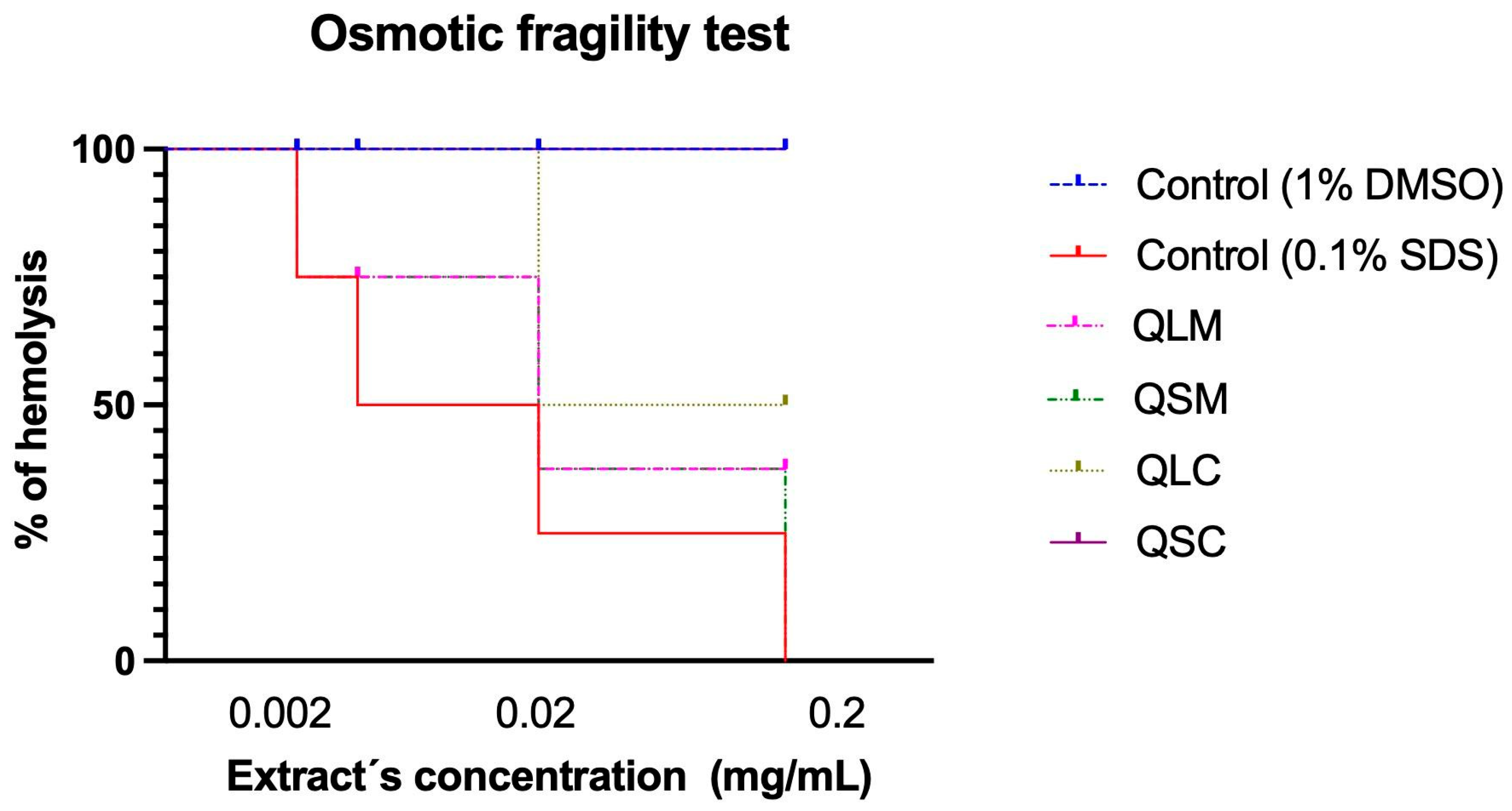
2.5.2. Cytotoxicity
2.5.3. Toxicity
3. Discussion
3.1. Antioxidant Capacity
3.2. Chemical Composition
3.3. Biological Activity
4. Materials and Methods
4.1. Sample Collection, Identification and Extraction
4.2. Antioxidant Potential Analysis
4.2.1. ORAC-FL
4.2.2. DPPH Radical Scavenging Activity
4.3. Total Phenolic Content (TPC) and Total Flavonoid Content (TFC)
4.4. Chemical Analysis
4.4.1. HPLC-DAD
4.4.2. UPLC-MS
4.5. Biological Activity
4.5.1. Microbial Strains
4.5.2. Antimicrobial Activity
Agar Disk Diffusion Assay
Microplate Assay
4.5.3. Cytotoxicity
4.5.4. Toxicity
Maintenance of Caenorhabditis elegans Culture
Test Preparation
Statistical Analysis
5. Conclusions
Author Contributions
Funding
Institutional Review Board Statement
Data Availability Statement
Acknowledgments
Conflicts of Interest
Correction Statement
Abbreviations
| AC | Antioxidant Capacity |
| AUC | Area under the curve |
| DPPH | 2,2-Diphenyl-1-picrylhydrazy |
| LC | Liquid Chromatography |
| MIC | Minimum Inhibitory Concentration |
| ORAC | Oxygen Radical Absorbance Capacity |
| QE | Quercetin Equivalent |
| QLC | Quitral Leaves Chloroform |
| QLM | Quitral Leaves Methanol |
| QSC | Quitral Stem Chloroform |
| QSM | Quitral Stem Methanol |
| TE | Trolox Equivalent |
| TFC | Total flavonoid Content |
| TPC | Total Phenolic Content |
References
- Rodriguez, R.; Marticorena, C.; Alarcón, D.; Baeza, C.; Cavieres, L.; Finot, V.L.; Fuentes, N.; Kiessling, A.; Mihoc, M.; Pauchard, A.; et al. Catálogo de las plantas vasculares de Chile. Gayana Bot. 2018, 75, 1–430. [Google Scholar] [CrossRef]
- Ministerio de Salud (Gobierno de Chile). Medicamentos Herbales Tradicionales, 1st ed.; Gobierno de Chile: Santiago, Chile, 2009; Volume 1.
- Simirgiotis, M.; Quispe, C.; Areche, C.; Sepúlveda, B. Phenolic Compounds in Chilean Mistletoe (Quintral, Tristerix tetrandus) Analyzed by UHPLC–Q/Orbitrap/MS/MS and Its Antioxidant Properties. Molecules 2016, 21, 245. [Google Scholar] [CrossRef]
- Espinoza, C.; Rojas, J.; Buitrago, A. Análisis Químico Cualitativo y Actividad Ecotóxica de La Especie Tristerix longebracteatus (Desr.) Barlow & Wiens (Loranthaceae) Colectada En Chimborazo, Ecuador. Rev. Fac. Farm. 2022, 64, 29–36. [Google Scholar] [CrossRef]
- Fontúrbel, F.E.; Bruford, M.W.; Salazar, D.A.; Cortés-Miranda, J.; Vega-Retter, C. The Hidden Costs of Living in a Transformed Habitat: Ecological and Evolutionary Consequences in a Tripartite Mutualistic System with a Keystone Mistletoe. Sci. Total Environ. 2019, 651, 2740–2748. [Google Scholar] [CrossRef] [PubMed]
- Tiribelli, F.; Amico, G.C.; Sasal, Y.; Morales, J.M. The Effect of Spatial Context and Plant Characteristics on Fruit Removal. Acta Oecologica 2017, 82, 69–74. [Google Scholar] [CrossRef]
- Olivares, G.S.; Orellana, J.I.; Rojas-Hernández, N.; Vega-Retter, C.; Villarroel, J.; Rodríguez-Gómez, G.B.; Nespolo, R.F.; Fontúrbel, F.E. Together but Not Mixed: Mistletoe Genetic Diversity and Seed Disperser Activity between Evergreen and Deciduous Forests. Perspect. Plant Ecol. Evol. Syst. 2025, 66, 125850. [Google Scholar] [CrossRef]
- Pincheira, J.; Villarroel, J.; Orellana, J.I.; Fontúrbel, F.E. A Tale of Two Mistletoes: Phenology and Fauna Associated with Two Sympatric Species. Botany 2024, 102, 98–107. [Google Scholar] [CrossRef]
- Torres, P.; Saldaña, C.; Ortega, R.; González, C. Determination of Reducing Power and Phytochemical Profile of the Chilean Mistletoe “Quintral” (Tristerix corymbosus (L.) Kuijt) Hosted in “Maqui” (Aristotelia chilensis), “Huayún” (Rhaphitamnus spinosus) and “Poplar” (Populus nigra). J. Chil. Chem. Soc. 2019, 64, 4645–4650. [Google Scholar] [CrossRef]
- Vidal Perez, D. Efectos del Quintral (Tristerix corymbosus) Extractos de Hoja y de Flor en la Viabilidad y Muerte Celular de Líneas Celulares de Cáncer de Mama, Próstata y Gástrico In Vitro. Master’s Thesis, Universidad de Valparaíso, Valparaíso, Chile, 2019. [Google Scholar]
- Velásquez, P.; Muñoz-Carvajal, E.; Luengo, M.; Bustos, D.; Galdames, F.; Gómez, M.; Montenegro, G.; Giordano, A. Phytochemical Screening and Biological Properties of Quintral Flower Polyphenolic Fractions. Nat. Prod. Res. 2024, ahead of print, 1–5. [Google Scholar] [CrossRef]
- Mandal, M.K.; Domb, A.J. Antimicrobial Activities of Natural Bioactive Polyphenols. Pharmaceutics 2024, 16, 718. [Google Scholar] [CrossRef]
- Xiao, J.; Capanoglu, E.; Jassbi, A.R.; Miron, A. Advance on the Flavonoid C-Glycosides and Health Benefits. Crit. Rev. Food Sci. Nutr. 2016, 56 (Suppl. S1), S29–S45. [Google Scholar] [CrossRef]
- Kumar, S.; Pandey, A.K. Chemistry and Biological Activities of Flavonoids: An Overview. Sci. World J. 2013, 2013, 162750. [Google Scholar] [CrossRef]
- Kaleem, M.; Ahmad, A. Flavonoids as Nutraceuticals. In Therapeutic, Probiotic, and Unconventional Foods; Academic Press: Cambridge, MA, USA, 2018; pp. 137–155. ISBN 978-0-12-814626-2. [Google Scholar]
- Basile, A.; Giordano, S.; López-Sáez, J.A.; Cobianchi, R.C. Antibacterial Activity of Pure Flavonoids Isolated from Mosses. Phytochemistry 1999, 52, 1479–1482. [Google Scholar] [CrossRef] [PubMed]
- Wan, L.; Jiang, J.-G. Protective Effects of Plant-Derived Flavonoids on Hepatic Injury. J. Funct. Foods 2018, 44, 283–291. [Google Scholar] [CrossRef]
- Russo, B.; Picconi, F.; Malandrucco, I.; Frontoni, S. Flavonoids and Insulin-Resistance: From Molecular Evidences to Clinical Trials. Int. J. Mol. Sci. 2019, 20, 2061. [Google Scholar] [CrossRef] [PubMed]
- Adamczak, A.; Ożarowski, M.; Karpiński, T.M. Antibacterial Activity of Some Flavonoids and Organic Acids Widely Distributed in Plants. J. Clin. Med. 2019, 9, 109. [Google Scholar] [CrossRef]
- Rice-Evans, C.A.; Miller, N.J.; Paganga, G. Structure-Antioxidant Activity Relationships of Flavonoids and Phenolic Acids. Free Radic. Biol. Med. 1996, 20, 933–956. [Google Scholar] [CrossRef]
- Manso, T.; Lores, M.; de Miguel, T. Antimicrobial Activity of Polyphenols and Natural Polyphenolic Extracts on Clinical Isolates. Antibiotics 2021, 11, 46. [Google Scholar] [CrossRef]
- Bravo, L. Polyphenols: Chemistry, Dietary Sources, Metabolism, and Nutritional Significance. Nutr. Rev. 1998, 56, 317–333. [Google Scholar] [CrossRef]
- Hagerman, A.E.; Riedl, K.M.; Jones, G.A.; Sovik, K.N.; Ritchard, N.T.; Hartzfeld, P.W.; Riechel, T.L. High Molecular Weight Plant Polyphenolics (Tannins) as Biological Antioxidants. J. Agric. Food Chem. 1998, 46, 1887–1892. [Google Scholar] [CrossRef]
- Williamson, G.; Sheedy, K. Effects of Polyphenols on Insulin Resistance. Nutrients 2020, 12, 3135. [Google Scholar] [CrossRef]
- Pastor-Villaescusa, B.; Sanchez Rodriguez, E.; Rangel-Huerta, O.D. Polyphenols in Obesity and Metabolic Syndrome. In Obesity; del Moral, A.M., Aguilera García, C.M., Eds.; Academic Press: Cambridge, MA, USA, 2018; pp. 213–239. ISBN 978-0-12-812504-5. [Google Scholar]
- Farhan, M. The Promising Role of Polyphenols in Skin Disorders. Molecules 2024, 29, 865. [Google Scholar] [CrossRef]
- Sangiovanni, E.; Dell’Agli, M. Special Issue: Anti-Inflammatory Activity of Plant Polyphenols 2.0. Biomedicines 2021, 10, 37. [Google Scholar] [CrossRef]
- Everette, J.D.; Bryant, Q.M.; Green, A.M.; Abbey, Y.A.; Wangila, G.W.; Walker, R.B. Thorough Study of Reactivity of Various Compound Classes toward the Folin-Ciocalteu Reagent. J. Agric. Food Chem. 2010, 58, 8139–8144. [Google Scholar] [CrossRef]
- Atawodi, S.E.; Atawodi, J.C.; Idakwo, G.A.; Pfundstein, B.; Haubner, R.; Wurtele, G.; Bartsch, H.; Owen, R.W. Evaluation of the Polyphenol Content and Antioxidant Properties of Methanol Extracts of the Leaves, Stem, and Root Barks of Moringa oleifera Lam. J. Med. Food 2010, 13, 710–716. [Google Scholar] [CrossRef]
- Dorta, E.; Fuentes-Lemus, E.; Aspée, A.; Atala, E.; Speisky, H.; Bridi, R.; Lissi, E.; López-Alarcón, C. The ORAC (Oxygen Radical Absorbance Capacity) Index Does Not Reflect the Capacity of Antioxidants to Trap Peroxyl Radicals. RSC Adv. 2015, 5, 39899–39902. [Google Scholar] [CrossRef]
- Brozdowski, J.; Waliszewska, B.; Gacnik, S.; Hudina, M.; Veberic, R.; Mikulic-Petkovsek, M. Phenolic Composition of Leaf and Flower Extracts of Black Cherry (Prunus serotina Ehrh.). Ann. For. Sci. 2021, 78, 66. [Google Scholar] [CrossRef]
- Rodrigo, R.; Libuy, M. Chapter 5—Modulation of Plant Endogenous Antioxidant Systems by Polyphenols. In Polyphenols in Plants; Watson, R.R., Ed.; Academic Press: San Diego, CA, USA, 2014; pp. 65–85. ISBN 978-0-12-397934-6. [Google Scholar]
- Di Ferdinando, M.; Brunetti, C.; Agati, G.; Tattini, M. Multiple Functions of Polyphenols in Plants Inhabiting Unfavorable Mediterranean Areas. Environ. Exp. Bot. 2014, 103, 107–116. [Google Scholar] [CrossRef]
- Tanase, C.; Bujor, O.-C.; Popa, V.I. Chapter 3—Phenolic Natural Compounds and Their Influence on Physiological Processes in Plants. In Polyphenols in Plants, 2nd ed.; Watson, R.R., Ed.; Academic Press: Cambridge, MA, USA, 2019; pp. 45–58. ISBN 978-0-12-813768-0. [Google Scholar]
- Vollmannová, A.; Bojňanská, T.; Musilová, J.; Lidiková, J.; Cifrová, M. Quercetin as One of the Most Abundant Represented Biological Valuable Plant Components with Remarkable Chemoprotective Effects—A Review. Heliyon 2024, 10, e33342. [Google Scholar] [CrossRef]
- Yang, B.; Liu, H.; Yang, J.; Gupta, V.K.; Jiang, Y. New Insights on Bioactivities and Biosynthesis of Flavonoid Glycosides. Trends Food Sci. Technol. 2018, 79, 116–124. [Google Scholar] [CrossRef]
- Xu, D.; Hu, M.-J.; Wang, Y.-Q.; Cui, Y.-L. Antioxidant Activities of Quercetin and Its Complexes for Medicinal Application. Molecules 2019, 24, 1123. [Google Scholar] [CrossRef]
- Rajesh, R.U.; Dhanaraj, S. A Critical Review on Quercetin Bioflavonoid and Its Derivatives: Scope, Synthesis, and Biological Applications with Future Prospects. Arab. J. Chem. 2023, 16, 104881. [Google Scholar] [CrossRef]
- Magar, R.T.; Sohng, J.K. A Review on Structure, Modifications and Structure-Activity Relation of Quercetin and Its Derivatives. J. Microbiol. Biotechnol. 2020, 30, 11–20. [Google Scholar] [CrossRef] [PubMed]
- Lesjak, M.; Beara, I.; Simin, N.; Pintać, D.; Majkić, T.; Bekvalac, K.; Orčić, D.; Mimica-Dukić, N. Antioxidant and Anti-Inflammatory Activities of Quercetin and Its Derivatives. J. Funct. Foods 2018, 40, 68–75. [Google Scholar] [CrossRef]
- Nikaido, H. Molecular Basis of Bacterial Outer Membrane Permeability Revisited. Microbiol. Mol. Biol. Rev. 2003, 67, 593–656. [Google Scholar] [CrossRef] [PubMed]
- Silhavy, T.J.; Kahne, D.; Walker, S. The Bacterial Cell Envelope. Cold Spring Harb. Perspect. Biol. 2010, 2, a000414. [Google Scholar] [CrossRef]
- Perlin, D.S. Mechanisms of Echinocandin Antifungal Drug Resistance. Ann. N. Y. Acad. Sci. 2015, 1354, 1–11. [Google Scholar] [CrossRef]
- Gómez-Estaca, J.; Pintado, T.; Jiménez-Colmenero, F.; Cofrades, S. The Effect of Household Storage and Cooking Practices on Quality Attributes of Pork Burgers Formulated with PUFA- and Curcumin-Loaded Oleogels as Healthy Fat Substitutes. LWT 2020, 119, 108909. [Google Scholar] [CrossRef]
- Kalemba, D.; Kunicka, A. Antibacterial and Antifungal Properties of Essential Oils. Curr. Med. Chem. 2003, 10, 813–829. [Google Scholar] [CrossRef]
- Siroli, L.; Patrignani, F.; Gardini, F.; Lanciotti, R. Effects of Sub-Lethal Concentrations of Thyme and Oregano Essential Oils, Carvacrol, Thymol, Citral and Trans-2-Hexenal on Membrane Fatty Acid Composition and Volatile Molecule Profile of Listeria monocytogenes, Escherichia coli and Salmonella enteritidis. Food Chem. 2015, 182, 185–192. [Google Scholar] [CrossRef]
- Ghannoum, M.A.; Rice, L.B. Antifungal Agents: Mode of Action, Mechanisms of Resistance, and Correlation of These Mechanisms with Bacterial Resistance. Clin. Microbiol. Rev. 1999, 12, 501–517. [Google Scholar] [CrossRef]
- Kaźmierczak, T.; Bonarska-Kujawa, D.; Męczarska, K.; Cyboran-Mikołajczyk, S.; Oszmiański, J.; Kapusta, I. Analysis of the Polyphenolic Composition of Vaccinium L. Extracts and Their Protective Effect on Red Blood Cell Membranes. Membranes 2023, 13, 589. [Google Scholar] [CrossRef]
- Hmidani, A.; Bouhlali, E.d.T.; Ajebli, M.; Khouya, T.; Benlyas, M.; Alem, C. In Vitro Investigation of Antioxidant and Antihemolytic Activities of Three Lamiaceae Species from Morocco. Beni-Suef Univ. J. Basic Appl. Sci. 2021, 10, 27. [Google Scholar] [CrossRef]
- Cheok, C.Y.; Salman, H.A.K.; Sulaiman, R. Extraction and Quantification of Saponins: A Review. Food Res. Int. 2014, 59, 16–40. [Google Scholar] [CrossRef]
- Azmir, J.; Zaidul, I.S.M.; Rahman, M.M.; Sharif, K.M.; Mohamed, A.; Sahena, F.; Jahurul, M.H.A.; Ghafoor, K.; Norulaini, N.A.N.; Omar, A.K.M. Techniques for Extraction of Bioactive Compounds from Plant Materials: A Review. J. Food Eng. 2013, 117, 426–436. [Google Scholar] [CrossRef]
- Rojas-Armas, J.P.; Arroyo-Acevedo, J.L.; Ortiz-Sánchez, J.M.; Palomino-Pacheco, M.; Justil-Guerrero, H.J.; Herrera-Calderón, O.; Hilario-Vargas, J. Corrigendum to “Potential Toxicity of the Essential Oil from Minthostachys mollis: A Medicinal Plant Commonly Used in the Traditional Andean Medicine in Peru”. J. Toxicol. 2020, 2020, 2103456. [Google Scholar] [CrossRef]
- Dubale, S.; Kebebe, D.; Zeynudin, A.; Abdissa, N.; Suleman, S. Phytochemical Screening and Antimicrobial Activity Evaluation of Selected Medicinal Plants in Ethiopia. J. Exp. Pharmacol. 2023, 15, 51–62. [Google Scholar] [CrossRef]
- Hunt, P.R. The C. elegans Model in Toxicity Testing. J. Appl. Toxicol. 2017, 37, 50–59. [Google Scholar] [CrossRef]
- Wu, T.; Xu, H.; Liang, X.; Tang, M. Caenorhabditis Elegans as a Complete Model Organism for Biosafety Assessments of Nanoparticles. Chemosphere 2019, 221, 708–726. [Google Scholar] [CrossRef]
- Touma, J.; Navarro, M.; Sepúlveda, B.; Pavon, A.; Corsini, G.; Fernández, K.; Quezada, C.; Torres, A.; Larrazabal-Fuentes, M.J.; Paredes, A.; et al. The Chemical Compositions of Essential Oils Derived from Cryptocarya alba and Laurelia sempervirens Possess Antioxidant, Antibacterial and Antitumoral Activity Potential. Molecules 2020, 25, 5600. [Google Scholar] [CrossRef]
- Bruna, F.; Fernández, K.; Urrejola, F.; Touma, J.; Navarro, M.; Sepúlveda, B.; Larrazabal-Fuentes, M.; Paredes, A.; Neira, I.; Ferrando, M.; et al. Chemical Composition, Antioxidant, Antimicrobial and Antiproliferative Activity of Laureliopsis philippiana Essential Oil of Chile, Study in Vitro and in Silico. Arab. J. Chem. 2022, 15, 104271. [Google Scholar] [CrossRef]
- Larrazabal-Fuentes, M.; Palma, J.; Paredes, A.; Mercado, A.; Neira, I.; Lizama, C.; Sepulveda, B.; Bravo, J. Chemical Composition, Antioxidant Capacity, Toxicity and Antibacterial Activity of the Essential Oils from Acantholippia deserticola (Phil.) Moldenke (Rica Rica) and Artemisia copa Phil. (Copa Copa) Extracted by Microwave-Assisted Hydrodistillation. Ind. Crops Prod. 2019, 142, 111830. [Google Scholar] [CrossRef]
- Yang, J.H.; Shin, B.Y.; Han, J.Y.; Kim, M.G.; Wi, J.E.; Kim, Y.W.; Cho, I.J.; Kim, S.C.; Shin, S.M.; Ki, S.H. Isorhamnetin Protects against Oxidative Stress by Activating Nrf2 and Inducing the Expression of Its Target Genes. Toxicol. Appl. Pharmacol. 2014, 274, 293–301. [Google Scholar] [CrossRef]
- Wang, K.; Zhang, H.; Yuan, L.; Li, X.; Cai, Y. Potential Implications of Hyperoside on Oxidative Stress-Induced Human Diseases: A Comprehensive Review. J. Inflamm. Res. 2023, 16, 4503–4526. [Google Scholar] [CrossRef]
- Ou, B.; Hampsch-Woodill, M.; Prior, R.L. Development and Validation of an Improved Oxygen Radical Absorbance Capacity Assay Using Fluorescein as the Fluorescent Probe. J. Agric. Food Chem. 2001, 49, 4619–4626. [Google Scholar] [CrossRef] [PubMed]
- Zúñiga-López, M.C.; Maturana, G.; Campmajó, G.; Saurina, J.; Núñez, O. Determination of Bioactive Compounds in Sequential Extracts of Chia Leaf (Salvia hispanica L.) Using UHPLC-HRMS (Q-Orbitrap) and a Global Evaluation of Antioxidant In Vitro Capacity. Antioxidants 2021, 10, 1151. [Google Scholar] [CrossRef]
- Peña-Cerda, M.; Arancibia-Radich, J.; Valenzuela-Bustamante, P.; Pérez-Arancibia, R.; Barriga, A.; Seguel, I.; García, L.; Delporte, C. Phenolic Composition and Antioxidant Capacity of Ugni molinae Turcz. Leaves of Different Genotypes. Food Chem. 2017, 215, 219–227. [Google Scholar] [CrossRef] [PubMed]
- Pérez-Arancibia, R.; Ordoñez, J.L.; Rivas, A.; Pihán, P.; Sagredo, A.; Ahumada, U.; Barriga, A.; Seguel, I.; Cárdenas, C.; Vidal, R.L.; et al. A Phenolic-Rich Extract from Ugni molinae Berries Reduces Abnormal Protein Aggregation in a Cellular Model of Huntington’s Disease. PLoS ONE 2021, 16, e0254834. [Google Scholar] [CrossRef]
- Chang, C.-C.; Yang, M.-H.; Wen, H.-M.; Chern, J.-C. Estimation of Total Flavonoid Content in Propolis by Two Complementary Colorimetric Methods. J. Food Drug Anal. 2002, 10, 178–182. [Google Scholar]
- Edwards-Hicks, J.; Mitterer, M.; Pearce, E.L.; Buescher, J.M. Metabolic Dynamics of In Vitro CD8+ T Cell Activation. Metabolites 2020, 11, 12. [Google Scholar] [CrossRef]
- CLSI M02; Performance Standards for Antimicrobial Disk Susceptibility Tests. CLSI: Malvern, PA, USA, 2010.
- Ultee, A.; Bennik, M.H.J.; Moezelaar, R. The Phenolic Hydroxyl Group of Carvacrol Is Essential for Action against the Food-Borne Pathogen Bacillus Cereus. Appl. Environ. Microbiol. 2002, 68, 1561–1568. [Google Scholar] [CrossRef] [PubMed]
- Jones, R.N. NCCLS Guidelines: Revised Performance Standards for Antimicrobial Disk Susceptibility Tests. Antimicrob. Newsl. 1984, 1, 64–65. [Google Scholar] [CrossRef]
- Sharma, P.; Sharma, J.D. In Vitro Hemolysis of Human Erythrocytes—By Plant Extracts with Antiplasmodial Activity. J. Ethnopharmacol. 2001, 74, 239–243. [Google Scholar] [CrossRef] [PubMed]
- Waczuk, E.P.; Kamdem, J.P.; Abolaji, A.O.; Meinerz, D.F.; Bueno, D.C.; Gonzaga, T.K.S.D.N.; Dorow, T.S.D.C.; Boligon, A.A.; Athayde, M.L.; da Rocha, J.B.T.; et al. Euphorbia tirucalli Aqueous Extract Induces Cytotoxicity, Genotoxicity and Changes in Antioxidant Gene Expression in Human Leukocytes. Toxicol. Res. 2015, 4, 739–748. [Google Scholar] [CrossRef]
- He, J.; Lin, J.; Li, J.; Zhang, J.-H.; Sun, X.-M.; Zeng, C.-M. Dual Effects of Ginkgo biloba Leaf Extract on Human Red Blood Cells. Basic. Clin. Pharmacol. Toxicol. 2009, 104, 138–144. [Google Scholar] [CrossRef]
- Pagano, M.; Faggio, C. The Use of Erythrocyte Fragility to Assess Xenobiotic Cytotoxicity. Cell Biochem. Funct. 2015, 33, 351–355. [Google Scholar] [CrossRef]
- Muñoz-Acevedo, A.; Aristizábal-Córdoba, S.; Rodríguez, J.D.; Torres, E.A.; Molina, A.M.; Gutiérrez, R.G.; Kouznetsov, V.V. Citotoxicidad/Capacidad antiradicalaria in-vitro y caracterización estructural por GC-MS/1H-13C-RMN de los aceites esenciales de hojas de árboles joven/adulto de Annona purpurea Moc. & Sessé ex Dunal de Repelón (Atlántico, Colombia). Boletín Latinoam. Caribe Plantas Med. Aromáticas 2016, 15, 99–111. [Google Scholar]





| Solvent | Leaf | Stem |
|---|---|---|
| Methanol | 3.79 | 8.99 |
| Chloroform | 1.58 | 0.30 |
| Number | Compound | Classification | RT (min) | Molecular Formula | m/z Meas | Δ m/z (ppm) | Ions | QSM | QLM |
|---|---|---|---|---|---|---|---|---|---|
| 1 | Gallic acid | Phenolic acid | 1.33 | C7H6O5 | 169.0145 | 0.881 | [M-H]- | - | - |
| 2 | Malic acid | Short-chain acid | 1.61 | C4H6O5 | 133.0143 | 0.335 | [M-H]- [M-H-H2O]- | + | - |
| 3 | Citric acid | Short-chain acid | 1.68 | C6H8O7 | 191.0201 | 2.19 | [M-H]- [M-H-H2O]- | + | + |
| 4 | Epicatechin | Flavonoid | 3.03 | C15H14O6 | 291.0867 | 1.403 | [M+H]+ | + | - |
| 5 | 2-Isopropylmalic acid | Malic acid derivative | 3.06 | C7H12O5 | 175.0616 | 2.551 | [M-H]- | - | + |
| 6 | Ellagic acid | Phenolic acid | 3.21 | C14H6O8 | 300.9994 | 1.222 | [M-H]- | + | + |
| 7 | Quercetin 3-O-rhamnoside 7-O-glycoside | Flavonoid | 3.54 | C27H30O16 | 611.1606 | −0.065 | [M+H]+ | - | - |
| 8 | Loliolide | Monoterpene | 3.58 | C11H16O3 | 197.1173 | 1.121 | [M+H]+ | - | + |
| 9 | Hyperoside (quercetin-3-O-galactoside) | Flavonoid | 3.79 | C21H20O12 | 465.1030 | 0.556 | [M+H]+ | ++ | ++ |
| 10 | Kaempferol 3-O-sophoroside | Flavonoid | 4.02 | C27H30O16 | 611.1620 | 2.202 | [M+H]+ | - | - |
| 11 | Plantaginin (kaemferol-7-O-glycoside) | Flavonoid | 4.09 | C21H20O11 | 449.1082 | 0.806 | [M+H]+ | + | + |
| 12 | Quercetin-4′-O-glycoside | Flavonoid | 4.20 | C21H20O12 | 463.0882 | −0.112 | [M-H]- | - | + |
| 13 | Azelaic acid | Short-chain acid | 4.41 | C9H16O4 | 187.0977 | 0.781 | [M-H]- | - | - |
| 14 | Isorhamnetin (3-methyl quercetin) 3-O-glycoside | Flavonoid | 4.45 | C22H22O11 | 461.1091 | 0.247 | [M-H]- | - | - |
| 15 | Peonidin-3-O-beta-galactoside | Anthocyanin | 4.45 | C22H22O11 | 463.1238 | 0.95 | [M+H]+ | + | + |
| 16 | Homoplantaginin (6-methoxyapigenin-7-O-glycoside) | Flavonoid | 4.50 | C28H24O16 | 615.1005 | 0.857 | [M-H]- | + | + |
| 17 | Quercetin-3-O-glycoside | Flavonoid | 4.61 | C21H20O12 | 465.1052 | 2.951 | [M+H]+ | + | + |
| 18 | Quercetin-3-O-xyloside | Flavonoid | 4.69 | C20H18O11 | 435.0928 | 1.503 | [M+H]+ | - | - |
| 19 | Kaempferol-3-O-glycoside | Flavonoid | 4.76 | C21H20O11 | 447.0945 | 2.06 | [M-H]- [2M-H]- | - | - |
| 20 | Kaempferol-3-O-glycoside 1 | Flavonoid | 4.84 | C22H22O12 | 477.1033 | −1.211 | [M-H]- [2M-H]- | + | + |
| 21 | Isorhamnetin-3-O-galactoside | Flavonoid | 4.83 | C22H22O12 | 479.1190 | 1.137 | [M+H]+ | + | ++ |
| 22 | Rutin | Flavonoid | 4.91 | C28H24O16 | 615.1008 | 2.649 | [M-H]- | - | + |
| 23 | Kaempferol-3O-glcoside 2 | Flavonoid | 5.03 | C21H20O11 | 499.1086 | 3.069 | [M+H]+ | - | + |
| 24 | Quercetin | Flavonoid | 5.39 | C15H10O7 | 303.0502 | 0.903 | [M-H]- | + | + |
| 25 | Cinnamic acid | Cinnamic acid | 5.74 | C9H8O2 | 131.0495 | 2.476 | [M-H2O+H]+ | - | - |
| 26 | Rhamnazin (2′,7-dimethoxy quercetin) | Flavonoid | 5.75 | C16H12O7 | 317.0662 | 1.915 | [M+H]+ | ++ | + |
| 27 | 3-methylquercetin | Flavonoid | 5.76 | C16H12O7 | 315.0503 | −2.273 | [M-H]-, [2M-H]- | ++ | + |
| 28 | Kaempferol | Flavonoid | 6.32 | C15H10O6 | 287.0558 | 2.752 | [M+H]+ | - | - |
| 29 | Isokaempferol | Flavonoid | 6.64 | C16H12O6 | 299.0553 | −1.581 | [M-H]- [2M-H]- | - | - |
| 30 | Quercetin-3,7-dimethileter | Flavonoid | 6.77 | C17H14O7 | 331.0819 | 2.002 | [M+H]+ | + | - |
| 31 | Avobenzone | Curcumin derivative | 12.53 | C20H22O3 | 311.1643 | 0.349 | [M+H]+ | + | n.d. |
| Microorganism | Negative Control | Positive Control | QLM | QSM | QFM | QLC | QSC | QFC |
|---|---|---|---|---|---|---|---|---|
| E. coli | - | 34.0 1 | - | - | - | - | - | - |
| S. boydii | - | 29.0 2 | 13.5 | 12.0 | 15.0 | - | - | - |
| P. Aeruginosa | - | 25.0 1 | - | 12.0 | 9.4 | - | - | - |
| S. Aerus ATCC 25923 | - | 55.0 3 | 11.5 | - | - | - | - | - |
| L. monocytogenes ATCC BAA751 | - | 36.0 3 | 17.5 | - | - | 15.0 | 26.0 | - |
| B. cereus | - | 15.0 3 | 10.0 | 10.0 | 7.0 | 8.0 | - | 7.0 |
| E. faecalis | - | 24.0 2 | - | - | - | - | - | - |
| C. guillermondii | - | 32.0 4 | - | - | - | - | - | - |
| C. tropicalis | - | 21.0 4 | - | - | - | - | - | - |
| Microbial Strain | QLM | QSM | QLC | QSC |
|---|---|---|---|---|
| S. boydii | 34.0 | 332.5 | 67.4 | 67.4 |
| P. Aeruginosa | 32.5 | 67.4 | 67.4 | 67.4 |
| S. Aerus ATCC 25923 | 34.0 | 67.4 | 67.4 | 68.0 |
| L. monocytogenes ATCC BAA751 | 32.5 | 68.0 | 67.4 | 32.5 |
| B. cereus | 68.0 | 68.0 | 67.4 | 68.0 |
| Filter Parameters | |
| Minimum # Features for Extraction | 1 |
| Presence of features in minimum # of analyses | Processing Parameters3 |
| T-ReX 3D | |
| Intensity threshold | 4000 (polar metabolites) |
| Minimum Peak Length | 12 |
| Enable Recursive Feature Extraction | True |
| Minimum Peak Length (recursive) | 7 |
| Perform MS/MS import | True |
| MS/MS import method | Average |
| Ion Deconvolution Parameters | |
| EIC correlation | 0.8 |
| Primary ion (negative mode) | [M-H]- |
| Primary ion (positive mode) | [M+H]+ |
| Seed ions (negative mode) | [M+Cl]- |
| Seed ions (positive mode) | [M+Na]+, [M+K]+, [M+NH4]+ |
| Common ions (negative mode) | [M-H-H2O]-, [M+COOH]- |
| Common ions (positive mode) | [M-H-H2O]+ |
| Mass Calibration Parameters | |
| Lock Mass Calibration | False |
| Mass Recalibration | True, calibration segment 0.1-0.4 min |
| Expert settings | |
| FerraWorkflow.chargeMax | 1 (only for polar metabolites) |
| Smart Formula Parameters | |
| m/z tolerance | 1 mDa (narrow), 3 mDa (wide) |
| mSigma | 15 (narrow), 50 (wide) |
| Elements | CHNOPS |
| Upper formula | S1 |
| Element ratio filters | Common |
| Electron configuration | Both |
| Analyte List Parameters | |
| m/z tolerance | 1 mDa (narrow), 3 mDa (wide) |
| Retention time tolerance | 0.2 min (narrow), 0.4 min (wide) |
| mSigma | 15 (narrow), 50 (wide) |
| Spectral Library Parameters | |
| Libraries (polar metabolites) | In house library, Bruker MetaboBASE 3.0, GNPS export (downloaded July 2020) |
| m/z tolerance | 1 mDa (narrow), 3 mDa (wide) |
| mSigma | 20 (narrow), 200 (wide) |
| MS/MS score | 900 (narrow), 700 (wide) |
Disclaimer/Publisher’s Note: The statements, opinions and data contained in all publications are solely those of the individual author(s) and contributor(s) and not of MDPI and/or the editor(s). MDPI and/or the editor(s) disclaim responsibility for any injury to people or property resulting from any ideas, methods, instructions or products referred to in the content. |
© 2025 by the authors. Licensee MDPI, Basel, Switzerland. This article is an open access article distributed under the terms and conditions of the Creative Commons Attribution (CC BY) license (https://creativecommons.org/licenses/by/4.0/).
Share and Cite
Fernández Moreno, K.; Maturana, G.; Blanco-Haros, S.; Norambuena-Jopia, U.; Valenzuela-Barra, G.; Zúñiga-López, M.C.; Bravo Garrido, J. Determination of Bioactive Compounds, Antioxidant Capacity, Safety Assessment, and Antimicrobial Effect of Tristerix corymbosus Extracts. Molecules 2025, 30, 4610. https://doi.org/10.3390/molecules30234610
Fernández Moreno K, Maturana G, Blanco-Haros S, Norambuena-Jopia U, Valenzuela-Barra G, Zúñiga-López MC, Bravo Garrido J. Determination of Bioactive Compounds, Antioxidant Capacity, Safety Assessment, and Antimicrobial Effect of Tristerix corymbosus Extracts. Molecules. 2025; 30(23):4610. https://doi.org/10.3390/molecules30234610
Chicago/Turabian StyleFernández Moreno, Katia, Gabriela Maturana, Sofía Blanco-Haros, Ulises Norambuena-Jopia, Gabriela Valenzuela-Barra, María Carolina Zúñiga-López, and Jessica Bravo Garrido. 2025. "Determination of Bioactive Compounds, Antioxidant Capacity, Safety Assessment, and Antimicrobial Effect of Tristerix corymbosus Extracts" Molecules 30, no. 23: 4610. https://doi.org/10.3390/molecules30234610
APA StyleFernández Moreno, K., Maturana, G., Blanco-Haros, S., Norambuena-Jopia, U., Valenzuela-Barra, G., Zúñiga-López, M. C., & Bravo Garrido, J. (2025). Determination of Bioactive Compounds, Antioxidant Capacity, Safety Assessment, and Antimicrobial Effect of Tristerix corymbosus Extracts. Molecules, 30(23), 4610. https://doi.org/10.3390/molecules30234610