1. Introduction
Bonds between carbon atoms lie at the heart of organic chemistry, underlying a variety of phenomena from the reactivity of small molecules to the architecture of advanced polymers. A basic tenet of chemical bonding holds that shorter bonds are typically stronger, reflecting greater orbital overlap and electron sharing, while long bonds indicate instability [
1,
2,
3]. This correlation between bond length and bond strength underpins much of our chemical intuition and it is used constantly in the design of stable molecular frameworks [
4,
5]. However, a growing number of structurally characterized compounds appear to defy this expectation, displaying carbon–carbon single bonds that stretch well beyond conventional distances while remaining remarkably stable under ambient conditions [
6,
7,
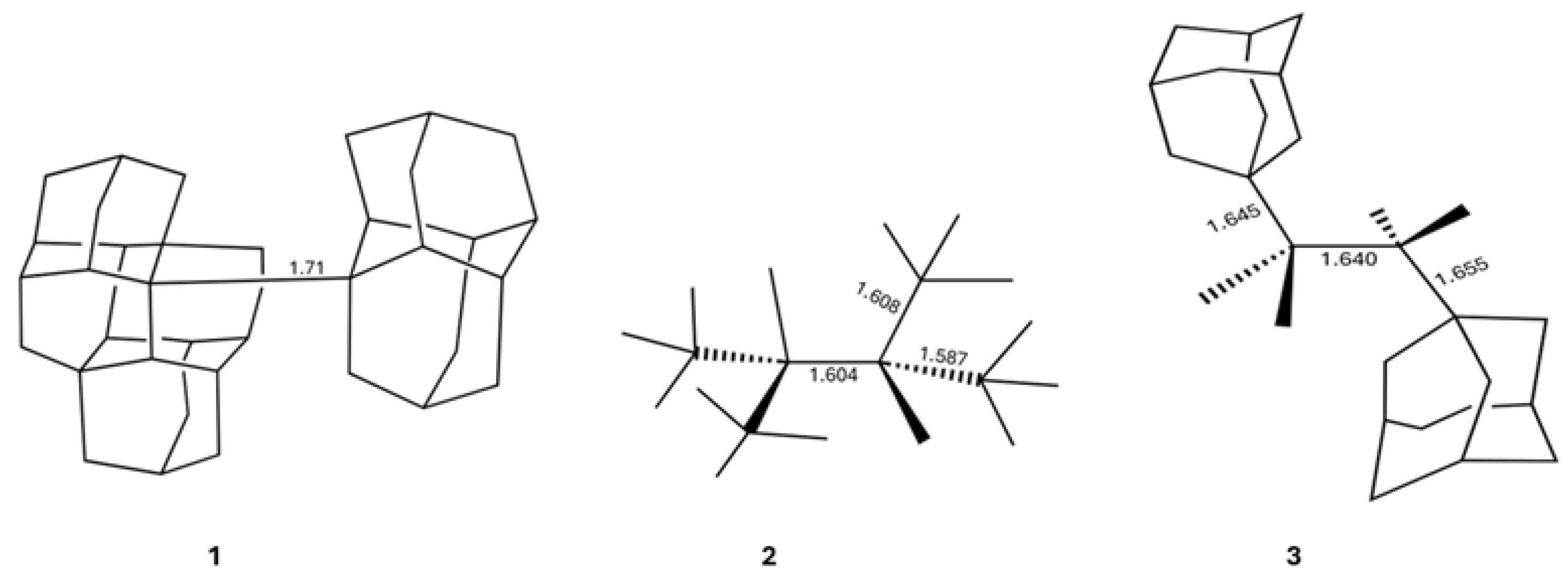
8]. Some of the most noticeable examples of this feature are diamondoid dimers, e.g., the molecule [121]tetramantane-diamantane
1 (
Figure 1), which is a very stable molecule with melting point of 246 °C, and yet it has the longest C–C bond for an alkane up to now (1.71 Å) [
9]. Another molecule having long, stable single C–C bonds is 1,1,2,2-tetra-
-butyl ethane
2 (m.p. 150 °C) which presents three single C–C bonds wherein
d(C–C) > 1.58 Å [
10]. Likewise, 2,3-di-1-adamantyl-2,3-dimethyl butane
3 has three C–C bonds whose bond lengths are larger than 1.64 Å, and, still, the corresponding crystal has a melting point of 167 °C [
11,
12]. These anomalously long yet stable bonds challenge textbook models of covalent bonding and raise fundamental questions about what forces can sustain such elongated chemical bonds [
12].
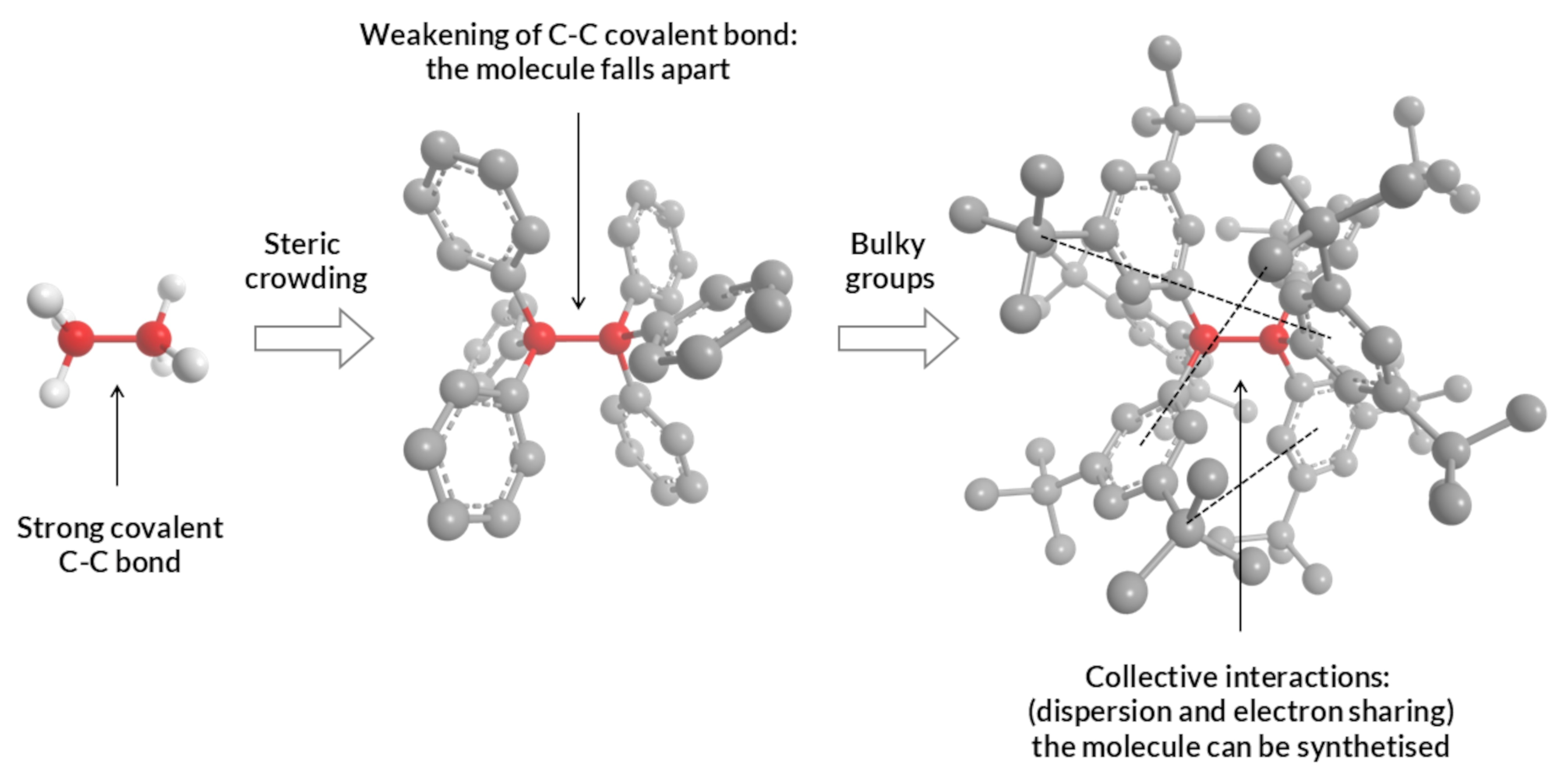
Among the forces capable of stabilizing weak interactions between atoms, London dispersion (LD), a long-range, non-directional interaction, plays a uniquely universal role. Arising from correlated fluctuations in the electron positions, LD acts as an attractive force on all matter, growing stronger with increasing molecular size and polarizability [
13,
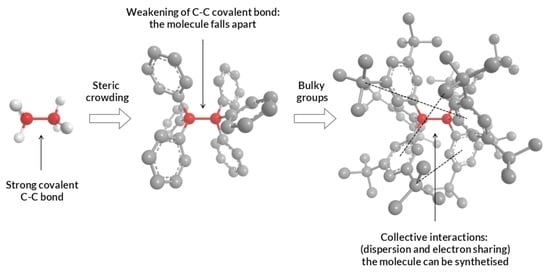
14]. In systems with large, flexible substituents, this effect becomes particularly significant. What might appear at first glance as simple steric crowding can instead give rise to a network of favorable dispersion contacts that compensate for the energetic cost of bond elongation. Rather than destabilizing a stretched C–C bond, bulky groups may in some cases aid in its stabilization by collectively lowering the total energy of the system via LD [
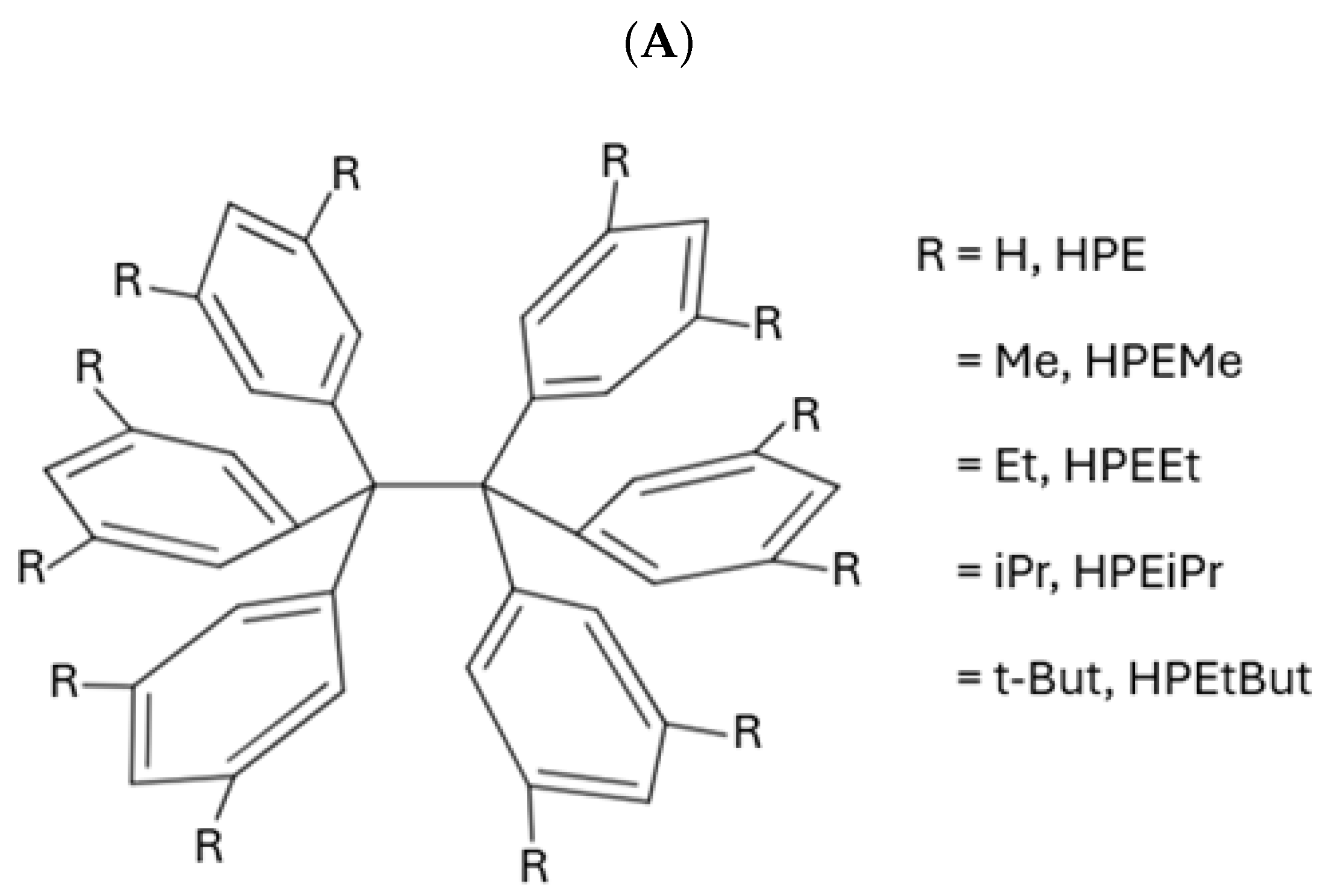
15]. A particularly conspicuous example is the effect of alkyl substituents on the hypothetical hexaphenylethane (HPE), (Ph)
3C–C(Ph)
3. Indeed, the introduction of large
tert-butyl groups in all meta positions leads to the isolation of hexa(3,5-di-
tert-butylphenyl) ethane which can be even characterized via X-ray crystal diffraction [
16,
17].
Experimental support for this view emerged most notably from the work of Schreiner and coworkers, who reported a series of remarkably stable alkanes with very long C–C bond lengths, as previously shown in
Figure 1. These species, stabilized by bulky alkyl groups, are thought to owe their persistent long C–C single bonds largely to LD forces rather than conventional covalent bonding. This interpretation is based on computational studies, typically using dispersion-corrected density functional theory (e.g., PBE0-D3BJ) or high-level ab initio methods, such as CCSD(T), which suggest a central role for dispersion in the stabilization of these molecules. However, a detailed understanding of the energetic balance that makes such bonding possible remains incomplete. Disentangling the physical contributions that stabilize very long C–C bonds remains a central challenge. Many energy decomposition approaches, such as the local energy decomposition (LED) [
18,
19,
20] or the symmetry-adapted perturbation theory (SAPT) [
21,
22,
23], are highly informative for interfragment interactions, but they rely on perturbative treatments and an a priori fragmentation of the system [
24]. In congested, covalently connected molecules, the strong density overlap across the C–C link violates the basic assumptions underlying these methods. As a result, such partitions may misattribute stabilization among electrostatics, exchange and dispersion, exhibit marked fragment-dependence, and yield trends that vary with the chosen scheme [
24]. Together, these issues hinder quantitative comparison across a homologous series and they can lead to misleading design rules [
25,
26]. In contrast, real-space approaches within the field of quantum chemical topology (QCT) like the quantum theory of atoms in molecules (QTAIM) enable a fully non-perturbative, atom-centric view of bonding [
27]. Among these, the interacting quantum atoms (IQA) method offers a rigorous decomposition of the total energy into chemically interpretable intra- and interatomic components [
28,
29]. IQA has been successfully applied to a wide range of problems, including chemical reactivity [
30,
31,
32,
33,
34], the analysis of hydrogen bonding [
35,
36,
37,
38], non-covalent interactions [
39,
40,
41,
42,
43], transition-metal complexes [
44,
45], and cooperative and anticooperative effects in non-covalent assemblies [
46,
47,
48,
49].
In this work, we apply QTAIM-based wave function analyses and the IQA partition of the electronic energy throughout a homologous series of compounds with long central C–C bonds to identify the most important energetic contributions in their stabilization. More specifically, we focused on the series of compounds shown in
Figure 2A, i.e., a set of HPE derivatives with progressively bulkier substituents, allowing us to track interaction energies and to examine the chemical bonding scenario evolution across this set of compounds. Altogether, our results reveal that the QCT characterization of the strength of the central chemical C–C bond in the molecules shown in
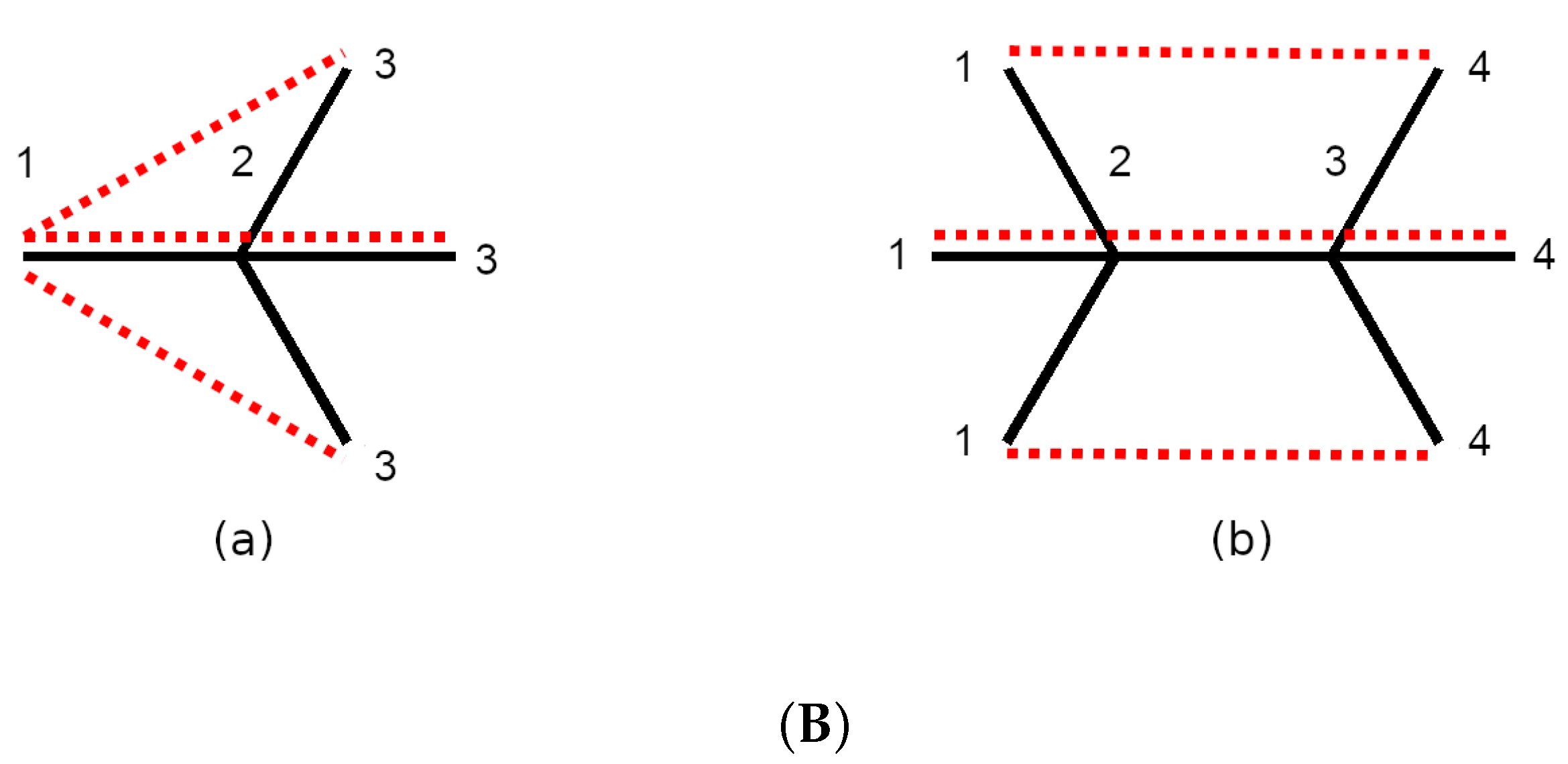
Figure 2A does not align with the computed dissociation energy of these systems. This observation indicates that there other factors that contribute to the stabilization of the molecule apart from the sole interaction between the carbon bonds in the ethane moiety. Indeed, the IQA analysis reveal the relevance of collective covalent 1–3 and, more importantly, 1–4 contacts (
Figure 2B) in the compounds schematized in (
Figure 2A) apart from LD. More broadly, these results highlight the essential features and the relevance of collective interactions and they aid in the understanding of both non-covalent interactions and covalent bonding in highly congested environments.
3. Theoretical Framework
The field of QCT comprises a series of methods of wave function analysis based on the topological study of distinct scalar fields derived from the electronic state vector. The origin of QCT resides on the QTAIM which relies on the topographical examination of the electron density,
. In the following lines, we show that the charge distribution equals the expectation value of the Dirac observable
, i.e.,
wherein
is the position vector and
is the position of the
i-th electron in an
N-electron system. Because of the indistinguishability of the electrons, one may write
wherein
denotes the position and spin coordinates of the
i-th electron. By integrating the position coordinate of electron 1 in the previous expression, we obtain
in which we exploit the properties of the Dirac delta function. Finally, by changing the order of integration in the former equation, we have
wherein
is the spin-dependent electron density. Because the electron density is completely given by the state vector, the QTAIM analysis is orbital-invariant and independent on elements of the particular model of computation (e.g., basis sets). The QTAIM involves the determination of the critical points of
, i.e., points in which
vanishes [
58]. Typically, molecular stable structures present critical points with range
, that is to say, with three curvatures different from zero [
58]. These curvatures equal the eigenvalues of the Hessian of
evaluated at the corresponding critical point
, i.e.,
Besides the rank, critical points of
are characterized according to their signature,
s, which equals the algebraic sum of the signs of the curvatures at the critical [
58] point. In other words, critical points can be associated with the ordinate pair
. The critical points with
are related with different elements of molecular structure. Namely, the critical points with
, i.e.,
,
,
, and
, indicate the occurrence of nuclei, chemical bonds between two atoms, rings, and cages, correspondingly. Hence, these critical points are, respectively, denoted as nuclear critical points (NCPs), bond critical points (BCPs), ring critical points (RCPs), and cage critical points (CCPs) [
58].
Indeed, the chemical bond between two atoms can be characterized via the values of
as well as of other scalar fields at the corresponding BCP. These scalar fields include, for example,
,
, and the density of energy
[
27,
58,
59].
By considering the dynamical system established by
, the QTAIM defines a division of the 3D space in atomic basins, A, B, …which are related with the atoms of chemistry [
58]. An atomic basin is defined as the stable manifold of an NCP. The atomic basins in QTAIM are separated by an interatomic surface, i.e., the stable manifold of a BCP, which satisfies the zero-flux condition
wherein
is a normal vector to the interatomic surface. Because QTAIM atomic basins are proper open quantum subsystems, one can calculate atomic expectation values of quantum mechanical operators. For example, the average number of electrons within an atom A is
and the corresponding QTAIM charge is
in which
is the atomic number of the nucleus inside basin
. The QTAIM also defines the delocalization index between two atoms A and B,
, as
in which
is the covariance of the two random variables
x and
y and
is defined in Equation (
9). The value of
is the number of electrons shared by the basins A and B; therefore, it is a measure of the relevance of covalency in the interaction of these two QTAIM atoms.
Regarding the IQA method for partitioning the electronic energy, we point out that this approach is based on the calculation of the electronic energy in terms of the first-order reduced density matrix
and the pair density
[
60]
in which
denotes the monoelectronic part of the electronic Hamiltonian,
and
is the nuclear repulsion. After establishing a partition of the 3D space into atomic basins, as QTAIM provides, one can divide the integrals in Equation (
12) in regions corresponding to the atomic basins, and, hence, one may partition the electronic energy in different real-space contributions. By collecting the terms that depend upon particles on (i) one atomic and (ii) two atomic basins, one can define intra- (
) and interatomic energies, respectively, (
) [
28,
29,
61] which fulfill the following condition:
As established in Equation (
12), the contributions to
and
can be computed completely in terms of
and
. Although Kohn–Sham DFT does not define any of these scalar fields, it is possible to introduce very reasonable approximations that allow an IQA partition energy based on the Kohn–Sham orbitals. By virtue of the partition of the pair density in a Coulombic and exchange-correlation term [
60],
the IQA interaction energy between atoms A and B,
, can be split into classical (
) and exchange-correlation components, (
)
which are, respectively, associated with the ionic and the covalent contributions of the interaction between atoms A and B. The consideration of the leading terms of the multipole expansion of
and
permits to approximate these two quantities as
wherein the Greek letters
and
denote Cartesian components,
is the
component of the dipole vector
, and
The IQA partition energy allows the gathering of atoms in functional groups,
…whose net and interaction energies are given by
respectively. A similar equation to expression (
16) holds for
and
, so that
Finally, the energy associated with the formation of a
adduct,
,
is given by
wherein
(
) is the deformation energy of
within the adduct
, i.e., the difference in energy of
in (i) the adduct
and in (ii) its isolated, equilibrium configuration.
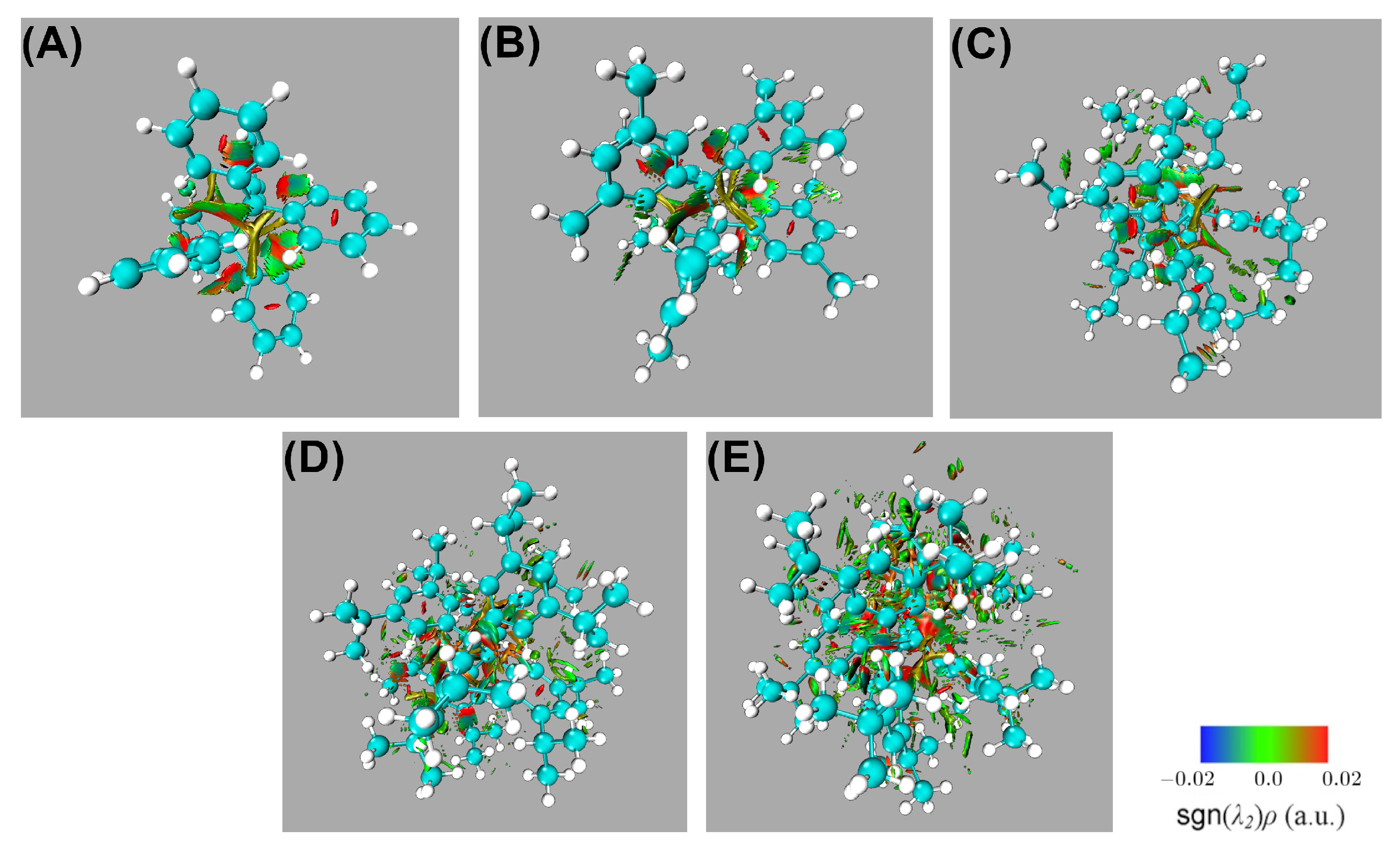
Finally, another tool of QCT that we exploit in this investigation is the non-covalent interaction (NCI) index. This index provides a simple real-space scalar field to locate and visualize weak interactions by analyzing regions of low electron density and low density gradient [
62]. The NCI-index is based on the reduced density gradient
whose small values highlight spatial domains where non-covalent contacts occur. To distinguish the nature of these contacts, the NCI maps are colored using
over isosurfaces of the reduced density gradient, where
is the second eigenvalue of the Hessian of
. Negative values of
(usually portrayed with blue) indicate attractive interactions such as hydrogen bonding or dispersion-dominated contacts, values near zero (normally displayed with green) correspond to weak van der Waals regimes, and positive
values (commonly shown in red) signal steric repulsion. Plotting isosurfaces of
at a low threshold, colored by
, thus, yields an intuitive picture of where weak interactions stabilize or destabilize an electronic system. NCI does not provide energies by itself, but it complements QTAIM and IQA by revealing the spatial extent and character of the interactions that those methods quantify.
4. Computational Details
All molecular structures were optimized with ORCA (version 6) [
63] using the PBE0 functional [
64] with D3 dispersion including Becke–Johnson damping [
65,
66,
67] and the def2-SVP basis set [
68]. All Gibbs free energies and enthalpies are reported at 298.15 K and 1 atm. Entropies and thermal corrections were obtained from analytic harmonic frequencies at the same level of theory, ideal gas, rigid rotor, harmonic oscillator treatment (including translational, rotational, and vibrational contributions). No frequency scaling, quasi-harmonic, or hindered-rotor corrections were applied. All reported structures were confirmed as true minima (no imaginary frequencies). We chose the PBE0-D3BJ functional after we had considered the formation of HPE from the triphenylmethyl radical, (Ph
3)C·,
with several exchange-correlation functionals and basis sets (
Table S1). We considered as benchmark the results of the DLPNO-CCSD(T)/cc-pVTZ approximation which describes the formation of HPE from two (Ph
3)C· radicals as an exothermic reaction. We note that apart from M06-2X, those functionals without dispersion corrections predict reaction (
28) to be endothermic, in concordance with previous studies addressing single, long C–C bonds [
12,
69,
70,
71]. Furthermore, the methods M06/Def2-SVP and PBE0+D3BJ/Def2-SVP are the approximations that approach most closely the results of the benchmark calculations. Nevertheless, the M06-2X functional may produce electron densities that may present some instabilities [
72] which can make them unsuitable for QTAIM analysis; hence, we chose the PBE0+D3BJ/Def2-SVP approximation to described the systems herein. We did not consider the Def2-TZVP approximation due to its strict computational requirements to address the largest systems considered in this work. The resolution-of-the-identity approximation [
73,
74] was employed for the Coulomb term and the chain-of-spheres (COSX) approximation [
75,
76] for the exchange-correlation one with the corresponding def2/J auxiliary basis [
77]. Thermochemical corrections were obtained from analytical harmonic frequency calculations at the same level of theory. QTAIM analyses were performed with AIMAll (version 19.10.12) [
78]; full IQA partitions and delocalization indices were computed for ethane and hexaphenylethane, whereas for the remaining derivatives we employed the first-order approximation to the IQA interatomic energies. We acknowledge that the PBE0+D3BJ geometry is not optimal for the computation of the PBE0 electron density. Nevertheless, dispersion corrections are necessary for the proper description of the energetics of the systems and processes investigated herein [
12,
69,
70,
71] In addition, the PBE0 and PBE + D3BJ structures are very similar (RMSD = 0.06 Å). We also point out that we also took into account these dispersion corrections throughout the decomposition of the electronic energies addressed herein. Non-covalent interaction (NCI) analysis was carried out with the Multiwfn [
79,
80] package, and the isosurfaces were rendered with VMD [
81]. Finally, we computed interaction collectivity indexes (expression (
2) vide infra), defined in terms of the sum of the IQA interatomic energies (Equation (23)), for the 1–3 and 1–4 cross-fragment contacts. This metric provides a compact measure of how much stabilization arises from many weak, non-bonded contacts rather than from the central C–C pair and it is inspired by the interaction collectivity index, ICI [
50].





 ,
,