


MCF-DTI: Multi-Scale Convolutional Local–Global Feature Fusion for Drug–Target Interaction Prediction

Abstract
1. Introduction
- We propose a local–global feature fusion model that combines multi-scale convolution with Transformer architecture. Specifically, the model integrates MSCNN and Transformer in a parallel convolution manner to capture distinctive features of the target-side sequences. Subsequently, feature crossing and feature selection are applied to enhance the model’s predictive capability.
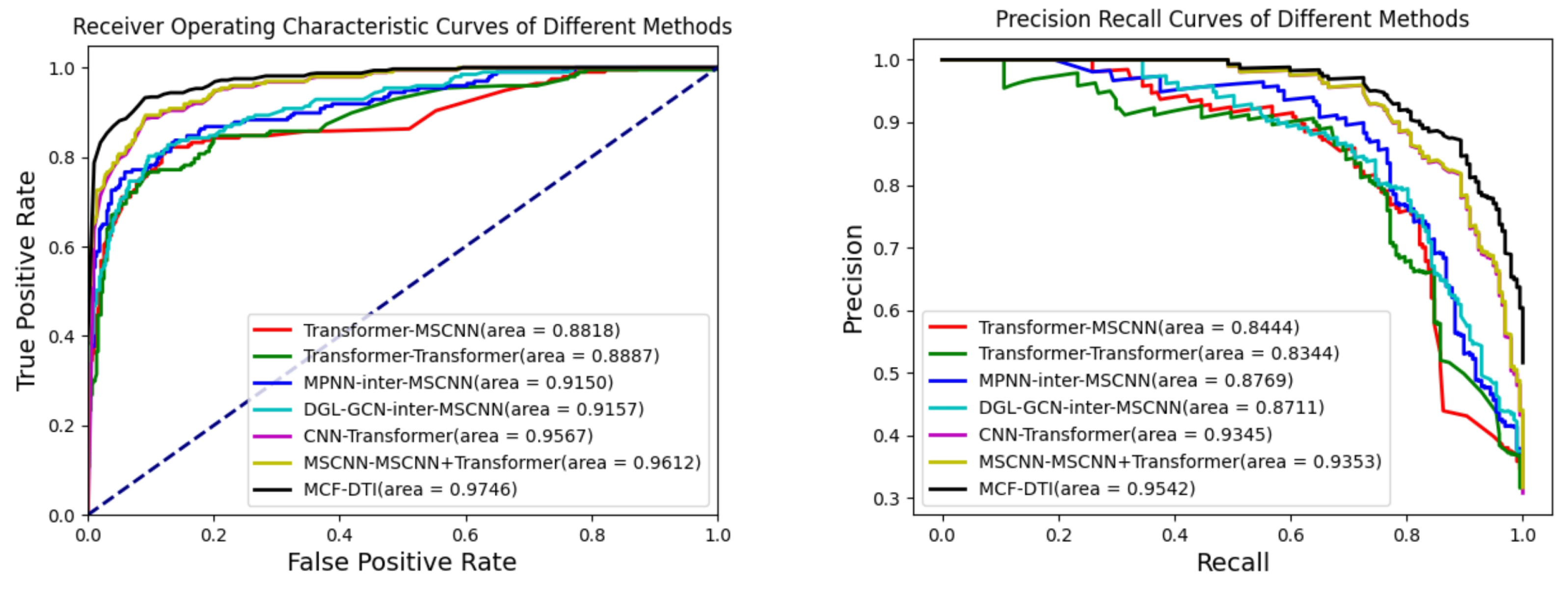
- The proposed model does not require complex feature engineering of the original input data, resulting in a simple yet effective approach with strong applicability. Compared to several existing models, our model demonstrates superior predictive performance.
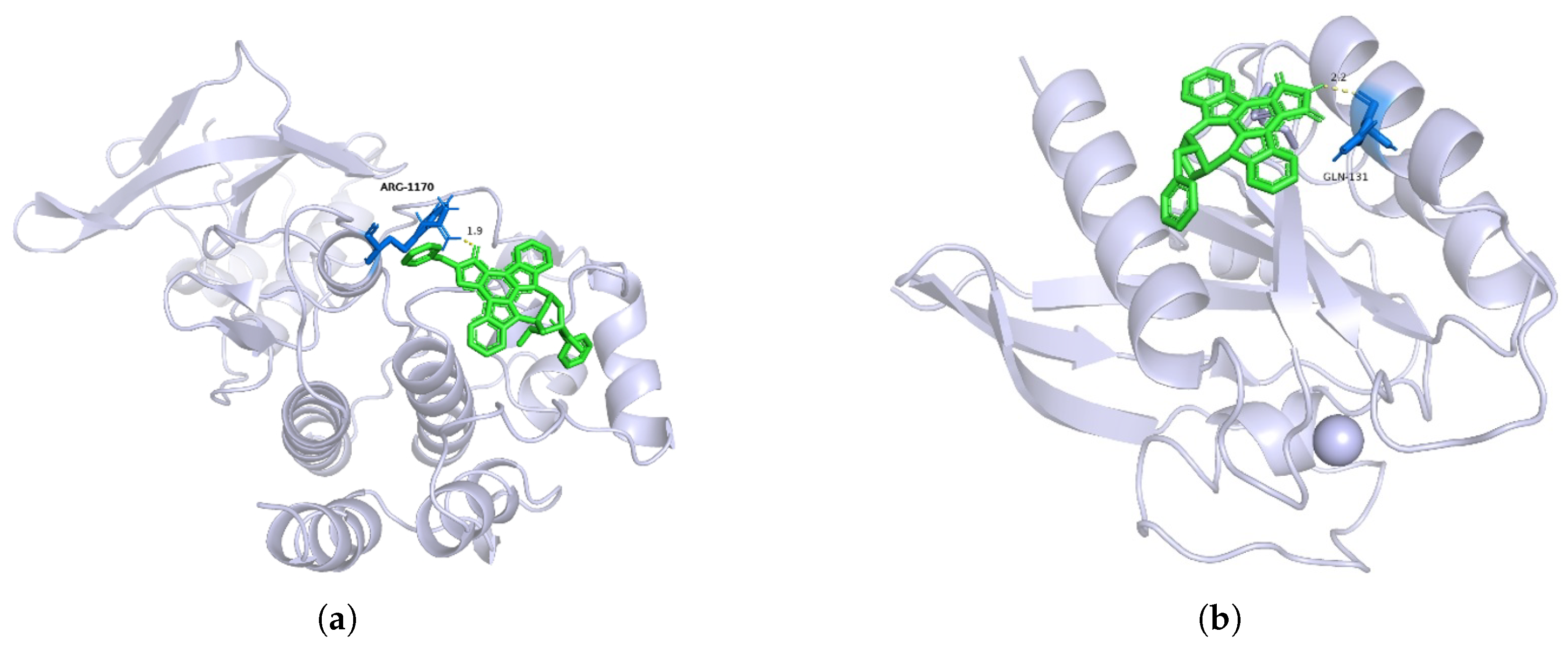
- We validated our model using known lung cancer targets and predicted potential therapeutic drugs for several lung cancer targets. This work highlights new drug discoveries and the possibilities for drug repurposing in targeted lung cancer therapy.
2. Related Work
3. Results and Analysis
3.1. Ablation Experiment
3.2. Model Comparison
3.3. Case Validation and Prediction Studies
4. Method
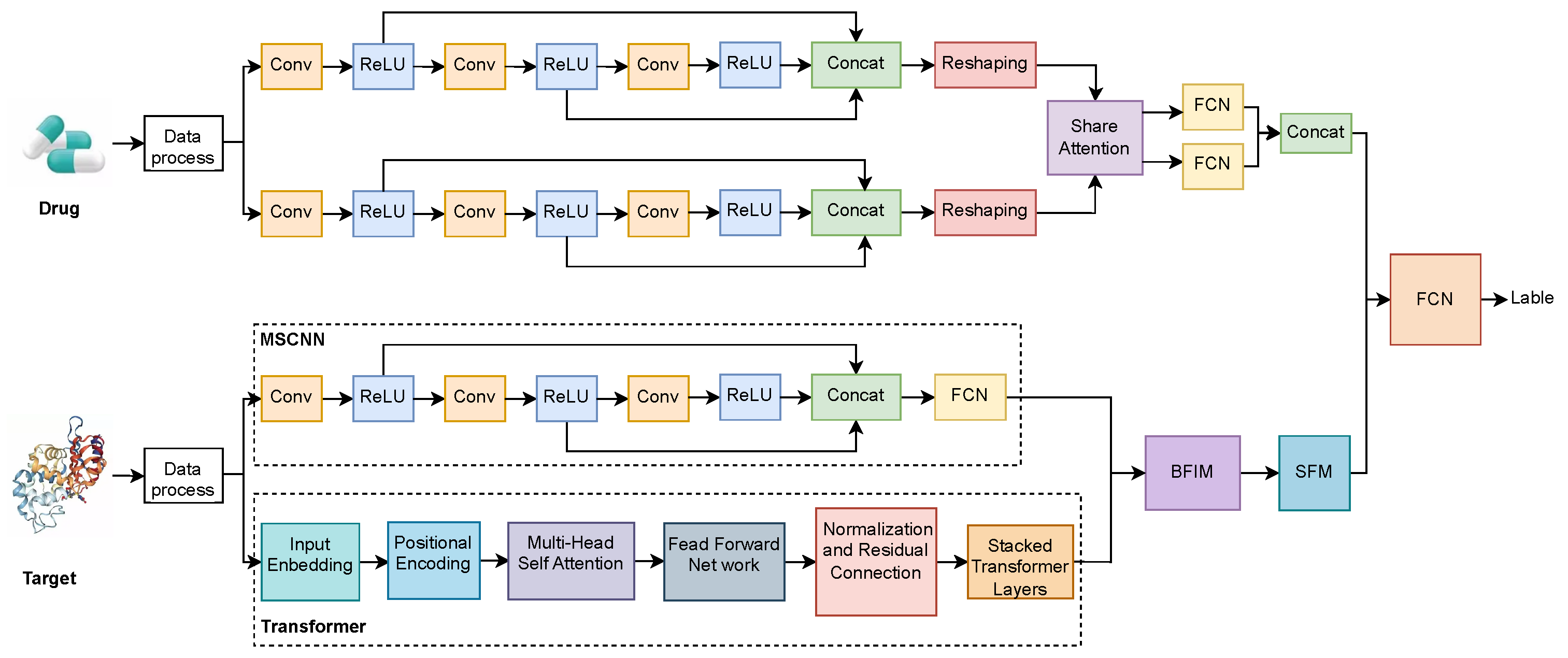
4.1. MCF-DTI Model Architecture
- Parallel Multi-Scale Convolution on Drug Side:The final drug feature is obtained by concatenating the outputs:
- Parallel Feature Extraction on Target Side:Multi-Scale Convolution Path:Transformer Path, including input embedding and multi-head self-attention:The final Transformer feature output:The final target feature is obtained by concatenation:
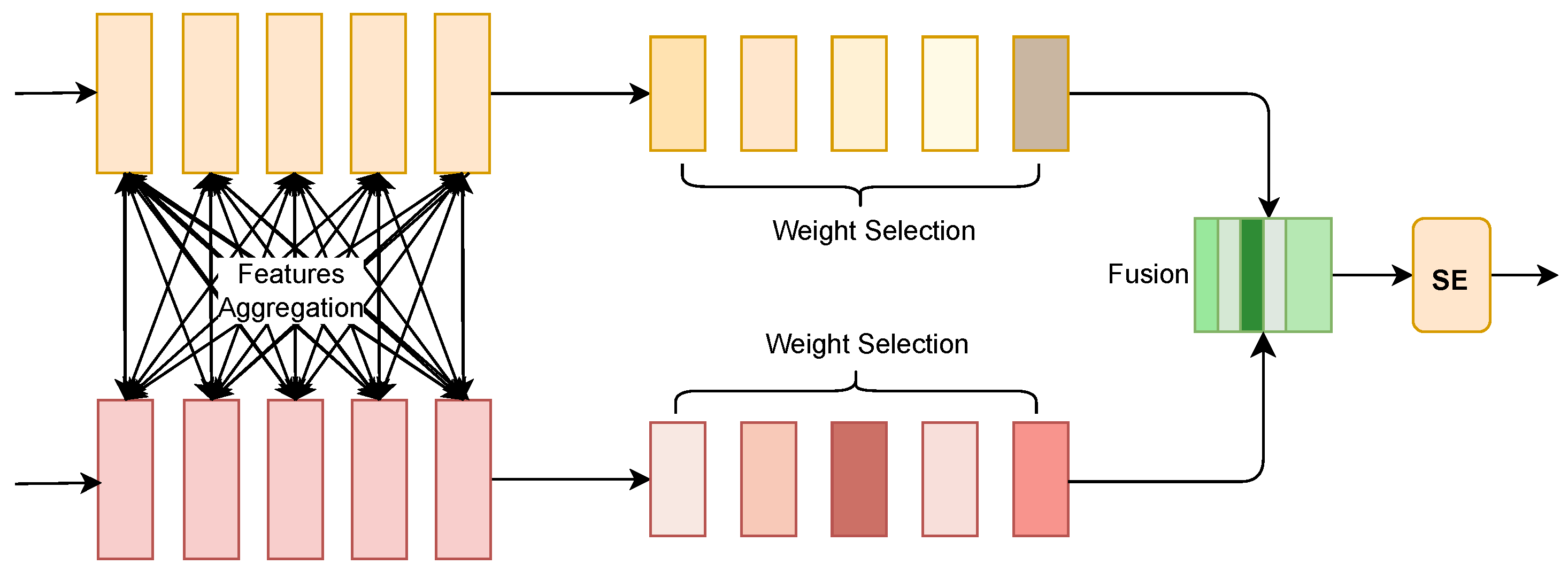
- Feature Interaction and Selection:Feature cross through BFIM:Feature selection through SFM:
- Final Prediction Output:
4.2. Selective Fusion Module
5. Experiments
5.1. Datasets
5.2. Data Preprocessing
- Drug SMILES Representation PreprocessingFirst, the SMILES representations of the drugs were split into individual characters, resulting in a list of chemical symbols such as ‘C’, ‘O’, ‘=’, etc. After splitting, each character underwent a validation check to ensure that it was a legitimate SMILES character. Any unknown or invalid character was replaced with ‘?’. To maintain uniform input length, all SMILES sequences were either padded or truncated to a fixed maximum length, with padding characters represented by ‘?’ if the original sequence length was insufficient. This ensured that all SMILES representations had the same length. Finally, these characters were converted to numerical indices using a character-to-index mapping table and passed through an embedding layer, transforming them into high-dimensional vectors to capture the feature representation of each drug.
- Target Protein Sequence PreprocessingFor target protein sequences, each sequence was first split into individual amino acid characters, represented by their single-letter codes (e.g., ‘M’, ‘A’, ‘L’). These sequences were then validated to ensure that each character was one of the 20 standard amino acid symbols, with invalid characters replaced by ‘?’. To maintain consistency in the input data, all sequences were either padded or truncated to a fixed maximum length, ensuring that all protein sequences were of uniform length. For input to the Transformer, each protein sequence underwent Byte Pair Encoding (BPE), splitting the sequences into frequent subword units. These subunits were then mapped to numerical indices, and an input mask was generated to indicate the valid and padded positions within the sequence, allowing the Transformer to focus on meaningful input. After passing through the embedding layer, the target sequences were transformed into numerical vectors that allowed the model to further learn the features of the protein sequences.
5.3. Evaluation Metrics
5.4. Parameter Settings
5.5. Comparisons
6. Conclusions
Author Contributions
Funding
Institutional Review Board Statement
Informed Consent Statement
Data Availability Statement
Conflicts of Interest
References
- Zhao, Q.; Yang, M.; Cheng, Z.; Li, Y.; Wang, J. Biomedical data and deep learning computational models for predicting compound-protein relations. IEEE/ACM Trans. Comput. Biol. Bioinform. 2021, 19, 2092–2110. [Google Scholar] [CrossRef] [Scilit] [PubMed]
- Yeu, Y.; Yoon, Y.; Park, S. Protein localization vector propagation: A method for improving the accuracy of drug repositioning. Mol. BioSyst. 2015, 11, 2096–2102. [Google Scholar] [CrossRef] [Scilit] [PubMed]
- Bagherian, M.; Kim, R.B.; Jiang, C.; Sartor, M.A.; Derksen, H.; Najarian, K. Coupled matrix–matrix and coupled tensor–matrix completion methods for predicting drug–target interactions. Brief. Bioinform. 2021, 22, 2161–2171. [Google Scholar] [CrossRef] [Scilit] [PubMed]
- Zeng, X.; Zhu, S.; Hou, Y.; Zhang, P.; Li, L.; Li, J.; Huang, L.F.; Lewis, S.J.; Nussinov, R.; Cheng, F. Network-based prediction of drug–target interactions using an arbitrary-order proximity embedded deep forest. Bioinformatics 2020, 36, 2805–2812. [Google Scholar] [CrossRef] [Scilit]
- Zhang, W.; Chen, Y.; Liu, F.; Luo, F.; Tian, G.; Li, X. Predicting potential drug-drug interactions by integrating chemical, biological, phenotypic and network data. BMC Bioinform. 2017, 18, 18. [Google Scholar] [CrossRef] [Scilit] [PubMed]
- Pliakos, K.; Vens, C. Drug-target interaction prediction with tree-ensemble learning and output space reconstruction. BMC Bioinform. 2020, 21, 49. [Google Scholar] [CrossRef] [Scilit]
- Abdollahi, S.; Schaub, D.P.; Barroso, M.; Laubach, N.C.; Hutwelker, W.; Panzer, U.; Gersting, S.ø.W.; Bonn, S. A comprehensive comparison of deep learning-based compound-target interaction prediction models to unveil guiding design principles. J. Cheminform. 2024, 16, 118. [Google Scholar] [CrossRef] [Scilit] [PubMed]
- You, J.; McLeod, R.D.; Hu, P. Predicting drug-target interaction network using deep learning model. Comput. Biol. Chem. 2019, 80, 90–101. [Google Scholar] [CrossRef] [Scilit]
- Jiang, L.; Sun, J.; Wang, Y.; Ning, Q.; Luo, N.; Yin, M. Identifying drug–target interactions via heterogeneous graph attention networks combined with cross-modal similarities. Briefings Bioinform. 2022, 23, bbac016. [Google Scholar] [CrossRef] [Scilit] [PubMed]
- Zhang, B.; Niu, D.; Zhang, L.; Zhang, Q.; Li, Z. MSH-DTI: Multi-graph convolution with self-supervised embedding and heterogeneous aggregation for drug-target interaction prediction. BMC Bioinform. 2024, 25, 275. [Google Scholar] [CrossRef] [Scilit]
- Li, J.; Wang, J.; Lv, H.; Zhang, Z.; Wang, Z. IMCHGAN: Inductive matrix completion with heterogeneous graph attention networks for drug-target interactions prediction. IEEE/ACM Trans. Comput. Biol. Bioinform. 2021, 19, 655–665. [Google Scholar] [CrossRef] [Scilit] [PubMed]
- Ma, D.L.; Chan, D.S.H.; Leung, C.H. Drug repositioning by structure-based virtual screening. Chem. Soc. Rev. 2013, 42, 2130–2141. [Google Scholar] [CrossRef] [Scilit] [PubMed]
- Lam, J.H.; Li, Y.; Zhu, L.; Umarov, R.; Jiang, H.; Héliou, A.; Sheong, F.K.; Liu, T.; Long, Y.; Li, Y.; et al. A deep learning framework to predict binding preference of RNA constituents on protein surface. Nat. Commun. 2019, 10, 4941. [Google Scholar] [CrossRef] [Scilit] [PubMed]
- Santos, R.; Ursu, O.; Gaulton, A.; Bento, A.P.; Donadi, R.S.; Bologa, C.G.; Karlsson, A.; Al-Lazikani, B.; Hersey, A.; Oprea, T.I.; et al. A comprehensive map of molecular drug targets. Nat. Rev. Drug Discov. 2017, 16, 19–34. [Google Scholar] [CrossRef] [Scilit] [PubMed]
- Ezzat, A.; Wu, M.; Li, X.L.; Kwoh, C.K. Computational prediction of drug–target interactions using chemogenomic approaches: An empirical survey. Briefings Bioinform. 2019, 20, 1337–1357. [Google Scholar] [CrossRef] [Scilit] [PubMed]
- Putha, S. AI-Driven Molecular Docking Simulations: Enhancing the Precision of Drug-Target Interactions in Computational Chemistry. Afr. J. Artif. Intell. Sustain. Dev. 2021, 1, 260–300. [Google Scholar]
- Abdul Raheem, A.K.; Dhannoon, B.N. Comprehensive Review on Drug-target Interaction Prediction-Latest Developments and Overview. Curr. Drug Discov. Technol. 2024, 21, 56–67. [Google Scholar] [CrossRef] [Scilit]
- Sharma, S.; Bhatia, V. Recent trends in QSAR in modelling of drug-protein and protein-protein interactions. Comb. Chem. High Throughput Screen. 2021, 24, 1031–1041. [Google Scholar] [CrossRef] [Scilit]
- Cathrine Braun Olsen, L.; Joakim Faergeman, N. Chemical genomics and emerging DNA technologies in the identification of drug mechanisms and drug targets. Curr. Top. Med. Chem. 2012, 12, 1331–1345. [Google Scholar] [CrossRef] [Scilit]
- Nascimento, A.C.; Prudêncio, R.B.; Costa, I.G. A multiple kernel learning algorithm for drug-target interaction prediction. BMC Bioinform. 2016, 17, 46. [Google Scholar] [CrossRef] [Scilit]
- Wen, M.; Zhang, Z.; Niu, S.; Sha, H.; Yang, R.; Yun, Y.; Lu, H. Deep-learning-based drug–target interaction prediction. J. Proteome Res. 2017, 16, 1401–1409. [Google Scholar] [CrossRef] [Scilit] [PubMed]
- Tian, Z.; Yu, Y.; Ni, F.; Zou, Q. Drug-target interaction prediction with collaborative contrastive learning and adaptive self-paced sampling strategy. BMC Biol. 2024, 22, 216. [Google Scholar] [CrossRef] [Scilit]
- Zhang, P.; Lin, P.; Li, D.; Wang, W.; Qi, X.; Li, J.; Xiong, J. MGACL: Prediction Drug–Protein Interaction Based on Meta-Graph Association-Aware Contrastive Learning. Biomolecules 2024, 14, 1267. [Google Scholar] [CrossRef] [Scilit] [PubMed]
- Shao, K.; Zhang, Y.; Wen, Y.; Zhang, Z.; He, S.; Bo, X. DTI-HETA: Prediction of drug–target interactions based on GCN and GAT on heterogeneous graph. Briefings Bioinform. 2022, 23, bbac109. [Google Scholar] [CrossRef] [Scilit]
- Huang, K.; Fu, T.; Glass, L.M.; Zitnik, M.; Xiao, C.; Sun, J. DeepPurpose: A deep learning library for drug–target interaction prediction. Bioinformatics 2020, 36, 5545–5547. [Google Scholar] [CrossRef] [Scilit] [PubMed]
- Zhang, Q.; Feng, Z.; Gao, M.; Guo, L. Determining novel candidate anti-hepatocellular carcinoma drugs using interaction networks and molecular docking between drug targets and natural compounds of SiNiSan. PeerJ 2021, 9, e10745. [Google Scholar] [CrossRef] [Scilit] [PubMed]
- Li, Y.; Ning, J.; Wang, Y.; Wang, C.; Sun, C.; Huo, X.; Yu, Z.; Feng, L.; Zhang, B.; Tian, X.; et al. Drug interaction study of flavonoids toward CYP3A4 and their quantitative structure activity relationship (QSAR) analysis for predicting potential effects. Toxicol. Lett. 2018, 294, 27–36. [Google Scholar] [CrossRef] [Scilit]
- Lee, I.; Keum, J.; Nam, H. DeepConv-DTI: Prediction of drug-target interactions via deep learning with convolution on protein sequences. PLoS Comput. Biol. 2019, 15, e1007129. [Google Scholar] [CrossRef] [Scilit] [PubMed]
- Lu, Q.; Zhou, Z.; Wang, Q. Multi-layer graph attention neural networks for accurate drug-target interaction mapping. Sci. Rep. 2024, 14, 26119. [Google Scholar] [CrossRef] [Scilit]
- Li, H.; Wang, S.; Zheng, W.; Yu, L. Multi-dimensional search for drug–target interaction prediction by preserving the consistency of attention distribution. Comput. Biol. Chem. 2023, 107, 107968. [Google Scholar] [CrossRef] [Scilit]
- Wang, T.; Yang, W.; Chen, J.; Tian, Y.; Wei, D.Q. ConformerDTI: Local Features Coupling Global Representations for Drug–Target Interaction Prediction. In Proceedings of the 2022 IEEE International Conference on Bioinformatics and Biomedicine (BIBM), Las Vegas, NV, USA, 6–8 December 2022; IEEE: Piscataway, NJ, USA, 2022; pp. 1227–1234. [Google Scholar]
- Liu, G.; Singha, M.; Pu, L.; Neupane, P.; Feinstein, J.; Wu, H.C.; Ramanujam, J.; Brylinski, M. GraphDTI: A robust deep learning predictor of drug-target interactions from multiple heterogeneous data. J. Cheminform. 2021, 13, 58. [Google Scholar] [CrossRef] [Scilit] [PubMed]
- Chen, L.; Tan, X.; Wang, D.; Zhong, F.; Liu, X.; Yang, T.; Luo, X.; Chen, K.; Jiang, H.; Zheng, M. TransformerCPI: Improving compound–protein interaction prediction by sequence-based deep learning with self-attention mechanism and label reversal experiments. Bioinformatics 2020, 36, 4406–4414. [Google Scholar] [CrossRef] [Scilit]
- Gao, M.; Zhang, D.; Chen, Y.; Zhang, Y.; Wang, Z.; Wang, X.; Li, S.; Guo, Y.; Webb, G.I.; Nguyen, A.T.; et al. Graphormerdti: A graph transformer-based approach for drug-target interaction prediction. Comput. Biol. Med. 2024, 173, 108339. [Google Scholar] [CrossRef] [Scilit]
- Zhao, Q.; Zhao, H.; Zheng, K.; Wang, J. HyperAttentionDTI: Improving drug–protein interaction prediction by sequence-based deep learning with attention mechanism. Bioinformatics 2022, 38, 655–662. [Google Scholar] [CrossRef] [Scilit]
- Huang, K.; Xiao, C.; Glass, L.M.; Sun, J. MolTrans: Molecular interaction transformer for drug–target interaction prediction. Bioinformatics 2021, 37, 830–836. [Google Scholar] [CrossRef] [Scilit] [PubMed]
- Mayekar, M.K.; Bivona, T.G. Current landscape of targeted therapy in lung cancer. Clin. Pharmacol. Ther. 2017, 102, 757–764. [Google Scholar] [CrossRef] [Scilit] [PubMed]
- Gaulton, A.; Hersey, A.; Nowotka, M.; Bento, A.P.; Chambers, J.; Mendez, D.; Mutowo, P.; Atkinson, F.; Bellis, L.J.; Cibrián-Uhalte, E.; et al. The ChEMBL database in 2017. Nucleic Acids Res. 2017, 45, D945–D954. [Google Scholar] [CrossRef] [Scilit] [PubMed]
- Davis, M.I.; Hunt, J.P.; Herrgard, S.; Ciceri, P.; Wodicka, L.M.; Pallares, G.; Hocker, M.; Treiber, D.K.; Zarrinkar, P.P. Comprehensive analysis of kinase inhibitor selectivity. Nat. Biotechnol. 2011, 29, 1046–1051. [Google Scholar] [CrossRef] [Scilit]
- Gilmer, J.; Schoenholz, S.S.; Riley, P.F.; Vinyals, O.; Dahl, G.E. Message passing neural networks. In Machine Learning Meets Quantum Physics; Springer: Cham, Switzerland, 2020; pp. 199–214. [Google Scholar]
- Zhang, S.; Tong, H.; Xu, J.; Maciejewski, R. Graph convolutional networks: A comprehensive review. Comput. Soc. Networks 2019, 6, 11. [Google Scholar] [CrossRef] [Scilit] [PubMed]
- Wang, M.Y. Deep graph library: Towards efficient and scalable deep learning on graphs. In Proceedings of the ICLR Workshop on Representation Learning on Graphs and Manifolds, New Orleans, LA, USA, 6 May 2019. [Google Scholar]

| Model | AUC | AUPR | Pre | Rec | Acc |
|---|---|---|---|---|---|
| MSCNN-Transformer | 0.9478 | 0.9134 | 0.9026 | 0.7056 | 0.8862 |
| MSCNN-MSCNN | 0.9675 | 0.9491 | 0.8968 | 0.868 | 0.9164 |
| MSCNN2-MSCNN+Transformer (S) | 0.9659 | 0.9217 | 0.8636 | 0.868 | 0.9148 |
| MSCNN2-MSCNN2 | 0.9680 | 0.9359 | 0.8125 | 0.9239 | 0.9084 |
| MCF-DTI | 0.9746 | 0.9542 | 0.8696 | 0.9036 | 0.9148 |
| Model | AUC | AUPR | Pre | Rec | Acc |
|---|---|---|---|---|---|
| Transformer-MSCNN | 0.8818 | 0.8443 | 0.8218 | 0.7259 | 0.8633 |
| Transformer-Transformer | 0.8887 | 0.8344 | 0.7989 | 0.7462 | 0.8601 |
| MPNN-inter-MSCNN | 0.9156 | 0.8769 | 0.8788 | 0.7310 | 0.8826 |
| DGL-GCN-inter-MSCNN | 0.9157 | 0.8711 | 0.8645 | 0.6802 | 0.8654 |
| CNN-Transformer | 0.9567 | 0.9369 | 0.8367 | 0.8367 | 0.9068 |
| MSCNN-MSCNN+Transformer (C) | 0.9612 | 0.9335 | 0.8376 | 0.8376 | 0.8971 |
| MCF-DTI | 0.9746 | 0.9542 | 0.8696 | 0.9036 | 0.9148 |
| Type | Target | Drug | Predictive Probability | Binding Energy (kcal/mol) |
|---|---|---|---|---|
| Drugs FDA approved | EGFR | Gefitinib | 1.00 | −6.44 |
| ALK | Alectinib | 1.00 | −9.40 | |
| ROS1 | Crizotinib | 1.00 | −5.82 | |
| Drugs under study | RET1 | Cabozantinib | 1.00 | −5.49 |
| NTRK1 | Larotrectinib | 1.00 | −4.64 | |
| BRAF | Vemurafenib | 1.00 | −5.27 | |
| Drugs prediction by MCF-DTI | HER2 | CHEMBL95825 | 0.99 | −4.47 |
| HER2 | CHEMBL451964 | 0.99 | −4.77 | |
| MET | CHEMBL36432 | 0.99 | −4.81 | |
| MET | CHEMBL415233 | 0.98 | −8.53 | |
| KRAS | CHEMBL481491 | 0.99 | −6.37 | |
| KRAS | CHEMBL144479 | 0.98 | −7.72 |
| Dataset | Drug | Target | Interaction |
|---|---|---|---|
| Davis | 68 | 442 | 30,056 |
Disclaimer/Publisher’s Note: The statements, opinions and data contained in all publications are solely those of the individual author(s) and contributor(s) and not of MDPI and/or the editor(s). MDPI and/or the editor(s) disclaim responsibility for any injury to people or property resulting from any ideas, methods, instructions or products referred to in the content. |
© 2025 by the authors. Licensee MDPI, Basel, Switzerland. This article is an open access article distributed under the terms and conditions of the Creative Commons Attribution (CC BY) license (https://creativecommons.org/licenses/by/4.0/).
Share and Cite
Wang, J.; He, R.; Wang, X.; Li, H.; Lu, Y. MCF-DTI: Multi-Scale Convolutional Local–Global Feature Fusion for Drug–Target Interaction Prediction. Molecules 2025, 30, 274. https://doi.org/10.3390/molecules30020274
Wang J, He R, Wang X, Li H, Lu Y. MCF-DTI: Multi-Scale Convolutional Local–Global Feature Fusion for Drug–Target Interaction Prediction. Molecules. 2025; 30(2):274. https://doi.org/10.3390/molecules30020274
Chicago/Turabian StyleWang, Jihong, Ruijia He, Xiaodan Wang, Hongjian Li, and Yulei Lu. 2025. "MCF-DTI: Multi-Scale Convolutional Local–Global Feature Fusion for Drug–Target Interaction Prediction" Molecules 30, no. 2: 274. https://doi.org/10.3390/molecules30020274
APA StyleWang, J., He, R., Wang, X., Li, H., & Lu, Y. (2025). MCF-DTI: Multi-Scale Convolutional Local–Global Feature Fusion for Drug–Target Interaction Prediction. Molecules, 30(2), 274. https://doi.org/10.3390/molecules30020274

