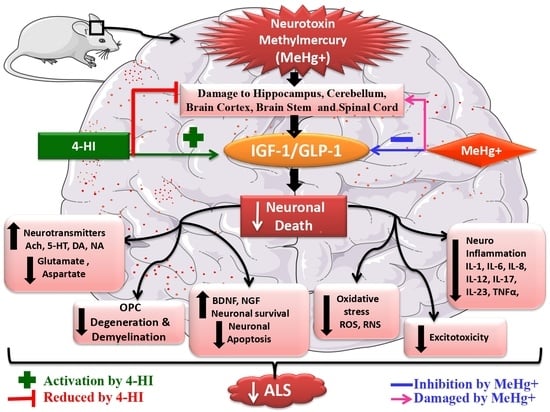
Activation of IGF-1/GLP-1 Signalling via 4-Hydroxyisoleucine Prevents Motor Neuron Impairments in Experimental ALS-Rats Exposed to Methylmercury-Induced Neurotoxicity
 ,
,  ,
, 
Abstract
Share and Cite
Shandilya, A.; Mehan, S.; Kumar, S.; Sethi, P.; Narula, A.S.; Alshammari, A.; Alharbi, M.; Alasmari, A.F. Activation of IGF-1/GLP-1 Signalling via 4-Hydroxyisoleucine Prevents Motor Neuron Impairments in Experimental ALS-Rats Exposed to Methylmercury-Induced Neurotoxicity. Molecules 2022, 27, 3878. https://doi.org/10.3390/molecules27123878
Shandilya A, Mehan S, Kumar S, Sethi P, Narula AS, Alshammari A, Alharbi M, Alasmari AF. Activation of IGF-1/GLP-1 Signalling via 4-Hydroxyisoleucine Prevents Motor Neuron Impairments in Experimental ALS-Rats Exposed to Methylmercury-Induced Neurotoxicity. Molecules. 2022; 27(12):3878. https://doi.org/10.3390/molecules27123878
Chicago/Turabian StyleShandilya, Ambika, Sidharth Mehan, Sumit Kumar, Pranshul Sethi, Acharan S. Narula, Abdulrahman Alshammari, Metab Alharbi, and Abdullah F. Alasmari. 2022. "Activation of IGF-1/GLP-1 Signalling via 4-Hydroxyisoleucine Prevents Motor Neuron Impairments in Experimental ALS-Rats Exposed to Methylmercury-Induced Neurotoxicity" Molecules 27, no. 12: 3878. https://doi.org/10.3390/molecules27123878
APA StyleShandilya, A., Mehan, S., Kumar, S., Sethi, P., Narula, A. S., Alshammari, A., Alharbi, M., & Alasmari, A. F. (2022). Activation of IGF-1/GLP-1 Signalling via 4-Hydroxyisoleucine Prevents Motor Neuron Impairments in Experimental ALS-Rats Exposed to Methylmercury-Induced Neurotoxicity. Molecules, 27(12), 3878. https://doi.org/10.3390/molecules27123878