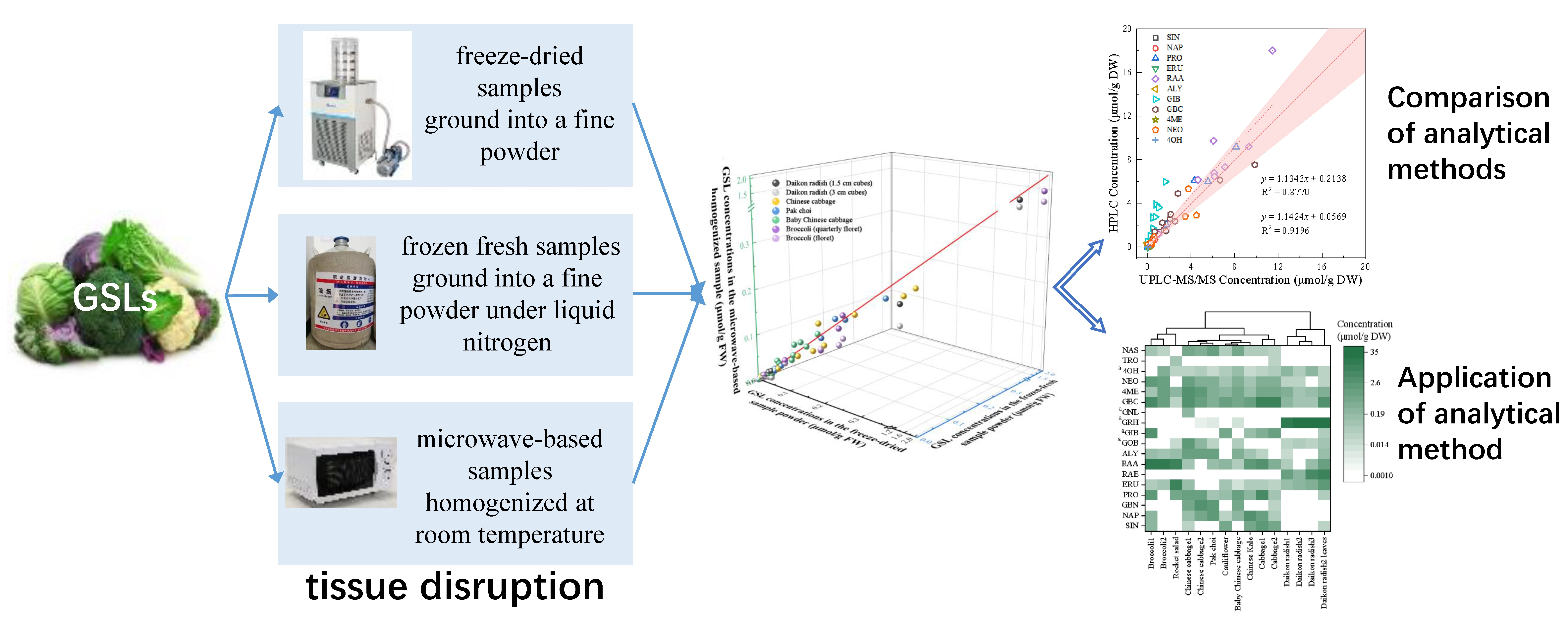
Determination of 18 Intact Glucosinolates in Brassicaceae Vegetables by UHPLC-MS/MS: Comparing Tissue Disruption Methods for Sample Preparation



Abstract
Share and Cite
Yu, X.; He, H.; Zhao, X.; Liu, G.; Hu, L.; Cheng, B.; Wang, Y. Determination of 18 Intact Glucosinolates in Brassicaceae Vegetables by UHPLC-MS/MS: Comparing Tissue Disruption Methods for Sample Preparation. Molecules 2022, 27, 231. https://doi.org/10.3390/molecules27010231
Yu X, He H, Zhao X, Liu G, Hu L, Cheng B, Wang Y. Determination of 18 Intact Glucosinolates in Brassicaceae Vegetables by UHPLC-MS/MS: Comparing Tissue Disruption Methods for Sample Preparation. Molecules. 2022; 27(1):231. https://doi.org/10.3390/molecules27010231
Chicago/Turabian StyleYu, Xiaolu, Hongju He, Xuezhi Zhao, Guangmin Liu, Liping Hu, Bing Cheng, and Yaqin Wang. 2022. "Determination of 18 Intact Glucosinolates in Brassicaceae Vegetables by UHPLC-MS/MS: Comparing Tissue Disruption Methods for Sample Preparation" Molecules 27, no. 1: 231. https://doi.org/10.3390/molecules27010231
APA StyleYu, X., He, H., Zhao, X., Liu, G., Hu, L., Cheng, B., & Wang, Y. (2022). Determination of 18 Intact Glucosinolates in Brassicaceae Vegetables by UHPLC-MS/MS: Comparing Tissue Disruption Methods for Sample Preparation. Molecules, 27(1), 231. https://doi.org/10.3390/molecules27010231