Phase Behavior of Aqueous Biphasic Systems with Choline Alkanoate Ionic Liquids and Phosphate Solutions: The Influence of pH


Abstract
1. Introduction
2. Results and Discussion
Extraction of Triazine Herbicides Using Choline Alkanoate/K3PO4 (pH 7.5) ABS
3. Materials and Methods
3.1. Materials and Chemicals
3.2. Synthesis and Characterization of ILs
3.3. Phase Diagrams
3.3.1. Determination of the Phase Diagrams
3.3.2. Determination of the Tie-Lines
3.4. NMR Analysis
3.5. Extraction and Determination of the Target Herbicides Using the ABS Formed by ILs and pH 7.5 Phosphate Solutions
4. Conclusions
Supplementary Materials
Author Contributions
Funding
Data Availability Statement
Acknowledgments
Conflicts of Interest
Sample Availability
References
- Shao, M.; Zhang, X.; Li, N.; Shi, J.; Zhang, H.; Wang, Z.; Zhang, H.; Yu, A.; Tu, Y. Ionic liquid-based aqueous two-phase system extraction of sulfonamides in milk. J. Chromatogr. B. 2014, 961, 5–12. [Google Scholar] [CrossRef] [Scilit]
- Sha, O.; Zhu, X.; Feng, Y.; Ma, W. Aqueous two-phase based on ionic liquid liquid–liquid microextraction for simultaneous determination of five synthetic food colourants in different food samples by high-performance liquid chromatography. Food Chem. 2015, 174, 380–386. [Google Scholar] [CrossRef] [Scilit]
- Passos, H.; Sousa, A.C.; Pastorinho, M.R.; Nogueira, A.J.; Rebelo, L.P.N.; Coutinho, J.A.P.; Freire, M.G. Ionic-liquid-based aqueous biphasic systems for improved detection of bisphenol A in human fluids. Anal. Methods 2012, 4, 2664–2667. [Google Scholar] [CrossRef] [Scilit]
- Dinis, T.B.; Passos, H.; Lima, D.L.; Esteves, V.I.; Coutinho, J.A.P.; Freire, M.G. One-step extraction and concentration of estrogens for an adequate monitoring of wastewater using ionic-liquid-based aqueous biphasic systems. Green Chem. 2015, 17, 2570–2579. [Google Scholar] [CrossRef] [Scilit]
- Gutowski, K.E.; Broker, G.A.; Willauer, H.D.; Huddleston, J.G.; Swatloski, R.P.; Holbrey, J.D.; Rogers, R.D. Controlling the aqueous miscibility of ionic liquids: Aqueous biphasic systems of water-miscible ionic liquids and water-structuring salts for recycle, metathesis, and separations. J. Am. Chem. Soc. 2003, 125, 6632–6633. [Google Scholar] [CrossRef] [Scilit] [PubMed]
- Flieger, J.; Czajkowska-Żelazko, A. Aqueous two phase system based on ionic liquid for isolation of quinine from human plasma sample. Food Chem. 2015, 166, 150–157. [Google Scholar] [CrossRef] [Scilit]
- Lin, X.; Wang, Y.; Zeng, Q.; Ding, X.; Chen, J. Extraction and separation of proteins by ionic liquid aqueous two-phase system. Analyst 2013, 138, 6445–6453. [Google Scholar] [CrossRef] [Scilit]
- Zeng, Q.; Wang, Y.; Li, N.; Huang, X.; Ding, X.; Lin, X.; Huang, S.; Liu, X. Extraction of proteins with ionic liquid aqueous two-phase system based on guanidine ionic liquid. Talanta 2013, 116, 409–416. [Google Scholar] [CrossRef] [Scilit] [PubMed]
- Wang, X.; Wei, X.; Liu, J.; Liu, J.; Sun, D.; Du, P.; Ping, A. Study on the aqueous two-phase systems composed of surfactant, ionic liquid and water. Fluid Phase Equilib. 2013, 347, 1–7. [Google Scholar] [CrossRef] [Scilit]
- Jiang, B.; Feng, Z.; Liu, C.; Xu, Y.; Li, D.; Ji, G. Extraction and purification of wheat-esterase using aqueous two-phase systems of ionic liquid and salt. J. Food Sci. Technol. 2015, 52, 2878–2885. [Google Scholar] [CrossRef] [Scilit]
- Abraham, M.H.; Zissimos, A.M.; Huddleston, J.G.; Willauer, H.D.; Rogers, R.D.; Acree, W.E. Some novel liquid partitioning systems: Water–ionic liquids and aqueous biphasic systems. Ind. Eng. Chem. Res. 2003, 42, 413–418. [Google Scholar] [CrossRef] [Scilit]
- Holbrey, J.D.; Rogers, R.D. Ionic Liquids in Synthesis, 1st ed.; Wasserscheid, P., Welton, T., Eds.; Wiley-VCH: Weinheim, Germany, 2002; pp. 41–55. [Google Scholar]
- Trujillo-Rodríguez, M.J.; Nan, H.; Varona, M.; Emaus, M.N.; Souza, I.D.; Anderson, J.L. Advances of ionic liquids in analytical chemistry. Anal. Chem. 2019, 91, 505–531. [Google Scholar] [CrossRef] [Scilit]
- Ventura, S.P.M.; Sousa, S.G.; Serafim, L.S.; Lima, A.S.; Freire, M.G.; Coutinho, J.A.P. Ionic-liquid-based aqueous biphasic systems with controlled pH: The ionic liquid anion effect. J. Chem. Eng. Data 2012, 57, 507–512. [Google Scholar] [CrossRef] [Scilit]
- Ventura, S.P.M.; Sousa, S.G.; Serafim, L.S.; Lima, A.S.; Freire, M.G.; Coutinho, J.A.P. Ionic liquid based aqueous biphasic systems with controlled pH: The ionic liquid cation effect. J. Chem. Eng. Data. 2011, 56, 4253–4260. [Google Scholar] [CrossRef] [Scilit]
- Costa, S.P.; Martins, B.S.; Pinto, P.C.; Saraiva, M.L.M. Automated cytochrome c oxidase bioassay developed for ionic liquids’ toxicity assessment. J. Hazard. Mater. 2016, 309, 165–172. [Google Scholar] [CrossRef] [Scilit] [PubMed]
- Costa, S.P.; Pinto, P.C.; Lapa, R.A.; Saraiva, M.L.M. Toxicity assessment of ionic liquids with Vibrio fischeri: An alternative fully automated methodology. J. Hazard. Mater. 2015, 284, 136–142. [Google Scholar] [CrossRef] [Scilit]
- Radošević, K.; Železnjak, J.; Bubalo, M.C.; Redovniković, I.R.; Slivac, I.; Srček, V.G. Comparative in vitro study of cholinium-based ionic liquids and deep eutectic solvents toward fish cell line. Ecotoxicol. Environ. Saf. 2016, 131, 30–36. [Google Scholar] [CrossRef] [Scilit] [PubMed]
- Petkovic, M.; Ferguson, J.L.; Gunaratne, H.Q.N.; Ferreira, R.; Leitão, M.C.; Seddon, K.R.; Rebelo, L.P.N.; Pereira, C.S. Novel biocompatible cholinium-based ionic liquids–toxicity and biodegradability. Green Chem. 2010, 12, 643–649. [Google Scholar] [CrossRef] [Scilit]
- Ventura, S.P.M.; e Silva, F.A.; Gonçalves, A.M.M.; Pereira, J.L.; Gonçalves, F.; Coutinho, J.A.P. Ecotoxicity analysis of cholinium-based ionic liquids to Vibrio fischeri marine bacteria. Ecotoxicol. Environ. Saf. 2014, 102, 48–54. [Google Scholar] [CrossRef] [Scilit]
- Muhammad, N.; Hossain, M.I.; Man, Z.; El-Harbawi, M.; Bustam, M.A.; Noaman, Y.A.; Alitheen, N.B.M.; Ng, M.K.; Hefter, G.; Yin, C.-Y. Synthesis and physical properties of choline carboxylate ionic liquids. J. Chem. Eng. Data 2012, 57, 2191–2196. [Google Scholar] [CrossRef] [Scilit]
- Rengstl, D.; Kraus, B.; Van Vorst, M.; Elliott, G.D.; Kunz, W. Effect of choline carboxylate ionic liquids on biological membranes. Colloids Surf. B 2014, 123, 575–581. [Google Scholar] [CrossRef] [Scilit]
- Liu, X.; Li, Z.; Pei, Y.; Wang, H.; Wang, J. (Liquid+ liquid) equilibria for (cholinium-based ionic liquids+ polymers) aqueous two-phase systems. J. Chem. Thermodyn. 2013, 60, 1–8. [Google Scholar] [CrossRef] [Scilit]
- Mourão, T.; Tomé, L.C.; Florindo, C.; Rebelo, L.P.N.; Marrucho, I.M. Understanding the role of cholinium carboxylate ionic liquids in PEG-based aqueous biphasic systems. ACS Sustain. Chem. Eng. 2014, 2, 2426–2434. [Google Scholar] [CrossRef] [Scilit]
- Pereira, J.F.B.; Vicente, F.; Santos-Ebinuma, V.C.; Araújo, J.M.; Pessoa, A.; Freire, M.G.; Coutinho, J.A.P. Extraction of tetracycline from fermentation broth using aqueous two-phase systems composed of polyethylene glycol and cholinium-based salts. Process. Biochem. 2013, 48, 716–722. [Google Scholar] [CrossRef] [Scilit]
- Quental, M.V.; Caban, M.; Pereira, M.M.; Stepnowski, P.; Coutinho, J.A.P.; Freire, M.G. Enhanced extraction of proteins using cholinium-based ionic liquids as phase-forming components of aqueous biphasic systems. Biotechnol. J. 2015, 10, 1457–1466. [Google Scholar] [CrossRef] [Scilit]
- Tian, H.; Berton, P.; Rogers, R.D. Choline-based aqueous biphasic systems: Overview of applications. Fluid Phase Equilibr. 2019, 502, 112258. [Google Scholar] [CrossRef] [Scilit]
- Shahriari, S.; Tomé, L.C.; Araújo, J.M.; Rebelo, L.P.N.; Coutinho, J.A.P.; Marrucho, I.M.; Freire, M.G. Aqueous biphasic systems: A benign route using cholinium-based ionic liquids. RSC Adv. 2013, 3, 1835–1843. [Google Scholar] [CrossRef] [Scilit]
- Sintra, T.E.; Cruz, R.; Ventura, S.P.M.; Coutinho, J.A.P. Phase diagrams of ionic liquids-based aqueous biphasic systems as a platform for extraction processes. J. Chem. Thermodyn. 2014, 77, 206–213. [Google Scholar] [CrossRef] [Scilit]
- Bogdanov, M.G.; Svinyarov, I. Analysis of acetylcholinesterase inhibitors by extraction in choline saccharinate aqueous biphasic systems. J. Chromatogr. A 2018, 1559, 62–68. [Google Scholar] [CrossRef] [Scilit]
- Nie, L.; Song, H.; Yohannes, A.; Liang, S.; Yao, S. Extraction in cholinium-based magnetic ionic liquid aqueous two-phase system for the determination of berberine hydrochloride in Rhizoma coptidis. RSC Adv. 2018, 8, 25201–25209. [Google Scholar] [CrossRef] [Scilit]
- Saravanan, S.; Rao, J.R.; Nair, B.U.; Ramasami, T. Aqueous two-phase poly (ethylene glycol)–poly (acrylic acid) system for protein partitioning: Influence of molecular weight, pH and temperature. Process Biochem. 2008, 43, 905–911. [Google Scholar] [CrossRef] [Scilit]
- Neogi, P. Electrostatic effects on partitioning of proteins in aqueous two-phase systems: I. pH and charge equilibria. J. Colloid Interface Sci. 1993, 159, 261–274. [Google Scholar] [CrossRef] [Scilit]
- Gündüz, U.; Korkmaz, K. Bovine serum albumin partitioning in an aqueous two-phase system: Effect of pH and sodium chloride concentration. J. Chromatogr. B: Biomed. Sci. Appl. 2000, 743, 255–258. [Google Scholar] [CrossRef] [Scilit]
- Shang, Q.; Li, W.; Jia, Q.; Li, D. Partitioning behavior of amino acids in aqueous two-phase systems containing polyethylene glycol and phosphate buffer. Fluid Phase Equilib. 2004, 219, 195–203. [Google Scholar] [CrossRef] [Scilit]
- Saravanan, S.; Rao, J.R.; Murugesan, T.; Nair, B.U.; Ramasami, T. Partition of tannery wastewater proteins in aqueous two-phase poly (ethylene glycol)-magnesium sulfate systems: Effects of molecular weights and pH. Chem. Eng. Sci. 2007, 62, 969–978. [Google Scholar] [CrossRef] [Scilit]
- Kianmehr, A.; Pooraskari, M.; Mousavikoodehi, B.; Mostafavi, S.S. Recombinant D-galactose dehydrogenase partitioning in aqueous two-phase systems: Effect of pH and concentration of PEG and ammonium sulfate. Bioresour. Bioprocess. 2014, 1, 6. [Google Scholar] [CrossRef] [Scilit]
- Pusztai, A. Interactions of proteins with other polyelectrolytes in a two-phase system containing phenol and aqueous buffers at various pH values. Biochem. J. 1966, 99, 93. [Google Scholar] [CrossRef] [Scilit] [PubMed]
- Gautam, S.; Simon, L. Partitioning of β-glucosidase from Trichoderma reesei in poly (ethylene glycol) and potassium phosphate aqueous two-phase systems: Influence of pH and temperature. Biochem. Eng. J. 2006, 30, 104–108. [Google Scholar] [CrossRef] [Scilit]
- Pereira, J.F.; Kurnia, K.A.; Cojocaru, O.A.; Gurau, G.; Rebelo, L.P.N.; Rogers, R.D.; Freire, M.G.; Coutinho, J.A.P. Molecular interactions in aqueous biphasic systems composed of polyethylene glycol and crystalline vs. liquid cholinium-based salts. Phys. Chem. Chem. Phys. 2014, 16, 5723–5731. [Google Scholar] [CrossRef] [Scilit] [PubMed]
- Li, Z.; Liu, X.; Pei, Y.; Wang, J.; He, M. Design of environmentally friendly ionic liquid aqueous two-phase systems for the efficient and high activity extraction of proteins. Green Chem. 2012, 14, 2941–2950. [Google Scholar] [CrossRef] [Scilit]
- Cheng, F.; Wang, H.; Chatel, G.; Gurau, G.; Rogers, R.D. Facile pulping of lignocellulosic biomass using choline acetate. Bioresour. Technol. 2014, 164, 394–401. [Google Scholar] [CrossRef] [Scilit] [PubMed]
- Ninomiya, K.; Kohori, A.; Tatsumi, M.; Osawa, K.; Endo, T.; Kakuchi, R.; Ogino, C.; Shimizu, N.; Takahashi, K. Ionic liquid/ultrasound pretreatment and in situ enzymatic saccharification of bagasse using biocompatible cholinium ionic liquid. Bioresour. Technol. 2015, 176, 169–174. [Google Scholar] [CrossRef] [Scilit]
- Tian, H.; Berton, P.; Rogers, R.D. Aqueous biphasic systems composed of random ethylene/propylene oxide copolymers, choline acetate, and water for triazine-based herbicide partitioning study. Solvent Extr. Ion Exch. 2018, 36, 602–616. [Google Scholar] [CrossRef] [Scilit]
- Tian, H.; Xu, C.; Cai, J.; Xu, J. The aqueous biphasic system based on cholinium ionic liquids and nonionic surfactant and its application for triazine-based herbicides extraction. J. Chem. Thermodyn. 2018, 125, 41–49. [Google Scholar] [CrossRef] [Scilit]
- Neves, C.M.S.S.; Ventura, S.P.; Freire, M.G.; Marrucho, I.M.; Coutinho, J.A.P. Evaluation of cation influence on the formation and extraction capability of ionic-liquid-based aqueous biphasic systems. J. Phys. Chem. B 2009, 113, 5194–5199. [Google Scholar] [CrossRef] [Scilit]
- Li, C.X.; Han, J.; Wang, Y.; Yan, Y.S.; Pan, J.M.; Xu, X.H.; Zhang, Z.L. Phase Behavior for the Aqueous Two-Phase Systems Containing the Ionic Liquid 1Butyl3-methylimidazolium Tetrafluoroborate and Kosmotropic Salts. J. Chem. Eng. Data. 2009, 55, 1087–1092. [Google Scholar] [CrossRef] [Scilit]
- Deive, F.J.; Rodríguez, A. (Liquid + liquid) equilibrium of aqueous biphasic systems composed of 1-benzyl or 1-hexyl-3-methylimidazolium chloride ionic liquids and inorganic salts. J. Chem. Thermodyn. 2012, 54, 272–277. [Google Scholar] [CrossRef] [Scilit]
- Zafarani-Moattar, M.T.; Hamzehzadeh, S. Effect of pH on the phase separation in the ternary aqueous system containing the hydrophilic ionic liquid 1-butyl-3-methylimidazolium bromide and the kosmotropic salt potassium citrate at T= 298.15 K. Fluid Phase Equilib. 2011, 304, 110–120. [Google Scholar] [CrossRef] [Scilit]
- E Silva, F.A.; Sintra, T.; Ventura, S.P.; Coutinho, J.A.P. Recovery of paracetamol from pharmaceutical wastes. Sep. Purif. Technol. 2014, 122, 315–322. [Google Scholar] [CrossRef] [Scilit]
- Freire, M.G.; Claudio, A.F.M.; Araujo, J.M.M.; Coutinho, J.A.P.; Marrucho, I.M.; Lopes, J.N.C.; Rebelo, L.P.N. Aqueous biphasic systems: A boost brought about by using ionic liquids. Chem. Soc. Rev. 2012, 41, 4966–4995. [Google Scholar] [CrossRef] [Scilit] [PubMed]
- Mourão, T.; Cláudio, A.F.M.; Boal-Palheiros, I.; Freire, M.G.; Coutinho, J.A.P. Evaluation of the impact of phosphate salts on the for mation of ionic-liquid-based aqueous biphasic systems. J. Chem. Thermodyn. 2012, 54, 398–405. [Google Scholar] [CrossRef] [Scilit]
- Pismenskaya, N.; Laktionov, E.; Nikonenko, V.; El Attar, A.; Auclair, B.; Pourcelly, G. Dependence of composition of anion-exchange membranes and their electrical conductivity on concentration of sodium salts of carbonic and phosphoric acids. J. Membr. Sci. 2001, 181, 185–197. [Google Scholar] [CrossRef] [Scilit]
- DrugBank. Available online: https://go.drugbank.com/drugs/DB00122 (accessed on 3 March 2021).
- Carboxylic Acids. Available online: https://crab.rutgers.edu/~alroche/Ch20.pdf (accessed on 3 March 2021).
- Yang, X.J.; Qu, Y.; Yuan, Q.; Wan, P.; Du, Z.; Chen, D.; Wong, C. Effect of ammonium on liquid- and gas-phase protonation and deprotonation in electrospray ionization mass spectrometry. Analyst 2013, 138, 659–665. [Google Scholar] [CrossRef] [Scilit]
- Yu, Y.; Lu, X.; Zhou, Q.; Dong, K.; Yao, H.; Zhang, S. Biodegradable naphthenic acid ionic liquids: Synthesis, characterization, and quantitative structure–biodegradation relationship. Chem.—Eur. J. 2008, 14, 11174–11182. [Google Scholar] [CrossRef] [Scilit] [PubMed]
- Merchuk, J.C.; Andrews, B.A.; Asenjo, J.A. Aqueous two-phase systems for protein separation: Studies on phase inversion. J. Chromatogr. B: Biomed. Sci. Appl. 1998, 711, 285–293. [Google Scholar] [CrossRef] [Scilit]
- Kalla, R.M.N.; Lim, J.; Bae, J.; Kim, I. Sulfated choline ionic liquid-catalyzed acetamide synthesis by grindstone method. Tetrahedron Lett. 2017, 58, 1595–1599. [Google Scholar] [CrossRef] [Scilit]





| [Cho][OAc] | [Cho][Pro] | [Cho][But] | [Cho][Hex] | [Cho][Oct] | |
|---|---|---|---|---|---|
| K3PO4 (pH 14.5) | ✓ | ✓ | ✓ | ✓ | × |
| K3PO4 (pH 7.2) | × | ✓ | ✓ | ✓ | × |
| Na2HPO4 (pH 9.0) | × | × | × | × | × |
| NaH2PO4 (pH 3.3) | × | × | × | × | × |
| NaH2PO4/Na2HPO4 (pH 5.5) | × | × | × | × | × |
| NaH2PO4/Na2HPO4 (pH 7.0) | × | × | × | × | × |
| ABS IL/K3PO4 (pH 7.5) | IL (wt%) | K3PO4 (wt%) | Recovery ± SD a (%) b | ||
|---|---|---|---|---|---|
| Simazine | Cyanazine | Atrazine | |||
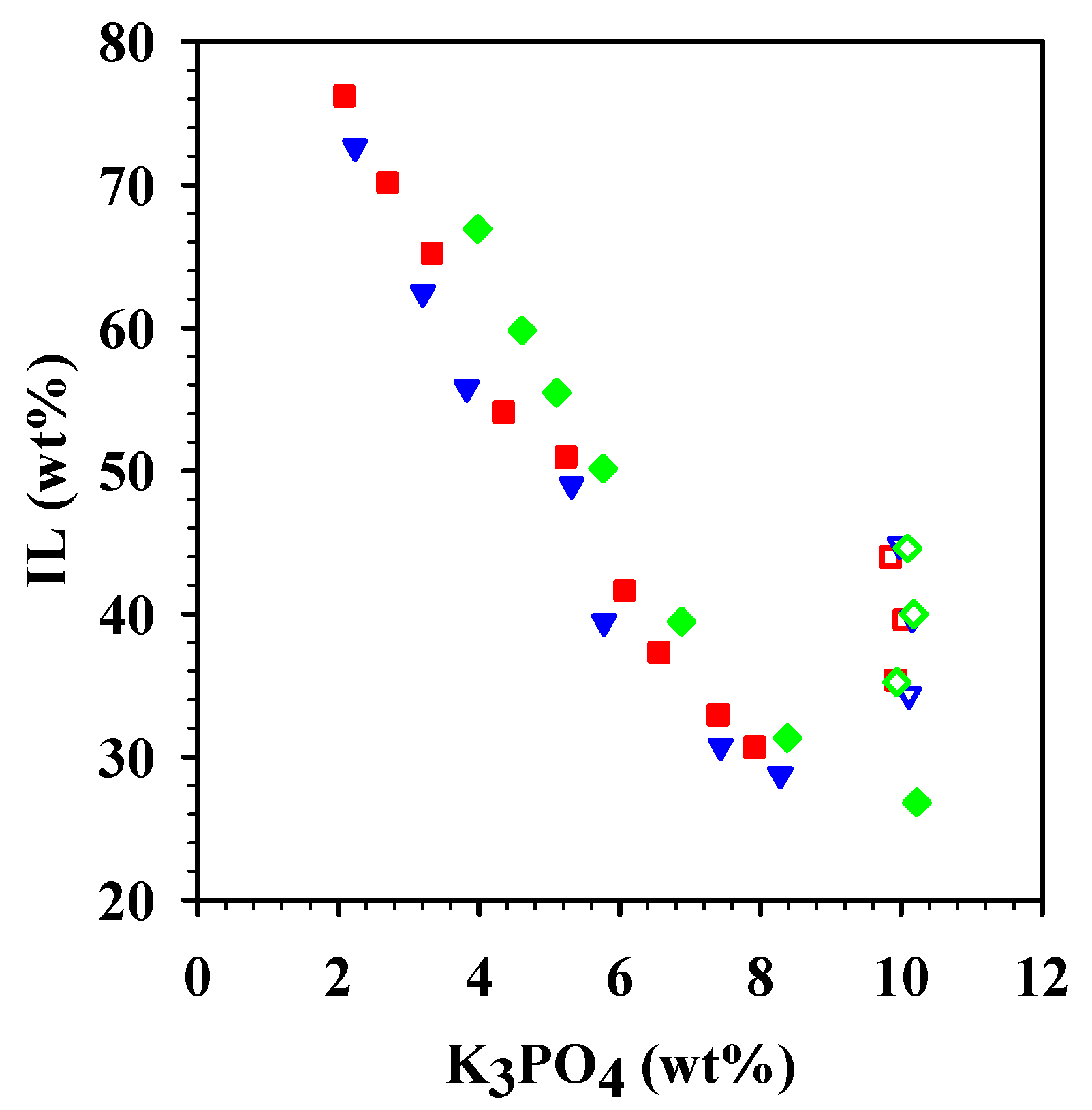
| [Cho][Pro]/K3PO4 | 35.37 | 9.92 | 88 (5) | 92 (5) | 86 (5) |
| 39.60 | 10.04 | 93 (4) | 92 (4) | 97 (4) | |
| 43.98 | 9.85 | 96 (4) | 92 (4) | 98 (4) | |
| [Cho][But]/K3PO4 | 34.35 | 10.11 | 52 (5) | 54 (5) | 58 (5) |
| 39.70 | 10.16 | 69 (6) | 68 (5) | 77 (5) | |
| 44.82 | 9.98 | 68 (6) | 62 (5) | 75 (6) | |
| [Cho][Hex]/K3PO4 | 35.23 | 9.94 | 60 (6) | 67 (6) | 71 (4) |
| 39.99 | 10.18 | 66 (5) | 73 (5) | 83 (5) | |
| 44.58 | 10.09 | 75 (4) | 80 (5) | 93 (4) | |
| IL | ||||||
|---|---|---|---|---|---|---|
 [Cho]+ [Cho]+ |  [OAc]− [OAc]− |  [Pro]− [Pro]− |  [But]− [But]− |  [Hex]− [Hex]− |  [Oct]− [Oct]− | |
| Molecular weight (g/mol) | 163.2 | 177.2 | 191.2 | 219.2 | 247.4 | |
| Water content (ppm) | 4840 ± 125 | 4960 ± 135 | 5041 ± 185 | 5117 ± 168 | 5132 ± 150 | |
Publisher’s Note: MDPI stays neutral with regard to jurisdictional claims in published maps and institutional affiliations. |
© 2021 by the authors. Licensee MDPI, Basel, Switzerland. This article is an open access article distributed under the terms and conditions of the Creative Commons Attribution (CC BY) license (http://creativecommons.org/licenses/by/4.0/).
Share and Cite
Berton, P.; Tian, H.; Rogers, R.D. Phase Behavior of Aqueous Biphasic Systems with Choline Alkanoate Ionic Liquids and Phosphate Solutions: The Influence of pH. Molecules 2021, 26, 1702. https://doi.org/10.3390/molecules26061702
Berton P, Tian H, Rogers RD. Phase Behavior of Aqueous Biphasic Systems with Choline Alkanoate Ionic Liquids and Phosphate Solutions: The Influence of pH. Molecules. 2021; 26(6):1702. https://doi.org/10.3390/molecules26061702
Chicago/Turabian StyleBerton, Paula, Hongzhe Tian, and Robin D. Rogers. 2021. "Phase Behavior of Aqueous Biphasic Systems with Choline Alkanoate Ionic Liquids and Phosphate Solutions: The Influence of pH" Molecules 26, no. 6: 1702. https://doi.org/10.3390/molecules26061702
APA StyleBerton, P., Tian, H., & Rogers, R. D. (2021). Phase Behavior of Aqueous Biphasic Systems with Choline Alkanoate Ionic Liquids and Phosphate Solutions: The Influence of pH. Molecules, 26(6), 1702. https://doi.org/10.3390/molecules26061702