
Review

Flavonoids: A Myth or a Reality for Cancer Therapy?

by
Cinzia Forni
1,*,
Massimiliano Rossi
1,2,
Ilaria Borromeo
3,
Giordana Feriotto
4,
Giovambattista Platamone
1,2,
Claudio Tabolacci
5,
Carlo Mischiati
6 and
Simone Beninati
1
1
Department of Biology, University of Rome Tor Vergata, Via della Ricerca Scientifica, 00133 Rome, Italy
2
PhD Program in Evolutionary Biology and Ecology, Department of Biology, University of Rome Tor Vergata, Via della Ricerca Scientifica, 00133 Rome, Italy
3
Department of Physics, University of Rome Tor Vergata, Via della Ricerca Scientifica, 00133 Rome, Italy
4
Department of Chemistry and Pharmaceutical Sciences, University of Ferrara, 44121 Ferrara, Italy
5
Department of Oncology and Molecular Medicine, Istituto Superiore di Sanità, 00161 Rome, Italy
6
Department of Neuroscience and Rehabilitation, University of Ferrara, 44121 Ferrara, Italy
*
Author to whom correspondence should be addressed.
Molecules 2021, 26(12), 3583; https://doi.org/10.3390/molecules26123583

Submission received: 26 April 2021 / Revised: 3 June 2021 / Accepted: 8 June 2021 / Published: 11 June 2021

Abstract

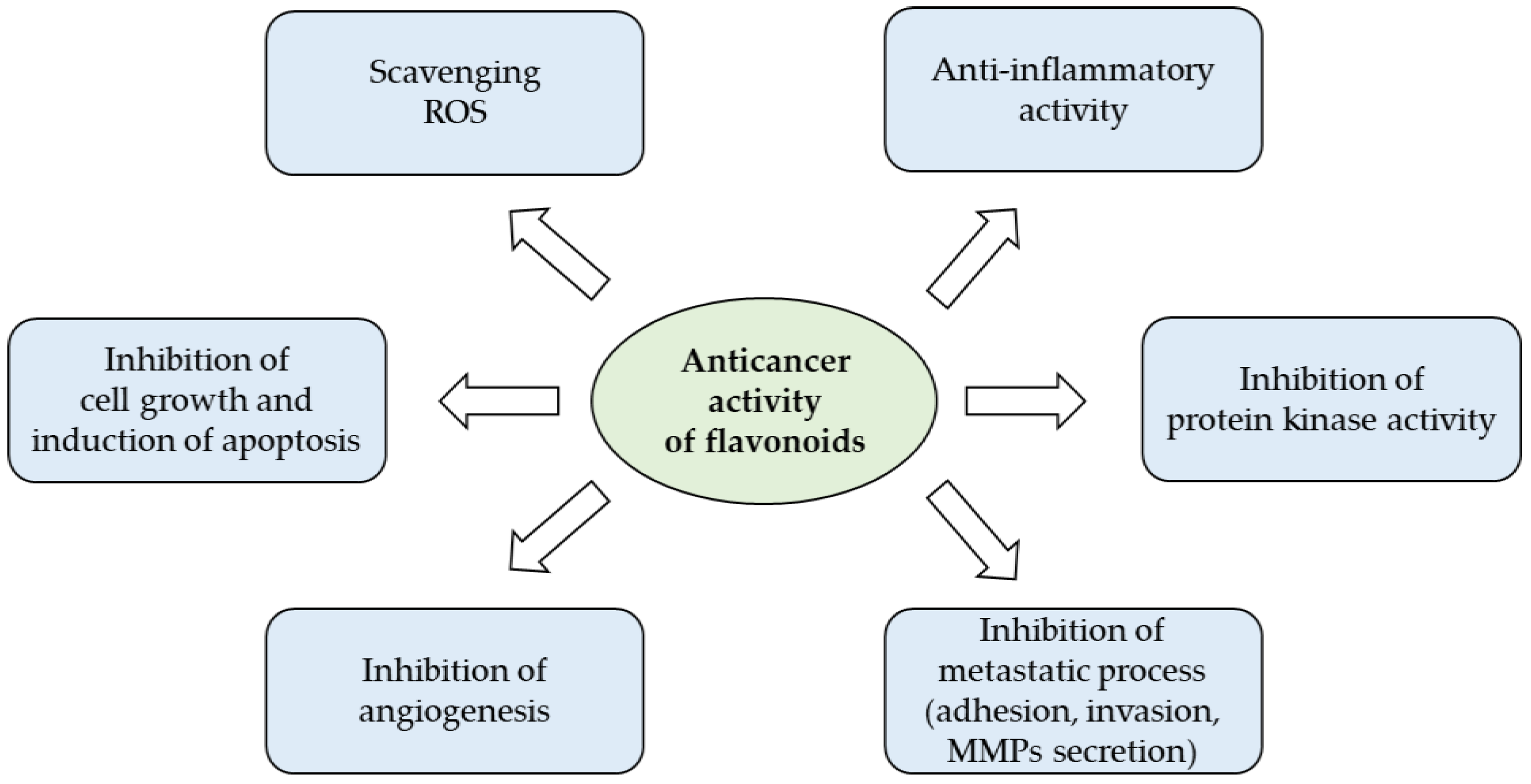
Nutraceuticals are biologically active molecules present in foods; they can have beneficial effects on health, but they are not available in large enough quantities to perform this function. Plant metabolites, such as polyphenols, are widely diffused in the plant kingdom, where they play fundamental roles in plant development and interactions with the environment. Among these, flavonoids are of particular interest as they have significant effects on human health. In vitro and/or in vivo studies described flavonoids as essential nutrients for preventing several diseases. They display broad and promising bioactivities to fight cancer, inflammation, bacterial infections, as well as to reduce the severity of neurodegenerative and cardiovascular diseases or diabetes. Therefore, it is not surprising that interest in flavonoids has sharply increased in recent years. More than 23,000 scientific publications on flavonoids have described the potential anticancer activity of these natural molecules in the last decade. Studies, in vitro and in vivo, show that flavonoids exhibit anticancer properties, and many epidemiological studies confirm that dietary intake of flavonoids leads to a reduced risk of cancer. This review provides a glimpse of the mechanisms of action of flavonoids on cancer cells.
Keywords: flavonoids; cancer; oxidative stress; inflammation; apoptosis/autophagy; metastasis; angiogenesis flavonoids; cancer; oxidative stress; inflammation; apoptosis/autophagy; metastasis; angiogenesis