Bioassay-Guided Isolation of Anti-Alzheimer Active Components from the Aerial Parts of Hedyotis diffusa and Simultaneous Analysis for Marker Compounds


Abstract
1. Introduction
2. Results
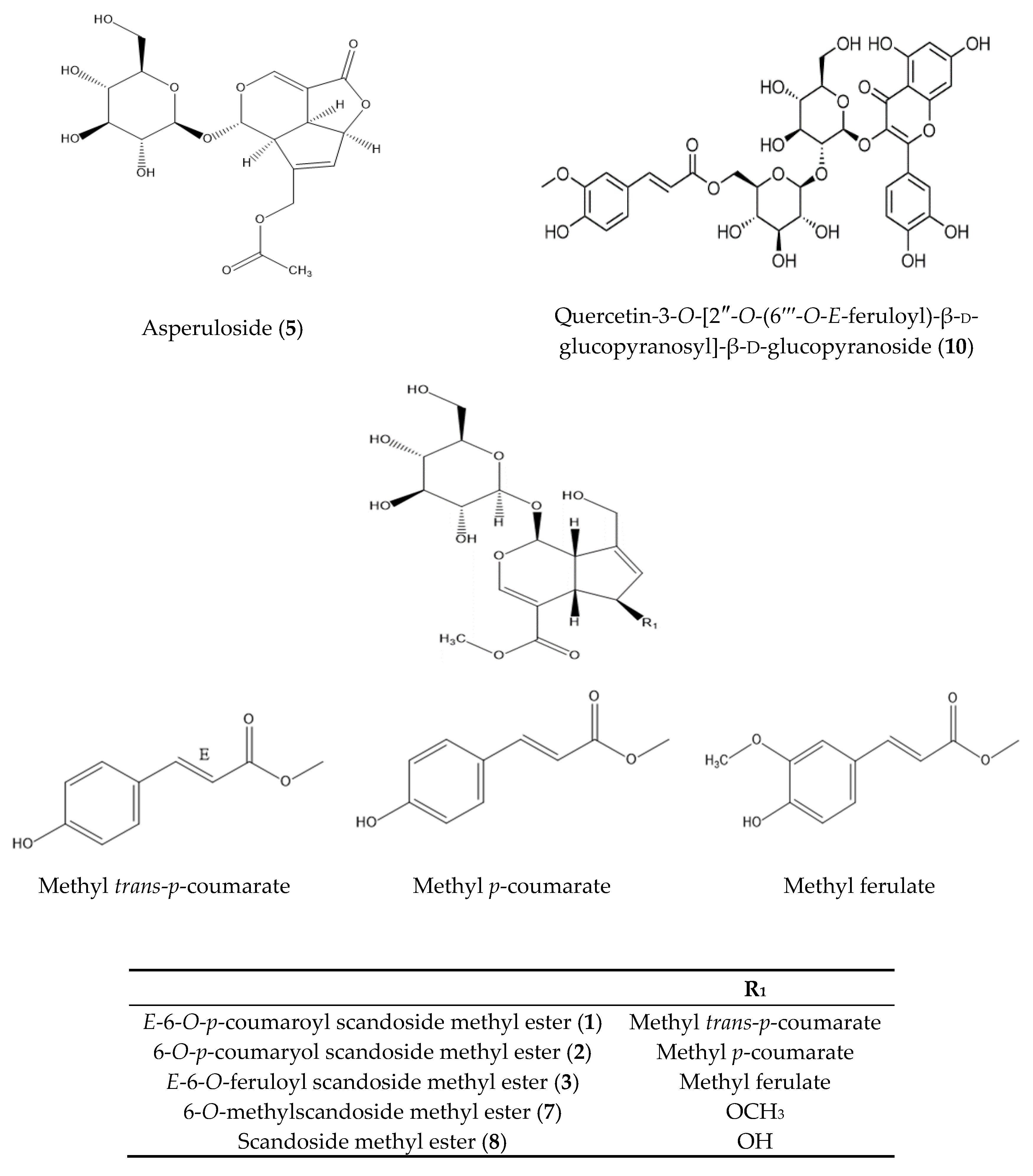
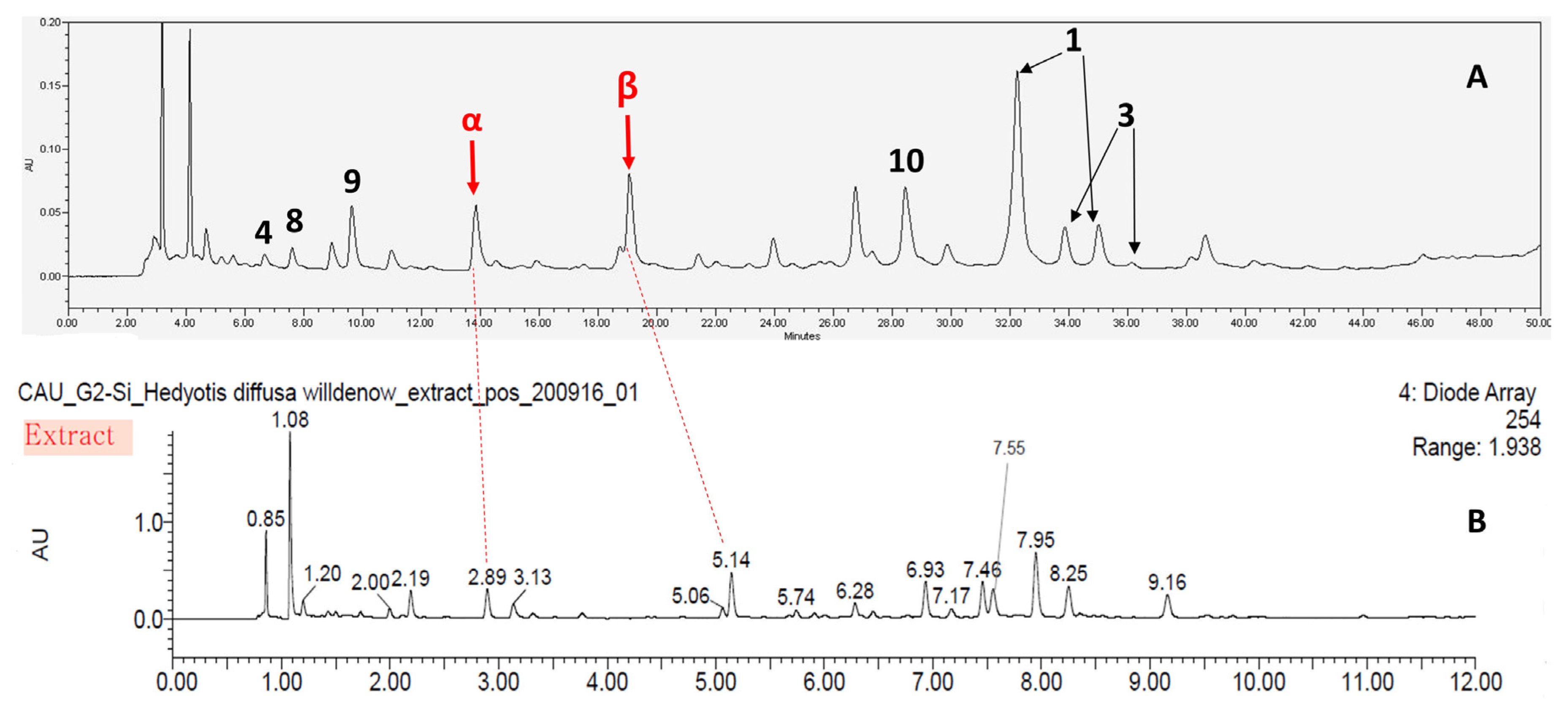
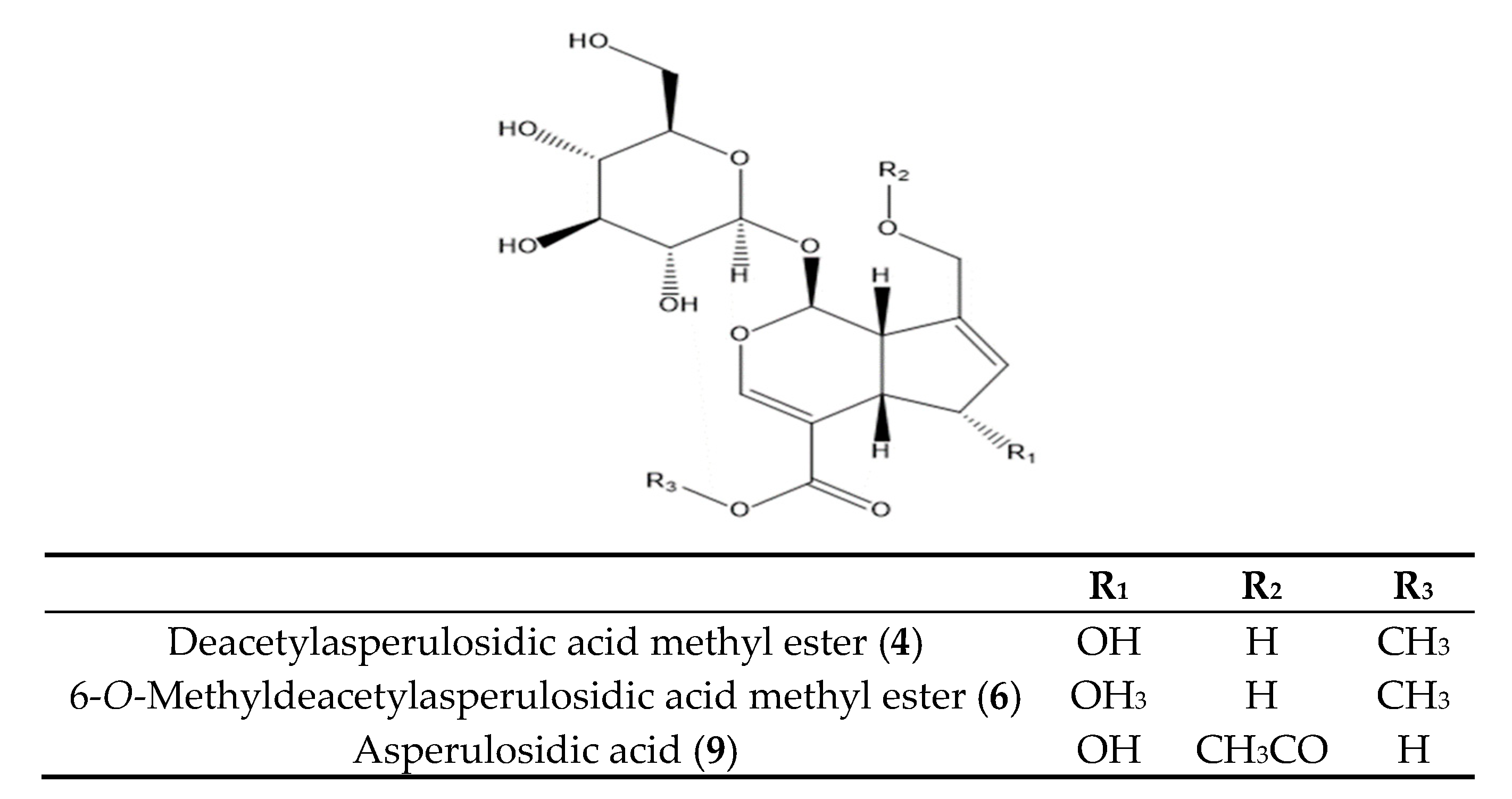
2.1. Structural Identification of Compounds 1–10 Isolated from H. diffusa
2.2. Inhibitory Activities of the Extract and Fractions Obtained from H. diffusa against Cholinesterase (AChE and BChE), BACE1, and the Formation of AGE
2.3. Inhibitory Activities of Compounds 1–10 Isolated from H. diffusa against ChE (AChE and BChE), BACE1, and the Formation of AGE
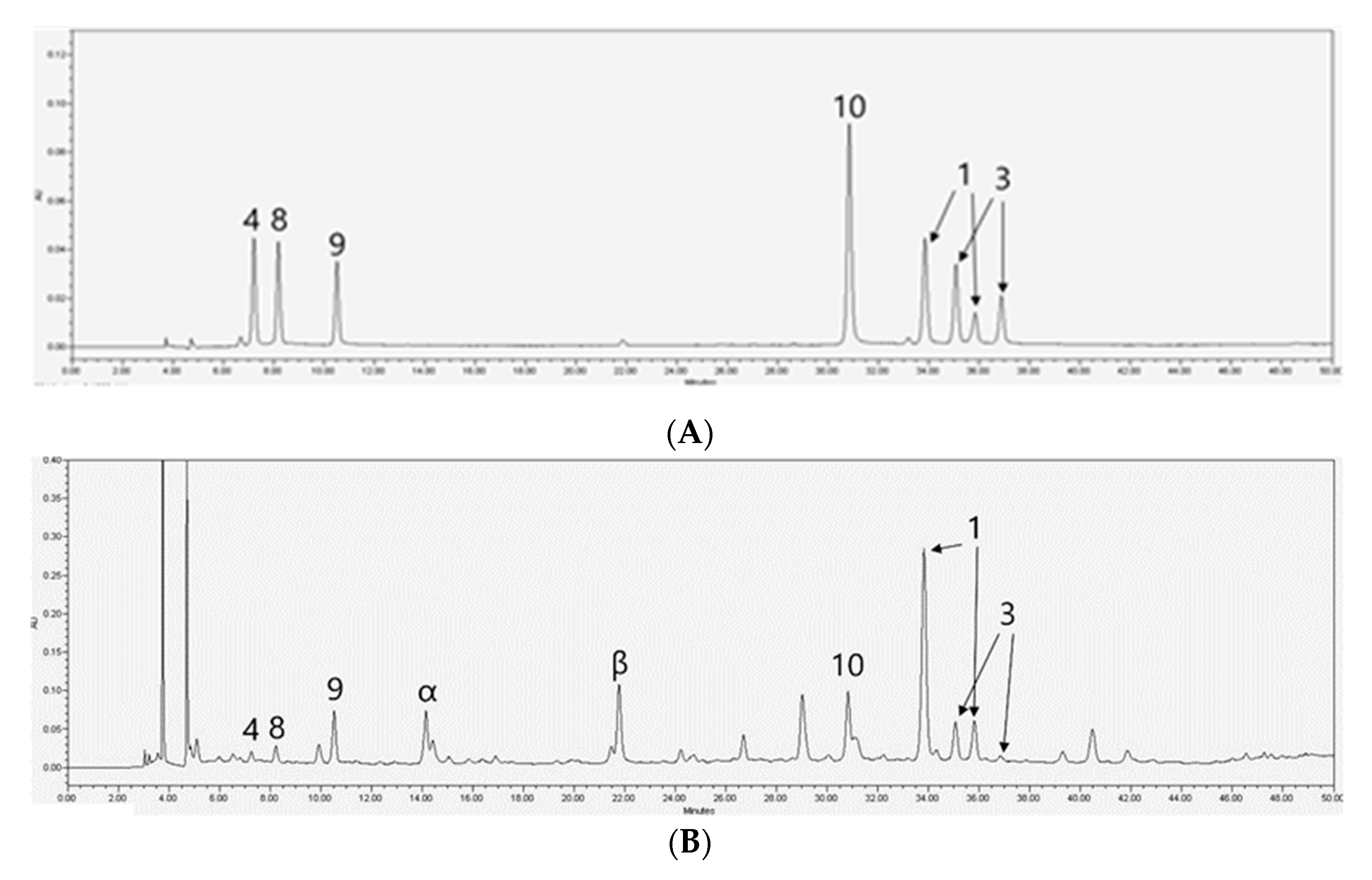
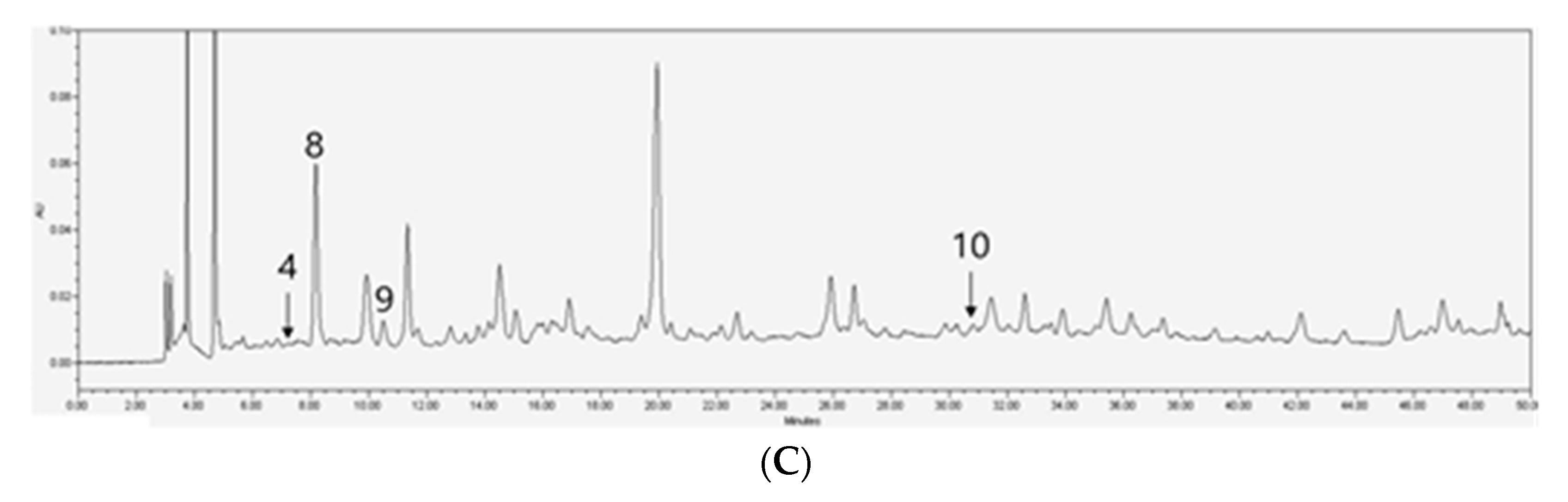
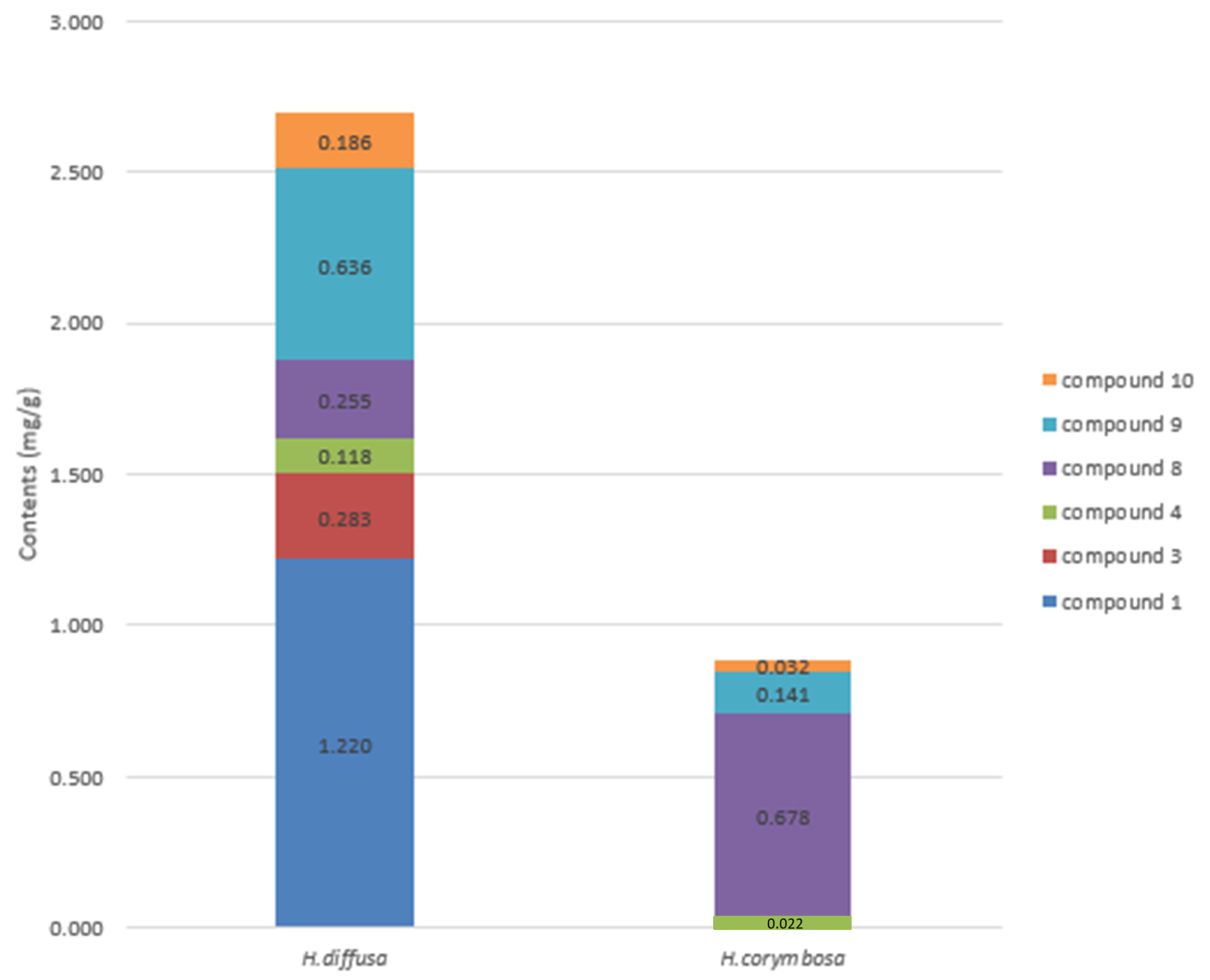
2.4. Simultaneous Quantitative HPLC Analysis of Six Bioactive Components in H. diffusa and H. corymbosa
3. Materials and Methods
3.1. Plant Materials
3.2. Equipment and Reagents
3.3. Extraction, Fractionation, and Isolation of H. diffusa
3.4. Identification of Compounds Isolated from H. diffusa
3.4.1. NMR
3.4.2. UPLC-ESI/LTQ-Orbitrap-HRMS Conditions
3.5. HPLC Analysis
3.6. Identification of Compounds Isolated from H. diffusa
3.6.1. E-6-O-p-Coumaroyl Scandoside Methyl Ester (1)
3.6.2. 6-O-p-Coumaroyl Scandoside Methyl Ester (2)
3.6.3. E-6-O-Feruloyl Scandoside Methyl ester (3)
3.6.4. Deacetylasperulosidic Acid Methyl ester (4)
3.6.5. Asperuloside (5)
3.6.6. 6-O-Methyldeacetylasperulosidic Acid Methyl Ester (6)
3.6.7. 6-O-Methylscandoside Methyl Ester (7)
3.6.8. Scandoside Methyl Ester (8)
3.6.9. Asperulosidic Acid (9)
3.6.10. Quercetin-3-O-[2′′-O-(6′′′-O-E-feruolyl)-β-d-glucopyranosyl]-β-d-glucopyranoside (10)
3.7. Bioactivities Assay
3.7.1. Measurement of ChE Enzyme Assay
3.7.2. Measurement of BACE1 Enzyme Assay
3.7.3. Measurement of Inhibition of Formation of the AGE
3.8. Statistical Analysis
4. Conclusions
Author Contributions
Funding
Acknowledgments
Conflicts of Interest
References
- Rui, C.; Jingyu, H.; Xueli, T.; Lan, T.; Menghua, L. The Hedyotis diffusa Willd. (Rubiaceae): A Review on Phytochemistry, Pharmacology, Quality Control and Pharmacokinetics. Molecules 2016, 21, 710. [Google Scholar]
- Kim, Y.; Park, E.; Kim, J.; Kim, Y.; Kim, S.; Kim, Y. Neuroprotective constituents from Hedyotis diffusa. J. Nat. Prod. 2001, 64, 75–78. [Google Scholar] [CrossRef] [Scilit] [PubMed]
- Ding, B.; Ma, W.; Dai, Y.; Gao, H.; Yu, Y.; Tao, Y.; Zhong, Y.; Yao, X. Biologically Active Iridoids from Hedyotis diffusa. Helv. Chim. Acta. 2010, 93, 2488–2494. [Google Scholar] [CrossRef] [Scilit]
- Lu, C.M.; Yang, J.J.; Wang, P.Y.; Lin, C.C. A New Acylated Flavonol glycoside and Antioxidant effects of Hedyotis diffusa. Planta Med. 2000, 66, 374–377. [Google Scholar] [CrossRef] [Scilit] [PubMed]
- Zhang, P.; Zhang, B.; Gu, J.; Hao, L.; Hu, F.; Han, C. The Study of the Effect of Hedyotis diffusa on the Proliferation and the Apoptosis of the Cervical Tumor in Nude Mouse Model. Cell Biochem. Biophys. 2015, 72, 783–789. [Google Scholar] [CrossRef] [Scilit]
- Li, Y.L.; Zhang, Y.; Min, D.; Hongyan, Z.; Lin, N.; Li, Q.S. Anticancer Effects of 1,3-Dihydroxy-2-Methylanthraquinone and the Ethyl Acetate Fraction of Hedyotis diffusa Willd against HepG2 Carcinoma Cells Mediated via Apoptosis. PLoS ONE 2016, 11, e0151502. [Google Scholar] [CrossRef] [Scilit]
- Chen, Y.; Lin, Y.; Li, Y. Total flavonoids of Hedyotis diffusa Willd inhibit inflammatory responses in LPS-activated macrophages via suppression of the NF-KB and MAPK signaling pathways. Exp. Ther. Med. 2016, 11, 1116–1122. [Google Scholar] [CrossRef] [Scilit]
- Wong, B.Y.; Lau, B.H.; Jia, T.Y.; Wan, C.P. Oldenlandia diffusa and Scutellaria barbata augment macrophage oxidative burst and inhibit tumor growth. Cancer Biother. Radiopharm. 1996, 11, 51–56. [Google Scholar] [CrossRef] [Scilit]
- Wang, Y.; Zhang, Y.; Fang, M.; Li, Q.; Jiang, Q.; Ming, L. Anti-inflammatory and antibacterial effects of total flavones of Oldenlandia diffusa Willd. Chin. Pharmacol. Bull. 2005, 21, 348–350. [Google Scholar]
- Lin, C.C.; NG, L.T.; Yang, J.J.; Hsu, Y.F. Anti-inflammatory and Hepatoprotective Activity of Peh-Hue-Juwa-Chi-Cao in Male Rats. Am. J. Chin. Med. 2002, 30, 225–234. [Google Scholar] [CrossRef] [Scilit]
- Wu, H.; Tao, X.; Chen, Q.; Lao, X. Iridoids from Hedyotis diffusa. J. Nat. Prod. 1991, 54, 254–256. [Google Scholar] [CrossRef] [Scilit]
- Nishihama, Y.; Masuda, K.; Yamaki, M.; Takagi, S.; Sakina, K. Three new iridoid glucosides from Hedyotis diffusa. Planta Med. 1981, 43, 28–33. [Google Scholar] [CrossRef] [Scilit] [PubMed]
- Huang, J.T. Neue Iridoide aus Oldenlandia Diffusa ROXB. Arch. Pharm. 1981, 314, 831–836. [Google Scholar] [CrossRef] [Scilit]
- Xiao, S.Z.; Xi, X.J.; Tang, F.; Dai, J.; Liu, J.; Lei, J.; Wang, L.Y. Subcritical water extraction of Ursolic acid from Hedyotis diffusa. Appl. Sci. 2017, 7, 187. [Google Scholar] [CrossRef] [Scilit]
- Zhang, Y.Y.; Chen, Y.; Fan, C.L.; Ye, W.C.; Luo, J.B. Two new iridoid glycosides from Hedyotis diffusa. Fitoterapia 2010, 81, 515–517. [Google Scholar] [CrossRef] [Scilit] [PubMed]
- Kim, Y. Studies on the constituents of Oldenlandia diffusa. Korean J. Med. Crop. Sci. 1995, 3, 91–95. [Google Scholar]
- Tang, Q.F.; Yang, C.H.; Chen, F.L.; Xin, X.F.; Zeng, Y.C. Separation and Purification of Bioactive Flavonol Glycosides from Hedyotis diffusa Willd by High-Speed-Counter-Current Chromatography. Sep. Sci. Technol. 2010, 46, 1184–1188. [Google Scholar] [CrossRef] [Scilit]
- Richard, A.A. What causes Alzheimer’s disease? Folia Neuropathol. 2013, 51, 169–188. [Google Scholar]
- Corinna, V.; Emma, T.; Robert, V. Traumatic brain injury and Alzheimer’s disease: A review. Prog. Brain Res. 2007, 161, 303–316. [Google Scholar]
- Dennis, J. Alzheimer’s Disease: Genes, Proteins and Therapy. Physiol. Rev. 2001, 81, 741–766. [Google Scholar]
- Robert, L.M.; Christopher, E.E. Alzheimer’s disease and Parkinson’s disease. N. Engl. J. Med. 2003, 348, 1356–1364. [Google Scholar]
- Paul, T.F.; Alan, M.P.; Michael, S.; Gordon, K.W. The cholinergic hypothesis of Alzheimer’s disease: A review of progress. J. Neurol. Neurosurg. Psychiatry 1999, 66, 137–147. [Google Scholar]
- John, H.; Dennis, J.S. The Amyloid Hypothesis of Alzheimer’s Disease: Progress and Problems on the Road to Therapeutics. Science 2002, 297, 353–356. [Google Scholar]
- Martin, C. Alzheimer’s disease: Strategies for disease modification. Nat. Rev. Drug Discov. 2010, 9, 387–398. [Google Scholar]
- David, G.M.; Howard, F. Causes of Alzheimer’s disease. Can. Med. Assoc. J. 2000, 162, 65–72. [Google Scholar]
- Natarajan, S.; Shunmugiahthevar, K.P.; Kasi, P.D. Cholinesterase Inhibitors from Plants: Possible Treatment strategy for Neurological Disorders—A review. Int. J. Biomed. Pharm. Sci. 2009, 1, 87–103. [Google Scholar]
- David, G.W.; Paul, T.F.; Elias, S.; Jennifer, P.P. Cholinesterase inhibitors used in the Treatment of Alzheimer’s disease. Drugs Aging 2004, 21, 453–478. [Google Scholar]
- John, H. The Amyloid Hypothesis for Alzheimer’s Disease: A critical reappraisal. J. Neurochem. 2009, 110, 1129–1134. [Google Scholar]
- Rowan, M.J.; Klyubin, I.; Wang, Q.; Hu, N.W.; Anwyl, R. Synaptic memory mechanisms: Alzheimer’s disease amyloid β-peptide-induced dysfunction. Biochem. Soc. Trans. 2007, 35, 1219–1223. [Google Scholar] [CrossRef] [Scilit]
- Yan, R.; Robert, V. Targeting the β secretase BACE1 for Alzheimer’s disease therapy. Lancet Neurol. 2014, 13, 319–329. [Google Scholar] [CrossRef] [Scilit]
- Gerald, M.; Johannes, T.; Paul, F.; Reinhard, S.; Peter, R. Advanced glycation endproducts in ageing and Alzheimer’s disease. Brain Res. Rev. 1997, 23, 134–143. [Google Scholar]
- Volker, S. Ginkgo extract or cholinesterase inhibitors in patients with dementia: What clinical trials and guidelines fail to consider. Phytomedicine 2003, 4, 74–79. [Google Scholar]
- Kohei, K.; Yasuhiro, F.; Yasushisa, S.; Endang, H.; Umar, M.; Toshiko, S. Studies on the constituents of Indonesian Borreria latifolia. Heterocycles 2002, 56, 537–544. [Google Scholar]
- Silvia, L.; Gilsane, L.P.; Vitor, A.K.; Fabiane, M.F.; Eduardo, L.K.; Paulo, M.; Marcos, E.S.; Joe, A.S.Z.; Amelia, T.H. Taxonomic significance of alkaloids and iridoid glycosides in the tribe Psychotrieae (Rubiaceae). Biochem. Syst. Ecol. 2004, 32, 1187–1195. [Google Scholar]
- Koichi, M.; Emiko, T.; Hiroko, K.; Masao, K. Studies on the constituents of Gardenia Species. Ⅲ. New Iridoid glycosides from the leaves of Gardenia jasminoides cv. fortuneana Hara. Chem. Pharm. Bull 2003, 51, 1414–1419. [Google Scholar]
- Zühal, G.; Nurcan, K.; Cavit, K.; Yusuf, K.; L. ömür, D. Chemical constituents of Galium tortumense. Turk. J. Chem. 2006, 30, 515–523. [Google Scholar]
- Bang, H.; Yang, E.; Kim, J.; Song, K. Simultaneous HPLC Determination of Marker Compounds for the Standardization of Hedyotis diffusa. J. Life Sci. 2013, 23, 1025–1031. [Google Scholar] [CrossRef] [Scilit]
- George, L.E.; Kevin, D.C.; Valentino, A.; Robert, M.F. A new and rapid colorimetric determination of acetylcholinesterase activity. Biochem. Pharmacol. 1961, 7, 88–95. [Google Scholar]
- Lee, Y.; Hong, E.; Whang, W. Inhibitory effect of chemical constituents isolated from Artemisia iwayomogi on Polyol pathway and simultaneous quantification of major bioactive compounds. BioMed Res. Int. 2017, 2017, 1–12. [Google Scholar] [CrossRef] [Scilit]
- Li, N.; Wang, Y.; Li, X.; Zhang, H.; Zhou, D.; Wang, W.; Li, W.; Zhang, X.; Li, X.; Hou, Y.; et al. Bioactive phenols as potential neuroinflammation inhibitors from the leaves of Xanthoceras sorbifolia Bunge. Bioorg. Med. Chem. Lett. 2016, 26, 5018–5023. [Google Scholar] [CrossRef] [Scilit]



| Compound No. | Rt (min) | Formula | Mass Mode | Theoretical Mass | Observed Mass | Mass Error (Da) | Mass Accuracy (ppm) |
|---|---|---|---|---|---|---|---|
| 1 | 10.55 | C26H30O13 | Negative | 549.1624 | 549.1610 | 0.0014 | 2.5 |
| 2 | 10.56 | C26H30O13 | Negative | 549.1610 | 549.1609 | 0.0001 | 0.2 |
| 3 | 10.83 | C27H32O14 | Negative | 579.1721 | 579.1732 | 0.0011 | 1.9 |
| 4 | 2.14 | C17H24O11 | Negative | 403.1262 | 403.1252 | 0.0010 | 2.5 |
| 5 | 5.87 | C18H22O11 | Negative | 413.1096 | 413.1093 | 0.0003 | 0.7 |
| 6 | 5.68 | C18H26O11 | Negative | 417.1382 | 417.1402 | 0.0020 | 4.8 |
| 7 | 6.19 | C18H26O11 | Negative | 417.1382 | 417.1402 | 0.0020 | 4.8 |
| 8 | 4.08 | C17H24O11 | Negative | 403.1234 | 403.1249 | 0.0015 | 3.7 |
| 9 | 4.96 | C18H24O12 | Negative | 431.1187 | 431.1192 | 0.0005 | 1.2 |
| 10 | 9.63 | C37H38O20 | Negative | 801.1889 | 801.1929 | 0.0040 | 4.9 |
| Compound α (5) | Compound β | |
|---|---|---|
| Retention time (UV) | 2.89 | 5.14 |
| Retention time (MS) | 2.96 | 5.21 |
| Expected formula (as M) | C18H22O11 (MW 414.36) | C27H30O17 (MW 626.52) |
| Theoretical monoisotopic molecular weight of deprotonated form | 413.1084 | 625.1405 |
| [M−H]− | 413.1148 | 625.1511 |
| Identification of compound | Asperuloside | Quercetin-3-O-sophoroside |
| Sample | IC50 a (μg/mL) | |||
|---|---|---|---|---|
| AChE | BChE | BACE1 | AGE Formation | |
| Ext. | 102.01 ± 4.90 *** | 99.79 ± 4.52 *** | 113.44 ± 9.04 ** | 347.55 ± 7.27 *** |
| Hx fr. | 54.51 ± 2.07 *** | 7.28 ± 1.04 ** | ND e | 355.52 ± 9.47 *** |
| DCM fr. | 132.95 ± 12.91 ** | 36.74 ± 4.91 ** | 56.60 ± 2.95 *** | >1000 |
| EA fr. | 25.98 ± 3.07 ** | 31.22 ± 0.90 *** | 14.84 ± 1.24 *** | 99.32 ± 1.31 *** |
| n-BuOH fr. | 58.92 ± 4.08 ** | 1.15 ± 0.32 * | 26.92 ± 3.48 *** | 109.27 ± 5.76 *** |
| Water fr. | ND e | ND e | ND e | 636.05 ± 25.69 *** |
| Berberine b | 0.11 ± 0.1 * | 0.40 ± 0.09 * | - | - |
| Quercetin c | - | - | 8.65 ± 0.25 *** | - |
| AMG d | - | - | - | 131.92 ± 11.24 *** |
| Compound | IC50 a (μM) | |||
|---|---|---|---|---|
| AChE | BChE | BACE1 | AGE Formation | |
| 1 | 304.18 ± 12.15 *** | 98.96 ± 2.74 *** | 63.33 ± 4.56 *** | 104.89 ± 14.47 *** |
| 2 | 297.84 ± 22.68 ** | 26.22 ± 1.76 ** | 120.81 ± 14.76 *** | 380.78 ± 42.72 *** |
| 3 | 96.84 ± 5.29 *** | 116.09 ± 29.39 * | 121.14 ± 11.86 *** | 66.61 ± 11.86 *** |
| 4 | 172.26 ± 20.55 ** | 17.59 ± 0.78 *** | >500 | ND e |
| 5 | 258.81 ± 7.48 *** | >500 | >500 | >1000 |
| 6 | 81.06 ± 5.58 ** | 32.24 ± 2.80 ** | >500 | ND e |
| 7 | ND e | 11.59 ± 0.68 ** | >500 | ND e |
| 8 | 157.68 ± 13.18 ** | 16.18 ± 2.05 ** | >500 | ND e |
| 9 | 68.34 ± 5.11 ** | 80.29 ± 19.76 * | >500 | ND e |
| 10 | 46.22 ± 1.59 *** | 13.77 ± 0.37 *** | 4.49 ± 1.86 *** | 2.71 ± 0.06 *** |
| Berberine b | 0.31 ± 0.01 *** | 1.82 ± 0.33 * | - | - |
| Quercetin c | - | - | 23.58 ± 4.17 *** | - |
| AMG d | - | - | - | 108.85 ± 5.27 *** |
| Solvent Composition | 30% MeOH 60 min | 50% MeOH 60 min | 70% MeOH 60 min | 100% MeOH 60 min |
| Compound 1 (mg/g) | 1.266 ± 0.013 | 2.870 ± 0.033 | 3.190 ± 0.008 | 3.494 ± 0.003 |
| Compound 3 (mg/g) | 0.214 ± 0.002 | 0.419 ± 0.003 | 0.411 ± 0.003 | 0.419 ± 0.010 |
| Compound 4 (mg/g) | 0.039 ± 0.001 | 0.040 ± 0.003 | 0.032 ± 0.001 | 0.026 ± 0.001 |
| Compound 8 (mg/g) | 0.353 ± 0.001 | 0.166 ± 0.005 | 0.145 ± 0.001 | 0.126 ± 0.001 |
| Compound 9 (mg/g) | 0.827 ± 0.008 | 1.006 ± 0.004 | 0.923 ± 0.012 | 0.581 ± 0.005 |
| Compound 10 (mg/g) | 0.248 ± 0.001 | 0.404 ± 0.003 | 0.333 ± 0.008 | 0.188 ± 0.001 |
| Solvent Composition | 30% EtOH 60 min | 50% EtOH 60 min | 70% EtOH 60 min | 100% EtOH 60 min |
| Compound 1 (mg/g) | 1.827 ± 0.032 | 2.488 ± 0.005 | 2.653 ± 0.022 | 2.607 ± 0.007 |
| Compound 3 (mg/g) | 0.281 ± 0.007 | 0.349 ± 0.002 | 0.356 ± 0.001 | 0.334 ± 0.001 |
| Compound 4 (mg/g) | 0.036 ± 0.002 | 0.020 ± 0.001 | 0.024 ± 0.001 | 0.018 ± 0.001 |
| Compound 8 (mg/g) | 0.243 ± 0.002 | 0.123 ± 0.002 | 0.105 ± 0.001 | 0.065 ± 0.001 |
| Compound 9 (mg/g) | 0.845 ± 0.004 | 0.798 ± 0.005 | 0.764 ± 0.001 | 0.261 ± 0.001 |
| Compound 10 (mg/g) | 0.310 ± 0.002 | 0.336 ± 0.002 | 0.331 ± 0.001 | 0.101 ± 0.001 |
| Solvent Composition | 70% MeOH 30 min | 70% MeOH 60 min | 70% MeOH 90 min | 70% MeOH 120 min |
| Compound 1 (mg/g) | 2.756 ± 0.029 | 2.224 ± 0.022 | 3.011 ± 0.016 | 2.288 ± 0.027 |
| Compound 3 (mg/g) | 0.350 ± 0.001 | 0.305 ± 0.002 | 0.412 ± 0.004 | 0.309 ± 0.002 |
| Compound 4 (mg/g) | 0.031 ± 0.003 | 0.016 ± 0.001 | 0.027 ± 0.001 | 0.018 ± 0.001 |
| Compound 8 (mg/g) | 0.132 ± 0.004 | 0.105 ± 0.001 | 0.141 ± 0.002 | 0.104 ± 0.001 |
| Compound 9 (mg/g) | 0.836 ± 0.004 | 0.719 ± 0.003 | 0.982 ± 0.009 | 0.696 ± 0.002 |
| Compound 10 (mg/g) | 0.294 ± 0.002 | 0.272 ± 0.004 | 0.430 ± 0.001 | 0.280 ± 0.001 |
| Compound Number | Rt (min) | Regression Equation | r2 | Linear Range (μg/mL) | LOD (μg/mL) | LOQ (μg/mL) |
|---|---|---|---|---|---|---|
| 1 | 34.20/36.19 | y = 1518.5x − 13,274 | 0.9994 | 10–500 | 0.04 | 0.13 |
| 3 | 35.41/37.21 | y = 1459.1x − 11,482 | 0.9998 | 10–500 | 0.19 | 0.58 |
| 4 | 7.48 | y = 974.39x − 7002.9 | 0.9995 | 10–500 | 0.14 | 0.43 |
| 8 | 8.48 | y = 898.19x − 3765.1 | 0.9998 | 10–500 | 0.41 | 1.25 |
| 9 | 10.87 | y = 795.26x − 5237.4 | 0.9995 | 10–500 | 0.61 | 1.84 |
| 10 | 31.22 | y = 3123.7x − 21,456 | 0.9998 | 10–500 | 0.12 | 0.36 |
Sample Availability: Samples of the compounds are not available from the authors. |
Publisher’s Note: MDPI stays neutral with regard to jurisdictional claims in published maps and institutional affiliations. |
© 2020 by the authors. Licensee MDPI, Basel, Switzerland. This article is an open access article distributed under the terms and conditions of the Creative Commons Attribution (CC BY) license (http://creativecommons.org/licenses/by/4.0/).
Share and Cite
Park, J.H.; Whang, W.K. Bioassay-Guided Isolation of Anti-Alzheimer Active Components from the Aerial Parts of Hedyotis diffusa and Simultaneous Analysis for Marker Compounds. Molecules 2020, 25, 5867. https://doi.org/10.3390/molecules25245867
Park JH, Whang WK. Bioassay-Guided Isolation of Anti-Alzheimer Active Components from the Aerial Parts of Hedyotis diffusa and Simultaneous Analysis for Marker Compounds. Molecules. 2020; 25(24):5867. https://doi.org/10.3390/molecules25245867
Chicago/Turabian StylePark, Jun Hee, and Wan Kyunn Whang. 2020. "Bioassay-Guided Isolation of Anti-Alzheimer Active Components from the Aerial Parts of Hedyotis diffusa and Simultaneous Analysis for Marker Compounds" Molecules 25, no. 24: 5867. https://doi.org/10.3390/molecules25245867
APA StylePark, J. H., & Whang, W. K. (2020). Bioassay-Guided Isolation of Anti-Alzheimer Active Components from the Aerial Parts of Hedyotis diffusa and Simultaneous Analysis for Marker Compounds. Molecules, 25(24), 5867. https://doi.org/10.3390/molecules25245867