Characterization of Bioactive Compounds of Opuntia ficus-indica (L.) Mill. Seeds from Spanish Cultivars

 ,
,  , , and
Abstract
1. Introduction
2. Results and Discussion
2.1. Metabolite Identification Using UPLC-MS Analysis
2.1.1. Phenolic Acid Derivatives
2.1.2. Flavonols
2.1.3. Organic Acids
2.1.4. Other Compounds
2.2. Quantitative Analysis of Polyphenols
2.3. In Vitro Antioxidant Activity
2.4. Protein and Amino Acid Composition
2.5. Fat and Fatty Acid Composition
3. Materials and Methods
3.1. Reagents and Standards
3.2. Plant Material and Sample Processing
3.3. Identification and Quantification of Polyphenols by the UPLC-PDA-MS Method
3.4. Antioxidant Capacity
3.5. Proximate Composition
3.6. Amino Acid Analysis
3.7. Quantitative Evaluation of Protein Quality
3.8. Fatty Acids Analysis
4. Conclusions
Author Contributions
Funding
Conflicts of Interest
References
- FAO, Food and Agricultural Organization. Ecologia del Cultivo, Manejo y Usos del Nopal; Inglese, P., Mondragon, C., Nefzaoui, A., Sáenz, C., Eds.; FAO: Rome, Italy, 2018. [Google Scholar]
- Reyes-Agüero, J.A.; Rivera, J.R.A.; Carlín-Castelán, F.; González-Durán, A. Diversity of wild and cultivated opuntia variants in the meridional highlands plateau of Mexico. Acta Hortic. 2013, 995, 69–74. [Google Scholar] [CrossRef] [Scilit]
- Saenz, C. Processing technologies: An alternative for cactus pear (Opuntia spp.) fruits and cladodes. J. Arid. Environ. 2000, 46, 209–225. [Google Scholar] [CrossRef] [Scilit]
- Escobar-Alvarado, L.F.; Vaca-Mier, M.; López, R.; Rojas-Valencia, M.N. Hydrocarbon Degradation and Lead Solubility in a Soil Polluted with Lead and Used Motor Oil Treated by Composting and Phytoremediation. Bull. Environ. Contam. Toxicol. 2018, 100, 280–285. [Google Scholar] [CrossRef] [Scilit] [PubMed]
- Urrutia-Morales, J.; Gámez-Vázquez, H.G.; Beltrán-López, S.; Díaz-Gómez, M.O. Use of Atriplex canescens and Opuntia ficus indica as feed for lactating goats during drought. Agronomía Mesoamericana 2014, 25, 287–296. [Google Scholar] [CrossRef] [Scilit]
- Andreu, L.; Nuncio-Jáuregui, N.; Carbonell-Barrachina, Á.A.; Legua, P.; Hernández, F. Antioxidant properties and chemical characterization of Spanish Opuntia ficus-indica Mill. cladodes and fruits. J. Sci. Food Agric. 2018, 98, 1566–1573. [Google Scholar] [CrossRef] [Scilit]
- Feugang, J.M. Nutritional and medicinal use of Cactus pear (Opuntia spp.) cladodes and fruits. Front. Biosci. 2006, 11, 2574–2589. [Google Scholar] [CrossRef] [Scilit]
- Chougui, N.; Tamendjari, A.; Hamidj, W.; Hallal, S.; Barras, A.; Richard, T.; Larbat, R. Oil composition and characterisation of phenolic compounds of Opuntia ficus-indica seeds. Food Chem. 2013, 139, 796–803. [Google Scholar] [CrossRef] [Scilit]
- De Wit, M.; Hugo, A.; Shongwe, N. South African Cactus Pear Seed Oil: A Comprehensive Study on 42 Spineless Burbank Opuntia ficus-indica and Opuntia robusta Cultivars. Eur. J. Lipid Sci. Technol. 2018, 120, 1700343. [Google Scholar] [CrossRef] [Scilit]
- Matthäus, B.; Özcan, M.M. Habitat effects on yield, fatty acid composition and tocopherol contents of prickly pear (Opuntia ficus-indica L.) seed oils. Sci. Hortic. 2011, 131, 95–98. [Google Scholar] [CrossRef] [Scilit]
- Özcan, M.M.; Al-Juhaimi, F.Y. Nutritive value and chemical composition of prickly pear seeds (Opuntia ficus indica L.) growing in Turkey. Int. J. Food Sci. Nutr. 2011, 62, 533–536. [Google Scholar] [CrossRef] [Scilit]
- Rodríguez-Cruz, M.; Tovar, A.; del Prado, M.; Torres, N. Mecanismos moleculares de los ácidos grasos poliinsaturados y sus beneficios. Rev. Invest. Clínic. 2005, 57, 457–472. Available online: http://www.scielo.org.mx/scielo.php?script=sci_arttext&pid=S0034-83762005000300010 (accessed on 1 August 2020).
- Ghazi, Z.; Ramdani, M.; Tahri, M.; Rmili, R.; Elmsellem, H.; El Mahi, B.; Fauconnier, M.L. Chemical composition and antioxidant activity of seeds oils and fruit juice of Opuntia Ficus Indica and Opuntia Dillenii from Morocco. J. Mater. Environ. Sci. 2015, 6, 2338–2345. Available online: https://www.jmaterenvironsci.com/Document/vol6/vol6_N8/279-JMES-1597-2015-Ghazi.pdf (accessed on 15 August 2020).
- El Kossori, R.L.; Villaume, C.; El Boustani, E.; Sauvaire, Y.; Méjean, L. Composition of pulp, skin and seeds of prickly pears fruit (Opuntia ficus indica sp.). Plant Foods Hum. Nutr. 1998, 52, 263–270. [Google Scholar] [CrossRef] [Scilit] [PubMed]
- Sawaya, W.N.; Khatchadourian, H.A.; Safi, W.M.; Al-Muhammad, H.M. Chemical characterization of prickly pear pulp, Opuntia ficus-indica, and the manufacturing of prickly pear jam. Int. J. Food Sci. Technol. 1983, 18, 183–193. [Google Scholar] [CrossRef] [Scilit]
- Ramírez-Moreno, E.; Cariño-Cortés, R.; Cruz-Cansino, N.D.S.; Delgado-Olivares, L.; Ariza-Ortega, J.A.; Montañez-Izquierdo, V.Y.; Hernández-Herrero, M.M.; Filardo-Kerstupp, T. Antioxidant and Antimicrobial Properties of Cactus Pear (Opuntia) Seed Oils. J. Food Qual. 2017, 2017, 3075907. [Google Scholar] [CrossRef] [Scilit]
- Chahdoura, H.; João, C.M.B.; Barros, L.; Santos-Buelga, C.; Ferreira, I.C.F.R.; Achour, L. Phytochemical characterization and antioxidant activity of Opuntia microdasys (Lehm.) Pfeiff flowers in different stages of maturity. J. Funct. Foods 2014, 9, 27–37. [Google Scholar] [CrossRef] [Scilit]
- Ginestra, G.; Parker, M.L.; Bennett, R.N.; Robertson, J.; Mandalari, G.; Narbad, A.; Curto, R.B.L.; Bisignano, G.; Faulds, C.B.; Waldron, K.W. Anatomical, Chemical, and Biochemical Characterization of Cladodes from Prickly Pear [Opuntia ficus-indica (L.) Mill.]. J. Agric. Food Chem. 2009, 57, 10323–10330. [Google Scholar] [CrossRef] [Scilit]
- Chen, H.-J.; Inbaraj, B.S.; Chen, B.-H. Determination of Phenolic Acids and Flavonoids in Taraxacum formosanum Kitam by Liquid Chromatography-Tandem Mass Spectrometry Coupled with a Post-Column Derivatization Technique. Int. J. Mol. Sci. 2012, 13, 260–285. [Google Scholar] [CrossRef] [Scilit]
- Farag, M.A.; Sallam, I.E.; Fekry, M.I.; Zaghloul, S.S.; El-Dine, R.S. Metabolite profiling of three Opuntia ficus-indica fruit cultivars using UPLC-QTOF-MS in relation to their antioxidant potential. Food Biosci. 2020, 36, 100673. [Google Scholar] [CrossRef] [Scilit]
- Guevara-Figueroa, T.; Jiménez-Islas, H.; Reyes-Escogido, M.L.; Mortensen, A.G.; Laursen, B.B.; Lin, L.-W.; De Leon-Rodriguez, A.; Fomsgaard, I.S.; De La Rosa, A.P.B. Proximate composition, phenolic acids, and flavonoids characterization of commercial and wild nopal (Opuntia spp.). J. Food Compos. Anal. 2010, 23, 525–532. [Google Scholar] [CrossRef] [Scilit]
- Mata, A.; Ferreira, J.P.; Semedo, C.; Serra, T.; Duarte, C.M.M.; Bronze, M.R. Contribution to the characterization of Opuntia spp. juices by LC–DAD–ESI-MS/MS. Food Chem. 2016, 210, 558–565. [Google Scholar] [CrossRef] [Scilit] [PubMed]
- Yeddes, N.; Chérif, J.K.; Guyot, S.; Sotin, H.; Ayadi, M.T. Comparative Study of Antioxidant Power, Polyphenols, Flavonoids and Betacyanins of the Peel and Pulp of Three Tunisian Opuntia Forms. Antioxidants 2013, 2, 37–51. [Google Scholar] [CrossRef] [Scilit] [PubMed]
- Yeddes, N.; Chérif, J.K.; Guyot, S.; Baron, A.; Trabelsi-Ayadi, M. Phenolic Profile of Tunisian Opuntia Ficus Indica Thornless form Flowers via Chromatographic and Spectral Analysis by Reversed Phase-High Performance Liquid Chromatography-UV-Photodiode Array and Electrospray Ionization-Mass Spectrometer. Int. J. Food Prop. 2013, 17, 741–751. [Google Scholar] [CrossRef] [Scilit]
- De Leo, M.; De Abreu, M.B.; Pawlowska, A.; Cioni, P.; Braca, A. Profiling the chemical content of Opuntia ficus-indica flowers by HPLC–PDA-ESI-MS and GC/EIMS analyses. Phytochem. Lett. 2010, 3, 48–52. [Google Scholar] [CrossRef] [Scilit]
- Deng, J.; Yang, Y. Chemical fingerprint analysis for quality assessment and control of Bansha herbal tea using paper spray mass spectrometry. Anal. Chim. Acta 2013, 785, 82–90. [Google Scholar] [CrossRef] [Scilit]
- De Wit, M.; Du Toit, A.; Osthoff, G.; Hugo, A. Cactus pear antioxidants: A comparison between fruit pulp, fruit peel, fruit seeds and cladodes of eight different cactus pear cultivars (Opuntia ficus-indica and Opuntia robusta). J. Food Meas. Charact. 2019, 13, 2347–2356. [Google Scholar] [CrossRef] [Scilit]
- Markham, K.R.; Ryan, K.G.; Bloor, S.J.; Mitchell, K.A. An increase in the luteolin: Apigenin ratio in Marchantia polymorpha on UV-B enhancement. Phytochemistry 1998, 48, 791–794. [Google Scholar] [CrossRef] [Scilit]
- Rivero, R.M.; Ruiz, J.M.; García, P.C.; López-Lefebre, L.R.; Sánchez, E.; Romero, L. Resistance to cold and heat stress: Accumulation of phenolic compounds in tomato and watermelon plants. Plant Sci. 2001, 160, 315–321. [Google Scholar] [CrossRef] [Scilit]
- Rühmann, S.; Leser, C.; Bannert, M.; Treutter, D. Relationship Between Growth, Secondary Metabolism, and Resistance of Apple. Plant Biol. 2002, 4, 137–143. [Google Scholar] [CrossRef] [Scilit]
- Kivrak, I.; Duru, M.E.; Öztürk, M.; Mercan, N.; Harmandar, M.; Topcu, G. Antioxidant, anticholinesterase and antimicrobial constituents from the essential oil and ethanol extract of Salvia potentillifolia. Food Chem. 2009, 116, 470–479. [Google Scholar] [CrossRef] [Scilit]
- Triantis, T.; Stelakis, A.; Dimotikali, D.; Papadopoulos, K. Investigations on the antioxidant activity of fruit and vegetable aqueous extracts on superoxide radical anion using chemiluminescence techniques. Anal. Chim. Acta 2005, 536, 101–105. [Google Scholar] [CrossRef] [Scilit]
- Dudonneé, S.; Vitrac, X.; Coutieère, P.; Woillez, M.; Meérillon, J.-M. Comparative Study of Antioxidant Properties and Total Phenolic Content of 30 Plant Extracts of Industrial Interest Using DPPH, ABTS, FRAP, SOD, and ORAC Assays. J. Agric. Food Chem. 2009, 57, 1768–1774. [Google Scholar] [CrossRef] [Scilit] [PubMed]
- Eberhardt, M.V.; Lee, C.Y.; Liu, R.H. Antioxidant activity of fresh apples. Nature 2000, 405, 903–904. [Google Scholar] [CrossRef] [Scilit] [PubMed]
- Floegel, A.; Kim, D.-O.; Chung, S.-J.; Koo, S.I.; Chun, O.K. Comparison of ABTS/DPPH assays to measure antioxidant capacity in popular antioxidant-rich US foods. J. Food Compos. Anal. 2011, 24, 1043–1048. [Google Scholar] [CrossRef] [Scilit]
- Kolniak-Ostek, J.; Oszmiański, J.; Wojdyło, A. Effect of apple leaves addition on physicochemical properties of cloudy beverages. Ind. Crop. Prod. 2013, 44, 413–420. [Google Scholar] [CrossRef] [Scilit]
- Tekin, A.; Coşkuner, Y. Monitoring of seed composition of prickly pear (Opuntia ficus-indica L.) fruits during maturation period. J. Sci. Food Agric. 2003, 83, 846–849. [Google Scholar] [CrossRef] [Scilit]
- Nassar, A.G. Chemical composition and functional properties of Prickly Pear (Opuntia ficus indica) seeds flour and protein concentrate. World J. Dairy Food Sci. 2008, 3, 11–16. Available online: https://www.idosi.org/wjdfs/wjdfs3(1)/2.pdf (accessed on 1 August 2020).
- El Mannoubi, I.; Barrek, S.; Skanji, T.; Casabianca, H.; Zarrouk, H. Characterization of Opuntia ficus indica seed oil from Tunisia. Chem. Nat. Compd. 2009, 45, 616–620. [Google Scholar] [CrossRef] [Scilit]
- Sawaya, W.N.; Khalil, J.K.; Al-Mohammad, M.M. Nutritive value of prickly pear seeds,Opuntia ficus-indica. Plant Foods Hum. Nutr. 1983, 33, 91–97. [Google Scholar] [CrossRef] [Scilit]
- FAO/WHO. Protein Quality Evaluation; Report of the joint FAO/WHO Expert Consultation, Paper 51; FAO Food and Nutrition: Rome, Italy, 1991. [Google Scholar]
- Labuschagne, M.T.; Hugo, A. Oil content and fatty acid composition of cactus pear seed compared with cotton and grape seed. J. Food Biochem. 2010, 34, 93–100. [Google Scholar] [CrossRef] [Scilit]
- Ciriminna, R.; Bongiorno, D.; Scurria, A.; Danzì, C.; Timpanaro, G.; DeLisi, R.; Avellone, G.; Pagliaro, M. Sicilian Opuntia ficus-indica seed oil: Fatty acid composition and bio-economical aspects. Eur. J. Lipid Sci. Technol. 2017, 119, 1700232. [Google Scholar] [CrossRef] [Scilit]
- García-Rollán, M. Claves de la flora de España (Península y Baleares), Pteridofitas, Gimnospermas, Dicotiledoneas (A-J); Ediciones Mundi-Prensa: Madrid, Spain, 1981; Volume 1. [Google Scholar]
- Kolniak-Ostek, J. Chemical composition and antioxidant capacity of different anatomical parts of pear (Pyrus communis L.). Food Chem. 2016, 203, 491–497. [Google Scholar] [CrossRef] [Scilit] [PubMed]
- Benzie, I.F.F.; Strain, J.J. The ferric reducing ability of plasma (FRAP) as a measure of “antioxidant power”: The FRAP assay. Anal. Biochem. 1996, 239, 70–76. [Google Scholar] [CrossRef] [Scilit] [PubMed]
- Yen, G.-C.; Chen, H.-Y. Antioxidant Activity of Various Tea Extracts in Relation to Their Antimutagenicity. J. Agric. Food Chem. 1995, 43, 27–32. [Google Scholar] [CrossRef] [Scilit]
- Re, R.; Pellegrini, N.; Proteggente, A.; Pannala, A.; Yang, M.; Rice-Evans, C. Antioxidant activity applying an improved ABTS radical cation decolorization assay. Free. Radic. Biol. Med. 1999, 26, 1231–1237. [Google Scholar] [CrossRef] [Scilit]
- AOAC. Official Methods of Analysis of AOAC International, 16th ed.; AOAC: Gaithersburg, MD, USA, 1996. [Google Scholar]
- AOAC. Official Methods of Analysis, 16th ed.; AOAC: Washington, DC, USA, 1995. [Google Scholar]
- Simpson, R.J.; Neuberger, M.R.; Liu, T.Y. Complete amino acid analysis of proteins from a single hydrolysate. J. Biol. Chem. 1976, 251, 1936–1940. [Google Scholar]
- Moore, S.; Spackman, D.H.; Stein, W.H. Automatic recording apparatus for use in the chromatography of amino acids. Anal. Chem. 1958, 30, 1190–1206. [Google Scholar]
- Osborne, D.R.; Voogt, P. The Analysis of Nutrients in Foods; Academic Press: New York, NY, USA, 1978. [Google Scholar]
- Oser, B.L. Method for integrating essential amino acid content in the nutritional evaluation of protein. J. Am. Diet. Assoc. 1951, 27, 396–402. [Google Scholar]
- AOAC. Official Methods of Analysis of AOAC International; Association of Official Analytical Chemists: Gaithersburg, MD, USA, 2005. [Google Scholar]
Sample Availability: Samples of the compounds are not available from the authors. |
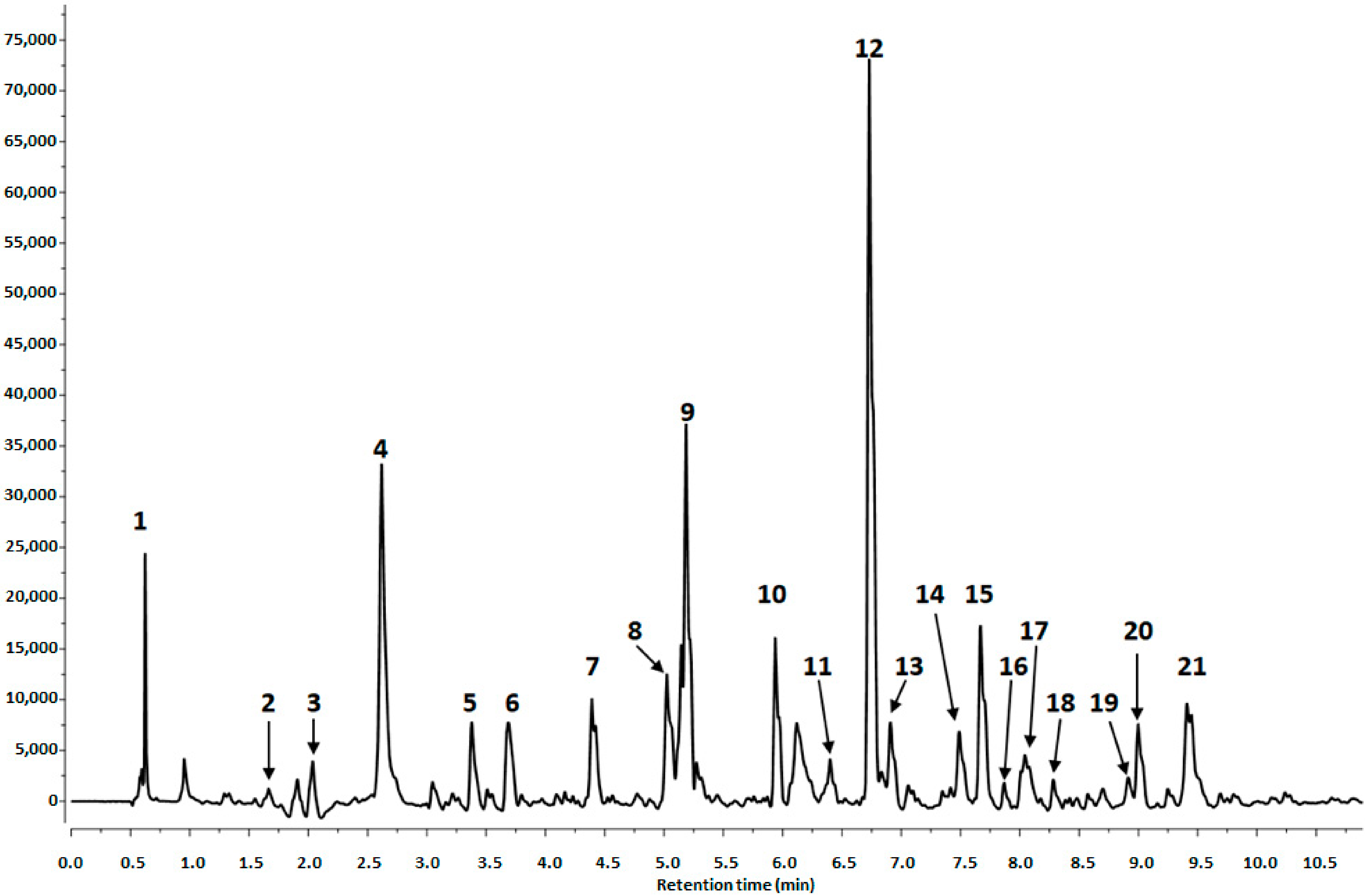

| Peak No. | Rt | UV [nm] | MS [M − H]− (m/z) a | MS/MS (m/z) a | Tentative Identification |
|---|---|---|---|---|---|
| 1. | 0.62 | 360 | 195.0522 | 177.0404; 159.2073; 129.0194 | Gluconic acid |
| 2. | 1.66 | 210 | 191.0051 | 110.9974 | (Iso)Citric acid |
| 3. | 2.04 | 340 | 301.0920 | 179.0521; 151.0274 | Quercetin |
| 4. | 2.62 | 220, 275 | 255.0366 | 237.0222; 193.0362; 165.0417 | Piscidic acid |
| 5. | 3.38 | 299 | 315.0781 | 153.0173 | Protocatechuic acid hexoside |
| 6. | 3.68 | 325 | 517.1523 | 386.1084; 193.0476 | Ferulic acid derivative |
| 7. | 4.39 | 220, 275 | 239.0416 | 179.0218; 149.0408 | Eucomic acid |
| 8. | 5.02 | 325 | 341.0837 | 179.0372 | Caffeic acid glucoside I |
| 9. | 5.18 | 325 | 517.1543 | 193.0480; 175.0378 | Ferulic acid diglucoside |
| 10. | 5.94 | 324 | 341.0697 | 179.0523 | Caffeic acid glucoside II |
| 11. | 6.40 | 325 | 371.1151 | 249.9247; 193.0503; 175.0273 | Feruloyl gluconic acid |
| 12. | 6.73 | 202, 216, 275 | 565.1764 | 339.1087; 327.1086 | - |
| 13. | 6.91 | 325 | 595.2080 | 329.1040; 197.8092; 175.0987; 193.0476; 162.8393 | Ferulic acid derivative |
| 14. | 7.49 | 350 | 609.1295 | 301.0355 | Quercetin-3-O-rutinoside |
| 15. | 7.69 | 355 | 463.1399 | 301.0355 | Quercetin-3-O-galactoside |
| 16. | 7.75 | 350 | 755.1174 | 623.0457; 315.0475 | Isorhamnetin-pentosyl rutinoside |
| 17. | 8.04 | 340 | 593.1521 | 315.0511 | Isorhamnetin-pentosyl rhamnoside |
| 18. | 8.28 | 350 | 623.1598 | 315.0420 | Isorhamnetin-3-O-rutinoside |
| 19. | 8.91 | 350 | 477.1020 | 315.0455 | Isorhamnetin-3-O-galactoside |
| 20. | 8.96 | 350 | 477.1022 | 315.0475 | Isorhamnetin-3-O-glucoside |
| 21. | 9.41 | 340 | 519.1130 | 315.0510 | Isorhamnetin acylated hexoside |
| Peak No. | [mg/kg] | Fresa | Nopal Alargado | Nopal Espinoso | Nalle | Nopal Ovalado | Nopal Tradicional | Orito |
|---|---|---|---|---|---|---|---|---|
| Phenolic acids | ||||||||
| 5. | Protocatechuic acid hexoside | 4.57 ± 0.2 a | 7.13 ± 0.2 b | 22.36 ± 1.1 f | 11.37 ± 0.2 c | 11.24 ± 0.2 c | 12.56 ± 0.1 d | 19.03 ± 0.3 e |
| 6. | Ferulic acid derivative | 2.35 ± 0.1 c | 0.00 ± 0.0 a | 0.00 ± 0.0 a | 11.62 ± 0.1 d | 1.08 ± 0.0 b | 0.00 ± 0.0 a | 0.00 ± 0.0 a |
| 8. | Caffeic acid hexoside I | 1.28 ± 0.0 a | 4.35 ± 0.3 b | 12.59 ± 0.2 e | 11.95 ± 0.2 d | 4.09 ± 0.1 b | 5.51 ± 0.1 c | 13.50 ± 0.9 f |
| 9. | Ferulic acid diglucoside | 4.10 ± 0.1 a | 37.07 ± 1.2 c | 108.97 ± 3.5 e | 63.46 ± 3.3 d | 13.59 ± 1.0 b | 31.68 ± 1.2 c | 60.56 ± 2.2 d |
| 10. | Caffeic acid hexoside II | 1.75 ± 0.0 c | 2.41 ± 0.1 d | 1.54 ± 0.0 b | 1.07 ± 0.0 a | 2.40 ± 0.0 d | 2.61 ± 0.0 d | 1.71 ± 0.0 c |
| 11. | Feruloyl gluconic acid | 2.64 ± 0.0 a | 2.43 ± 0.1 a | 14.21 ± 0.5 c | 3.67 ± 0.0 b | 2.20 ± 0.1 a | 3.22 ± 0.0 b | 2.57 ± 0.1 a |
| 13. | Ferulic acid derivative | 2.35 ± 0.1 a | 7.09 ± 0.3 d | 11.93 ± 0.2 f | 6.28 ± 0.5 c | 4.69 ± 0.2 b | 10.16 ± 0.3 | 7.64 ± 0.4 e |
| Sum of phenolic acids | 19.05 | 60.47 | 171.60 | 109.44 | 39.29 | 65.75 | 105.01 | |
| Flavonols | ||||||||
| 3. | Quercetin | 1.95 ± 0.0 d | 1.21 ± 0.0 b | 0.90 ± 0.0 a | 8.40 ± 0.4 e | 1.52 ± 0.1 c | 2.03 ± 0.0 d | 1.16 ± 0.1 ab |
| 14. | Quercetin-3-O-rutinoside | 0.96 ± 0.0 a | 5.95 ± 0.3 c | 8.34 ± 0.2 e | 5.41 ± 0.1 c | 4.18 ± 0.1 b | 7.48 ± 0.6 d | 4.78 ± 0.1 b |
| 15. | Quercetin-3-O-galactoside | 1.46 ± 0.1 a | 4.99 ± 0.2 e | 3.58 ± 0.1 c | 4.96 ± 0.1 e | 2.62 ± 0.0 b | 7.13 ± 0.3 f | 4.34 ± 0.3 d |
| 16. | Isorhamnetin-pentosyl rutinoside | 1.97 ± 0.1 a | 2.98 ± 0.2 b | 3.71 ± 0.1 c | 1.60 ± 0.0 a | 3.92 ± 0.1 c | 4.77 ± 0.0 d | 1.67 ± 0.1 a |
| 17. | Isorhamnetin-pentosyl rhamnoside | 1.05 ± 0.0 bc | 1.23 ± 0.1 c | 0.86 ± 0.0 b | 0.94 ± 0.0 b | 0.12 ± 0.0 a | 0.15 ± 0.0 a | 1.03 ± 0.0 bc |
| 18. | Isorhamnetin-3-O-rutinoside | 1.23 ± 0.0 b | 1.62 ± 0.0 c | 1.59 ± 0.0 c | 1.10 ± 0.0 b | 0.64 ± 0.0 a | 1.82 ± 0.0 de | 1.94 ± 0.0 e |
| 19. | Isorhamnetin-3-O-galactoside | 0.00 ± 0.0 a | 2.06 ± 0.1 e | 3.31 ± 0.1 f | 1.11 ± 0.0 c | 0.61 ± 0.0 b | 1.99 ± 0.1 e | 1.66 ± 0.0 d |
| 20. | Isorhamnetin-3-O-glucoside | 2.65 ± 0.2 a | 38.92 ± 1.1 d | 51.03 ± 1.6 e | 22.76 ± 0.8 c | 12.75 ± 0.6 b | 29.81 ± 1.1 cd | 23.93 ± 1.0 c |
| 21. | Isorhamnetin acylated hexoside | 3.75 ± 0.2 a | 17.26 ± 1.0 c | 21.74 ± 1.1 d | 21.21 ± 0.6 d | 3.46 ± 0.1 a | 10.28 ± 0.6 b | 17.69 ± 1.1 c |
| Sum of flavonols | 15.02 | 76.22 | 95.07 | 67.49 | 29.83 | 65.47 | 58.21 | |
| Total | 34.07 | 136.69 | 266.67 | 176.92 | 69.13 | 131.21 | 163.22 |
| [mMol Trolox/kg] | Fresa | Nopal Alargado | Nopal Espinoso | Nalle | Nopal Ovalado | Nopal Tradicional | Orito |
|---|---|---|---|---|---|---|---|
| DPPH | 1.39 ± 0.0 a | 2.62 ± 0.0 b | 4.99 ± 0.0 d | 3.11 ± 0.0 c | 2.57 ± 0.0 b | 1.92 ± 0.0 a | 2.44 ± 0.0 b |
| ABTS | 7.08 ± 0.1 a | 10.43 ± 0.2 c | 11.67 ± 0.2 e | 11.33 ± 0.1 d | 9.97 ± 0.1 b | 10.04 ± 0.1 b,c | 11.49 ± 0.1 d |
| FRAP | 3.67 ± 0.0 a | 6.14 ± 0.0 c | 8.89 ± 0.1 f | 6.77 ± 0.0 d | 6.86 ± 0.1 d | 5.9 ± 0.0 b | 7.22 ± 0.1 e |
| [g/100 g] | Fresa | Nopal Alargado | Nopal Espinoso | Nalle | Nopal Ovalado | Nopal Tradicional | Orito |
|---|---|---|---|---|---|---|---|
| Protein | 9.97 ± 0.5 f | 9.45 ± 0.2 d | 9.61 ± 0.2 e | 6.36 ± 0.2 a | 9.97 ± 0.3 f | 7.69 ± 0.4 c | 7.09 ± 0.1 b |
| Fat | 4.94 ± 0.2 b | 6.17 ± 0.3 d | 5.24 ± 0.3 c | 2.61 ± 0.1 a | 3.25 ± 0.2 c | 5.97 ± 0.3 d | 4.39 ± 0.2 c |
| Amino Acids | Fresa | Nopal Alargado | Nopal Espinoso | Nalle | Nopal Ovalado | Nopal Tradicional | Orito | FAO/WHO Reference Pattern (1991) |
|---|---|---|---|---|---|---|---|---|
| IAA * | ||||||||
| LEU | 2.41 ± 0.04 b | 4.75 ± 0.08 a | 3.55 ± 0.28 a,b | 4.23 ± 0.11 a | 4.04 ± 0.43 a,b | 4.05 ± 0.35 a,b | 4.24 ± 0.19 a | 6.60 |
| Leucine | 1.33 ± 0.03 b | 2.54 ± 0.04 a | 1.98 ± 0.12 a,b | 2.45 ± 0.18 a | 2.24 ± 0.24 a | 2.24 ± 0.15 a | 2.32 ± 0.12 a | 2.80 |
| Isoleucine | 0.32 ± 0.02 b | 0.56 ± 0.02 b | 0.72 ± 0.21 a | 0.63 ± 0.07 a,b | 0.78 ± 0.14 a | 0.65 ± 0.17 a,b | 0.64 ± 0.09 a,b | |
| Methionine | 0.22 ± 0.01 b | 0.58 ± 0.05 a | 0.44 ± 0.06 a,b | 0.58 ± 0.04 a | 0.46 ± 0.11 a | 0.60 ± 0.06 a | 0.49 ± 0.05 a | |
| Cysteine | 0.54 | 1.14 | 1.16 | 1.21 | 1.24 | 1.25 | 1.13 | 2.50 |
| Cysteine+Methionie | 1.32 ± 0.04 b | 3.13 ± 0.09 a | 2.14 ± 0.18 a,b | 2.57 ± 0.10 a | 2.53 ± 0.34 a | 2.54 ± 0.29 a | 2.53 ± 0.11 a | |
| Phenyloalanie | 1.08 ± 0.08 b | 2.39 ± 0.09 a | 1.83 ± 0.11 a,b | 2.06 ± 0.02 a | 2.17 ± 0.29 a | 2.08 ± 0.16 a | 2.08 ± 0.05 a | 3.40 |
| Threonine | 1.93 | 4.77 | 3.28 | 4.63 | 3.82 | 4.08 | 3.89 | 6.30 |
| Phenyloalanine+Threonine | 1.48 ± 0.05 b | 2.59 ± 0.04 a | 2.09 ± 0.17 a,b | 2.41 ± 0.04 a,b | 2.43 ± 0.25 a,b | 2.32 ± 0.21 a,b | 2.39 ± 0.09 a,b | 5.80 |
| Lysine | 0.61 ± 0.03 b | 1.64 ± 0.10 a | 1.14 ± 0.11 a,b | 1.42 ± 0.14 a | 1.29 ± 0.25 a,b | 1.54 ± 0.19 a | 1.36 ± 0.09 a,b | |
| Tyrosine | 1.53 ± 0.25 b | 3.43 ± 0.06 a | 2.60 ± 0.21 a,b | 2.77 ± 0.15 a | 3.00 ± 0.31 a | 2.94 ± 0.10 a | 2.82 ± 0.10 a | 3.50 |
| Valine | 10.30 | 21.60 | 16.49 | 19.12 | 18.94 | 18.97 | 18.86 | |
| DAA ** | ||||||||
| ASP | 2.78 ± 0.23 c | 5.82 ± 0.08 a | 4.42 ± 0.37 a,b | 5.16 ± 0.54 a | 5.33 ± 0.74 a | 4.99 ± 0.40 a,b | 5.05 ± 0.16 a,b | |
| Aspartic acid | 5.44 ± 0.41 b | 13.85 ± 0.23 a | 9.69 ± 1.33 a,b | 12.02 ± 0.33 a | 11.44 ± 1.73 a,b | 11.83 ± 1.13 a | 11.40 ± 0.36 a,b | |
| Glutamic acid | 1.40 ± 0.10 b | 2.76 ± 0.07 a | 2.40 ± 0.20 a,b | 2.66 ± 0.22 a | 2.74 ± 0.35 a | 2.55 ± 0.18 a | 2.51 ± 0.08 a,b | |
| Serine | 1.97 ± 0.13 b | 4.79 ± 0.17 a | 3.66 ± 0.46 a,b | 4.13 ± 0.11 a | 3.65 ± 0.43 a,b | 4.18 ± 0.42 a | 4.27 ± 0.17 a | |
| Glycine | 2.14 ± 0.03 b | 3.65 ± 0.05 a | 3.18 ± 0.21 a,b | 3.48 ± 0.45 a | 4.02 ± 0.27 a | 3.71 ± 0.23 a | 3.21 ± 0.21 a,b | |
| Alanine | 1.44 ± 0.39 | 2.77 ± 0.53 | 2.43 ± 0.12 | 2.66 ± 0.12 | 2.31 ± 0.22 | 2.67 ± 0.57 | 2.63 ± 0.58 | |
| Histidine | 4.21 ± 0.04 c | 9.58 ± 0.52 a | 6.09 ± 0.67 a,b | 8.08 ± 0.43 a,b | 7.62 ± 1.03 a,b | 8.17 ± 0.85 a,b | 7.93 ± 0.42 a,b | |
| Arginine | 3.52 ± 0.22 b | 4.15 ± 0.17 a,b | 7.39 ± 0.32 a | 6.89 ± 0.18 a,b | 7.09 ± 0.46 a,b | 5.18 ± 0.16 a,b | 4.71 ± 0.28 a,b | |
| Proline | 22.90 | 47.36 | 39.25 | 45.08 | 44.20 | 43.28 | 41.75 | |
| IAA/DAA | 0.45 | 0.46 | 0.42 | 0.42 | 0.43 | 0.44 | 0.45 | |
| I limiting amino acid | Met+Cys | Lys | Lys | Lys | Lys | Lys | Lys | |
| II limiting amino acid | Lys | Met+Cys | Met+Cys | Met+Cys | Met+Cys | Met+Cys | Met+Cys | |
| TP | 9.97 ± 0.5 a | 9.45 ± 0.2 c | 9.61 ± 0.2 b | 6.36 ± 0.2 f | 9.97 ± 0.3 a | 7.69 ± 0.4 d | 7.09 ± 0.1 e |
| Fresa | Nopal Alargado | Nopal Espinoso | Nalle | Nopal Ovalado | Nopal Tradicional | Orito | |
|---|---|---|---|---|---|---|---|
| Fat content (%) | 4.99 ± 0.2 b | 6.17 ± 0.3 d | 5.24 ± 0.3 c | 2.61 ± 0.1 a | 7.69 ± 0.2 e | 5.97 ± 0.3 d | 5.55 ± 0.2 c |
| Fatty acid (%) | |||||||
| Miristic acid (C 14:0) | 0.01 ± 0.01 a | 0.02 ± 0.01 a | 0.01 ± 0.01 a | 0.01 ± 0.01 a | 0.01 ± 0.01 a | 0.01 ± 0.01 a | 0.02 ± 0.01 a |
| Palmitic acid (C 16:0) | 14.56 ± 0.53 d | 15.06 ± 0.35 e | 12.47 ± 0.41 a | 13.83 ± 0.28 b | 14.33 ± 0.26 c | 13.77 ± 0.82 b | 14.16 ± 0.51 c |
| Palmitooleic acid (C 16:1) | 0.82 ± 0.28 a | 0.79 ± 0.12 a | 0.78 ± 0.12 a | 0.84 ± 0.15 a | 0.85 ± 0.25 a | 0.91 ± 0.32 a | 0.83 ± 0.30 a |
| Margaric acid (C 17:0) | 0.02 ± 0.01 a | 0.01 ± 0.00 a | 0.03 ± 0.01 a | 0.01 ± 0.01 a | 0.02 ± 0.01 a | 0.01 ± 0.00 a | 0.02 ± 0.01 a |
| Stearic acid (C 18:0) | 3.50 ± 0.22 b | 3.36 ± 0.17 b | 2.56 ± 0.21 a | 4.12 ± 0.16 c | 4.00 ± 0.27 c | 3.62 ± 0.31 b | 3.88 ± 0.28 c |
| Oleic acid (C 18:1) | 20.26 ± 0.61 b | 20.48 ± 0.51 b | 19.37 ± 0.37 a | 21.23 ± 0.41 d | 21.64 ± 0.41 e | 21.79 ± 0.54 e | 20.77 ± 0.41 c |
| Liloleic acid (C 18:2) | 60.04 ± 0.43 d | 59.38 ± 0.66 c | 63.11 ± 0.82 e | 58.11 ± 0.48 c | 57.72 ± 0.70 a | 58.30 ± 0.72 b | 59.29 ± 0.55 c |
| Linolenic acid (C 18:3) | 0.23 ± 0.10 a | 0.33 ± 0.10 a | 1.10 ± 0.19 d | 0.54 ± 0.07 b | 0.89 ± 0.20 c | 1.01 ± 0.09 d | 0.46 ± 0.10 b |
| Arachidic acid (C 20:0) | 0.20 ± 0.01 a | 0.21 ± 0.01 a | 0.19 ± 0.03 a | 0.20 ± 0.02 a | 0.20 ± 0.02 a | 0.21 ± 0.02 a | 0.21 ± 0.02 a |
| Gondoic acid (C 20:1) | 0.09 ± 0.01 a | 0.11 ± 0.01 a | 0.11 ± 0.01 a | 0.09 ± 0.01 a | 0.12 ± 0.01 a | 0.10 ± 0.01 a | 0.12 ± 0.01 a |
| Eicosatrienoic acid (C 20:3) | 0.13 ± 0.02 a | 0.15 ± 0.01 a | 0.12 ± 0.01 a | 0.12 ± 0.01 a | 0.13 ± 0.02 a | 0.14 ± 0.01 a | 0.14 ± 0.01 a |
| Behenic acid (C 22:0) | 0.11 ± 0.01 a | 0.09 ± 0.01 a | 0.12 ± 0.01 a | 0.10 ± 0.01 a | 0.08 ± 0.01 a | 0.10 ± 0.10 a | 0.09 ± 0.01 a |
| Lignoceric acid (C 24:0) | 0.03 ± 0.02 a | 0.01 ± 0.01 a | 0.03 ± 0.01 a | 0.01 ± 0.01 a | 0.01 ± 0.01 a | 0.02 ± 0.01 a | 0.01 ± 0.01 a |
| ∑ MUFA | 21.17 ± 0.6 b | 21.38 ± 0.33 b | 20.26 ± 0.32 a | 22.16 ± 0.34 d | 22.61 ± 0.29 e | 22.71 ± 0.55 e | 21.72 ± 0.41 c |
| ∑ PUFA | 60.40 ± 0.38 d | 59.86 ± 0.51 c | 64.33 ± 0.50 e | 59.56 ± 0.50 c | 58.74 ± 0.62 a | 59.55 ± 0.72 b | 59.89 ± 0.48 c |
| ∑ SFA | 18.43 ± 0.34 d | 18.76 ± 0.36 e | 15.41 ± 0.31 a | 18.28 ± 0.17 c | 18.65 ± 0.45 e | 17.74 ± 0.21 b | 18.39 ± 0.25 d |
| Cultivar | Characteristics |
|---|---|
| Fresa | Red cultivar. High amount of betalains and polyphenols. Weight of the fruit: 100–140 g. |
| Nalle | Green cultivar. Average weight of the fruit 90−100 g. |
| Nopal alargado | Green-yellow cultivar without prickles. Weight of the fruit: 120–160 g. |
| Nopal espinoso | Highly spiny green cultivar. Weight of the fruit 60–80 g. |
| Nopal ovalado | Green-yellow cultivar. Weight of the fruit: 90–120 g. |
| Nopal tradicional | Traditional cultivar (orange). Weight of the fruit: 90–120 g. |
| Orito | Orange cultivar. Average weight of the fruit 110−140 g. High fruit production. |
Publisher’s Note: MDPI stays neutral with regard to jurisdictional claims in published maps and institutional affiliations. |
© 2020 by the authors. Licensee MDPI, Basel, Switzerland. This article is an open access article distributed under the terms and conditions of the Creative Commons Attribution (CC BY) license (http://creativecommons.org/licenses/by/4.0/).
Share and Cite
Kolniak-Ostek, J.; Kita, A.; Miedzianka, J.; Andreu-Coll, L.; Legua, P.; Hernandez, F. Characterization of Bioactive Compounds of Opuntia ficus-indica (L.) Mill. Seeds from Spanish Cultivars. Molecules 2020, 25, 5734. https://doi.org/10.3390/molecules25235734
Kolniak-Ostek J, Kita A, Miedzianka J, Andreu-Coll L, Legua P, Hernandez F. Characterization of Bioactive Compounds of Opuntia ficus-indica (L.) Mill. Seeds from Spanish Cultivars. Molecules. 2020; 25(23):5734. https://doi.org/10.3390/molecules25235734
Chicago/Turabian StyleKolniak-Ostek, Joanna, Agnieszka Kita, Joanna Miedzianka, Lucia Andreu-Coll, Pilar Legua, and Francisca Hernandez. 2020. "Characterization of Bioactive Compounds of Opuntia ficus-indica (L.) Mill. Seeds from Spanish Cultivars" Molecules 25, no. 23: 5734. https://doi.org/10.3390/molecules25235734
APA StyleKolniak-Ostek, J., Kita, A., Miedzianka, J., Andreu-Coll, L., Legua, P., & Hernandez, F. (2020). Characterization of Bioactive Compounds of Opuntia ficus-indica (L.) Mill. Seeds from Spanish Cultivars. Molecules, 25(23), 5734. https://doi.org/10.3390/molecules25235734