Abstract
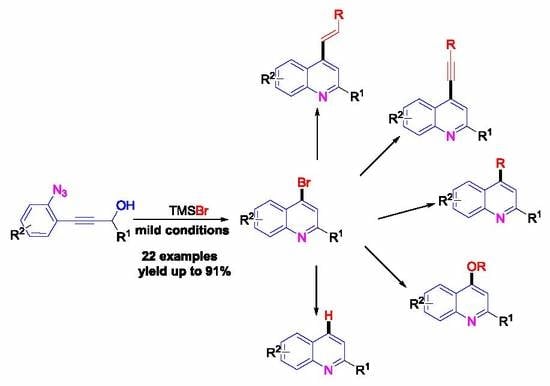
Difficult-to-access 4-bromo quinolines are constructed directly from easily prepared ortho-propynol phenyl azides using TMSBr as acid-promoter. The cascade transformation performs smoothly to generate desired products in moderate to excellent yields with good functional groups compatibility. Notably, TMSBr not only acted as an acid-promoter to initiate the reaction, and also as a nucleophile. In addition, 4-bromo quinolines as key intermediates could further undergo the coupling reactions or nucleophilic reactions to provide a variety of functionalized compounds with molecular diversity at C4 position of quinolines.
1. Introduction
Quinolines are distinctive and significant frameworks which are widely existed in numerous pharmaceuticals, pesticide molecules, bioactive molecules, and natural products [1,2,3,4,5,6,7,8]. Moreover, such compounds using as ligands play crucial role in synthetic and catalysis chemistry [9,10,11,12,13]. Consequently, developing general and flexible approach towards these heterocycles has attracted much attention among synthetic chemists. Until now, despite significant achievements having been made in the construction of functionalized quinolines [14,15,16,17,18,19,20,21,22], methods for the direct synthesis of 4-halo quinolines are still limited [23,24,25,26]. 4-halo quinolines have been widely used as key synthetic intermediates for the construction of various bioactive molecules or drugs [27,28,29]. Therefore, the development of an efficient and versatile strategy towards 4-halo quinolines is highly desirable, especially through a cascade cyclization, because of the merits of efficiency and atomic economy.
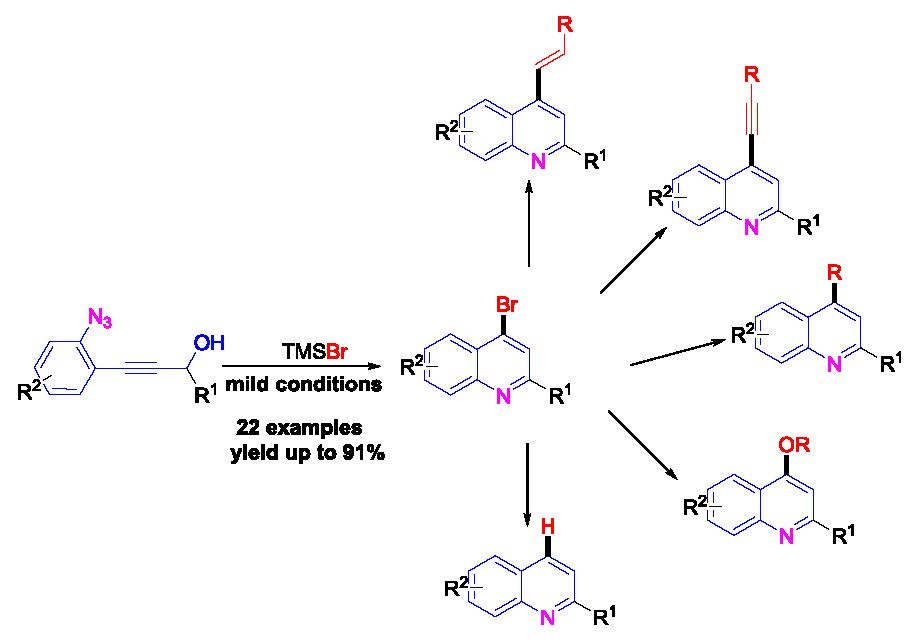
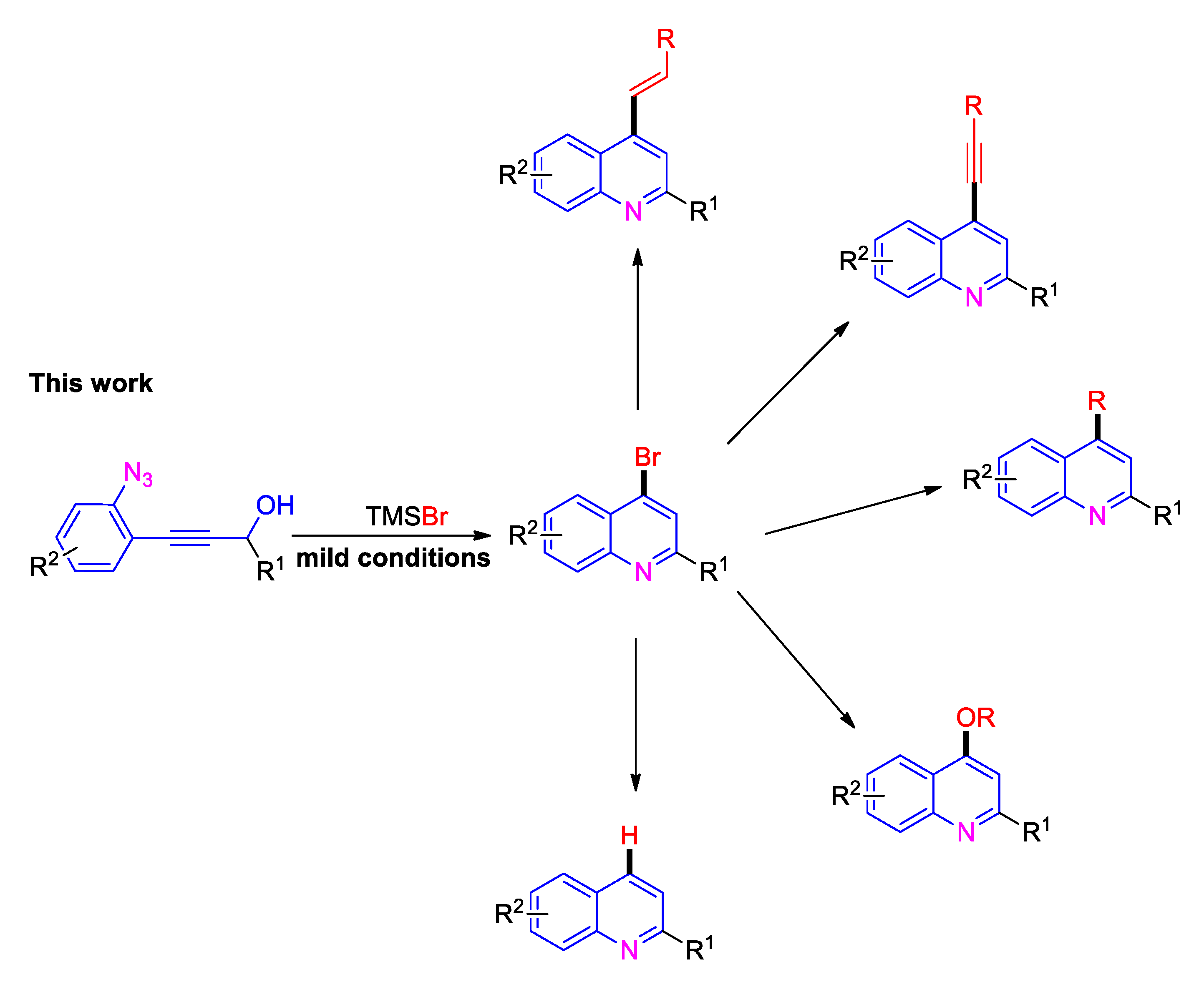
Based on its distinctive bifunctional group characteristics, the cascade reaction of propynols is an important tactic in organic synthesis, which exerts a significant role in the construction of functionalized carbo- or heterocyclic compounds [30,31,32,33,34]. In the past few years, our group had developed various efficient methods to construct functionalized heterocyclics through the cascade cyclization of propargylic alcohols in the presence of acid-promoter [35,36,37,38,39,40,41,42,43,44]. For example, we recently reported an efficient approach for the construction of 4-chrolo quinolines via the cyclization of ortho-propynol phenyl azides with TMSCl as acid-promoter [45]. Taking into consideration that the coupling reaction of chloro-substituted compounds is more difficult than bromo- or iodo-substituted compounds, the further development of universal approach for the construction of 4-bromo quinolines is still desirable and necessary. Herein, we report a general TMSBr-promoted the cascade cyclization of ortho-propynol phenyl azides for constructing 4-bromo quinolines, which can further undergo the coupling reactions or nucleophilic reactions to provide a variety of functionalized compounds with molecular diversity at C4 position of quinolines (Scheme 1). Compared to the Shvartsberg’s method [26], our developed strategy has the merits of good functional groups compatibility, easy preparation of the starting material, and simple operation.
Scheme 1.
Our strategy for the construction of 4-bromo quinolines and its applications.
2. Results and Discussion
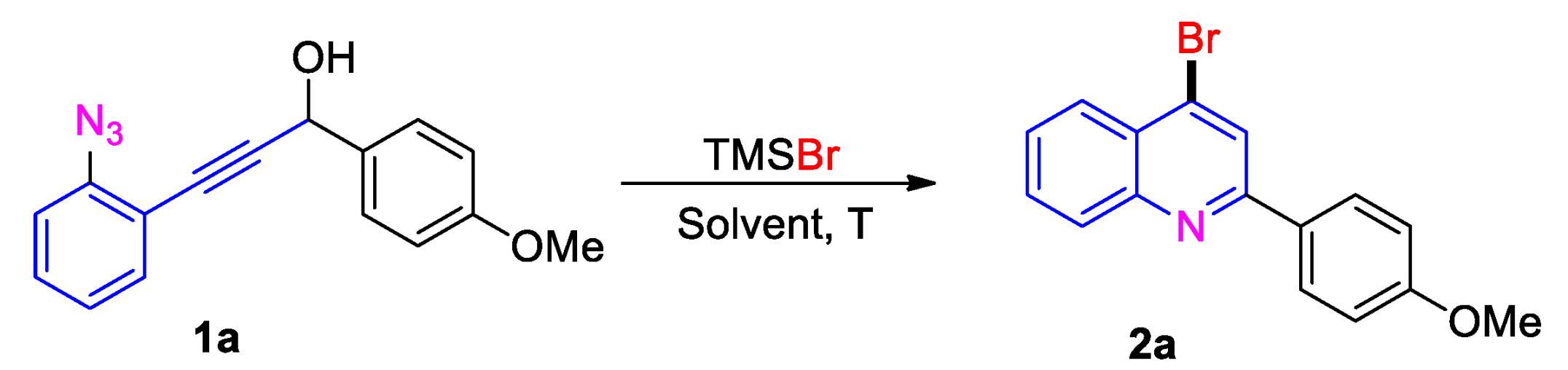
Initially, the reaction conditions were optimized for cascade cyclization of ortho-propynol phenyl azides 1a in the presence of TMSBr. Various solvents, temperatures, and TMSBr loading were investigated, and all cases were shown in Table 1. To our delight, with 2.5 equiv of TMSBr in different solvents—such as MeCN, CH3NO2, DCE, 1,4-dioxane, HOAc, and DCM—all reactions proceeded smoothly and cleanly to produce expected product 4-bromo-2-(4-methoxyphenyl)quinoline 2a (Table 1, entries 1–5); CH3NO2 as solvent was most suitable for this transformation (73% yield). Encouraged by this preliminary result, further efforts were then directed toward improving the yield of desired product 2a while suppressing the classical Meyer–Schuster rearrangement side reaction. Our studies on the loading of TMSBr with CH3NO2 as solvent showed that 3.5 equiv of TMSBr was the most efficient for this cascade transformation and could improve the yield of product 2a to 81% (Table 1, entries 6–8). Subsequently, the examination of the reaction temperature indicated that the choice of reaction temperature was also an important in this transformation (entries 9, 10). Furthermore, no better yield was obtained when hydrobromic acid (HBr, 48 wt % in H2O) was used instead of TMSBr as the acid promoter (entry 11). Therefore, we establish the reaction conditions as optimum: 0.2 mmol of 2-propynol phenyl azides, 3.5 equiv of TMSBr in CH3NO2 were stirred at 60 °C.
Table 1.
Optimization of the reaction for the synthesis of 2a a.
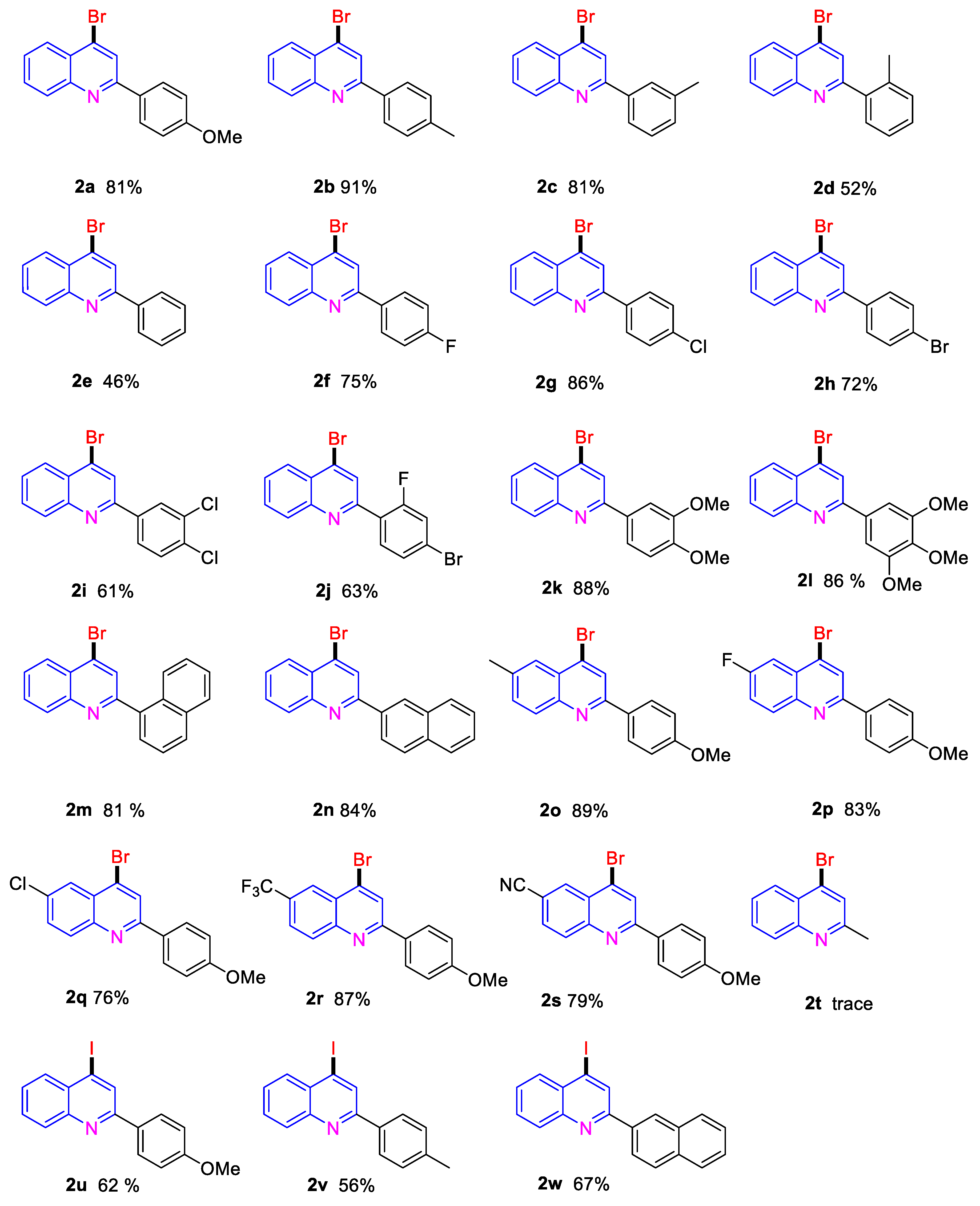
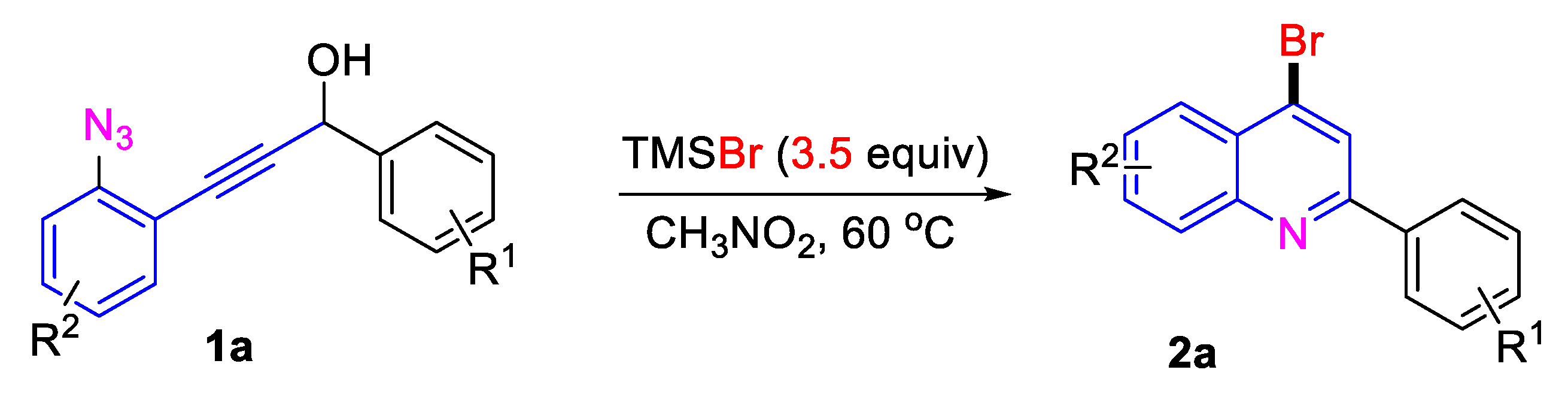
Then, we investigated the generality of the reaction with diverse substituted propynols 1 using TMSBr as acid-promoter and nucleophile, and the results are presented in Figure 1. Various substituents R1 and R2 on the aryl ring were well-tolerated under the optimal conditions, efficiently generating the corresponding products 4-bromo quinolines in favorable yields (up to 91% yield). Firstly, we investigated the influence of substituent electronic effects on this reaction, and the results indicated that substrates containing electron-donor groups (OMe, Me) gave better transformation than those containing electron-poor groups (F, Cl, Br). This might due to the fact that the reaction involved the carbocation intermediate (Intermediate B, see Scheme 4); and the electron-rich groups were good for the stabilization of carbocation intermediate. The corresponding products 4-bromo quinolines give the better yields compared to the synthesis of 4-chrolo quinolines bearing the electron-withdrawing groups. Substrates bearing ortho-position substituent provided slightly lower yields (2j–2k), indicating that the steric effect showed clear influence on this reaction. Importantly, the functionalities of halogen atoms such as fluorine, chlorine, and bromine were also tolerated for this transformation producing the target products. Such halogenated products could be converted into a variety of functionalized quinolines through cross-coupling reactions. Substrates containing two or three substituents attached to the benzene ring smoothly, and the target compounds were generated in good to excellent yields. Notably, the substrates with naphthyl or styryl group (1m and 1o) were also compatible to generate the target products in good yields (2k–2m). Then we examined the effect of a substituent (R2) on another aromatic ring on this transformation. Both electron-rich and electron-poor substituents were performed smoothly to produce the target compounds in 76–89% yields (2m–2s). It was noteworthy that the strong electron-deficient groups (CN and CF3) in R2 also proceeded well in this reaction and provided the target products in good yields. Unfortunately, no target product 2t was generated when alkyl-substituted substrate 1t was performed under the optimal conditions. Having successfully accomplished the direct formation of 4-bromo-quinolines, this cascade reaction was further extended to the construction of 4-iodo quinolines by using 2-propynol phenyl azides as starting materials with TMSI in CH3NO2 at 60 °C for 1.0 h under these circumstances. Some selected substrates (1a, 1b, 1n) were tolerated smoothly to the corresponding 4-iodo quinolines in moderate yields.

Figure 1.
Transformation of ortho-propynol phenyl azides 1 to 4-bromo quinolines 2 a. a Unless otherwise noted, all reactions were performed with 1 (0.2 mmol) in CH3NO2 (2.0 mL) at 60 °C for 1 h. Isolated yield.
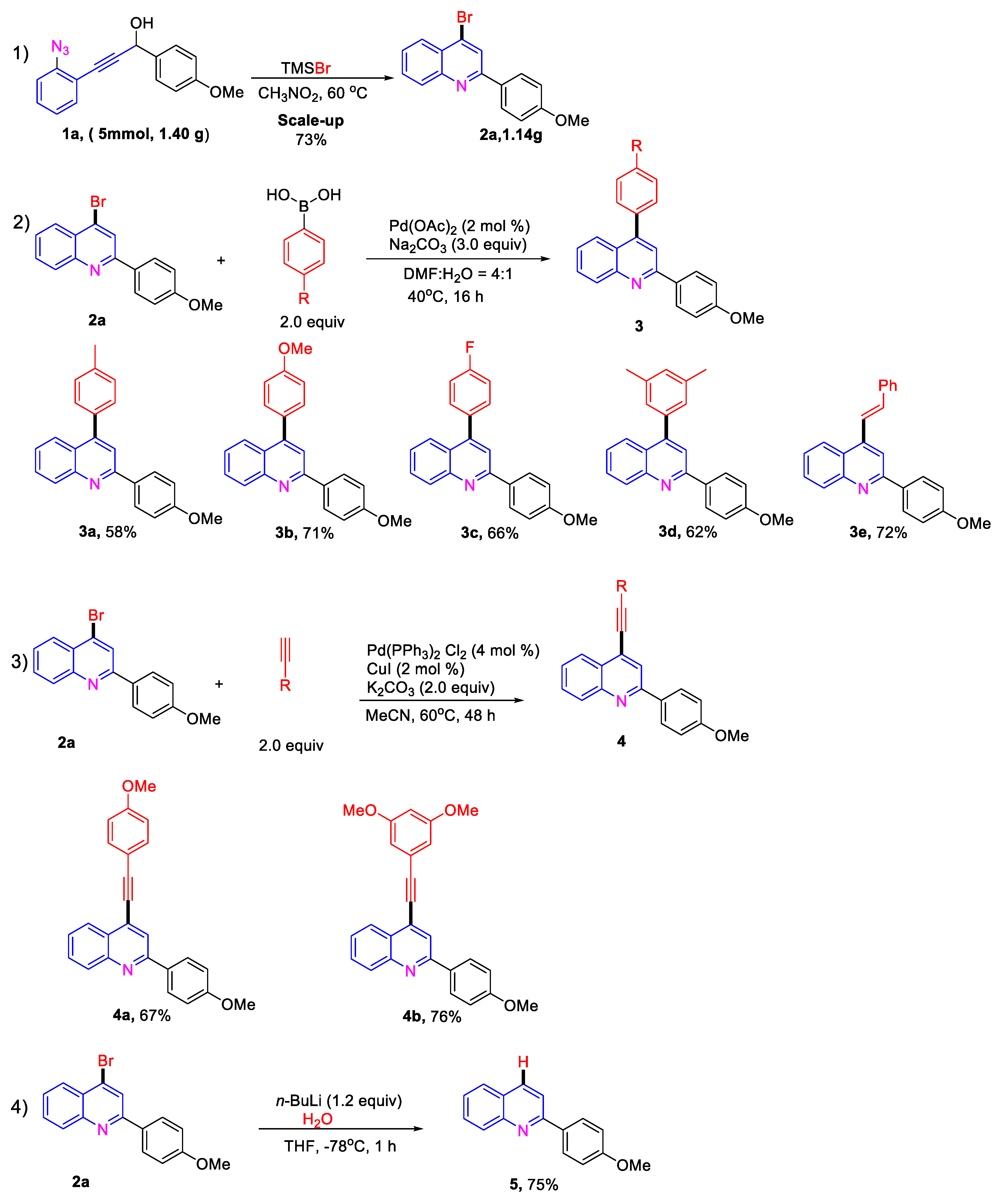
Furthermore, the synthetic utility of this TMSBr-promoted reaction of ortho-propynol azides was demonstrated by a gram-scale synthesis (Scheme 2-1). The yield of product 2a was not obvious affected when a gram-scale (5 mmol, 1.40g) experiment of 1a was performed under similar reaction conditions. Importantly, a bromine atom at the 4-position of obtained product quinolines moiety is useful and easily substituted by various functional hydrocarbon and heteroatomic groups, which persuades us to exploit synthetic transformation of 4-bromo quinolones [46,47,48]. As representative examples, the Suzuki coupling reaction of 2a with arylboronic acids to 4-aryl quinolines 3a–3d in good yield was achieved (Scheme 2-2) [46]. Notably, the corresponding product 4-vinyl quinoline 3e was also generated when the reaction of 2a with E-phenylethenylboronic acid. Furthermore, the Sonogashira coupling of 2a with arylacetylene could smoothly proceed to produce the target products 4a–4b in good yields (Scheme 2-3) [47]. More importantly, the classical reduction reaction of 2a to the corresponding quinoline 5 was also investigated (Scheme 2-4). These results clearly demonstrate the usefulness of our obtained product 4-bromo quinolines as synthetic intermediates.
Scheme 2.
Functionality elaboration of 4-bromo-quinolines.
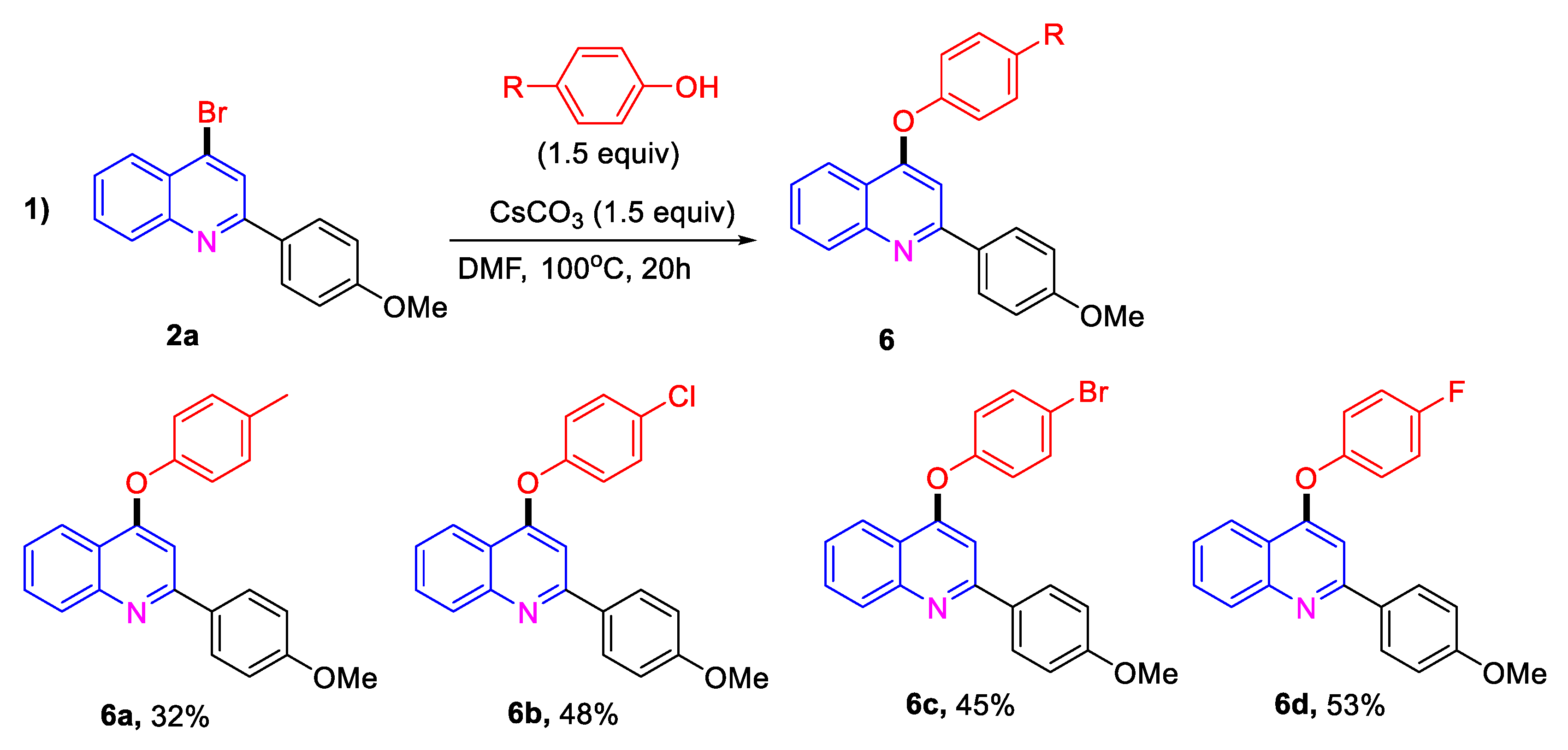
As we all known, 4-aryloxy quinolines are significant structure frameworks which are existed widely in various bioactive molecules and natural products [49,50,51,52]. In this context, the synthesis of 4-aryloxy quinolines from 4-bromo quinolines is attractive because of the clean conversion and the mild reaction conditions. Therefore, the scope of the reactions was also investigated by varying the phenols. Some representative substituted 4-aryllkoxy quinolines 6a–6d were generated in acceptable yields by choosing the appropriate nucleophilic reagents (Scheme 3).
Scheme 3.
Transformation of 4-bromo quinoline 2a to 4-aryloxy quinolines 6.
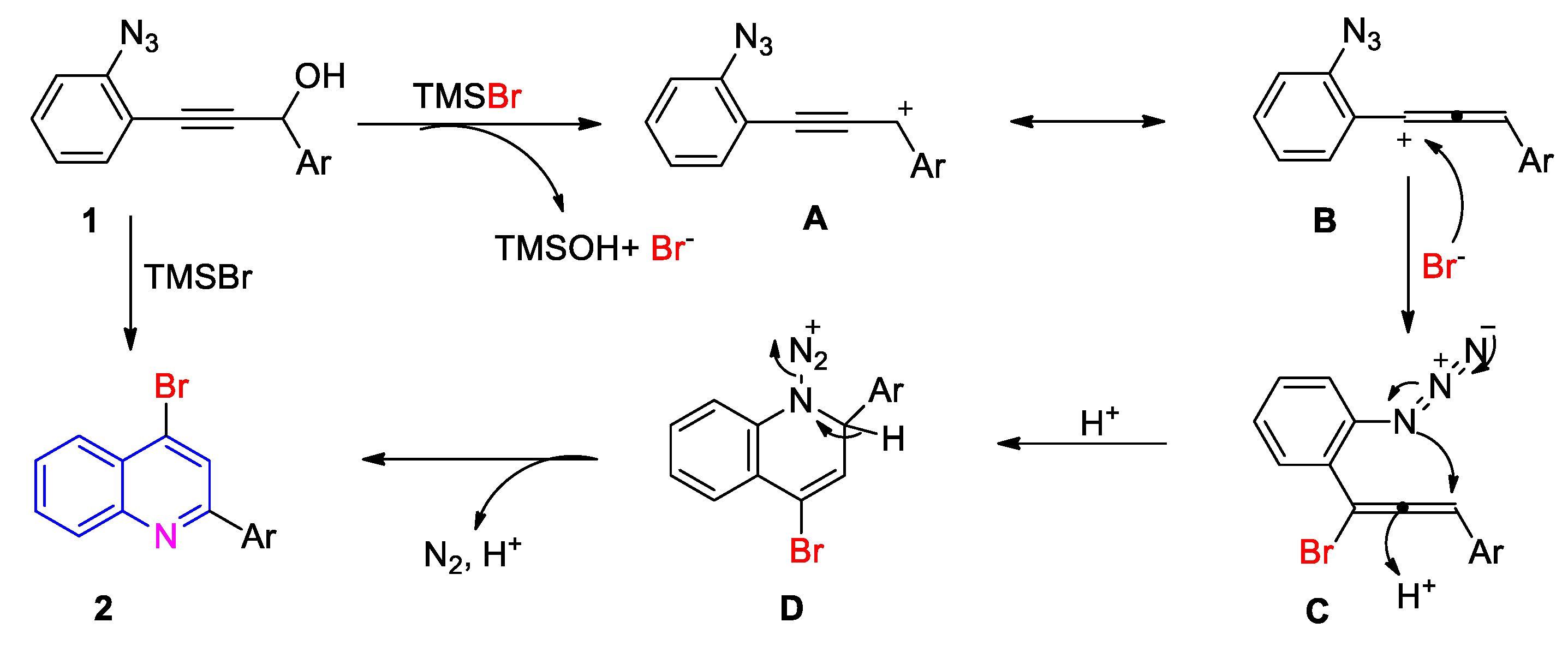
On the basis of the above experimental results and literature reports [45,53,54], we propose a plausible reaction mechanism for this reaction (Scheme 4). Firstly, a proargylic carbocation intermediate A was formed through the TMSBr-promoted the dehydration of propargylic alcohols 1. Intermediate A could easily undergo tautomerization to generate allenic carbocation intermediate B, which could be attracted by nucleophile halide anion (Br−) to produce intermediate C. Subsequently, the 6-endo-trig cyclization of intermediate C in the presence of proton forms intermediate D. Finally, the target product 2 was generated through the aromatization of the intermediate D with the generation of a nitrogen gas and a proton.
Scheme 4.
Proposed reaction mechanism.
3. Materials and Methods
3.1. General Remarks
1H-NMR spectra were recorded on 400 MHz in CDCl3 and 13C-NMR spectra were recorded on 100 MHz in CDCl3. Chemical shifts (ppm) were recorded with tetramethylsilane (TMS) as the internal reference standard. Multiplicities are given as: s (singlet), d (doublet), t (triplet), dd (doublet of doublets), q (quartet), or m (multiplet). High-resolution mass spectrometry (HRMS) was performed on a TOF/Q–TOF mass spectrometer. Copies of the 1H-NMR and 13C-NMR spectra are provided in the Supporting Information. Commercially available reagents were used without further purification. All solvents were dried under standard method.
3.2. General Procedure for the Construction of 4-Bromo Quinolines 2
To a seal tube was added ortho-propynol phenyl azides (1) (0.2 mmol), TMSBr (0.7 mmol), in CH3NO2 at 60 °C. After 1.0 h, as monitored by TLC, the reaction mixture was concentrated in vacuum and purified by column chromatography to generate 4-bromo quinolines 2.
4-Bromo-2-(4-Methoxyphenyl)quinoline (2a)
The title compound was prepared according to the 0.5, 130.8, 134.5, 148.7, 156.7, 161.1. general procedure and purified by column chromatography (silica gel, petroleum ether/ethyl acetate) to give a product 2a (81%) [45]. 1H-NMR (400 MHz, CDCl3): δ 3. 79 (s, 3 H), 6.95 (dd, J = 2.0, 6.8 Hz, 2 H), 7.47–7.51 (m, 1 H), 7.63–7.67 (m, 1 H), 8.01–8.07 (m, 5 H). 13C-NMR (100 MHz, CDCl3): δ 55.4, 122.4, 126.3, 126.5, 127.0, 128.9, 129.8, 13.
4-Bromo-2-(p-tolyl)quinoline (2b)
The title compound was prepared according to the general procedure and purified by column chromatography (silica gel, petroleum ether/ethyl acetate) to give a product 2b (91%). 1H-NMR (400 MHz, CDCl3): δ 2.34 (s, 3 H), 7.23 (d, J = 8.4 Hz, 2 H), 7.48–7.52 (m, 1 H), 7.64–7.68 (m, 1 H), 7.95 (d, J = 8.0 Hz, 2 H), 8.04–8.08 (m, 3 H). 13C-NMR (100 MHz, CDCl3): δ 21.3, 122.7, 126.5, 127.2, 127.4, 129.6, 130.0, 130.4, 134.5, 135.5, 139.9, 148.7, 157.1. HRMS (ESI, m/z): calcd for C16H12BrN: M + H = 298.0226; found: 298.0229.
4-Bromo-2-(m-tolyl)quinoline (2c)
The title compound was prepared according to the general procedure and purified by column chromatography (silica gel, petroleum ether/ethyl acetate) to give a product 2c (81%). 1H-NMR (400 MHz, CDCl3): δ 2.39 (s, 3 H), 7.21 (d, J = 7.2 Hz, 1 H), 7.33 (t, J = 7.6 Hz, 1 H), 7.52 (t, J = 7.2 Hz, 1 H), 7.68 (t, J = 7.6 Hz, 1 H), 7.81 (d, J = 8.0 Hz, 1 H), 7.89 (s, 1 H), 8.07–8.10 (m, 3 H). 13C-NMR (100 MHz, CDCl3): δ 21.5, 123.0, 124.6, 126.5, 126.6, 127.4, 128.2, 128.8, 130.0, 130.5, 130.6, 134.5, 138.3, 138.6, 148.7, 157.4. HRMS (ESI, m/z): calcd for C16H12BrN: M + H = 298.0226; found: 298.0229.
4-Bromo-2-(o-tolyl)quinoline (2d)
The title compound was prepared according to the general procedure and purified by column chromatography (silica gel, petroleum ether/ethyl acetate) to give a product 2d (52%). 1H-NMR (400 MHz, CDCl3): δ 2.35 (s, 3 H), 7.20–7.29 (m, 3 H), 7.41 (d, J = 6.8 Hz, 1 H), 7.58 (t, J = 7.6 Hz, 1 H), 7.70 (t, J = 7.6 Hz, 1 H), 7.78 (s, 1 H), 8.06–8.16 (m, 2 H). 13C-NMR (100 MHz, CDCl3): δ 20.3, 126.1, 126.1, 126.3, 126.6, 127.6, 128.9, 129.6, 130.0, 130.5, 131.1, 133.9, 136.1, 139.4, 148.4, 160.0. HRMS (ESI, m/z): calcd for C16H12BrN: M + H = 298.0226; found: 298.0227.
4-Bromo-2-phenylquinoline (2e)
The title compound was prepared according to the general procedure and purified by column chromatography (silica gel, petroleum ether/ethyl acetate) to give a product 2e (46%). 1H-NMR (400 MHz, CDCl3): δ 7.40–7.48 (m, 3 H), 7.54–7.56 (m, 1 H), 7.67–7.71 (m, 1 H), 8.05–8.11 (m, 5 H). 13C-NMR (100 MHz, CDCl3): δ 122.9, 126.5, 126.7, 127.5, 127.5, 128.9, 129.8, 130.1, 130.5, 134.6, 138.4, 148.8, 157.2. HRMS (ESI, m/z): calcd for C15H10BrN: M + H = 284.0069; found: 284.0071.
4-Bromo-2-(4-fluorophenyl)quinoline (2f)
The title compound was prepared according to the general procedure and purified by column chromatography (silica gel, petroleum ether/ethyl acetate) to give a product 2f (75%). 1H-NMR (400 MHz, CDCl3): δ 7.11–7.18 (m, 2 H), 7.52–7.56 (m, 1 H), 7.67–7.71 (m, 1 H), 8.05–8.11 (m, 5 H). 13C-NMR (100 MHz, CDCl3): δ 115.8, 116.0, 122.5, 126.6, 127.5, 129.4, 129.5, 130.0, 130.7, 134.5, 134.8, 148.7, 156.0, 162.8, 165.3. HRMS (ESI, m/z): calcd for C15H9BrFN: M + H = 301.9975; found: 301.9973.
4-Bromo-2-(4-chlorophenyl)quinoline (2g)
The title compound was prepared according to the general procedure and purified by column chromatography (silica gel, petroleum ether/ethyl acetate) to give a product 2g (86%). 1H-NMR (400 MHz, CDCl3): δ 7.41 (d, J = 8.4 Hz, 2 H), 7.52–7.56 (m, 1 H), 7.67–7.71 (m, 1 H), 7.99–8.10 (m, 5 H). 13C-NMR (100 MHz, CDCl3): δ 122.5, 126.6, 126.7, 127.7, 128.7, 129.1, 130.0, 130.7, 134.8, 136.0, 136.7, 148.7, 155.8. HRMS (ESI, m/z): calcd for C15H9BrClN: M + H = 317.9680; found: 317.9682.
4-Bromo-2-(4-bromophenyl)quinoline (2h)
The title compound was prepared according to the general procedure and purified by column chromatography (silica gel, petroleum ether/ethyl acetate) to give a product 2h (72%). 1H-NMR (400 MHz, CDCl3): δ 7.54–7.57 (m, 3 H), 7.68 (t, J = 8.4 Hz, 1 H), 7.94 (d, J = 8.4 Hz, 2 H), 8.04–8.10 (m, 3 H). 13C-NMR (100 MHz, CDCl3): δ 122.4, 124.5, 126.6, 126.7, 127.7, 129.0, 130.1, 130.7, 132.0, 134.8, 137.2, 148.7, 155.9. HRMS (ESI, m/z): calcd for C15H9Br2N: M + H = 361.9175; found: 361.9179.
4-Bromo-2-(3,4-dichlorophenyl)quinoline (2i)
The title compound was prepared according to the general procedure and purified by column chromatography (silica gel, petroleum ether/ethyl acetate) to give a product 2i (61%). 1H-NMR (400 MHz, CDCl3): δ 7.50 (d, J = 8.4 Hz, 1 H), 7.54–7.58 (m, 1 H), 7.69–7.73 (m, 1 H), 7.87–7.90 (m, 1 H), 8.02–8.11 (m, 3 H), 8.21 (d, J = 2.0 Hz, 1 H). 13C-NMR (100 MHz, CDCl3): δ 122.2, 126.4, 126.6, 126.8, 128.0, 129.3, 130.1, 130.8, 130.9, 133.3, 134.1, 135.0, 138.1, 148.6, 154.4. HRMS (ESI, m/z): calcd for C15H8BrCl2N: M + H = 351.9290; found: 351.9291.
4-Bromo-2-(4-bromo-2-fluorophenyl)quinoline (2j)
The title compound was prepared according to the general procedure and purified by column chromatography (silica gel, petroleum ether/ethyl acetate) to give a product 2j (63%). 1H-NMR (400 MHz, CDCl3): δ 7.34 (dd, J = 1.6, 6.8 Hz, 1 H), 7.40 (dd, J = 1.6, 8.4 Hz, 1 H) 7.59 (t, J = 7.2 Hz, 1 H), 7.72 (t, J = 7.2 Hz, 1 H), 7.97 (t, J = 7.6 Hz, 1 H), 8.07–8.14 (m, 3 H). 13C-NMR (100 MHz, CDCl3): δ 119.8, 120.0, 124.1, 124.2, 125.8, 125.9, 126.7, 126.9, 128.1, 128.2, 128.2, 130.0, 130.7, 132.5, 132.6, 134.4, 148.6, 152.6, 159.1, 161.8. HRMS (ESI, m/z): calcd for C15H8Br2FN: M + H = 379.9080; found: 379.9084.
4-Bromo-2-(3,4-dimethoxyphenyl)quinoline (2k)
The title compound was prepared according to the general procedure and purified by column chromatography (silica gel, petroleum ether/ethyl acetate) to give a product 2k (88%). 1H-NMR (400 MHz, CDCl3): δ 3.87 (s, 3 H), 3.97 (s, 3 H), 6.89 (d, J = 8.4 Hz, 1 H), 7.48–7.56 (m, 2 H), 7.64–7.68 (m, 1 H), 7.75 (d, J = 2.0 Hz, 1 H), 8.05–8.08 (m, 3 H). 13C-NMR (100 MHz, CDCl3): δ 55.9, 56.0, 110.2, 111.0, 120.3, 122.5, 126.4, 126.5, 127.1, 129.8, 130.5, 131.0, 134.5, 148.6, 149.4, 150.7, 156.6. HRMS (ESI, m/z): calcd for C17H14BrNO2: M + H = 344.0281; found: 344.0283.
4-Bromo-2-(3,4,5-trimethoxyphenyl)quinoline (2l)
The title compound was prepared according to the general procedure and purified by column chromatography (silica gel, petroleum ether/ethyl acetate) to give a product 2l (86%). 1H-NMR (400 MHz, CDCl3): δ 3.85 (s, 3 H), 3.93 (s, 6 H), 7.29 (s, 2 H), 7.53 (t, J = 7.2 Hz, 1 H), 7.69 (t, J = 7.6 Hz, 1 H), 8.04 (s, 1 H), 8.07–8.10 (m, 2 H). 13C-NMR (100 MHz, CDCl3): δ 56.3, 60.9, 104.8, 122.7, 126.5, 127.5, 129.9, 130.6, 133.8, 134.6, 139.8, 148.5, 153.6, 156.7. HRMS (ESI, m/z): calcd for C18H16BrNO3: M + H = 374.0386; found: 374.0382.
4-Bromo-2-(naphthalen-1-yl)quinoline (2m)
The title compound was prepared according to the general procedure and purified by column chromatography (silica gel, petroleum ether/ethyl acetate) to give a product 2m (81%). 1H-NMR (400 MHz, CDCl3): δ 7.41–7.48 (m, 2 H), 7.51–7.55 (m, 1 H), 7.61–7.66 (m, 2 H), 7.56 (t, J = 7.2 Hz, 1 H), 7.86–7.91 (m, 2 H), 7.96 (s, 1 H), 8.05 (d, J = 8.0 Hz, 1 H), 8.19 (dd, J = 8.8 Hz, 2 H). 13C-NMR (100 MHz, CDCl3): δ 125.3, 126.1, 126.6, 126.7, 126.9, 127.0, 127.9, 128.0, 128.5, 129.6, 129.9, 130.8, 131.0, 133.9, 134.4, 137.1, 148.4, 159.1. HRMS (ESI, m/z): calcd for C19H12BrN: M + H = 334.0226; found: 334.0227.
4-Bromo-2-(naphthalen-2-yl)quinoline (2n)
The title compound was prepared according to the general procedure and purified by column chromatography (silica gel, petroleum ether/ethyl acetate) to give a product 2n (84%). 1H-NMR (400 MHz, CDCl3): δ 7.42–7.46 (m, 2 H), 7.50–7.54 (m, 1 H), 7.66–7.70 (m, 1 H), 7.78–7.81 (m, 1 H), 7.88 (dd, J = 2.8, 5.6 Hz, 2 H), 8.08–8.11 (m, 2 H), 8.22–8.24 (m, 2 H), 8.47 (d, J = 0.8 Hz, 1 H). 13C-NMR (100 MHz, CDCl3): δ 123.0, 124.7, 126.4, 126.6, 126.7, 126.9, 127.3, 127.5, 127.7, 128.7, 128.8, 130.1, 130.6, 133.3, 134.0, 134.6, 135.6, 148.8, 156.9. HRMS (ESI, m/z): calcd for C19H12BrN: M + H = 334.0226; found: 334.0227.
4-Bromo-2-(4-methoxyphenyl)-6-methylquinoline (2o)
The title compound was prepared according to the general procedure and purified by column chromatography (silica gel, petroleum ether/ethyl acetate) to give a product 2o (89%). 1H-NMR (400 MHz, CDCl3): δ 2.48 (s, 3 H), 3.79 (s, 3 H), 6.94 (d, J = 8.8 Hz, 2 H), 7.47 (dd, J = 1.6, 8.4 Hz, 1 H), 7.80 (s, 1 H), 7.91 (d, J = 8.8 Hz, 1 H), 7.98–8.00 (m, 3 H). 13C-NMR (100 MHz, CDCl3): δ 21.7, 55.3, 114.2, 122.4, 125.3, 126.2, 128.7, 129.6, 131.1, 132.6, 133.7, 137.2, 147.3, 155.8, 160.9. HRMS (ESI, m/z): calcd for C17H14BrNO: M + H = 328.0332; found: 328.0331.
4-Bromo-6-fluoro-2-(4-methoxyphenyl)quinoline (2p)
The title compound was prepared according to the general procedure and purified by column chromatography (silica gel, petroleum ether/ethyl acetate) to give a product 2p (83%). 1H-NMR (400 MHz, CDCl3): δ 3.81 (s, 3 H), 6.95 (d, J = 8.4 Hz, 2 H), 7.39–7.44 (m, 1 H), 7.70 (dd, J = 2.8, 9.6 Hz, 1 H), 7.99–8.05 (m, 4 H). 13C-NMR (100 MHz, CDCl3): δ 55.4, 110.2, 110.4, 114.3, 120.5, 120.7, 123.0, 127.2, 127.3, 128.8, 130.6, 132.4, 132.5, 133.3, 133.4, 145.8, 156.1, 156.2, 159.7, 161.2, 162.2. HRMS (ESI, m/z): calcd for C16H11BrFNO: M + H = 332.0081; found: 332.0081.
4-Bromo-6-chloro-2-(4-methoxyphenyl)quinoline (2q)
The title compound was prepared according to the general procedure and purified by column chromatography (silica gel, petroleum ether/ethyl acetate) to give a product 2q (76%). 1H-NMR (400 MHz, CDCl3): δ 3.80 (s, 3 H), 6.95 (d, J = 8.8 Hz, 2 H), 7.57 (dd, J = 2.4, 8.8 Hz, 1 H), 7.94–8.05 (m, 5 H). 13C-NMR (100 MHz, CDCl3): δ 55.4, 114.3, 123.1, 125.5, 127.0, 128.8, 130.4, 131.4, 131.5, 133.0, 133.1, 147.1, 156.9, 161.3. HRMS (ESI, m/z): calcd for C16H11BrClNO: M + H = 347.9785; found: 347.9787.
4-Bromo-2-(4-methoxyphenyl)-6-(trifluoromethyl)quinoline (2r)
The title compound was prepared according to the general procedure and purified by column chromatography (silica gel, petroleum ether/ethyl acetate) to give a product 2r (87%). 1H-NMR (400 MHz, CDCl3): δ 3.80 (s, 3 H), 6.94 (d, J = 8.8 Hz, 2 H), 7.79 (d, J = 8.8 Hz, 1 H), 8.03 (d, J = 8.4 Hz, 2 H), 8.10 (d, J = 8.4 Hz, 2 H), 8.34 (s, 1 H). 13C-NMR (100 MHz, CDCl3): δ 55.4, 114.4, 123.4, 124.6, 124.7, 125.5, 126.1, 126.1, 129.1, 130.0, 131.0, 135.0, 149.7, 158.6, 161.7. HRMS (ESI, m/z): calcd for C17H11BrF3NO: M + H = 382.0049; found: 382.0045.
4-Bromo-2-(4-methoxyphenyl)quinoline-6-carbonitrile (2s)
The title compound was prepared according to the general procedure and purified by column chromatography (silica gel, petroleum ether/ethyl acetate) to give a product 2s (79%). 1H-NMR (400 MHz, CDCl3): δ 3.83 (s, 3 H), 6.98 (d, J = 8.8 Hz, 2 H), 7.79 (dd, J = 1.6, 8.4 Hz, 1 H), 8.08 (dd, J = 5.6, 8.8 Hz, 3 H), 8.16 (s, 1 H), 8.47 (d, J = 1.2 Hz, 1 H). 13C-NMR (100 MHz, CDCl3): δ 55.5, 110.4, 114.5, 118.5, 123.8, 126.0, 129.3, 129.7, 131.2, 131.3, 132.9, 134.5, 149.9, 159.4, 162.0. HRMS (ESI, m/z): calcd for C17H11BrN2O: M + H = 339.0128; found: 339.0128.
4-Iodo-2-(4-methoxyphenyl)quinoline (2u)
The title compound was prepared according to the general procedure and purified by column chromatography (silica gel, petroleum ether/ethyl acetate) to give a product 2u (62%) [45]. 1H-NMR (400 MHz, CDCl3): δ 3.89 (s, 3 H), 7.03–7.05 (m, 2 H), 7.54–7.58 (m, 1 H), 7.70–7.74 (m, 1 H), 7.98 (d, J = 8.4 Hz, 1 H), 8.05 (d, J = 8.4 Hz, 1 H), 8.09–8.12 (m, 2 H), 8.42 (s, 1 H). 13C-NMR (100 MHz, CDCl3): δ 66.4, 112.5, 114.3, 127.4, 128.9, 128.9, 130.1, 130.1, 130.5, 130.6, 131.4, 147.8, 156.7, 161.1.
4-Iodo-2-(p-tolyl)quinoline (2v)
The title compound was prepared according to the general procedure and purified by column chromatography (silica gel, petroleum ether/ethyl acetate) to give a product 2v (56%). 1H-NMR (400 MHz, CDCl3): 2.44 (s, 3 H), 7.33 (d, J = 8.0 Hz, 2 H), 7.60 (t, J = 7.2 Hz, 1 H), 7.72–7.76 (m, 1 H), 7.99–8.08 (m, 4 H), 8.45 (s, 1 H). 13C-NMR (100 MHz, CDCl3): δ 21.3, 112.5, 127.4, 127.6, 129.0, 129.7, 130.2, 130.4, 130.5, 131.4, 135.2, 139.9, 147.8, 157.0. HRMS (ESI, m/z): calcd for C16H12IN: M + H = 346.0087; found: 346.0092.
4-Iodo-2-(naphthalen-2-yl)quinoline (2w)
The title compound was prepared according to the general procedure and purified by column chromatography (silica gel, petroleum ether/ethyl acetate) to give a product 2w (67%). 1H-NMR (400 MHz, CDCl3): δ 7.54–7.57 (m, 2 H), 7.60–7.64 (m, 1 H), 7.75–7.80 (m, 1 H), 7.90–7.92 (m, 1 H), 7.99–8.05 (m, 3 H), 8.14 (d, J = 8.4 Hz, 1 H), 8.32–8.35 (m, 1 H), 8.59 (s, 1 H), 8.63 (s, 1 H). 13C-NMR (100 MHz, CDCl3): δ 112.6, 124.8, 126.5, 126.9, 127.3, 127.7, 127.9, 128.7, 128.8, 129.2, 130.3, 130.6, 130.7, 131.5, 133.4, 134.0, 135.3, 147.9, 156.9. HRMS (ESI, m/z): calcd for C19H12IN: M + H = 382.0087; found: 382.0089.
2-(4-Methoxyphenyl)-4-(p-tolyl)quinoline (3a)
The title compound was purified by column chromatography (silica gel, petroleum ether/ethyl acetate) to give a product 3a (58%) [55]. 1H-NMR (400 MHz, CDCl3): δ 2.38 (s, 3 H), 3.78 (s, 3 H), 6.95 (d, J = 8.4 Hz, 2 H), 7.26 (d, J = 8.0 Hz, 2 H), 7.32–7.37 (m, 3 H), 7.59–7.63 (m, 1 H), 7.66 (s, 1 H), 7.81 (d, J = 8.4 Hz, 1 H), 8.05–8.12 (m, 3 H). 13C-NMR (100 MHz, CDCl3): δ 21.3, 55.3, 114.2, 118.8, 125.6, 125.7, 125.8, 128.9, 129.2, 129.3, 129.4, 129.8, 132.3, 135.6, 138.2, 148.8, 149.0, 156.4, 160.8.
2,4-bis(4-Methoxyphenyl)quinoline (3b)
The title compound was purified by column chromatography (silica gel, petroleum ether/ethyl acetate) to give a product 3b (71%) [55]. 1H-NMR (400 MHz, CDCl3): δ 3.79 (s, 3 H), 3.81 (s, 3 H), 6.97 (dd, J = 8.8, 13.2 Hz, 4 H), 7.33–7.37 (m, 1 H), 7.41 (d, J = 8.8 Hz, 2 H), 7.59–7.63 (m, 1 H), 7.66 (s, 1 H), 7.82 (d, J = 8.4 Hz, 1 H), 8.06–8.12 (m, 3 H). 13C-NMR (100 MHz, CDCl3): δ 55.3, 55.4, 114.0, 114.2, 118.8, 125.6, 125.7, 125.8, 128.9, 129.3, 129.8, 130.7, 132.3, 148.6, 148.9, 156.4, 159.8, 160.8.
4-(4-Fluorophenyl)-2-(4-methoxyphenyl)quinoline (3c)
The title compound was purified by column chromatography (silica gel, petroleum ether/ethyl acetate) to give a product 3c (66%) [55]. 1H-NMR (400 MHz, CDCl3): δ 3.80 (s, 3 H), 6.96 (d, J = 8.8 Hz, 2 H), 7.13–7.18 (m, 2 H), 7.35–7.39 (m, 1 H), 7.43–7.46 (m, 2 H), 7.61–7.65 (m, 2 H), 7.73 (d, J = 8.4 Hz, 1 H), 8.06–8.13 (m, 3 H). 13C-NMR (100 MHz, CDCl3): δ 55.4, 114.2, 115.5, 115.7, 118.9, 125.3, 125.5, 126.0, 128.9, 128.5, 130.0, 131.2, 131.3, 132.0, 134.4, 134.5, 147.9, 148.8, 156.4, 160.9, 161.6, 164.1.
4-(3,5-Dimethylphenyl)-2-(4-methoxyphenyl)quinoline (3d)
The title compound was purified by column chromatography (silica gel, petroleum ether/ethyl acetate) to give a product 3d (62%). 1H-NMR (400 MHz, CDCl3): δ 2.34 (s, 6 H), 3.79 (s, 3 H), 6.95 (d, J = 8.8 Hz, 2 H), 7.05–7.08 (m, 3 H), 7.33–7.37 (m, 1 H), 7.59–7.63 (m, 1 H), 7.67 (s, 1 H), 7.81 (d, J = 8.4 Hz, 1 H), 8.06–8.12 (m, 3 H). 13C-NMR (100 MHz, CDCl3): δ 21.3, 55.3, 114.2, 118.7, 125.6, 125.7, 125.8, 127.3, 128.9, 129.3, 129.8, 129.9, 132.2, 138.1, 138.4, 148.7, 149.3, 156.4, 160.8. HRMS (ESI, m/z): calcd for: C24H21NO: M + H = 340.1696; found: M + H = 340.1692.
(E)-2-(4-Methoxyphenyl)-4-styrylquinoline (3e)
The title compound was purified by column chromatography (silica gel, petroleum ether/ethyl acetate) to give a product 3e (72%) [56]. 1H-NMR (400 MHz, CDCl3): δ 3.83 (s, 3 H), 6.99 (d, J = 8.4 Hz, 2 H), 7.27–7.39 (m, 4 H), 7.44–7.49 (m, 1 H), 7.58 (d, J = 7.2 Hz, 2 H), 7.63–7.67 (m, 1 H), 7.77 (d, J = 16.0 Hz, 1 H), 7.95 (s, 1 H), 8.08–8.12 (m, 4 H). 13C-NMR (100 MHz, CDCl3): δ 55.4, 114.2, 114.7, 123.3, 123.6, 125.2, 125.9, 127.1, 128.7, 128.8, 128.9, 129.4, 130.2, 132.4, 134.9, 136.7, 143.5, 148.8, 156.8, 160.8.
2-(4-Methoxyphenyl)-4-((4-methoxyphenyl)ethynyl)quinoline (4a)
The title compound was purified by column chromatography (silica gel, petroleum ether/ethyl acetate) to give a product 4a (67%) [45]. 1H-NMR (400 MHz, CDCl3): δ 3.86 (s, 3 H), 3.89 (s, 3 H), 6.95 (d, J = 8.8 Hz, 2 H), 7.05 (d, J = 8.8 Hz, 2 H), 7.55–7.59 (m, 1 H), 7.63 (d, J = 8.8 Hz, 2 H), 7.71–7.75 (m, 1 H), 8.00 (s, 1 H), 8.13–8.16 (m, 3 H), 8.33 (d, J = 7.6 Hz, 1 H). 13C-NMR (100 MHz, CDCl3): δ 55.4, 84.5, 98.2, 114.2, 114.2, 114.4, 120.9, 125.7, 126.3, 126.3, 128.8, 129.8, 129.9, 130.5, 131.8, 133.5, 148.2, 156.4, 160.4, 160.9.
4-((3,5-Dimethoxyphenyl)ethynyl)-2-(4-methoxyphenyl)quinoline (4b)
The title compound was purified by column chromatography (silica gel, petroleum ether/ethyl acetate) to give a product 4b (76%). 1H-NMR (400 MHz, CDCl3): δ 3.78 (s, 6 H), 3.82 (s, 3 H), 6.48 (t, J = 2.0 Hz, 1 H), 6.76 (d, J = 2.4 Hz, 2 H), 6.98 (d, J = 8.8 Hz, 2 H), 7.51 (t, J = 7.6 Hz, 1 H), 7.67 (t, J = 8.0 Hz, 1 H), 7.96 (s, 1 H), 8.07–8.10 (m, 3 H), 8.25 (d, J = 8.0 Hz, 1 H). 13C-NMR (100 MHz, CDCl3): δ 55.5, 85.0, 97.8, 102.6, 109.7, 114.3, 121.3, 123.6, 125.6, 126.3, 126.5, 128.8, 129.9, 130.0, 130.0, 131.7, 148.2, 156.4, 160.7, 161.0. HRMS (ESI, m/z): calcd for: C26H21NO3: M + H = 396.1594; found: 396.1596.
2-(4-Methoxyphenyl)quinoline (5)
The title compound was purified by column chromatography (silica gel, petroleum ether/ethyl acetate) to give a product 5 (75%) [57]. 1H-NMR (400 MHz, CDCl3): δ 3.79 (s, 3 H), 6.96 (d, J = 8.8 Hz, 2 H), 7.38–7.42 (m, 1 H), 7.59–7.64 (m, 1 H), 7.70–7.75 (m, 2 H), 8.04–8.09 (m, 4 H). 13C-NMR (100 MHz, CDCl3): δ 55.4, 114.2, 118.5, 125.8, 126.9, 127.4, 128.9, 129.5, 129.5, 132.2, 136.6, 148.3, 156.9, 160.8.
2-(4-Methoxyphenyl)-4-(p-tolyloxy)quinoline (6a)
The title compound was purified by column chromatography (silica gel, petroleum ether/ethyl acetate) to give a product 6a (32%). 1H-NMR (400 MHz, CDCl3): δ 2.35 (s, 3 H), 3.77 (s, 3 H), 6.88–6.90 (m, 3 H), 7.04 (d, J = 8.4 Hz, 2 H), 7.18–7.21 (m, 2 H), 7.44 (t, J = 7.6 Hz, 1 H), 7.66 (t, J = 7.6 Hz, 1 H), 7.84 (d, J = 8.8 Hz, 2 H), 8.04 (d, J = 8.8 Hz, 1 H), 8.25 (d, J = 8.0 Hz, 1 H). 13C-NMR (100 MHz, CDCl3): δ 20.9, 55.4, 101.7, 114.0, 120.4, 120.7, 121.7, 125.4, 128.8, 129.1, 130.2, 130.7, 132.5, 135.1, 149.8, 152.3, 158.1, 160.7, 162.5. HRMS (ESI, m/z): calcd for: C23H19NO2: M + H = 342.1489; found: 342.1495.
4-(4-Chlorophenoxy)-2-(4-methoxyphenyl)quinoline (6b)
The title compound was purified by column chromatography (silica gel, petroleum ether/ethyl acetate) to give a product 6b (48%). 1H-NMR (400 MHz, CDCl3): δ 3.77 (s, 3 H), 6.89–6.92 (m, 3 H), 7.09 (d, J = 8.8 Hz, 2 H), 7.36 (d, J = 9.2 Hz, 2 H), 7.45 (t, J = 7.2 Hz, 1 H), 7.65–7.70 (m, 1 H), 7.86 (d, J = 8.8 Hz, 2 H), 8.05 (d, J = 8.4 Hz, 1 H), 8.19 (d, J = 7.6 Hz, 1 H). 13C-NMR (100 MHz, CDCl3): δ 55.5, 110.4, 114.5, 118.5, 123.8, 126.0, 129.3, 129.7, 131.2, 131.3, 132.9, 134.5, 149.9, 159.4, 162.0. HRMS (ESI, m/z): calcd for: C22H16ClNO2: M + H = 362.0942; found: 362.0948.
4-(4-Bromophenoxy)-2-(4-methoxyphenyl)quinoline (6c)
The title compound was purified by column chromatography (silica gel, petroleum ether/ethyl acetate) to give a product 6c (45%). 1H-NMR (400 MHz, CDCl3): δ 3.77 (s, 3 H), 6.89–6.93 (m, 3 H), 7.04 (d, J = 8.8 Hz, 2 H), 7.45 (t, J = 7.2 Hz, 1 H), 7.51 (d, J = 8.8 Hz, 2 H), 7.67 (t, J = 8.4 Hz, 1 H), 7.86 (d, J = 8.4 Hz, 2 H), 8.06 (d, J = 8.4 Hz, 1 H), 8.18 (d, J = 8.0Hz, 1 H). 13C-NMR (100 MHz, CDCl3): δ 55.4, 102.3, 114.1, 118.2, 120.2, 121.5, 122.5, 125.7, 128.8, 129.2, 130.4, 132.1, 133.3, 149.8, 153.9, 158.1, 160.9, 161.7. HRMS (ESI, m/z): calcd for: C22H16BrNO2: M + H = 406.0437; found: 406.0431.
4-(4-Fluorophenoxy)-2-(4-methoxyphenyl)quinoline (6d)
The title compound was purified by column chromatography (silica gel, petroleum ether/ethyl acetate) to give a product 6d (53%). 1H-NMR (400 MHz, CDCl3): δ 3.77 (s, 3 H), 6.89–6.93 (m, 3 H), 7.04 (d, J = 8.8 Hz, 2 H), 7.45 (t, J = 7.2 Hz, 1 H), 7.51 (d, J = 8.8 Hz, 2 H), 7.67 (t, J = 8.4 Hz, 1 H), 7.86 (d, J = 8.4 Hz, 2 H), 8.06 (d, J = 8.4 Hz, 1 H), 8.18 (d, J = 8.0Hz, 1 H). 13C-NMR (100 MHz, CDCl3): δ 55.4, 102.3, 114.1, 118.2, 120.2, 121.5, 122.5, 125.7, 128.8, 129.2, 130.4, 132.1, 133.3, 149.8, 153.9, 158.1, 160.9, 161.7. HRMS (ESI, m/z): calcd for: C22H16FNO2: M + H = 346.1238; found: 346.1234.
4. Conclusions
In summary, we have developed an efficient and general approach for the synthesis of 4-bromo or 4-iodo quinolines through the TMSBr promoted the cascade cyclization of ortho-propynol phenyl azides. It is noteworthy that the obtained products 4-halo quinolines could be used as key intermediate for the construction of various bioactive molecules, natural products, and drugs. A variety of 4-halo quinolines were obtained in moderate to excellent yields under mild conditions. This process does not require the use of metal catalysts, additional oxidants; water and nitrogen gas are generated as the only side products.
Supplementary Materials
The following are available online at https://www.mdpi.com/1420-3049/24/21/3999/s1.
Author Contributions
Conceptualization, Q.X.; Data curation, J.B.; Formal analysis, F.J., T.Y., and X.-R.S.; Writing—original draft preparation, F.J.; Writing—review and editing, X.-R.S., R.Y., and H.D.
Funding
This work was funded by the National Science Foundation of China (21676131 and 21462019), the Science Foundation of Jiangxi Province (20181BAB203005 and 20143ACB20012), the Education Department of Jiangxi Province (GJJ180616), Jiangxi Science & Technology Normal University (2017QNBJRC004).
Conflicts of Interest
The authors declare no conflict of interest.
References
- Joule, J.A.; Mills, K. Heterocylic Chemistry, 4th ed.; Blackwell Science, Ltd.: Oxford, UK, 2000; p. 121. [Google Scholar]
- Balasubraimanan, M.; Keay, J.G. Comprehensive Heterocyclic Chemistry II; Katritzky, A.R., Rees, C.W., Scriven, E.F.V., Eds.; Pergamon Press: Oxford, UK, 1996; Volume 5, p. 245. [Google Scholar]
- Michael, J.P. Quinoline, quinazoline and acridone alkaloids. Nat. Prod. Rep. 2008, 25, 166–187. [Google Scholar] [CrossRef]
- Boa, A.N.; Canavan, S.P.; Hirst, P.R.; Ramsey, C.; Stead, A.M.W.; McConkey, G.A. Synthesis of brequinar analogue inhibitors of malaria parasite dihydroorotate dehydrogenase. Bioorg. Med. Chem. 2005, 13, 1945–1967. [Google Scholar] [CrossRef]
- Diao, Y.; Lu, W.; Jin, H.; Zhu, J.; Han, L.; Xu, M.; Gao, R.; Shen, X.; Zhao, Z.; Liu, X.; et al. Discovery of Diverse Human Dihydroorotate Dehydrogenase Inhibitors as Immunosuppressive Agents by Structure-Based Virtual Screening. J. Med. Chem. 2012, 55, 8341–8349. [Google Scholar] [CrossRef]
- Munier-Lehmann, H.; Lucas-Hourani, M.; Guillou, S.; Helynck, O.; Zanghi, G.; Noel, A.; Tangy, F.; Vidalain, P.; Janin, Y.L. Original 2-(3-Alkoxy-1H-pyrazol-1-yl)pyrimidine Derivatives as Inhibitors of Human Dihydroorotate Dehydrogenase (DHODH). J. Med. Chem. 2015, 58, 860–877. [Google Scholar] [CrossRef]
- Das, P.; Deng, X.; Zhang, L.; Roth, M.G.; Fontoura, B.M.A.; Phillips, M.A.; De Brabander, J.K. SAR-Based Optimization of a 4-Quinoline Carboxylic Acid Analogue with Potent Antiviral Activity. ACS Med. Chem. Lett. 2013, 4, 517–521. [Google Scholar] [CrossRef]
- Strekowski, L.; Say, M.; Zegrocka, O.; Tanious, F.A.; Wilson, W.D.; Manzel, L.; Macfarlane, D.E. Bis-4-aminoquinolines: Novel triple-helix DNA intercalators and antagonists of immunostimulatory CpG-oligodeoxynucleotides. Bioorg. Med. Chem. 2003, 11, 1079–1085. [Google Scholar] [CrossRef]
- Gogoi, S.; Zhao, C.-G. Organocatalyzed enantioselective synthesis of 6-amino-5-cyanodihydropyrano[2,3-c]pyrazoles. Tetrahedron Lett. 2009, 50, 2252–2255. [Google Scholar] [CrossRef]
- Tan, B.; Shi, Z.; Chua, J.P.; Zhong, G. Control of Four Stereocenters in an Organocatalytic Domino Double Michael Reaction: Efficient Synthesis of Multisubstituted Cyclopentanes. Org. Lett. 2008, 10, 3425–3428. [Google Scholar] [CrossRef]
- Wang, B.; Wu, F.; Wang, Y.; Liu, X.; Deng, L. Control of Diastereoselectivity in Tandem Asymmetric Reactions Generating Nonadjacent Stereocenters with Bifunctional Catalysis by Cinchona Alkaloids. J. Am. Chem. Soc. 2007, 129, 768–769. [Google Scholar] [CrossRef]
- Biddle, M.M.; Lin, M.; Scheidt, K.A. Catalytic Enantioselective Synthesis of Flavanones and Chromanones. J. Am. Chem. Soc. 2007, 129, 3830–3831. [Google Scholar] [CrossRef]
- Enders, D.; Grondal, C.; Hüttl, M.R.M. Asymmetric Organocatalytic Domino Reactions. Angew. Chem. Int. Ed. 2007, 46, 1570–1581. [Google Scholar] [CrossRef] [PubMed]
- Bharate, J.B.; Vishwakarma, R.A.; Bharate, S.B. Metal-free domino one-pot protocols for quinoline synthesis. RSC Adv. 2015, 5, 42020–42053. [Google Scholar] [CrossRef]
- Prajapati, S.M.; Patel, K.D.; Vekariya, R.H.; Panchal, S.N.; Patel, H.D. Recent advances in the synthesis of quinolines: A review. RSC Adv. 2014, 4, 24463–24476. [Google Scholar] [CrossRef]
- Hassanin, H.M.; Ibrahim, M.A.; Gabr, Y.A.; Alnamer, Y.A. Synthesis and Chemical Reactivity of Pyrano[3,2-c]quinolinones. J. Heterocycl. Chem. 2012, 49, 1269–1289. [Google Scholar] [CrossRef]
- Wang, Y.; Peng, C.; Liu, L.; Zhao, J.; Su, L.; Zhu, Q. Sulfuric acid promoted condensation cyclization of 2-(2-(trimethylsilyl) ethynyl)anilines with arylaldehydes in alcoholic solvents: An efficient one-pot synthesis of 4-alkoxy-2-arylquinolines. Tetrahedron Lett. 2009, 50, 2261–2265. [Google Scholar] [CrossRef]
- Sridharan, V.; Avendano, C.; Menendez, J.C. CAN-catalyzed three-component reaction between anilines and alkyl vinyl ethers: Stereoselective synthesis of 2-methyl-1,2,3,4-tetrahydroquinolines and studies on their aromatization. Tetrahedron 2007, 63, 673–681. [Google Scholar] [CrossRef]
- Gharpure, S.J.; Nanda, S.K.; Adate, P.A.; Shelke, Y.G. Lewis Acid Promoted Oxonium Ion Driven Carboamination of Alkynes for the Synthesis of 4-Alkoxy Quinolines. J. Org. Chem. 2017, 82, 2067–2080. [Google Scholar] [CrossRef]
- Mao, X.-F.; Zhu, X.-P.; Li, D.-Y.; Liu, P.-N. Cu-Catalyzed Cascade Annulation of Alkynols with 2-Azidobenzaldehydes: Access to 6H-Isochromeno [4,3-c]quinoline. J. Org. Chem. 2017, 82, 7032–7039. [Google Scholar] [CrossRef]
- Liu, Y.; Zhang, X.; Xi, C. MeOTf-induced annulation of arylisocyanates and arylalkynes leading to 4-methoxyl-2,3-diarylquinolines. Tetrahedron Lett. 2018, 59, 2440–2442. [Google Scholar] [CrossRef]
- Yang, T.; Ding, H.; Li, R.; Jin, F.; Song, X.-R.; Chen, X.; Bai, J.; Xiao, Q.; Liang, Y.-M. para-TsOH-Promoted Cascade Reaction of ortho-Propynol Phenyl Azides for the Synthesis of 4-Methoxy Quinolines and Propargyl Methyl Ethers: Insight on Mechanism of Propargylic Alcohols. Asian J. Org. Chem. 2019, 8, 391–398. [Google Scholar] [CrossRef]
- Abbiati, G.; Arcadi, A.; Marinelli, F.; Rossi, E. Domino [3 + 2] Cycloaddition/Annulation Reactions of β-(2-Aminophenyl)-α,β-ynones with Nitrile Oxides: Synthesis of Isoxazolo[4,5-c]quinolines. Eur. J. Org. Chem. 2003, 2003, 1423–1427. [Google Scholar] [CrossRef]
- Strekowski, L.; Zegrocka, O.; Windham, C.; Czarny, A. Practical Synthesis of 4-Chloro-2-(2-naphthyl)quinoline, a Precursor to Triple-Helix DNA Intercalators. Org. Process Res. Dev. 1997, 1, 384–386. [Google Scholar] [CrossRef]
- Akila, S.; Selvi, S.; Balasubramanian, K. The Vilsmeier cyclization of 2′-azido and 2′-aminochalcones—A mild one pot synthesis of 2-aryl-4-chloroquinoline and its N-formyl-1,2-dihydro derivatives. Tetrahedron 2001, 57, 3465–3469. [Google Scholar] [CrossRef]
- Shvartsberg, M.S.; Kolodina, E.A. Synthesis of 4-haloquinolines and their fused polycyclic derivatives. Mendeleev Commun. 2008, 18, 109–111. [Google Scholar] [CrossRef]
- O’Neill, P.M.; Bray, P.G.; Hawley, S.R.; Ward, S.A.; Park, B.K. 4-Aminoquinolines—Past, present, and future; A chemical perspective. Pharmacol. Ther. 1998, 77, 29–58. [Google Scholar] [CrossRef]
- Blauer, G.; Akkawi, M.; Fleischhacker, W.; Hiessboeck, R. Synthesis and optical properties of the chloroquine enantiomers and their complexes with ferriprotoporphyrin IX in aqueous solution. Chirality 1998, 10, 556–563. [Google Scholar] [CrossRef]
- Egan, T.J.; Hunter, R.; Kaschula, C.H.; Marques, H.M.; Misplon, A.; Walden, J. Structure−Function Relationships in Aminoquinolines: Effect of Amino and Chloro Groups on Quinoline−Hematin Complex Formation, Inhibition of β-Hematin Formation, and Antiplasmodial Activity. J. Med. Chem. 2000, 43, 283–291. [Google Scholar] [CrossRef]
- Muzart, J. Gold-catalysed reactions of alcohols: Isomerisation, inter- and intramolecular reactions leading to C–C and C–heteroatom bonds. Tetrahedron 2008, 64, 5815–5849. [Google Scholar] [CrossRef]
- Kabalka, G.W.; Yao, M.-L. Direct Propargylic Substitution of Hydroxyl Group in Propargylic Alcohols. Curr. Org. Synth. 2008, 5, 28–32. [Google Scholar] [CrossRef]
- Zhang, L.; Fang, G.; Kumar, R.K.; Bi, X. Coinage-Metal-Catalyzed Reactions of Propargylic Alcohols. Synthesis 2015, 47, 2317–2346. [Google Scholar]
- Zhu, Y.; Sun, L.; Lu, P.; Wang, Y. Recent Advances on the Lewis Acid-Catalyzed Cascade Rearrangements of Propargylic Alcohols and Their Derivatives. ACS Catal. 2014, 4, 1911–1925. [Google Scholar] [CrossRef]
- Song, X.-R.; Qiu, Y.-F.; Liu, X.-Y.; Liang, Y.-M. Recent advances in the tandem reaction of azides with alkynes or alkynols. Org. Biomol. Chem. 2016, 14, 11317–11331. [Google Scholar] [CrossRef] [PubMed]
- Han, Y.-P.; Li, X.-S.; Zhu, X.-Y.; Li, M.; Zhou, L.; Song, X.-R.; Liang, Y.-M. Lewis Acid Catalyzed Dehydrogenative Coupling of Tertiary Propargylic Alcohols with Quinoline N-Oxides. J. Org. Chem. 2017, 82, 1697–1704. [Google Scholar] [CrossRef] [PubMed]
- Han, Y.-P.; Song, X.-R.; Qiu, Y.-F.; Li, X.-S.; Zhang, H.-R.; Zhu, X.-Y.; Liu, X.-Y.; Liang, Y.-M. Lewis Acid Catalyzed Cyclization of Propargylic Alcohols with 2-Vinylphenol. Org. Lett. 2016, 18, 3866–3869. [Google Scholar] [CrossRef] [PubMed]
- Han, Y.-P.; Song, X.-R.; Qiu, Y.-F.; Zhang, H.-R.; Li, L.-H.; Jin, D.-P.; Sun, X.-Q.; Liu, X.-Y.; Liang, Y.-M. Lewis Acid Catalyzed [4 + 3] Cycloaddition of Propargylic Alcohols with Azides. Org. Lett. 2016, 18, 940–943. [Google Scholar] [CrossRef]
- Qiu, Y.-F.; Song, X.-R.; Li, M.; Zhu, X.-Y.; Wang, A.-Q.; Yang, F.; Han, Y.-P.; Zhang, H.-R.; Jin, D.-P.; Li, Y.-X.; et al. BF3·OEt2-AgSCF3 Mediated Trifluoromethylthiolation/Cascade Cyclization of Propynols: Synthesis of 4-((Trifluoromethyl)thio)-2H-chromene and 4-((Trifluoromethyl)thio)-1,2-dihydroquinoline Derivatives. Org. Lett. 2016, 18, 1514–1517. [Google Scholar] [CrossRef]
- Li, R.; Jin, F.; Song, X.-R.; Yang, T.; Ding, H.; Yang, R.; Xiao, Q.; Liang, Y.-M. Acid-promoted cyclization of 2-propynolphenols leading to 4-tosyloxy-2H-chromenes. Tetrahedron Lett. 2019, 60, 331–334. [Google Scholar] [CrossRef]
- Yang, T.; Song, X.-R.; Li, R.; Jin, F.; Zhang, Y.; Bai, J.; Yang, R.; Ding, H.; Xiao, Q. Metal-free and efficient approach to 4-thiocyanated 2H-chromenes via TFA-mediated cascade cyclization of 2-propynolphenols. Tetrahedron Lett. 2019, 60, 1248–1253. [Google Scholar] [CrossRef]
- Li, R.; Song, X.-R.; Chen, X.; Ding, H.; Xiao, Q.; Liang, Y.-M. Copper-Catalyzed Cascade Cyclization of 2-Propynolphenols: Access to 4-Phosphorylated 2H-Chromenes. Adv. Synth. Catal. 2017, 359, 3962–3967. [Google Scholar] [CrossRef]
- Song, X.-R.; Li, R.; Yang, T.; Chen, X.; Ding, H.; Xiao, Q.; Liang, Y.-M. Novel and Efficient Access to Flavones under Mild Conditions: Aqueous HI-Mediated Cascade Cyclization/Oxidative Radical Reaction of 2-Propynolphenols. Eur. J. Org. Chem. 2018, 2018, 5548–5552. [Google Scholar] [CrossRef]
- Yang, T.; Kou, P.; Jin, F.; Song, X.-R.; Bai, J.; Ding, H.; Xiao, Q.; Liang, Y.-M. TFA-Promoted Sulfonation/Cascade Cyclization of 2-Propynolphenols with Sodium Sulfinates to 4-Sulfonyl 2H-Chromenes under Metal-free Conditions. Org. Chem. Front. 2019, 6, 3162–3166. [Google Scholar] [CrossRef]
- Song, X.-R.; Li, R.; Ding, H.; Yang, R.; Xiao, Q.; Liang, Y.-M. Highly efficient access to 4-chloro-2H-chromenes and 1,2-dihydroquinolines under mild conditions: TMSCl-mediated cyclization of 2-propynolphenols/anilines. Tetrahedron Lett. 2016, 57, 4519–4524. [Google Scholar] [CrossRef]
- Song, X.-R.; Li, R.; Ding, H.; Chen, X.; Yang, T.; Jiang, B.; Xiao, Q.; Liang, Y.-M. An efficient approach to 4-chloro quinolines via TMSCl-mediated cascade cyclization of ortho-propynol phenyl azides. Org. Chem. Front. 2018, 5, 1537–1541. [Google Scholar] [CrossRef]
- Wada, T.; Iwasaki, M.; Kondoh, A.; Yorimitsu, H.; Hideki Yorimitsu Oshima, K. Palladium-Catalyzed Addition of Silyl-Substituted Chloroalkynes to Terminal Alkynes. Chem. Eur. J. 2010, 16, 10671–10674. [Google Scholar] [CrossRef]
- Gopinath, V.S.; Pinjari, J.; Dere, R.T.; Verma, A.; Vishwakarma, P.; Shivahare, R.; Moger, M.; Goud, P.S.K.; Ramanathan, V.; Bose, P.; et al. Design, synthesis and biological evaluation of 2-substituted quinolines as potential antileishmanial agents. Eur. J. Med. Chem. 2013, 69, 52. [Google Scholar] [CrossRef] [PubMed]
- Gopinath, V.S.; Rao, M.; Shivahare, R.; Vishwakarma, P.; Ghose, S.; Pradhan, A.; Hindupur, R.; Sarma, K.D.; Gupta, S.; Puri, S.K.; et al. Design, synthesis, ADME characterization and antileishmanial evaluation of novel substituted quinoline analogs. Bioorg. Med. Chem. Lett. 2014, 24, 2046–2052. [Google Scholar] [CrossRef]
- Michael, J.P. Quinoline, quinazoline and acridone alkaloids. Nat. Prod. Rep. 2001, 18, 543–559. [Google Scholar] [CrossRef]
- Michael, J.P. Quinoline, quinazoline and acridone alkaloids. Nat. Prod. Rep. 2003, 20, 476–493. [Google Scholar] [CrossRef]
- Musiol, R.; Serda, M.; Bielowka, S.H.; Polanski, J. Quinoline-Based Antifungals. Curr. Med. Chem. 2010, 17, 1960–1973. [Google Scholar] [CrossRef]
- Solomon, V.R.; Lee, H. Quinoline as a Privileged Scaffold in Cancer Drug Discovery. Curr. Med. Chem. 2011, 18, 1488–1508. [Google Scholar] [CrossRef]
- Zhang, H.; Tanimoto, H.; Morimoto, T.; Nishiyama, Y.; Kakiuchi, K. Regioselective Rapid Synthesis of Fully Substituted 1,2,3-Triazoles Mediated by Propargyl Cations. Org. Lett. 2013, 15, 5222–5225. [Google Scholar] [CrossRef] [PubMed]
- Zhu, Y.; Yin, G.; Hong, D.; Lu, P.; Wang, Y. Tandem Reaction of Propargylic Alcohol, Sulfonamide, and N-Iodosuccinimide: Synthesis of N-(2-Iodoinden-1-yl)arenesulfonamide. Org. Lett. 2011, 13, 1024–1027. [Google Scholar] [CrossRef] [PubMed]
- Adeloye, A.O.; Mphahlele, M.J. 2,4-Diarylquinolines: Synthesis, absorption and emission properties. J. Chem. Res. 2011, 35, 254–259. [Google Scholar] [CrossRef]
- Abbitati, G.; Arcadi, A.; Marinelli, F.; Rossi, E.; Verdecchia, M. Rh-Catalyzed Sequential Hydroarylation/Hydrovinylation–Heterocyclization of b-(2-Aminophenyl)-a,b-ynones with Organoboron Derivatives: A New Approach to Functionalized Quinolines. Synlett 2006, 19, 3218–3224. [Google Scholar]
- Azizi, K.; Akrami, S.; Madsen, R. Manganese(III) Porphyrin-Catalyzed Dehydrogenation of Alcohols to form Imines, Tertiary Amines and Quinolines. Chem. Eur. J. 2019, 25, 6439–6446. [Google Scholar] [CrossRef] [PubMed]
Sample Availability: Samples of the final products are available from the authors. |
© 2019 by the authors. Licensee MDPI, Basel, Switzerland. This article is an open access article distributed under the terms and conditions of the Creative Commons Attribution (CC BY) license (http://creativecommons.org/licenses/by/4.0/).