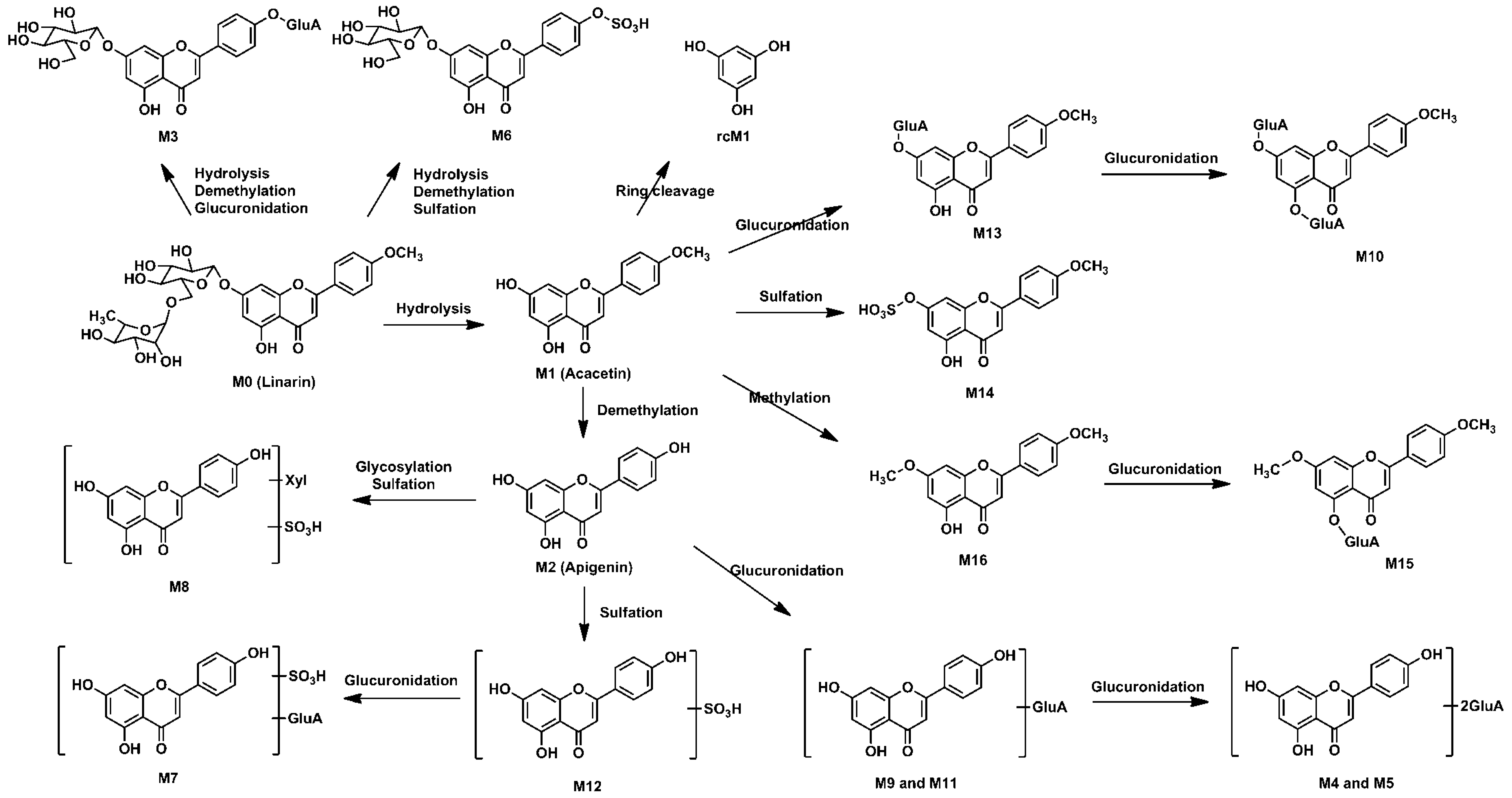
Characterization of the In Vivo and In Vitro Metabolites of Linarin in Rat Biosamples and Intestinal Flora Using Ultra-High Performance Liquid Chromatography Coupled with Quadrupole Time-of-Flight Tandem Mass Spectrometry

 ,
, Abstract
Share and Cite
Feng, X.; Li, Y.; Guang, C.; Qiao, M.; Wang, T.; Chai, L.; Qiu, F. Characterization of the In Vivo and In Vitro Metabolites of Linarin in Rat Biosamples and Intestinal Flora Using Ultra-High Performance Liquid Chromatography Coupled with Quadrupole Time-of-Flight Tandem Mass Spectrometry. Molecules 2018, 23, 2140. https://doi.org/10.3390/molecules23092140
Feng X, Li Y, Guang C, Qiao M, Wang T, Chai L, Qiu F. Characterization of the In Vivo and In Vitro Metabolites of Linarin in Rat Biosamples and Intestinal Flora Using Ultra-High Performance Liquid Chromatography Coupled with Quadrupole Time-of-Flight Tandem Mass Spectrometry. Molecules. 2018; 23(9):2140. https://doi.org/10.3390/molecules23092140
Chicago/Turabian StyleFeng, Xinchi, Yang Li, Chenxi Guang, Miao Qiao, Tong Wang, Liwei Chai, and Feng Qiu. 2018. "Characterization of the In Vivo and In Vitro Metabolites of Linarin in Rat Biosamples and Intestinal Flora Using Ultra-High Performance Liquid Chromatography Coupled with Quadrupole Time-of-Flight Tandem Mass Spectrometry" Molecules 23, no. 9: 2140. https://doi.org/10.3390/molecules23092140
APA StyleFeng, X., Li, Y., Guang, C., Qiao, M., Wang, T., Chai, L., & Qiu, F. (2018). Characterization of the In Vivo and In Vitro Metabolites of Linarin in Rat Biosamples and Intestinal Flora Using Ultra-High Performance Liquid Chromatography Coupled with Quadrupole Time-of-Flight Tandem Mass Spectrometry. Molecules, 23(9), 2140. https://doi.org/10.3390/molecules23092140