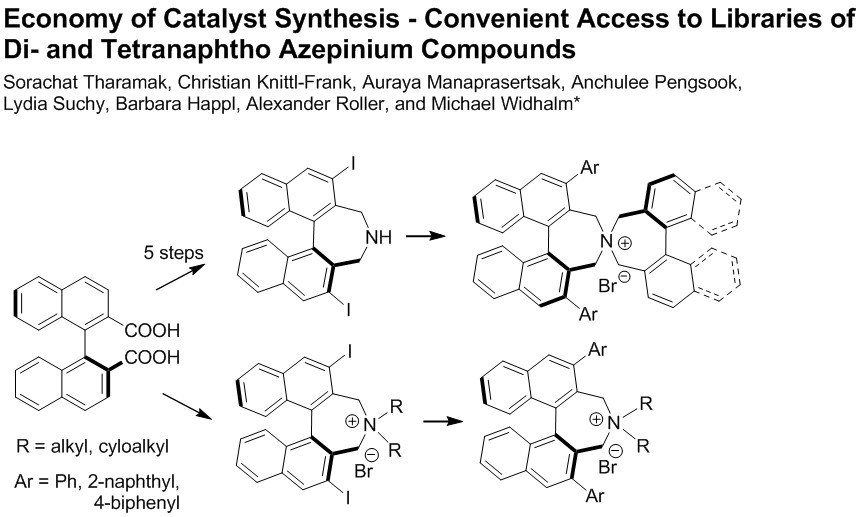
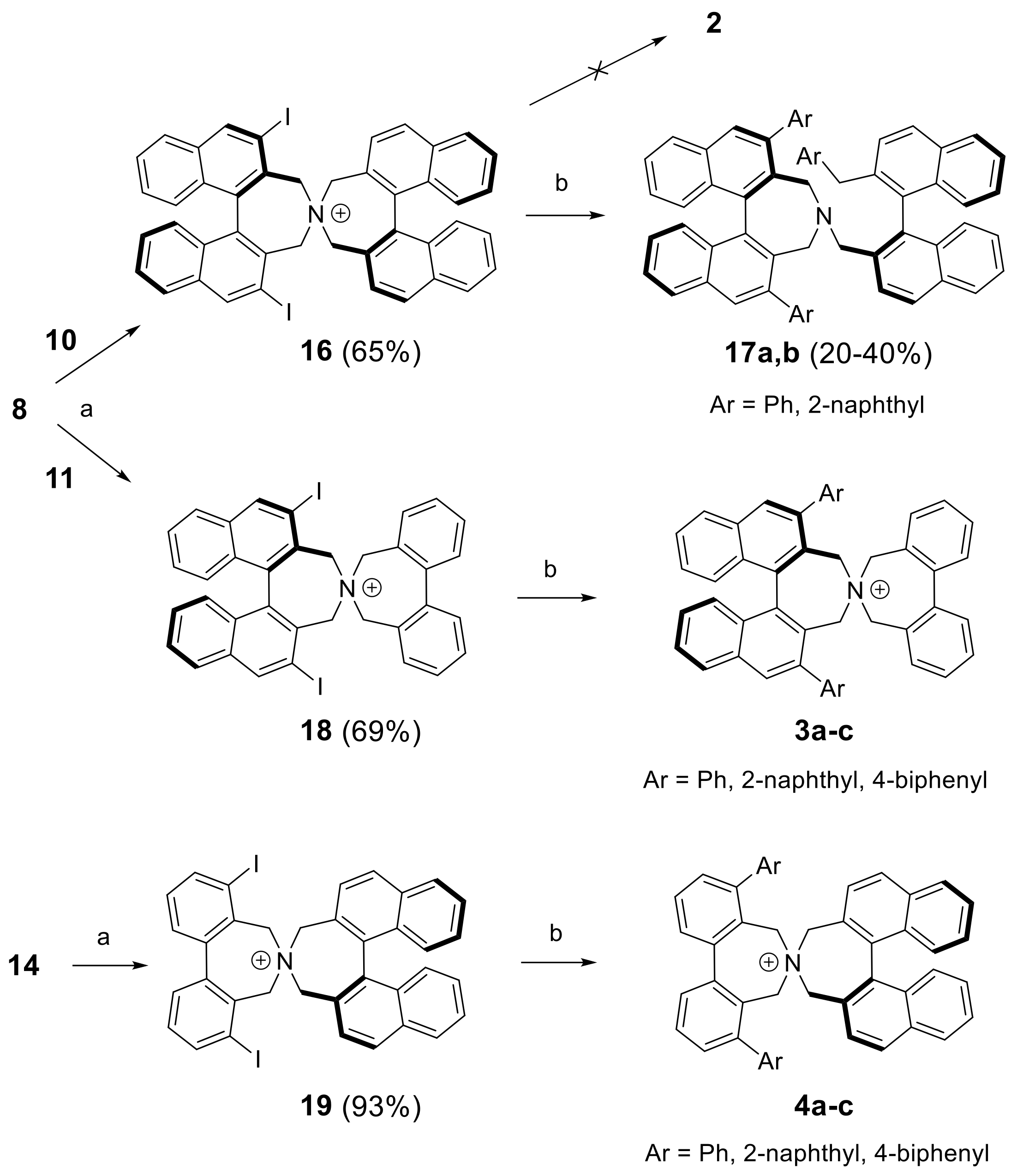
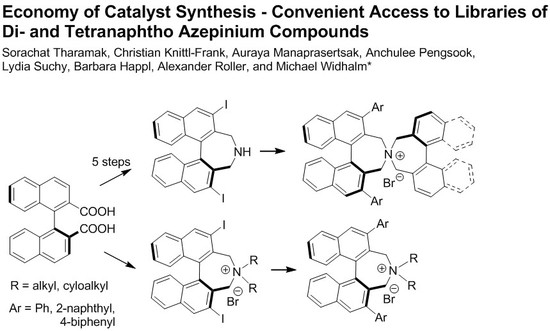
Economy of Catalyst Synthesis—Convenient Access to Libraries of Di- and Tetranaphtho Azepinium Compounds
 ,
, Abstract
Share and Cite
Tharamak, S.; Knittl-Frank, C.; Manaprasertsak, A.; Pengsook, A.; Suchy, L.; Schuller, P.; Happl, B.; Roller, A.; Widhalm, M. Economy of Catalyst Synthesis—Convenient Access to Libraries of Di- and Tetranaphtho Azepinium Compounds. Molecules 2018, 23, 750. https://doi.org/10.3390/molecules23040750
Tharamak S, Knittl-Frank C, Manaprasertsak A, Pengsook A, Suchy L, Schuller P, Happl B, Roller A, Widhalm M. Economy of Catalyst Synthesis—Convenient Access to Libraries of Di- and Tetranaphtho Azepinium Compounds. Molecules. 2018; 23(4):750. https://doi.org/10.3390/molecules23040750
Chicago/Turabian StyleTharamak, Sorachat, Christian Knittl-Frank, Auraya Manaprasertsak, Anchulee Pengsook, Lydia Suchy, Philipp Schuller, Barbara Happl, Alexander Roller, and Michael Widhalm. 2018. "Economy of Catalyst Synthesis—Convenient Access to Libraries of Di- and Tetranaphtho Azepinium Compounds" Molecules 23, no. 4: 750. https://doi.org/10.3390/molecules23040750
APA StyleTharamak, S., Knittl-Frank, C., Manaprasertsak, A., Pengsook, A., Suchy, L., Schuller, P., Happl, B., Roller, A., & Widhalm, M. (2018). Economy of Catalyst Synthesis—Convenient Access to Libraries of Di- and Tetranaphtho Azepinium Compounds. Molecules, 23(4), 750. https://doi.org/10.3390/molecules23040750