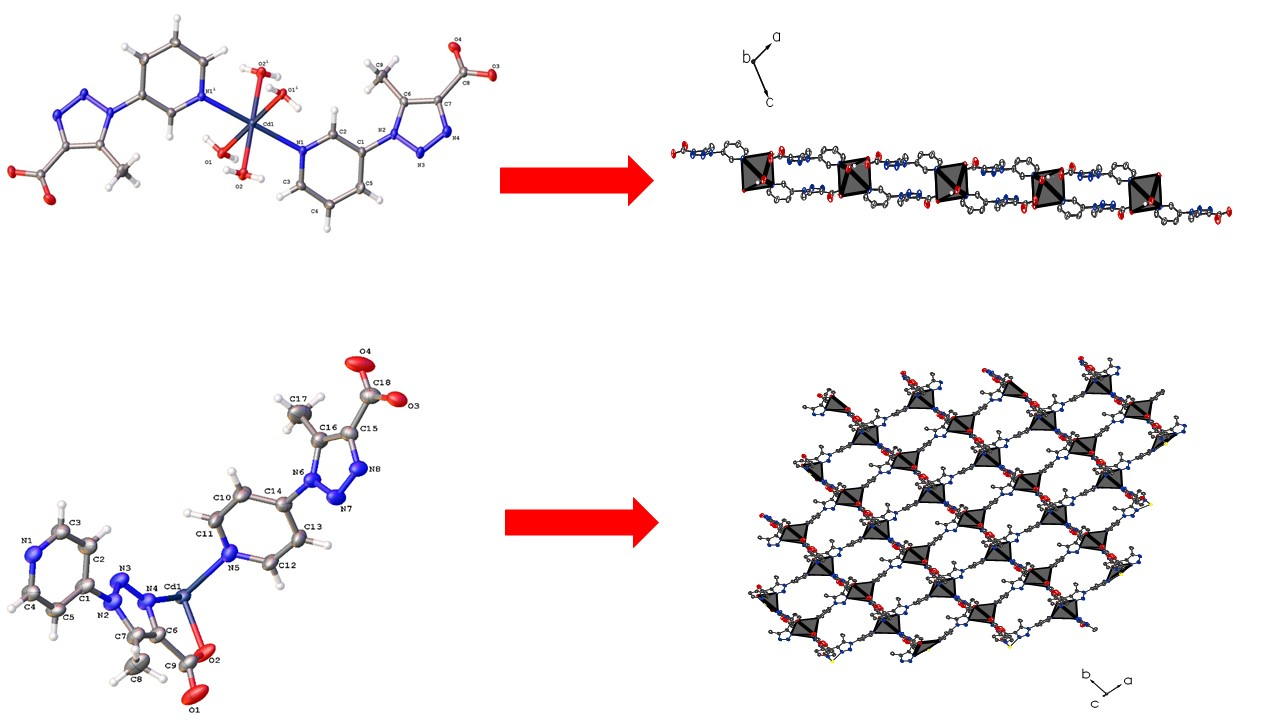
The Positional Isomeric Effect on the Structural Diversity of Cd(II) Coordination Polymers, Using Flexible Positional Isomeric Ligands Containing Pyridyl, Triazole, and Carboxylate Fragments

 ,
, 
Abstract
Share and Cite
Cisterna, J.; Araneda, C.; Narea, P.; Cárdenas, A.; Llanos, J.; Brito, I. The Positional Isomeric Effect on the Structural Diversity of Cd(II) Coordination Polymers, Using Flexible Positional Isomeric Ligands Containing Pyridyl, Triazole, and Carboxylate Fragments. Molecules 2018, 23, 2634. https://doi.org/10.3390/molecules23102634
Cisterna J, Araneda C, Narea P, Cárdenas A, Llanos J, Brito I. The Positional Isomeric Effect on the Structural Diversity of Cd(II) Coordination Polymers, Using Flexible Positional Isomeric Ligands Containing Pyridyl, Triazole, and Carboxylate Fragments. Molecules. 2018; 23(10):2634. https://doi.org/10.3390/molecules23102634
Chicago/Turabian StyleCisterna, Jonathan, Catherine Araneda, Pilar Narea, Alejandro Cárdenas, Jaime Llanos, and Iván Brito. 2018. "The Positional Isomeric Effect on the Structural Diversity of Cd(II) Coordination Polymers, Using Flexible Positional Isomeric Ligands Containing Pyridyl, Triazole, and Carboxylate Fragments" Molecules 23, no. 10: 2634. https://doi.org/10.3390/molecules23102634
APA StyleCisterna, J., Araneda, C., Narea, P., Cárdenas, A., Llanos, J., & Brito, I. (2018). The Positional Isomeric Effect on the Structural Diversity of Cd(II) Coordination Polymers, Using Flexible Positional Isomeric Ligands Containing Pyridyl, Triazole, and Carboxylate Fragments. Molecules, 23(10), 2634. https://doi.org/10.3390/molecules23102634