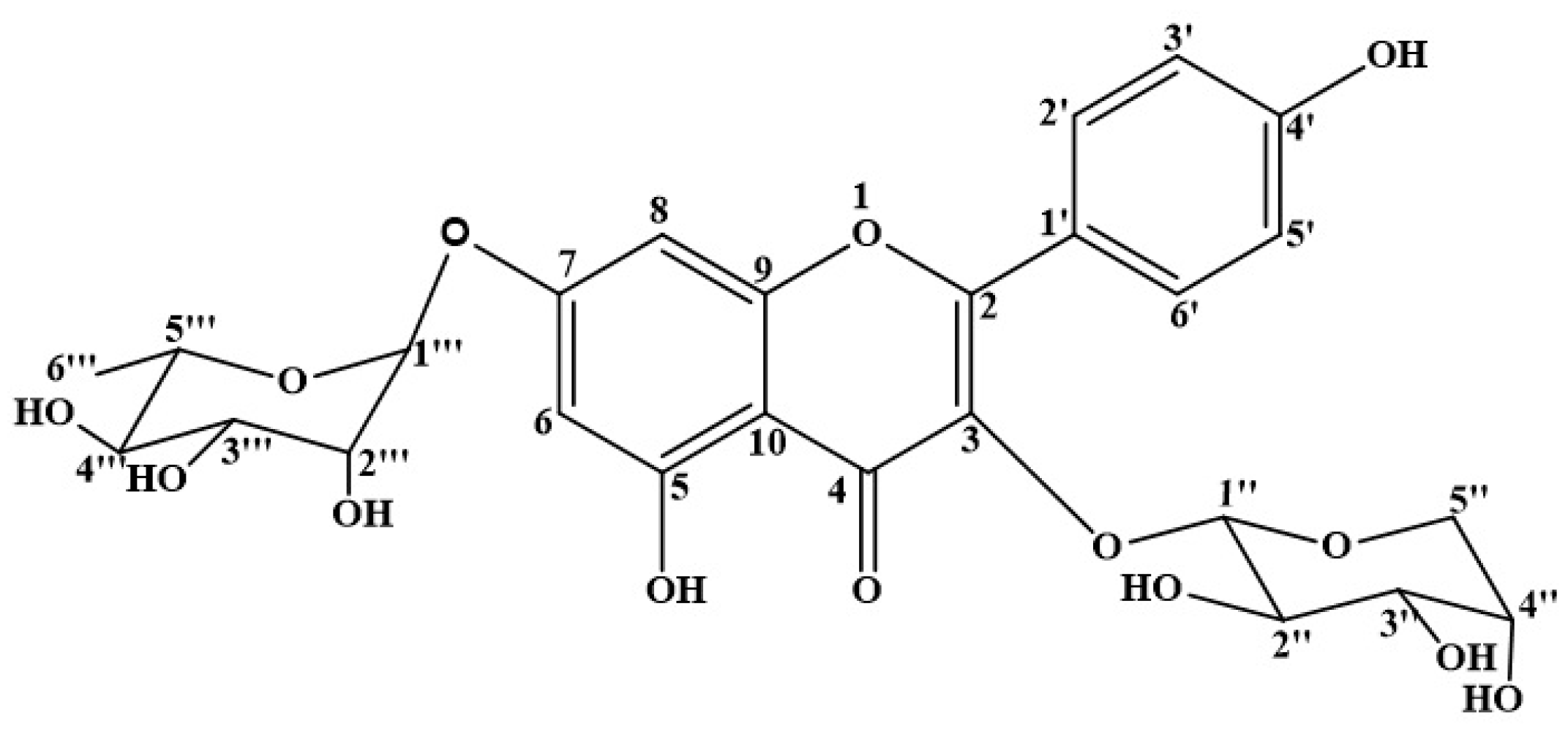
Hepatoprotective Effects of Kaempferol-3-O-α-l-Arabinopyranosyl-7-O-α-l-Rhamnopyranoside on d-Galactosamine and Lipopolysaccharide Caused Hepatic Failure in Mice

Abstract
Share and Cite
Dong, L.; Yin, L.; Quan, H.; Chu, Y.; Lu, J. Hepatoprotective Effects of Kaempferol-3-O-α-l-Arabinopyranosyl-7-O-α-l-Rhamnopyranoside on d-Galactosamine and Lipopolysaccharide Caused Hepatic Failure in Mice. Molecules 2017, 22, 1755. https://doi.org/10.3390/molecules22101755
Dong L, Yin L, Quan H, Chu Y, Lu J. Hepatoprotective Effects of Kaempferol-3-O-α-l-Arabinopyranosyl-7-O-α-l-Rhamnopyranoside on d-Galactosamine and Lipopolysaccharide Caused Hepatic Failure in Mice. Molecules. 2017; 22(10):1755. https://doi.org/10.3390/molecules22101755
Chicago/Turabian StyleDong, Lin, Lei Yin, Hongfeng Quan, Yuankui Chu, and Jincai Lu. 2017. "Hepatoprotective Effects of Kaempferol-3-O-α-l-Arabinopyranosyl-7-O-α-l-Rhamnopyranoside on d-Galactosamine and Lipopolysaccharide Caused Hepatic Failure in Mice" Molecules 22, no. 10: 1755. https://doi.org/10.3390/molecules22101755
APA StyleDong, L., Yin, L., Quan, H., Chu, Y., & Lu, J. (2017). Hepatoprotective Effects of Kaempferol-3-O-α-l-Arabinopyranosyl-7-O-α-l-Rhamnopyranoside on d-Galactosamine and Lipopolysaccharide Caused Hepatic Failure in Mice. Molecules, 22(10), 1755. https://doi.org/10.3390/molecules22101755