Abstract
Diarrheal disease is one of the most important worldwide health problems. Enterotoxigenic Escherichia coli (ETEC) is the most frequently isolated enteropathogen in diarrheal diseases. In developing countries, a very large number of people, especially children, suffer from diarrhea. To combat this problem, World Health Organization has constituted the Diarrhea Diseases Control Program which guides studies on traditional medicinal practices and preventive measures. Gusuibu, a traditional folk medicine, has been claimed to heal certain types of diarrhea. However, so far no scientific study has been carried out on the anti-diarrheal mechanism of Gusiubu. The present study was performed to examine the suppressive activities of ethanol extracts of six sources of folk medicinal ferns used as Gusuibu on heat-labile enterotoxin (LT)-induced diarrhea. Inhibitory effects of six sources were evaluated on the ETEC LT subunit B (LTB) and monosialotetrahexosylganglioside (GMI) interaction by GM1-enzyme linked immunosorbent assay and patent mouse gut assay. Our results indicated that Drynaria fortunei had no anti-diarrheal effect, while, among the remaining five folk medicinal ferns, four belonging to family Davalliaceae had significant abilities on both the blocking of LTB and GM1 interaction and the inhibition of LT-induced diarrhea. In conclusion, these findings suggested the potential application of Gusuibu as an anti-diarrheal remedy.
1. Introduction
Diarrhea diseases constitute one of the most important worldwide health problems, particularly in developing countries with an estimated 5 billion cases and a mortality of 5 million cases per year. Children less than 5 years of age have been reported to experience higher incidence and severity of gastrointestinal symptoms [1]. Enterotoxigenic Escherichia coli (ETEC) are the most frequently isolated enteropathogen, which is responsible for approximately 380,000 deaths annually [2]. Pneumonia and diarrhoea together account for 29% of all child deaths globally. To see a drop in deaths from diarrhea to less than 1 in 1,000, the World Health Organization has constituted the Integrated Global Action Plan for the Prevention and Control of Pneumonia and Diarrhoea which includes studies on traditional medicinal practices together with the evaluation of health education and prevention approaches [3,4,5,6].
Among the vast array of remedies used in the Traditional Chinese Medicine system, many ferns (rhizomes and whole plants mostly) have been recorded to have activities against diarrhea and thus act as very useful remedies [7]. Gusuibu, one such Traditional Chinese Medicine, has a long history of use in the treatment of bone injuries, inflammation, hyperlipemia arteriosclerosis [8]. This folk medicine has also been claimed to heal certain types of diarrhea [9]. However, so far no scientific study has been carried out on anti-diarrheal mechanism or changes the gastrointestinal transit/motility effects of Gusiubu. In the Chinese materia medica literature, several species of ferns have been mentioned as Gusuibu [9]. Only a few researches study the chemical composition of the various Gusiubu. Drynaria fortunei (DF) contains several flavonones, such as naringin, which present oestrogen-like protective effects in bone [10]. Davallic acid was extracted from Davallia divaricata (DD), and its effects on apoptosis induction in A549 lung cancer cells were reported [11]. Some of the proanthocyanidins from D. mariesii (DM) could inhibit protein kinase C [12]. 4-O-β-d-Gluco-pyranosyl-2,6,4′-trihydroxybenzophenone, which has been isolated from D. solida (DS), could bind to the purified C-terminal cytosolic domain of p-glycoprotein [13]. As a part of our continuing evaluation of anti-diarrheal activities of Traditional Chinese Medicine materials, the present study was performed to examine the suppressive activities of ethanol extracts of six sources of folk medicinal ferns (Drynaria fortunei (DF)., Pseudodrynaria coronans (PC), Davallia divaricata (DD), D. mariesii (DM), D. solida (DS), and Humata griffithiana (HG)) [14,15] used as Gusuibu on heat-labile enterotoxin (LT)-induced diarrhea.
2. Results and Discussion
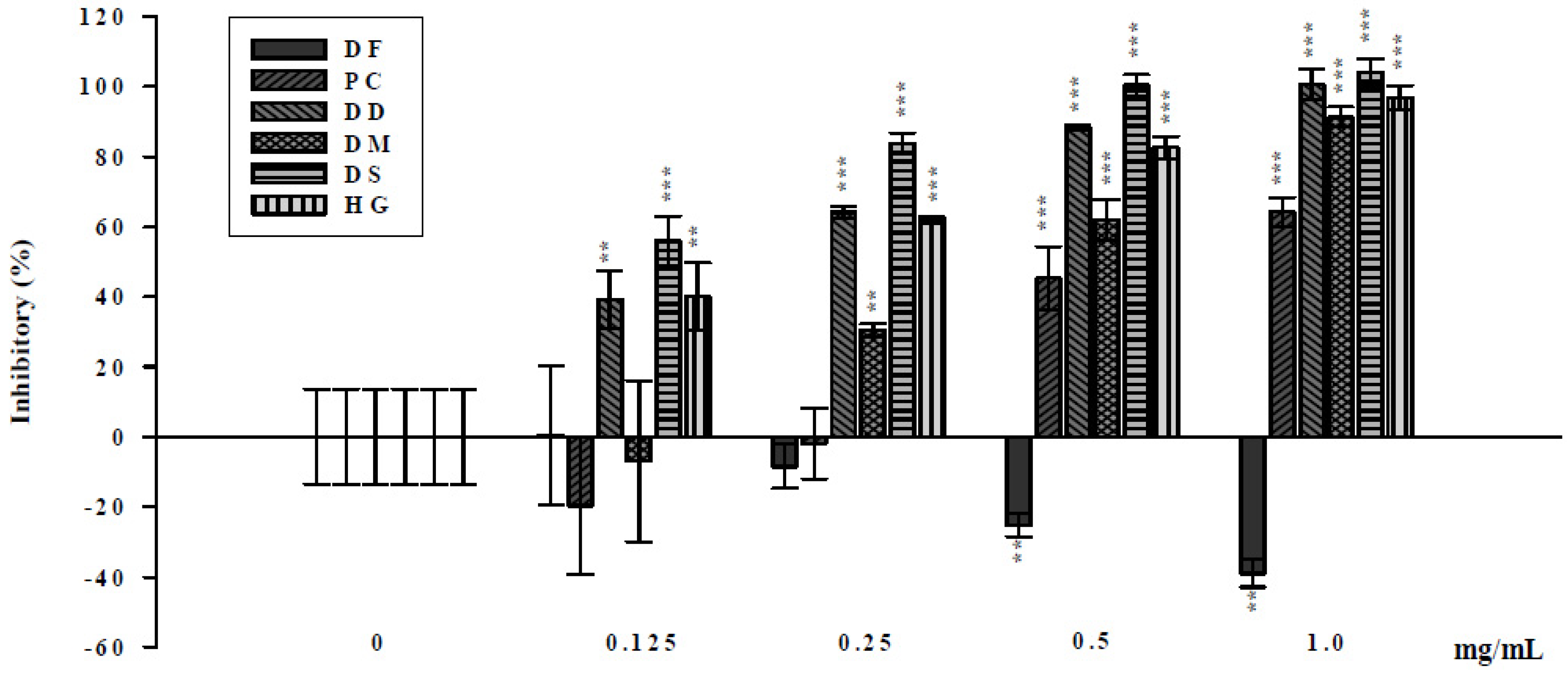
The LT is the major virulent factor of ETEC [16] and is a kind of AB toxin, which comprise one A subunit and five identical B subunits [17]. The mechanism of diarrhea induced by LT is initiated by the binding of B subunit (LTB) to the receptor, ganglioside GM1, on the surface of intestinal epithelial cells [18,19]. Upon evaluation of the inhibitory ability of the six sources of Gusuibu on the binding of LTB to GM1 by competitive GM1-ELISA it was observed that five ferns (PC, DD, DM, DS and HG) blocked the binding of LTB to GM1, resulting in the suppression of LT-induced diarrhea. All four species belonging to family Davalliaceae were found to be more efficient compared to two species of Polypodiaceae (Figure 1). All Davalliaceae species were significantly more efficient than the Polypodiaceae species at 0.25 mg/mL.
Figure 1.
Inhibitory ability of six sources of Gusuibu on the binding of LTB to GM1 by competitive GM1-ELISA. Different quantities of six sources of Gusuibu were incubated with 16 ng biotinylated LTB at 4 °C for 3 h. The wells were coated with 200 ng of GM1 and challenged with 100 μL of biotinylated LTB/compound mixture. Following three washes, peroxidase-conjugated avidin and chromatic substrate were sequentially added. The absorbance was read at 405 nm in an ELISA plate reader. The results are expressed as inhibitory ability (%). Values represent mean ± standard error of four independent assays. ** p < 0.01, *** p < 0.001, compared with LTB.
Figure 1.
Inhibitory ability of six sources of Gusuibu on the binding of LTB to GM1 by competitive GM1-ELISA. Different quantities of six sources of Gusuibu were incubated with 16 ng biotinylated LTB at 4 °C for 3 h. The wells were coated with 200 ng of GM1 and challenged with 100 μL of biotinylated LTB/compound mixture. Following three washes, peroxidase-conjugated avidin and chromatic substrate were sequentially added. The absorbance was read at 405 nm in an ELISA plate reader. The results are expressed as inhibitory ability (%). Values represent mean ± standard error of four independent assays. ** p < 0.01, *** p < 0.001, compared with LTB.

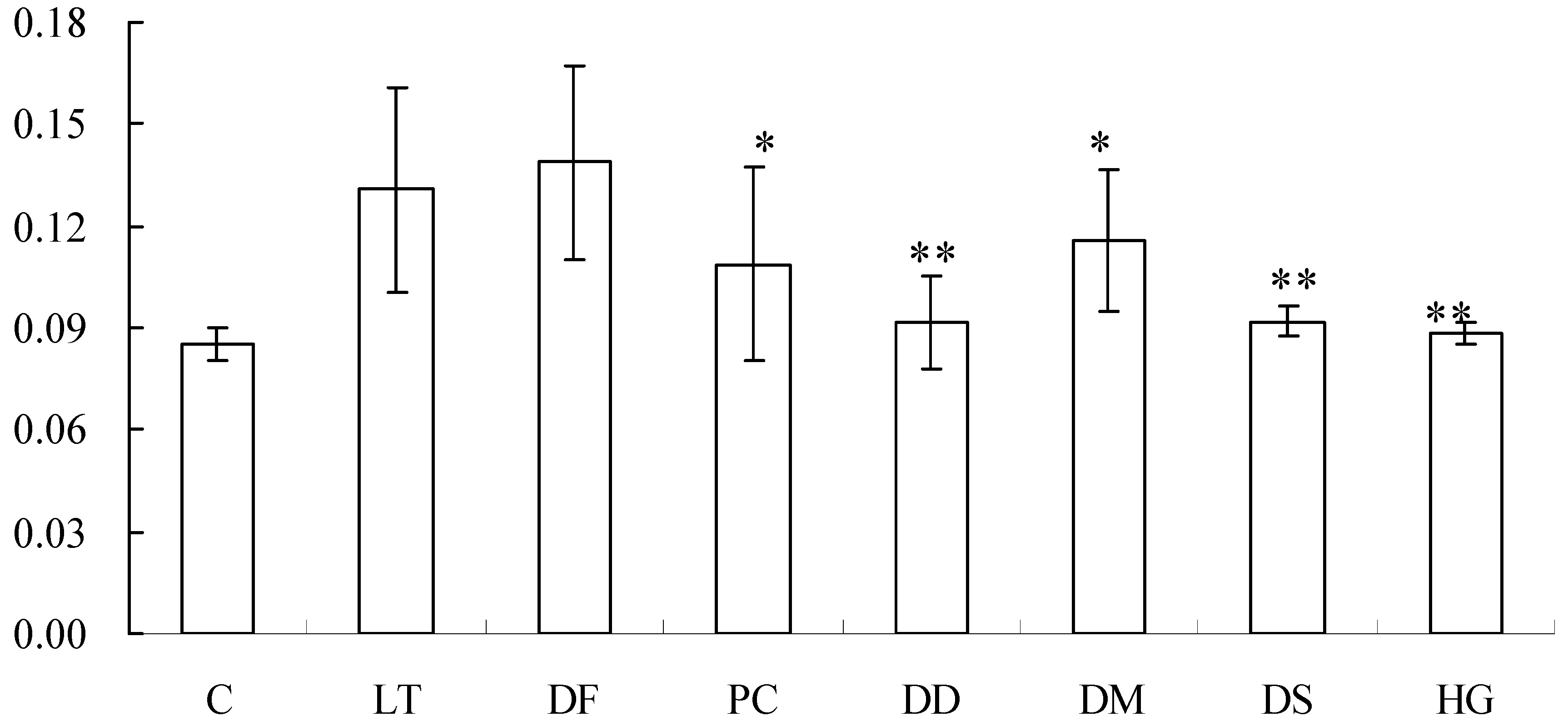
Since one of the biological activities of LT is the induction of fluid accumulation in the intestine, we analyzed the anti-diarrheal effect of the six ferns by a patent mouse gut assay. As shown in Figure 2, LT stimulated the fluid accumulation in the gut, with the mean gut/carcass weight ratio as 0.13. Five ferns (PC, DD, DM, DS and HG) suppressed LT-induced fluid accumulation. Out of these five sources, four (DD, DM, DS and HG) belong to the same family, while three (DD, DM and DS) are the same species.
Thus, our results indicate that DF had no anti-diarrheal effect, while, among the remaining five species, four belonging to family Davalliaceae had significant ability to inhibit LT-induced diarrhea indicating their potential application in the anti-diarrheal remedies.
Figure 2.
Anti-diarrheal effect of six sources of Gusuibu by patent mouse gut assay. Three mice per group were administrated orally with PBS, 10 μg LT, or in conjunction with different sources of Gusuibu. After 6 h incubation, mice were sacrificed. The gut/carcass weight ratio was calculated for each group. Values represent mean ± standard error of triplicate assays. C: control. * p < 0.05, ** p < 0.01 compared with LT.
Figure 2.
Anti-diarrheal effect of six sources of Gusuibu by patent mouse gut assay. Three mice per group were administrated orally with PBS, 10 μg LT, or in conjunction with different sources of Gusuibu. After 6 h incubation, mice were sacrificed. The gut/carcass weight ratio was calculated for each group. Values represent mean ± standard error of triplicate assays. C: control. * p < 0.05, ** p < 0.01 compared with LT.

3. Experimental
3.1. Plant Materials

Rhizomes of Drynaria fortunei, Pseudodrynaria coronans (PC) (both from the Polypodiaceae), Davallia divaricata, D. mariesii, D. solida, and Humata griffithiana (HG) (all four from the Davalliaceae) used as Gusuibu were collected from the counties of Hsinchu, Taichung, Nantou and Taitung in Taiwan (Table 1). These were identified and authenticated by Professor C.C. Chen of the Institute of Chinese Pharmaceutical Science, China Medical University, Taichung, Taiwan.
Table 1.
Particulars of the six sources of medicinal fern used as Gusuibu, and their comparative yields in ethanol extracts.
| Family Name | Botanic Name | Common Name | Voucher Number | Location | Yield (%) |
|---|---|---|---|---|---|
| Polypodiaceae | Drynaria fortunei (Kze.) J.Sm. | Gusuibu | CMU-94-DF-01 | Hsinchu, Taichung | 11.2 |
| Pseudodrynaria coronans (Wall. ex Mett.) Ching | Gusuibu | CMU-94-PC-01 | Taichung, Nantou | 15.0 | |
| Davalliaceae | Davallia divaricata Bl. | Dayegusuibu | CMU-94-DD-01 | Nantou | 14.6 |
| Davallia mariesii Moore ex Bak | Haizhougusuibu | CMU-94-DM-01 | Nantou | 8.5 | |
| Davallia solida (Forst.) Sw. | Koyegusuibu | CMU-94-DS-01 | Taitung | 12.7 | |
| Humata griffithiana (Hk.) C.Chr. | Begaigusuibu | CMU-94-HG-01 | Taichung | 6.7 |
3.2. Extractions
Dried rhizome (100 g each) was macerated with 95% ethanol (1,000 mL) for 24 h at room temperature. Filtration and collection of the extract was done three times. Then, the ethanol crude extract (~3,000 mL) was evaporated to 10 mL and then dried in vacuo at 40 °C (Table 1). The dry extract was weighted and stored in −20 °C until further use.
3.3. The In Vitro and In Vivo Assay
The methods of (i) Expression and purification of Escherichia coli LT and LTB; (ii) Patent mouse gut assay; (iii) Biotinylation of LTB and (iv) Competitive GM1-ELISA were followed as per our previous report [14,15]. Mouse experiments were conducted under ethics approval from China Medical University Animal Care and Use Committee.
3.4. Statistical Analysis
Data were presented as mean ± standard error. Student’s t-test was used for comparisons between two experiments. A value of p < 0.05 was considered statistically significant.
4. Conclusions
We demonstrated that the ethanol extracts of six sources of folk medicinal ferns used as Gusuibu suppressed LT-induced fluid accumulation through blocking the binding of LTB to GM1. Drynaria fortunei had no anti-diarrheal effect, while other five ferns had significant abilities on both the blocking of LTB and GM1 interaction and the inhibition of LT-induced diarrhea. Therefore, these data suggested that Pseudodrynaria coronans, Davallia divaricata, D. mariesii, D. solida, and Humata griffithiana might be candidates for the treatment of LT-induced diarrhea.
Acknowledgments
This work was supported by grants from National Research Program for Biopharmaceuticals (NSC101-2325-B-039-007 and NSC102-2325-B-039-007), National Science Council (NSC 100-2320-B-212-001, NSC101-2320-B-039-034-MY3, NSC101-3114-Y-466-002, and NSC 102-2632-B-039-001-MY3), and China Medical University (CMU101-S-21, CMU101-AWARD-09, and CMU102-NSC-04).
Conflicts of Interest
The authors declare no conflict of interest.
References
- Wiedermann, U.; Kollaritsch, H. Vaccines against traveler’s diarrhoea and rotavirus disease–a review. Wien. Klin. Wochenschr. 2006, 118, 2–8. [Google Scholar] [CrossRef]
- World Health Organization (WHO). State of the Art of New Vaccines: Research and Development. Diarrhoeal Diseases. Available online: http://www.medicina.ufba.br/educacao_medica/graduacao/dep_pediatria/disc_pediatria/disc_prev_social/roteiros/desidratacao/stateofart_excler%202003.pdf (accessed on 24 January 2014).
- World Health Organization (WHO) Expert Committee. WHO Technical Report Series on Enteric Infection. Available online: http://apps.who.int/iris/bitstream/10665/40603/1/WHO_TRS_288.pdf?ua=1 (accessed on 24 January 2014).
- World Health Organization (WHO). Ending Preventable Deaths from Pneumonia and Diarrhoea by 2025. Available online: http://www.who.int/maternal_child_adolescent/news_events/news/2013/gappd_launch/en/index.html (accessed on 24 January 2014).
- Lutterodt, G.D. Inhibition of gastrointestinal release of acetylcholine by quercetin as possible mode of action of Psidium guiana leaf extracts in the treatment of acute disease. J. Ethnopharmacol. 1989, 25, 235–247. [Google Scholar] [CrossRef]
- Syder, J.D.; Merson, M.H. The magnitude of the global problem of acute diarrhoeal disease, a review of active surveillance data. Bull. World Health Organ. 1982, 60, 605–613. [Google Scholar]
- State Administration of Traditional Chinese Medicine. Zhong Hua Ben Cao (China Herbal); Shanghai Science and Technology Press: Shanghai, China, 1999; Chapter 2; pp. 25–270. [Google Scholar]
- Pharmacopoeia Commission of the People Republic of China (ChPC). Pharmacopoeia of the People’s Republic of China; Chemical Industry Press: Beijing, China, 2005; Chapter 1; pp. 179–180. [Google Scholar]
- Li, J.; Jia, T.; Zhang, Y.; Wang, Z. A review of the study on Drynaria fortunei. Zhong Yao Cai 1999, 22, 263–266. [Google Scholar]
- Wong, K.C.; Pang, W.Y.; Wang, X.L.; Mok, S.K.; Lai, W.P.; Chow, H.K.; Leung, P.C.; Yao, X.S.; Wong, M.S. Drynaria fortunei-derived total flavonoid fraction and isolated compounds exert estrogen-like protective effects in bone. Br. J. Nutr. 2013, 110, 475–485. [Google Scholar] [CrossRef]
- Cheng, A.S.; Chang, W.C.; Cheng, Y.H.; Chen, K.Y.; Chen, K.H.; Chang, T.L. The effects of Davallic acid from Davallia divaricata Blume on apoptosis induction in A549 lung cancer cells. Molecules 2012, 17, 12938–12949. [Google Scholar] [CrossRef]
- Cui, C.B.; Tezuka, Y.; Kikuchi, T.; Nakano, H.; Tamaoki, T.; Park, J.H. Davallin, a new tetrameric proanthocyanidin from the rhizomes of Davallia mariesii Moore. Chem. Pharm. Bull. 1991, 39, 2179–2181. [Google Scholar] [CrossRef]
- Rancon, S.; Chaboud, A.; Darbour, N.; Comte, G.; Bayet, C.; Simon, P.N.; Raynaud, J.; di Pietro, A.; Cabalion, P.; Barron, D. Natural and synthetic benzophenones: Interaction with the cytosolic binding domain of p-glycoprotein. Phytochemistry 2001, 57, 553–557. [Google Scholar] [CrossRef]
- Chen, J.C.; Ho, T.Y.; Chang, Y.S.; Wu, S.L.; Hsiang, C.Y. Anti-diarrheal effect of Galla Chinensis on the Escherichia coli heat-labile enterotoxin and ganglioside interaction. J. Ethnopharmacol. 2006, 103, 385–391. [Google Scholar] [CrossRef]
- Chen, J.C.; Ho, T.Y.; Chang, Y.S.; Wu, S.L.; Li, C.C.; Hsiang, C.Y. Identification of Escherichia coli enterotoxin inhibitors from traditional medicinal herbs by in silico, in vitro, and in vivo analyses. J. Ethnopharmacol. 2009, 121, 372–378. [Google Scholar] [CrossRef]
- Holmgren, J.; Svennerholm, A.M. Bacterial enteric infections and vaccine development. Gastroenterol. Clin. N. Am. 1992, 21, 283–302. [Google Scholar]
- Merritt, E.A.; Hol, W.G. AB5 toxins. Curr. Opin. Struct. Biol. 1995, 5, 165–171. [Google Scholar] [CrossRef]
- Pickens, J.C.; Merritt, E.A.; Ahn, M.; Verlinde, C.L.; Hol, W.G.; Fan, E. Anchor-based design of improved cholera toxin and E. coli heat-labile enterotoxin receptor binding antagonists that display multiple binding modes. Chem. Biol. 2002, 9, 215–224. [Google Scholar] [CrossRef]
- Spangler, B.D. Structure and function of cholera toxin and the related Escherichia coli heat-labile enterotoxin. Microbiol. Rev. 1992, 56, 622–647. [Google Scholar]
- Sample Availability: Not available.
© 2014 by the authors. Licensee MDPI, Basel, Switzerland. This article is an open access article distributed under the terms and conditions of the Creative Commons Attribution license ( http://creativecommons.org/licenses/by/3.0/).