

Anti-Inflammatory and Analgesic Activity of Total Flavone of Cunninghamia lanceolata

Abstract
1. Introduction
2. Results
3. Discussion
4. Experimental
4.1. Plant Material
4.2. Sample Preparation
4.3. Animal
4.4. Drugs and Chemicals
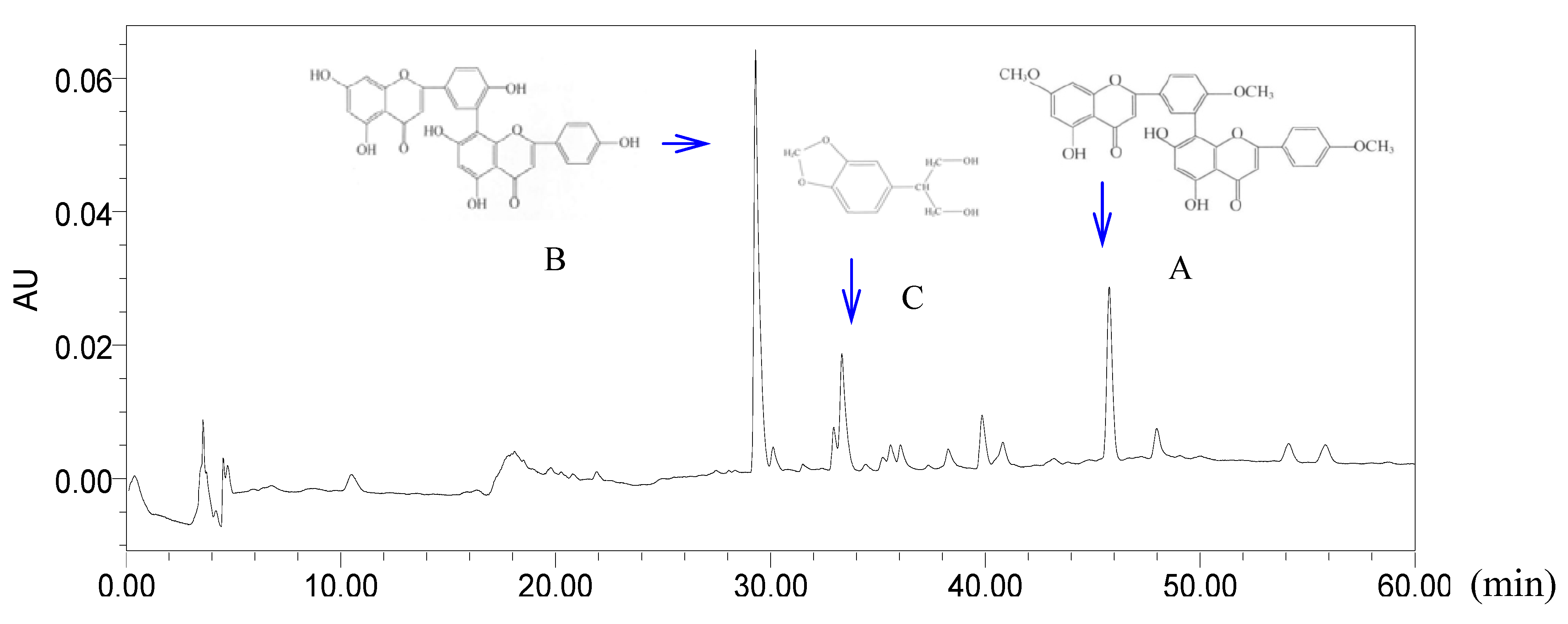
4.5. HPLC Fingerprint Analysis
4.6. Acute Toxicity Test
4.7. Acetic Acid-Induced Writhing Test [12]
4.8. Hot Plate Latency Test [13]
4.9. Carrageenan Induced Paw Oedema Test [14,15]
4.9.1. Edema Inhibitory Activity
4.9.2. Content of COX-2 in Blood Serum
4.9.3. Content of PEG2 in Paw Edema Tissue
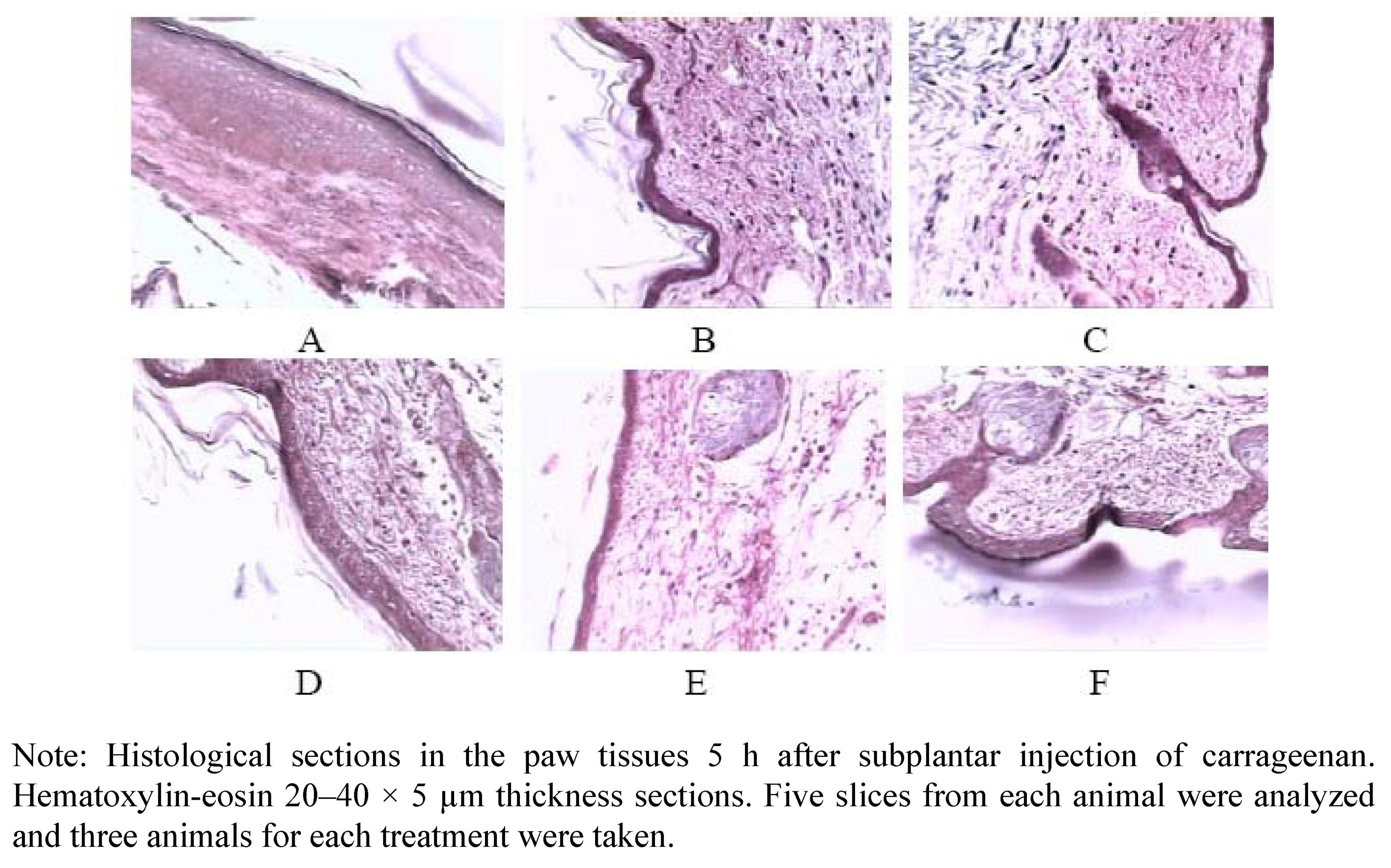
4.9.4. Histological Assessment
4.10. Formalin Test [16]
4.11. Statistical Analysis
5. Conclusions
References
- Nanjing New Medicine College. The Dictionary of Chinese Herbal Medicine; Shanghai Science and Technology Press: Shanghai, China, 1977. [Google Scholar]
- Ye, Z.; Lin, W.; Chen, W.; Yu, X. Chemical components and antimicrobial activity of essential oils in Cunninghamia lanceolata heartwood. Ying Yong Sheng Tai Xue Bao 2005, 16, 2394–2398. [Google Scholar] [PubMed]
- Cheng, S.S.; Chung, M.J.; Lin, C.Y.; Wang, Y.N.; Chang, S.T. Phytochemicals from Cunninghamia konishii Hayata act as antifungal agents. J. Agric. Food. Chem. 2012, 60, 124–128. [Google Scholar] [CrossRef] [Scilit] [PubMed]
- Zhang, M.; Liu, J.; Liu, P.; Liu, J.P.; Xin, H.L.; Zhang, L.; Wang, Y.L.; Tang, K.X. Study on chemical constituents of the branches and leaves of Cunninghamia lanceolata. J. Shanghai Jiaotong Univ. (Agric. Sci.) 2011, 29, 67–71. [Google Scholar]
- Zhang, M.; Liu, J.P.; Liu, J.; Liu, P.; Xin, H.L.; Zhang, L.; Wang, Y.L. Amentoflavone content of leaves and branches of Cunninghamia lanceolata from different origins. Pharm. Care. Res. 2011, 11, 149–150. [Google Scholar] [CrossRef] [Scilit]
- Santos, A.R.S.; Calixto, J.B. Further evidence for the involvement of tachykinin receptor subtypes in formalin and capsaicin models of pain in mice. Neuropeptides 1997, 31, 381–389. [Google Scholar] [CrossRef] [Scilit]
- Marrassini, C.; Acevedo, C.; Miño, J.; Ferraro, G.; Gorzalczany, S. Evaluation of antinociceptive, antiinfl-amatory activities and phytochemical analysis of aerial parts of Urtica urens L. Phytother. Res. 2010, 24, 1807–1812. [Google Scholar] [CrossRef] [Scilit] [PubMed]
- Ferreira, S.H.; Lorenzetti, B.B.; Castro, M.S.A.; Correa, F.M.A. Antialgic Effect of Aspirin-Like Drugs and the Inhibition of Prostaglandin Synthesis. In The Recognition of Anti-rheumatic Drugs; Dumonde, D.C., Jasani, M.K., Eds.; MTP Press Limited: Lancaster, UK, 1978; pp. 25–37. [Google Scholar]
- Gene, R.M.; Segura, L.; Adzet, T.; Marin, E.; Inglesias, J. Heterotheca inuloides: Anti-inflammatory and analgesic effects. J. Ethnopharmacol. 1998, 60, 157–162. [Google Scholar] [CrossRef] [Scilit]
- Panthong, A.; Kanjanapothi, D.; Taesotikul, T.; Wongcome, T.; Reutrakul, V. Anti-inflammatory and antipyretic properties of Clerodendrum petasites S. Moore. J. Ethnopharmacol. 2003, 85, 151–156. [Google Scholar] [CrossRef] [Scilit]
- Tjolsen, A.; Berge, O.G.; Hunskaar, S.; Rosland, J.H.; Hole, K. The formalin test: an evaluation of the method. Pain 1992, 51, 5–17. [Google Scholar] [CrossRef] [Scilit]
- Saha, A.; Ahmed, M. The analgesic and anti-inflammatory activities of the extract of Albizia lebbeck in animal model. Pak. J. Pharm. Sci. 2009, 22, 74–77. [Google Scholar] [PubMed]
- Franzotti, E.M.; Santos, C.V.; Rodrigues, H.M.; Mourão, R.H.; Andrade, M.R.; Antoniolli, A.R. Anti-inflammatory, analgesic activity and acute toxicity of Sida cordifolia L. (Malva-branca). J. Ethnopharmacol. 2000, 72, 273–277. [Google Scholar] [CrossRef] [Scilit]
- Amresha, G.; Singh, P.N.; Rao, C.V. Antinociceptive and antiarthritic activity of Cissampelos pareira roots. J. Ethnopharmacol. 2007, 111, 531–536. [Google Scholar] [CrossRef] [Scilit] [PubMed]
- Gokhale, A.B.; Damre, A.S.; Kulkarni, K.R.; Saraf, M.N. Preliminary evaluation of anti-inflammatory and anti-arthritic activity of S. lappa, A. speciosa and A. aspera. Phytomedicine 2002, 9, 433–437. [Google Scholar]
- Santos, A.R.S.; Calixto, J.B. Further evidence for the involvement of tachykinin receptor subtypes in formalin and capsaicin models of pain in mice. Neuropeptides 1997, 31, 381–389. [Google Scholar] [CrossRef] [Scilit]
- Rajnarayana, K.; Sripal Reddy, M.; Chaluvadi, M.R. Bioflavanoids classification, pharmacological, biochemical effects and therapeutic potential. Indian J. Pharmacol. 2001, 33, 2–16. [Google Scholar]
Sample Availability: Samples of the compounds are available from the author Hai-Liang Xin. |

| Groups | Acetic acid-induced writhing (number of writhings) | Hot plate latency test (duration on the plate) | Formalin test | |
|---|---|---|---|---|
| Paw licking time in early phase (s) | Paw licking time in late phase (s) | |||
| Normal saline (10 mL/kg. o.p.) | 37.41 ± 4.91 | 14.36 ± 5.10 | 134.5 ± 28.3 | 171.4 ± 24.8 |
| TFC (100 mg/kg. o.p.) | 29.66 ± 5.02 * | 13.27 ± 4.80 | 117.6 ± 20.4 | 132.1 ± 37.5 * |
| TFC (200 mg/kg. o.p.) | 24.24 ± 3.81 ** | 15.31 ± 6.46 | 121.4 ± 18.5 | 110.3 ± 26.7 ** |
| TFC (400 mg/kg. o.p.) | 18.35 ± 4.54 ** | 18.39 ± 3.02 * | 108.5 ± 20.0 * | 96.2 ± 23.1 ** |
| ASA (100 mg/kg. o.p.) | 13.27 ± 5.49 ** | / | / | / |
| Morphine (5 mg/kg. s.c.) | / | 36.40 ± 1.69 ** | 19.3 ± 3.2 ** | 10.4 ± 8.3 ** |
| Group | Increase in paw size (edema) (mm) | Inhibition (%) | ||
|---|---|---|---|---|
| 3 h | 5 h | 3 h | 5 h | |
| Normal saline (10 mL/kg. o.p.) | 6.72 ± 0.34 | 4.80 ± 0.22 | / | / |
| TFC (100 mg/kg. o.p.) | 5.10 ± 0.21 ** | 3.49 ± 0.37 ** | 33.47 | 44.63 |
| TFC (200 mg/kg. o.p.) | 4.67 ± 0.42 ** | 3.04 ± 0.19 ** | 41.43 | 58.39 |
| TFC (400 mg/kg. o.p.) | 3.61 ± 0.36 * | 2.86 ± 0.24 ** | 73.27 | 62.75 |
| ASA (10 mg/kg. o.p.) | 3.06 ± 0.30 ** | 2.13 ± 0.16 ** | 62.45 | 87.92 |
| Group | Content (OD value/g) |
|---|---|
| Normal saline (10 mL/kg. o.p.) | 0.94 ± 0.12 |
| TFC (100 mg/kg. o.p.) | 0.47 ± 0.16 * |
| TFC (200 mg/kg. o.p.) | 0.31 ± 0.20 ** |
| TFC (400 mg/kg. o.p.) | 0.28 ± 0.11 ** |
| ASA (10 mg/kg. o.p.) | 0.21 ± 0.14 ** |
| Group | Content (pg/mL) |
|---|---|
| Normal saline (10 mL/kg. o.p.) | 874.64 ± 142.51 |
| TFC (100 mg/kg. o.p.) | 521.70 ± 193.65 * |
| TFC (200 mg/kg. o.p.) | 328.75 ± 123.27 ** |
| TFC (400 mg/kg. o.p.) | 275.91 ± 105.38 ** |
| ASA (10 mg/kg. o.p.) | 217.61 ± 149.64 ** |
© 2012 by the authors. licensee MDPI, Basel, Switzerland. This article is an open access article distributed under the terms and conditions of the Creative Commons Attribution license (http://creativecommons.org/licenses/by/3.0/).
Share and Cite
Xin, H.-L.; Zhai, X.-F.; Zheng, X.; Zhang, L.; Wang, Y.-L.; Wang, Z. Anti-Inflammatory and Analgesic Activity of Total Flavone of Cunninghamia lanceolata. Molecules 2012, 17, 8842-8850. https://doi.org/10.3390/molecules17088842
Xin H-L, Zhai X-F, Zheng X, Zhang L, Wang Y-L, Wang Z. Anti-Inflammatory and Analgesic Activity of Total Flavone of Cunninghamia lanceolata. Molecules. 2012; 17(8):8842-8850. https://doi.org/10.3390/molecules17088842
Chicago/Turabian StyleXin, Hai-Liang, Xiao-Feng Zhai, Xu Zheng, Lei Zhang, Yu-Liang Wang, and Zhuo Wang. 2012. "Anti-Inflammatory and Analgesic Activity of Total Flavone of Cunninghamia lanceolata" Molecules 17, no. 8: 8842-8850. https://doi.org/10.3390/molecules17088842
APA StyleXin, H.-L., Zhai, X.-F., Zheng, X., Zhang, L., Wang, Y.-L., & Wang, Z. (2012). Anti-Inflammatory and Analgesic Activity of Total Flavone of Cunninghamia lanceolata. Molecules, 17(8), 8842-8850. https://doi.org/10.3390/molecules17088842

