

Principal Component Regression Analysis of the Relation Between CIELAB Color and Monomeric Anthocyanins in Young Cabernet Sauvignon Wines

Abstract
Introduction
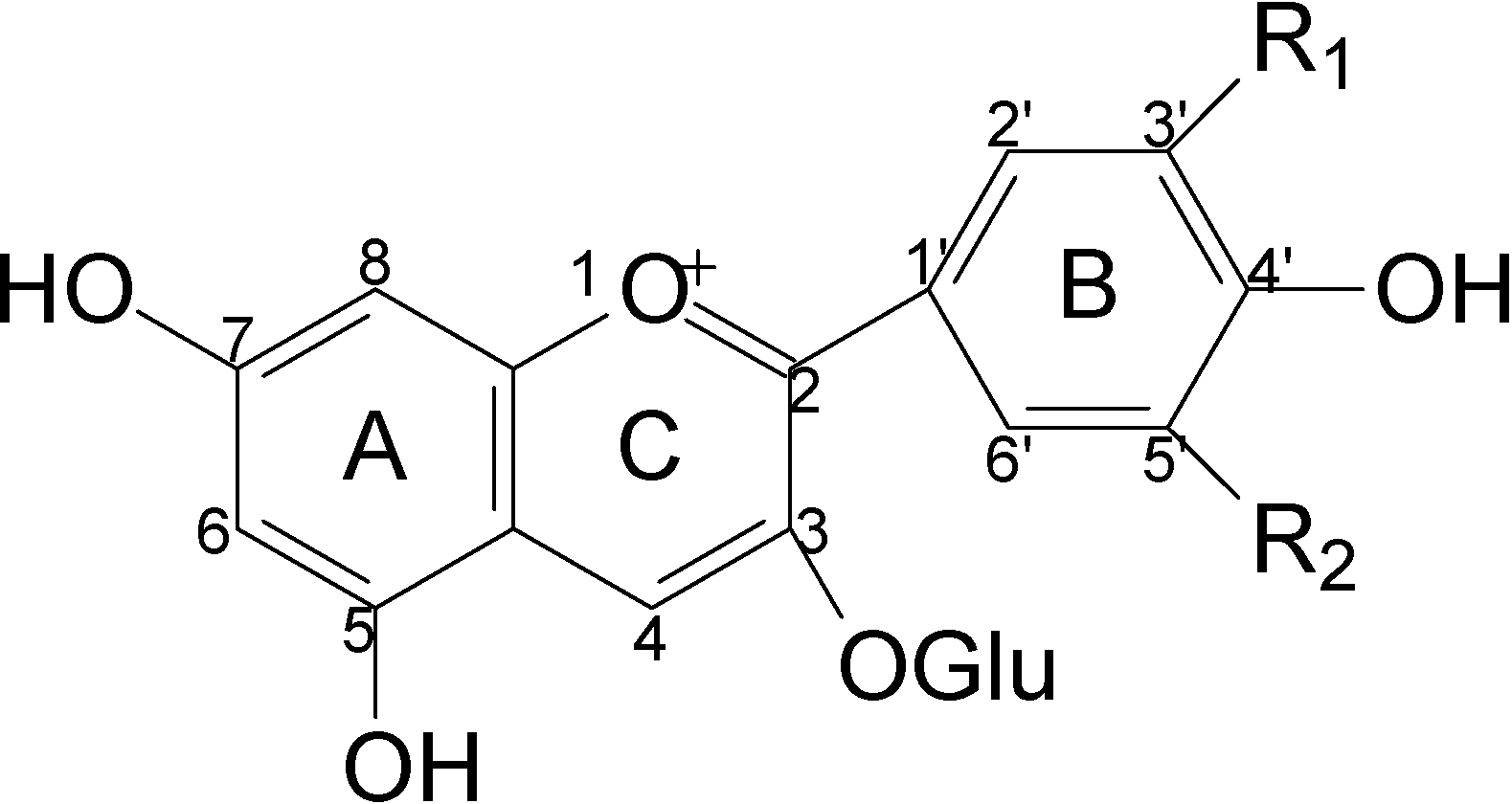
Results and Discussion
Identification of monomeric anthocyanins in Cabernet Sauvignon wine
Validity of Principal Component Regression (PCR)

| Peak No. | Rt | Anthocyanins | λmax (nm) | Molecular and Product Ions (m/z) |
|---|---|---|---|---|
| 1 | 8.047 | Dp3-glu | 524 | 465 (M+), 303 |
| 2 | 10.272 | Cy3-glu | 516 | 449 (M+), 287 |
| 3 | 11.303 | Pt3-glu | 524 | 479 (M+), 317 |
| 4 | 13.272 | Pn3-glu | 518 | 463 (M+), 301 |
| 5 | 13.885 | Mv3-glu | 528 | 493 (M+), 331 |
| 6 | 14.612 | Dp3-acet-glu | 526 | 507 (M+), 303 |
| 7 | 17.490 | Pt3-acet-glu | 522 | 521 (M+), 317 |
| 8 | 19.814 | Pn3-acet-glu | 522 | 505 (M+), 301 |
| 9 | 20.212 | Mv3-acet-glu | 528 | 535 (M+), 331 |
| 10 | 21.367 | Mv3-caff-glu | 532 | 655 (M+), 331 |
| 11 | 21.793 | Pt3-coum-glu | 530 | 625 (M+), 317 |
| 12 | 22.836 | Mv3-cis-coum-glu | 536 | 639 (M+), 331 |
| 13 | 23.625 | Pn3-coum-glu | 522 | 609 (M+), 301 |
| 14 | 23.849 | Mv3-trans-coum-glu | 530 | 639 (M+), 331 |
| Samples | L* | a* | b* | C*ab | H*ab |
|---|---|---|---|---|---|
| W1 | 0.6490** | 0.7796** | 0.1997** | 0.7649** | 0.5306** |
| W2 | 0.7623** | 0.7347** | 0.3134** | 0.7309** | 0.6013** |
| W3 | 0.7458** | 0.7885** | 0.0636 | 0.7846** | 0.4416** |
| W4 | 0.5937** | 0.6456** | 0.0073 | 0.6405** | 0.2111** |
| W5 | 0.7529** | 0.8157** | 0.0366 | 0.8197** | 0.5087** |
| Significance | a | a | c | a | b |
The CIELa*b*color of different anthocyanins
Effects of substituents of the B-ring on anthocyanins’ contribution to color
Effect of acylation of anthocyanins on color
| Peak No. | Anthocyanins | L* | a* | b* | C*ab | H*ab | ||||||||
|---|---|---|---|---|---|---|---|---|---|---|---|---|---|---|
| Mean ± STD | Mean ± STD | Mean ± STD | Mean ± STD | Mean ± STD | ||||||||||
| 2 | Cy3-glu | -2.3079±0.3995 | a | 2.8100±0.5751 | a | -0.2977±0.3165 | a | 2.6948±0.4598 | a | -1.3099±1.0863 | a | |||
| 11 | Pt3-coum-glu | -1.7715±0.3522 | b | 2.1636±0.5072 | b | -0.1840±0.1485 | ab | 2.0912±0.5269 | b | -0.8846±0.4949 | ab | |||
| 13 | Pn3-coum-glu | -1.2023±0.1639 | c | 1.4641±0.2424 | c | -0.1273±0.1024 | bc | 1.4149±0.2672 | c | -0.5971±0.3205 | bc | |||
| 12 | Mv3-cis-coum-glu | -1.1452±0.196 | c | 1.3910±0.2568 | c | -0.1175±0.0844 | bc | 1.3456±0.2818 | c | -0.5578±0.2548 | bcd | |||
| 10 | Mv3-caff-glu | -0.8647±0.0532 | d | 1.0521±0.1110 | d | -0.0972±0.0853 | bc | 1.0146±0.1225 | d | -0.4449±0.2722 | bcde | |||
| 7 | Pt3-acet-glu | -0.3247±0.0242 | e | 0.3945±0.0401 | e | -0.0376±0.0333 | c | 0.3799±0.0389 | e | -0.1715±0.1076 | cde | |||
| 4 | Pn3-glu | -0.2644±0.0272 | e | 0.3208±0.0344 | ef | -0.0323±0.0307 | c | 0.3083±0.0250 | ef | -0.1435±0.1001 | cde | |||
| 8 | Pn3-acet-glu | -0.2180±0.0255 | ef | 0.2644±0.0308 | ef | -0.0239±0.0190 | c | 0.2553±0.0353 | ef | -0.1104±0.0587 | cde | |||
| 1 | Dp3-glu | -0.1786±0.0212 | ef | 0.2172±0.0325 | ef | -0.0218±0.0211 | c | 0.2087±0.0269 | ef | -0.0981±0.0708 | cde | |||
| 6 | Dp3-acet-glu | -0.1760±0.0123 | ef | 0.2133±0.0129 | ef | -0.0200±0.0170 | c | 0.2056±0.0155 | ef | -0.0911±0.0527 | cde | |||
| 14 | Mv3-trans-coum-glu | -0.1179±0.0047 | ef | 0.1432±0.0101 | ef | -0.0139±0.0129 | c | 0.1378±0.0083 | ef | -0.0624±0.0417 | de | |||
| 3 | Pt3-glu | -0.1116±0.0085 | ef | 0.1356±0.0134 | ef | -0.0127±0.0110 | c | 0.1306±0.0139 | ef | -0.0583±0.0352 | de | |||
| 9 | Mv3-acet-glu | -0.0196±0.0012 | f | 0.0237±0.0009 | f | -0.0022±0.0019 | c | 0.0229±0.0015 | f | -0.0101±0.0057 | e | |||
| 5 | Mv3-glu | -0.0091±0.0007 | f | 0.0110±0.0005 | f | -0.0010±0.0008 | c | 0.0106±0.0008 | f | -0.0047±0.0026 | e | |||
Conclusions
Materials and methods
Analytical standards and reagents
Samples
Analysis of CIELAB values
Quantitative analysis of anathocyanins by HPLC-MS
Statistical analysis
Acknowledgements
References and Notes
- Fulcrand, H.; Benabdeljalil, C.; Rigaud, J.; Cheynier, V.; Moutounet, M. A new class of wine pigments generated by reaction between pyruvic acid and grape anthocyanins. Phytochemistry 1998, 47, 1401–1407. [Google Scholar] [CrossRef]
- Mateus, N.; Pascual-Teresa, S.; Rivas-Gonzalo, J.C.; Santos-Buelga, C.; Freitas, V. Structural diversity of anthocyanin-derived pigments in port wines. Food Chem. 2002, 76, 335–342. [Google Scholar] [CrossRef]
- Sáenz-López, R.; Fernández-Zurbano, P.; Tena, M.T. Analysis of aged red wine pigments by capillary zone electrophoresis. J. Chromatogr. A. 2004, 1052, 191–197. [Google Scholar] [CrossRef]
- Alcalde-Eon, C.; Escribano-Bailón, M.T.; Santos-Buelga, C.; Rivas-Gonzalo, J.C. Changes in the detailed pigment composition of red wine during maturity and ageing A comprehensive study. Anal. Chim. Acta 2006, 563, 238–254. [Google Scholar] [CrossRef]
- Oliveira, J.; Santos-Buelga, C.; Silva, A.M.S.; de Freitas, V.; Mateus, N. Chromatic and structural features of blue anthocyanin-derived pigments present in Port wine. Anal. Chim. Acta 2006, 563, 2–9. [Google Scholar] [CrossRef]
- Versari, A.; Boulton, R.B.; Parpinello, G.P. A comparison of analytical methods for measuring the color components of red wines. Food Chem. 2008, 106, 397–402. [Google Scholar] [CrossRef]
- Rentzsch, M.; Schwarz, M.; Winterhalter, P. Pyranoanthocyanins -an overview on structures, occurrence, and pathways of formation. Trends Food Sci. Tech. 2007, 18, 526–534. [Google Scholar] [CrossRef]
- Dalla, C.; Laureano, O. Effect of pH, sulphur dioxide, alcohol content, temperature and storage time on color composition of a young Portuguese red table wine. J. Sci. Food Agric. 1994, 65, 477–485. [Google Scholar] [CrossRef]
- Fossen, T.; Cabrita, L.; Andersen, Ø.M. Color and stability of pure anthocyanins influenced by pH including the alkaline region. Food Chem. 1998, 63, 435–440. [Google Scholar] [CrossRef]
- Boulton, R. The copigmentation of anthocyanins and its role in the color of red wine: A critical review. Am. J. Enol. Viticulture 2001, 52, 67–87. [Google Scholar]
- Darias-Martin, J.; Carrillo, M.; Diaz, E.; Boulton, R.B. Enhancement of red wine color by pre-fermentation addition of copigments. Food Chem. 2001, 73, 217–220. [Google Scholar] [CrossRef]
- Gutiérrez, I.H.; Lorenzo, E.S-P.; Espinosa, A.V. Phenolic composition and magnitude of copigmentation in young and shortly aged red wines made from the cultivars, Cabernet Sauvignon, Cencibel, and Syrah. Food Chem. 2005, 92, 269–283. [Google Scholar] [CrossRef]
- Berké, B.; de Freitas, V.A.P. Influence of procyanidin structures on their ability to complex with oenin. Food Chem. 2005, 90, 453–460. [Google Scholar] [CrossRef]
- Esparza, I.; Santamaría, C.; Fernández, J.M. Chromatic characterisation of three consecutive vintages of Vitis vinifera red wine: Effect of dilution and iron addition. Anal. Chim. Acta 2006, 563, 331–337. [Google Scholar] [CrossRef]
- Pérez-Magariño, S.; González-San José, M.L. Polyphenols and color variability of red wines made from grapes harvested at different ripeness grade. Food Chem. 2006, 96, 197–208. [Google Scholar] [CrossRef]
- Heredia, F.J.; Francia-Aricha, E.M.; Rivas-Gonzalo, J.C.; Vicario, I.M.; Santos-Buelga, C. Chromatic characterization of anthocyanins from red grapes-I. pH effect. Food Chem. 1998, 63, 491–498. [Google Scholar] [CrossRef]
- Cabrita, L.; Fossen, T.; Andersen, Ø.M. Colour and stability of the six common anthocyanidin 3-glucosides in aqueous solutions. Food Chem. 2000, 68, 101–107. [Google Scholar] [CrossRef]
- Giusti, M.M.; Wrolstad, R.E. Acylated anthocyanins from edible sources and their applications in food systems. Biochem. Eng. J. 2003, 14, 217–225. [Google Scholar] [CrossRef]
- Romero, C.; Bakker, J. Anthocyanin and colour evolution during maturation of four port wines: effect of pyruvic acid addition. J. Sci. Food Agric. 2000, 81, 252–260. [Google Scholar] [CrossRef]
- Håkansson, A.E.; Pardon, K.; Hayasaka, Y.; de Sa, M.; Herderich, M. Structures and colour properties of new red wine pigments. Tetrahedron Lett. 2003, 44, 4887–4891. [Google Scholar] [CrossRef]
- Gao, L.; Girard, B.; Mazza, G.; Reynolds, A.G. Changes in anthocyanins and color characteristics of Pinot Noir wines during different vinification processed. J. Agric. Food Chem. 1997, 45, 2003–2008. [Google Scholar] [CrossRef]
- Monagas, M.; Martín-Álvarez, P.J.; Bartolomé, B.; Gómez-Cordovés, C. Statistical interpretation of the color parameters of red wines in function of their phenolic composition during aging in bottle. Eur. Food Res. Technol. 2005, 222, 702–709. [Google Scholar]
- Cano-López, M.; Pardo-Minguez, F.; López-Roca, J.M.; Gómez-Plaza, E. Effect of microoxygenation on anthocyanin and derived pigment content and chromatic characteristics of red wines. Am. J. Enol. Viticulture 2006, 57, 325–331. [Google Scholar]
- Preys, S.; Mazerolles, G.; Courcoux, P.; Samson, A.; Fischer, U.; Hanafi, M.; Bertrand, D.; Cheynier, V. Relationship between polyphenolic composition and some sensory properties in red wines using multiway analyses. Anal. Chim. Acta 2006, 563, 126–136. [Google Scholar] [CrossRef]
- Gómez-Míguez, M.; González-Miret, M.L.; Heredia, F.J. Evolution of color and anthocyanin composition of Syrah wines elaborated with pre-fermentative cold maceration. J. Food Eng. 2007, 79, 271–278. [Google Scholar] [CrossRef]
- Xie, Y.L.; Kalivas, J.H. Evaluation of principal component selection methods to form a global prediction model by principal component regression. Anal. Chim. Acta 1997, 348, 19–27. [Google Scholar] [CrossRef]
- Rougoor, C.W.; Sundaram, R.; van Arendonk, J.A.M. The relation between breeding management and 305-day milk production determined via principal components regression and partial least squares. Livest. Prod. Sci. 2000, 66, 71–83. [Google Scholar] [CrossRef]
- Zhang, M.H.; Xu, Q.S.; Massart, D.L. Robust principal components regression based on principal sensitivity vectors. Chemometr. Intell. Lab. 2003, 67, 175–185. [Google Scholar] [CrossRef]
- Preys, S.; Mazerolles, G.; Courcoux, P.; Samson, A.; Fischer, U.; Hanafi, M.; Bertrand, D.; Cheynier, V. Relationship between polyphenolic composition and some sensory properties in red wines using multiway analyses. Anal. Chim. Acta 2006, 563, 126–136. [Google Scholar] [CrossRef]
- Vivar-Quintana, A.M.; Santos-Buelga, C.; Rivas-Gonzalo, J.C. Anthocyanin-derived pigments and colour of red wines. Anal. Chim. Acta 2002, 458, 147–155. [Google Scholar] [CrossRef]
- Torskangerpoll, K.; Nøbæk, R.; Nodland, E.; Øvstedal, D.O.; Andersen, Ø.M. Anthocyanin content of Tulipa species and cultivars and its impact on tepal colours. Biochem. Syst. Ecol. 2005, 33, 499–510. [Google Scholar] [CrossRef]
- Dangles, O.; Saito, N.; Brouillard, R. Anthocyanin intramolecular copigment effect. Phytochemistry 1993, 34, 119–124. [Google Scholar] [CrossRef]
- Figueiredo, P.; Elhabiri, M.; Toki, K.; Saito, N.; Dangles, O.; Brouillard, R. New aspects of anthocyanin complexation. Intramolecular copigmentation as a means for colour loss? Phytochemistry 1996, 41, 301–308. [Google Scholar] [CrossRef]
- Figueiredo, P.; George, F.; Tatsuzawa, F.; Toki, K.; Saito, N.; Brouillard, R. New features of intramolecular copigmentation by acylated anthocyanins. Phytochemistry 1999, 51, 125–132. [Google Scholar] [CrossRef]
- George, F.; Figueiredo, P.; Toki, K.; Tatsuzawa, F.; Saito, N.; Brouillard, R. Influence of trans-cis isomerisation of coumaric acid substituents on colour variance and stabilisation in anthocyanins. Phytochemistry 2001, 57, 791–795. [Google Scholar] [CrossRef]
- Schwarz, M.; Winterhalter, P. A novel synthetic route to substituted pyranoanthocyanins with unique colour properties. Tetrahedron Lett. 2003, 44, 7583–7587. [Google Scholar] [CrossRef]
- Ayala, F.; Echávarri, J.F.; Negueruela, A.I. A new simplified method for measuring the color of wines: I. Red and Rosé wines. Am. J. Enol. Viticulture 1997, 48, 357–363. [Google Scholar]
- Ayala, F.; Echávarri, J.F.; Negueruela, A.I. A new simplified method for measuring the color of wines: III. All wines and brandies. Am. J. Enol. Viticulture 1999, 50, 359–363. [Google Scholar]
- Sample Availability: Not available.
© 2008 by the authors. Licensee Molecular Diversity Preservation International, Basel, Switzerland. This article is an open-access article distributed under the terms and conditions of the Creative Commons Attribution license ( http://creativecommons.org/licenses/by/3.0/).
Share and Cite
Han, F.-L.; Zhang, W.-N.; Pan, Q.-H.; Zheng, C.-R.; Chen, H.-Y.; Duan, C.-Q. Principal Component Regression Analysis of the Relation Between CIELAB Color and Monomeric Anthocyanins in Young Cabernet Sauvignon Wines. Molecules 2008, 13, 2859-2870. https://doi.org/10.3390/molecules13112859
Han F-L, Zhang W-N, Pan Q-H, Zheng C-R, Chen H-Y, Duan C-Q. Principal Component Regression Analysis of the Relation Between CIELAB Color and Monomeric Anthocyanins in Young Cabernet Sauvignon Wines. Molecules. 2008; 13(11):2859-2870. https://doi.org/10.3390/molecules13112859
Chicago/Turabian StyleHan, Fu-Liang, Wen-Na Zhang, Qiu-Hong Pan, Cheng-Rong Zheng, Hai-Yan Chen, and Chang-Qing Duan. 2008. "Principal Component Regression Analysis of the Relation Between CIELAB Color and Monomeric Anthocyanins in Young Cabernet Sauvignon Wines" Molecules 13, no. 11: 2859-2870. https://doi.org/10.3390/molecules13112859
APA StyleHan, F.-L., Zhang, W.-N., Pan, Q.-H., Zheng, C.-R., Chen, H.-Y., & Duan, C.-Q. (2008). Principal Component Regression Analysis of the Relation Between CIELAB Color and Monomeric Anthocyanins in Young Cabernet Sauvignon Wines. Molecules, 13(11), 2859-2870. https://doi.org/10.3390/molecules13112859

