3.3.3. Vehicle Conflict Constraints
To simplify the model calculation, this paper sets the ideal operating speeds of personnel transport vehicles and muck vehicles to the same value, so that overtaking conflicts will not occur.
- ①
Crossing Conflicts
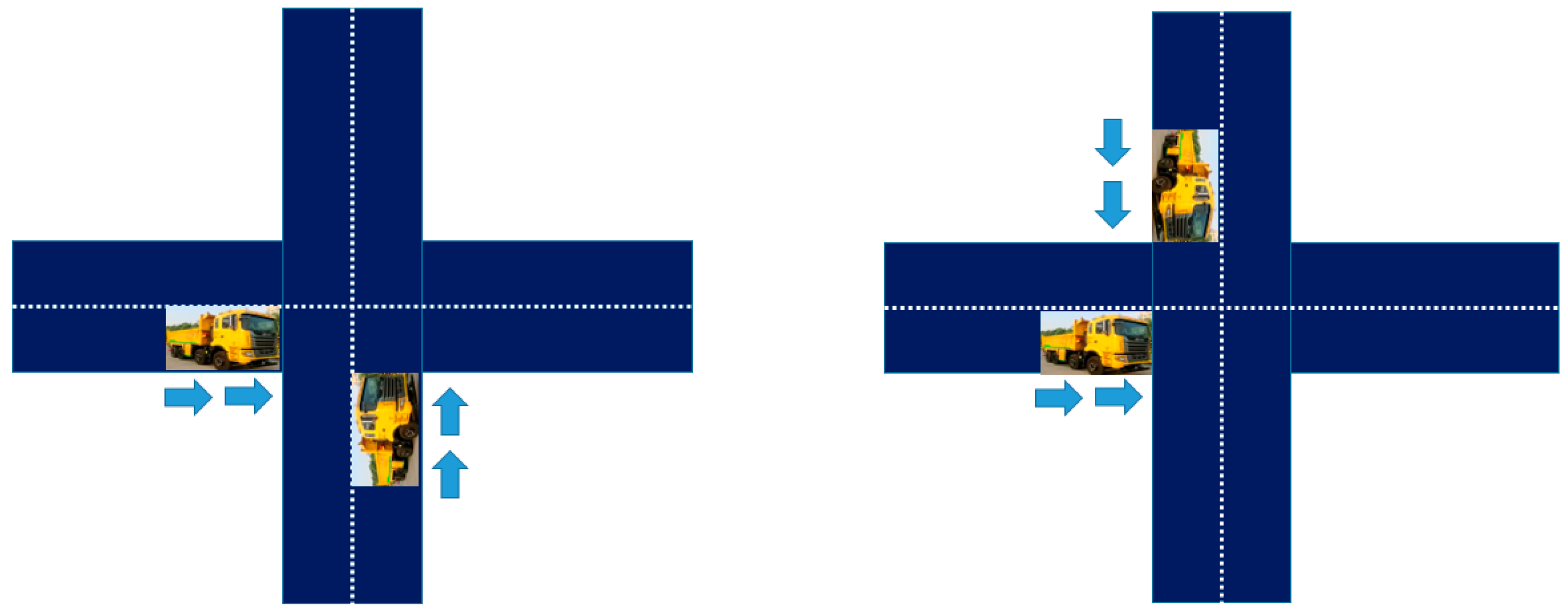
A crossing conflict is considered to occur when two vehicles meet at an intersection, as shown in
Figure 1. When the intersection is relatively wide, it can be considered that no crossing conflict occurs, and the actual situation of the tunnel entrance should be analyzed.
For safety, the number of crossing conflicts between vehicles in the tunnel must be controlled within a certain range:
where
—0–1 variable, which is 1 when a conflict occurs between vehicle k and vehicle k’ on the crossing road segment (i, j).
- ②
Head-on Conflicts
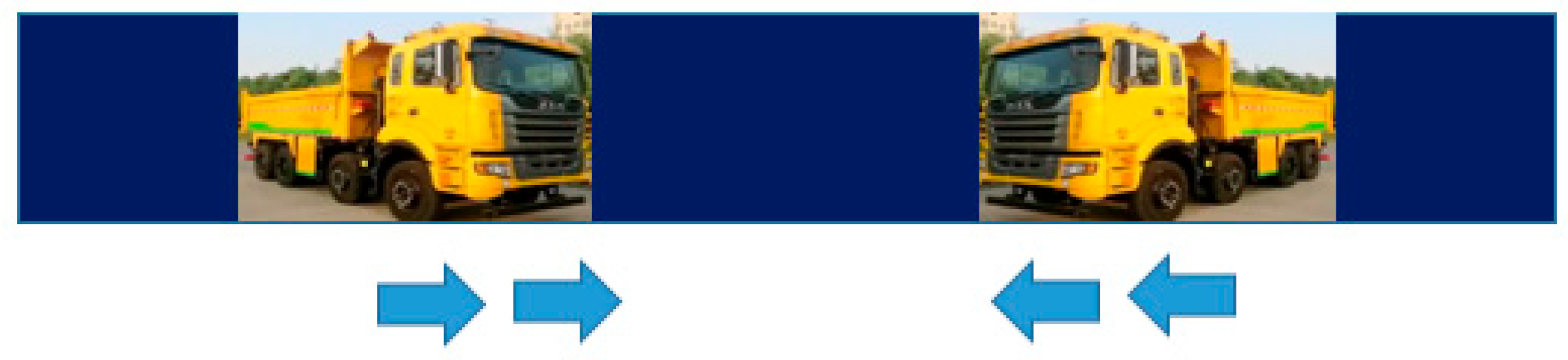
For some narrow transverse passages, only one-way traffic is allowed, so head-on conflicts must not occur. As shown in
Figure 2.
For safety, the number of head-on conflicts between vehicles in the tunnel must be controlled within a certain range:
where
—0–1 variable, which is 1 when a conflict occurs between vehicle k and vehicle k’ on the one-way road segment (i, j).
- ③
Congestion Conflicts
Whether it is a cross-shaped passage, a T-shaped passage or other types of passages, too many vehicles shall not accumulate at the same node at time
t. As shown in
Figure 3.
For safety, the number of congestion conflicts between vehicles in the tunnel must be controlled within a certain range:
where
—0–1 variable, which is 1 when the number of vehicles at node i exceeds the capacity at time t, otherwise 0.
3.3.5. Vehicle Scheduling Optimization Algorithm Based on Improved NSGA-II
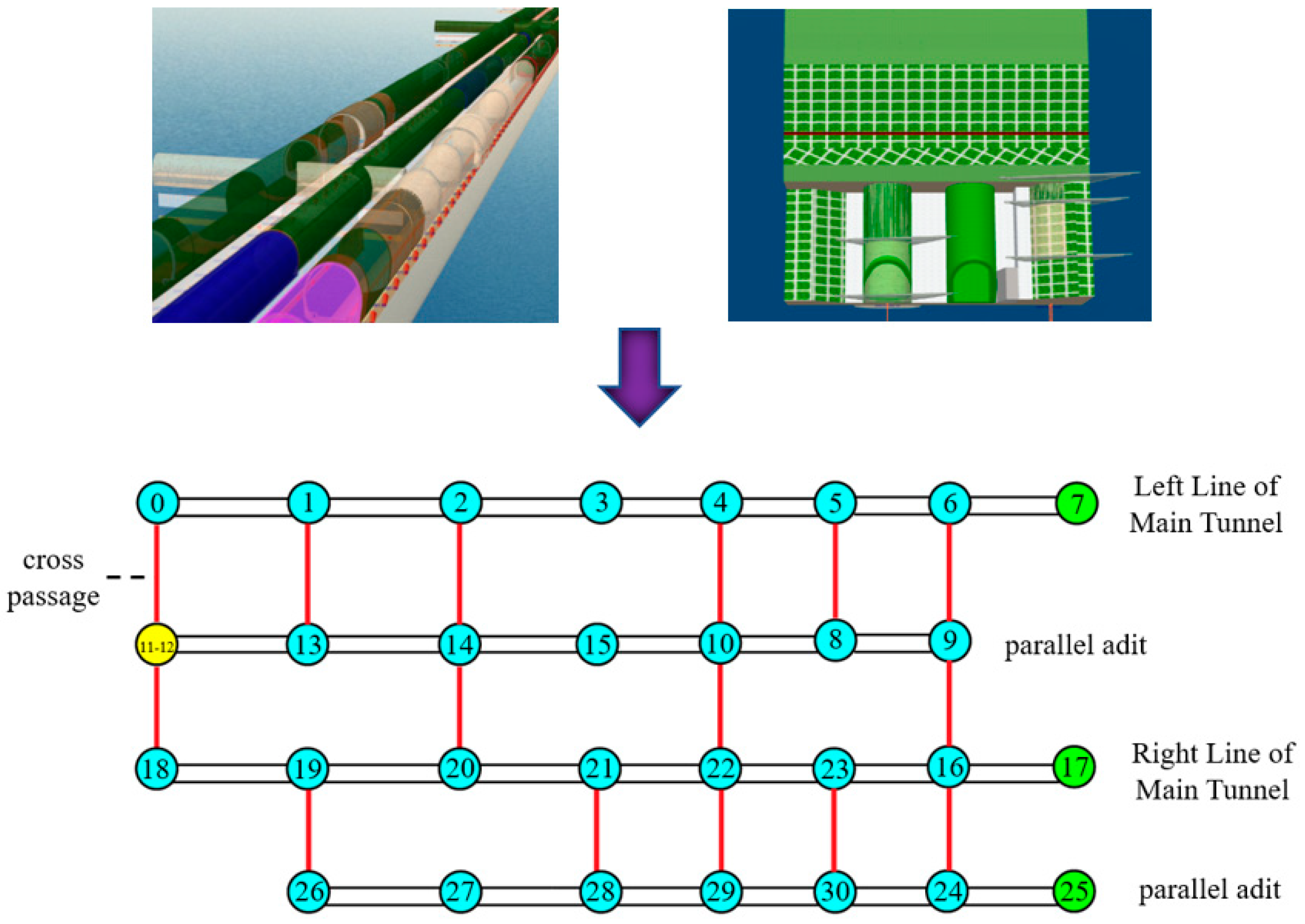
To address the dual-objective optimization requirements of “minimum total travel time” and “minimum number of conflicts” in the transportation organization of multiple types of construction vehicles in long and large tunnels, combined with the engineering characteristics of complex road network topology, frequent traffic flow interactions, and strict spatio-temporal constraints in tunnels, a collaborative optimization algorithm based on the Non-dominated Sorting Genetic Algorithm (NSGA-II) is designed. This algorithm fully draws on the path-time coupling optimization idea of the Adaptive Large Neighborhood Search (ALNS) algorithm in previous studies, integrates the core advantages of NSGA-II in balancing the convergence and diversity of solution sets in multi-objective optimization, and realizes the collaborative optimization of dual objectives through coding design, genetic operation adaptation, non-dominated sorting, and elite retention mechanisms, providing scientific decision support for the transportation organization of tunnel construction vehicles.
The detailed steps of the optimization algorithm are as follows:
Step 1: Coding Design
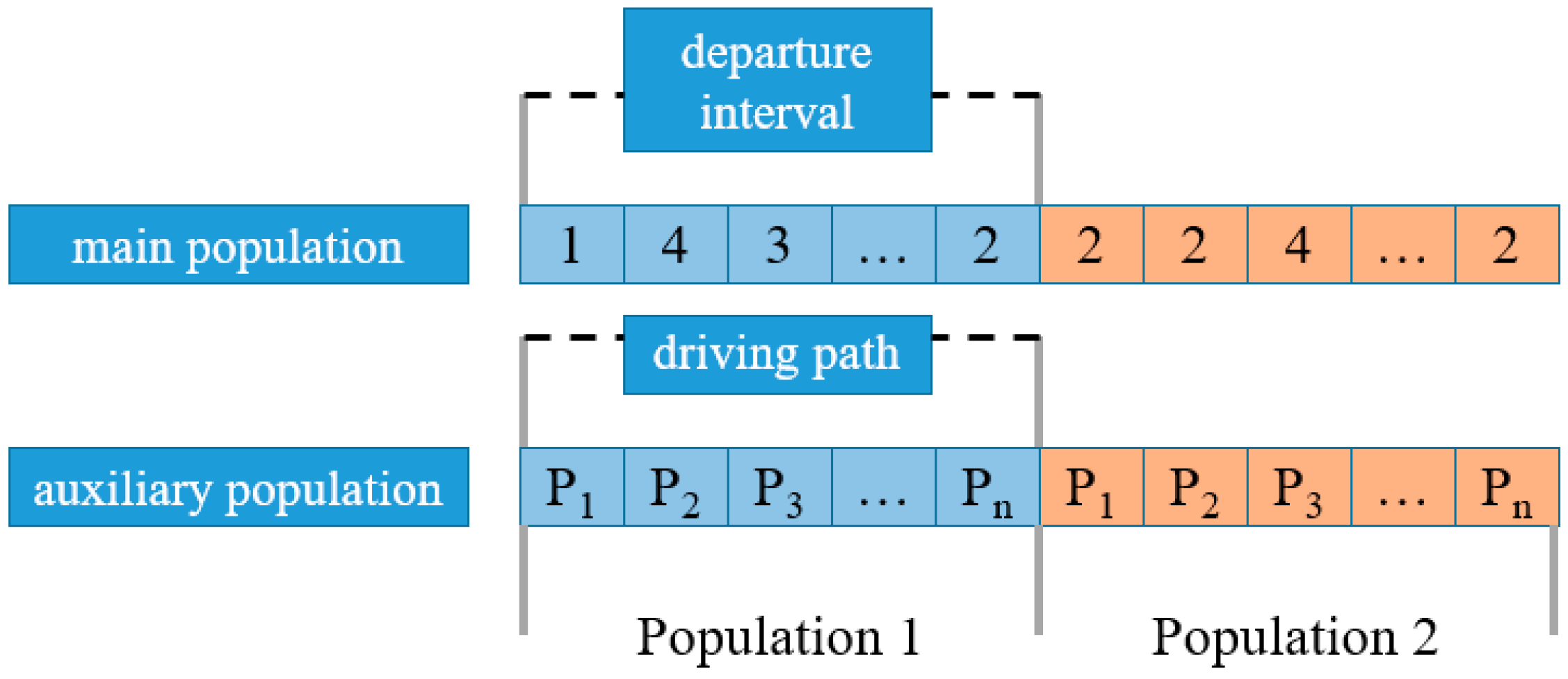
This paper takes the vehicle departure intervals as the initial population and randomly generates p groups of initial populations. Each population represents a departure scheme , and the value of any gene in the departure scheme must satisfy .
Step 2: Decoding process
The core of decoding is based on the gap encoding between transmissions. By improving the social force model, the driving paths (including return paths) of vehicles are dynamically derived, and the values of the dual objective functions are accurately calculated. This ensures that the decoding results are completely consistent with the model and constraints in the paper. The specific operation is as follows:
① Extract the interval
from the population encoding, and based on the constraints in the previous text, derive the departure time sequence
, clearly determining the departure time for each vehicle. ② Path dynamic derivation: Firstly, determine the candidate road segment set. Based on the tunnel traffic topology network, filter all candidate road segments that meet the path constraints to form a unified candidate road segment set. Then, calculate the road passage cost for each candidate road segment (
i,
j), based on the improved social force model of Equations (1)–(16), and calculate the passage cost of each path at time
t. Finally, select the optimal path. With the goal of minimizing the “total co-travel cost”, choose the optimal driving path and return path for each vehicle
k. ③ Constraint verification: Check whether the derived vehicle routes satisfy all the constraints (time constraints, spatial constraints, logical constraints, etc.) mentioned in the paper. If there are violations of constraints, such as the presence of loops in the route, then the route selection should be adjusted based on the improved social force model until all constraints are met. The vehicle’s driving path will be added as an additional population to the initial population, as shown in
Figure 4. Here,
represents the driving path of vehicle 1. ④ Calculate the objective function, and calculate the total driving time of the vehicles and the number of conflicts that occur.
Step 3: Non-dominated sorting and congestion degree calculation
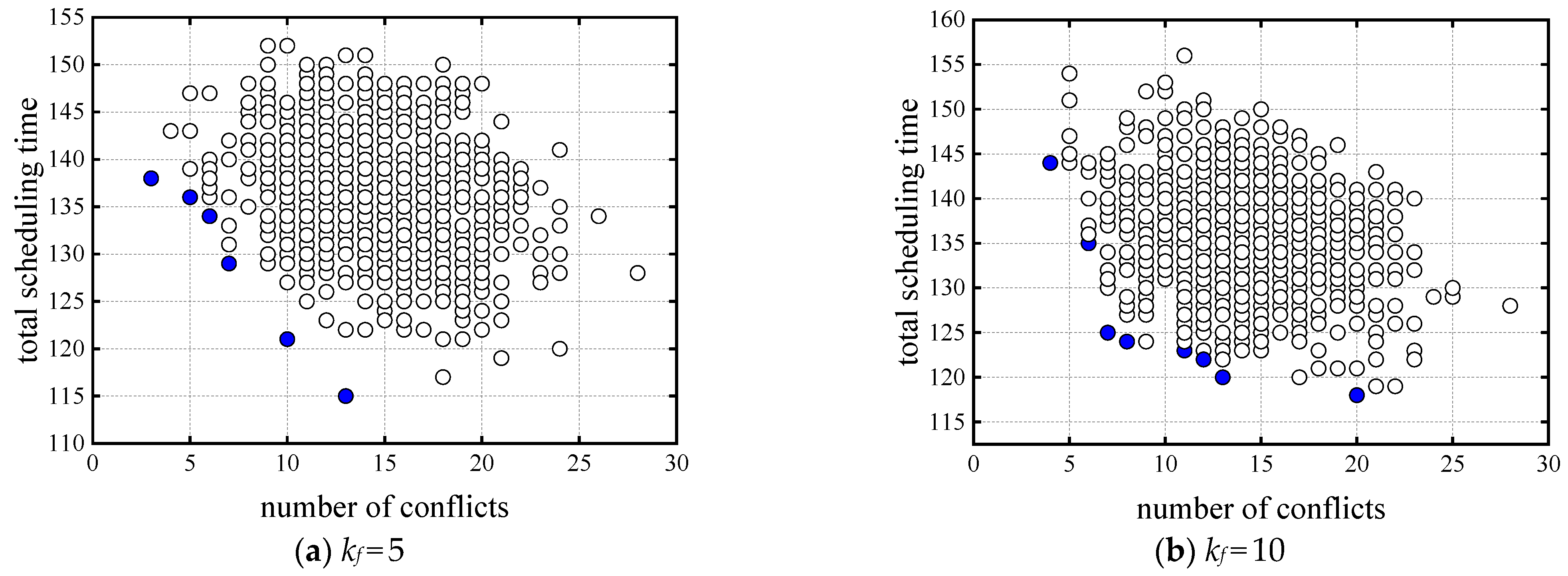
Using the classic sorting mechanism of NSGA-II, the population individuals are evaluated for their superiority and inferiority based on the dual objective function values. For two individuals X1 and X2 in the population, if the total travel time of X1 ≤ that of X2, and the number of conflicts of X1 ≤ that of X2, and at least one objective is strictly better, then X1 dominates X2. The distance process of non-dominated sorting is as follows: ① Traverse the population and calculate the dominance count and dominance set for each individual; ② Classify the individuals with a dominance count of 0 into the first non-dominated rank, and this serves as the Pareto optimal frontier; ③ Remove the individuals of the first rank, update the dominance counts of the remaining individuals, classify the new individuals with a dominance count of 0 into the second rank, and so on. Continue this process until the entire population is classified into ranks.
In order to prevent too many individuals within the same hierarchical level from being concentrated, and to ensure the diversity of the solution set, the degree of crowding of each individual in the target space is calculated
where
—The congestion distance of the i-th individual for the k-th objective;
—Corresponding to the kth objective of the (i + 1)th individual and the (i − 1)th individual, respectively;
—They represent the maximum and minimum values of the k-th objective for the i-th individual.
If individuals i and j have the same ranking, denoted as , then the distances and corresponding to these two individuals need to be compared. If condition is met and is true, then the ith individual is superior to the jth individual.
Step 4: Genetic Manipulation
Taking into account the characteristics of a single code for the inter-activity interval, design cross and mutation operations that are compatible with the constraints, ensuring that the individuals after genetic operations still meet the constraints stipulated in the paper, and at the same time enhancing the evolutionary ability of the population.
- ①
Cross-operation
The cross-operation is divided into two parts. One part is the cross-operation between train intervals, and the other part is the cross-operation between driving paths. The cross-operation of train intervals is as follows:
Step 4-1: Set a type A cross probability and a type B cross probability , generate a temporary random number . When occurs, proceed to Step 4-2; when occurs, turn to Step 4-3; otherwise, proceed to Step 4-4. In this paper, = 0.4 and = 0.8.
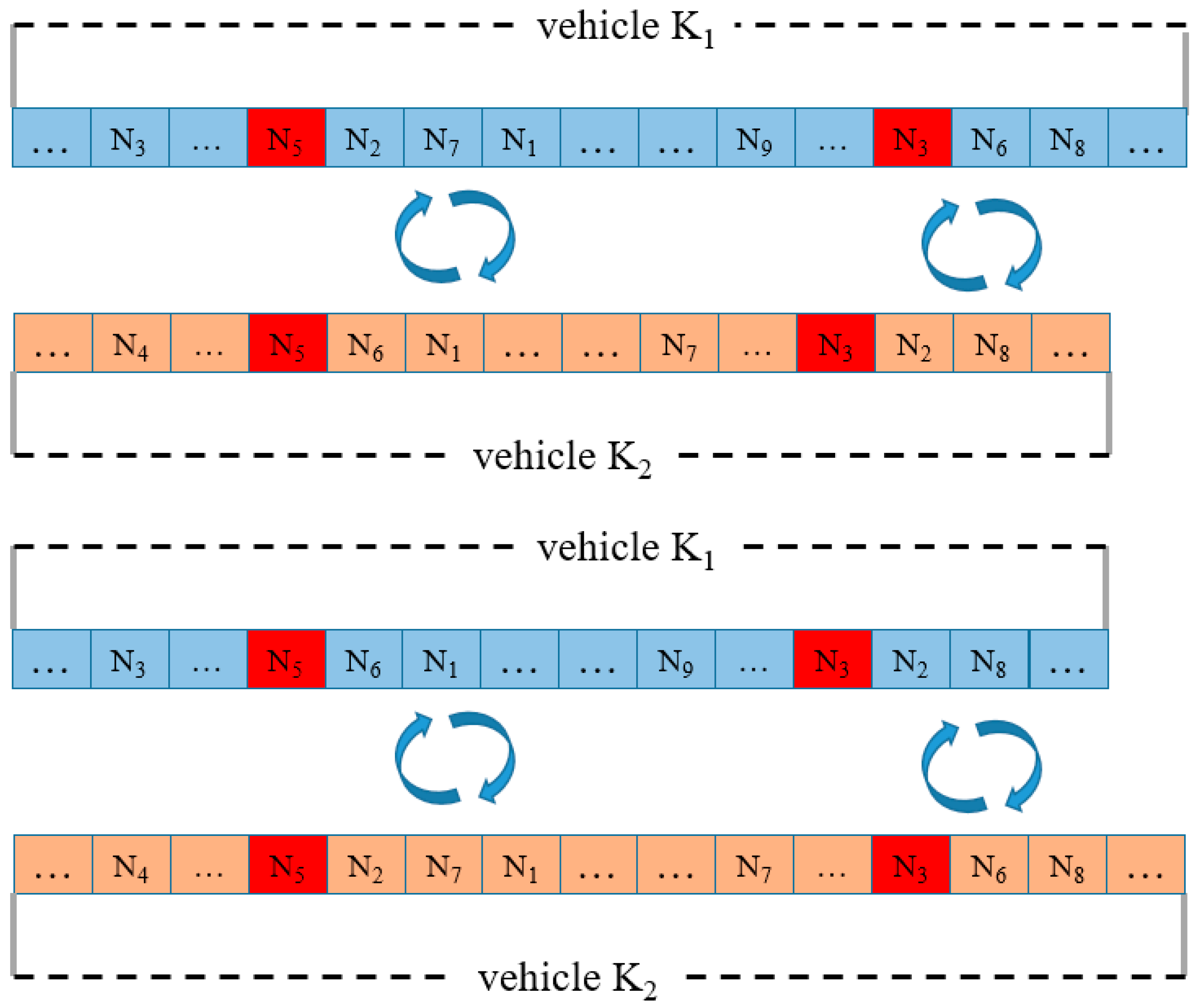
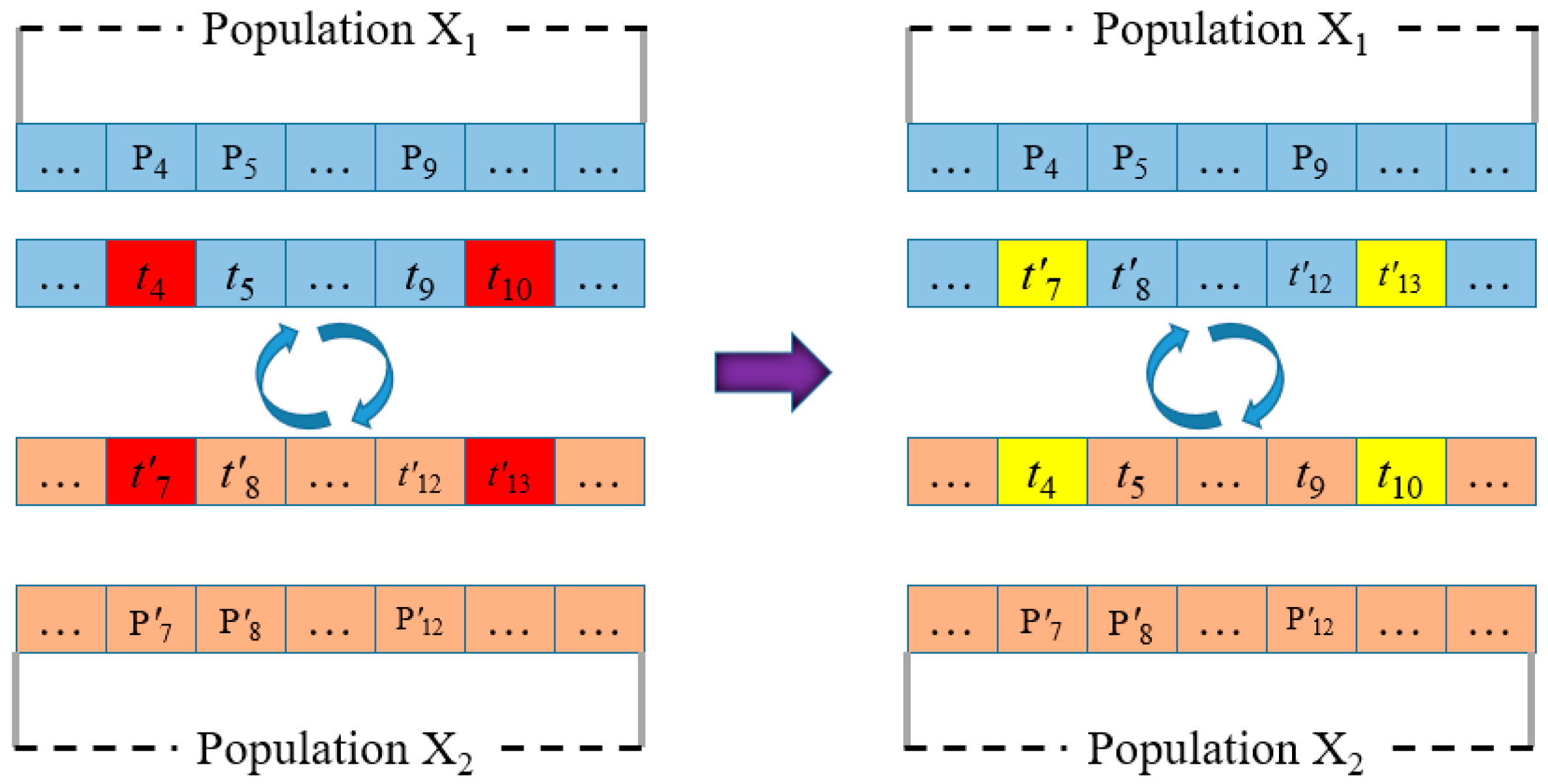
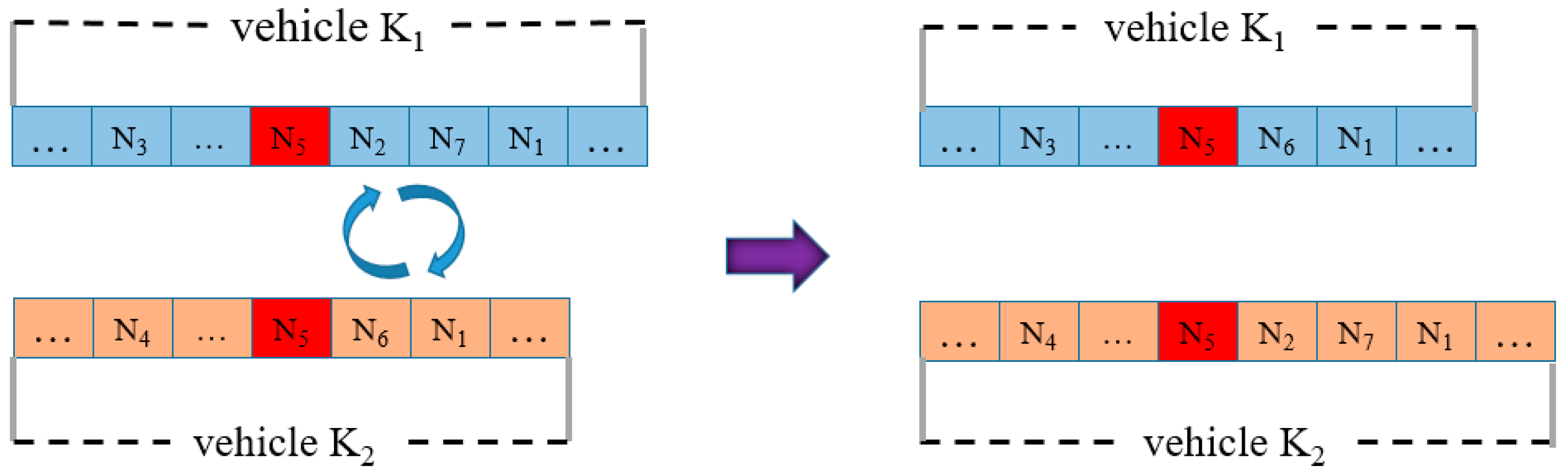
Step 4-2: One type of crossover is the generation of offspring intervals through the crossover of intervals between different parent individuals. A new population is formed by generating intervals between these different parent individuals. Suppose the intervals between these different parent individuals are respectively composed of sets
and
. To ensure the excellence of the crossover result, two vehicle intervals that have conflicts, namely point
and point
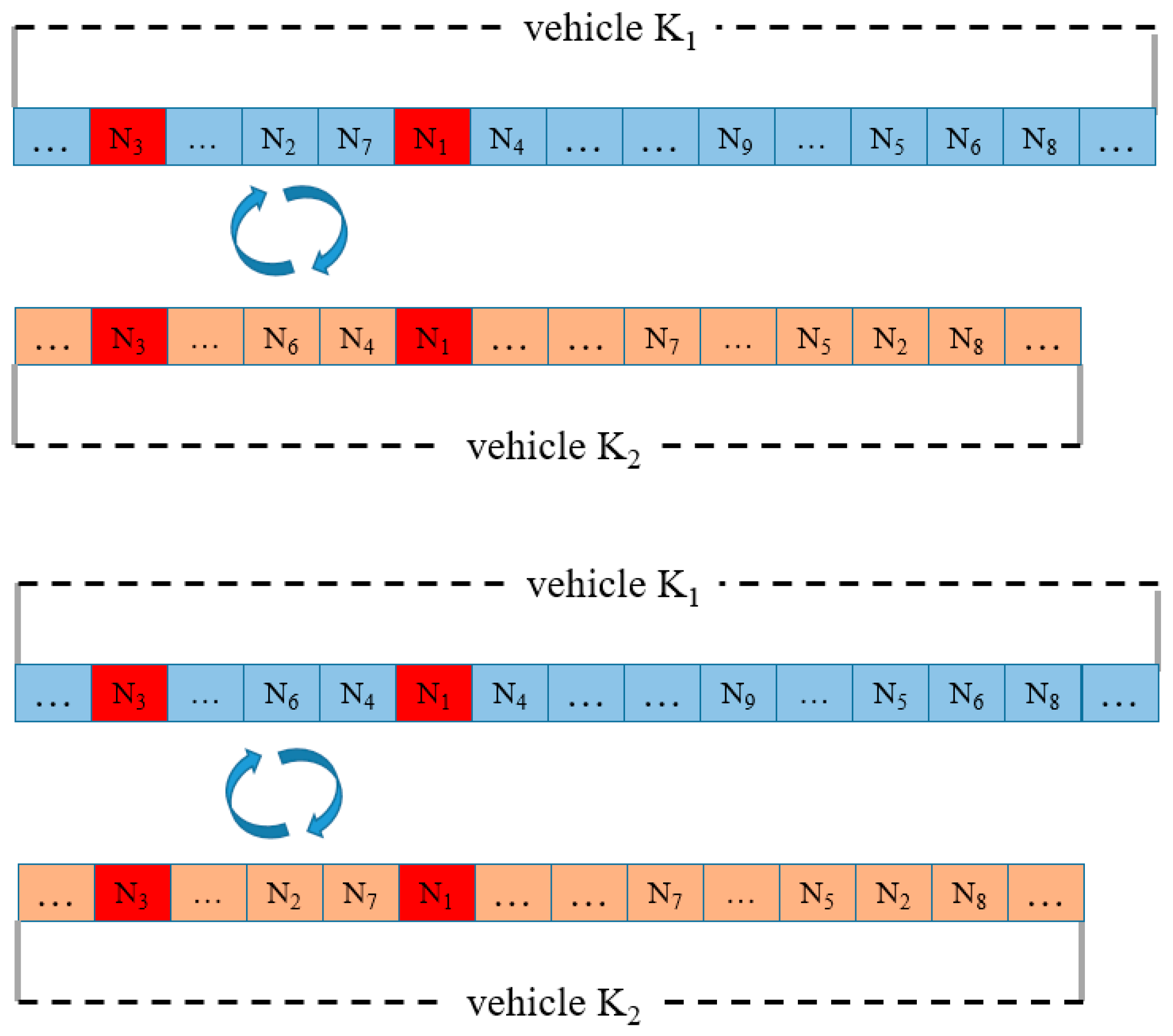
, are randomly selected. Subsequently, these two nodes and all the alleles between them are exchanged and recombined to form a new offspring chromosome, as shown in
Figure 5, or the alleles at the front of the conflicting nodes are interchanged, as shown in
Figure 6.
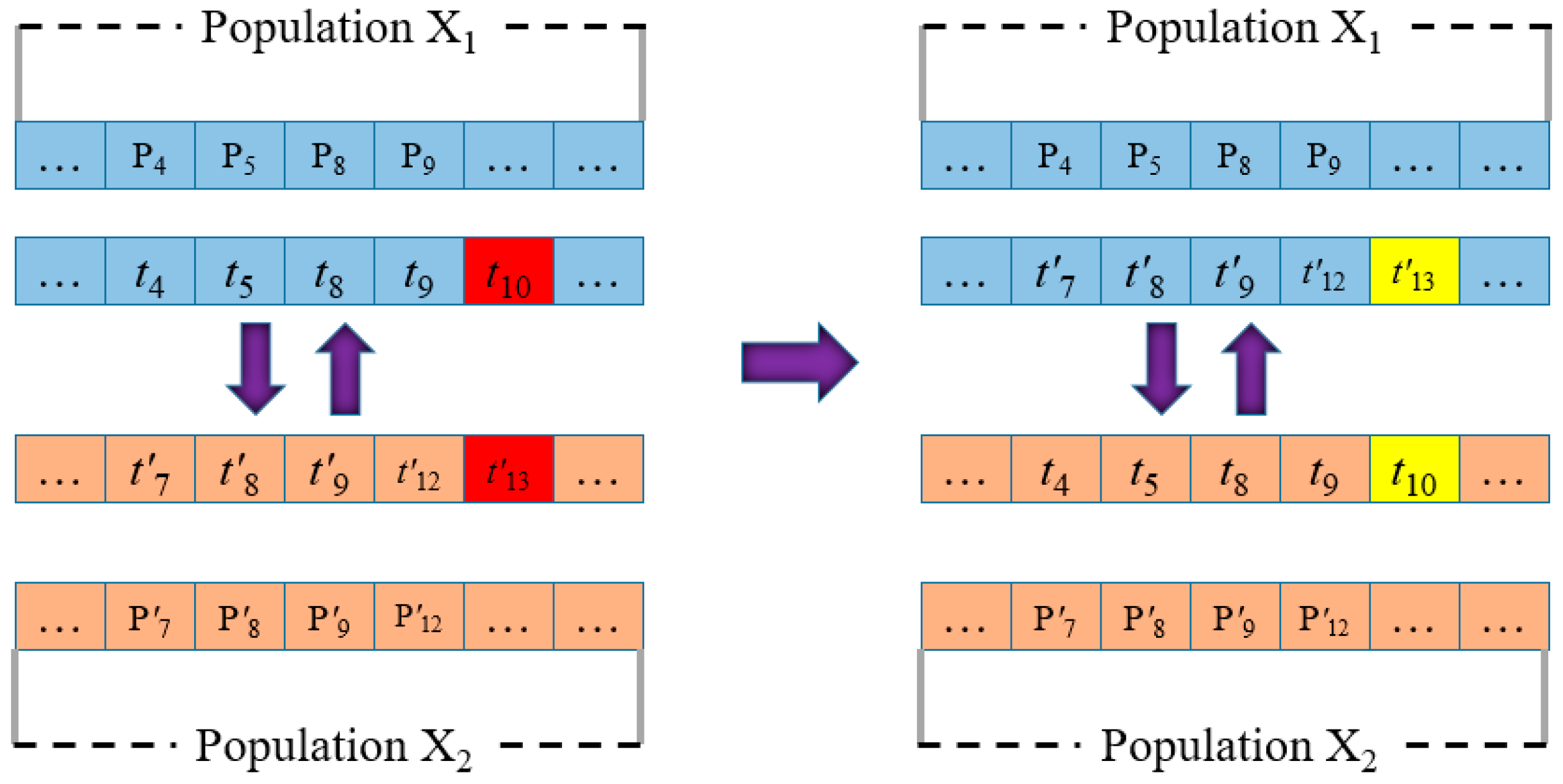
Step 4-3: The second type of crossover is the intersection of vehicle travel paths, which does not involve the interval between departures. By using the travel paths corresponding to the same numbered vehicle among different parent generations to generate a new population. Suppose the travel paths of different parent individuals to the same vehicle form sets
and
. Select the conflicting travel nodes
or
(different from the departure interval, vehicle travel paths strictly follow the constraints and topological network structure, and it is not necessary for two nodes to have a conflict simultaneously to exchange), and based on the three types of crossover algorithms (single-line crossover, multi-line crossover, and intermediate path interchange), exchange the travel paths of vehicles and generate new offspring chromosomes, as shown in
Figure 7,
Figure 8 and
Figure 9.
The newly formed sub-population obtained through crossover must meet the constraints, such as prohibiting the occurrence of loops or closed circuits in the path. If any violation of the constraints is detected, this crossover will be canceled.
Step 4-4: Proceed to Step 5.
Step 5: Mutation Operation.
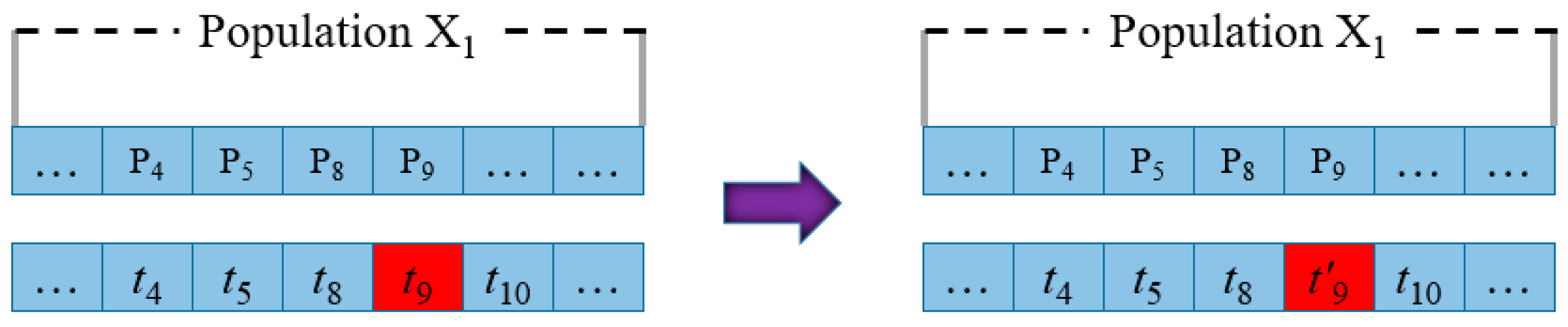
To ensure the excellence of the mutation results and reduce the complexity of the model, this paper only performs mutation operations on the conflicting departure interval points, extending the departure interval backward by 1 to 4 min (not exceeding the constraint condition of the maximum departure interval), as shown in
Figure 10.
Step 6: Elite preservation and population renewal
By merging the parental population and the offspring population, the optimized individuals are obtained, forming a merged population with a size of 2p. The non-dominated sorting is conducted for the merged population, and the crowding degree is calculated. Individuals are selected from high to low based on the non-dominated ranking, and the crowding degree within the same ranking is selected from large to small. This process continues until a new population of size p is selected, ensuring that high-quality genes are retained and maintaining the diversity of the population. During the iterative process, a part of the population generated after each crossover and mutation is saved as a process solution and incorporated into the calculation of the Pareto frontier solution.
Step 7: Convergence judgment and termination condition
Establish a dual convergence criterion to balance the algorithm efficiency and the quality of the solution: ① Based on the number of vehicles K, determine the maximum number of iterations. When K ≤ 50, T = 150~200 generations; when K > 50, T = 200~300 generations. The choice is made according to the actual situation. ② The cross-probability and mutation probability of this paper are 0.9 and 0.1, respectively. ③ When the continuous iteration reaches Nd (Nd = 20~30), the mean change value of the dual objective function for the first non-dominated rank individuals is less than the threshold. In this case, it is considered that the population has converged and the iteration is terminated.