Forward-Secure Linearly Homomorphic Signature Scheme in the Standard Model and Its Application


Abstract
1. Introduction
2. Preliminaries
2.1. Notation
2.2. Definitions and Lemmas
2.3. Algorithms
3. The FSLHS Scheme: Formal Definition and Security Model
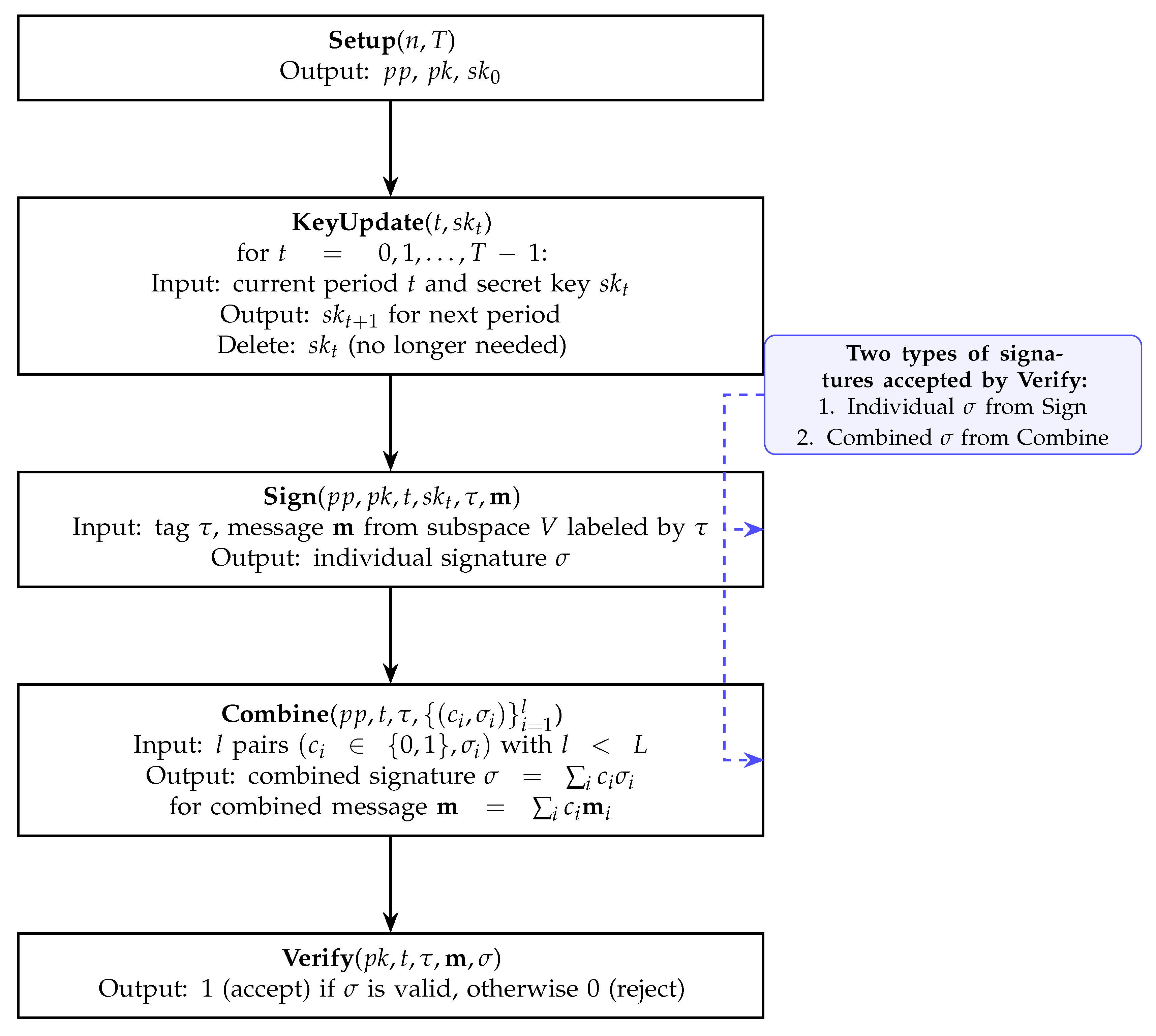
3.1. Formal Definition of FSLHS
- (1)
- For any τ and any message from the subspace it identifies, if the signature at time period t, then the verification algorithm satisfies
- (2)
- If the signature at time period t, then the verification algorithm satisfies
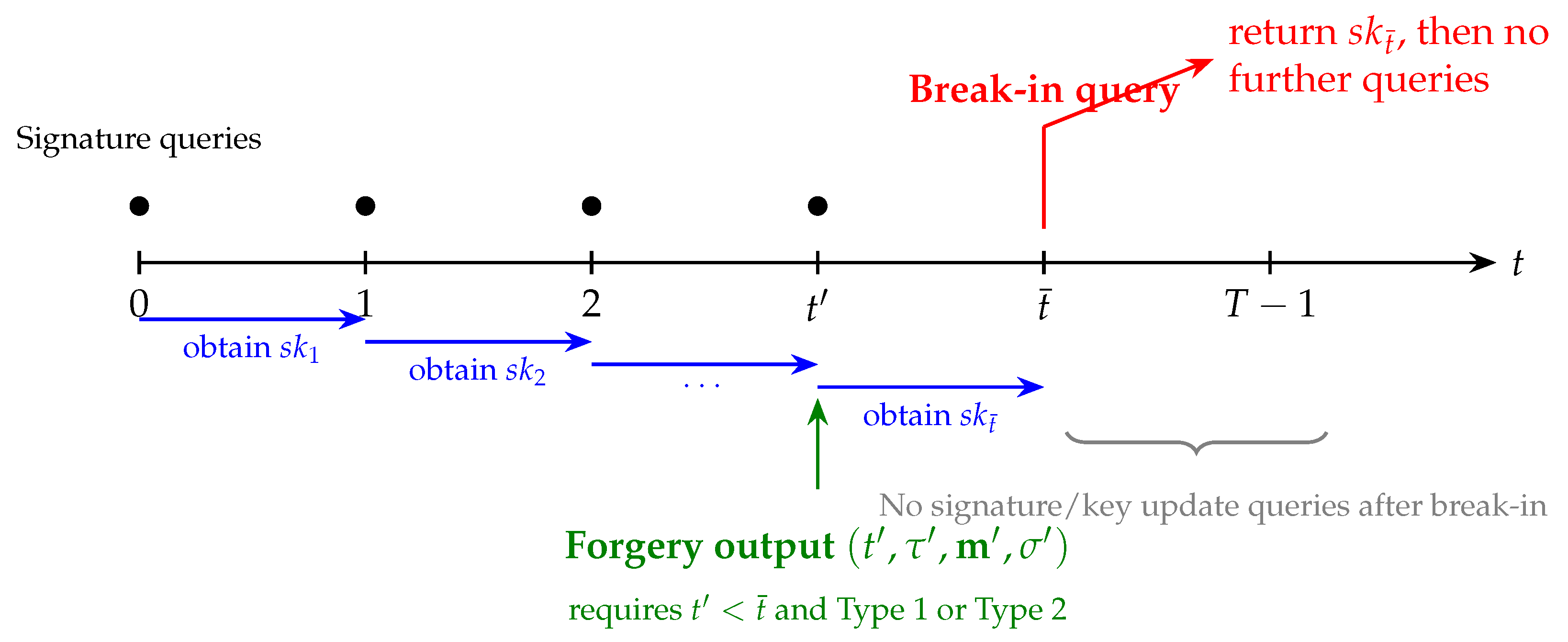
3.2. Security Model of FSLHS
- (1)
- For time period , the tuple has never been queried for a signature.
- (2)
- The signature verification result satisfies .
- (3)
- It conforms to one of the following two types:
- (a)
- Type 1: For all signature queries involving a tag in time period , .
- (b)
- Type 2: There exists some such that , but , where V denotes the subspace spanned by the vectors and is labeled by in time period .
4. Lattice-Based FSLHS Scheme
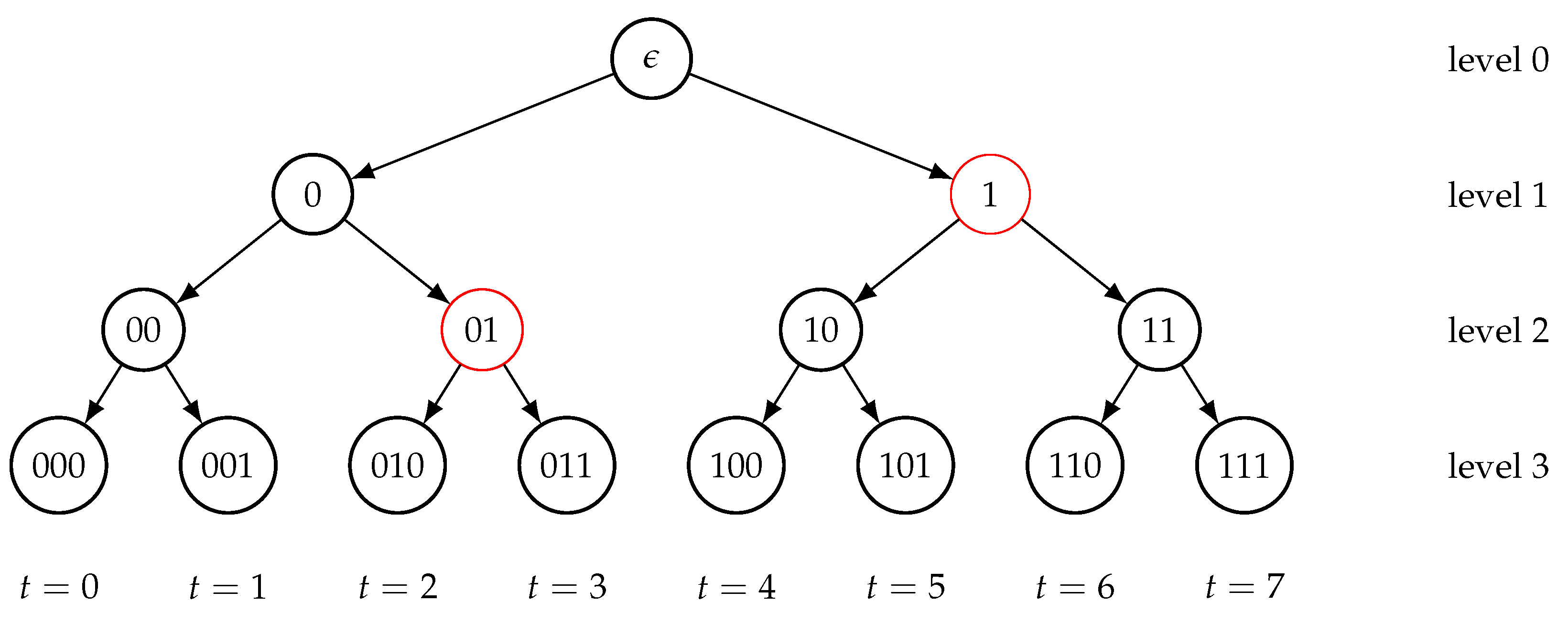
4.1. Time Periods on a Binary Tree
4.2. Design of Our Scheme
- (1)
- Randomly select k vectors from .
- (2)
- Randomly select matrices from .
- (3)
- Execute the TrapGen to obtain a pair of matrices , where is the matrix for the root node and is its associated trapdoor matrix.
- (4)
- Output the public parameters , the public key , and the initial secret key .
- (1)
- Construct the matrix according to the time period .
- (2)
- Check whether the trapdoor corresponding to is contained in . If not, extract the trapdoor corresponding to the ancestor nodes of t from and invoke the ExtBasis to generate (this is because not all trapdoors corresponding to leaf nodes are directly stored in . For example, when , its binary representation is , while the corresponding trapdoor is not in ).
- (3)
- Execute the to obtain a pair of vectors , where , and .
- (4)
- Determine whether there exists a zero vector in . If so, computeand invoke the to output the signature . Otherwise, computethen invokerespectively to obtain and , and finally output
- (5)
- Regard as the signature of the vector within time period t.
- (1)
- Compute , where .
- (2)
- If the following conditions are satisfied:
- (a)
- ;
- (b)
- , then the algorithm outputs “1”. Otherwise, it outputs “0”.
4.3. Correctness
4.4. Forward-Secure Unforgeability
- (1)
- For each , sets . For and , executes the to obtain a pair of matrices , where is the trapdoor of .
- (2)
- invokes the to generate k vectors , and computes for , where .
- (1)
- Construct .
- (2)
- Check whether holds.
- (a)
- Obtain via , where is the smallest index such that .
- (b)
- Execute to obtain a pair of vectors , where , and .
- (c)
- Compute , then invoke respectively to obtain and , and set for .
- (d)
- Output and send in time period t to .
- (a)
- Execute to obtain a pair of vectors , where , and .
- (b)
- Compute and . Set for .
- (c)
- Output and send in time period t to .
- (1)
- In the simulated game, not all matrices used in constructing the matrix are randomly sampled from , some are generated by . According to Theorem 1, matrices produced by this algorithm are statistically indistinguishable from the uniform distribution over .
- (2)
- In the simulated game, the vectors are computed as where the vectors are obtained by running . By Theorem 5, the vectors are statistically indistinguishable from vectors uniformly sampled from .
- (3)
- In 1 of the signature query phase, the signature is generated in the same way as in the actual scheme.
- (4)
- In 2 of the signature query phase, the simulated signatures and are, by Lemmas 2 and 3, statistically close to samples drawn from distribution . Moreover, since and , it follows from Theorem 5 that and are also approximately distributed as and , respectively.
- (5)
- Verifying that holds, the process is as follows:
- (6)
- Next, we verify that holds. By Lemma 1, the probability that and is overwhelming. Hence it follows that .
5. Comparative Analysis
6. Application Feasibility Analysis: Smart Grid Data Acquisition
- Low-frequency reporting: The time interval between consecutive signatures should be at least several minutes to accommodate the signing time of 24.2–242 s.
- Need for forward security in the standard model: Our scheme is intended for applications where key leakage is a major security concern and security under the random oracle model is insufficient.
- Sufficient bandwidth: The 480 MB aggregated signature requires adequate network capacity between the aggregation nodes and the data center. This is typically available in industrial-grade smart grid backhaul networks.
Other Potential Application Scenarios
- Low-frequency data reporting
- Stable power supply
- Sufficient storage capacity (GB-level)
- High-bandwidth network connections
7. Conclusions
Author Contributions
Funding
Data Availability Statement
Conflicts of Interest
References
- Li, S.Y.; Yeung, R.W.; Cai, N. Linear network coding. IEEE Trans. Inf. Theory 2003, 49, 371–381. [Google Scholar] [CrossRef]
- Gennaro, R.; Katz, J.; Krawczyk, H.; Rabin, T. Secure network coding over the integers. In International Workshop on Public Key Cryptography; Springer: Berlin/Heidelberg, Germany, 2010; pp. 142–160. [Google Scholar]
- Libert, B.; Peters, T.; Joye, M.; Yung, M. Linearly homomorphic structure-preserving signatures and their applications. Des. Codes Cryptogr. 2015, 77, 441–477. [Google Scholar] [CrossRef]
- Johnson, R.; Molnar, D.; Song, D.; Wagner, D. Homomorphic signature schemes. In Cryptographers’ Track at the RSA Conference; Springer: Berlin/Heidelberg, Germany, 2002; pp. 244–262. [Google Scholar]
- Boneh, D.; Freeman, D.; Katz, J.; Waters, B. Signing a linear subspace: Signature schemes for network coding. In International Workshop on Public Key Cryptography; Springer: Berlin/Heidelberg, Germany, 2009; pp. 68–87. [Google Scholar]
- Freeman, D.M. Improved security for linearly homomorphic signatures: A generic framework. In International Workshop on Public Key Cryptography; Springer: Berlin/Heidelberg, Germany, 2012; pp. 697–714. [Google Scholar]
- Attrapadung, N.; Libert, B.; Peters, T. Efficient completely context-hiding quotable and linearly homomorphic signatures. In International Workshop on Public Key Cryptography; Springer: Berlin/Heidelberg, Germany, 2013; pp. 386–404. [Google Scholar]
- Catalano, D.; Fiore, D.; Nizzardo, L. Homomorphic signatures with sublinear public keys via asymmetric programmable hash functions. Des. Codes Cryptogr. 2018, 86, 2197–2246. [Google Scholar]
- Hébant, C.; Pointcheval, D.; Schädlich, R. Tracing a linear subspace: Application to linearly-homomorphic group signatures. In IACR International Conference on Public-Key Cryptography; Springer Nature: Cham, Switzerland, 2023; pp. 312–341. [Google Scholar]
- Grover, L.K. A fast quantum mechanical algorithm for database search. In Proceedings of the Twenty-Eighth Annual ACM Symposium on Theory of Computing, Philadelphia, PA, USA, 22–24 May 1996; pp. 212–219. [Google Scholar]
- Shor, P.W. Algorithms for quantum computation: Discrete logarithms and factoring. In Proceedings 35th Annual Symposium on Foundations of Computer Science; IEEE: New York, NY, USA, 1994; pp. 124–134. [Google Scholar]
- Boneh, D.; Freeman, D.M. Linearly homomorphic signatures over binary fields and new tools for lattice-based signatures. In International Workshop on Public Key Cryptography; Springer: Berlin/Heidelberg, Germany, 2011; pp. 1–16. [Google Scholar]
- Boneh, D.; Freeman, D.M. Homomorphic signatures for polynomial functions. In Annual International Conference on the Theory and Applications of Cryptographic Techniques; Springer: Berlin/Heidelberg, Germany, 2011; pp. 149–168. [Google Scholar]
- Wang, F.H.; Hu, Y.P.; Wang, B.C. Lattice-based linearly homomorphic signature scheme over binary field. Sci. China Inf. Sci. 2013, 56, 1–9. [Google Scholar] [CrossRef]
- Chen, W.; Lei, H.; Qi, K. Lattice-based linearly homomorphic signatures in the standard model. Theor. Comput. Sci. 2016, 634, 47–54. [Google Scholar] [CrossRef]
- Lin, C.J.; Xue, R.; Yang, S.J.; Huang, X.; Li, S. Linearly homomorphic signatures from lattices. Comput. J. 2020, 63, 1871–1885. [Google Scholar] [CrossRef]
- Cai, J.; Jiang, H.; Wang, H.; Xu, Q. Lattice-based linearly homomorphic signature scheme over . Secur. Commun. Netw. 2020, 2020, 8857815. [Google Scholar] [CrossRef]
- Chen, W.; Huang, Z. Towards tightly secure short linearly homomorphic signatures. Theor. Comput. Sci. 2024, 1014, 114758. [Google Scholar] [CrossRef]
- Guo, H.; Liu, F.; Tian, K.; Zheng, Z. Linearly homomorphic signature with tight security on lattice. arXiv 2024, arXiv:2412.01641. [Google Scholar]
- Anderson, R. Two remarks on public-key cryptology. In Proceedings of the Fourth ACM Conference on Computer and Communications Security (CCS 1997), Zurich, Switzerland, 1–4 April 1997. [Google Scholar]
- Bellare, M.; Miner, S.K. A forward-secure digital signature scheme. In Proceedings of Advances in Cryptology (CRYPTO 1999), Santa Barbara, CA, USA; Springer: Berlin/Heidelberg, Germany, 1999; pp. 431–448. [Google Scholar]
- Abdalla, M.; Reyzin, L. A new forward-secure digital signature scheme. In Proceedings of Advances in Cryptology (ASI ACRYPT 2000); Springer: Berlin/Heidelberg, Germany, 2000; Volume 1976, pp. 116–129. [Google Scholar]
- Itkis, G.; Reyzin, L. Forward-secure signatures with optimal signing and verifying. In Proceedings of Advances in Cryptology (CRYPTO 2001); Springer: Berlin/Heidelberg, Germany, 2001; Volume 2139, pp. 499–514. [Google Scholar]
- Kozlov, A.; Reyzin, L. Forward-secure signatures with fast key update. In International Conference on Security in Communication Networks; Springer: Berlin/Heidelberg, Germany, 2002; pp. 241–256. [Google Scholar]
- Yu, J.; Kong, F.; Cheng, X.; Hao, R.; Li, G. One forward secure signature scheme using bilinear maps and its applications. Inf. Sci. 2014, 279, 60–76. [Google Scholar] [CrossRef]
- Hu, F.; Wu, C.; Irwin, J.D. A New Forward Secure Signature Scheme Using Bilinear Maps. Cryptology ePrint Archive, Report 2003/188. 2003. Available online: http://eprint.iacr.org/2003/188 (accessed on 15 June 2026).
- Zhang, X.; Xu, X.; Jin, C.; Xie, R. Efficient forward secure identity-based shorter signature from lattice. Comput. Electr. Eng. 2014, 40, 1963–1971. [Google Scholar] [CrossRef]
- Singh, K.; Pandurangan, C.; Banerjee, A.K. Lattice based forward-secure identity based encryption scheme with shorter ciphertext. J. Internet Serv. Inf. Secur 2013, 3, 5–19. [Google Scholar]
- Ling, S.; Nguyen, K.; Wang, H.; Xu, Y. Forward-secure group signatures from lattices. In International Conference on Post-Quantum Cryptography; Springer International Publishing: Cham, Switzerland, 2019; pp. 44–64. [Google Scholar]
- Le, H.Q.; Duong, D.H.; Susilo, W.; Tran, H.T.N.; Trinh, V.C.; Pieprzyk, J.; Plantard, T. Lattice blind signatures with forward security. In Australasian Conference on Information Security and Privacy; Springer International Publishing: Cham, Switzerland, 2020; pp. 3–22. [Google Scholar]
- Wu, B.; Wang, C.; Li, Y.; Shi, N. A efficient lattice-based forward-secure linearly homomorphic signature scheme for network coding. Telecommun. Syst. 2024, 87, 1129–1145. [Google Scholar] [CrossRef]
- Wu, B.; Shi, N.; Li, Y.; Wu, K.; Wang, C. A key leakage resistant linearly homomorphic signature scheme and its application. Peer-Peer Netw. Appl. 2025, 18, 101. [Google Scholar] [CrossRef]
- Zheng, Z.; Liu, F.; Tian, K. Modern cryptography, Volume 2: A classical introduction to informational and mathematical principle. In Financial Mathematics and Fintech; Springer: Singapore, 2023. [Google Scholar]
- Micciancio, D.; Regev, O. Worst-case to average-case reductions based on Gaussian measures. SIAM J. Comput. 2007, 37, 267–302. [Google Scholar] [CrossRef]
- Alwen, J.; Peikert, C. Generating shorter bases for hard random lattices. Theory Comput. Syst. 2011, 48, 535–553. [Google Scholar]
- Agrawal, S.; Boneh, D.; Boyen, X. Efficient lattice (H)IBE in the standard model. In Proceedings of the Advances in Cryptology-EUROCRYPT 2010, 29th Annual International Conference on the Theory and Applications of Cryptographic Techniques, Monaco, France, 30 May–3 June 2010; pp. 553–572. [Google Scholar]
- Gentry, C.; Peikert, C.; Vaikuntanathan, V. Trapdoors for hard lattices and new cryptographic constructions. In Proceedings of the Fortieth Annual ACM Symposium on Theory of Computing; Association for Computing Machinery: New York, NY, USA, 2008; pp. 197–206. [Google Scholar]
- Micciancio, D.; Peikert, C. Trapdoors for lattices: Simpler, tighter, faster, smaller. In Annual International Conference on the Theory and Applications of Cryptographic Techniques; Springer: Berlin/Heidelberg, Germany, 2012; pp. 700–718. [Google Scholar]



| Symbol | Meaning |
|---|---|
| means and such that for , . | |
| means for some constant c. | |
| means that for , such that for . | |
| for some constant c. | |
| for . | |
| The event occurs with overwhelming probability. | |
| The set . | |
| Bold lowercase letters | Vectors. e.g., , . |
| uppercase letters | Matrices. e.g., F, H. |
| An n-dimensional column vector. | |
| The -norm of a vector . | |
| An matrix composed of column vectors . | |
| The Gram–Schmidt orthogonalization of a matrix T. | |
| is drawn uniformly at random according to the distribution . | |
| is derived from uniform sampling over the set . | |
| Running algorithm with input x yields output y. |
| Schemes | [19] | [32] | Our Scheme |
|---|---|---|---|
| Public key size | |||
| Signature size | |||
| Signing time | |||
| Forward secure | No | Yes | Yes |
| Security model | SM | ROM | SM |
| Assumption | SIS | SIS | SIS |
Disclaimer/Publisher’s Note: The statements, opinions and data contained in all publications are solely those of the individual author(s) and contributor(s) and not of MDPI and/or the editor(s). MDPI and/or the editor(s) disclaim responsibility for any injury to people or property resulting from any ideas, methods, instructions or products referred to in the content. |
© 2026 by the authors. Licensee MDPI, Basel, Switzerland. This article is an open access article distributed under the terms and conditions of the Creative Commons Attribution (CC BY) license.
Share and Cite
Wang, L.; Chang, Z. Forward-Secure Linearly Homomorphic Signature Scheme in the Standard Model and Its Application. Entropy 2026, 28, 706. https://doi.org/10.3390/e28060706
Wang L, Chang Z. Forward-Secure Linearly Homomorphic Signature Scheme in the Standard Model and Its Application. Entropy. 2026; 28(6):706. https://doi.org/10.3390/e28060706
Chicago/Turabian StyleWang, Linlin, and Zuling Chang. 2026. "Forward-Secure Linearly Homomorphic Signature Scheme in the Standard Model and Its Application" Entropy 28, no. 6: 706. https://doi.org/10.3390/e28060706
APA StyleWang, L., & Chang, Z. (2026). Forward-Secure Linearly Homomorphic Signature Scheme in the Standard Model and Its Application. Entropy, 28(6), 706. https://doi.org/10.3390/e28060706