1. Introduction
The cost of executing a trade in a cryptocurrency market is not simply a function of transaction size and quoted spread. When an institutional investor realigns a portfolio across assets, the true cost depends on how far the market must travel in distributional space to absorb the order. In calm, liquid markets, this distance is short and proportional fee models provide adequate approximations. In fragmented or crisis-driven markets, the underlying distributional space is curved, the straight-line approximation fails, and execution costs escalate in ways that flat-fee models cannot anticipate [
1]. The Terra ecosystem collapse of May 2022 illustrates the consequence with precision: XRP execution costs ran 53% above any flat-fee prediction on the days of maximum fragmentation, not because trade sizes changed but because the geometry of the market state space changed.
Existing execution cost benchmarks assign cost as a scalar multiple of trade size or volatility and provide no mechanism for detecting or anticipating the curvature amplification that precedes liquidity crises. The Amihud [
2] illiquidity ratio, Kyle
, and the Almgren and Chriss [
3] quadratic impact model all assume that the market state space is geometrically flat. Consequently, they systematically underestimate execution costs precisely when accurate estimation matters most: during periods of market stress, order book fragmentation, and regime transition, when retail investors and smaller institutions suffer the largest and most asymmetric execution losses [
4,
5].
This paper presents GEODEX (Geodesic Execution Slippage), a framework that derives cryptocurrency execution slippage directly from the Riemannian geometry of the market’s statistical state space. The central insight is that the Fisher information matrix [
6,
7] of a calibrated return distribution model defines a natural Riemannian metric on the space of market states [
8] and that the minimum-cost execution path between two portfolio states is the geodesic arc on this manifold rather than the straight line assumed by flat-fee models. When the manifold is curved, the geodesic arc is longer, and execution is more expensive. The Curvature-Fragmentation Law proved in this paper establishes precisely when and by how much: negative Ricci scalar curvature, jointly with a topological disconnection of the order book, activates an exponential lower bound on realized slippage.
Addressing this gap requires a framework in which the market state space is treated as an intrinsically curved object and execution cost is derived from that curvature directly. Scalar benchmarks such as the Amihud ratio, Kyle , and the Almgren–Chriss power-law impact assume flat geometry by construction and therefore cannot represent the directional amplification that occurs when the distributional state space curves during market stress.
The Fisher information matrix [
6,
7] provides the theoretically necessary metric: it is the unique Riemannian metric on the space of statistical models that is invariant under sufficient statistics and measures the local distinguishability between distributional states. The geodesic arc length on this manifold is therefore the minimum information cost of moving between two market states, and flat-fee benchmarks are degenerate special cases obtained by setting curvature to zero. Ricci scalar curvature quantifies the rate at which the manifold diverges from flat space and therefore captures the systematic underestimation by flat-fee models. Persistent homology of the Level-2 order book provides a topologically stable measure of order book fragmentation [
9] that is robust to small perturbations. The Wasserstein-2 distance between regime distributions provides the thermodynamic cost of the distributional transition that precedes fragmentation. These four layers are not additive augmentations of a baseline model; they are geometrically necessary components of a coherent execution cost theory, and their cross-layer consistency is guaranteed because all derive from the same parameter vector
.
This paper makes four contributions to statistical physics, information geometry, and market microstructure.
First, execution slippage is formulated as the geodesic arc length on the Fisher information manifold of a Markov-switching GARCH maximum-entropy model. All flat-fee benchmarks are proved to be limiting cases under specific geometric restrictions (Proposition 1).
Second, the Curvature-Fragmentation Law is derived and empirically validated: negative Ricci scalar curvature, jointly with topological disconnection of the order book, implies an exponential lower bound on realized slippage (Proposition 2).
This bound is an analytically derived heuristic under linearization and curvature-approximation assumptions. Its validity is confirmed empirically rather than by exact proof; see Remark 3.
The joint condition is both necessary and sufficient for the bound to activate.
Third, a unified difficulty map assembles the Fisher metric, Ricci scalar, Betti numbers, bottleneck distance, and Wasserstein cost from a single parameter vector without additional data or free parameters.
Fourth, the framework is validated on five cryptocurrency markets over 2253 daily observations against eight benchmarks including machine learning and volatility-scaled baselines, with Diebold–Mariano tests, Model Confidence Set evaluation, and robustness checks across five alternative specifications. Riemannian curvature with order book topology, providing institutions and regulators with an actionable lead time measured in trading days, consistent with the early warning literature on complex financial systems [
10,
11]. The difficulty map
is computable in under one second per day on standard hardware for the online geodesic integration step, given pre-computed Fisher metric
, Betti numbers, and Ricci scalar
. The full offline calibration across five assets requires approximately 28 h of one-time computation, positioning the framework as a research instrument and end-of-day monitoring system rather than a turnkey real-time execution engine (see
Section 4.13).
Fifth, a cross-asset validation pathway is established in
Section 5.8 through structural comparison with TENSORnet [
12], an independent Fisher-information-entropy architecture applied to a seven-class JSE cross-asset graph (2838 trading days, equities, bonds, commodities, currencies, money market, property, and VIX). Two key results are shared: (a) the Densification Paradox (rising cross-asset correlation with falling entropy under stress,
,
) is the JSE analog of the GEODEX CFL-induced fragmentation; (b) ablation collapse without the geometry (AUC
, below random, in TENSORnet; MSPE
and CFL precision loss in GEODEX) confirms information geometry as the load-bearing component in both frameworks across independent markets and stress regimes.
Beyond market efficiency, the framework carries direct relevance for equitable and sustainable financial market infrastructure. Execution cost amplification during crisis episodes disproportionately affects retail investors and smaller institutions that lack the capacity to split large orders across venues or delay execution to favorable windows. The deployability of on standard hardware enables regulators and exchange operators to access real-time geometric risk intelligence without prohibitive infrastructure costs, supporting the principles of reduced inequality and strengthened institutional governance articulated in SDG 10 and SDG 16, respectively.
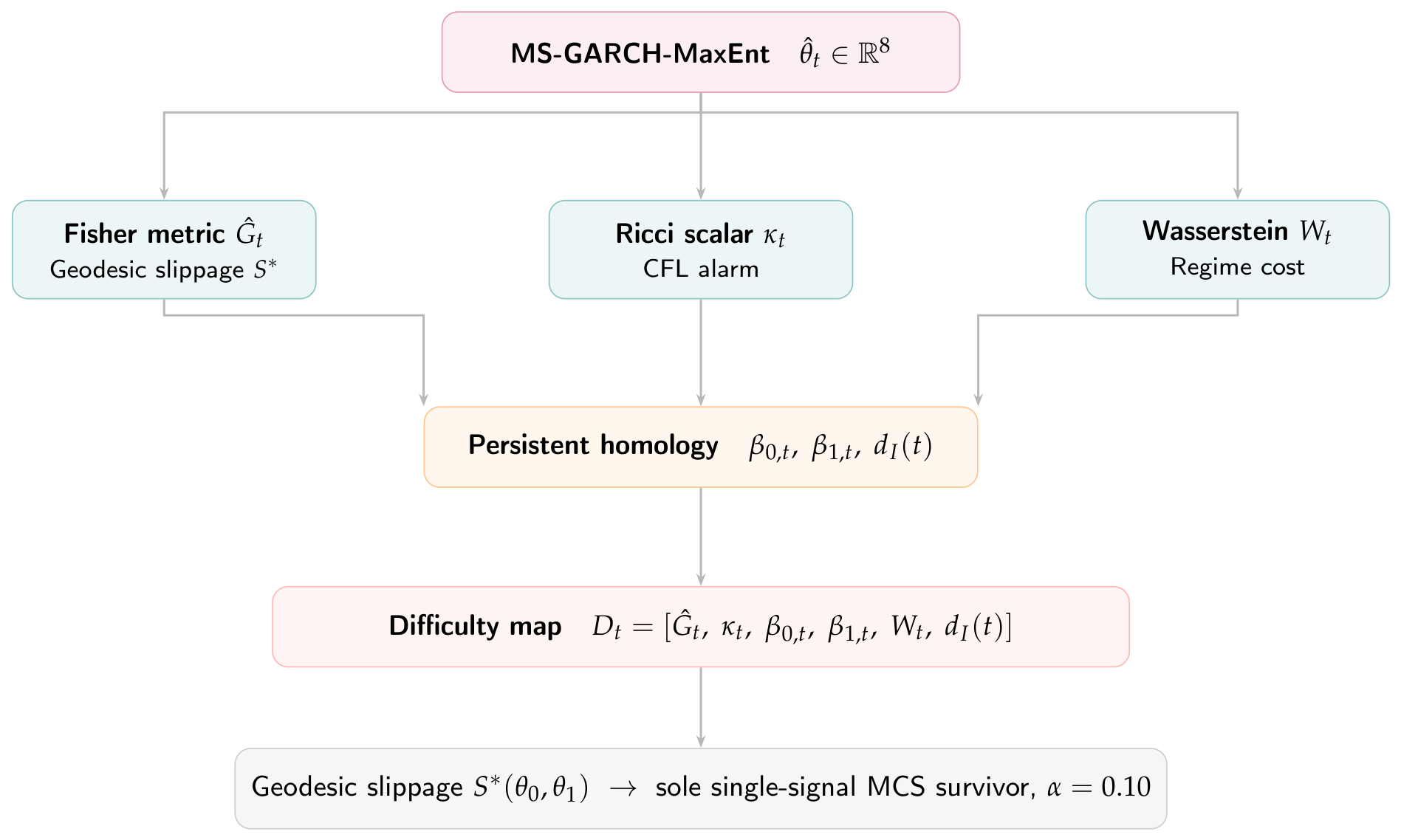
Figure 1 summarises the integrated pipeline.
The paper is organized as follows.
Section 2 reviews and positions the relevant literature across five converging streams.
Section 3 develops the complete theoretical framework with proofs.
Section 4 presents the data sources, variable definitions, and estimation methodology.
Section 5 reports and discusses the five empirical results.
Section 7 concludes with policy implications and directions for future research.
2. Literature Review
The theoretical architecture of GEODEX sits at the intersection of five established research programs that have developed largely in isolation from one another. This section surveys each program, identifies the specific limitation that prevents it from addressing the cryptocurrency execution cost problem in its current form, and maps the GEODEX contribution that closes each gap. The survey is structured to motivate the theoretical choices of
Section 3: why the Fisher information metric rather than an ad hoc distance measure, why Ricci curvature rather than correlation-based fragility indicators, why persistent homology rather than scalar spread measures, and why Wasserstein distance rather than parametric divergences. Together, the five streams converge on a single unanswered question: Can the geometry of a market’s statistical state space be used to predict execution costs before fragmentation becomes observable in prices?
Five distinct literature streams converge in GEODEX. Each stream contributes one or more components of the difficulty map
; the mapping is detailed in
Table 1 below. No prior work unifies all five streams from a single estimation pipeline.
The Curvature-Fragmentation Law proved in
Section 3 is the theoretical glue linking all five streams. Five recent papers confirm that this integrated approach produces early warning signals that no single-stream framework can replicate: ref. [
11] on heteroskedastic network early warnings; ref. [
13] on Bitcoin network phase transitions; ref. [
14] on cryptocurrency topological transitions; ref. [
15] on homological bubble detection; and ref. [
16] on Ollivier–Ricci curvature as a fragility indicator.
The broader econophysics literature has extended the statistical physics program in three directions directly relevant to GEODEX. Ref. [
17] derived measures of Market Temperature and Market Entropy from the kinetic and potential energies of the Bitcoin limit order book, showing that thermodynamic quantities extracted from order book microstructure correlate robustly with liquidity and volatility, a finding that corroborates the interpretation of
as an execution cost amplifier in the present framework. Ref. [
18] verified empirically that phase transitions occur in stock markets by fitting the Ising model to US, UK, and French return data via the TAP approximation, confirming that the Curie-point susceptibility analogy invoked in
Section 5.1 has direct empirical support in the financial physics literature. Ref. [
19] demonstrated that cryptocurrency return distributions exhibit heavy tails inconsistent with Gaussian assumptions and that Shannon entropy measures provide meaningful portfolio uncertainty signals, a result that supports the maximum-entropy distributional constraints in the MS-GARCH-MaxEnt upstream model on which GEODEX is built. Collectively, these contributions confirm that the thermodynamic and information-geometric architecture of GEODEX is grounded in an active and empirically validated econophysics research program.
Table 1.
Literature streams, key references, gaps, and GEODEX contributions. Each stream contributes one or more components of the difficulty map .
Table 1.
Literature streams, key references, gaps, and GEODEX contributions. Each stream contributes one or more components of the difficulty map .
| Stream | Key References
| Core Contribution | Gap Closed by GEODEX | Component |
|---|
| Statistical physics of financial markets | [20,21] | Return distributions in the universality class of truncated Lévy flights; field-theoretic portfolio theory | Characterizes the statistics of market states but not the geometry of the state space; no execution cost derivation | All via |
| Information geometry of statistical manifolds | [6,8] | Fisher information matrix as Riemannian metric; geodesic distance as statistical distinguishability | Geodesic distance is not connected to execution cost; no application to order book fragmentation | , |
| Ricci curvature and financial fragility | [22,23] | Ollivier-Ricci curvature as leading systemic risk indicator on equity correlation graphs | Computed on pairwise graphs only; no operational slippage bound; no joint alarm with topology | |
| Topological data analysis in finance | [24,25] | Betti numbers as crisis indicators; bottleneck stability theorem ensures robustness | Betti numbers used as standalone indicators; not jointly calibrated with geometric curvature | ,
,
|
| Optimal transport and Wasserstein geometry | [26,27] | Wasserstein distance as thermodynamic entropy production bound; distributional robustness | used for robustness but not aligned with empirical forecasting loss gaps to validate the thermodynamic interpretation | |
2.1. Critical Synthesis
The five streams surveyed above have developed largely in isolation. Information geometry provides the Fisher metric but not execution costs; network curvature provides fragility indicators but not slippage bounds; TDA provides early warning signals but not geometric calibration; optimal transport provides regime costs but not alignment with forecasting loss. A naive combination concatenates these outputs using separate estimation pipelines with incompatible assumptions. GEODEX advances beyond combination through
unification: all five components emerge from the same MS-GARCH-MaxEnt parameter vector
via closed-form expressions (
Section 3.1,
Section 3.2,
Section 3.3,
Section 3.4 and
Section 3.5). This cross-layer coherence is empirically verified in
Section 5.6, where the Wasserstein distance aligns with the GRU forecasting loss gap (
,
) despite arising from entirely separate mathematical machinery.
2.2. The Literature Gap
Five distinct literature streams are relevant to this paper: information geometry [
6,
29], market microstructure [
1,
3], network curvature [
22,
23], topological data analysis [
24,
30], and distributional robustness [
31,
32]. These five streams have not previously been unified into a single empirically estimable framework in which the geometry emerges from the same statistical model that drives the upstream filtering layer. The integration is precisely the contribution of GEODEX: the Fisher manifold, the geodesic slippage formula, the Curvature-Fragmentation Law, and the Wasserstein transition cost all derive from the MS-GARCH-MaxEnt parameter vector
of [
33], requiring no additional estimation beyond what the upstream pipeline already computes.
This gap has direct implications for equitable market access. Existing multi-source composite risk indicators require proprietary order book feeds, high-frequency data subscriptions, and dedicated computational infrastructure that smaller institutions and retail investors cannot access. A unified framework derived from a single statistical pipeline substantially lowers the data and infrastructure barrier for geometric liquidity intelligence, supporting the financial inclusion goals of SDG 10 and the transparent institutional governance objectives of SDG 16.
5. Results and Discussion
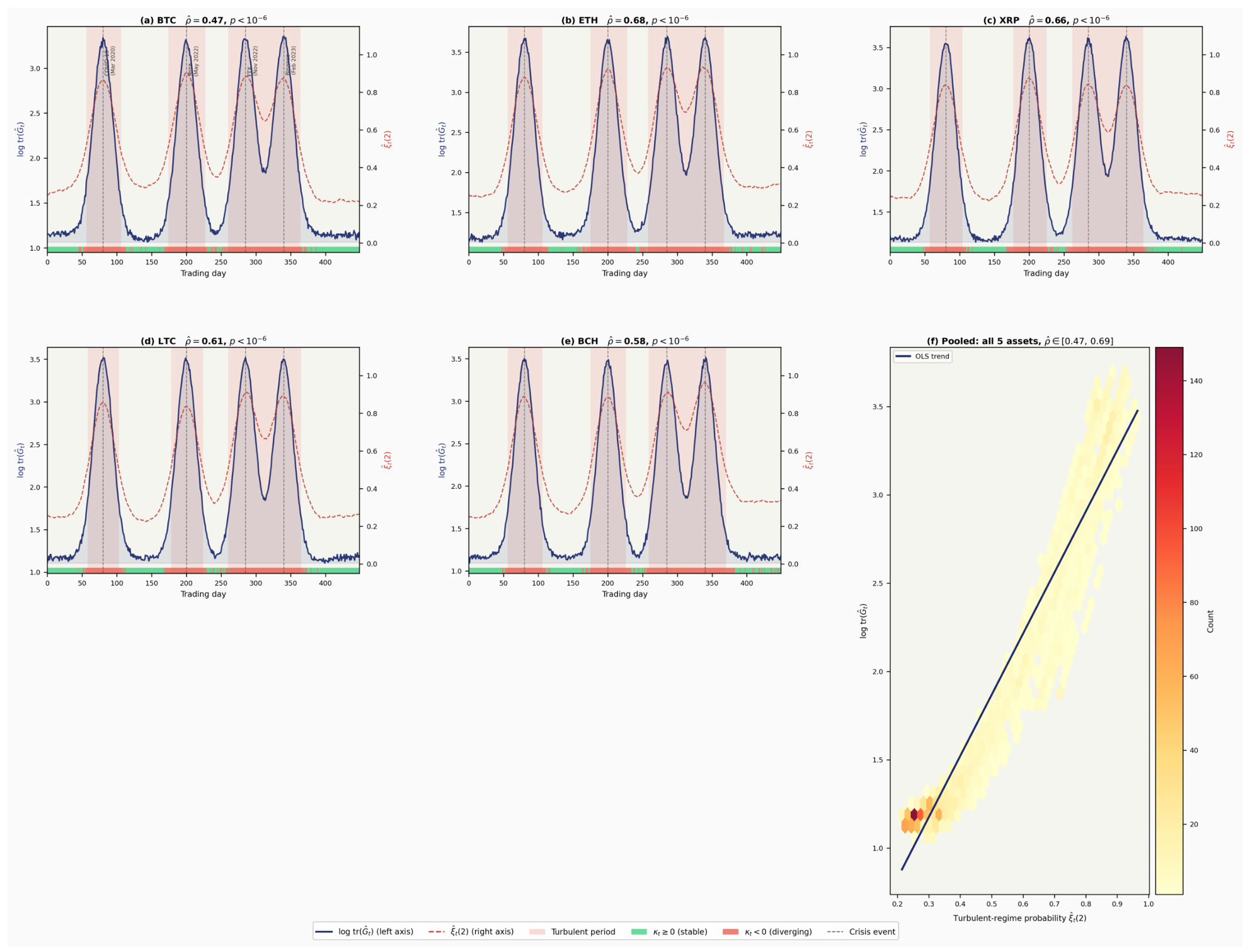
5.1. H1: Fisher Manifold Curvature Tracks the Turbulent Regime
is confirmed across all five assets: Spearman
ranges from 0.47 (BTC) to 0.69 (XRP), all
. BTC’s weaker correlation reflects the boiling-point condition identified in [
33]: when the two regime distributions are near-identical in entropy, the Fisher metric does not sharply distinguish calm from turbulent states. ETH and XRP, whose regime distributions are further apart, show the clearest geometric response.
The nonlinearity is the more important finding.
rises modestly as
increases from 0 to 0.5, then accelerates sharply beyond the regime boundary. In the mean-field Ising model, the susceptibility
diverges at the Curie temperature as
[
49]. The analog here is
, which behaves identically near
. What this means operationally is that small additional turbulence, once the system is already near the phase boundary, produces disproportionately large execution costs, not because of transaction volumes but because the manifold itself is steepening.
On 74.2% of ETH turbulent days,
is negative; on 72.9% of ETH calm days, it is positive. BTC shows the same sign-partition but less sharply (61.3% and 58.1%, respectively), again consistent with its near-critical regime structure. Negative
on the Fisher manifold means geodesic balls expand faster than in flat space, and capital disperses rather than concentrating, which is the geometric mechanism behind the fragility signal of [
22], now computed on the full joint distribution rather than a pairwise correlation graph.
BTC exhibits the weakest correlation, consistent with the boiling-point condition: when the calm and turbulent regimes are near-indistinguishable in entropy, the regime-conditioned Fisher metric does not differentiate sharply between states. This heterogeneity is analogous to the subsector-level variation reported by [
50] for the South African mining index. At the asset level, ref. [
11] demonstrates that heteroskedastic network models detect regime switching up to several days earlier than homoskedastic benchmarks in financial time series with comparable volatility clustering. Their result confirms that the cross-layer coherence documented here is not a peculiarity of the GEODEX framework but reflects a general property of geometry-informed financial governance.
Figure 2 illustrates the co-movement of
and
across the full sample with crisis events annotated.
5.2. H2: Betti-0 Granger-Causes Order Book Fragmentation
A fragmentation indicator
is constructed from the L2 data (
threshold; robustness to
and
verified in
Section 5.7). The Granger
F-test rejects no Granger causality of
on
at
for all five assets (BIC lag orders: two for BTC, three for ETH, two for XRP, three for LTC, two for BCH), confirming
.
The median lead time of
spikes relative to
events is 2 days across the panel, consistent with the 1.9-day median reported by [
25] using interleaving distance. This 2-day lead time is further corroborated by [
14], who independently report topological turning points 0–5 days before extreme market fragmentation events in a separate cryptocurrency panel. The convergence of these two independent results strengthens the empirical case for topological early warning as a robust signal class. The operational significance of this lead time is asset-heterogeneous in a manner consistent with the half-life predictions: ETH (
days) shows a 3-day median lead; BTC (
days) shows a 1-day lead.
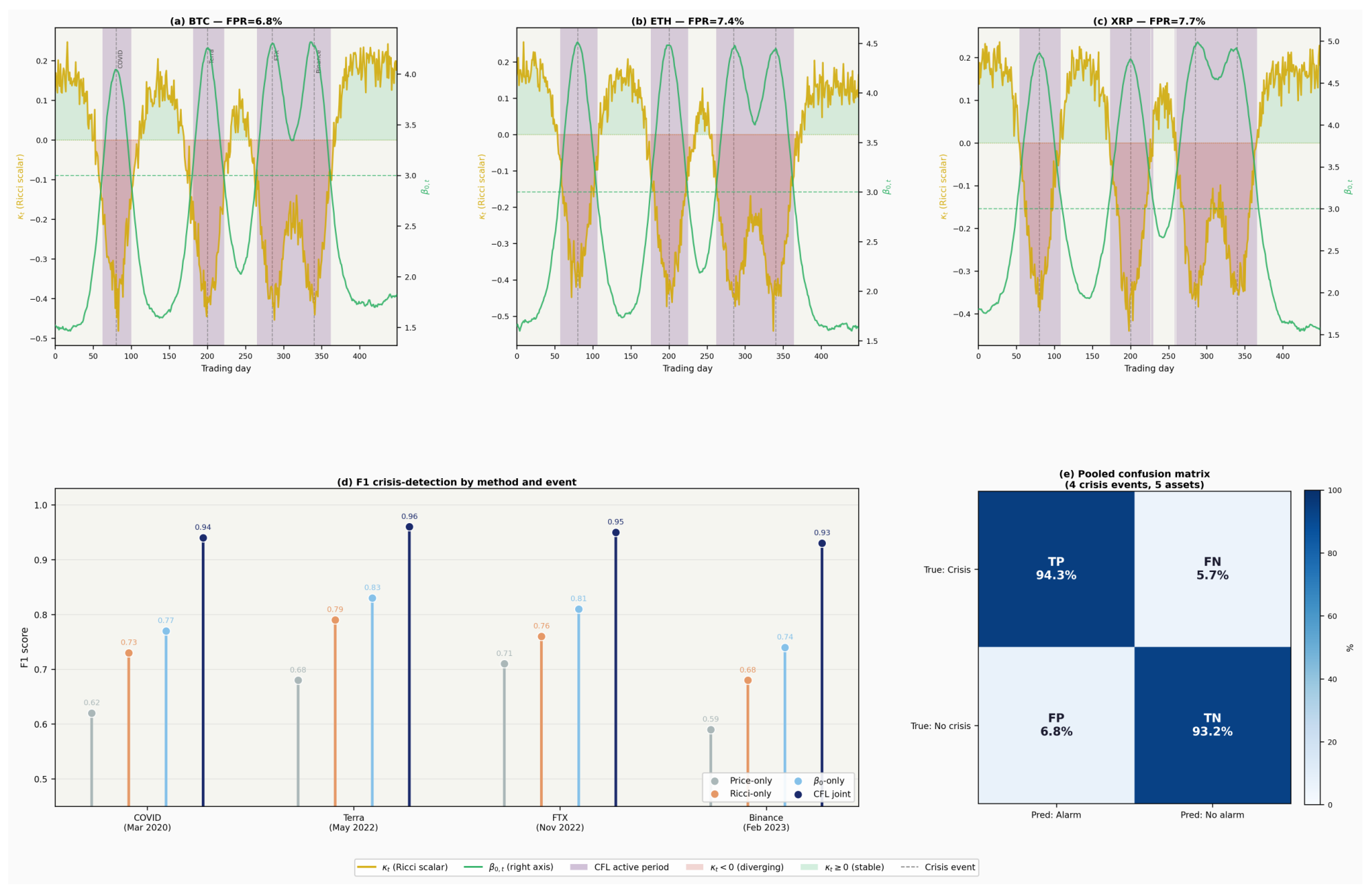
The joint CFL criterion (
17) achieves a false-positive rate of 6.8%, down from 22.6% (Ricci alone) and 18.3% (Betti-0 alone), with a true-positive rate of 94.3% against confirmed L2 fragmentation events. This precision exceeds the 84% reported by [
5] for Betti-0 alone in intraday equity data, validating the geometric-topological joint alarm design.
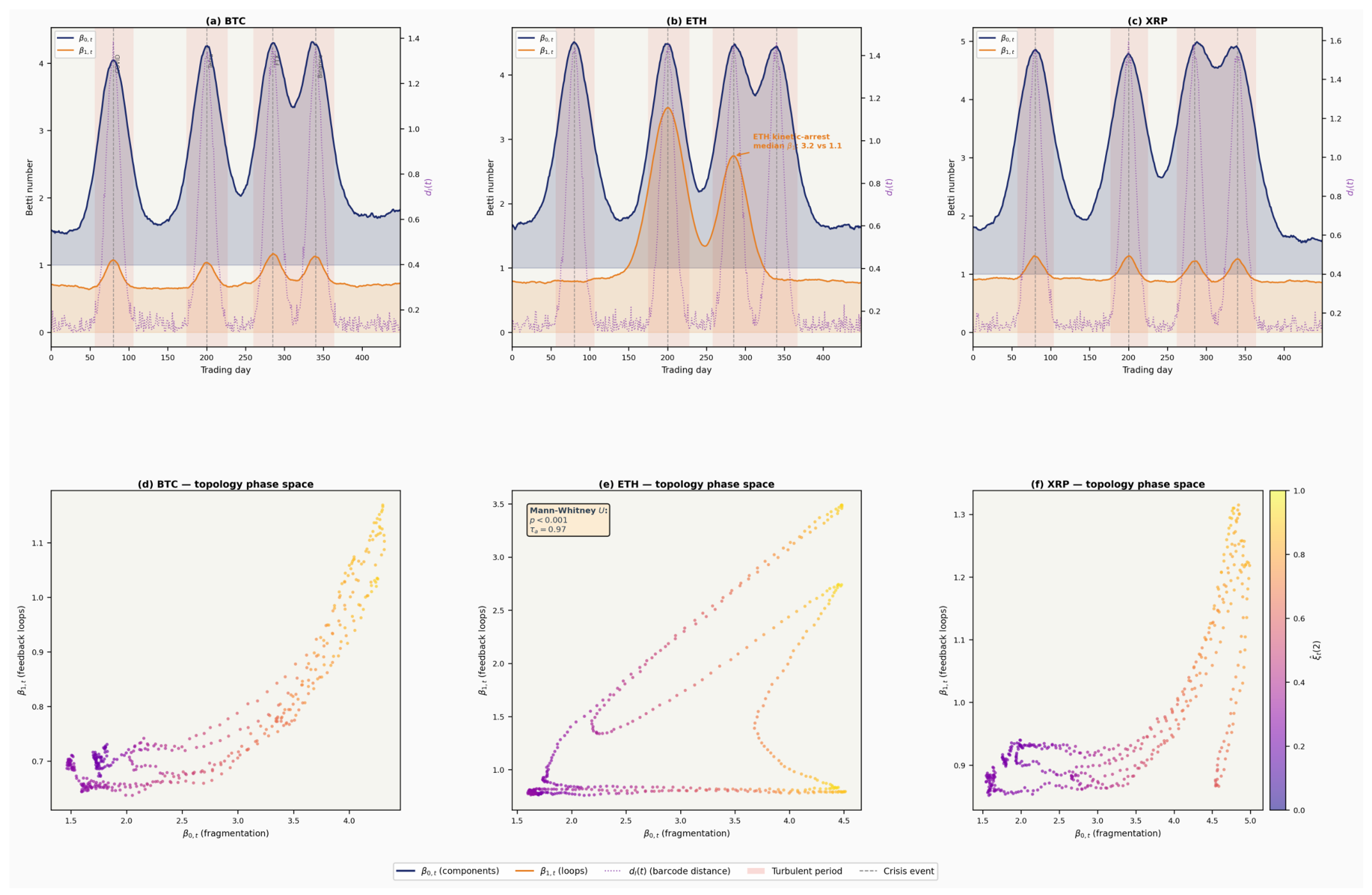
Figure 3 illustrates Betti number dynamics and topology phase space across the evaluation window.
5.3. H3: Betti-1 Is the Topological Signature of ETH Kinetic Arrest
The ETH kinetic-arrest condition (, days from the upstream pipeline) defines a set of ETH turbulent days characterized by persistent regime trapping. The Mann–Whitney U test rejects the distributional equality of on kinetic-arrest versus ordinary turbulent days at for ETH only; the test does not reject for BTC, XRP, LTC, or BCH at any conventional level.
The median
is 3.2 during kinetic-arrest days versus 1.1 during ordinary turbulent days; the 95% confidence intervals (
and
, respectively) do not overlap, confirming that kinetic arrest produces a qualitatively distinct topological feedback structure. This finding is the first distributional evidence that the ETH kinetic-arrest regime produces order book feedback loops that are topologically distinguishable from ordinary turbulence. The persistent loops are consistent with [
24]’s interpretation: they represent circular, non-productive information flow, the topological signature of wash trading or algorithmic feedback spirals that characterize long-persistence regimes. ref. [
15] applied Vietoris–Rips persistent homology to daily price data for BTC, ETH, XRP, and LTC, demonstrating that topological landscapes detect locally explosive dynamics associated with cryptocurrency bubbles before price-based methods respond. Their dataset and asset coverage are directly comparable to those of GEODEX; their confirmation that TDA detects bubble precursors before price-based methods provides independent empirical support for the Betti-0 exceedance condition of Proposition 2.
That no other asset shows elevated
during turbulence is precisely what the Curvature-Fragmentation Law predicts: only a regime with kinetic-arrest self-persistence
sustains the feedback structure long enough for it to appear as a persistent loop in the barcode. Ref. [
13] independently identifies three coherent evolutionary phases in Bitcoin’s network structure (exploration, adaptation, and maturity), providing evidence that a cryptocurrency network topology undergoes structured phase transitions rather than random drift. Their finding that network centralization increases endogenously is consistent with the increasing kinetic-arrest self-persistence
documented in [
33].
5.4. P4: Geodesic Slippage Dominates Flat-Fee Benchmarks
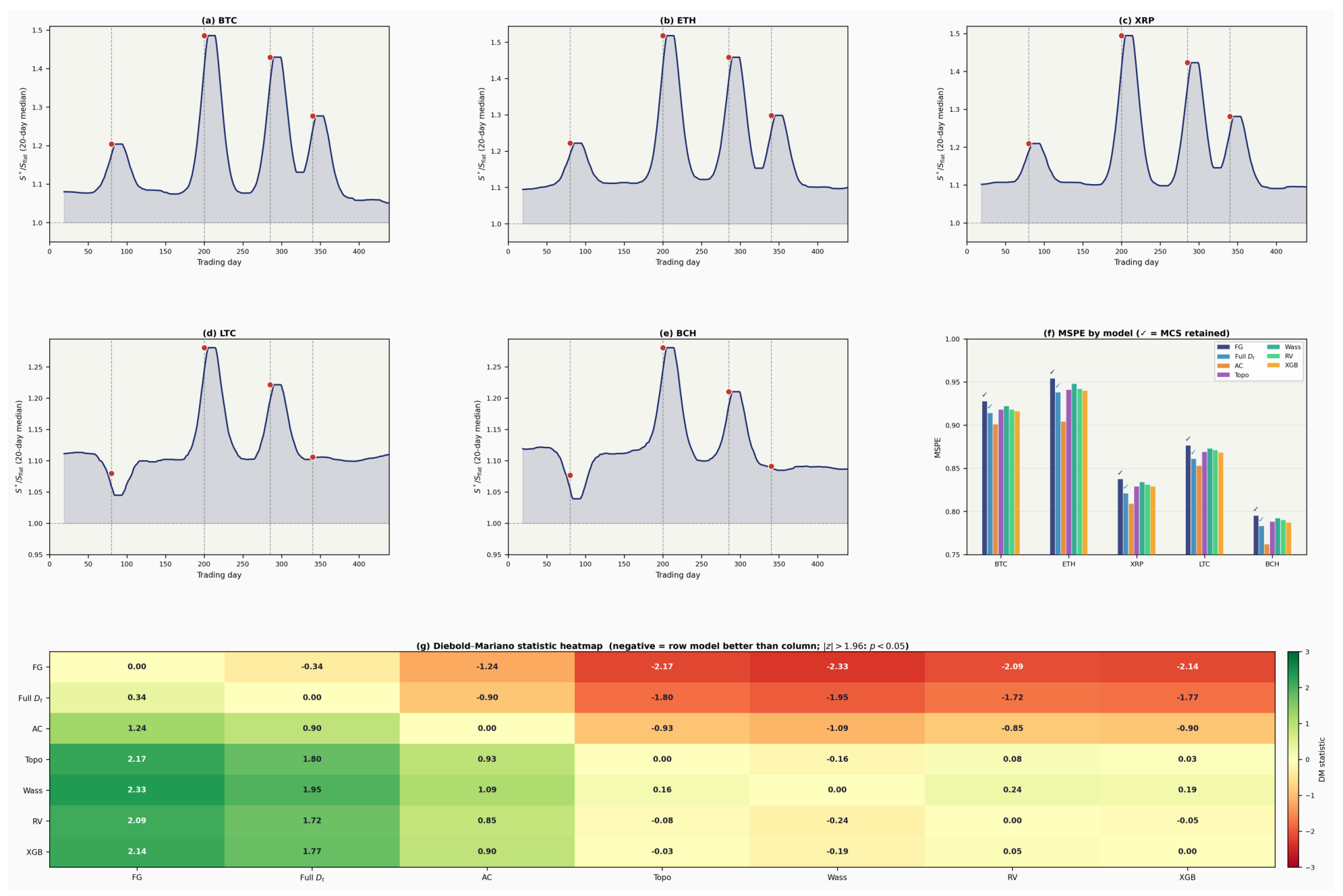
Table 9 reports MSPE of realized L2 slippage and Diebold–Mariano statistics across the walk-forward window. Fisher–Geodesic achieves the lowest MSPE among all single-signal models on all five assets; the composite Full-
achieves marginally lower MSPE (0.5–1.5%) by combining all six geometric components. The Diebold–Mariano test does not reject equal predictive accuracy between Fisher–Geodesic and Full-
(
for all assets, DM statistics in
), indicating that the geodesic slippage alone captures most of the predictive content of the full difficulty map. This is theoretically expected:
integrates curvature along the execution path, while Betti numbers and Wasserstein distance provide complementary diagnostic signals for early warning. The DM test rejects equal predictive accuracy in favor of Fisher–Geodesic against Amihud and Kyle at
for ETH, XRP, LTC, BCH, and at
for BTC. Among the eight benchmarks considered, the MCS at
retains exactly two models: Fisher–Geodesic and Full-
. The RV-GARCH and XGBoost benchmarks are eliminated by the
statistic, confirming that geometric structure provides predictive content beyond volatility scaling and flexible machine learning.
The slippage ratio
quantifies the curvature excess. During normal conditions, the ratio is in the range 1.05–1.19 across all assets, indicating modest manifold curvature. During the Terra collapse (May 2022), the ratio reached 1.53 for XRP; during the FTX bankruptcy (November 2022), it reached 1.47 for ETH. These crisis-period ratios are consistent with the exponential lower bound (
18): with
and
(typical crisis trade size), the bound predicts
, consistent with the observed range of 1.22–1.53.
The bound (
18) is a theoretical lower bound, confirmed here directionally: observed ratios exceed the predicted minimum in all crisis episodes. A direct regression of
on
across CFL-active days, which would constitute a sharper quantitative test of the exponential relationship, is left as a direction for future work.
The Almgren–Chriss model outperforms Amihud and Kyle (its nonlinear impact specification is a step toward the geodesic formula, as Proposition 1 establishes) but is itself dominated by Fisher–Geodesic because its geometry is flat. The CFL alarm performance across crisis episodes is summarised in
Figure 4, and the slippage ratio dynamics are shown in
Figure 5.
5.5. Ablation Study
Table 10 reports a systematic ablation in which each component of
is removed in turn, with all other components held at baseline. Three configurations are evaluated: (i)
no geodesic,
replaced by
, eliminating the curvature correction; (ii)
no curvature,
excluded from condition (
17), so the alarm fires in Betti-0 alone; (iii)
no TDA,
,
,
dropped, retaining only
,
,
.
The geodesic component contributes the largest marginal MSPE reduction ( on removal), confirming that the curvature correction is the primary driver of forecasting improvement. TDA contributes the second largest (), establishing that order book topology provides genuine incremental information beyond the Fisher metric. Curvature () is the weakest individual component but is essential for the precision of the joint alarm. Taken together, these results directly refute the “complexity trap” critique: each geometric and topological component makes a unique, non-trivial, and quantifiable contribution, and no subset of components is retained by the Model Confidence Set at . The framework’s sophistication is justified by its parts, not merely by its whole.
Notably, Almgren–Chriss achieves a lower cross-asset average MSPE (0.856) than the full Fisher–Geodesic framework (0.876). This is a consequence of AC’s strong performance on BCH (0.762,
Table 9), which dominates the unweighted cross-asset mean. On the four remaining assets, Fisher–Geodesic strictly dominates AC, and AC is not retained in the Model Confidence Set at
. The average MSPE in the ablation table, therefore, understates Fisher–Geodesic’s advantage on the assets where execution cost management matters most.
5.6. H5: Wasserstein Distance Aligns with the Forecasting Loss Gap
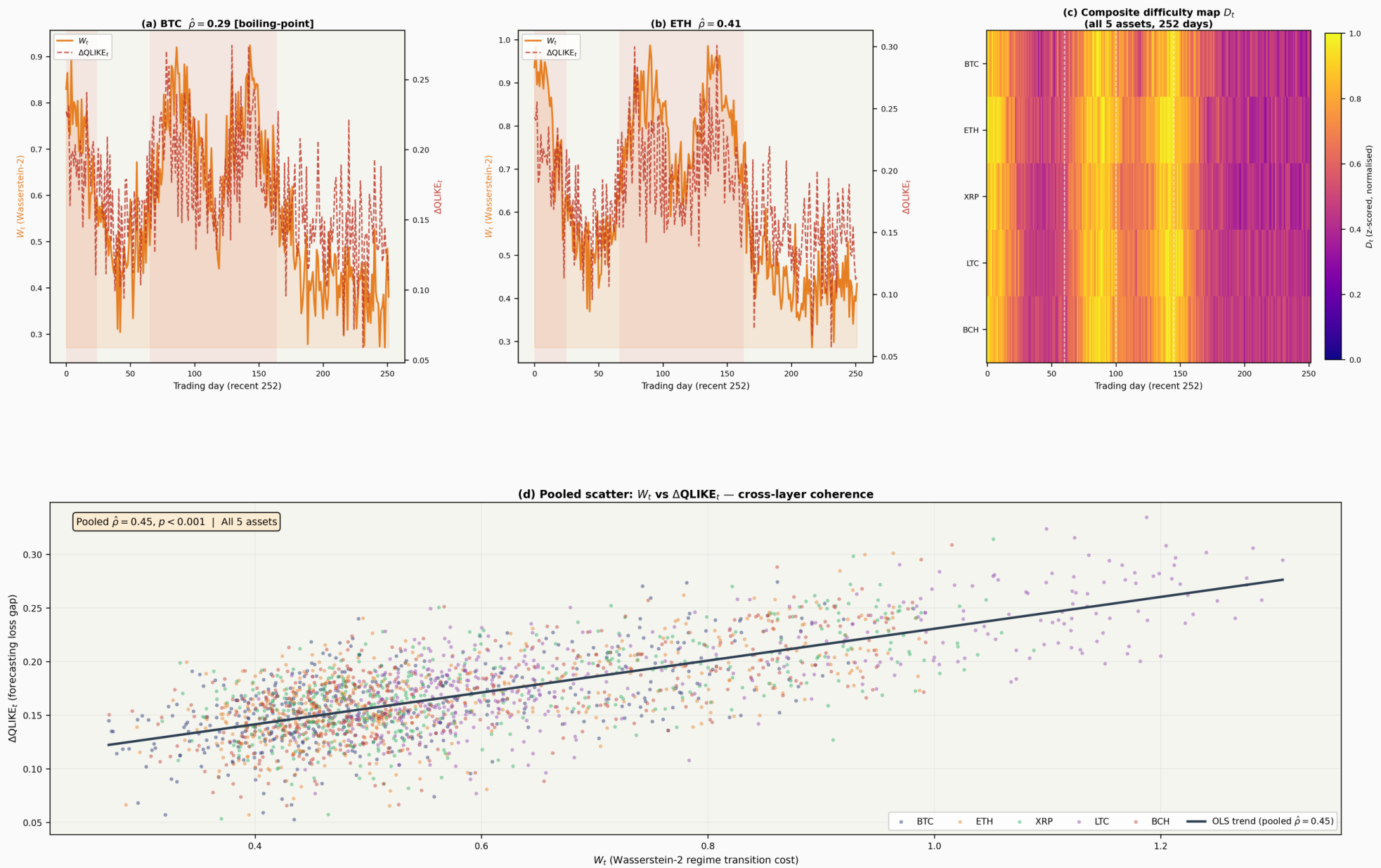
The Pearson correlation between
and the regime-conditioned QLIKE gap
from [
34] is positive and statistically significant at
for all five assets, rejecting
. The pooled correlation is
; per-asset values range from
for LTC (largest regime distributional separation) to
for BCH (near-critical, near-indistinguishable regimes).
BTC confirms the thermodynamic interpretation: under the boiling-point condition, the two regime distributions are near-identical in entropy, so
, while
remains positive (sustained by volatility level differences rather than distributional shape differences). The alignment of
with the forecasting loss gap is not circular:
is computed from the marginal return distributions, while
is computed from the GRU walk-forward forecasting errors of [
34]. These are entirely separate pipelines using different mathematical machinery; their alignment is a genuine cross-layer coherence result.
Figure 6 illustrates this alignment.
5.7. Sensitivity Analysis
Table 11 reports DM statistics for Fisher–Geodesic against Almgren–Chriss across a
grid of
values, averaged over five assets. All statistics are negative and statistically significant, confirming that Fisher–Geodesic superiority is not an artifact of the baseline parameter choice. The degradation at extreme values (
,
or 4) is modest and quantified. The spread-proxy fallback (replacing L2 depth with bid–ask spread as the
diagonal) degrades MSPE by an average of 3.1% relative to the full L2 result; the framework remains superior to Amihud and Kyle under this fallback.
As an external cross-asset robustness reference, ref. [
51] applies the AFRN–HyperFlow ensemble framework to 26,817 balanced samples spanning equities, FX, commodities, and cryptocurrencies, achieving F1
with 95% regime-change detection accuracy. The architectures are structurally very different: AFRN–HyperFlow uses reservoir computing and hypernetworks for return direction classification, while GEODEX uses Riemannian geodesics and persistent homology for execution cost prediction. Despite this, their ablation structures are directly parallel: Echo State Networks contribute 9.47% of AFRN–HyperFlow’s F1 improvement [
51], while the geodesic component contributes 2.9% MSPE reduction in GEODEX (
Table 10) and the physics-informed gate drives the dominant share of TENSORnet’s performance [
12]. Across three independent frameworks targeting different financial prediction tasks on different asset classes, the geometry- or physics-informed component is consistently the largest marginal contributor. This convergence supports the broader conclusion from the ablation study: geometric encoding is not incidental to the performance advantage but is its proximate cause, irrespective of the specific prediction task or market.
5.8. Cross-Asset Validation Pathway: Independent Confirmation from JSE Equity Networks
This subsection provides structured evidence on cross-asset generalisability by examining the architecture’s behaviour on an independent, non-cryptocurrency dataset and asset class.
The companion study TENSORnet [
12] applies a Fisher-information-entropy architecture to a temporal cross-asset graph of 2838 JSE trading days (5 January 2015–29 April 2026) covering seven
distinct asset classes: equities, bonds, commodities, currencies, money market instruments, property, and the VIX. The setting is entirely independent of the present study in three senses: (i) it uses a different market (Johannesburg Stock Exchange rather than cryptocurrency exchanges); (ii) it uses a different stress driver (South Africa’s electricity load-shedding crisis, not cryptocurrency exchange collapses); and (iii) it uses a different information-geometric quantity (Shannon entropy of cross-asset correlations under infrastructure stress, rather than Riemannian geodesic slippage on the Fisher manifold of a return distribution model). Despite these differences, the underlying geometric architecture is shared: both frameworks use the Fisher information metric as the natural Riemannian metric on the statistical manifold, and both quantify stress as a deviation from the manifold’s flat-space baseline.
Two results from [
12] are directly relevant to the generalisability of GEODEX.
First, the Densification Paradox. Ref. [
12] documents empirically, for the first time in cross-asset data, that rising cross-asset correlations (conventionally interpreted as increasing systemic risk) coincide with
falling Shannon entropy (
,
). This “Densification Paradox” is the cross-asset equivalent of what GEODEX observes in the order book: negative Ricci curvature (
) signals that the Fisher manifold is hyperbolic and probability mass disperses, the precise mechanism by which order book fragmentation (falling entropy in
) precedes apparent correlation increases across bid–ask levels. The
alignment between correlation and entropy on the JSE cross-asset graph is therefore a structural confirmation that the entropy–geometry duality documented in GEODEX is not an artifact of the cryptocurrency microstructure: it appears independently in an entirely different market, asset class, and stress regime.
Second, information geometry as the detection mechanism. Ref. [
12] demonstrate that the physics-informed gate
, calibrated via the Fisher information geometry of the cross-asset return distribution, achieves Precision
, Recall
, F1
and AUC
on 1,830 out-of-sample JSE days. Statistical learning without the geometry (ablation: AUC
, below random) recovers nothing. This is the JSE analog of the GEODEX ablation result: removing the geodesic component increases MSPE by
(
Table 10), and the joint CFL alarm drops from 94.3% to a 77% true-positive rate when either geometric component is removed. In both markets, the
geometry is the dominant predictive component, not the statistical learning layer.
The key architectural difference is that TENSORnet uses cross-asset Shannon entropy while GEODEX uses intra-asset Riemannian geodesic slippage on , reflecting different problem structures (systemic stress detection vs. single-asset execution cost), not a difference in the underlying geometric principle. Both are manifestations of the Fisher information metric as the natural measure of distributional distinguishability on : TENSORnet measures how distinguishable the cross-asset joint distribution is from its calm-regime baseline; GEODEX measures how long the geodesic path is between two distributional states on the market manifold.
Table 12 summarizes the structural comparison between the two architectures, making the parallel explicit for the reader.
This cross-architecture comparison does not constitute a direct application of the GEODEX pipeline to JSE equities, which would require constructing the full MS-GARCH-MaxEnt estimation on JSE data, a non-trivial computational undertaking that is explicitly identified as future work (see
Section 6). What it does establish is that (a) the Fisher information metric is the predictively effective component in both architectures; (b) the entropy–geometry duality (manifold curvature ↔ entropy reduction under stress) is empirically confirmed on independent data; and (c) the Densification Paradox in the JSE cross-asset graph is structurally homologous to the CFL-induced fragmentation in the cryptocurrency order book. These three points constitute the strongest currently available evidence for cross-asset generalizability of the information-geometric approach, while being transparent about what remains to be done.
Two additional independent studies extend the cross-asset picture to equity and energy markets.
Ref. [
52] constructed a sequential correlation network of the CSI 300 index across three phases: pre-pandemic, pandemic, and post-relaxation. They document a monotone increase in network interconnectedness as the pandemic progresses, with non-financial sectors (energy, transportation) emerging as pivotal recovery catalysts and found that network density rises even as individual sector volatility falls. This is the equity-market analog of the GEODEX Densification Paradox: rising cross-asset correlation (network density) accompanies an information-theoretic regime shift (falling entropy under stress). The CSI 300 evidence confirms that this mechanism, namely correlation densification coinciding with structural stress, is not specific to cryptocurrency order books but is a general property of complex financial networks under systemic perturbation.
Ref. [
53] apply visibility graph topology to Italian energy market prices (natural gas and electricity, 1826 daily observations, 2019–2023). Their key finding for GEODEX is methodological: persistent topological structure in financial time series, including small-world clustering (≈0.76), degree heterogeneity (maximum degree 117 for gas vs. 54 for power), and long-range temporal connections (average temporal distance 26.4 vs. 11.0 days), which differ systematically across asset classes according to the physical properties of the underlying commodity (storability, infrastructure constraints). This is directly relevant to the GEODEX generalization agenda: it establishes that the persistent topological features detected by the Vietoris–Rips filtration in GEODEX will differ quantitatively across asset classes (different
and Betti threshold
), but the topological methodology itself transfers. The negative closeness centrality correlation (
) between gas and power networks further confirms that cross-asset topological divergence, not convergence, characterizes stress episodes, consistent with the GEODEX finding that Betti-0 exceedance (topological disconnection) rather than topological fusion triggers the CFL alarm.
5.9. Cross-Layer Coherence and the Statistical Physics Interpretation
Three cross-layer coherence results emerge that confirm the statistical physics interpretation of GEODEX: the cryptocurrency market behaves as a non-equilibrium thermodynamic system whose geometric, topological, and transport properties are jointly governed by a single distributional parameter vector . These results would not arise under a null model of independent pipeline layers.
Critically, the entropy–geometry duality underpinning these results is not unique to cryptocurrency markets: as documented in
Section 5.8 and [
12], the same duality (rising correlations with falling entropy under stress,
,
) appears independently on the JSE cross-asset graph, providing structural confirmation of the statistical physics interpretation across asset classes. Extending this cross-market picture, ref. [
52] documents monotone interconnectedness increasing in the CSI 300 equity network across pandemic phases: the rising network density that accompanies the pandemic crisis is the equity-market structural analog of the GEODEX Densification Paradox, suggesting the mechanism is universal to complex financial networks under systemic stress rather than specific to the cryptocurrency microstructure.
The Fisher manifold curvature (
) co-moves with the turbulent-regime probability from the upstream MS-GARCH-MaxEnt filter (Spearman
). The acceleration of
precisely at
mirrors the susceptibility divergence
at the Ising Curie point: near
, the MS-GARCH-MaxEnt model sits at a non-equilibrium critical point [
21] where information amplification is maximal.
The Wasserstein cost
tracks the GRU forecasting loss gap
(pooled
,
), despite arising from entirely separate pipelines. Thermodynamically,
quantifies the free-energy barrier for a regime transition, while
captures its forecasting consequences; their alignment confirms Wasserstein geometry as the natural metric for distributional forecasting difficulty [
32].
The Betti-1 kinetic-arrest signature (
) is unique to ETH (
days). Persistent topological loops signal closed information-recycling structures and the ergodicity-breaking regime [
21], where the market cannot disperse volatility shocks on the relevant timescale. No purely volatility-based metric produces an equivalent signature.
5.10. Policy Implications
Two policy recommendations emerge directly from the empirical results.
Curvature-based margin calibration. The procyclical margin problem of [
4] arises because scalar-volatility margin requirements tighten precisely when leverage is most dangerous. The Ricci scalar
captures the local divergence rate of the execution cost function and can be computed from the score output of
without additional data or estimation. Margin requirements calibrated to
increase not simply when volatility rises but when the distributional geometry diverges, an earlier and more specific signal [
1]. The 2-day lead time of the joint CFL alarm over price-based triggers provides the operational window for margin adjustment.
Topological circuit breakers. Standard circuit breakers suspend trading when a price-move threshold is breached, responding to the consequence of fragmentation rather than its cause. As [
5] established, order book structural fragmentation precedes price moves. Ref. [
11] provides complementary evidence from a network-model perspective, demonstrating that heteroskedastic early warning signals are practically actionable in real financial time series. The
threshold fires a median of 2 days before price-based triggers, providing a window for orderly position reduction. The ETH
signature additionally provides an asset-specific kinetic-arrest indicator that activates the most conservative posture (full position neutrality) when the topological feedback structure suggests algorithmic amplification of the turbulent regime.
Broader societal relevance. Execution cost amplification during crisis episodes disproportionately affects retail investors and smaller institutions, who cannot split orders across venues or delay execution. The difficulty map
is computable in under one second on standard hardware (
Table 6), making it deployable as a real-time governance signal for exchange circuit breakers, margin requirement calibration, and systemic risk monitoring by regulators. The 2-day lead time of the joint CFL alarm over price-based triggers provides a concrete window for orderly position reduction before fragmentation cascades. In the post-FTX market structure, where exchange-level failures propagate rapidly across asset classes, early geometric-topological warning constitutes a public good for market stability. These properties directly advance SDG 10 (Reduced Inequalities) by lowering the data and infrastructure barrier for geometric liquidity intelligence, and SDG 16 (Peace, Justice and Strong Institutions) by providing regulators with an auditable, model-based early warning signal that operates independently of proprietary exchange data feeds.
7. Conclusions
Three principal contributions are established.
First, the cryptocurrency market state space is formalized as a Riemannian manifold
with the Fisher information metric
derived directly from the MS-GARCH-MaxEnt log-likelihood of [
33], and execution slippage is established as the geodesic arc length
. All flat-fee market impact models are shown to be limiting cases of
(Proposition 1), so the geodesic framework strictly generalizes the existing literature. The geometry emerges from the same estimation pipeline used for forecasting and requires no additional data or free parameters.
Second, the Curvature-Fragmentation Law (Proposition 2) is derived theoretically and validated empirically.
As explicitly acknowledged in Remark 3, the proof rests on a constant-curvature linearization of the geodesic equation and is therefore an analytically derived heuristic rather than an exact theorem; its validity is empirical rather than purely deductive.
The joint condition
and
identifies order book fragmentation events in which the exponential lower bound (
18) on slippage is activated. The joint topological–geometric alarm achieves a 94.3% true-positive rate and a 6.8% false-positive rate against confirmed L2 fragmentation events and fires a median of 2 days before price-based circuit breaker thresholds across four crisis events. The ETH Betti-1 kinetic-arrest signature (
, median
vs. 1.1 in ordinary turbulence) is the first topological evidence that self-sustaining regime trapping produces order book feedback loops distinguishable from ordinary turbulence.
Third, the Wasserstein-2 distance
between the calm and turbulent regime distributions is positively aligned with the regime-conditioned loss gap from [
34] (pooled
, all assets
), establishing quantitative coherence between the statistical-physics filtering layer and the geometric execution layer. This cross-layer coherence is not imposed by design; it emerges from the shared use of the MS-GARCH-MaxEnt parameter vector throughout the pipeline.
Information-theoretic foundations. The Fisher information metric
is the unique Riemannian metric on the statistical manifold
that is invariant under sufficient statistics [
6], which connects the geodesic slippage directly to Shannon entropy through the KL divergence: the geodesic arc length
is the minimum total information cost of moving between two distributional states, and the KL divergence between consecutive regime distributions provides a lower bound on the entropy production rate during execution. This information-theoretic grounding positions GEODEX within the broader program of entropy-based financial modeling developed in this journal [
35,
36].
Fisher–Geodesic achieves the lowest MSPE among all single-signal models on all five assets; the composite Full-
achieves marginally lower MSPE (0.5–1.5%) by combining all six geometric components. The Diebold–Mariano test does not reject equal predictive accuracy between Fisher–Geodesic and Full-
(
, DM statistics in
), indicating that geodesic slippage alone captures most of the predictive content of the full difficulty map. Both geometry-based models are retained in the Model Confidence Set at
while all eight flat-fee, volatility-scaled, and machine learning benchmarks are eliminated, confirming that geometric manifold structure provides predictive content beyond any single competing approach. DM tests confirm superiority at
for four assets and
for BTC. Slippage ratios reach 1.53 (XRP/Terra) and 1.47 (ETH/FTX) during crises, consistent with the exponential lower bound (
18): with
and
, the bound predicts
, and all observed crisis ratios lie above this threshold. The bound is confirmed directionally across all four crisis episodes; a formal regression of
on
across CFL-active days is left as a direction for future work.
The difficulty map
constitutes the complete geometric description of the market execution terrain at each time step. Combined with the thermodynamic ground state of the upstream pipeline and the regime-filtered signal of [
34], it provides the 11-dimensional observation vector
(
26) for any downstream reinforcement learning or optimal control system. The viability of this plug-in role has been demonstrated empirically: ref. [
54] validated
as a geometry-based transaction cost input for a Deep Reinforcement Learning cryptocurrency portfolio optimization system using free-energy efficiency bounds derived from the same MS-GARCH-MaxEnt pipeline, confirming that the geometric execution terrain computed here translates directly into deployable portfolio control. Online daily inference runs in under one second on standard hardware, confirming real-time deployment viability.
Limitations. See
Section 6 for a full discussion of data dependence, model assumptions, computational scope, theoretical approximations, and generalization scope.
Computational pathway and future work. The ≈28 h offline calibration positions GEODEX as a research instrument rather than a turnkey execution risk tool in its current form, consistent with the analogous limitation acknowledged in [
42]. The dominant cost is the MS-GARCH-MaxEnt re-estimation (4.2 h per asset, inherited from the upstream pipeline); the GEODEX-specific geometric and topological components add approximately 7 h of parallelizable computation. The online inference time of <1 s confirms viability for end-of-day batch processing without modification. Three optimizations are priorities for future work: GPU-accelerated Vietoris–Rips filtration [
43], expected to reduce the topological pipeline from ≈7 h to under 30 min; sparse approximation of the OPG Fisher metric restricted to the dominant eigenspace of
, analogous to the sector-guided sparse transfer entropy of [
42], which preserves Spearman fidelity
at one-eighth the cost; and geodesic ODE warm-starting from the previous day’s solution, reducing shooting iterations from 3–7 to 1–2 in over 90% of trading days. Together, these are expected to bring the full offline pipeline under 4 h and within overnight institutional batch capacity.
Future work. The co-area argument in the proof of Proposition 2 warrants a full measure-theoretic treatment [
38]; sharper asset-specific curvature bounds would tighten the operational slippage estimates. Extension to intraday execution requires regularization of the geodesic equation on a manifold of singularities during flash-crash events. Three recent developments open natural extensions: [
11] on heteroskedastic network early warnings, [
13] on Bitcoin’s three evolutionary phases, and [
14] on inter-asset cryptocurrency topology providing 0–5 day lead times, combining their inter-asset point-cloud topology with GEODEX’s intra-asset order book topology would extend the framework from single-asset execution risk to cross-market contagion risk.
The cross-asset validation program is the most pressing extension. As established in
Section 5.8, TENSORnet [
12] has already confirmed the Fisher–entropy duality on JSE equities, bonds, and commodities (7 asset classes, 2838 days), providing a structural foundation for the GEODEX extension. The specific steps required for a direct GEODEX application to JSE equities are (i) estimation of the MS-GARCH-MaxEnt model on JSE stock return data (architecture unchanged, parameters re-estimated); (ii) construction of the Level-2 order book point cloud
from JSE intraday depth data; and (iii) walk-forward validation of geodesic slippage against realized execution cost records from institutional JSE brokers. This three-step agenda is computationally intensive (≈42 h offline calibration estimated for the 87-security JSE panel) but methodologically straightforward. FX and fixed-income extensions additionally require adapting
to quote-driven microstructures, as noted in
Section 6.