Article

Coupling Divergence Under Regime Switching: A Methodology for Structural Systemic Risk in Heterogeneous Subsystems


1
CoE “National Center of Mechatronics and Clean Technologies”, 1000 Sofia, Bulgaria
2
Department of Computer Systems and Technologies, Faculty of Computer Systems and Technologies, Technical University of Sofia, 8 Kliment Ohridski Blvd, 1000 Sofia, Bulgaria
*
Authors to whom correspondence should be addressed.
Entropy 2026, 28(6), 689; https://doi.org/10.3390/e28060689
Submission received: 24 April 2026 / Revised: 1 June 2026 / Accepted: 8 June 2026 / Published: 15 June 2026

Abstract

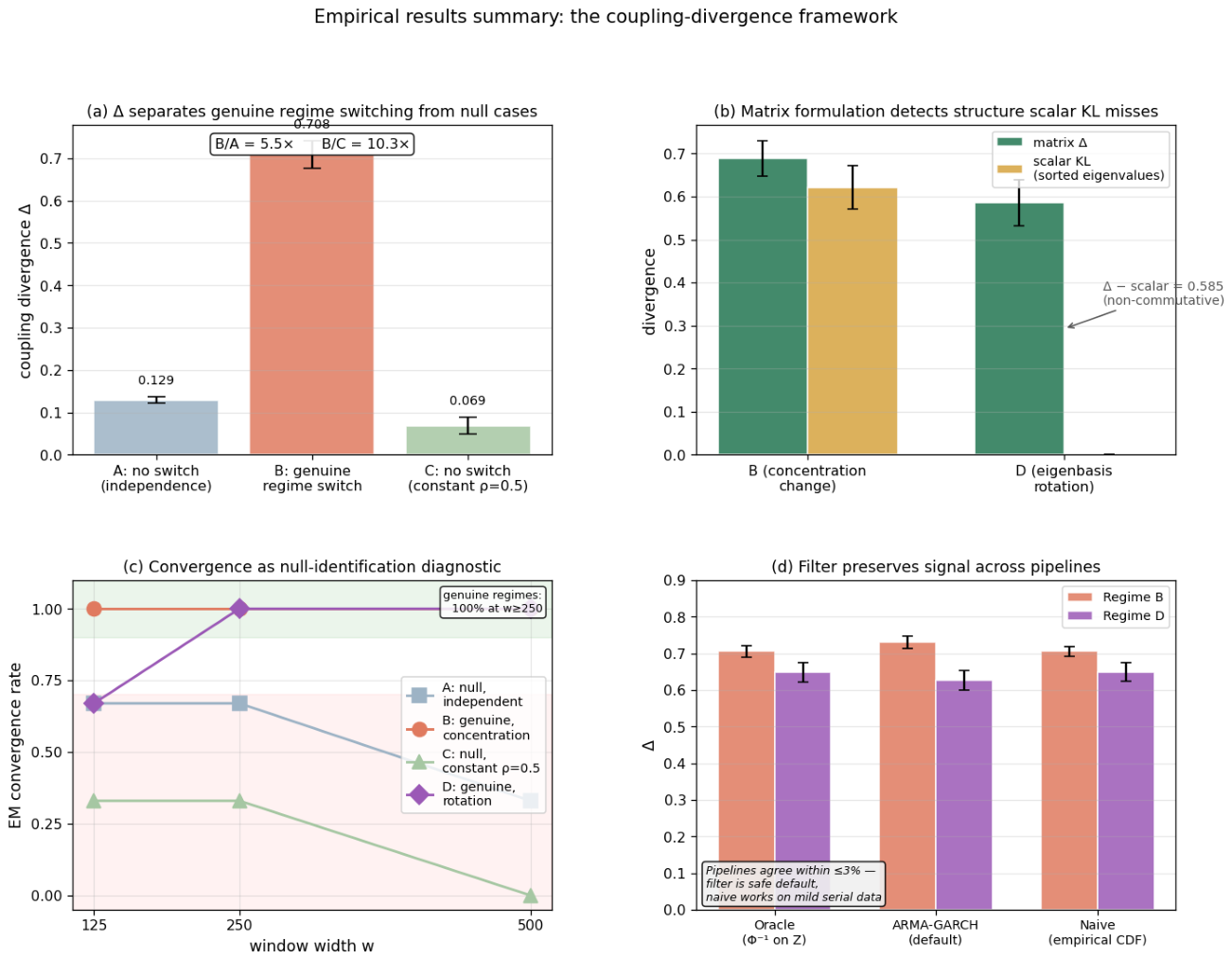
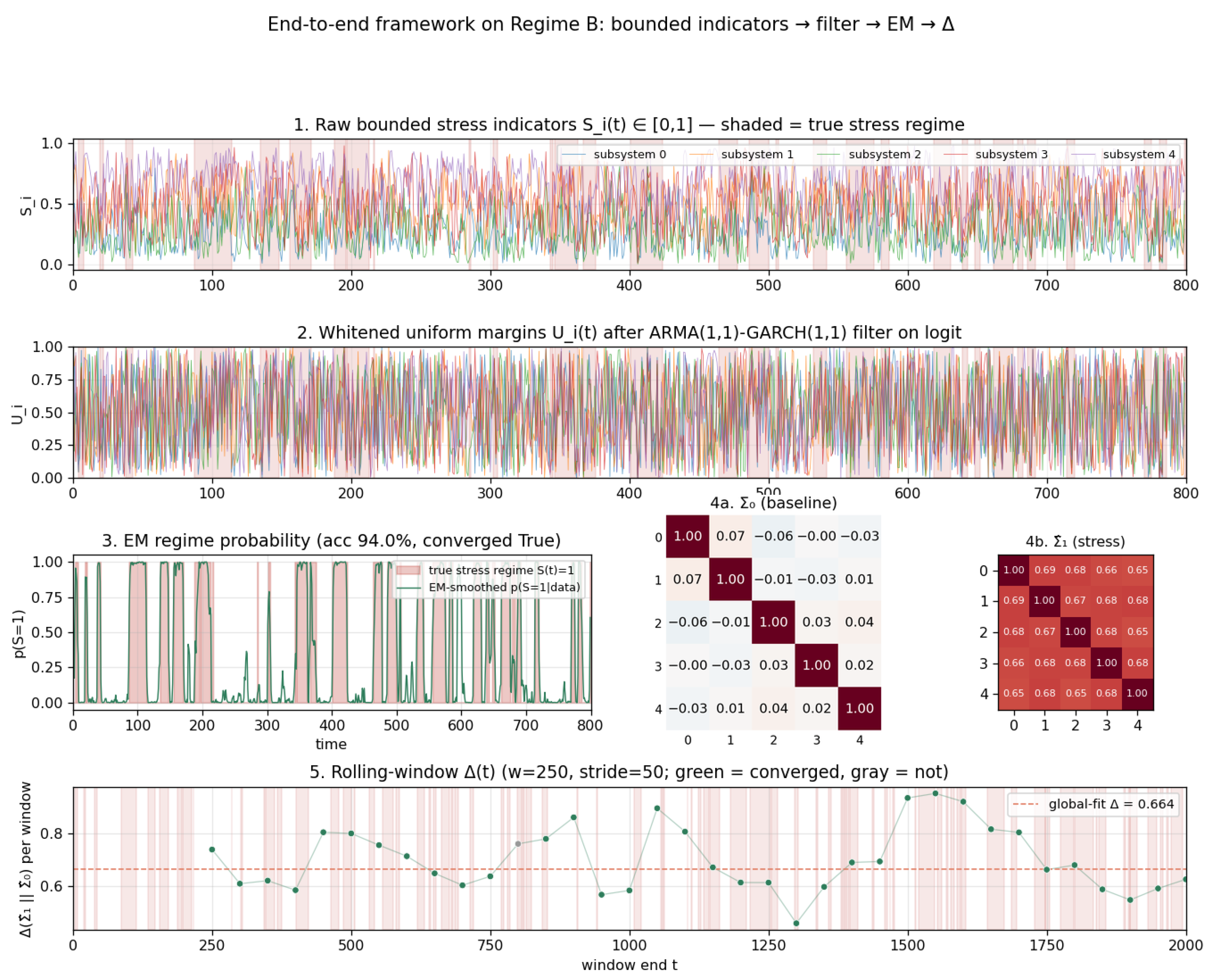
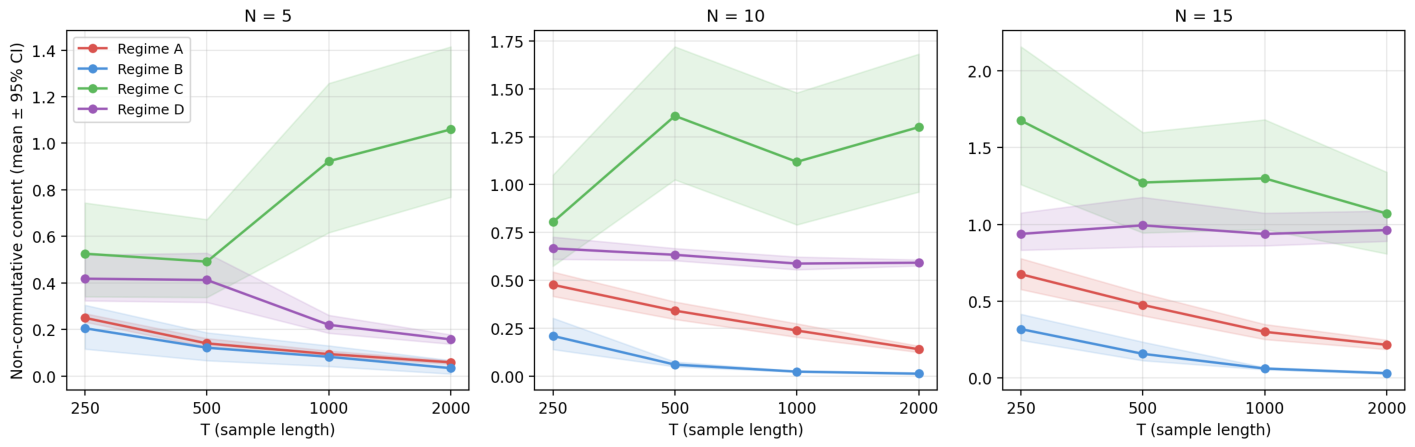
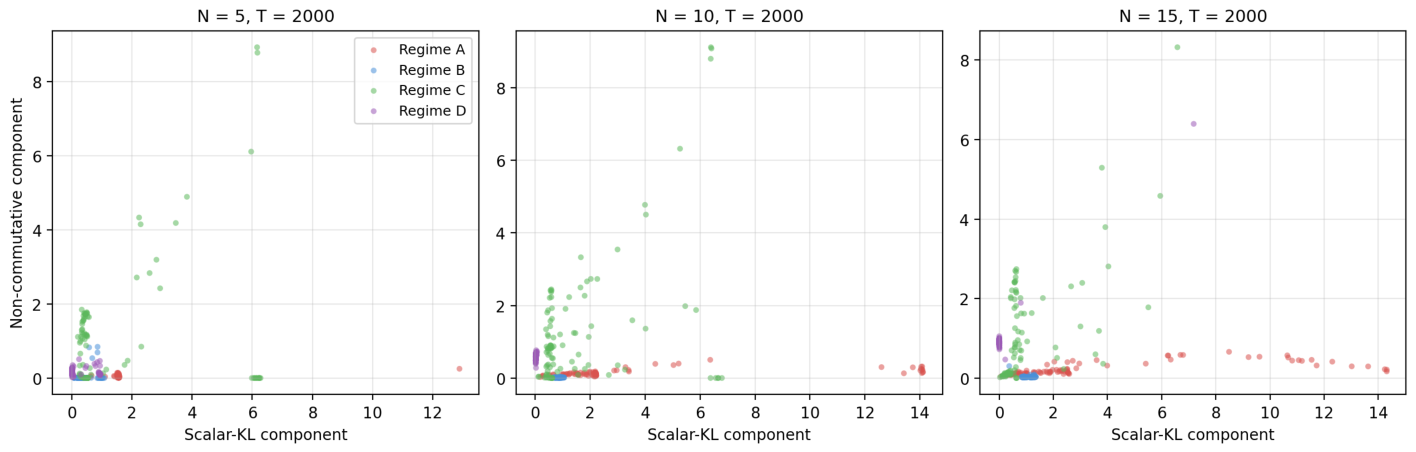
Background: Systemic risk in heterogeneous multi-subsystem settings has been addressed by composite stress indices, spectral entropy of correlation matrices, and regime-switching copula models; none directly measures structural divergence between regime-conditional coupling matrices under an explicit hidden-regime model. Methods: We embed whitened subsystem indicators in a two-regime Gaussian-copula hidden Markov process and define the coupling divergence as the matrix relative entropy between regime-conditional correlation matrices. We establish non-negativity, reduction to scalar Kullback–Leibler divergence between sorted eigenvalue distributions under commutativity, orthogonal invariance, and vanishing under the no-regime-switching null. Results: On stylized simulation, the framework separates regime-switching from single-regime null cases at an operating window T ∈ [250, 1000]; it isolates eigenbasis-rotation signals invisible to any sorted-eigenvalue method, with 99.9% of the divergence in the rotation regime residing in the non-commutative component; it tolerates Gaussian-copula misspecification under heavy-tailed processes with a quantifiable upward bias; and expectation–maximization convergence behavior serves as an auxiliary null-identification diagnostic. Conclusions: The framework composes existing primitives into a regime-to-regime structural divergence and isolates a compositional mode of regime change beyond scalar methods. Results are internal-validity claims on synthetic data; external validation on real multi-subsystem data is an open question.
Keywords: matrix relative entropy; coupling divergence; systemic risk; regime switching; hidden Markov model; Gaussian copula; econophysics; structural entropy; eigenbasis rotation; heterogeneous subsystems matrix relative entropy; coupling divergence; systemic risk; regime switching; hidden Markov model; Gaussian copula; econophysics; structural entropy; eigenbasis rotation; heterogeneous subsystems