Towards a Mathematical Structure of Global Phenomenal Consciousness

 , , , and
Abstract
1. Introduction
2. Structural Approaches to Phenomenal Consciousness
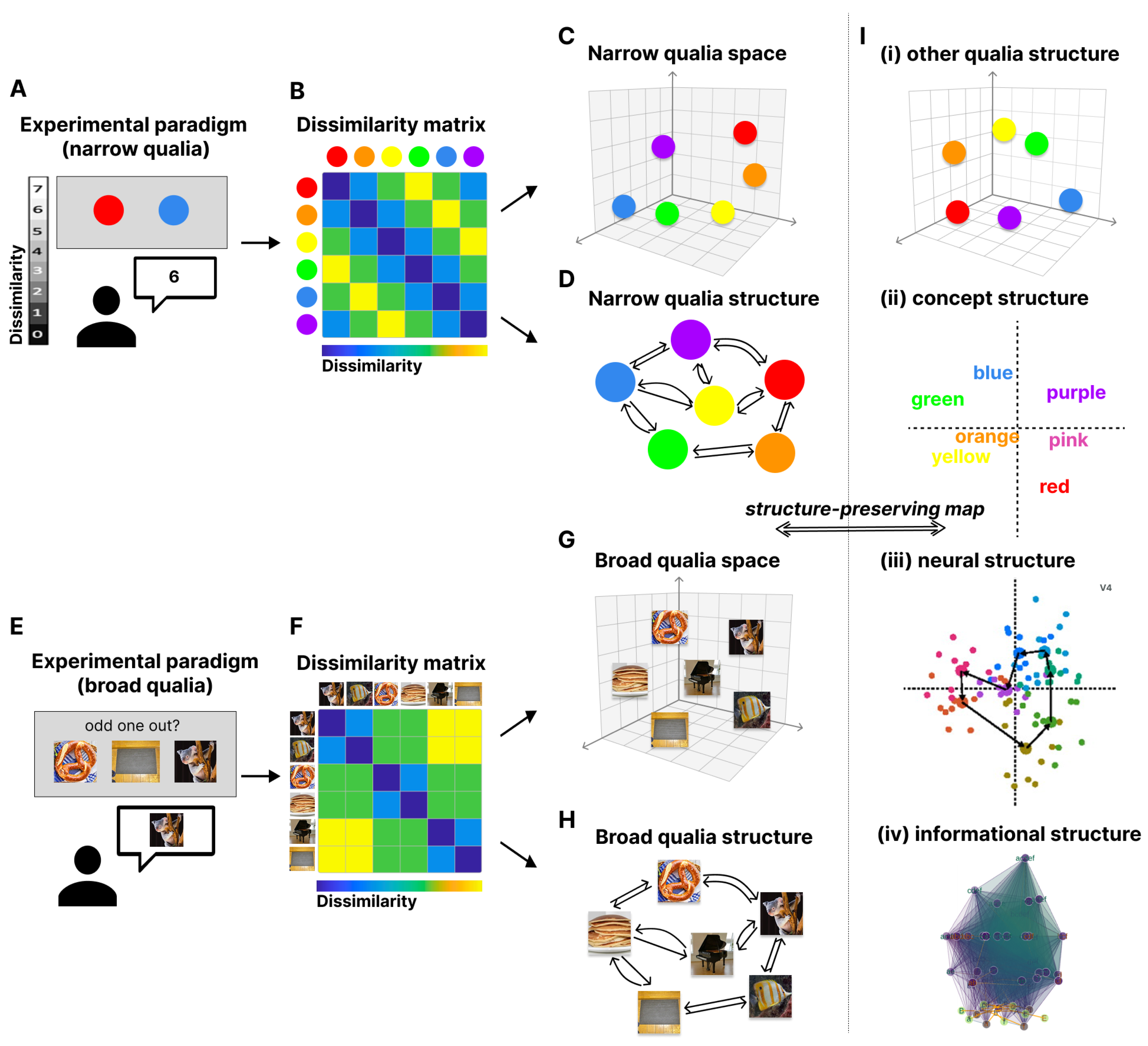
Mathematizing Structural Descriptions of Qualia
3. Two Types of Structural Descriptions of Qualia
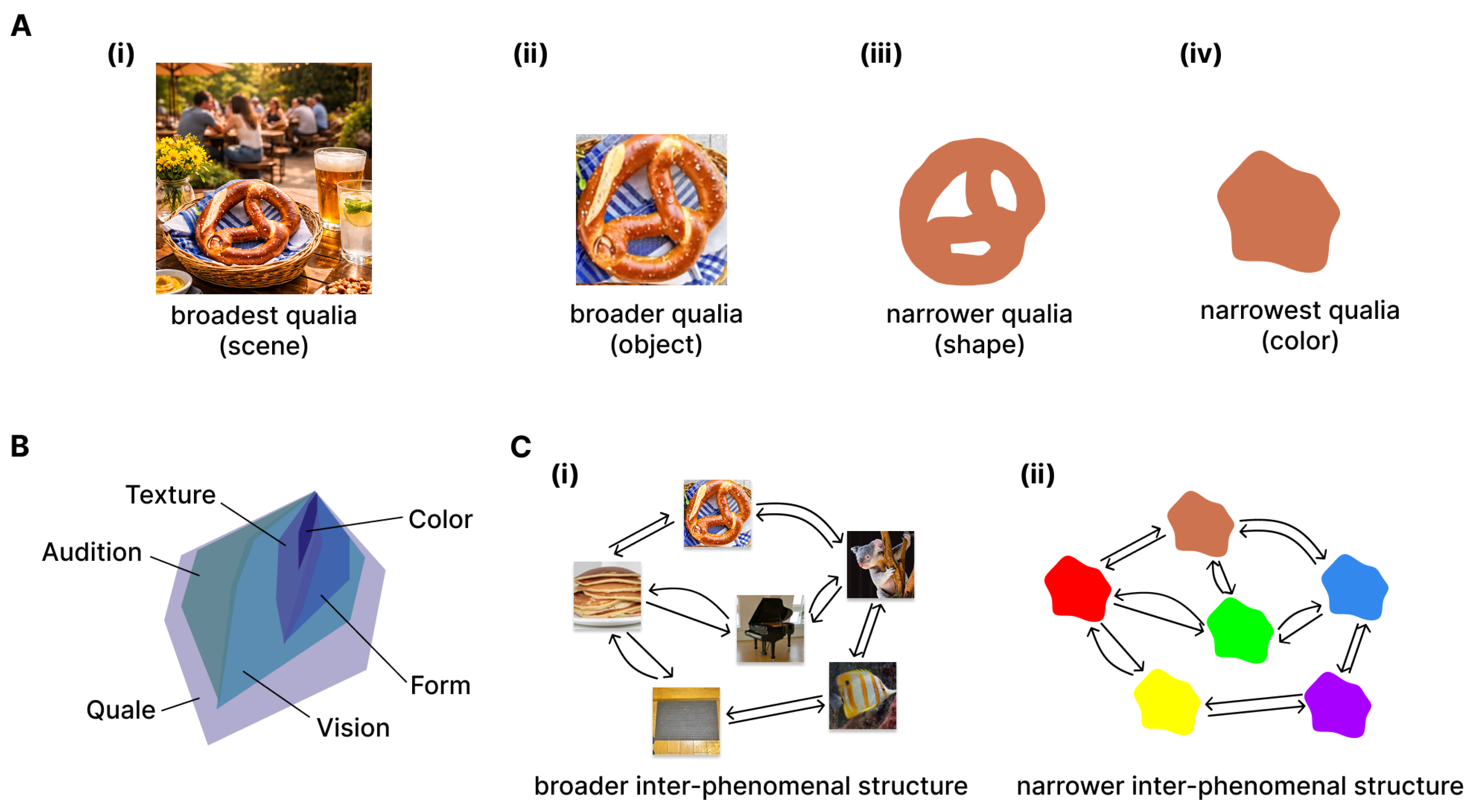
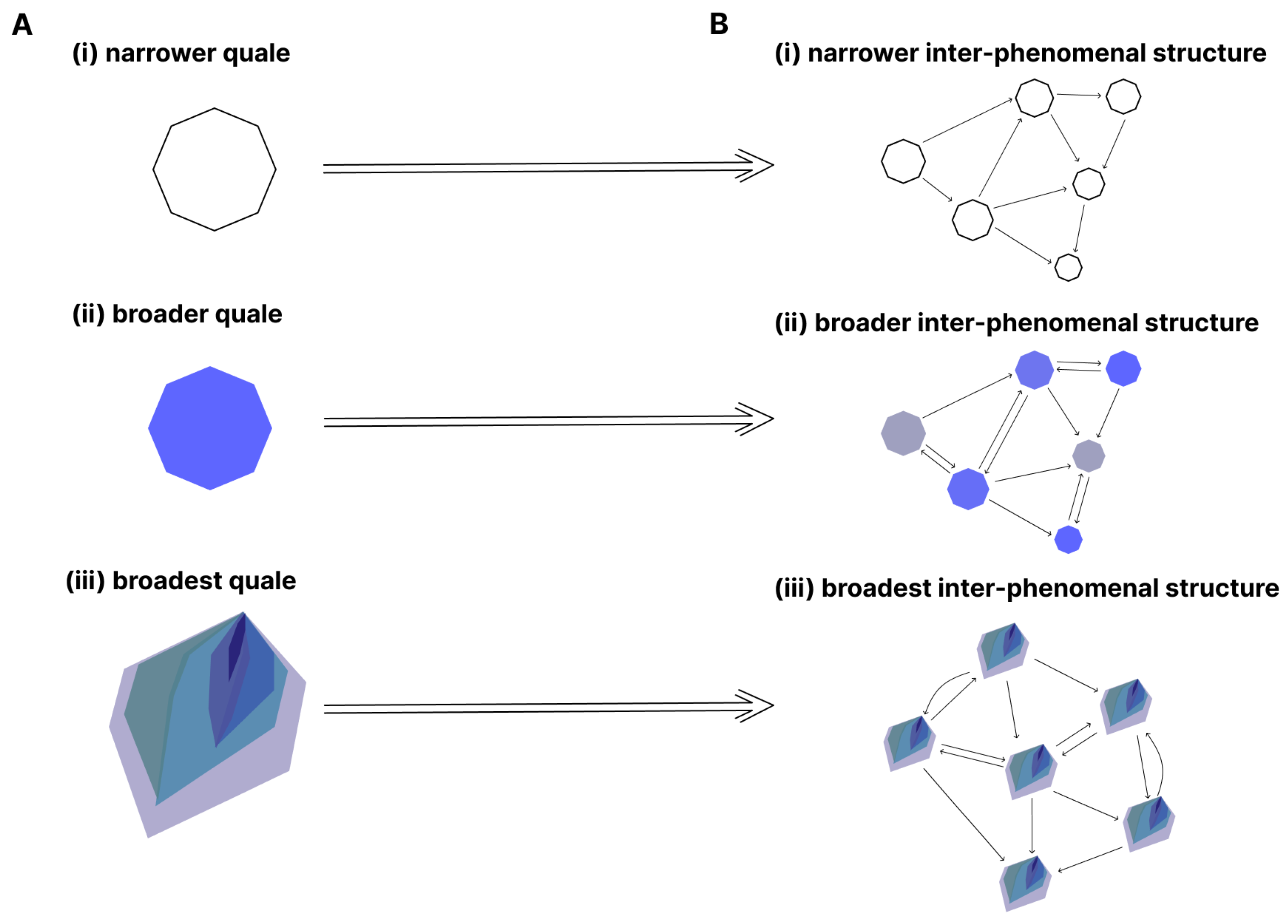
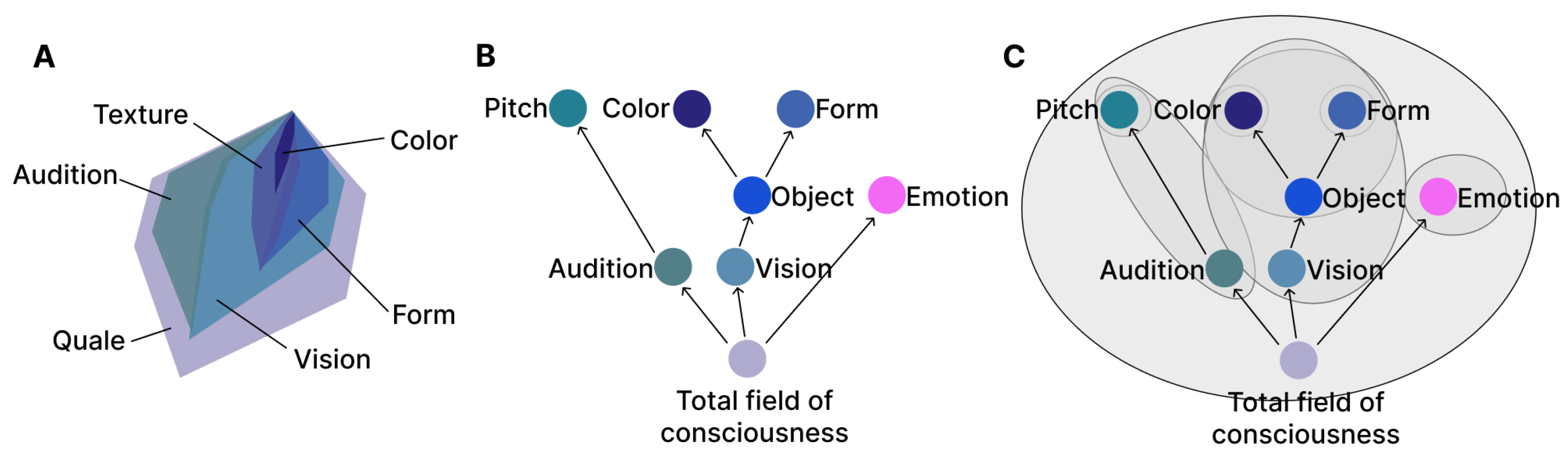
3.1. Intra-Phenomenal Structures
3.2. Inter-Phenomenal Structures

4. Mathematical Model of Broad Qualia
4.1. Sheaf-Theoretic Framework for Broad Qualia
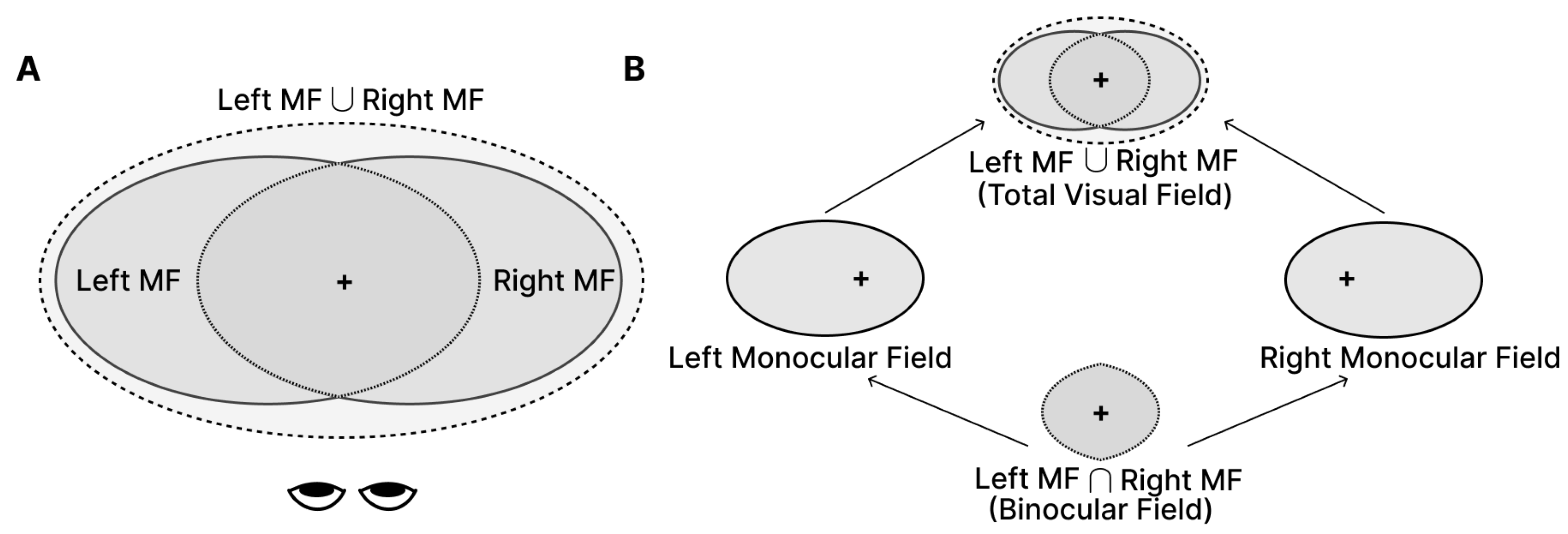
4.1.1. Intra-Phenomenal Structure as a Topological Space as a Category
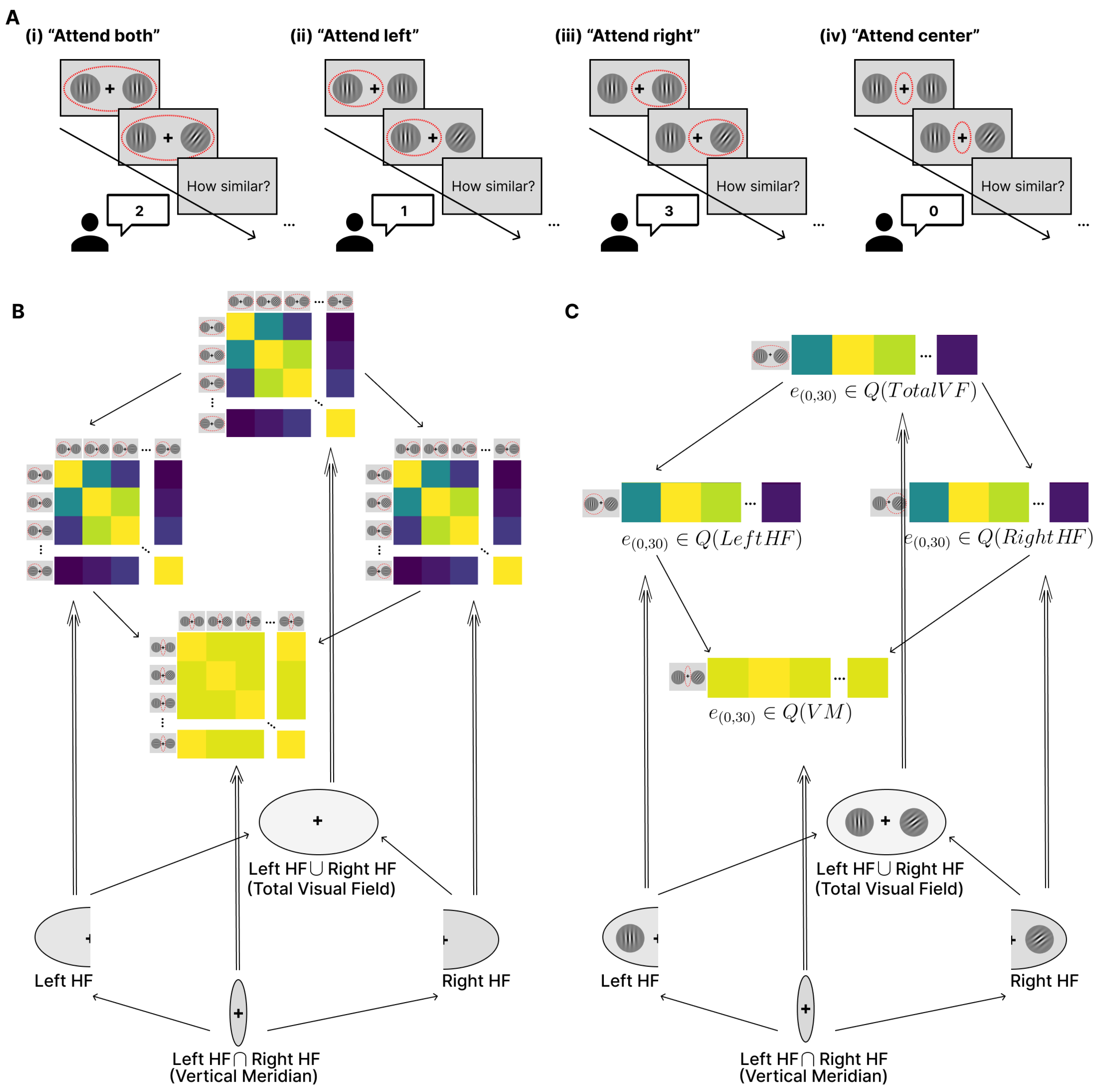
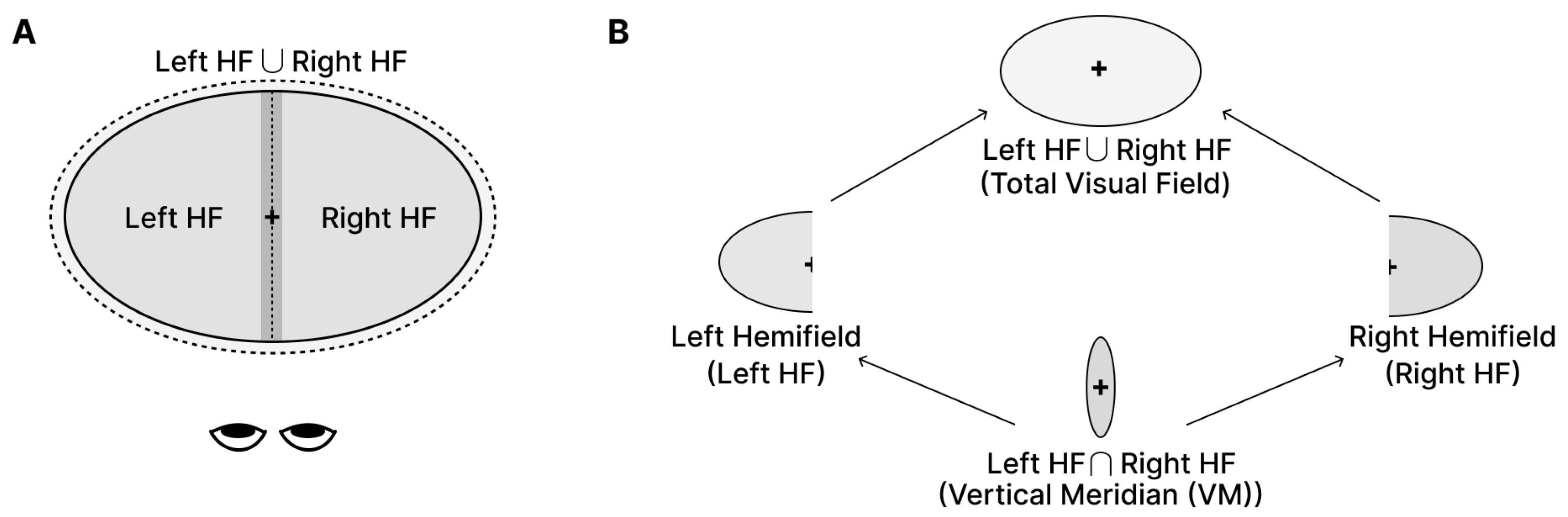
- Example. Experience of the Visual Field as a Topological Space
4.1.2. Local Assignment of Phenomenal Qualities as a Presheaf
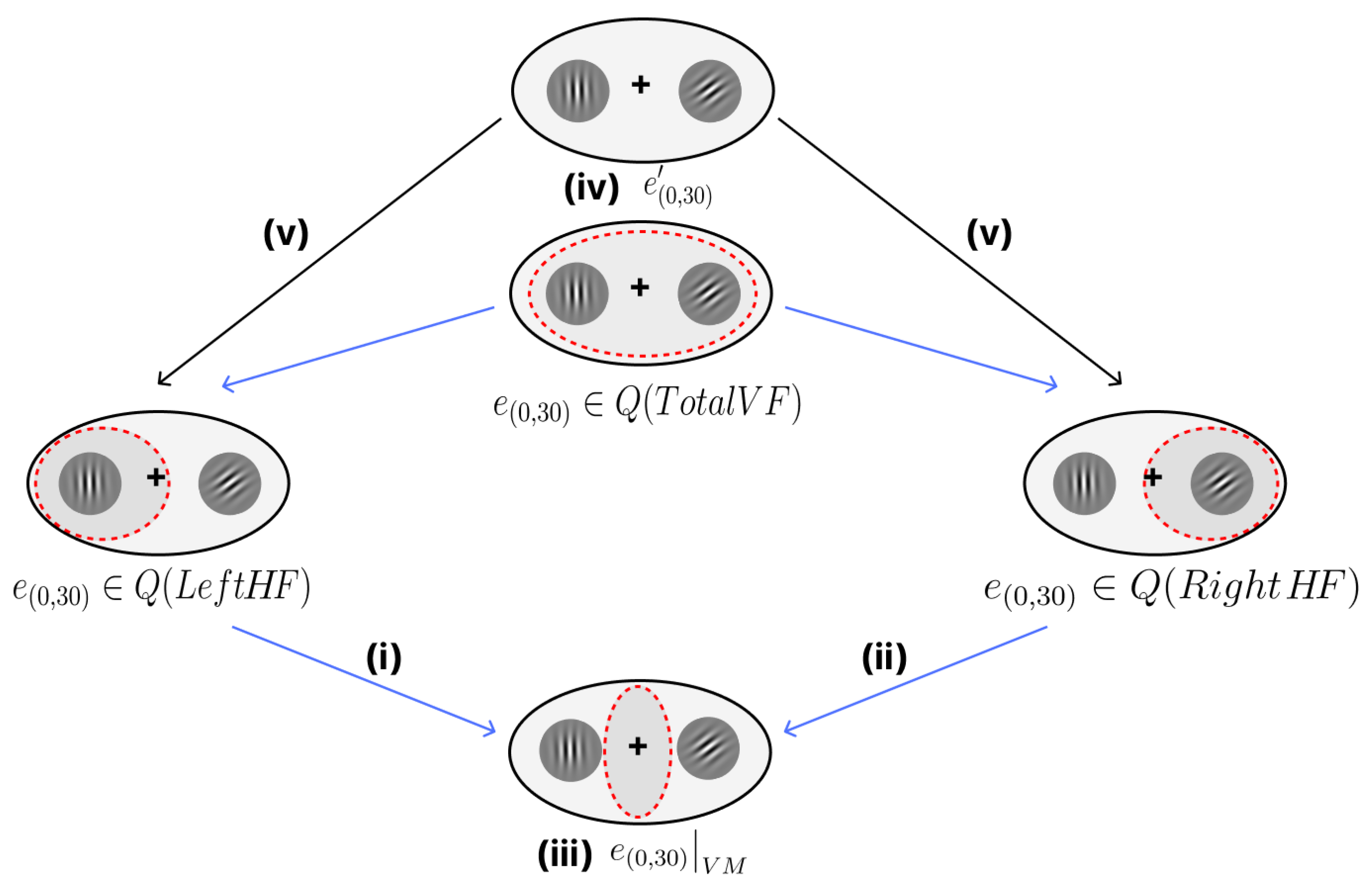
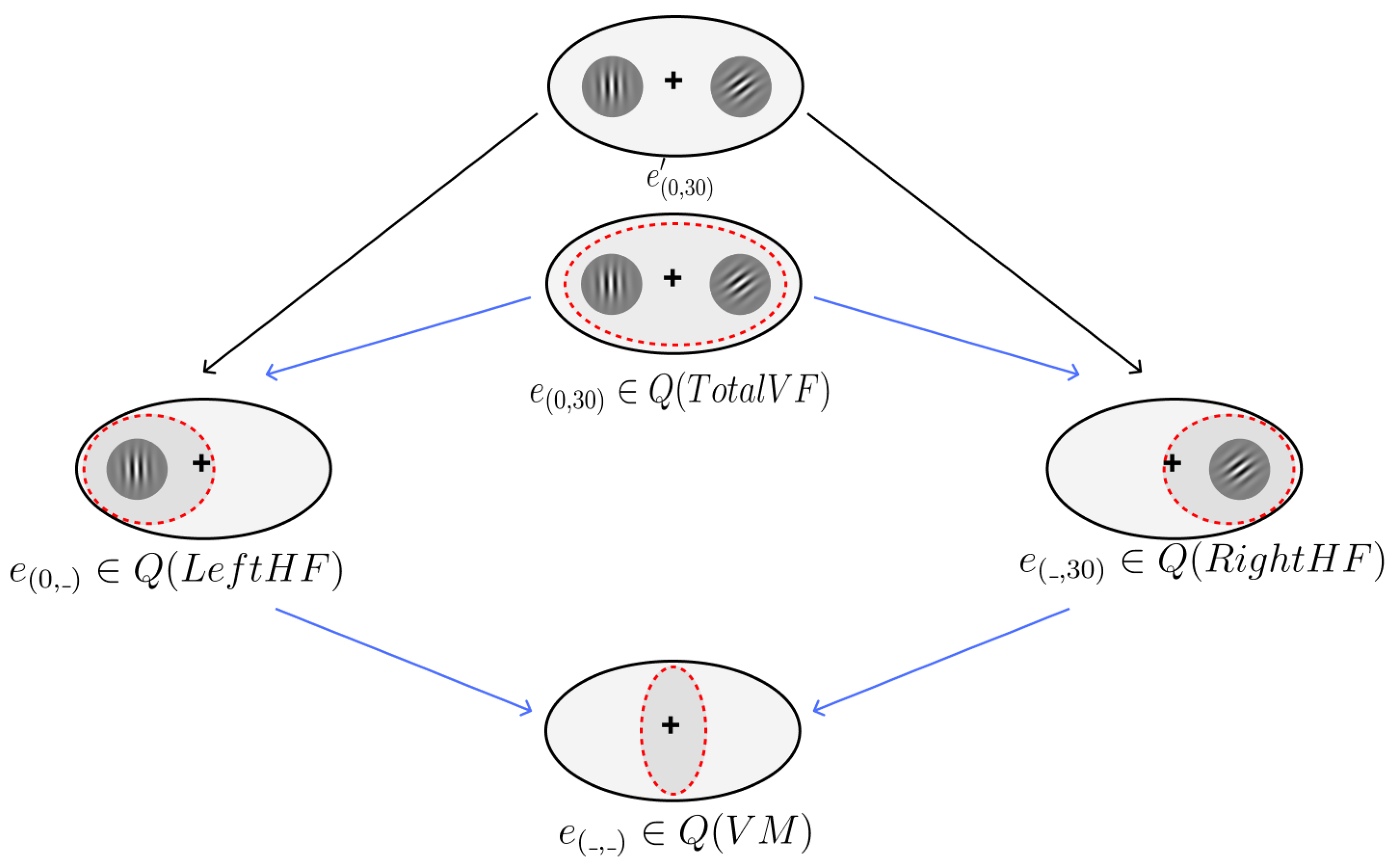
- To , the measure of broader quale obtained under simultaneous attention to the total, bilateral visual field ;
- To , the measure of narrower quale obtained under selective attention to the left hemifield ;
- To , the measure of narrower quale obtained under selective attention to the right hemifield .
4.1.3. Decomposition of Broad to Narrow Qualia as Restriction Maps
4.1.4. Phenomenal Binding as Gluing of Narrow Qualia
4.1.5. Hypothesized Relation Between Narrow and Broad Qualia as a Sheaf Diagram
4.1.6. Context Dependence as Violation of the Sheaf Condition
5. Discussion
5.1. Hypothesis Testing with Sheaf-Theoretic Models of Qualia
5.2. Formalization of Phenomenal Unity
5.3. Limitations and Future Directions
5.3.1. Partitioning of Experience
5.3.2. Experimental Procedures for Measuring Qualia
6. Concluding Remarks
Author Contributions
Funding
Acknowledgments
Conflicts of Interest
Appendix A
- A morphism between a pair of objects is written as , where A is the domain of f and B is the codomain of f. For each object in , there is a self-referential identity morphism that maps an object to itself, i.e., . Given a pair of morphisms and whose codomain and domain coincide, the composition operation returns a composite morphism .
- For to be a category, its objects and morphisms must satisfy the identity and associativity laws:
- Identity: Composing any morphism with an identity morphism returns the morphism. That is, for every and every morphism , we have and .
- Associativity: Composition is associative; that is, given three morphisms , , , we have .
- Duality by arrow reversal. Given a category and its opposite category , a construction in has a corresponding dual construction in . Classical examples include limits and colimits, products and coproducts, and terminal and initial objects. Dual constructions are the same construction viewed in the opposite category.
- Directional or oppositional duality. More broadly, two constructions may be described as dual when they are opposed in direction. For example, a pair of functors and may be considered dual in the sense that they relate the same categories in opposite directions. This notion of duality reflects a contrast in the role or orientation of mappings, and is weaker than the notion of duality by arrow reversal [74].
- Reflexivity: For every ;
- Transitive: If with and , then ;
- There is at most one arrow between two objects.
- The empty set ∅ is an open set and is an element of .
- The entire set X is an open set and is an element of .
- The union of any number of open sets are open sets and is an element of (closed under arbitrary unions).
- The intersection of any finite number of open sets are open sets and is an element of (closed under finite intersections).
- Identity: For any object , ;
- Compositionality: For every pair of compatible morphisms where and , we have .
- Identity: For each open set U, the restriction morphism is the identity morphism .
- Compositionality: For open sets , restriction commutes with composition of morphisms, i.e., .
- Gluing (existence): If for all there is a (local) section and a section that agree throughout their intersection, i.e., , then there exists a global section that agrees with the local section when restricted to the subregions, i.e., .
- Locality (uniqueness): The global section is unique, i.e., if there are sections where , then .
References
- James, W. The Principles of Psychology; Henry Holt and Company: New York, NY, USA, 1890; Volumes 1 and 2. [Google Scholar]
- Nagel, T. What Is It Like to Be a Bat? Philos. Rev. 1974, 83, 435–450. [Google Scholar] [CrossRef] [Scilit]
- Bayne, T.; Chalmers, D.J. What is the Unity of Consciousness? In The Unity of Consciousness: Binding, Integration, and Dissociation; Cleeremans, A., Ed.; Oxford University Press: Oxford, UK, 2003; pp. 23–58. [Google Scholar]
- Tye, M. Consciousness and Persons: Unity and Identity; The MIT Press: Cambridge, MA, USA, 2003. [Google Scholar]
- Wiese, W. How to solve the problem of phenomenal unity: Finding alternatives to the single state conception. Phenomenol. Cogn. Sci. 2017, 16, 811–836. [Google Scholar] [CrossRef] [Scilit]
- Masrour, F.; Brook, A.; Raymont, P. The Unity of Consciousness. In The Stanford Encyclopedia of Philosophy, Summer 2025 ed.; Zalta, E.N., Nodelman, U., Eds.; Metaphysics Research Lab, Stanford University: Stanford, CA, USA, 2025. [Google Scholar]
- Prentner, R. Consciousness and topologically structured phenomenal spaces. Conscious. Cogn. 2019, 70, 25–38. [Google Scholar] [CrossRef] [Scilit]
- Balduzzi, D.; Tononi, G. Qualia: The geometry of integrated information. PLoS Comput. Biol. 2009, 5, e1000462. [Google Scholar] [CrossRef] [Scilit]
- Kanai, R.; Tsuchiya, N. Qualia. Curr. Biol. 2012, 22, R392–R396. [Google Scholar] [CrossRef] [Scilit] [PubMed]
- Yoshimi, J.; Ford, J. The symphony of consciousness and the minimal experience of self. Philos. Mind Sci. 2025, 6. [Google Scholar] [CrossRef] [Scilit]
- Ling, Y.; Hurlbert, A. Color and size interactions in a real 3D object similarity task. J. Vis. 2004, 4, 5. [Google Scholar] [CrossRef] [Scilit]
- McGurk, H.; MacDonald, J. Hearing lips and seeing voices. Nature 1976, 264, 746–748. [Google Scholar] [CrossRef] [Scilit]
- Hirst, R.J.; McGovern, D.P.; Setti, A.; Shams, L.; Newell, F.N. What you see is what you hear: Twenty years of research using the Sound-Induced Flash Illusion. Neurosci. Biobehav. Rev. 2020, 118, 759–774. [Google Scholar] [CrossRef] [Scilit]
- Ćwiek, A.; Fuchs, S.; Draxler, C.; Asu, E.L.; Dediu, D.; Hiovain, K.; Kawahara, S.; Koutalidis, S.; Krifka, M.; Lippus, P.; et al. The bouba/kiki effect is robust across cultures and writing systems. Philos. Trans. R. Soc. 2022, 377, 20200390. [Google Scholar]
- Adelson, E.H. Perceptual organization and the judgment of brightness. Science 1993, 262, 2042–2044. [Google Scholar] [CrossRef] [Scilit]
- Burns, B.; Shepp, B.E. Dimensional interactions and the structure of psychological space: The representation of hue, saturation, and brightness. Percept. Psychophys. 1988, 43, 494–507. [Google Scholar] [CrossRef] [Scilit] [PubMed]
- Kemler Nelson, D.G. Processing integral dimensions: The whole view. J. Exp. Psychol. Hum. Percept. Perform. 1993, 19, 1105–1113. [Google Scholar] [CrossRef] [Scilit]
- Seth, A.K.; Bayne, T. Theories of consciousness. Nat. Rev. Neurosci. 2022, 23, 439–452. [Google Scholar] [CrossRef] [Scilit]
- Revonsuo, A. Binding and the phenomenal unity of consciousness. Conscious. Cogn. 1999, 8, 173–185. [Google Scholar] [CrossRef] [Scilit]
- Garson, J.W. (Dis) solving the binding problem. Philos. Psychol. 2001, 14, 381–392. [Google Scholar] [CrossRef] [Scilit]
- Revonsuo, A.; Tarkko, K. Binding in dreams-the bizarreness of dream images and the unity of consciousness. J. Conscious. Stud. 2002, 9, 3–24. [Google Scholar]
- Plate, J. An analysis of the binding problem. Philos. Psychol. 2007, 20, 773–792. [Google Scholar] [CrossRef] [Scilit]
- Bayne, T. The Unity of Consciousness; Oxford University Press: Oxford, UK, 2012. [Google Scholar]
- Chalmers, D.J. The Conscious Mind: In Search of a Fundamental Theory; Oxford Paperbacks: Oxford, UK, 1997. [Google Scholar]
- Keizer, A.W.; Hommel, B.; Lamme, V.A. Consciousness is not necessary for visual feature binding. Psychon. Bull. Rev. 2015, 22, 453–460. [Google Scholar] [CrossRef] [Scilit] [PubMed]
- Treisman, A. Consciousness and Perceptual Binding. In The Unity of Consciousness: Binding, Integration, and Dissociation; Cleeremans, A., Ed.; Oxford University Press: Oxford, UK, 2003; pp. 95–113. [Google Scholar]
- Gold, I. Does 40-Hz oscillation play a role in visual consciousness? Conscious. Cogn. 1999, 8, 186–195. [Google Scholar] [CrossRef] [Scilit] [PubMed]
- Crick, F.; Koch, C. Towards a neurobiological theory of consciousness. Semin. Neurosci. 1990, 2, 203. [Google Scholar]
- Cleeremans, A.; Frith, C. The Unity of Consciousness; Oxford University Press: Oxford, UK, 2003. [Google Scholar]
- Engel, A.K.; Singer, W. Temporal binding and the neural correlates of sensory awareness. Trends Cogn. Sci. 2001, 5, 16–25. [Google Scholar] [CrossRef] [Scilit]
- Kleiner, J. Towards a structural turn in consciousness science. Conscious. Cogn. 2024, 119, 103653. [Google Scholar] [CrossRef] [Scilit] [PubMed]
- Maier, A.; Tsuchiya, N. Linking the Structure of Neuronal Mechanisms to the Structure of Qualia. Philos. Mind Sci. 2025, 6. [Google Scholar] [CrossRef] [Scilit]
- Tsuchiya, N. The Qualia Structure Paradigm: Towards a Construction of a Qualia Periodic Table for the Dissolution of the Hard Problem of Consciousness. 2024. Available online: https://osf.io/preprints/psyarxiv/492hu_v2 (accessed on 2 April 2026).
- Fink, S.B.; Kob, L.; Lyre, H. A structural constraint on neural correlates of consciousness. Philos. Mind Sci. 2021, 2, 7. [Google Scholar] [CrossRef] [Scilit]
- Fink, S.B.; Lee, A.Y. Structuralism in the Science Of Consciousness–Editorial Introduction Draft. PsyArXiv 2023. [Google Scholar] [CrossRef] [Scilit]
- Prentner, R. Category theory in consciousness science: Going beyond the correlational project. Synthese 2024, 204, 69. [Google Scholar] [CrossRef] [Scilit]
- Ellia, F.; Hendren, J.; Grasso, M.; Kozma, C.; Mindt, G.; Lang, J.P.; Haun, A.M.; Albantakis, L.; Boly, M.; Tononi, G. Consciousness and the fallacy of misplaced objectivity. Neurosci. Conscious. 2021, 2021, niab032. [Google Scholar] [CrossRef] [Scilit]
- Varela, F.J. Neurophenomenology: A methodological remedy for the hard problem. J. Conscious. Stud. 1996, 3, 330–349. [Google Scholar]
- Lutz, A.; Abdoun, O.; Dor-Ziderman, Y.; Trautwein, F.M.; Berkovich-Ohana, A. An overview of neurophenomenological approaches to meditation and their relevance to clinical research. Biol. Psychiatry Cogn. Neurosci. Neuroimaging 2025, 10, 411–424. [Google Scholar] [CrossRef] [Scilit]
- Timmermann, C.; Bauer, P.R.; Gosseries, O.; Vanhaudenhuyse, A.; Vollenweider, F.; Laureys, S.; Singer, T.; Antonova, E.; Lutz, A. A neurophenomenological approach to non-ordinary states of consciousness: Hypnosis, meditation, and psychedelics. Trends Cogn. Sci. 2023, 27, 139–159. [Google Scholar] [CrossRef] [Scilit]
- Smith, R.; Mayeli, A.; Taylor, S.; Al Zoubi, O.; Naegele, J.; Khalsa, S.S. Gut inference: A computational modelling approach. Biol. Psychol. 2021, 164, 108152. [Google Scholar] [CrossRef] [Scilit]
- Lutz, A. Toward a neurophenomenology as an account of generative passages: A first empirical case study. Phenomenol. Cogn. Sci. 2002, 1, 133–167. [Google Scholar] [CrossRef] [Scilit]
- Sandved-Smith, L.; Hesp, C.; Mattout, J.; Friston, K.; Lutz, A.; Ramstead, M.J. Towards a computational phenomenology of mental action: Modelling meta-awareness and attentional control with deep parametric active inference. Neurosci. Conscious. 2021, 2021, niab018. [Google Scholar] [CrossRef] [Scilit]
- Olivares, F.A.; Vargas, E.; Fuentes, C.; Martínez-Pernía, D.; Canales-Johnson, A. Neurophenomenology revisited: Second-person methods for the study of human consciousness. Front. Psychol. 2015, 6, 673. [Google Scholar] [CrossRef] [Scilit]
- Berkovich-Ohana, A.; Dor-Ziderman, Y.; Trautwein, F.M.; Schweitzer, Y.; Nave, O.; Fulder, S.; Ataria, Y. The hitchhiker’s guide to neurophenomenology–the case of studying self boundaries with meditators. Front. Psychol. 2020, 11, 1680. [Google Scholar] [CrossRef] [Scilit]
- Kok, B.E.; Singer, T. Phenomenological fingerprints of four meditations: Differential state changes in affect, mind-wandering, meta-cognition, and interoception before and after daily practice across 9 months of training. Mindfulness 2017, 8, 218–231. [Google Scholar] [CrossRef] [Scilit]
- Abdoun, O.; Poublan-Couzardot, A.; Offort, S.; Pagnoni, G.; Lutz, A. Shedding light on changes in subjective experience during an intensive contemplative retreat: The Lyon Assessment of Meditation Phenomenology Questionnaire. Biol. Psychiatry Glob. Open Sci. 2025, 5, 100474. [Google Scholar] [CrossRef] [Scilit] [PubMed]
- Chalmers, D.J. Facing up to the problem of consciousness. J. Conscious. Stud. 1995, 2, 200–219. [Google Scholar]
- Kob, L. Exploring the role of structuralist methodology in the neuroscience of consciousness: A defense and analysis. Neurosci. Conscious. 2023, 2023, niad011. [Google Scholar] [CrossRef] [Scilit] [PubMed]
- Lyre, H. Neurophenomenal structuralism. A philosophical agenda for a structuralist neuroscience of consciousness. Neurosci. Conscious. 2022, 2022, niac012. [Google Scholar] [CrossRef] [Scilit] [PubMed]
- Spinoza, B.D. The Collected Works of Spinoza; Princeton University Press: Princeton, NJ, USA, 2016. [Google Scholar]
- Russell, B. The Analysis of Matter; Kegan Paul: London, UK, 1927. [Google Scholar]
- Negro, N. Three arguments against metaphysical structuralism in consciousness research. Synthese 2025, 206, 8. [Google Scholar] [CrossRef] [Scilit]
- Haun, A.; Tononi, G. Why does space feel the way it does? Towards a principled account of spatial experience. Entropy 2019, 21, 1160. [Google Scholar] [CrossRef] [Scilit]
- Comolatti, R.; Grasso, M.; Tononi, G. Why does time feel the way it does? Toward a principled account of temporal experience. Iscience 2025, 28, 113434. [Google Scholar] [CrossRef] [Scilit]
- Taguchi, S.; Saigo, H. The monoid-now: A category theoretic approach to the structure of phenomenological time-consciousness. Front. Psychol. 2023, 14, 1237984. [Google Scholar] [CrossRef] [Scilit]
- Kawakita, G.; Zeleznikow-Johnston, A.; Takeda, K.; Tsuchiya, N.; Oizumi, M. Is my “red” your “red”?: Evaluating structural correspondences between color similarity judgments using unsupervised alignment. Iscience 2025, 28, 112029. [Google Scholar] [CrossRef] [Scilit]
- Moriguchi, Y.; Watanabe, R.; Sakata, C.; Zeleznikow-Johnston, A.; Wang, J.; Saji, N.; Tsuchiya, N. Comparing color qualia structures through a similarity task in young children versus adults. Proc. Natl. Acad. Sci. USA 2025, 122, e2415346122. [Google Scholar] [CrossRef] [Scilit]
- Rowe, E.G.; Takeda, K.; Oizumi, M.; D’Souza, J.F.; van Boxtel, J.J.; Tsuchiya, N. Qualia structures collapse for geometric shapes, but not faces, when spatial attention is withdrawn. Neurosci. Conscious. 2025, 2025, niaf053. [Google Scholar] [CrossRef] [Scilit] [PubMed]
- Togashi, Y.; Yotsumoto, Y.; Hiramatsu, C.; Tsuchiya, N.; Oizumi, M. Robust individual alignment of color qualia structures: Toward a structure-based taxonomy of divergent color experiences. bioRxiv 2026. [Google Scholar] [CrossRef] [Scilit]
- Eilenberg, S.; MacLane, S. General theory of natural equivalences. Trans. Am. Math. Soc. 1945, 58, 231–294. [Google Scholar] [CrossRef] [Scilit]
- Lawvere, F.W.; Schanuel, S.H. Conceptual Mathematics: A First Introduction to Categories; Cambridge University Press: Cambridge, UK, 2009. [Google Scholar]
- Spivak, D.I. Category Theory for the Sciences; The MIT Press: Cambridge, MA, USA, 2014. [Google Scholar]
- Fong, B.; Spivak, D.I. An Invitation to Applied Category Theory: Seven Sketches in Compositionality; Cambridge University Press: Cambridge, MA, USA, 2019. [Google Scholar]
- Cheng, E. The Joy of Abstraction: An Exploration of Math, Category Theory, and Life; Cambridge University Press: Cambridge, MA, USA, 2022. [Google Scholar]
- Tsuchiya, N.; Taguchi, S.; Saigo, H. Using category theory to assess the relationship between consciousness and integrated information theory. Neurosci. Res. 2016, 107, 1–7. [Google Scholar] [CrossRef] [Scilit]
- Northoff, G.; Tsuchiya, N.; Saigo, H. Mathematics and the Brain: A Category Theoretical Approach to Go Beyond the Neural Correlates of Consciousness. Entropy 2019, 21, 1234. [Google Scholar] [CrossRef] [Scilit]
- Maruyama, Y. Category theory and foundations of life science: A structuralist perspective on cognition. Biosystems 2021, 203, 104376. [Google Scholar] [CrossRef] [Scilit]
- Tsuchiya, N.; Phillips, S.; Saigo, H. Enriched category as a model of qualia structure based on similarity judgements. Conscious. Cogn. 2022, 101, 103319. [Google Scholar] [CrossRef] [Scilit]
- Abramsky, S.; Coecke, B. Categorical quantum mechanics. Handb. Quantum Log. Quantum Struct. 2009, 2, 261–325. [Google Scholar]
- Phillips, S. What is category theory to cognitive science? Compositional representation and comparison. Front. Psychol. 2022, 13, 1048975. [Google Scholar] [CrossRef] [Scilit]
- Tsuchiya, N.; Saigo, H. A relational approach to consciousness: Categories of level and contents of consciousness. Neurosci. Conscious. 2021, 2021, niab034. [Google Scholar] [CrossRef] [Scilit]
- Tsuchiya, N.; Saigo, H.; Phillips, S. An adjunction hypothesis between qualia and reports. Front. Psychol. 2023, 13, 1053977. [Google Scholar] [CrossRef] [Scilit]
- Phillips, S.; Tsuchiya, N. Towards a (meta-) mathematical theory of consciousness: Universal (mapping) properties of experience. arXiv 2024, arXiv:2412.12179. [Google Scholar]
- Signorelli, C.M.; Wang, Q.; Khan, I. A compositional model of consciousness based on consciousness-only. Entropy 2021, 23, 308. [Google Scholar] [CrossRef] [Scilit]
- Signorelli, C.M.; Wang, Q.; Coecke, B. Reasoning about conscious experience with axiomatic and graphical mathematics. Conscious. Cogn. 2021, 95, 103168. [Google Scholar] [CrossRef] [Scilit]
- Tull, S.; Kleiner, J. Integrated information in process theories. arXiv 2020, arXiv:2002.07654. [Google Scholar] [CrossRef] [Scilit]
- Phillips, S.; Wilson, W.H. Categorial compositionality: A category theory explanation for the systematicity of human cognition. PLoS Comput. Biol. 2010, 6, e1000858. [Google Scholar] [CrossRef] [Scilit]
- Phillips, S.; Wilson, W.H. Systematicity and a categorical theory of cognitive architecture: Universal construction in context. Front. Psychol. 2016, 7, 1139. [Google Scholar] [CrossRef] [Scilit]
- Moriguchi, Y.; Tsuchiya, N.; Saigo, H. A Structural Approach in Cognitive Developmental Research with Category Theory. Available online: https://osf.io/preprints/psyarxiv/8gf7k_v2 (accessed on 2 April 2026).
- Albantakis, L.; Barbosa, L.; Findlay, G.; Grasso, M.; Haun, A.M.; Marshall, W.; Mayner, W.G.; Zaeemzadeh, A.; Boly, M.; Juel, B.E.; et al. Integrated information theory (IIT) 4.0: Formulating the properties of phenomenal existence in physical terms. PLoS Comput. Biol. 2023, 19, e1011465. [Google Scholar] [CrossRef] [Scilit] [PubMed]
- Yoshimi, J.; Vinson, D.W. Extending Gurwitsch’s field theory of consciousness. Conscious. Cogn. 2015, 34, 104–123. [Google Scholar] [CrossRef] [Scilit] [PubMed]
- Lee, A.Y. Objective phenomenology. Erkenntnis 2024, 89, 1197–1216. [Google Scholar] [CrossRef] [Scilit]
- Borg, I.; Groenen, P.J.F. Modern Multidimensional Scaling: Theory and Applications, 2nd ed.; Springer Series in Statistics; Springer: New York, NY, USA, 2005. [Google Scholar]
- Prentner, R. Mathematized phenomenology and the science of consciousness. Phenomenol. Cogn. Sci. 2025, 1–23. [Google Scholar] [CrossRef] [Scilit]
- Kriegeskorte, N. Relating population-code representations between man, monkey, and computational models. Front. Neurosci. 2009, 3, 879. [Google Scholar] [CrossRef] [Scilit]
- Kriegeskorte, N.; Diedrichsen, J. Peeling the onion of brain representations. Annu. Rev. Neurosci. 2019, 42, 407–432. [Google Scholar] [CrossRef] [Scilit] [PubMed]
- Kriegeskorte, N.; Wei, X.X. Neural tuning and representational geometry. Nat. Rev. Neurosci. 2021, 22, 703–718. [Google Scholar] [CrossRef] [Scilit]
- Saji, N.; Imai, M.; Asano, M. Acquisition of the meaning of the word orange requires understanding of the meanings of red, pink, and purple: Constructing a lexicon as a connected system. Cogn. Sci. 2020, 44, e12813. [Google Scholar] [CrossRef] [Scilit] [PubMed]
- Brouwer, G.J.; Heeger, D.J. Decoding and reconstructing color from responses in human visual cortex. J. Neurosci. 2009, 29, 13992–14003. [Google Scholar] [CrossRef] [Scilit] [PubMed]
- Kawakita, G.; Zeleznikow-Johnston, A.; Tsuchiya, N.; Oizumi, M. Gromov–Wasserstein unsupervised alignment reveals structural correspondences between the color similarity structures of humans and large language models. Sci. Rep. 2024, 14, 15917. [Google Scholar] [CrossRef] [Scilit] [PubMed]
- Hebart, M.N.; Contier, O.; Teichmann, L.; Rockter, A.H.; Zheng, C.Y.; Kidder, A.; Corriveau, A.; Vaziri-Pashkam, M.; Baker, C.I. THINGS-data, a multimodal collection of large-scale datasets for investigating object representations in human brain and behavior. eLife 2023, 12, e82580. [Google Scholar] [CrossRef] [Scilit]
- Epping, G.P.; Fisher, E.L.; Zeleznikow-Johnston, A.M.; Pothos, E.M.; Tsuchiya, N. A quantum geometric framework for modeling color similarity judgments. Cogn. Sci. 2023, 47, e13231. [Google Scholar] [CrossRef] [Scilit]
- Polk, T.A.; Behensky, C.; Gonzalez, R.; Smith, E.E. Rating the similarity of simple perceptual stimuli: Asymmetries induced by manipulating exposure frequency. Cognition 2002, 82, B75–B88. [Google Scholar] [CrossRef] [Scilit]
- Rosch, E. Cognitive reference points. Cogn. Psychol. 1975, 7, 532–547. [Google Scholar] [CrossRef] [Scilit]
- Roberson, D.; Damjanovic, L.; Pilling, M. Categorical perception of facial expressions: Evidence for a “category adjustment” model. Mem. Cogn. 2007, 35, 1814–1829. [Google Scholar] [CrossRef] [Scilit]
- Best, R.M.; Goldstone, R.L. Bias to (and away from) the extreme: Comparing two models of categorical perception effects. J. Exp. Psychol. Learn. Mem. Cogn. 2019, 45, 1166. [Google Scholar] [CrossRef] [Scilit]
- Hodgetts, C.J.; Hahn, U. Similarity-based asymmetries in perceptual matching. Acta Psychol. 2012, 139, 291–299. [Google Scholar] [CrossRef] [Scilit]
- Rosenthal, I.A.; Singh, S.R.; Hermann, K.L.; Pantazis, D.; Conway, B.R. Color space geometry uncovered with magnetoencephalography. Curr. Biol. 2022, 32, 1670–1674. [Google Scholar] [CrossRef] [Scilit]
- Palmer, S.E. Color, consciousness, and the isomorphism constraint. Behav. Brain Sci. 1999, 22, 923–943. [Google Scholar] [CrossRef] [Scilit]
- Shepard, R.N.; Cooper, L.A. Representation of colors in the blind, color-blind, and normally sighted. Psychol. Sci. 1992, 3, 97–104. [Google Scholar] [CrossRef] [Scilit]
- Zeleznikow-Johnston, A.; Aizawa, Y.; Yamada, M.; Tsuchiya, N. Are color experiences the same across the visual field? J. Cogn. Neurosci. 2023, 35, 509–542. [Google Scholar] [CrossRef] [Scilit]
- Robinson, K.; Zeleznikow-Johnston, A.; Wu, J.; Yoshimura, Y.; Tsuchiya, N. Common phenomenal and neural substrate geometry in visual motion perception. bioRxiv 2025. [Google Scholar] [CrossRef] [Scilit]
- Shepard, R.N. Geometrical approximations to the structure of musical pitch. Psychol. Rev. 1982, 89, 305. [Google Scholar] [CrossRef]
- Marjieh, R.; Griffiths, T.L.; Jacoby, N. Musical pitch has multiple psychological geometries. BioRxiv 2023. [Google Scholar] [CrossRef] [Scilit]
- Lee, B.K.; Mayhew, E.J.; Sanchez-Lengeling, B.; Wei, J.N.; Qian, W.W.; Little, K.A.; Andres, M.; Nguyen, B.B.; Moloy, T.; Yasonik, J.; et al. A principal odor map unifies diverse tasks in olfactory perception. Science 2023, 381, 999–1006. [Google Scholar] [CrossRef] [Scilit] [PubMed]
- Lipeng, L.; Chuyin, Z.; Tsuchiya, N. Do I Experience Happiness in the Same Way as You Do? A Relational Approach to Characterize Emotional Experience. 2025. Available online: https://osf.io/preprints/psyarxiv/eu8qf_v3 (accessed on 2 April 2026).
- Cowen, A.; Sauter, D.; Tracy, J.L.; Keltner, D. Mapping the passions: Toward a high-dimensional taxonomy of emotional experience and expression. Psychol. Sci. Public Interest 2019, 20, 69–90. [Google Scholar] [CrossRef] [Scilit] [PubMed]
- Hebart, M.N.; Zheng, C.Y.; Pereira, F.; Baker, C.I. Revealing the multidimensional mental representations of natural objects underlying human similarity judgements. Nat. Hum. Behav. 2020, 4, 1173–1185. [Google Scholar] [CrossRef] [Scilit]
- Graham, D.J.; Friedenberg, J.D.; Rockmore, D.N.; Field, D.J. Mapping the similarity space of paintings: Image statistics and visual perception. Vis. Cogn. 2010, 18, 559–573. [Google Scholar] [CrossRef] [Scilit]
- Josephs, E.L.; Hebart, M.N.; Konkle, T. Dimensions underlying human understanding of the reachable world. Cognition 2023, 234, 105368. [Google Scholar] [CrossRef] [Scilit]
- Phillips, S. Going Beyond the Data as the Patching (Sheaving) of Local Knowledge. Front. Psychol. 2018, 9, 1926. [Google Scholar] [CrossRef] [Scilit] [PubMed]
- MacLane, S.; Moerdijk, I. Sheaves in Geometry and Logic: A First Introduction to Topos Theory; Springer Science & Business Media: Berlin/Heidelberg, Germany, 2012. [Google Scholar]
- Robinson, M. Sheaf and duality methods for analyzing multi-model systems. In Recent Applications of Harmonic Analysis to Function Spaces, Differential Equations, and Data Science: Novel Methods in Harmonic Analysis, Volume 2; Springer International Publishing: Cham, Switzerland, 2017; pp. 653–703. [Google Scholar]
- Rosiak, D. Sheaf Theory Through Examples; The MIT Press: Cambridge, MA, USA, 2022. [Google Scholar]
- Haun, A.M.; Tononi, G. The unfathomable richness of seeing. Trends Cogn. Sci. 2025, 29, 892–902. [Google Scholar] [CrossRef] [Scilit]
- Tversky, A. Features of similarity. Psychol. Rev. 1977, 84, 327. [Google Scholar] [CrossRef]
- Dosher, B.A.; Lu, Z.L. Noise exclusion in spatial attention. Psychol. Sci. 2000, 11, 139–146. [Google Scholar] [CrossRef] [Scilit] [PubMed]
- Baldassi, S.; Verghese, P. Attention to locations and features: Different top-down modulation of detector weights. J. Vis. 2005, 5, 556–570. [Google Scholar] [CrossRef] [Scilit]
- Ling, S.; Liu, T.; Carrasco, M. How spatial and feature-based attention affect the gain and tuning of population responses. Vis. Res. 2009, 49, 1194–1204. [Google Scholar] [CrossRef] [Scilit]
- Carrasco, M.; Ling, S.; Read, S. Attention alters appearance. Nat. Neurosci. 2004, 7, 308–313. [Google Scholar] [CrossRef] [Scilit]
- Liu, T.; Abrams, J.; Carrasco, M. Voluntary attention enhances contrast appearance. Psychol. Sci. 2009, 20, 354–362. [Google Scholar] [CrossRef] [Scilit]
- Anton-Erxleben, K.; Henrich, C.; Treue, S. Attention changes perceived size of moving visual patterns. J. Vis. 2007, 7, 1–9. [Google Scholar] [CrossRef] [Scilit] [PubMed]
- Chapman, A.F.; Chunharas, C.; Störmer, V.S. Feature-based attention warps the perception of visual features. Sci. Rep. 2023, 13, 6487. [Google Scholar] [CrossRef] [Scilit]
- Chapman, A.F.; Allouche, M.; Denison, R.N. Attention reshapes the representational geometry of a perceptual feature space. bioRxiv 2025. [Google Scholar] [CrossRef] [Scilit]
- Shepard, R.N. Attention and the metric structure of the stimulus space. J. Math. Psychol. 1964, 1, 54–87. [Google Scholar] [CrossRef] [Scilit]
- Nosofsky, R. Overall similarity and the identification of separable-dimension stimuli: A choice model analysis. Percept. Psychophys. 1985, 38, 415–432. [Google Scholar] [CrossRef] [Scilit]
- Goldstone, R.L.; Medin, D.L.; Halberstadt, J. Similarity in context. Mem. Cogn. 1997, 25, 237–255. [Google Scholar] [CrossRef] [Scilit]
- Nosofsky, R.M. Attention, similarity, and the identification–categorization relationship. J. Exp. Psychol. Gen. 1986, 115, 39. [Google Scholar] [CrossRef] [PubMed]
- Chapman, A.F.; Störmer, V.S. Representational structures as a unifying framework for attention. Trends Cogn. Sci. 2024, 28, 416–427. [Google Scholar] [CrossRef] [Scilit]
- Chen, Z.; Kosovicheva, A.; Wolfe, B.; Cavanagh, P.; Gorea, A.; Whitney, D. Unifying visual space across the left and right hemifields. Psychol. Sci. 2018, 29, 356–369. [Google Scholar] [CrossRef] [Scilit]
- Penrose, R. On the cohomology of impossible figures. Leonardo 1992, 25, 245–247. [Google Scholar] [CrossRef] [Scilit]
- Abramsky, S. Contextuality: At the Borders. Categ. Work. Philos. 2017, 262. [Google Scholar]
- Abramsky, S.; Brandenburger, A. The sheaf-theoretic structure of non-locality and contextuality. New J. Phys. 2011, 13, 113036. [Google Scholar]
- Tsuchiya, N.; Bruza, P.; Yamada, M.; Saigo, H.; Pothos, E. Quantum-like Qualia hypothesis: 2 from Quantum Cognition to Quantum Perception. Front. Psychol. 2024, 15, 1406459. [Google Scholar] [CrossRef] [Scilit]
- Sayed, K.; Störmer, V.S. Task-irrelevant inputs alter ensemble representations of faces within the spatial focus of attention. J. Exp. Psychol. Hum. Percept. Perform. 2024, 50, 1236–1247. [Google Scholar] [CrossRef] [Scilit]
- Bruza, P.D.; Fell, L.; Hoyte, P.; Dehdashti, S.; Obeid, A.; Gibson, A.; Moreira, C. Contextuality and context-sensitivity in probabilistic models of cognition. Cogn. Psychol. 2023, 140, 101529. [Google Scholar] [CrossRef] [Scilit]
- Robinson, M.; Szulczewski, M.L.; Thorson, J.T. Analyzing the topological structure of composite dynamical systems. arXiv 2025, arXiv:2511.04603. [Google Scholar] [CrossRef] [Scilit]
- Petitmengin, C.; Van Beek, M.; Bitbol, M.; Nissou, J.M.; Roepstorff, A. Studying the experience of meditation through micro-phenomenology. Curr. Opin. Psychol. 2019, 28, 54–59. [Google Scholar] [CrossRef] [Scilit]
- Pothos, E.M.; Busemeyer, J.R. Quantum cognition. Annu. Rev. Psychol. 2022, 73, 749–778. [Google Scholar] [CrossRef] [Scilit]
- Nakayama, H.; Gerkin, R.C.; Rinberg, D. A behavioral paradigm for measuring perceptual distances in mice. Cell Rep. Methods 2022, 2, 100233. [Google Scholar] [CrossRef] [Scilit]
- Kriegeskorte, N.; Mur, M. Inverse MDS: Inferring dissimilarity structure from multiple item arrangements. Front. Psychol. 2012, 3, 245. [Google Scholar] [CrossRef] [Scilit]
- Cowen, A.S.; Keltner, D. Self-report captures 27 distinct categories of emotion bridged by continuous gradients. Proc. Natl. Acad. Sci. USA 2017, 114, E7900–E7909. [Google Scholar] [CrossRef] [Scilit]
- Daggett, E.W.; Hout, M.C. A tutorial review on methods for collecting similarity judgments from human observers. Atten. Percept. Psychophys. 2025, 87, 737–751. [Google Scholar] [CrossRef] [Scilit]
- Verheyen, S.; White, A.; Storms, G. A comparison of the spatial arrangement method and the total-set pairwise rating method for obtaining similarity data in the conceptual domain. Multivar. Behav. Res. 2022, 57, 356–384. [Google Scholar] [CrossRef] [Scilit]
- Kemmerer, D. Are we ever aware of concepts? A critical question for the Global Neuronal Workspace, Integrated Information, and Attended Intermediate-Level Representation theories of consciousness. Neurosci. Conscious. 2015, 2015, niv006. [Google Scholar] [CrossRef] [Scilit]
- McClelland, T.; Bayne, T. Concepts, contents, and consciousness. Neurosci. Conscious. 2016, 2016, niv012. [Google Scholar] [CrossRef] [Scilit]
- Rosch, E.; Mervis, C.B.; Gray, W.D.; Johnson, D.M.; Boyes-Braem, P. Basic objects in natural categories. Cogn. Psychol. 1976, 8, 382–439. [Google Scholar] [CrossRef] [Scilit]
- Goldstone, R.L.; Barsalou, L.W. Reuniting perception and conception. Cognition 1998, 65, 231–262. [Google Scholar] [CrossRef] [Scilit]
- Attneave, F. Dimensions of similarity. Am. J. Psychol. 1950, 63, 516–556. [Google Scholar] [CrossRef] [Scilit]
- Nosofsky, R.M. Stimulus bias, asymmetric similarity, and classification. Cogn. Psychol. 1991, 23, 94–140. [Google Scholar] [CrossRef] [Scilit]
- Wuerger, S.M.; Maloney, L.T.; Krauskopf, J. Proximity judgments in color space: Tests of a Euclidean color geometry. Vis. Res. 1995, 35, 827–835. [Google Scholar] [CrossRef] [Scilit] [PubMed]
- Webster, M.A. Adaptation and visual coding. J. Vis. 2011, 11, 3. [Google Scholar] [CrossRef] [Scilit]
- Hiatt, L.M.; Trafton, J.G. Familiarity, priming, and perception in similarity judgments. Cogn. Sci. 2017, 41, 1450–1484. [Google Scholar] [CrossRef] [Scilit]
- Verheyen, S.; Voorspoels, W.; Vanpaemel, W.; Storms, G. Caveats for the spatial arrangement method: Comment on Hout, Goldinger, and Ferguson (2013). J. Exp. Psychol. Gen. 2016, 145, 376–382. [Google Scholar] [CrossRef] [Scilit] [PubMed]
- Basieva, I.; Cervantes, V.H.; Dzhafarov, E.N.; Khrennikov, A. True contextuality beats direct influences in human decision making. J. Exp. Psychol. Gen. 2019, 148, 1925. [Google Scholar] [CrossRef] [Scilit] [PubMed]




Disclaimer/Publisher’s Note: The statements, opinions and data contained in all publications are solely those of the individual author(s) and contributor(s) and not of MDPI and/or the editor(s). MDPI and/or the editor(s) disclaim responsibility for any injury to people or property resulting from any ideas, methods, instructions or products referred to in the content. |
© 2026 by the authors. Licensee MDPI, Basel, Switzerland. This article is an open access article distributed under the terms and conditions of the Creative Commons Attribution (CC BY) license.
Share and Cite
Lee-Youngzie, Z.; Tsuchiya, N.; Robinson, M.; Dietz, D.; Monti, M.M. Towards a Mathematical Structure of Global Phenomenal Consciousness. Entropy 2026, 28, 615. https://doi.org/10.3390/e28060615
Lee-Youngzie Z, Tsuchiya N, Robinson M, Dietz D, Monti MM. Towards a Mathematical Structure of Global Phenomenal Consciousness. Entropy. 2026; 28(6):615. https://doi.org/10.3390/e28060615
Chicago/Turabian StyleLee-Youngzie, Zoe, Naotsugu Tsuchiya, Michael Robinson, Donna Dietz, and Martin M. Monti. 2026. "Towards a Mathematical Structure of Global Phenomenal Consciousness" Entropy 28, no. 6: 615. https://doi.org/10.3390/e28060615
APA StyleLee-Youngzie, Z., Tsuchiya, N., Robinson, M., Dietz, D., & Monti, M. M. (2026). Towards a Mathematical Structure of Global Phenomenal Consciousness. Entropy, 28(6), 615. https://doi.org/10.3390/e28060615