1. Introduction
With the increasing amount of information transmitted in modern society, massive multiple-input multiple-output (MIMO) systems are widely used to meet the demand for high-data-rate transmission [
1]. However, the use of a large number of antenna elements and high-resolution analog-to-digital converters (ADCs) [
2] in massive MIMO systems leads to significant increases in hardware cost and power consumption. To mitigate the impact of growing hardware expense, sparse arrays [
3] and low-bit ADCs have been proposed and widely adopted. Sparse arrays effectively enhance the degrees of freedom and resolution of an array by employing non-uniform element layouts with a limited number of antenna elements; common examples include coprime arrays and nested arrays. Low-bit ADCs, on the other hand, effectively reduce system complexity by decreasing the number of quantization bits per sampling point. However, the reduction in quantization bits and the increase in array complexity pose greater challenges for signal processing. Direction-of-arrival (DOA) estimation, a fundamental problem in array signal processing, is one of the key challenges that must be addressed.
A typical low-bit quantization technique is 1-bit quantization. This technique uses a comparator to quantize continuous-amplitude signals into 1-bit signals that contain only sign information, significantly reducing the hardware complexity and power consumption of ADCs. When the threshold of the comparator is set to zero, the scheme is referred to as zero-threshold 1-bit quantization, which has a long research history. The correlation coefficient estimation problem for zero-threshold 1-bit sampled signals was studied in [
4], which introduced the well-known arcsine law. The authors of [
5,
6] presented maximum-likelihood-based 1-bit DOA estimation methods and provided performance analyses. The Cramér–Rao lower bound (CRLB) of zero-threshold 1-bit quantization under sparse arrays was analyzed in [
7]. The authors of [
8] extended the DOA estimation problem for 1-bit sparse arrays to polarization-sensitive arrays. Other applications of 1-bit quantization techniques can be found in [
9,
10,
11,
12]. To address the fact that zero-threshold 1-bit quantization cannot recover signal amplitude information, researchers have proposed biased 1-bit quantization techniques. The authors of [
13] presented a fixed-threshold 1-bit autocorrelation estimation method, whose estimation performance was analyzed in [
14]. Closely related, ref. [
15] addressed the recovery of the full (i.e., diagonal-included) covariance matrix from non-zero-threshold 1-bit samples, deriving the Fisher information matrix and characterizing the dependence of the recovery MSE on the threshold; this work makes it clear that under 1-bit sampling the optimal threshold varies with the unknown variances and correlations, motivating the multi-level or time-varying schemes considered next. A time-varying-threshold 1-bit parameter estimation method was proposed in [
16] and applied to MIMO radar. Building on the modified arcsine law, ref. [
17] extended 1-bit covariance recovery to non-stationary signals with time-varying sampling thresholds, recovering both the time-varying variance and the autocorrelation values of the input. Both refs. [
15,
17] therefore tackle the same underlying difficulty—the loss of amplitude information under 1-bit sampling—through richer (non-zero or time-varying) thresholds, rather than through a finer quantization grid. However, whether zero-threshold or biased, 1-bit quantization techniques both introduce significant quantization errors, which lead to degraded DOA estimation performance. To address this, researchers have proposed multi-bit quantization techniques to improve DOA estimation performance. A MIMO parameter estimation method based on mixed-bit ADCs was proposed in [
18], and ref. [
19] presented a low-bit covariance matrix estimation method. However, increasing the number of bits also means further increasing hardware cost, which contradicts the original intent of low-bit quantization.
To strike a balance between performance and complexity, a 1.5-bit quantization technique was proposed in [
20] and has shown strong application prospects. The 1.5-bit quantization technique quantizes signal amplitudes into three levels using two symmetric non-zero thresholds, thereby retaining more information than traditional 1-bit quantization. Compared with 2-bit quantization, 1.5-bit quantization uses one fewer comparator, which further reduces hardware complexity and power consumption. The authors of [
21] subsequently provided a closed-form solution for covariance matrix recovery under 1.5-bit quantization and analyzed the DOA estimation performance obtained from this recovered covariance matrix. It should be noted that all theoretical results in [
21] are based on infinite-snapshot scenarios, so their performance for DOA estimation in low-snapshot scenarios is unknown. In addition, for sparse arrays, the method in [
20] requires constructing difference co-array outputs. However, difference co-arrays reduce the statistical efficiency of the received signals [
22], which causes the DOA estimation accuracy at high signal-to-noise ratios (SNRs) to deviate from the CRLB.
Existing sparsity-based methods provide new tools to address the above two issues. For the processing of 1-bit quantized signals, refs. [
23,
24] presented signal reconstruction methods based on convex optimization and iterative hard thresholding, respectively, to recover the normalized signals prior to 1-bit compressed quantization; refs. [
25,
26] provided gridless sparse line-spectrum estimation methods for 1-bit quantization. The above methods transform the signal recovery or parameter estimation problem after 1-bit quantization into a convex optimization problem with sign constraints; this approach does not rely on the statistical characteristics of the signal and is independent of the number of snapshots. For the processing of sparse-array received signals, refs. [
27,
28] transformed the DOA estimation problem into nuclear-norm and atomic-norm optimization problems, thereby eliminating the dependence of DOA estimation on differential array outputs, while the Sparse and Parametric Approach (SPA) [
29] and Enhanced Matrix Completion (EMaC) [
30] exploited the structure of Toeplitz and Hankel matrices, respectively, to fit the covariance matrix of sparse arrays. The above methods treat the elements of a sparse array as sparse spatial-domain samples and use sparse reconstruction algorithms to reconstruct the covariance matrix of a uniform linear array with the same degrees of freedom, without the need to construct differential array outputs, while effectively suppressing finite-snapshot errors. By combining these two lines of work, the DOA estimation problem for 1.5-bit sparse arrays can be transformed into a sparsity-based reconstruction problem with sign constraints, which allows reconstruction of the normalized unquantized received-signal covariance matrix of a uniform linear array with the same degrees of freedom, effectively suppressing finite-snapshot errors and avoiding the loss of statistical efficiency caused by difference co-arrays.
Motivated by the above observations, this paper proposes a DOA estimation algorithm based on 1.5-bit sparse covariance matrix estimation (1.5B-SCE) for 1.5-bit sparse arrays. In contrast to the closed-form covariance recovery of [
21], which is accurate only in the infinite-snapshot regime, and in contrast to the difference-coarray-based 1.5B-MUSIC of [
20], which suffers from statistical-efficiency loss [
22], 1.5B-SCE directly formulates the recovery of the unquantized ULA covariance as a constrained covariance-fitting problem. The novelty of this paper lies at the formulation level: the three ingredients used here—sign consistency of low-bit quantization, Toeplitz covariance fitting on sparse arrays, and Schur-complement relaxation—have each been studied individually in prior work, but to our knowledge they have not previously been combined into a single SDP tailored to 1.5-bit sparse-array DOA estimation. The resulting formulation (i) keeps the information in the three-level
output through a sign-product inequality, (ii) enforces the Toeplitz structure of the underlying ULA covariance without resorting to difference co-arrays, and (iii) remains convex and can therefore be solved to global optimality via standard SDP. We further note that the present work is complementary to, rather than a refinement of [
15,
17]: those works recover the covariance of 1-bit samples by exploiting non-zero or time-varying thresholds within the (modified) arcsine-law framework, whereas 1.5B-SCE works in the 1.5-bit (three-level
) regime on a sparse array, replaces the closed-form arcsine recovery by a sign-product inequality inside an explicitly convex SDP, and simultaneously enforces the Toeplitz structure of the underlying ULA covariance to suppress finite-snapshot errors. The gain over the closed-form 1.5-bit recovery of [
21] therefore comes from the structured covariance-fitting regularization rather than from a tighter arcsine relation. Simulation experiments show that 1.5B-SCE effectively improves the DOA estimation accuracy on 1.5-bit sparse arrays compared with 1.5B-MUSIC, and that on coprime arrays in the low-snapshot regime its accuracy is competitive with structured covariance-fitting baselines applied to unquantized data. We note that 1.5B-SCE does not recover information that was lost during quantization; its advantage over plain MUSIC on unquantized sparse arrays comes from the structured covariance-fitting regularization, not from the quantization itself as our extended baselines in
Section 4 make explicit.
The rest of this paper is organized as follows.
Section 2 introduces the signal model of 1.5-bit sparse arrays;
Section 3 presents the specific implementation steps of 1.5B-SCE;
Section 4 validates the effectiveness of the proposed method through simulation experiments; and finally,
Section 5 concludes the paper.
2. Signal Model
Consider
K plane-wave signals arriving from the far field at a linear array composed of
M elements, with the element positions determined by the set
, which we refer to as the array configuration set. The position of the
m-th element is given by
, where
and
is the signal wavelength. The received signal
at the
m-th element is given by
where
is the baseband complex amplitude of the
k-th signal,
,
is the DOA of the
k-th signal, and
is additive complex Gaussian white noise at the
m-th element, satisfying
. Stacking the received signals of all elements into a vector, we obtain
where
,
,
,
,
is the array steering matrix, and
is the array steering vector of the
k-th signal.
In this paper, we make the following assumptions about the sources and noise: (1) all K sources are independent far-field Gaussian sources; (2) the DOAs of the different sources are distinct; (3) the noise at all elements follows independent and identically distributed complex Gaussian distributions; and (4) the noise is statistically independent of the sources.
Let us now consider the array configuration. When the array configuration set
consists of consecutive non-negative integers starting from 0, i.e.,
(so that
has exactly
M elements, consistent with the assumption above), we refer to this array as a uniform linear array (ULA). When the elements of
are not consecutive, it is referred to as a sparse linear array (SLA). There are two common SLA configurations. The first is the nested array [
31], which consists of a ULA with element spacing 1 and
elements, nested with another ULA with element spacing
and
elements. Its array configuration set is given by
The second type of sparse array is the coprime array [
32], which consists of two ULAs with element spacings
and
and with
and
elements, respectively, where
and
are coprime. Its array configuration set is given by
Other sparse arrays include minimum redundancy arrays [
33], super nested arrays [
34], and least hole arrays [
35]. For simplicity, in the sequel we refer to an array with configuration set
simply as
. For example, a coprime array with configuration set
is referred to as
.
This paper considers the 1.5-bit quantization technique, which quantizes the received signal into three levels using two symmetric non-zero thresholds
. The quantization is defined as follows:
where
is the quantization function, and
is a non-negative threshold. For complex signals, 1.5-bit quantization is performed separately on the real and imaginary parts, resulting in the quantized signal:
where
and
denote the real and imaginary parts, respectively. Stacking the quantized signals of all elements into a vector, we have
Assuming that the array received signals are quantized with the 1.5-bit quantizer and that
N snapshots are collected, the resulting set of quantized signal samples is
. The sample covariance matrix of the quantized signals can be estimated as
where
denotes the conjugate transpose operation.
3. Proposed Method
In this section, we propose a DOA estimation algorithm based on 1.5-bit sparse covariance matrix estimation (1.5B-SCE) that estimates the signal DOAs from the sample covariance matrix in (
6). In ref. [
21], the authors provided a closed-form solution for covariance matrix recovery under 1.5-bit quantization in the infinite-snapshot regime. However, this closed-form solution is applicable only in the infinite-snapshot regime; in the finite-snapshot regime the recovered covariance matrix has significant errors, which lead to degraded DOA estimation performance. Moreover, the method in [
20] requires constructing difference co-array outputs, which reduces the statistical efficiency of the received signals [
22] and causes the DOA estimation accuracy at high SNR to deviate from the CRLB.
Before presenting the derivation, we summarize the notation used in this section in
Table 1 so that the role of each matrix (observed, modeling target, optimization variable, or derived auxiliary) is unambiguous.
The core problem of DOA estimation under low-snapshot sampling is to recover the covariance matrix of the unquantized received signals, that is, to estimate the unquantized received-signal covariance matrix
from the quantized covariance matrix in (
6). For sparse arrays, it is also necessary to reconstruct the covariance matrix
of a uniform linear array
with the same degrees of freedom from the estimated
.
We express the signal model in (
2) in matrix form as
where
,
, and
collect the unquantized snapshots, source-signal vectors, and noise vectors columnwise, i.e.,
,
, and
, and
is the array steering matrix; the source-matrix symbol
(bold–italic) is distinct from the array configuration set
(blackboard bold). The relationship between the received-signal matrix of array
and
can be expressed as
where
is the selection matrix from array
to array
. Here, the virtual ULA
is the smallest ULA whose aperture matches that of
; we denote its size by
. The selection matrix
has a single 1 in row
m at column
(and zeros elsewhere) so that
retains exactly the rows of
indexed by
.
The sample covariance matrix
of
is then expressed as
Since
is an unbiased estimate of
, we have
where
denotes the matrix vectorization operator, and
denotes the expectation operator. The process of using generalized least squares to solve for
can be expressed as
where ⊗ denotes the Kronecker product. Equation (
11) can be further simplified, as in [
29], to
where the subscript
F denotes the Frobenius norm of a matrix, also referred to as the
F-norm. As shown theoretically in [
36], (
12) yields the maximum-likelihood solution of
. However, (
12) is non-convex, so its global optimum cannot be obtained with standard convex optimization algorithms. To address this, we adopt the convex approximation of [
37] to transform it into a convex problem. The convex approximation of (
12) is
The covariance matrix fitting above is only for unquantized received signals. For signals after 1.5-bit quantization, the key to applying covariance-matrix-fitting techniques to 1.5-bit quantized sparse arrays is how to combine the characteristics of 1.5-bit quantization with covariance matrix fitting. Since (
13) obtains the estimate
from the value of
, we must first establish the relationship between the 1.5-bit quantized signal
and
. If this relationship is used as a constraint, a constrained optimization problem can be formulated based on (
13) to recover the covariance matrix of the unquantized received signals from 1.5-bit quantized data.
Let the matrix form of the received signal
of array
be
. According to the definition of 1.5-bit quantization, with quantization threshold
we have
and
where
is the sign function. Equation (
15) is equivalent to the definition in (
3) as shown by the following lemma.
Lemma 1. The 1.5-bit quantization in (3) can equivalently be expressed as Proof. Since is symmetric about 0, we only consider the case .
If
, the results in (
3) and (
15) both degenerate to traditional 1-bit quantization. If
, then for any
we have
,
, and
, so the results in (
3) and (
15) are the same. The cases
and
can be proved analogously. □
The relationship in (
14) and (
15) is referred to as the sign consistency between the 1.5-bit quantized signal
and the unquantized received signal
. We further simplify (
14) as
The relationship between
and
is determined by (
8) and (
9). By incorporating (
8), (
9), and (
17) as constraints in the covariance-matrix-fitting optimization problem, we obtain
Clearly, the three constraints in (
18) are all equality constraints, which makes (
18) non-convex and not directly solvable by convex optimization algorithms. However, by using convex relaxation, (
18) can be transformed into a convex optimization problem and solved via semidefinite programming.
Relaxation roadmap. Before presenting the derivation, we classify the three transformations that will be applied so that their status—equivalent reformulation versus genuine relaxation—is unambiguous. (i) The Frobenius objective in (
18) is rewritten as a linear objective plus a Schur-complement LMI by introducing an auxiliary variable
; this step is an equivalent reformulation and does not enlarge the feasible set. (ii) The sample-covariance equality
is replaced by the PSD inequality
; this is the standard Schur-complement relaxation used in atomic-norm/SPA-style covariance fitting and introduces a small outward relaxation of the feasible set. (iii) The sign-consistency equality
is replaced by a sign-product inequality between
and
; this is the only genuinely loose relaxation in our formulation, and the quantitative effect of losing the quantization-threshold information in the forward direction is discussed in the remark following (
32).
First, consider the minimization term in (
18). Using properties of the matrix
F-norm, we have
where
denotes the trace of a matrix. Since
is a Toeplitz matrix, it can be written as
, where
is the Toeplitz operator and
is a complex vector. Therefore, (
19) can be further transformed into
where
is an auxiliary variable and ⪰ denotes the positive semidefinite matrix inequality.
Equation (
20) successfully transforms the minimization term in (
18) into a convex optimization problem. Next, we transform the three equality constraints in (
18) into convex constraints.
Let the unquantized received-signal covariance matrix of the sparse array
be
By using (
8) and (
9), we can establish the relationship between
and
as
Since the optimization variables in (
19) are
and the auxiliary matrix
, the term
in (
19) is a data-dependent constant and can be dropped from the objective without affecting the optimum. After dropping this constant and applying the change of variable
together with (
22), the objective is expressed purely in terms of quantities that appear in the final SDP:
where the equivalence is up to a data-dependent constant. By substituting (
23) and (
21) into (
18), the first equality constraint is transformed into a convex constraint, yielding
Next, the second equality constraint in (
18) can be relaxed into a convex inequality constraint using the positive semidefiniteness of
. First, the equality constraint is relaxed to
By utilizing the positive semidefinite property of
, we have
By the Schur complement [
38], (
26) is equivalent to
Inserting (
27) into (
24), we relax the second equality constraint into a convex constraint, yielding
Finally, the third equality constraint in (
18) can be relaxed into a convex constraint using properties of the sign function. According to (
21), the sign consistency of 1.5-bit quantization can be written as
Using (
15), (
29) can be further written as
Using the fact that the square of any real number is non-negative, we can relax (
30) to
where ⊙ denotes the Hadamard product. Since the sign function is not convex, (
31) is still not a convex constraint. However, inspection of (
31) shows that the sign function can be replaced by the unquantized data without affecting the validity of the inequality. Thus, we can relax (
31) to
At this point, the third equality constraint in (
18) has also been relaxed into a convex constraint.
Remark on the relaxation. We emphasize the status of (
32): it is the only genuinely loose step in the derivation, whereas the Schur-complement rewriting of the Frobenius objective and of the sample-covariance equality either are equivalent or tighten to standard SDP relaxations already used in the sparse covariance-fitting literature [
29,
37]. Four observations are in order. (i) The relaxation in (
32) discards, in the forward direction, the exact value of the quantization threshold
: any
whose real and imaginary parts share the sign of the corresponding entries of
is admissible, regardless of the magnitude of
. (ii) Nevertheless, the threshold is not entirely erased from the problem:
controls the zero pattern of
(the zero-triad corresponds to
), and entries of
associated with zero entries of
are unconstrained by sign but are still shaped by the covariance-fitting term. (iii) The relaxation preserves phase information since the sign products are imposed separately on the real and imaginary parts in (
32). (iv) A tight empirical indicator of the looseness of (
32) is the gap, observed in
Section 4, between 1.5B-SCE and the same covariance-fitting SDP applied to unquantized data (denoted UNQ-SCE): this gap upper-bounds the information lost by the sign relaxation in our formulation. A tight analytical bound, for instance a fundamental limit on the minimum MSE achievable by any convex relaxation that preserves sign consistency, is beyond the scope of this paper and is left as future work.
Tightness of the relaxation. Collecting the observations above, the three transformations used in the derivation have the following tightness status. (a) The Schur-complement rewriting of the Frobenius objective in (
20) is an equivalent reformulation: its optimum in the auxiliary matrix is attained at
, so no optimum is lost. (b) The PSD relaxation of the sample-covariance equality in (
25)–(
27) is tight at the optimum whenever the minimizing
has rank at most
M, which the trace term in the objective implicitly encourages; this is the same tightness condition documented for SPA-style structured covariance fitting in [
29,
37], and it holds in our setting whenever the covariance-fitting objective dominates the sign-constraint slack, which is the case in the snapshot regime considered in
Section 4. (c) The sign-product inequality in (
32) is the only genuinely loose step, in the sense that its feasible set strictly contains that of (
30); the size of this gap is numerically bounded above by the 1.5B-SCE to UNQ-SCE curve distance as shown in the numerical results, which stays within 2–3 dB on the coprime array across the tested SNR and snapshot ranges. In particular, (a) and (b) together certify that the SDP in (
33) is a valid convex surrogate of the covariance-fitting problem in (
18) whose only information loss is attributable to (c), and this loss is empirically small.
By substituting (
32) into (
28), and recalling from (
23) that the data-dependent constant has already been dropped from the objective, we obtain the final covariance matrix fitting optimization problem:
Equation (
33) is a standard semidefinite programming (SDP) problem, which can be solved using SDP algorithms such as SDPT3 [
39] to obtain
, and hence the estimate of the unquantized ULA covariance matrix
. Finally, using subspace methods such as MUSIC or ESPRIT, the estimated DOAs of the source signals can be obtained from
. In summary, the steps of the proposed estimator are given in Algorithm 1.
| Algorithm 1: DOA estimator based on 1.5-bit sparse covariance matrix estimation (1.5B-SCE) |
Require: 1.5-bit quantized received signal matrix , quantization threshold , number of snapshots N, array selection matrix .
Ensure: Estimated DOAs of source signals.
- 1:
Compute the sample covariance matrix . - 2:
Solve the SDP problem in ( 33) to obtain . - 3:
Use subspace methods such as MUSIC or ESPRIT to estimate the DOAs from .
|
Computational Complexity
The SDP in (
33) has three classes of optimization variables: the Toeplitz parameter
where
is the aperture of the virtual ULA; the auxiliary Hermitian matrices
; and the snapshot block
. The dominant real-variable count is
, which simplifies to
in the snapshot-rich regime
. The two LMI constraints involve Hermitian blocks of size
and
, respectively, and the Toeplitz PSD constraint
is of size
; the largest LMI block therefore has dimension
, and the sum of LMI block sizes is
. A primal-dual interior-point SDP solver such as SDPT3 [
39] requires
Newton iterations to reach an
-accurate solution, and each Newton iteration is dominated by Cholesky factorization of the largest LMI block at cost
together with the formation and solution of the Schur complement at cost
[
38]. In the snapshot-rich regime
, the LMI Cholesky term
dominates the per-iteration cost, so the overall worst-case complexity scales as
; in the very-large-snapshot regime where the Schur-complement cost dominates, the bound degrades to
. In contrast, 1.5B-MUSIC [
20] forms an
sample covariance, applies the arcsine law to recover the augmented coarray covariance on the virtual ULA, and then performs an
eigendecomposition at cost
, so 1.5B-SCE trades higher computation for the structured regularization benefit documented in
Section 4. Because the cost of (
33) grows steeply with
N through the
block, for very long snapshots or very large arrays a first-order reformulation (for example an ADMM splitting in which
,
, and
are updated alternately, or a Burer–Monteiro factorization of the LMIs) would be a more practical implementation path; we leave such a solver-level study to future work.
Accuracy–complexity trade-off. Combining the analytical bounds above with the empirical runtime reported later in the numerical results, the two methods occupy opposite ends of the accuracy–complexity spectrum. 1.5B-MUSIC incurs a per-trial cost of
—below 20 ms on all tested apertures—but is statistically inefficient due to coarray processing [
22] and caps the number of resolvable sources at
on coprime arrays because of the hole in the difference coarray. 1.5B-SCE incurs a per-trial cost of
—4 s to 18 s on the same apertures—but recovers the full
degrees of freedom and reduces the MSE of DOA estimation by roughly 2–12 dB in the coprime/low-snapshot regime as the numerical results indicate. In short, 1.5B-SCE is preferable when per-snapshot accuracy is the limiting factor (for example, offline post-processing, batch covariance estimation, or low-snapshot scenarios in which coarray MUSIC loses statistical efficiency), whereas 1.5B-MUSIC remains attractive for real-time, high-aperture tracking where per-trial latency dominates the design budget.
4. Numerical Results
In this section, we present simulation results of the 1.5B-SCE method and validate the performance of the proposed algorithm. Unless otherwise specified, the sparse array used for simulation in this section consists of 6 elements arranged as follows:
where
is a nested array and
is a coprime array. The nested array
is composed of two 3-element ULA subarrays, with
; the coprime array
is composed of two ULA subarrays with
and
. In the experiments, all source signals have unit energy, and the number of sources is assumed to be known. The noise at each array element is zero-mean complex Gaussian white noise and is independent and identically distributed across elements. The signal-to-noise ratio (SNR) is defined as
where
p and
are the source and noise powers, respectively. After solving the SDP problem in (
33), the root-MUSIC algorithm is used to obtain the estimated DOAs
. In this section, the mean squared error (MSE) is used to measure the accuracy of DOA estimation, defined as
where
is the true DOA of the
k-th source.
All experiments in this section were run on a computer with MATLAB 2025b, the Windows 11 operating system, an Intel Core i7-14700K CPU (3.4 GHz), and 64 GB of memory. For solving the SDP, we use the SDPT3 algorithm from the CVX convex optimization toolbox for MATLAB. Since it was shown in [
21] that, under 1.5-bit quantization, the DOA estimation performance obtained from the closed-form covariance recovery is similar to that obtained by directly applying MUSIC to the sample covariance matrix, we simplify the experimental setup by using MUSIC applied directly to the sample covariance matrix as the 1.5-bit comparison algorithm, denoted as 1.5B-MUSIC. Additionally, in some experiments we include MUSIC under unquantized sparse arrays as a reference for the performance upper bound, denoted as UNQ-MUSIC. To isolate the benefit of the structured covariance-fitting regularization from the benefit of using 1.5-bit over 1-bit quantization, we also report two additional baselines built from the same SDP kernel as (
33) but without the 1.5-bit sign constraints: UNQ-SCE, which applies the covariance-fitting SDP directly to the unquantized sample covariance; and OB-SCE, which applies it to a 1-bit quantized sample covariance (obtained by setting
). UNQ-SCE thus acts as an empirical upper bound on what the proposed covariance-fitting formulation can achieve in the absence of quantization loss, while OB-SCE isolates the genuine 1.5-bit-over-1-bit benefit at the same level of regularization.
We first verify the number of resolvable sources that 1.5B-SCE can handle with different sparse arrays. As mentioned earlier, 1.5B-SCE uses the output of the sparse array to estimate the covariance matrix of the ULA with the same degrees of freedom; hence, when 1.5B-SCE is applied to an SLA, the number of resolvable sources depends only on the aperture of and is independent of the type of .
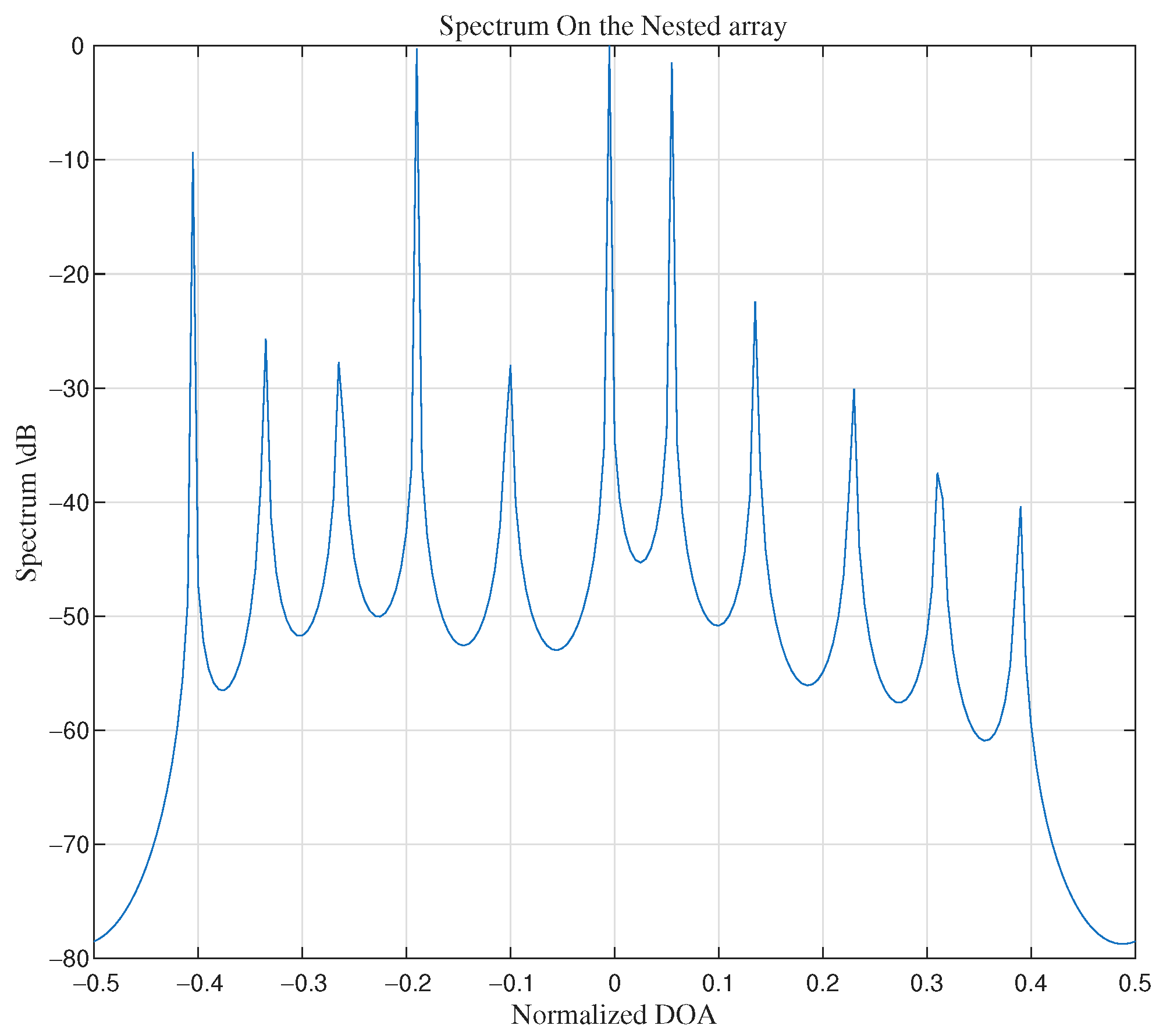
As shown in
Figure 1, we plot the MUSIC spectrum after 1.5B-SCE recovers the covariance matrix on
, with SNR
dB, 100 snapshots, and 11 sources with different DOAs. From
Figure 1, we observe 11 spectral peaks in total, which shows that for
with 12 degrees of freedom, 1.5B-SCE can successfully resolve the maximum number of sources that it is theoretically able to resolve.
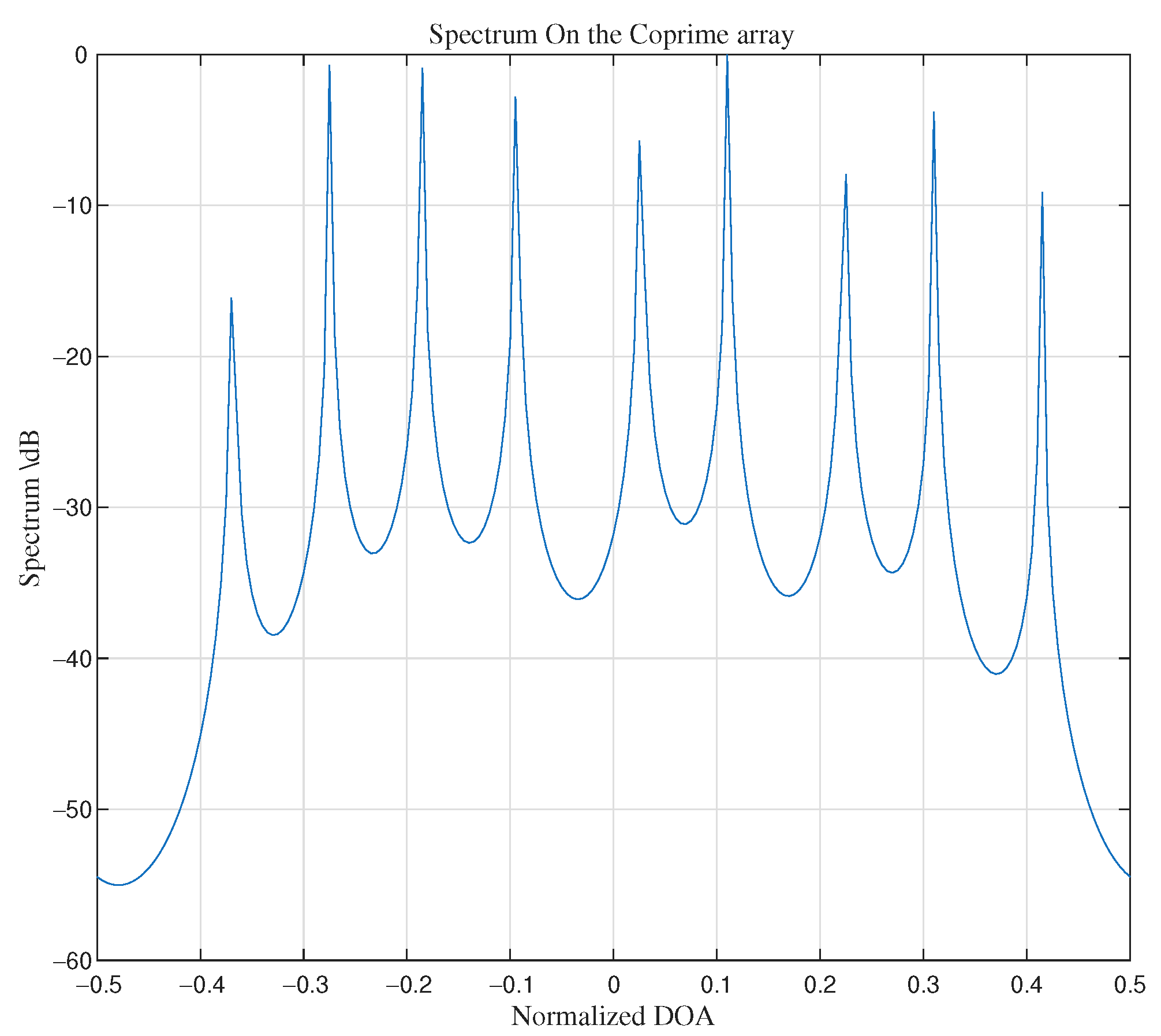
As shown in
Figure 2, we also plot the MUSIC spectrum after 1.5B-SCE recovers the covariance matrix on the coprime array, using the same SNR and number of snapshots as in
Figure 1. However, since
has 10 degrees of freedom, we use 9 sources with different DOAs. In
Figure 2, there are 9 spectral peaks in total, indicating that 1.5B-SCE successfully resolves 9 sources. In contrast, 1.5B-MUSIC of [
20] uses a difference co-array and discards the virtual elements outside the holes of the difference co-array of the coprime array, which reduces the effective degrees of freedom. For example, for the 6-element coprime array used in this paper, due to the hole at position 8, 1.5B-MUSIC can only exploit the difference co-array with 8 degrees of freedom, yielding a maximum of 7 resolvable sources. Therefore, compared with 1.5B-MUSIC, 1.5B-SCE increases the number of resolvable sources on coprime arrays.
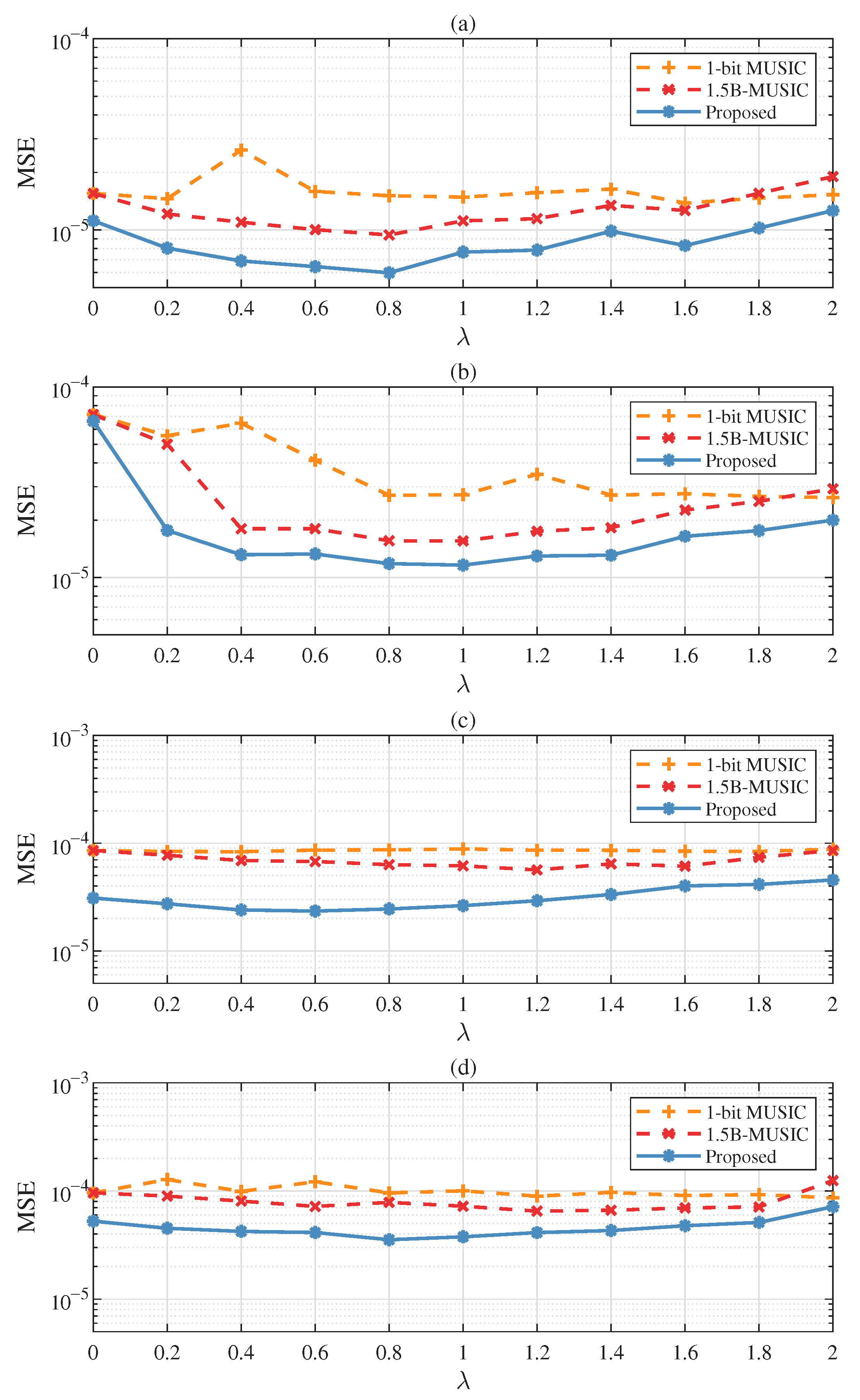
In the following experiments, we examine the impact of the 1.5-bit quantization threshold on DOA estimation performance. The experiments are conducted at SNRs of 0 dB and 10 dB, with 100 snapshots and 5 sources with different DOAs. All results are averaged over 200 Monte Carlo trials. To better illustrate the performance of 1.5B-SCE, we also provide results for 1.5B-MUSIC and 1-bit MUSIC for comparison.
As shown in
Figure 3, 1.5B-SCE exhibits good DOA estimation performance under different quantization thresholds. In addition, 1.5B-SCE significantly outperforms 1.5B-MUSIC across different quantization thresholds, which validates the effectiveness of the proposed method. From
Figure 3a,c, we observe that at SNR
dB, 1.5B-SCE achieves a lower MSE when the quantization threshold
is between
and
. However, when
is too large, the performance of 1.5-bit quantization degrades to a level worse than that of 1-bit quantization. At SNR
dB, the best performance is achieved at
, while at SNR
dB the best performance is achieved at
. This indicates that the optimal value of
is significantly related to the SNR. Furthermore, the performance gap between 1.5B-SCE and 1.5B-MUSIC remains relatively stable, indicating that 1.5B-SCE effectively suppresses finite-snapshot errors and improves DOA estimation performance. On the coprime array, as shown in
Figure 3c,d, 1.5B-SCE also exhibits good DOA estimation performance, and its advantage over 1.5B-MUSIC remains relatively stable, validating the effectiveness of 1.5B-SCE on coprime arrays. Specifically, at SNR
dB, the best performance is achieved at
; at SNR
dB, the best performance is achieved at
. Comparing across arrays, at SNR
dB the performance gap between 1.5B-SCE and 1.5B-MUSIC is 2 dB on the nested array, while it is approximately 4 dB on the coprime array. At SNR
dB, the gap is
dB on the nested array and approximately
dB on the coprime array. This indicates that 1.5B-SCE offers a more significant performance improvement over 1.5B-MUSIC on coprime arrays. Finally, due to the sparsity of the nested array’s elements, its low-bit sampling exhibits noticeable fluctuations in numerical stability; however, this issue is beyond the scope of this paper.
Practical guideline for selecting . The numerical trends in
Figure 3 also give rise to a short practical recipe for selecting the 1.5-bit quantization threshold. The best-performing
tracks the signal-plus-noise scale
, so
is a reasonable operating range. In deployment,
can be estimated as
from a brief unquantized calibration burst if the front end allows one, or, when only 1.5-bit data are available, approximated from the average power of
together with an auxiliary noise-power estimate obtained from a signal-free interval. With
in hand, we suggest the following three-item guideline:
- (1)
Set with .
- (2)
Choose when the operating SNR is high (≳10 dB) so that more samples exceed the threshold and the three-level quantizer preserves large-magnitude signal structure; choose when the operating SNR is low (≲0 dB), to avoid over-quantizing the noise floor into the non-zero levels.
- (3)
When the operating SNR is unknown or time-varying,
is a robust default, since it lies inside the best-performing band on both the nested and coprime layouts of
Figure 3 across the tested SNR range.
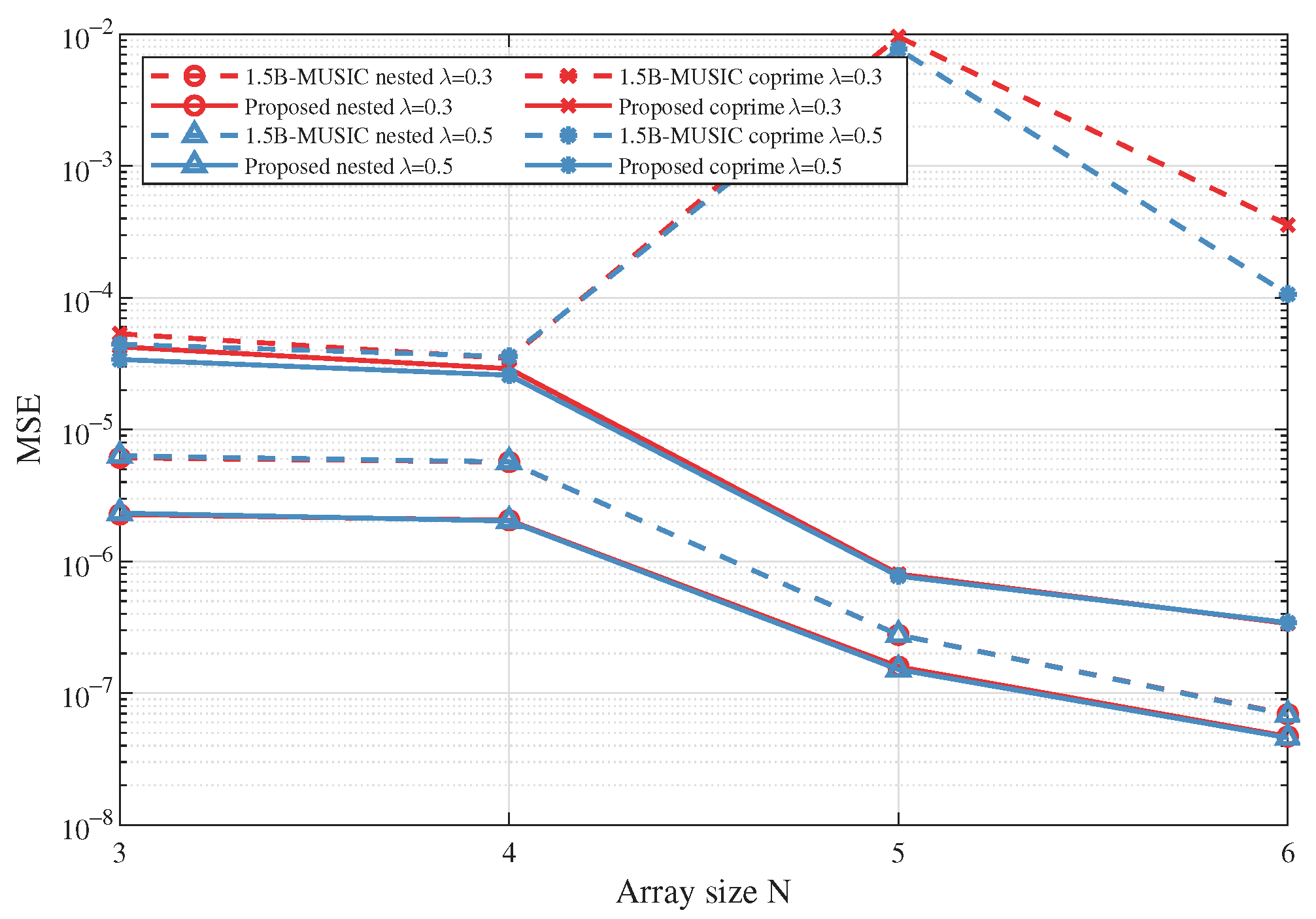
We first examine how the proposed estimator scales with array size. We use both coprime and nested arrays with parameters
chosen so that the total aperture grows, and report MSE versus the number of physical elements. The experiment is conducted at SNR
dB with 100 snapshots and
sources. The results in
Figure 4 show that, on both array geometries, the MSE of 1.5B-SCE decreases monotonically as the array size grows and stays consistently below that of 1.5B-MUSIC, and the relative ordering of the baselines is preserved. This indicates that the proposed covariance-fitting formulation scales gracefully to larger sparse arrays under both coprime and nested configurations.
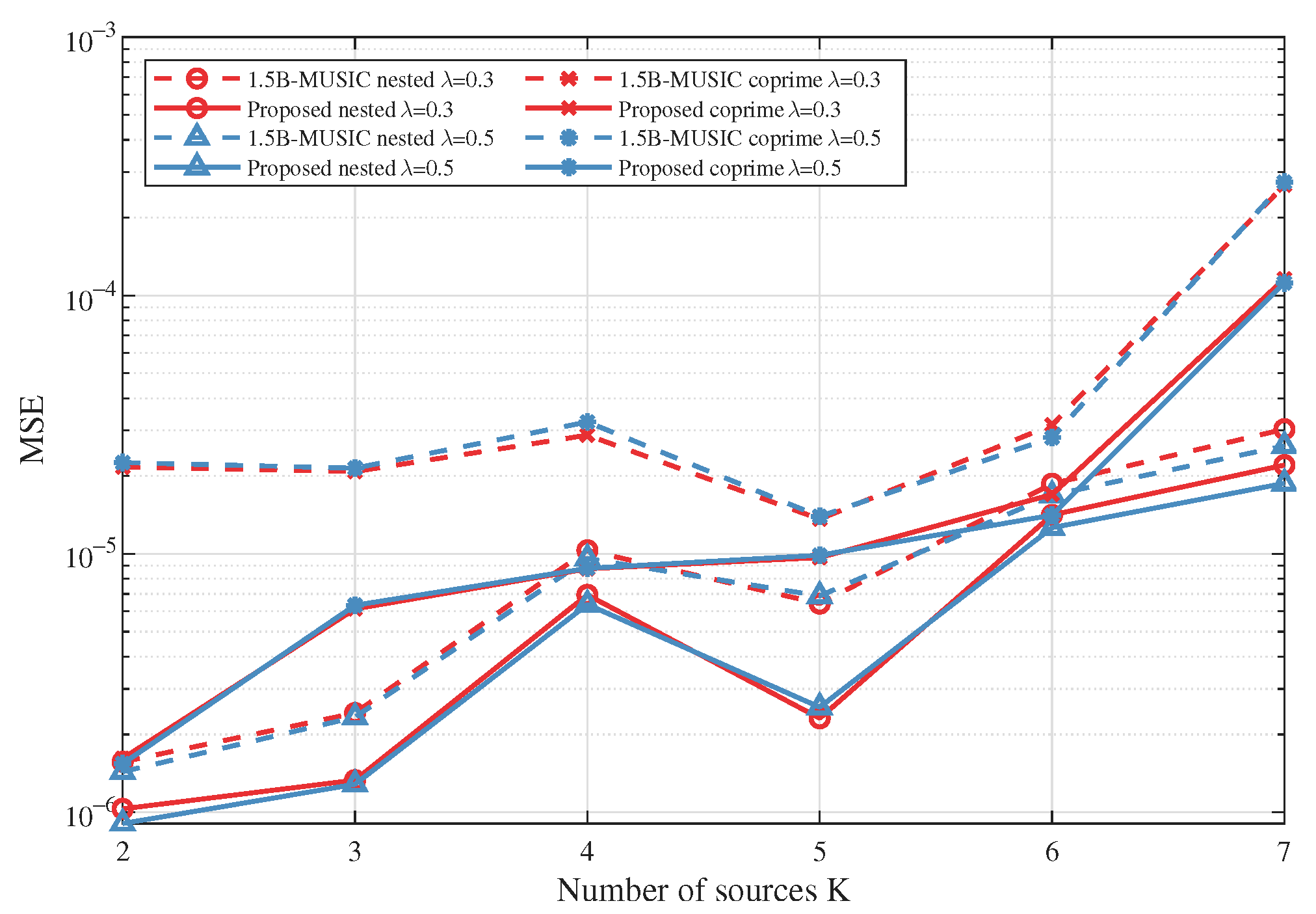
Next, we verify the performance of 1.5B-SCE as the number of sources
K varies, on both the nested array and the coprime array at SNR
dB with 100 snapshots. As shown in
Figure 5, on both arrays 1.5B-SCE maintains an advantage over 1.5B-MUSIC across the range
, and the degradation with increasing
K is consistent with the reduced per-source effective aperture. For
K approaching the degrees of freedom of the array, all estimators degrade, as expected.
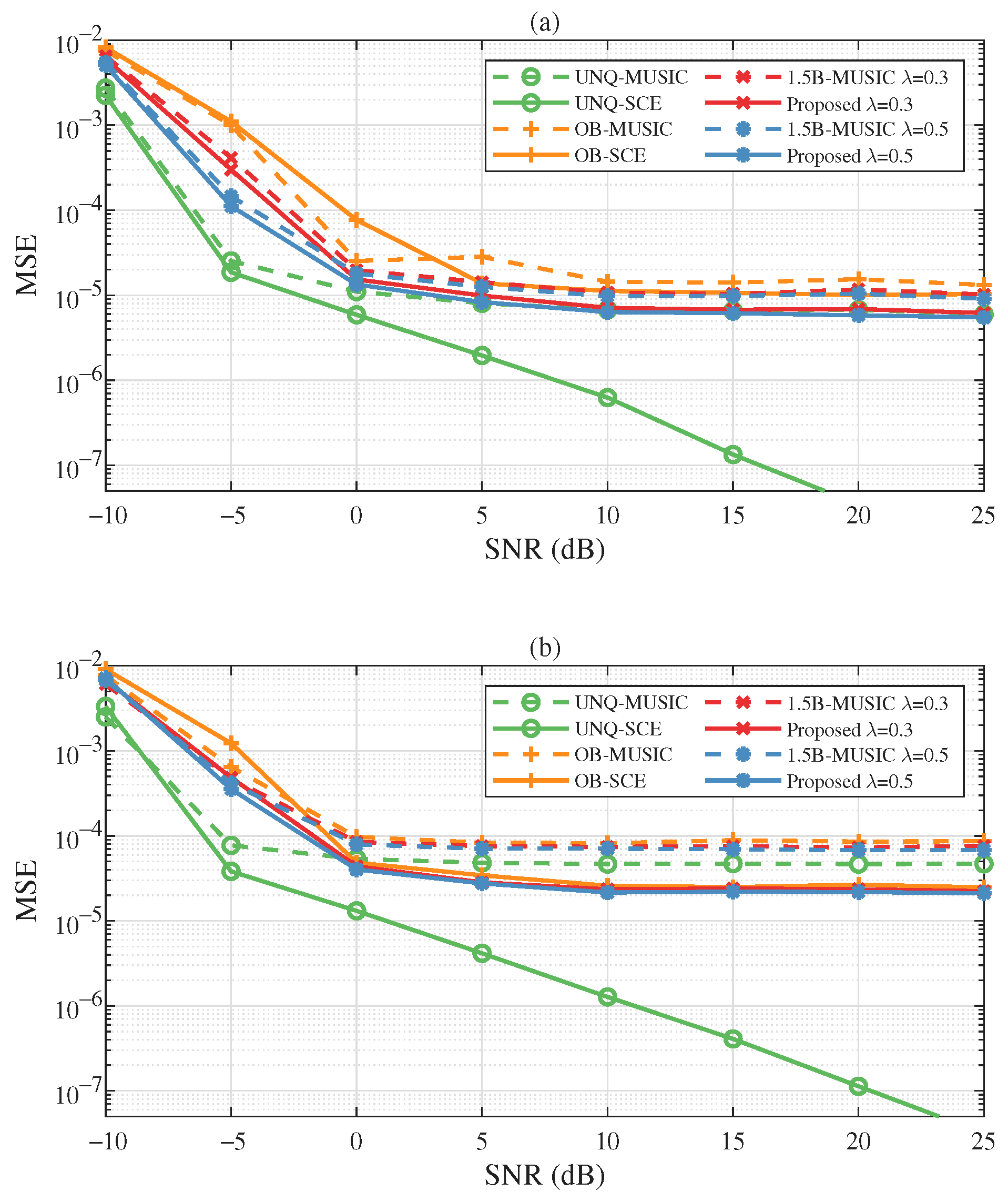
We then verify the DOA estimation performance of 1.5B-SCE under different SNRs, ranging from dB to 25 dB with a step size of 5 dB. The experiment uses 5 sources with different DOAs, 100 snapshots, and quantization thresholds and . The reason is that at , 1.5B-SCE exhibits good DOA estimation performance on both nested and coprime arrays, while at , its performance is only average. For a fair comparison, we choose both thresholds in the experiments. Additionally, 1.5B-MUSIC and UNQ-MUSIC are included as comparison algorithms, together with the structured baselines UNQ-SCE and OB-SCE described above.
As shown in
Figure 6, 1.5B-SCE exhibits good DOA estimation performance under different SNRs. In addition, 1.5B-SCE significantly outperforms 1.5B-MUSIC across different quantization thresholds, which validates the effectiveness of the proposed method. From
Figure 6a, we observe that on the nested array, when
and SNR
dB, the estimation accuracy of 1.5B-SCE is about
dB better than that of 1.5B-MUSIC. Across different values of
, its accuracy is close to that of UNQ-MUSIC, indicating that 1.5B-SCE effectively suppresses finite-snapshot errors and improves DOA estimation performance. From
Figure 6b, we observe that on the coprime array, when
and SNR
dB, the estimation accuracy of 1.5B-SCE is about
dB better than that of 1.5B-MUSIC. When
, it is about
dB better than 1.5B-MUSIC. In particular, at
and SNR
dB, the accuracy of 1.5B-SCE is about
dB better than that of UNQ-MUSIC, indicating that the proposed algorithm yields a more significant performance improvement on coprime arrays.
Three further observations follow once the structured baselines UNQ-SCE and OB-SCE are added to
Figure 6. First, the gap between 1.5B-SCE and UNQ-SCE isolates the loss attributable to 1.5-bit quantization at the same level of structured regularization: on the coprime array this gap is typically 2–3 dB at moderate SNR, consistent with the 1.5-bit/unquantized loss reported for closed-form recovery in [
21]. Second, the gap between 1.5B-SCE and OB-SCE isolates the genuine benefit of moving from 1-bit to 1.5-bit at fixed regularization: on the coprime array this gap reaches 3–5 dB in the high-SNR regime, because 1-bit quantization saturates while 1.5-bit retains coarse amplitude information. Third, the fact that 1.5B-SCE can match or exceed plain UNQ-MUSIC on the coprime array is consistent with the structured baselines: UNQ-SCE also outperforms UNQ-MUSIC on the coprime array, which shows that the advantage comes from the structured covariance-fitting regularization—not from the quantization itself. We therefore avoid interpreting the 1.5B-SCE/UNQ-MUSIC crossover as information gain from quantization.
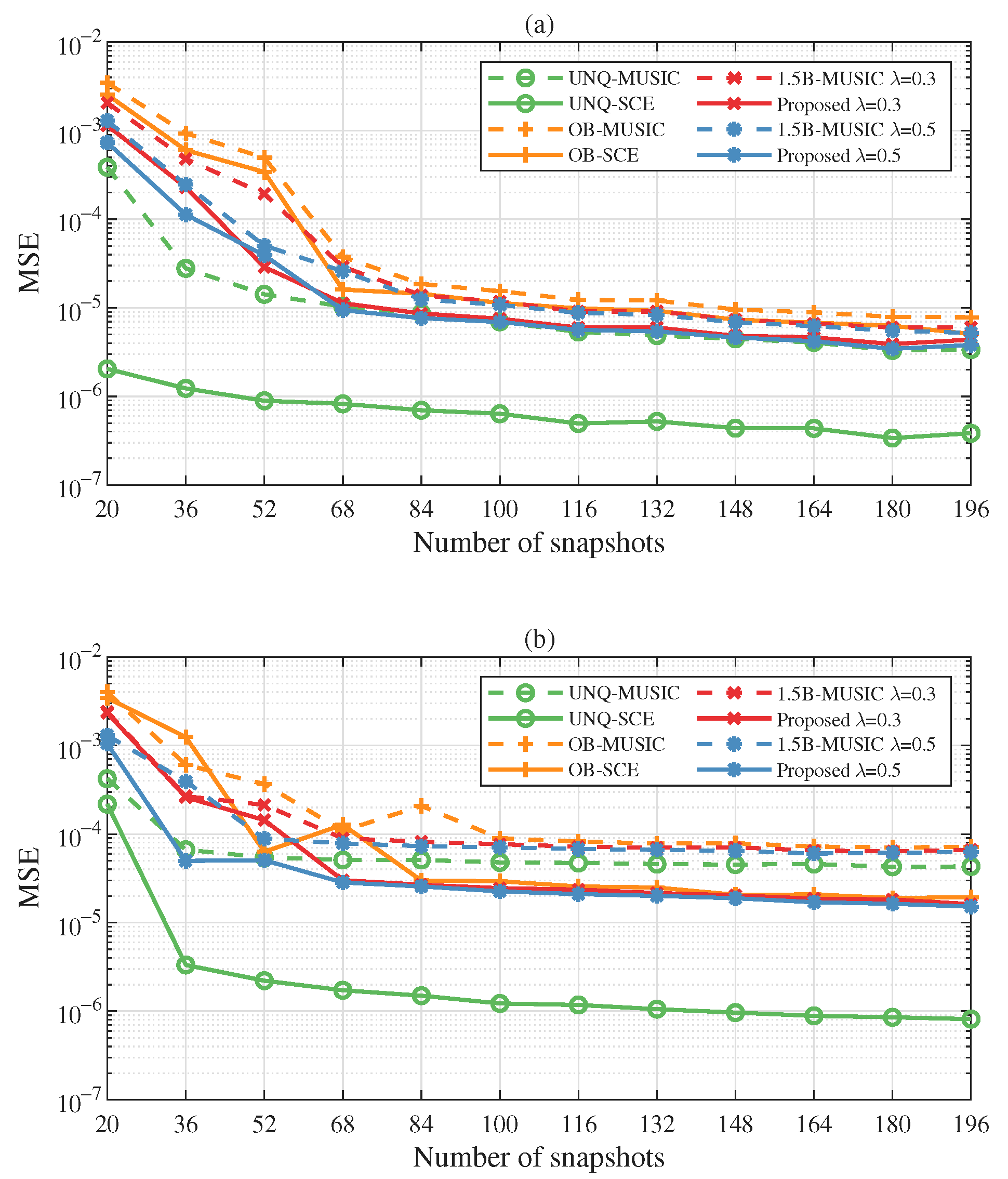
Finally, we verify the DOA estimation performance of 1.5B-SCE under different numbers of snapshots, ranging from 20 to 196 with a step size of 16. The experiment uses 5 sources with different DOAs, SNR dB, and quantization thresholds and .
As shown in
Figure 7, 1.5B-SCE exhibits good DOA estimation performance across different numbers of snapshots. In particular, on the coprime array, 1.5B-SCE significantly outperforms UNQ-MUSIC across different quantization thresholds, which validates the effectiveness of the proposed method. When the number of snapshots is only 68, 1.5B-SCE achieves an estimation accuracy approximately
dB better than UNQ-MUSIC and approximately
dB better than 1.5B-MUSIC at
. When the number of snapshots is 180, its performance is approximately
dB better than UNQ-MUSIC and approximately
dB better than 1.5B-MUSIC. However, as shown in
Figure 7a, on the nested array the performance advantage of 1.5B-SCE is relatively modest, about
dB. Therefore, the proposed algorithm is more suitable for coprime arrays than for nested arrays. The same three-way reading that we applied to
Figure 6 extends here: the 1.5B-SCE/UNQ-SCE gap quantifies the 1.5-bit loss at fixed regularization, the 1.5B-SCE/OB-SCE gap quantifies the genuine 1.5-bit-over-1-bit gain, and the 1.5B-SCE/UNQ-MUSIC crossover on the coprime array is matched by the UNQ-SCE/UNQ-MUSIC crossover, confirming that the advantage comes from the structured covariance-fitting regularization rather than from quantization.
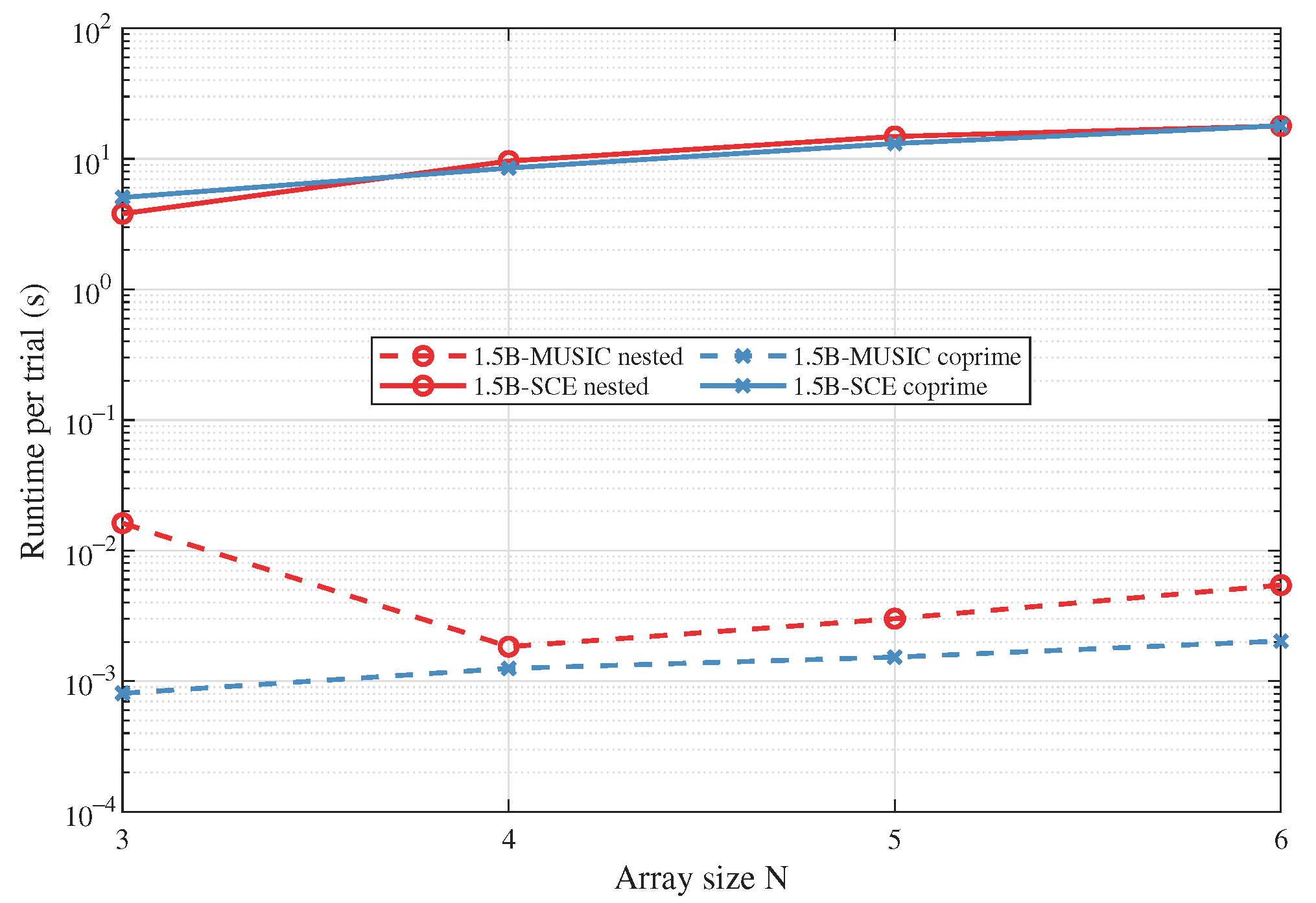
To complement the analytical complexity bounds derived in
Section 3, we also report the empirical wall-clock runtime of 1.5B-SCE and 1.5B-MUSIC under the same array-size sweep as in
Figure 4. Both methods are run in MATLAB R2025b on the same workstation; 1.5B-SCE uses CVX with the SDPT3 solver, and 1.5B-MUSIC consists of arcsine-law correction on the coarray followed by a root-MUSIC eigendecomposition. The reported value is the average of 20 independent Monte Carlo trials at SNR
dB and 100 snapshots. As shown in
Figure 8, the runtime of 1.5B-MUSIC remains below 20 ms across all tested apertures, while that of 1.5B-SCE grows from about 4 s at
to about 18 s at
(virtual ULA aperture
); the gap of roughly three orders of magnitude is consistent with the asymptotic comparison
versus
in
Section 3, and confirms that 1.5B-SCE trades wall-clock time for the structured-regularization gain documented above.