Unified Space–Time-Message Interference Alignment: An End-to-End Learning Approach

Abstract
1. Introduction
- Space-Domain Interference Alignment (SIA) manages interference by designing precoding vectors based on the available CSIT to direct beams from a multi-antenna transmitter. In a MISO BC with perfect CSIT, zero forcing (ZF) [8] or dirty paper coding (DPC) [9] techniques aim to completely eliminate interference, achieving the maximum sum DoF of for M transmit antennas and K single-antenna users.
- Time-Domain Interference Alignment (TIA) leverages the channel’s temporal dimension by retrospective IA design over multiple time intervals. A notable example is the Maddah-Ali and Tse (MAT) scheme [10], which uses perfect delayed CSIT to send an interference-resolving signal in a subsequent interval to resolve interference from the past. TIA has been shown to be highly effective in time-correlated channels [11,12].
- Message-Domain Interference Alignment (MIA) manages interference by encoding a common message stream intended for all users in addition to private user messages. This approach, typically implemented through rate-splitting multiple access (RSMA) [1,5,11,13], is particularly robust to imperfect CSIT [14], which has been identified as a key enabler for various 6G scenarios, ranging from satellite communications to massive MIMO [15]. RSMA allocates the interference components most vulnerable to CSIT inaccuracy to the common stream. Since the common message is designed for universal decodability, it remains robust against CSI uncertainty, protecting private streams from the catastrophic interference typical of conventional multi-user precoding [5,13,16].
- A novel deep-STMIA framework based on E2E DL is proposed to jointly optimize interference alignment across the spatial, temporal, and message domains.
- Unlike conventional schemes tailored to specific CSIT regimes, the proposed approach exhibits generalized CSI robustness and learns a unified communication strategy that adapts to a continuum of CSIT conditions—ranging from no CSIT and delayed CSIT to imperfect and perfect current CSIT.
- In contrast to traditional modular designs, recent advances in semantic communications [20] suggest that joint optimization of the message representation and the physical layer transmission can significantly enhance reliability. The proposed Deep-STMIA framework adopts this philosophy by regularizing the message domain to ensure that the transmitted streams are inherently robust to the interference patterns of the space-time channel. In particular, a structural message-domain regularization mechanism is proposed using auxiliary common bits, enabling the network to autonomously perform common message decoding for interference management and mitigate CSIT uncertainty. This allows the framework to improve upon RSMA for uncertainty-prone channels.
- By replacing rigid, iterative processing with successive interference cancellation (SIC), the Deep-STMIA neural network approach implicitly mitigates decoding bottlenecks from catastrophic error propagation, particularly for high-order modulation and imperfect CSIT scenarios.
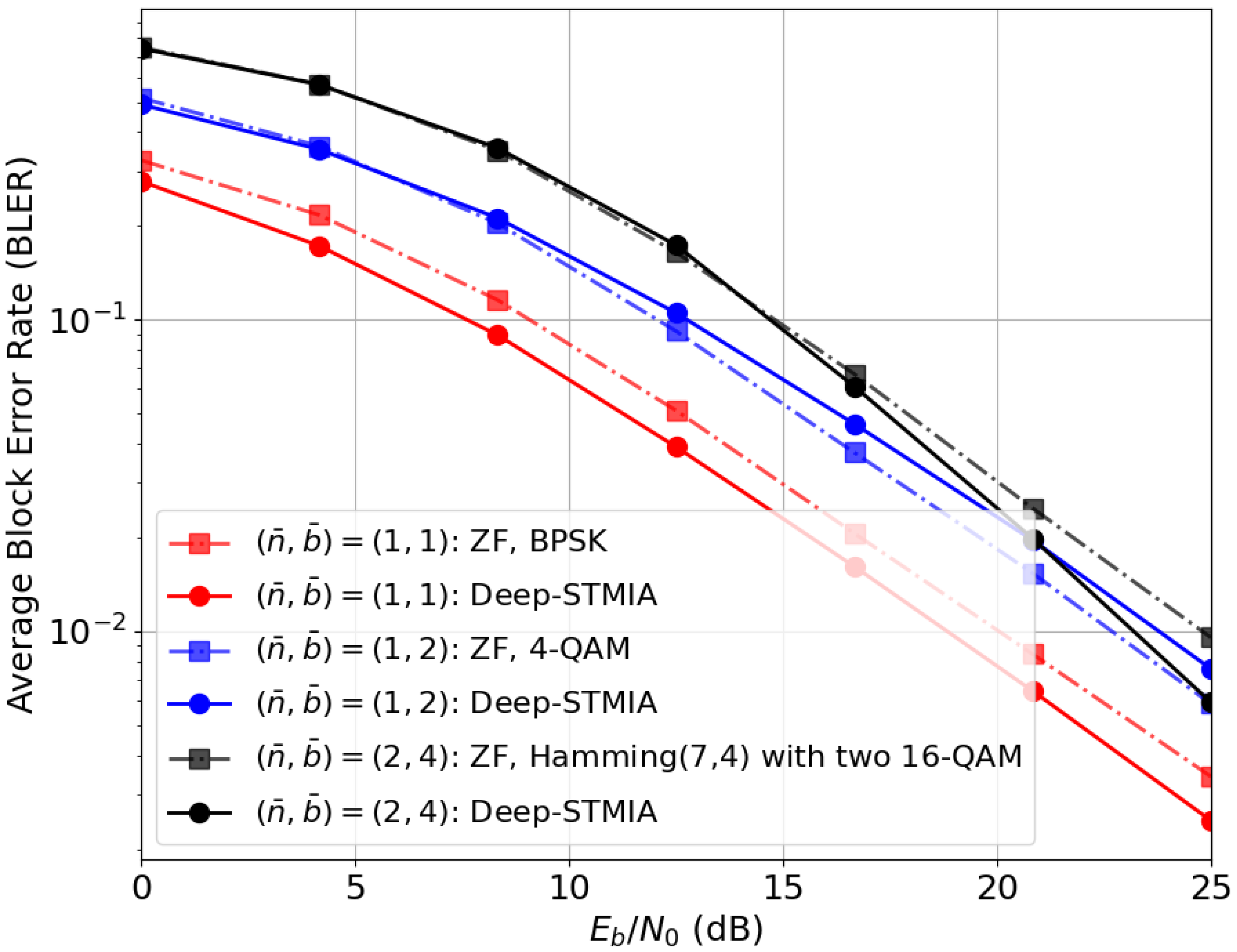
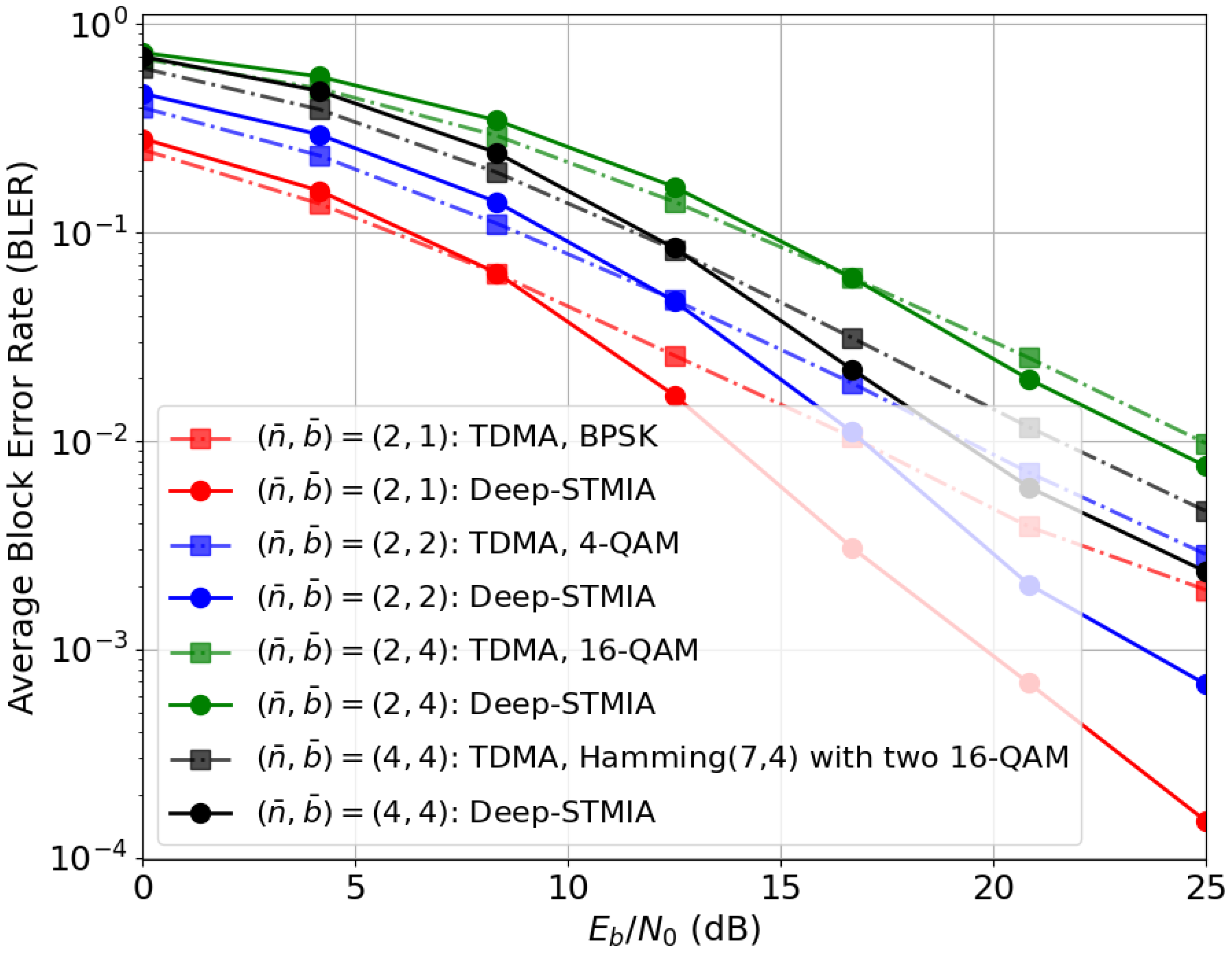
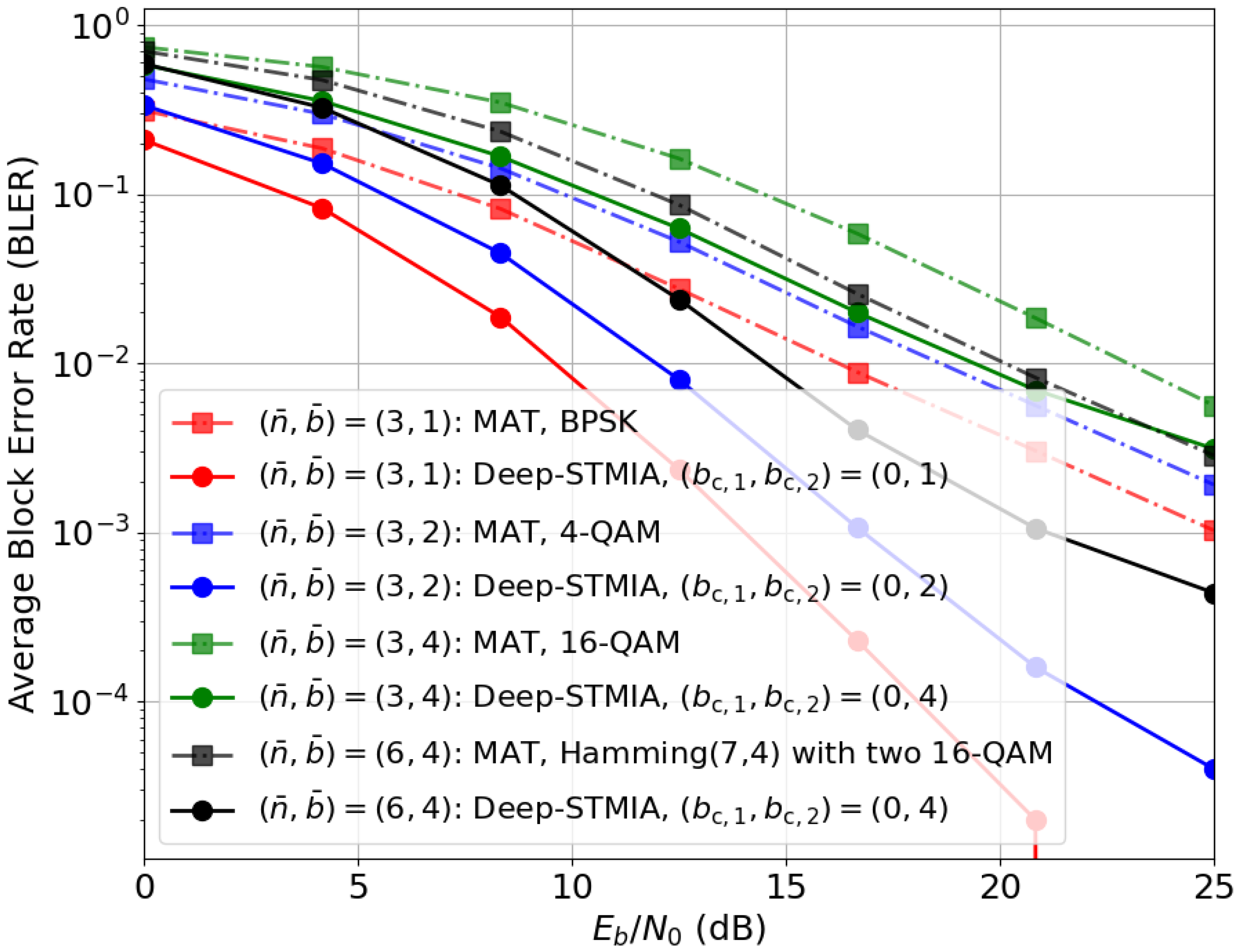
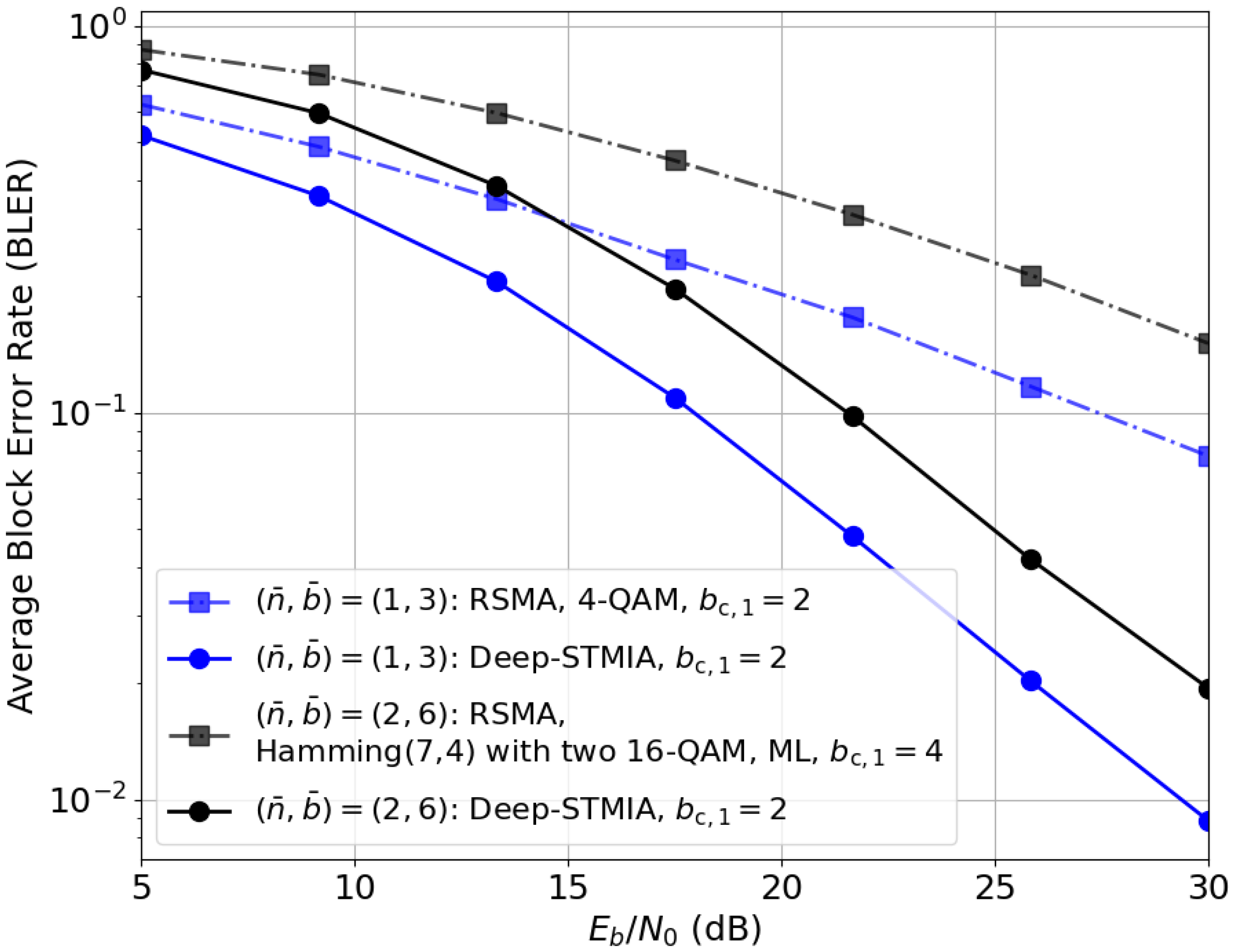
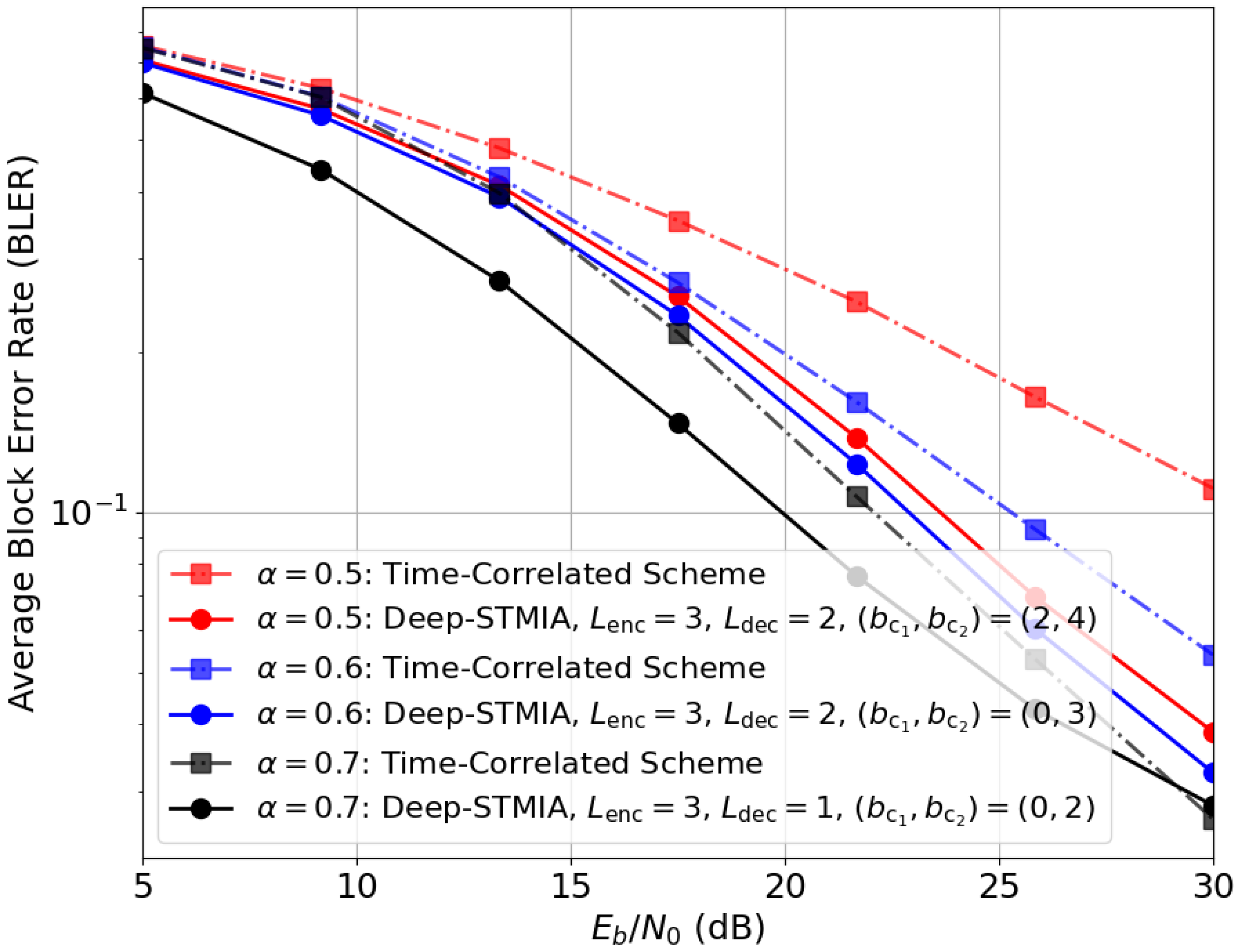
- Validation and performance gains are demonstrated by extensive simulations. The reliability of Deep-STMIA, measured via block error rate (BLER), is observed to match the performance slopes of DoF-optimal benchmarks in extreme CSIT regimes and significantly outperform existing RSMA [1] and time-correlated [11] schemes in imperfect CSIT conditions.
2. System Model
- Local CSIR (): Each user possesses local channel knowledge with quality parameter . The error variance for CSIR is , where .
- Delayed CSIT (): The transmitter receives past channel states with quality parameter . The corresponding error variance is , where . This delayed feedback enables TIA.
- Current CSIT (): The transmitter possesses instantaneous channel knowledge with quality parameter . The error variance is , where is defined above. Current CSIT is essential for SIA and MIA.
3. DoF Optimal Baseline Schemes
- 1.
- Perfect Current CSIT (): Enables full space-domain IA (SIA), such as ZF precoding.
- 2.
- No CSIT (): Requires orthogonal schemes, such as time division multiple access (TDMA).
- 3.
- Perfect Delayed CSIT and No Current CSIT ( and ) [10]: Enables time-domain IA (TIA), such as the MAT scheme.
- 4.
- 5.
- Perfect Delayed CSIT and Imperfect Current CSIT ( and ) [11]: Enables a joint space–time IA (STIA) scheme using both current and delayed CSIT.
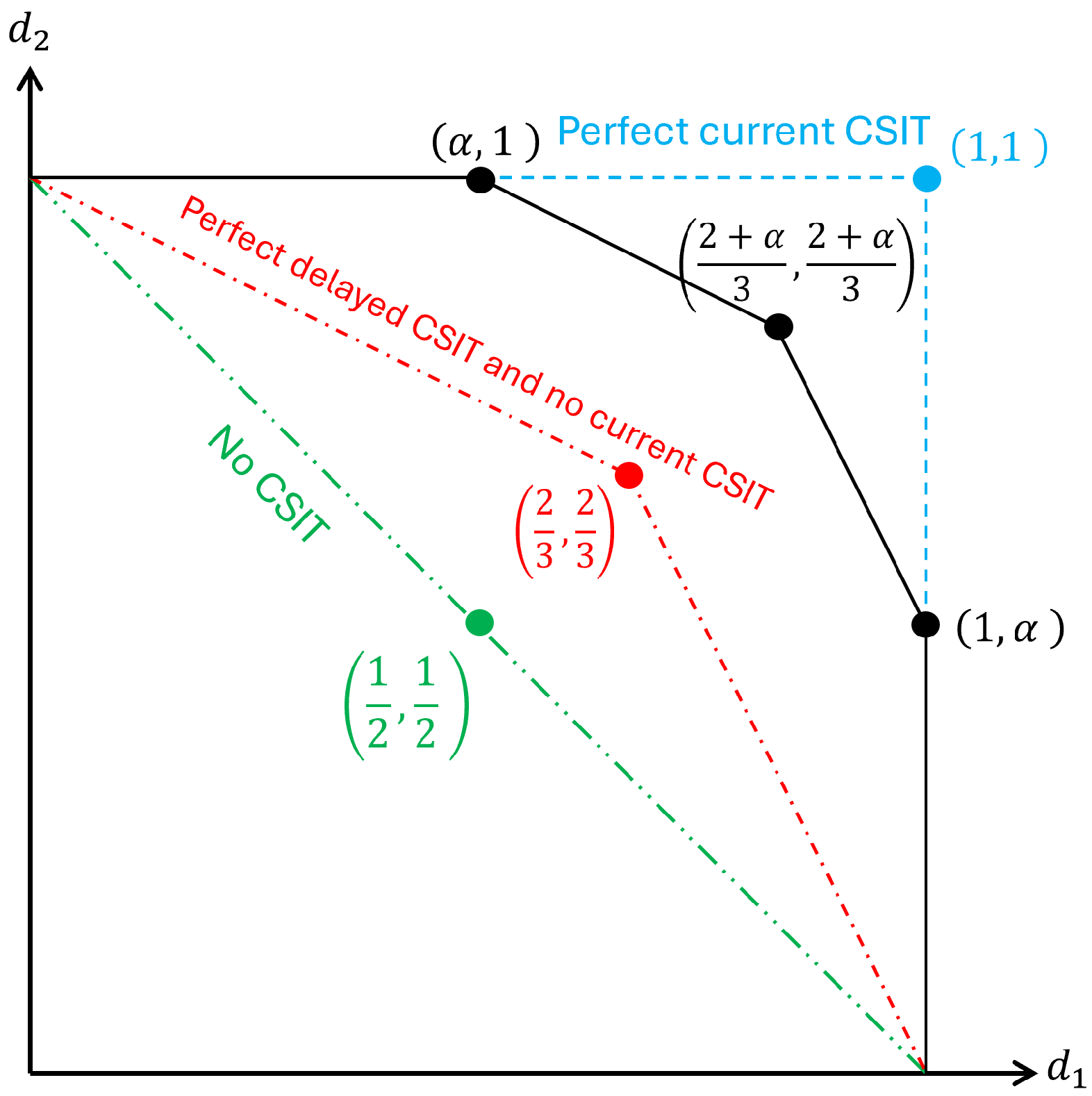
- The green region corresponds to the minimum case of no CSIT ().
- The blue region corresponds to the maximum DoF case of perfect CSIT ().
- The red region corresponds to the specific case of perfect delayed CSIT and no current CSIT ().
- The black region represents the general case of .
3.1. Zero Forcing
3.2. Time Division Multiple Access
3.3. Maddah-Ali and Tse (MAT) Scheme
3.4. Rate-Splitting
- SIA: The private streams are precoded with power ∼, using the imperfect current CSIT, such that unintended private interference is suppressed to the noise level.
- MIA: The common stream, with power ∼P, absorbs the residual interference components that cannot be accurately nulled due to CSIT uncertainty, thereby preventing the rate-saturation typical of conventional precoding in interference-limited regimes.
3.5. Time-Correlated Scheme
- Time Interval : User messages and are encoded and precoded into using the available imperfect current CSIT, similar to standard space-division multiple access (SDMA). While SIA precoding attempts to minimize interference, the CSIT uncertainty results in residual interference at each receiver, which is subsequently addressed via the retrospective alignment in the next interval.
- Time Interval : The transmitter utilizes the delayed CSIT from to precisely calculate the interference that was overheard by the users. This interference is quantized and encoded into a common message . This common message is then transmitted alongside new private user messages and using SIA precoding based on the current CSIT of the second interval.
- Decoding Process: The receivers employ a two-stage decoding strategy. First, they decode the common message and the private messages from the signal received at . Subsequently, the information from is used to reconstruct and cancel the residual interference present in the signal received during . This reduces the interference from the first interval retroactively over the entire two-slot duration.
4. End-to-End Deep-Learning Using Interference Alignment
4.1. Transmitter Architecture
- 1.
- It ensures that the number of trainable parameters remains constant regardless of the number of time intervals T, enhancing scalability.
- 2.
- It allows for the design of transmit symbols, , and common messages, , to be jointly optimized over the entire sequence of T time intervals, facilitating the exploitation of inter-slot temporal dependencies. This is crucial for schemes using time-domain IA (TIA), where transmission in any given interval is coupled with the interference patterns of previous intervals.
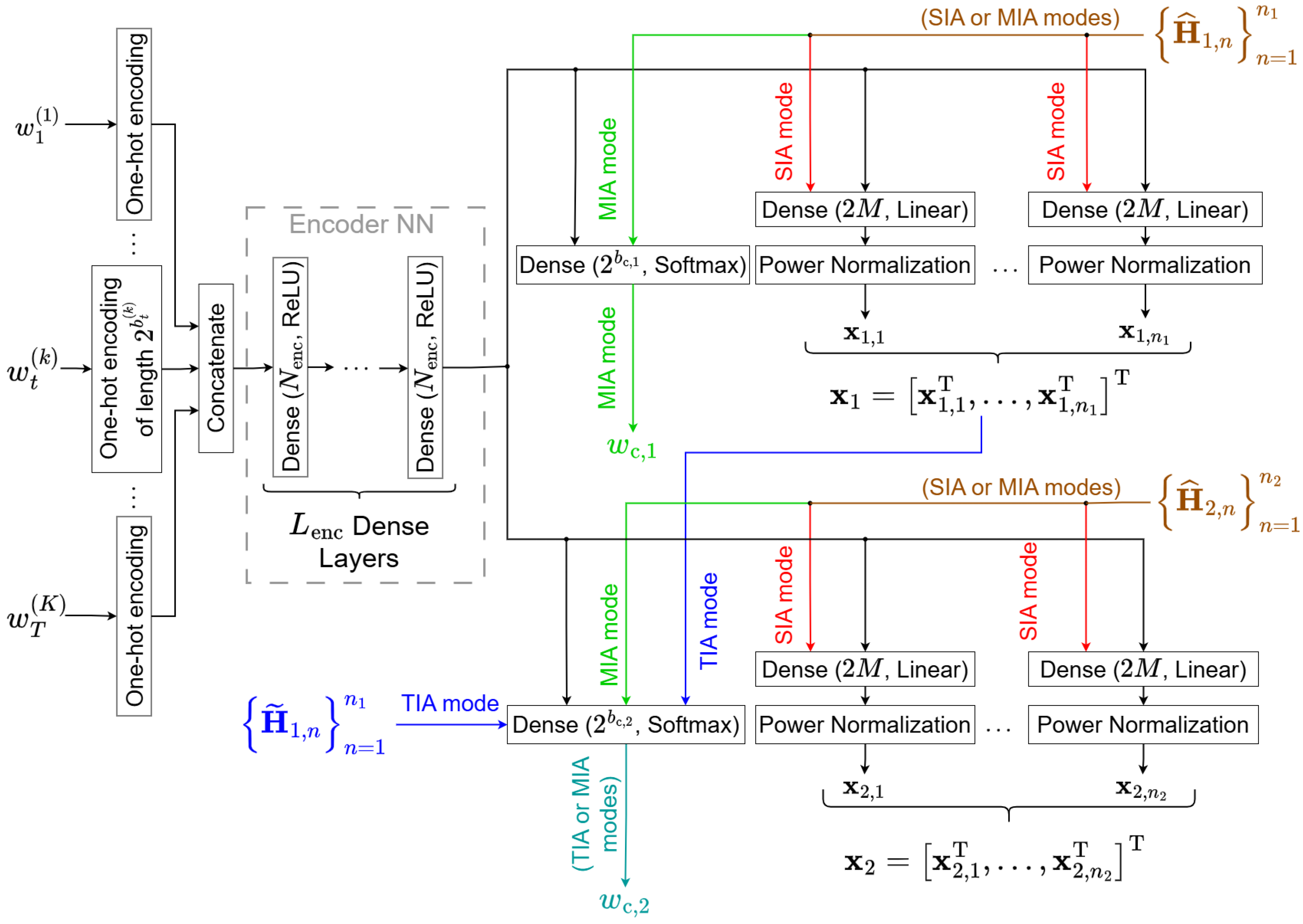
- Encoded Signal () Generation: To ensure that the power constraint is satisfied on a per-symbol basis, the signal generated for each time interval t is achieved via a dedicated dense layer followed by a power normalization layer. Current CSIT (), if available, is input to the corresponding dense layer processing encoded signal at time , allowing the network to learn a spatial precoding strategy for space-domain interference alignment (SIA). This approach aligns with recent findings that deep learning-based beamformers can achieve superior robustness against CSI uncertainty compared to conventional iterative algorithms [22].
- Common Message () Generation: For the common message generation, rather than a discrete (binary bit) output, a probability vector of length is generated by a dense layer with a softmax activation function. This differentiable output facilitates the backpropagation process.
- –
- MIA Implementation: The generation of is always based on the user messages. If only current CSIT is available, is conditioned on the user messages and .
- –
- TIA Implementation: If delayed CSIT is accessible for , the common message generated at time also uses the delayed CSIT () and the encoded signal from the previous time interval () as inputs. This dependency allows the common message to contain the necessary retrospective alignment information for time-domain interference alignment (TIA).
4.2. Receiver Architecture
4.3. Implementation of Interference Alignment Techniques
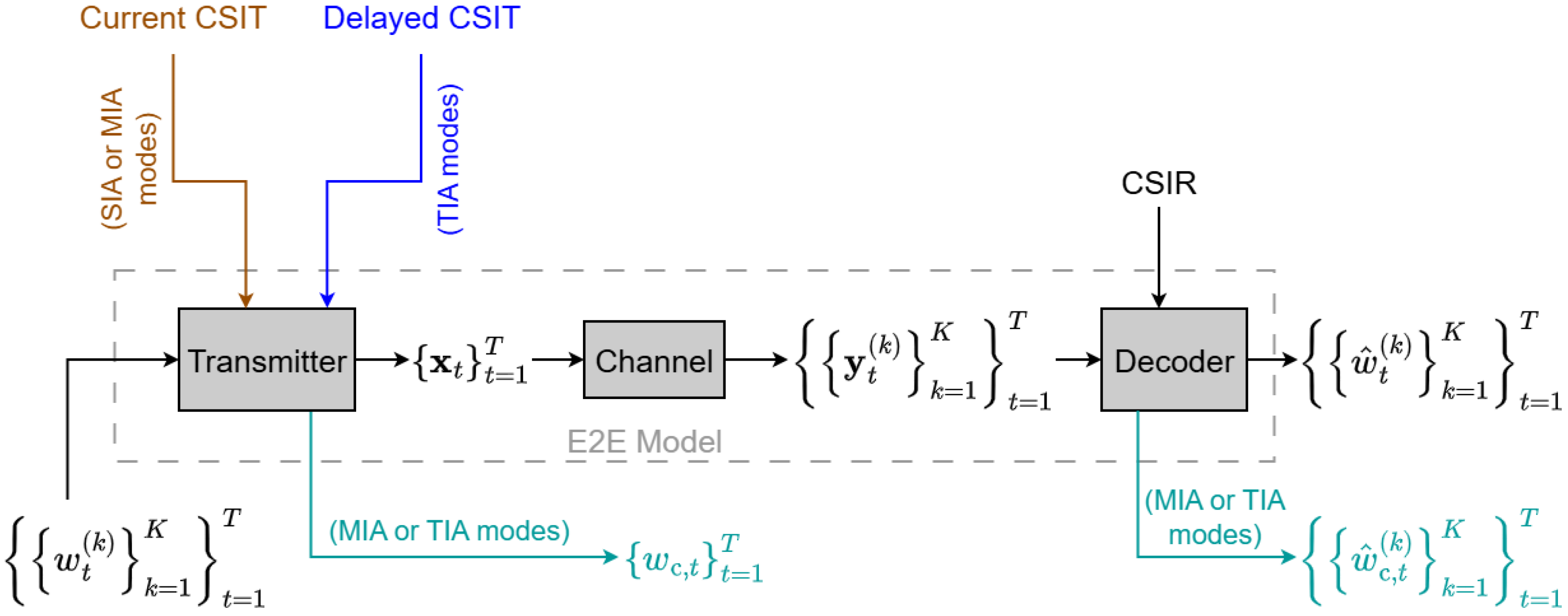
- Space-Domain IA (SIA) is implemented by feeding the current CSIT () as an input to the layers that determine the encoded signal in each time interval as shown in Figure 3. The network learns to compute the spatial precoding vectors based on instantaneous channel conditions.
- Message-Domain IA (MIA) is enabled by the common message , which acts as a regularizer, determining the portion of information decoded by all users (rate-splitting concept [1]). The quality of current CSIT directly influences the common message generated, as less perfect CSIT necessitates a larger common stream for robustness. The common message must be generated at the transmitter and decoded at the receiver for MIA to be effective.
- Time-Domain IA (TIA) is realized when the common message generator at time accepts the delayed CSIT and the previous time’s encoded signal () as input. This allows the common message to carry retrospective alignment information based on past channel conditions, incorporating the principles of the MAT scheme [10].
- SIA mode (red color).
- MIA mode (green color).
- TIA mode (blue color).
- The combination of SIA and/or MIA modes (brown color) shows current CSIT dependency.
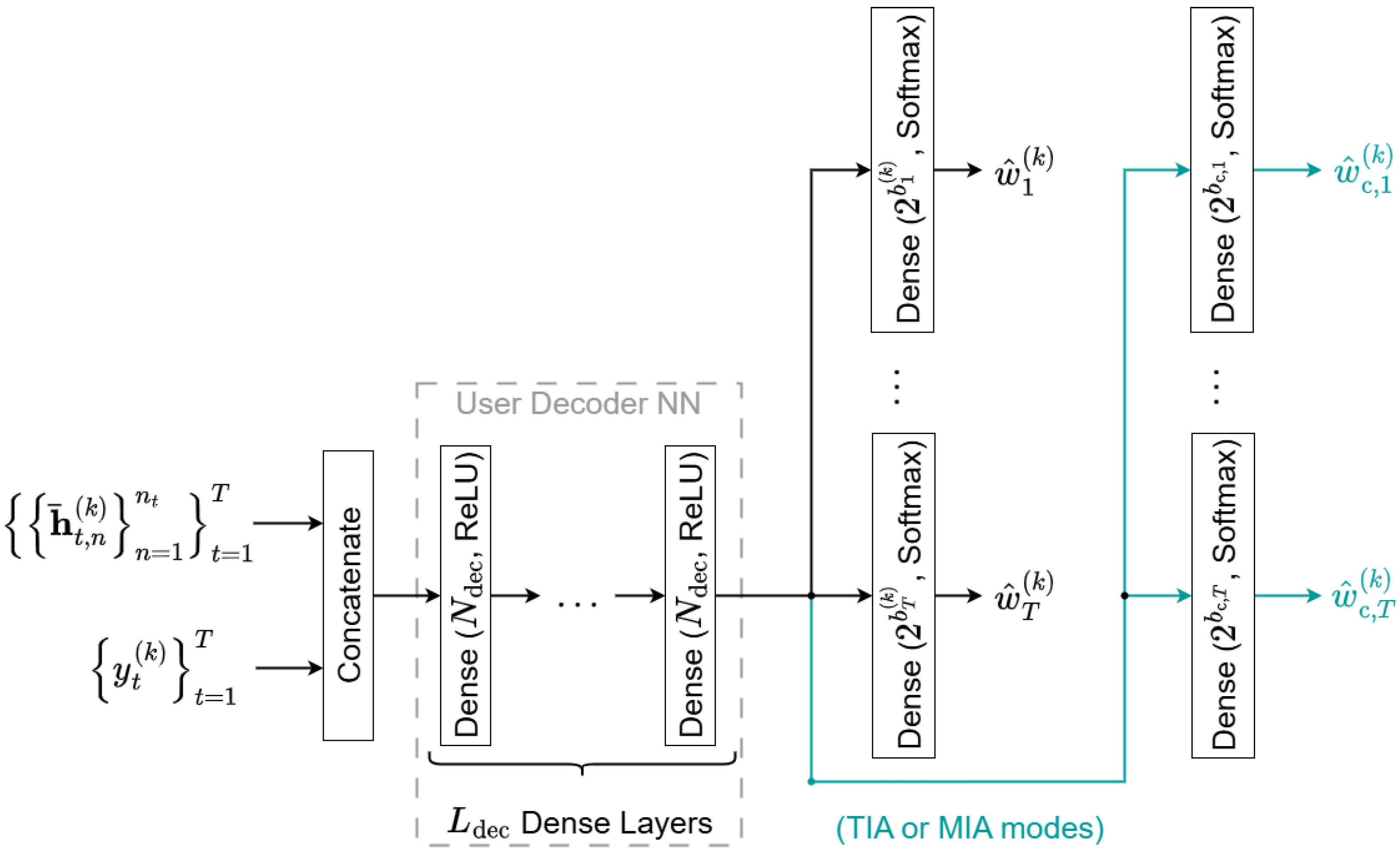
- The combination of MIA and/or TIA modes (blue-green color) shows common message generation/decoding.
4.4. Training and Loss Function
- Private Message Loss (): Since user messages are represented by one-hot encoding, the loss for each message is calculated using the categorical cross-entropy function. Let denote the one-hot encoded ground truth vector of length and denote the predicted probability vector for user k at time t. The loss is defined as follows:
- Common Message Loss (): As the common message generator outputs a probability vector and the decoder reconstructs a probability vector, the loss is computed using the Kullback–Leibler (KL) Divergence. For the common message distribution of length and its reconstruction at receiver k, the loss is
- Total Common Message Loss: Each common message must be decoded by all users. Therefore, the loss for a given common message is defined as the worst-case loss among all users: .
4.5. Complexity
- 1.
- Transmitter Complexity (): The transmitter complexity is the summation of the flops required for (i) processing raw one-hot messages by Encoder NN (), (ii) generating common messages (), and (iii) generating the encoded signals (), which are calculated as follows:
- 2.
- Receiver Complexity (): The decoder at each user is designed to be lightweight, involving only the received signal processing and bit estimation. The FLOPs required for the K receivers is the summation of the FLOPs required for (i) processing CSIR and received signals by User Decoder NN (), (ii) estimating common messages (), and (iii) estimating user messages (), which are as follows:
5. Simulation Results
5.1. System Configuration
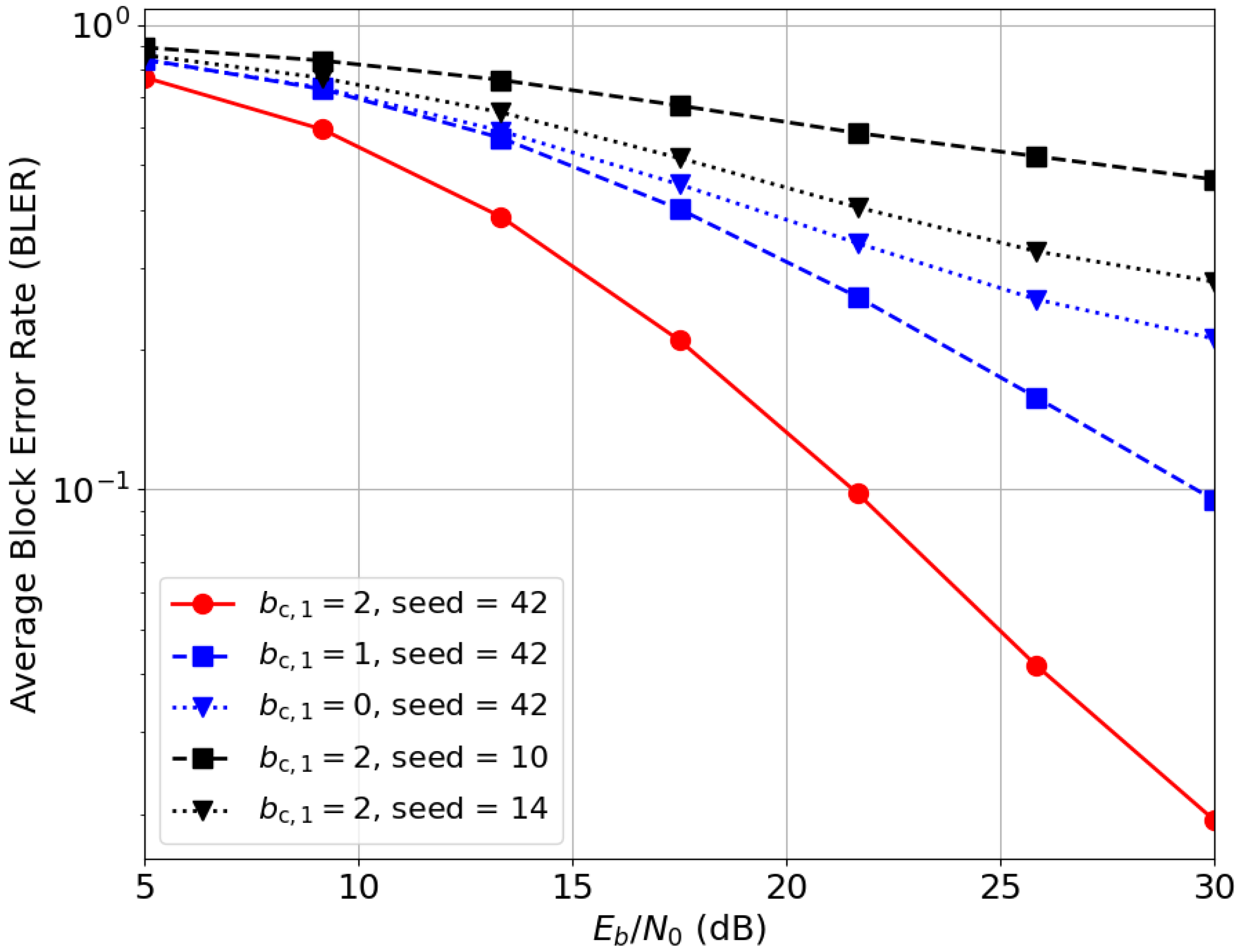
5.2. Hyperparameter Settings and Regularization
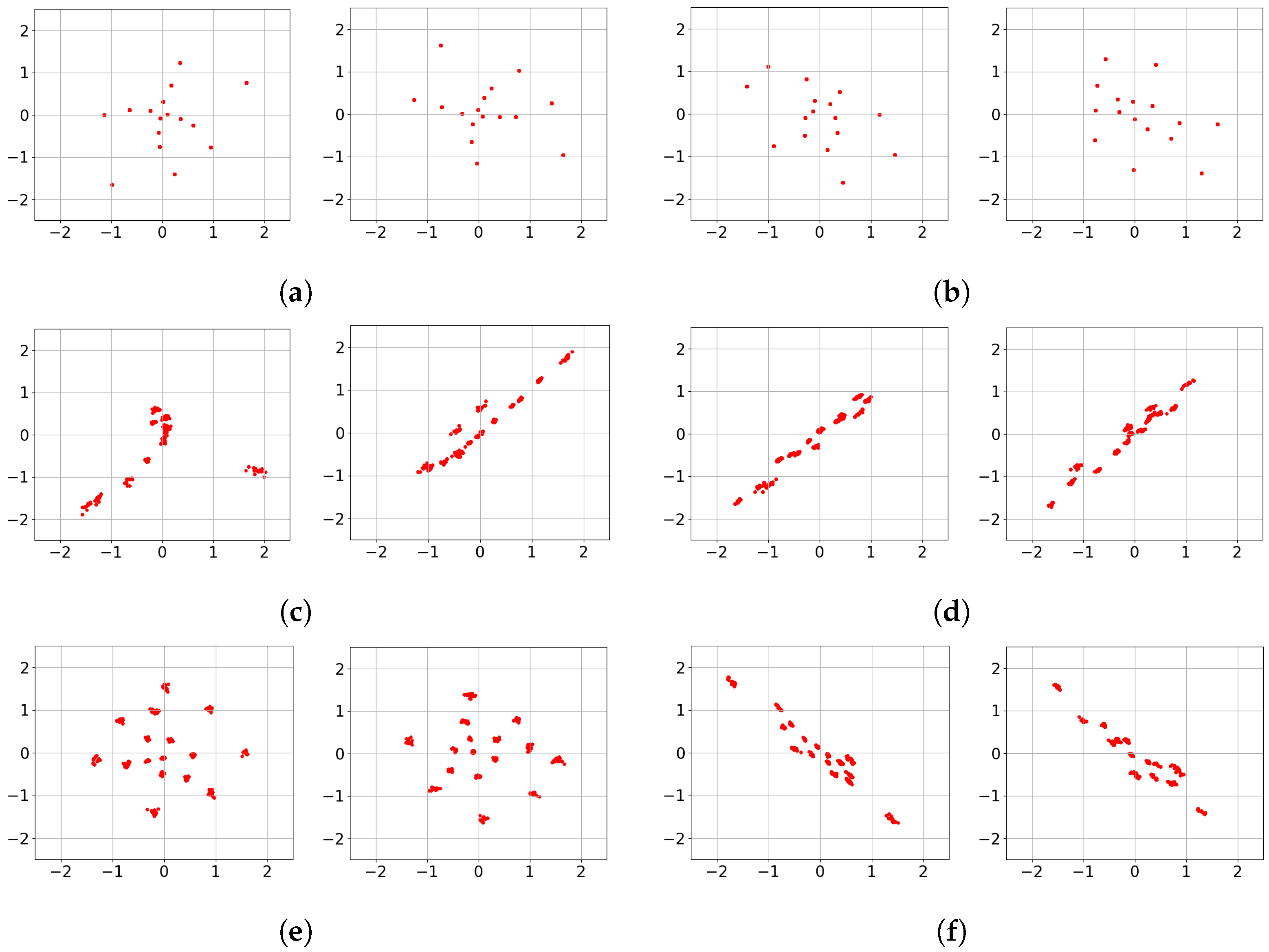
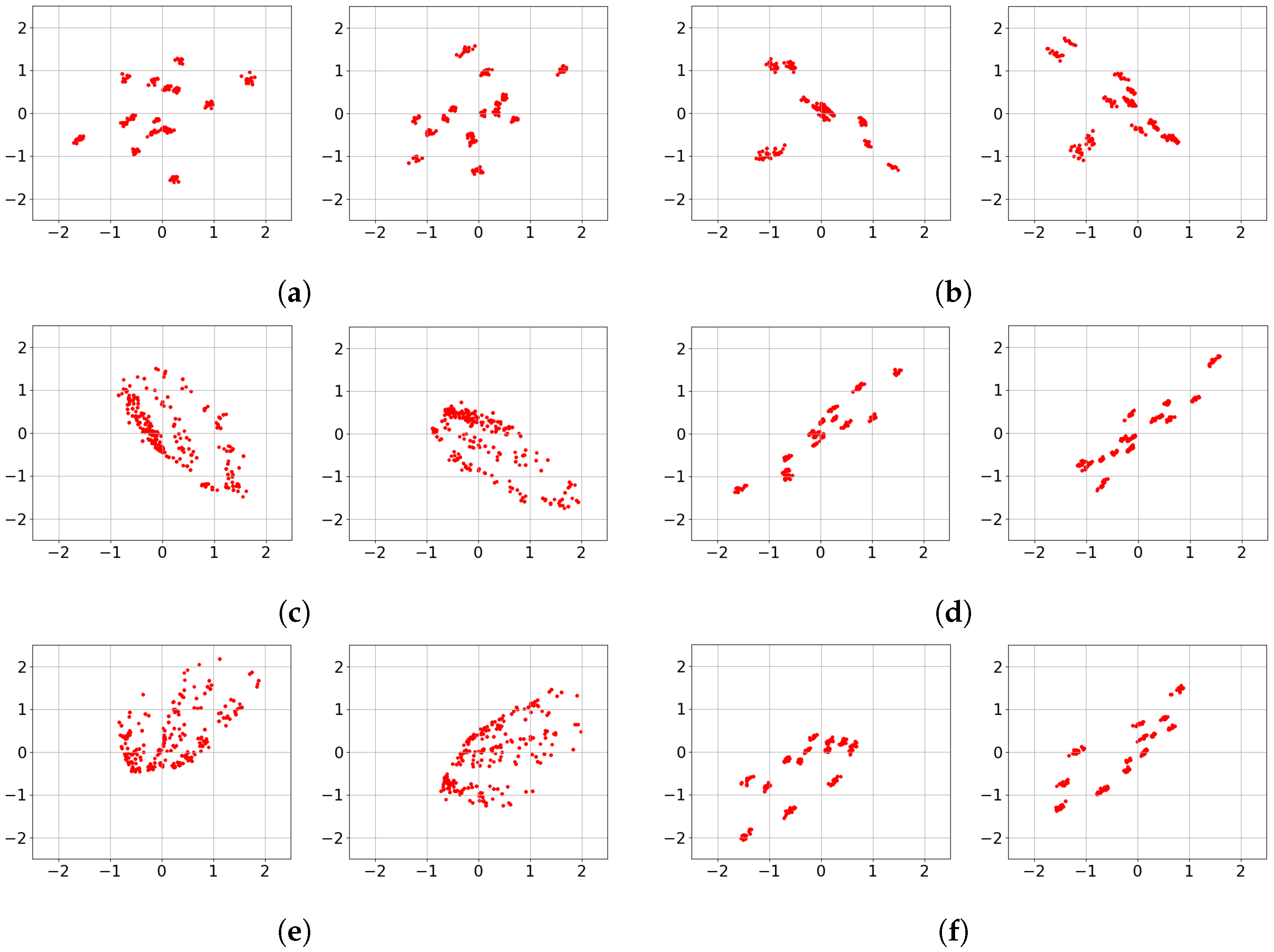
5.3. Extreme CSIT Regimes
5.4. Practical CSIT Regime
6. Conclusions
Author Contributions
Funding
Institutional Review Board Statement
Informed Consent Statement
Data Availability Statement
Acknowledgments
Conflicts of Interest
Abbreviations
| AWGN | Additive White Gaussian Noise |
| BS | Base Station |
| bpcu | bits per channel use |
| BLER | Block Error Rate |
| BC | Broadcast Channel |
| CSI | Channel State Information |
| CSIT | Channel State Information at the Transmitter |
| CSIR | Channel State Information at the Receiver |
| DL | Deep Learning |
| Deep-STMIA | Deep Space–Time-Message Interference Alignment |
| DoF | Degrees of Freedom |
| DPC | Dirty Paper Coding |
| E2E | End-to-End |
| FDD | Frequency-Division Duplexing |
| FLOP | FLoating-Point OPeration |
| i.i.d. | independent and identical distribution |
| IA | Interference Alignment |
| KL | Kullback–Leibler |
| MAT | Maddah-Ali and Tse |
| ML | Maximum Likelihood |
| MIA | Message-Domain Interference Alignment |
| MU-MISO | Multi-User Multiple-Input Single-Output |
| NR | New 5G Radio |
| RS | Rate-Splitting |
| RSMA | Rate-Splitting Multiple Access |
| SNR | Signal-to-Noise Ratio |
| SDMA | Space-Division Multiple Access |
| SIA | Space-Domain Interference Alignment |
| STIA | Space-Time Interference Alignment |
| SIC | Successive Interference Cancellation |
| TIA | Time-Domain Interference Alignment |
| TDMA | Time-Division Multiple Access |
| ZF | Zero Forcing |
References
- Mao, Y.; Dizdar, O.; Clerckx, B.; Schober, R.; Popovski, P.; Poor, H.V. Rate-Splitting Multiple Access: Fundamentals, Survey, and Future Research Trends. IEEE Commun. Surv. Tutor. 2022, 24, 2073–2126. [Google Scholar] [CrossRef]
- Jindal, N. MIMO Broadcast Channels with Finite-Rate Feedback. IEEE Trans. Inf. Theory 2006, 52, 5045–5060. [Google Scholar] [CrossRef]
- Love, D.J.; Heath, R.W.; Lau, V.K.N.; Gesbert, D.; Rao, B.D.; Andrews, M. An Overview of Limited Feedback in Wireless Communication Systems. IEEE J. Sel. Areas Commun. 2008, 26, 1341–1365. [Google Scholar] [CrossRef]
- Caire, G.; Jindal, N.; Kobayashi, M.; Ravindran, N. Multiuser MIMO Achievable Rates with Downlink Training and Channel State Feedback. IEEE Trans. Inf. Theory 2010, 56, 2845–2866. [Google Scholar] [CrossRef]
- Piovano, E.; Clerckx, B. Optimal DoF Region of the K-User MISO BC with Partial CSIT. IEEE Commun. Lett. 2017, 21, 2368–2371. [Google Scholar] [CrossRef]
- Jafar, S.A. Interference Alignment: A New Look at Signal Dimensions in a Communication Network; Now Publishers: Delft, The Netherlands, 2011. [Google Scholar] [CrossRef]
- Cadambe, V.R.; Jafar, S.A. Interference Alignment and Degrees of Freedom of the K-User Interference Channel. IEEE Trans. Inf. Theory 2008, 54, 3425–3441. [Google Scholar] [CrossRef]
- Wiesel, A.; Eldar, Y.C.; Shamai, S. Zero-Forcing Precoding and Generalized Inverses. IEEE Trans. Signal Process. 2008, 56, 4409–4418. [Google Scholar] [CrossRef]
- Weingarten, H.; Steinberg, Y.; Shamai, S. The Capacity Region of the Gaussian Multiple-Input Multiple-Output Broadcast Channel. IEEE Trans. Inf. Theory 2006, 52, 3936–3964. [Google Scholar] [CrossRef]
- Maddah-Ali, M.A.; Tse, D. Completely Stale Transmitter Channel State Information is Still Very Useful. IEEE Trans. Inf. Theory 2012, 58, 4418–4431. [Google Scholar] [CrossRef]
- Yang, S.; Kobayashi, M.; Gesbert, D.; Yi, X. Degrees of Freedom of Time Correlated MISO Broadcast Channel with Delayed CSIT. IEEE Trans. Inf. Theory 2013, 59, 315–328. [Google Scholar] [CrossRef]
- Clerckx, B.; Gesbert, D. Space-Time Encoded MISO Broadcast Channel with Outdated CSIT: An Error Rate and Diversity Performance Analysis. IEEE Trans. Commun. 2015, 63, 1661–1675. [Google Scholar] [CrossRef]
- Joudeh, H.; Clerckx, B. Sum-Rate Maximization for Linearly Precoded Downlink Multiuser MISO Systems with Partial CSIT: A Rate-Splitting Approach. IEEE Trans. Commun. 2016, 64, 4847–4861. [Google Scholar] [CrossRef]
- Flores, A.R.; de Lamare, R.C. Robust Rate-Splitting-Based Precoding for Cell-Free MU-MIMO Systems. IEEE Commun. Lett. 2025, 29, 1230–1234. [Google Scholar] [CrossRef]
- Park, J.; Lee, B.; Choi, J.; Lee, H.; Lee, N.; Park, S.H.; Lee, K.J.; Choi, J.; Chae, S.H.; Jeon, S.W.; et al. Rate-Splitting Multiple Access for 6G Networks: Ten Promising Scenarios and Applications. IEEE Netw. 2024, 38, 128–136. [Google Scholar] [CrossRef]
- Hao, C.; Wu, Y.; Clerckx, B. Rate Analysis of Two-Receiver MISO Broadcast Channel with Finite Rate Feedback: A Rate-Splitting Approach. IEEE Trans. Commun. 2015, 63, 3232–3246. [Google Scholar] [CrossRef]
- O’Shea, T.; Hoydis, J. An Introduction to Deep Learning for the Physical Layer. IEEE Trans. Cogn. Commun. Netw. 2017, 3, 563–575. [Google Scholar] [CrossRef]
- O’Shea, T.J.; Erpek, T.; Clancy, T.C. Physical Layer Deep Learning of Encodings for the MIMO Fading Channel. In Proceedings of the 2017 55th Annual Allerton Conference on Communication, Control, and Computing (Allerton), Monticello, IL, USA, 3–6 October 2017; pp. 76–80. [Google Scholar] [CrossRef]
- Song, J.; Häger, C.; Schröder, J.; O’Shea, T.J.; Agrell, E.; Wymeersch, H. Benchmarking and Interpreting End-to-End Learning of MIMO and Multi-User Communication. IEEE Trans. Wirel. Commun. 2022, 21, 7287–7298. [Google Scholar] [CrossRef]
- Xie, H.; Qin, Z.; Li, G.Y.; Juang, B.H. Deep Learning Enabled Semantic Communication Systems. IEEE Trans. Signal Process. 2021, 69, 2663–2675. [Google Scholar] [CrossRef]
- Chen, J.; Elia, P. Can Imperfect Delayed CSIT be as Useful as Perfect Delayed CSIT? DoF Analysis and Constructions for the BC. In Proceedings of the 2012 50th Annual Allerton Conference on Communication, Control, and Computing (Allerton), Monticello, IL, USA, 1–5 October 2012; pp. 1254–1261. [Google Scholar] [CrossRef]
- Kim, J.; Lee, H.; Park, S.H. Learning Robust Beamforming for MISO Downlink Systems. IEEE Commun. Lett. 2021, 25, 1916–1920. [Google Scholar] [CrossRef]
- Kingma, D.P.; Ba, J. Adam: A Method for Stochastic Optimization. arXiv 2017, arXiv:1412.6980. [Google Scholar] [CrossRef]
- Lee, C.Y.; Xie, S.; Gallagher, P.; Zhang, Z.; Tu, Z. Deeply-Supervised Nets. arXiv 2014, arXiv:1409.5185. [Google Scholar] [CrossRef]
- Goodfellow, I.; Bengio, Y.; Courville, A. Deep Learning; MIT Press: Cambridge, MA, USA, 2016; Available online: http://www.deeplearningbook.org (accessed on 30 December 2025).
- Tran, A.T.; Truong, T.P.; Won, D.; Dao, N.N.; Cho, S. Weighted Sum-Rate Maximization in Rate-Splitting MISO Downlink Systems. IEEE Trans. Netw. Sci. Eng. 2025, 13, 5522–5538. [Google Scholar] [CrossRef]







| Scheme | CSIT Condition | Sum-DoF |
|---|---|---|
| ZF | Perfect Current CSIT | 2 |
| TDMA | No CSIT | 1 |
| MAT | Perfect Delayed CSIT and No Current CSIT | |
| Rate-Splitting (RS) | Imperfect -CSIT () | |
| Time-correlated scheme | Imperfect -CSIT and Perfect Delayed CSIT |
| Parameter | Value |
|---|---|
| Optimizer | Adam |
| Learning Rate 1 | |
| Learning Rate 2 | |
| Number of samples | 100,000 |
| Mini-batch size | 1024 |
| Number of epochs | 30 |
| Training SNR | 20 dB or 30 dB |
| User k Loss Weight | |
| Common Message Loss Weight | |
| Random seed | 42 (unless mentioned otherwise) |
| Training CSIR quality | 0.8 (unless mentioned otherwise) |
| Training delayed CSIT quality | 0.8 (if delayed CSIT available) |
| Training current CSIT quality | (Mentioned in the text) |
| Scenario, Scheme | Trainable Parameters | Execution Run Time Measured for 1000 Samples |
|---|---|---|
| , RSMA | — | s |
| , Deep-STMIA | 20,768 | s |
| , RSMA | — | s |
| , Deep-STMIA | 36,372 | s |
Disclaimer/Publisher’s Note: The statements, opinions and data contained in all publications are solely those of the individual author(s) and contributor(s) and not of MDPI and/or the editor(s). MDPI and/or the editor(s) disclaim responsibility for any injury to people or property resulting from any ideas, methods, instructions or products referred to in the content. |
© 2026 by the authors. Licensee MDPI, Basel, Switzerland. This article is an open access article distributed under the terms and conditions of the Creative Commons Attribution (CC BY) license.
Share and Cite
Sadeghabadi, E.; Blostein, S. Unified Space–Time-Message Interference Alignment: An End-to-End Learning Approach. Entropy 2026, 28, 249. https://doi.org/10.3390/e28020249
Sadeghabadi E, Blostein S. Unified Space–Time-Message Interference Alignment: An End-to-End Learning Approach. Entropy. 2026; 28(2):249. https://doi.org/10.3390/e28020249
Chicago/Turabian StyleSadeghabadi, Elaheh, and Steven Blostein. 2026. "Unified Space–Time-Message Interference Alignment: An End-to-End Learning Approach" Entropy 28, no. 2: 249. https://doi.org/10.3390/e28020249
APA StyleSadeghabadi, E., & Blostein, S. (2026). Unified Space–Time-Message Interference Alignment: An End-to-End Learning Approach. Entropy, 28(2), 249. https://doi.org/10.3390/e28020249