1. Introduction
Quantum steering traces back to Schrödinger’s 1936 reply to the EPR paradox [
1,
2]. It refers to the ability of one party to direct the state of a distant quantum system using shared entanglement [
3,
4,
5,
6,
7], and provides a way to confirm entanglement without relying on the measurement devices. In 2007 Wiseman and co-workers revived the idea by giving it a precise operational definition [
8]. They placed steering between ordinary entanglement and Bell nonlocality: it is strictly stronger than entanglement but weaker than the full nonlocality revealed by Bell tests. This definition underlines the one-way nature of steering, which has since been observed in both continuous-variable and discrete-variable quantum systems [
9,
10,
11,
12,
13,
14,
15]. The two-party case naturally extends to the multi-party setting, where more complex forms of correlation appear. In the three-party case, Reid’s monogamy relationship holds: a single party can steer both others at the same time, but two independent parties cannot steer the same third party [
16,
17]. Tripartite systems also display layered steering structures that include genuine three-party steering, effective two-party steering, and collective steering. These rich structures position multipartite steering as a key resource for designing and analyzing quantum networks [
18]. Consequently, the special properties of multipartite steering support new protocols for large-scale quantum communication and establish steering itself as a useful quantum resource.
Controlling the temporal evolution of quantum steering and mitigating decoherence are essential for reliable quantum information processing. In photonic systems, environmental dephasing commonly induces the sudden death of steering [
11,
19,
20], thereby restricting the operational range of quantum communication and networking protocols. Photonic platforms nevertheless provide important advantages over other implementations, including extended coherence times and compatibility with high-speed, long-distance optical channels, which make them especially suitable for scalable quantum networks [
21,
22]. However, photon loss, phase damping, and spectral diffusion continue to challenge the long-term preservation of directional quantum correlations.
Despite significant progress in understanding bipartite steering dynamics, the tripartite regime remains considerably less explored, particularly in the presence of environmental memory effects. In multipartite settings, the interplay between system partitioning, steering directionality, and noise correlations can lead to qualitatively different dynamical behaviors that are not captured by two-party analyses.
Quantum steering occupies a distinctive position among quantum resources: it is strictly stronger than entanglement yet weaker than Bell nonlocality and possesses an inherent one-way character that enables device-independent entanglement verification. Quantum steering plays a central role in scenarios where entanglement alone is insufficient to characterize directional quantum correlations. In particular, steering provides an operational framework for asymmetric quantum information tasks such as one-sided device-independent protocols and quantum network verification, where the trust in measurement devices is not symmetric between parties. Although the dynamics of entanglement and nonlocality under noise have received considerable attention, the behavior of steering—particularly in the tripartite regime—requires further investigation [
9]. Non-Markovian environments, where memory effects permit the backflow of information from the reservoir to the system, can counteract irreversible decay and induce periodic revivals of quantum steering [
23,
24,
25].
However, the role of non-Markovianity in multipartite steering is not yet fully understood, as memory effects may act either as a resource or as a source of enhanced decoherence depending on the system configuration and the distribution of environmental coupling. This ambiguity motivates a systematic study of steering dynamics under different memory distributions across subsystems.
To address these issues, we investigate the non-Markovian dynamics of quantum steering in a tripartite photonic system subject to dephasing noise. By developing a theoretical framework based on the single-photon dephasing model extended to three independent photons, we analyse the temporal evolution of the steering measures and for two distinct classes of initial states: W-type entangled states and GHZ-type mixed entangled states. The system is studied under various environmental configurations ranging from fully Markovian to fully non-Markovian regimes, with asymmetric distributions of memory effects across the three photons. Our results reveal that the dynamics of quantum steering are highly sensitive to both the number of photons coupled to non-Markovian environments and the specific partition of the system being considered. Non-Markovian environments can either enhance steering through information backflow or prove detrimental depending on which subsystems they are coupled to relative to the steering and steered parties. These results indicate that environmental memory effects can substantially modify the decay dynamics of multipartite steering by enabling partial recovery of coherence through information backflow mechanisms.
In particular, we show that the presence of non-Markovian memory does not guarantee improved robustness of steering correlations, and in certain configurations it may lead to faster decay than in the Markovian regime despite exhibiting revival behavior.
While previous studies have extensively investigated bipartite steering dynamics and the influence of non-Markovian environments on entanglement and nonlocality, comparatively less attention has been devoted to tripartite steering in discrete-variable photonic systems with asymmetric memory distributions. In particular, the combined influence of steering directionality, multipartite partitioning, and non-uniform distributions of Markovian and non-Markovian environments remains insufficiently explored. The present work addresses this gap by systematically analyzing the steering dynamics of W-type and GHZ-type three-photon states under several distinct memory configurations, thereby revealing how environmental memory effects depend not only on the reservoir properties but also on the specific steering partition considered.
The structure of this paper is as follows. In
Section 2, we develop the theoretical framework for non-Markovian dynamics in photonic networks. We begin by introducing the single-photon dephasing model, which we then extend to describe three independent photons interacting with their respective environments. A matrix representation in the polarization basis is presented to accurately capture the dephasing mechanisms affecting each photon. In
Section 3, we apply this framework to analyze the temporal evolution of W-type entangled states under both Markovian and non-Markovian dephasing dynamics.
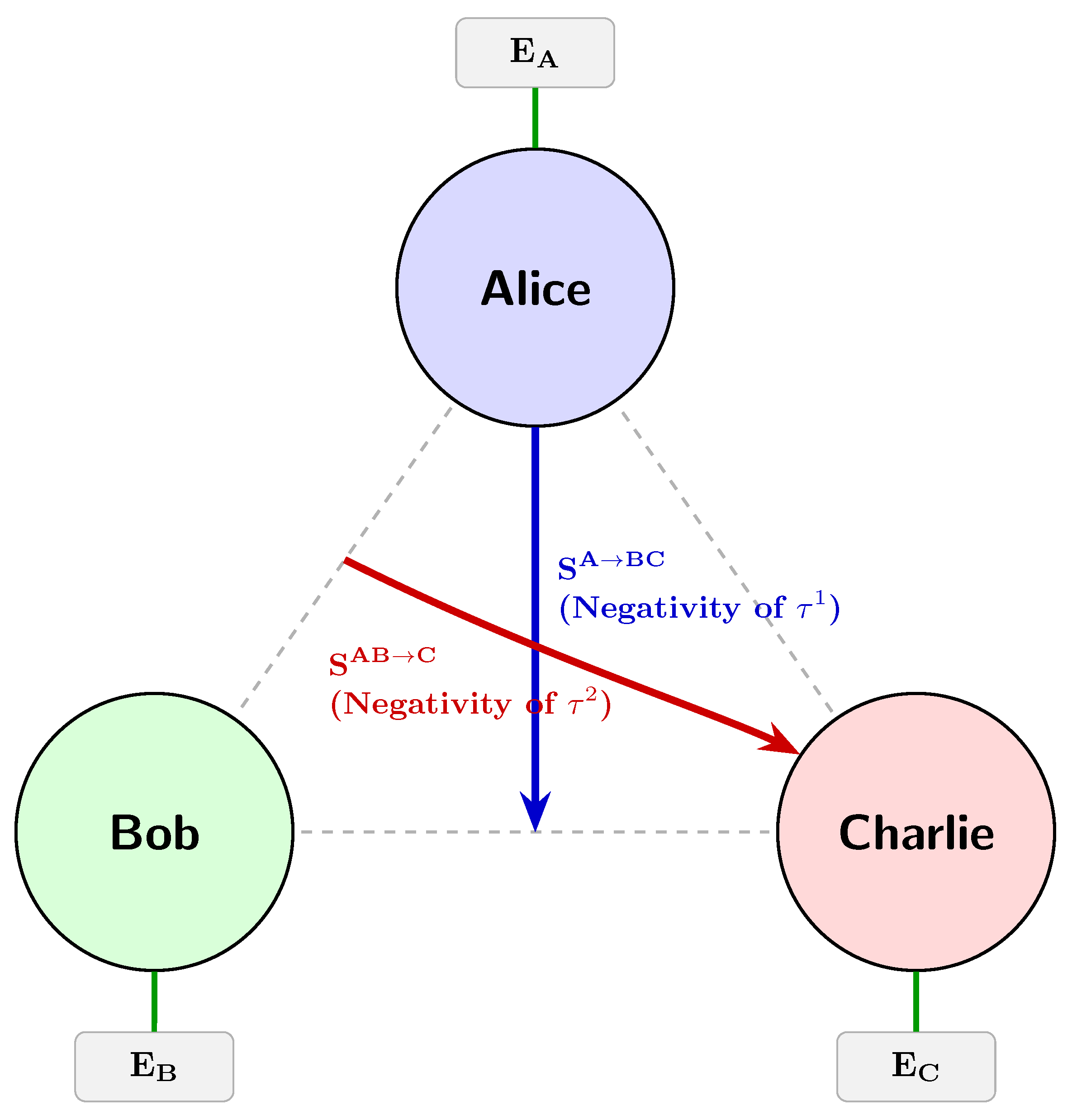
Section 4 extends this analysis to GHZ-type mixed entangled states, examining how environmental memory effects influence their decay and revival patterns. The concept of quantum steering in three-photon systems is introduced in
Section 5, where we define the steering measures
and
used to quantify directional quantum correlations between different bipartitions. Our main findings are presented and discussed in
Section 6, where we systematically compare the steering dynamics for both W and GHZ states under various environmental configurations, ranging from fully Markovian to fully non-Markovian regimes with asymmetric distributions of memory effects across the three photons. Finally,
Section 7 summarizes our conclusions and discusses the implications of our results for quantum information processing tasks requiring the preservation of directional quantum correlations in photonic networks.
6. Results and Discussion
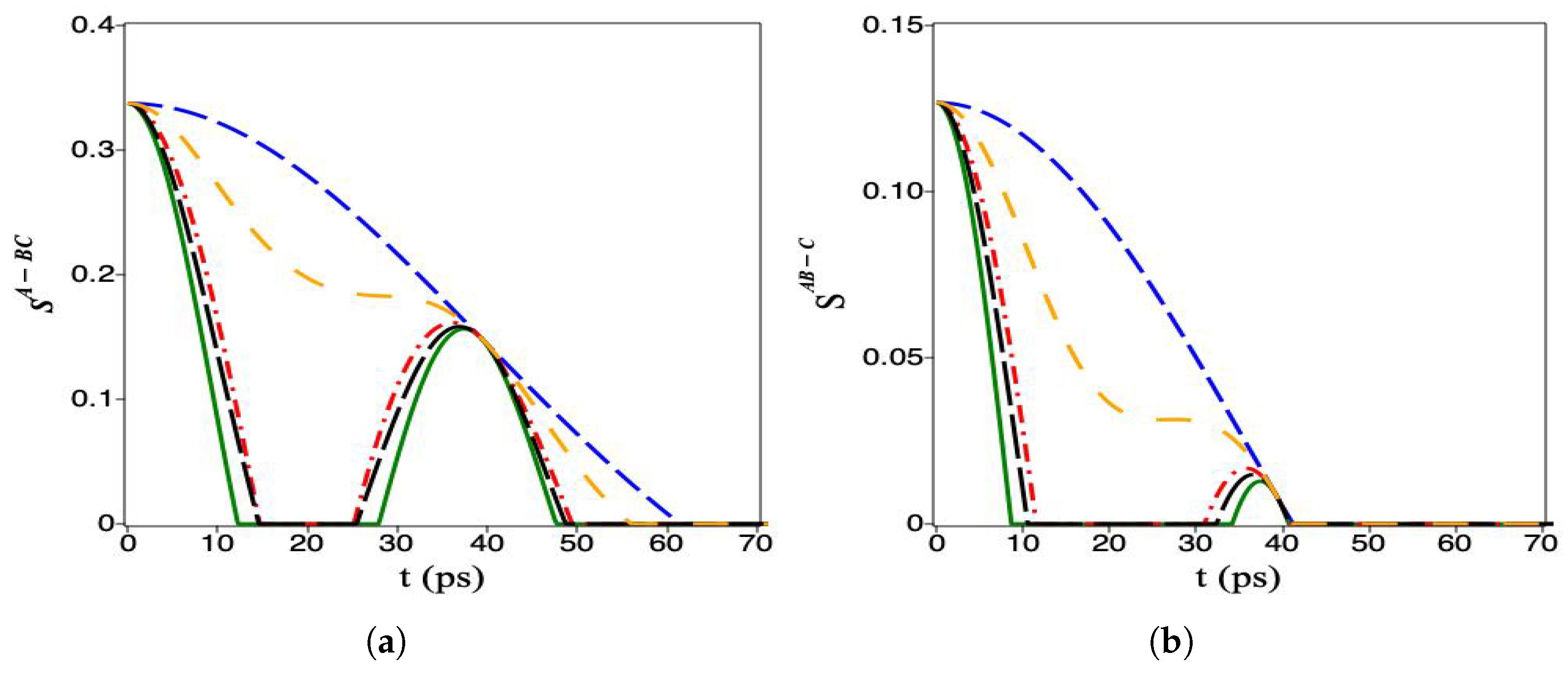
The dynamics of steering correlations for a three-mode photonic system, initially prepared in a W-state and subject to dephasing, are presented in
Figure 3. The figure illustrates the time evolution of two distinct steering measures:
(panel a), which quantifies the ability of party
A to steer the composite subsystem
, and
(panel b), which quantifies the ability of the composite system
to steer party
C. The system evolves under various configurations of Markovian and non-Markovian dephasing environments, characterized by the angle parameter
, with the spectral properties of the environments defined by the detuning
, central frequencies
PHz and
PHz, and bandwidth
THz [
21]. The numerical parameters employed throughout this work are chosen in accordance with experimentally accessible values reported in Ref. [
21], thereby maintaining a direct connection with realistic photonic implementations. Our intention is not to reproduce a specific experiment quantitatively, but rather to illustrate the qualitative features of multipartite steering dynamics under physically relevant conditions. We have verified that the main phenomena discussed in this work, including oscillatory decay, revival behavior, and the configuration-dependent influence of non-Markovianity, remain qualitatively robust under reasonable variations of the frequency and time-scale parameters.
We consider symmetric and asymmetric distributions of non-Markovianity characterized by different values of , , corresponding to one-, two-, and three-photon memory configurations, respectively.
Panel (a) depicts the steering from mode A to the combined modes B and C. A key observation is the pronounced difference in the longevity of steering under different environmental conditions. In the fully Markovian symmetric case (dashed blue line, ), the steering decays monotonically and slowly, vanishing entirely by approximately ps. This behavior is characteristic of memoryless environments, where information is lost irreversibly. In stark contrast, the fully non-Markovian symmetric case (solid green line, ) exhibits a rapid initial decay leading to a sudden death of steering. After a finite interval, however, the steering experiences a revival, displaying oscillatory behavior: it passes through a maximum before decaying once more to another sudden death. This oscillatory behavior is a direct consequence of the memory effects arising from the non-Markovian environments, which facilitate a temporary backflow of information between the tripartite system and its reservoirs, leading to the recurrent revival and decay of quantum correlations. The intermediate cases reveal a nuanced dependence on how many photons are coupled to a non-Markovian reservoir. The scenario with a single photon in a non-Markovian environment (case 1, dash-dotted red line, ) exhibits a similar oscillatory behavior to the fully non-Markovian symmetric case, characterized by an initial rapid decay to sudden death followed by a revival. However, in this configuration, both the intervals of sudden death and the subsequent revival are noticeably smaller, and the overall amplitude of the decay is also increased compared to the symmetric case. This suggests that while the Markovian baths on modes B and C drive the initial loss, the single non-Markovian bath on mode A introduces memory effects that are sufficient to induce revivals, though with diminished strength and duration. The configuration with two photons in a non-Markovian environment (case 2, long-dashed black line, ) displays the same qualitative oscillatory pattern observed in the previous cases. However, compared to case 1, the intervals of sudden death are further reduced, and the revival occurs more rapidly, with the steering maintaining a higher overall value (∼0.07 at ps). This indicates a cumulative effect; coupling more modes to non-Markovian environments enhances the memory-driven recovery process, leading to greater overall robustness of the steering shared by A over . An intriguing anomaly is observed for the configuration (spaced dashed orange line). Despite only one photon being in a non-Markovian environment (mode B), the steering exhibits an oscillatory decay that is more rapid than in the fully Markovian case, notably characterized by the absence of complete sudden death over short intervals, unlike the distinct death–revival cycles seen in previous non-Markovian configurations. This counter-intuitive result suggests that the distribution of non-Markovian resources is critical. If the steering party (A) is in a Markovian environment, placing a non-Markovian bath on a steered party (B) does not aid A’s ability to steer and may, through back-action effects mediated by the global tripartite correlations, even accelerate the loss of its steering capability while simultaneously preventing the complete suppression of steerability.
Panel (b) shows the steering from the composite system to party C. The dynamics here are qualitatively different from panel (a), with the initial values being notably smaller across all configurations compared to the case. The fully Markovian symmetric case (dashed blue line, ) exhibits a monotonic decay, with steering slowly decreasing and undergoing sudden death by approximately ps, after which it remains zero with no further revival. In stark contrast, the fully non-Markovian symmetric case (solid green line, ) displays a pronounced oscillatory behavior. After an initial rapid decay leading to a sudden death around ps, the steering experiences a strong revival, passing through a maximum value of approximately at ps. This oscillatory behavior is a clear signature of strong system-environment memory effects, where information lost to the environment is subsequently fed back into the system, temporarily restoring quantum correlations. The behavior of the mixed cases is also highly distinct. The configuration with one non-Markovian photon on the steering side (case 1, dash-dotted red line, ) exhibits the same qualitative oscillatory behavior observed in the fully non-Markovian symmetric case, characterized by an initial decay to sudden death followed by a revival. However, in this configuration, the interval of sudden death is notably smaller (occurring around ps), and the amplitude of the subsequent revival is sufficiently greater than in the symmetric case. This enhanced revival amplitude, despite the shorter death interval, suggests that the asymmetric distribution of non-Markovian resources—where only the steering party A benefits from memory effects—can, under certain conditions, amplify the backflow of information and temporarily strengthen the steering capability of over C, even though the steered party C itself is in a Markovian environment. Most notably, the configuration with two non-Markovian photons on the steering side (case 2, long-dashed black line, ) exhibits a dramatically different dynamic compared to the previous cases. While it follows the same qualitative pattern of oscillatory behavior, the initial decay is extremely rapid, leading to sudden death after a very short time ( ps). However, unlike case 1 where a revival with greater amplitude followed, here the steering shows no evidence of recovery; its value drops below the resolution of the plot and remains effectively zero. This suggests that while non-Markovian environments on the steering parties (A and B) preserve their individual steering over C (as seen in panel a), they completely and irreversibly disrupt the collective steering capability of the pair over C, effectively suppressing the oscillatory recovery observed when only one steering party was non-Markovian. The anomalous case from panel (b) (, spaced dashed orange line) here exhibits an oscillatory decay, but notably, it does not undergo sudden death within the simulated time frame, maintaining small oscillations without ever reaching zero. This reinforces that a non-Markovian environment on a non-steering party (B) introduces memory effects that induce oscillatory behavior in the steering dynamics of , yet without causing the complete death of steering observed in other configurations. In summary, the dynamics of tripartite steering in a dephasing W-state are highly sensitive to both the number of photons coupled to non-Markovian environments and the specific partition of the system being considered. For the steering measure, non-Markovian effects can induce oscillatory behavior characterized by death–revival cycles, with the intervals of sudden death and revival amplitudes depending critically on how many photons share the memory effects. However, when the steering party itself is Markovian, placing a non-Markovian environment on a steered party leads to oscillatory decay without complete sudden death, yet accelerates the overall loss of steering capability. For the steering measure, non-Markovian environments can produce revivals with significantly enhanced amplitudes when asymmetrically distributed, but can also completely suppress oscillatory recovery when both steering parties are non-Markovian, leading to irreversible sudden death. These results highlight the complex interplay between multipartite quantum correlations and environmental memory, demonstrating that non-Markovianity can be a resource for protecting specific types of quantum steering, but its effects are highly configuration-dependent, sometimes enhancing correlations and other times proving detrimental depending on the correlation structure and the distribution of memory effects across the system.
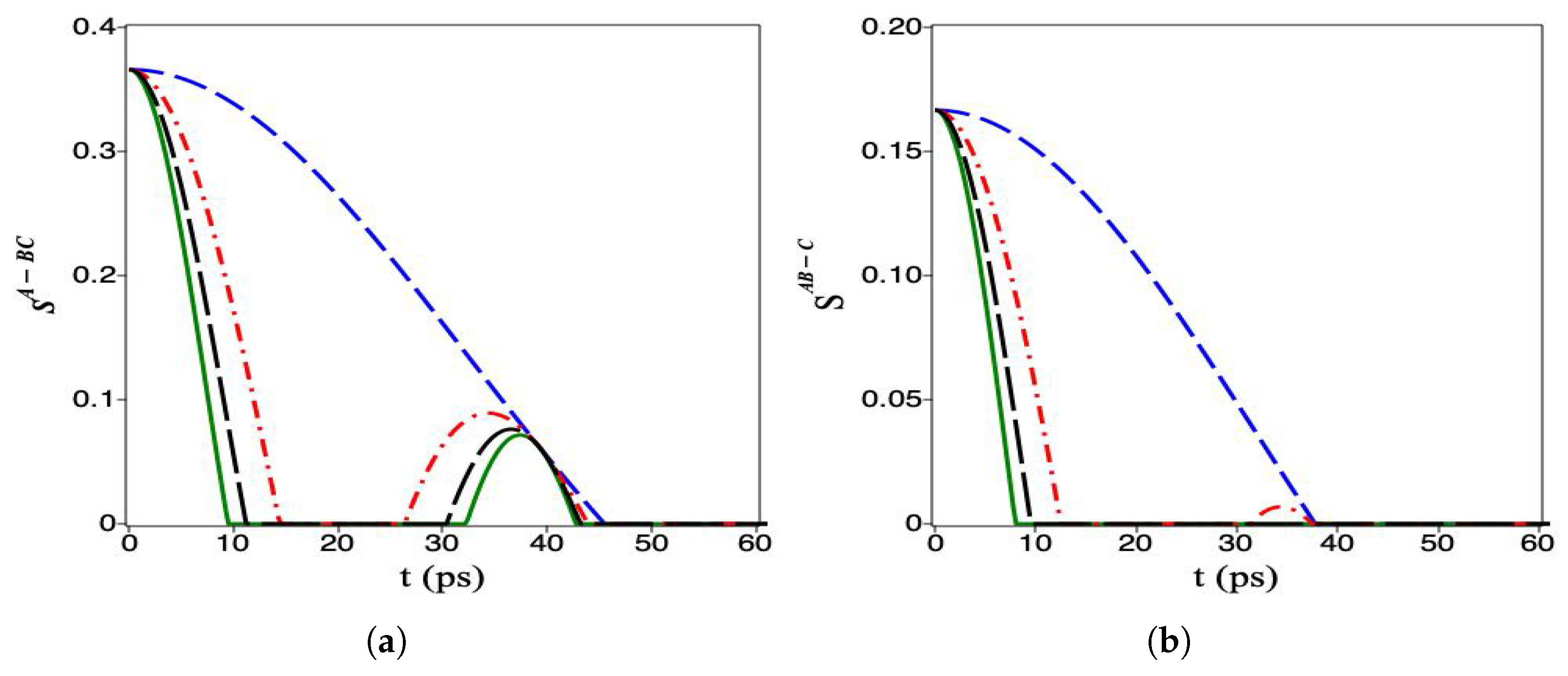
The dynamics of quantum steering for a three-mode photonic system, initially prepared in a GHZ-state with parameter
and subject to dephasing, are presented in
Figure 4. The figure illustrates the time evolution of two distinct steering measures:
(panel a), which quantifies the ability of party
A to steer the composite subsystem
, and
(panel b), which quantifies the ability of the composite system
to steer party
C. The system evolves under various configurations of Markovian and non-Markovian dephasing environments, characterized by the angle parameter
, with the spectral properties defined by the detuning
, central frequencies
PHz (∼704.5 nm),
PHz (∼700.3 nm), and bandwidth
THz [
21].
Panel (a) depicts the steering from mode A to the combined modes B and C for the GHZ-state. The dynamics reveal a strong sensitivity to the environmental configuration, with notable differences compared to the W-state case, particularly in the initial values and decay patterns. The fully Markovian symmetric case (dashed blue line, ) exhibits a rapid monotonic decay, with steering undergoing sudden death around ps and remaining zero thereafter. This behavior is characteristic of memoryless environments where information is irreversibly lost. In stark contrast, the fully non-Markovian symmetric case (solid green line, ) displays a distinct oscillatory behavior. After an initial decay, the steering experiences a revival, passing through a small maximum around ps, followed by another decay. Notably, after ps, which the steering ultimately undergoes complete sudden death. This oscillatory behavior, characterized by multiple death–revival cycles, is a direct consequence of the environment’s memory, which allows for a recurrent backflow of information to the system, temporarily restoring quantum correlations before their eventual irreversible loss. The configuration with one non-Markovian photon (case 1, dash-dotted red line, ) exhibits a behavior qualitatively similar to the fully non-Markovian symmetric case, with oscillatory decay and revival. However, in this configuration, the amplitude of the revival is notably larger, and the steering maintains a higher value throughout the dynamics compared to the symmetric non-Markovian case. This suggests that when only the steering party A benefits from memory effects, the backflow of information is more efficiently channeled into preserving its steering capability over , despite modes B and C being in Markovian environments. The configuration with two non-Markovian photons on the non-steering sides (case 2, long-dashed black line, ) displays yet another distinct dynamic. It follows the same oscillatory pattern but with a much longer-lived revival. After an initial decay to near-zero around ps, the steering experiences a narrow revival that persists with small oscillations up to ps before eventually decaying. This indicates a synergistic effect; coupling more modes to non-Markovian environments enhances the memory-driven recovery process, leading to shorted preservation of the steering shared by A over .
Panel (b) shows the steering from the composite system to party C for the GHZ-state. The dynamics here are qualitatively different from panel (a), with overall smaller initial values and distinct decay patterns across configurations. The fully Markovian symmetric case (dashed blue line, ) exhibits a monotonic decay, with steering undergoing sudden death around ps and remaining zero thereafter with no revival. The fully non-Markovian symmetric case (solid green line, ) displays a markedly different behavior. After an initial rapid decay, the steering undergoes sudden death around ps and remains zero thereafter, exhibiting no revival. This absence of recovery indicates that, despite the non-Markovian character of the environments, the collective steering capability of over C is irreversibly lost. The configuration with one non-Markovian photon on the steering side (case 1, dash-dotted red line, ) exhibits a similar oscillatory pattern to the fully non-Markovian symmetric case, but with notably different characteristics. The initial decay is slower, and the revival amplitude is smaller, with steering maintaining a smaller value throughout the dynamics. However, like the symmetric case, it undergoes sudden death around ps with no further revival. This suggests that while a single non-Markovian environment on the steering party A enhances the steering capability, it cannot prevent the eventual sudden death when the steered party C is in a Markovian environment. Most notably, the configuration with two non-Markovian photons on the steering side (case 2, long-dashed black line, ) exhibits a dramatically different dynamic. It decays monotonically without any oscillatory behavior, undergoing sudden death around ps and remaining zero thereafter. This suggests that while non-Markovian environments on the steering parties (A and B) preserve their individual steering over C (as seen in panel a), they completely disrupt the oscillatory recovery of the collective steering capability of the pair over C, leading to irreversible sudden death.
In summary, the dynamics of steering correlations in a dephasing GHZ-state are highly sensitive to both the number of photons coupled to non-Markovian environments and the specific partition of the system being considered. For the steering measure, non-Markovian effects can induce oscillatory behavior with multiple death–revival cycles, and in some configurations, lead to prolonged preservation of steering without complete sudden death. In contrast, for the steering measure, non-Markovian environments on the steering parties can either induce a single revival before irreversible sudden death or, in the case of two non-Markovian steering parties, result in rapid decay with no revival whatsoever. These results highlight that the efficacy of non-Markovian environments depends critically on which subsystems they are coupled to, relative to the steering and steered parties. The complex interplay between multipartite quantum correlations and environmental memory demonstrates that non-Markovianity can serve as a resource for protecting specific types of quantum steering in GHZ-states, but its effects are highly configuration-dependent, sometimes leading to enhanced preservation and other times resulting in accelerated irreversible loss. These results indicate that environmental memory effects can substantially modify the decay dynamics of multipartite steering by enabling partial recovery of coherence through information backflow mechanisms.
Furthermore, we conclude with a remark on the comparison between Markovian and non-Markovian dephasing regimes.
The results presented above demonstrate clear qualitative differences between Markovian and non-Markovian dephasing dynamics in multipartite photonic systems. In the Markovian regime, the steering measures generally exhibit monotonic decay due to the irreversible loss of coherence into the environment. By contrast, the non-Markovian regime is characterized by oscillatory and nonmonotonic behavior associated with environmental memory effects and partial information backflow from the reservoir to the system.
Importantly, non-Markovianity does not necessarily imply an enhancement or preservation of multipartite quantum steering. In the present model, we observe that non-Markovian dephasing can, in several parameter regimes, induce a stronger suppression of steering compared with the Markovian limit, despite the presence of revival structures. This indicates that revival phenomena alone cannot be interpreted as a signature of increased robustness of quantum correlations.
This behavior originates from the competition between memory-induced information backflow and phase-destroying processes acting on the off-diagonal elements of the density matrix, which encode multipartite coherence. Depending on the bipartition and the distribution of environmental memory across the subsystems, this interplay may either transiently restore steering correlations or accelerate their overall degradation. These observations highlight the strongly configuration-dependent role of environmental memory in multipartite quantum systems.
7. Conclusions
In this work, we have systematically investigated the non-Markovian dynamics of quantum steering in a tripartite photonic system, with a particular focus on how environmental memory effects influence the temporal evolution of quantum correlations. We developed a comprehensive theoretical framework beginning with the single-photon dephasing model, which we extended to describe three independent photons interacting with their respective environments. By employing a matrix representation in the polarization basis, we were able to accurately model the dephasing mechanisms affecting each photon and subsequently derive the dynamics for composite three-photon systems. We applied this framework to two distinct classes of initial states: the W-type entangled state and the GHZ-type mixed entangled state, examining their evolution under both Markovian and non-Markovian dephasing dynamics. The steering measures and were used to quantify the directional quantum correlations between different bipartitions of the tripartite system, providing insight into how the steering is distributed and preserved throughout the network. Our results reveal that the dynamics of quantum steering are highly sensitive to both the number of photons coupled to non-Markovian environments and the specific partition of the system being considered. For the W-state, the steering measure exhibited oscillatory behavior characterized by death–revival cycles, with the intervals of sudden death and revival amplitudes depending critically on how many photons shared the memory effects. Notably, when the steering party itself was Markovian, placing a non-Markovian environment on a steered party led to oscillatory decay without complete sudden death, yet paradoxically accelerated the overall loss of steering capability. For the steering measure in W-states, non-Markovian environments produced revivals with significantly enhanced amplitudes when asymmetrically distributed, but completely suppressed oscillatory recovery when both steering parties were non-Markovian, leading to irreversible sudden death. For the GHZ-state, the dynamics displayed even richer behavior. In the case, non-Markovian effects induced multiple death–revival cycles, with some configurations leading to prolonged preservation of steering without complete sudden death. The asymmetric distribution of memory effects proved particularly beneficial when only the steering party benefited from non-Markovian environment, resulting in enhanced revival amplitudes. In contrast, the steering measure for GHZ-states showed that non-Markovian environments on the steering parties could either induce a single revival before irreversible sudden death or, in the case of two non-Markovian steering parties, result in rapid decay with no revival whatsoever. These findings demonstrate that the efficacy of non-Markovian environments depends critically on which subsystems they are coupled to, relative to the steering and steered parties.
Importantly, our analysis shows that non-Markovianity does not universally enhance or preserve multipartite quantum steering. Depending on the configuration of the system and the distribution of memory effects among the steering and steered subsystems, environmental memory may either induce temporary revivals through information backflow or accelerate the degradation of quantum correlations. In the present dephasing model, several non-Markovian configurations were found to produce stronger damping of steering than their Markovian counterparts, despite the appearance of oscillatory revival dynamics. This behavior highlights the subtle interplay between coherence exchange, phase accumulation, and environmental memory in multipartite photonic systems. The stronger suppression observed in certain non-Markovian regimes can be attributed to the competition between information backflow and destructive interference effects in the off-diagonal coherence terms responsible for steering. Although memory effects may temporarily restore coherence, they can also enhance oscillatory decoherence processes, leading to faster overall decay depending on the considered bipartition and initial state. Therefore, the role of non-Markovianity should be regarded as highly configuration-dependent rather than universally beneficial. Our results contribute to the fundamental understanding of open quantum systems and provide practical insights for quantum information processing tasks that rely on the preservation of steering-based quantum correlations. The present work is primarily focused on an analytically tractable non-Markovian dephasing model that enables a clear characterization of multipartite steering dynamics. More realistic environments, such as Ohmic, sub-Ohmic, super-Ohmic, Drude–Lorentz, or structured spectral-density reservoirs, may lead to richer dynamical features and constitute an important direction for future investigations. Such extensions would generally require fully numerical treatments beyond the scope of the current analytical framework. Nevertheless, the ability to engineer environmental memory effects remains a promising route to control quantum correlations in photonic networks. Understanding how different reservoir configurations influence steering robustness may provide useful guidelines for the implementation of quantum communication, quantum cryptography, and distributed quantum-information protocols in realistic noisy environments. Future work may explore the extension of these results to larger photonic networks, the influence of different spectral densities, and the optimization of environmental parameters to maximize the preservation of quantum correlations in realistic experimental settings.