1. Introduction
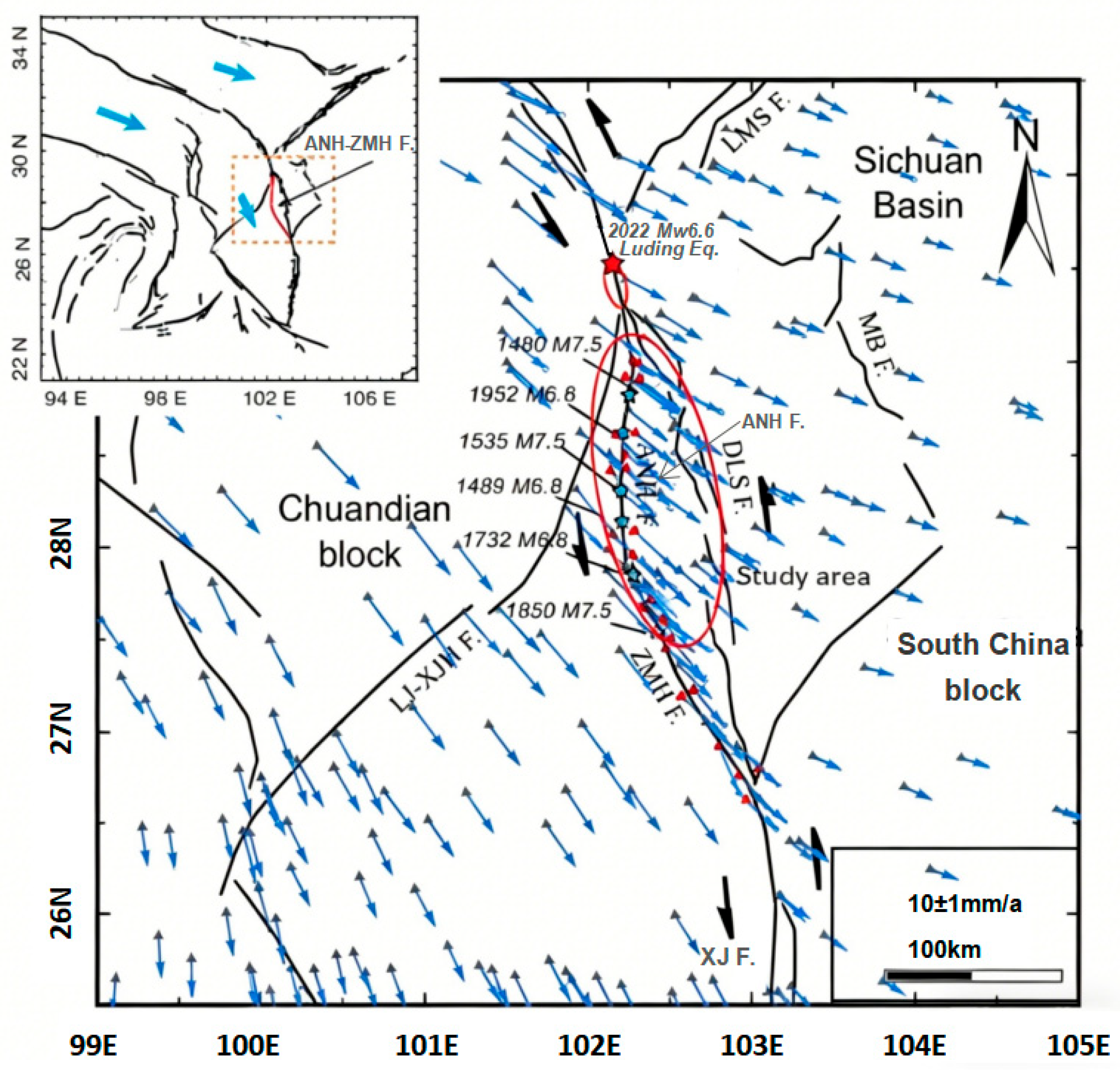
The Anning River Fault Zone is located at the southeastern edge of the Qinghai–Xizang Plateau, running along the border between Sichuan and Yunnan provinces, and is oriented in a north–south direction. It has a total length of approximately 400 kilometers and is a highly active, deep, large fault (
Figure 1). This fault forms the eastern boundary of the Sichuan–Yunnan rhombic block and is mainly composed of the Zemu River Fault, the main branch of the Anning River Fault, and the Daliangshan Fault, among other secondary faults. It has both reverse thrust and right-lateral strike-slip properties. Historically, this fault zone has experienced frequent strong earthquakes, including the 1536 Xichang North 7.5 magnitude earthquake and the 1850 Xichang 7.5 magnitude earthquake. In recent years, there have been continuous minor and medium earthquakes, indicating a relatively high seismic hazard. Along the fault zone, there are important towns such as Xichang, Mengniang, and Dechang. These towns are close to population centers such as Panzhihua and Liangshan Prefecture. Previous studies have shown that the frequency and intensity of earthquakes in this area are higher than those in the adjacent Daliangshan Fault Zone, and the probability of strong earthquakes in sections such as Puge and Mianning is relatively high [
1]. Zhou et al. [
2] also provided a basis for earthquake tectonic environment evaluation from the perspectives of fault zone characteristics, historical earthquakes, and focal displacement. However, research on time series modeling and prediction of the seismicity frequency of this fault zone is still relatively limited. Therefore, a systematic analysis of its frequency characteristics and temporal patterns, and an assessment of future earthquake probabilities, have important scientific value and practical significance for seismic prevention planning along the line.
The formation of earthquakes is closely related to plate motion. According to the elastic rebound theory [
4], when mantle material undergoes thermal convection, crustal plates squeeze against each other, leading to continuous accumulation of crustal stress. When the stress exceeds the strength limit of the fault zone, the crust suddenly ruptures and releases energy, resulting in an earthquake. Thereafter, the plates continue to move, and stress accumulates again, repeating the cycle. This complete process is referred to as the seismic cycle, which generally denotes the entire process of stress accumulation, slip release, and re-accumulation on the same fault zone from one major earthquake to the next [
5]. On a given fault zone, seismic activity may exhibit alternating periods of high activity and quiescence in terms of frequency. This regular time interval is known as the characteristic earthquake recurrence interval, representing the average time between characteristic earthquakes on that fault zone [
6]. For the study area, existing research [
7] supports the above earthquake preparation mechanism, indicating that plate compression and stress accumulation are the main drivers of local seismic activity, and that seismic activity on this fault zone indeed exhibits periodic alternation between active and quiescent phases.
Due to the complexity of earthquake formation mechanisms, it is currently impossible to achieve precise earthquake prediction. However, analyzing historical earthquake data and studying the frequency distribution and periodic characteristics of earthquake events on the time axis can provide important clues for revealing patterns of earthquake activity. Previous studies have shown that seismic activity is not completely random in time, but exhibits certain periodic or rhythmic characteristics [
8,
9]. Exploring the periodic patterns of earthquake frequency can help deepen the understanding of regional earthquake activity trends and provide a scientific basis for disaster prevention and mitigation.
This paper studies the seismicity frequency pattern of the Anning River Fault Zone, which has clear temporal attributes. Previous statistical models applied to earthquake catalog data—such as Woessner and Wiemeron [
10] on completeness, Griffin et al. [
11] on periodicity and clustering, Hainzl et al. [
12] and Touati et al. [
13] on interevent-time distributions, and Zhuang et al. [
14] on temporal seismicity models—often assume linearity or stationarity, limiting their ability to capture the complex nature of earthquake occurrence. The seasonal autoregressive integrated moving average (SARIMA) model, an extension of the autoregressive integrated moving average (ARIMA) model, has notable shortcomings for predicting earthquake timing: it assumes fixed seasonality rarely seen in seismicity, struggles with clustered and aftershock-dominated sequences, and fails to capture the long-memory dependence highlighted by Hainzl et al. [
12] and Touati et al. [
13]. Therefore, acknowledging these limitations, this paper applies SARIMA to recent earthquake catalog data from the Anning River Fault Zone to explore and predict its seismicity frequency pattern.
2. Relevant Theories and Methods
2.1. G-R Relationship Equation
In the assessment of earthquake hazard, seismic activity parameters play an indispensable role. In the field of statistical seismology, the magnitude–frequency relationship (Gutenberg–Richter relation, G-R) proposed by Gutenberg and Richter is one of the most fundamental laws [
15]:
where
M represents the magnitude of the earthquake;
N represents the cumulative number of seismic events greater than the magnitude
M;
a is a constant; and the slope value
b represents the proportion of seismic frequencies at each magnitude relative to the total seismic frequency, and it is an important parameter for earthquake activity. A low value of
b indicates that earthquakes of higher magnitudes account for a large proportion among all earthquakes, while a high value of
b indicates that small earthquakes account for a larger proportion.
Since Gutenberg et al. proposed Formula (1) and applied it to global seismic activity, this relationship has been widely adopted worldwide. It is the most frequently cited empirical relationship in seismological studies and has been extensively applied in earthquake activity analysis, geological research, and earthquake hazard prediction [
16].
2.2. SARIMA Model
The ARIMA model was first proposed by Box and Jenkins in the 1970s. Its full name is the autoregressive integrated moving average model, denoted as ARIMA(
,
,
). Here,
and
represent the autoregressive and moving average orders respectively;
represents the trend difference order. The basic model structure is as follows:
where
,
are polynomials of autoregressive coefficients of order
p;
is the lag operator, with
;
is the differencing of order
d; and
is the polynomial of moving average coefficients of order
q [
17].
The ARIMA model can model non-stationary time series without seasonal effects. However, many time series in real life have certain periodicity. For sequences that contain both seasonal effects and long-term trend effects with complex interactive relationships between them, the SARIMA model can be adopted. The SARIMA model, also known as the multiplicative seasonal model (ARIMA multiplicative model), was first proposed with a general expression by Wang et al. [
18], denoted as ARIMA(p,d,q) × (P,D,Q)
s, where
and
are the orders of seasonal autoregression and seasonal moving average, respectively;
is the order of seasonal differencing; and
is the seasonal period. As an extension of the ARIMA model, this model performs seasonal differencing on the sequence based on the original model to extract seasonal information, so as to achieve the purpose of modeling seasonal time series.
For the time series
, the expression of the SARIMA model can be denoted as:
where
is the
-th order seasonal difference with
as the period;
is the random interference of the error term
at the moment; and
and
represent the polynomial of the
-th order seasonal autoregressive coefficient and the polynomial of the
-th order seasonal moving average coefficient, respectively.
3. Research Methods and Modeling Process
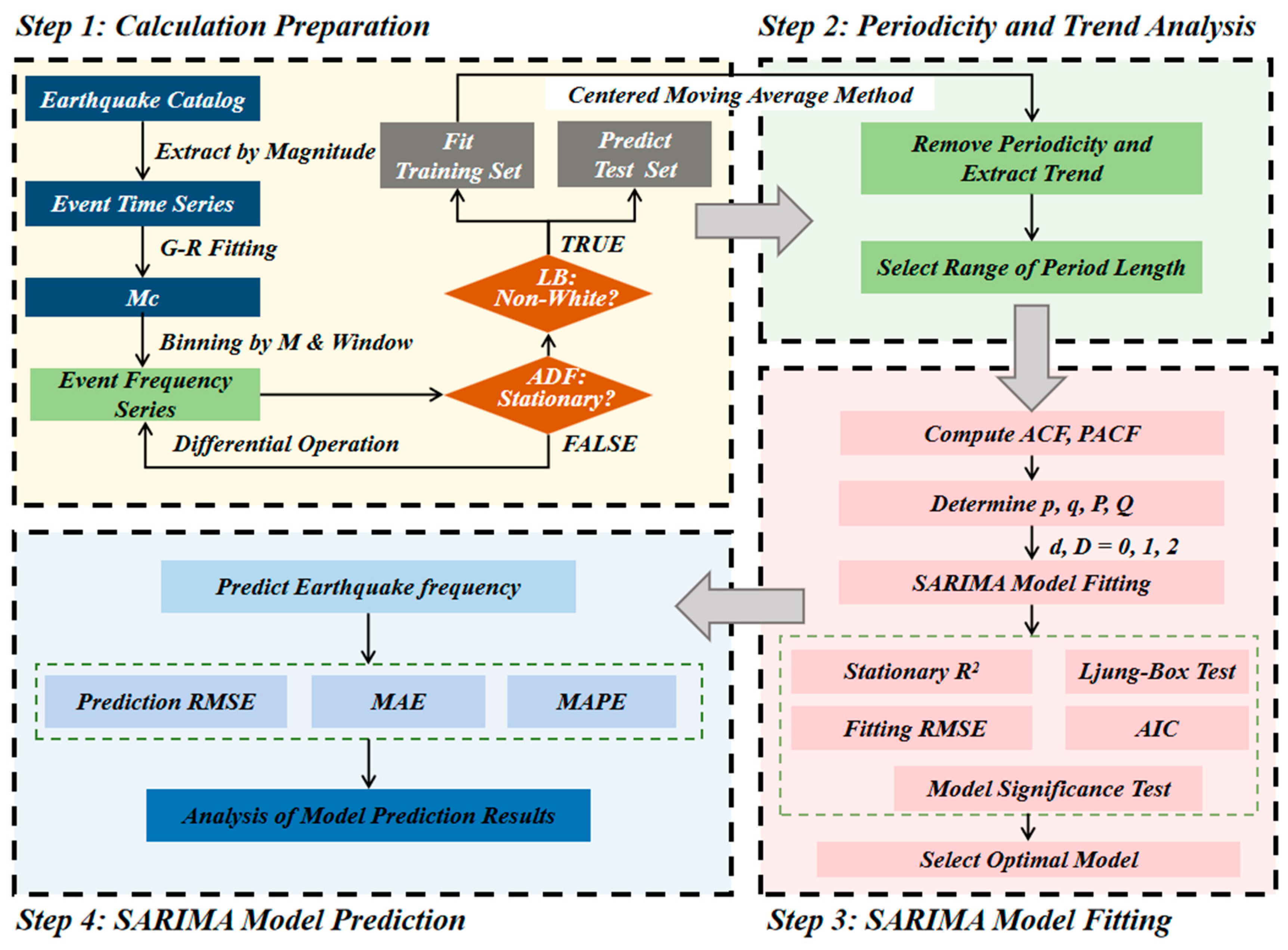
To obtain the periodicity, trend, and other temporal patterns of earthquake occurrence frequencies (defined as the number of earthquakes within different time windows: annual, quarterly, and monthly), and to predict the frequency of earthquakes within a certain period, this paper constructs an analysis and prediction method based on the SARIMA model. The overall process is shown in
Figure 2.
Firstly, the earthquake occurrence frequency sequence (based on the above-defined annual, quarterly, and monthly time windows) is constructed based on the earthquake catalog data, and a stationary non-white noise sequence is selected through the ADF test and LB test. It is proportionally divided into a training set and a validation set. On this basis, different-order centered moving average methods are used to remove the periodicity and extract the trend of the training set sequence, to identify short-, medium-, and long-cycle characteristics, and thereby determine the type of the SARIMA model (additive or multiplicative). Further, by analyzing the autocorrelation coefficient (ACF) and partial autocorrelation coefficient (PACF) of the sequence, the non-seasonal and seasonal parameter orders (p, q, P, Q) of the model are preliminarily determined, and the candidate model set is constructed by combining the difference order (d, D). The candidate models are fitted, and residual white noise tests are conducted to select the model that passes the test and has the largest stationary R2 as the optimal model. Finally, the optimal model is used to predict the validation set, and the prediction effect is evaluated by indicators such as the Root Mean Square Error (RMSE), thereby achieving the prediction of future earthquake frequencies.
4. Overview of the Study Area and Data Preprocessing
This article collects and organizes catalog data of earthquakes with magnitudes of 2.5 and above that occurred within the longitude and latitude range of the Anning River Fault Zone (26.96–29.06° N, 102.14–102.91° E) from 7 May 1972 to 30 September 2025, totaling 291 entries from the China Earthquake Networks Center (
https://www.cenc.ac.cn/) (last accessed on 12 March 2026).
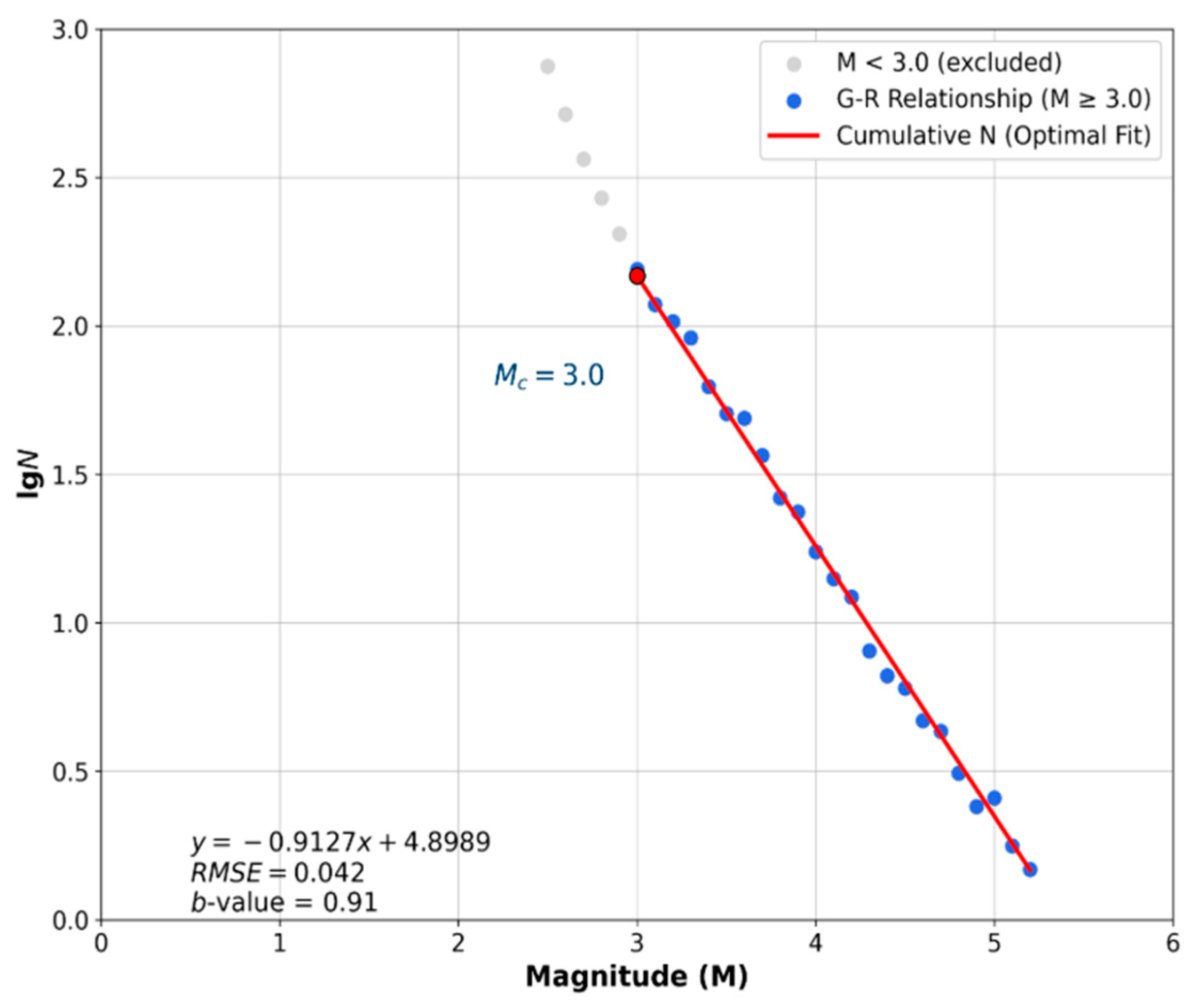
Based on the characteristics and practical application results of existing completeness analysis methods, this study first employs the maximum likelihood method (MLE) [
19] to fit the Gutenberg–Richter (G-R) relationship and estimate the b-value (i.e., the slope of the G-R curve) for different magnitude thresholds M
cut. To quantitatively determine the minimum magnitude of completeness M
C, the Root Mean Square Error (RMSE) between the observed and predicted cumulative frequencies (in logarithmic scale) is calculated for each M
cut. The RMSE is defined as:
where
is the number of magnitude bins with M ≥ M
cut. The value of M
cut that minimizes the RMSE is taken as M
C.
Table 1 reports the b-values (estimated via MLE) and the corresponding RMSE for M
cut ranging from 2.5 to 3.4. The RMSE reaches its minimum of 0.042 at M
cut = 3.0, and the b-value stabilizes around 0.91 for M ≥ 3.0. For M
cut < 3.0, the RMSE is consistently higher (≥0.071), indicating a poorer G-R fit due to incomplete detection of smaller events. Therefore, the minimum magnitude of completeness of this catalog is determined as M
C = 3.0.
Figure 3 shows the G-R fitting curve for M ≥ 3.0 as a visual reference, with an RMSE of 0.042.
A total of 139 earthquake catalog data were obtained for the analysis. The time range of the earthquakes was from 7 May 1972, to 30 September 2025, and the magnitude range was from 3.0 to 5.2. The data grouped by magnitude are shown in
Table 2, and the spatial distribution of the earthquake locations is depicted in
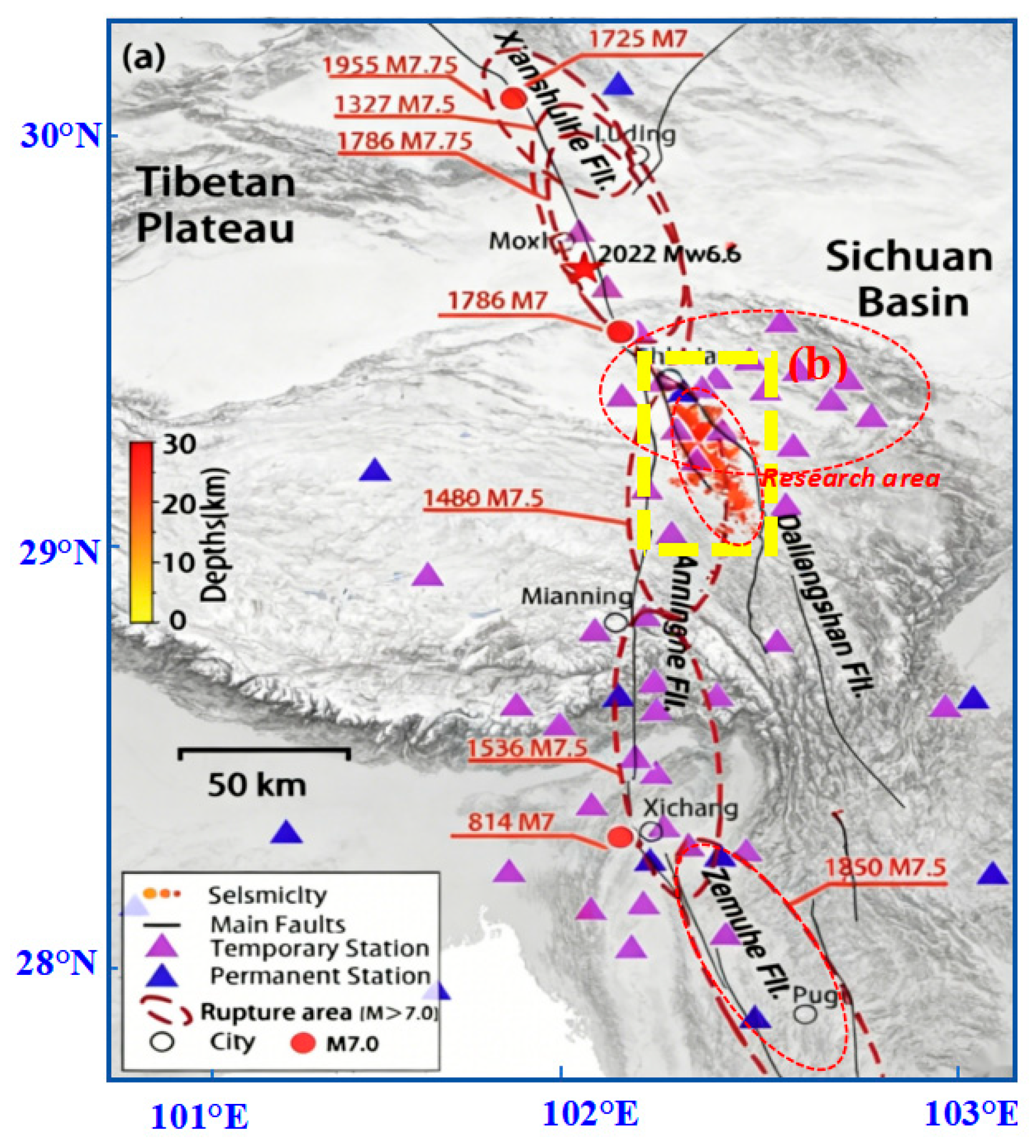
Figure 4.
According to the current classification of earthquake magnitudes and intensities by scholars, earthquakes with magnitudes less than 3.0 are classified as weak earthquakes, which are generally not easily detectable by people; earthquakes with magnitudes greater than 3.0 but less than or equal to 4.5 are considered perceptible earthquakes; earthquakes with magnitudes greater than 4.5 but less than or equal to 6.0 are classified as moderately weak earthquakes, which can cause damage; earthquakes with magnitudes greater than 6.0 are classified as strong earthquakes. Based on the above criteria, combined with the characteristics of the sample data (there are fewer high-magnitude events in the data, making it difficult to conduct research), and considering that the M
C obtained from the previous text is 3.0, the modeling of M ≥ 2.5 (all data) will not be carried out in subsequent practical work, and the magnitude groups of the data are determined as M ≥ 3.0, M ≥ 4.0, and M ≥ 5.0 (
Table 3).
First, the three magnitude groups M ≥ 3.0, M ≥ 4.0, and M ≥ 5.0 are abbreviated as M3, M4, and M5, respectively. Then, the statistical and sorting work is carried out on an annual, quarterly, and monthly basis. In
Table 4, the time periods of the quarterly and monthly sequences are named “Annual”, “Quarter” and “Monthly”. In
Table 5, the ADF test indicates that all sequences are stationary and no differencing is required. Subsequently, the LB test shows that the quarterly sequence M3, the monthly sequence M3, and the monthly sequence M4 are non-white noise sequences, while the remaining sequences are white noise sequences. Due to the excessive zero values in the monthly sequences M3 and M4, and since the data in the test set are all zero, modeling and prediction cannot be carried out. Therefore, only the quarterly sequence M3 is analyzed.
5. Model Establishment and Parameter Optimization
As shown in
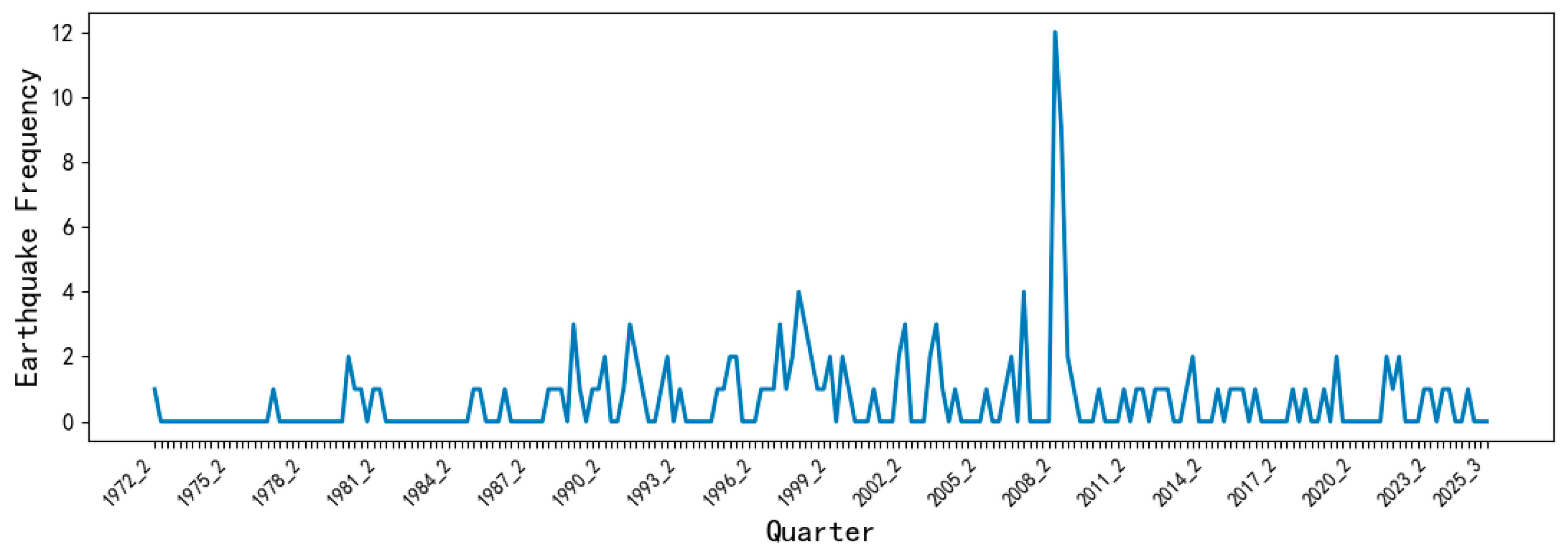
Figure 5, the quarterly seismic occurrence frequency sequence M
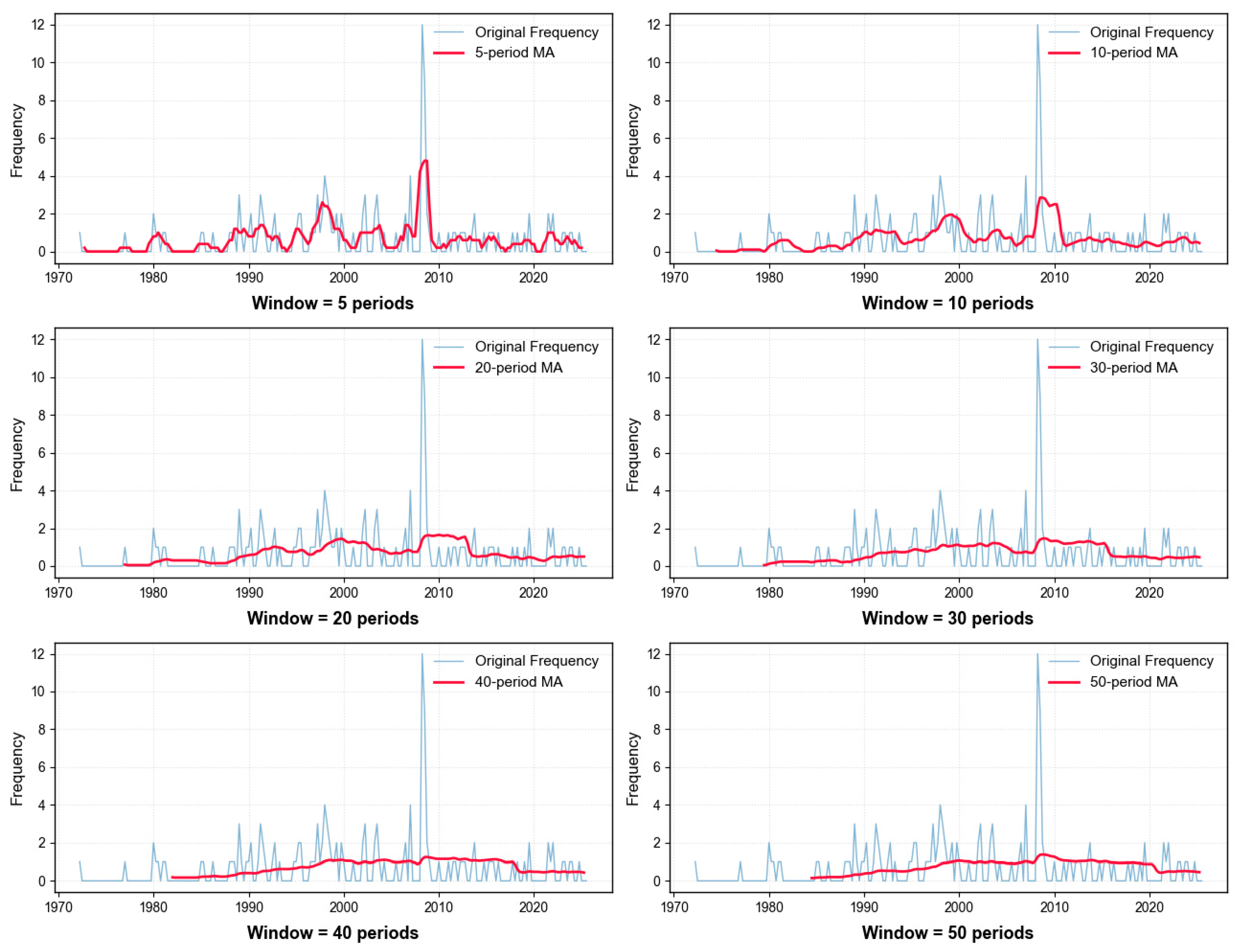
3 generally shows a trend of first increasing and then decreasing, and there are changes in short-, medium- and long-nested cycles. Additionally, the seismic occurrence frequency suddenly increased at the time point 2008_2. These earthquakes were actually the main shock and aftershocks of the magnitude 8.0 Wenchuan earthquake on 12 May 2008. To fit the optimal SARIMA model, it is necessary to analyze and determine the specific periods of the sequence’s cycle changes and further confirm its overall trend. An attempt was made to use the 5th-, 10th-, 20th-, 30th-, 40th-, and 50th-order (period) centered moving average methods [
17] to remove cycles and extract the trend from the sequence. The results are shown in
Figure 6.
As shown in
Figure 6, the frequency of earthquakes of magnitude 3.0 and above along the Anning River Fault Zone fluctuated at a low level from 1972 to 2000. It gradually increased after 2000, reached its peak in 2008, then declined and remained at a lower level. Therefore, this paper adopts the multiplicative SARIMA model [
21]. Additionally, the 5th-, 20th-, and 40th-order centered moving average methods were used to remove short-, medium-, and long-term periodicities and extract the trend, which achieved better results. The 50th-order centered moving average method was the best for removing long-term periodicities and extracting the trend, but the period number was too long and was not suitable for calculation, nor was it necessary. Therefore, the period numbers of 4–6, 19–21, and 39–41 were selected for SARIMA model fitting to determine the short-, medium-, and long-term models with optimal parameters. The training set data used for fitting was the first 90% (time period from 1972_2 to 2020_2).
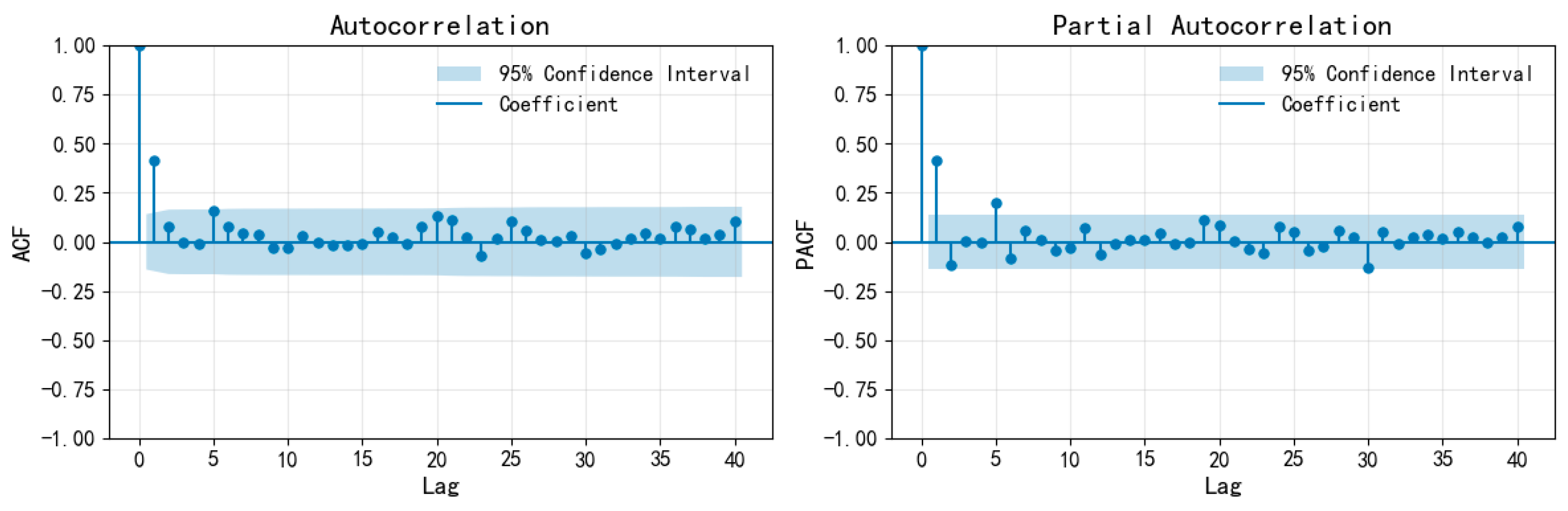
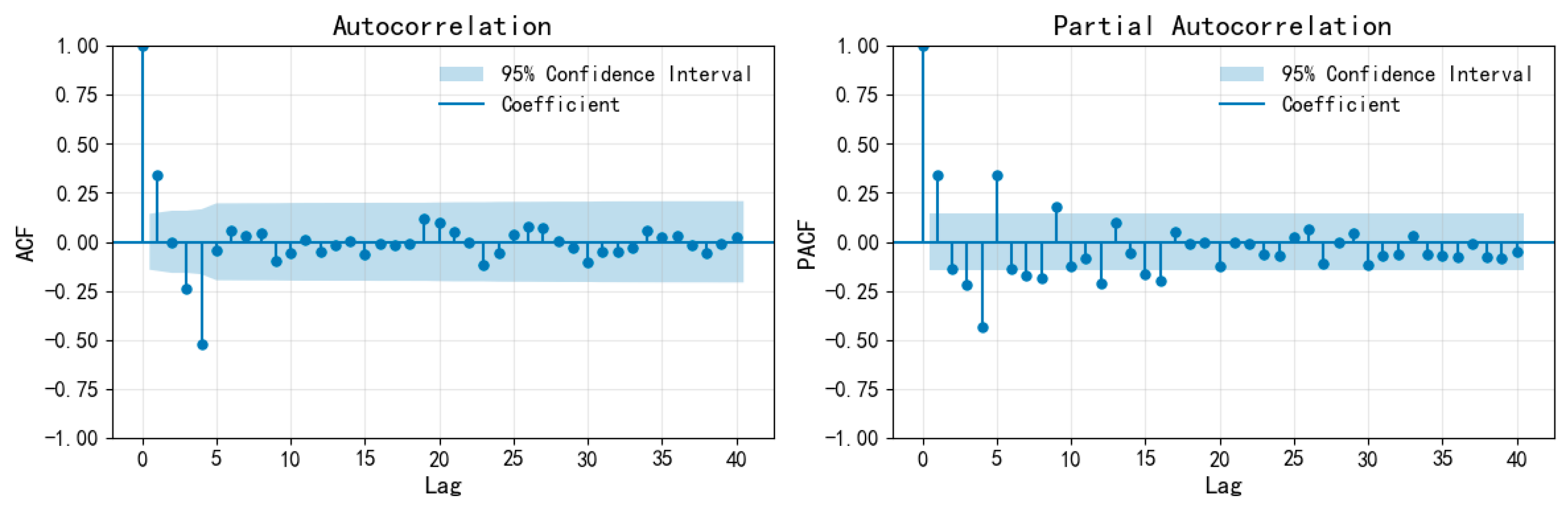
First, consider that the seasonal cycle is a short period. Since the data are quarterly, let us take s = 4. The autocorrelation function (ACF) and partial autocorrelation function (PACF) plots of the training set of the quarterly seismic frequency sequence M
3 are shown in
Figure 7, and those after fourth-order seasonal differencing are shown in
Figure 8. Based on the autocorrelation and partial autocorrelation coefficients of the training set of the quarterly seismic occurrence frequency sequence M
3 and its seasonally differenced sequence, the model order is determined as ARIMA(4,d,0) × (0,0,1)
4, where d is the difference order. Taking d = 0, 1, and 2 for model fitting, the model fitting and parameter test (
Table 6) show that only ARIMA(4,1,0) × (0,0,1)
4 passes the parameter test and residual white noise test (significance > 0.05), and has the highest stationary R
2. Therefore, it is determined that d = 1.
Furthermore, the number of short cycles is set to 5 and 6, the number of medium cycles to 19, 20, and 21, and the number of long cycles to 39, 40, and 41. Based on the autocorrelation coefficient and partial autocorrelation coefficient of the sequence, each SARIMA model is ordered and fitted. The model fitting parameters are shown in
Table 7. The
p-values of the LB test for each cycle model are all greater than 0.05, indicating that the residual white noise test is passed and that the models are significant. By further comparing the stationary R-squared values of the short-term, medium-term, and long-term cycle models, and selecting the models that pass the parameter test and have the largest stationary R-squared values, the optimal models for the short-term, medium-term, and long-term cycles are obtained as ARIMA(2,0,1) × (1,1,0)
4, ARIMA(2,0,1) × (1,0,0)
20, and ARIMA(5,1,2) × (1,1,1)
40, respectively.
Table 7 shows that the standard deviations of stationary R
2, AIC, and fitting RMSE within the neighborhoods of each cycle type are all small. Among them, the maximum standard deviation of AIC is 7.2 (short cycle), the maximum standard deviation of fitting RMSE is 0.0084 (long cycle), and the maximum standard deviation of stationary R
2 is 0.0037 (long cycle). Overall, the model performance remains stable under small variations in the cycle parameter, indicating that the selected SARIMA models are insensitive to cycle length and possess good local stability.
6. Prediction Results and Analysis
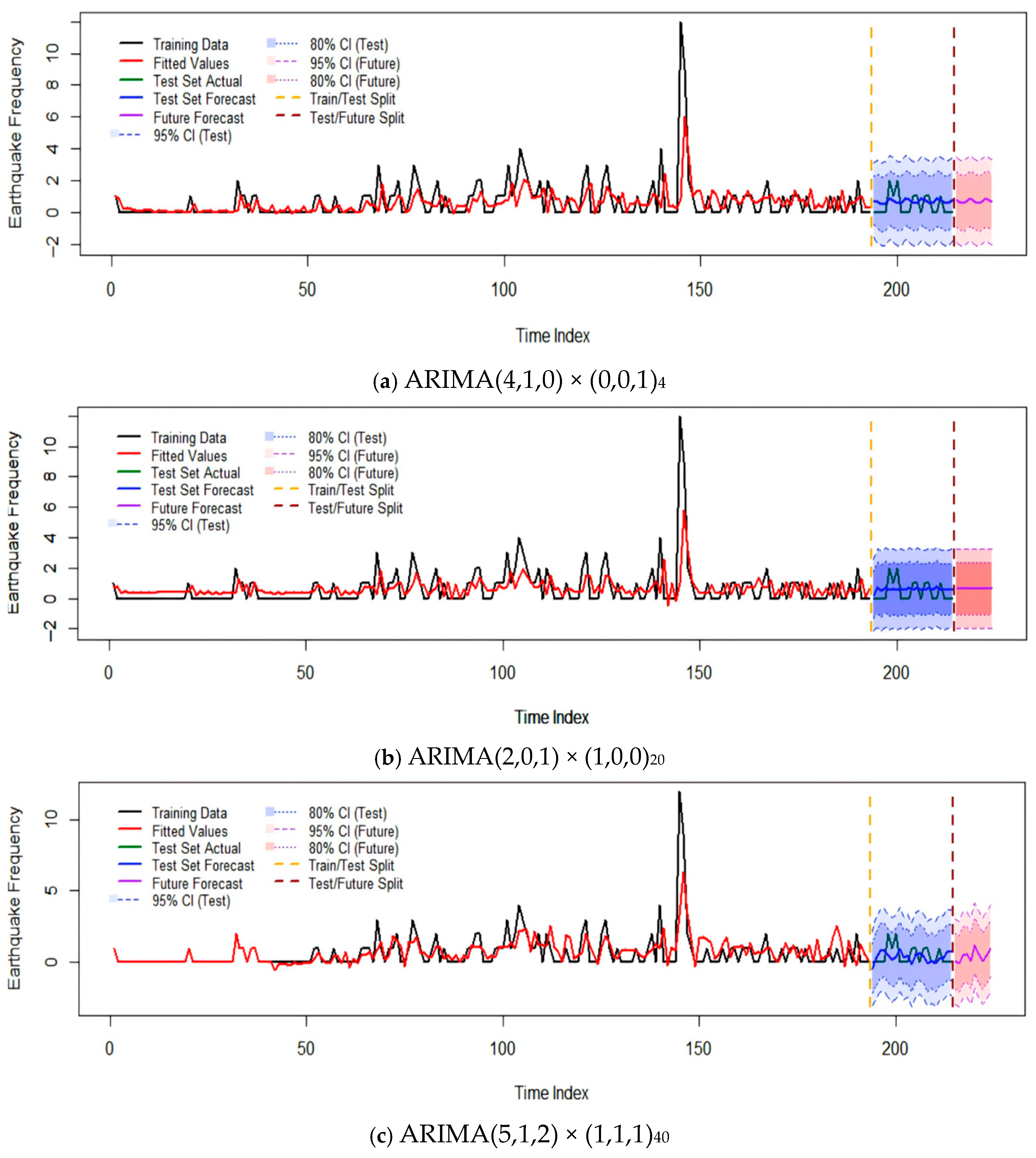
The SARIMA models of different cycles obtained from the previous fitting were used to predict the last 10% of the seismic frequency (seismic order: 194–214) of the quarterly seismic frequency sequence M
3, while the first 90% of the seismic frequency was used for ARIMA model fitting. The fitting effects of the models for different cycles of the sequence is shown in
Figure 9, and the Root Mean Square Error (RMSE) predicted by each model is shown in
Table 8.
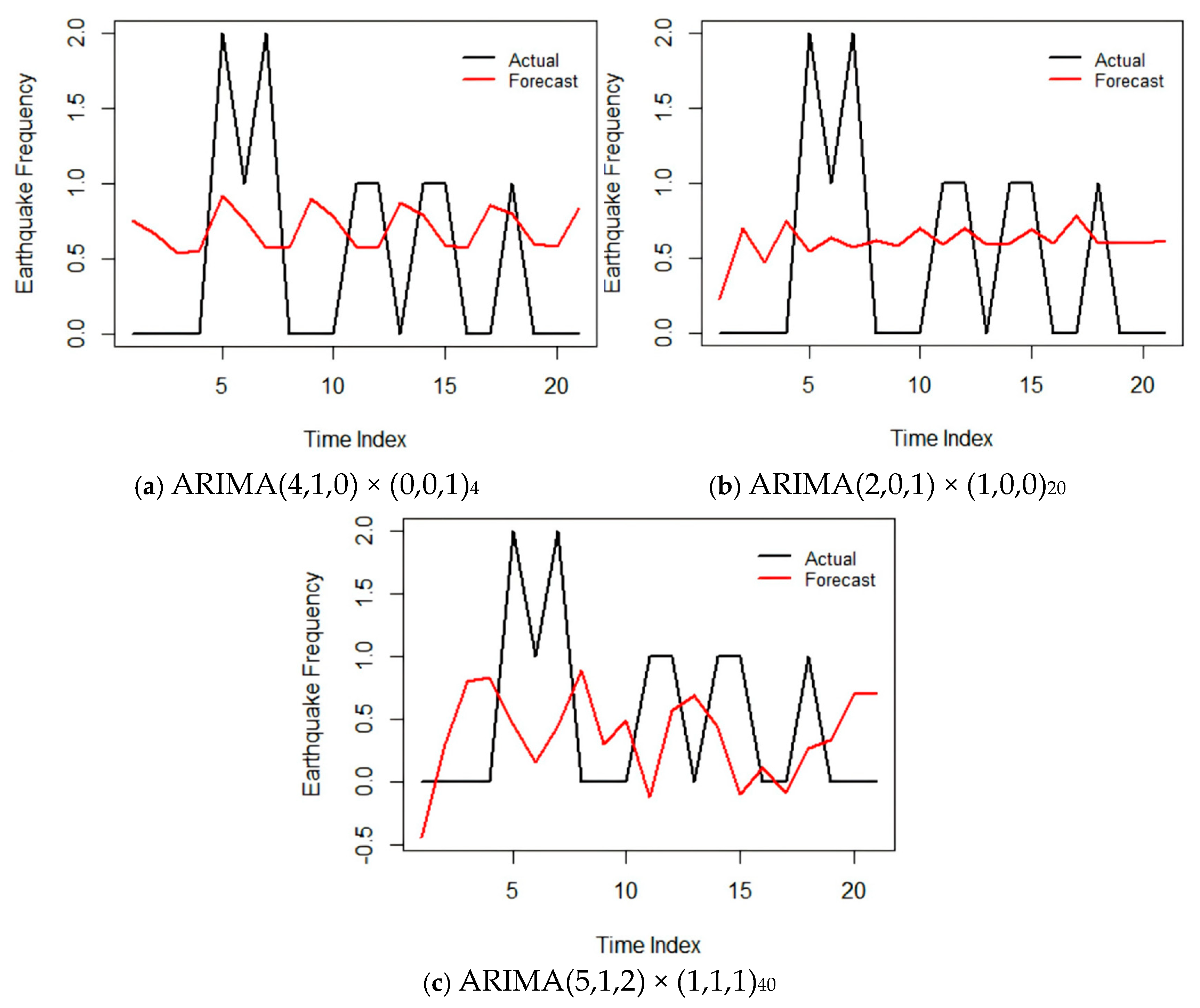
The optimal model was used to predict the test set data of each sequence, and the predicted results were compared with the actual values, as shown in
Figure 10.
To examine the dependence of model performance on the partitioning of training and test sets, three different fixed split schemes (training proportions of 90%, 80%, and 70%) were adopted. The prediction RMSEs of the three models on the corresponding test sets are compared, and the results are shown in
Table 9.
Table 9 shows that the prediction RMSE of all models increases to varying extents as the training proportion decreases (i.e., as the test set becomes larger). Specifically, the RMSE of the short-cycle model increases from 0.7045 to 0.7412 (an increase of approximately 5.2%), with a standard deviation of 0.0154; the RMSE of the medium-cycle model increases from 0.6868 to 0.7124 (an increase of approximately 3.7%), with a standard deviation of 0.0106; and the RMSE of the long-cycle model increases from 0.7983 to 0.8631 (an increase of approximately 8.1%), with a standard deviation of 0.026. Among the three models, the medium-cycle model exhibits the smallest fluctuation and the lowest standard deviation (0.0106) across different split schemes, indicating that its predictive performance is relatively insensitive to the choice of training–test split and thus possesses good robustness. The long-cycle model shows the largest standard deviation (0.026), reflecting higher sensitivity to the split point, and its prediction results should be interpreted with caution. The sensitivity of the short-cycle model lies between the two.
The detailed 10-step prediction results for the short-term, medium-term, and long-term models are presented in
Table 10,
Table 11 and
Table 12, respectively.
Figure 10 shows the comparison between the predicted values and actual values of the three models on the test set. Overall, all models can well capture the overall variation trend of seismic frequency, but there are differences in prediction accuracy in specific quarters, which are manifested as follows: (1) The predicted values of the short-cycle model ARIMA(4,1,0) × (0,0,1)
4 fluctuate frequently, which can reflect short-term changes in seismic activity to a certain extent, but there are large deviations in individual periods such as the third quarter of 2021 and the first quarter of 2023. The RMSE of this model is 0.7045, the MAE is 0.6420, and the MAPE is 39.53%, indicating that short-term prediction is acceptable in most quarters, but its responsiveness to sudden seismic activities (such as aftershock sequences) is limited.
(2) The prediction curve of the medium-cycle model ARIMA(2,0,1) × (1,0,0)20 is relatively smooth, with a high degree of agreement with the actual value sequence. Especially during 2020–2022, the predicted values basically fall near the actual frequency. The RMSE of this model is 0.6868, the MAE is 0.6143, and the MAPE is 45.45%, which has the smallest error among the three and shows the best prediction performance. This indicates that the seasonal law of the medium cycle (about five years) is relatively stable in the seismic activity of the Anninghe Fault Zone, and the model can effectively extract the periodic characteristics at this scale.
(3) The long-cycle model ARIMA(5,1,2) × (1,1,1)40 has a relatively large prediction error, with an RMSE of 0.7983, an MAE of 0.6941, and an MAPE of 47.81%. The prediction curve deviates significantly from the actual values in the later period of the test set (2024–2025), which may be related to the sparse distribution of seismic events and insufficient sample size within the long-cycle seasonal window (40 quarters, i.e., 10 years). In addition, the long-cycle model is more sensitive to trend changes. As seismic activity has tended to be calm in recent years, the model may have over-extrapolated historical trends.
In summary, the SARIMA model shows certain effectiveness in predicting the seismic frequency of the Anninghe Fault Zone, but the prediction error is still affected by the following factors: (1) Data sparsity: Earthquakes with M ≥ 3.0 are mostly 0 or 1 time on a quarterly scale, with a high proportion of zero values, leading to large sequence volatility and making it difficult for the model to fit accurately. (2) External interference events: The aftershock activity triggered by the 2008 Wenchuan Earthquake formed a significant peak in the sequence, and such sudden events are difficult to be accurately predicted by pure statistical models.
Despite the above limitations, this study still verifies the feasibility of the SARIMA model in seismic frequency prediction and provides a basis for the subsequent introduction of more seismic physical parameters or hybrid models.
7. Discussion
Previous studies have shown that earthquake prediction methods based on geophysical precursor anomalies (e.g., ionospheric, electromagnetic, and thermal anomalies) [
22,
23,
24,
25] can predict the timing of earthquake occurrence to a certain extent by analyzing anomalous variation characteristics before historical earthquakes, and have achieved high accuracy in specific cases. However, such methods typically require continuous, real-time monitoring of relevant geophysical parameters, demand a high quantity and quality of basic data, and have anomaly discrimination criteria have limited transferability across different fault systems or tectonic settings, making them difficult to apply directly to the analysis of large-scale tectonic seismicity. In view of these limitations, the present study attempts to work from a different perspective, namely, without relying on precursory observations, starting directly from the earthquake catalog itself to analyze the intrinsic statistical structure of the seismic frequency sequence. As a complementary exploration, this method can provide a baseline for seismic frequency prediction independent of observational infrastructure in regions where geophysical precursor data are sparse or unavailable.
Unlike previous ARIMA studies that have mostly focused on magnitude prediction [
26] or earthquake occurrence time prediction [
27], this study takes the less-attended seismic frequency as its prediction target. The results show that the SARIMA model achieves certain effectiveness in predicting seismic frequency at different periodic scales in the Anninghe Fault Zone. Among them, the medium-period model performs best (RMSE = 0.6868, MAE = 0.6143), the mean absolute percentage error of the short-period model is controlled at 39.53%, and the long-period model exhibits a significantly increased prediction error due to the excessively long seasonal period (40 quarters). This indicates the feasibility of the SARIMA model in frequency prediction and extends its application beyond magnitude and occurrence time prediction.
Within the above data-driven framework, we further attempt to provide a preliminary physical interpretation of the multi-scale periodic structure identified from the sequence, although the following explanations are speculative. Considering that the quarterly M ≥ 3.0 seismic frequency sequence is dominated by small-to-moderate earthquakes (M3.0–3.9, accounting for >80% of the total; see
Table 1), these periodicities may reflect seismic clustering behavior at different temporal scales. Among them, the short-term cycle (4–6 quarters, i.e., 1–1.5 years) may be related to modulation of the shallow stress field by seasonal surface loading variations (e.g., rainfall, snow cover, or reservoir impoundment), or may reflect the decay duration of aftershock sequences following moderate earthquakes. The medium-term cycle (20 quarters, i.e., 5 years) is the focus of our attention: we hypothesize that it may be linked to fluctuations in the local strain accumulation rate or episodic slow-slip events on the Anninghe Fault. Previous geodetic studies have shown that this fault is not uniformly locked but exhibits spatially variable slip rates [
3,
20]; this five-year cycle may represent the characteristic time for stress transfer and triggering among small fault segments or asperities. The long-term cycle (approximately 40 quarters, i.e., 10 years) may correspond to the characteristic recurrence interval of larger earthquakes (M ≥ 5) on the Anninghe Fault Zone, or be associated with longer-term fluctuations in regional tectonic stress loading. It should be emphasized that the above interpretations are speculative and require validation through joint analysis with continuous geodetic time series (e.g., GNSS or InSAR).
Future work may further integrate physical constraints (e.g., b-value or strain rate) into the SARIMA framework to enhance its interpretability and prediction robustness.
8. Conclusions
Based on the earthquake catalog data with M ≥ 3.0 in the Anninghe Fault Zone from May 1972 to September 2025, this study constructed a quarterly seismic frequency sequence and used the SARIMA model to model and predict its temporal structure. The main conclusions are as follows:
(1) The quarterly seismic frequency sequence of earthquakes with M ≥ 3.0 in the Anninghe Fault Zone has significant periodic and trend characteristics, which meets the modeling premise of the SARIMA model. The ADF test shows that the sequence is stationary, and the Ljung–Box test rejects the white noise hypothesis, indicating that the sequence has a modelable time-dependent structure.
(2) The nested short-term, medium-term, and long-term periodic characteristics of the sequence were identified by the central moving average method, and corresponding scale SARIMA models were constructed accordingly. The model parameters passed the residual white noise test and parameter significance test, indicating that the model structure is reasonable.
(3) The prediction results show that the medium-cycle model ARIMA(2,0,1) × (1,0,0)20 has the best prediction accuracy (RMSE = 0.6868, MAE = 0.6143), followed by the short-cycle model, while the long-cycle model has a slightly higher error. This indicates that the SARIMA model has certain practical value in short-term and medium-term seismic frequency prediction, but there are still limitations in dealing with extreme events and long-cycle fluctuations.
(4) This study verifies the feasibility of the SARIMA model in seismic frequency prediction, expands its application direction beyond magnitude and occurrence time prediction, and provides a new methodological reference for regional seismic activity analysis. In the future, more physical parameters can be integrated, or hybrid models can be introduced to further improve the prediction accuracy and robustness.
Author Contributions
Conceptualization, X.F. and Y.X.; methodology, X.F. and Y.X.; validation, X.F. and Y.X.; formal analysis, X.F. and Y.X.; investigation, X.F. and Y.X.; resources, X.F.; data curation, X.F. and Y.X.; writing—original draft, X.F. and Y.X.; writing—review and editing, X.F. and Y.X.; visualization, X.F. and Y.X.; supervision, X.F. and Y.X.; project administration, X.F. and Y.X.; funding acquisition, X.F. and Y.X. All authors have read and agreed to the published version of the manuscript.
Funding
Provincial College Students’ Innovation and Entrepreneurship Training Program Project “Application of ARIMA-GARCH-LSTM Hybrid Model under Spatiotemporal Correlation Constraints in Seismic Activity Clustering Analysis” (Project No.: S202510616100).
Data Availability Statement
The seismic catalog data used in this study were obtained from the China Earthquake Networks Center (
https://www.cenc.ac.cn/). Detailed data can be queried after registration and login at the National Earthquake Science Data Center database (
https://data.earthquake.cn) (Last accessed on 12 March 2026).
Acknowledgments
We wish to thank the anonymous referees for their careful reading and for providing insightful comments to improve the initial version of this paper.
Conflicts of Interest
The authors declare no conflicts of interest.
References
- Li, J.; Zhou, B.; Li, T.; Yang, Y.; Li, Z.; Long, F. Seismogenic depths of the Anninghe-Zemuhe and Daliangshan fault zones and their seismic hazards. Chin. J. Geophys. (Chin.) 2020, 63, 3669–3682. [Google Scholar] [CrossRef]
- Zhou, H.; Wu, D.; Cai, X. Segmental analysis of seismic activity in the Anninghe-Zemuhe fault zone. West. Resour. (Chin.) 2013, 5, 158–159+161. [Google Scholar]
- Diao, F.; Weng, H.; Ampuero, J.-P.; Shao, Z.; Wang, R.; Long, F.; Xiong, X. Physics-based assessment of earthquake potential on the Anninghe-Zemuhe fault system in southwestern China. Nat. Commun. 2024, 15, 6908. [Google Scholar] [CrossRef] [PubMed]
- Reid, H.F. The Mechanics of the Earthquake. In The California Earthquake of April 18, 1906: Report of the State Earthquake Investigation Commission; Carnegie Institution for Science: Washington, DC, USA, 1910; Volume 2, p. 192. [Google Scholar] [CrossRef]
- Scholz, C.H. Earthquakes and friction laws. Nature 1998, 391, 37–42. [Google Scholar] [CrossRef]
- Schwartz, D.P.; Coppersmith, K.J. Fault behavior and characteristic earthquakes: Examples from the Wasatch and San Andreas fault zones. J. Geophys. Res. 1984, 89, 5681–5698. [Google Scholar] [CrossRef]
- Yi, G.X.; Wen, X.Z.; Fan, J.; Wang, S.W. Assessing current faulting behaviors and seismic risk of the Anninghe-Zemuhe fault zone from seismicity parameters. Acta Seism. Sin. 2004, 17, 322–333. [Google Scholar] [CrossRef]
- Oldham, R.D. IV.—The periodicity of earthquakes. Geol. Mag. 1901, 8, 193–201. [Google Scholar] [CrossRef]
- Zhang, G.M. Rhythmic Characteristics of Strong Earthquake Activity in Chinese Mainland. Seismol. Geol. 1987, 2, 27–37. Available online: https://www.dzdz.ac.cn/EN/Y1987/V9/I2/27 (accessed on 4 April 2026).
- Woessner, J.; Wiemer, S. Assessing the quality of earthquake catalogues: Estimating the magnitude of completeness and its uncertainty. Bull. Seismol. Soc. Am. 2005, 95, 684–698. [Google Scholar] [CrossRef]
- Griffin, J.D.; Stirling, M.W.; Wang, T. Periodicity and clustering in the long-term earthquake record. Geophys. Res. Lett. 2020, 47, e2020GL089272. [Google Scholar] [CrossRef]
- Hainzl, S.; Scherbaum, F.; Beauval, C. Estimating background activity based on interevent-time distribution. Bull. Seism. Soc. Am. 2006, 96, 313–320. [Google Scholar] [CrossRef]
- Touati, S.; Naylor, M.; Main, I.G. Origin and nonuniversality of the earthquake interevent time distribution. Phys. Rev. Lett. 2009, 102, 168501. [Google Scholar] [CrossRef]
- Zhuang, J.; Harte, D.; Werner, M.J.; Hainzl, S.; Zhou, S. Basic models of seismicity: Temporal models. Com. Online Res. Statis. Seism. Anal. 2012, 8, 14. [Google Scholar] [CrossRef]
- Gutenberg, B.; Richter, C.F. Frequency of Earthquakes in California. Bull. Seism. Soc. Am. 1944, 34, 185–188. [Google Scholar] [CrossRef]
- Hu, X.M.; Shao, Y.P. Calculation Method of Monitoring Capability of Reservoir Seismic Network—Based on G-R Relationship. Seismol. Geol. (Chin.) 2010, 32, 647–655. [Google Scholar] [CrossRef]
- Yi, D.; Wang, Y. Applied Time Series Analysis, 5th ed.; China Renmin University Press: Beijing, China, 2019; Available online: http://new.crup.cn/Book/TextDetail?doi=76394366-8597-4fa1-816f-1a0f3d18e8e5 (accessed on 15 April 2026).
- Wang, W.Q.; Guo, Y. Air pollution PM2.5 data analysis in Los Angeles Long Beach with seasonal ARIMA model. In Proceedings of the International Conference on Energy and Environment Technology, Guilin, China, 16–18 October 2009; pp. 7–10. [Google Scholar]
- Meng, Z.; Liu, J.; Xie, Z.; Lü, Y. Analysis of the correlation between the temporal-spatial distribution of b-value and seismic hazard:a review. Prog. Geophys. 2021, 36, 30–38. [Google Scholar] [CrossRef]
- Li, J.; Zhang, G.; Zhang, S.; Wang, Q.; Peng, C.; Lu, Z.; Song, S.; Hao, M.; Zhou, Y.; Wang, Q.; et al. Seismicity characteristics and interseismic locking of the Anninghe Fault, Southwest China: Insights from long-term dense seismic array observations. Earth Planets Space 2025, 77, 63. [Google Scholar] [CrossRef]
- Xue, Y.; Hu, D.; Ye, Q.; Zeng, W.; Yang, J.; Rao, M. Analysis and Prediction of the SARIMA Model for a Time Interval of Earthquakes in the Longmenshan Fault Zone [Internet]. In Natural Hazards—New Insights; IntechOpen: London, UK, 2023. [Google Scholar] [CrossRef]
- Chen, S.; Cao, S.; Sun, Y.; Su, Y.; Lin, Y.; Gao, J. Seismic time-frequency analysis via time-varying filtering based empirical mode decomposition method. J. Appl. Geophys. 2022, 204, 104731. [Google Scholar] [CrossRef]
- Mohammed, D.H.K.; Külahcı, F.; Muhammed, A. Determination of possible responses of Radon-222, magnetic effects, and total electron content to earthquakes on the North Anatolian Fault Zone, Turkiye: An ARIMA and Monte Carlo Simulation. Nat. Hazards 2021, 108, 2493–2512. [Google Scholar] [CrossRef]
- Saqib, M.; Şentürk, E.; Sahu, S.A.; Adil, M.A. Ionospheric anomalies detection using autoregressive integrated moving average (ARIMA) model as an earthquake precursor. Acta Geophys. 2021, 69, 1493–1507. [Google Scholar] [CrossRef]
- Zhai, D.L.; Lin, J.; Zhang, X.M.; Song, R.; Xiong, P. Analysis of Ionospheric TEC Anomalies before the 2019 Ms6.0 Earthquake in Changning, Sichuan Province. Earthquake (Chin.) 2021, 41, 171–191. [Google Scholar]
- Merdasse, M.; Hamdache, M.; Peláez, J.A.; Henares, J.; Medkour, T. Earthquake Magnitude and Frequency Forecasting in Northeastern Algeria using Time Series Analysis. Appl. Sci. 2023, 13, 1566. [Google Scholar] [CrossRef]
- Kumoro, R.N.; Fattima, A.S.; Susatyo, W.H.; Fudholi, D.R. Analysis and prediction of the occurrence of an earthquake using ARIMA and statistical tests. Indones. J. Comput. Cybern. Syst. 2024, 18, 257–270. [Google Scholar] [CrossRef]
Figure 1.
Outline map of the Anning River Fault Zone and its adjacent areas [
3]. Black lines indicate active faults obtained from the public data catalog of the China Seismic Experiment Site. Red triangles and gray triangles represent the 24 newly developed near-field GNSS stations and the existing stations used for constraining the kinematic coupling model, respectively. Cyan stars denote historical events (M > 6.5) that occurred in the past 500 years. Blue vectors show the GNSS velocity in this region. Thick black half-arrows indicate the fault kinematic directions. Cyan vectors in the upper-left inset show the block motions. The red star and red ellipse represent the epicenter and rupture extent of the 2022 Mw 6.6 Luding earthquake, respectively. Abbreviations: ANHF: Anninghe Fault; ZMHF: Zemuhe Fault; DLSF: Daliangshan Fault; LJ-XJHF: Lijiang–Xiaojinhe Fault; LMSF: Longmen Shan Fault; MBF: Mabian Fault; XJF: Xiaojiang Fault.
Figure 1.
Outline map of the Anning River Fault Zone and its adjacent areas [
3]. Black lines indicate active faults obtained from the public data catalog of the China Seismic Experiment Site. Red triangles and gray triangles represent the 24 newly developed near-field GNSS stations and the existing stations used for constraining the kinematic coupling model, respectively. Cyan stars denote historical events (M > 6.5) that occurred in the past 500 years. Blue vectors show the GNSS velocity in this region. Thick black half-arrows indicate the fault kinematic directions. Cyan vectors in the upper-left inset show the block motions. The red star and red ellipse represent the epicenter and rupture extent of the 2022 Mw 6.6 Luding earthquake, respectively. Abbreviations: ANHF: Anninghe Fault; ZMHF: Zemuhe Fault; DLSF: Daliangshan Fault; LJ-XJHF: Lijiang–Xiaojinhe Fault; LMSF: Longmen Shan Fault; MBF: Mabian Fault; XJF: Xiaojiang Fault.
Figure 2.
Analysis and prediction process of the SARIMA model for earthquake frequency.
Figure 2.
Analysis and prediction process of the SARIMA model for earthquake frequency.
Figure 3.
Fitting effect of the G-R relationship for the earthquake frequency sequence.
Figure 3.
Fitting effect of the G-R relationship for the earthquake frequency sequence.
Figure 4.
Distribution of earthquakes and stations in the Anning River Fault Zone and its adjacent areas [
20]. (
a) represents the overall topographic environment and characteristics of the entire region, and (
b) denotes the core study area selected in this research (Yellow dashed box). The red star represent the epicenter extent of the 2022 Mw 6.6 Luding earthquake.
Figure 4.
Distribution of earthquakes and stations in the Anning River Fault Zone and its adjacent areas [
20]. (
a) represents the overall topographic environment and characteristics of the entire region, and (
b) denotes the core study area selected in this research (Yellow dashed box). The red star represent the epicenter extent of the 2022 Mw 6.6 Luding earthquake.
Figure 5.
Quarterly M3 seismic frequency sequence diagram.
Figure 5.
Quarterly M3 seismic frequency sequence diagram.
Figure 6.
Results of seismic frequency sequence trend extraction using the central moving average method.
Figure 6.
Results of seismic frequency sequence trend extraction using the central moving average method.
Figure 7.
ACF and PACF plots of the M3 training set for the quarterly earthquake frequency sequence.
Figure 7.
ACF and PACF plots of the M3 training set for the quarterly earthquake frequency sequence.
Figure 8.
ACF and PACF plots of the M3 training set for the quarterly earthquake frequency sequence after fourth-order seasonal differencing.
Figure 8.
ACF and PACF plots of the M3 training set for the quarterly earthquake frequency sequence after fourth-order seasonal differencing.
Figure 9.
Fitting effects of different cycle models.
Figure 9.
Fitting effects of different cycle models.
Figure 10.
Prediction effects of models with different cycles.
Figure 10.
Prediction effects of models with different cycles.
Table 1.
G-R fitting parameters estimated by the maximum likelihood method and RMSE for different magnitude thresholds Mcut.
Table 1.
G-R fitting parameters estimated by the maximum likelihood method and RMSE for different magnitude thresholds Mcut.
| Mcut | b-Value | RMSE | Mcut | b-Value | RMSE |
|---|
| 2.5 | 0.87 | 0.151 | 3.0 | 0.91 | 0.042 |
| 2.6 | 0.88 | 0.133 | 3.1 | 0.90 | 0.058 |
| 2.7 | 0.89 | 0.115 | 3.2 | 0.89 | 0.074 |
| 2.8 | 0.90 | 0.097 | 3.3 | 0.88 | 0.092 |
| 2.9 | 0.90 | 0.071 | 3.4 | 0.87 | 0.111 |
Table 2.
Grouped data volume of earthquakes of magnitude 3.0 and above in the Anning River Fault Zone from May 1972 to September 2025.
Table 2.
Grouped data volume of earthquakes of magnitude 3.0 and above in the Anning River Fault Zone from May 1972 to September 2025.
| Group Sequence Number | Magnitude Range (Scale) | Data Volume (Units) |
|---|
| 1 | 3.0–3.4 | 81 |
| 2 | 3.5–3.9 | 32 |
| 3 | 4.0–4.4 | 18 |
| 4 | 4.5–4.9 | 7 |
| 5 | ≥5.0 | 1 |
Table 3.
Cumulative data volume of each magnitude group.
Table 3.
Cumulative data volume of each magnitude group.
| Group Sequence Number | Magnitude Range | Cumulative Data Volume |
|---|
| 1 | M 3 | 139 |
| 2 | M 4 | 26 |
| 3 | M 5 | 1 |
Table 4.
Frequency data of different magnitude groups by different statistical calibers (earthquake events only).
Table 4.
Frequency data of different magnitude groups by different statistical calibers (earthquake events only).
| Statistical Scope | Period | M3 | M4 | M5 |
|---|
| Annual | 1972 | 1 | 1 | 0 |
| 1977 | 1 | 1 | 0 |
| … | … | … | … |
| 2024 | 2 | 0 | 0 |
| Quarter | 1972_2 | 1 | 1 | 0 |
| 1977_1 | 1 | 1 | 0 |
| … | … | … | … |
| 2024_4 | 1 | 0 | 0 |
| Monthly | 1972_05 | 1 | 1 | 0 |
| 1977_01 | 1 | 1 | 0 |
| … | … | … | … |
| 2024_11 | 1 | 0 | 0 |
Table 5.
Pre-test information of models for each seismic frequency sequence.
Table 5.
Pre-test information of models for each seismic frequency sequence.
| Statistical Scope | Magnitude Group | ADF Statistic | ADF Test p-Value | Stationary (Yes/No) | LB Statistic | LB Test p-Value | White Noise (Yes/No) |
|---|
| Annual | M3 | −6.069 | 1.16 × 10⁻⁷ | Yes | 3.733 | 0.589 | Yes |
| Annual | M4 | −5.698 | 7.81 × 10⁻⁷ | Yes | 3.138 | 0.371 | Yes |
| Annual | M5 | −7.280 | 1.51 × 10⁻¹⁰ | Yes | 0.118 | 0.999 | Yes |
| Quarter | M3 | −4.939 | 2.93 × 10⁻⁵ | Yes | 45.681 | 1.64 × 10⁻⁶ | No |
| Quarter | M4 | −12.514 | 2.64 × 10⁻²³ | Yes | 16.226 | 0.093 | Yes |
| Quarter | M5 | −14.595 | 4.26 × 10⁻²⁷ | Yes | 0.0514 | 1.000 | Yes |
| Monthly | M3 | −10.418 | 1.73 × 10⁻¹⁸ | Yes | 142.146 | 2.21 × 10⁻²⁴ | No |
| Monthly | M4 | −12.729 | 9.45 × 10⁻²⁴ | Yes | 22.200 | 0.035 | No |
| Monthly | M5 | −25.298 | 0 | Yes | 0.019 | 1 | Yes |
Table 6.
Fitting parameters of the ARIMA(4,d,0) × (0,0,1)4 model.
Table 6.
Fitting parameters of the ARIMA(4,d,0) × (0,0,1)4 model.
| Model | Stationary R2 | LB Test p-Value | Parameter
Test | Fitted RMSE | AIC |
|---|
| ARIMA(4,0,0) × (0,0,1)4 | 0.3041 | 0.7463 | Not Significant | 1.1986 | 615.29 |
| ARIMA(4,1,0) × (0,0,1)4 | 0.3124 | 0.5333 | pass | 1.1820 | 597.8 |
| ARIMA(4,2,0) × (0,0,1)4 | 0.2816 | 0.0004 | pass | 1.3569 | 617.73 |
Table 7.
Model parameters and periodic neighborhood stability of the M3 SARIMA model for the Anninghe Fault Zone quarterly earthquake frequency.
Table 7.
Model parameters and periodic neighborhood stability of the M3 SARIMA model for the Anninghe Fault Zone quarterly earthquake frequency.
| Cycle | Model | Stationary R2 | LB Test p-Value | Parameter
Test | Fitted RMSE | AIC |
|---|
| Short Cycle | ARIMA(4,1,0) × (0,0,1)4 | 0.3124 | 0.5333 | pass | 1.1820 | 597.8 |
| ARIMA(0,1,2) × (0,0,1)5 | 0.3103 | 0.9154 | pass | 1.1840 | 611.8 |
| ARIMA(0,1,2) × (0,0,1)6 | 0.3098 | 0.9103 | pass | 1.1826 | 612.5 |
| Short-Cycle Mean ± SD | - | −0.3108 ± 0.0014 | - | - | 1.1829 ± 0.0009 | 607.4 ± 7.2 |
| Medium Cycle | ARIMA(2,0,1) × (1,0,0)19 | 0.3010 | 0.6754 | pass | 1.2257 | 583.3 |
| ARIMA(2,0,1) × (1,0,0)20 | 0.3075 | 0.4375 | pass | 1.2249 | 582.1 |
| ARIMA(2,0,1) × (1,0,0)21 | 0.3034 | 0.4320 | pass | 1.2253 | 584.2 |
| Medium-Cycle Mean ± SD | - | 0.3040 ± 0.0027 | - | - | 1.2253 ± 0.0003 | 583.2 ± 0.9 |
| Long Cycle | ARIMA(5,1,2) × (1,1,1)39 | 0.2573 | 0.6764 | pass | 1.3325 | 617.9 |
| ARIMA(5,1,2) × (1,1,1)40 | 0.2579 | 0.6859 | pass | 1.3125 | 617.7 |
| ARIMA(5,1,2) × (1,1,1)41 | 0.2498 | 0.6923 | pass | 1.3276 | 618.4 |
| Long-Cycle Mean ± SD | - | 0.2550 ± 0.0037 | - | - | 1.3242 ± 0.0084 | 618.0 ± 0.3 |
Table 8.
Root Mean Square Error (RMSE) of SARIMA model predictions for the test set of the M3 seismic frequency sequence in the Anninghe Fault Zone.
Table 8.
Root Mean Square Error (RMSE) of SARIMA model predictions for the test set of the M3 seismic frequency sequence in the Anninghe Fault Zone.
| Cycle | Model | Predicted
RMSE | MAE | MAPE |
|---|
| Short Cycle | ARIMA(4,1,0) × (0,0,1)4 | 0.7045 | 0.6420 | 39.53% |
| Medium Cycle | ARIMA(2,0,1) × (1,0,0)20 | 0.6868 | 0.6143 | 45.45% |
| Long Cycle | ARIMA(5,1,2) × (1,1,1)40 | 0.7983 | 0.6941 | 47.81% |
Table 9.
Prediction RMSE under different fixed training–test split schemes (training proportions: 90%, 80%, and 70%).
Table 9.
Prediction RMSE under different fixed training–test split schemes (training proportions: 90%, 80%, and 70%).
| Cycle | Model | Scheme 1 (Original, 90% Training) | Scheme 2 (80% Training) | Scheme 3 (70% Training) | Mean ± SD |
|---|
| Short Cycle | ARIMA(4,1,0) × (0,0,1)4 | 0.7045 | 0.7189 | 0.7412 | 0.7215 ± 0.0154 |
| Medium Cycle | ARIMA(2,0,1) × (1,0,0)20 | 0.6868 | 0.6957 | 0.7124 | 0.6983 ± 0.0106 |
| Long Cycle | ARIMA(5,1,2) × (1,1,1)40 | 0.7983 | 0.8246 | 0.8631 | 0.8287 ± 0.026 |
Table 10.
Prediction results of the ARIMA(4,1,0) × (0,0,1)4 model for the next 10 steps.
Table 10.
Prediction results of the ARIMA(4,1,0) × (0,0,1)4 model for the next 10 steps.
| Future Prediction Steps | Predicted
Mean | 80% Prediction Interval | 95% Prediction Interval |
|---|
| LCL | UCL | LCL | UCL |
|---|
| 1 | 0.8061 | −0.9383 | 2.5506 | −1.8618 | 3.4741 |
| 2 | 0.6070 | −1.1385 | 2.3525 | −2.0625 | 3.2765 |
| 3 | 0.5808 | −1.1649 | 2.3265 | −2.0891 | 3.2507 |
| 4 | 0.8143 | −0.9318 | 2.5605 | −1.8561 | 3.4848 |
| 5 | 0.8100 | −0.9393 | 2.5592 | −1.8653 | 3.4852 |
| 6 | 0.6179 | −1.1326 | 2.3683 | −2.0592 | 3.2950 |
| 7 | 0.5831 | −1.1676 | 2.3338 | −2.0943 | 3.2606 |
| 8 | 0.7986 | −0.9525 | 2.5497 | −1.8794 | 3.4767 |
| 9 | 0.8120 | −0.9419 | 2.5659 | −1.8704 | 3.4944 |
| 10 | 0.6287 | −1.1265 | 2.3840 | −2.0557 | 3.3131 |
Table 11.
Prediction results of the ARIMA(2,0,1) × (1,0,0)20 model for the next 10 steps.
Table 11.
Prediction results of the ARIMA(2,0,1) × (1,0,0)20 model for the next 10 steps.
| Future Prediction Steps | Predicted
Mean | 80% Prediction Interval | 95% Prediction Interval |
|---|
| LCL | UCL | LCL | UCL |
|---|
| 1 | 0.6620 | −1.0497 | 2.3738 | −1.9558 | 3.2799 |
| 2 | 0.6413 | −1.0705 | 2.3531 | −1.9766 | 3.2592 |
| 3 | 0.6660 | −1.0458 | 2.3778 | −1.9520 | 3.2840 |
| 4 | 0.6479 | −1.0639 | 2.3597 | −1.9701 | 3.2659 |
| 5 | 0.6561 | −1.0558 | 2.3679 | −1.9620 | 3.2741 |
| 6 | 0.6503 | −1.0615 | 2.3621 | −1.9677 | 3.2683 |
| 7 | 0.6547 | −1.0571 | 2.3665 | −1.9633 | 3.2727 |
| 8 | 0.6514 | −1.0604 | 2.3633 | −1.9666 | 3.2695 |
| 9 | 0.6622 | −1.0496 | 2.3740 | −1.9558 | 3.2802 |
| 10 | 0.6521 | −1.0598 | 2.3639 | −1.9659 | 3.2701 |
Table 12.
Prediction results of the ARIMA(5,1,2) × (1,1,1)40 model for the next 10 steps.
Table 12.
Prediction results of the ARIMA(5,1,2) × (1,1,1)40 model for the next 10 steps.
| Future Prediction Steps | Predicted
Mean | 80% Prediction Interval | 95% Prediction Interval |
|---|
| LCL | UCL | LCL | UCL |
|---|
| 1 | −0.1871 | −2.4040 | 2.0298 | −3.5776 | 3.2034 |
| 2 | −0.6270 | −2.8481 | 1.5941 | −4.0238 | 2.7698 |
| 3 | 0.3764 | −1.8486 | 2.6015 | −3.0265 | 3.7793 |
| 4 | 0.5006 | −1.7285 | 2.7296 | −2.9085 | 3.9097 |
| 5 | −0.6249 | −2.8581 | 1.6082 | −4.0402 | 2.7903 |
| 6 | 1.6283 | −0.6088 | 3.8654 | −1.7930 | 5.0496 |
| 7 | −0.6256 | −2.8667 | 1.6155 | −4.0531 | 2.8019 |
| 8 | −0.6247 | −2.8698 | 1.6203 | −4.0583 | 2.8088 |
| 9 | −0.1888 | −2.4379 | 2.0603 | −3.6285 | 3.2509 |
| 10 | −0.6250 | −2.8781 | 1.6280 | −4.0708 | 2.8207 |
| Disclaimer/Publisher’s Note: The statements, opinions and data contained in all publications are solely those of the individual author(s) and contributor(s) and not of MDPI and/or the editor(s). MDPI and/or the editor(s) disclaim responsibility for any injury to people or property resulting from any ideas, methods, instructions or products referred to in the content. |