A Discrete Informational Framework for Classical Gravity: Ledger Foundations and Galaxy Rotation Curve Constraints


Abstract
1. Introduction
2. Cost-First Foundations and the Recognition Composition Law
- (i)
- (ii)
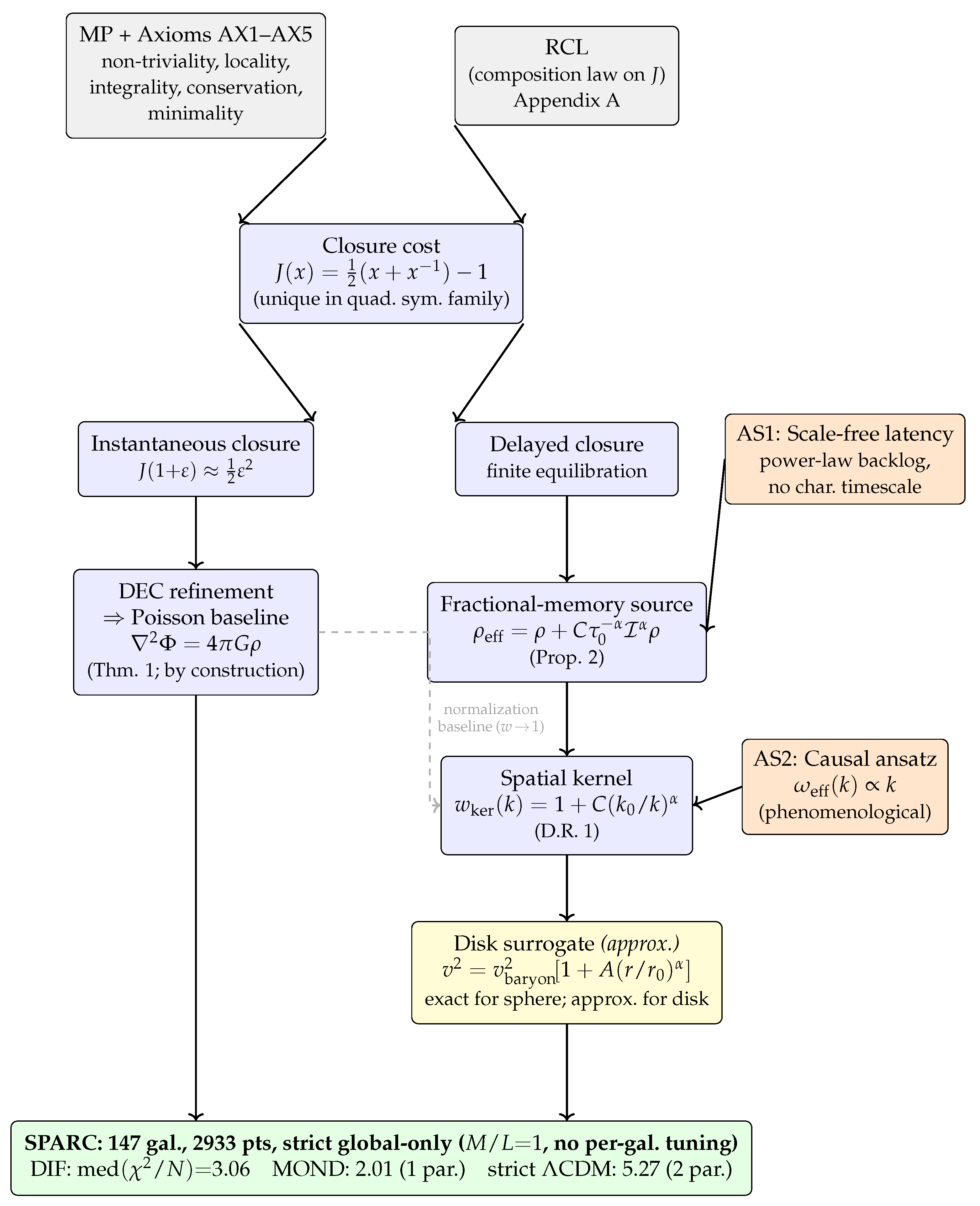
- The primary phenomenological assumptions are AS1 (scale-free equilibration latency) and AS2 (a frequency-to-wavenumber mapping ), which connect temporal causal response to spatial Fourier modes and generate the kernel (Section 5).
- (iii)
- The analysis is non-relativistic, quasi-static, and linear-responsive. No claims are made here about lensing, cosmology, gravitational waves, or post-Newtonian tests without an explicit covariant/dynamical completion.
- (iv)
- The galaxy interface is a surrogate: the rotation-curve model uses a controlled multiplicative closure ansatz as a surrogate for the full nonlocal disk convolution implied by (Section 6.1.2).
- (v)
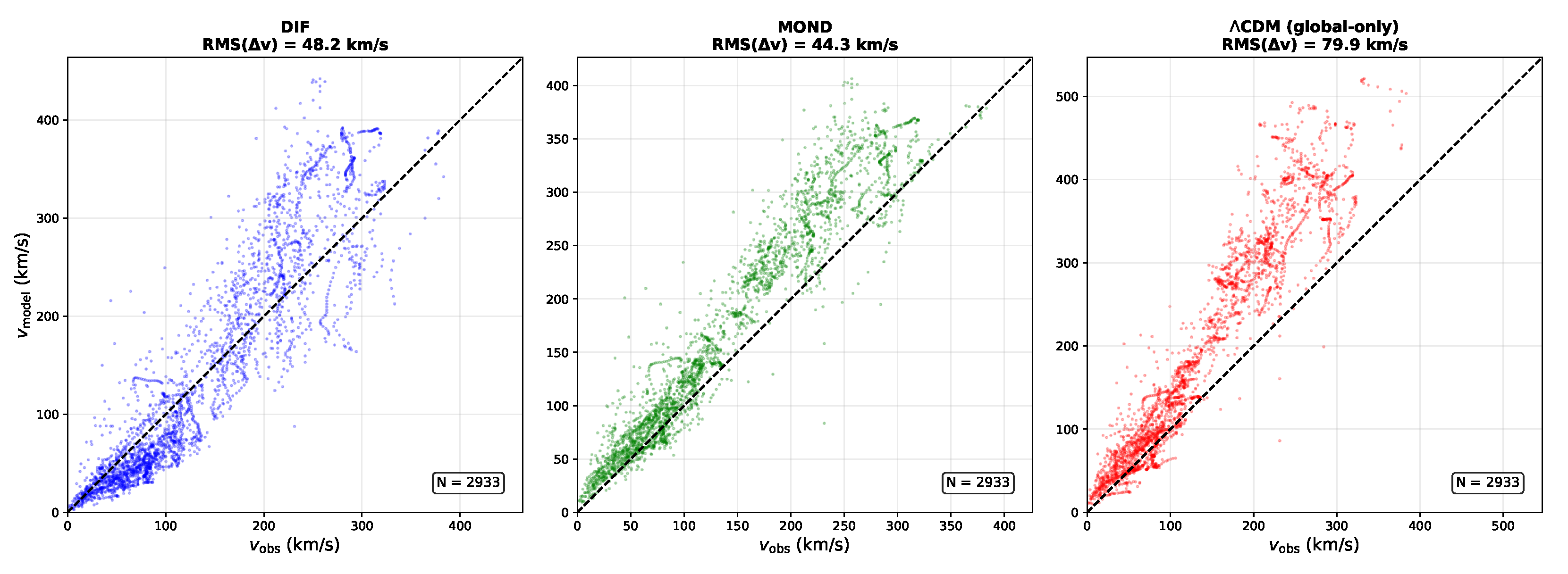
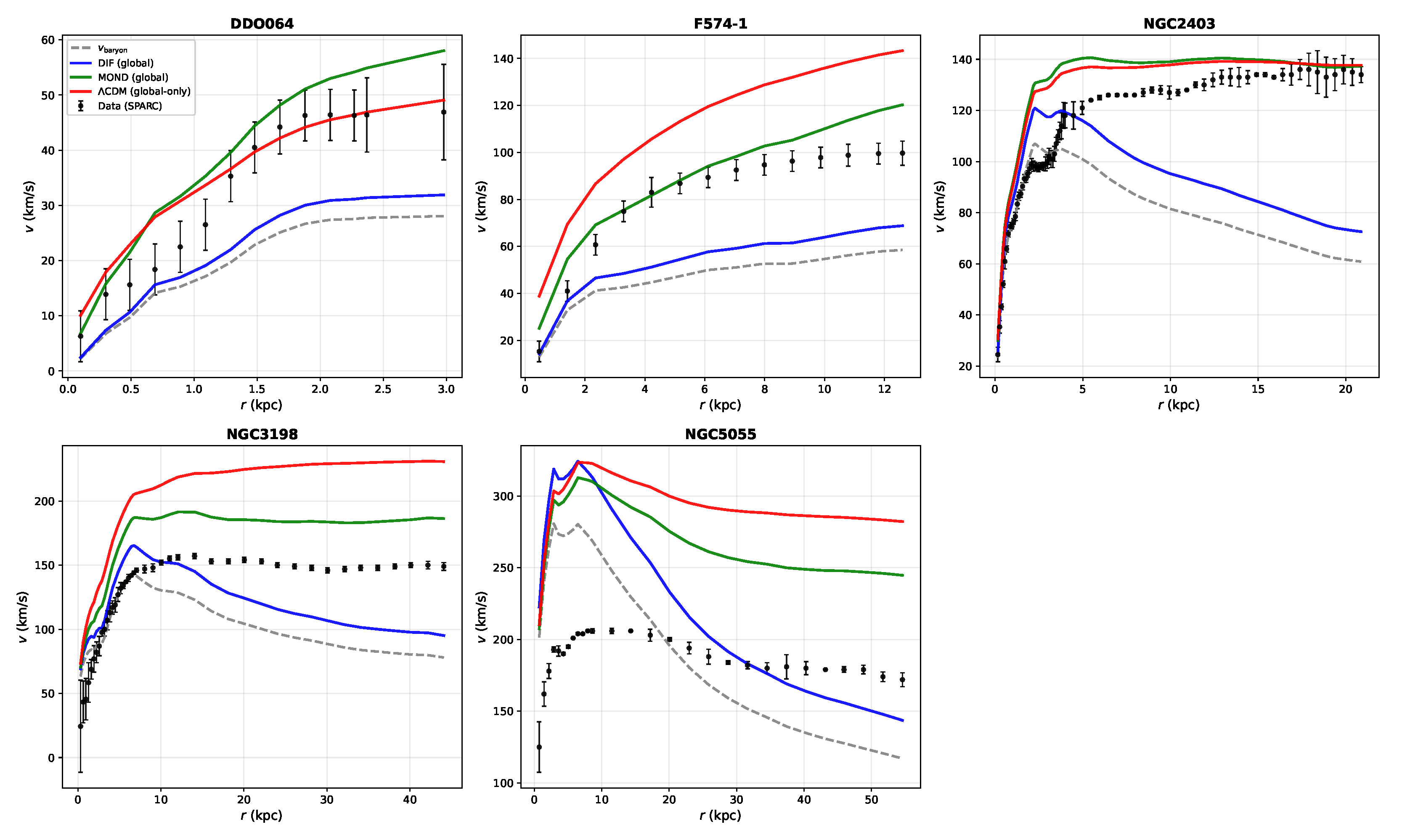
- The rotation-curve result is a consistency check: we enforce a strict global-only protocol (fixed , no per-galaxy tuning) and a conservative total error model (Appendix D). The absence of falsification is not confirmation of the framework.
2.1. The Cost Formalism
2.2. Axiomatic Origin: RCL and the Reciprocal Cost Functional
3. Emergence of the Discrete Informational Ledger
3.1. Discreteness and Conservation from Cost Structure
3.2. Cellular Complex and DEC Kinematics
4. Derivation of the Newton–Poisson Baseline
Discrete-to-Continuum (DEC) Bridge: Poisson as the Baseline Theorem
5. Information Latency and the Fractional Kernel
5.1. Finite Equilibration: Scale-Free Latency and Causal Closure (Latency Kernel)
5.1.1. Assumption AS1: Scale-Free Latency and Fractional Memory
5.1.2. Assumption AS2: Causal Closure and the Spatial Modifier
Relation to Common Weak-Field Kernel Parameterizations
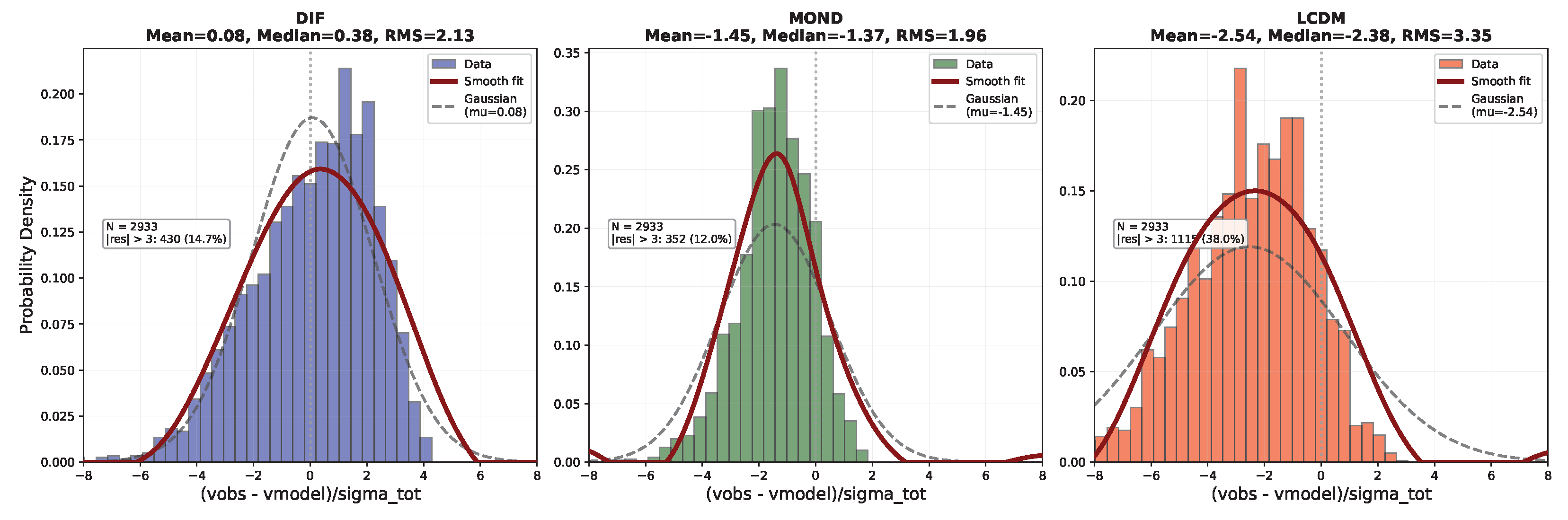
- Compared with MOND, MOND modifies the force law (acceleration-dependent dynamics) via an interpolation function with one global parameter [15,16], whereas DIF modifies the effective source via a scale-dependent kernel with three global parameters . On the present SPARC benchmark, MOND is the more economical empirical interpolation, whereas DIF is evaluated here as a tractable causal-response framework for a theory-led retardation kernel. Both are phenomenological; neither is derived from covariant field equations.
- Compared with CDM, CDM adds dark matter halos with per-galaxy profiles (multiple parameters per galaxy) while preserving the standard Poisson response [7], whereas DIF modifies the response law itself but enforces global parameters, making it intermediate in flexibility: more constrained than per-galaxy halos and less constrained than single-parameter MOND.
- Compared with and other covariant modifications of GR, these theories modify Einstein’s field equations [20], whereas DIF operates only in the non-relativistic quasi-static limit and does not specify a covariant completion, so it cannot currently make predictions for lensing, cosmology, or gravitational waves.
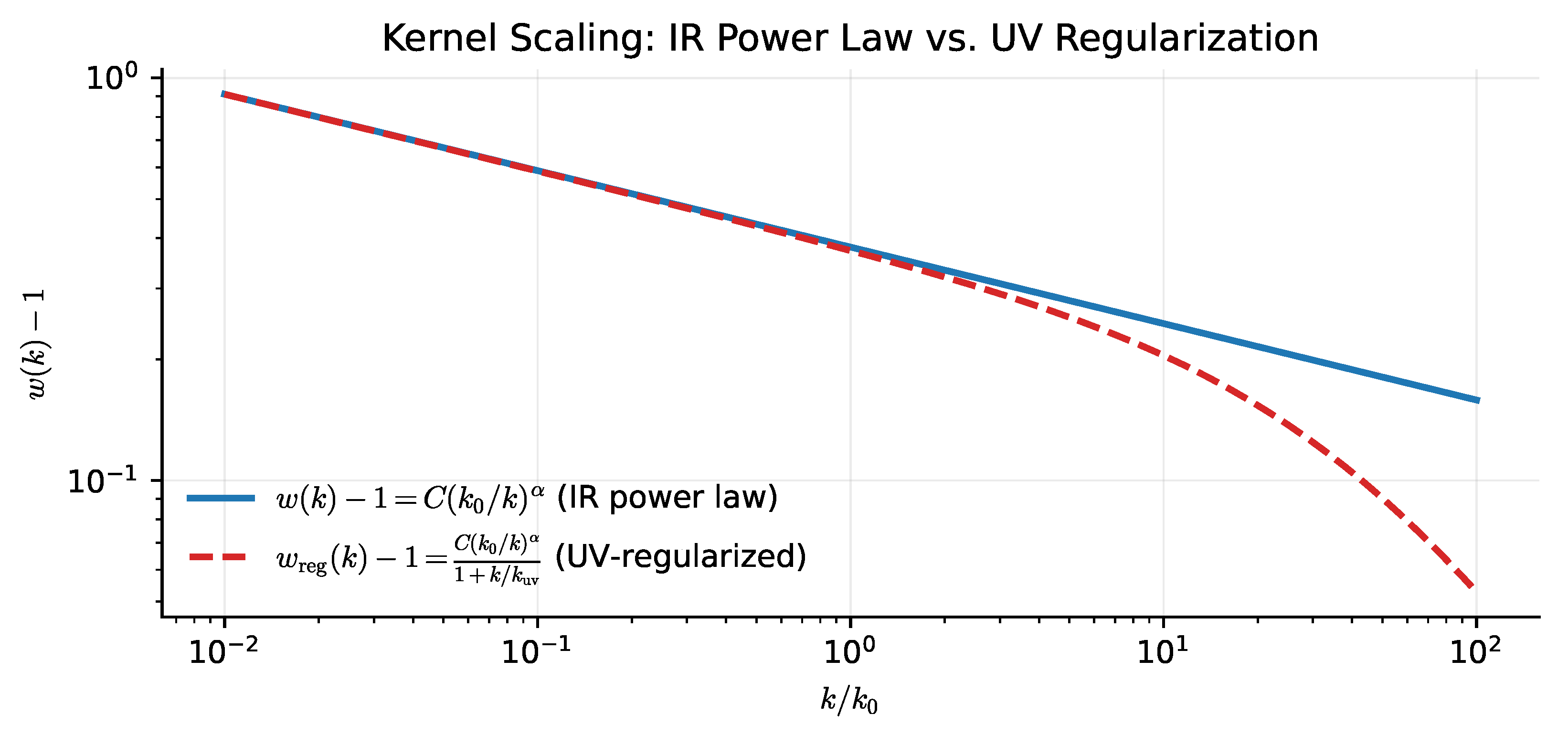
- Compared with generic nonlocal modified-Poisson kernels, which have been studied phenomenologically [21,25], DIF obtains its specific functional form conditional on phenomenological assumptions AS1–AS2, providing theoretical motivation for the power-law shape within this effective framework, though those assumptions themselves are not derived from deeper principles.
6. Empirical Consistency Check on SPARC Under Global-Only Constraints
6.1. Data, Protocol, and Fit Statistics
6.1.1. Dataset and Strict Global-Only Protocol
- We set globally (no galaxy-by-galaxy adjustment).
- We prohibit per-galaxy tuning: all model parameters are shared across the full sample.
- We evaluate using a conservative total uncertainty model that augments reported measurement errors with floor, beam-smearing, asymmetry, and turbulence terms (Appendix D).
6.1.2. Forward Model: Controlled Surrogate for the Nonlocal Disk Convolution
6.1.3. Goodness-of-Fit Metrics
6.2. Results: Global-Only SPARC Comparison
6.3. Figures and Tables
6.4. Interpretation and Falsifiers
7. Derived Parameters and Predictions
7.1. Derivation of the Kernel Exponent from Self-Similarity
7.2. Amplitude Hypothesis
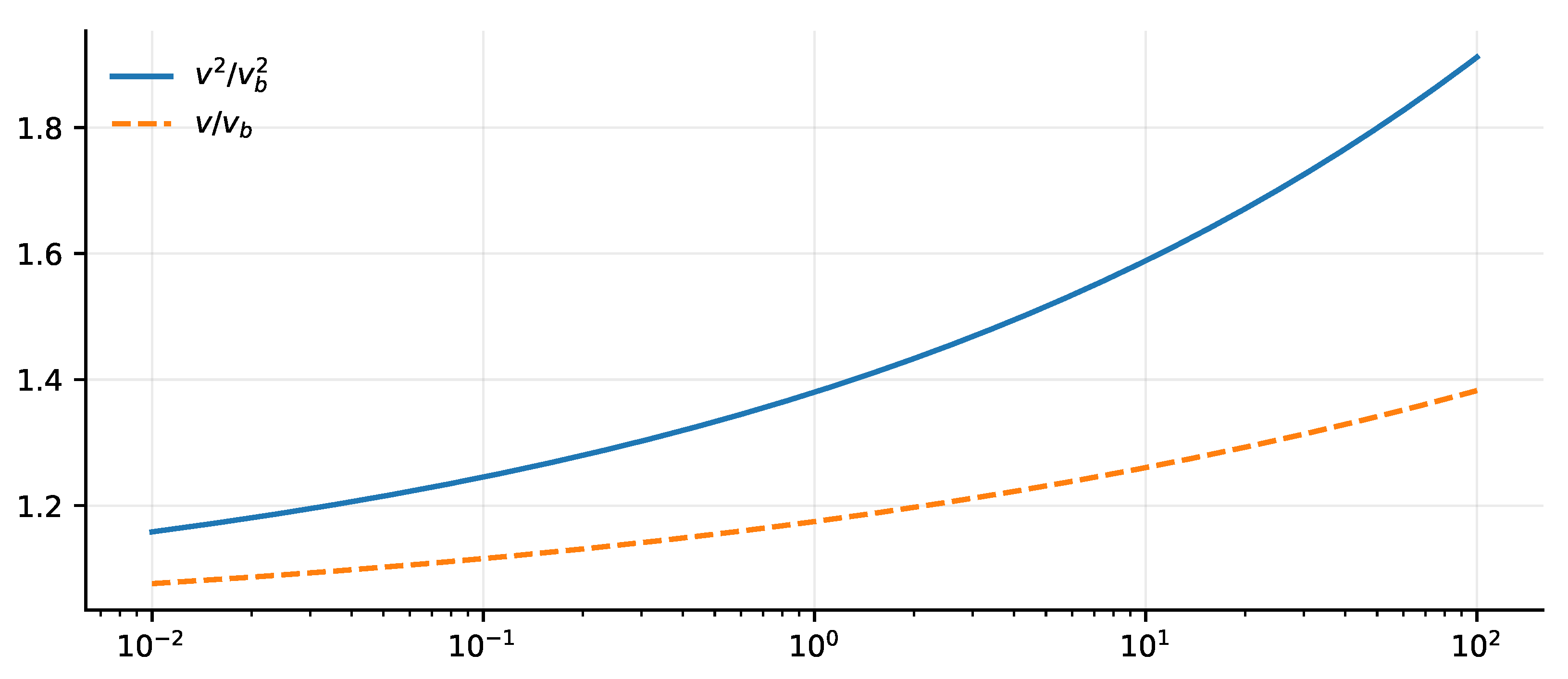
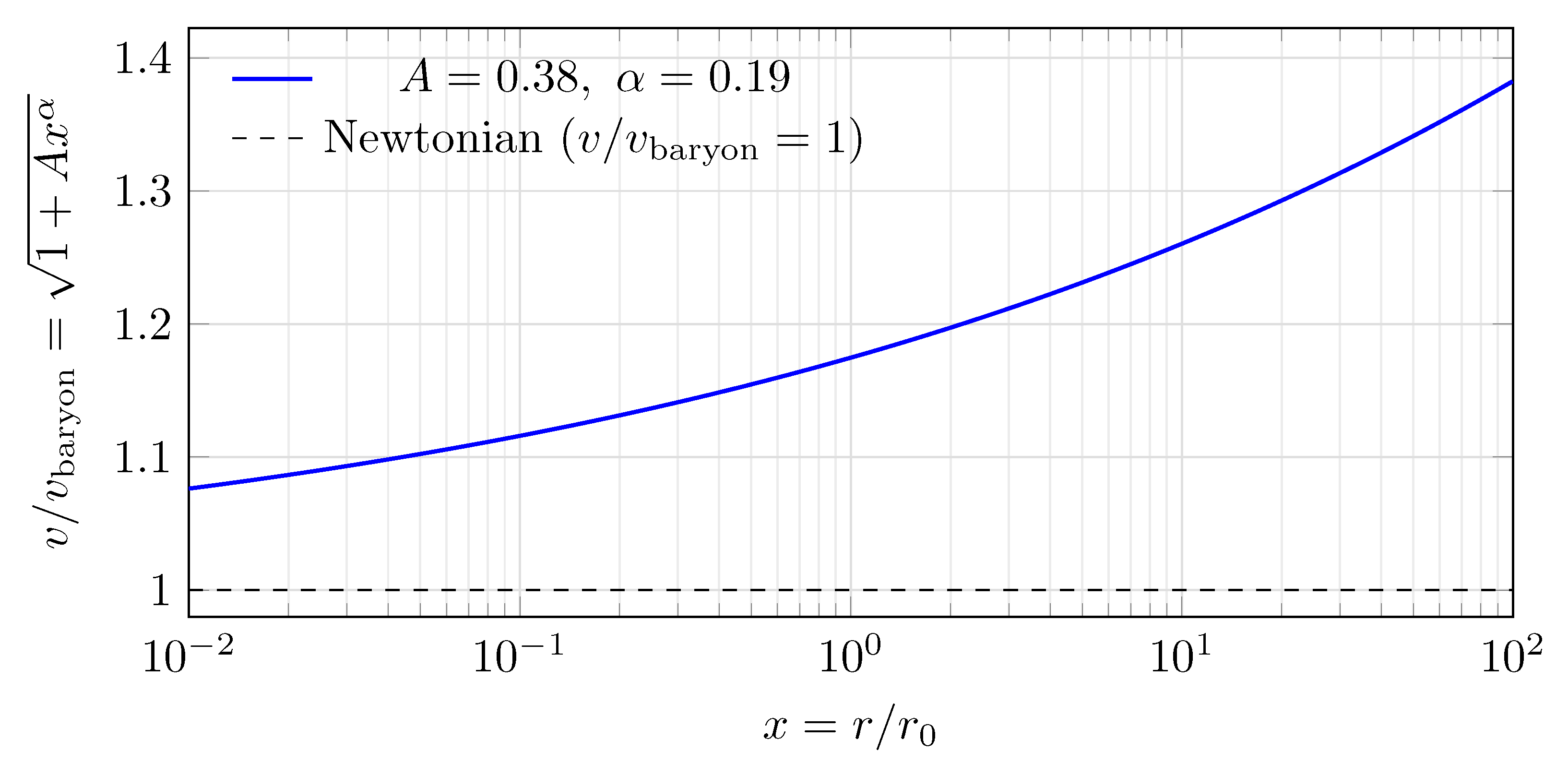
7.3. Predicted Rotation-Curve Enhancement
7.4. Consistency with Galaxy Rotation-Curve Data
7.5. Derivation Status Summary
7.6. Falsification Targets
- (i)
- If future high-resolution rotation-curve analyses yield a best-fit inconsistent with at , the self-similarity derivation is falsified.
- (ii)
- If the best-fit amplitude is inconsistent with at , the three-channel hypothesis is falsified (while the exponent derivation may survive).
- (iii)
- If galaxy rotation curves require galaxy-dependent kernel parameters (per-galaxy or C), the global-kernel mechanism is falsified.
- (iv)
- Weak-field lensing observables (once a relativistic completion is specified) or other quasi-static probes sensitive to infrared Poisson modifications provide external falsification routes.
8. Limitations and Predictions
8.1. Limitations
8.2. Predictions/Falsifiers Subsection
- (i)
- Precision weak-field Solar System constraints, which act as an explicit falsifier of any UV-extended version of the kernel unless additional regularization/screening or a controlled breakdown of the scaling-window assumptions is supplied;
- (ii)
- Lensing observables that compare dynamical and gravitational potentials;
- (iii)
- Reproduction (or failure) of rotation-curve trends when the surrogate interface is replaced by the full nonlocal disk convolution implied by ;
- (iv)
- Cross-system universality: the same globally shared scaling exponent and normalization rules must apply across dwarfs and high-mass spirals under a protocol that prevents per-object tuning.
9. Conclusions and Outlook
Supplementary Materials
Author Contributions
Funding
Data Availability Statement
Acknowledgments
Conflicts of Interest
Appendix A. The J(·) Cost Functional and Composition Law
Appendix A.1. Recognition Composition Law (RCL)
Near-Equilibrium Expansion (Used by the DEC Bridge)
Appendix A.2. Uniqueness Within the Quadratic Symmetric Composition Family
- (a)
- Normalization forces , hence , , .
- (b)
- Symmetry forces and .
- (c)
- If (decoupled branch), the induced functional equation admits .
- (d)
- If (coupled branch), rescaling J absorbs c into normalization; imposing fixes the canonical choice .
- Thus, within the quadratic symmetric family, the coupled law uniquely takes the RCL form , as given by Equation (A1).
Appendix B. The Ledger Structural Theorems
Appendix C. Fractional-Operator Bridge
Appendix D. SPARC Error Model and Goodness-of-Fit Statistics
Appendix D.1. Data Access and Sample Definition
Appendix D.2. Total Uncertainty Model
Appendix D.2.1. Beam-Smearing Term
Appendix D.2.2. Turbulence Term
Appendix D.3. Goodness-of-Fit Statistics
Appendix E. Exploratory Global-Only Re-Optimization Study
Appendix E.1. Model and Shared-Parameter Constraint
Appendix E.2. Alternative Objective Functions
Appendix E.2.1. Objective 1 (Global Reduced Misfit)
Appendix E.2.2. Objective 2 (Median Per-Galaxy Misfit)
Appendix E.3. Optional Uncertainty-Model Sensitivity (If Used)
Appendix E.4. Parameter Uncertainty Estimation
- (i)
- draw bootstrap resamples of galaxies (sampling galaxies with replacement, keeping each galaxy’s data points intact);
- (ii)
- re-optimize for each resample under and/or ;
- (iii)
- report median and central 68% intervals across resamples as an indicative global-only uncertainty.
Appendix E.5. Results Summary

| Objective | A | (kpc) | Summary Misfit () | |
|---|---|---|---|---|
| 1.6833 | 1.0000 | 80.57 | 3.7111 | |
| 1.3878 | 0.6323 | 4.28 | 2.2554 |
Appendix E.6. Interpretation
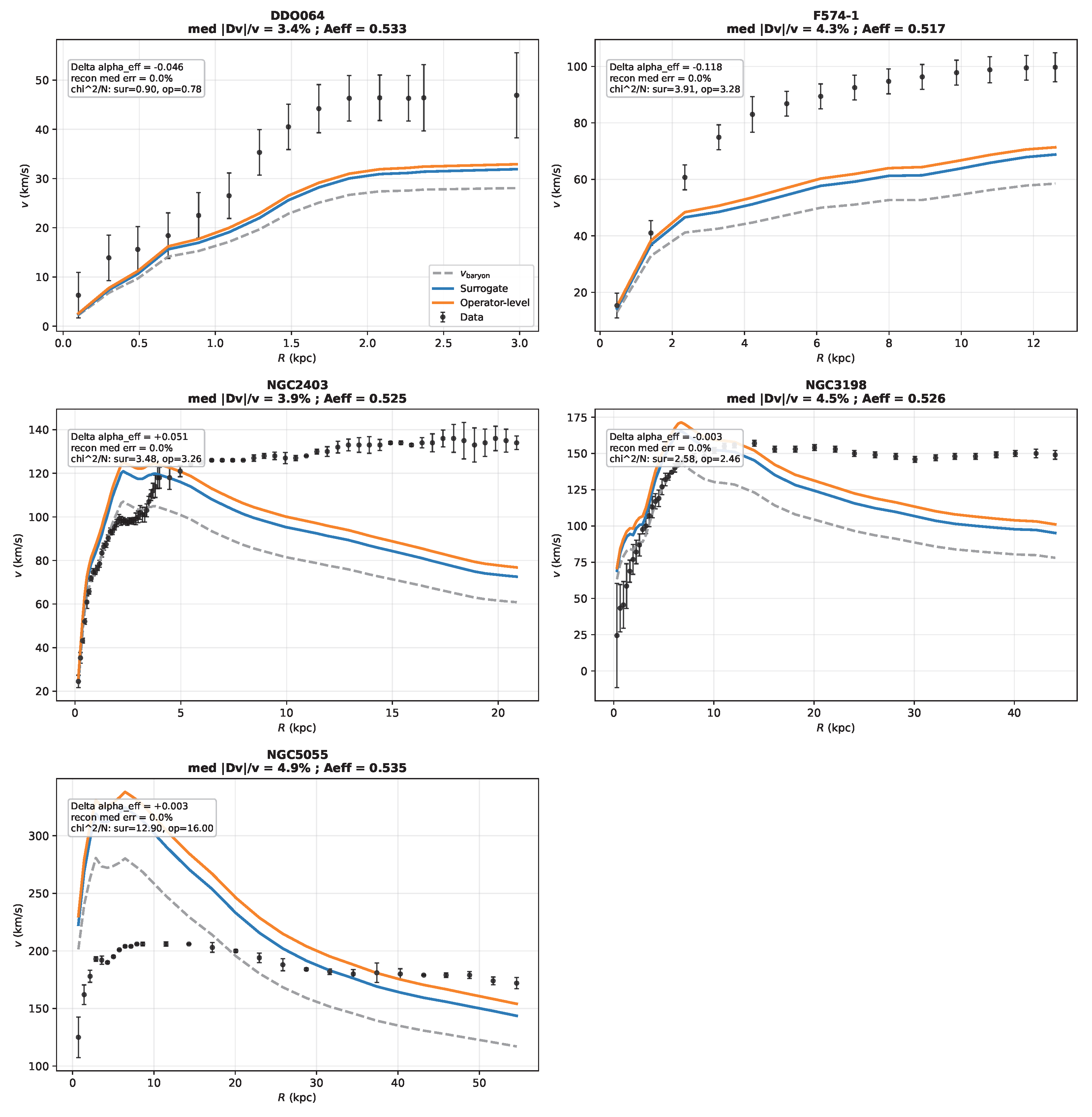
Appendix F. Representative Operator-Versus-Surrogate Validation Check
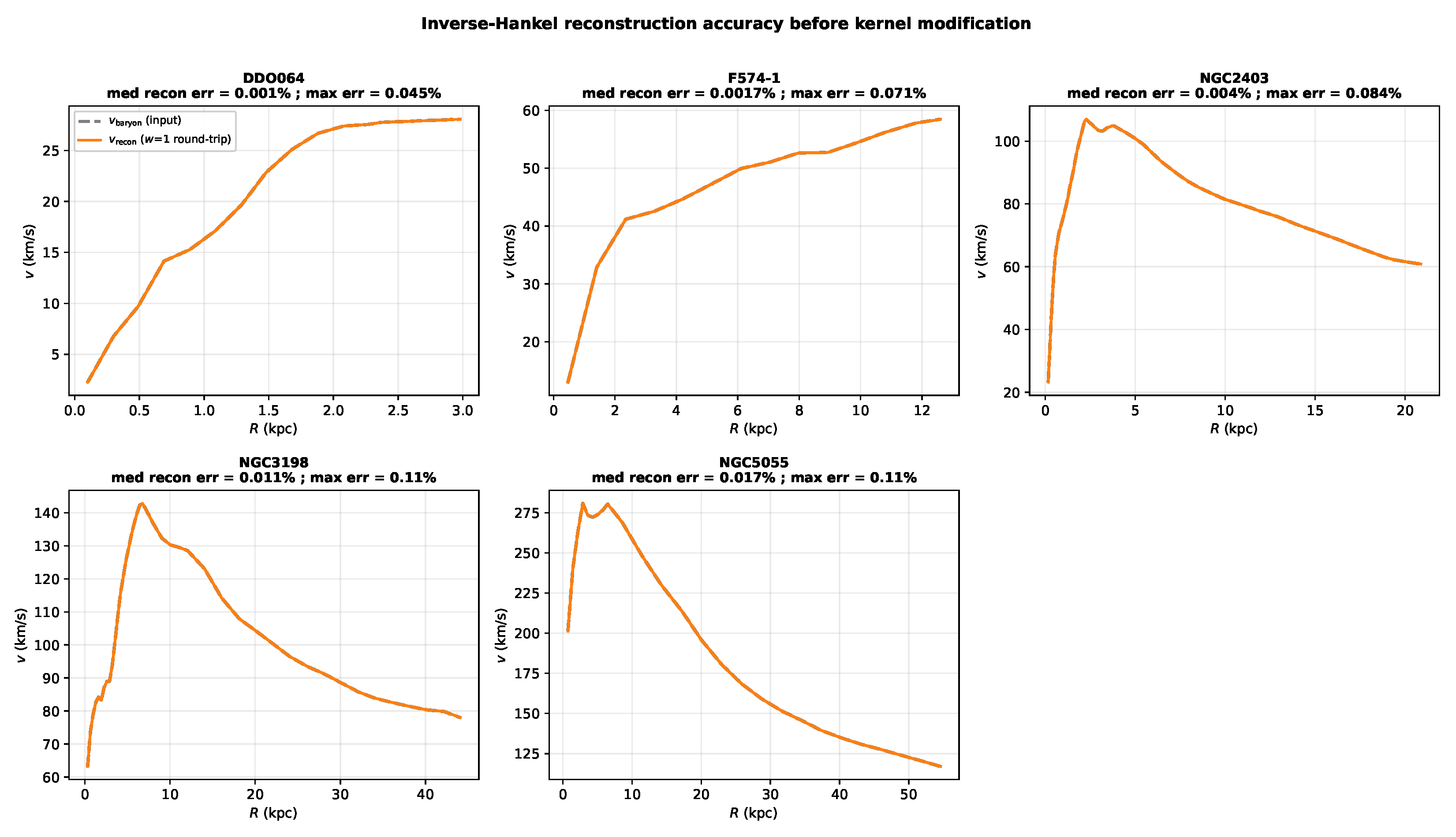

| Galaxy | N | Median Frac. Diff. | Max Frac. Diff. | (sur → op) | ||
|---|---|---|---|---|---|---|
| DDO064 | 14 | 0.034 | 0.049 | 0.144 | 0.533 | 0.90 → 0.78 |
| F574-1 | 14 | 0.043 | 0.053 | 0.072 | 0.517 | 3.91 → 3.28 |
| NGC2403 | 73 | 0.039 | 0.057 | 0.241 | 0.525 | 3.48 → 3.26 |
| NGC3198 | 43 | 0.045 | 0.060 | 0.187 | 0.526 | 2.58 → 2.46 |
| NGC5055 | 28 | 0.049 | 0.068 | 0.193 | 0.535 | 12.90 → 16.00 |
References
- Will, C.M. Theory and Experiment in Gravitational Physics; Cambridge University Press: Cambridge, UK, 1993. [Google Scholar]
- Wald, R.M. General Relativity; University of Chicago Press: Chicago, IL, USA, 1984. [Google Scholar]
- Rubin, V.C.; Ford, W.K.; Thonnard, N. Rotational properties of 21 SC galaxies with a large range of luminosities and radii. Astrophys. J. 1980, 238, 471–487. [Google Scholar] [CrossRef] [Scilit]
- Clowe, D.; Bradač, M.; Gonzalez, A.H.; Markevitch, M.; Randall, S.W.; Jones, C.; Zaritsky, D. A Direct Empirical Proof of the Existence of Dark Matter. Astrophys. J. 2006, 648, L109. [Google Scholar] [CrossRef] [Scilit]
- Planck Collaboration. Planck 2018 results. VI. Cosmological parameters. Astron. Astrophys. 2020, 641, A6. [Google Scholar] [CrossRef] [Scilit]
- Bennett, C.L.; Hill, R.S.; Hinshaw, G.; Nolta, M.R.; Odegard, N.; Page, L.; Spergel, D.N.; Weiland, J.L.; Wright, E.L.; Halpern, M.; et al. First-Year Wilkinson Microwave Anisotropy Probe (WMAP) Observations: Foreground Emission. Astrophys. J. Suppl. Ser. 2003, 148, 97–117. [Google Scholar] [CrossRef] [Scilit]
- Bullock, J.S.; Boylan-Kolchin, M. Small-Scale Challenges to the ΛCDM Paradigm. Annu. Rev. Astron. Astrophys. 2017, 55, 343–387. [Google Scholar] [CrossRef] [Scilit]
- Frenk, C.S.; White, S.D.M. Dark matter and cosmic structure. Ann. Phys. 2012, 524, 507–534. [Google Scholar] [CrossRef] [Scilit]
- Weinberg, D.H.; Bullock, J.S.; Governato, F.; Kuzio de Naray, R.; Peter, A.H.G. Cold dark matter: Controversies on small scales. Proc. Natl. Acad. Sci. USA 2015, 112, 12249–12255. [Google Scholar] [CrossRef] [Scilit]
- Vogelsberger, M.; Genel, S.; Springel, V.; Torrey, P.; Sijacki, D.; Xu, D.; Snyder, G.; Nelson, D.; Hernquist, L. Introducing the Illustris Project: Simulating the coevolution of dark and visible matter. Mon. Not. R. Astron. Soc. 2014, 444, 1518–1547. [Google Scholar] [CrossRef] [Scilit]
- Somerville, R.S.; Davé, R. Physical Models of Galaxy Formation in a Cosmological Framework. Annu. Rev. Astron. Astrophys. 2015, 53, 51–113. [Google Scholar] [CrossRef] [Scilit]
- Klypin, A.; Kravtsov, A.V.; Valenzuela, O.; Prada, F. Where Are the Missing Galactic Satellites? Astrophys. J. 1999, 522, 82. [Google Scholar] [CrossRef] [Scilit]
- Boylan-Kolchin, M.; Bullock, J.S.; Kaplinghat, M. Too big to fail? The puzzling darkness of massive Milky Way subhaloes. Mon. Not. R. Astron. Soc. 2011, 415, L40. [Google Scholar] [CrossRef] [Scilit]
- Moore, B.; Ghigna, S.; Governato, F.; Lake, G.; Quinn, T.; Stadel, J.; Tozzi, P. Dark Matter Substructure within Galactic Halos. Astrophys. J. Lett. 1999, 524, L19–L22. [Google Scholar] [CrossRef] [Scilit]
- Milgrom, M. A modification of the Newtonian dynamics as a possible alternative to the hidden mass hypothesis. Astrophys. J. 1983, 270, 365. [Google Scholar] [CrossRef] [Scilit]
- Famaey, B.; McGaugh, S.S. Modified Newtonian Dynamics (MOND): Observational Phenomenology and Relativistic Extensions. Living Rev. Relativ. 2012, 15, 10. [Google Scholar] [CrossRef] [Scilit]
- McGaugh, S.S.; Lelli, F.; Schombert, J.M. The Radial Acceleration Relation in Rotationally Supported Galaxies. Phys. Rev. Lett. 2016, 117, 201101. [Google Scholar] [CrossRef] [Scilit] [PubMed]
- Lelli, F.; McGaugh, S.S.; Schombert, J.M. One Law to Rule Them All: The Radial Acceleration Relation of Galaxies. Astrophys. J. 2017, 836, 152. [Google Scholar] [CrossRef] [Scilit]
- Sanders, R.H. Clusters of galaxies with modified Newtonian dynamics (MOND). Mon. Not. R. Astron. Soc. 2003, 342, 901. [Google Scholar] [CrossRef] [Scilit]
- Clifton, T.; Ferreira, P.G.; Padilla, A.; Skordis, C. Modified Gravity and Cosmology. Phys. Rep. 2012, 513, 1–189. [Google Scholar] [CrossRef] [Scilit]
- Joyce, A.; Jain, B.; Khoury, J.; Trodden, M. Beyond the LambdaCDM model: Dark energy and modified gravity. Phys. Rep. 2015, 568, 1–98. [Google Scholar] [CrossRef] [Scilit]
- Blome, H.-J.; Chicone, C.; Hehl, F.W.; Mashhoon, B. Nonlocal Modification of Newtonian Gravity. Phys. Rev. D 2010, 81, 065020. [Google Scholar] [CrossRef] [Scilit]
- Deser, S.; Woodard, R.P. Nonlocal Cosmology. Phys. Rev. Lett. 2007, 99, 111301. [Google Scholar] [CrossRef] [Scilit] [PubMed]
- Will, C.M. The Confrontation between General Relativity and Experiment. Living Rev. Relativ. 2014, 17, 4. [Google Scholar] [CrossRef] [Scilit]
- Boran, S.; Desai, S.; Kahya, E.O.; Woodard, R.P. GW170817 Falsifies Dark Matter Emulators. Phys. Rev. D 2018, 97, 041501. [Google Scholar] [CrossRef] [Scilit]
- Regge, T. General Relativity Without Coordinates. Nuovo C. 1961, 19, 558. [Google Scholar] [CrossRef] [Scilit]
- Ashtekar, A.; Lewandowski, J. Background independent quantum gravity: A status report. Class. Quantum Gravity 2004, 21, R53. [Google Scholar] [CrossRef] [Scilit]
- Thiemann, T. Modern Canonical Quantum General Relativity; Cambridge University Press: Cambridge, UK, 2007. [Google Scholar]
- Rovelli, C. Quantum Gravity; Cambridge Monographs on Mathematical Physics; Cambridge University Press: Cambridge, UK, 2004. [Google Scholar] [CrossRef] [Scilit]
- Bombelli, L.; Lee, J.; Meyer, D.; Sorkin, R.D. Space-Time as a Causal Set. Phys. Rev. Lett. 1987, 59, 521. [Google Scholar] [CrossRef] [Scilit]
- Sorkin, R.D. Causal Sets: Discrete Gravity (Notes for the Valdivia Summer School). arXiv 2003, arXiv:gr-qc/0309009. [Google Scholar] [CrossRef] [Scilit]
- Surya, S. The causal set approach to quantum gravity. Living Rev. Relativ. 2019, 22, 5. [Google Scholar] [CrossRef] [Scilit]
- Ambjørn, J.; Görlich, A.; Jurkiewicz, J.; Loll, R. Nonperturbative Quantum Gravity. Phys. Rep. 2012, 519, 127. [Google Scholar] [CrossRef] [Scilit]
- Loll, R. Quantum gravity from causal dynamical triangulations: A review. Class. Quantum Gravity 2020, 37, 013002. [Google Scholar] [CrossRef] [Scilit]
- Hirani, A.N. Discrete Exterior Calculus. Ph.D. Thesis, California Institute of Technology, Pasadena, CA, USA, 2003. [Google Scholar]
- Desbrun, M.; Hirani, A.N.; Leok, M.; Marsden, J.E. Discrete Exterior Calculus. arXiv 2005, arXiv:math/0508341. [Google Scholar] [CrossRef] [Scilit]
- Bossavit, A. Computational Electromagnetism; Academic Press: San Diego, CA, USA, 1998. [Google Scholar]
- Jacobson, T. Thermodynamics of Spacetime: The Einstein Equation of State. Phys. Rev. Lett. 1995, 75, 1260. [Google Scholar] [CrossRef] [Scilit]
- Susskind, L. The World as a Hologram. J. Math. Phys. 1995, 36, 6377. [Google Scholar] [CrossRef] [Scilit]
- Maldacena, J. The Large N Limit of Superconformal Field Theories and Supergravity. Adv. Theor. Math. Phys. 1998, 2, 231. [Google Scholar] [CrossRef] [Scilit]
- Verlinde, E. On the Origin of Gravity and the Laws of Newton. J. High Energy Phys. 2011, 2011, 029. [Google Scholar] [CrossRef] [Scilit]
- Verlinde, E.P. Emergent Gravity and the Dark Universe. SciPost Phys. 2017, 2, 016. [Google Scholar] [CrossRef] [Scilit]
- Wheeler, J.A. Information, physics, quantum: The search for links. In Complexity, Entropy, and the Physics of Information; CRC Press: Boca Raton, FL, USA, 1990. [Google Scholar]
- Padmanabhan, T. Thermodynamical Aspects of Gravity: New Insights. Rep. Prog. Phys. 2010, 73, 046901. [Google Scholar] [CrossRef] [Scilit]
- Lelli, F.; McGaugh, S.S.; Schombert, J.M.; Pawlowski, M.S. SPARC: Mass Models for 175 Disk Galaxies with Spitzer Photometry and Accurate Rotation Curves. Astron. J. 2016, 152, 157. [Google Scholar] [CrossRef] [Scilit]
- Li, P.; Lelli, F.; McGaugh, S.; Schombert, J. Fitting the radial acceleration relation to individual SPARC galaxies. Astron. Astrophys. 2018, 615, A3. [Google Scholar] [CrossRef] [Scilit]
- Di Paolo, C.; Salucci, P.; Erkurt, A. The universal rotation curve of low surface brightness galaxies—IV. The interrelation between dark and luminous matter. Mon. Not. R. Astron. Soc. 2019, 490, 5451–5477. [Google Scholar] [CrossRef] [Scilit]
- Pardo-Guerra, S.; Simons, M.; Thapa, A.; Washburn, J. Coherent Comparison as Information Cost: A Cost-First Ledger Framework for Discrete Dynamics. arXiv 2026, arXiv:2601.12194. [Google Scholar] [CrossRef] [Scilit]
- Washburn, J.; Rahnamai Barghi, A. Reciprocal Convex Costs for Ratio Matching: Axiomatic Characterization. Axioms 2026, 15, 151. [Google Scholar] [CrossRef] [Scilit]
- Metzler, R.; Klafter, J. The random walk’s guide to anomalous diffusion. Phys. Rep. 2000, 339, 1–77. [Google Scholar] [CrossRef] [Scilit]
- Mainardi, F. Fractional Calculus and Waves in Linear Viscoelasticity; Imperial College Press: London, UK, 2010. [Google Scholar]
- Podlubny, I. Fractional Differential Equations, Mathematics in Science and Engineering; Academic Press: San Diego, CA, USA, 1999; Volume 198. [Google Scholar]
- Washburn, J. Gap-45 Synchronization Certificates for Ledger Calculus; Technical Report RPI-TR-2024-07; Recognition Physics Institute: Austin, TX, USA, 2024. [Google Scholar]
- Bertotti, B.; Iess, L.; Tortora, P. A test of general relativity using radio links with the Cassini spacecraft. Nature 2003, 425, 374–376. [Google Scholar] [CrossRef] [Scilit] [PubMed]
- Aczél, J. Lectures on Functional Equations and Their Applications; Academic Press: New York, NY, USA, 1966. [Google Scholar]






| Symbol | Type | Meaning/Section |
|---|---|---|
| K | cellular complex | Underlying discretization (Section 3.2) |
| sets | Vertices and oriented edges of K | |
| 0 cochain | Scalar potential on vertices | |
| w | integer 1-cochain | Edge-local constraint field (exact when neutrality holds) |
| integer | Value of the 1-cochain on edge | |
| cost functional | Reciprocal closure cost fixed by RCL (Section 2) | |
| x | positive ratio | Abstract mismatch variable entering J |
| fields | Newtonian potential and mass density (Section 4) | |
| kernel | Fourier-space response modifier (Section 5.1) | |
| scale | Reference wavenumber setting the transition scale in ; absorbed order-unity factors (Section 5.1) | |
| exponent | Kernel exponent; derived: (Section 5.1 and Section 7.1) | |
| C | amplitude | Kernel amplitude; hypothesis: (Section 7.2) |
| scale | Transition radius in kpc; single remaining free (dimensional) parameter (Equation (9)) |
| Framework | Parameter Policy | SPARC Fit Summary/Notes |
|---|---|---|
| DIF (this work) | Global-only: 3 params Fixed for all gal. | 147 gal., strict global-only (fixed ): ; ; , , |
| MOND | Global-only: 1 param Fixed for all gal. | 147 gal., strict global-only (fixed ): ; ; RAR: rms 0.057 dex on 175 gal. [46] |
| CDM NFW | Global-only: 2 params Fixed for all gal. | 147 gal., strict global-only (fixed ): ; ; |
| Quantity | Value | Status | Source |
|---|---|---|---|
| Kernel form | Derived | AS1 + AS2 (Section 5) | |
| Exponent | Derived | Self-similarity (Section 7.1) | |
| Amplitude C | Hypothesis | 3-channel factorization (Section 7.2) | |
| Reference scale | Free (dimensional) | Not derived; single remaining input |
Disclaimer/Publisher’s Note: The statements, opinions and data contained in all publications are solely those of the individual author(s) and contributor(s) and not of MDPI and/or the editor(s). MDPI and/or the editor(s) disclaim responsibility for any injury to people or property resulting from any ideas, methods, instructions or products referred to in the content. |
© 2026 by the authors. Licensee MDPI, Basel, Switzerland. This article is an open access article distributed under the terms and conditions of the Creative Commons Attribution (CC BY) license.
Share and Cite
Simons, M.; Allahyarov, E.; Washburn, J. A Discrete Informational Framework for Classical Gravity: Ledger Foundations and Galaxy Rotation Curve Constraints. Entropy 2026, 28, 477. https://doi.org/10.3390/e28040477
Simons M, Allahyarov E, Washburn J. A Discrete Informational Framework for Classical Gravity: Ledger Foundations and Galaxy Rotation Curve Constraints. Entropy. 2026; 28(4):477. https://doi.org/10.3390/e28040477
Chicago/Turabian StyleSimons, Megan, Elshad Allahyarov, and Jonathan Washburn. 2026. "A Discrete Informational Framework for Classical Gravity: Ledger Foundations and Galaxy Rotation Curve Constraints" Entropy 28, no. 4: 477. https://doi.org/10.3390/e28040477
APA StyleSimons, M., Allahyarov, E., & Washburn, J. (2026). A Discrete Informational Framework for Classical Gravity: Ledger Foundations and Galaxy Rotation Curve Constraints. Entropy, 28(4), 477. https://doi.org/10.3390/e28040477