


Quantifying the Nonclassicality of the Kirkwood–Dirac Quasiprobability Distribution Under Discrete-Time Dynamics

Abstract
1. Introduction
2. Temporal KD Quasiprobability Distribution Under Two-Time Dynamics
3. Nonclassicality Measures for the Temporal KD Quasiprobability Distribution
- (i)
- Faithfulness: if and only if the temporal KD quasiprobability distribution equals the Lüders–von Neumann distribution, i.e., .
- (ii)
- Convexity: , where is a probability distribution satisfying and .
- (iii)
- Noncommutativity witness: If , then there is a choice of the indices i and j, for which does not commute with ρ and , where denotes the Hilbert–Schmidt adjoint of .
- (iv)
- Monotonic decrease under decoherence: The decoherence channel is represented as , where , with denoting the identity channel and signifying the completely dephasing channel defined by . Consequently, it follows that .
4. Temporal KD Nonclassicality, Uncertainty, and Causal Correlations
4.1. Temporal KD Nonclassicality and Uncertainty
4.1.1. Connection with the Schrödinger Uncertainty Relation
4.1.2. A State-Dependent Uncertainty Relation for the Temporal KD Nonclassicality
4.2. Temporal KD Nonclassicality and Causal Correlations
4.2.1. Three Causal Structures for Two Observables
- (i)
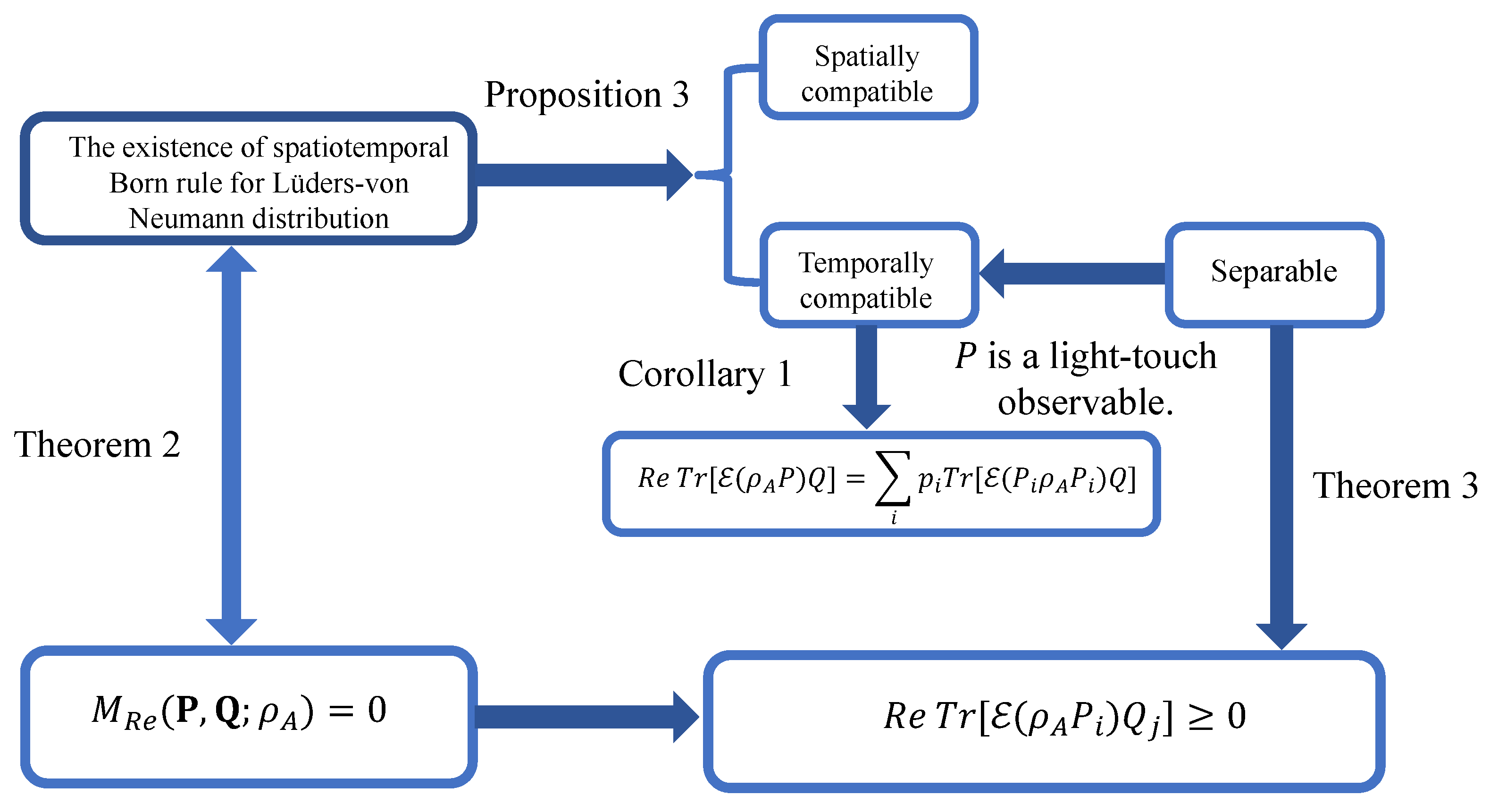
- Spatially compatible. There exists a density matrix such that for all . Then, the expectation values are said to be spatially compatible on the joint system . If no such exists, then expectation values are said to be spatially incompatible.
- (ii)
- Temporally compatible with temporal order . There exists a density matrix and a quantum channel such that equals the two-time expectation value associated with the process , i.e.,for all . Here, is the canonical spectral decomposition of the observable , and corresponds to the spectral projection associated with eigenvalue .
- (iii)
- Temporally compatible with temporal order . There exists a density matrix and a quantum channel such that equals the two-time expectation value associated with the process , i.e.,for all . Here, is the canonical spectral decomposition of the observable , and corresponds to the spectral projection associated with eigenvalue .
4.2.2. Spatiotemporal Born Rule
4.2.3. Connection with the Temporal KD Nonclassicality
5. Conclusions
Author Contributions
Funding
Institutional Review Board Statement
Informed Consent Statement
Data Availability Statement
Acknowledgments
Conflicts of Interest
Appendix A
Appendix B. Proof of Theorem 1
Appendix C
Appendix D. Proofs of Theorems 2 and 3 and Corollary 1
References
- Stobińska, M.; Milburn, G.J.; Wódkiewicz, K. Wigner function evolution of quantum states in the presence of self-Kerr interaction. Phys. Rev. A 2008, 78, 013810. [Google Scholar] [CrossRef]
- Filip, R.; Mita, L. Detecting Quantum States with a Positive Wigner Function beyond Mixtures of Gaussian States. Phys. Rev. Lett. 2011, 106, 200401. [Google Scholar] [CrossRef]
- Albarelli, F.; Genoni, M.G.; Paris, M.G.A.; Ferraro, A. Resource theory of quantum non-Gaussianity and Wigner negativity. Phys. Rev. A 2018, 98, 052350. [Google Scholar] [CrossRef]
- Yoshikawa, J.i.; Makino, K.; Kurata, S.; van Loock, P.; Furusawa, A. Creation, Storage, and On-Demand Release of Optical Quantum States with a Negative Wigner Function. Phys. Rev. X 2013, 3, 041028. [Google Scholar] [CrossRef]
- Delfosse, N.; Allard Guerin, P.; Bian, J.; Raussendorf, R. Wigner Function Negativity and Contextuality in Quantum Computation on Rebits. Phys. Rev. X 2015, 5, 021003. [Google Scholar] [CrossRef]
- Davis, J.; Kumari, M.; Mann, R.B.; Ghose, S. Wigner negativity in spin-j systems. Phys. Rev. Res. 2021, 3, 033134. [Google Scholar] [CrossRef]
- Booth, R.I.; Chabaud, U.; Emeriau, P.E. Contextuality and Wigner Negativity Are Equivalent for Continuous-Variable Quantum Measurements. Phys. Rev. Lett. 2022, 129, 230401. [Google Scholar] [CrossRef] [PubMed]
- Kirkwood, J.G. Quantum Statistics of Almost Classical Assemblies. Phys. Rev. 1933, 44, 31–37. [Google Scholar] [CrossRef]
- Dirac, P.A.M. On the Analogy Between Classical and Quantum Mechanics. Rev. Mod. Phys. 1945, 17, 195–199. [Google Scholar] [CrossRef]
- Arvidsson-Shukur, D.R.M.; Halpern, N.Y.; Lepage, H.V.; Lasek, A.A.; Lloyd, S. Quantum advantage in postselected metrology. Nat. Commun. 2020, 11, 3775. [Google Scholar] [CrossRef]
- Lupu-Gladstein, N.; Yilmaz, Y.B.; Arvidsson-Shukur, D.R.M.; Brodutch, A.; Pang, A.O.T.; Steinberg, A.M.; Halpern, N.Y. Negative Quasiprobabilities Enhance Phase Estimation in Quantum-Optics Experiment. Phys. Rev. Lett. 2022, 128, 220504. [Google Scholar] [CrossRef]
- Yunger Halpern, N.; Swingle, B.; Dressel, J. Quasiprobability behind the out-of-time-ordered correlator. Phys. Rev. A 2018, 97, 042105. [Google Scholar] [CrossRef]
- Lostaglio, M. Certifying Quantum Signatures in Thermodynamics and Metrology via Contextuality of Quantum Linear Response. Phys. Rev. Lett. 2020, 125, 230603. [Google Scholar] [CrossRef] [PubMed]
- Arvidsson-Shukur, D.R.M.; Drori, J.C.; Halpern, N.Y. Conditions tighter than noncommutation needed for nonclassicality. J. Phys. A Math. Theor. 2021, 54, 284001. [Google Scholar] [CrossRef]
- De Bièvre, S. Complete Incompatibility, Support Uncertainty, and Kirkwood-Dirac Nonclassicality. Phys. Rev. Lett. 2021, 127, 190404. [Google Scholar] [CrossRef]
- De Bièvre, S. Relating incompatibility, noncommutativity, uncertainty, and Kirkwood–Dirac nonclassicality. J. Math. Phys. 2023, 64, 022202. [Google Scholar] [CrossRef]
- Langrenez, C.; Arvidsson-Shukur, D.R.M.; De Bièvre, S. Characterizing the geometry of the Kirkwood–Dirac-positive states. J. Math. Phys. 2024, 65, 072201. [Google Scholar] [CrossRef]
- Yunger Halpern, N. Jarzynski-like equality for the out-of-time-ordered correlator. Phys. Rev. A 2017, 95, 012120. [Google Scholar] [CrossRef]
- Fitzsimons, J.F.; Jones, J.A.; Vedral, V. Quantum correlations which imply causation. Sci. Rep. 2015, 5, 18281. [Google Scholar] [CrossRef] [PubMed]
- Horsman, D.; Heunen, C.; Pusey, M.F.; Barrett, J.; Spekkens, R.W. Can a quantum state over time resemble a quantum state at a single time? Proc. R. Soc. A Math. Phys. Eng. Sci. 2017, 473, 20170395. [Google Scholar] [CrossRef]
- Liu, X.; Qiu, Y.; Dahlsten, O.; Vedral, V. Quantum causal inference with extremely light touch. npj Quantum Inf. 2025, 11, 54. [Google Scholar] [CrossRef]
- Fullwood, J.; Parzygnat, A.J. Operator representation of spatiotemporal quantum correlations. arXiv 2025, arXiv:2405.17555. [Google Scholar] [CrossRef]
- Jia, Z.; Modi, K.; Kaszlikowski, D. Temporal Kirkwood-Dirac Quasiprobability Distribution and Unification of Temporal State Formalisms through Temporal Bloch Tomography. arXiv 2026, arXiv:2601.05294. [Google Scholar] [CrossRef]
- Arvidsson-Shukur, D.R.; Braasch, W.F., Jr.; De Bievre, S.; Dressel, J.; Jordan, A.N.; Langrenez, C.; Lostaglio, M.; Lundeen, J.S.; Halpern, N.Y. Properties and applications of the Kirkwood–Dirac distribution. New J. Phys. 2024, 26, 121201. [Google Scholar] [CrossRef]
- Liu, L.; Cheng, S. The boundary of Kirkwood-Dirac quasiprobability. arXiv 2025, arXiv:2504.09238. [Google Scholar] [CrossRef]
- Fullwood, J.; Ma, Z.; Wu, Z. The spatiotemporal Born rule is quasiprobabilistic. arXiv 2025, arXiv:2507.16919. [Google Scholar] [CrossRef]
- Lostaglio, M.; Belenchia, A.; Levy, A.; Hernández-Gómez, S.; Fabbri, N.; Gherardini, S. Kirkwood-Dirac quasiprobability approach to the statistics of incompatible observables. Quantum 2023, 7, 1128. [Google Scholar] [CrossRef]
- Hernández-Gómez, S.; Gherardini, S.; Belenchia, A.; Lostaglio, M.; Levy, A.; Fabbri, N. Projective measurements can probe nonclassical work extraction and time correlations. Phys. Rev. Res. 2024, 6, 023280. [Google Scholar] [CrossRef]
- Dixon, P.B.; Starling, D.J.; Jordan, A.N.; Howell, J.C. Ultrasensitive Beam Deflection Measurement via Interferometric Weak Value Amplification. Phys. Rev. Lett. 2009, 102, 173601. [Google Scholar] [CrossRef] [PubMed]
- Pang, S.; Dressel, J.; Brun, T.A. Entanglement-Assisted Weak Value Amplification. Phys. Rev. Lett. 2014, 113, 030401. [Google Scholar] [CrossRef]
- Jordan, A.N.; Martínez-Rincón, J.; Howell, J.C. Technical Advantages for Weak-Value Amplification: When Less Is More. Phys. Rev. X 2014, 4, 011031. [Google Scholar] [CrossRef]
- Pusey, M.F. Anomalous Weak Values Are Proofs of Contextuality. Phys. Rev. Lett. 2014, 113, 200401. [Google Scholar] [CrossRef] [PubMed]
- Kunjwal, R.; Lostaglio, M.; Pusey, M.F. Anomalous weak values and contextuality: Robustness, tightness, and imaginary parts. Phys. Rev. A 2019, 100, 042116. [Google Scholar] [CrossRef]
- Schmid, D.; Baldijo, R.D.; Yīng, Y.; Wagner, R.; Selby, J.H. Kirkwood-Dirac representations beyond quantum states and their relation to noncontextuality. Phys. Rev. A 2024, 110, 052206. [Google Scholar] [CrossRef]
- Lundeen, J.S.; Sutherland, B.; Patel, A.; Stewart, C.; Bamber, C. Direct measurement of the quantum wavefunction. Nature 2011, 474, 188–191. [Google Scholar] [CrossRef]
- Lundeen, J.S.; Bamber, C. Procedure for Direct Measurement of General Quantum States Using Weak Measurement. Phys. Rev. Lett. 2012, 108, 070402. [Google Scholar] [CrossRef]
- Wu, S. State tomography via weak measurements. Sci. Rep. 2013, 3, 1193. [Google Scholar] [CrossRef]
- González Alonso, J.R.; Yunger Halpern, N.; Dressel, J. Out-of-Time-Ordered-Correlator Quasiprobabilities Robustly Witness Scrambling. Phys. Rev. Lett. 2019, 122, 040404. [Google Scholar] [CrossRef]
- Baumgratz, T.; Cramer, M.; Plenio, M.B. Quantifying Coherence. Phys. Rev. Lett. 2014, 113, 140401. [Google Scholar] [CrossRef]
- Streltsov, A.; Adesso, G.; Plenio, M.B. Colloquium: Quantum coherence as a resource. Rev. Mod. Phys. 2017, 89, 041003. [Google Scholar] [CrossRef]
- Horodecki, R.; Horodecki, P.; Horodecki, M.; Horodecki, K. Quantum entanglement. Rev. Mod. Phys. 2009, 81, 865–942. [Google Scholar] [CrossRef]
- Plenio, M.B.; Virmani, S. An introduction to entanglement measures. Quantum Inf. Comput. 2007, 7, 1–51. [Google Scholar] [CrossRef]
- Busch, P.; Singh, J. Lüders theorem for unsharp quantum measurements. Phys. Lett. A 1998, 249, 10–12. [Google Scholar] [CrossRef]
- He, J.; Fu, S. Nonclassicality of the Kirkwood-Dirac quasiprobability distribution via quantum modification terms. Phys. Rev. A 2024, 109, 012215. [Google Scholar] [CrossRef]
- Wu, K.D.; Kondra, T.V.; Rana, S.; Scandolo, C.M.; Xiang, G.Y.; Li, C.F.; Guo, G.C.; Streltsov, A. Resource theory of imaginarity: Quantification and state conversion. Phys. Rev. A 2021, 103, 032401. [Google Scholar] [CrossRef]
- Schrödinger, E. Discussion of Probability Relations between Separated Systems. Math. Proc. Camb. Philos. Soc. 1935, 31, 555–563. [Google Scholar] [CrossRef]
- Zhang, Y.; Luo, S. Quantum states as observables: Their variance and nonclassicality. Phys. Rev. A 2020, 102, 062211. [Google Scholar] [CrossRef]
- Song, M.; Parzygnat, A.J. Bipartite quantum states admitting a causal explanation. AVS Quantum Sci. 2025, 7, 045002. [Google Scholar] [CrossRef]
- Song, M.; Narasimhachar, V.; Regula, B.; Elliott, T.J.; Gu, M. Causal Classification of Spatiotemporal Quantum Correlations. Phys. Rev. Lett. 2024, 133, 110202. [Google Scholar] [CrossRef]
- Jamiołkowski, A. Linear transformations which preserve trace and positive semidefiniteness of operators. Rep. Math. Phys. 1972, 3, 275–278. [Google Scholar] [CrossRef]
- Lie, S.H.; Fullwood, J. Multipartite Quantum States over Time from Two Fundamental Assumptions. Phys. Rev. Lett. 2025, 135, 230204. [Google Scholar] [CrossRef] [PubMed]
- Wolfe, E.; Pozas-Kerstjens, A.; Grinberg, M.; Rosset, D.; Acín, A.; Navascués, M. Quantum Inflation: A General Approach to Quantum Causal Compatibility. Phys. Rev. X 2021, 11, 021043. [Google Scholar] [CrossRef]
- Allen, J.M.A.; Barrett, J.; Horsman, D.C.; Lee, C.M.; Spekkens, R.W. Quantum Common Causes and Quantum Causal Models. Phys. Rev. X 2017, 7, 031021. [Google Scholar] [CrossRef]
- Zhang, D.J.; Tong, D.M. Krylov Shadow Tomography: Efficient Estimation of Quantum Fisher Information. Phys. Rev. Lett. 2025, 134, 110802. [Google Scholar] [CrossRef] [PubMed]
- Sakai, S. Derivations of W*-algebras. Ann. Math. 1966, 83, 273–279. [Google Scholar] [CrossRef]


| Basis | ||||
|---|---|---|---|---|
Disclaimer/Publisher’s Note: The statements, opinions and data contained in all publications are solely those of the individual author(s) and contributor(s) and not of MDPI and/or the editor(s). MDPI and/or the editor(s) disclaim responsibility for any injury to people or property resulting from any ideas, methods, instructions or products referred to in the content. |
© 2026 by the authors. Licensee MDPI, Basel, Switzerland. This article is an open access article distributed under the terms and conditions of the Creative Commons Attribution (CC BY) license.
Share and Cite
Ding, Z.; Zhou, S.-Q. Quantifying the Nonclassicality of the Kirkwood–Dirac Quasiprobability Distribution Under Discrete-Time Dynamics. Entropy 2026, 28, 395. https://doi.org/10.3390/e28040395
Ding Z, Zhou S-Q. Quantifying the Nonclassicality of the Kirkwood–Dirac Quasiprobability Distribution Under Discrete-Time Dynamics. Entropy. 2026; 28(4):395. https://doi.org/10.3390/e28040395
Chicago/Turabian StyleDing, Ziheng, and Si-Qi Zhou. 2026. "Quantifying the Nonclassicality of the Kirkwood–Dirac Quasiprobability Distribution Under Discrete-Time Dynamics" Entropy 28, no. 4: 395. https://doi.org/10.3390/e28040395
APA StyleDing, Z., & Zhou, S.-Q. (2026). Quantifying the Nonclassicality of the Kirkwood–Dirac Quasiprobability Distribution Under Discrete-Time Dynamics. Entropy, 28(4), 395. https://doi.org/10.3390/e28040395


