Thermodynamics à la Souriau on Kähler Non-Compact Symmetric Spaces for Cartan Neural Networks


Abstract
1. Introduction
1.1. Cartan Neural Networks: A New Paradigm
- The systematic substitution of the Euclidean space with a non-compact symmetric coset manifold , where is a simple non-compact Lie group, and is the maximal compact subgroup of . All these manifolds are Cartan–Hadamard manifolds and are metrically equivalent to a specific solvable Lie group manifold .
- The grouping of these manifolds into Tits Satake universality classes, which provides an ideal mathematical definition of neural layers.
- The systematic suppression of point-wise activation functions like the sigmoid and its close relatives, the necessary non-linearity being universally provided by generalized exponential maps from Lie Algebras to the corresponding Lie Groups and the generalized logarithm maps that are the inverse of the former.
- Covariance of CaNNs
- The Relevance of Covariance
1.2. The Mathematical Basis of CaNN
- The strategic metric equivalence with solvable groups
- Alekseevsky Normal Manifolds and Solvable Lie Groups
1.3. The Link with Symplectic Geometry and Generalized Thermodynamics
- Integrability of geodesic equations, Poisson, and symplectic manifolds
- Generalized Geometric Thermodynamics
1.4. Gibbs States and Lie Group Generalized Thermodynamics
1.4.1. Symplectic Moment Map
1.4.2. Coadjoint Orbits
1.5. Clearcut Distinctions
1.5.1. Kähler Non-Compact Symmetric Spaces
1.5.2. Hence Two Cases
- (A)
- The thermodynamics associated with the Geodesic Dynamical System (GDS) on , where the symplectic structure is that provided by the phase-space of the GDS, existing for all manifolds and in particular for all symmetric spaces .
- (B)
- Kähler thermodynamics on the symmetric spaces defined bywhere denotes the vector of moment maps associated with a basis of Killing vectors that correspond to a basis of generators of the Lie algebra and is a generalized temperature vector such that the partition function integral (32) converges.
1.6. Relevance for Cartan Neural Networks
1.7. Outline of This Paper
2. Shannon Information Entropy and the Partition Function
Conditional Minimalization of Information and the Partition Function
- (A)
- The correct normalization (37) should hold true.
- (B)
- The average value of a certain stochastic vector should be fixed to a certain precise vector :
3. Geometrical Structure of Thermodynamics
3.1. The Geometric Reformulation
- Internal Energy U;
- Entropy S;
- Volume V;
- Molar Fractions ();
- Temperature T;
- Pressure P;
- Chemical Potentials ().
3.1.1. Legendrian Submanifolds
3.1.2. The Lagrangian Submanifold and Its Metric
3.1.3. The Canonical Riemannian Metric on the Lagrangian Submanifold
3.1.4. The Lagrangian Submanifold in the Two-Dimensional Case and Its Riemannian Structure
- (A)
- The thermic equation
- (B)
- The caloric equation
3.2. General Conclusion of This Section
4. The Geodesic Dynamical System
4.1. The Geodesic Dynamical System in General
4.2. The Geodesic Dynamical System for Non-Compact Symmetric Spaces
4.2.1. The Symplectic 2-Form
4.2.2. The Poissonian Bi-Vector
4.2.3. Hamiltonian Vector Fields and the Poisson Bracket
4.2.4. Symplectic Moment Map
4.2.5. Relation with the Nomizu Operator
- (1)
- the structure constants of the solvable Lie algebra ;
- (2)
- the constant tensor defining the norm on the solvable Lie algebra.
5. A Master Example for the Geodesic Dynamical System:
- is the smallest symmetric space with a non-compact rank and a non-trivial solvable Lie algebra .
- is not a Kähler manifold, yet its 10-dimensional tangent bundle has the symplectic structure discussed in Section 4.2 and Section 5 as any other tangent bundle. This allows to illustrate the distinction among the symplectic manifold of the GDS utilized here with respect to what is done in paper [32], where, as we extensively stressed in the introduction, the moment maps and the thermodynamical states are defined with respect to the Souriau symplectic 2-form (25) constructed on coadjoint orbits and also with respect to what was done in the above mentioned papers [18,57], where the Poisson structure is defined only on the standard fibre of the tangent bundle to . As we stressed in the introduction, the Souriau case corresponds to thermodynamics on Käehler manifolds.
- The Solvable Lie Algebra Generators
- The solvable Lie group generic element
5.1. Hamiltonians in Involution and Generalized Thermodynamics
5.2. Generalized Thermodynamics for a Geodesic Dynamical System on
5.2.1. Generalized Thermodynamics for the Chosen Master Example
5.2.2. Final Remarks on the GDS Generalized Thermodynamics of the Master Model
6. Generalized Thermodynamics à la Souriau on Kähler Non-Compact .s
6.1. The General Setup
6.1.1. General Construction Method of the Killing Vector Fields
6.1.2. The General Form of the Moment-Maps
6.1.3. The Partition Function and the Gibbs Probability Distribution
6.2. Generalized Thermodynamics à la Souriau of the Poincaré–Lobachevsky Hyperbolic Plane
6.2.1. Calculation of the Partition Function
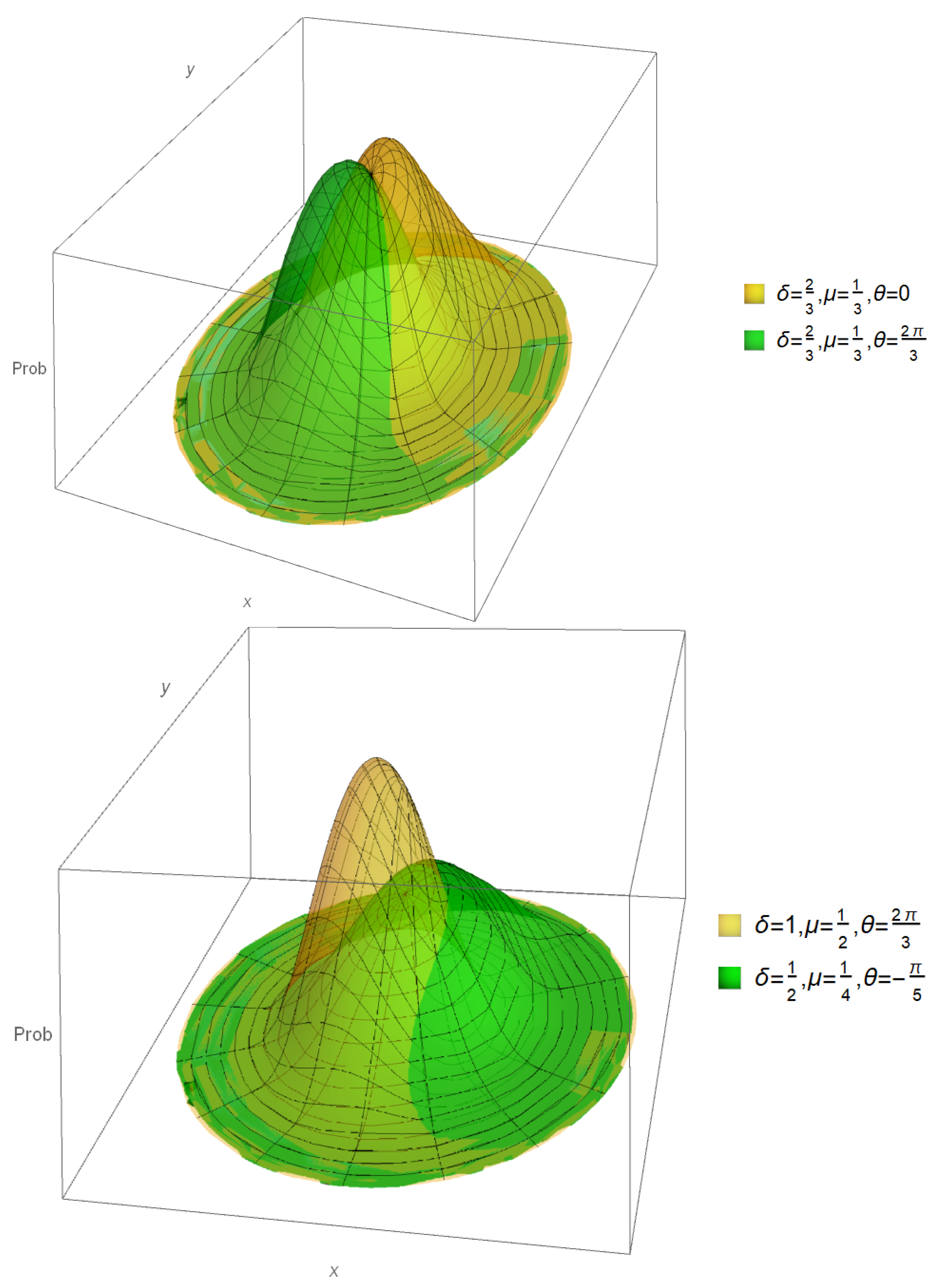
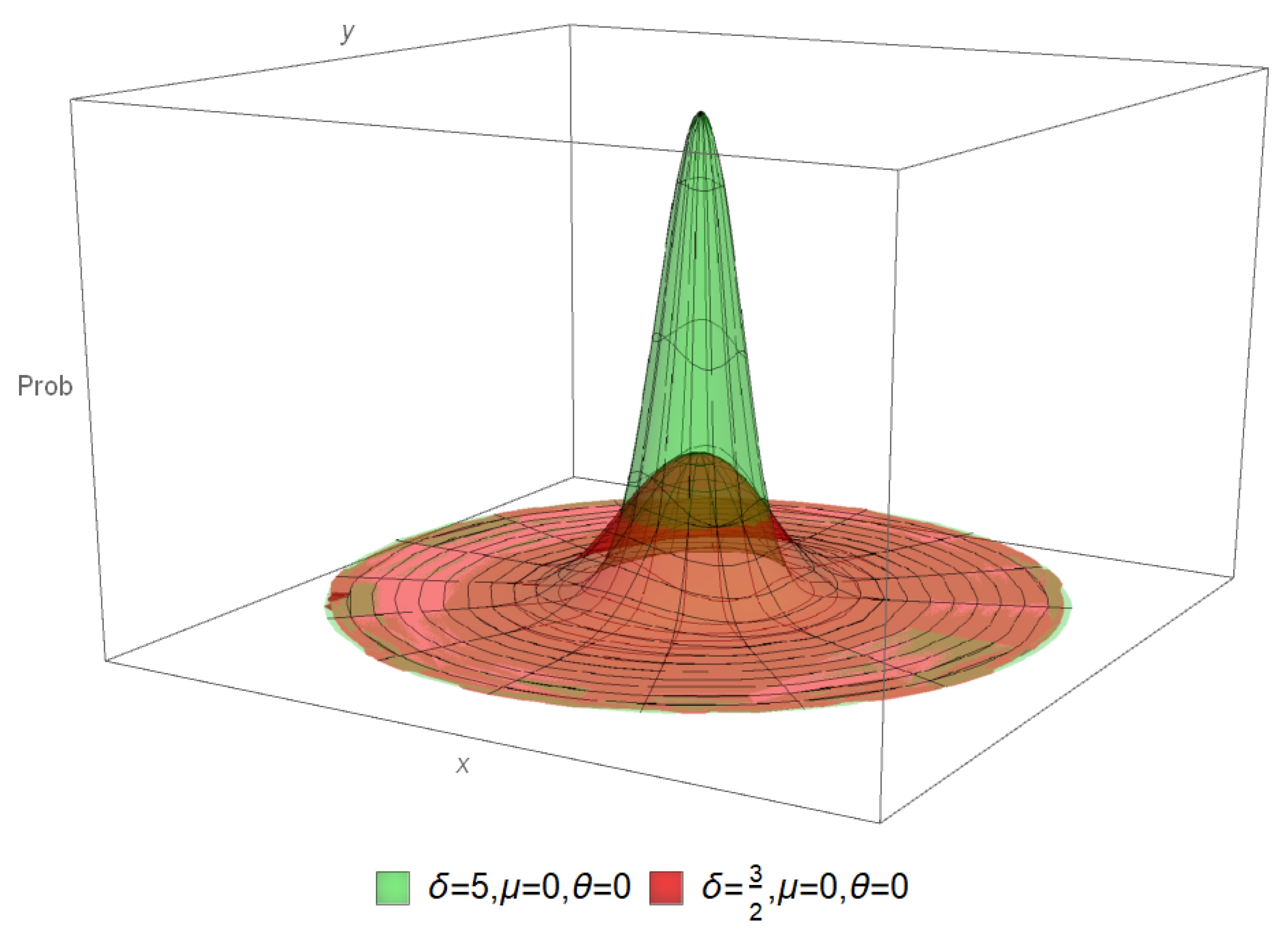
6.2.2. Visualization of the Gibbs Probability Distributions
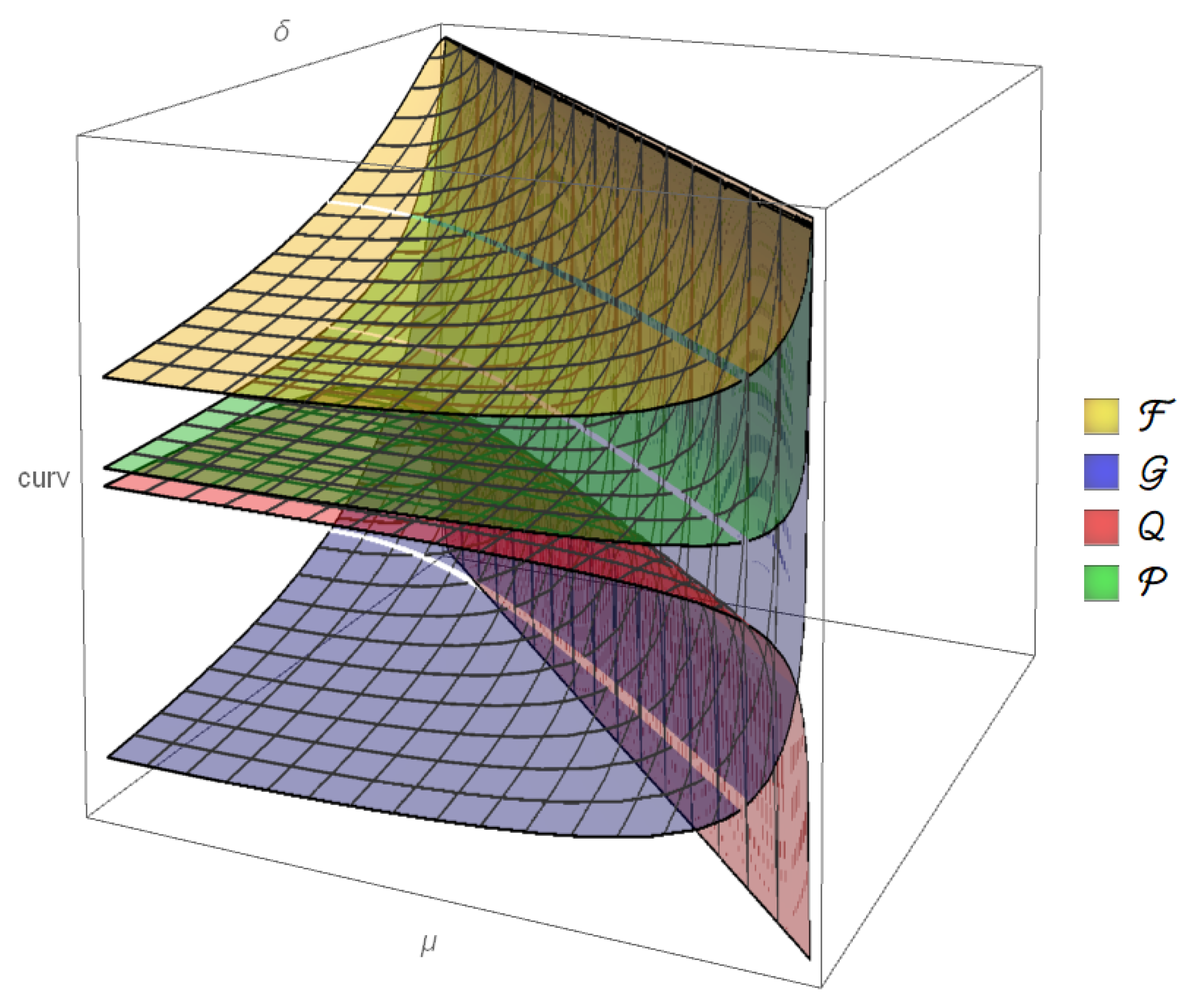
6.2.3. The Kähler Geothermodynamic Metric and Curvature
6.3. Generalized Thermodynamics à la Souriau of the Siegel Half Plane
- 1.
- 2.
- On the other hand we want to emphasize that the and cases are twins inside the entire series since their respective Tits Satake submanifolds are just the first and the second instance of a Siegel upper complex plane, which is the appropriate generalization of the Lobachevsky-Poincaré hypebolic plane. Instead, for values , the Tits Satake submanifold, that, by definition, is always a maximally split symmetric space, is not a further instance of a Siegel upper complex plane. Indeed the appearance of the first two Siegel planes is strictly linked with the low rank sporadic isomorphisms of simple Lie algebras.
6.3.1. The Siegel Upper Plane
6.3.2. The Kähler 2-Form, the Killing Vector Fields, and the Moment Maps
7. On the Partition Function and Gibbs Distributions in General and for in Particular
- The cyclic invariance of the trace.
- The crucial fact that is the center of the compact Lie algebra , which is the very reason why the considered manifold is Kählerian, so that is invariant against any adjoint transformation of group.
- The adjoint H representation in the space of its Lie algebra :
7.1. Canonical Form of the Partition Functions and of the Gibbs Probability Distributions, in General
7.2. Calculation of the Partition Function for the Siegel Plane in Canonical Form
8. Conclusions
- Distinguish between Souriau non-abelian thermodynamics and the geometrical thermodynamics associated with Integrable Dynamical Systems, in particular the Geodesic Dynamical System associated with the calculation of geodesics on the same symmetric spaces that enter the Machine Learning game as hidden layer models.
- Investigate the basic principle of Souriau’s thermodynamics, that is, the characterization of the locus in the relevant Lie algebra, whose elements are possible generalized temperatures in the sense that for them the partition function integral is convergent.
- Clarify the role of the coadjoint orbit conception, Souriau’s favorite one, that turns out to be equivalent to the more practical and algorithmic conception based on coset manifolds.
- (1)
- We have established the identity of Fisher’s Information metric, given as the Hessian of a certain matrix with the metric obtained as the Hessian of the stochastic Hamiltonian , derived in Lychagin’s approach as the canonical Riemannian metric on Lagrangian submanifolds of a symplectic manifold where, by definition, the symplectic 2-form vanishes identically. Such Lagrangian submanifolds are the thermodynamical equilibrium states, and the 1st and 2nd Principle of Thermodynamics are incorporated in their very definition. These notions are fully general and equally apply to any generalized thermodynamics, non-abelian algebra, as it happens in the thermodynamics à la Souriau.
- (2)
- With respect to the Poissonian structures on the dual of solvable Lie algebras utilized also by two of us (P.F. and A.S.) in their 2009 paper [18] on the integrability of the geodesic equations on non-compact symmetric spaces and investigated by Arkhangelsky in [57], where he derived their Hamiltonians in involution, we show here that such a Poissonian structure is only half of the full story, since it is defined only on the momentum subspace of phase space. Introducing also the coordinates, which is what one should always do, there is a complete symplectic manifold with a symplectic 2-form of maximal rank, and what one describes is just the geodesic dynamical system in Hamiltonian formalism. Arkhangelsky Hamiltonians depend only on the momenta, but they are Hamiltonians in involution also with respect to the complete symplectic structure. The geometric thermodynamics associated with such integrable dynamical systems can be constructed, but it is essentially uninteresting for three reasons:
- (a)
- The dependence of the partition function on volume is factorized, and the equation of state resembles the trivial one of Ideal Gases.
- (b)
- The degrees of freedom are few, and a statistical description seems inappropriate.
- (c)
- Last but not least, the Gibbs probability distributions have a non-trivial structure only in momentum space, namely along the fibres of the tangent bundle , not on the very base manifold . All that is of little appeal for Machine Learning applications, where one looks for probability distributions (Gibbs states) on .
- (3)
- The searched for Gaussian-like probability distributions on are instead provided by the construction of Gibbs states à la Souriau. This requires a symplectic structure on the very manifold and not on its tangent bundle. After demonstrating that a coadjoint -orbit of some element is always diffeomorphic and algebraically equivalent to a coset manifold , where is the stabilizer of the element in , we abandon the coadjoint orbit conception, and we focus on non-compact symmetric spaces . In order to have the symplectic structure and construct Souriau thermodynamics, must be the stabilizer of some Lie algebra element, and this, as we show, implies that has a which endows the symmetric space with a Kähler structure, and the Kähler 2-form is the required symplectic 2-form. In this way, we come to the conclusion that the relevant non-compact symmetric spaces are the Kähler ones corresponding only to two infinite series, the Siegel half-planes and the Calabi–Vesentini manifolds mentioned in Equation (201). The first series is composed of maximally split manifolds of increasing non-compact rank, while the second constitutes a Tits Satake universality class having the Siegel manifold as universal Tits Satake submanifold. In application to Machine Learning, if one wants to take advantage of the Paint Group symmetry (see [1]) and its potentiality in data clustering, the Calabi–Vesentini choice is preferred.
- (4)
- The central point of Souriau’s generalized thermodynamics, namely the determination of the subspace of allowed temperature vectors was also solved by us in a simple and elegant way. is just the the adjoint orbit of a positivity chamber in the Cartan subalgebra of the compact subalgebra . One fixes the sign of the ℓ independent temperatures associated with ℓ generators of , and by an adjoint transformation of , generates all the other possible temperature vectors that respect convergence of the partition function integral. This property, apart from solving the convergence issue, is also of practical relevance. Indeed, the true temperatures are just the compact Cartan ones; all the others are an effect of translation of the central point of a Gibbs probability distribution to any other in the manifold by means of an isometry. Hence, we can always utilize the same partition function depending on a very small number of temperatures and change the point in the Gibbs distribution from a given one to its image under any element of the isometry group .
- (5)
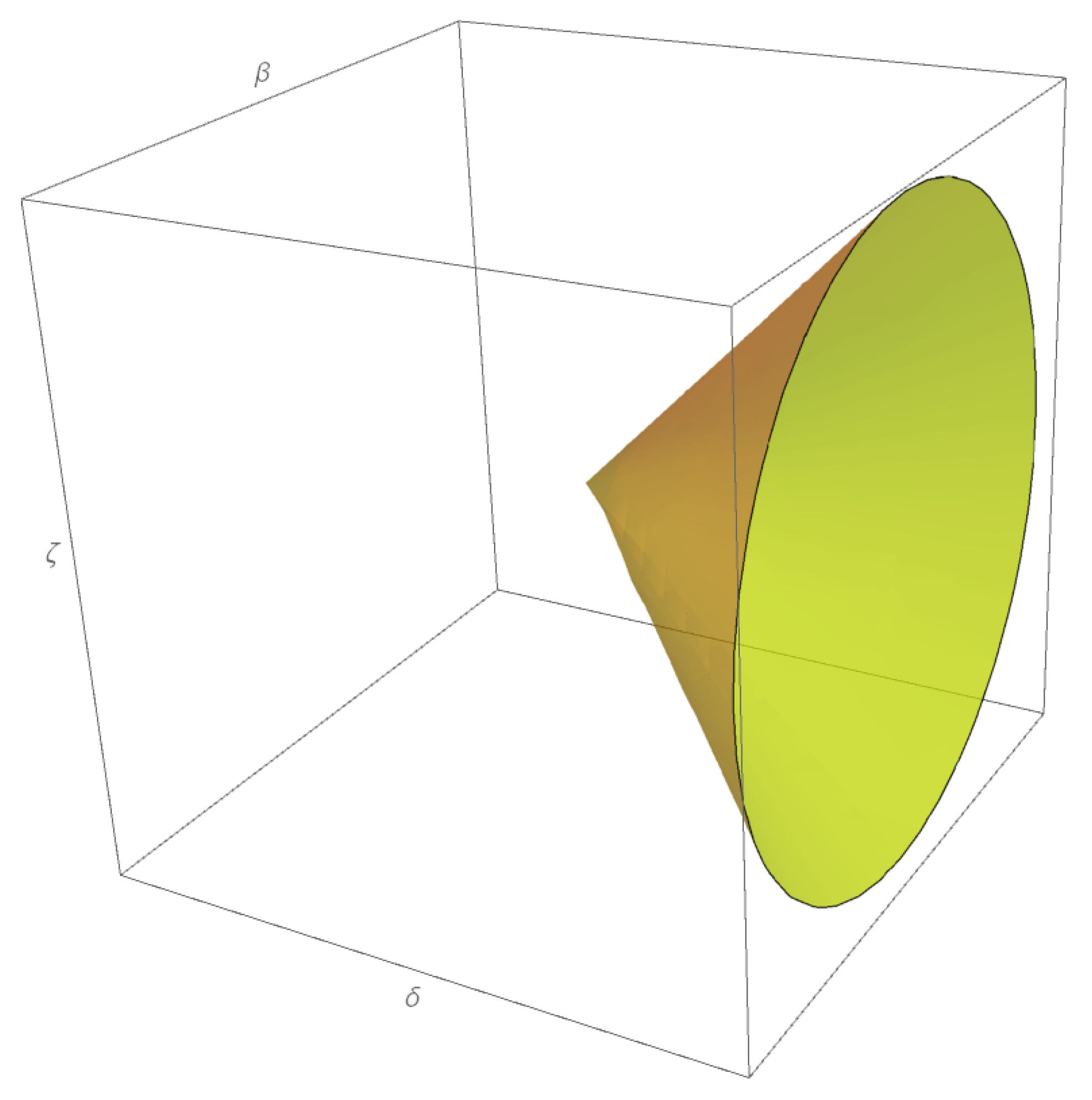
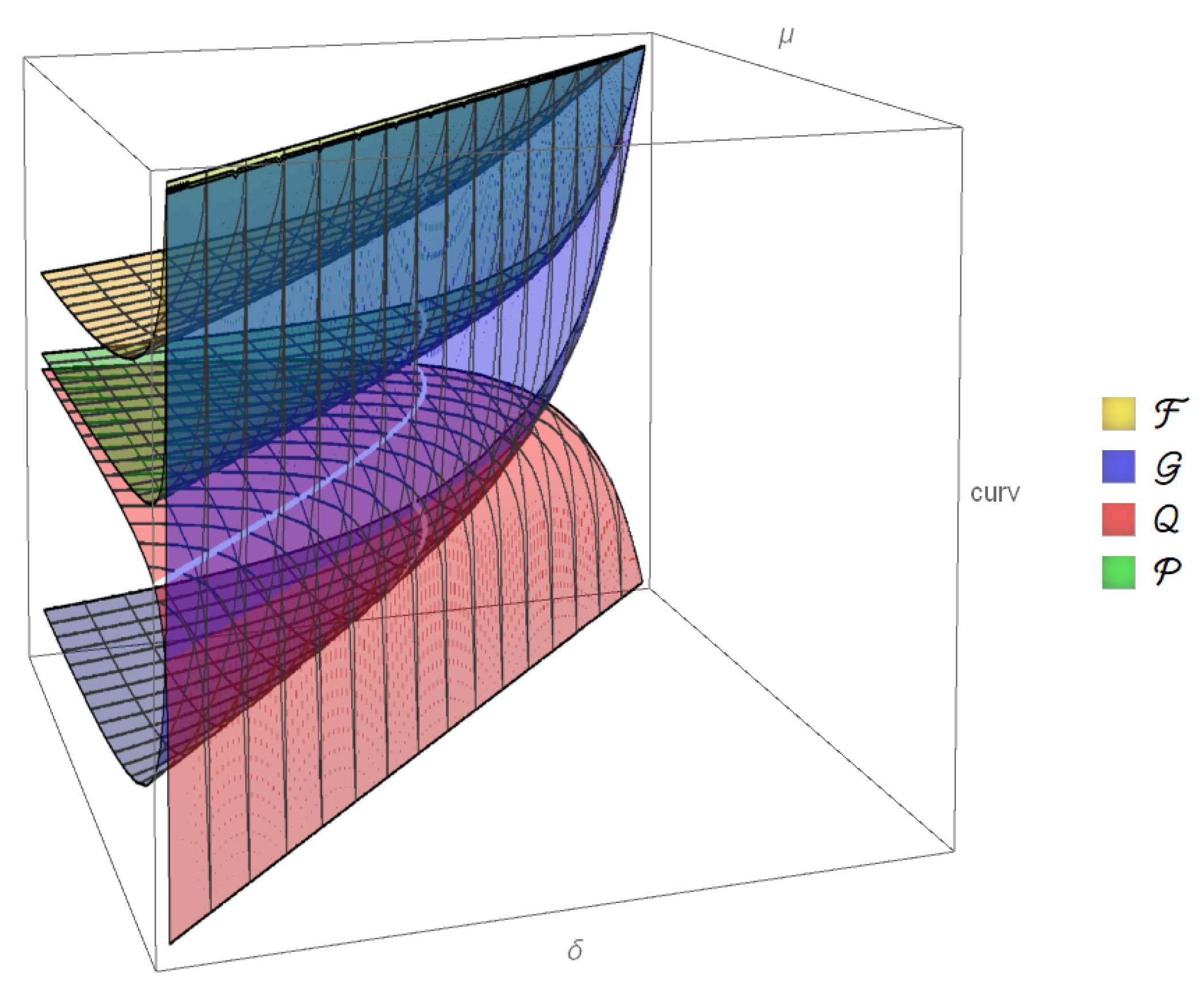
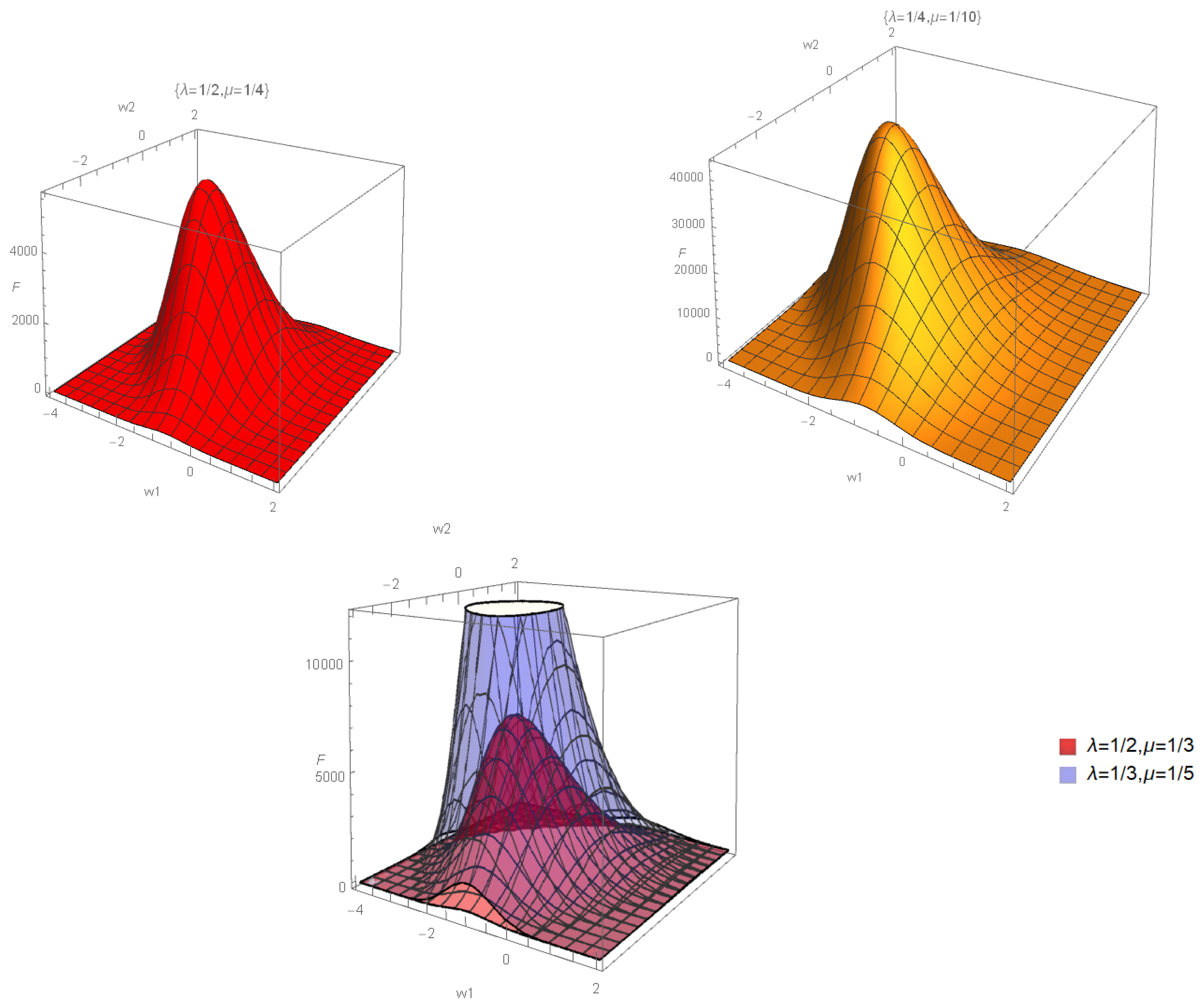
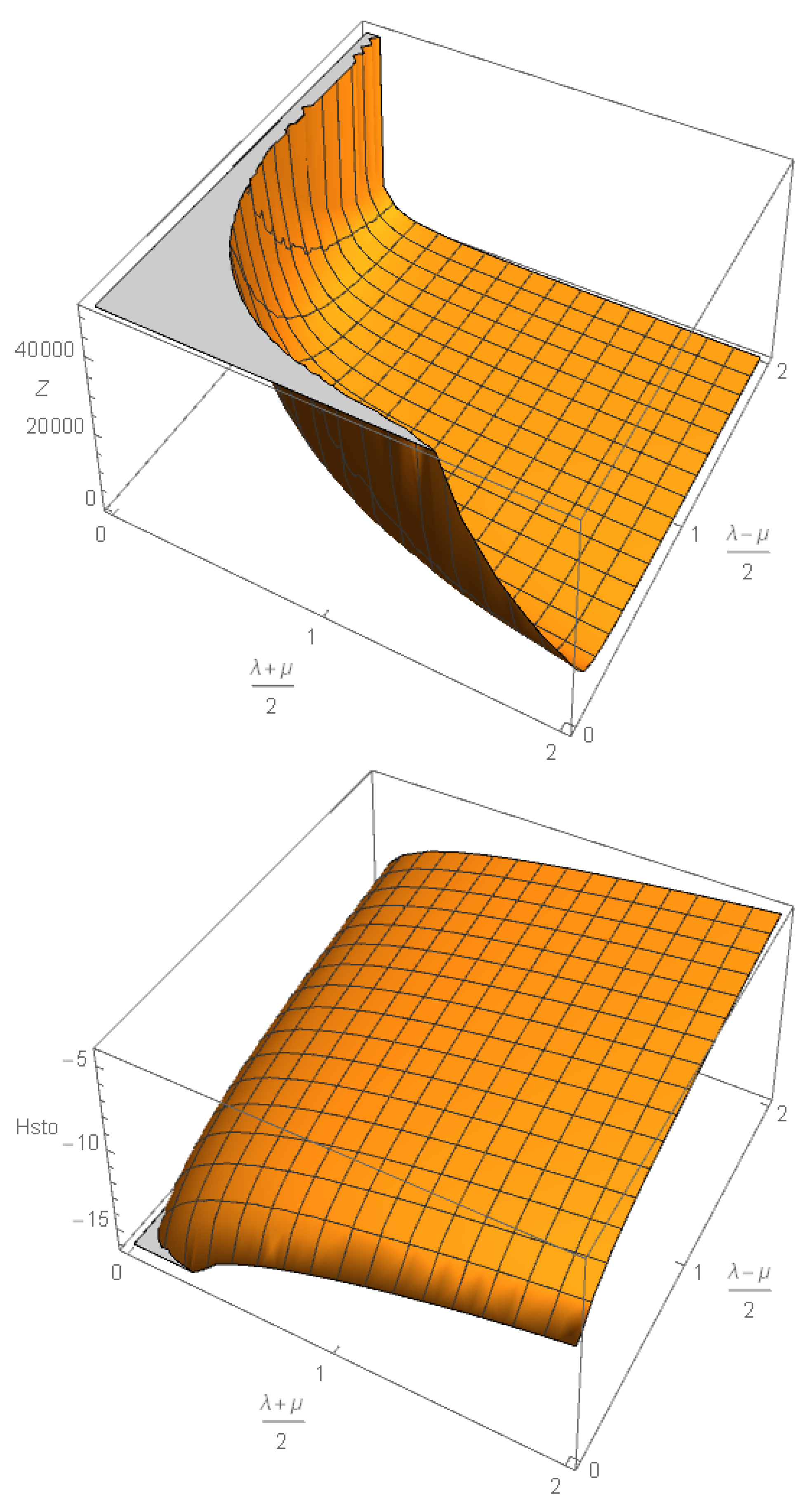
- For the case of the Poincaré plane, we have explicitly constructed the partition function depending on three temperatures and even studied the 3-dimensional thermodynamical Riemannian metric, showing that it is non-trivial and not that of a space. For the case of the Siegel half-plane , we have reduced the partition function to an integral in two variables, whose integrand is a combination of exponentials, roots, and Bessel functions. The integral is convergent, and one can construct a compiled function of which we have shown a plot. The only problem is the computing velocity of the utilized computer.
- What to Do Next
- Final Comment
Author Contributions
Funding
Data Availability Statement
Acknowledgments
Conflicts of Interest
Appendix A. Basic Structures of Contact and Symplectic Geometry
Appendix A.1. Contact Geometry
Appendix A.2. Contact Structures
Appendix A.3. Integrability and Frobenius Theorem
Appendix A.4. Isotropic Submanifolds of a Contact Manifold and Non Integrability
- An example relevant for Thermodynamics
- Big Data spaces
Appendix A.5. The Reeb Vector

Appendix A.6. Darboux Theorem and the Case of Thermodynamics
Appendix A.7. Symplectic and Poisson Manifolds
- (1)
- Antisymmetry ,
- (2)
- Jacobi Identity ,
- (3)
- Leibniz rule ,
Appendix A.8. The Relation Between Contact Manifolds and Symplectic Manifolds
Appendix B. Fundaments of Probability Theory
Appendix B.1. σ-Algebras and Probability Measures
- 1.
- and .
- 2.
- If then its complement also belongs to the same family .
- 3.
- If the elements of a denumerable family of sets belong to then also their union belongs to it:
- and
- for all denumerable unions of disjoint parts, i.e., such that se .
Appendix B.2. Stochastic Functions, Stochastic Vectors and Distributions
- Probability Density
Appendix C. A Summary of Classical Thermodynamics and Statistical Mechanics
Appendix C.1. Thermodynamical Potentials and State Functions
- U = internal energy of a thermodynamical system
- S = entropy
- V = volume occupied by the system under consideration, for instance a mixture of gases or a certain quantity of a liquid or of a solid.
- N = the total number of particles composing the system, ifor instance the number of molecules of a gas that can be measured in various units, among which the most frequently utilized is the number of moles of the chemical compound under investigation. Alternatively when the system is a mixture of more than one component one utilizes:
- = the total number of particles of the i-th component of the mixture, typically measured in number or fractions of moles.
- T = temperature that determines the average energy per particle.
- P = pressure which, as in mechanics, is the force per unit area.
- = chemical potential which is the intensive variable canonically conjugate to the number of particles N.
- = chemical potentials of the various components in the various phases as happens in multicomponent and multiphase mixtures.
Appendix C.2. Thermodynamical Constants
The First and Second Principles of Thermodynamics
- The First Principle
- (1)
- Internal Energy
- (2)
- Helmholtz Free Energy
- (3)
- Entalpy
- (4)
- Gibbs potential
Appendix C.3. The Three Ensembles of Statistical Mechanics
Appendix C.3.1. The Microcanonical Ensemble
Appendix C.3.2. The Canonical Ensemble
Appendix C.3.3. The Grand Canonical Ensemble and the Gibbs Potential
Appendix C.4. Statistical Mechanics of Ideal Gases
- (Pressure)
- (Entropy)
- (Internal Energy)
The Equation of State of Ideal Gases
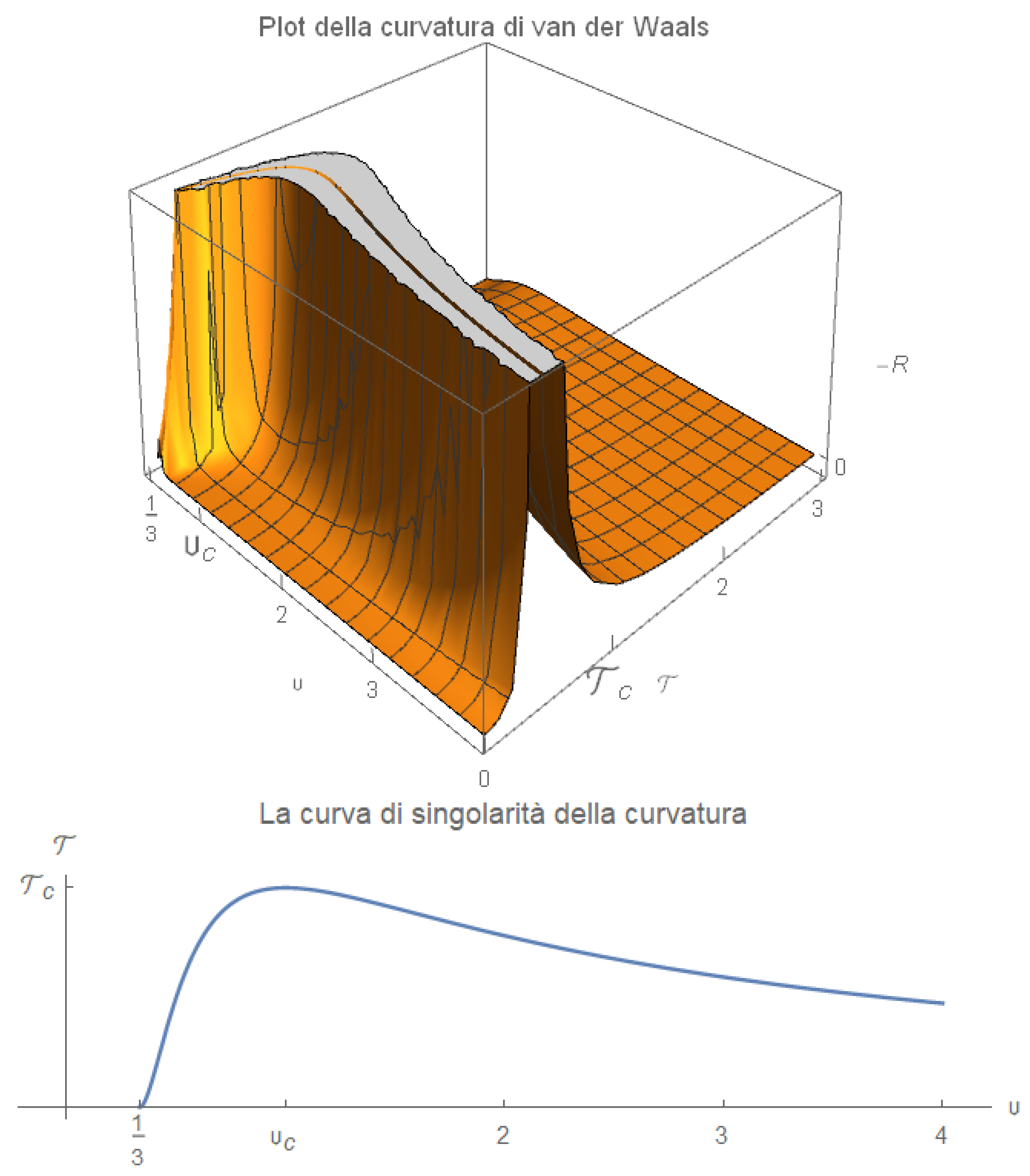
Appendix C.5. The Van Der Waals Model of a Real Gas

Appendix D. The Example of the Kählerian Manifold with Non Trivial Paint Group

Appendix D.1. The Kähler 2-Form
Appendix D.2. The Hamiltonian Vector Fields and Their Moment-Maps
References
- Bruzzo, U.; Fré, P.G.; Trigiante, M. The Paint Group Tits Satake Theory of Hyperbolic Symmetric Spaces: The distance function, paint invariants and discrete subgroups. arXiv 2025, arXiv:2503.07626. [Google Scholar]
- Fré, P.G.; Milanesio, F.; Santoro, M.; Sanguinetti, G. Navigation through Non Compact Symmetric Spaces: A mathematical perspective on Cartan Neural Networks. arXiv 2025, arXiv:2507.16871. [Google Scholar] [CrossRef]
- Fré, P.G.; Milanesio, F.; Santoro, M.; Sanguinetti, G. Cartan Networks: Group theoretical Hyperbolic Deep Learning. arXiv 2025, arXiv:2505.24353v1. [Google Scholar] [CrossRef]
- Fré, P.; Milanesio, M.; Oyarzo, F.; Santoro, M.; Trigiante, M. Tessellation Groups, Harmonic Analysis on Non Compact Symmetric Spaces and the Heat kernel in view of Cartan Convolutional Neural Networks. arXiv 2025, arXiv:2508.16015v1. [Google Scholar] [CrossRef]
- Barbaresco, F. Innovative Tools for Radar Signal Processing based on Cartan’s Geometry of SPD Matrices & Information Geometry. In Proceedings of the 2008 IEEE Radar Conference, Rome, Italy, 26–30 May 2008. [Google Scholar]
- Dongho, C.; Duboskiy, P. Travellling Wave-like solutions of the Navier Stokes and related equations. J. Math. Anal. Appl. 1996, 204, 930–939. [Google Scholar]
- Cartan, E. Sur une classe remarquable d’espaces de Riemann. Bull. Soc. Math. Fr. 1926, 54, 214–264. [Google Scholar] [CrossRef]
- Helgason, S. Differential Geometry and Symmetric Spaces; Academic Press: Cambridge, MA, USA, 1962. [Google Scholar]
- Fré, P.G. Discrete, Finite and Lie Groups; De Gruyter: Berlin, Germany; Boston, MA, USA, 2023. [Google Scholar] [CrossRef]
- Magnea, U. An introduction to symmetric spaces. arXiv 2002, arXiv:0205288. [Google Scholar] [CrossRef]
- Kobayashi, S.; Nomizu, K. Foundations of Differential Geometry; Interscience Publishers: New York, NY, USA, 1963; Volume 1. [Google Scholar]
- Alekseevsky, D. Classification of quaternionic spaces with a transitive solvable group of motions. Math. USSR Izv. 1975, 9, 297–339. [Google Scholar] [CrossRef]
- Cortés, V. Alekseevskian spaces. Diff. Geom. Appl. 1996, 6, 129–168. [Google Scholar] [CrossRef]
- Borel, A.; Tits, J. Groupes Réductifs. Publications Mathématiques de l’IHES 1965, 27, 55–151. [Google Scholar] [CrossRef]
- de Wit, B.; Van Proeyen, A. Special geometry, cubic polynomials and homogeneous quaternionic spaces. Commun. Math. Phys. 1992, 149, 307–334. [Google Scholar] [CrossRef]
- de Wit, B.; Van Proeyen, A. Broken sigma model isometries in very special geometry. Phys. Lett. 1992, B293, 94–99. [Google Scholar] [CrossRef]
- de Wit, B.; Van Proeyen, A. Isometries of special manifolds. arXiv 1995, arXiv:9505097. [Google Scholar]
- Fré, P.; Sorin, A.S. Integrability of supergravity billiards and the generalized Toda lattice equation. Nucl. Phys. 2006, B733, 334–355. [Google Scholar] [CrossRef][Green Version]
- Fré, P.; Sorin, A.S. Supergravity black holes and billiards and the Liouville integrable structure associated with Borel algebras. J. High Energy Phys. 2010, 2010, 66. [Google Scholar] [CrossRef]
- Fré, P.G.; Sorin, A.S. Classification of Arnold-Beltrami flows and their hidden symmetries. Phys. Part. Nucl. 2015, 46, 497–632. [Google Scholar] [CrossRef][Green Version]
- Fré, P.; Trigiante, M. Chaos from symmetry, Navier Stokes equations, Beltrami fields and the universal classifying crystallographic group. J. Geom. Phys. 2022, 191, 104884. [Google Scholar] [CrossRef]
- Ruppeiner, G.; Seftas, A. Thermodynamic Curvature of the Binary van der Waals Fluid. Entropy 2020, 22, 1208. [Google Scholar] [CrossRef]
- Weinhold, F. Metric geometry of thermodynamics. Phys. Today 1976, 29, 23. [Google Scholar] [CrossRef]
- Ruppeiner, G. Thermodynamic curvature measures interactions. Am. J. Phys. 2010, 78, 1170–1180. [Google Scholar] [CrossRef]
- Ruppeiner, G. Thermodynamic curvature from the critical point to the triple point. Phys. Rev. E 2012, 86, 021130. [Google Scholar] [CrossRef] [PubMed]
- Ruppeiner, G.; Sahay, A.; Sarkar, T.; Sengupta, G. Thermodynamic geometry, phase transitions, and the Widom line. Phys. Rev. E 2012, 86, 052103. [Google Scholar] [CrossRef]
- Ruppeiner, G. Thermodynamic curvature: Pure fluids to black holes. J. Phys. Conf. Ser. 2013, 410, 012138. [Google Scholar] [CrossRef]
- Ruppeiner, G.; Mausbach, P.; May, H.-O. Thermodynamic R-diagrams reveal solid-like fluid states. Phys. Lett. A 2015, 379, 646–649. [Google Scholar] [CrossRef]
- Lychagin, V. Contact Geometry, Measurement and Thermodynamics. In Nonlinear PDEs, Their Geometry, and Applications, Proceedings of the Wisla 18 Summer School; Springer Nature: Berlin/Heidelberg, Germany, 2019; pp. 3–54. [Google Scholar] [CrossRef]
- Marle, C.-M. From Tools in Symplectic and Poisson Geometry to Souriau’s Theories of Statistical Mechanics and Thermodynamics. Entropy 2016, 18, 370. [Google Scholar] [CrossRef]
- Barbaresco, F. Geometric Theory of Heat from Souriau Lie Groups Thermodynamics and Koszul Hessian Geometry: Applications in Information Geometry for Exponential Families. Entropy 2016, 18, 386. [Google Scholar] [CrossRef]
- Barbaresco, F. Lie Group Machine Learning and Gibbs Density on Poincaré Unit Disk from Souriau Lie Group Thermodynamics and SU(1,1) Coadjoint Orbits. In Geometric Science of Information; Nielsen, F., Barbaresco, F., Eds.; Springer International Publishing: Cham, Switzerland, 2019; pp. 157–170. [Google Scholar] [CrossRef]
- Barbaresco, F. Gaussian Distributions on the Space of Symmetric Positive Definite Matrices from Souriau’s Gibbs State for Siegel Domains by Coadjoint Orbit and Moment Map. In Geometric Science of Information; Nielsen, F., Barbaresco, F., Eds.; Springer International Publishing: Berlin/Heidelberg, Germany, 2021; pp. 245–255. [Google Scholar] [CrossRef]
- Marle, C.-M. On Gibbs states of mechanical systems with symmetries. arXiv 2021, arXiv:2012.00582. [Google Scholar] [CrossRef]
- Trigiante, M. Gauged supergravities. Phys. Rep. 2017, 680, 1–175. [Google Scholar] [CrossRef]
- Fré, P.G. Advances in Geometry and Lie Algebras from Supergravity; Theoretical and Mathematical Physics Book Series; Springer: Berlin/Heidelberg, Germany, 2018. [Google Scholar] [CrossRef]
- Andrianopoli, L.; Bertolini, M.; Ceresole, A.; D’Auria, R.; Ferrara, S.; Fre, P.; Magri, T. N = 2 supergravity and N = 2 superYang-Mills theory on general scalar manifolds: Symplectic covariance, gaugings and the momentum map. J. Geom. Phys. 1997, 23, 111–189. [Google Scholar] [CrossRef]
- Frè, P.G. Lectures on resolutions à la Kronheimer of orbifold singularities, McKay quivers for Gauge Theories on D3 branes, and the issue of Ricci flat metrics on the resolved three-folds. arXiv 2023, arXiv:2308.14022. [Google Scholar] [CrossRef]
- Dwivedi, S.; Herman, J.; Jeffrey, L.; van den Hurk, T. Hamiltonian Group Actions and Equivariant Cohomology; SpringerBriefs in Mathematics; Springer: Berlin/Heidelberg, Germany, 2010. [Google Scholar]
- Cabanes, Y. Multidimensional Complex Stationary Centered Gaussian Autoregressive Time Series Machine Learning in Poincaré and Siegel Disks: Application for Audio and Radar Clutter Classification. Ph.D. Thesis, Université de Bordeaux, Bordeaux, France, 2022. [Google Scholar]
- Rao, C. Information and Accuracy attainable in the estimation of statistical parameters. Bull. Calcutta Math. Soc. 1945, 37, 81–91. [Google Scholar]
- Chentsov, N. Statistical Decision Rules and Optimal Inferences. Trans. Math. Monog. Amer. Math. Soc. Provid. 1982, 53. [Google Scholar]
- Nielsen, F. An elementary introduction to information geometry. Entropy 2020, 22, 1100. [Google Scholar] [CrossRef]
- Amari, S. Information Geometry and Its Applications. In Applied Mathematical Sciences; Springer: Tokyo, Japan, 2016. [Google Scholar]
- Shannon, C. A Mathematical Theory of Communication. Bell Syst. Tech. J. 1948, 27, 379–423. [Google Scholar] [CrossRef]
- Koralov, L.B.; Sinai, Y.G. Theory of Probability and Random Processes; Springer: Berlin/Heidelberg, Germany, 2007. [Google Scholar]
- Jaynes, E. Information Theory and Statistical Mechanics. Phys. Rev. 1957, 106, 620–630. [Google Scholar] [CrossRef]
- Jaynes, E. Information Theory and Statistical Mechanics ii. Phys. Rev. 1957, 108, 171–190. [Google Scholar] [CrossRef]
- Lychagin, V.; Roop, M. Phase transitions in filtration of real gases. arXiv 2019, arXiv:1903.00276. [Google Scholar] [CrossRef]
- Lychagin, V.; Roop, M. Steady filtration of Peng-Robinson gas in a porous medium. arXiv 2019, arXiv:1904.08387. [Google Scholar] [CrossRef]
- Lychagin, V.; Roop, M. On higher order structures in thermodynamics. Entropy 2020, 22, 1147. [Google Scholar] [CrossRef]
- Kushner, A.; Lychagin, V.; Roop, M. Optimal thermodynamic processes for gases. Entropy 2020, 22, 448. [Google Scholar] [CrossRef]
- Bianchi, M.; Bruzzo, U.; Fré, P.; Martelli, D. Resolution à la Kronheimer of C3/Γ singularities and the Monge-Ampère equation for Ricci-flat Kähler metrics in view of d3-brane solutions of supergravity. Lett. Math. Phys. 2021, 111, 79. [Google Scholar] [CrossRef]
- Bruzzo, U.; Fré, P.; Shahzad, U.; Trigiante, M. D3-brane supergravity solutions from Ricci-flat metrics on canonical bundles of Kähler-einstein surfaces. Lett. Math. Phys. 2023, 113, 64. [Google Scholar] [CrossRef]
- Fré, P.G. Gravity, a Geometrical Course; Springer Science & Business Media: Dordrecht, The Netherlands, 2012; Volumes 1–2. [Google Scholar]
- Alekseevsky, D.V.; Cortes, V.; Devchand, C.; Van Proeyen, A. Polyvector superPoincare algebras. Commun. Math. Phys. 2004, 253, 385–422. [Google Scholar] [CrossRef]
- Arkhangel’skii, A. Completely Integrable Hamiltonian systems on a Group of Triangular Matrices. Math. USSR Sb 1980, 36, 127. [Google Scholar] [CrossRef]
- Fre, P. Lectures on special Kahler geometry and electric–magnetic duality rotations. Nucl. Phys. Proc. Suppl. 1996, 45BC, 59–114. [Google Scholar] [CrossRef]
- Nickel, M.; Kiela, D. Poincaré Embeddings for Learning Hierarchical Representations. In Advances in Neural Information Processing Systems; Guyon, I., Luxburg, U.V., Bengio, S., Wallach, H., Fergus, R., Vishwanathan, S., Garnett, R., Eds.; Curran Associates, Inc.: Red Hook, NY, USA, 2017; Volume 30. [Google Scholar]
- Nickel, M.; Kiela, D. Learning continuous hierarchies in the Lorentz model of hyperbolic geometry. In Proceedings of the 35th International Conference on Machine Learning; Dy, J., Krause, A., Eds.; PMLR: New York, NY, USA, 2018; Volume 80, pp. 3779–3788. [Google Scholar]
- Klimovskaia, A.; Lopez-Paz, D.; Bottou, L.; Nickel, M. Poincaré maps for analyzing complex hierarchies in single-cell data. Nat. Commun. 2020, 11, 2966. [Google Scholar] [CrossRef]
- Bonnasse-Gahot, L.; Nadal, J.P. Category learning in deep neural networks: Information content and geometry of internal representations. Phys. Rev. E 2025, 112, 055315. [Google Scholar] [CrossRef] [PubMed]
- Jones, S.E.; Gilbert, A.D. Dynamo action in the abc flows using symmetries. Geophys. Astrophys. Fluid Dyn. 2014, 108, 83–116. [Google Scholar] [CrossRef][Green Version]
- Etnyre, J.; Ghrist, R. Contact topology and hydrodynamics: Beltrami fields and the seifert conjecture. Nonlinearity 2000, 13, 441–458. [Google Scholar] [CrossRef]
- Ghrist, R. On the contact topology and geometry of ideal fluids. In Handbook of Mathematical Fluid Dynamics; North Holland: Amsterdam, The Netherlands, 2007; Volume 4, pp. 1–37. [Google Scholar]
- Geiges, H. Contact geometry. Handb. Differ. Geom. 2006, 2, 315–382. [Google Scholar]
- Cardona, R.; Miranda, E.; Peralta-Salas, D. Euler flows and singular geometric structures. Philos. Trans. R. Soc. A Math. Phys. Eng. Sci. 2019, 377, 20190034. [Google Scholar] [CrossRef]
- Eva, M.; Oms, C. The geometry and topology of contact structures with singularities. arXiv 2021, arXiv:1806.05638. [Google Scholar]
- Cardona, R.; Miranda, E. On the volume elements of a manifold with transverse zeroes. Regul. Chaotic Dyn. 2019, 24, 187–197. [Google Scholar] [CrossRef]
- Cardona, R.; Miranda, E. Integrable systems and closed one forms. J. Geom. Phys. 2018, 131, 204–209. [Google Scholar] [CrossRef]
- Guillemin, V.; Miranda, E.; Pires, A.R. Symplectic and poisson geometry on b-manifolds. Adv. Math. 2014, 264, 864–896. [Google Scholar] [CrossRef]
- Pollard, J.; Alexander, G.P. Singular contact geometry and beltrami fields in cholesteric liquid crystals. arXiv 2019, arXiv:1911.10159. [Google Scholar] [CrossRef]
- Arnold, V. Metodi Matematici della Meccanica Classica; Editori Riuniti; Edizioni Mir: Roma, Italy, 1979. [Google Scholar]
- Huang, K. Statistical Mechanics; John Wiley & Sons: New York, NY, USA; London, UK; Sydney, Australia, 1963. [Google Scholar]
- Uhlenbeck, G.; Ford George, G. Lectures in Statistical Mechanics; Lectures in Applied Mathematics; American Mathematical Society: Providence, RI, USA, 1963. [Google Scholar]


Disclaimer/Publisher’s Note: The statements, opinions and data contained in all publications are solely those of the individual author(s) and contributor(s) and not of MDPI and/or the editor(s). MDPI and/or the editor(s) disclaim responsibility for any injury to people or property resulting from any ideas, methods, instructions or products referred to in the content. |
© 2026 by the authors. Licensee MDPI, Basel, Switzerland. This article is an open access article distributed under the terms and conditions of the Creative Commons Attribution (CC BY) license.
Share and Cite
Fré, P.G.; Sorin, A.S.; Trigiante, M. Thermodynamics à la Souriau on Kähler Non-Compact Symmetric Spaces for Cartan Neural Networks. Entropy 2026, 28, 365. https://doi.org/10.3390/e28040365
Fré PG, Sorin AS, Trigiante M. Thermodynamics à la Souriau on Kähler Non-Compact Symmetric Spaces for Cartan Neural Networks. Entropy. 2026; 28(4):365. https://doi.org/10.3390/e28040365
Chicago/Turabian StyleFré, Pietro G., Alexander S. Sorin, and Mario Trigiante. 2026. "Thermodynamics à la Souriau on Kähler Non-Compact Symmetric Spaces for Cartan Neural Networks" Entropy 28, no. 4: 365. https://doi.org/10.3390/e28040365
APA StyleFré, P. G., Sorin, A. S., & Trigiante, M. (2026). Thermodynamics à la Souriau on Kähler Non-Compact Symmetric Spaces for Cartan Neural Networks. Entropy, 28(4), 365. https://doi.org/10.3390/e28040365