Disorder-Assisted Adiabaticity in Correlated Many-Particle Systems

Abstract
1. Introduction
2. Model and Methods
2.1. Model
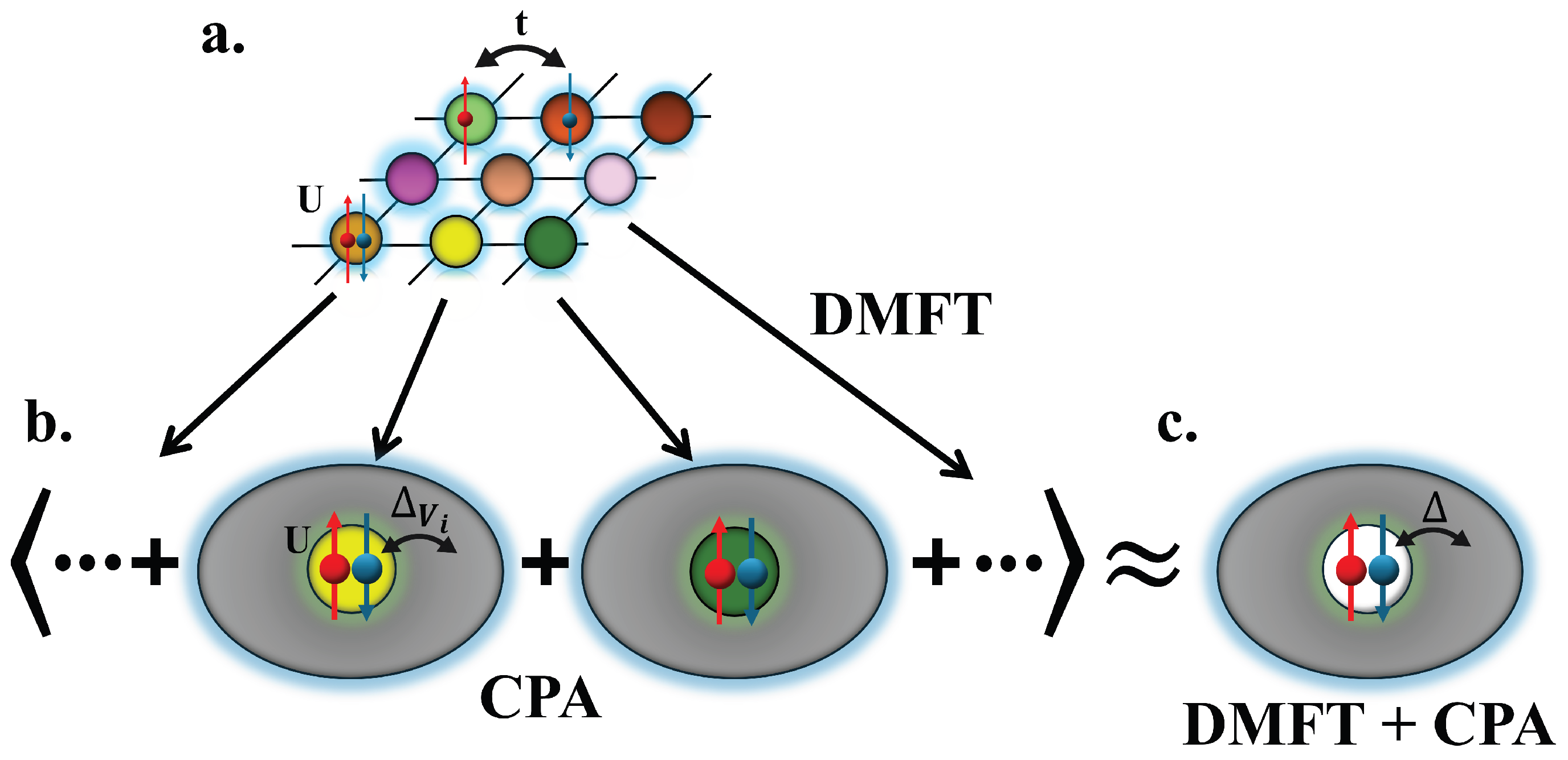
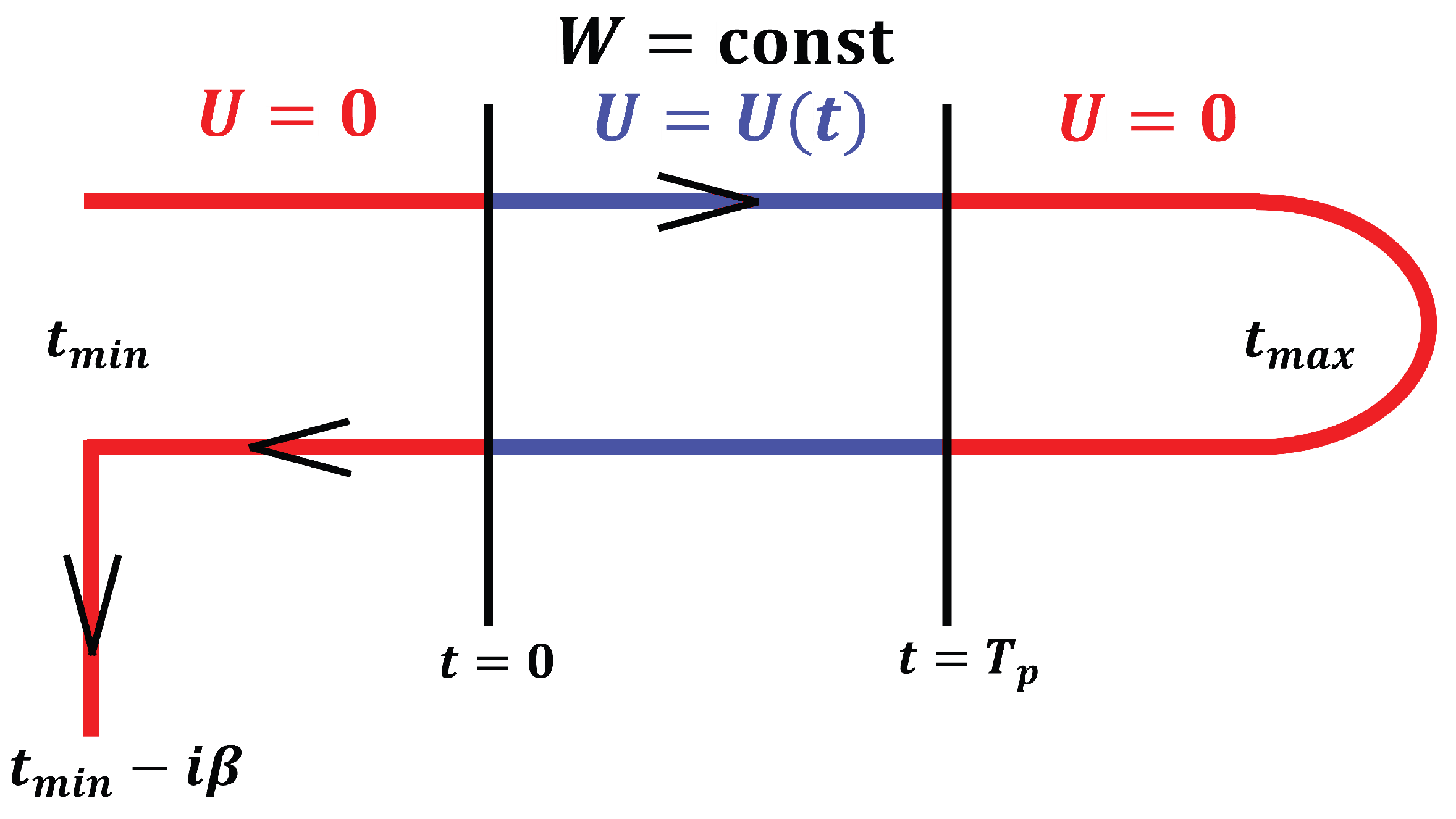
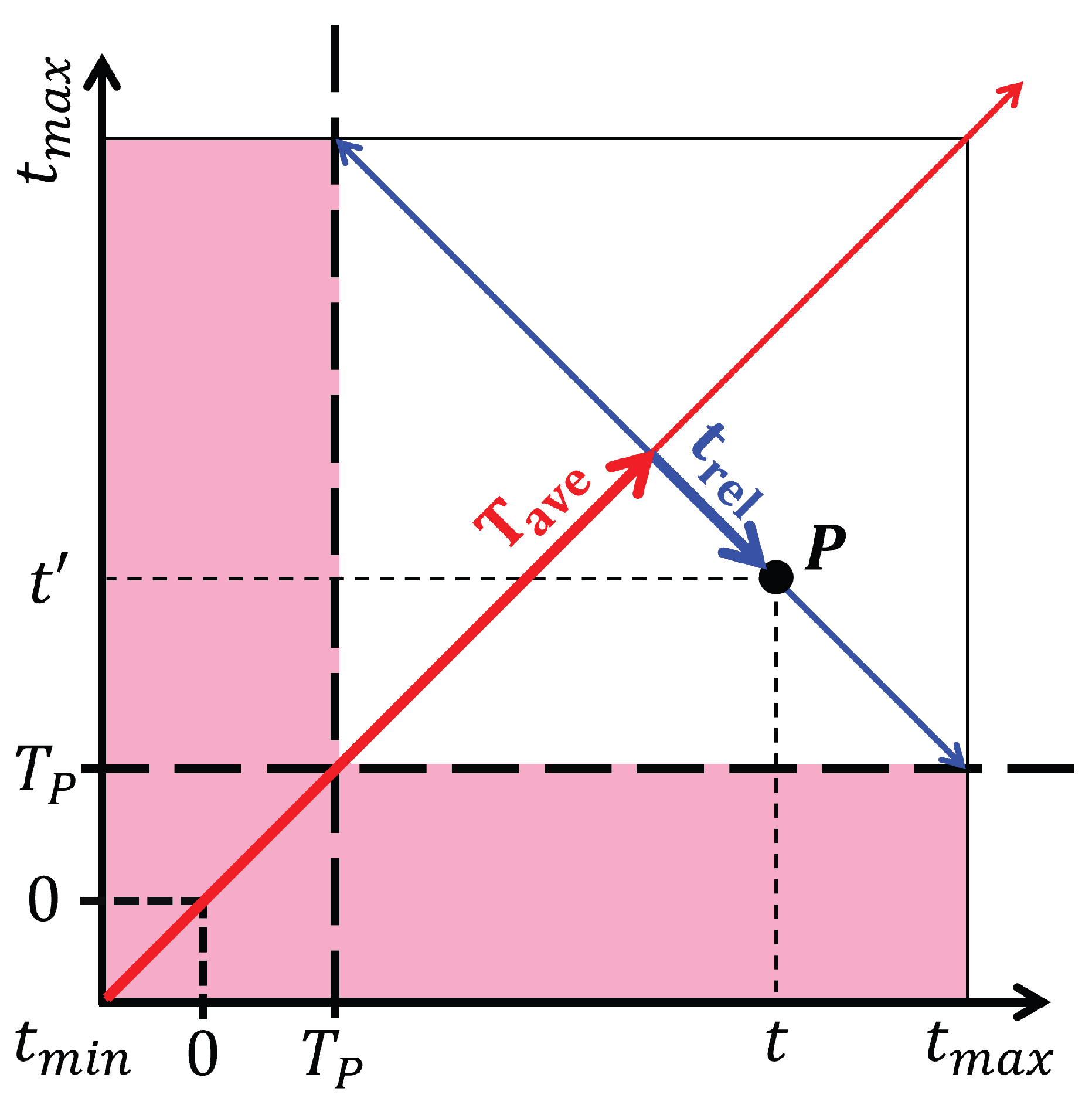
2.2. Nonequilibrium DMFT + CPA
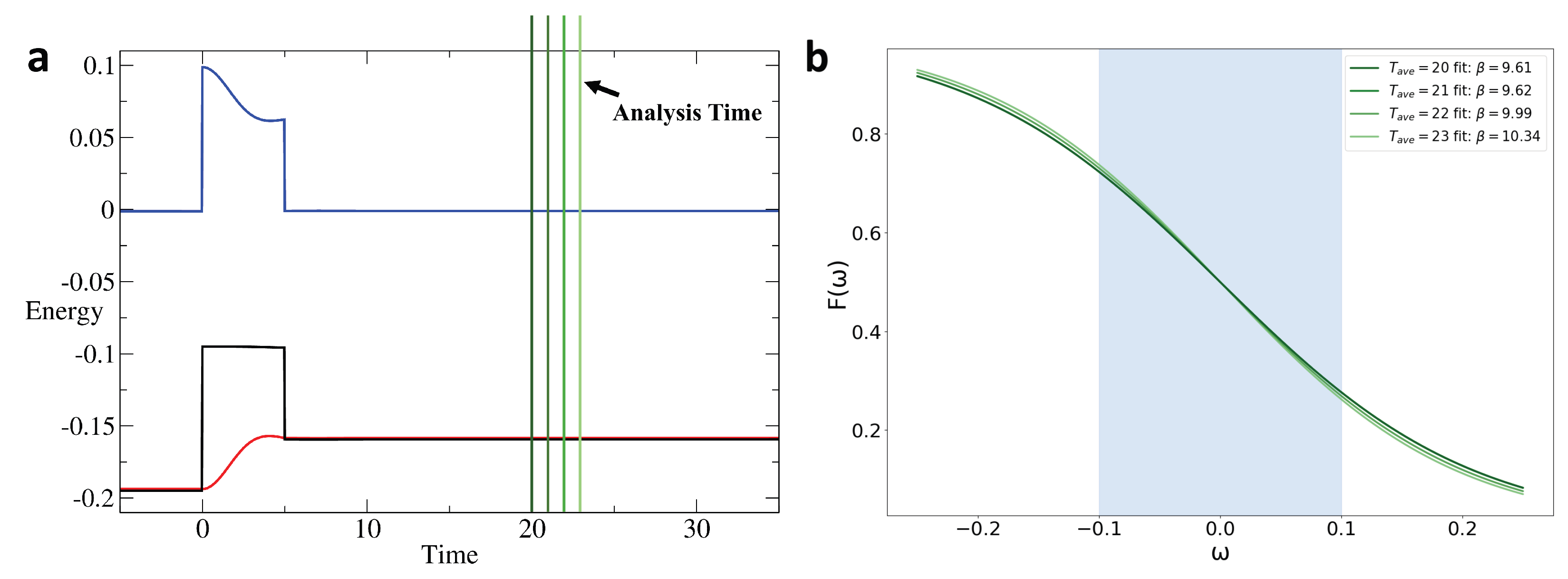
2.3. Effective Temperature
3. Results
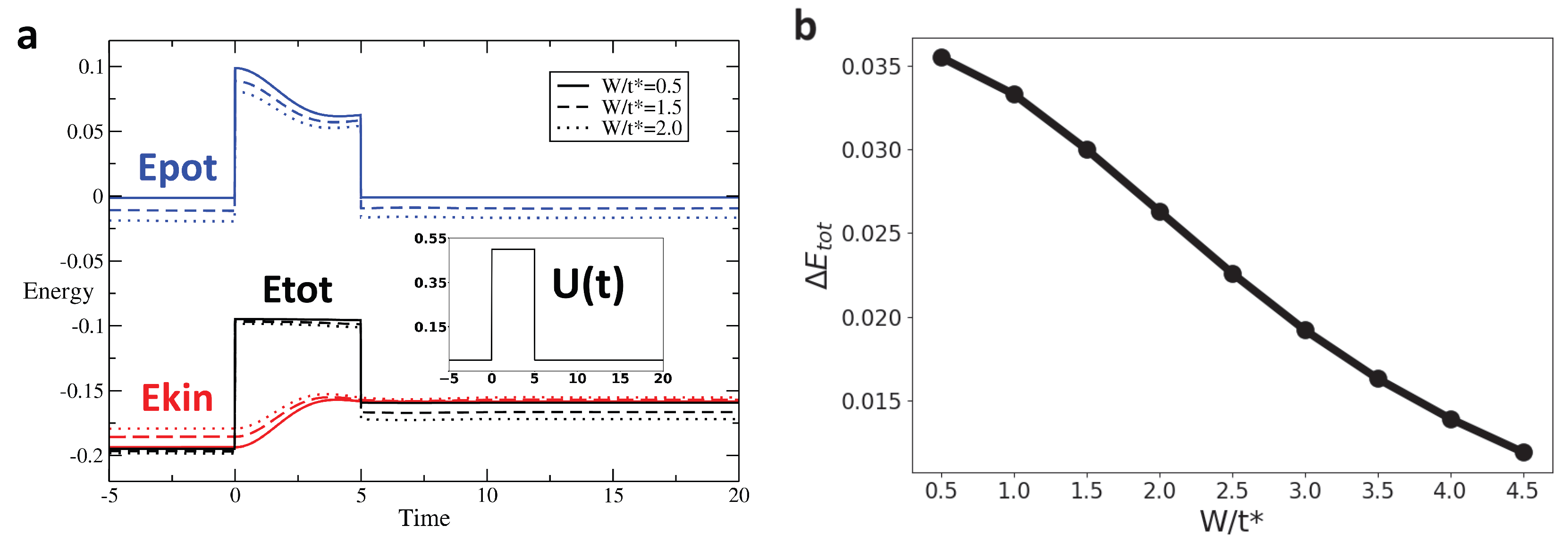
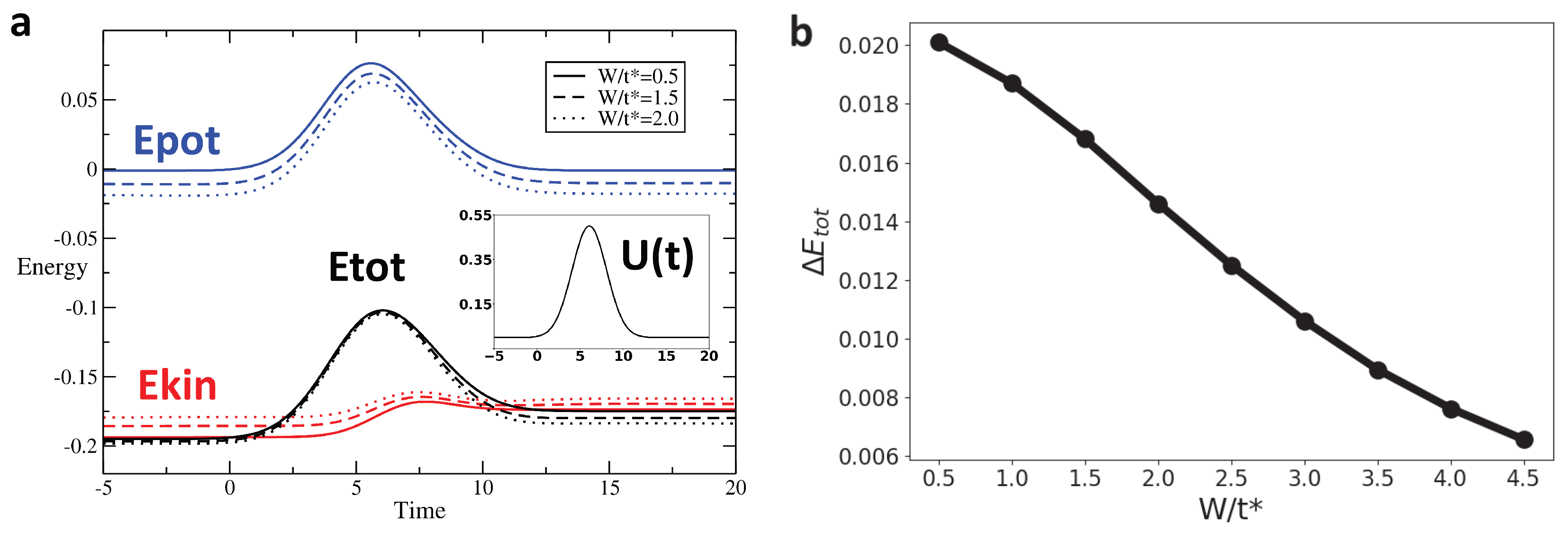
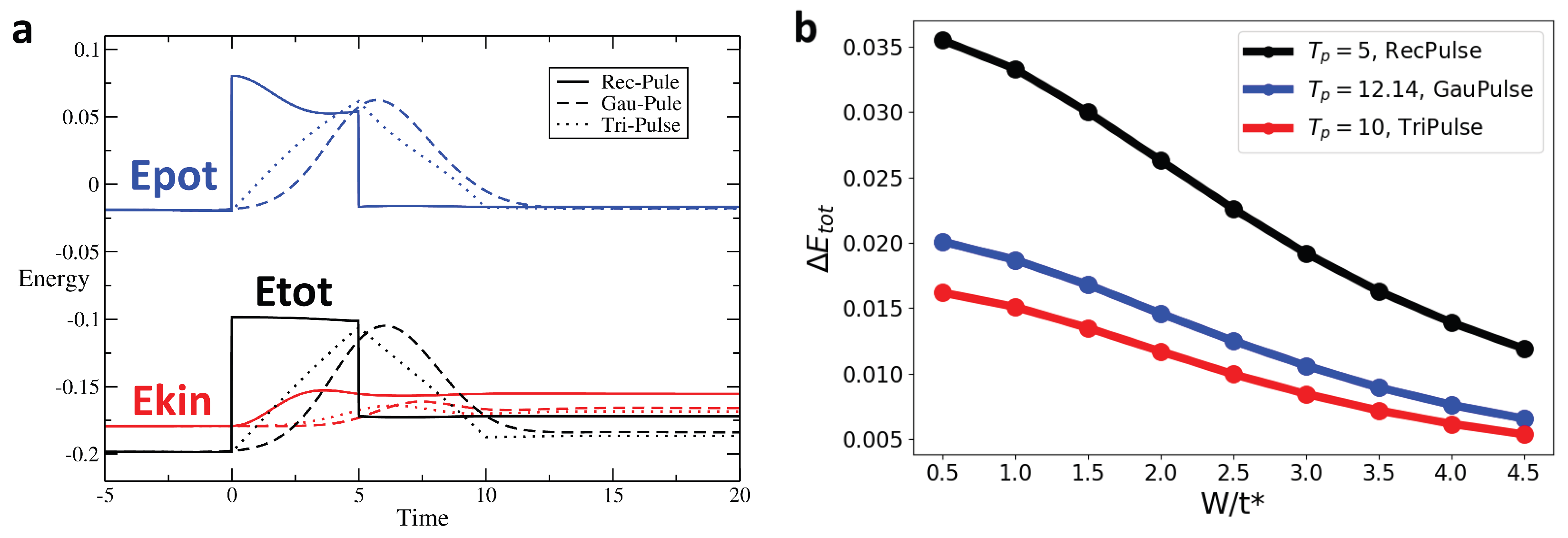
3.1. Change in Energy for Different Interaction Pulse Shapes and Disorder
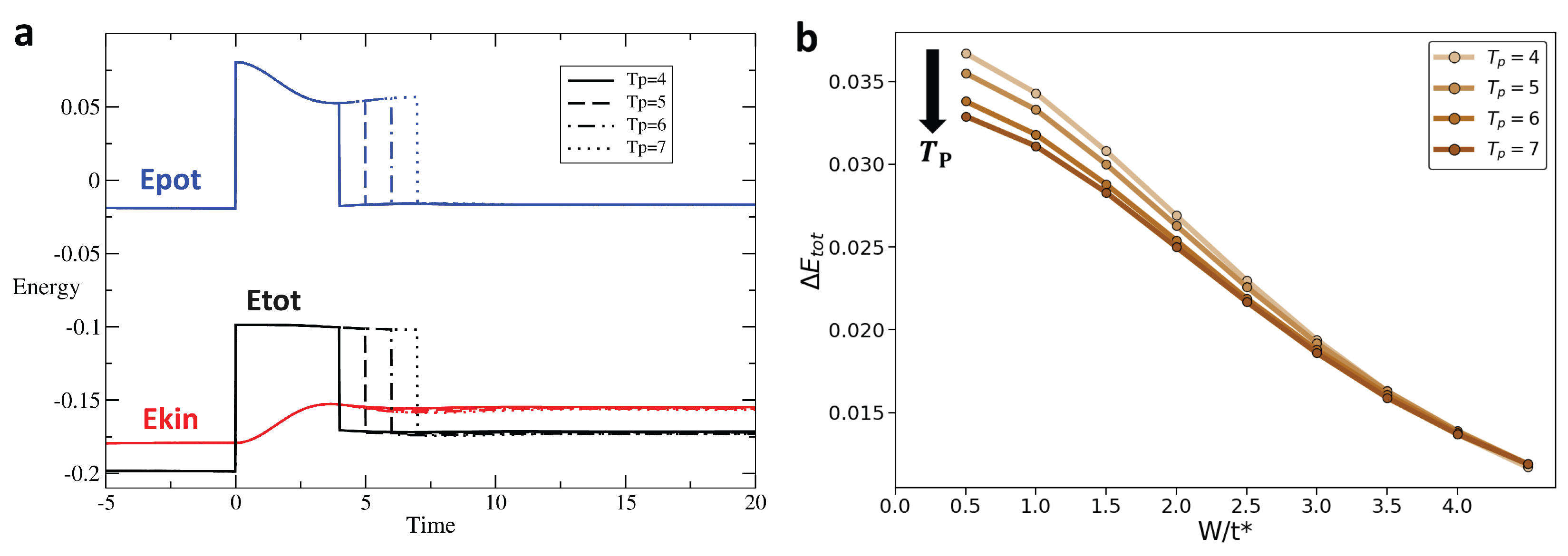
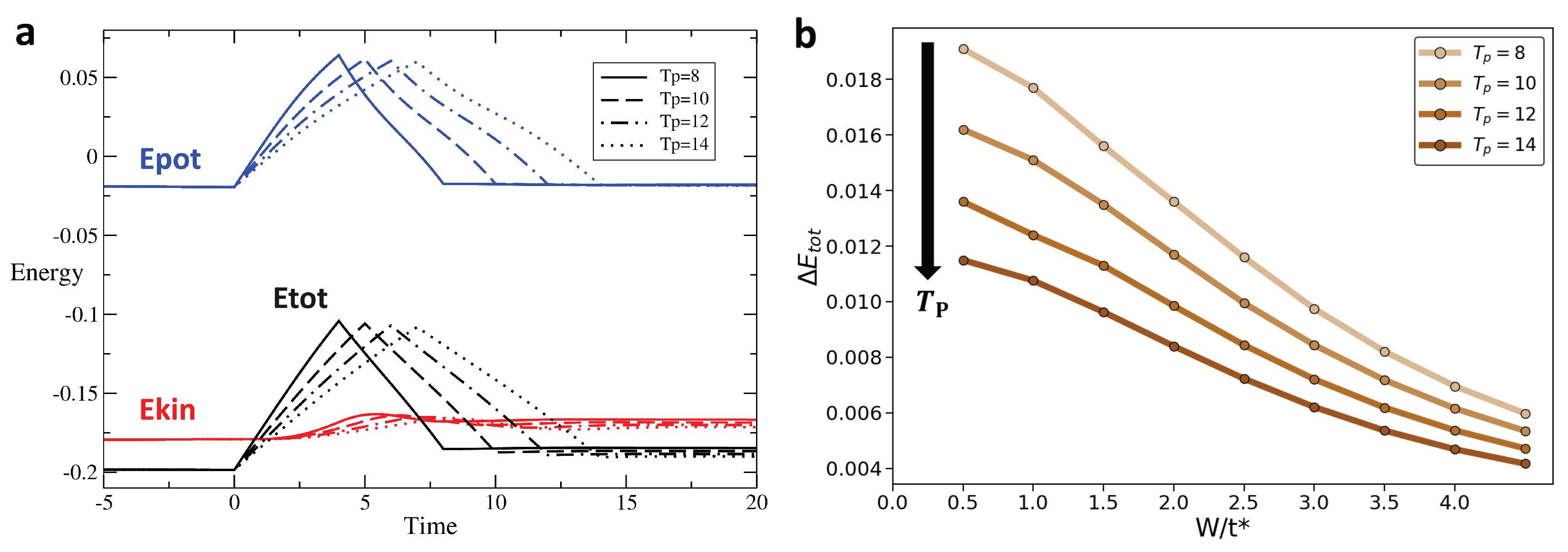
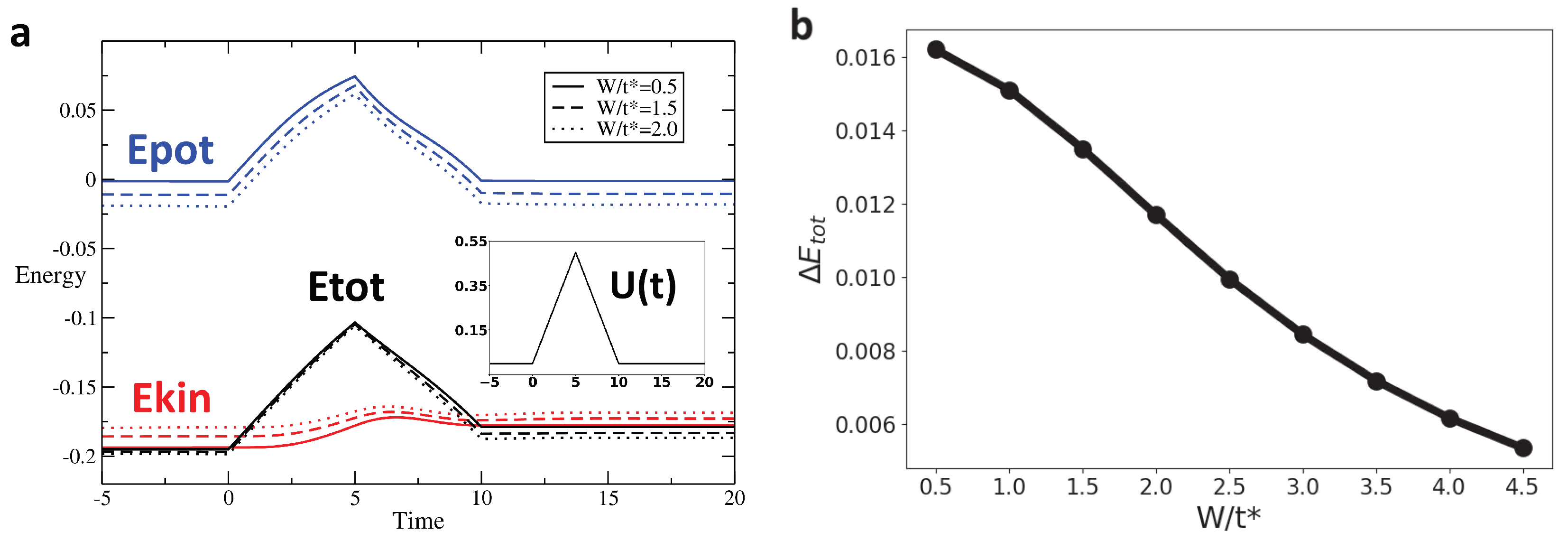
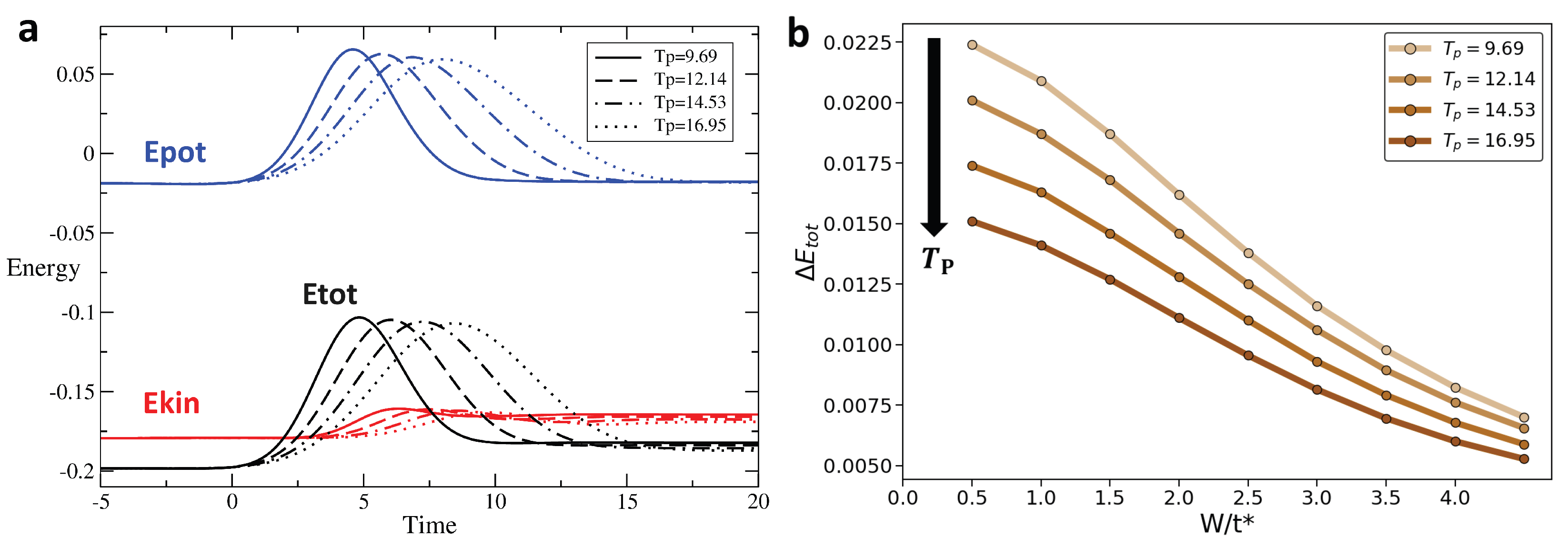
3.2. Change in Energy for Different Pulse Durations and Disorder
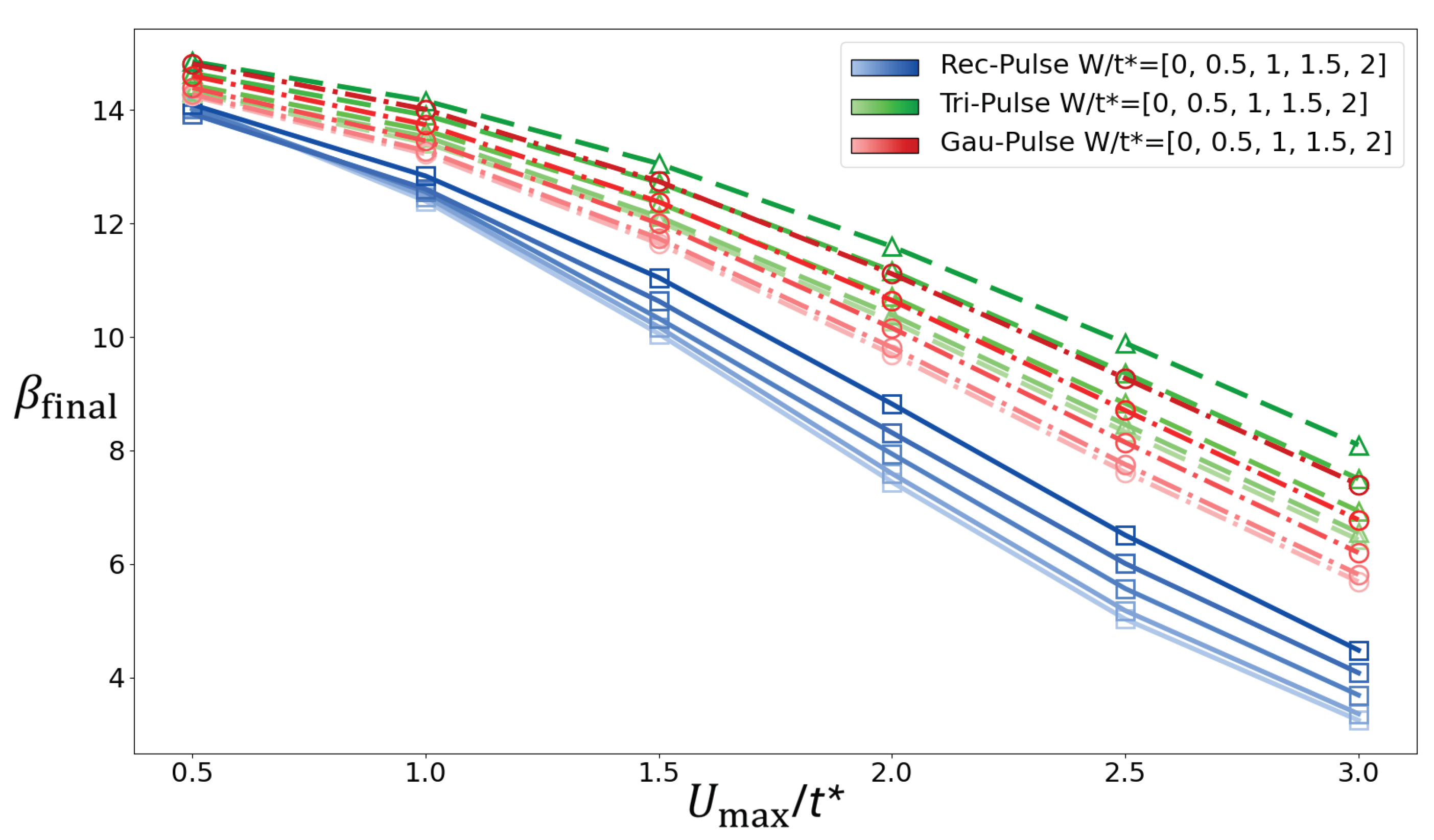
3.3. Effective Final Temperature vs. U for Different Pulse Shape and W
4. Conclusions
Author Contributions
Funding
Data Availability Statement
Acknowledgments
Conflicts of Interest
References
- Guéry-Odelin, D.; Ruschhaupt, A.; Kiely, A.; Torrontegui, E.; Martínez-Garaot, S.; Muga, J.G. Shortcuts to adiabaticity: Concepts, methods, and applications. Rev. Mod. Phys. 2019, 91, 045001. [Google Scholar] [CrossRef] [Scilit]
- Born, M.; Fock, V. Proof of the adiabatic theorem. Z. Phys. 1928, 51, 165–180. [Google Scholar] [CrossRef] [Scilit]
- Herrera, M.; Serra, R.M.; D’Amico, I. Nonequilibrium thermodynamics of quantum systems with local control. Sci. Rep. 2017, 7, 4655. [Google Scholar] [CrossRef] [Scilit]
- Skelt, A.; Zawadzki, K.; D’Amico, I. Quantum speed limits in driven open systems. Phys. Rev. Lett. 2021, 127, 030602. [Google Scholar] [CrossRef] [Scilit]
- Nielsen, M.A.; Chuang, I.L. Quantum Computation and Quantum Information; Cambridge University Press: Cambridge, UK, 2000. [Google Scholar] [CrossRef] [Scilit]
- Farhi, E.; Goldstone, J.; Gutmann, S. Quantum adiabatic evolution algorithms with different paths. arXiv 2002, arXiv:0208135. [Google Scholar] [CrossRef] [Scilit]
- Albash, T.; Lidar, D.A. Adiabatic quantum computation. Rev. Mod. Phys. 2018, 90, 015002. [Google Scholar] [CrossRef] [Scilit]
- Sørensen, A.S.; Altman, E.; Gullans, M.; Porto, J.V.; Lukin, M.D.; Demler, E. Adiabatic preparation of many-body states in optical lattices. Phys. Rev. A 2010, 81, 061603(R). [Google Scholar] [CrossRef] [Scilit]
- Bloch, I.; Dalibard, J.; Zwerger, W. Many-body physics with ultracold gases. Rev. Mod. Phys. 2008, 80, 885. [Google Scholar] [CrossRef] [Scilit]
- García-Ripoll, J.J.; Martin-Delgado, M.A.; Cirac, J.I. Implementation of spin Hamiltonians in optical lattices. Phys. Rev. Lett. 2004, 93, 250405. [Google Scholar] [CrossRef] [Scilit] [PubMed]
- Saberi, H.; Opatrný, T.; Mølmer, K.; del Campo, A. Adiabatic tracking of quantum many-body dynamics. Phys. Rev. A 2014, 90, 060301(R). [Google Scholar] [CrossRef] [Scilit]
- Dupays, L.; del Campo, A.; Dóra, B. Slow approach to adiabaticity in many-body non-Hermitian systems: The Hatano–Nelson model. Phys. Rev. B 2025, 111, 045130. [Google Scholar] [CrossRef] [Scilit]
- Gell-Mann, M.; Low, F. Bound states in quantum field theory. Phys. Rev. 1951, 84, 350–354. [Google Scholar] [CrossRef] [Scilit]
- Avron, J.E.; Elgart, A. Adiabatic theorem without a gap condition. Commun. Math. Phys. 1999, 203, 445–463. [Google Scholar] [CrossRef] [Scilit]
- Marzlin, K.-P.; Sanders, B.C. Inconsistency in the application of the adiabatic theorem. Phys. Rev. Lett. 2004, 93, 160408. [Google Scholar] [CrossRef] [Scilit]
- Tong, D.M.; Singh, K.; Kwek, L.C.; Oh, C.H. Quantitative conditions do not guarantee the validity of the adiabatic approximation. Phys. Rev. Lett. 2005, 95, 110407. [Google Scholar] [CrossRef] [Scilit]
- Ortigoso, J. Note on the adiabatic approximation. Phys. Rev. A 2012, 86, 032121. [Google Scholar] [CrossRef] [Scilit]
- Born, M.; Oppenheimer, R. Zur Quantentheorie der Molekeln. Ann. Phys. 1927, 389, 457–484. [Google Scholar] [CrossRef] [Scilit]
- Abuelmaged, A.; Dohner, E.; Liou, S.-J.; Fotso, H.F. Nonequilibrium dynamics of a disordered binary alloy. Phys. Rev. B 2025, 112, 134308. [Google Scholar] [CrossRef] [Scilit]
- Dohner, E.; Terletska, H.; Fotso, H.F. Thermalization of a disordered interacting system under an interaction quench. Phys. Rev. B 2023, 108, 144202. [Google Scholar] [CrossRef] [Scilit]
- Rangi, C.; Fotso, H.F.; Terletska, H.; Moreno, J.; Tam, K.-M. Disorder-enhanced thermalization in interacting many-particle systems. Phys. Rev. B 2025, 111, L161122. [Google Scholar] [CrossRef] [Scilit]
- Dohner, E.; Terletska, H.; Tam, K.-M.; Moreno, J.; Fotso, H.F. Nonequilibrium DMFT + CPA for correlated disordered systems. Phys. Rev. B 2022, 106, 195156. [Google Scholar] [CrossRef] [Scilit]
- Freericks, J.K.; Turkowski, V.M.; Zlatić, V. Nonequilibrium dynamical mean-field theory. Phys. Rev. Lett. 2006, 97, 266408. [Google Scholar] [CrossRef] [Scilit]
- Freericks, J.K. Nonequilibrium dynamical mean-field theory. Phys. Rev. B 2008, 77, 075109. [Google Scholar] [CrossRef] [Scilit]
- Aoki, H.; Tsuji, N.; Eckstein, M.; Kollar, M.; Oka, T.; Werner, P. Nonequilibrium dynamical mean-field theory and its applications. Rev. Mod. Phys. 2014, 86, 779–837. [Google Scholar] [CrossRef] [Scilit]
- Freericks, J.K.; Joura, A.V. Nonequilibrium dynamical mean-field theory. In Electron Transport in Nanosystems; NATO Science for Peace and Security Series B: Physics and Biophysics; Bonča, J., Kruchinin, S., Eds.; Springer: Dordrecht, The Netherlands, 2008; pp. 219–236. [Google Scholar] [CrossRef] [Scilit]
- Joura, A.V.; Freericks, J.K.; Pruschke, T. Correlated electron transport through mesoscopic structures. Phys. Rev. Lett. 2008, 101, 196401. [Google Scholar] [CrossRef] [Scilit] [PubMed]
- Tsuji, N.; Oka, T.; Aoki, H. Nonequilibrium steady state of photoexcited correlated electrons in the presence of dissipation. Phys. Rev. B 2008, 78, 235124. [Google Scholar] [CrossRef] [Scilit]
- Fotso, H.F.; Freericks, J.K. Nonequilibrium dynamical mean-field theory for strongly correlated materials. Front. Phys. 2020, 8, 324. [Google Scholar] [CrossRef] [Scilit]
- Fotso, H.F.; Mikelsons, K.; Freericks, J.K. Nonequilibrium dynamics of strongly correlated electrons under a uniform electric field. Sci. Rep. 2014, 4, 4699. [Google Scholar] [CrossRef] [Scilit] [PubMed]
- Zhu, Y.; Liu, L.; Guo, H. Quantum transport theory with nonequilibrium coherent potentials. Phys. Rev. B 2013, 88, 205415. [Google Scholar] [CrossRef] [Scilit]
- Kalitsov, A.V.; Chshiev, M.G.; Velev, J.P. Nonequilibrium coherent potential approximation for electron transport. Phys. Rev. B 2012, 85, 235111. [Google Scholar] [CrossRef] [Scilit]
- Soven, P. Coherent-potential model of substitutional disordered alloys. Phys. Rev. 1967, 156, 809–813. [Google Scholar] [CrossRef] [Scilit]
- Kirkpatrick, S.; Velický, B.; Ehrenreich, H. Paramagnetic Ni–Cu alloys: Electronic density of states in the coherent-potential approximation. Phys. Rev. B 1970, 1, 3250–3256. [Google Scholar] [CrossRef] [Scilit]
- Velický, B. Theory of electronic transport in disordered binary alloys: Coherent-potential approximation. Phys. Rev. 1969, 184, 614–627. [Google Scholar] [CrossRef] [Scilit]
- Yonezawa, F.; Morigaki, K. Coherent potential approximation: Basic concepts and applications. Prog. Theor. Phys. Suppl. 1973, 53, 1–76. [Google Scholar] [CrossRef] [Scilit]
- Keldysh, L.V. Diagram technique for nonequilibrium processes. Zh. Eksp. Teor. Fiz. 1964, 47, 1515–1527, Sov. Phys. JETP 1965, 20, 1018–1026.. [Google Scholar]
- Stefanucci, G.; van Leeuwen, R. Nonequilibrium Many-Body Theory of Quantum Systems: A Modern Introduction; Cambridge University Press: Cambridge, UK, 2013. [Google Scholar] [CrossRef] [Scilit]
- Rammer, J. Quantum Field Theory of Nonequilibrium States; Cambridge University Press: Cambridge, UK, 2007. [Google Scholar] [CrossRef] [Scilit]
- Kadanoff, L.P.; Baym, G. Quantum Statistical Mechanics; Benjamin: New York, NY, USA, 1962. [Google Scholar] [CrossRef] [Scilit]
- Stefanucci, G.; van Leeuwen, R. Nonequilibrium Many-Body Theory of Quantum Systems: A Modern Introduction, 2nd ed.; Cambridge University Press: Cambridge, UK, 2025. [Google Scholar] [CrossRef] [Scilit]
- Kamenev, A. Field Theory of Non-Equilibrium Systems; Cambridge University Press: Cambridge, UK, 2011. [Google Scholar] [CrossRef] [Scilit]
- Eckstein, M.; Kollar, M.; Werner, P. Interaction quench in the Hubbard model: Relaxation of the spectral function and the optical conductivity. Phys. Rev. B 2010, 81, 115131. [Google Scholar] [CrossRef] [Scilit]







Disclaimer/Publisher’s Note: The statements, opinions and data contained in all publications are solely those of the individual author(s) and contributor(s) and not of MDPI and/or the editor(s). MDPI and/or the editor(s) disclaim responsibility for any injury to people or property resulting from any ideas, methods, instructions or products referred to in the content. |
© 2026 by the authors. Licensee MDPI, Basel, Switzerland. This article is an open access article distributed under the terms and conditions of the Creative Commons Attribution (CC BY) license.
Share and Cite
Liou, S.-J.; Fotso, H.F. Disorder-Assisted Adiabaticity in Correlated Many-Particle Systems. Entropy 2026, 28, 327. https://doi.org/10.3390/e28030327
Liou S-J, Fotso HF. Disorder-Assisted Adiabaticity in Correlated Many-Particle Systems. Entropy. 2026; 28(3):327. https://doi.org/10.3390/e28030327
Chicago/Turabian StyleLiou, Shang-Jie, and Herbert F. Fotso. 2026. "Disorder-Assisted Adiabaticity in Correlated Many-Particle Systems" Entropy 28, no. 3: 327. https://doi.org/10.3390/e28030327
APA StyleLiou, S.-J., & Fotso, H. F. (2026). Disorder-Assisted Adiabaticity in Correlated Many-Particle Systems. Entropy, 28(3), 327. https://doi.org/10.3390/e28030327