DELP-Net: A Differentiable Entropy Layer Pyramid Network for End-to-End Low-Rate DoS Detection


Abstract
1. Introduction
- 1.
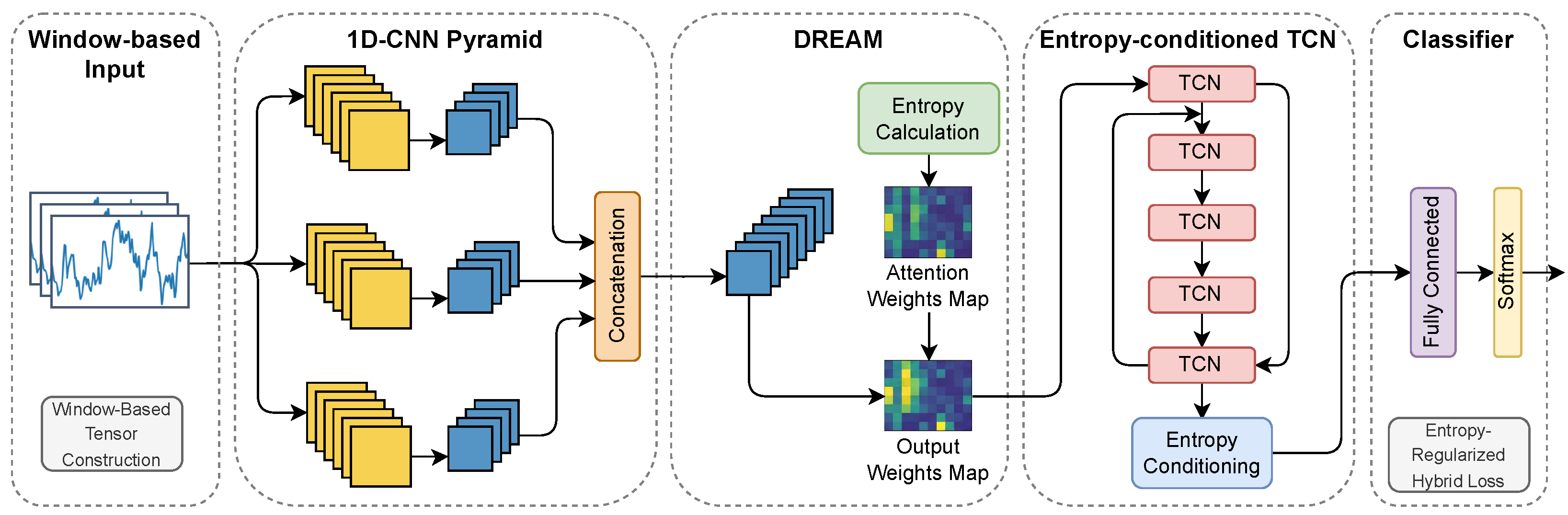
- We propose DELP-Net, an end-to-end differentiable entropy pyramid network for low-rate Denial-of-Service (LDoS) detection. The proposed approach operates directly on raw traffic streams segmented into time windows and upgrades information entropy from an external statistical descriptor to an intrinsic, learnable operator within the network, establishing a unified information-theoretic deep learning framework for detecting low-rate and weak-signal attacks.
- 2.
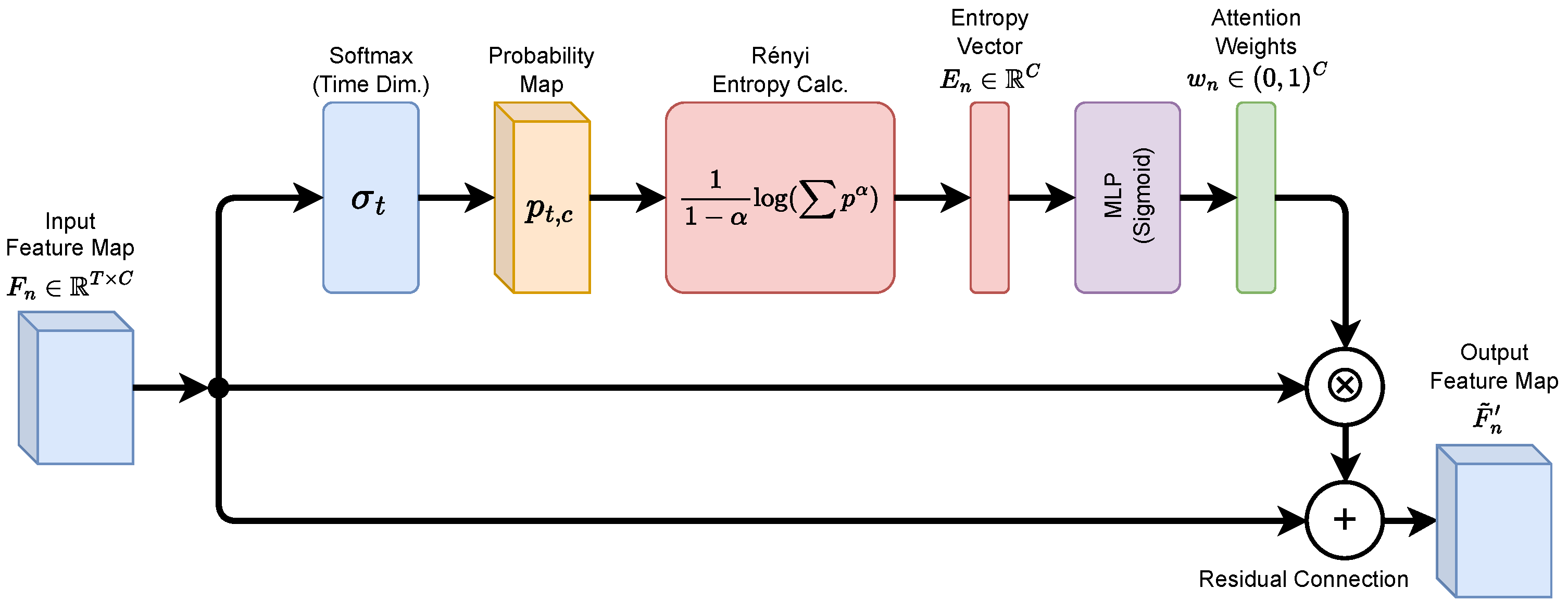
- We design a Differentiable Rényi Entropy Attention Module (DREAM), which embeds Rényi entropy computation into the forward and backward propagation of the network and leverages entropy-driven channel recalibration. By characterizing distributional concentration and repetitive patterns, DREAM enhances the model’s sensitivity to weak and regular LDoS behaviors, outperforming conventional amplitude- or mean-based attention mechanisms.
- 3.
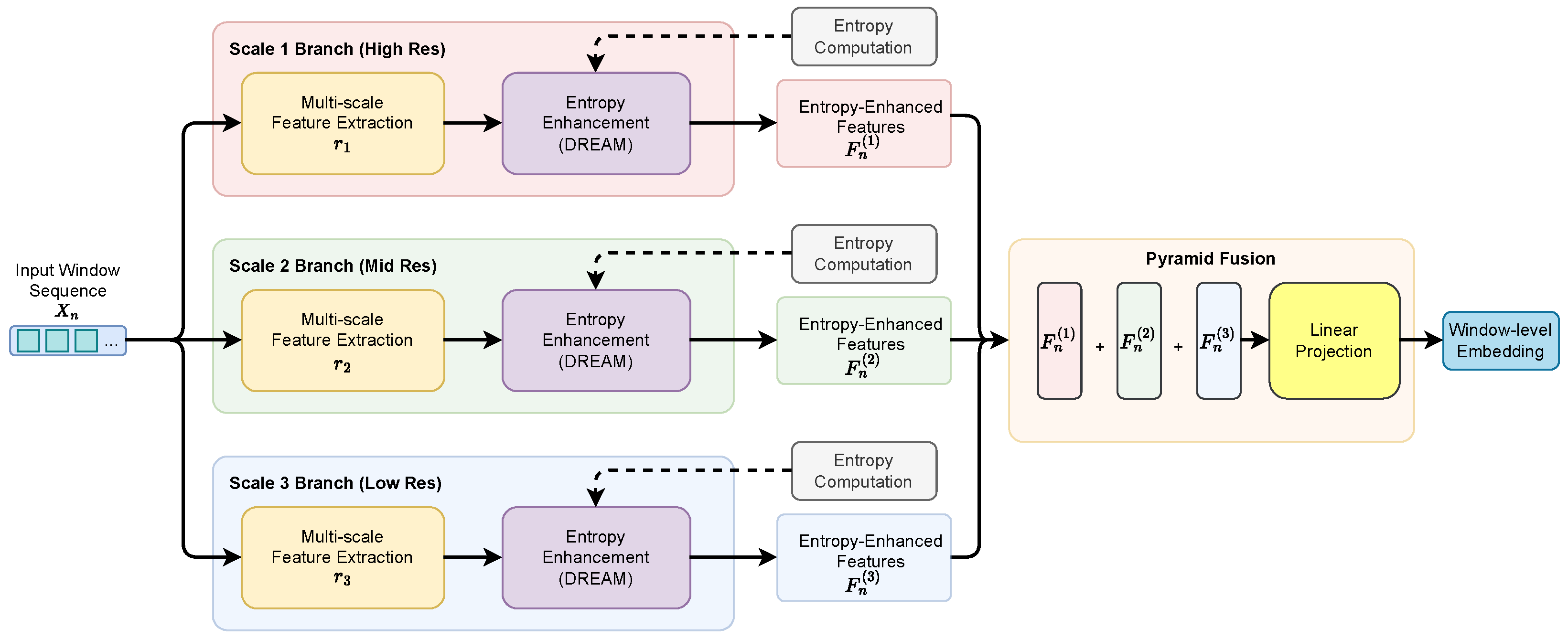
- We introduce a multi-scale entropy pyramid learning framework that jointly models feature representations and entropy statistics across multiple receptive-field scales. Through scale-wise entropy-aware fusion, the proposed framework effectively captures both short burst behaviors and long-period structures of LDoS attacks, improving robustness to diverse low-rate attack patterns.
- 4.
- We develop an entropy-conditioned temporal convolutional network (TCN) for cross-window temporal modeling, in which entropy-guided gating mechanisms are used to modulate dilated convolutional responses. This design enables the model to focus on entropy anomalies and abrupt entropy variations over time, facilitating effective modeling of periodic pulses and long-range dependencies in LDoS traffic.
2. Related Work
2.1. Statistical and Signal Processing-Based LDoS Detection
2.2. Traditional Machine Learning for LDoS and DoS Detection
2.3. Deep Learning Based Intrusion Detection
2.4. Recent Deep Learning Advances in IDS
3. Methodology
3.1. Input Representation
| Algorithm 1: Window-Based Tensor Construction and Label Alignment |
 |
3.2. LDoS Pulse Characteristics from an Entropy Perspective
3.3. Overall Architecture of DELP-Net
3.4. Multi-Scale 1D-CNN Pyramid for Window Feature Extraction
3.5. Differentiable Rényi Entropy Attention Mechanism (DREAM)
3.6. Entropy Pyramid Fusion
3.7. Temporal Modeling with Entropy-Conditioned TCN
3.8. Classification with Entropy-Regularized Hybrid Loss
| Algorithm 2: End-To-End Training Process of DELP-Net |
 |
4. Experiments
4.1. Datasets and Sample Construction
4.1.1. Datasets
4.1.2. Sample Construction
4.2. Evaluation Metrics
4.3. Window-Based Preprocessing and Data Splits
4.4. Baselines
- Entropy-Threshold: A window-level entropy threshold detector. For each time window, empirical distributions are constructed on discretized traffic attributes. Rényi entropy statistics are computed and compared against thresholds estimated from benign windows in the training set and tuned on the validation set to control false alarms.
- RF: A Random Forest classifier trained on handcrafted window-level statistical features. The feature vector includes byte counts, mean and variance of inter-arrival times, simple directional statistics within the window, TCP flag counts, and packet-length quantiles. Hyperparameters are selected on the validation set.
- XGBoost: A gradient-boosted decision tree classifier trained on the same handcrafted window-level feature set as RF. Model hyperparameters are tuned on the validation set to ensure a fair comparison.
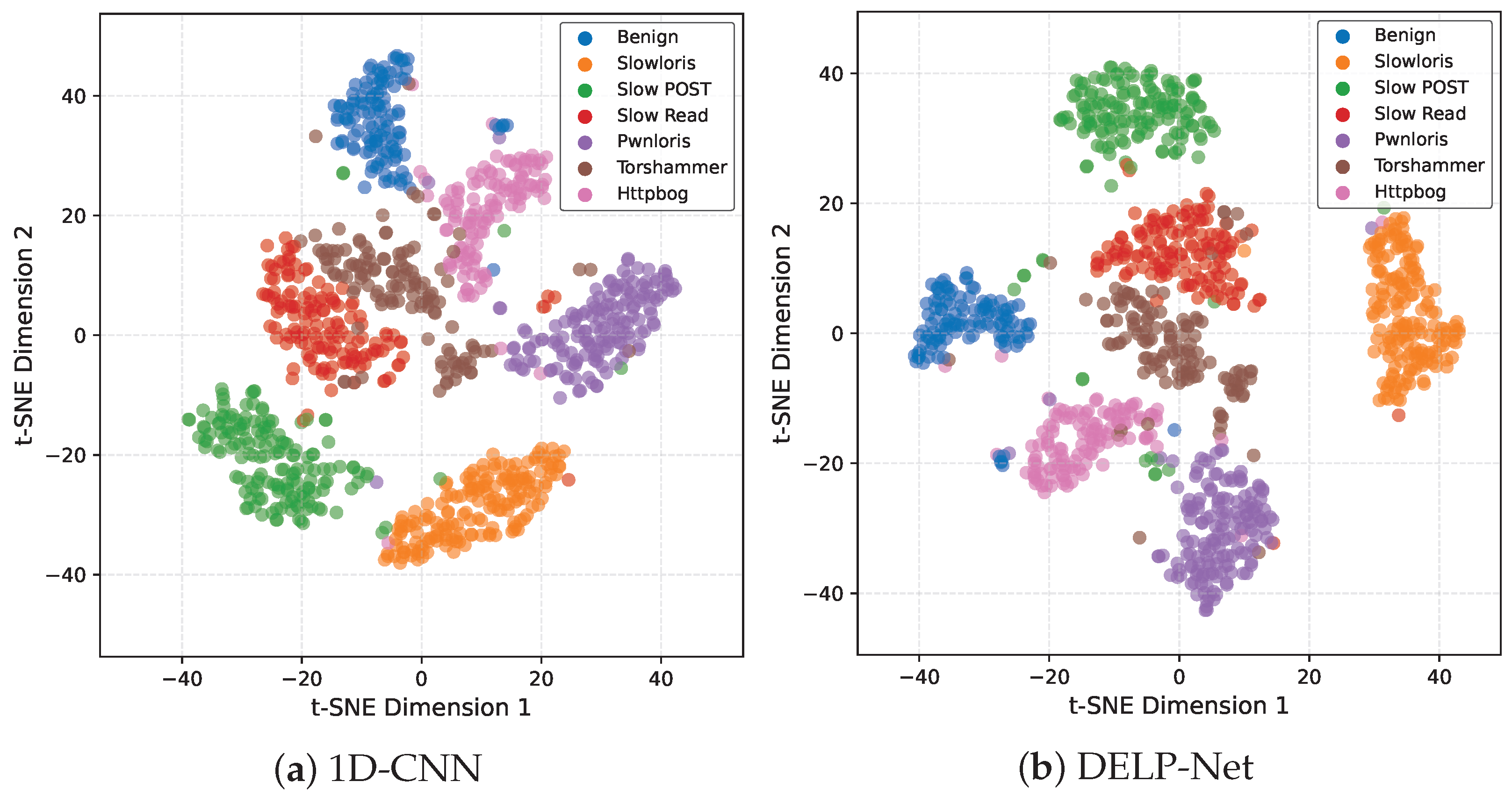
- 1D-CNN: An end-to-end convolutional baseline operating on raw bytes. Each window is represented as a fixed-shape byte tensor (with truncation/padding) and then serialized as a 1D sequence. Stacked single-scale Conv1D layers extract window representations, followed by a fully connected classification head.
- LSTM: A deep sequence baseline for raw-window modeling. The byte tensor is treated as an ordered sequence, and an LSTM encoder is used to model temporal dependencies within the window. The final hidden state is fed into a fully connected classifier.
4.5. Implementation Details
4.6. Detection Performance
5. Discussion
5.1. Comparison with Recent State-of-the-Art Methods
5.2. Ablation Studies
5.2.1. Ablation Settings
- w/o DREAM: Remove DREAM and disable entropy-driven channel recalibration, and pyramid features are forwarded directly to subsequent modules.
- DREAM to SE: Replace DREAM with the Squeeze-and-Excitation (SE) channel attention [14].
- DREAM to CBAM: Replace DREAM with CBAM using mean-based channel and spatial attention [57].
- w/o Entropy Pyramid Fusion: Keep multi-scale convolution and DREAM, but remove multi-scale entropy fusion and use only the final-scale feature as the window representation.
- w/o TCN: Remove the temporal modeling module, and window embeddings are fed directly into the classifier.
- TCN w/o Entropy Conditioning: Keep TCN but disable entropy-conditioned gating, and temporal modeling uses window embeddings only.
- DELP-Net (Full): The full model.
5.2.2. Ablation Results
5.3. Sensitivity Analysis of Rényi Parameter
5.3.1. Experimental Setting
5.3.2. Results and Discussion
5.4. Robustness to Attack Parameter Variations
5.4.1. Experimental Setting
5.4.2. Results and Discussion
5.5. Feature Space Visualization
5.6. Computational Cost and Deployment Feasibility
5.7. Detection Granularity
6. Conclusions
Author Contributions
Funding
Institutional Review Board Statement
Informed Consent Statement
Data Availability Statement
Conflicts of Interest
References
- Tang, D.; Dai, R.; Yan, Y.; Li, K.; Liang, W.; Qin, Z. When SDN Meets Low-rate Threats: A Survey of Attacks and Countermeasures in Programmable Networks. ACM Comput. Surv. 2024, 57, 1–32. [Google Scholar] [CrossRef]
- Setitra, M.A.; Fan, M.; Benkhaddra, I.; Bensalem, Z.E.A. DoS/DDoS attacks in Software Defined Networks: Current situation, challenges and future directions. Comput. Commun. 2024, 222, 77–96. [Google Scholar] [CrossRef]
- Benmoussa, A.; Kerrache, C.A.; Lagraa, N.; Mastorakis, S.; Lakas, A.; Tahari, A.E.K. Interest flooding attacks in named data networking: Survey of existing solutions, open issues, requirements, and future directions. ACM Comput. Surv. 2022, 55, 1–37. [Google Scholar] [CrossRef]
- Wang, B. Improving multivariate time-series anomaly detection in industrial sensor networks using entropy-based feature aggregation. Entropy 2026, 28, 14. [Google Scholar] [CrossRef]
- Wu, Z.; Zhang, L.; Yue, M. Low-rate DoS attacks detection based on network multifractal. IEEE Trans. Dependable Secur. Comput. 2015, 13, 559–567. [Google Scholar] [CrossRef]
- Lin, J. Divergence measures based on the Shannon entropy. IEEE Trans. Inf. Theory 2002, 37, 145–151. [Google Scholar] [CrossRef]
- Dong, X. The gravity dual of Rényi entropy. Nat. Commun. 2016, 7, 12472. [Google Scholar] [CrossRef]
- Liu, Z.; Yin, X.; Liu, D. A Comprehensive Survey on Low-rate DDoS Attacks Detection Based on Deep Learning. In Proceedings of the 2024 International Conference on Computers, Information Processing and Advanced Education (CIPAE), Ottawa, ON, Canada, 26–28 August 2024; IEEE: Piscataway, NJ, USA, 2024; pp. 259–263. [Google Scholar]
- Ren, K.; Yuan, S.; Zhang, C.; Shi, Y.; Huang, Z. CANET: A hierarchical CNN-attention model for network intrusion detection. Comput. Commun. 2023, 205, 170–181. [Google Scholar] [CrossRef]
- Gamal, M.; Elhamahmy, M.; Taha, S.; Elmahdy, H. Improving intrusion detection using LSTM-RNN to protect drones’ networks. Egypt. Inform. J. 2024, 27, 100501. [Google Scholar] [CrossRef]
- Rani, Y.A.; Reddy, E.S. Deep intrusion net: An efficient framework for network intrusion detection using hybrid deep TCN and GRU with integral features. Wirel. Netw. 2025, 31, 1255–1278. [Google Scholar] [CrossRef]
- Laghrissi, F.; Douzi, S.; Douzi, K.; Hssina, B. IDS-attention: An efficient algorithm for intrusion detection systems using attention mechanism. J. Big Data 2021, 8, 149. [Google Scholar] [CrossRef]
- Lashkari, A.H.; Gil, G.D.; Mamun, M.S.I.; Ghorbani, A.A. Characterization of Tor Traffic using Time based Features. In Proceedings of the 3rd International Conference on Information Systems Security and Privacy—Volume 1: ICISSP; SciTePress: Setúbal, Portugal, 2017; pp. 253–262. [Google Scholar] [CrossRef]
- Jin, X.; Xie, Y.; Wei, X.S.; Zhao, B.R.; Chen, Z.M.; Tan, X. Delving deep into spatial pooling for squeeze-and-excitation networks. Pattern Recognit. 2022, 121, 108159. [Google Scholar] [CrossRef]
- Hosseini, S.; Ebrahimi, A.; Mosavi, M.; Shahhoseini, H. A novel hybrid CNN-CBAM-GRU method for intrusion detection in modern networks. Results Eng. 2025, 28, 107103. [Google Scholar] [CrossRef]
- Bhuyan, M.H.; Bhattacharyya, D.; Kalita, J.K. An empirical evaluation of information metrics for low-rate and high-rate DDoS attack detection. Pattern Recognit. Lett. 2015, 51, 1–7. [Google Scholar] [CrossRef]
- Chen, Z.; Yeo, C.K.; Lee, B.S.; Lau, C.T. Power spectrum entropy based detection and mitigation of low-rate DoS attacks. Comput. Netw. 2018, 136, 80–94. [Google Scholar] [CrossRef]
- Fu, Y.; Duan, X.; Wang, K.; Li, B. Low-rate Denial of Service attack detection method based on time-frequency characteristics. J. Cloud Comput. 2022, 11, 31. [Google Scholar] [CrossRef]
- Yue, M.; Liu, L.; Wu, Z.; Wang, M. Identifying LDoS attack traffic based on wavelet energy spectrum and combined neural network. Int. J. Commun. Syst. 2018, 31, e3449. [Google Scholar] [CrossRef]
- Yu, H.; Yang, W.; Cui, B.; Sui, R.; Wu, X. Renyi entropy-driven network traffic anomaly detection with dynamic threshold. Cybersecurity 2024, 7, 64. [Google Scholar] [CrossRef]
- Lima, C.F.L.; Assis, F.M.; de Souza, C.P. A comparative study of use of Shannon, Rényi and Tsallis entropy for attribute selecting in network intrusion detection. In Proceedings of the 2011 IEEE International Workshop on Measurements and Networking Proceedings (M&N), Anacapri, Italy, 10–11 October 2011; IEEE: Piscataway, NJ, USA, 2011; pp. 77–82. [Google Scholar]
- Tang, D.; Dai, R.; Zuo, C.; Chen, J.; Li, K.; Qin, Z. A Low-Rate DoS Attack Mitigation Scheme Based on Port and Traffic State in SDN. IEEE Trans. Comput. 2025, 74, 1758–1770. [Google Scholar] [CrossRef]
- Tulczyjew, L.; Biruk, I.; Bilgic, M.; Abondo, C.; Weill, N. PCAPVision: PCAP-Based High-Velocity and Large-Volume Network Failure Detection. In Proceedings of the NAIC ’24: 2024 SIGCOMM Workshop on Networks for AI Computing, Sydney, NSW, Australia, 4–8 August 2024; Association for Computing Machinery: New York, NY, USA, 2024; pp. 26–33. [Google Scholar] [CrossRef]
- Liu, L.; Wang, H.; Wu, Z.; Yue, M. The detection method of low-rate DoS attack based on multi-feature fusion. Digit. Commun. Netw. 2020, 6, 504–513. [Google Scholar] [CrossRef]
- Tang, D.; Tang, L.; Dai, R.; Chen, J.; Li, X.; Rodrigues, J.J. MF-Adaboost: LDoS attack detection based on multi-features and improved Adaboost. Future Gener. Comput. Syst. 2020, 106, 347–359. [Google Scholar] [CrossRef]
- Li, S.; Cao, Y.; Liu, S.; Lai, Y.; Zhu, Y.; Ahmad, N. HDA-IDS: A Hybrid DoS Attacks Intrusion Detection System for IoT by using semi-supervised CL-GAN. Expert Syst. Appl. 2024, 238, 122198. [Google Scholar] [CrossRef]
- Azimjonov, J.; Kim, T. Designing accurate lightweight intrusion detection systems for IoT networks using fine-tuned linear SVM and feature selectors. Comput. Secur. 2024, 137, 103598. [Google Scholar] [CrossRef]
- Abdelaziz, M.T.; Radwan, A.; Mamdouh, H.; Saad, A.S.; Abuzaid, A.S.; AbdElhakeem, A.A.; Zakzouk, S.; Moussa, K.; Darweesh, M.S. Enhancing network threat detection with random forest-based NIDS and permutation feature importance. J. Netw. Syst. Manag. 2025, 33, 2. [Google Scholar] [CrossRef]
- Chalichalamala, S.; Govindan, N.; Kasarapu, R. An extreme gradient boost based classification and regression tree for network intrusion detection in IoT. Bull. Electr. Eng. Inform. 2024, 13, 1741–1751. [Google Scholar] [CrossRef]
- Wang, Z.; Yu, X. CSCVAE-NID: A Conditionally Symmetric Two-Stage CVAE Framework with Cost-Sensitive Learning for Imbalanced Network Intrusion Detection. Entropy 2025, 27, 1086. [Google Scholar] [CrossRef] [PubMed]
- Mohy-Eddine, M.; Guezzaz, A.; Benkirane, S.; Azrour, M.; Farhaoui, Y. An ensemble learning based intrusion detection model for industrial IoT security. Big Data Min. Anal. 2023, 6, 273–287. [Google Scholar] [CrossRef]
- Salmi, S.; Oughdir, L. Performance evaluation of deep learning techniques for DoS attacks detection in wireless sensor network. J. Big Data 2023, 10, 17. [Google Scholar] [CrossRef]
- Akgun, D.; Hizal, S.; Cavusoglu, U. A new DDoS attacks intrusion detection model based on deep learning for cybersecurity. Comput. Secur. 2022, 118, 102748. [Google Scholar] [CrossRef]
- Abdel Wahab, O. Intrusion Detection in the IoT Under Data and Concept Drifts: Online Deep Learning Approach. IEEE Internet Things J. 2022, 9, 19706–19716. [Google Scholar] [CrossRef]
- Manocchio, L.D.; Layeghy, S.; Lo, W.W.; Kulatilleke, G.K.; Sarhan, M.; Portmann, M. Flowtransformer: A transformer framework for flow-based network intrusion detection systems. Expert Syst. Appl. 2024, 241, 122564. [Google Scholar] [CrossRef]
- Kheddar, H. Transformers and large language models for efficient intrusion detection systems: A comprehensive survey. Inf. Fusion 2025, 124, 103347. [Google Scholar] [CrossRef]
- Qathrady, M.A.; Ullah, S.; Alshehri, M.S.; Ahmad, J.; Almakdi, S.; Alqhtani, S.M.; Khan, M.A.; Ghaleb, B. SACNN-IDS: A self-attention convolutional neural network for intrusion detection in industrial internet of things. CAAI Trans. Intell. Technol. 2024, 9, 1398–1411. [Google Scholar] [CrossRef]
- Mehedi, S.T.; Anwar, A.; Rahman, Z.; Ahmed, K.; Islam, R. Dependable intrusion detection system for IoT: A deep transfer learning based approach. IEEE Trans. Ind. Inform. 2022, 19, 1006–1017. [Google Scholar] [CrossRef]
- Long, Z.; Yan, H.; Shen, G.; Zhang, X.; He, H.; Cheng, L. A Transformer-based network intrusion detection approach for cloud security. J. Cloud Comput. 2024, 13, 5. [Google Scholar] [CrossRef]
- Xi, C.; Wang, H.; Wang, X. A novel multi-scale network intrusion detection model with transformer. Sci. Rep. 2024, 14, 23239. [Google Scholar] [CrossRef]
- Koukoulis, I.; Syrigos, I.; Korakis, T. Self-supervised transformer-based contrastive learning for intrusion detection systems. arXiv 2025, arXiv:2505.08816. [Google Scholar]
- Lo, W.W.; Layeghy, S.; Sarhan, M.; Gallagher, M.; Portmann, M. E-GraphSAGE: A Graph Neural Network based Intrusion Detection System for IoT. In Proceedings of the NOMS 2022–2022 IEEE/IFIP Network Operations and Management Symposium, Budapest, Hungary, 25–29 April 2022; pp. 1–9. [Google Scholar]
- Sun, Z.; Teixeira, A.M.; Toor, S. GNN-IDS: Graph Neural Network based Intrusion Detection System. In Proceedings of the ARES ’24: 19th International Conference on Availability, Reliability and Security, Vienna, Austria, 30 July–2 August 2024; Association for Computing Machinery: New York, NY, USA, 2024. [Google Scholar] [CrossRef]
- Friji, H.; Olivereau, A.; Sarkiss, M. Efficient Network Representation for GNN-Based Intrusion Detection. In Proceedings of the Applied Cryptography and Network Security, Kyoto, Japan, 19–22 June 2023; Springer: Cham, Switzerland, 2023; pp. 532–554. [Google Scholar]
- Xiang, Y.; Li, K.; Zhou, W. Low-rate DDoS attacks detection and traceback by using new information metrics. IEEE Trans. Inf. Forensics Secur. 2011, 6, 426–437. [Google Scholar] [CrossRef]
- Szegedy, C.; Vanhoucke, V.; Ioffe, S.; Shlens, J.; Wojna, Z. Rethinking the inception architecture for computer vision. In Proceedings of the IEEE Conference on Computer Vision and Pattern Recognition, Las Vegas, NV, USA, 27–30 June 2016; pp. 2818–2826. [Google Scholar]
- Sharafaldin, I.; Lashkari, A.H.; Ghorbani, A.A. Toward generating a new intrusion detection dataset and intrusion traffic characterization. ICISSP 2018, 1, 108–116. [Google Scholar]
- Liu, L.; Engelen, G.; Lynar, T.; Essam, D.; Joosen, W. Error Prevalence in NIDS datasets: A Case Study on CIC-IDS-2017 and CSE-CIC-IDS-2018. In Proceedings of the 2022 IEEE Conference on Communications and Network Security (CNS), Austin, TX, USA, 3–5 October 2022; IEEE: Piscataway, NJ, USA, 2022; pp. 254–262. [Google Scholar]
- Xu, C.; Shen, J.; Du, X. Low-rate DoS attack detection method based on hybrid deep neural networks. J. Inf. Secur. Appl. 2021, 60, 102879. [Google Scholar] [CrossRef]
- Xu, C.; Shen, J.; Du, X. A Method of Few-Shot Network Intrusion Detection Based on Meta-Learning Framework. IEEE Trans. Inf. Forensics Secur. 2020, 15, 3540–3552. [Google Scholar] [CrossRef]
- Ilango, H.S.; Ma, M.; Su, R. A feedforward–convolutional neural network to detect low-rate DoS in IoT. Eng. Appl. Artif. Intell. 2022, 114, 105059. [Google Scholar] [CrossRef]
- Asgharzadeh, H.; Ghaffari, A.; Masdari, M.; Gharehchopogh, F.S. Anomaly-based intrusion detection system in the Internet of Things using a convolutional neural network and multi-objective enhanced Capuchin Search Algorithm. J. Parallel Distrib. Comput. 2023, 175, 1–21. [Google Scholar] [CrossRef]
- Tang, D.; Wang, S.; Liu, B.; Jin, W.; Zhang, J. GASF-IPP: Detection and mitigation of LDoS attack in SDN. IEEE Trans. Serv. Comput. 2023, 16, 3373–3384. [Google Scholar] [CrossRef]
- Yin, X.; Fang, W.; Liu, Z.; Liu, D. A novel multi-scale CNN and Bi-LSTM arbitration dense network model for low-rate DDoS attack detection. Sci. Rep. 2024, 14, 5111. [Google Scholar] [CrossRef] [PubMed]
- Liu, B.; Tang, D.; Chen, J.; Liang, W.; Liu, Y.; Yang, Q. ERT-EDR: Online defense framework for TCP-targeted LDoS attacks in SDN. Expert Syst. Appl. 2024, 254, 124356. [Google Scholar] [CrossRef]
- Lei, F.; Jiang, X.; Jin, G.; Yu, D. HawkEye: An end-host method to detect the Low-rate Denial-of-Service attack of cross-traffic over bottleneck links. Comput. Netw. 2025, 257, 110951. [Google Scholar] [CrossRef]
- Woo, S.; Park, J.; Lee, J.Y.; Kweon, I.S. CBAM: Convolutional block attention module. In Proceedings of the the European Conference on Computer Vision (ECCV), Munich, Germany, 8–14 September 2018; pp. 3–19. [Google Scholar]
- Wüsteney, L.; Hellmanns, D.; Schramm, M.; Osswald, L.; Hummen, R.; Menth, M.; Heer, T. Analyzing and modeling the latency and jitter behavior of mixed industrial TSN and DetNet networks. In Proceedings of the the 18th International Conference on Emerging Networking EXperiments and Technologies, Roma, Italy, 6–9 December 2022; pp. 91–109. [Google Scholar]
- Bechtel, L.; Muller, S.; Menth, M.; Heer, T. GeNESIS: Generator for Network Evaluation Scenarios of Industrial Systems. In Proceedings of the 2024 IEEE 29th International Conference on Emerging Technologies and Factory Automation (ETFA), Padova, Italy, 10–13 September 2024; IEEE: Piscataway, NJ, USA, 2024; pp. 1–4. [Google Scholar]
- Maaten, L.v.d.; Hinton, G. Visualizing data using t-SNE. J. Mach. Learn. Res. 2008, 9, 2579–2605. [Google Scholar]



| Dataset | Total Samples | Benign | Attack | Protocols | Train/Test |
|---|---|---|---|---|---|
| CICIDS2017 | 62,000 | 31,500 | 30,500 | TCP/UDP | 70/30 |
| CICIDS2018 | 71,000 | 36,200 | 34,800 | TCP/UDP | 70/30 |
| Self-built | 28,500 | 14,800 | 13,700 | TCP | 70/30 |
| Item | Value |
|---|---|
| Window length | s |
| Window stride | s |
| Max packets per window K | 16 |
| Bytes per packet L | 256 |
| Sequence length for TCN M | 16 |
| Minimum packets per window | 8 |
| Label overlap threshold |
| Item | Value |
|---|---|
| Optimizer | Adam |
| Initial learning rate | |
| Batch size | 64 |
| Dropout rate | |
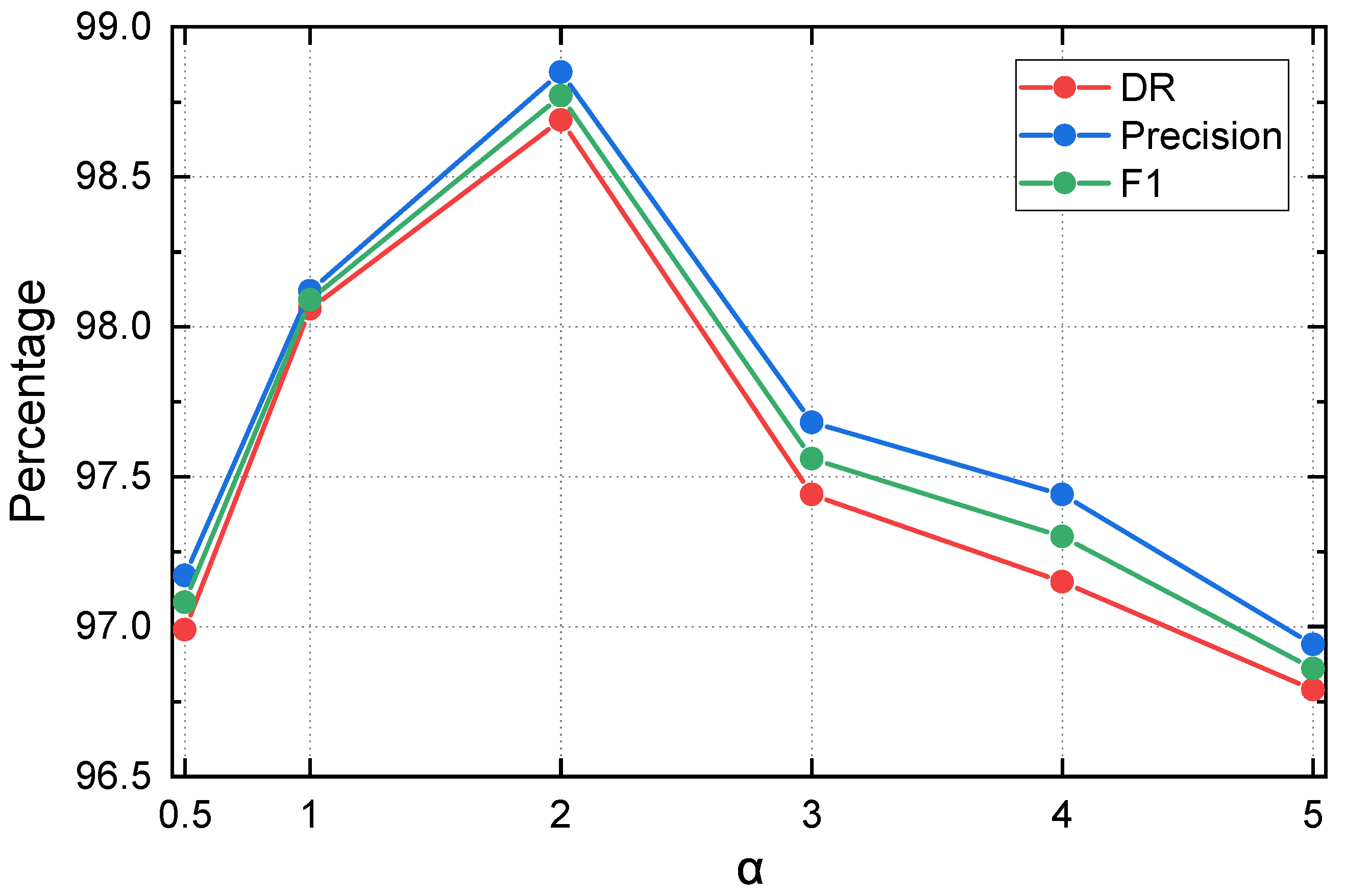
| Rényi parameter | 2 |
| Entropy regularization weight | |
| TCN layers | 4 |
| TCN kernel size | 3 |
| TCN dilation rates | |
| Early stopping patience | 10 |
| Type | ACC (%) | DR (%) | FPR (%) | Precision (%) | F1 |
|---|---|---|---|---|---|
| Slowloris | 98.72 | 98.96 | 1.52 | 98.49 | 0.9872 |
| Slow POST | 98.76 | 98.60 | 1.08 | 98.92 | 0.9876 |
| Slow Read | 98.82 | 98.56 | 0.92 | 99.08 | 0.9882 |
| Pwnloris | 98.54 | 98.40 | 1.32 | 98.68 | 0.9854 |
| Torshammer | 98.90 | 98.88 | 1.08 | 98.92 | 0.9890 |
| Httpbog | 98.88 | 98.76 | 1.00 | 99.00 | 0.9888 |
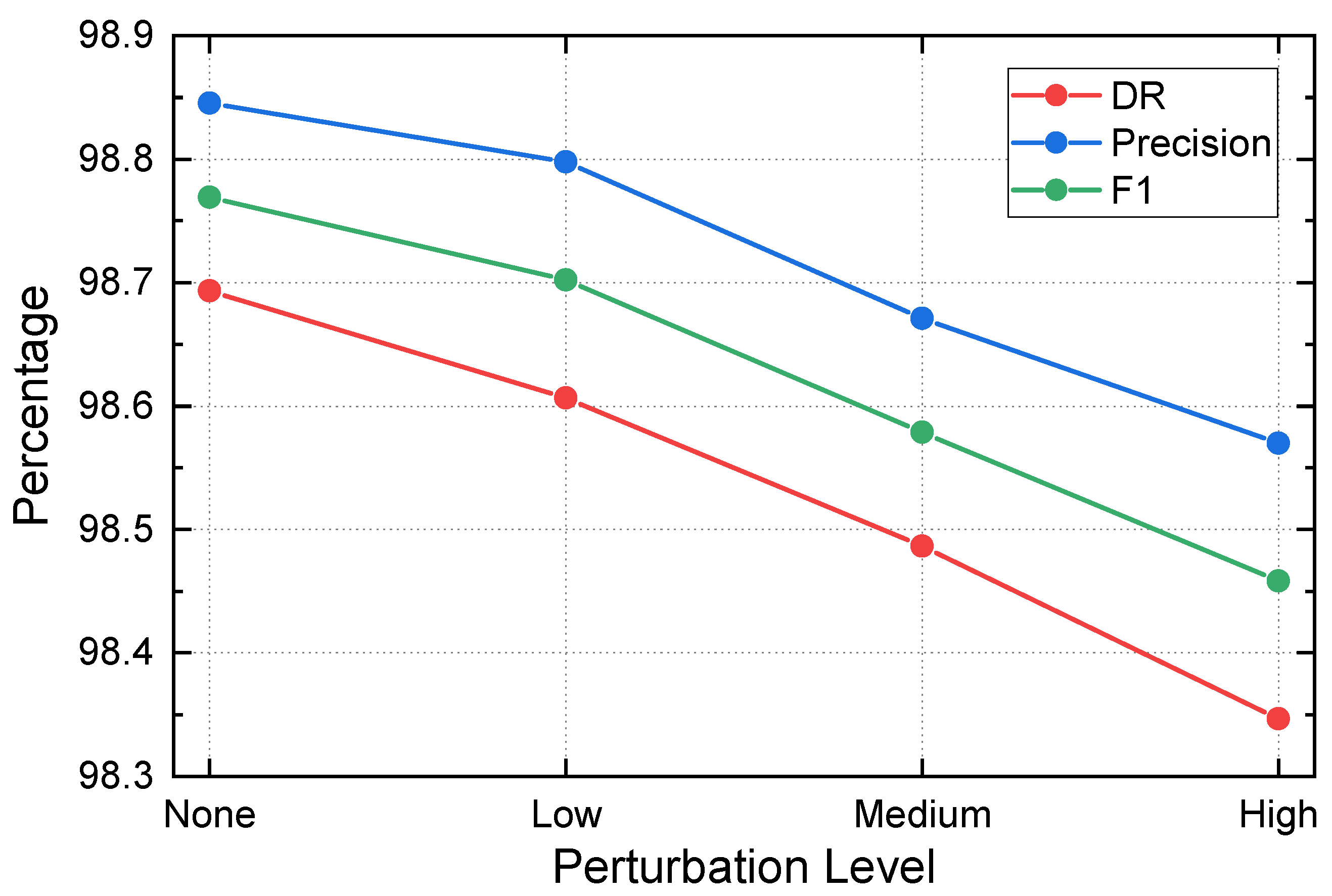
| (Average) | 98.77 | 98.69 | 1.15 | 98.85 | 0.9877 |
| Method | ACC (%) | DR (%) | FPR (%) | Precision (%) | F1 |
|---|---|---|---|---|---|
| Entropy-Threshold | 92.63 | 92.76 | 7.50 | 92.52 | 0.9264 |
| RF | 91.98 | 91.95 | 7.99 | 92.01 | 0.9198 |
| XGBoost | 91.64 | 91.57 | 8.29 | 91.70 | 0.9164 |
| 1D-CNN | 94.70 | 94.66 | 5.25 | 94.74 | 0.9470 |
| LSTM | 94.83 | 94.92 | 5.26 | 94.75 | 0.9483 |
| DELP-Net | 98.77 | 98.69 | 1.15 | 98.85 | 0.9877 |
| Method (Year) | ACC (%) | DR (%) | Precision (%) | F1 |
|---|---|---|---|---|
| FFCNN (2022) [51] | – | 96.30 | 97.50 | 0.9690 |
| CNN-BMECapSA-RF (2023) [52] | 95.91 | 94.69 | 94.95 | 0.9482 |
| GASF-IPP (2023) [53] | 93.57 | 93.22 | 95.39 | 0.9429 |
| MSCBL-AND (2024) [54] | 96.74 | 96.74 | 96.77 | 0.9675 |
| ERT-EDR (2024) [55] | 95.25 | 97.91 | – | 0.9557 |
| HawkEye (2025) [56] | 91.78 | – | 96.46 | 0.9307 |
| DELP-Net (Proposed) | 98.77 | 98.69 | 98.85 | 0.9877 |
| Variant | ACC (%) | DR (%) | FPR (%) | Precision (%) | F1 |
|---|---|---|---|---|---|
| w/o DREAM | 94.40 | 94.28 | 5.48 | 94.51 | 0.9439 |
| DREAM to SE | 95.85 | 95.83 | 4.13 | 95.87 | 0.9585 |
| DREAM to CBAM | 96.56 | 96.61 | 3.48 | 96.52 | 0.9656 |
| w/o Entropy Pyramid Fusion | 96.70 | 96.66 | 3.26 | 96.74 | 0.9670 |
| w/o TCN | 97.60 | 97.87 | 2.66 | 97.35 | 0.9761 |
| TCN w/o Entropy Conditioning | 98.20 | 98.12 | 1.71 | 98.28 | 0.9820 |
| DELP-Net (Full) | 98.77 | 98.69 | 1.15 | 98.85 | 0.9877 |
| Model | Parameters (M) | FLOPs (G) |
|---|---|---|
| 1D-CNN | 0.94 | 0.41 |
| LSTM | 1.57 | 0.68 |
| DELP-Net | 1.16 | 0.47 |
| Model | Latency/Sample (ms) | Samples/s | GPU Memory (MB) |
|---|---|---|---|
| 1D-CNN | 1.21 | 826 | 486 |
| LSTM | 2.87 | 348 | 664 |
| DELP-Net | 1.64 | 610 | 528 |
Disclaimer/Publisher’s Note: The statements, opinions and data contained in all publications are solely those of the individual author(s) and contributor(s) and not of MDPI and/or the editor(s). MDPI and/or the editor(s) disclaim responsibility for any injury to people or property resulting from any ideas, methods, instructions or products referred to in the content. |
© 2026 by the authors. Licensee MDPI, Basel, Switzerland. This article is an open access article distributed under the terms and conditions of the Creative Commons Attribution (CC BY) license.
Share and Cite
Wang, J.; Xu, C.; Yang, J. DELP-Net: A Differentiable Entropy Layer Pyramid Network for End-to-End Low-Rate DoS Detection. Entropy 2026, 28, 328. https://doi.org/10.3390/e28030328
Wang J, Xu C, Yang J. DELP-Net: A Differentiable Entropy Layer Pyramid Network for End-to-End Low-Rate DoS Detection. Entropy. 2026; 28(3):328. https://doi.org/10.3390/e28030328
Chicago/Turabian StyleWang, Jinyi, Congyuan Xu, and Jun Yang. 2026. "DELP-Net: A Differentiable Entropy Layer Pyramid Network for End-to-End Low-Rate DoS Detection" Entropy 28, no. 3: 328. https://doi.org/10.3390/e28030328
APA StyleWang, J., Xu, C., & Yang, J. (2026). DELP-Net: A Differentiable Entropy Layer Pyramid Network for End-to-End Low-Rate DoS Detection. Entropy, 28(3), 328. https://doi.org/10.3390/e28030328