A Multiple-Well Framework for Human Perceptual Decision-Making
 ,
,  and
and 
Abstract
1. Introduction
2. Background
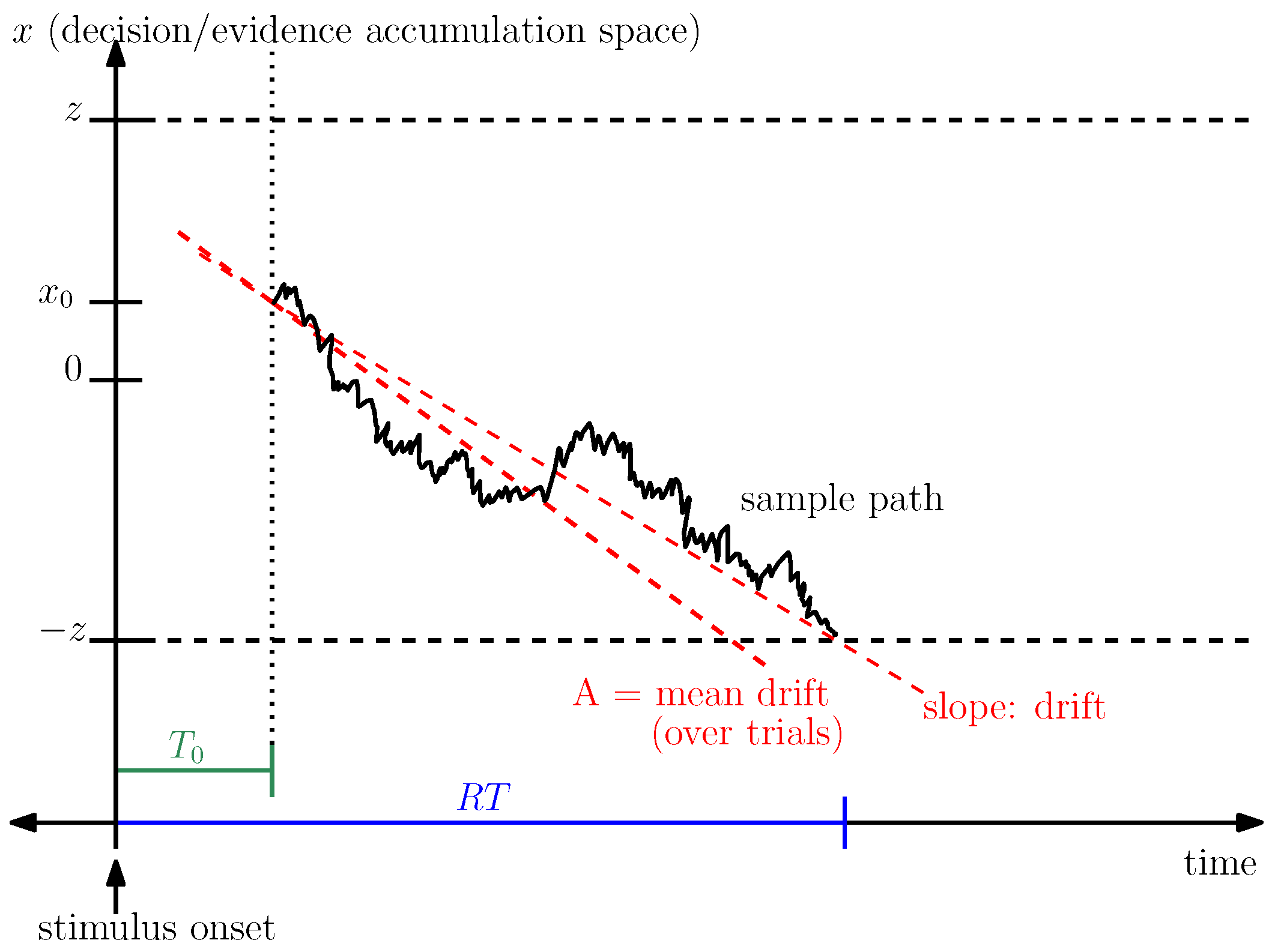
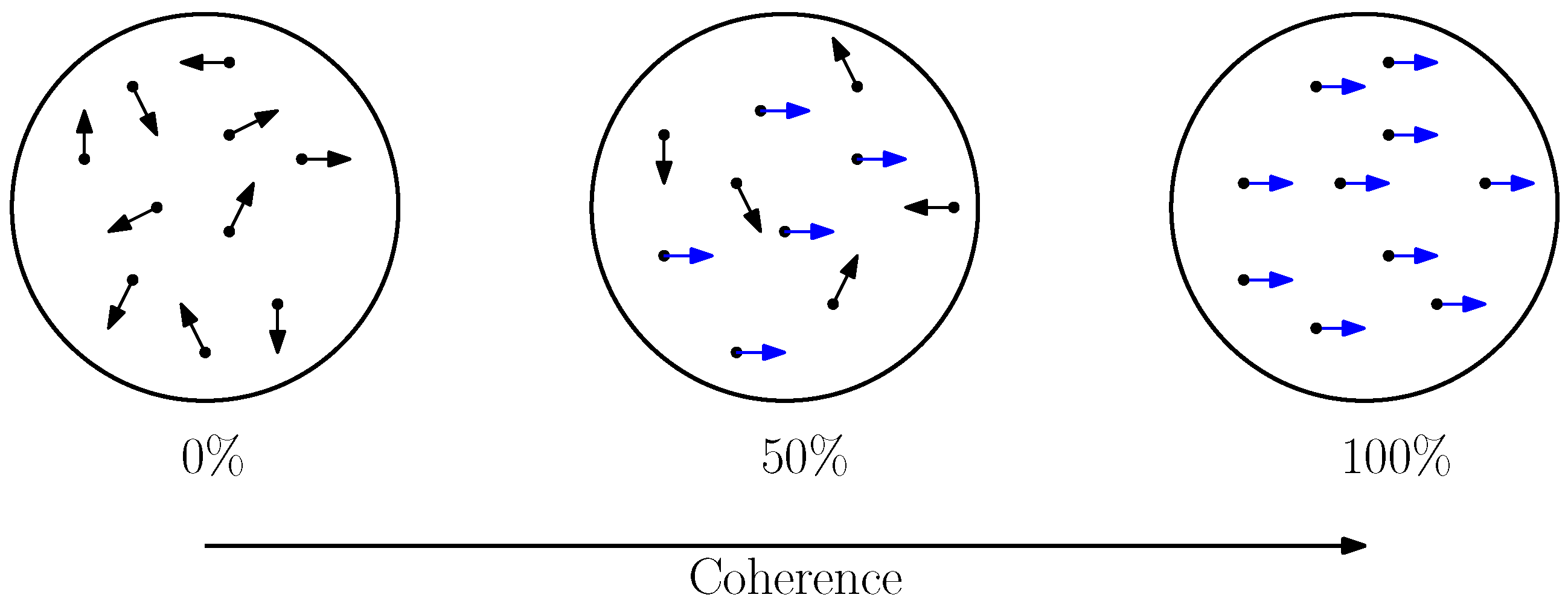
2.1. Drift Diffusion Model of Two-Alternative Forced Choice Task
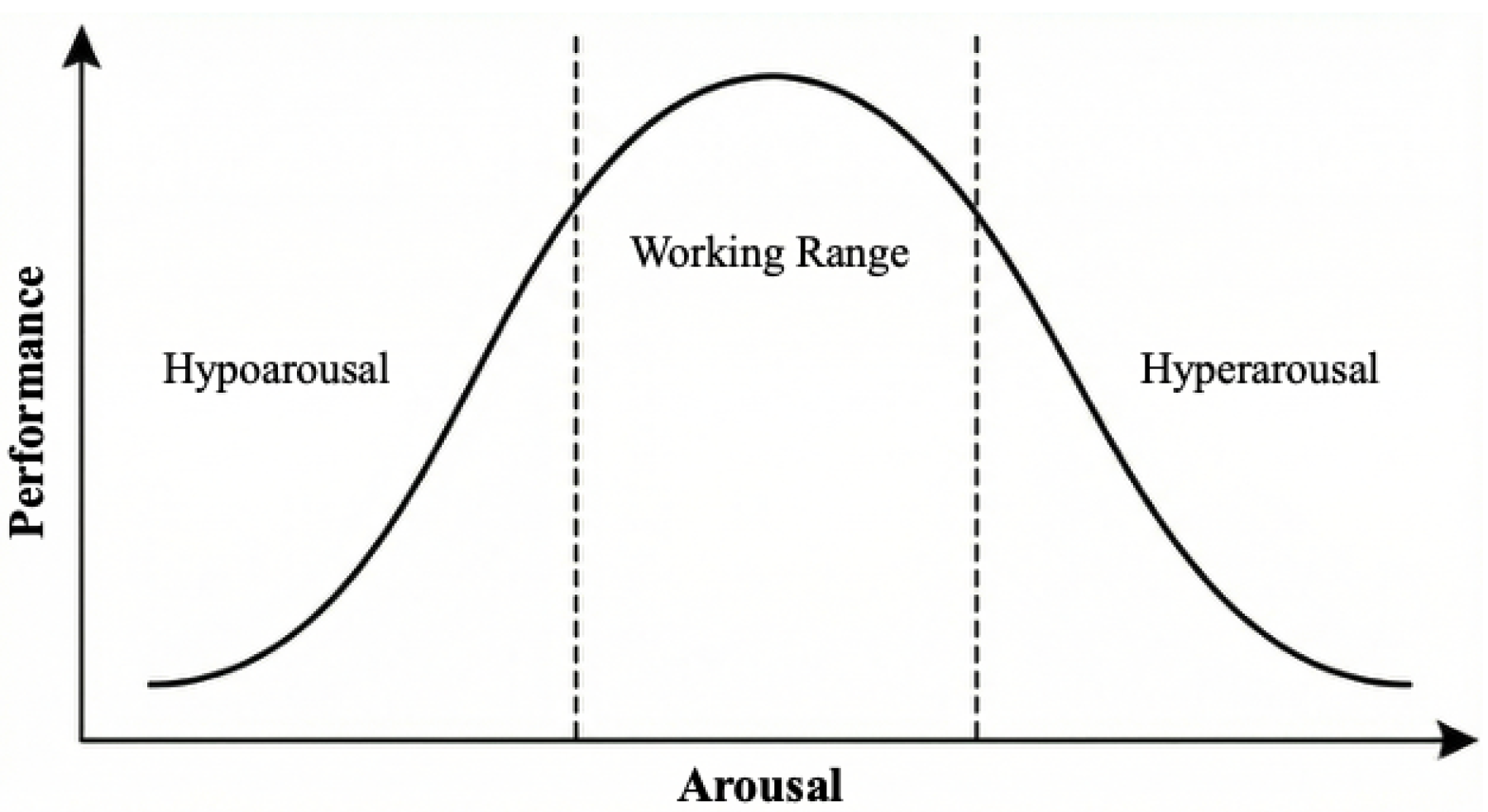
2.2. Arousal and Yerkes–Dodson Law
3. The Multiple-Particle Multiple-Well Framework for Perceptual Decision-Making
3.1. General Framework
Connection to DDM
3.2. Method (A): Eigenstate Method, Also Classical-Quantum Method, or Total Energy Arousal Model
3.3. Method (B): Time-Evolution Method, Also Quantum Method, or Kinetic Energy Arousal Model
4. Empirical Test of the Model
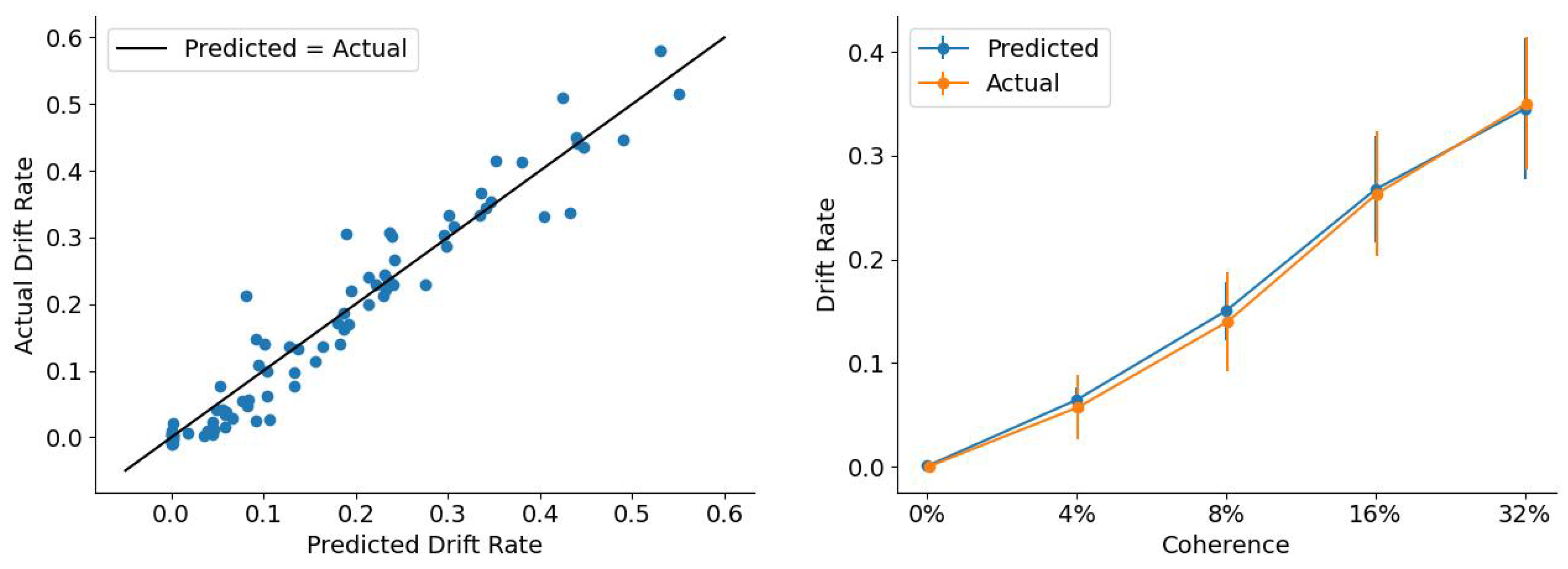
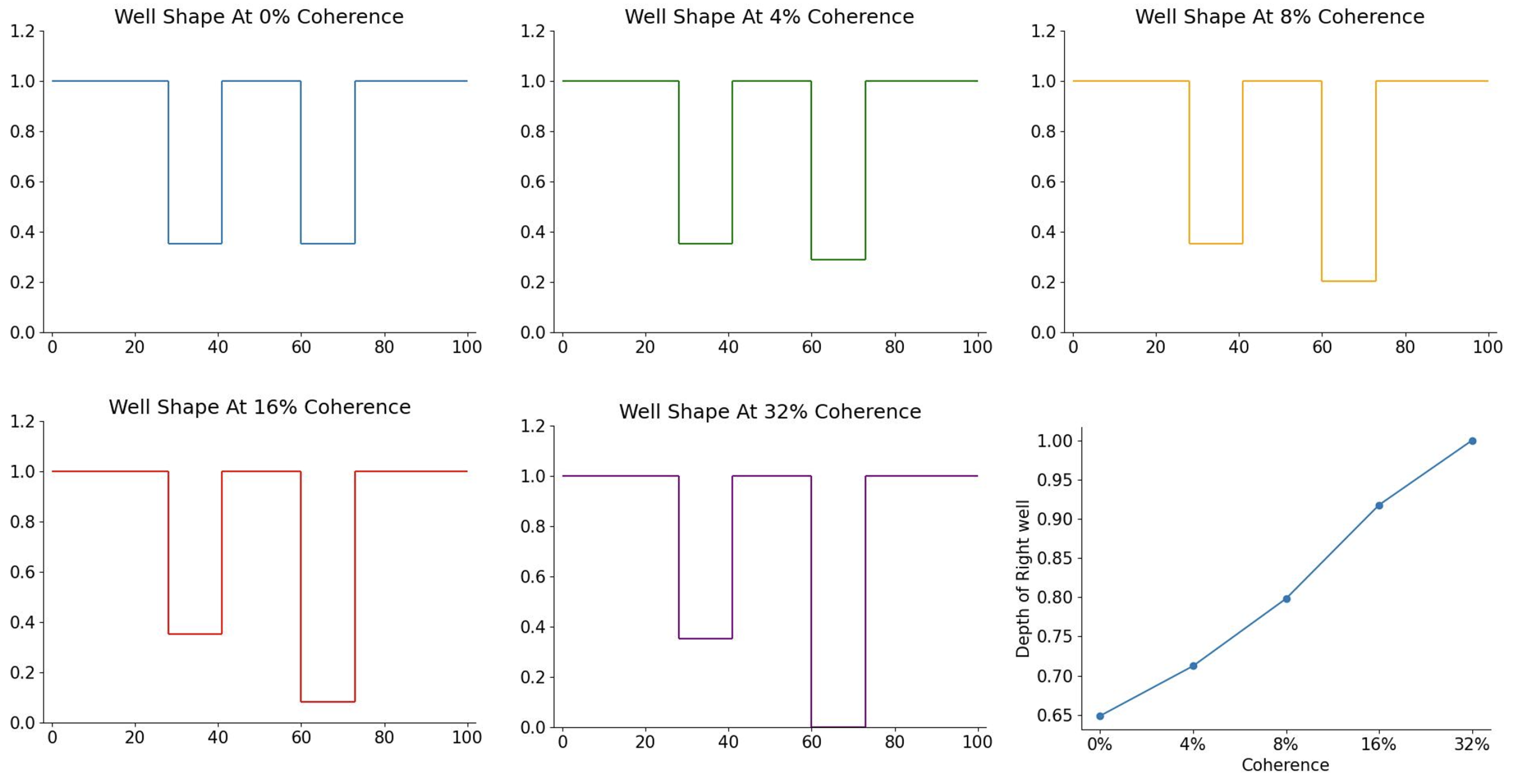
4.1. Fitting to Mean Drift Rates
- We fixed at 1 and fit a single and across all coherence conditions and participants (2 parameters). This establishes the energy scale for the fitting process.
- We let vary across the five coherence conditions but kept it constant across participants (5 parameters). This accounts for varying attentional control over the five different levels of motion coherence.
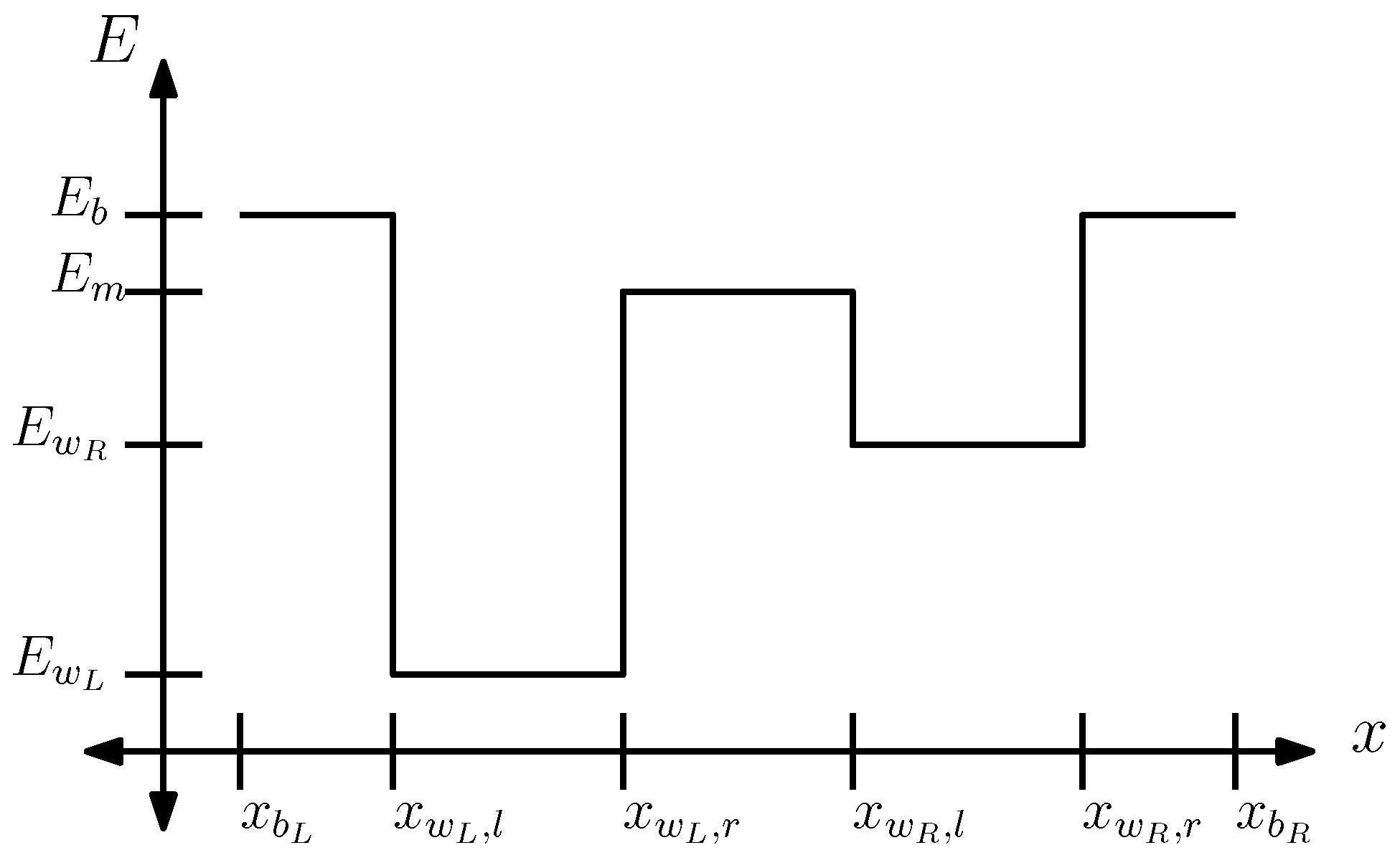
- We fit a well width for the left well and a width for the left edge ( in Figure 4), setting these equal to the right well and right edge widths, respectively. Since width represents the generality of a concept, maintaining symmetry assumes that “dot moving left” and “dot moving right” are equivalent concepts that do not differ in generality (2 parameters).
- We fit a single time for the time evolution, corresponding to the non-decision time, across all conditions and participants (1 parameter). Although a simplification, fixing a single non-decision time is a common convention in the DDM literature [4].
- We fit a single scaling constant across all participants and coherence conditions (1 parameter).
- For each participant, we fit a single scaling constant across all coherence conditions (17 parameters). This assumes that individual differences arise from the varying arousal levels of the participants.
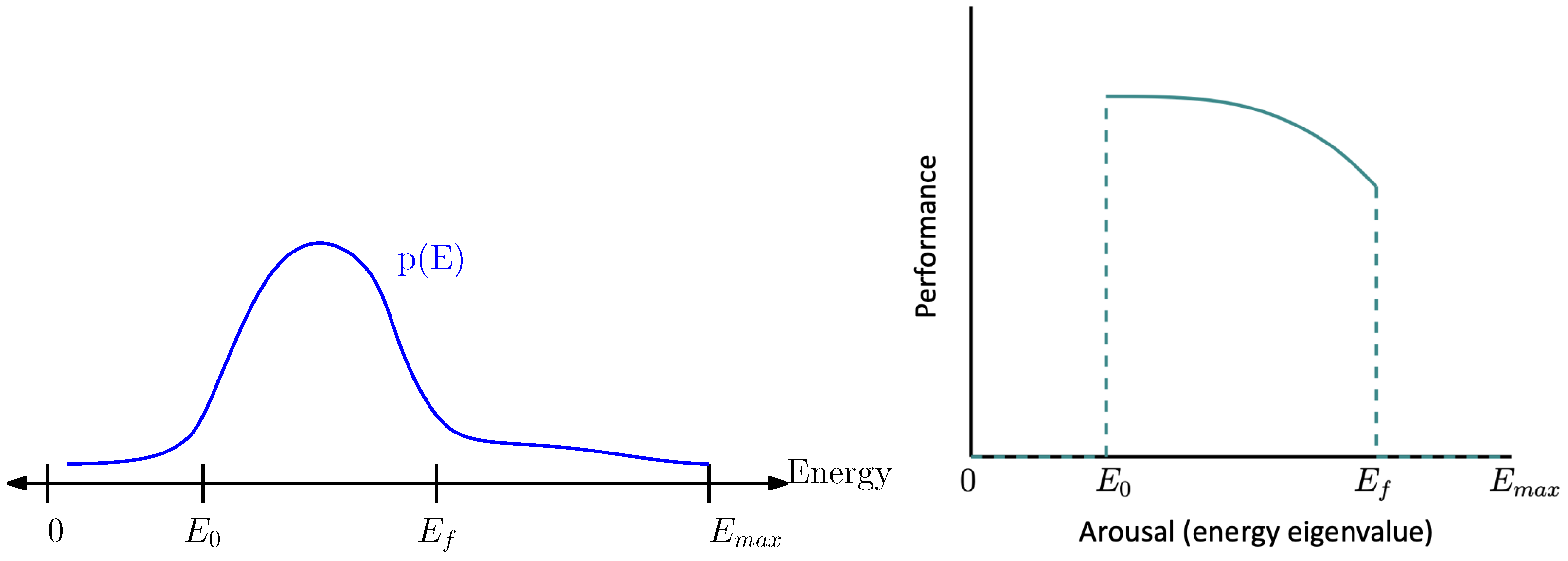
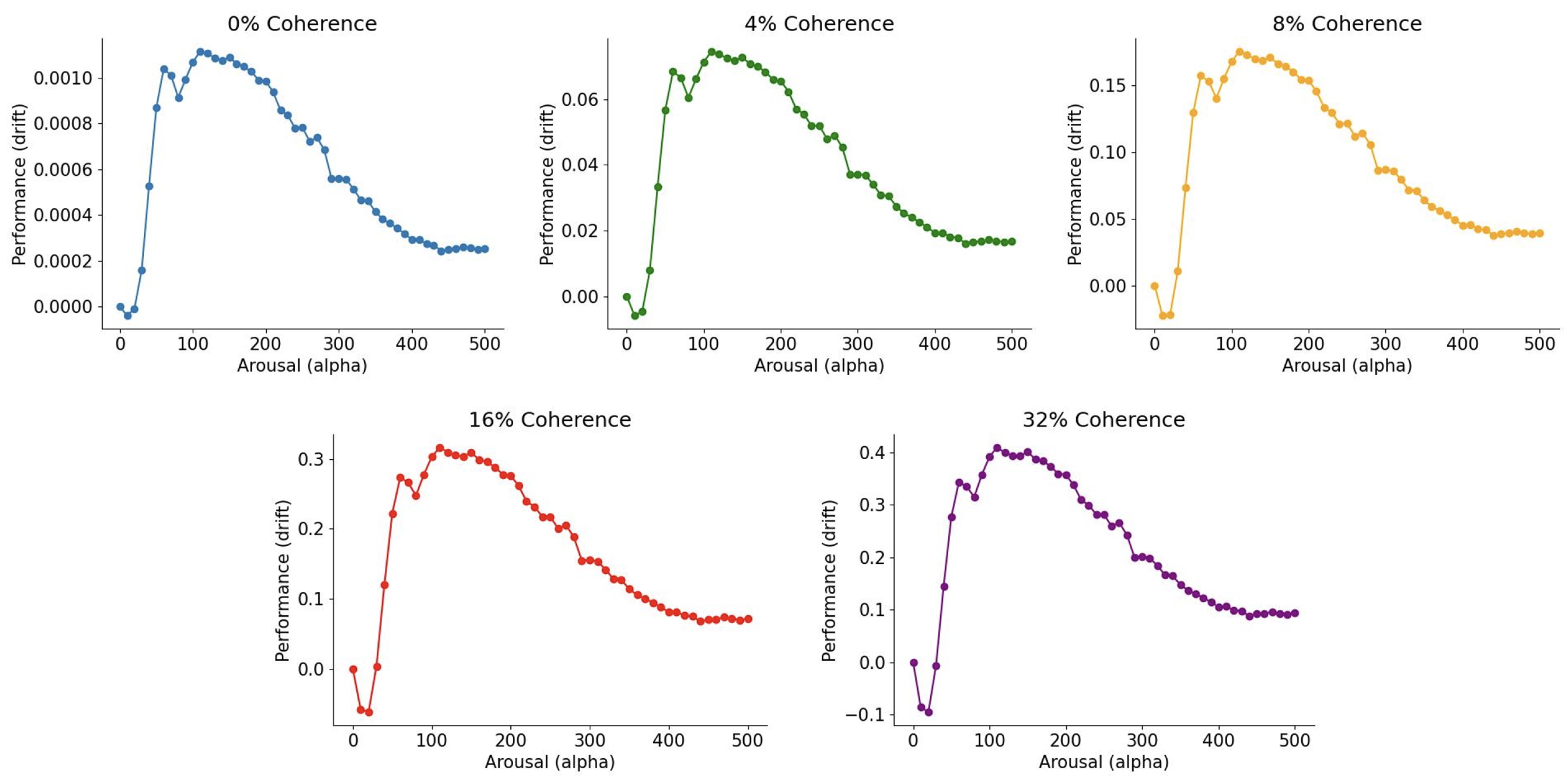
4.2. Prediction of Yerkes–Dodson Law
5. General Discussions
Author Contributions
Funding
Institutional Review Board Statement
Informed Consent Statement
Data Availability Statement
Acknowledgments
Conflicts of Interest
Abbreviations
| 2AFC | Two-alternative forced-choice (task). |
| DDM | Drift diffusion model. |
| DT | Decision time. |
| LC-NE | Locus coeruleus–norepinephrine (system). |
| MIE | Mean integration efficiency. |
| MPMW | Multiple-particle multiple-well. |
| NE | Norepinephrine. |
| RDM | Random dot motion. |
| RT | Response time |
| SNR | Signal-to-noise ratio. |
Appendix A. Matrix Numerov Method
Appendix B. Optimal Parameter Results of Fitting

| Edge Width | Well Width | ||||
|---|---|---|---|---|---|
| 28.0514 | 13.4231 | 3.9883 | 2.4738 | 0.3522 | 1.0000 |
| 0.3512 | 0.2876 | 0.2018 | 0.0823 | 0.0000 |
| ID | 1 | 2 | 3 | 4 | 5 | 6 | 7 | 8 | 9 |
| 151.38 | 55.86 | 176.80 | 111.82 | 60.39 | 177.01 | 43.10 | 54.14 | 176.09 | |
| ID | 10 | 11 | 12 | 13 | 14 | 15 | 16 | 17 | |
| 173.69 | 54.24 | 100.86 | 190.69 | 57.89 | 168.80 | 156.66 | 119.01 |
References
- Bogacz, R.; Brown, E.; Moehlis, J.; Holmes, P.; Cohen, J.D. The physics of optimal decision making: A formal analysis of models of performance in two-alternative forced-choice tasks. Psychol. Rev. 2006, 113, 700. [Google Scholar] [CrossRef] [PubMed]
- Ratcliff, R.; McKoon, G. The diffusion decision model: Theory and data for two-choice decision tasks. Neural Comput. 2008, 20, 873–922. [Google Scholar] [CrossRef] [PubMed]
- Kvam, P.D.; Pleskac, T.J.; Yu, S.; Busemeyer, J.R. Interference effects of choice on confidence: Quantum characteristics of evidence accumulation. Proc. Natl. Acad. Sci. USA 2015, 112, 10645–10650. [Google Scholar] [CrossRef]
- Ratcliff, R. A diffusion model account of response time and accuracy in a brightness discrimination task: Fitting real data and failing to fit fake but plausible data. Psychon. Bull. Rev. 2002, 9, 278–291. [Google Scholar] [CrossRef] [PubMed]
- Ratcliff, R.; Thapar, A.; Mckoon, G. A diffusion model analysis of the effects of aging on brightness discrimination. Percept. Psychophys. 2003, 65, 523–535. [Google Scholar] [CrossRef]
- Cohen, J.D. Cognitive control: Core constructs and current considerations. In The Wiley Handbook of Cognitive Control; Wiley Blackwell: Hoboken, NJ, USA, 2017; pp. 1–28. [Google Scholar]
- Simen, P.; Contreras, D.; Buck, C.; Hu, P.; Holmes, P.; Cohen, J.D. Reward rate optimization in two-alternative decision making: Empirical tests of theoretical predictions. J. Exp. Psychol. Hum. Percept. Perform. 2009, 35, 1865. [Google Scholar] [CrossRef]
- Starns, J.J.; Ratcliff, R. The effects of aging on the speed–accuracy compromise: Boundary optimality in the diffusion model. Psychol. Aging 2010, 25, 377. [Google Scholar] [CrossRef]
- Nunez, M.D.; Vandekerckhove, J.; Srinivasan, R. How attention influences perceptual decision making: Single-trial EEG correlates of drift-diffusion model parameters. J. Math. Psychol. 2017, 76, 117–130. [Google Scholar] [CrossRef]
- Pribram, K.H.; McGuinness, D. Arousal, activation, and effort in the control of attention. Psychol. Rev. 1975, 82, 116. [Google Scholar] [CrossRef]
- Thayer, R.E. The Biopsychology of Mood and Arousal; Oxford University Press: Oxford, UK, 1990. [Google Scholar]
- Sohn, J.H.; Kim, H.E.; Sohn, S.; Seok, J.W.; Choi, D.; Watanuki, S. Effect of emotional arousal on inter-temporal decision-making: An fMRI study. J. Physiol. Anthropol. 2015, 34, 8. [Google Scholar] [CrossRef]
- Wichary, S.; Mata, R.; Rieskamp, J. Probabilistic inferences under emotional stress: How arousal affects decision processes. J. Behav. Decis. Mak. 2016, 29, 525–538. [Google Scholar] [CrossRef]
- Hulsey, D.; Zumwalt, K.; Mazzucato, L.; McCormick, D.A.; Jaramillo, S. Decision-making dynamics are predicted by arousal and uninstructed movements. Cell Rep. 2024, 43, 113709. [Google Scholar] [CrossRef]
- Yerkes, R.M.; Dodson, J.D. The relation of strength of stimulus to rapidity of habit-formation. J. Comp. Neurol. Psychol. 1908, 18, 459–482. [Google Scholar] [CrossRef]
- Busemeyer, J.R.; Bruza, P. Quantum Models of Cognition and Decision: Principles and Applications, 2nd ed.; Cambridge University Press: Cambridge, UK, 2025. [Google Scholar]
- Huang, J.; Epping, G.; Trueblood, J.S.; Yearsley, J.M.; Busemeyer, J.R.; Pothos, E.M. An overview of the quantum cognition research program. Psychon. Bull. Rev. 2025, 32, 2507–2556. [Google Scholar] [CrossRef] [PubMed]
- Tversky, A.; Kahneman, D. Extensional versus intuitive reasoning: The conjunction fallacy in probability judgment. Psychol. Rev. 1983, 90, 293. [Google Scholar] [CrossRef]
- Huang, J.; Busemeyer, J.R.; Ebelt, Z.; Pothos, E.M. Bridging the gap between subjective probability and probability judgments: The quantum sequential sampler. Psychol. Rev. 2024, 132, 916–955. [Google Scholar] [CrossRef] [PubMed]
- Hogarth, R.M.; Einhorn, H.J. Order effects in belief updating: The belief-adjustment model. Cogn. Psychol. 1992, 24, 1–55. [Google Scholar] [CrossRef]
- Aston-Jones, G.; Cohen, J.D. An integrative theory of locus coeruleus-norepinephrine function: Adaptive gain and optimal performance. Annu. Rev. Neurosci. 2005, 28, 403–450. [Google Scholar] [CrossRef] [PubMed]
- Rosendahl, M.L. The Multi-Particle Multi-Well (MPMW) Framework: A Quantum Framework Incorporating Attentional Capture, Representational Generality, and Arousal to Perceptual Choice Problems. Ph.D. Thesis, Departments of Mechanical and Aerospace Engineering and Neuroscience, Princeton University, Princeton, NJ, USA, 2022. [Google Scholar]
- Huang, J.; Cohen, J.; Busemeyer, J. A quantum model of arousal and yerkes dodson law. In Proceedings of the Annual Meeting of the Cognitive Science Society, San Francisco, CA, USA, 30 July–2 August 2025; Volume 47. [Google Scholar]
- Balci, F.; Simen, P.; Niyogi, R.; Saxe, A.; Hughes, J.A.; Holmes, P.; Cohen, J.D. Acquisition of decision making criteria: Reward rate ultimately beats accuracy. Atten. Percept. Psychophys 2011, 73, 640–657. [Google Scholar] [CrossRef]
- Hopfield, J.J. Neural networks and physical systems with emergent collective computational abilities. Proc. Natl. Acad. Sci. USA 1982, 79, 2554–2558. [Google Scholar] [CrossRef]
- Musslick, S.; Bizyaeva, A. Examining cognitive flexibility and stability through the lens of dynamical systems. Curr. Opin. Behav. Sci. 2024, 57, 101375. [Google Scholar] [CrossRef]
- Pillai, M.; Goglio, J.; Walker, T.G. Matrix Numerov method for solving Schrödinger’s equation. Am. J. Phys. 2012, 80, 1017–1019. [Google Scholar] [CrossRef]
- Rosendahl, M.L.; Bizyaeva, A.; Cohen, J. A novel quantum approach to the dynamics of decision making. In Proceedings of the Annual Meeting of the Cognitive Science Society, Virtual, 29 July–1 August 2020. [Google Scholar]
- Vol, E.D. Simple Quantum Model of Learning Explains the Yerkes-Dodson Law in Psychology. arXiv 2012, arXiv:1202.1893. [Google Scholar] [CrossRef]
- Anderson, K.J. Impulsitivity, caffeine, and task difficulty: A within-subjects test of the Yerkes-Dodson law. Personal. Individ. Differ. 1994, 16, 813–829. [Google Scholar] [CrossRef]
- Teigen, K.H. Yerkes-Dodson: A law for all seasons. Theory Psychol. 1994, 4, 525–547. [Google Scholar] [CrossRef]
- Watters, P.A.; Martin, F.; Schreter, Z. Caffeine and cognitive performance: The nonlinear Yerkes–Dodson law. Hum. Psychopharmacol. Clin. Exp. 1997, 12, 249–257. [Google Scholar] [CrossRef]
- Busemeyer, J.; Zhang, Q.; Balakrishnan, S.; Wang, Z. Application of quantum—Markov open system models to human cognition and decision. Entropy 2020, 22, 990. [Google Scholar] [CrossRef]
- Maksymov, I.S.; Pogrebna, G. Exploring Cognitive Paradoxes in Video Games: A Quantum Mechanical Perspective. arXiv 2023, arXiv:2307.08758. [Google Scholar]
- Fuss, I.G.; Navarro, D.J. Open parallel cooperative and competitive decision making. Top. Cogn. Sci. 2013, 5, 779–798. [Google Scholar] [CrossRef]
- Khrennikov, A.; Ozawa, M.; Benninger, F.; Shor, O. Coupling quantum-like cognition with the neuronal networks within generalized probability theory. J. Math. Psychol. 2025, 125, 102923. [Google Scholar] [CrossRef]


| Parameter | Effect on Drift Rate | Cognitive Interpretation |
|---|---|---|
| well depth of the “correct” well | deeper = larger | correct option’s signal strength |
| well width of the “correct” well | wider = larger | correct option’s conceptual generality |
| kinetic energy strength | there exists optimal that maximizes | arousal and gain modulation |
Disclaimer/Publisher’s Note: The statements, opinions and data contained in all publications are solely those of the individual author(s) and contributor(s) and not of MDPI and/or the editor(s). MDPI and/or the editor(s) disclaim responsibility for any injury to people or property resulting from any ideas, methods, instructions or products referred to in the content. |
© 2026 by the authors. Licensee MDPI, Basel, Switzerland. This article is an open access article distributed under the terms and conditions of the Creative Commons Attribution (CC BY) license.
Share and Cite
Fluegemann, J.; Huang, J.; Rosendahl, M.L.; Busemeyer, J.; Cohen, J.D. A Multiple-Well Framework for Human Perceptual Decision-Making. Entropy 2026, 28, 232. https://doi.org/10.3390/e28020232
Fluegemann J, Huang J, Rosendahl ML, Busemeyer J, Cohen JD. A Multiple-Well Framework for Human Perceptual Decision-Making. Entropy. 2026; 28(2):232. https://doi.org/10.3390/e28020232
Chicago/Turabian StyleFluegemann, Joseph, Jiaqi Huang, Morgan Lena Rosendahl, Jerome Busemeyer, and Jonathan D. Cohen. 2026. "A Multiple-Well Framework for Human Perceptual Decision-Making" Entropy 28, no. 2: 232. https://doi.org/10.3390/e28020232
APA StyleFluegemann, J., Huang, J., Rosendahl, M. L., Busemeyer, J., & Cohen, J. D. (2026). A Multiple-Well Framework for Human Perceptual Decision-Making. Entropy, 28(2), 232. https://doi.org/10.3390/e28020232