Further Computations of Quantum Fluid Triplet Structures at Equilibrium in the Diffraction Regime


Abstract
1. Introduction
2. Path Integral Background
2.1. PI Canonical Partition Function
2.2. The Action of Weak External Continuous Fields
2.3. Propagators for the PI-Discretized Canonical Partition Function
3. Quantum Fluid Structures
3.1. The Centroid Structures
3.1.1. Opening Centroid Facts
3.1.2. PI Centroid Formulations
3.1.3. The Exact Centroid OZn Framework
3.1.4. The Centroid Usefulness
- (i)
- Keeping track of the closed paths (or necklaces) associated with the atoms j (or the one-site particles) throughout general PI simulations. Without any loss of generality, the closed paths can be expressed as where use of the auxiliary general path-vector is made runs over the bead labels Thus, the displacements of the particles can be referred to those of their moving centroids plus those of the closed paths around the centroids. This also yields the useful PI image of the centroid-constrained paths for every particle j [6,81,82,85,90,91,92,93,94,95,96,97,129]. In this regard, note that, when using SCVJ, some care is to be exercised to distinguish between the physically significant centroid of a necklace, involving the odd-numbered beads, and the auxiliary global “centroid” that can be defined for the whole set of P beads [14].
- (ii)
- (iii)
- (iv)
- (v)
- (vi)
- Dealing with coarse-graining approaches in quantum statistical mechanics [95].
- (vii)
- Studying the number fluctuations under zero-spin BE conditions [19,78,79]. As a result of the action of an external field of constant strength given the algebraic group character of the permutations, one can derive a partition function closely similar to Equation (11) involving the conventional PI centroids given by Equation (10):where the coefficients within the permutation sum are , and the probability density function at zero field behaves as [19,78]. Consequently, with the proviso that is used, number fluctuations can be counted as in Equation (23).
3.2. The Instantaneous Structures
- -
- SCVJ (fourth-order propagator)
- -
- CBHSP (pair action)
4. Triplet Closures and Associated Features
- -
- JF3where the distances stand for for centroids or for actual quantum particles (the atoms of helium-3, or the one-site hard spheres), and is Kirkwood superposition [25], which reads as follows:
- -
- KS3
- -
- AV3
- -
- JF3
- -
- DAS3
5. Computational Details
5.1. State Points
5.2. PIMC Simulations
5.2.1. Real r-Space
5.2.2. Fourier k-Space
5.3. Closure Calculations
5.3.1. Helium-3
- (i)
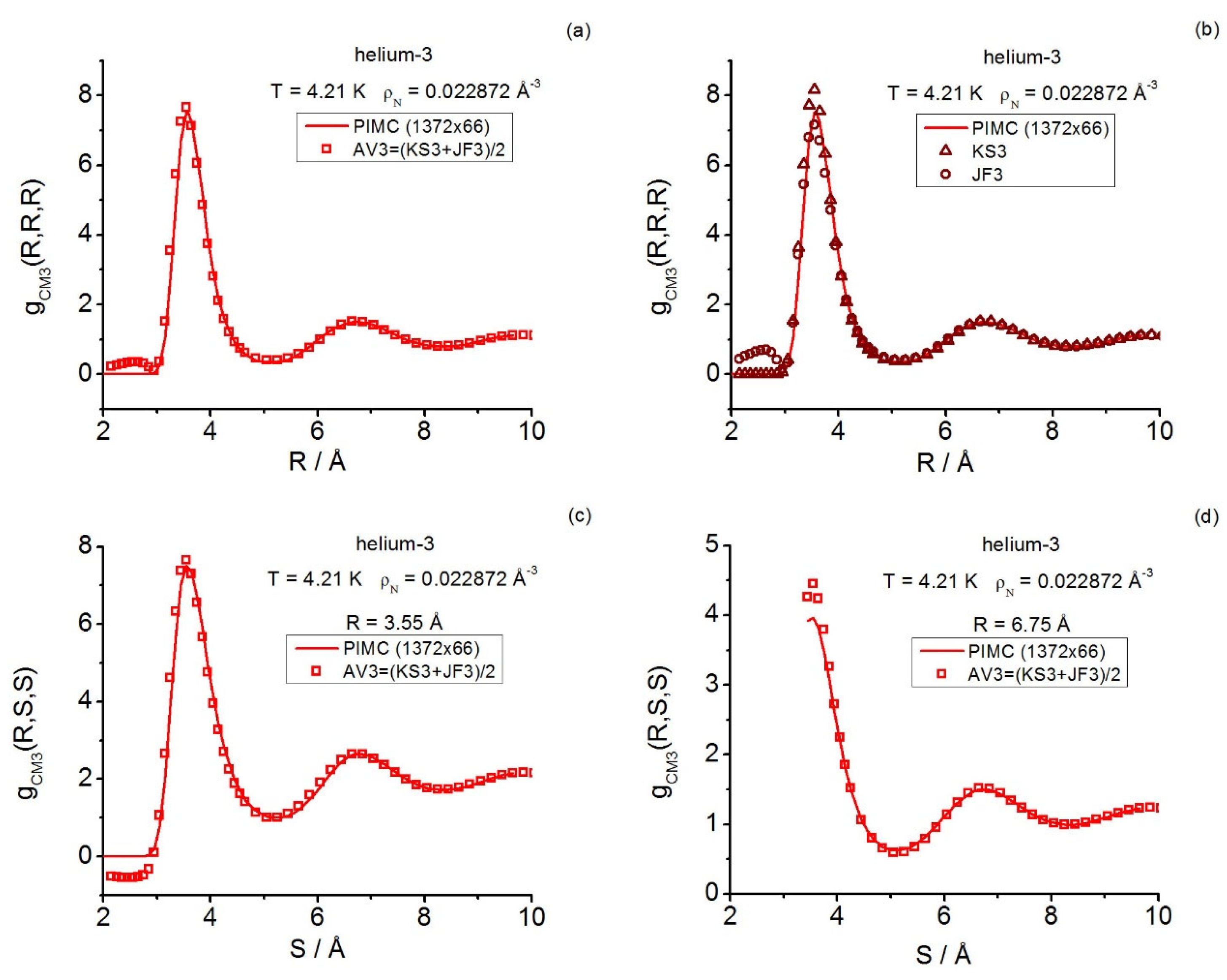
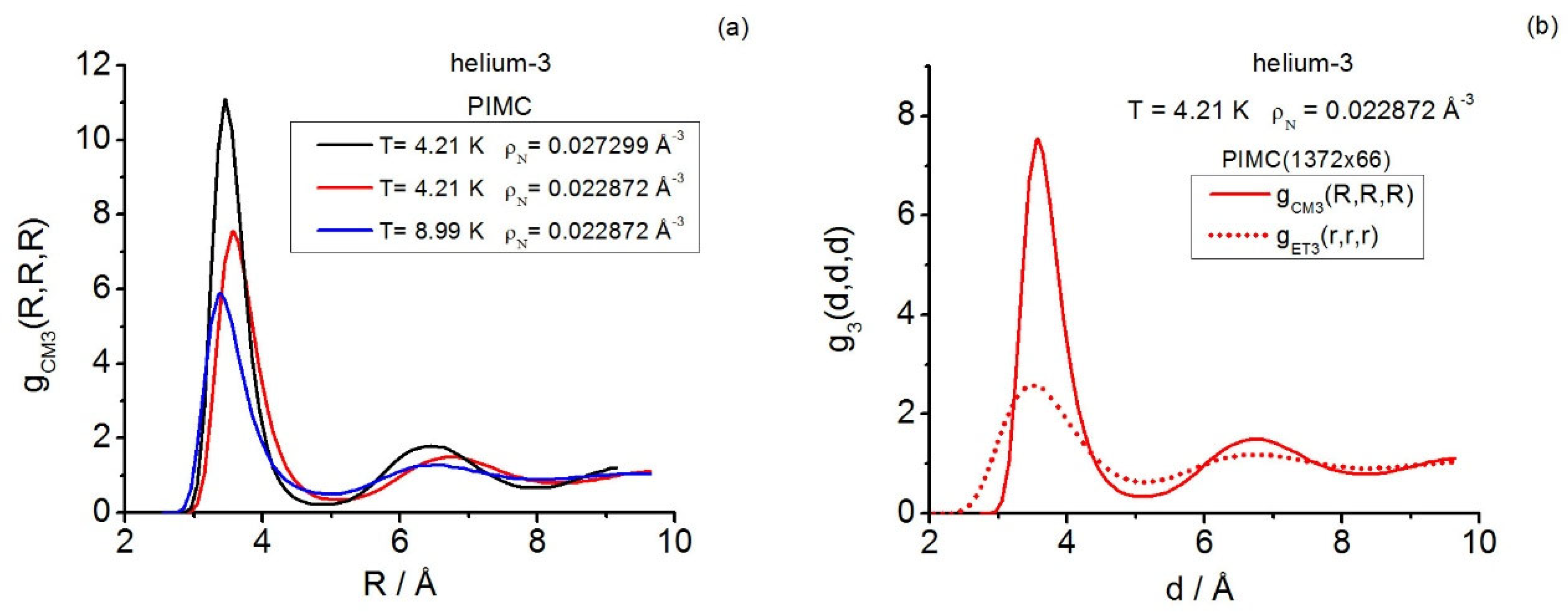
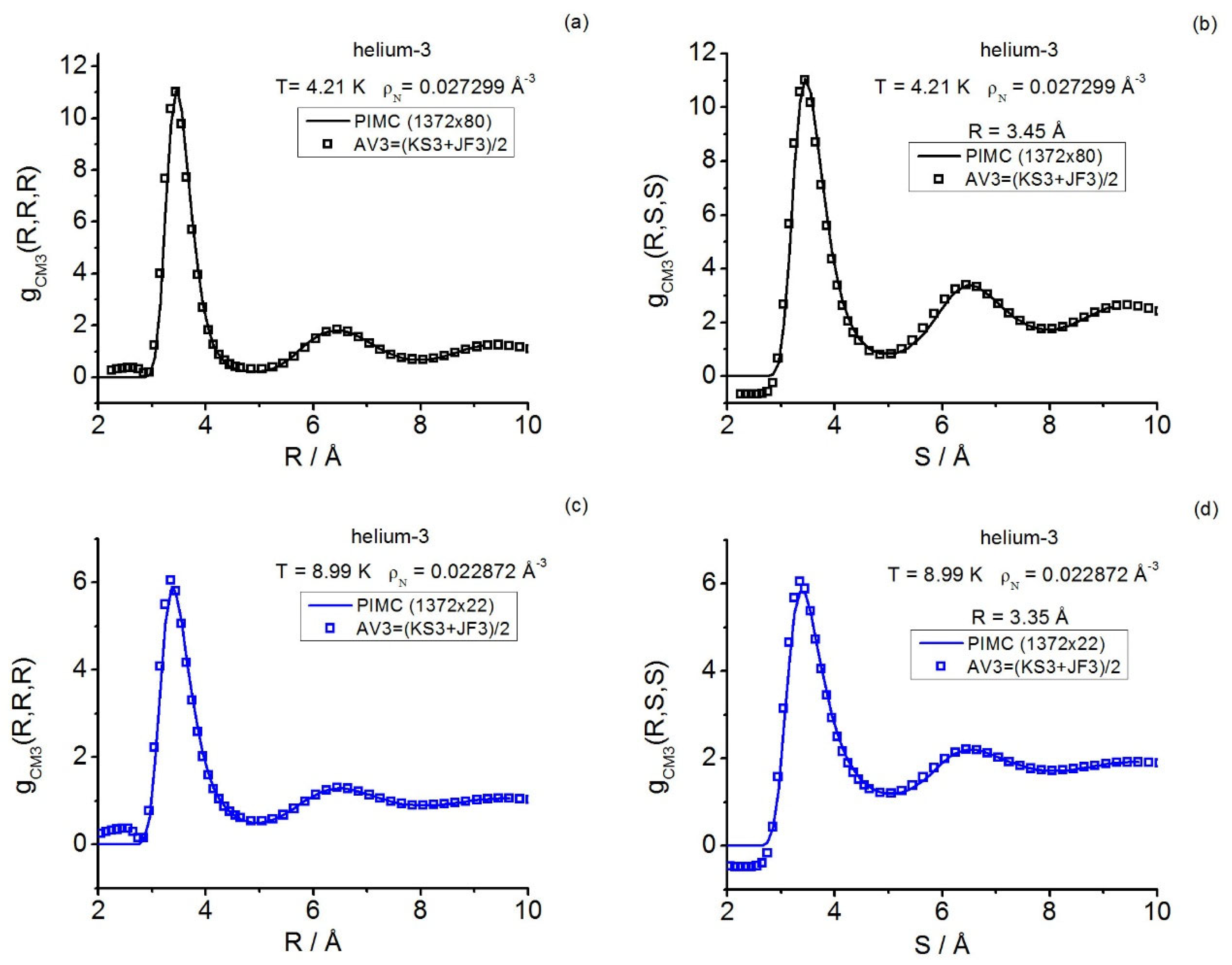
- The correlations, as approximated by the JF3 and AV3 r-space closures, involve the convolution integral included in Equation (33a). Such a convolution can be expanded as a Legendre polynomial series [29,43,45]; truncation, keeping the first thirty-one terms/polynomials is utilized The pair radial function at each of the state points (SP1, SP2, and SP3) is used as data input, and the basic distance spacings for tabulating the triplet correlations are taken equal to 0.1
- (ii)
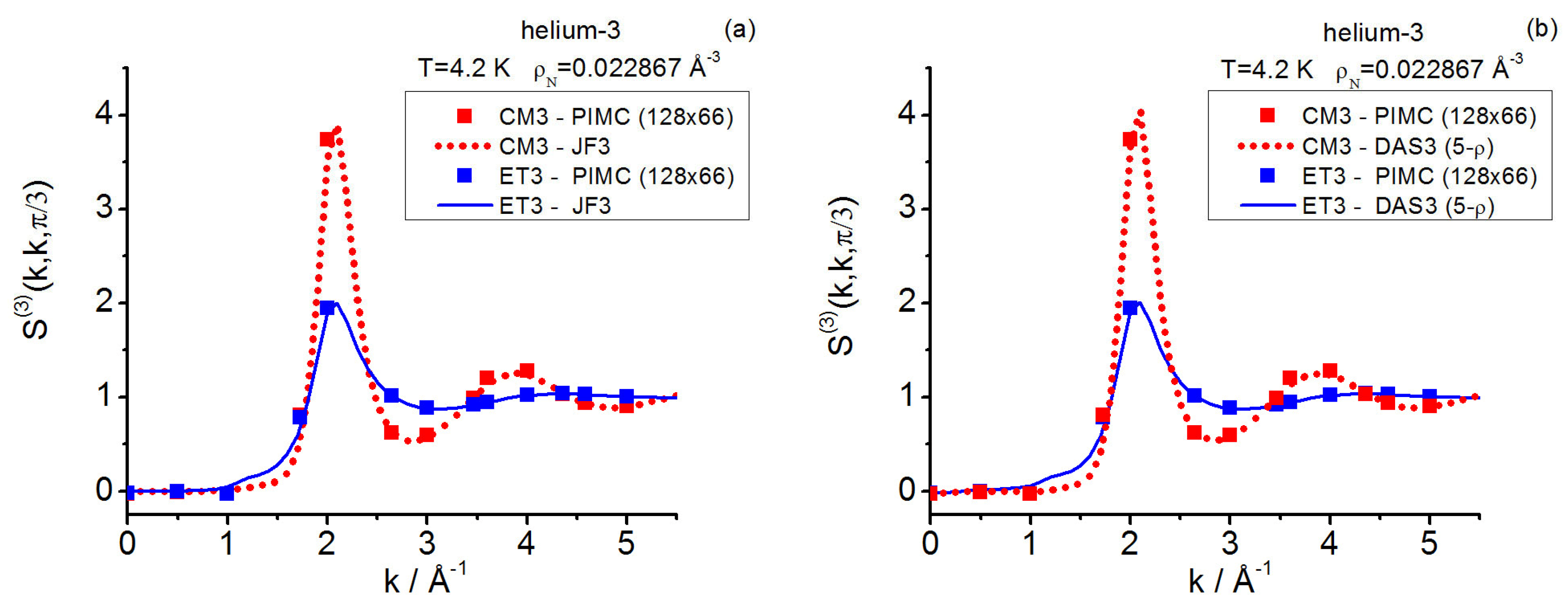
- The pair structure factors and related to the helium-3 calculations are needed. In relation to this, OZ2 treatments apply BDH+BHw (5 iterations) to the pair radial structures obtained with PIMC [96] (see Reference [35] for calculations of at SP1, SP2, and SP3). However, for the triplet structure factors at SP4, the closure JF3 only requires the pair structure factors at this state point; DAS3 closure calculations do need their corresponding OZ2 direct correlation functions at the neighboring four state points to fix the corresponding isothermal density derivatives. The basic information on SP4 at the pair level is taken from the helium-3 study reported in Reference [96]. With regard to all these questions, the following OZ2-related information is worth giving here.
- (a)
- At SP1, is 0.005288 for CM2 , 0.005202 for ET2 , with 0.005715 being the experimental value.
- (b)
- At SP2, is 0.002401 for CM2 , 0.002844 for ET2 , with 0.002383 being the experimental value.
- (c)
- At SP3, is 0.005526 for CM2 , 0.005552 for ET2 , with 0.005003 being the experimental value.
- (iii)
- The isothermal density derivatives at SP4 needed for the k-space DAS3 calculations (CM3 and ET3) can be calculated through Richardson extrapolation [136], using four selected functions, one per each of the auxiliary state points about SP4 and the uniform density spacing ) [96]. By taking advantage of such uniform spacing, this algorithm reads as follows:where, for a given density spacing the simple Stirling numerical estimates are given by the following:
- (iv)
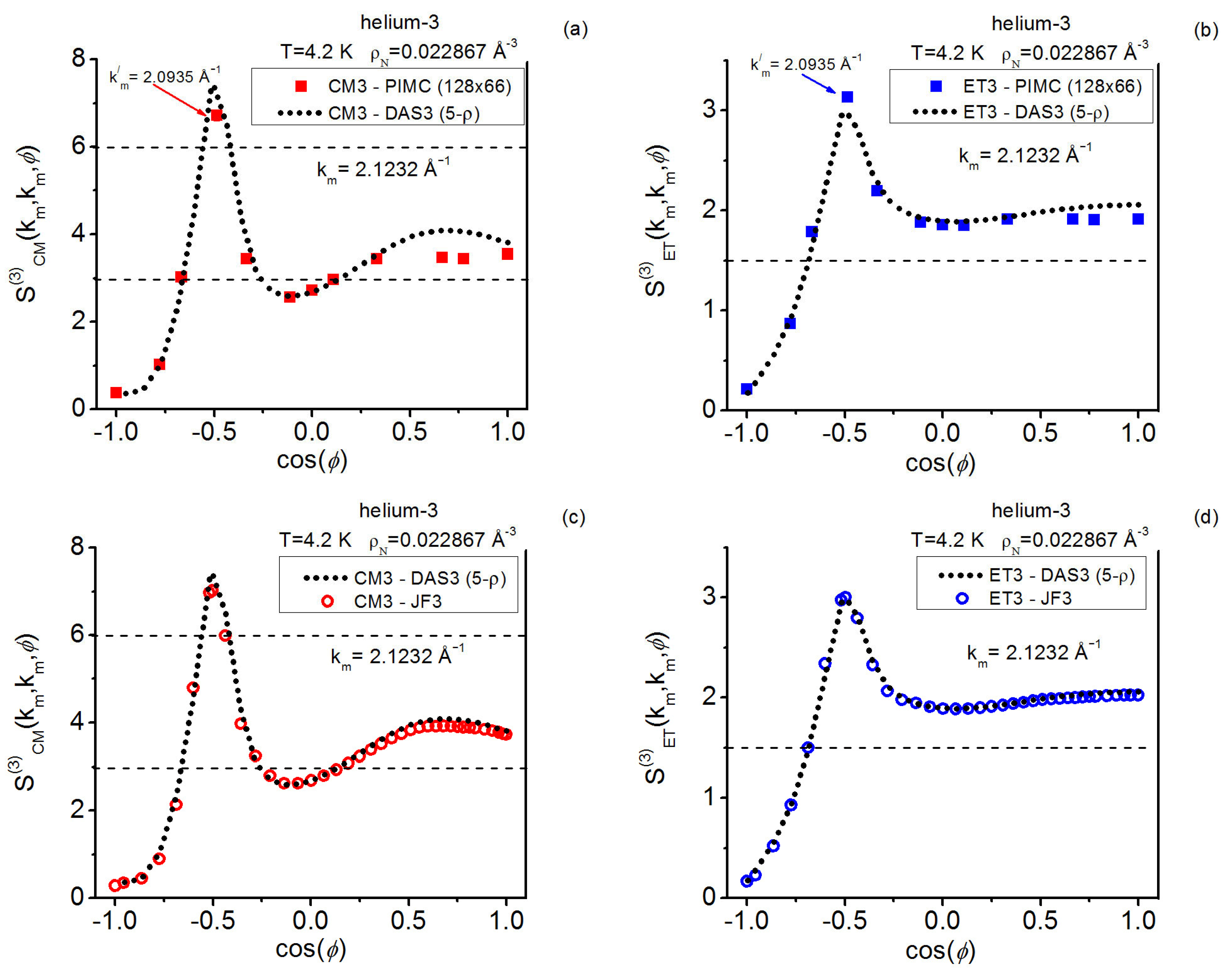
- The basic wavenumber spacings for tabulating the components calculated with the closures are taken equal to 0.1 The evaluations of the double-zero momentum transfer quantities are carried out through Equation (37b) for the centroid cases using and its analogous (approximate) relationship for the instantaneous cases using Richardson extrapolations akin to Equation (38a) are employed for the density derivatives of the pair structure factor values. Alternatively, these quantities can be evaluated using the direct method based on the values, Equations (20b) and (38a), etc. These two different methods, (i.e., based on or are theoretically equivalent, although their numerical estimates may show slight differences because of the underlying density dependence of the input functions.
5.3.2. QHS
- (i)
- For DAS3 calculations, the auxiliary QHS pair structural quantities needed are obtained via application of OZ2 to the PIMC pair radial structures fixed in this work; applications of BDH+BHw (5- iterations) to the centroid structures, and of BDH alone to the instantaneous structures, are made. As mentioned earlier, OZ2 for the instantaneous correlations is an approximation, and the related application of the simplified BHw procedure in the region of the fluid–solid change of phase leads to unclear numerical behaviors of the iterations [97]. That is why BHw iterations are not included in the instantaneous analysis at any QHS state point. Whether more advanced grand canonical corrections [127] might cope with this drawback remains to be investigated. (Recall that for the JF3 application at a given state point only its pair structure factor is needed).
- (ii)
- The DAS3 isothermal density derivatives for the cases CM3 and ET3 are calculated through the two-point differentiation Equation (38b) (calculations at state points QHS1, QHS2, and QHS3). This involves the functions obtained via OZ2, i.e., those arising from the sequences about each QHS state point investigated ( constant; basic density spacing or in reduced units). For each state point on the crystallization line, one representative solution of the foregoing CM2 or the ET2 sequences, is selected from the respective regions of significant convergence. The pair structure factors so fixed at the state points QHS1, QHS2, and QHS3 are employed in the final calculation of their triplet structure factors.
- (a)
- About QHS1, and
- (b)
- About QHS2, and
- (c)
- About QHS3, and
- (iii)
- As a complementary test, extended DAS3 calculations are carried out at QHS1 using five densities. On the isothermal fluid branch the state points about QHS1 at densities are also studied at the pair level with PIMC and OZ2. The procedures for fixing the necessary CM2 and ET2 properties are the same as those described earlier, and the impact of this extension on the DAS3 results is discussed in the next Section.
6. Results and Discussion
6.1. Helium-3 Triplet Results in Real r-Space
6.2. Helium-3 Triplet Results in Fourier k-Space
- (a)
- Method Equation (37b) and its instantaneous analog,and
- (b)
- Method Equation (20b) and its instantaneous analog,and
6.3. QHS Triplet Results in Fourier k-Space
- (i)
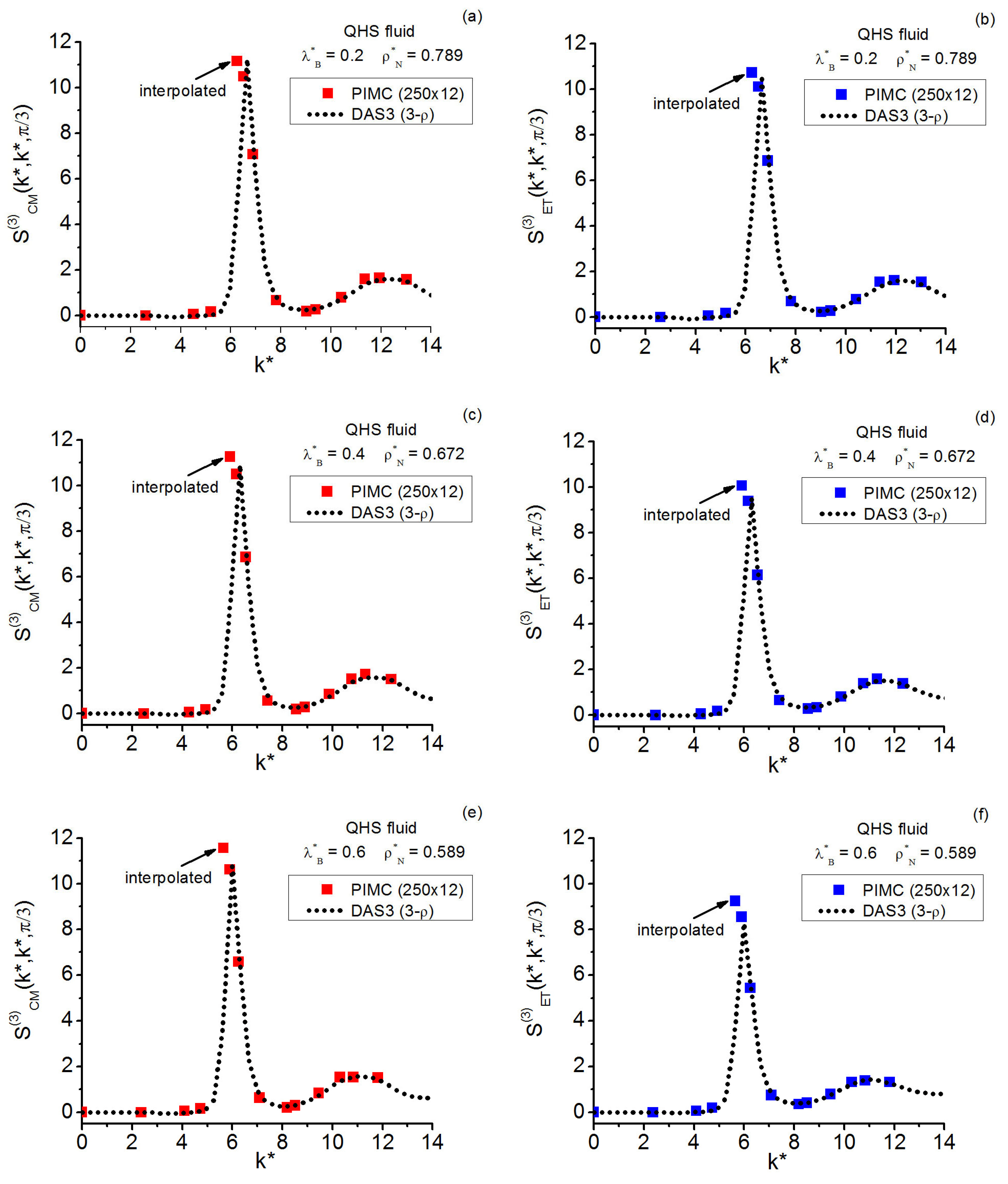
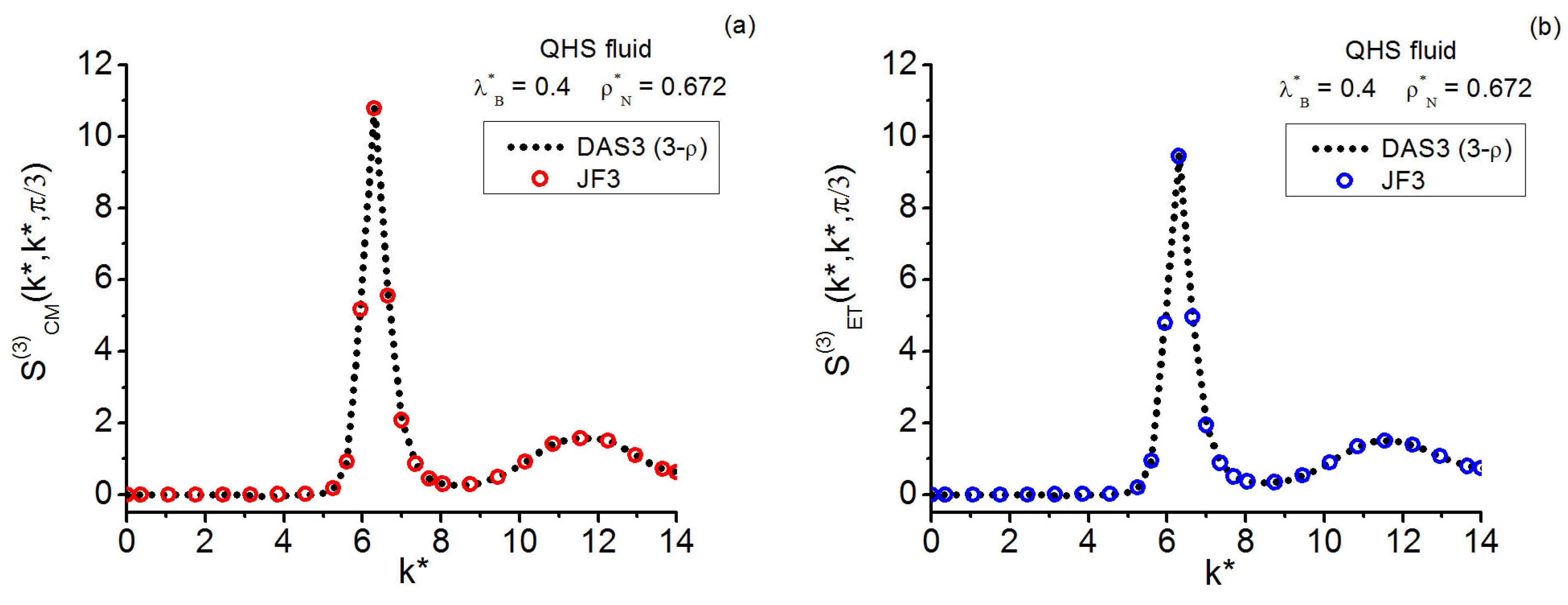
- As compared to PIMC, the graphs indicate that DAS3 and JF3 appear to be slightly shifted towards larger wavenumbers (see also the Supplementary Material). The differences between DAS3 and JF3 are most noticeable within the low -wavenumber region, since DAS3 gives negative values, whereas JF3 cannot yield that behavior. Despite the inaccuracies in the closure results, their current representations of the triplet structure factors turn out to be very valuable approximations to PIMC results. In the behavior of the equilateral components calculated with closures, JF3 takes over as increases (JF3 appears to yield a limit behavior).
- (ii)
- From the graphs, one can observe at each state point that the triplet structure factor components show more pronounced features in the centroid cases than in the instantaneous cases. Furthermore, as the quantum effects increase (i.e., larger QHS1 < QHS2 < QHS3), one observes that the CM3-ET3 differences increase, and the structures are shifted towards lower wavenumbers. All of these traits are consistent with their analogs at the pair level when comparison of and is made [97].
- (iii)
- As regards the centroid absolute maxima that can be derived from the equilateral PIMC results, if one uses a simple quadratic fitting of the mean amplitudes in the related regions, the obtained values hint (once again [33]) at the existence of a “constancy” in the maximal centroid equilateral amplitudes . The related centroid estimates turn out to be (a) 11.153 (QHS1), (b) 11.259 (QHS2), and (c) 11.559 (QHS3). Roughly speaking, this would amount to having an interval for the absolute maxima of the equilateral centroid components of the QHS model, which could be applicable within the present range of conditions investigated.
- (iv)
- The foregoing centroid pilot result might be related to a hypothetical maximal -constancy for real systems that, because of the existence of triple point, show a liquid–solid coexistence line bounded from below in the plane (e.g., para-hydrogen, neon) [32,33,137,138]. However, to ascertain this question, one should carefully analyze the following issues:
- (a)
- The combined effects of a more exhaustive PI sampling, seeking to reduce the present error bars , and a closer spacing for the fixing of the interpolating points; the sets of commensurate wave vectors should also include general triangular geometries.
- (b)
- (c)
- (v)
- In relation to the instantaneous maximal equilateral components by quadratically fitting the PIMC data, as performed in the centroid case, one obtains the maximal amplitude estimates: 10.724 (QHS1), 10.060 (QHS2), and 9.238 (QHS3). Therefore, these maxima appear to decrease monotonically with increasing quantum effects. Regardless of the magnitude of the error bars and of the spacing available for defining these maximum regions, this behavior agrees with the general pattern of less-structured instantaneous functions arising when going from higher to lower temperatures and densities (QHS1 to QHS3) [33,34,97].
- (vi)
- The existence of equilateral negative values for low wavenumbers is an observable fact for both classes of components, and From the current calculations, PIMC results show just a glimpse of this behavior for (Table 3), whilst DAS3 gives such a behavior within larger ranges, which go from at QHS1-CM3 to at QHS3-ET3 Furthermore, the double-zero momentum transfer components turn out to be negative, with the exception of the estimate at QHS1. (See the Supplementary Material for illustrative results at QHS1).
- (vii)
- Given that density-differentiation algorithms that are more accurate than Equation (38b) can influence greatly the final estimates, particularly in situations involving zero-momentum transfers (i.e., values this point deserves further consideration. Thus, it is worth noting that the additional DAS3 five-point closure calculations at QHS1, based on Equation (38a), do not show qualitative alterations in the magnitude of the foregoing CM3 and ET3 ranges of negative values resulting from Equation (38b). However, the use of Equation (38a) yields at QHS1: and which are to be compared with the entries in Table 3 at QHS1: and 0.00005, respectively. (Recall that the calculation of the exact -component is obtained through the CM3 scheme). Finally, for completeness, the effect of the differentiation algorithm on DAS3 results becomes less important as increases, which can be observed within the maximal amplitude regions For example, at QHS1 for :
- (a)
- use of Stirling Equation (38b) yields , whilst use of Richardson Equation (38a) yields
- (b)
- use of Stirling Equation (38b) yields , whilst use of Richardson Equation (38a) yields
6.4. Further Comments and General Connections
7. Conclusions
Supplementary Materials
Funding
Institutional Review Board Statement
Informed Consent Statement
Data Availability Statement
Acknowledgments
Conflicts of Interest
Appendix A
Appendix A.1. Quantum Operator Manipulations
Appendix A.2. Functional Derivatives and Centroid Linear Response
Appendix A.3. OZ3 Equations for the Instantaneous Case
References
- Feynman, R.P.; Hibbs, A.R. Quantum Mechanics and Path Integrals; McGraw-Hill: New York, NY, USA, 1965; ISBN 0-07-020650-3. [Google Scholar]
- Feynman, R.P. Statistical Mechanics; Benjamin/Cummings: Reading, MA, USA, 1972; ISBN 0-8053-2509-3. [Google Scholar]
- Trotter, M.F. Approximation of Semi-Groups of Operators. Pac. J. Math. 1958, 8, 887–919. [Google Scholar] [CrossRef]
- Chandler, D.; Wolynes, P.G. Exploiting the Isomorphism Between Quantum Theory and Classical Statistical Mechanics of Polyatomic Fluids. J. Chem. Phys. 1981, 74, 4078–4095. [Google Scholar] [CrossRef]
- Singer, K.; Smith, W. Path Integral Simulations of Condensed Phase Lennard-Jones Systems. Mol. Phys. 1988, 64, 1215–1231. [Google Scholar] [CrossRef]
- Melrose, J.R.; Singer, K. An Investigation of Supercooled Lennard-Jones Argon by Quantum Mechanical and Classical Monte Carlo Simulations. Mol. Phys. 1989, 66, 1203–1214. [Google Scholar] [CrossRef]
- Ramírez, R.; Herrero, C.P.; Antonelli, A.; Hernández, E.R. Path Integral Calculation of Free Energies: Quantum Effects on the Melting Temperature of Neon. J. Chem. Phys. 2008, 129, 064110. [Google Scholar] [CrossRef]
- Scharf, D.; Martyna, G.J.; Klein, M.L. Structure and Energetics of Fluid Para-Hydrogen. Low Temp. Phys. 1993, 19, 364–367. [Google Scholar] [CrossRef]
- Ceperley, D.M. Path Integrals in the Theory of Condensed Helium. Rev. Mod. Phys. 1995, 67, 279–355. [Google Scholar] [CrossRef]
- Grüter, P.; Ceperley, D.; Laloë, F. Critical Temperature of Bose-Einstein Condensation of Hard-Sphere Gases. Phys. Rev. Lett. 1997, 79, 3549–3552. [Google Scholar] [CrossRef]
- Boninsegni, M.; Prokof’ev, N.V.; Svistunov, B.V. Worm Algorithm and Diagrammatic Monte Carlo: A New Approach to Continuous-Space Path Integral Monte Carlo Simulations. Phys. Rev. E 2006, 74, 036701. [Google Scholar] [CrossRef]
- Jang, S.; Jang, S.; Voth, G.A. Applications of Higher-Order Composite Factorization Schemes in Imaginary Time Path Integral Simulations. J. Chem. Phys. 2001, 115, 7832–7842. [Google Scholar] [CrossRef]
- Pérez, A.; Tuckerman, M.E. Improving the Convergence of Closed and Open Path Integral Molecular Dynamics Via Higher-Order Trotter Factorization Schemes. J. Chem. Phys. 2011, 135, 064104. [Google Scholar] [CrossRef] [PubMed]
- Sesé, L.M. Path Integrals and Effective Potentials in the Study of Monatomic Fluids at Equilibrium. In Advances in Chemical Physics; Rice, S.A., Dinner, A., Eds.; Wiley: Hoboken, NJ, USA, 2016; Volume 160, pp. 49–158. [Google Scholar] [CrossRef]
- Filinov, V.S.; Syrovatka, R.A.; Levashov, P.R. Exchange-Correlation Bound States of the Triplet Soft-Sphere Fermions by Path Integral Monte Carlo Simulations. Phys. Rev. E 2023, 108, 024136. [Google Scholar] [CrossRef] [PubMed]
- Filinov, V.; Levashov, P.; Larkin, A. Wigner Path Integral Representation of the Density of States. Monte Carlo Simulation of Plasma Media. J. Stat. Phys. 2025, 192, 125. [Google Scholar] [CrossRef]
- Jackson, H.W.; Feenberg, E. Energy Spectrum of Elementary Excitations in Helium II. Rev. Mod. Phys. 1962, 34, 686–693. [Google Scholar] [CrossRef]
- Feenberg, E. Theory of Quantum Fluids; Academic Press: New York, NY, USA, 1969; Library of Congress Catalog Card Number 75-84249. [Google Scholar]
- Sesé, L.M. Contribution to the Statistical Mechanics of Static Triplet Structures in Fluids with Quantum Spinless Behavior. Quantum Rep. 2024, 6, 564–626. [Google Scholar] [CrossRef]
- Egelstaff, P.A. The Structure of Simple Liquids. Annu. Rev. Phys. Chem. 1973, 24, 159–187. [Google Scholar] [CrossRef]
- Lovesey, S.W. Theory of Neutron Scattering from Condensed Matter; Clarendon Press: Oxford, UK, 1984; Volume 1, ISBN 0-19-852028-X. [Google Scholar]
- Hallock, R.B. X-Ray Scattering from Gaseous 3He and 4He at Small Momentum Transfer. Phys. Rev. A 1973, 8, 2143–2159. [Google Scholar] [CrossRef]
- Woods, A.D.B.; Svensson, E.C.; Martel, P. The Dynamic Structure Factor of 4He at 4.2 K. In Low Temperature Physics-LT14; Krusius, M., Vuorio, M., Eds.; North-Holland: Amsterdam, The Netherlands, 1975; Volume 1, pp. 187–190. ISBN 978-0-720-49301-6. [Google Scholar]
- Svensson, E.C.; Sears, V.F.; Woods, A.D.B.; Martel, P. Neutron Diffraction Study of the Static Structure Factor and Pair Correlations in Liquid 4He. Phys. Rev. B 1980, 21, 3638–3651. [Google Scholar] [CrossRef]
- Kirkwood, J.G. Statistical Mechanics of Fluid Mixtures. J. Chem. Phys. 1935, 3, 300–313. [Google Scholar] [CrossRef]
- Hill, T.L. Statistical Mechanics; McGraw-Hill/Dover: New York, NY, USA, 1987; ISBN 0-486-65390-0. [Google Scholar]
- Hansen, J.P.; McDonald, I.R. Theory of Simple Liquids; Academic Press: London, UK, 1976; ISBN 0-12-323850-1. [Google Scholar]
- Balescu, R. Equilibrium and Nonequilibrium Statistical Mechanics; John Wiley & Sons: New York, NY, USA, 1975; ISBN 0-471-04600-0. [Google Scholar]
- Sesé, L.M. Triplet Correlations in the Quantum Hard-Sphere Fluid. J. Chem. Phys. 2005, 123, 104507. [Google Scholar] [CrossRef]
- Sesé, L.M. Computational Study of the Structures of Gaseous Helium-3 at Low Temperature. J. Phys. Chem B 2008, 112, 10241–10254. [Google Scholar] [CrossRef]
- Sesé, L.M. A Study of the Pair and Triplet Structures of the Quantum Hard-Sphere Yukawa Fluid. J. Chem. Phys. 2009, 130, 074504. [Google Scholar] [CrossRef]
- Sesé, L.M. On Static Triplet Structures in Fluids with Quantum Behavior. J. Chem. Phys. 2018, 148, 102312. [Google Scholar] [CrossRef]
- Sesé, L.M. Computation of Static Quantum triplet Structure Factors of Liquid Para-Hydrogen. J. Chem. Phys. 2018, 149, 124507. [Google Scholar] [CrossRef]
- Sesé, L.M. Real Space Triplets in Quantum Condensed Matter: Numerical Experiments Using Path Integrals, Closures and Hard Spheres. Entropy 2020, 22, 1338. [Google Scholar] [CrossRef]
- Sesé, L.M. A Glimpse into Quantum Triplet Structures in Supercritical 3He. Entropy 2023, 25, 283. [Google Scholar] [CrossRef]
- Abe, R. On the Kirkwood Superposition Approximation. Prog. Theor. Phys. 1959, 21, 421–430. [Google Scholar] [CrossRef][Green Version]
- Lebowitz, J.L.; Percus, J.K. Statistical Thermodynamics of Nonuniform Fluids. J. Math. Phys. 1963, 4, 116–123. [Google Scholar] [CrossRef]
- Baxter, R.J. Direct Correlation Functions and Their Derivatives with Respect to Particle Density. J. Chem. Phys. 1964, 41, 553–558. [Google Scholar] [CrossRef]
- Egelstaff, P.A.; Page, D.I.; Heard, C.R.T. Experimental Study of the Triplet Correlation Function for Simple Liquids. Phys. Lett. 1969, 30A, 376–377. [Google Scholar] [CrossRef]
- Lee, L.L. Correlation Functions of Classical Fluids III. The Method of Partition Function Variations Applied to the Chemical Potential Cases of PY and HNC2. J. Chem. Phys. 1974, 60, 1197–1207. [Google Scholar] [CrossRef]
- Tanaka, M.; Fukui, Y. Simulation of the Three-Particle Distribution Function in a Long-Range Oscillatory Potential Liquid. Prog. Theor. Phys. 1975, 53, 1547–1565. [Google Scholar] [CrossRef][Green Version]
- Evans, R. The Nature of the Liquid-Vapour Interface and other Topics in the Statistical Mechanics of Non-Uniform, Classical Fluids. Adv. Phys. 1979, 28, 143–200. [Google Scholar] [CrossRef]
- Haymet, A.D.J.; Rice, S.A. An Accurate Integral Equation for the Pair and Triplet Distribution Functions of a Simple Liquid. J. Chem. Phys. 1981, 74, 3033–3041. [Google Scholar] [CrossRef]
- Curtin, W.A.; Ashcroft, N.W. Weighted-Density-Functional Theory of Inhomogeneous Liquids and the Freezing Transition. Phys. Rev. A 1985, 32, 2909–2919. [Google Scholar] [CrossRef] [PubMed]
- Barrat, J.L.; Hansen, J.P.; Pastore, G. On the Equilibrium Structure of Dense Fluids. Triplet Correlations, Integral Equations and Freezing. Mol. Phys. 1988, 63, 747–767. [Google Scholar] [CrossRef]
- Allen, M.P.; Tildesley, D.J. Computer Simulation of Liquids; Clarendon Press: Oxford, UK, 1989; ISBN 0-19-855645-4. [Google Scholar]
- Denton, A.R.; Ashcroft, N.W. High-Order Direct Correlation Functions of Uniform Classical Liquids. Phys. Rev. A 1989, 39, 426–429. [Google Scholar] [CrossRef] [PubMed]
- Baranyai, A.; Evans, D.J. Three-Particle Contribution to the Configurational Entropy of Simple Fluids. Phys. Rev. A 1990, 42, 849–857. [Google Scholar] [CrossRef]
- Evans, R. Density Functionals in the Theory of Nonuniform Fluids. In Fundamentals of Homogeneous Fluids; Henderson, D.A., Ed.; Marcel Dekker: New York, NY, USA, 1992; Chapter 3; pp. 85–175. ISBN 0-8247-8711-0. [Google Scholar]
- Bildstein, B.; Kahl, G. Triplet Correlation functions for Hard Spheres: Comparison of different Approaches. Phys. Rev. E. 1993, 47, 1712–1726. [Google Scholar] [CrossRef]
- Bildstein, B.; Kahl, G. Triplet Correlation functions for Hard Spheres: Computer Simulation Results. J. Chem. Phys. 1994, 100, 5882–5893. [Google Scholar] [CrossRef]
- Jorge, S.; Kahl, G.; Lomba, E.; Abascal, J.L.F. On the triplet Structure Factor of Binary Liquids. J. Chem. Phys. 2000, 113, 3302–3309. [Google Scholar] [CrossRef]
- Sciortino, F.G.; Kob, W. Debye-Waller Factor of Liquid Silica: Theory and Simulation. Phys. Rev. Lett. 2001, 86, 648–651. [Google Scholar] [CrossRef]
- Frenkel, D.; Smit, B. Understanding Molecular Simulation; Academic Press: San Diego, CA, USA, 2002; ISBN 0-12-267351-4. [Google Scholar]
- Jorge, S.; Lomba, E.; Abascal, J.L.F. Theory and Simulation of the Triplet Structure Factor and Triplet Direct Correlation Functions in Binary Mixtures. J. Chem. Phys. 2002, 116, 730–736. [Google Scholar] [CrossRef][Green Version]
- Ho, H.M.; Lin, B.; Rice, S.A. Three-Particle Correlation Functions of Quasi-Two-Dimensional One-Component and Binary Colloid Suspensions. J. Chem. Phys. 2006, 125, 184715. [Google Scholar] [CrossRef]
- Coslovich, D. Static Triplet Correlations in Glass-forming Liquids: A Molecular dynamics Study. J. Chem. Phys. 2013, 138, 12A539. [Google Scholar] [CrossRef]
- Götze, W. Complex Dynamics of Glass-Forming Liquids; Oxford University Press: Oxford, UK, 2012; ISBN 978-0-19-965614-1. [Google Scholar]
- Nguyen, M.-T.; Monchiet, V.; Bonnet, G.; To, Q.D. Conductivity Estimates of Spherical-Particle Suspensions Based on Triplet Structure Factors. Phys. Rev. E 2016, 93, 022105. [Google Scholar] [CrossRef] [PubMed]
- Raveché, H.J.; Mountain, R.D. Structure Studies in Liquid 4He. Phys. Rev A 1974, 9, 435–447. [Google Scholar] [CrossRef]
- Montfrooij, W.; de Graaf, L.A.; van den Bosch, P.J.; Soper, A.K.; Howells, W.S. Density and Temperature Dependence of the Structure Factor of Dense Fluid Helium. J. Phys. Condens. Matter 1991, 3, 4089–4096. [Google Scholar] [CrossRef]
- Markland, T.E.; Morrone, J.A.; Miyazaki, K.; Berne, B.J.; Reichman, D.; Rabani, E. Theory and Simulation of Quantum Glass Forming Liquids. J. Chem. Phys. 2012, 136, 074511. [Google Scholar] [CrossRef]
- Schiff, D.; Verlet, L. Ground State of Liquid Helium-4 and Helium-3. Phys. Rev. 1967, 160, 208–218. [Google Scholar] [CrossRef]
- Ceperley, D.M.; Chester, G.V.; Kalos, M.H. Monte Carlo Simulation of a Many-Body Fermion Study. Phys. Rev. B 1977, 16, 3081–3099. [Google Scholar] [CrossRef]
- Dobbs, E.R. Solid Helium Three; Oxford University Press: Oxford, UK, 1994; ISBN 0-19-851382-8. [Google Scholar]
- Kleinert, H. Path Integrals in Quantum Mechanics, Statistics, and Polymer Physics; World Scientific: Singapore, 1995; ISBN 981-02-1472-3. [Google Scholar]
- Wigner, E.P. On the Quantum Correction for Thermodynamic Equilibrium. Phys. Rev. 1932, 40, 749–759. [Google Scholar] [CrossRef]
- Moyal, J.E. Quantum Mechanics as a Statistical Theory. Proc. Cambridge Phil. Soc. 1949, 45, 99–124. [Google Scholar] [CrossRef]
- Hillery, M.; O’Connell, R.F.; Scully, M.O.; Wigner, E.P. Distribution Functions in Physics: Fundamentals. Phys. Rep. 1984, 106, 121–167. [Google Scholar] [CrossRef]
- Ceperley, D.M. Path-Integral Calculations of Normal Liquid 3He. Phys. Rev. Lett. 1992, 69, 331–334. [Google Scholar] [CrossRef]
- Boninsegni, M.; Ceperley, D.M. Path Integral Monte Carlo Simulation of Isotopic Liquid Helium Mixtures. Phys. Rev. Lett. 1995, 74, 2288–2291. [Google Scholar] [CrossRef]
- Ruggeri, M.; Moroni, S.; Boninsegni, M. Quasi-2D Liquid 3He. Phys. Rev. Lett. 2013, 111, 045303. [Google Scholar] [CrossRef]
- Boninsegni, M. Momentum Distribution of He-3 in One Dimension. Int. J. Mod. Phys. B 2025, 39, 2550208. [Google Scholar] [CrossRef]
- Berne, B.J.; Thirumalai, D. On the Simulation of Quantum Systems: Path Integral Methods. Annu. Rev. Phys. Chem. 1986, 37, 401–424. [Google Scholar] [CrossRef]
- Herman, M.F.; Bruskin, E.J.; Berne, B.J. On Path Integral Monte Carlo Simulations. J. Chem. Phys. 1982, 76, 5150–5155. [Google Scholar] [CrossRef]
- Cao, J.; Berne, B.J. A New Quantum Propagator for Hard-Sphere and Cavity Systems. J. Chem. Phys. 1992, 97, 2382–2385. [Google Scholar] [CrossRef]
- Yvon, J. Note sur un Calcul de Perturbation en Mécanique Statistique. Suppl. Nuovo C. 1958, 9, 144–151. [Google Scholar] [CrossRef]
- Sesé, L.M. The Compressibility Theorem for Quantum Simple Fluids at Equilibrium. Mol. Phys. 2003, 101, 1455–1468. [Google Scholar] [CrossRef]
- Sesé, L.M. Static Structures in Monatomic Fluids. Encyclopedia 2025, 5, 141. [Google Scholar] [CrossRef]
- López-Ciudad, T.; Ramírez, R. Spectral Decomposition and Bloch Equation of the Operators Represented by Fixed-Centroid Path Integrals. J. Chem. Phys. 2000, 113, 10849–10860. [Google Scholar] [CrossRef]
- Sesé, L.M. On the Accurate Direct Computation of the Isothermal Compressibility for Normal Quantum Simple Fluids: Application to Quantum Hard Spheres. J. Chem. Phys. 2012, 136, 244504. [Google Scholar] [CrossRef]
- Sesé, L.M. Path-Integral Monte Carlo Study of Quantum Hard-Sphere Solids. J. Chem. Phys. 2013, 139, 0440502. [Google Scholar] [CrossRef]
- Steinhardt, P.; Nelson, D.R.; Ronchetti, M. Bond-Orientational Order in Liquids and Glasses. Phys. Rev. B 1983, 28, 784–805. [Google Scholar] [CrossRef]
- Sesé, L.M. Feynman-Hibbs Quantum Effective Potentials for Monte Carlo Simulations of Liquid Neon. Mol. Phys. 1993, 78, 1167–1177. [Google Scholar] [CrossRef]
- Sesé, L.M. An Application of the Self-Consistent Variational Effective Potential Against the Path Integral to Compute Equilibrium Properties of Quantum Simple Fluids. Mol. Phys. 1999, 97, 881–896. [Google Scholar] [CrossRef]
- Blinov, N.; Roy, P.-N. Connection Between the Observable and Centroid Structural Properties of a Quantum Fluid: Application to Liquid Para-Hydrogen. J. Chem. Phys. 2004, 120, 3759–3764. [Google Scholar] [CrossRef] [PubMed]
- Roy, P.-N.; Jang, S.; Voth, G.A. Feynman Path Centroid Dynamics for Fermi Dirac Statistics. J. Chem. Phys. 1999, 111, 5303–5305. [Google Scholar] [CrossRef]
- Blinov, N.; Roy, N.-P.; Voth, G.A. Path Integral Formulation of Centroid Dynamics for Systems Obeying Bose-Einstein Statistics. J. Chem. Phys. 2001, 115, 4484–4495. [Google Scholar] [CrossRef]
- Blinov, N.; Roy, P.-N. Operator Formulation of Centroid Dynamics for Bose-Einstein and Fermi-Dirac Statistics. J. Chem. Phys. 2001, 115, 7822–7831. [Google Scholar] [CrossRef]
- Cao, J.; Voth, G.A. The formulation of Quantum Statistical Mechanics Based on the Feynman Path Centroid Density. I. Equilibrium Properties. J. Chem. Phys. 1994, 100, 5093–5105. [Google Scholar] [CrossRef]
- Cao, J.; Voth, G.A. The formulation of Quantum Statistical Mechanics Based on the Feynman Path Centroid Density. IV. Algorithms for Centroid Molecular Dynamics. J. Chem. Phys. 1994, 101, 6168–6183. [Google Scholar] [CrossRef]
- Voth, G.A. Path- Integral Centroid Methods in Quantum Statistical Mechanics and Dynamics. In Advances in Chemical Physics; Prigogine, I., Rice, S.A., Eds.; John Wiley & Sons: New York, NY, USA, 1996; Volume 93, pp. 135–218. ISBN 0-471-14321-9. [Google Scholar]
- Miura, S.; Okazaki, S.; Kinugawa, K.A. Path-Integral Molecular Dynamics Study of Nonsuperfluid Helium-4. J. Chem. Phys. 1999, 110, 4523–4532. [Google Scholar] [CrossRef]
- Ramírez, R.; López-Ciudad, T.; Noya, J.C. The Feynman Effective Classical Potential in the Schrödinger Formulation. Phys. Rev. Lett. 1998, 81, 3303–3306. [Google Scholar] [CrossRef]
- Sinitskyi, A.V.; Voth, G.A. A Reductionistic Perspective on Quantum Statistical Mechanics: Coarse-Graining of Path Integrals. J. Chem. Phys. 2015, 143, 094104. [Google Scholar] [CrossRef]
- Sesé, L.M. Path Integral and Ornstein-Zernike Computations of Quantum Fluid Structures Under Strong Fluctuations. AIP Adv. 2017, 7, 025204. [Google Scholar] [CrossRef]
- Sesé, L.M. Path Integral and Ornstein-Zernike Studies of Quantum Fluid Structures on the Crystallization Line. J. Chem. Phys. 2016, 144, 094505. [Google Scholar] [CrossRef] [PubMed]
- Suzuki, M. New Scheme of Hybrid Exponential Product Formulas with Applications to Quantum Monte Carlo Simulations. In Computer Simulation Studies in Condensed Matter Physics VIII; Springer Proceedings in Physics; Landau, D.P., Mon, K.K., Schüttler, H.-B., Eds.; Springer: Berlin/Heidelberg, Germany, 1995; Volume 80, pp. 169–174. ISBN 978-3-642-79993-8. [Google Scholar]
- Chin, S.A. Symplectic Integrators from Composite Operator Factorizations. Phys. Lett. A 1997, 226, 344–348. [Google Scholar] [CrossRef]
- Janzen, A.R.; Aziz, R.A. An accurate Potential Energy Curve for Helium Based on Ab-Initio Calculations. J. Chem. Phys. 1997, 107, 914–919. [Google Scholar] [CrossRef]
- Sutcliffe, B.T. Fundamentals of Computational Quantum Chemistry and Molecular Physics. In Computational Techniques in Quantum Chemistry; Diercksen, G.H.F., Sutcliffe, B.T., Veillard, A., Eds.; NATO Advanced Study Institutes Series; Springer: Dordrecht, The Netherlands, 1975; Volume 15, pp. 1–105. ISBN 978-94-010-1815-9. [Google Scholar]
- Martyna, G.J.; Hughes, A.; Tuckerman, M.E. Molecular Dynamics Algorithms for Path Integrals at Constant Pressure. J. Chem. Phys. 1999, 110, 3275–3290. [Google Scholar] [CrossRef]
- Wang, Q.; Johnson, J.K.; Broughton, J.Q. Path Integral Grand Canonical Monte Carlo. J. Chem. Phys. 1997, 107, 5108–5117. [Google Scholar] [CrossRef]
- Normand, J.M. A Lie Group: Rotations in Quantum Mechanics; North-Holland: Amsterdam, The Netherlands, 1980; ISBN 0-444-86125-4. [Google Scholar]
- Takahashi, M.; Imada, M. Monte Carlo Calculation of Quantum Systems. II. Higher Order Corrections. J. Phys. Soc. Japan 1984, 53, 3765–3769. [Google Scholar] [CrossRef]
- Pollock, E.L.; Ceperley, D.M. Simulation of Quantum Many-Body Systems by Path-Integral Methods. Phys. Rev. B 1984, 30, 2555–2568. [Google Scholar] [CrossRef]
- Ceperley, D.M.; Pollock, E.L. Path-Integral Computation of the Low Temperature Properties of Liquid 4He. Phys. Rev. Lett. 1986, 56, 351–354. [Google Scholar] [CrossRef]
- Boninsegni, M. Permutational Sampling in Path Integral Monte Carlo. J. Low Temp. Phys. 2005, 141, 27–46. [Google Scholar] [CrossRef]
- Neumman, M.; Zoppi, M. Path-Integral Monte Carlo Simulation of the Structure of Deuterium in the Critical Region. Phys. Rev. A 1991, 44, 2474–2483. [Google Scholar] [CrossRef]
- Turnbull, J.; Boninsegni, M. Disorder and the Elusive Superfluid Phase of Para-Hydrogen. Phys. Rev. B 2008, 78, 144509. [Google Scholar] [CrossRef]
- Boninsegni, M. Ground State Phase-Diagram of Para-Hydrogen in One Dimension. Phys. Rev. Lett. 2013, 111, 235303. [Google Scholar] [CrossRef] [PubMed]
- Kinugawa, K. Path-Integral Centroid Molecular Dynamics Study of the Dynamic Structure Factors of Liquid Para-Hydrogen. Chem. Phys. Lett. 1998, 292, 454–460. [Google Scholar] [CrossRef]
- Egelstaff, P.A. Structure and Dynamics of Diatomic Molecular Fluids. Faraday Discuss. Chem. Soc. 1978, 66, 7–26. [Google Scholar] [CrossRef]
- Giachetti, R.; Tognetti, V. Variational Approach to Quantum Statistical Mechanics of Nonlinear Systems with Application to Sine-Gordon Chains. Phys. Rev. Lett. 1985, 55, 912–915. [Google Scholar] [CrossRef]
- Feynman, R.P.; Kleinert, H. Effective Classical Partition Function. Phys. Rev. A 1986, 34, 5080–5084. [Google Scholar] [CrossRef]
- Young, R.A. Theory of Quantum Mechanical Effects on the Thermodynamic Properties of Lennard-Jones Fluids. Phys. Rev. A 1981, 23, 1498–1510. [Google Scholar] [CrossRef]
- Sesé, L.M. Quantum Effects on the Static Structure Factor of Lennard-Jones Fluids. Mol. Phys. 1997, 92, 693–703. [Google Scholar] [CrossRef]
- Jervell, J.G.; Wilhelmsen, ∅. The Limits of Feynman-Hibbs Corrections in Capturing Quantum-Nuclear Contributions to Thermophysical Properties. J. Chem. Phys. 2025, 163, 144503. [Google Scholar] [CrossRef]
- Kirkwood, J.G. Quantum Statistics of Almost Classical Assemblies. Phys. Rev. 1933, 44, 31–37. [Google Scholar] [CrossRef]
- Hansen, J.-P.; Weis, J.-J. Quantum Corrections to the Coexistence Curve of Neon Near the Triplet Point. Phys. Rev. 1969, 188, 314–318. [Google Scholar] [CrossRef]
- Fujiwara, Y.; Osborn, T.A.; Wilk, S.F.J. Wigner-Kirkwood Expansions. Phys. Rev. A 1982, 25, 14–34. [Google Scholar] [CrossRef]
- Barocchi, F.; Neumann, M.; Zoppi, M. Wigner-Kirkwood Expansion: Calculation of “Almost Classical” Static Properties of a Lennard-Jones Many-Body System. Phys. Rev. A 1987, 36, 2440–2454. [Google Scholar] [CrossRef]
- Neumann, M.; Zoppi, M. Asymptotic Expansions and Effective Potentials for Almost Classical N-body Systems. Phys. Rev. A 1989, 40, 4572–4584. [Google Scholar] [CrossRef] [PubMed]
- Ornstein, L.S.; Zernike, F. Accidental Deviations of Density and Opalescence at the Critical Point of a Single Substance. Proc. Acad. Sci. Amst. 1914, 17, 793–806. [Google Scholar]
- Baxter, R.J. Ornstein Zernike Relation for a Disordered Fluid. Aust. J. Phys. 1968, 21, 563–569. [Google Scholar] [CrossRef]
- Dixon, M.; Hutchinson, P.A. Method for the Extrapolation of Pair Distribution Functions. Mol. Phys. 1977, 33, 1663–1670. [Google Scholar] [CrossRef]
- Salacuse, J.J.; Denton, A.R.; Egelstaff, P.A. Finite-Size Effects in Molecular dynamics Simulations: Static Structure Factor and Compressibility. I. Theoretical Method. Phys. Rev. E 1996, 53, 2382–2389. [Google Scholar] [CrossRef]
- Baumketner, A.; Hiwatari, Y. Finite-Size Dependence of the Bridge Function Extracted from Molecular Dynamics Simulations. Phys. Rev. E 2001, 63, 061201. [Google Scholar] [CrossRef][Green Version]
- Herrero, C.P.; Ramírez, R. Path-Integral Simulation of Solids. J. Phys. Condens. Matter 2014, 26, 233201. [Google Scholar] [CrossRef]
- Huang, Y.H.; Chen, G.B.; Li, X.Y.; Arp, V. Density Equation for Saturated 3He. Int. J. Thermophys. 2005, 26, 729–741. [Google Scholar] [CrossRef]
- Bogoyavlenski, I.V.; Karnatsevitch, L.V.; Konareva, V.G. Experimental Investigation of the Equation of State of Helium Isotopes (4He and 3He) in the Temperature Range from 3.3 K to 14 K. Sov J. Low Temp. Phys. 1978, 4, 265–271. [Google Scholar] [CrossRef]
- Gibson, W.G. Quantum Corrections to the Properties of a Dense Fluid with Non-Analytic Intermolecular Potential Function. II. Hard Spheres. Mol. Phys. 1975, 30, 13–30. [Google Scholar] [CrossRef]
- Yoon, B.-J.; Scheraga, H.A. Monte Carlo Simulation of the Hard-Sphere Fluid with Quantum Correction and Estimate of its Free Energy. J. Chem. Phys. 1988, 88, 3923–3933. [Google Scholar] [CrossRef]
- Runge, K.J.; Chester, G.V. Solid-Fluid Phase Transition of Quantum Hard Spheres at Finite Temperature. Phys. Rev. B 1988, 38, 135–162. [Google Scholar] [CrossRef]
- Coalson, R.D. On the Connection between Fourier Coefficients and Discretized Cartesian Path Integration. J. Chem. Phys. 1986, 85, 926–936. [Google Scholar] [CrossRef]
- Ralston, A.; Rabinowitz, P. A First Course in Numerical Analysis; Dover: Mineola, NY, USA, 2001; ISBN 0-48641454-X. [Google Scholar]
- Younglove, B.A. Thermophysical Properties of Fluids. I. Argon, Ethylene, Para-Hydrogen, Nitrogen, Nitrogen Trifluoride, and Oxygen; American Institute of Physics: New York, NY, USA, 1982; Volume 11, I, pp. 97–161. ISBN 0-88318-415-X. [Google Scholar]
- Rabinovich, V.A.; Vasserman, A.A.; Nedostup, V.I.; Veksler, L.S. Thermophysical Properties of Neon, Argon, Krypton, and Xenon; Hemisphere Publishing Co.: Washington, DC, USA, 1988; ISBN 0-89116-675-0. [Google Scholar]
- Hansen, J.P.; Verlet, L. Phase Transitions of the Lennard-Jones System. Phys. Rev. 1969, 184, 151–161. [Google Scholar] [CrossRef]
- Whitlock, P.A.; Chester, G.V. Three-Body Correlations in Liquid and Solid 4He. Phys. Rev. B 1987, 35, 4719–4727. [Google Scholar] [CrossRef]
- Chakravarty, C.; Debenedetti, P.G.; Stillinger, F.H. Lindemann Measures for the Solid-Liquid Phase Transition. J. Chem. Phys. 2007, 126, 204508. [Google Scholar] [CrossRef]
- Sesé, L.M. Path-Integral Monte Carlo Study of the Structural and Mechanical Properties of Quantum FCC and BCC Hard-Sphere Solids. J. Chem. Phys. 2001, 114, 1732–1744. [Google Scholar] [CrossRef]
- Chakravarty, C.; Lynden-Bell, R.M. Landau Free Energy Curves for Melting of Quantum Solids. J. Chem. Phys. 2000, 113, 9239–9247. [Google Scholar] [CrossRef]
- Vega, C.; Noya, E.G. Revisiting the Frenkel-Ladd Method to Compute the Free Energy of Solids: The Einstein Molecule Approach. J. Chem. Phys. 2007, 127, 154113. [Google Scholar] [CrossRef]
- Moustafa, S.G.; Schultz, A.J.; Kofke, D.A. A Comparative Study of methods to Compute the Free Energy of an Ordered Assembly by Molecular Simulation. J. Chem. Phys. 2013, 139, 084105. [Google Scholar] [CrossRef] [PubMed]
- Senatore, G.; Pastore, G. Density-Functional Theory of Freezing for Quantum Systems: The Wigner Crystallization. Phys. Rev. Lett. 1990, 64, 303–306. [Google Scholar] [CrossRef] [PubMed]
- Denton, A.R.; Nielaba, P.; Runge, K.J.; Ashcroft, N.W. Freezing of a Quantum Hard-Sphere Liquid at Zero Temperature: A Density Functional Approach. Phys. Rev. Lett. 1990, 64, 1529–1532. [Google Scholar] [CrossRef] [PubMed]
- Cencek, W.; Patkowski, K.; Szalewicz, K. Full-Configuration-Interaction Calculation of Three-Body Nonadditive Contribution to Helium Interaction Potential. J. Chem. Phys. 2009, 131, 064105. [Google Scholar] [CrossRef]
- Barnes, A.L.; Hinde, R.J. Three-Body Interactions and the Elastic Constants of HCP Solid 4He. J. Chem. Phys. 2017, 147, 114504. [Google Scholar] [CrossRef]
- Warshavsky, W.B.; Ford, D.M.; Monson, P.A. On the Mechanical Stability of the Body-Centered Cubic Phase and the Emergence of a Metastable cI16 Phase in Classical Hard-Sphere Solids. J. Chem. Phys. 2018, 148, 024502. [Google Scholar] [CrossRef]
- Spada, G.; Giorgini, S.; Pilati, S. Path-Integral Monte Carlo worm algorithm for Bose Systems with Periodic Boundary Conditions. Condens. Matter 2022, 7, 30. [Google Scholar] [CrossRef]
- Higer, J.; Feldman, Y.M.Y.; Hirshberg, B. Periodic Boundary Conditions for Bosonic Path Integral Molecular Dynamics. J. Chem. Phys. 2025, 163, 024101. [Google Scholar] [CrossRef]




| Helium-3 SP4 ( | |||||||
| EQUILATERAL COMPONENTS | |||||||
| PIMC | DAS3 | JF3 | |||||
| 0 a | 0.0321 a | 0.0215 a | 0 a | 0.0321 a | 0.0215 a | 0.0005 | 0.0006 |
| 0.500452 | 0.010(1) | 0.008((1) | 0.5 | 0.0017 | 0.0128 | 0.0004 | 0.0029 |
| 1.000903 | 0.033(1) | 0.028(2) | 1 | 0.0042 | 0.0607 | 0.0088 | 0.0474 |
| 1.733615 | 0.805(27) | 0.782(4) | 1.7 | 0.3975 | 0.5851 | 0.4311 | 0.5966 |
| 2.001806 | 3.732(17) | 1.938(34) | 2 | 3.6795 | 1.9096 | 3.5315 | 1.8934 |
| 2.648141 | 0.621(7) | 1.008(1) | 2.6 | 0.7025 | 1.0541 | 0.6966 | 1.0541 |
| 3.002710 | 0.594(18) | 0.881(3) | 3 | 0.5768 | 0.8809 | 0.5748 | 0.8807 |
| 3.467231 | 0.988(25) | 0.915(1) | 3.4 | 0.9284 | 0.9041 | 0.9287 | 0.9040 |
| 3.608808 | 1.201(9) | 0.946(1) | 3.6 | 1.1299 | 0.9458 | 1.1288 | 0.9458 |
| 4.003613 | 1.274(3) | 1.019(2) | 4 | 1.2378 | 1.0177 | 1.2371 | 1.0177 |
| 4.362836 | 1.031(22) | 1.035(1) | 4.4 | 1.0207 | 1.0326 | 1.0208 | 1.0326 |
| 4.586715 | 0.933(13) | 1.025(3) | 4.6 | 0.9289 | 1.0247 | 0.9287 | 1.0247 |
| 5.004516 | 0.897(7) | 1.006(1) | 5 | 0.8949 | 1.0046 | 0.8949 | 1.0046 |
| Helium-3 SP4 ( | ||||||||
| ISOSCELES COMPONENTS | ||||||||
| PIMC | DAS3 | JF3 | ||||||
| 0 | 3.54(9) | 1.91(1) | 0 | 3.810 | 2.059 | 0 | 3.726 | 2.025 |
| 38.9424 | 3.43(6) | 1.91(1) | 38.499 | 4.063 | 2.043 | 38.499 | 3.896 | 2.013 |
| 48.1897 | 3.46(6) | 1.91(1) | 47.198 | 4.094 | 2.027 | 47.198 | 3.920 | 1.999 |
| 70.5288 | 3.43(9) | 1.91(5) | 72.133 | 3.467 | 1.931 | 72.133 | 3.379 | 1.924 |
| 83.6206 | 2.96(5) | 1.85(5) | 82.504 | 2.968 | 1.894 | 82.504 | 2.927 | 1.889 |
| 90 | 2.72(9) | 1.85(4) | 89.897 | 2.683 | 1.895 | 89.897 | 2.684 | 1.890 |
| 96.3794 | 2.55(9) | 1.88(5) | 97.801 | 2.591 | 1.941 | 97.801 | 2.621 | 1.946 |
| 109.4712 | 3.43(8) | 2.20(4) | 111.018 | 4.300 | 2.370 | 111.018 | 3.974 | 2.328 |
| 119.0593 a | 6.72(13) | 3.13(8) | 119.804 b | 7.435 | 119.758 d | 3.004 | ||
| 119.398 c | 3.000 | 120.249 e | 7.014 | |||||
| 131.8103 | 3.02(12) | 1.79(4) | 133.389 | 2.344 | 1.485 | 133.389 | 2.131 | 1.500 |
| 141.0576 | 1.02(4) | 0.86(4) | 140.766 | 1.023 | 0.930 | 140.766 | 0.894 | 0.929 |
| 180 | 0.3647 f | 0.2133 f | 180 | 0.294 | 0.169 | 180 | 0.284 | 0.169 |
| PIMC SIMULATION | ||||||||
| EQUILATERAL COMPONENTS | ||||||||
| QHS1; | QHS2; | QHS3; | ||||||
| 0 | 0.0011 a | 0.00005 a | 0 | 0.0011 a | 0.0008 a | 0 | 0.0009 a | 0.0004 |
| 2.6068 | 0.006(1) | 0.006(1) | 2.4710 | 0.006(1) | 0.007(1) | 2.3647 | 0.006(1) | 0.006(1) |
| 4.5151 | 0.052(12) | 0.052(11) | 4.2798 | 0.044(12) | 0.044(11) | 4.0959 | 0.052(15) | 0.053(13) |
| 5.2136 | 0.159(20) | 0.162(11) | 4.9419 | 0.161(10) | 0.168(12) | 4.7295 | 0.157(12) | 0.189(10) |
| 6.5169 | 10.49(34) | 10.10(35) | 6.1774 | 10.50(55) | 9.38(52) | 5.9118 | 10.62(59) | 8.54(48) |
| 6.8969 | 7.07(22) | 6.86(25) | 6.5376 | 6.86(14) | 6.13(12) | 6.2565 | 6.57(22) | 5.42(18) |
| 9.3989 | 0.249(7) | 0.272(6) | 8.9092 | 0.262(14) | 0.330(11) | 8.5262 | 0.291(19) | 0.401(8) |
| 11.3627 | 1.587(15) | 1.538(13) | 10.7707 | 1.503(74) | 1.387(47) | 10.3077 | 1.527(18) | 1.313(6) |
Disclaimer/Publisher’s Note: The statements, opinions and data contained in all publications are solely those of the individual author(s) and contributor(s) and not of MDPI and/or the editor(s). MDPI and/or the editor(s) disclaim responsibility for any injury to people or property resulting from any ideas, methods, instructions or products referred to in the content. |
© 2026 by the author. Licensee MDPI, Basel, Switzerland. This article is an open access article distributed under the terms and conditions of the Creative Commons Attribution (CC BY) license.
Share and Cite
Sesé, L.M. Further Computations of Quantum Fluid Triplet Structures at Equilibrium in the Diffraction Regime. Entropy 2026, 28, 231. https://doi.org/10.3390/e28020231
Sesé LM. Further Computations of Quantum Fluid Triplet Structures at Equilibrium in the Diffraction Regime. Entropy. 2026; 28(2):231. https://doi.org/10.3390/e28020231
Chicago/Turabian StyleSesé, Luis M. 2026. "Further Computations of Quantum Fluid Triplet Structures at Equilibrium in the Diffraction Regime" Entropy 28, no. 2: 231. https://doi.org/10.3390/e28020231
APA StyleSesé, L. M. (2026). Further Computations of Quantum Fluid Triplet Structures at Equilibrium in the Diffraction Regime. Entropy, 28(2), 231. https://doi.org/10.3390/e28020231