Given that the registration phase for both the user and the sensor node is a one-time operation, and password/biometric updates are infrequent, the performance comparison focuses on the authentication phases.
6.1. Computational Performance Analysis
The computational performance comparison is based on counting the cryptographic operations executed by each entity during one complete authentication session. The following notations are used:
,
,
,
and
, representing the time cost of a single hash operation, fuzzy extractor operation, PUF operation, symmetric encryption/decryption, and elliptic curve point multiplication, respectively. The time consumption for string concatenation and XOR operations is considered insignificant and is ignored. We evaluated the computational overhead following the experimental environment described by Wu et al. [
13], which utilized a platform with the following specifications: an Intel(R) Core(TM) i7-13700K CPU (5.40 GHz), 32.0 GB RAM, with Windows 10 OS. The execution times for various operations are summarized in
Table 6, indicating that the fuzzy extractor function requires a running time similar to that of an ECC point multiplication operation [
24].
During the authentication phase of the scheme proposed by Wu et al. [
13], the user performs six hash operations and one fuzzy extraction operation when initiating a login request. After receiving the response from the gateway node
, the user further performs three hash operations. Therefore, the total computational cost at the user side consists of nine hash operations and one fuzzy extraction operation. Upon receiving the user’s login request, the
executes eight hash operations, two
operations, and one fuzzy extraction operation. After obtaining the response message from the sensor node
, the
additionally performs four hash operations. As a result, the total computational overhead at the
amounts to twelve hash operations, two
operations, and one fuzzy extraction operation. Meanwhile, after receiving message
, the sensor node performs a total of six hash operations, one
operation, and one fuzzy extraction operation.
In the authentication phase of the scheme introduced by Sahoo et al. [
6], the user incurs four hash operations, one fuzzy extraction operation, one elliptic curve point multiplication, and one symmetric encryption when generating the login request. Upon receiving the reply from the gateway node
, the user carries out two additional hash operations and one symmetric decryption. Hence, the overall computational burden at the user side includes six hash operations, one fuzzy extraction operation, one elliptic curve point multiplication, and two symmetric cryptographic operations. At the gateway node, four hash operations, one symmetric encryption, one symmetric decryption, and one elliptic curve point multiplication are executed upon processing the user’s login request. Subsequently, after the response from the sensor node
is received, the
performs two further hash operations along with one elliptic curve point multiplication. Accordingly, the cumulative computational cost at the
amounts to six hash operations, two symmetric cryptographic operations, and two elliptic curve point multiplications. For the sensor node, once the message from the gateway node is obtained, the authentication procedure requires seven hash operations, two elliptic curve point multiplications, one symmetric encryption, and one symmetric decryption in total.
With respect to the authentication phase in the scheme presented by Huang et al. [
7], the user executes seven hash operations, one fuzzy extraction operation, and three elliptic curve point multiplications while constructing the login request. After the feedback from the gateway node
is received, the user additionally conducts ten hash operations and one elliptic curve point multiplication. Consequently, the user-side computation involves a total of seventeen hash operations, one fuzzy extraction operation, and four elliptic curve point multiplications. On the gateway side, processing the user’s login request requires ten hash operations together with one elliptic curve point multiplication. Once the response from the sensor node
is obtained, the
proceeds to carry out seven further hash operations and an additional elliptic curve point multiplication. Therefore, the overall computational effort at the
amounts to seventeen hash operations and two elliptic curve point multiplications. From the perspective of the sensor node, upon reception of the message from the gateway node, the authentication procedure entails eight hash operations and three elliptic curve point multiplications in total.
For the authentication procedure in the scheme developed by Kumar et al. [
17], the user carries out five hash operations, one fuzzy extraction operation, and two symmetric encryption operations when submitting the login request. After receiving the return message from the gateway node
, the user performs two additional hash operations and two symmetric decryption operations. Accordingly, the total computational requirement at the user side consists of seven hash operations, one fuzzy extraction operation, and four symmetric cryptographic operations. At the gateway node, two symmetric encryption operations and one symmetric decryption operation are executed during the processing of the user’s login request. Following the reception of the response from the sensor node
, the
conducts two hash operations together with one symmetric encryption and one symmetric decryption. Hence, the aggregate computational cost incurred by the
includes five hash operations and five symmetric cryptographic operations. As for the sensor node, once the message forwarded by the gateway node is received, a total of four hash operations, one symmetric encryption, and one symmetric decryption are required to complete the authentication process.
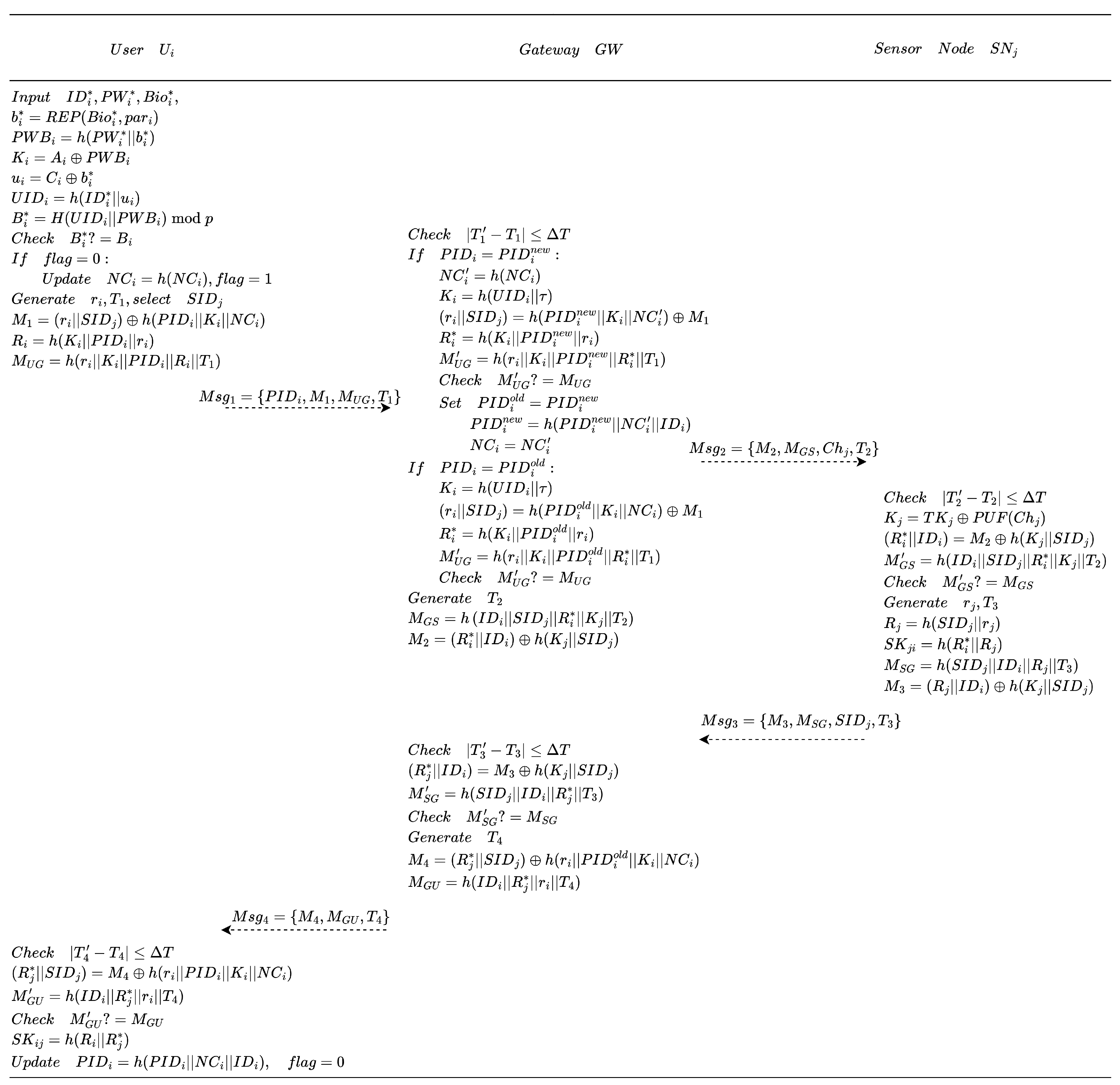
In the authentication phase of our proposed scheme, the user computes seven hash operations and one fuzzy extraction operation while initiating the login request. Upon receiving the response from the gateway node , the user further computes four hash operations. As such, the overall computational load at the user side is limited to eleven hash operations and one fuzzy extraction operation. For the gateway node, eight hash operations are required to process the user’s login request, followed by four additional hash operations after the response from the sensor node is obtained. Consequently, the total computational cost incurred by the amounts to twelve hash operations. Regarding the sensor node, after receiving the message from the gateway node, the authentication procedure involves six hash operations and one operation in total.
This comparative analysis of computational overhead, presented in
Table 7, shows that our proposed protocol outperforms four recent counterparts [
6,
7,
13,
17].
6.2. Communication Performance Analysis
In this subsection, we compare the communication performance of the proposed protocol with the four protocols mentioned above. The communication performance comparison considers only the authentication messages exchanged over the public channel. The bit lengths of all parameters and message components are explicitly defined, and the total communication overhead is obtained by summing the sizes of all transmitted messages. The bit widths for the parameters in the protocol are defined as follows: random number (256 bits), hash value (256 bits), PUF challenge (128 bits), identity (128 bits), elliptic curve point (256 bits), and timestamp (32 bits). Concurrently, the output of the symmetric encryption is defined as an integer multiple of 128 bits (i.e., its block size).
In the authentication phase of the scheme proposed by Wu et al. [
13], a total of four messages, namely
,
,
, and
, are transmitted among the participating entities. In these messages,
,
,
,
and
denote hash values, while
,
,
and
represent timestamps. In addition,
corresponds to the identity of the sensor node, and
denotes the PUF challenge. The values
,
,
,
and
are obtained through XOR operations, whose lengths are determined by the longer operands involved, resulting in bit-lengths of 256 bits, 512 bits, 256 bits, 256 bits and 512 bits, respectively. Consequently, the total size of the transmitted information in this scheme amounts to
bits.
In the authentication phase of the scheme proposed by Sahoo et al. [
6], four messages, denoted as
,
,
, and
, are exchanged during the authentication procedure. In these messages,
,
,
,
and
represent hash values, whereas
,
,
and
correspond to timestamps. Moreover,
denotes a point on the elliptic curve. The value
is generated through a XOR operation, whose length is determined by the longer operand and is equal to 256 bits. In addition,
,
and
are the outputs of symmetric encryption. According to the lengths of their corresponding plaintexts, the sizes of
,
and
are 512 bits, 1024 bits and 128 bits, respectively. Consequently, the total amount of transmitted data in this scheme is
bits.
In the authentication phase of the scheme proposed by Huang et al. [
7], four messages, namely
,
,
, and
, are transmitted during the authentication process. In these messages,
,
and
denote points on the elliptic curve, while
,
,
,
,
and
represent hash values. In addition,
,
,
and
are timestamps. The values
,
,
,
,
,
,
and
are generated through XOR operations, whose bit-lengths are determined by the longer operands involved and are equal to 512 bits, 256 bits, 256 bits, 256 bits, 256 bits, 256 bits, 256 bits and 256 bits, respectively. Consequently, the total amount of transmitted information in this scheme is
bits.
In the authentication phase of the scheme proposed by Kumar et al. [
17], four messages, denoted as
,
,
and
, are exchanged during the authentication process. In these messages,
,
,
and
represent timestamps, while
and
denote hash values. In addition,
,
,
,
and
are the outputs of symmetric encryption, whose lengths are integer multiples of 128 bits. Based on the lengths of the corresponding plaintexts, the sizes of
,
,
,
and
are 640 bits, 1152 bits, 1408 bits, 896 bits and 896 bits, respectively. The value
is generated through a XOR operation, and its bit-length is determined by the longer operand involved, resulting in a length of 1152 bits. Consequently, the total amount of transmitted information in this scheme is
bits.
During the authentication phase, the proposed protocol exchanges a total of four messages ( to ). The composition of is as follows:
: User’s pseudo-identity, 128 bits.
: Generated by XORing the concatenation of the random number and the sensor node’s identity with a hash value (using cyclic padding). Its length equals the sum of the bit lengths of and , i.e., 256 bits + 128 bits.
: Hash output, 256 bits.
: Timestamp, 32 bits.
The length of
is 800 bits. The lengths of
,
, and
are subsequently derived as 800, 800, and 672 bits, respectively. Consequently, the aggregate communication cost for the authentication phase is 3072 bits. A comparison with four recent relevant protocols, presented in
Table 8, further confirms that our protocol holds an advantage in communication overhead.