Article

Sheath Formation in a Plasma with Regularized Kappa Distribution

1
Department of Physics, Taiyuan Normal University, Jinzhong 030619, China
2
Institute of Computational and Applied Physics, Taiyuan Normal University, Jinzhong 030619, China
Entropy 2026, 28(2), 142; https://doi.org/10.3390/e28020142
Submission received: 29 September 2025 / Revised: 2 November 2025 / Accepted: 5 November 2025 / Published: 27 January 2026
(This article belongs to the Special Issue Nonextensive Statistical Mechanics in Astrophysics)

Abstract

Debye shielding in an electron–ion plasma with regularized kappa distribution is examined. An unmagnetized collisionless plasma sheath with regularized kappa distributed electrons is investigated and the modified Bohm criterion is derived. It is found that the variation of the electrostatic potential depends significantly on the superthermal index κ and cutoff parameter α. If κ < 3/2, a plasma sheath with a regularized kappa distribution exists. Our present work may be useful in understanding plasma processing and plasma sheaths in related plasma regions (i.e., Earth’s inner magnetosphere).

1. Introduction

In recent years, plasma sheaths have been one of the most researched topics in plasma physics owing to their unique characteristics. When plasma interacts with a solid wall, due to the electrons’ higher mobility than ions, there exists a non-neutral transition region between the plasma and the wall. The wall will repel the electrons and attract ions. Finally, a very narrow (a few electrons Debye length, λDe) positive space charge layer is formed, which is called the plasma sheath [1]. The properties of the plasma sheath are significantly different from those of the plasma body because of the presence of the electric field, and are extensively applied in many processes such as plasma probe measurements, plasma material surface modification, and fusion research [2,3,4].
Langmuir and Tonks first proposed the term “plasma sheath” in the 1920s [5]. Later, Bohm theoretically studied the necessary conditions for the existence of a steady-state sheath by using the fluid model [6]. It was concluded that the velocity of ions entering the edge of the plasma sheath must be greater than the ion acoustic velocity, which is known as the Bohm sheath criterion. After Bohm, many researchers found that the Bohm sheath criterion in an ion–electron plasma is modified by many factors, such as ion–electron collision, ion temperature, external magnetic field, so on. Liu et al. investigated the Bohm sheath criterion with a two-fluid model by considering collisions [7]. Hatami and Shokri studied the Bohm criterion in a collisional magnetized plasma with thermal ions [8]. The Bohm sheath criterion in multi-component plasma has been extensively discussed [9,10,11,12].
The works mentioned above studied the Bohm sheath criterion in the framework of Boltzmann–Gibbs statistics. However, in systems with long-range interactions such as plasma, particle distribution will deviate from the Maxwellian distribution and often exhibit a long power-law tail [13,14]. These high-energy particles are described appropriately by the kappa distribution proposed by Vasyliunas in 1968 [15]. Subsequently, people found that the application of the kappa distribution helps us to understand plasma environments better than the Maxwellian distribution, and employed it in space, solar, and other astrophysical plasma [16,17,18,19,20]. In spite of a wide range of applications in plasma, there exists a mathematical issue in the kappa distribution that the spectral index κ must satisfy κ > (l + 1)/2 where l is the order of moments. But the observations display the existence of suprathermal tails which correspond to lower κ. In order to avoid diverging moments, the regularized kappa distribution was introduced, with which arbitrary velocity moments are valid for all κ > 0 [21,22]. Recently, some authors have applied the regularized kappa distribution to investigate the wave and instability in space plasma. Liu et al. studied the dispersion and damping rate of Langmuir waves with regularized kappa distributed electrons. They found that in the region κ < 1.5, the damping rate of LW will be much larger than that with Maxwellian distributed electrons [23]. The effect of a regularized kappa distribution on various ion acoustic waves has also been discussed [24,25,26,27]. However, no one has applied the regularized kappa distribution to the sheath theory. The application of non-Maxwellian distributions in sheath theory has been quite extensive [28,29,30,31,32,33]. Therefore, the present work will be devoted to studying the effect of regularized kappa distribution on Debye shielding and the electrostatic sheath.
The paper is organized as follows. In Section 2, the Debye shielding in an electron–ion plasma with regularized kappa distribution is examined. In Section 3, the plasma sheath with regularized kappa distributed electrons is investigated. And in Section 4, the conclusion is given.

2. Debye Shielding

We are considering an unmagnetized collisionless ion–electron plasma with a regularized kappa distribution. The charge neutrality condition at equilibrium is ne0 = ni0 = n0. The high-energy electrons are modeled by the regularized kappa distribution with an electrostatic potential ϕ given as [21]
f e v = n 0 π κ θ 2 3 / 2 1 U 3 / 2 , 3 / 2 κ ; α 2 κ 1 + v 2 2 e ϕ / m e κ θ 2 κ 1 × exp α 2 v 2 2 e ϕ / m e θ 2 ,
where U (a, b; z) is the Tricomi function (or Kummer U function). κ and α are the superthermal spectral index and the cutoff parameter, respectively, satisfying κ > 0 and α ≥ 0. θ = 2 T e / m e is the thermal velocity. When we take (a) α = 0, Equation (1) reduces to the standard kappa distribution with κ > 3/2; when (b) α = 0 and κ , Equation (1) reduces to the Maxwellian distribution. Integrating Equation (1) over the velocity space, we can obtain the electron number density ne
n e = n e 0 exp α 2 e ϕ T e 1 e ϕ κ T e κ + 1 / 2 U 3 / 2 , 3 / 2 κ ; α 2 κ 1 e ϕ / κ T e U 3 / 2 , 3 / 2 κ ; α 2 κ
In the case e ϕ / T e < < 1 , expanding ϕ and retaining the first two terms, we obtain
n e = n e 0 1 + α 2 + κ 1 2 κ + 3 α 2 U 3 / 2 , 3 / 2 κ ; α 2 κ 2 U 5 / 2 , 5 / 2 κ ; α 2 κ e ϕ T e
In the same way, we obtain the ion number density ni
n i = n i 0 1 α 2 + κ 1 2 κ + 3 α 2 U 3 / 2 , 3 / 2 κ ; α 2 κ 2 U 5 / 2 , 5 / 2 κ ; α 2 κ e ϕ T i
The Poisson equation for the considered plasma is written as
2 ϕ = 4 π e n i n e = 1 + σ α 2 + κ 1 2 κ + 3 α 2 U 3 / 2 , 3 / 2 κ ; α 2 κ 2 U 5 / 2 , 5 / 2 κ ; α 2 κ 4 π e 2 n 0 T e ϕ .
where σ = T e / T i is the temperature ratio of electrons to ions. We can easily solve Equation (5), and its solution reads as
ϕ = ϕ 0 exp x λ D R K ,
where the effective Debye shielding length λ D R K is given by
λ D R K = 1 1 + σ α 2 + κ 1 2 κ + 3 α 2 U 3 / 2 , 3 / 2 κ ; α 2 κ 2 U 5 / 2 , 5 / 2 κ ; α 2 κ λ D ,
Here we note that λ D = 1 / 1 + σ T e / 4 π e 2 n 0 1 / 2 is the well-known Debye length for the Maxwellian distributed electron–ion plasma. The effective Debye shielding length λ D R K reduces to λ D in the limiting case α = 0 and κ . Then, we study the effect of κ and α on the small-amplitude electrostatic potential Equation (6), which can be rewritten as
Φ = ϕ / ϕ 0 = exp 1 + σ α 2 + κ 1 2 κ + 3 α 2 U 3 / 2 , 3 / 2 κ ; α 2 κ 2 U 5 / 2 , 5 / 2 κ ; α 2 κ χ ,
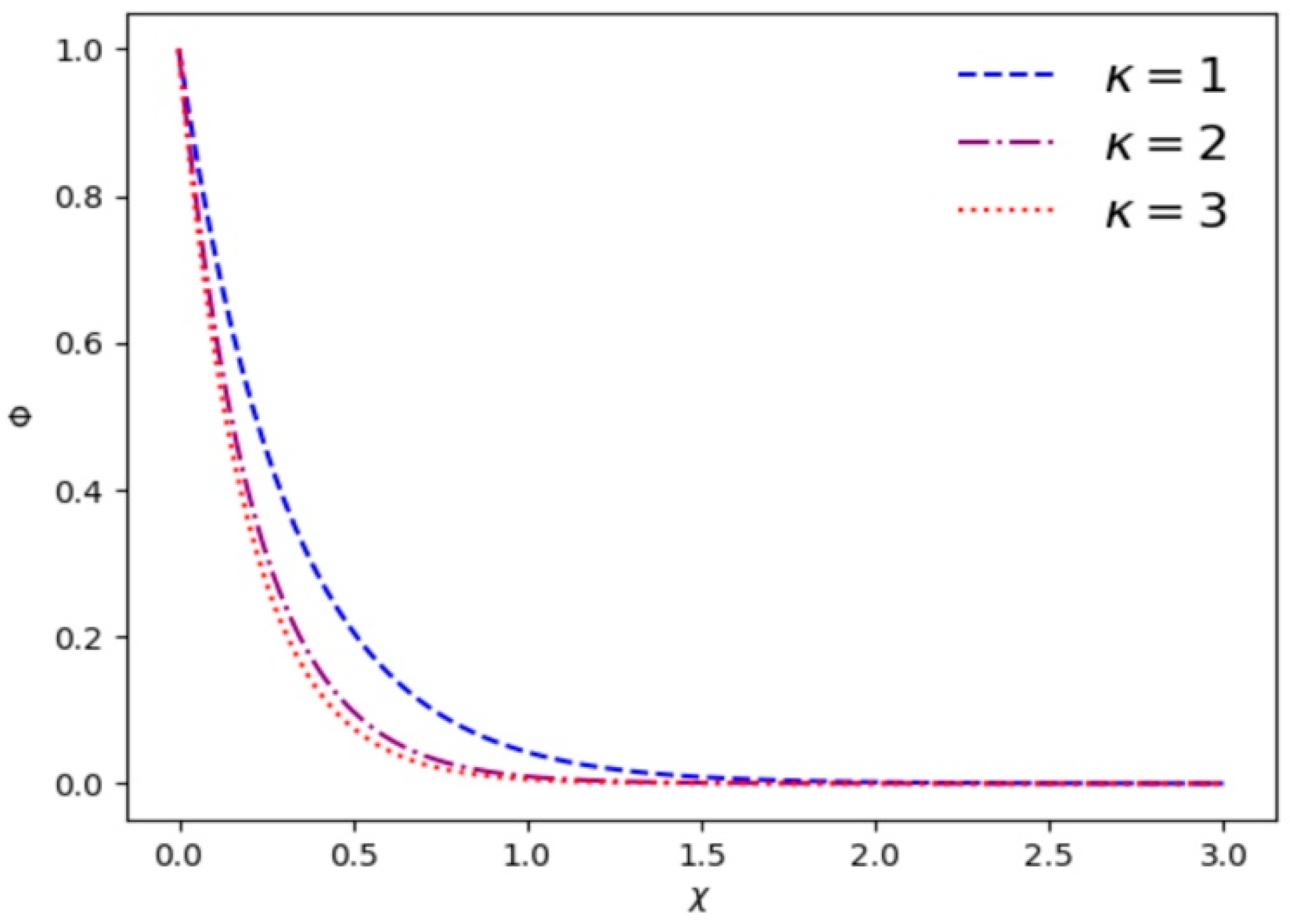
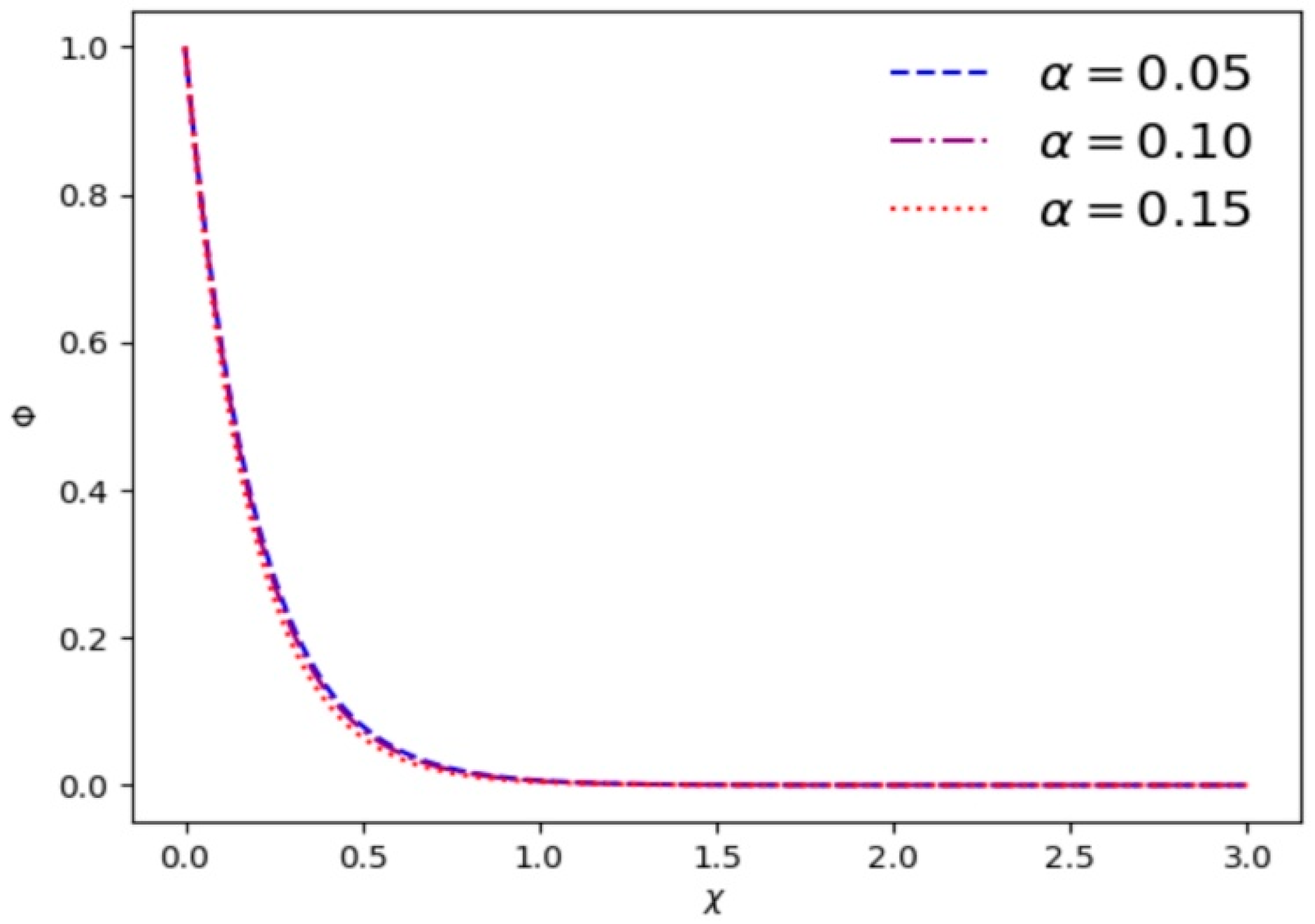
where χ = x / λ D . Figure 1 gives the variation in electrostatic potential Φ as a function of χ with different κ and α. It is found that electrostatic shielding is quite effective beyond a few Debye lengths. Figure 1 shows that the drop of electrostatic potential Φ becomes rapid with the increase in κ. Figure 2 exhibits that with increasing values of α, electrostatic shielding has a more obvious effect at the same position.

3. Electrostatic Sheath

We consider a plasma consisting of cold fluid ions and regularized kappa-distributed electrons, assuming the plasma sheath boundary is located at x = 0 (where ϕs = 0) with the plasma filling the space x < 0, and the plasma sheath is located at x > 0. The steady-state continuity and momentum equations for ions in plasma sheath are
n i u i = n i 0 u i 0 ,
1 2 m i u i 2 1 2 m i u i 0 2 = e ϕ s ,
where ϕs is the electrostatic potential inside the sheath, and ni0 and vi0 are the ion number density and ion drift speed at x = 0. From Equations (9) and (10), we can obtain the number density of ions in the electrostatic sheath
n i = n i 0 1 2 e ϕ s m i u i 2 1 / 2 .
The Poisson’s equation for the plasma sheath is
2 ϕ x 2 = 4 π e n e n i .
Then we introduce the following dimensionless variables:
φ s = e ϕ s T e ,   ξ = x λ D = x T e / 4 π n e 0 e 2 ,   M = u i 0 C s = u i 0 T e / m i
The Poisson’s Equation (12) can be rewritten as
2 φ s ξ 2 = 1 + α 2 + κ 1 2 κ + 3 α 2 U 3 / 2 , 3 / 2 κ ; α 2 κ 2 U 5 / 2 , 5 / 2 κ ; α 2 κ φ s 1 2 φ s M 2 1 / 2 .
Multiplying both sides of Equation (14) by s/, and integrating it for ξ under the boundary conditions (i.e., φs = 0, and s/dξ = 0 at ξ = 0), we can obtain the following equation of φs
1 2 d φ s d ξ 2 + V φ s = 1 2 E 0 2 ,
where E 0 0 is the weak pre-sheath electric field and
V φ s = M 2 1 1 2 φ s M 2 1 / 2 φ s 1 2 α 2 + κ 1 2 κ + 3 α 2 U 3 / 2 , 3 / 2 κ ; α 2 κ 2 U 5 / 2 , 5 / 2 κ ; α 2 κ φ s 2
is the Sagdeev potential. It is easily seen that the solution of Equation (15) exists if d 2 V φ s = 0 / d φ s 2 < 0 or
M > M c = 1 α 2 + κ 1 2 κ + 3 α 2 U 3 / 2 , 3 / 2 κ ; α 2 κ 2 U 5 / 2 , 5 / 2 κ ; α 2 κ
Equation (17) is the modified Bohm sheath criterion in an electron–ion plasma with regularized kappa distributed electrons. In the limiting condition α = 0 and κ , Equation (17) becomes M > 1 for Maxwellian cases.
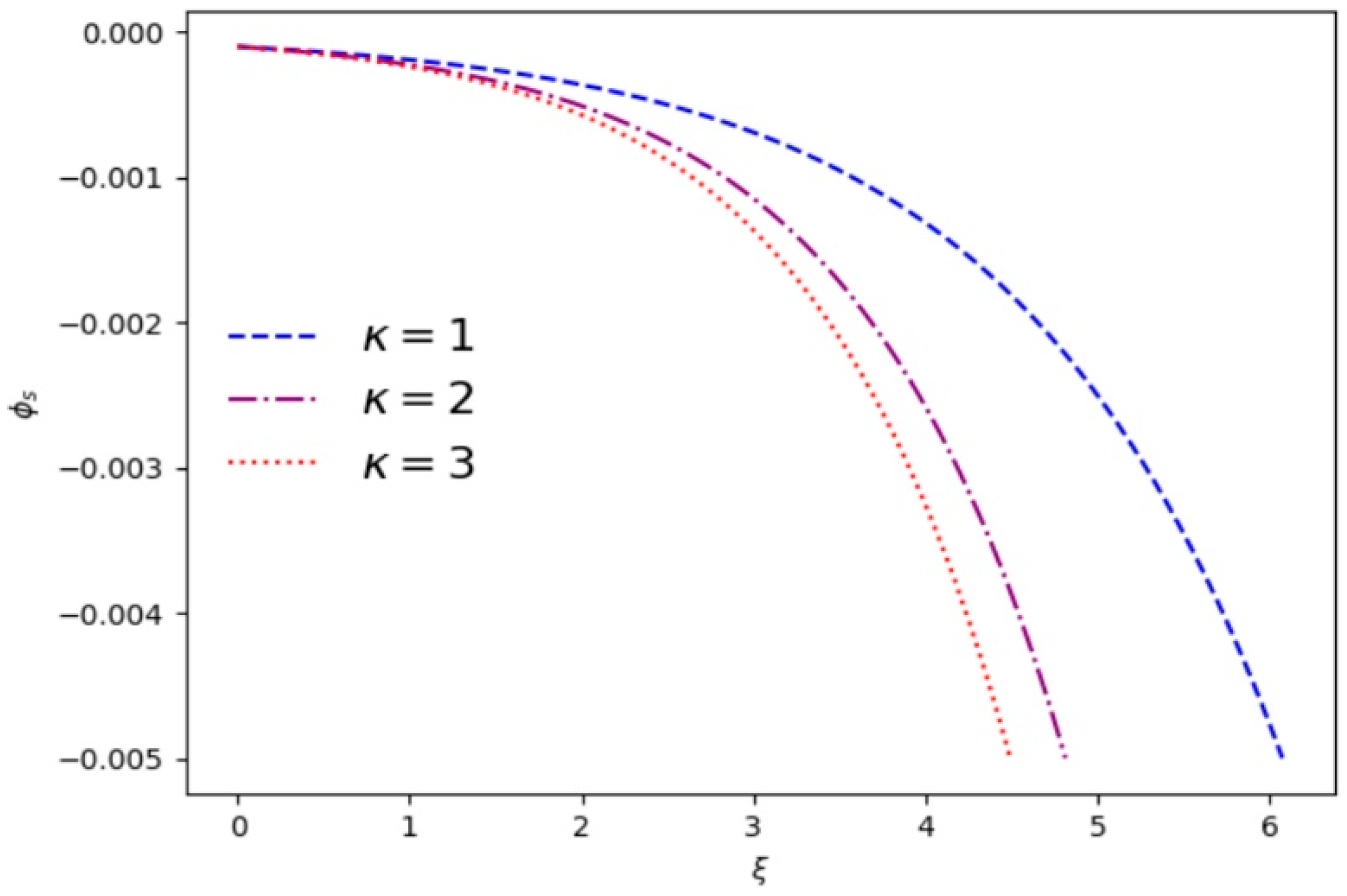
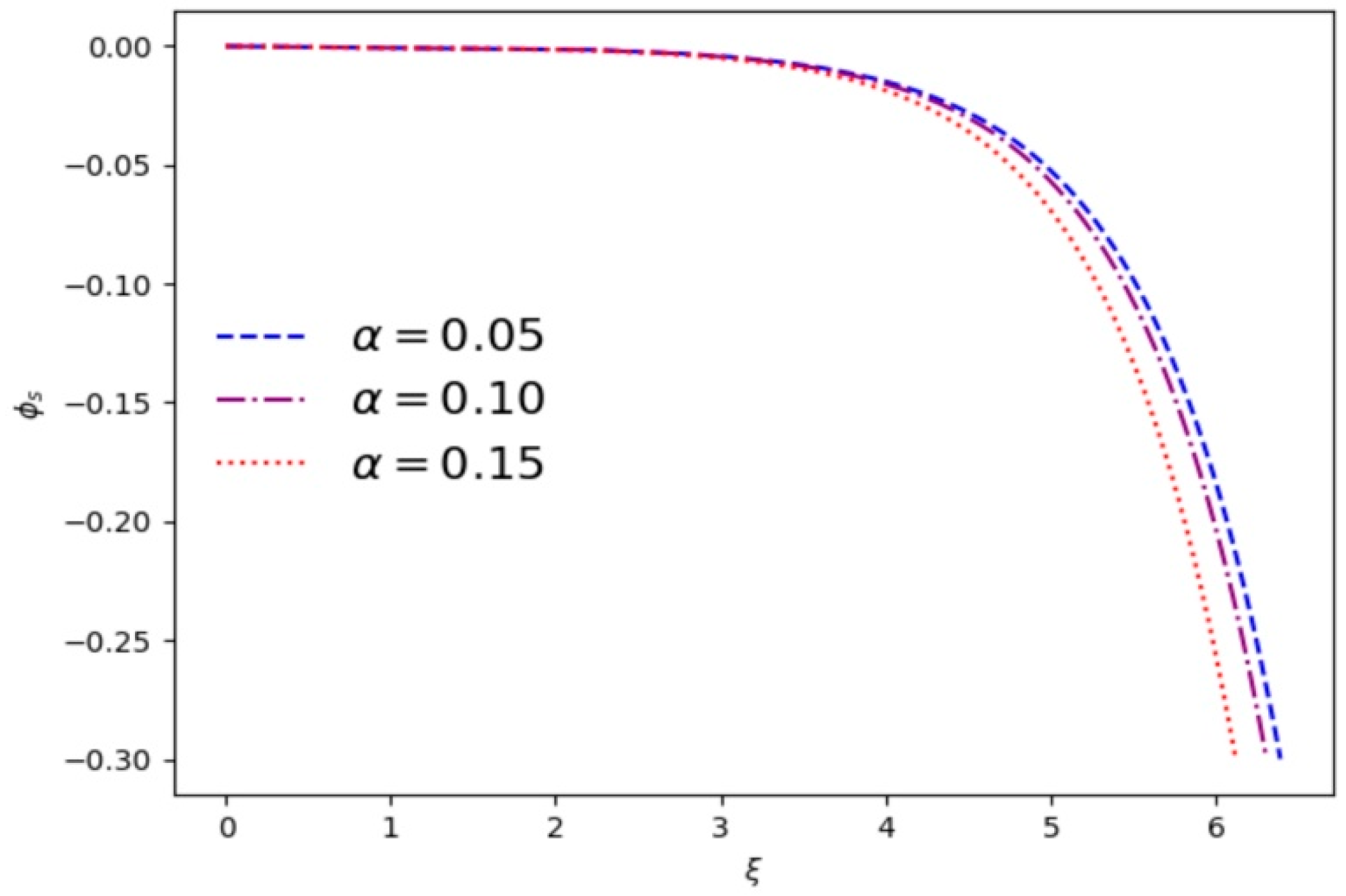
Figure 3 and Figure 4 numerically show the variation in the shielded electrostatic potential ϕs with distance for different plasma parameters. The sheath region begins where charge neutrality breaks down. Figure 3 shows that by increasing κ, the fall-off of ϕs through the sheath region becomes more rapid and the thickness of sheath decreases. For the larger κ, the average velocity of electrons is relatively slower, which may affect the electrostatic potential. Figure 4 shows that the electrostatic potential ϕs and the thickness of sheath decrease with the increase in α.

4. Conclusions

In this paper, we have examined the phenomenon of Debye shielding in an electron–ion plasma with regularized kappa distribution. The unmagnetized collisionless plasma sheath with regularized kappa distributed electrons is investigated and the modified Bohm criterion is derived. It is found that the variation in the electrostatic potential depends significantly on the superthermal index κ and cutoff parameters α. The electrostatic potential ϕs falls more quickly with the increase in κ and α. The thickness of sheath becomes thicker for the smaller values of κ and α. It is worth noting that the plasma sheath exists with the regularized kappa distribution if κ < 3/2. The presence of regularized kappa-distributed electrons has been observed in the Earth’s inner magnetosphere [33]. Our present work may be useful in understanding plasma sheath and plasma processing in related plasma regions.

Funding

This research received no external funding.

Data Availability Statement

The data presented in this study are available on request from the corresponding author.

Conflicts of Interest

The authors declare no conflict of interest.

References

  1. Chen, F.F. Introduction to Plasma Physics and Controlled Fusion; Springer International Publishing: Cham, Switzerland, 2016. [Google Scholar]
  2. Qiu, H.B.; Zhou, Z.Y.; Peng, X.K.; Zhang, X.; Zhu, Y.; Gao, Y.; Xiao, D.; Bao, H.; Xu, T.; Zhang, J.; et al. Initial measurement of electron nonextensive parameter with electric probe. Phys. Rev. E 2020, 101, 043206. [Google Scholar] [CrossRef]
  3. Flender, U.; Wiesemann, K. Characterization of plasma-surface contacts in low-pressure rf discharges using ion energy analysis and langmuir probes’. Plasma Chem. Plasma Process. 1995, 15, 123–157. [Google Scholar] [CrossRef]
  4. Stangeby, P.C. The Plasma Boundary of Magnetic Fusion Devices; IOP Publishing: Bristol, UK, 2000. [Google Scholar]
  5. Tonks, L.; Langmuir, I. A general theory of the plasma of an arc. Phys. Rev. 1929, 34, 876. [Google Scholar] [CrossRef]
  6. Bohm, D. The Characteristics of Electrical Discharges in Magnetic Fields; Guthrie, A., Wakerling, R., Eds.; McGraw-Hill: New York, NY, USA, 1949. [Google Scholar]
  7. Liu, J.Y.; Wang, Z.X.; Wang, X.G. Sheath criterion for a collisional sheath. Phys. Plasmas 2003, 10, 3032–3034. [Google Scholar] [CrossRef]
  8. Hatami, M.M.; Shokri, B. Bohm’s criterion in a collisional magnetized plasma with thermal ions. Phys. Plasmas 2012, 19, 083510. [Google Scholar] [CrossRef]
  9. Ma, J.X.; Yu, M.Y. Electrostatic sheath at the boundary of a dusty plasma. Phys. Plasmas 1995, 2, 1343–1348. [Google Scholar] [CrossRef]
  10. Song, S.B.; Chang, C.S.; Choi, D. Effect of two-temperature electron distribution on the Bohm sheath criterion. Phys. Rev. E 1997, 55, 1213. [Google Scholar] [CrossRef]
  11. Fernandez Palop, J.I.; Ballesteros, J.; Hernandez, M.A.; Morales Crespo, R. Sheath structure in electronegative plasmas. Plasma Sources Sci. Technol. 2007, 16, S76. [Google Scholar] [CrossRef]
  12. Aslaninejad, M.; Yasserian, K. Magnetized electronegative plasma presheath-sheath containing two positive ion species. Phys. Plasmas 2012, 19, 033504. [Google Scholar] [CrossRef]
  13. Chaston, C.C.; Hu, Y.D.; Fraser, B.J. Non-Maxwellian particle distributions and electromagnetic ion cyclotron instabilities in the near-Earth magnetotail. Geophys. Res. Lett. 1997, 24, 2913–2916. [Google Scholar] [CrossRef]
  14. Armstrong, T.P.; Paonessa, M.T., II; Bell, E.V.; Krimigis, S.M.J. Voyager observations of Saturnian ion and electron phase space densities. Geophys. Res. 1983, 88, 8893–8904. [Google Scholar] [CrossRef]
  15. Vasyliunas, V.M.J. A survey of low-energy electrons in the evening sector of the magnetosphere with OGO 1 and OGO 3. Geophys. Res. 1968, 73, 2839–2884. [Google Scholar] [CrossRef]
  16. Baluku, T.K.; Hellberg, M.A. Dust acoustic solitons in plasmas with kappa-distributed electrons and/or ions. Phys. Plasmas 2008, 15, 123705. [Google Scholar] [CrossRef]
  17. Guo, R. Different effects of suprathermal electrons and ions on drift instabilities in non-uniform plasmas. Phys. Plasmas 2023, 30, 122113. [Google Scholar] [CrossRef]
  18. Guo, R. Kinetic theory of sech2x electron holes and applications to Kappa-distributed plasmas. Plasma Phys. Control. Fusion 2022, 64, 065003. [Google Scholar] [CrossRef]
  19. Livadiotis, G.; Desai, M.I.; Wilson, L.B. Generation of Kappa Distributions in Solar Wind at 1 au. Astrophys. J. 2018, 853, 142. [Google Scholar] [CrossRef]
  20. Bora, M.P.; Choudhury, B.; Das, G.C. Dust-acoustic soliton in a plasma with multi-species ions and kappa-distributed electrons. Astrophys. Space Sci. 2012, 341, 515–525. [Google Scholar] [CrossRef]
  21. Scherer, K.; Fichtner, H.; Lazar, M. Regularized κ-distributions with non-diverging moments. Europhys. Lett. 2017, 120, 50002. [Google Scholar] [CrossRef]
  22. Scherer, K.; Lazar, M.; Husidic, E.; Fichtner, H. Moments of the Anisotropic Regularized κ-distributions. Astrophys. J. 2019, 880, 118. [Google Scholar] [CrossRef]
  23. Liu, Y.; Chen, X. Dispersion and damping rate of Langmuir wave in space plasma with regularized Kappa distributed electrons. Plasma Sci. Technol. 2022, 24, 015301. [Google Scholar] [CrossRef]
  24. Liu, Y. Solitary ion acoustic waves in a plasma with regularized κ-distributed electrons. AIP Adv. 2020, 10, 085022. [Google Scholar] [CrossRef]
  25. Lu, F.F.; Liu, S.Q. Small amplitude ion-acoustic solitons with regularized κ-distributed electrons. AIP Adv. 2021, 11, 085223. [Google Scholar] [CrossRef]
  26. Zhou, J.; Yang, X.S.; Chen, X.C.; Liu, S.Q. Ion temperature gradient mode and its solitons with regularized κ-distributed electrons. AIP Adv. 2022, 12, 105301. [Google Scholar] [CrossRef]
  27. Huo, R.; Du, J. Dispersion and Damping Rate of Ion-Acoustic Waves in Regularized Kappa Distributed Plasma. IEEE Trans. Plasma Sci. 2023, 51, 2383–2387. [Google Scholar] [CrossRef]
  28. Gougam, L.A.; Tribeche, M. Debye shielding in a nonextensive plasma. Phys. Plasmas 2011, 18, 062102. [Google Scholar] [CrossRef]
  29. Bouzit, O.; Gougam, L.A.; Tribeche, M. Screening and sheath formation in a nonequilibrium mixed Cairns-Tsallis electron distribution. Phys. Plasmas 2015, 22, 052112. [Google Scholar] [CrossRef]
  30. Khalilpour, H.; Foroutan, V. Numerical study of an electrostatic plasma sheath with non-thermal electrons and charged nanoparticles. Contrib. Plasma Phys. 2019, 60, e201900060. [Google Scholar] [CrossRef]
  31. Paul, R.; Deka, K.; Sharma, G.; Moulick, R.; Adhikari, S.; Kausik, S.S.; Saikia, B.K. Study of a collisionless magnetized plasma sheath with nonextensively distributed species. Plasma Sci. Technol. 2023, 25, 125001. [Google Scholar] [CrossRef]
  32. Basnet, S.; Pokhrel, R.R.; Khanal, R. Characteristics of Magnetized Dusty Plasma Sheath with Two Ion Species and q-Nonextensive Electrons. IEEE Trans. Plasma Sci. 2021, 49, 1268–1277. [Google Scholar] [CrossRef]
  33. Vasko, I.Y.; Agapitov, O.V.; Mozer, F.S.; Bonnell, J.W.; Artemyev, A.V.; Krasnoselskikh, V.V.; Reeves, G.; Hospodarsky, G. Electron-acoustic solitons and double layers in the inner magnetosphere. Geophys. Res. Lett. 2017, 44, 4575–4583. [Google Scholar] [CrossRef]
Figure 1. Variation in the electrostatic potential Φ vs. χ for different superthermal index κ and α = 0.1.
Entropy 28 00142 g001
Figure 2. Variation in the electrostatic potential Φ vs. χ for different cutoff parameters α and κ = 3.
Entropy 28 00142 g002
Figure 3. Variation in the shielded electrostatic potential ϕs vs. ξ for different superthermal index κ and α = 0.1.
Entropy 28 00142 g003
Figure 4. Variation in the shielded electrostatic potential ϕs vs. ξ for different cutoff parameters α and κ = 3.
Entropy 28 00142 g004
Disclaimer/Publisher’s Note: The statements, opinions and data contained in all publications are solely those of the individual author(s) and contributor(s) and not of MDPI and/or the editor(s). MDPI and/or the editor(s) disclaim responsibility for any injury to people or property resulting from any ideas, methods, instructions or products referred to in the content.