Returnformer: A Graph Transformer-Based Model for Predicting Product Returns in E-Commerce


Abstract
1. Introduction
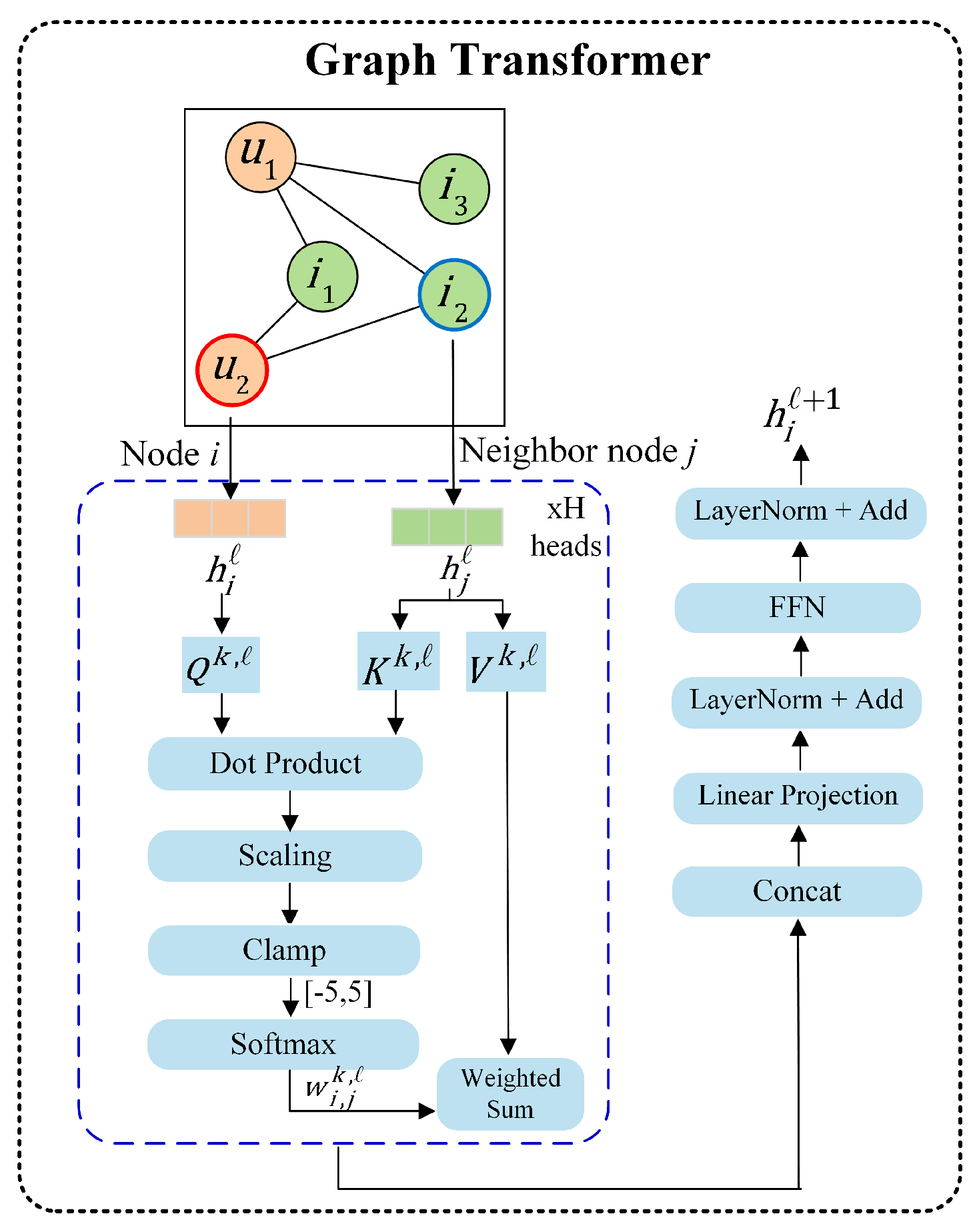
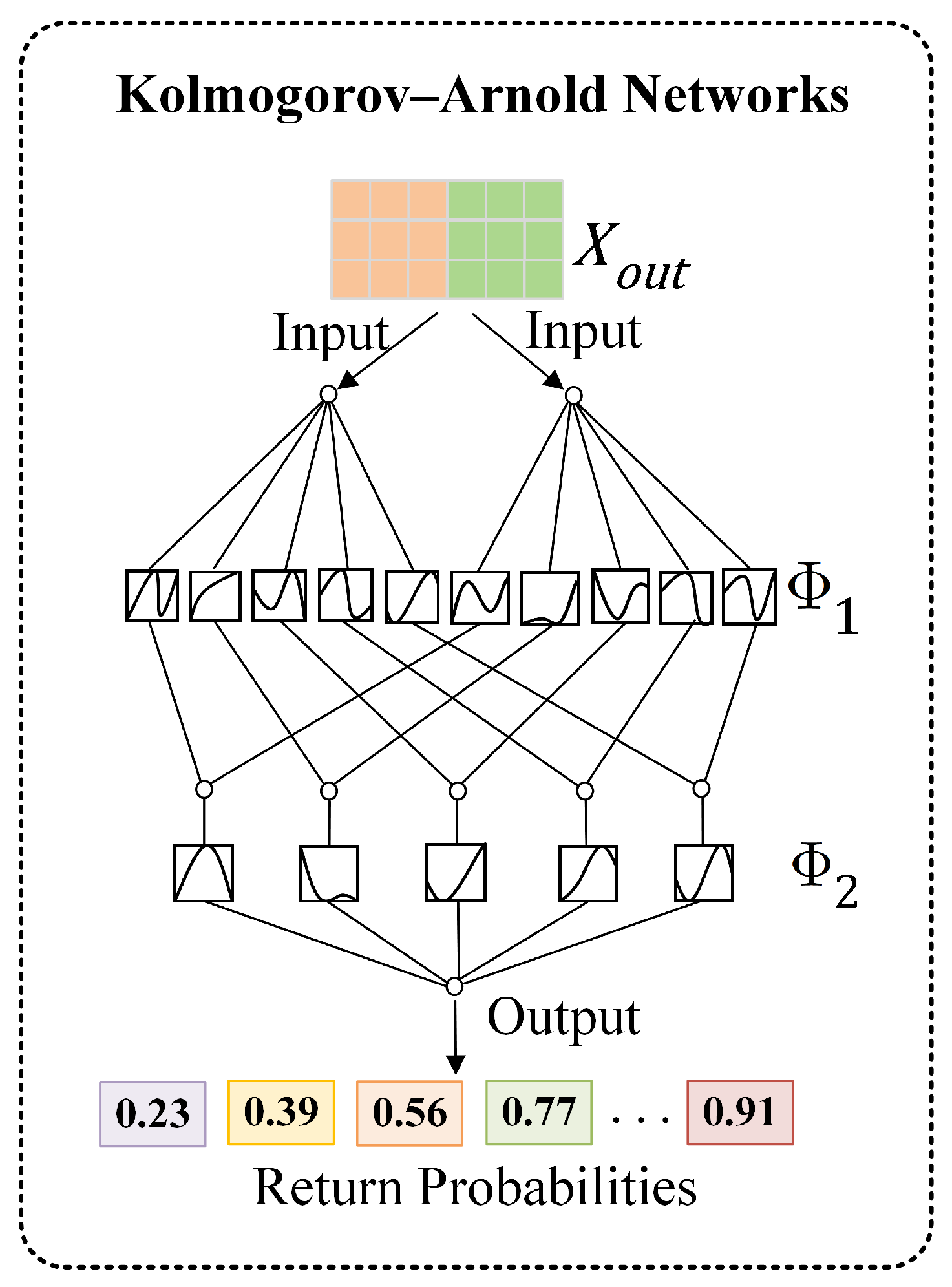
- We introduced Returnformer, a new return prediction model based on the Graph Transformer. By using the self-attention layer, it can effectively aggregate high-order information in the customer–product interaction graph. Furthermore, we have also introduced the Kolmogorov–Arnold Network (KAN) as a decoder to improve classification performance by constructing complex decision-making boundaries through nonlinear transformation.
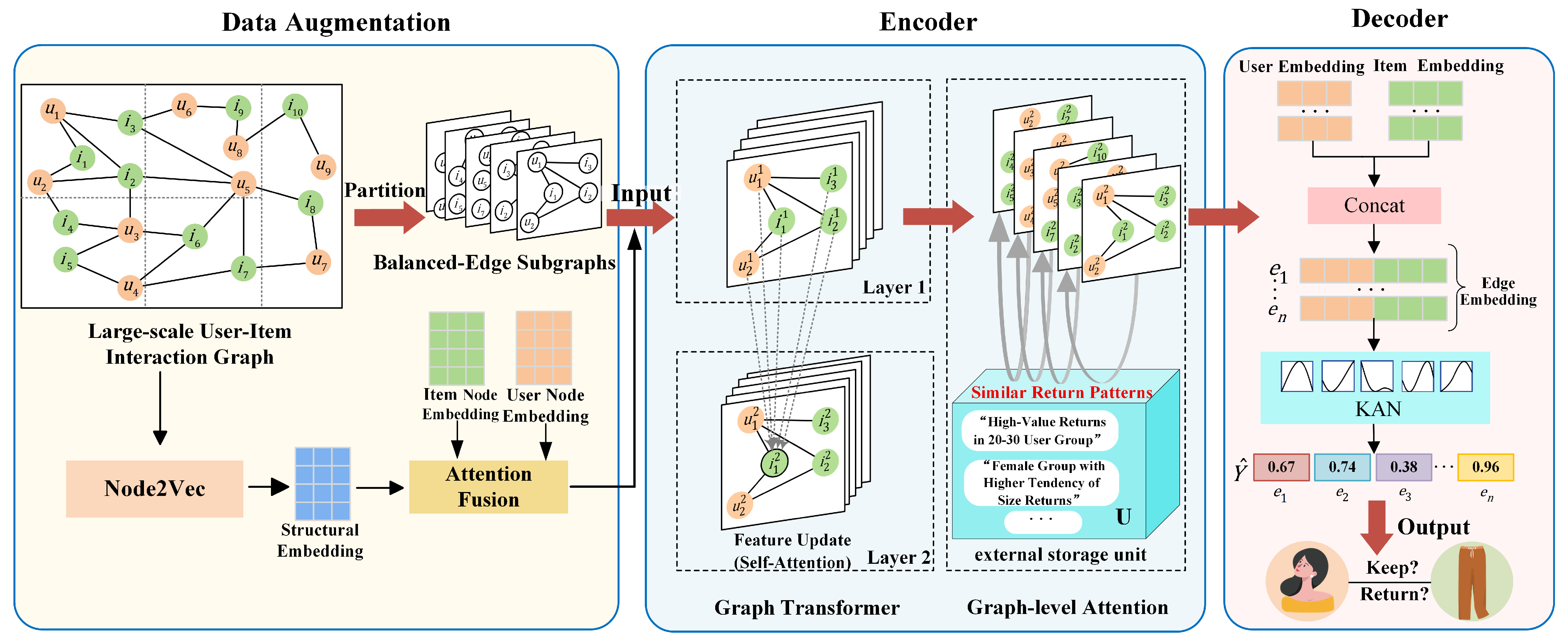
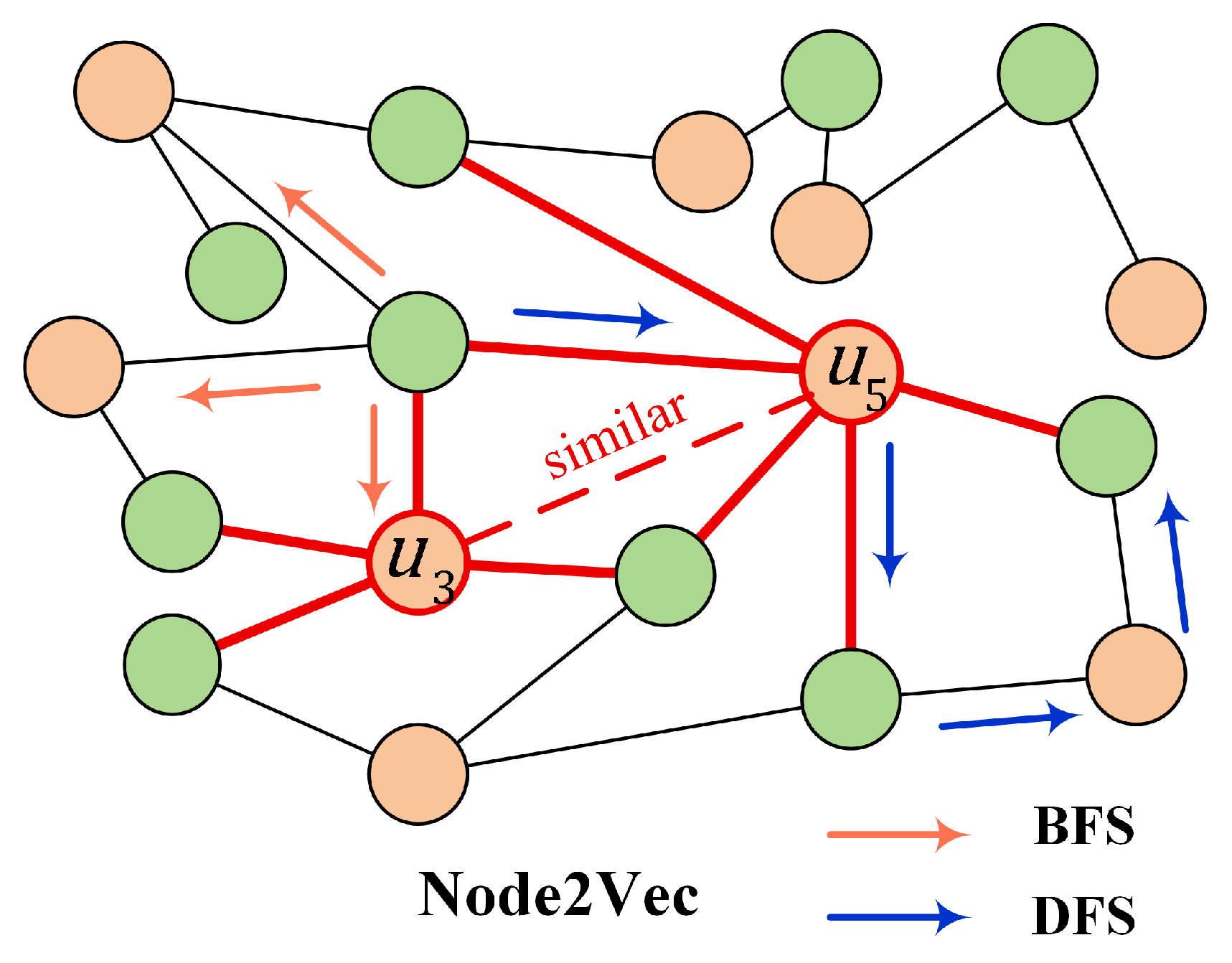
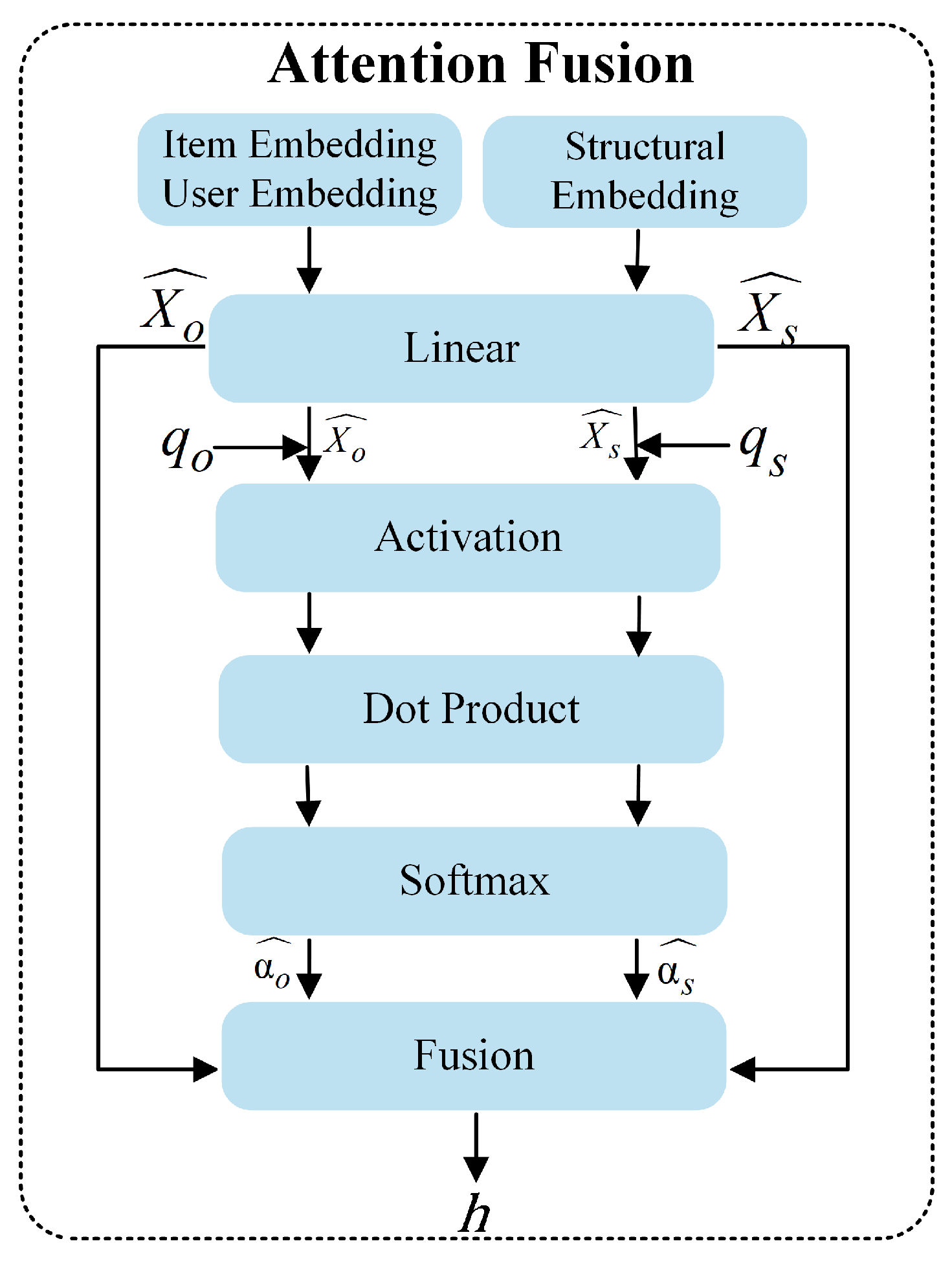
- The topological embeddings generated by Node2Vec are utilized to supplement the structural information. And then we adopt a dual-path feature fusion method, which combines the structural embedding with the original feature embedding, to obtain the final fusion embedding as the input feature.
- We use the graph-level attention mechanism to capture the relations between customers and products in different subgraphs. This method enables similar nodes in different subgraphs to interact, thereby capturing the global characteristics and patterns of customer return behaviors.
2. Related Works
2.1. Prediction of Product Return Rate and Return Volume
2.2. Prediction of Product Return Propensity
2.2.1. Traditional Machine Learning Models for Return Prediction
2.2.2. Leveraging Graph Representation for Return Prediction
3. Methodology
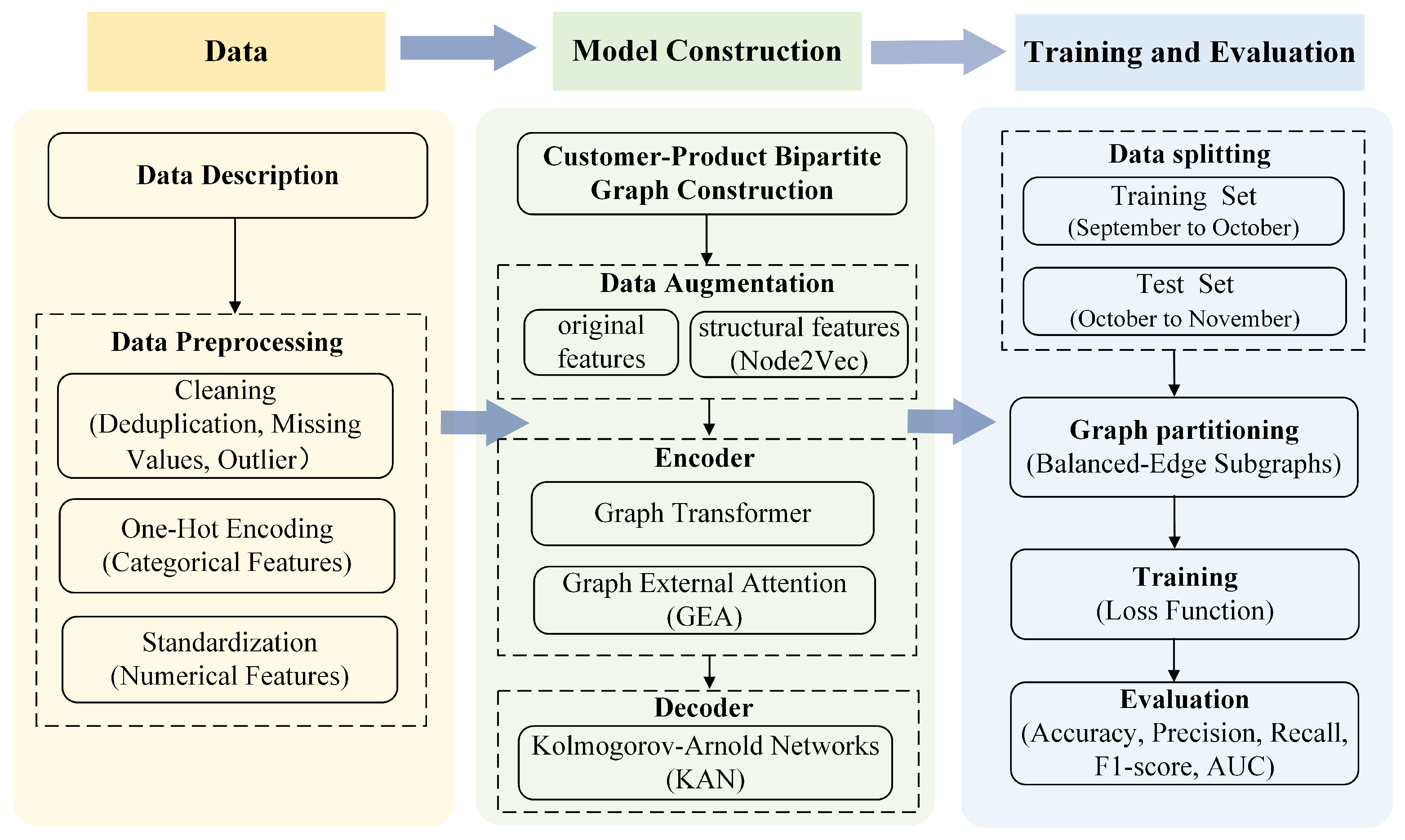
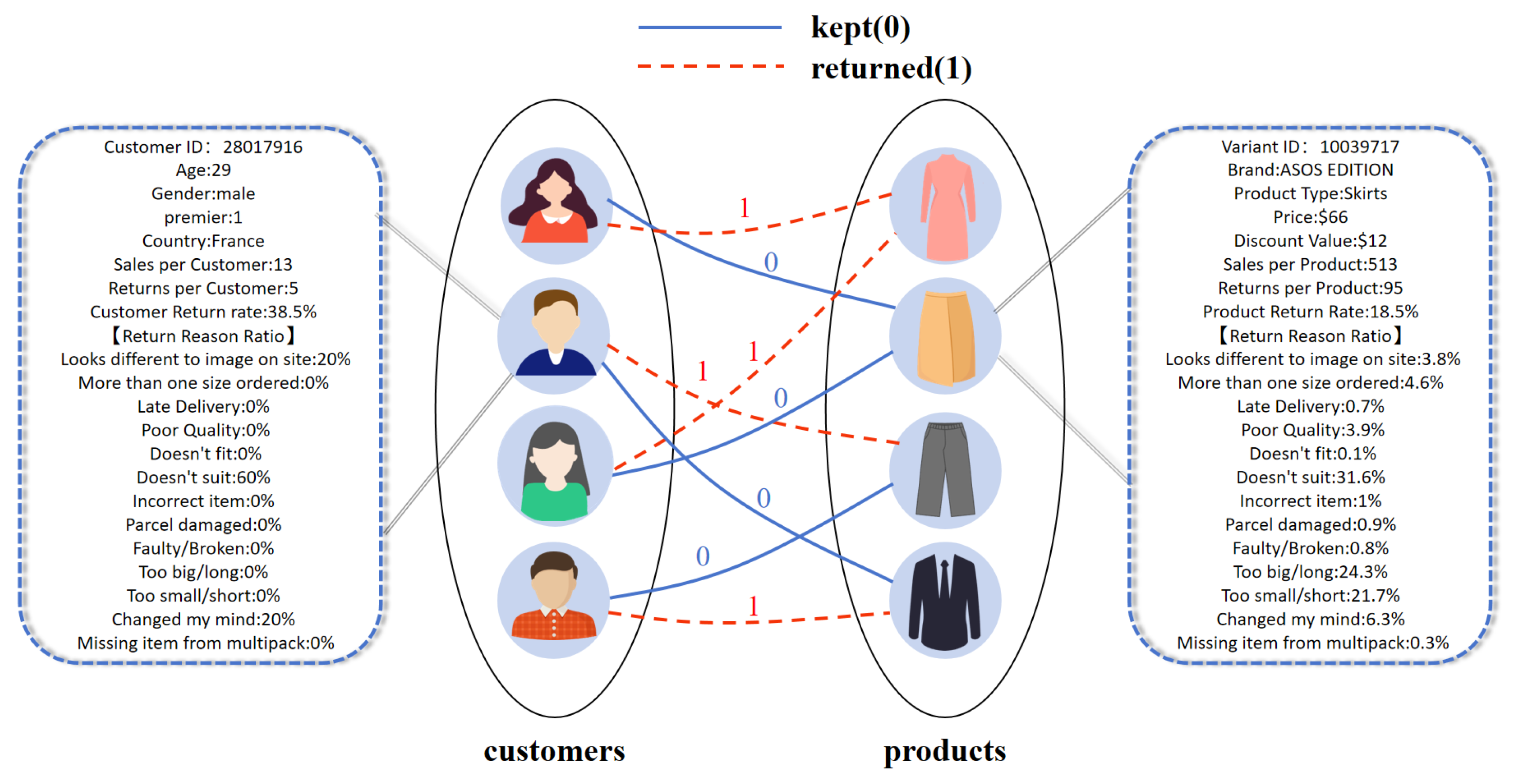
3.1. Data and Customer–Product Bipartite Graph Construction
3.1.1. Data Description
3.1.2. Data Preprocessing
3.1.3. Customer–Product Bipartite Graph Construction
3.2. Proposed Model
3.2.1. Data Augmentation
3.2.2. Encoder
| Algorithm 1 Framework of the GEA |
| Input: Graph with node set V, node embeddings X |
| Output: Updated node representations |
| 1: Initialize model parameters: external key-value units , , and number of heads |
| 2: for each node do |
| 3: |
| 4: |
| 5: |
| 6: |
| 7: |
| 8: end for |
| 9: return |
3.2.3. Decoder
| Algorithm 2 Framework of Returnformer |
| Input: User–item bipartite graph ; user features ; item features ; Node2Vec embeddings |
| Output: Edge-level prediction return probabilities |
| 1: Initialize model parameters randomly |
| 2: Feature fusion: |
| 3: Initialize node embeddings: |
| 4: for each edge do |
| 5: |
| 6: |
| 7: |
| 8: |
| 9: |
| 10: end for |
| 11: return |
4. Experiments
4.1. Experimental Environment Setup
4.2. Comparison Results
4.3. Ablation Analysis
4.4. Sensitivity Analysis
4.5. Discussion
5. Conclusions and Future Works
Author Contributions
Funding
Data Availability Statement
Conflicts of Interest
Abbreviations
| GNN | Graph Neural Network |
| GCN | Graph Convolutional Network |
| GAT | Graph Attention Network |
| GraphSAGE | Graph Sample and Aggregate |
| MLP | Multi-Layer Perceptron |
| XGBoost | Extreme Gradient Boosting |
| KAN | Kolmogorov–Arnold Networks |
| GEA | Graph External Attention |
| AUC | Area Under the Receiver Operating Characteristic Curve |
| ROC | Receiver Operating Characteristic |
References
- Statista. Global Retail e-Commerce Sales 2014–2027. Available online: https://www.statista.com/statistics/worldwide-retail-e-commerce-sales (accessed on 20 September 2025).
- Röllecke, F.J.; Huchzermeier, A.; Schröder, D. Returning customers: The hidden strategic opportunity of returns management. Calif. Manag. Rev. 2018, 60, 176–203. [Google Scholar]
- de Araújo, A.C.; Matsuoka, E.M.; Ung, J.E.; Massote, A.; Sampaio, M. An exploratory study on the returns management process in an online retailer. Int. J. Logist. Res. Appl. 2018, 21, 345–362. [Google Scholar]
- Zhao, S.; Wu, F.; Jia, T.; Shu, L. The impact of product returns on price and delivery time competition in online retailing. Comput. Ind. Eng. 2018, 125, 658–667. [Google Scholar] [CrossRef]
- Dzyabura, D.; El Kihal, S.; Hauser, J.R.; Ibragimov, M. Leveraging the power of images in managing product return rates. Mark. Sci. 2023, 42, 1125–1142. [Google Scholar] [CrossRef]
- Roichman, R.; Sprecher, B.; Blass, V.; Meshulam, T.; Makov, T. The convenience economy: Product flows and GHG emissions of returned apparel in the EU. Resour. Conserv. Recycl. 2024, 210, 107811. [Google Scholar] [CrossRef]
- Mishra, A.; Dutta, P. Return management in e-commerce firms: A machine learning approach to predict product returns and examine variables influencing returns. J. Clean. Prod. 2024, 477, 143802. [Google Scholar] [CrossRef]
- Al Imran, A.; Amin, M.N. Predicting the return of orders in the e-tail industry accompanying with model interpretation. Procedia Comput. Sci. 2020, 176, 1170–1179. [Google Scholar] [CrossRef]
- Bhattacharjee, B.; Unni, K.; Pratap, M. Bayesian-optimized extreme gradient boosting models for classification problems: An experimental analysis of product return case. J. Syst. Inf. Technol. 2024, 26, 495–527. [Google Scholar] [CrossRef]
- Li, J.; He, J.; Zhu, Y. E-tail product return prediction via hypergraph-based local graph cut. In Proceedings of the 24th ACM SIGKDD International Conference on Knowledge Discovery and Data Mining, London, UK, 19–23 August 2018; pp. 519–527. [Google Scholar]
- Zhu, Y.; Li, J.; He, J.; Quanz, B.L.; Deshpande, A.A. A local algorithm for product return prediction in e-commerce. In Proceedings of the Twenty-Seventh International Joint Conference on Artificial Intelligence (IJCAI), Stockholm, Sweden, 13–19 July 2018; pp. 3718–3724. [Google Scholar]
- Li, X.; Zhuang, Y.; Fu, Y.; He, X. A trust-aware random walk model for return propensity estimation and consumer anomaly scoring in online shopping. Sci. China Inf. Sci. 2019, 62, 052101. [Google Scholar] [CrossRef]
- McGowan, J.; Guest, E.; Yan, Z.; Zheng, C.; Patel, N.; Cusack, M.; Donaldson, C.; de Cnudde, S.; Facini, G.; Dzogang, F. A dataset for learning graph representations to predict customer returns in fashion retail. In Proceedings of the Workshop on Recommender Systems in Fashion and Retail, Seattle, WA, USA, 18–22 September 2022; pp. 99–108. [Google Scholar]
- Lv, J.; Liu, X. The impact of information overload of e-commerce platform on consumer return intention: Considering the moderating role of perceived environmental effectiveness. Int. J. Environ. Res. Public Health 2022, 19, 8060. [Google Scholar] [PubMed]
- Fernandez-Lores, S.; Crespo-Tejero, N.; Fernández-Hernández, R.; García-Muiña, F.E. Online product returns: The role of perceived environmental efficacy and post-purchase entrepreneurial cognitive dissonance. J. Bus. Res. 2024, 174, 114462. [Google Scholar] [CrossRef]
- Ambilkar, P.; Dohale, V.; Gunasekaran, A.; Bilolikar, V. Product returns management: A comprehensive review and future research agenda. Int. J. Prod. Res. 2022, 60, 3920–3944. [Google Scholar] [CrossRef]
- Prayogo, D.H.; Domanski, R.; Golinska-Dawson, P. The key factors for improving returns management in e-commerce in Indonesia from customers’ perspectives—An analytic hierarchy process approach. Sustainability 2024, 16, 7303. [Google Scholar]
- Li, Y.; Xu, L.; Li, D. Examining relationships between the return policy, product quality, and pricing strategy in online direct selling. Int. J. Prod. Econ. 2013, 144, 451–460. [Google Scholar] [CrossRef]
- Yoga, I.A.M.; Budiarsa, M.; Ardika, I.W.; Wiranatha, A.A.P.; Suryawan, A. Improving the marketing strategy into 7PS+ for sustainability: A study of Bali tourism, Indonesia. Russ. J. Agric. Socio-Econ. Sci. 2020, 104, 15–23. [Google Scholar]
- Walsh, G.; Albrecht, A.K.; Kunz, W.; Hofacker, C.F. Relationship between online retailers’ reputation and product returns. Br. J. Manag. 2016, 27, 3–20. [Google Scholar]
- Saarijärvi, H.; Sutinen, U.-M.; Harris, L.C. Uncovering consumers’ returning behaviour: A study of fashion e-commerce. Int. Rev. Retail Distrib. Consum. Res. 2017, 27, 284–299. [Google Scholar] [CrossRef]
- Masuch, S.; Landwehr, J.R.; Flath, C.M.; Thiesse, F. The faster, the better? The impact of short delivery times on product returns in online retailing. J. Retail. 2024, 100, 475–485. [Google Scholar] [CrossRef]
- Yan, S.; Xu, X.; Bian, Y. Pricing and return strategy: Whether to adopt a cross-channel return option? IEEE Trans. Syst. Man Cybern. Syst. 2020, 50, 5058–5073. [Google Scholar]
- Rajasekaran, V.; Priyadarshini, R. An e-commerce prototype for predicting the product return phenomenon using optimization and regression techniques. In Proceedings of the International Conference on Advances in Computing and Data Sciences, Dehradun, India, 20–21 April 2021; pp. 230–240. [Google Scholar]
- Cui, H.; Rajagopalan, S.; Ward, A.R. Predicting product return volume using machine learning methods. Eur. J. Oper. Res. 2020, 281, 612–627. [Google Scholar] [CrossRef]
- Tripathy, S.; Kumar, A.; Mahanty, B. Short-lived product returns forecasting when customers are unwilling to return the product: A grey-graphical evaluation and review technique. Technol. Forecast. Soc. Change 2023, 195, 122755. [Google Scholar] [CrossRef]
- Ma, J.; Kim, H.M. Predictive model selection for forecasting product returns. J. Mech. Des. 2016, 138, 054501. [Google Scholar] [CrossRef]
- Chou, M.C.; Sim, C.-K.; Yuan, X.-M. Policies for inventory models with product returns forecast from past demands and past sales. Ann. Oper. Res. 2020, 288, 137–180. [Google Scholar] [CrossRef]
- Fu, Y.; Liu, G.; Papadimitriou, S.; Xiong, H.; Li, X.; Chen, G. Fused latent models for assessing product return propensity in online commerce. Decis. Support Syst. 2016, 91, 77–88. [Google Scholar] [CrossRef]
- Urbanke, P.; Kranz, J.; Kolbe, L. Predicting product returns in e-commerce: The contribution of Mahalanobis feature extraction. Electron. Mark. 2015, 25, 353–368. [Google Scholar]
- Duong, Q.H.; Zhou, L.; Van Nguyen, T.; Meng, M. Understanding and predicting online product return behavior: An interpretable machine learning approach. Int. J. Prod. Econ. 2025, 280, 109499. [Google Scholar] [CrossRef]
- Hofmann, A.; Gwinner, F.; Fuchs, K.; Winkelmann, A. An industry-agnostic approach for the prediction of return shipments. In Proceedings of the Americas Conference on Information Systems (AMCIS), Salt Lake City, UT, USA, 15–17 August 2020. [Google Scholar]
- Ma, S.; Wang, W. Proactive return prediction in online fashion retail using heterogeneous graph neural networks. Electronics 2024, 13, 1398. [Google Scholar] [CrossRef]
- Joshi, T.; Mukherjee, A.; Ippadi, G. One size does not fit all: Predicting product returns in e-commerce platforms. In Proceedings of the 2018 IEEE/ACM International Conference on Advances in Social Networks Analysis and Mining, Barcelona, Spain, 28–31 August 2018; pp. 926–927. [Google Scholar]
- Kedia, S.; Madan, M.; Borar, S. Early bird catches the worm: Predicting returns even before purchase in fashion e-commerce. arXiv 2019, arXiv:1906.12128. [Google Scholar] [CrossRef]
- Defferrard, M.; Bresson, X.; Vandergheynst, P. Convolutional neural networks on graphs with fast localized spectral filtering. In Proceedings of the 30th Conference on Neural Information Processing Systems, Barcelona, Spain, 5–10 December 2016. [Google Scholar]
- Kipf, T.N.; Welling, M. Semi-supervised classification with graph convolutional networks. In Proceedings of the International Conference on Learning Representations, Toulon, France, 24–26 April 2017. [Google Scholar]
- Veličković, P.; Cucurull, G.; Casanova, A.; Romero, A.; Liò, P.; Bengio, Y. Graph attention networks. In Proceedings of the International Conference on Learning Representations, Vancouver, BC, Canada, 30 April–3 May 2018. [Google Scholar]
- Hamilton, W.; Ying, Z.; Leskovec, J. Inductive representation learning on large graphs. In Proceedings of the 31st Conference on Neural Information Processing Systems, Long Beach, CA, USA, 4–9 December 2017. [Google Scholar]
- Xu, K.; Hu, W.; Leskovec, J.; Jegelka, S. How powerful are graph neural networks? In Proceedings of the International Conference on Learning Representations, Vancouver, BC, Canada, 30 April–3 May 2018. [Google Scholar]
- Dwivedi, V.P.; Bresson, X. A generalization of transformer networks to graphs. arXiv 2020, arXiv:2012.09699. [Google Scholar]
- Liang, J.; Chen, M.; Liang, J. Graph external attention enhanced transformer. In Proceedings of the International Conference on Machine Learning, Vienna, Austria, 21–27 July 2024; pp. 29560–29574. [Google Scholar]
- Liu, Z.; Wang, Y.; Vaidya, S.; Ruehle, F.; Halverson, J.; Soljačić, M.; Hou, T.Y.; Tegmark, M. KAN: Kolmogorov–Arnold networks. In Proceedings of the International Conference on Learning Representations, Singapore, 22–26 April 2025. [Google Scholar]



| Studies | Method | Comparison of Predictive Method Considerations | |||
|---|---|---|---|---|---|
| Similarity | Topological Structure | Graph Partitioning | Inter-Graph Correlation | ||
| Li et al. [10] | random walks | A truncated random walk | – | Local graph partitioning | – |
| Zhu et al. [11] | A random walk-based local algorithm | Hybrid similarity | – | LoGraph algorithm | – |
| Li et al. [12] | A trust-aware random walk model | Enhanced Pearson similarity | – | – | Trust-aware subgraph fusion |
| Ma and Wang [33] | Heterogeneous Graph Neural Network | – | Message passing | Heterogeneous graph sampling algorithm | – |
| Joshi et al. [34] | community detection +SVM | – | – | – | Multi-view subgraph fusion |
| Kedia et al. [35] | MF–BPR + skip-gram | – | – | – | – |
| McGowan et al. [13] | Graph Neural Network | – | Message passing | – | – |
| This study | Returnformer | Topological interaction similarity | Node2Vec to data Augmentation | Balanced-edge partitioning | Graph-level Attention Mechanism |
| Entity | Type | Attributes |
|---|---|---|
| customer | node | customer ID, age, gender, country, membership status, historical purchase volume, historical return volume, user return rate, the proportion of different return reasons |
| product | node | variant ID, brand, product type, average product price, average discounted product price, product sales volume, product return volume, product return rate, the proportion of different return reasons |
| Parameter | Definition | Setting |
|---|---|---|
| p | return parameter in Node2Vec | 0.8 |
| q | in-out parameter in Node2Vec | 0.8 |
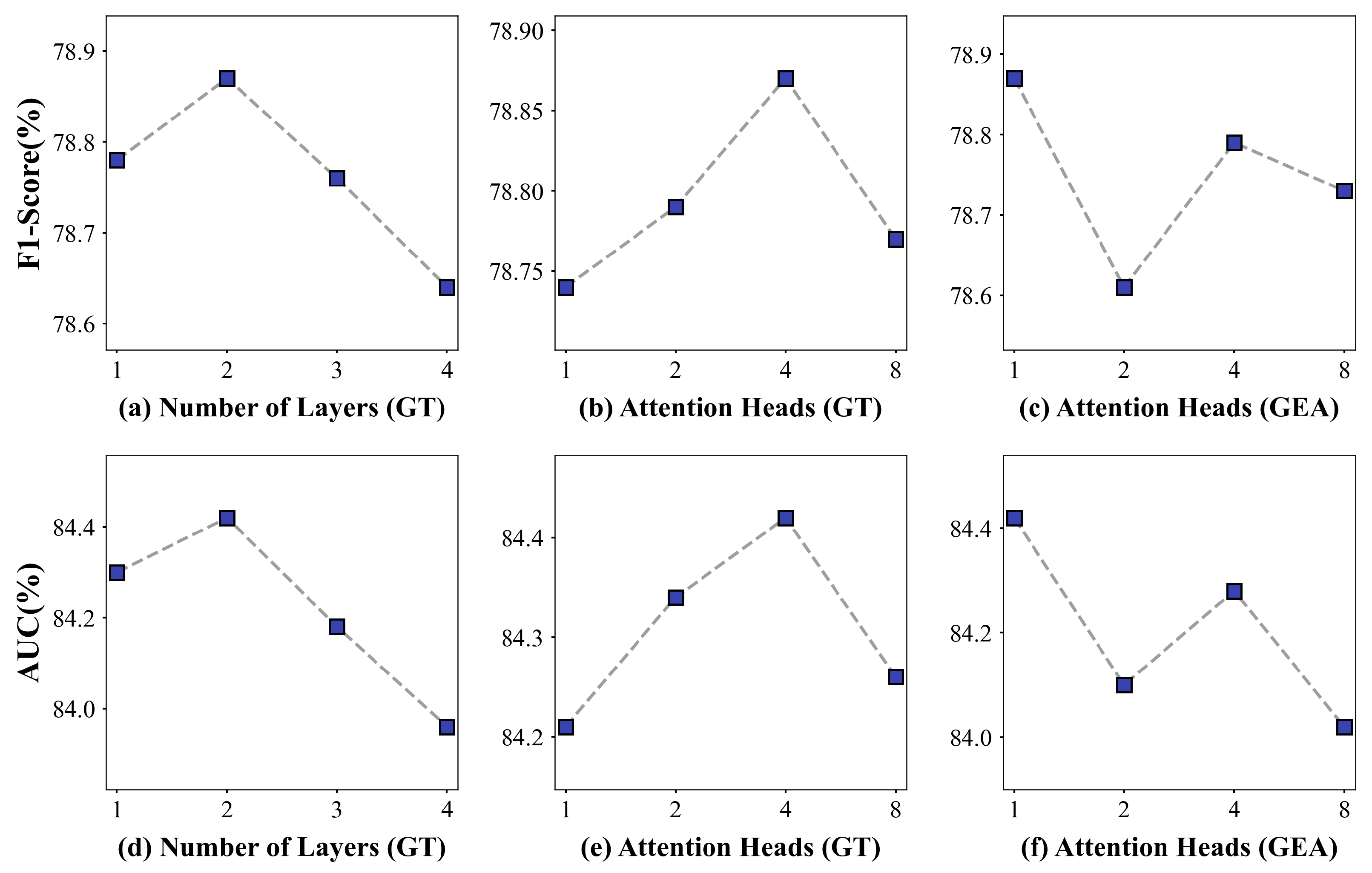
| ℓ | number of layers in the Graph Transformer | 2 |
| k | number of attention heads in the Graph Transformer | 4 |
| m | number of virtual nodes in the memory unit of the GEA | 20 |
| number of attention heads in the GEA | 1 | |
| d | embedding dimension | 128 |
| learning rate | ||
| dropout rate | 0.45 | |
| batch size | 128 |
| Model | Accuracy | Precision | Recall | F1-Score | AUC |
|---|---|---|---|---|---|
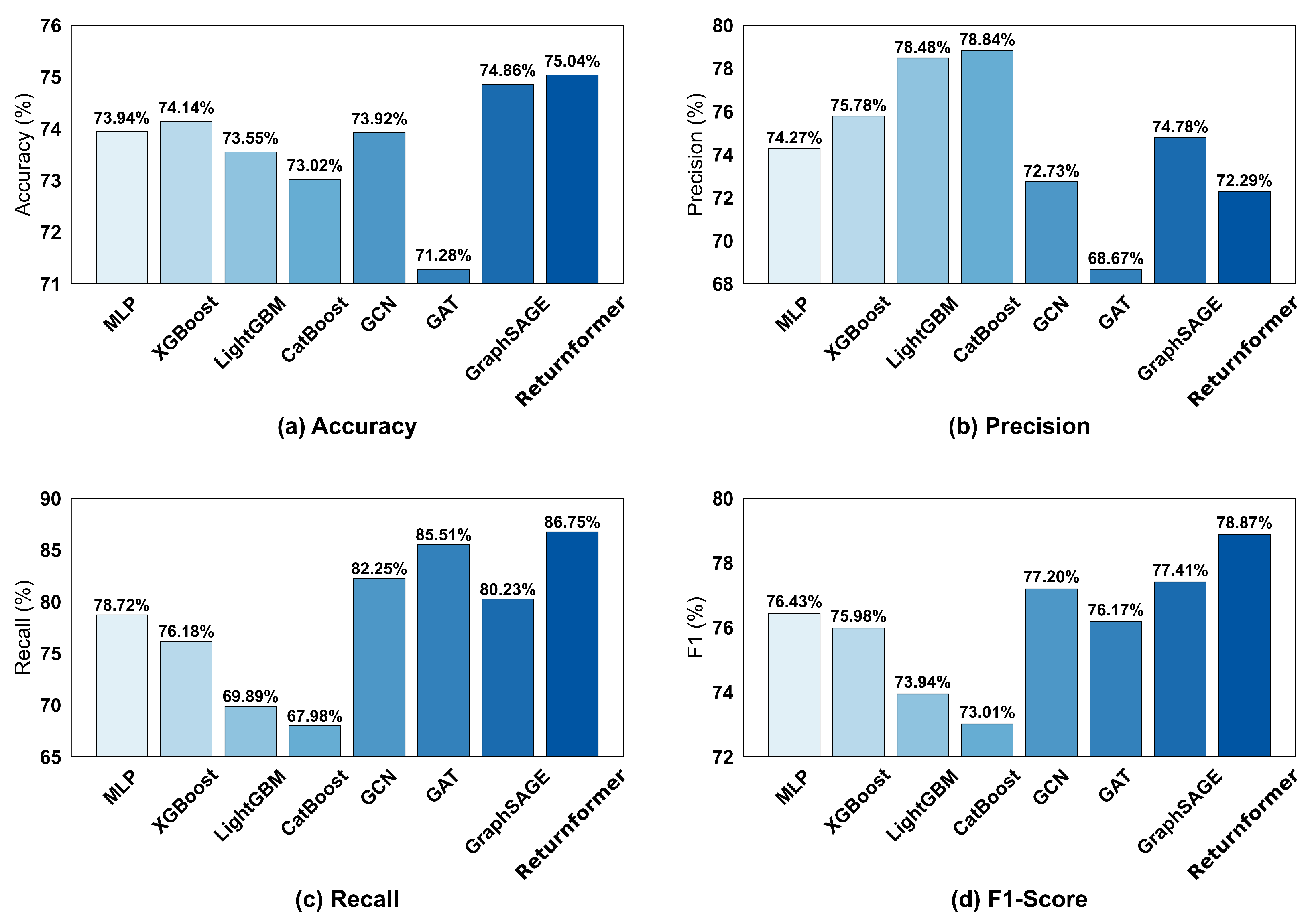
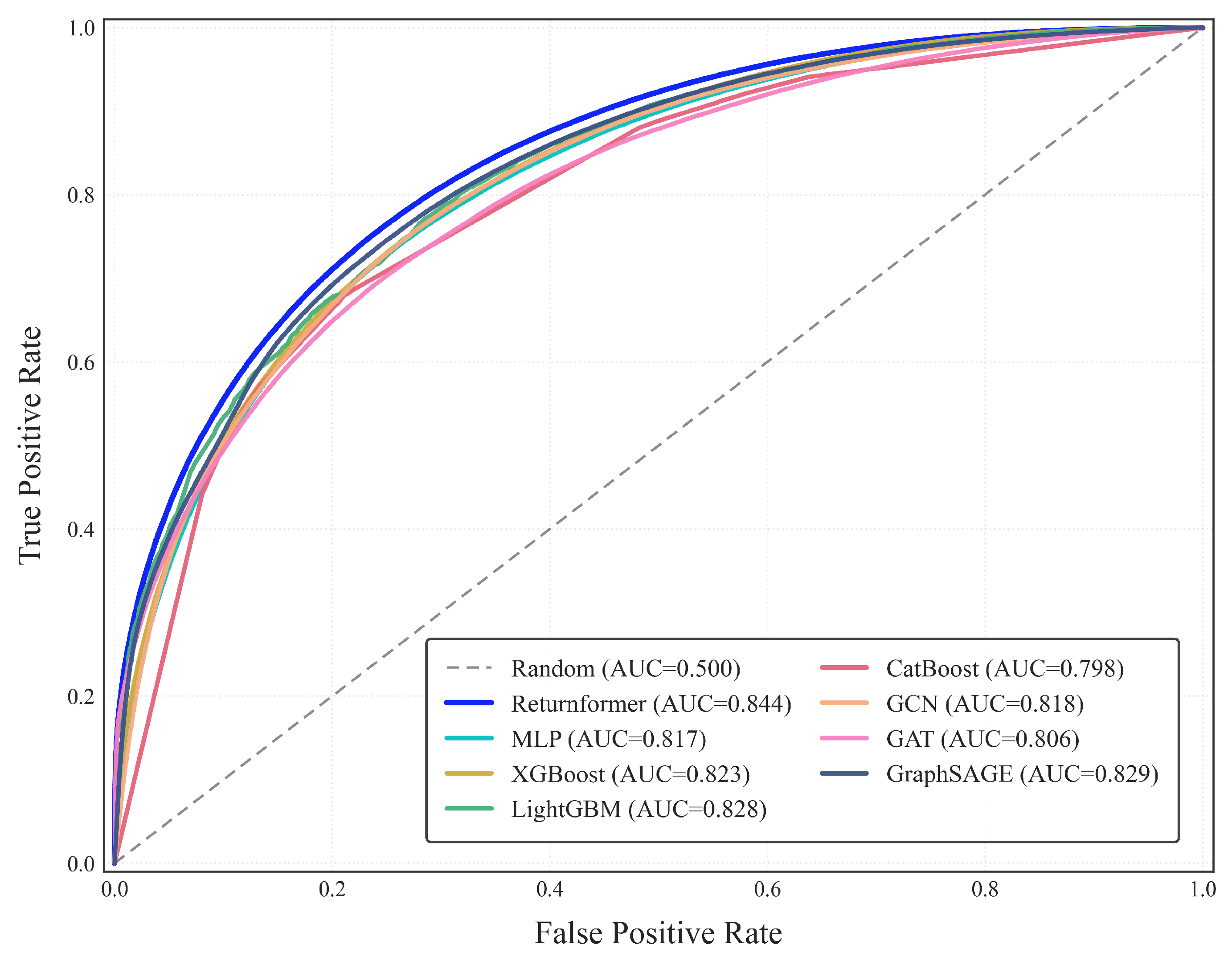
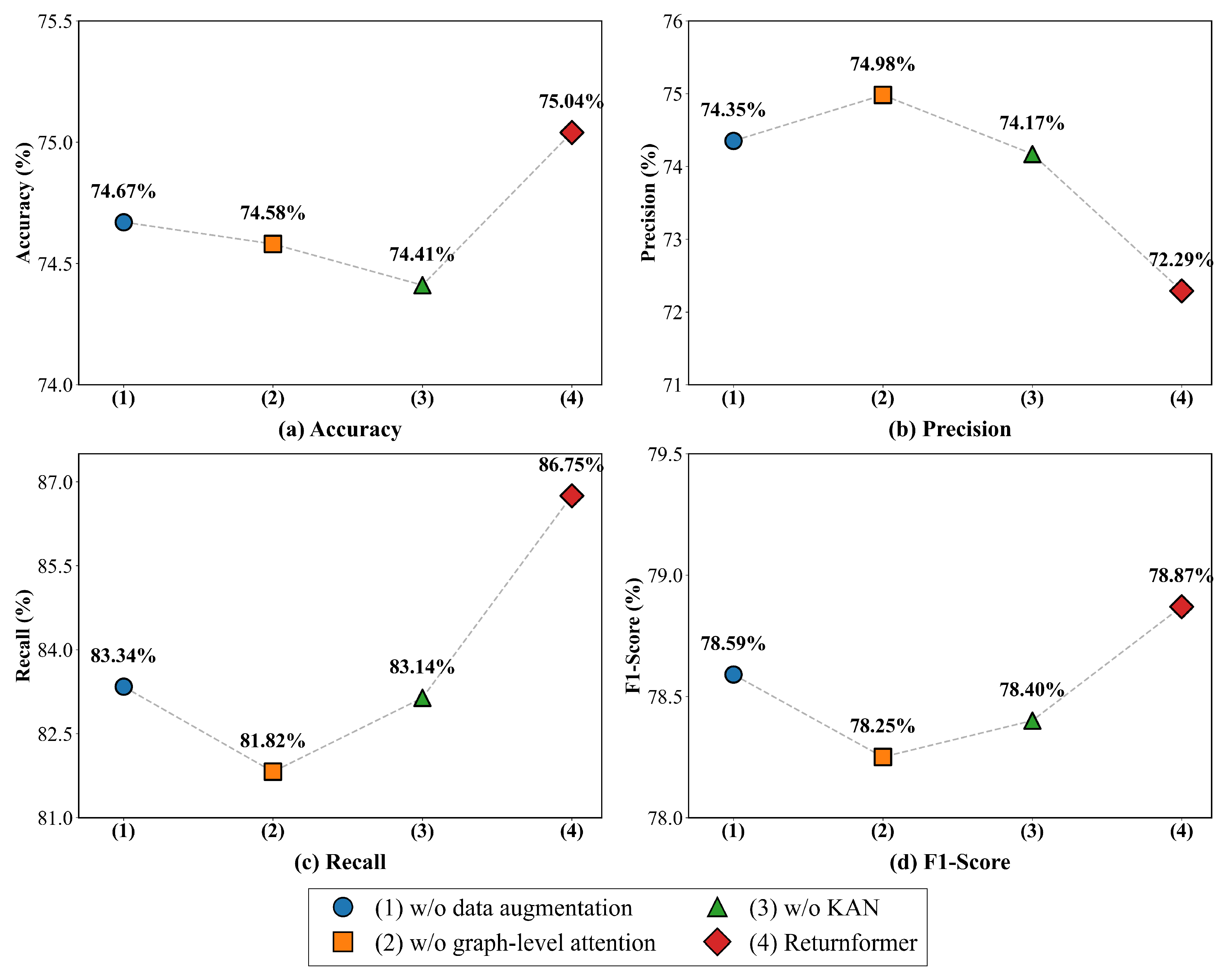
| Returnformer (all tests) | 75.04% | 72.29% | 86.75% | 78.87% | 84.42% |
| Returnformer (high-return customers) | 79.23% (+4.19%) | 80.80% (+8.51%) | 95.71% (+8.96%) | 87.63% (+8.76%) | 78.21% |
Disclaimer/Publisher’s Note: The statements, opinions and data contained in all publications are solely those of the individual author(s) and contributor(s) and not of MDPI and/or the editor(s). MDPI and/or the editor(s) disclaim responsibility for any injury to people or property resulting from any ideas, methods, instructions or products referred to in the content. |
© 2026 by the authors. Licensee MDPI, Basel, Switzerland. This article is an open access article distributed under the terms and conditions of the Creative Commons Attribution (CC BY) license.
Share and Cite
Cao, Q.; Zhang, N.; Li, H. Returnformer: A Graph Transformer-Based Model for Predicting Product Returns in E-Commerce. Entropy 2026, 28, 72. https://doi.org/10.3390/e28010072
Cao Q, Zhang N, Li H. Returnformer: A Graph Transformer-Based Model for Predicting Product Returns in E-Commerce. Entropy. 2026; 28(1):72. https://doi.org/10.3390/e28010072
Chicago/Turabian StyleCao, Qian, Ning Zhang, and Huiyong Li. 2026. "Returnformer: A Graph Transformer-Based Model for Predicting Product Returns in E-Commerce" Entropy 28, no. 1: 72. https://doi.org/10.3390/e28010072
APA StyleCao, Q., Zhang, N., & Li, H. (2026). Returnformer: A Graph Transformer-Based Model for Predicting Product Returns in E-Commerce. Entropy, 28(1), 72. https://doi.org/10.3390/e28010072