
Transition-Aware Decomposition of Single-Qudit Gates

Abstract
1. Introduction
2. Qudit Computing
3. Qudit Hardware Operations
4. Unitary Decomposition for Trapped-Ion and Superconducting Hardware
5. Unitary Decomposition for Qudit with Arbitrary Selection Rules
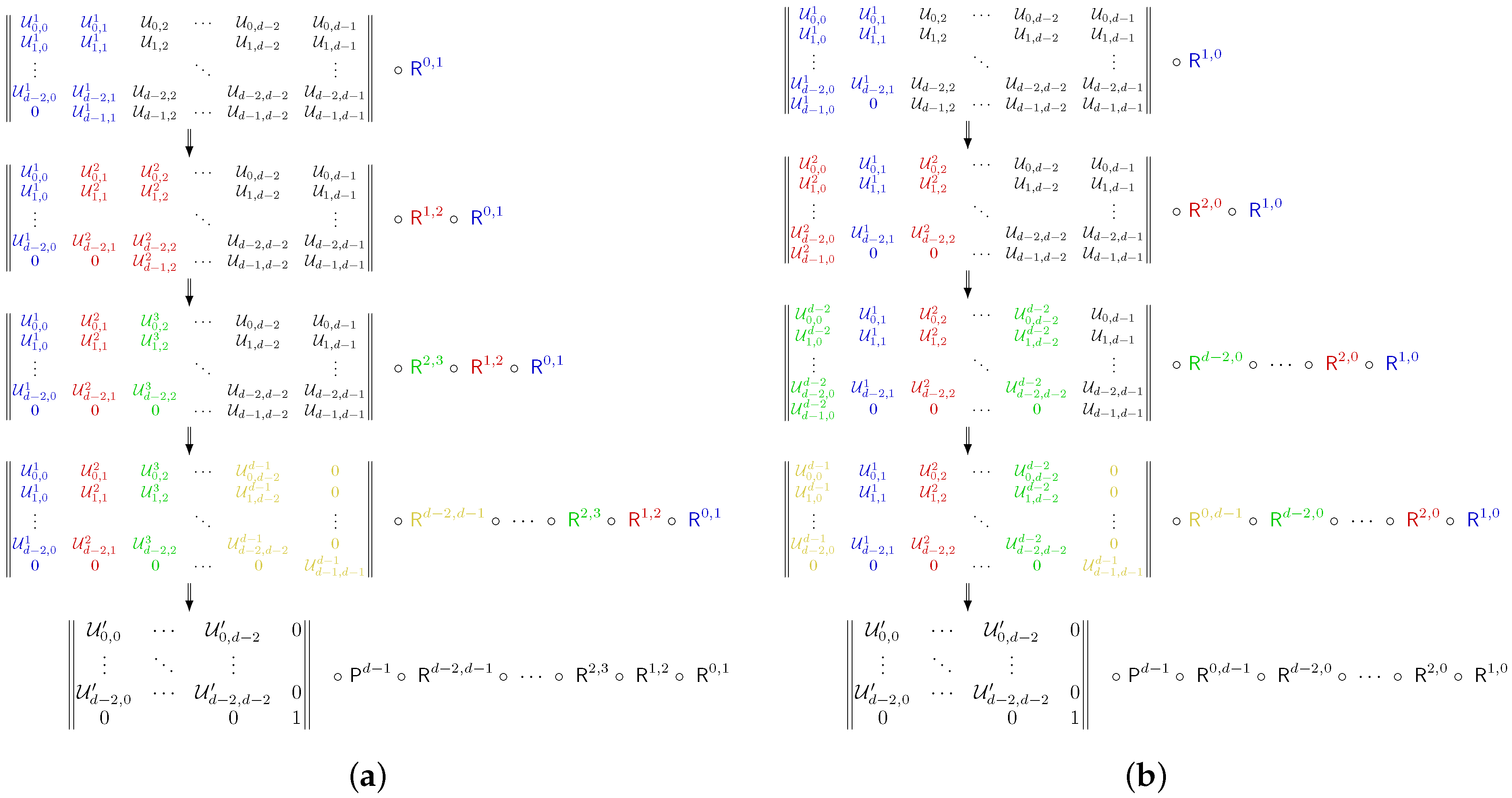
- On each step, we apply gate, where is the index of eliminated element in row and is the index of pivot element that used to eliminate ;
- must be allowed transition;
- Indices are non-repetitive and take all levels ;
- Indices could be arbitrary levels, except those that have already been eliminated:
- —the order of eliminated rows;
- —the order of eliminated elements on step;
- —pivot elements on step.
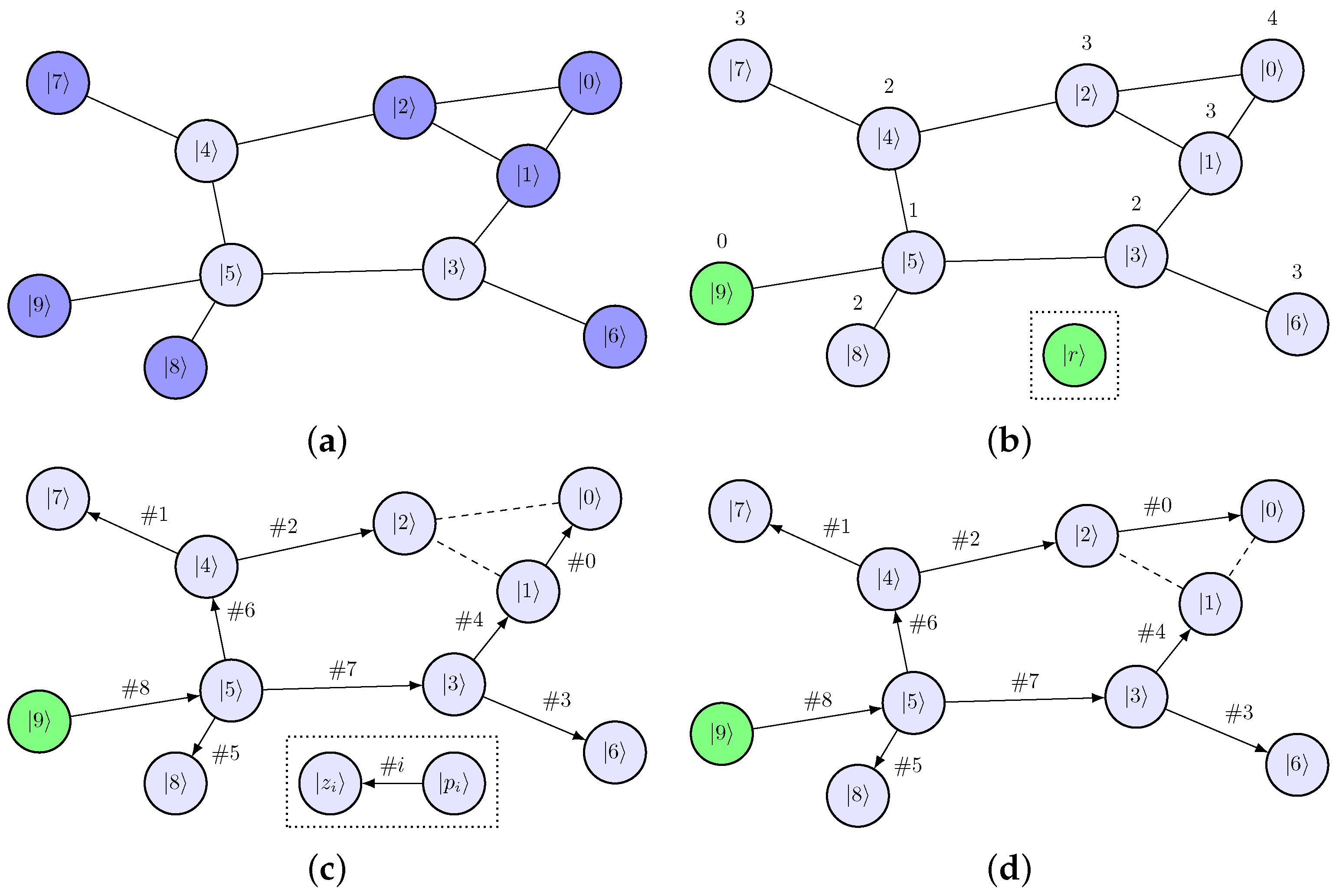
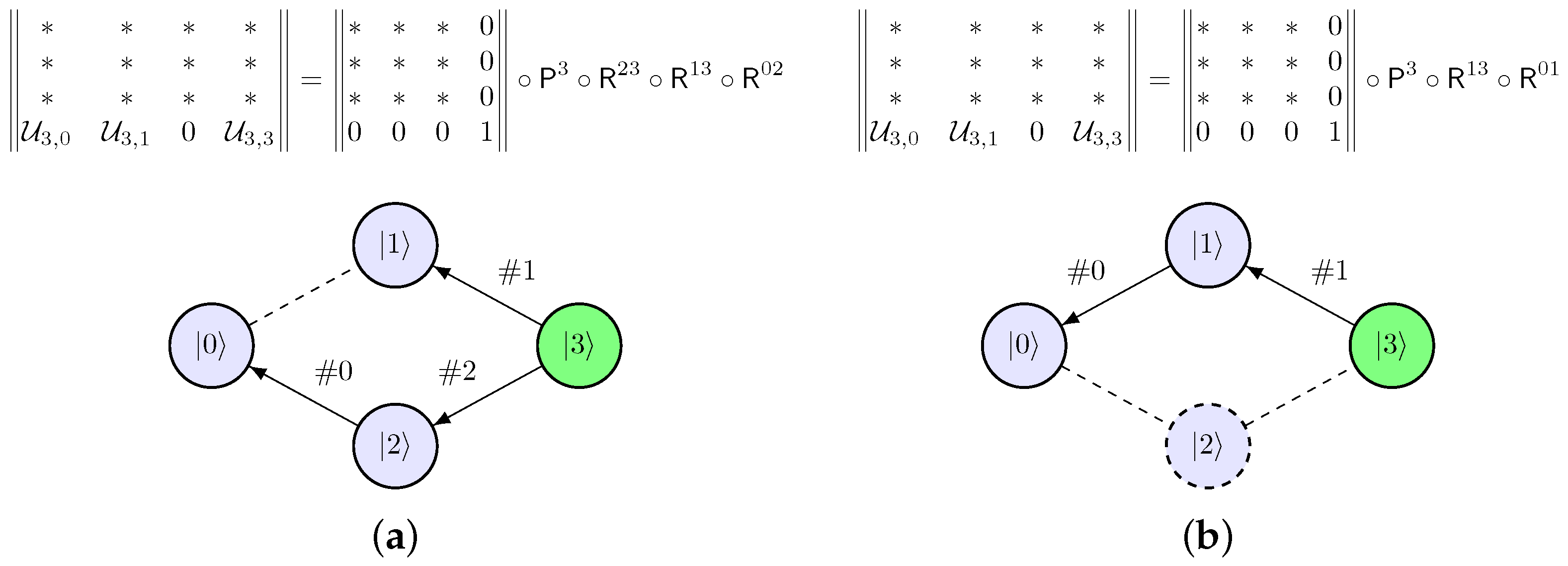
- On the step k (runs from to 1), has nodes/levels. We select levels that, if removed, do not break connectivity of the graph. One of these levels can be chosen as to eliminate the row of the qudit unitary matrix (Figure 2a). Here, we can use physical heuristics to eliminate less stable levels earlier.
- Each level is assigned the shortest distance from the level . This could be done using breadth-first search, which has time complexity . We can split all levels into sets , where contains levels at distance l from (Figure 2b).
- Let L be the maximum distance from in the . Each level is connected by a transition to some element . We add these indices into the decomposition scheme, then repeat for all in descending order of l (Figure 2c). There could be several levels connected to (Figure 2d). Using physical properties of a qudit, we can select the least noisy transition to reduce the average error of hardware execution.
- Continue the algorithm on the step for the transition graph until .
- Indices are taken from each . These are non-intersecting sets, so , i.e., all elements are eliminated except the diagonal one.
- Indices do not intersect already eliminated elements, since they have distance .
6. Comparison with Existing Decomposition Methods
- State number increment/decrement gate and , which have the form as in Equation (4).
- Quantum Fourier Transform with a size d that is denoted in Equation (7).
- Uniformly distributed (using Haar measure procedure) unitary matrix . Since the matrix is random, we run each decomposition on 100 generated matrices, then take median value for decomposition length.
- Two-qubit matrix that represents the action on two qubits embedded into the qudit with d = 4. Chosen gates are as follows: , , , , , and .
7. Conclusions
Author Contributions
Funding
Institutional Review Board Statement
Data Availability Statement
Conflicts of Interest
Appendix A. Comparison with Existing Decomposition Methods in Terms of Execution Time

| Method | Two-Qubit Gate | |||||||||||||||||
|---|---|---|---|---|---|---|---|---|---|---|---|---|---|---|---|---|---|---|
| = 4 | = 5 | = 6 | = 4 | = 5 | = 6 | = 4 | = 5 | = 6 | = 4 | = 5 | = 6 | |||||||
| QSearchPass [87] | 3182 | 14,078 | 10,513 | 3160 | 7046 | 14,449 | 3712 | 6264 | 16,764 | 3993 | 7324 | 16,364 | 10,378 | 2554 | 2204 | 2891 | 3170 | 2550 |
| QSweepPass [85] | 61.95 | 96.84 | 157.01 | 13.02 | 17.37 | 24.71 | 145.45 | 246.6 | 427.24 | 155.2 | 323.21 | 599.99 | 57.8 | 48.01 | 39.79 | 52.21 | 74.06 | 44.62 |
| LocQRPass [88] | 0.227 | 0.294 | 0.328 | 0.239 | 0.298 | 0.552 | 0.421 | 0.785 | 0.789 | 0.396 | 0.553 | 0.998 | 0.361 | 0.097 | 0.083 | 0.229 | 0.237 | 0.147 |
| LocAdaPass [88] | 0.706 | 0.93 | 1.223 | 1.263 | 3.23 | 8.81 | 1427.2 | TO | TO | 1089.1 | TO | TO | 0.929 | 0.179 | 0.15 | 0.472 | 0.478 | 0.249 |
| TAQR | 0.28 | 0.347 | 0.487 | 0.281 | 0.425 | 0.468 | 0.435 | 0.688 | 1.009 | 0.494 | 0.692 | 1.035 | 0.407 | 0.117 | 0.105 | 0.265 | 0.282 | 0.166 |
| TAQR Adaptive | 1.261 | 2.318 | 4.456 | 1.253 | 2.341 | 4.146 | 1.553 | 2.854 | 4.878 | 1.67 | 2.857 | 4.861 | 1.502 | 0.597 | 0.594 | 1.638 | 1.185 | 0.859 |
| (a) Line transition graph. | ||||||||||||||||||
| QSearchPass [87] | 2821 | 3067 | 3742 | 2929 | 3057 | 4241 | 4147 | 7187 | 17,974 | 3949 | 7785 | 17,719 | 3461 | 2602 | 2200 | 3068 | 3107 | 3051 |
| LocQRPass [88] | 0.392 | 0.896 | 0.625 | 0.361 | 0.514 | 0.654 | 0.842 | 1.361 | 2.036 | 1.186 | 1.173 | 1.947 | 0.713 | 0.101 | 0.083 | 0.407 | 0.408 | 0.208 |
| LocAdaPass [88] | 1.052 | 2.222 | 2.545 | 1.005 | 1.509 | 2.144 | 4.606 | 14.07 | 36.08 | 4.181 | 13.41 | 39.36 | 1.254 | 0.168 | 0.143 | 0.769 | 0.711 | 0.396 |
| TAQR | 0.663 | 0.472 | 0.623 | 0.274 | 0.367 | 0.459 | 0.397 | 1.09 | 0.99 | 0.431 | 0.735 | 1.048 | 0.314 | 0.113 | 0.104 | 0.254 | 0.279 | 0.268 |
| TAQR Adaptive | 1.359 | 2.204 | 2.374 | 1.059 | 1.631 | 2.355 | 1.379 | 2.335 | 3.578 | 1.38 | 2.33 | 3.581 | 1.128 | 0.398 | 0.353 | 1.118 | 1.009 | 1.249 |
| (b) Star transition graph. | ||||||||||||||||||
| QSearchPass [87] | 2446 | 2835 | 4177 | 2524 | 2949 | 4469 | 3159 | 7087 | 11,866 | 3525 | 7992 | 19,952 | 2276 | 2289 | 2267 | 2239 | 2229 | 2268 |
| LocQRPass [88] | 0.352 | 0.489 | 0.651 | 0.371 | 0.553 | 0.775 | 0.761 | 1.27 | 1.823 | 0.658 | 1.152 | 1.933 | 0.619 | 0.099 | 0.086 | 0.354 | 0.369 | 0.15 |
| LocAdaPass [88] | 0.872 | 1.65 | 2.437 | 0.953 | 1.565 | 2.339 | 3.658 | 13.0 | 37.24 | 826.7 | 12.02 | 49.2 | 1.102 | 0.171 | 0.138 | 0.625 | 0.606 | 0.254 |
| TAQR | 0.286 | 0.439 | 0.576 | 0.262 | 0.387 | 0.47 | 0.441 | 0.736 | 0.966 | 0.438 | 0.677 | 1.032 | 0.21 | 0.116 | 0.108 | 0.161 | 0.169 | 0.163 |
| TAQR Adaptive | 1.203 | 1.952 | 3.11 | 1.213 | 1.821 | 2.542 | 1.57 | 2.568 | 3.822 | 1.574 | 2.594 | 3.909 | 1.027 | 0.418 | 0.405 | 0.93 | 0.83 | 0.987 |
| (c) Bipartite transition graph. | ||||||||||||||||||
Appendix B. Python Code to Execute Decomposition
| Listing A1. Invoke QSearchPass decomposition using bqskit package with the version 1.2.1. |
 |
| Listing A2. Invoke QSweepPass decomposition using qsweep package from https://github.com/edyounis/QSweep.git (accessed on 26 December 2025) repository at the commit b621547. |
 |
| Listing A3. Invoke MQT.Qudits decomposition using mqt.qudits package with the version 0.4.0. |
 |
References
- Brassard, G.; Chuang, I.; Lloyd, S.; Monroe, C. Quantum computing. Proc. Natl. Acad. Sci. USA 1998, 95, 11032–11033. [Google Scholar] [CrossRef] [Scilit]
- Ladd, T.D.; Jelezko, F.; Laflamme, R.; Nakamura, Y.; Monroe, C.; O’Brien, J.L. Quantum computers. Nature 2010, 464, 45–53. [Google Scholar] [CrossRef] [Scilit] [PubMed]
- Fedorov, A.K.; Gisin, N.; Beloussov, S.M.; Lvovsky, A.I. Quantum computing at the quantum advantage threshold: A down-to-business review. arXiv 2022, arXiv:2203.17181. [Google Scholar] [CrossRef] [Scilit]
- Lloyd, S. Universal Quantum Simulators. Science 1996, 273, 1073–1078. [Google Scholar] [CrossRef] [Scilit]
- Farhi, E.; Goldstone, J.; Gutmann, S. A Quantum Approximate Optimization Algorithm. arXiv 2014, arXiv:1411.4028. [Google Scholar] [CrossRef] [Scilit]
- Shor, P. Algorithms for quantum computation: Discrete logarithms and factoring. In Proceedings of the Proceedings 35th Annual Symposium on Foundations of Computer Science, Santa Fe, NM, USA, 20–22 November 1994; pp. 124–134. [Google Scholar] [CrossRef] [Scilit]
- Cerezo, M.; Arrasmith, A.; Babbush, R.; Benjamin, S.C.; Endo, S.; Fujii, K.; McClean, J.R.; Mitarai, K.; Yuan, X.; Cincio, L.; et al. Variational quantum algorithms. Nat. Rev. Phys. 2021, 3, 625–644. [Google Scholar] [CrossRef] [Scilit]
- Bharti, K.; Cervera-Lierta, A.; Kyaw, T.H.; Haug, T.; Alperin-Lea, S.; Anand, A.; Degroote, M.; Heimonen, H.; Kottmann, J.S.; Menke, T.; et al. Noisy intermediate-scale quantum (NISQ) algorithms. Rev. Mod. Phys. 2022, 94, 015004. [Google Scholar] [CrossRef] [Scilit]
- Ebadi, S.; Wang, T.T.; Levine, H.; Keesling, A.; Semeghini, G.; Omran, A.; Bluvstein, D.; Samajdar, R.; Pichler, H.; Ho, W.W.; et al. Quantum phases of matter on a 256-atom programmable quantum simulator. Nature 2021, 595, 227–232. [Google Scholar] [CrossRef] [Scilit]
- Arute, F.; Arya, K.; Babbush, R.; Bacon, D.; Bardin, J.C.; Barends, R.; Biswas, R.; Boixo, S.; Brandao, F.G.S.L.; Buell, D.A.; et al. Quantum supremacy using a programmable superconducting processor. Nature 2019, 574, 505–510. [Google Scholar] [CrossRef] [Scilit] [PubMed]
- Wu, Y.; Bao, W.S.; Cao, S.; Chen, F.; Chen, M.C.; Chen, X.; Chung, T.H.; Deng, H.; Du, Y.; Fan, D.; et al. Strong Quantum Computational Advantage Using a Superconducting Quantum Processor. Phys. Rev. Lett. 2021, 127, 180501. [Google Scholar] [CrossRef] [Scilit]
- Xue, X.; Russ, M.; Samkharadze, N.; Undseth, B.; Sammak, A.; Scappucci, G.; Vandersypen, L.M.K. Quantum logic with spin qubits crossing the surface code threshold. Nature 2022, 601, 343–347. [Google Scholar] [CrossRef] [Scilit] [PubMed]
- Madzik, M.T.; Asaad, S.; Youssry, A.; Joecker, B.; Rudinger, K.M.; Nielsen, E.; Young, K.C.; Proctor, T.J.; Baczewski, A.D.; Laucht, A.; et al. Precision tomography of a three-qubit donor quantum processor in silicon. Nature 2022, 601, 348–353. [Google Scholar] [CrossRef] [Scilit]
- Noiri, A.; Takeda, K.; Nakajima, T.; Kobayashi, T.; Sammak, A.; Scappucci, G.; Tarucha, S. Fast universal quantum gate above the fault-tolerance threshold in silicon. Nature 2022, 601, 338–342. [Google Scholar] [CrossRef] [Scilit]
- Zhong, H.S.; Wang, H.; Deng, Y.H.; Chen, M.C.; Peng, L.C.; Luo, Y.H.; Qin, J.; Wu, D.; Ding, X.; Hu, Y.; et al. Quantum computational advantage using photons. Science 2020, 370, 1460–1463. [Google Scholar] [CrossRef] [Scilit]
- Madsen, L.S.; Laudenbach, F.; Askarani, M.F.; Rortais, F.; Vincent, T.; Bulmer, J.F.F.; Miatto, F.M.; Neuhaus, L.; Helt, L.G.; Collins, M.J.; et al. Quantum computational advantage with a programmable photonic processor. Nature 2022, 606, 75–81. [Google Scholar] [CrossRef] [Scilit] [PubMed]
- Scholl, P.; Schuler, M.; Williams, H.J.; Eberharter, A.A.; Barredo, D.; Schymik, K.N.; Lienhard, V.; Henry, L.P.; Lang, T.C.; Lahaye, T.; et al. Quantum simulation of 2D antiferromagnets with hundreds of Rydberg atoms. Nature 2021, 595, 233–238. [Google Scholar] [CrossRef] [Scilit] [PubMed]
- Henriet, L.; Beguin, L.; Signoles, A.; Lahaye, T.; Browaeys, A.; Reymond, G.O.; Jurczak, C. Quantum computing with neutral atoms. Quantum 2020, 4, 327. [Google Scholar] [CrossRef] [Scilit]
- Graham, T.M.; Song, Y.; Scott, J.; Poole, C.; Phuttitarn, L.; Jooya, K.; Eichler, P.; Jiang, X.; Marra, A.; Grinkemeyer, B.; et al. Multi-qubit entanglement and algorithms on a neutral-atom quantum computer. Nature 2022, 604, 457–462. [Google Scholar] [CrossRef] [Scilit]
- Zhang, J.; Pagano, G.; Hess, P.W.; Kyprianidis, A.; Becker, P.; Kaplan, H.; Gorshkov, A.V.; Gong, Z.X.; Monroe, C. Observation of a many-body dynamical phase transition with a 53-qubit quantum simulator. Nature 2017, 551, 601–604. [Google Scholar] [CrossRef] [Scilit]
- Blatt, R.; Roos, C.F. Quantum simulations with trapped ions. Nat. Phys. 2012, 8, 277–284. [Google Scholar] [CrossRef] [Scilit]
- Hempel, C.; Maier, C.; Romero, J.; McClean, J.; Monz, T.; Shen, H.; Jurcevic, P.; Lanyon, B.P.; Love, P.; Babbush, R.; et al. Quantum Chemistry Calculations on a Trapped-Ion Quantum Simulator. Phys. Rev. X 2018, 8, 031022. [Google Scholar] [CrossRef] [Scilit]
- Kiktenko, E.O.; Nikolaeva, A.S.; Fedorov, A.K. Colloquium: Qudits for decomposing multiqubit gates and realizing quantum algorithms. Rev. Mod. Phys. 2025, 97, 021003. [Google Scholar] [CrossRef] [Scilit]
- Farhi, E.; Gutmann, S. Analog analogue of a digital quantum computation. Phys. Rev. A 1998, 57, 2403–2406. [Google Scholar] [CrossRef] [Scilit]
- Kessel’, A.R.; Ermakov, V.L. Multiqubit spin. J. Exp. Theor. Phys. Lett. 1999, 70, 61–65. [Google Scholar] [CrossRef] [Scilit]
- Kessel’, A.R.; Ermakov, V.L. Physical implementation of three-qubit gates on a separate quantum particle. J. Exp. Theor. Phys. Lett. 2000, 71, 307–309. [Google Scholar] [CrossRef] [Scilit]
- Kessel, A.R.; Yakovleva, N.M. Implementation schemes in NMR of quantum processors and the Deutsch-Jozsa algorithm by using virtual spin representation. Phys. Rev. A 2002, 66, 062322. [Google Scholar] [CrossRef] [Scilit]
- Muthukrishnan, A.; Stroud, C.R. Multivalued logic gates for quantum computation. Phys. Rev. A 2000, 62, 052309. [Google Scholar] [CrossRef] [Scilit]
- Nielsen, M.A.; Bremner, M.J.; Dodd, J.L.; Childs, A.M.; Dawson, C.M. Universal simulation of Hamiltonian dynamics for quantum systems with finite-dimensional state spaces. Phys. Rev. A 2002, 66, 022317. [Google Scholar] [CrossRef] [Scilit]
- Wang, X.; Sanders, B.C.; Berry, D.W. Entangling power and operator entanglement in qudit systems. Phys. Rev. A 2003, 67, 042323. [Google Scholar] [CrossRef] [Scilit]
- Klimov, A.B.; Guzmán, R.; Retamal, J.C.; Saavedra, C. Qutrit quantum computer with trapped ions. Phys. Rev. A 2003, 67, 062313. [Google Scholar] [CrossRef] [Scilit]
- Bagan, E.; Baig, M.; Muñoz Tapia, R. Minimal measurements of the gate fidelity of a qudit map. Phys. Rev. A 2003, 67, 014303. [Google Scholar] [CrossRef] [Scilit]
- Vlasov, A.Y. Algebra of quantum computations with higher dimensional systems. In Proceedings of the First International Symposium on Quantum Informatics; Ozhigov, Y.I., Ed.; International Society for Optics and Photonics, SPIE: Bellingham, DC, USA, 2003; Volume 5128, pp. 29–36. [Google Scholar] [CrossRef] [Scilit]
- Greentree, A.D.; Schirmer, S.G.; Green, F.; Hollenberg, L.C.L.; Hamilton, A.R.; Clark, R.G. Maximizing the Hilbert Space for a Finite Number of Distinguishable Quantum States. Phys. Rev. Lett. 2004, 92, 097901. [Google Scholar] [CrossRef] [Scilit]
- O’Leary, D.P.; Brennen, G.K.; Bullock, S.S. Parallelism for quantum computation with qudits. Phys. Rev. A 2006, 74, 032334. [Google Scholar] [CrossRef] [Scilit]
- Ralph, T.C.; Resch, K.J.; Gilchrist, A. Efficient Toffoli gates using qudits. Phys. Rev. A 2007, 75, 022313. [Google Scholar] [CrossRef] [Scilit]
- Lanyon, B.P.; Weinhold, T.J.; Langford, N.K.; O’Brien, J.L.; Resch, K.J.; Gilchrist, A.; White, A.G. Manipulating Biphotonic Qutrits. Phys. Rev. Lett. 2008, 100, 060504. [Google Scholar] [CrossRef] [Scilit] [PubMed]
- Ionicioiu, R.; Spiller, T.P.; Munro, W.J. Generalized Toffoli gates using qudit catalysis. Phys. Rev. A 2009, 80, 012312. [Google Scholar] [CrossRef] [Scilit]
- Neeley, M.; Ansmann, M.; Bialczak, R.C.; Hofheinz, M.; Lucero, E.; O’Connell, A.D.; Sank, D.; Wang, H.; Wenner, J.; Cleland, A.N.; et al. Emulation of a Quantum Spin with a Superconducting Phase Qudit. Science 2009, 325, 722–725. [Google Scholar] [CrossRef] [Scilit]
- Lanyon, B.P.; Barbieri, M.; Almeida, M.P.; Jennewein, T.; Ralph, T.C.; Resch, K.J.; Pryde, G.J.; O’Brien, J.L.; Gilchrist, A.; White, A.G. Simplifying quantum logic using higher-dimensional Hilbert spaces. Nat. Phys. 2009, 5, 134–140. [Google Scholar] [CrossRef] [Scilit]
- Ivanov, S.S.; Tonchev, H.S.; Vitanov, N.V. Time-efficient implementation of quantum search with qudits. Phys. Rev. A 2012, 85, 062321. [Google Scholar] [CrossRef] [Scilit]
- Mischuck, B.E.; Merkel, S.T.; Deutsch, I.H. Control of inhomogeneous atomic ensembles of hyperfine qudits. Phys. Rev. A 2012, 85, 022302. [Google Scholar] [CrossRef] [Scilit]
- Fedorov, A.; Steffen, L.; Baur, M.; da Silva, M.P.; Wallraff, A. Implementation of a Toffoli gate with superconducting circuits. Nature 2012, 481, 170–172. [Google Scholar] [CrossRef] [Scilit]
- Li, B.; Yu, Z.H.; Fei, S.M. Geometry of Quantum Computation with Qutrits. Sci. Rep. 2013, 3, 2594. [Google Scholar] [CrossRef] [Scilit]
- Svetitsky, E.; Suchowski, H.; Resh, R.; Shalibo, Y.; Martinis, J.M.; Katz, N. Hidden two-qubit dynamics of a four-level Josephson circuit. Nat. Commun. 2014, 5, 5617. [Google Scholar] [CrossRef] [Scilit] [PubMed]
- Peterer, M.J.; Bader, S.J.; Jin, X.; Yan, F.; Kamal, A.; Gudmundsen, T.J.; Leek, P.J.; Orlando, T.P.; Oliver, W.D.; Gustavsson, S. Coherence and Decay of Higher Energy Levels of a Superconducting Transmon Qubit. Phys. Rev. Lett. 2015, 114, 010501. [Google Scholar] [CrossRef] [Scilit]
- Kiktenko, E.O.; Fedorov, A.K.; Man’ko, O.V.; Man’ko, V.I. Multilevel superconducting circuits as two-qubit systems: Operations, state preparation, and entropic inequalities. Phys. Rev. A 2015, 91, 042312. [Google Scholar] [CrossRef] [Scilit]
- Kiktenko, E.; Fedorov, A.; Strakhov, A.; Man’ko, V. Single qudit realization of the Deutsch algorithm using superconducting many-level quantum circuits. Phys. Lett. A 2015, 379, 1409–1413. [Google Scholar] [CrossRef] [Scilit]
- Braumüller, J.; Cramer, J.; Schlör, S.; Rotzinger, H.; Radtke, L.; Lukashenko, A.; Yang, P.; Skacel, S.T.; Probst, S.; Marthaler, M.; et al. Multiphoton dressing of an anharmonic superconducting many-level quantum circuit. Phys. Rev. B 2015, 91, 054523. [Google Scholar] [CrossRef] [Scilit]
- Song, C.; Su, S.L.; Wu, J.L.; Wang, D.Y.; Ji, X.; Zhang, S. Generation of tree-type three-dimensional entangled states via adiabatic passage. Phys. Rev. A 2016, 93, 062321. [Google Scholar] [CrossRef] [Scilit]
- Frydryszak, A.; Jakóbczyk, L.; Ługiewicz, P. Determining quantum correlations in bipartite systems - from qubit to qutrit and beyond. J. Phys. Conf. Ser. 2017, 804, 012016. [Google Scholar] [CrossRef] [Scilit]
- Godfrin, C.; Ferhat, A.; Ballou, R.; Klyatskaya, S.; Ruben, M.; Wernsdorfer, W.; Balestro, F. Operating Quantum States in Single Magnetic Molecules: Implementation of Grover’s Quantum Algorithm. Phys. Rev. Lett. 2017, 119, 187702. [Google Scholar] [CrossRef] [Scilit]
- Bocharov, A.; Roetteler, M.; Svore, K.M. Factoring with qutrits: Shor’s algorithm on ternary and metaplectic quantum architectures. Phys. Rev. A 2017, 96, 012306. [Google Scholar] [CrossRef] [Scilit]
- Kues, M.; Reimer, C.; Roztocki, P.; Cortés, L.R.; Sciara, S.; Wetzel, B.; Zhang, Y.; Cino, A.; Chu, S.T.; Little, B.E.; et al. On-chip generation of high-dimensional entangled quantum states and their coherent control. Nature 2017, 546, 622–626. [Google Scholar] [CrossRef] [Scilit] [PubMed]
- Gokhale, P.; Baker, J.M.; Duckering, C.; Brown, N.C.; Brown, K.R.; Chong, F.T. Asymptotic Improvements to Quantum Circuits via Qutrits. In Proceedings of the 46th International Symposium on Computer Architecture, New York, NY, USA, 22–26 June 2019; ISCA ’19, pp. 554–566. [Google Scholar] [CrossRef] [Scilit]
- Luo, Y.H.; Zhong, H.S.; Erhard, M.; Wang, X.L.; Peng, L.C.; Krenn, M.; Jiang, X.; Li, L.; Liu, N.L.; Lu, C.Y.; et al. Quantum Teleportation in High Dimensions. Phys. Rev. Lett. 2019, 123, 070505. [Google Scholar] [CrossRef] [Scilit]
- Low, P.J.; White, B.M.; Cox, A.A.; Day, M.L.; Senko, C. Practical trapped-ion protocols for universal qudit-based quantum computing. Phys. Rev. Res. 2020, 2, 033128. [Google Scholar] [CrossRef] [Scilit]
- Jin, Z.; Gong, W.J.; Zhu, A.D.; Zhang, S.; Qi, Y.; Su, S.L. Dissipative preparation of qutrit entanglement via periodically modulated Rydberg double antiblockade. Opt. Express 2021, 29, 10117–10133. [Google Scholar] [CrossRef] [Scilit]
- Sawant, R.; Blackmore, J.A.; Gregory, P.D.; Mur-Petit, J.; Jaksch, D.; Aldegunde, J.; Hutson, J.M.; Tarbutt, M.R.; Cornish, S.L. Ultracold polar molecules as qudits. New J. Phys. 2020, 22, 013027. [Google Scholar] [CrossRef] [Scilit]
- Pavlidis, A.; Floratos, E. Quantum-Fourier-transform-based quantum arithmetic with qudits. Phys. Rev. A 2021, 103, 032417. [Google Scholar] [CrossRef] [Scilit]
- Rambow, P.; Tian, M. Reduction of circuit depth by mapping qubit-based quantum gates to a qudit basis. arXiv 2021, arXiv:2109.09902. [Google Scholar] [CrossRef] [Scilit]
- Nikolaeva, A.S.; Kiktenko, E.O.; Fedorov, A.K. Efficient realization of quantum algorithms with qudits. EPJ Quantum Technol. 2024, 11, 1–25. [Google Scholar] [CrossRef] [Scilit]
- Nikolaeva, A.S.; Kiktenko, E.O.; Fedorov, A.K. Universal quantum computing with qubits embedded in trapped-ion qudits. Phys. Rev. A 2024, 109, 022615. [Google Scholar] [CrossRef] [Scilit]
- Drozhzhin, D.A.; Nikolaeva, A.S.; Kiktenko, E.O.; Fedorov, A.K. Transpiling Quantum Assembly Language Circuits to a Qudit Form. Entropy 2024, 26, 1129. [Google Scholar] [CrossRef] [Scilit]
- Barenco, A.; Bennett, C.H.; Cleve, R.; DiVincenzo, D.P.; Margolus, N.; Shor, P.; Sleator, T.; Smolin, J.A.; Weinfurter, H. Elementary gates for quantum computation. Phys. Rev. A 1995, 52, 3457–3467. [Google Scholar] [CrossRef] [Scilit]
- Liu, W.Q.; Wei, H.R.; Kwek, L.C. Low-Cost Fredkin Gate with Auxiliary Space. Phys. Rev. Appl. 2020, 14, 054057. [Google Scholar] [CrossRef] [Scilit]
- Baker, J.M.; Duckering, C.; Chong, F.T. Efficient Quantum Circuit Decompositions via Intermediate Qudits. In Proceedings of the 2020 IEEE 50th International Symposium on Multiple-Valued Logic (ISMVL), Miyazaki, Japan, 9–11 November 2020; pp. 303–308. [Google Scholar] [CrossRef] [Scilit]
- Kiktenko, E.O.; Nikolaeva, A.S.; Xu, P.; Shlyapnikov, G.V.; Fedorov, A.K. Scalable quantum computing with qudits on a graph. Phys. Rev. A 2020, 101, 022304. [Google Scholar] [CrossRef] [Scilit]
- Liu, W.Q.; Wei, H.R.; Kwek, L.C. Universal Quantum Multi-Qubit Entangling Gates with Auxiliary Spaces. Adv. Quantum Technol. 2022, 5, 2100136. [Google Scholar] [CrossRef] [Scilit]
- Galda, A.; Cubeddu, M.; Kanazawa, N.; Narang, P.; Earnest-Noble, N. Implementing a Ternary Decomposition of the Toffoli Gate on Fixed-Frequency Transmon Qutrits. arXiv 2021, arXiv:2109.00558. [Google Scholar]
- Gu, X.; Allcock, J.; An, S.; Liu, Y.x. Efficient multi-qubit subspace rotations via topological quantum walks. arXiv 2021, arXiv:2111.06534. [Google Scholar] [CrossRef] [Scilit]
- Hill, A.D.; Hodson, M.J.; Didier, N.; Reagor, M.J. Realization of arbitrary doubly-controlled quantum phase gates. arXiv 2021, arXiv:2108.01652. [Google Scholar] [CrossRef] [Scilit]
- Chi, Y.; Huang, J.; Zhang, Z.; Mao, J.; Zhou, Z.; Chen, X.; Zhai, C.; Bao, J.; Dai, T.; Yuan, H.; et al. A programmable qudit-based quantum processor. Nat. Commun. 2022, 13, 1166. [Google Scholar] [CrossRef] [Scilit] [PubMed]
- Ringbauer, M.; Meth, M.; Postler, L.; Stricker, R.; Blatt, R.; Schindler, P.; Monz, T. A universal qudit quantum processor with trapped ions. Nat. Phys. 2022, 18, 1053–1057. [Google Scholar] [CrossRef] [Scilit]
- Aksenov, M.A.; Zalivako, I.V.; Semerikov, I.A.; Borisenko, A.S.; Semenin, N.V.; Sidorov, P.L.; Fedorov, A.K.; Khabarova, K.Y.; Kolachevsky, N.N. Realizing quantum gates with optically addressable ion qudits. Phys. Rev. A 2023, 107, 052612. [Google Scholar] [CrossRef] [Scilit]
- Champion, E.; Wang, Z.; Parker, R.W.; Blok, M.S. Efficient Control of a Transmon Qudit Using Effective Spin-7/2 Rotations. Phys. Rev. X 2025, 15, 021096. [Google Scholar] [CrossRef] [Scilit]
- Wang, Z.; Parker, R.W.; Champion, E.; Blok, M.S. High-EJ/EC transmon qudits with up to 12 levels. Phys. Rev. Appl. 2025, 23, 034046. [Google Scholar] [CrossRef] [Scilit]
- Yu, Y.; Chi, Y.; Zhai, C.; Huang, J.; Gong, Q.; Wang, J. Simulating Hamiltonian dynamics in a programmable photonic quantum processor using linear combinations of unitary operations. arXiv 2022, arXiv:2211.06723. [Google Scholar]
- Nikolaeva, A.S.; Kiktenko, E.O.; Fedorov, A.K. Decomposing the generalized Toffoli gate with qutrits. Phys. Rev. A 2022, 105, 032621. [Google Scholar] [CrossRef] [Scilit]
- Nikolaeva, A.S.; Zalivako, I.V.; Borisenko, A.S.; Semenin, N.V.; Galstyan, K.P.; Korolkov, A.E.; Kiktenko, E.O.; Khabarova, K.Y.; Semerikov, I.A.; Fedorov, A.K.; et al. Scalable improvement of the generalized Toffoli gate realization using trapped-ion-based qutrits. Phys. Rev. Lett. 2024, 135, 060601. [Google Scholar] [CrossRef] [Scilit]
- Brennen, G.; O’Leary, D.; Bullock, S. Criteria for exact qudit universality. Phys. Rev. A 2005, 71, 052318. [Google Scholar] [CrossRef] [Scilit]
- Low, P.J.; White, B.; Senko, C. Control and readout of a 13-level trapped ion qudit. npj Quantum Inf. 2025, 11, 85. [Google Scholar] [CrossRef] [Scilit]
- Low, P.J.; Zutt, N.C.F.; Tathed, G.A.; Senko, C. Quantum logic operations and algorithms in a single 25-level atomic qudit. arXiv 2025, arXiv:2507.15799. [Google Scholar] [CrossRef] [Scilit]
- Zalivako, I.V.; Nikolaeva, A.S.; Borisenko, A.S.; Korolkov, A.E.; Sidorov, P.L.; Galstyan, K.P.; Semenin, N.V.; Smirnov, V.N.; Aksenov, M.A.; Makushin, K.M.; et al. Towards multiqudit quantum processor based on a ion string: Realizing basic quantum algorithms. Quantum Rep. 2025, 7, 19. [Google Scholar] [CrossRef] [Scilit]
- Younis, E.; Goss, N. QSweep: Pulse-Optimal Single-Qudit Synthesis. arXiv 2023, arXiv:2312.09990. [Google Scholar]
- Clements, W.R.; Humphreys, P.C.; Metcalf, B.J.; Kolthammer, W.S.; Walmsley, I.A. Optimal design for universal multiport interferometers. Optica 2016, 3, 1460–1465. [Google Scholar] [CrossRef] [Scilit]
- Davis, M.G.; Smith, E.; Tudor, A.; Sen, K.; Siddiqi, I.; Iancu, C. Towards Optimal Topology Aware Quantum Circuit Synthesis. In Proceedings of the 2020 IEEE International Conference on Quantum Computing and Engineering (QCE), Denver, CO, USA, 12–16 October 2020; pp. 223–234. [Google Scholar] [CrossRef] [Scilit]
- Mato, K.; Ringbauer, M.; Burgholzer, L.; Wille, R. MQT Qudits: A Software Framework for Mixed-Dimensional Quantum Computing. arXiv 2024, arXiv:2410.02854. [Google Scholar] [CrossRef] [Scilit]


| Platform | d | Connectivity | Decomposition Schemes |
|---|---|---|---|
| Superconducting qudit | 4 |  | |
| trapped-ion qudit | 4 | 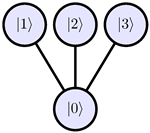 | |
| trapped-ion qudit | 5 |  |
| Method | Two-Qubit Gate | |||||||||||||||||
|---|---|---|---|---|---|---|---|---|---|---|---|---|---|---|---|---|---|---|
| = 4 | = 5 | = 6 | = 4 | = 5 | = 6 | = 4 | = 5 | = 6 | = 4 | = 5 | = 6 | |||||||
| QSearchPass [87] | 3 | 4 | 5 | 3 | 4 | 5 | 7 | 11 | 17 | 7 | 12 | 16 | 6 | 0 | 0 | 3 | 3 | 1 |
| QSweepPass [85] | 5 | 6 | 7 | 3 | 4 | 5 | 7 | 11 | 16 | 7 | 11 | 16 | 6 | 2 | 2 | 5 | 5 | 3 |
| LocQRPass [88] | 3 | 4 | 5 | 3 | 4 | 5 | 6 | 10 | 15 | 6 | 10 | 15 | 6 | 0 | 0 | 3 | 3 | 1 |
| LocAdaPass [88] | 3 | 4 | 5 | 3 | 4 | 5 | 6 | TO | TO | 7 | TO | TO | 4 | 0 | 0 | 2 | 2 | 1 |
| TAQR | 3 | 4 | 5 | 3 | 4 | 5 | 6 | 10 | 15 | 6 | 10 | 15 | 6 | 0 | 0 | 3 | 3 | 1 |
| TAQR Adaptive | 3 | 4 | 5 | 3 | 4 | 5 | 6 | 10 | 15 | 6 | 10 | 15 | 6 | 0 | 0 | 3 | 3 | 1 |
| (a) Line transition graph. | ||||||||||||||||||
| QSearchPass [87] | 3 | 4 | 5 | 3 | 4 | 5 | 6 | 12 | 16 | 7 | 11 | 16 | 4 | 0 | 0 | 3 | 3 | 3 |
| LocQRPass [88] | 7 | 10 | 13 | 7 | 10 | 13 | 16 | 28 | 43 | 16 | 28 | 43 | 16 | 0 | 0 | 9 | 9 | 3 |
| LocAdaPass [88] | 4 | 6 | 7 | 4 | 5 | 6 | 8 | 15 | 24 | 8 | 15 | 24 | 3 | 0 | 0 | 2 | 2 | 2 |
| TAQR | 5 | 6 | 9 | 3 | 4 | 5 | 5 | 10 | 15 | 6 | 10 | 15 | 4 | 0 | 0 | 3 | 3 | 3 |
| TAQR Adaptive | 3 | 4 | 5 | 3 | 4 | 5 | 6 | 10 | 15 | 6 | 10 | 15 | 4 | 0 | 0 | 3 | 3 | 3 |
| (b) Star transition graph. | ||||||||||||||||||
| QSearchPass [87] | 3 | 4 | 6 | 3 | 4 | 5 | 7 | 12 | 13 | 7 | 11 | 16 | 2 | 0 | 0 | 1 | 1 | 1 |
| LocQRPass [88] | 7 | 10 | 13 | 7 | 10 | 13 | 14 | 26 | 41 | 14 | 26 | 41 | 14 | 0 | 0 | 7 | 7 | 1 |
| LocAdaPass [88] | 4 | 6 | 7 | 4 | 5 | 6 | 9 | 14 | 21 | 9 | 14 | 21 | 2 | 0 | 0 | 1 | 1 | 1 |
| TAQR | 3 | 6 | 7 | 3 | 4 | 5 | 6 | 10 | 14 | 6 | 10 | 15 | 2 | 0 | 0 | 1 | 1 | 1 |
| TAQR Adaptive | 3 | 4 | 5 | 3 | 4 | 5 | 6 | 10 | 14 | 6 | 10 | 15 | 2 | 0 | 0 | 1 | 1 | 1 |
| (c) Bipartite transition graph. | ||||||||||||||||||
Disclaimer/Publisher’s Note: The statements, opinions and data contained in all publications are solely those of the individual author(s) and contributor(s) and not of MDPI and/or the editor(s). MDPI and/or the editor(s) disclaim responsibility for any injury to people or property resulting from any ideas, methods, instructions or products referred to in the content. |
© 2025 by the authors. Licensee MDPI, Basel, Switzerland. This article is an open access article distributed under the terms and conditions of the Creative Commons Attribution (CC BY) license.
Share and Cite
Drozhzhin, D.A.; Kiktenko, E.O.; Fedorov, A.K.; Nikolaeva, A.S. Transition-Aware Decomposition of Single-Qudit Gates. Entropy 2026, 28, 56. https://doi.org/10.3390/e28010056
Drozhzhin DA, Kiktenko EO, Fedorov AK, Nikolaeva AS. Transition-Aware Decomposition of Single-Qudit Gates. Entropy. 2026; 28(1):56. https://doi.org/10.3390/e28010056
Chicago/Turabian StyleDrozhzhin, Denis A., Evgeniy O. Kiktenko, Aleksey K. Fedorov, and Anastasiia S. Nikolaeva. 2026. "Transition-Aware Decomposition of Single-Qudit Gates" Entropy 28, no. 1: 56. https://doi.org/10.3390/e28010056
APA StyleDrozhzhin, D. A., Kiktenko, E. O., Fedorov, A. K., & Nikolaeva, A. S. (2026). Transition-Aware Decomposition of Single-Qudit Gates. Entropy, 28(1), 56. https://doi.org/10.3390/e28010056