Qudit-Native Simulation of the Potts Model


Abstract
1. Introduction
2. Quantum Potts Model
3. Suzuki–Trotter Decomposition
4. Gate Decompositions
4.1. Single-Qudit Gate Decomposition
4.2. Two-Qudit Gate Decompositions
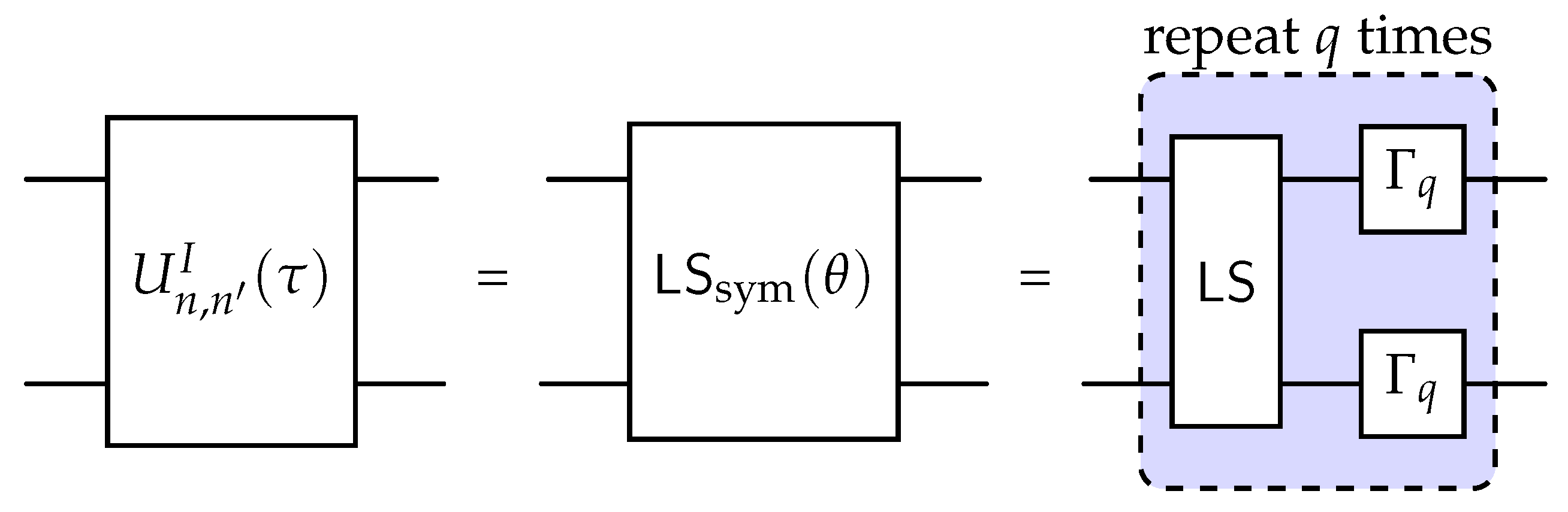
4.2.1. LS-Gate-Based Decomposition
4.2.2. Decomposition Based on an Additional Level
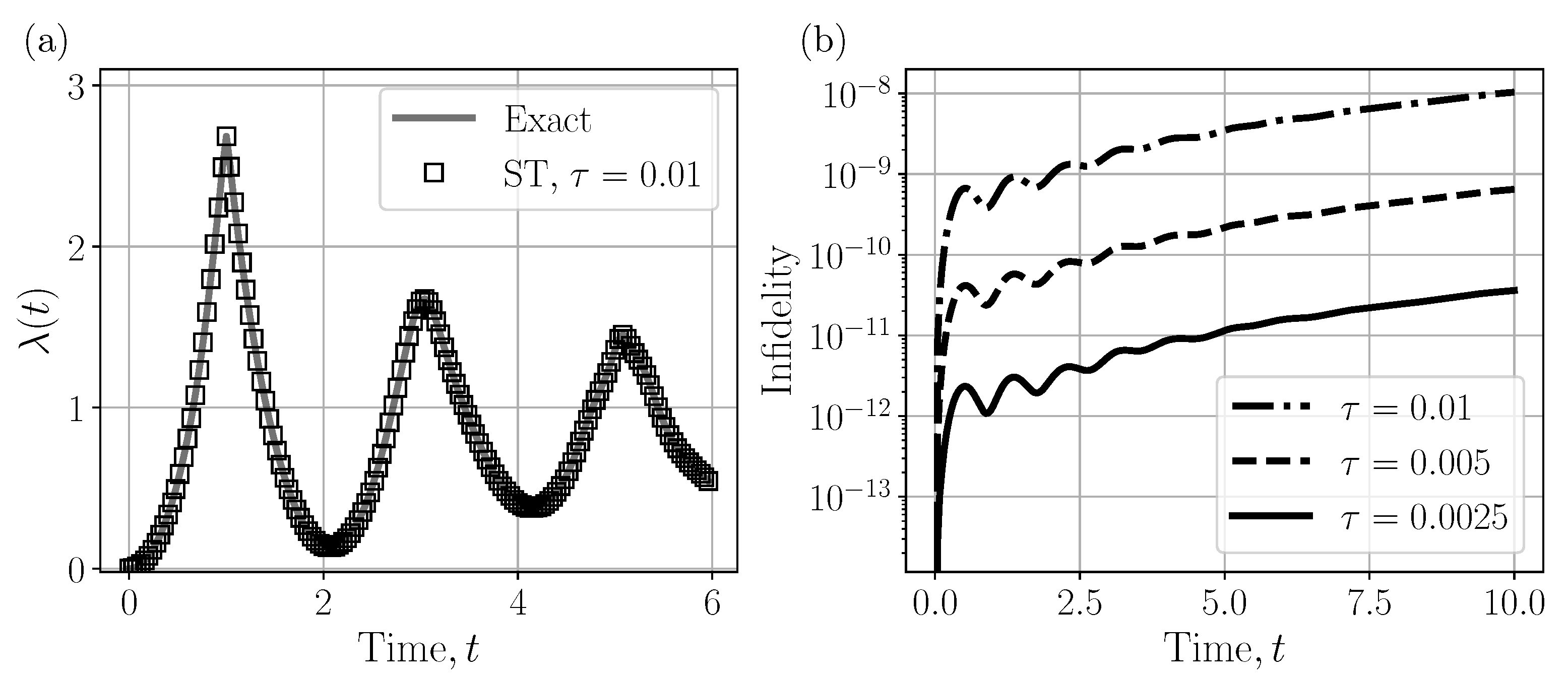
5. Qudit Simulation of the Potts Model: Dynamical Quantum Phase Transition
6. Qubits and Qudits
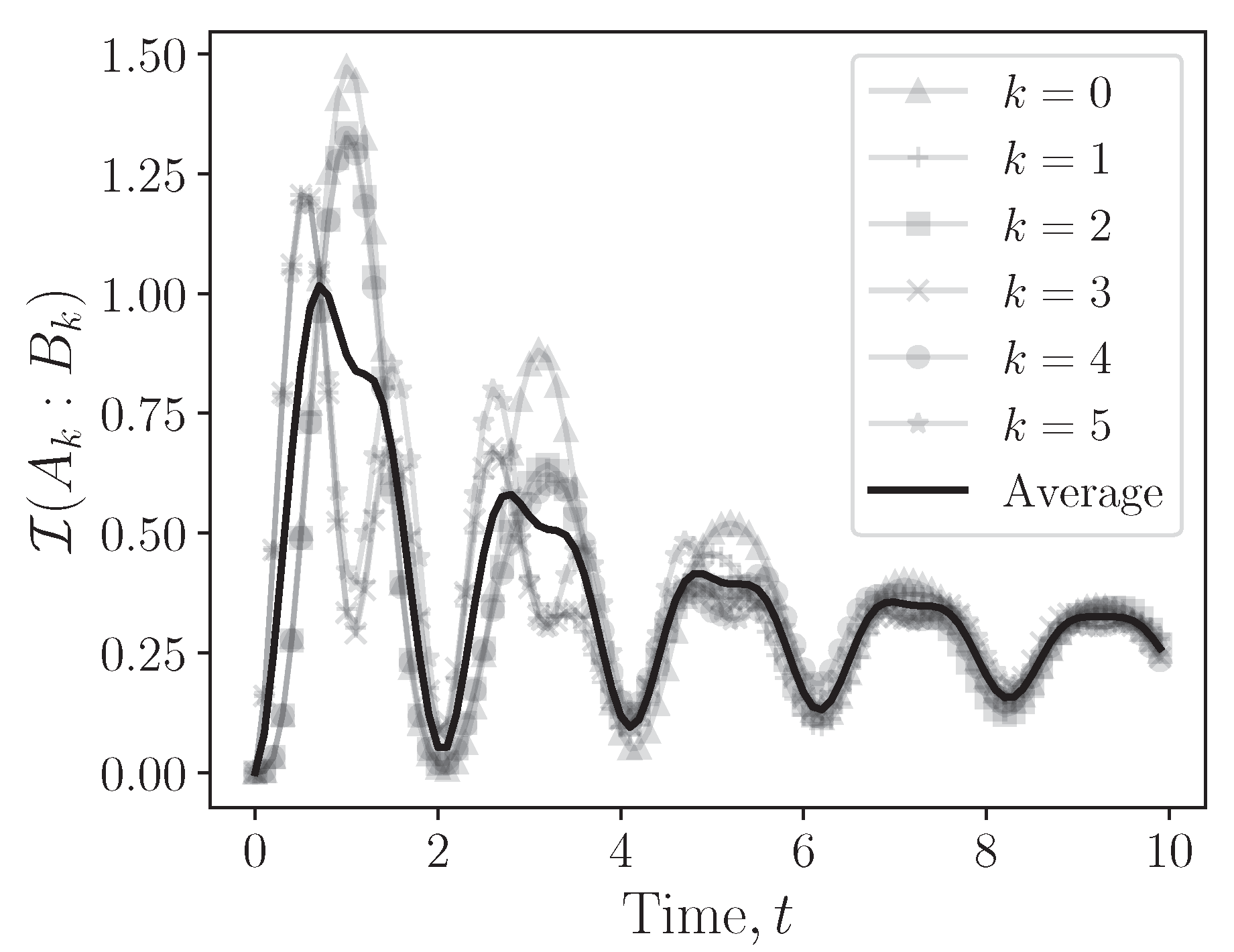
6.1. Representation-Induced Correlations in a Two-Qubit Encoding
6.2. Representation-Induced Entropy Estimates
7. Conclusions
Author Contributions
Funding
Institutional Review Board Statement
Data Availability Statement
Acknowledgments
Conflicts of Interest
References
- Preskill, J. Quantum computing and the entanglement frontier. arXiv 2012, arXiv:1203.5813. [Google Scholar] [CrossRef]
- Brassard, G.; Chuang, I.; Lloyd, S.; Monroe, C. Quantum computing. Proc. Natl. Acad. Sci. USA 1998, 95, 11032–11033. [Google Scholar] [CrossRef]
- Devoret, M.H.; Schoelkopf, R.J. Superconducting circuits for quantum information: An outlook. Science 2013, 339, 1169–1174. [Google Scholar] [CrossRef] [PubMed]
- Temme, K.; Bravyi, S.; Gambetta, J.M. Error Mitigation for short-depth quantum circuits. Phys. Rev. Lett. 2017, 119, 180509. [Google Scholar] [CrossRef] [PubMed]
- Neill, C.; Roushan, P.; Kechedzhi, K.; Boixo, S.; Isakov, S.V.; Smelyanskiy, V.; Megrant, A.; Chiaro, B.; Dunsworth, A.; Arya, K.; et al. A blueprint for demonstrating quantum supremacy with superconducting qubits. Science 2018, 360, 195–199. [Google Scholar] [CrossRef]
- Kiktenko, E.O.; Pozhar, N.O.; Anufriev, M.N.; Trushechkin, A.S.; Yunusov, R.R.; Kurochkin, Y.V.; Lvovsky, A.I.; Fedorov, A.K. Quantum-secured blockchain. Quantum Sci. Technol. 2018, 3, 035004. [Google Scholar] [CrossRef]
- Rico, E.; Dalmonte, M.; Zoller, P.; Banerjee, D.; Bögli, M.; Stebler, P.; Wiese, U.J. SO(3) “nuclear physics” with ultracold gases. Ann. Phys. 2018, 393, 466–483. [Google Scholar] [CrossRef]
- Kiktenko, E.O.; Nikolaeva, A.S.; Fedorov, A.K. Colloquium: Qudits for decomposing multiqubit gates and realizing quantum algorithms. Rev. Mod. Phys. 2025, 97, 021003. [Google Scholar] [CrossRef]
- Nikolaeva, A.S.; Kiktenko, E.O.; Fedorov, A.K. Efficient realization of quantum algorithms with qudits. EPJ Quantum Technol. 2024, 11, 43. [Google Scholar] [CrossRef]
- Zalivako, I.V.; Nikolaeva, A.S.; Borisenko, A.S.; Korolkov, A.E.; Sidorov, P.L.; Galstyan, K.P.; Semenin, N.V.; Smirnov, V.N.; Aksenov, M.A.; Makushin, K.M.; et al. Towards multiqudit quantum processor based on a 171Yb+ ion string: Realizing basic quantum algorithms. Quantum Rep. 2025, 7, 19. [Google Scholar] [CrossRef]
- Ringbauer, M.; Meth, M.; Postler, L.; Stricker, R.; Blatt, R.; Schindler, P.; Monz, T. A universal qudit quantum processor with trapped ions. Nat. Phys. 2022, 18, 1053–1057. [Google Scholar] [CrossRef]
- Hill, A.D.; Hodson, M.J.; Didier, N.; Reagor, M.J. Realization of arbitrary doubly-controlled quantum phase gates. arXiv 2021, arXiv:2108.01652. [Google Scholar] [CrossRef]
- Nguyen, L.B.; Goss, N.; Siva, K.; Kim, Y.; Younis, E.; Qing, B.; Hashim, A.; Santiago, D.I.; Siddiqi, I. Empowering a qudit-based quantum processor by traversing the dual bosonic ladder. Nat. Commun. 2024, 15, 7117. [Google Scholar] [CrossRef] [PubMed]
- Chi, Y.; Huang, J.; Zhang, Z.; Mao, J.; Zhou, Z.; Chen, X.; Zhai, C.; Bao, J.; Dai, T.; Yuan, H.; et al. A programmable qudit-based quantum processor. Nat. Commun. 2022, 13, 1166. [Google Scholar] [CrossRef]
- Kazmina, A.S.; Zalivako, I.V.; Borisenko, A.S.; Nemkov, N.A.; Nikolaeva, A.S.; Simakov, I.A.; Kuznetsova, A.V.; Egorova, E.Y.; Galstyan, K.P.; Semenin, N.V.; et al. Demonstration of a parity-time-symmetry-breaking phase transition using superconducting and trapped-ion qutrits. Phys. Rev. A 2024, 109, 032619. [Google Scholar] [CrossRef]
- Meth, M.; Zhang, J.; Haase, J.F.; Edmunds, C.; Postler, L.; Jena, A.J.; Steiner, A.; Dellantonio, L.; Blatt, R.; Zoller, P.; et al. Simulating two-dimensional lattice gauge theories on a qudit quantum computer. Nat. Phys. 2025, 21, 570–576. [Google Scholar] [CrossRef]
- Chizzini, M.; Tacchino, F.; Chiesa, A.; Tavernelli, I.; Carretta, S.; Santini, P. Qudit-based quantum simulation of fermionic systems. Phys. Rev. A 2024, 110, 062602. [Google Scholar] [CrossRef]
- Chicco, S.; Allodi, G.; Chiesa, A.; Garlatti, E.; Buch, C.D.; Santini, P.; De Renzi, R.; Piligkos, S.; Carretta, S. Proof-of-Concept Quantum Simulator Based on Molecular Spin Qudits. J. Am. Chem. Soc. 2024, 146, 1053–1061. [Google Scholar] [CrossRef]
- Jiang, J.; Klco, N.; Di Matteo, O. Non-Abelian dynamics on a cube: Improving quantum compilation through qudit-based simulations. Phys. Rev. D 2025, 112, 074512. [Google Scholar] [CrossRef]
- Bauer, C.W.; Davoudi, Z.; Balantekin, A.B.; Bhattacharya, T.; Carena, M.; de Jong, W.A.; Draper, P.; El-Khadra, A.; Gemelke, N.; Hanada, M.; et al. Quantum simulation for high-energy physics. PRX Quantum 2023, 4, 027001. [Google Scholar] [CrossRef]
- Cheng, B.; Lin, M.; Huang, G.; Li, Y.; Ji, B.; Genin, G.M.; Deshpande, V.S.; Lu, T.J.; Xu, F. Cellular mechanosensing of the biophysical microenvironment: A review of mathematical models of biophysical regulation of cell responses. Phys. Life Rev. 2017, 22–23, 88–119. [Google Scholar] [CrossRef]
- Szabó, G.; Borsos, I. Evolutionary potential games on lattices. Phys. Rep. 2016, 624, 1–60. [Google Scholar] [CrossRef]
- Li, M.; Liu, R.R.; Lü, L.; Hu, M.B.; Xu, S.; Zhang, Y.C. Percolation on complex networks: Theory and application. Phys. Rep. 2021, 907, 1–68. [Google Scholar] [CrossRef]
- Samajdar, R.; Choi, S.; Pichler, H.; Lukin, M.D.; Sachdev, S. Numerical study of the chiral quantum phase transition in one spatial dimension. Phys. Rev. A 2018, 98, 023614. [Google Scholar] [CrossRef]
- Yoo, Y.; Swingle, B. Temperature dependence of energy transport in the chiral clock model. Phys. Rev. B 2024, 109, 235104. [Google Scholar] [CrossRef]
- Mahyaeh, I.; Ardonne, E. Exact results for a -clock-type model and some close relatives. Phys. Rev. B 2018, 98, 245104. [Google Scholar] [CrossRef]
- Bernien, H.; Schwartz, S.; Keesling, A.; Levine, H.; Omran, A.; Pichler, H.; Choi, S.; Zibrov, A.S.; Endres, M.; Greiner, M.; et al. Probing many-body dynamics on a 51-atom quantum simulator. Nature 2017, 551, 579–584. [Google Scholar] [CrossRef] [PubMed]
- Keesling, A.; Omran, A.; Levine, H.; Bernien, H.; Pichler, H.; Choi, S.; Samajdar, R.; Schwartz, S.; Silvi, P.; Sachdev, S.; et al. Quantum Kibble–Zurek mechanism and critical dynamics on a programmable Rydberg simulator. Nature 2019, 568, 207–211. [Google Scholar] [CrossRef]
- Liu, F.; Whitsitt, S.; Bienias, P.; Lundgren, R.; Gorshkov, A.V. Realizing and Probing baryonic excitations in rydberg atom arrays. arXiv 2020, arXiv:2007.07258. [Google Scholar] [CrossRef]
- Martin, P.P. Potts Models and Related Problems in Statistical Mechanics; World Scientific: Singapore, 1991; Volume 5. [Google Scholar]
- Lotkov, A.I.; Gritsev, V.; Fedorov, A.K.; Kurlov, D.V. Floquet integrability and long-range entanglement generation in the one-dimensional quantum Potts model. Phys. Rev. B 2022, 105, 144306. [Google Scholar] [CrossRef]
- Pan, C. Monte Carlo simulation for the quantum q-state Potts model. J. Magn. Magn. Mater. 1992, 104–107, 773–774. [Google Scholar] [CrossRef]
- Wen, Z.B.; Hou, Z.L.; Fu, X.J. Monte carlo simulation of the potts model on a dodecagonal quasiperiodic structure. Chin. Phys. Lett. 2011, 28, 046102. [Google Scholar] [CrossRef]
- Śmierzchalski, T.; Dziubyna, A.M.; Jałowiecki, K.; Mzaouali, Z.; Pawela, Ł.; Gardas, B.; Rams, M.M. SpinGlassPEPS.jl: Tensor-network package for Ising-like optimization on quasi-two-dimensional graphs. SoftwareX 2025, 31, 102257. [Google Scholar] [CrossRef]
- Hrmo, P.; Wilhelm, B.; Gerster, L.; van Mourik, M.W.; Huber, M.; Blatt, R.; Schindler, P.; Monz, T.; Ringbauer, M. Native qudit entanglement in a trapped ion quantum processor. Nat. Commun. 2023, 14, 2242. [Google Scholar] [CrossRef] [PubMed]
- Joshi, R.; Louw, J.C.; Meth, M.; Osborne, J.J.; Mato, K.; Su, G.X.; Ringbauer, M.; Halimeh, J.C. Probing hadron scattering in lattice gauge theories on qudit quantum computers. arXiv 2025, arXiv:2507.12614. [Google Scholar] [CrossRef]
- Low, P.J.; Zutt, N.C.F.; Tathed, G.A.; Senko, C. Quantum logic operations and algorithms in a single 25-level atomic qudit. arXiv 2025, arXiv:2507.15799. [Google Scholar] [CrossRef]
- Nikolaeva, A.S.; Zalivako, I.V.; Borisenko, A.S.; Semenin, N.V.; Galstyan, K.P.; Korolkov, A.E.; Kiktenko, E.O.; Khabarova, K.Y.; Semerikov, I.A.; Fedorov, A.K.; et al. Scalable improvement of the generalized toffoli gate realization using trapped-ion-based qutrits. Phys. Rev. Lett. 2025, 135, 060601. [Google Scholar] [CrossRef]
- Lloyd, S. Universal Quantum Simulators. Science 1996, 273, 1073–1078. [Google Scholar] [CrossRef]
- McKay, D.C.; Wood, C.J.; Sheldon, S.; Chow, J.M.; Gambetta, J.M. Efficient Z gates for quantum computing. Phys. Rev. A 2017, 96, 022330. [Google Scholar] [CrossRef]
- Drozhzhin, D.A.; Kiktenko, E.O.; Fedorov, A.K.; Nikolaeva, A.S. Transition-aware decomposition of single-qudit gates. Entropy 2026, 28, 56. [Google Scholar] [CrossRef] [PubMed]
- López-Saldívar, J.A.; Castaños, O.; Nahmad-Achar, E.; López-Peña, R.; Man’ko, M.A.; Man’ko, V.I. Geometry and entanglement of two-qubit states in the quantum probabilistic representation. Entropy 2018, 20, 630. [Google Scholar] [CrossRef] [PubMed]
- Page, D. Average entropy of a subsystem. Phys. Rev. Lett. 1993, 71, 1291–1294. [Google Scholar] [CrossRef] [PubMed]



| Section 4.2.1 () | Section 4.2.2 () | |
|---|---|---|
| Two-qudit | 15 | 15 |
| Single-qudit | 192 | 62 |
| Depth | 54 | 28 |
Disclaimer/Publisher’s Note: The statements, opinions and data contained in all publications are solely those of the individual author(s) and contributor(s) and not of MDPI and/or the editor(s). MDPI and/or the editor(s) disclaim responsibility for any injury to people or property resulting from any ideas, methods, instructions or products referred to in the content. |
© 2026 by the authors. Licensee MDPI, Basel, Switzerland. This article is an open access article distributed under the terms and conditions of the Creative Commons Attribution (CC BY) license.
Share and Cite
Gavreev, M.A.; Kiktenko, E.O.; Fedorov, A.K.; Nikolaeva, A.S. Qudit-Native Simulation of the Potts Model. Entropy 2026, 28, 160. https://doi.org/10.3390/e28020160
Gavreev MA, Kiktenko EO, Fedorov AK, Nikolaeva AS. Qudit-Native Simulation of the Potts Model. Entropy. 2026; 28(2):160. https://doi.org/10.3390/e28020160
Chicago/Turabian StyleGavreev, Maksim A., Evgeniy O. Kiktenko, Aleksey K. Fedorov, and Anastasiia S. Nikolaeva. 2026. "Qudit-Native Simulation of the Potts Model" Entropy 28, no. 2: 160. https://doi.org/10.3390/e28020160
APA StyleGavreev, M. A., Kiktenko, E. O., Fedorov, A. K., & Nikolaeva, A. S. (2026). Qudit-Native Simulation of the Potts Model. Entropy, 28(2), 160. https://doi.org/10.3390/e28020160