Towards Pragmatist Thermodynamics: An Essay on the Natural Philosophy of Entropy and Sustainability


Abstract
1. Introduction
2. Peirce and the Origins of Pragmatist Thermodynamics
2.1. Randomness and Evolution
2.2. Finality
3. The Foundational Pragmatist Move: From Systems to Assemblages
3.1. The Many Meanings of Entropy
- The first concept is the extension of OET, which focuses on the processes of entropy production beyond isolated systems. A key reference in this area is the work of Prigogine and his colleagues on dissipative structures in closed systems [51]. Dissipative structures are still viewed as single systems that reach a certain end state defined by minimum entropy production. However, more recently, various approaches to open and non-linear systems have been proposed, often using the term “maximum entropy production,” which seems to create tension with earlier perspectives [52].
- The second significant development is the merging of Shannon’s information theory with thermodynamics, for which Boltzmann’s definition of entropy laid the groundwork [53]. This integration has been a crucial driver in the development of a wide variety of mathematical measures of entropy, also incorporating applications of entropy in quantum mechanics. All these approaches are grounded in the fundamental concept of probability.
- The third aspect involves extending concepts beyond physical systems to include chemical and biological systems, particularly in the ecological sciences [7]. These extensions can be divided into two main focuses: we can emphasize mathematical forms of entropy, such as measures of biodiversity [36], or concentrate on the physical processes associated with entropy production [54].
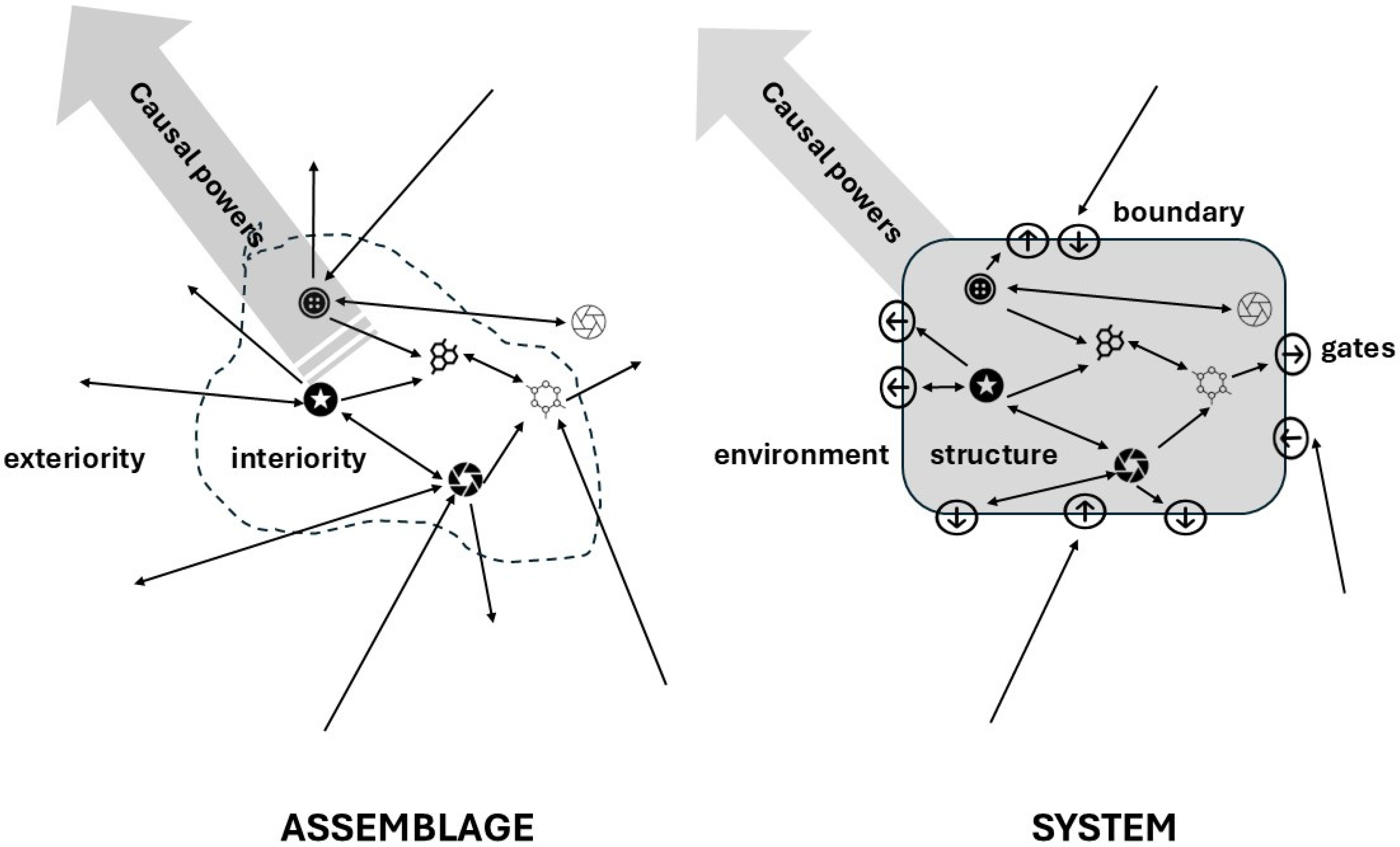
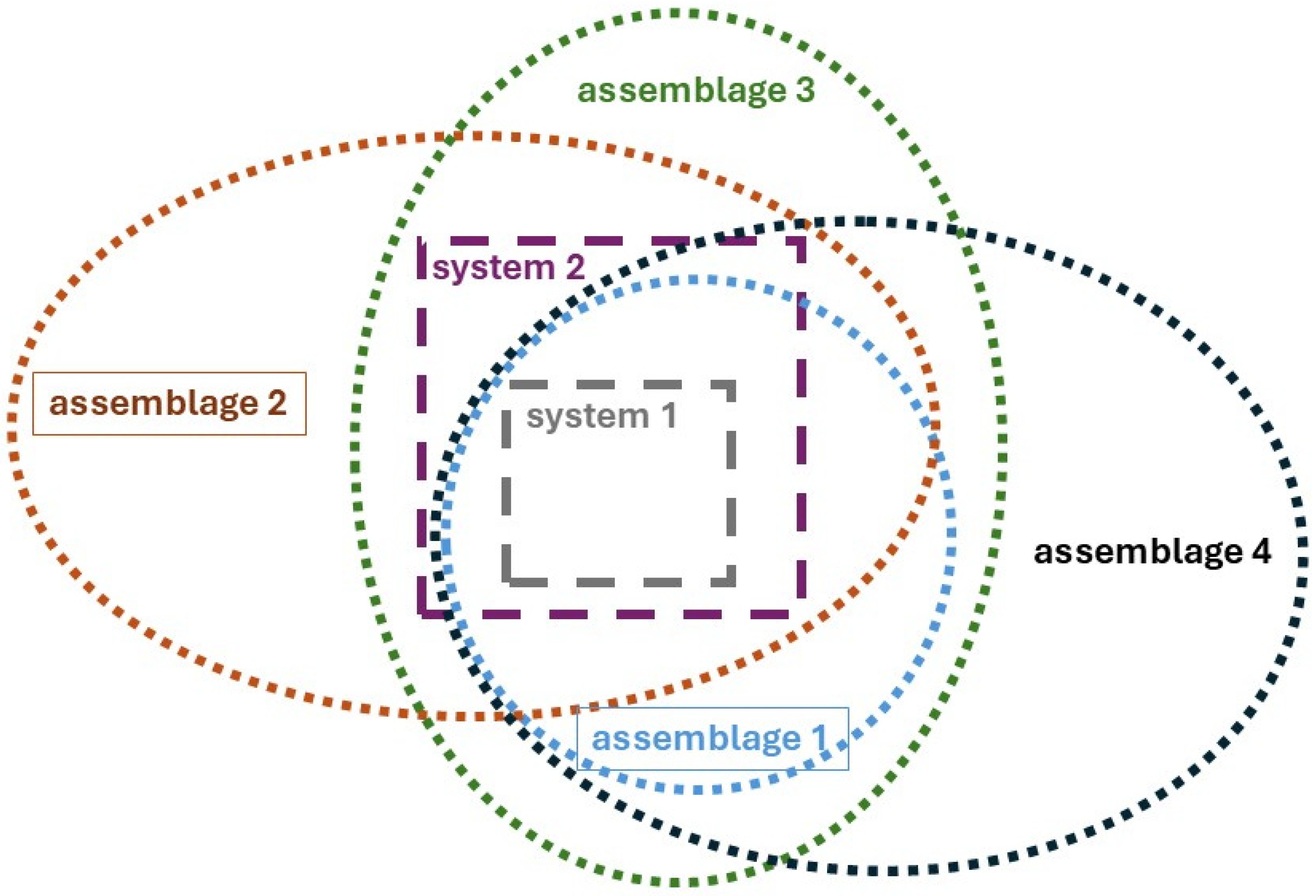
3.2. The Concept of Out-of-Equilibrium Assemblages
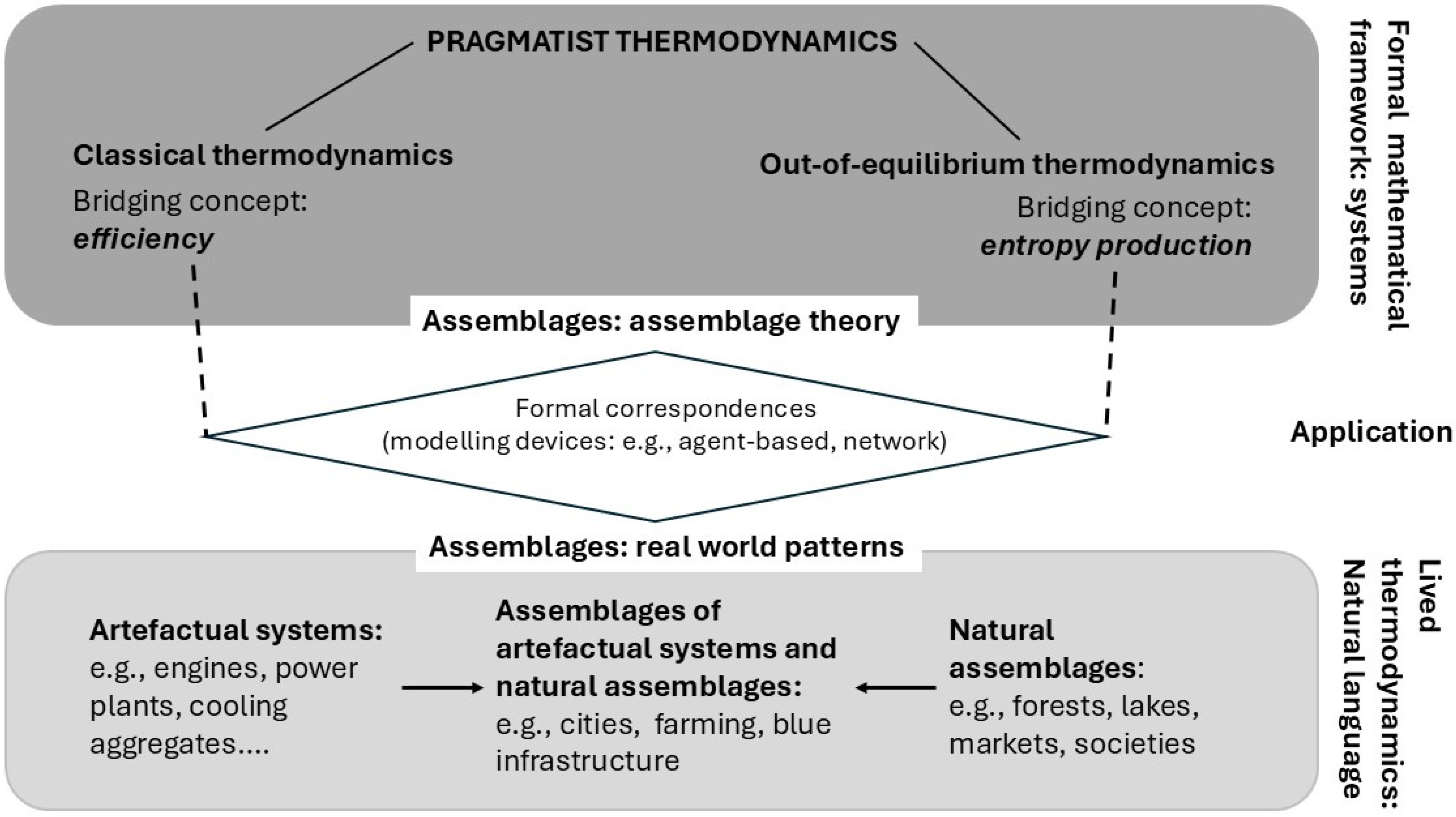
3.3. The Three Languages of PT
4. Evolution and Entropy Production in Pragmatist Thermodynamics
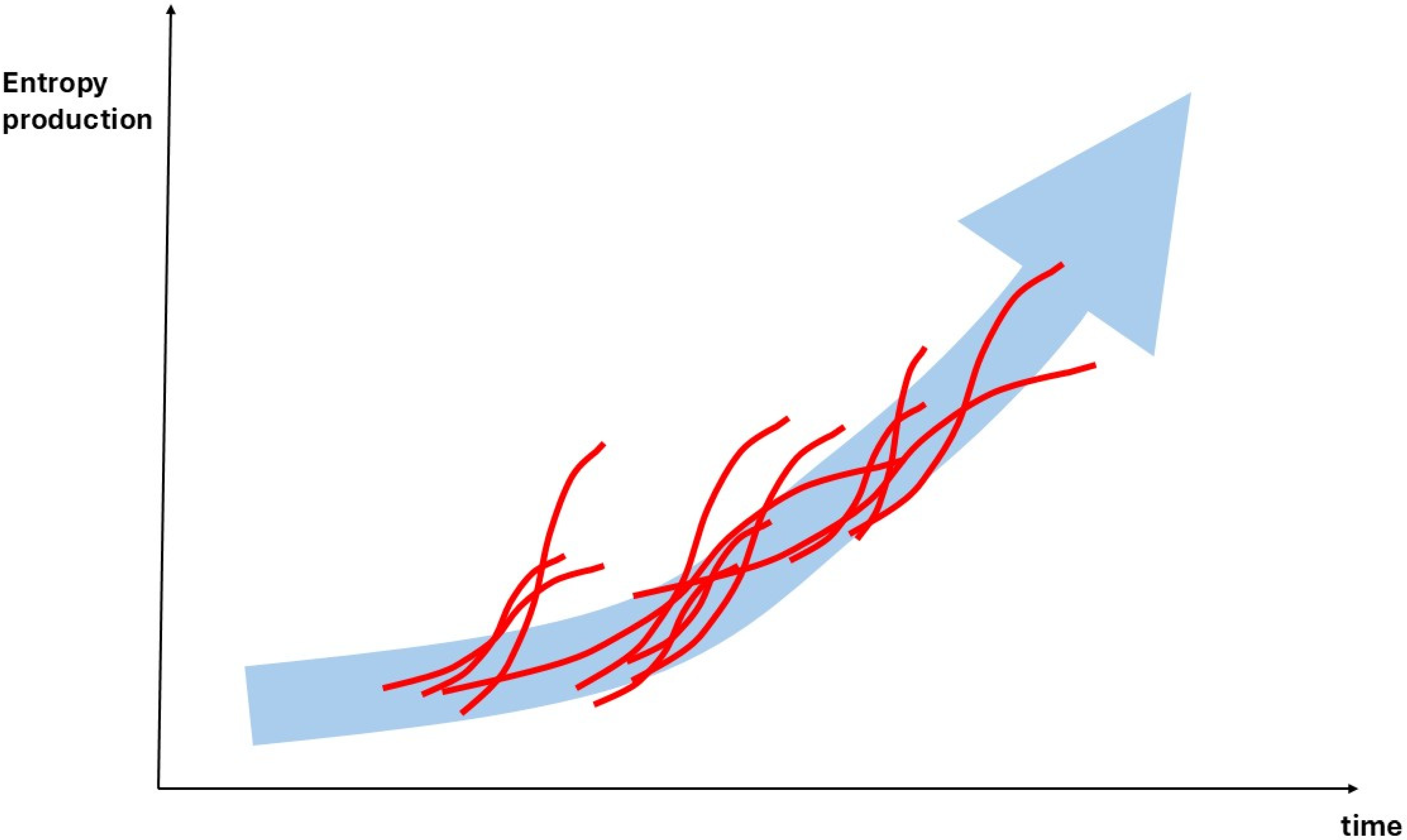
4.1. Evolution and the Second Law
4.2. The Centrality of Maximum Power
- Chaisson’s theory [74,75] suggests that there is an increasing intensity of free energy rate per unit mass, a concept that has also been embraced in big history research [76]. The essence of this analysis is that evolutionary trends can be observed even on a cosmological level, which allows for the categorization of distinct entities—such as organisms and human technological devices—on the scale of increasing energy flows through their unit mass. Additionally, there are variations of this analysis that focus on the evolution of human technology, emphasizing the increasing flow of energy through spatial units (power density) [77].
- This research connects to studies that examine evolution within the context of transformations of Planet Earth. These studies reveal specific trends in energy transitions toward greater complexity, increased intensity of dissipation, and innovations in utilizing the potential of inflowing solar energy for growth [71,78]. These perspectives include visions of transforming the planet into a “hybrid” structure [79], in which technological evolution would eventually shift the planet from a closed to an open system, specifically by enabling the export of material waste to outer space [80].
- There are various theories that claim differences among themselves, but they generally share basic principles and propose adding a new thermodynamic law to the established four laws. For example, the “Constructal Law” suggests that flow systems evolve in a direction that maximizes flow throughput by minimizing obstacles to those flows, and has been employed on the evolution of energy systems [81,82].
- On the topic of biological growth, there is a long-standing genealogy of theories suggesting systematic trends toward increasing size and complexity of organisms [83]. This idea is often summarized in the hypothesis that evolution favors the emergence of organisms and their related social units, which compete for the enhanced production of power in the sense of physical work, and embodied capacities to generate work [49,84].
- Finally, there are contributions that link these approaches to the evolution of human technology. This connection is already present in “big history” research, but it is more directly related to evolutionary theory, particularly in the field of evolutionary economics, which builds on the legacy of Georgescu-Roegen [25,85,86].
5. Sustainability and Entropy
6. Conclusions
Funding
Data Availability Statement
Acknowledgments
Conflicts of Interest
Abbreviations
| CT | Classical thermodynamics |
| OET | Out-of-equilibrium thermodynamics |
| PT | Pragmatist thermodynamics |
| MaxEnt | Maximum Entropy |
| MNET | mesoscopic nonequilibrium thermodynamics |
| MPP | Maximum power principle |
References
- Wessling, B. What a Coincidence! On Unpredictability, Complexity and the Nature of Time; Springer Fachmedien Wiesbaden GmbH: Wiesbaden, Germany, 2023. [Google Scholar]
- Ültay, E.; Durukan, Ü.G.; Ültay, N. Determination of Prospective Science Teachers’ Level of Knowledge about Thermodynamics and Their Reasoning with Daily Life Examples. J. Sci. Learning 2021, 4, 298–308. [Google Scholar] [CrossRef]
- Bezen, S.; Bayrak, C. Investigation of Pre-Service Physics Teachers’ Transfer of Knowledge of the First and Second Laws of Thermodynamics to Daily Life. Anadolu J. Educ. Sci. Int. 2025, 15, 275–293. [Google Scholar] [CrossRef]
- Bridgman, P.W. The Nature of Thermodynamics; Harvard University Press: Cambridge, MA, USA, 1941. [Google Scholar]
- Azevedo, I.M.L. Consumer End-Use Energy Efficiency and Rebound Effects. Annu. Rev. Environ. Resour. 2014, 39, 393–418. [Google Scholar] [CrossRef]
- Brockway, P.E.; Sorrell, S.; Semieniuk, G.; Heun, M.K.; Court, V. Energy efficiency and economy-wide rebound effects: A review of the evidence and its implications. Renew. Sustain. Energy Rev. 2021, 141, 110781. [Google Scholar] [CrossRef]
- Nielsen, S.; Müller, F.; Marques, J.; Bastianoni, S.; Jørgensen, S. Thermodynamics in Ecology—An Introductory Review. Entropy 2020, 22, 820. [Google Scholar] [CrossRef]
- Chang, W. Teaching the First Law of Thermodynamics via Real-Life Examples. Phys. Teach. 2011, 49, 231–233. [Google Scholar] [CrossRef]
- Poudel, R.; McGowan, J.; Georgiev, G.Y.; Haven, E.; Gunes, U.; Zhang, H. Thermodynamics 2.0: Bridging the natural and social sciences. Phil. Trans. R. Soc. A 2023, 381, 20220275. [Google Scholar] [CrossRef]
- Daggett, C.N. The Birth of Energy: Fossil Fuels, Thermodynamics, and the Politics of Work; Duke University Press: Durham, NC, USA, 2019. [Google Scholar]
- Atkins, P.W. Four Laws That Drive the Universe; Oxford University Press: Oxford, UK, 2007. [Google Scholar]
- Zeh, H.-D. Entropie: Physik der Wahrscheinlichkeiten: Statistische Mechanik; Information, Ordnung, Determinismus und Kausalität; Entropie in der Quantenmechanik. In das große Ganze: Zeit und Universum; Fischer-TB-Verlag: Frankfurt am Main, Germany, 2005. [Google Scholar]
- Legg, C.; Hookway, C. Pragmatism. In The Stanford Encyclopedia of Philosophy; Zalta, E.N., Nodelman, U., Eds.; Metaphysics Research Lab, Stanford University: Stanford, CA, USA, 2024. [Google Scholar]
- Short, T.L. Peirce’s Theory of Signs; Cambridge University Press: Cambridge, UK, 2007. [Google Scholar]
- Reynolds, A. Peirce’s Cosmology and the Laws of Thermodynamics. Trans. Charles S. Peirce Soc. 1996, 32, 403–423. [Google Scholar]
- Lotka, A.J. Evolution and Thermodynamics. Sci. Soc. 1944, 8, 161–171. [Google Scholar] [CrossRef]
- Lotka, A.J. Natural Selection as a Physical Principle. Proc. Natl. Acad. Sci. USA 1922, 8, 151–154. [Google Scholar] [CrossRef]
- García-Valdecasas, M.; Deacon, T.W. Origins of biological teleology: How constraints represent ends. Synthese 2024, 204, 75. [Google Scholar] [CrossRef]
- Kauffman, S.A. Investigations; Oxford University Press: Oxford, UK, 2000. [Google Scholar]
- Kolchinsky, A.; Wolpert, D.H. Semantic information, autonomous agency and non-equilibrium statistical physics. Interface Focus. 2018, 8, 20180041. [Google Scholar] [CrossRef]
- Herrmann-Pillath, C. The Natural Philosophy of Economic Information: Autonomous Agents and Physiosemiosis. Entropy 2021, 23, 277. [Google Scholar] [CrossRef] [PubMed]
- Boyd, A.B.; Crutchfield, J.P.; Gu, M. Thermodynamic machine learning through maximum work production. New J. Phys. 2022, 24, 083040. [Google Scholar] [CrossRef]
- Herrmann-Pillath, C.; Hederer, C. A New Principles of Economics: The Science of Markets; Routledge: Abingdon, UK; New York, NY, USA, 2023. [Google Scholar]
- Witt, U. What is specific about evolutionary economics? J. Evol. Econ. 2008, 18, 547–575. [Google Scholar] [CrossRef]
- Gowdy, J.; Krall, L. The economic origins of ultrasociality. Behav. Brain Sci. 2016, 39, e92. [Google Scholar] [CrossRef] [PubMed]
- Samuelson, P.A. Maximum principles in analytical economics. Am. Econ. Rev. 1972, 62, 249–262. [Google Scholar]
- Herrmann-Pillath, C. Foundations of Economic Evolution: A Treatise on the Natural Philosophy of Economics; Edward Elgar: Cheltenham, UK, 2013. [Google Scholar]
- Lineweaver, C.H. Beyond the Second Law: Darwinian Evolution as a Tendency for Entropy Production to Increase. Entropy 2025, 27, 850. [Google Scholar] [CrossRef]
- Arango-Restrepo, A.; Torrenegra-Rico, J.D.; Rubi, J.M. Entropy Production in a System of Janus Particles. Entropy 2025, 27, 112. [Google Scholar] [CrossRef]
- Margolis, J. Peirce’s Fallibilism. Transactions of the Charles S. Peirce Soc. 1998, 34, 535–569. [Google Scholar]
- Burch, R. Charles Sanders Peirce. In The Stanford Encyclopedia of Philosophy; Zalta, E.N., Nodelman, U., Eds.; Metaphysics Research Lab, Stanford University: Stanford, CA, USA, 2024. [Google Scholar]
- Nielsen, S.N.; Müller, F. The Entropy of Entropy: Are We Talking about the Same Thing? Entropy 2023, 25, 1288. [Google Scholar] [CrossRef] [PubMed]
- Popper, K.R. The Open Universe: An Argument for Indeterminism; Routledge: London, UK, 1991. [Google Scholar]
- Jaynes, E.T. Probability Theory: The Logic of Science; Cambridge University Press: Cambridge, UK, 2021. [Google Scholar]
- Dewar, R.C. Maximum entropy production as an inference algorithm that translates physical assumptions into macroscopic predictions: Don’t shoot the messenger. Entropy 2009, 11, 931–944. [Google Scholar] [CrossRef]
- Elith, J.; Phillips, S.J.; Hastie, T.; Dudík, M.; Chee, Y.E.; Yates, C.J. A statistical explanation of MaxEnt for ecologists. Divers. Distrib. 2011, 17, 43–57. [Google Scholar] [CrossRef]
- Dyke, J.; Kleidon, A. The maximum entropy production principle: Its theoretical foundations and applications to the earth system. Entropy 2010, 12, 613–630. [Google Scholar] [CrossRef]
- Martyushev, L.M.; Seleznev, V.D. Maximum entropy production principle in physics, chemistry and biology. Phys. Rep. 2006, 426, 1–45. [Google Scholar] [CrossRef]
- Elsasser, W.M. A model of biological indeterminacy. J. Theor. Biol. 1972, 36, 627–633. [Google Scholar] [CrossRef]
- Weitzman, M.L. Recombinant growth. Q. J. Econ. 1998, 113, 331–360. [Google Scholar] [CrossRef]
- De Castro, C.; McShea, D.W. Applying the Prigogine view of dissipative systems to the major transitions in evolution. Paleobiology 2022, 48, 711–728. [Google Scholar] [CrossRef]
- McAllister, J.W. Algorithmic randomness in empirical data. Stud. Hist. Philos. Sci. Part A 2003, 34, 633–646. [Google Scholar] [CrossRef]
- Crutchfield, J.P.; Shalizi, C.R. Thermodynamic depth of causal states: Objective complexity via minimal representations. Phys. Rev. E 1999, 59, 275. [Google Scholar] [CrossRef]
- Peirce, C.S.; Houser, N. The Essential Peirce: Selected Philosophical Writings; Indiana University Press: Bloomington, IN, USA, 2008; Volume 1, pp. 1867–1893. [Google Scholar]
- Gould, S.J. The Structure of Evolutionary Theory; Belknap Press of Harvard University Press: Cambridge, MA, USA, 2002. [Google Scholar]
- Hayek, F.A. The Theory of Complex Phenomena. In Critical Approaches to Science and Philosophy; Routledge: Abingdon, UK, 2018; pp. 332–349. [Google Scholar]
- Deacon, T.W. Incomplete Nature: How Mind Emerged from Matter; Norton: New York, NY, USA, 2013. [Google Scholar]
- Whitfield, J. Survival of the Likeliest? PLoS Biol. 2007, 5, e142. [Google Scholar] [CrossRef]
- Vermeij, G.J. The Evolution of Power: A New Understanding of the History of Life; Princeton University Press: Princeton, NJ, USA, 2023. [Google Scholar]
- Nöth, W. Habits, Habit Change, and the Habit of Habit Change According to Peirce. In Consensus on Peirce’s Concept of Habit: Before and Beyond Consciousness; Springer: Berlin/Heidelberg, Germany, 2016; pp. 35–63. [Google Scholar]
- Prigogine, I.; Nicolis, G. Biological order, structure and instabilities1. Q. Rev. Biophys. 1971, 4, 107–148. [Google Scholar] [CrossRef]
- Kleidon, A.; Malhi, Y.; Cox, P.M. Maximum entropy production in environmental and ecological systems. Phil. Trans. R. Soc. B 2010, 365, 1297–1302. [Google Scholar] [CrossRef] [PubMed]
- Maroney, O. Information Processing and Thermodynamic Entropy. In The Stanford Encyclopedia of Philosophy; Zalta, E.N., Ed.; Metaphysics Research Lab, Stanford University: Stanford, CA, USA, 2009. [Google Scholar]
- Dewar, R.C. Maximum entropy production and plant optimization theories. Philos. Trans. R. Soc. B Biol. Sci. 2010, 365, 1429–1435. [Google Scholar] [CrossRef]
- Sánchez-Cañizares, J. Is the maximum entropy production just a heuristic principle? Metaphysics on natural determination. Synthese 2023, 201, 121. [Google Scholar] [CrossRef]
- Wolpert, D.H. The stochastic thermodynamics of computation. J. Phys. A Math. Theor. 2019, 52, 193001. [Google Scholar] [CrossRef]
- Jordan, C.F. The Farm as a Thermodynamic System: Implications of the Maximum Power Principle. Biophys Econ Resour Qual 2016, 1, 9. [Google Scholar] [CrossRef]
- Hiedanpää, J.; Salo, M.; Jokinen, M.; Pellikka, J.; Store, R.; Laaksonen, T.; Pirinen, M.; Heim, W.; Piironen, A.; Mikander, N. Amidst the flyway: Co-designing accommodation fields for the barnacle goose in south-eastern Finland. In Handbook of Transdisciplinarity: Global Perspectives; Lawrence, R., Ed.; Edward Elgar Publishing: Cheltenham, UK, 2023; pp. 367–383. [Google Scholar] [CrossRef]
- Vallino, J.J. Ecosystem biogeochemistry considered as a distributed metabolic network ordered by maximum entropy production. Philos. Trans. R. Soc. B Biol. Sci. 2010, 365, 1417–1427. [Google Scholar] [CrossRef] [PubMed]
- De Landa, M. Assemblage Theory. In Speculative Realism; Edinburgh University Press: Edinburgh, UK, 2016. [Google Scholar]
- Deleuze, G.; Guattari, F. Mille Plateaux. In Capitalisme et Schizophrénie 2; Les Editions de Minuit: Paris, France, 2009. [Google Scholar]
- Schlüter, M.; Hertz, T.; Klein, A.; Wijermans, N. Disentangling the entangled in productive ways: Modelling social–ecological systems from a process-relational perspective. Sustain. Sci. 2025, 20, 793–815. [Google Scholar] [CrossRef]
- Reguera, D.; Rubí, J.M.; Vilar, J.M.G. The Mesoscopic Dynamics of Thermodynamic Systems. J. Phys. Chem. B 2005, 109, 21502–21515. [Google Scholar] [CrossRef] [PubMed]
- Hu, J.; Zhou, S.; Sun, Y.; Fang, X.; Wu, L. Fabrication, properties and applications of Janus particles. Chem. Soc. Rev. 2012, 41, 4356–4378. [Google Scholar] [CrossRef]
- Arango-Restrepo, A.; Barragan, D.; Rubi, J.M. A criterion for the formation of nonequilibrium self-assembled structures. J. Phys. Chem. B 2021, 125, 1838–1845. [Google Scholar] [CrossRef]
- Vallino, J.J.; Tsakalakis, I. Phytoplankton Temporal Strategies Increase Entropy Production in a Marine Food Web Model. Entropy 2020, 22, 1249. [Google Scholar] [CrossRef]
- Lotka, A.J. Contribution to the Energetics of Evolution. Proc. Natl. Acad. Sci. USA 1922, 8, 147–151. [Google Scholar] [CrossRef]
- Vallino, J.J.; Algar, C.K. The Thermodynamics of Marine Biogeochemical Cycles: Lotka Revisited. Annu. Rev. Mar. Sci. 2016, 8, 333–356. [Google Scholar] [CrossRef]
- Salthe, S.N. Development and Evolution: Complexity and Change in Biology; MIT Press: Cambridge, MA, USA, 1993. [Google Scholar]
- Lenton, T.M. The evolution of Gaia(s). Phil. Trans. R. Soc. B 2025, 380, rstb.2024.0095. [Google Scholar] [CrossRef]
- Lenton, T.M.; Pichler, P.-P.; Weisz, H. Revolutions in energy input and material cycling in Earth history and human history. Earth Syst. Dyn. 2016, 7, 353–370. [Google Scholar] [CrossRef]
- Sorrell, S. Jevons’ Paradox revisited: The evidence for backfire from improved energy efficiency. Energy Policy 2009, 37, 1456–1469. [Google Scholar] [CrossRef]
- Giampietro, M.; Mayumi, K. Unraveling the Complexity of the Jevons Paradox: The Link Between Innovation, Efficiency, and Sustainability. Front. Energy Res. 2018, 6, 26. [Google Scholar] [CrossRef]
- Chaisson, E. Energy Flows in Low-Entropy Complex Systems. Entropy 2015, 17, 8007–8018. [Google Scholar] [CrossRef]
- Chaisson, E. Cosmic Evolution: The Rise of Complexity in Nature; Harvard University Press: Cambridge, MA, USA, 2001. [Google Scholar]
- Aunger, R. Major transitions in ‘big’ history. Technol. Forecast. Soc. Change 2007, 74, 1137–1163. [Google Scholar] [CrossRef]
- Smil, V. Power Density: A Key to Understanding Energy Sources and Uses; The MIT Press: Cambridge, MA, USA, 2015. [Google Scholar]
- Kleidon, A. The second law of thermodynamics, life and Earth‘s planetary machinery revisited. Phys. Life Rev. 2024, 51, 382–389. [Google Scholar] [CrossRef]
- Frank, A.; Kleidon, A.; Alberti, M. Earth as a Hybrid Planet: The Anthropocene in an Evolutionary Astrobiological Context. Anthropocene 2017, 19, 13–21. [Google Scholar] [CrossRef]
- Kümmel, R. The Second Law of Economics: Energy, Entropy, and the Origins of Wealth; Springer Science + Business Media, LLC: New York, NY, USA, 2011. [Google Scholar]
- Bejan, A.; Lorente, S. The constructal law of design and evolution in nature. Philos. Trans. R. Soc. B Biol. Sci. 2010, 365, 1335–1347. [Google Scholar] [CrossRef]
- Reini, M.; Casisi, M. Is the Evolution of Energy System Productive Structures Driven by a Physical Principle? Front. Sustain. 2021, 2, 599173. [Google Scholar] [CrossRef]
- Bonner, J.T. The Evolution of Complexity by Means of Natural Selection; Princeton University Press: Princeton, NJ, USA, 1988. [Google Scholar]
- Nature: An Economic History; Princeton University Press: Princeton, NJ, USA, 2004.
- Georgescu-Roegen, N. The Entropy Law and the Economic Process; Harvard University Press: Cambridge, MA, USA, 2013. [Google Scholar]
- Daly, H. A new economics for our full world. In Handbook on Growth and Sustainability; Edward Elgar Publishing: Cheltenham, UK, 2017; pp. 85–106. [Google Scholar]
- Odum, H.T. Environment, Power, and Society for the Twenty-First Century: The Hierarchy of Energy; Columbia University Press: New York, NY, USA, 2007. [Google Scholar]
- Hall, C.A.S.; McWhirter, T. Maximum power in evolution, ecology and economics. Phil. Trans. R. Soc. A 2023, 381, 20220290. [Google Scholar] [CrossRef] [PubMed]
- Smil, V. Growth: From Microorganisms to Megacities; The MIT Press: Cambridge, MA, USA, 2019. [Google Scholar]
- Arthur, W.B. The Nature of Technology: What It Is and How It Evolves; Free Press: New York, NY, USA, 2009. [Google Scholar]
- Herrmann-Pillath, C. The Case for a New Discipline: Technosphere Science. Ecol. Econ. 2018, 149, 212–225. [Google Scholar] [CrossRef]
- Vermeij, G.J. Comparative economics: Evolution and the modern economy. J. Bioecon. 2009, 11, 105–134. [Google Scholar] [CrossRef]
- Szathmáry, E. Toward major evolutionary transitions theory 2.0. Proc. Natl. Acad. Sci. USA 2015, 112, 10104–10111. [Google Scholar] [CrossRef]
- Sabater, B. Are organisms committed to lower their rates of entropy production? Biosystems 2006, 83, 10–17. [Google Scholar] [CrossRef]
- Ulanowicz, R.E. Ecology, the Ascendent Perspective; Columbia University Press: New York, NY, USA, 1997. [Google Scholar]
- Snyder, B.F. The genetic and cultural evolution of unsustainability. Sustain. Sci. 2020, 15, 1087–1099. [Google Scholar] [CrossRef]
- Hodgson, G.M. Darwinism in economics: From analogy to ontology. J. Evol. Econ. 2002, 12, 259–281. [Google Scholar] [CrossRef]
- Nelson, R.R. Modern Evolutionary Economics: An Overview; Cambridge University Press: Cambridge, UK; New York, NY, USA, 2018. [Google Scholar]
- Saviotti, P.P.; Metcalfe, J.S. Present development and trends in evolutionary economics. In Evolutionary Theories of Economic and Technological Change; Routledge: London, UK, 2018; pp. 1–30. [Google Scholar]
- Ertel, W.; Bonenberger, C. Rebound Effects Caused by Artificial Intelligence and Automation in Private Life and Industry. Sustainability 2025, 17, 1988. [Google Scholar] [CrossRef]
- Mhlanga, D. AI beyond efficiency, navigating the rebound effect in AI-driven sustainable development. Front. Energy Res. 2025, 13, 1460586. [Google Scholar] [CrossRef]
- Kleidon, A. Sustaining the Terrestrial Biosphere in the Anthropocene: A Thermodynamic Earth System Perspective. Ecol. Econ. Soc. 2023, 6, 53–80. [Google Scholar] [CrossRef]
- Herrmann-Pillath, C. Sharing planet Earth: Overcoming speciesism in economics. Real-World Econ. Rev. 2023, 106, 113–121. [Google Scholar]
- Haff, P.K. Maximum Entropy Production by Technology. In Beyond the Second Law; Dewar, R.C., Lineweaver, C.H., Niven, R.K., Regenauer-Lieb, K., Eds.; Springer: Berlin/Heidelberg, Germany, 2014; pp. 397–414. [Google Scholar]
- Capellán-Pérez, I.; de Castro, C.; Miguel González, L.J. Dynamic Energy Return on Energy Investment (EROI) and material requirements in scenarios of global transition to renewable energies. Energy Strategy Rev. 2019, 26, 100399. [Google Scholar] [CrossRef]
- Rondinel-Oviedo, D.R.; Keena, N. Entropy and Cities: A Bibliographic Analysis towards More Circular and Sustainable Urban Environments. Entropy 2023, 25, 532. [Google Scholar] [CrossRef] [PubMed]
- Wessling, B. Thermodynamische Analyse der CO2-Entnahme und-Speicherung: Entropie als Kriterium für Nachhaltigkeit. Phys. Unserer Zeit 2025, 56, 246–253. [Google Scholar] [CrossRef]
- Llavador, H.; Roemer, J.E.; Silvestre, J. Sustainability for a Warming Planet; Harvard University Press: Cambridge, MA, USA, 2015. [Google Scholar]
- Eisenberg, J.M. John Stuart Mill on History: Human Nature, Progress, and the Stationary State; Rowman & Littlefield: Lanham, MD, USA, 2018. [Google Scholar]
- Cheema, S.S.; Shanker, N.; Hsu, S.-L.; Schaadt, J.; Ellis, N.M.; Cook, M.; Rastogi, R.; Pilawa-Podgurski, R.C.N.; Ciston, J.; Mohamed, M.; et al. Giant energy storage and power density negative capacitance superlattices. Nature 2024, 629, 803–809. [Google Scholar] [CrossRef] [PubMed]
- Vivanco, D.F.; Freire-González, J.; Galvin, R.; Santarius, T.; Walnum, H.J.; Makov, T.; Sala, S. Rebound effect and sustainability science: A review. J. Ind. Ecol. 2022, 26, 1543–1563. [Google Scholar] [CrossRef]
- Özsoy, T. The “energy rebound effect” within the framework of environmental sustainability. Wiley Interdiscip. Rev. Energy Environ. 2024, 13, e517. [Google Scholar] [CrossRef]
- Brown, P.G.; Timmerman, P. (Eds.) Ecological Economics for the Anthropocene: An Emerging Paradigm; Columbia University Press: New York, NY, USA, 2015. [Google Scholar]


Disclaimer/Publisher’s Note: The statements, opinions and data contained in all publications are solely those of the individual author(s) and contributor(s) and not of MDPI and/or the editor(s). MDPI and/or the editor(s) disclaim responsibility for any injury to people or property resulting from any ideas, methods, instructions or products referred to in the content. |
© 2025 by the author. Licensee MDPI, Basel, Switzerland. This article is an open access article distributed under the terms and conditions of the Creative Commons Attribution (CC BY) license (https://creativecommons.org/licenses/by/4.0/).
Share and Cite
Herrmann-Pillath, C. Towards Pragmatist Thermodynamics: An Essay on the Natural Philosophy of Entropy and Sustainability. Entropy 2025, 27, 1257. https://doi.org/10.3390/e27121257
Herrmann-Pillath C. Towards Pragmatist Thermodynamics: An Essay on the Natural Philosophy of Entropy and Sustainability. Entropy. 2025; 27(12):1257. https://doi.org/10.3390/e27121257
Chicago/Turabian StyleHerrmann-Pillath, Carsten. 2025. "Towards Pragmatist Thermodynamics: An Essay on the Natural Philosophy of Entropy and Sustainability" Entropy 27, no. 12: 1257. https://doi.org/10.3390/e27121257
APA StyleHerrmann-Pillath, C. (2025). Towards Pragmatist Thermodynamics: An Essay on the Natural Philosophy of Entropy and Sustainability. Entropy, 27(12), 1257. https://doi.org/10.3390/e27121257