1. Introduction
Space-filling designs are extremely appropriate for computer experiments that are employed to address complex scientific or engineering problems. Using such designs to plan experiments can spread points in the experimental domain as evenly as possible, which allows every region of the experimental domain to be explored [
1,
2]. Hence, space-filling designs help to build predictions with high average accuracy when making predictions for unsampled points [
3]. Some researchers, such as [
4,
5], have worked on the construction of space-filling designs using Monte Carlo methods; some scholars have proposed obtaining such designs using entropy criterion optimization (see [
3,
6,
7,
8,
9,
10]); others have constructed such designs based on space-filling properties, such as the maximin distance criterion, discrepancy criterion, and low-dimensional projection [
3]. Maximum entropy designs can be approximated as maximin distance designs under the assumption of very weak correlations [
3,
11,
12]. The common goal of Monte Carlo methods, entropy optimization, and space-filling properties is to maximize the information obtained from complex systems using economical run sizes in experiments. Consequently, space-filling designs can be viewed as the interdisciplinary intersection of statistics and information theory. In this paper, we investigate a class of space-filling designs suitable for computer experiments with both qualitative and quantitative factors.
Computer experiments with both qualitative and quantitative factors represent a considerably effective methodology for investigating complex systems and addressing scientific challenges [
13,
14,
15]. Extensive studies have been conducted on how to efficiently plan such experiments. This goes back to Qian et al. [
16] and subsequently Qian [
17], who considered systematically planning such experiments using sliced space-filling designs and sliced Latin hypercube designs (SLHDs), respectively. But, these two types of designs can be criticized for their cost–benefit restrictions, namely that the run sizes increase dramatically as the number of qualitative factors grows. For cost-effectiveness, marginally coupled designs (MCDs), with economical run sizes and accommodating a large number of qualitative factors, are proposed by Deng et al. [
18]. An MCD consists of two subdesigns, one of which is used to arrange qualitative factors and the other to arrange quantitative factors. In an MCD, the qualitative factor subdesign is commonly an orthogonal array (OA) [
19], the quantitative factor subdesign is a Latin hypercube design (LHD) [
20], and the latter subdesign is also an SLHD with respect to any qualitative factor in the former subdesign. Since MCDs were proposed, scholars have worked to improve them to have superior properties. Some researchers have worked on optimizing properties of the subdesign for quantitative factors in an MCD, such as improving the low-dimensional space-filling property [
21,
22,
23,
24] and orthogonality [
25]. Others have concentrated on enhancing the stratification property between any
l (
) qualitative factors and all quantitative factors, such as doubly coupled designs (DCDs) [
26], group doubly coupled designs (GDCDs) [
27], and strongly coupled designs (SCDs) [
28]. A design with both qualitative and quantitative factors is classified as symmetrical if the subdesign of qualitative factors is a fixed-level OA. Conversely, such a design is termed asymmetrical when the subdesign of the qualitative factors employs a mixed-level OA. The above MCDs, DCDs, GDCDs, and SCDs are predominantly symmetrical, while asymmetrical designs are relatively rare.
In this paper, we propose four approaches to constructing asymmetrical MCDs based on symmetrical MCDs. When the symmetrical MCDs with low-dimensional space-filling properties in subdesigns of quantitative factors exist, the subdesigns of quantitative factors in the asymmetrical MCDs obtained by Algorithms 1 and 4 can inherit these space-filling properties. The space-filling symmetrical MCDs can be obtained from He et al. [
21,
22,
23] and Yang et al. [
26]. If LHDs with desirable low-dimensional space-filling properties are available, Algorithms 2 and 3 can be employed to create asymmetrical MCDs in which the subdesigns of quantitative factors have the same space-filling properties as those of the LHDs. Orthogonal-array-based LHDs and strong-orthogonal-array-based LHDs have been thoroughly examined in the existing literature [
29,
30,
31,
32,
33,
34,
35]; therefore, Algorithms 2 and 3 can employ these types of LHDs. Moreover, the obtained asymmetrical MCDs are flexible in terms of their run sizes.
The remainder of the paper is organized as follows.
Section 2 gives some definitions and notation.
Section 3 proposes several construction methods of asymmetrical MCDs. In
Section 4 we conduct a numerical study to verify the performance of the proposed designs. Concluding remarks are provided in
Section 5. All proofs and some tables are provided in
Appendix A and
Appendix B, respectively.
2. Definitions and Notation
Throughout this paper,
is an
vector of zeros,
is an
vector of ones, and
is a
matrix of ones. For two matrices,
and
, their Kronecker sum and Kronecker product are defined as
and
, respectively. Let
be an
matrix, and for a given integer
s,
, define an
matrix
as
where
represents the largest integer not exceeding
x.
Let
denote the Galois field of order
s, with each of the
s levels coming from
, where
and
. If
s is a prime,
simplifies to
. A difference scheme of strength 2 with
u rows,
v columns, and
s levels, denoted by
, is an
matrix with entries taken from
such that in the vector difference between any two distinct columns, the
s levels in
occur with the same frequency. An
matrix is called an orthogonal array (OA) of strength
t, denoted as
,
; if (i) the entries of the first
columns are taken from
, the entries of the next
columns are taken from
, and so on; (ii) all possible
t-tuples occur equally often in any
t columns. The
with
is called a fixed-level or symmetrical OA and denoted by
; otherwise, the array is called a mixed-level or asymmetrical OA. An
matrix is called a Latin hypercube design (LHD) with
n runs and
p factors, denoted as
, if each column of the matrix contains
n levels taken from
[
20]. Let
be a matrix of
n runs,
m factors, and
w levels, and for
, the
t columns of
D are said to achieve
t-dimensional stratification on an
grid if the
t columns can be collapsed into an
, where the
w levels are collapsed into
levels by
in Equation (1).
A design , with and representing two subdesigns for qualitative and quantitative factors, respectively, is called a marginally coupled design (MCD) if (i) and are an OA and an LHD, respectively, and (ii) the rows in corresponding to each level of any factor in form a small LHD. If and are an and an , respectively, the MCD is symmetric and denoted by ; if and are an and an , respectively, the MCD is asymmetric and denoted by .
The necessary and sufficient condition for the existence of a symmetrical MCD is presented by Proposition 1 of He et al. [
21]. Building upon their work, we can directly derive a necessary and sufficient condition for the existence of an asymmetrical MCD as follows.
Lemma 1.
Suppose is an , where is an for , and is an ; then is an if and only if is an , where is any column of , and is obtained from Equation (1), . Note that, When
, Lemma 1 is transformed into Proposition 1 of He et al. [
21].
3. Construction of Asymmetrical MCDs with Low-Dimensional Stratification
This section introduces four construction methods that utilize symmetrical MCDs to construct asymmetrical MCDs. Furthermore, the low-dimensional projection properties of the proposed MCDs are also investigated.
The first method presents a construction for an
,
, through an
,
. The key feature of
is that the space-filling property of
is determined by that of
. Suppose an
, denoted as
, is available, where
and
are an
and an
, respectively. For clarity, let the Kronecker sum ⊕ in Algorithm 1 be defined over
. Algorithm 1 is as follows.
| Algorithm 1 Construction of based on |
- Step 1.
Let and over , where is the ith column of for . Obtain a matrix . - Step 2.
Construct a matrix . Obtain a matrix based on by replacing the 2 entries with level k in each column of by a random permutation of for . - Step 3.
The resulting design .
|
Theorem 1. For in Algorithm 1 and generated by Algorithm 1, the following are true:
- (i)
is an ;
- (ii)
and achieve the same low-dimensional stratification.
Obviously, (i) and are symmetrical and asymmetrical MCDs, respectively, and (ii) if achieves stratification in any t dimensions, also achieves the same t-dimensional stratification as .
Remark 1.
The , , in Algorithm 1 can be obtained from He et al. [21]. For a given integer λ, , an can be generated by Construction 1 of He et al. [21]; then an exists and achieves stratification on grids. For a given integer u, , a space-filling with can be obtained through Construction 2 of He et al. [21]; then an exists, and achieves stratification on and grids. For a given integer u, , , , and , a space-filling can be obtained via Construction 3 of He et al. [21]; then (i) an exists, and (ii) can be partitioned into k disjoint groups of columns; any two distinct columns in achieve stratification on a grid; any two columns from different groups in achieve stratification on and grids. Moreover, in Algorithm 1 can also be taken from He et al. [23], and similar results can be obtained. Example 1.
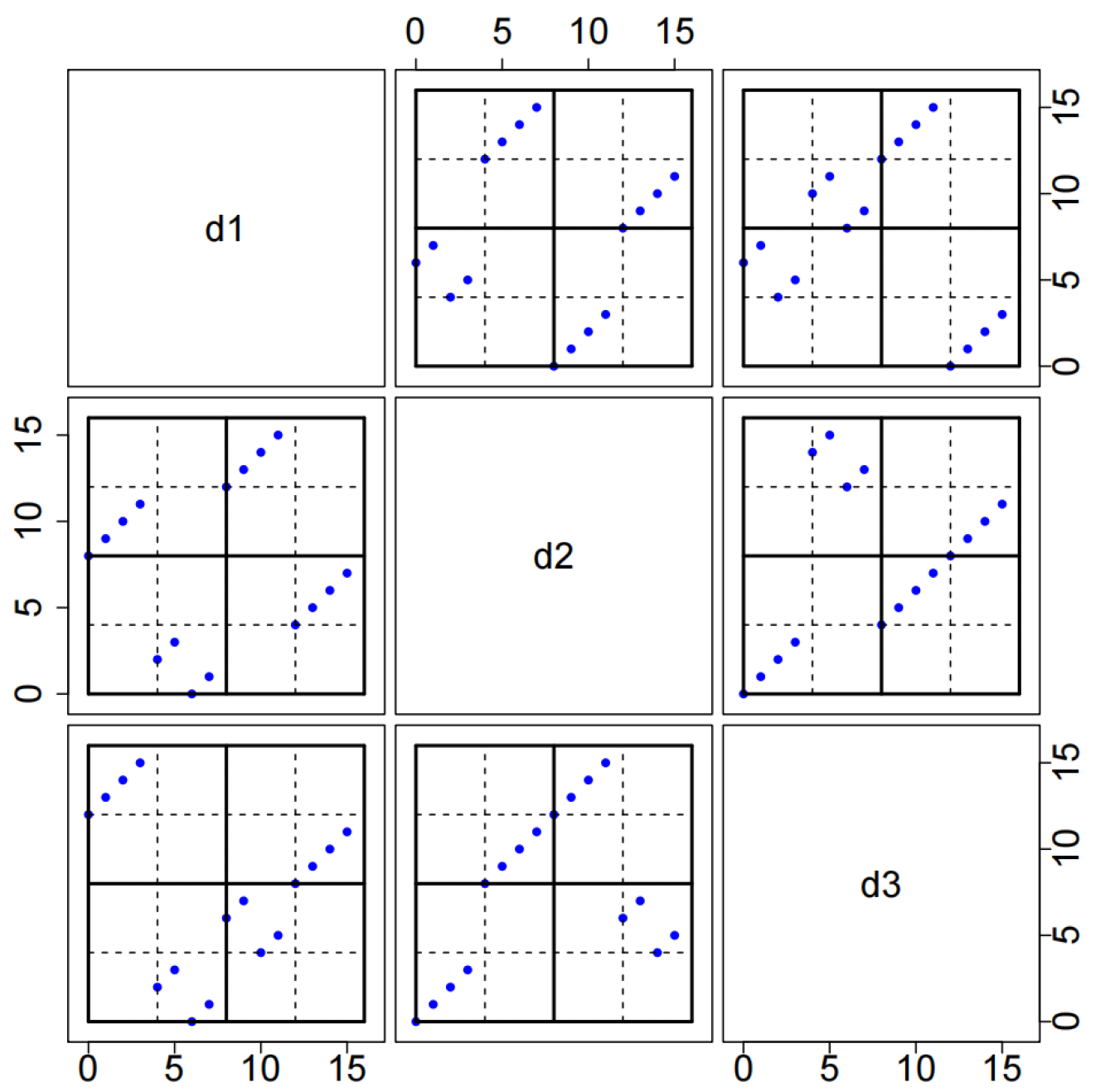
Consider , , and , and let be an , which are obtained from Construction 1 of He et al. [21] and listed as follows:Let be the ith column of for , i.e., . Then for and are found to be , , , , , and , listed as follows:Construct a matrix where ; then we can obtain as follows:It is easy to check that is an . The two-dimensional space-filing properties of can be seen intuitively in Figure 1, i.e., any two distinct columns in achieve stratification on a grid. Algorithm 1 provides a way to construct
s with low-dimensional stratification via
s with good properties in low-dimensional projections. In the following, we present an approach to constructing MCDs with
runs with
and
. Suppose a difference scheme
, denoted as
, and an
, denoted as
, are available, where
and
are an
and an
, respectively. Algorithm 2 offers a method for constructing asymmetrical MCDs, as detailed below.
| Algorithm 2 Construction of based on |
- Step 1.
Let , where is the matrix that consists of all columns in except . Let if is in ; otherwise, let . - Step 2.
Construct an matrix as , where the ⊕ operator is based on . - Step 3.
For a given , let , where is an . - Step 4.
The resulting design .
|
Theorem 2. For from Step 3 of Algorithm 2 and generated by Algorithm 2, the following are true:
- (i)
is an , if is in , ; otherwise ;
- (ii)
and achieve the same low-dimensional stratification.
The space-filling property of
plays a critical role in the space-filling property of
in Theorem 2, since
. More precisely, if the LHD
is based on an OA of strength
t,
will have stratification in any
t dimensions; if it is based on a strong orthogonal array
[
31],
will achieve stratification on the
grids in any three dimensions; in addition, it can achieve stratification on the
and the
grids in any two dimensions. The LHD
can be obtained from orthogonal-array-based LHDs or strong-orthogonal-array-based LHDs [
29,
30,
31,
32,
33,
34,
35].
Example 2.
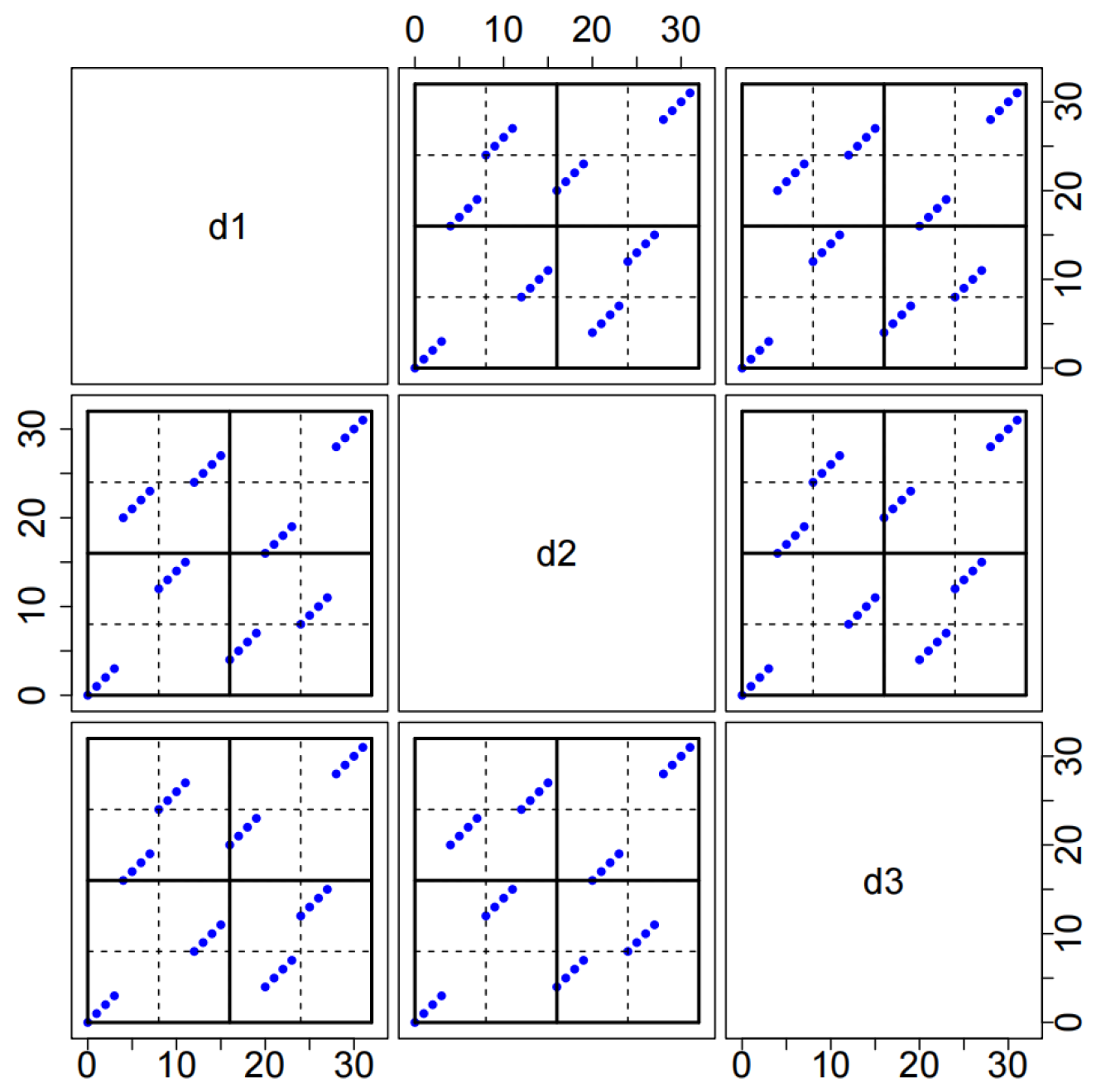
Let be a , be an , and be an obtained from He et al. [36]:Here, qualifies as an , according to He et al. [36], meaning that (i) any two distinct columns in achieve stratification on and grids, and (ii) can achieve stratification on a grid in three dimensions. In Step 1, remove the first column of to obtain the matrix . Construct a matrix using , which is listed in Table A1 of Appendix B. For a given , we can also construct from , which is provided in Table A1 of Appendix B. It is easy to check that is an . The two-dimensional space-filling properties of can be seen intuitively in Figure 2, i.e., any two distinct columns in achieve stratification on and grids. In addition, achieves stratification on a grid in three dimensions. Note that the subdesign of the
n level in
just has one column, which is not advisable. To increase the number of columns at level
n in
, we present Algorithm 3 below, which aims to generate MCDs with
runs for
and
. Suppose a difference scheme
, denoted as
, and an
, denoted as
, are available, where
and
are an
and an
, respectively.
| Algorithm 3 Construction of based on |
- Step 1.
Let , where is the matrix that consists of all columns in except . Let if is in ; otherwise, let . - Step 2.
Construct an matrix as , where the ⊕ operator is based on . - Step 3.
For a given , let , where is an . - Step 4.
The resulting design .
|
Algorithm 3 presents a method to extend the number of columns at level n in up to . Theorem 3 summarizes the properties of and constructed in Algorithm 3.
Theorem 3. For from Step 3 of Algorithm 3 and generated by Algorithm 3, the following are true:
- (i)
is an , if is in ; then ; otherwise ;
- (ii)
and achieve the same low-dimensional stratification.
Theorem 3(ii) illustrates that the space-filling property of in Algorithm 3 is dependent on that of the LHD , which means that may have the desired low-dimensional space-filling property when we choose with the low-dimensional space-filling property. The projection properties of in Algorithm 3 are similar to those of in Algorithm 2; therefore, can also be obtained from orthogonal-array-based LHDs or strong-orthogonal-array-based LHDs.
In Algorithms 2 and 3, the s may either be identical or distinct, i.e., and can be the same or different. If the number of runs in the two difference schemes in Algorithm 2 and in Algorithm 3 is equal, that is, , then in Algorithm 2 and in Algorithm 3 can take the same LHD. Next, we construct a new space-filling asymmetrical MCD from Algorithm 3, using the same symmetrical MCD and LHD as in Algorithm 2.
Example 3.
Let be a as follows:Let , , and , where are obtained from Example 2. Here, is the matrix which deletes the first column of . From Steps 1 and 2, we can obtain a matrix using , which is presented in Table A2 of Appendix B. Consider the case of in Step 3. For the , let , where is obtained from Example 2; then can be constructed as in Step 3, which is provided in Table A2 of Appendix B. It is easy to check that is an . The space-filling properties of are similar to those of in Example 2 and are therefore omitted here. Note that the addition operations in Step 2 are given as follows (Table 1). In Algorithms 2 and 3, the existence of the difference scheme is of great significance. Due to Theorem 6.6, Corollary 6.39 and Theorem 6.63 of Hedayat et al. [
19], there exist three types of difference schemes, (i)
; (ii)
; and (iii)
, where
p is a prime,
s is a prime power, and
w,
v, and
m are positive integers, with
and
. Table 6.67 of Hedayat et al. [
19] gives the exact maximal value of
v for which a difference scheme
exists, for
, as listed in
Table A3.
The above three algorithms can generate space-filling MCDs with
being an
, an
and
, respectively. We introduce another construction for space-filling MCDs with
being an
. Suppose an
, say
E, and an
with
, denoted as
, are available, where
and
are an
and an
, respectively (Algorithm 4).
| Algorithm 4 Construction of based on |
- Step 1.
Let , where and are the first columns and the last column of , respectively. Permute the rows of to obtain an MCD, denoted as with , where . - Step 2.
For , construct two matrices and based on E, as and , respectively. - Step 3.
Obtain two matrices and by replacing the levels of the with the 1st, 2nd, …, and th rows of and , respectively. Let and , where and are the ith columns of and , respectively. - Step 4.
For and , construct an as - Step 5.
Let . Construct three matrices , and . Let . - Step 6.
The resulting design .
|
Theorem 4. For in Algorithm 4 and generated by Algorithm 4, where and , the following are true:
- (i)
is an ;
- (ii)
and achieve the same low-dimensional stratification.
Theorem 4(i) shows that the existence of an
with
and
is equivalent to the simultaneous existence of both an
and an
. According to He et al. [
21],
in an
. For a prime
h and a positive integer
v, if
, there exist an
and an
.
Theorem 4(ii) tells us that the space-filling property of
in Algorithm 4 is determined by that of
in the initial MCD
. From Theorems 3.1, 3.2 and 3.20 of Hedayat et al. [
19], for a prime
h and a positive integer
v,
, the following three OAs exist: (i)
; (ii)
for
; (iii) and
for an odd prime
h. Thus
can be obtained from Construction 1 of He et al. [
21], where
M is an
with
, and any two distinct columns of
achieve stratification on an
grid. So any two distinct columns of
in Theorem 4 achieve stratification on an
grid. According to Remark 1 of He et al. [
21], for
,
M can choose an
for
s that is a power of 2, and an
for an odd prime power
s, respectively; furthermore,
achieves stratification in any three dimensions. Hence, the corresponding
in Theorem 4 also possesses a three-dimensional space-filling property.
Based on Algorithm 4, Theorem 4 confirms that asymmetrical MCDs with attractive space-filling properties can be constructed. Next, we give an example to illustrate Algorithm 4 and Theorem 4.
Example 4.
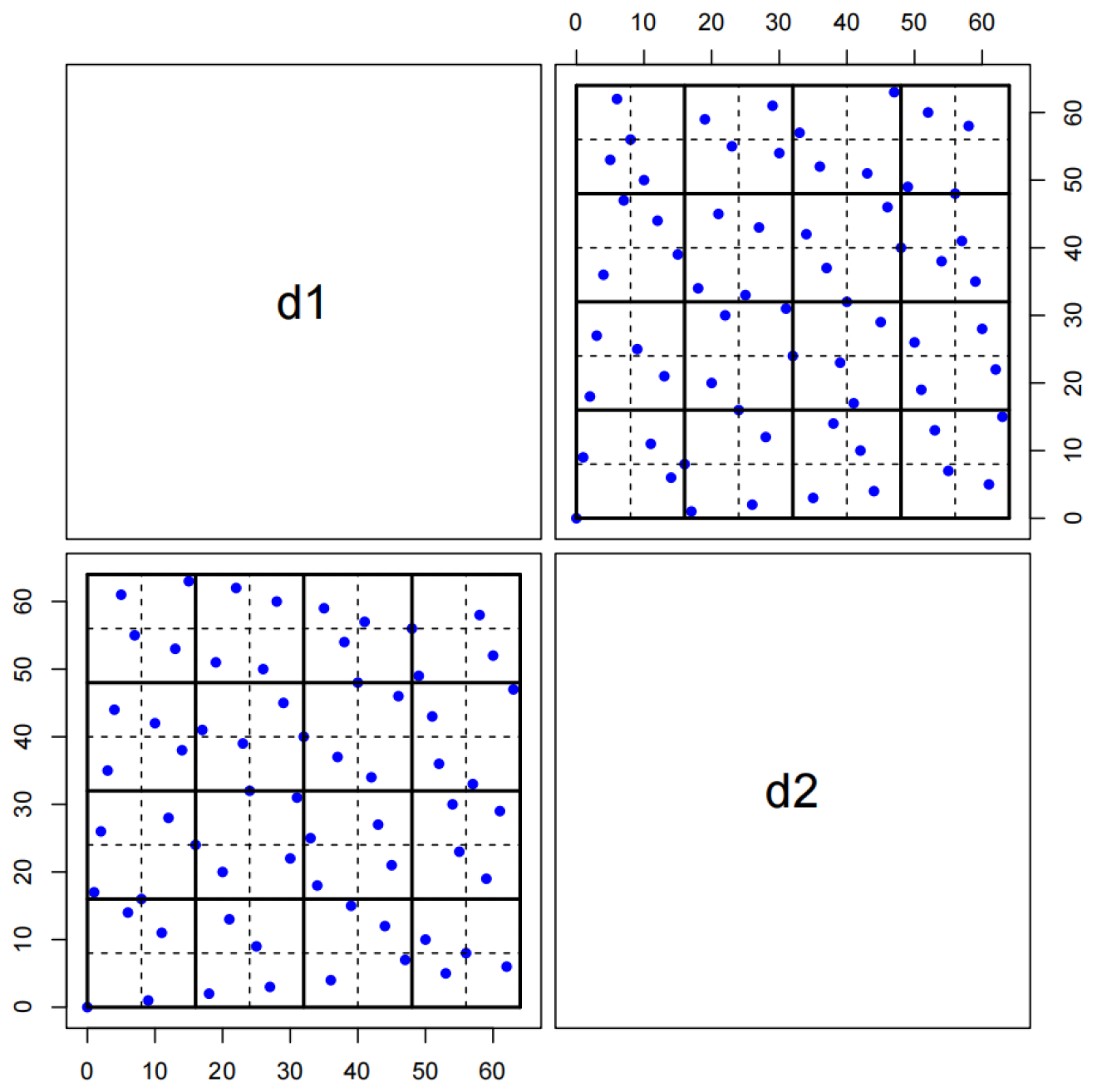
Consider , , , and . An is given as , where , , and . Let be an , where and are and , respectively. In Step 1, if we permute the rows of M, we can obtain , which is listed in Table A4 of Appendix B, where and . Obtain two matrices and based on E using and over . From Step 3, we can obtain two matrices, and . For , we obtain in Step 4, and in Step 5. We also construct three matrices, , , and . The resulting designs, and , are listed in Table A5 of Appendix B. Next, let and be the first and second columns of . It is easy to see that and achieve stratification on an grid, as shown in Figure 3. 4. Numerical Study
In this section, we validate the performance of the asymmetrical MCDs constructed by our methods in computer experiments.
Consider two
s, taken from Example 3 of this paper and Example 3 of Deng et al. [
18], and denote them as
and
, respectively. Here, for the
listed in
Table A2 of Example 3,
consists of the first four columns of
, and
. For the
generated by Construction 3 of Deng et al. [
18], as illustrated in their Example 3,
and
are taken from the last four columns of
and the first three columns of
, respectively.
First, we compare the space-filling properties of the above MCD1 with those of the above MCD2 under the maximum projection criterion [
37], the uniformity criterion [
38], and the minimum mixed-moment aberration criterion [
39]. For MCD1 and MCD2,
Table 2 shows the values of the maximum projection criterion (“MaxProQQ”), uniformity criterion (“QQD”) and mixed-moment pattern (“MK”). Obviously, MCD1 outperforms MCD2 under the three types of criteria, which implies that MCD1 has better space-filling properties.
We next evaluate the performance of MCD1 and MCD2 in building statistical surrogate models. We conduct simulations and generate data for a computer experiment with four qualitative factors, which have two levels, two levels, four levels and four levels, respectively, and three quantitative factors. Its computer model has the following form:
where
i,
j,
k, and
l are the levels for the qualitative factors,
,
;
are the values of quantitative factors; and the functions
,
,
, and
are as shown below:
, ,
, ,
, , , ,
, , , .
We adopt the easy-to-interpret Gaussian process model first proposed by Xiao et al. [
40] to fit the data corresponding to MCD1 and MCD2, and use the root-mean-square prediction error (RMSE) to measure the prediction performance. The RMSE is as follows:
where
is a test point on the test point set,
, and
and
are the true and predicted responses of the input
.
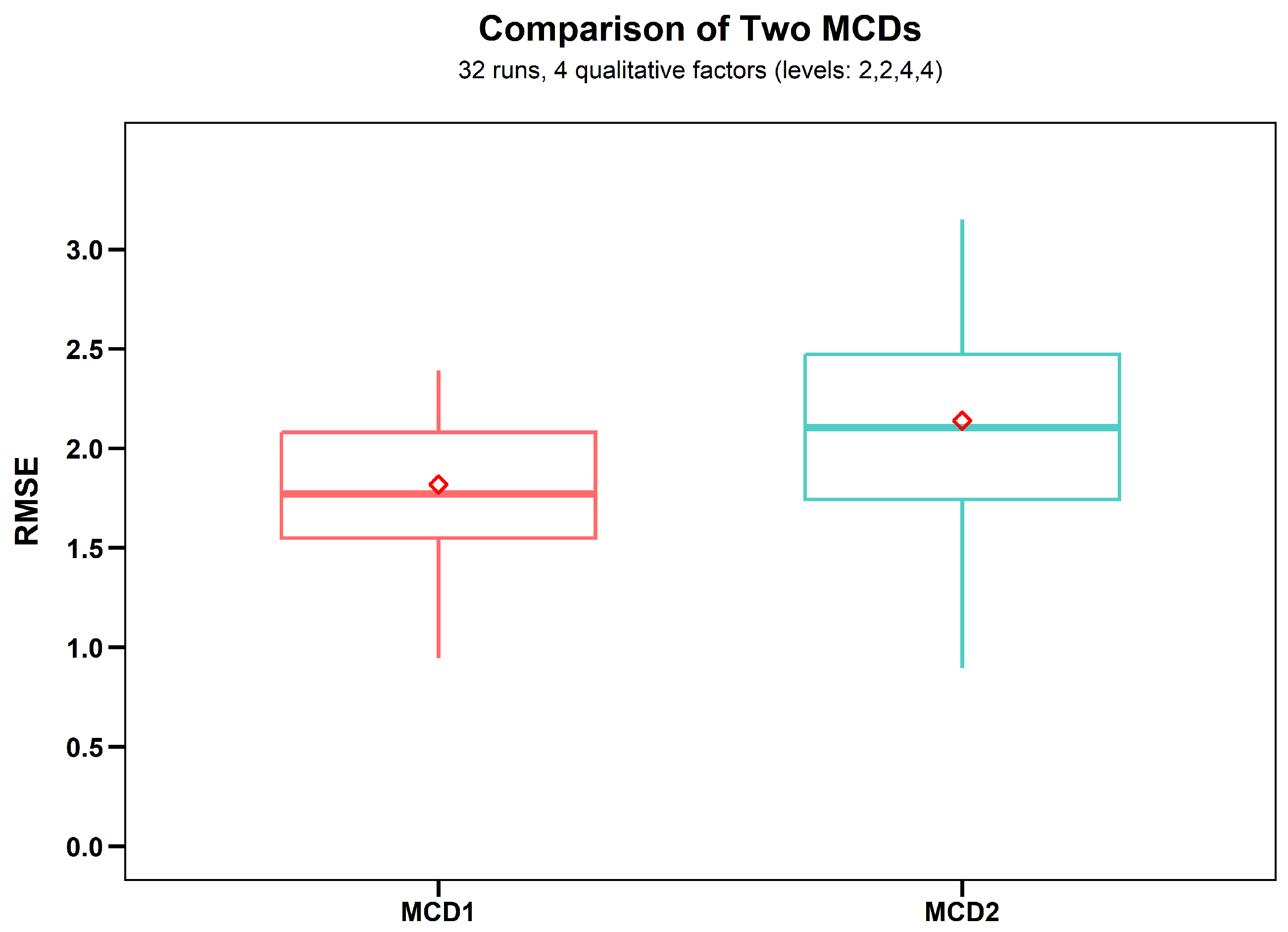
According to the RMSE in
Figure 4, MCD1 certainly outperforms MCD2 in building statistical surrogate models.
5. Concluding Remarks
Although Construction 3 of Deng et al. [
18] constructs asymmetrical MCDs, it does not discuss the space-filling property of the designs for quantitative factors in MCDs. Using simple and easily implementable Algorithms 1, 2, 3 and 4, the
,
,
, and
with
and
are obtained, respectively. Based on symmetrical MCDs with good low-dimensional projection properties in designs for quantitative factors, Algorithms 1 and 4 construct a series of asymmetrical MCDs, which inherit these low-dimensional space-filling properties. Algorithms 2 and 3 make use of the symmetrical MCDs and the space-filling LHDs to generate asymmetrical MCDs with desirable space-filling properties. Compared with Zhou et al. [
24], the designs obtained by Algorithms 1–3 are very flexible in terms of their run sizes: (i) if an asymmetrical MCD is constructed by Algorithm 1, the run size of such a design is a multiple of 8; (ii) when constructing the asymmetrical MCDs using Algorithms 2 and 3, their run sizes must be of the form
for some integer
.
The number of qualitative factors in an MCD determines its range of applications, so it is important to determine the upper bound of the number of qualitative factors. For the
constructed by Algorithm 1, the
generated by Algorithm 2, the
obtained by Algorithm 3, and the
obtained by Algorithm 4, on the one hand, since
or
for
, the maximum value of
can be obtained from
Table A3. On the other hand, according to Equation (3.2) of [
21], it is known that
in
,
in
,
in
, and
in
.
Given a small initial MCD
with
and
being an OA and an
, respectively, from Construction 3 of Deng et al. [
18], the large MCD
is found to be
and
, where
is a difference scheme,
is a
matrix with
, and
H is an
. Obviously, the space-filling property of
depends on
H, since
from Equation (
1). So we can choose a MCD from this paper as the initial small asymmetrical MCD and select a space-filling
H to construct a series of large space-filling asymmetrical MCDs based on Construction 3 of Deng et al. [
18].
As we know, orthogonality is extremely important for fitting polynomial models. A natural direction for future work would be to construct good asymmetrical MCDs with orthogonality.