A Review: Construction of Statistical Distributions


Abstract
1. Introduction
2. Construction of Univariate Statistical Distributions
- (1)
- Distribution families, including location-scale families, the Pearson system, and exponential families;
- (2)
- Functions of random variables via stochastic representations;
- (3)
- Parameter expansion generalizes existing families by adding parameters. For example, normal→ skew normal; exponential → Weibull.
- (4)
- Generalized families via transformation of the cdf. A powerful and prolific approach for generating new families of distributions is through the functional transformation of an existing baseline cdf, F(x). These transformations introduce new parameters, thereby creating more flexible distributions capable of modeling complex data behaviors.
- (5)
- Combination methods, such as mixture distributions, compound distributions, convolutions, and copula-based techniques.
2.1. Distribution Families
2.1.1. Location-Scale Distribution Family
- Cauchy distribution: Its pdf is given bywhere θ is the location parameter and λ is the scale parameter. Note that the Cauchy distribution does not have a defined mean or variance.
- Logistic distribution: Named for its relationship to the logistic (sigmoid) function, the logistic distribution resembles the normal distribution in shape but possesses heavier tails. It finds applications in logistic regression, growth models, and economics. Its cumulative distribution function (cdf) is given by
2.1.2. Pearson Distribution Family
2.1.3. The Exponential Distribution Family
- (1)
- All members have a low-dimensional sufficient statistic T(x).
- (2)
- In Bayesian statistics, the exponential family always has a natural conjugate prior. This makes Bayesian updating mathematically neat and computationally tractable.
- (3)
- Distributions in the exponential family are the maximum entropy distributions given constraints on the expected values of the sufficient statistics. For example, the normal distribution has the maximum entropy for a given mean and variance.
2.2. Distributions Produced by a Function of Random Variables
- (a)
- F−1(U) ∼ F(·);
- (b)
- F(X) ∼ U(0, 1).
2.2.1. Transformation of Random Variables
- Linear transformation Y = a + bX, for example, used in the location-scale distributions;
- Power transformation Y = Xr, for example, from the normal to the χ2 distribution by Y = X2;
- Exponential transformation Y = eX, for example, from the normal to the lognormal distribution by Y = eX;
- Inverse transformation Y = 1/X, for example, the inverse gamma distribution.
- Transformation , for example, the F-distribution and beta distribution are produced by functions of two χ2 distribution variables.
2.2.2. Order Statistics
2.2.3. Extreme Value Theory (EVT)
- Type I (Gumbel distribution) Gu(μ, σ) light-tailed, with ξ = 0. Its pdf is
- Type II (Frchet distribution) heavy-tailed, with ξ > 0.
- Type III (Weibull distribution) short-tailed and bounded with ξ < 0.
2.3. Generalized Families via Transformation of the cdf
2.4. Combination Methods
2.4.1. Types of Mixtures
- Continuous mixture f(x) = ∫ f(x; θ)g(θ)dθ. One example is the scale mixture. A primary method to create such continuous mixtures is through compounding, which we detail in the next section.
- The negative binomial distribution, which can be derived as a Poisson-gamma mixture where the Poisson rate parameter is governed by a gamma distribution. While the gamma is continuous, a discrete analogue exists (e.g., a Poisson mixture with a discrete log-gamma distribution would yield a similar over-dispersed count distribution).
- The Student’s t-distribution, which is a scale mixture of normal distributions where the precision (inverse variance) parameter follows a gamma distribution.
- The beta-binomial distribution, which arises when the success probability p of a binomial distribution follows a beta distribution.
- The compound Poisson distribution and related models, where the intensity or other parameters are driven by a latent discrete process.
2.4.2. Compounding
- First stage (conditional distribution): . The observation X is normally distributed with mean μ and a known variance σ2;
- Second stage (parameter distribution): . The mean μ itself is assumed to be normally distributed with prior mean μ0 and variance τ2;
- Compound distribution: The unconditional distribution of .
2.4.3. Convolution
2.5. Some Key Univariate Distributions and Related Distributions
2.5.1. Distributions Related to the Normal Distribution
- (1)
- Lognormal distribution: X ∼ LN(μ, σ2) if ln(X) ∼ N(μ, σ2);
- (2)
- Skew-normal distribution: proposed by Azzalini [28] with the pdfwhere ϕ(z) is the standard normal pdf, Φ(αz) is is the standard normal cdf evaluated at αz and α is a shape parameter. For more general cases, refer to Table 3. Skew-normal distribution is one of the skew-elliptical distributions, and there are more such distributions including skew-t, skew-Cauchy, skew-logistic, and skew-Laplace distributions; see [29,30]. There is more discussion about this topic in Section 4.6.
- (3)
- Chi-square distribution: If are independent and identically distributed (i.i.d.) random variables of N(0, 1), then , the χ2-distribution with degrees of freedom ν;
- (4)
- Chi distribution: If are i.i.d. N(0, 1), then the χ-distribution with degrees of freedom ν;
- (5)
- Beta distribution (special case): If Y ∼ χ2(2m) and Z ∼ χ2(2n) are independent, then , referred to Table 3;
- (6)
- Beta prime distribution: If X ∼ Be(α, β), then ;
- (7)
- Arcsine distribution: It is defined as ;
- (8)
- F-distribution: If Y ∼ χ2(m) and Z ∼ χ2(n) are independent, then ;
- (9)
- t-distribution: If Y ∼ χ2(ν) and Z ∼ N(0, 1) are independent, then .

| Distribution | Notation | Density |
|---|---|---|
| Normal | N(μ, σ2) | |
| Lognormal | LN(μ, σ2) | , |
| Skew-normal | SN(μ, σ, α) | |
| χ2(ν) | χ2(ν) | |
| χ(ν) | χν | |
| Beta | Be(a, b) | |
| Beta prime | BP(α, β) | |
| Arcsine | arcsine | |
| F | F(m, n) | |
| Student-t | tν |
2.5.2. Distributions Related to the Exponential Distribution
- (1)
- Laplace distribution: Also known as the double exponential distribution, the Laplace distribution extends the exponential distribution symmetrically to the entire real number space, .
- (2)
- Weibull distribution: The Weibull distribution is formed by introducing location δ and sharp α parameters to the density of the exponential density. It constitutes a flexible family of distributions widely used for modeling time-to-failure, lifespan, and other positive-valued measurements.
- (3)
- Rayleigh distribution: Proposed by Rayleigh [31] for modeling wave amplitudes, the Rayleigh distribution is a special case of the Weibull distribution with Wei(2, β, 0). It also arises from the normal distribution, N(0, σ2), by , where Y and Z are i.i.d. N(0, σ2) and β = 2σ2.
- (4)
- Topp–Leone exponential distribution (TLED): Introduced by [32], the TLED adds a shape parameter α to the exponential distribution, yielding the cumulative distribution function . Its density is provided in Table 4. The TLED generalizes certain distributions. For instance, TLED includes the Burr type as TLED(2, β) and Frèchet distribution as TLED(1/2, β).
| Distribution | Notation | Density |
|---|---|---|
| Exponential | Exp(β) | |
| Laplace | Laplace(μ, β) | |
| Weibull | Wei(α, β, δ) | |
| Rayleigh | Ray(β) or Ray(σ) | |
| TLED | TLED(α, β) |
2.5.3. Distributions Related to the Gamma Distribution
- (1)
- Location-shift gamma: Adding a location parameter δ forms the three-parameter distribution Gamma(α, β, δ).
- (2)
- Generalized gamma: This distribution exists in several forms. The version shown with shape a, scale d, and power p parameters was introduced by Stacy [33]. It includes several common distributions as special cases: the standard gamma (p = 1), the Weibull (a = 1), the Rayleigh (a = p = 2), and the exponential (a = p = 1).
- (3)
- Inverse gamma: Defined as Y = 1/X for X ∼ Gamma(α, β), this two-parameter distribution is positive-skewed. It is primarily used in Bayesian statistics as the conjugate prior for the variance of a normal distribution.
- (4)
- Beta prime distribution: The ratio X/Y of two independent variables, X ∼ Gamma(α, θ) and Y ∼ Gamma(β, θ), follows a beta prime distribution BP(α, β).
- (5)
- General beta prime distribution: This is a further extension of the beta prime distribution, incorporating two additional parameters.
| Distribution | Notation | Density |
|---|---|---|
| Gamma | Gamma(α, β) | |
| Location-shift gamma | Gamma(α, β, δ) | , , α, β > 0 |
| Generalized gamma | G − gamma(a, d, p) | |
| Inverse gamma | Inv − Gamma(α, β) | |
| Beta prime | BP(α, β) | |
| General beta prime | GBP(α, β, p, q) | , , p, q, β > 0, x > 0. |
2.6. The Generalized Hyperbolic Distribution Family
- (1)
- Mixing with the inverse Gaussian (λ = −0.5) distribution results in the normal inverse Gaussian distribution.
- (2)
- Mixing with the gamma (χ = 0, λ > 0) distribution results in the variance gamma distribution.
- (3)
- Mixing with the GIG (λ = 1) distribution results in the hyperbolic distribution.
2.7. Beta-Generated Distributions
2.7.1. The Beta-Normal Distribution
2.7.2. The Beta-Weibull Distribution
- (1)
- The limit of beta-Weibull density (16) is
- (2)
- Let Y ∼ Be(a, b), then the random variable follows BW(a, b, c, γ), where c, γ > 0. It provides a way to generate a random sample from the BW distribution.
- (3)
- Let Y follow a beta-exponential distribution with parameters (a, b, θ), then random variable X = θ(Y/θ)1/c follows a beta-Weibull distribution.
- (4)
- The beta-Weibull distribution is unimodal. The mode is at x0 = 1 whenever ac < 1 or ac = 1 and b ≥ (c − 1)/2c. For other cases, x0 is the solution of the equation
- (5)
- The rth moments of BW(a, b, c, γ) is given byby the transformation t = (x/γ)c.
3. Construction of Univariate Discrete Distributions and an Approximation
3.1. Classical Univariate Discrete Distributions
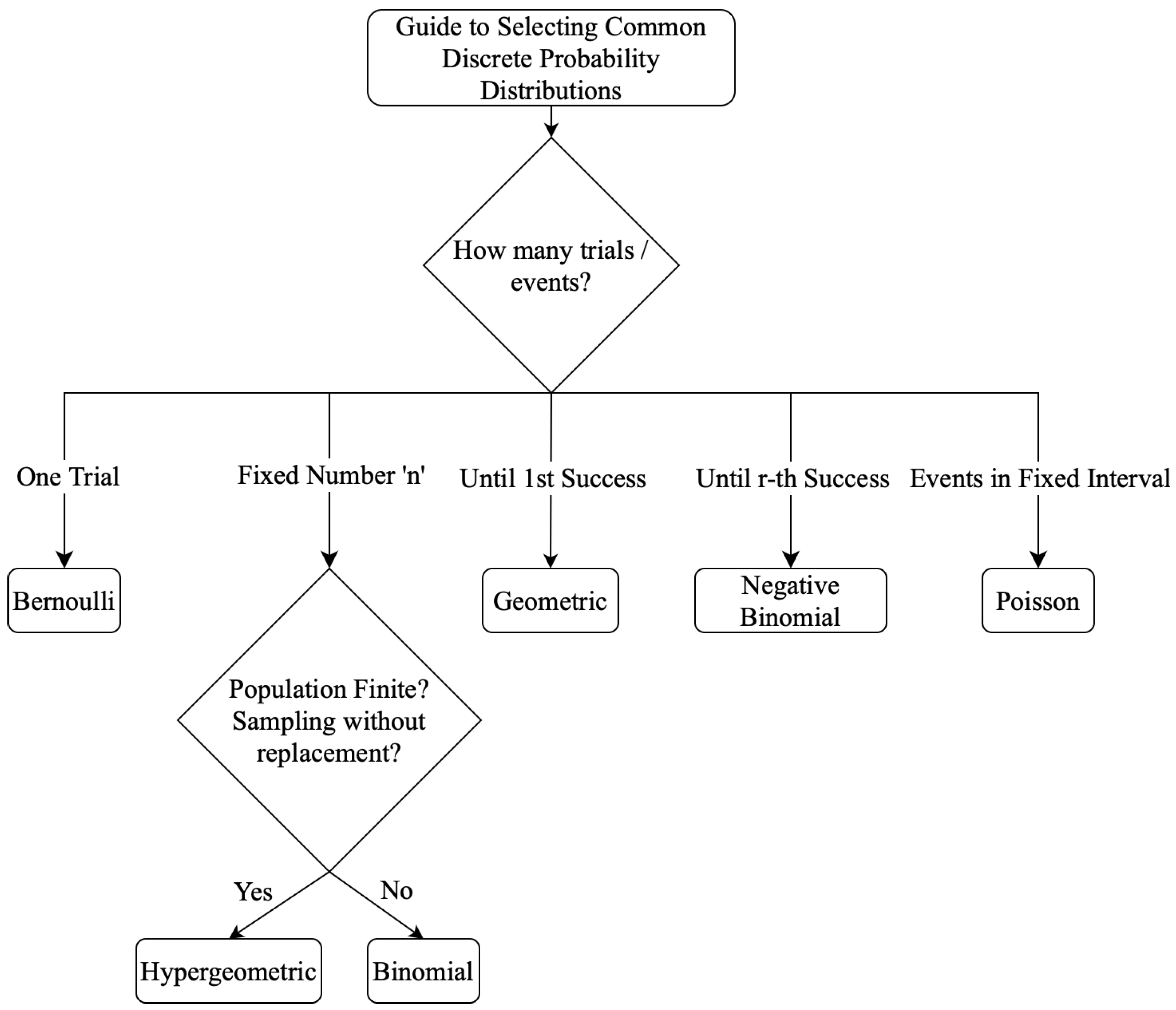
- Bernoulli(p)/Binomial(n, p): The Bernoulli distribution, Bernoulli(p), models a single trial, and Binomial(n, p) counts successes in n independent trials with sample success probability p.
- Geometric(p): It models the number of Bernoulli trials needed to obtain the first success, representing the waiting time for a success. It is a special case of the negative binomial (with r = 1).
- Negative Binomial(r, p): As a generalization of the geometric distribution, it models the number of Bernoulli trials needed to achieve r successes. The negative binomial distribution presented here in its classic form (modeling the number of trials) is equivalent to the parameterization modeling the number of failures before the r-th success (with support ), which is prevalent in many modern software packages and generalized linear models.
- Poisson(λ): It models the number of events occurring in a fixed interval of time or space, given a constant average rate (λ) and independence between events. It can be derived as a limiting case of the binomial distribution when n → ∞ and p → 0 such that np → λ.
- Hypergeometric(s, n, N, M): It represents the number s of successes in n draws without replacement from a population with N size with M success items, where max(0, n − (N − M)) ≤ s ≤ min(M, n). This differs from the binomial distribution, where trials are independent (i.e., with replacement).
3.2. Distributions Generated by Mixtures
3.2.1. Poisson Mixtures
3.2.2. Binomial Mixtures
3.3. Distributions Generated by Random Sums
- Compound Poisson distribution: If N ∼ Poisson(λ), then S is compound Poisson. This is a highly flexible family used in insurance (to model total claim amounts) and queueing theory. Special cases include the Poisson-exponential and Poisson-gamma (which is equivalent to the negative binomial under a specific parameterization) distributions.
- Geometric sum: If N ∼ Geometric(p), and Xi ∼ Exp(θ), then S ∼ Exp(θp). This result is foundational in renewal theory.
3.4. Approximation to Univariate Continuous Distributions by Representative Points
- Monte Carlo RPs (MC-RPs): the empirical sample points.
- Quasi-Monte Carlo RPs (QMC-RPs): deterministic points based on low-discrepancy sequences.
- Mean square error RPs (MSE-RPs): points minimizing a mean squared error criterion.
3.4.1. Difference Between Two Distributions
3.4.2. Discrete Analogues
- (1)
- (2)
- The probability mass function (pmf) of Y retains the form of the pdf of X, and the support of Y is determined from the full range of X. The pmf is defined asThis approach has been used to create discrete analogs of various continuous distributions, including the gamma, general Dirichlet, normal, lognormal, exponential, Laplace, generalized exponential, and gamma distributions [54,55,56].
- (3)
- The survival function (SF) of Y retains the form of the survival function of X, and the support of Y is determined from the full range of X. The discrete survival function is defined as SY(k) = P(Y ≥ k), and its corresponding cdf is FY(k) = P(Y ≤ k), related by SY(k) = 1 − FY(k − 1). This technique has generated numerous discrete distributions, such as the discrete exponential, Weibull, geometric Weibull, normal, Rayleigh, Maxwell, extended exponential, and Lindley distributions [57,58].
- (4)
- The hazard (failure) rate function of Y retains the form of the hazard rate function of X. This method preserves the hazard rate function. For a continuous random variable X with survival function SX(x) = P(X ≥ x) and hazard rate function λX(x) = fX(x)/SX(x), the survival function of the discrete analog Y is given byand its pmf isThis approach has been used to propose new discrete distributions, such as the discrete Lomax, Weibull, and Rayleigh [59].
- (5)
- The moments of Y and X coincide up to a certain order. This method requires that Y and X share the same finite rth moment for , and that their cdfs coincide at least at M + 1 points. The support of the discrete random variable Y is . It has been used to define new discrete uniform, normal, gamma, and beta distributions [60].
4. Multivariate Distributions
4.1. Multinomial Distribution
4.2. Multivariate Hypergeometric Distribution
4.3. Multivariate Poisson Distribution
4.4. Continuous Multivariate Distributions
4.4.1. Stochastic Representation
- (i)
- It assumes that the explicit form of the density function is known.
- (ii)
- It requires the analytical evaluation of high-dimensional integrals to compute probabilities, moments, and marginal distributions.
- (1)
- where fj are measurable functions.Examples are and
- (2)
- X, Y, and Z are random variables,can imply if Z is independent of (X, Y).
- (3)
- If , and Z is independent of (X, Y), it is not necessary for .
- (4)
- If Z is independent of (X, Y), then
- implies ;
- implies under some conditions.
- (5)
- if and only if and .
4.4.2. Dirichlet Distribution
- (i)
- U(j)∼ U(Stj), the uniform distribution on ;
- (ii)
- and are mutually independent;
- (iii)
- , and .
4.4.3. Spherical and Elliptical Distributions
- (i)
- for each P ∈ O(p), where O(p) is the set of orthogonal matrices of order p;
- (ii)
- The characteristic function (c.f.) of X is of the form ψ(t⊤t) for some ψ ∈ Ψp where
- (iii)
- X has a stochastic representation , where random variable R ≥ 0 is independent of U(p), U(p) is uniformly distributed on the unit sphere Sp and does not have a density;
- (iv)
- For any , we have .
4.4.4. Approximation to Multivariate Continuous Distributions by Representative Points
4.5. Basic Statistics Under the Multivariate Population
Multivariate L1-Norm Symmetric Distribution
4.6. Definition by Distribution, Density or Survival Functions
4.6.1. Meta-Skew Symmetric Distributions
4.6.2. Skew-Normal Distribution
4.6.3. Skew-Elliptical Distributions
4.6.4. Definition by Survival Function
4.7. Meta-Distributions via Copula Techniques
4.7.1. Some Examples of Copula
4.7.2. Gaussian Copula and Meta-Gaussian Distribution
4.7.3. Marshall–Olkin Copula
5. Conclusions
Author Contributions
Funding
Conflicts of Interest
References
- Johnson, N.L.; Kotz, S.; Balakrishnan, N. Continuous Univariate Distributions, 2nd ed.; John Wiley & Sons: New York, NY, USA, 1994; Volume 1. [Google Scholar]
- Johnson, N.L.; Kotz, S.; Balakrishnan, N. Continuous Univariate Distributions, 2nd ed.; John Wiley & Sons: New York, NY, USA, 1995; Volume 2. [Google Scholar]
- Johnson, N.L.; Kotz, S.; Balakrishnan, N. Discrete Multivariate Distributions; John Wiley & Sons: New York, NY, USA, 1997. [Google Scholar]
- Kotz, S.; Balakrishnan, N.; Johnson, N.L. Continuous Multivariate Distributions, Volume 1: Models and Applications, 2nd ed.; John Wiley & Sons: New York, NY, USA, 2000. [Google Scholar]
- Fang, K.T.; Xu, J.L. Statistical Distribution; China Higher Education Press: Beijing, China, 2016. [Google Scholar]
- Fang, K.T.; Kotz, S.; Ng, K.W. Symmetric Multivariate and Related Distributions; Chapman and Hall: London, UK, 1990. [Google Scholar]
- Johnson, M.E. Multivariate Statistical Simulation; John Wiley & Sons: New York, NY, USA, 1987. [Google Scholar]
- Fang, K.T.; Ye, H.; Zhou, Y. Representative Points of Statistical Distributions and Their Applications in Statistical Inference; CRC Press: Boca Raton, FL, USA, 2025. [Google Scholar]
- Lehmann, E.L.; Casella, G. Theory of Point Estimation, 2nd ed.; Springer: New York, NY, USA, 1998. [Google Scholar]
- Bickel, P.J.; Doksum, K.A. Mathematical Statistics: Basic Ideas and Selected Topics, 2nd ed.; Chapman and Hall/CRC: New York, NY, USA, 2015; Volume 1. [Google Scholar]
- Pearson, K.X. Contributions to the mathematical theory of evolution—II. Skew variation in homogeneous material. Philos. Trans. R. Soc. Lond. A 1895, 186, 343–414. [Google Scholar]
- Elderton, W.P.; Johnson, N.L. Systems of Frequency Curves; Cambridge University Press: Cambridge, UK, 1969. [Google Scholar]
- Hogg, R.V.; McKean, J.W.; Craig, A.T. Introduction to Mathematical Statistics, 6th ed.; Prentice Hall: Upper Saddle River, NJ, USA, 2005. [Google Scholar]
- Li, Y.; Sun, Z.H.; Fang, K.T. Generalized inverse transformation method via representative points in statistical simulation. Commun. Stat.-Simul. Comput. 2024, 54, 4519–4545. [Google Scholar] [CrossRef] [Scilit]
- David, H.A.; Nagaraja, H.N. Order Statistics, 3rd ed.; John Wiley & Sons: Hoboken, NJ, USA, 2004. [Google Scholar]
- De Haan, L.; Ferreira, A. Extreme Value Theory: An Introduction; Springer: New York, NY, USA, 2006. [Google Scholar]
- Al-Hussaini, E.K.; Ahsanullah, M. Exponentiated distributions. Atlantis Studies in Probability and Statistics; Atlantis Press: Paris, France, 2015; Volume 21. [Google Scholar]
- Mahdavi, A.; Kundu, D. A new method for generating distributions with an application to exponential distribution. Commun. Stat.-Theory Methods 2017, 46, 6543–6557. [Google Scholar] [CrossRef] [Scilit]
- Cordeiro, G.M.; De Castro, M. A new family of generalized distributions. J. Stat. Comput. Simul. 2011, 81, 883–898. [Google Scholar] [CrossRef] [Scilit]
- Alzaatreh, A.; Lee, C.; Famoye, F. A new method for generating families of continuous distributions using the T-X family. Metron 2013, 71, 6379. [Google Scholar] [CrossRef] [Scilit]
- Everitt, B.S.; Hand, D.J. Finite Mixture Distributions; Springer: Dordrecht, The Netherlands, 1981. [Google Scholar]
- Li, Y.; Fang, K.T.; He, P.; Peng, H. Representative points from a mixture of two normal distributions. Mathematics 2022, 10, 3952. [Google Scholar] [CrossRef] [Scilit]
- Yan, T.; Fang, K.T.; Yin, H. A novel approach for parameter estimation of mixture of two Weibull distributions in failure data modeling. Stat. Comput. 2024, 34, 221. [Google Scholar] [CrossRef] [Scilit]
- Aigner, D.; Lovell, C.K.; Schmidt, P. Formulation and estimation of stochastic frontier production function models. J. Econom. 1977, 6, 21–37. [Google Scholar] [CrossRef] [Scilit]
- Huygens, C. De Ratiociniis in Ludo Aleae. In Exercitationum Mathematicarum; Schooten, F.V., Ed.; Elsevier: Leiden, The Netherlands, 1657; pp. 521–534. [Google Scholar]
- de Moivre, A. Approximatio ad Summam Terminorum Binomii (a + b)n in Seriem Expansi. Misc. Anal. 1733, II, 1–7. [Google Scholar]
- Gauss, C.F. Theoria Motus Corporum Coelestium in Sectionibus Conicis Solem Ambientum; Perthes et Besser: Hamburg, Germany, 1809. [Google Scholar]
- Azzalini, A. A class of distributions which includes the normal ones. Scand. J. Stat. 1985, 12, 171–178. [Google Scholar]
- Martínez-Flórez, G.; Tovar-Falón, R.; Gómez, H. Bivariate Power-Skew-Elliptical Distribution. Symmetry 2020, 12, 1327. [Google Scholar] [CrossRef] [Scilit]
- Zhou, Y.F.; Lin, Y.X.; Fang, K.T.; Yin, H. The Representative Points of Generalized Alpha Skew-t Distribution and Applications. Entropy 2024, 26, 889. [Google Scholar] [CrossRef] [Scilit]
- Rayleigh, L. On the resultant of a large number of vibrations of the same pitch and of arbitrary phase. Philos. Mag. 1880, 10, 73–78. [Google Scholar] [CrossRef] [Scilit]
- Nadarajah, S.; Kotz, S. Moments of some J-shaped distributions. J. Appl. Stat. 2003, 30, 311–317. [Google Scholar] [CrossRef] [Scilit]
- Stacy, E.W. A generalization of the gamma distribution. Ann. Math. Stat. 1962, 33, 1187–1192. [Google Scholar] [CrossRef] [Scilit]
- Schrdinger, E. Zur theorie der fall-und steigversuche an teilchen mit brownscher bewegung. Phys. Z. 1915, 16, 289–295. [Google Scholar]
- Tweedie, K.C.M. Inverse statistical variates. Nature 1945, 155, 453. [Google Scholar] [CrossRef] [Scilit]
- Seshadri, V. The Inverse Gaussian Distribution: Statistical Theory and Applications; Springer: New York, NY, USA, 1999. [Google Scholar]
- Barndorff-Nielsen, O.E. Exponentially decreasing distributions for the logarithm of particle size. Proc. R. Soc. Lond. A Math. Phys. Sci. 1977, 353, 401–419. [Google Scholar]
- Eberlein, E.; Keller, U. Hyperbolic distributions in finance. Bernoulli 1995, 1, 281–299. [Google Scholar] [CrossRef]
- Barndorff-Nielsen, O.E. Normal inverse Gaussian distributions and stochastic volatility modelling. Scand. J. Stat. 1997, 24, 1–13. [Google Scholar] [CrossRef] [Scilit]
- Arnold, B.C.; Castillo, E.; Sarabia, J.M. Conditional Specification of Statistical Models; Springer Series in Statistics; Springer: New York, NY, USA, 1999. [Google Scholar]
- Arnold, B.C.; Castillo, E.; Sarabia, J.M. Conditionally specified distributions: An introduction (with comments and a rejoinder by the authors). Stat. Sci. 2001, 16, 249–274. [Google Scholar] [CrossRef] [Scilit]
- Zografos, K.; Balakrishnan, N. On families of beta-and generalized gamma-generated distributions and associated inference. Stat. Methodol. 2009, 6, 344–362. [Google Scholar] [CrossRef] [Scilit]
- Eugene, N.; Lee, C.; Famege, F. Beta-normal distribution and its applications. Commun. Stat.-Theory Methods 2002, 31, 497–512. [Google Scholar] [CrossRef] [Scilit]
- Gupta, A.K.; Nadarajah, S. On the moments of the beta normal distribution. Commun. Stat.-Theory Methods 2005, 33, 1–13. [Google Scholar] [CrossRef] [Scilit]
- Famege, F.; Lee, C.; Olumolade, O. The beta-Weibull distribution. J. Stat. Theory Appl. 2005, 4, 121–136. [Google Scholar]
- Mdziniso, N.C. The Quotient of the Beta-Weibull Distribution. Master’s Thesis, Marshall University, Huntington, WV, USA, 2012. [Google Scholar]
- Johnson, N.L.; Kotz, S. Urn Models and Their Applications; John Wiley & Sons: New York, USA, NY, 1977. [Google Scholar]
- Johnson, N.L.; Kemp, A.W.; Kotz, S. Univariate Discrete Distributions, 3rd ed.; John Wiley & Sons: New York, NY, USA, 2005. [Google Scholar]
- Ross, S.M. Introduction to Probability Models, 11th ed.; Academic Press: Cambridge, MA, USA, 2014. [Google Scholar]
- Fang, K.T.; Pan, J. A review of representative points of statistical distributions and their applications. Mathematics 2023, 11, 2930. [Google Scholar] [CrossRef] [Scilit]
- Chakraborty, S. Generating discrete analogues of continuous probability distributions—A survey of methods and constructions. J. Stat. Distrib. Appl. 2015, 2, 6. [Google Scholar] [CrossRef] [Scilit]
- Kemp, A.W. A wide class of discrete distributions and the associated differential equations. Sankhyā Indian J. Stat. Ser. A 1968, 30, 401–410. [Google Scholar]
- Sundt, B.; Jewell, W.S. Further results on recursive evaluation of compound distributions. ASTIN Bull. J. IAA 1981, 12, 27–39. [Google Scholar] [CrossRef] [Scilit]
- Lisman, J.H.C.; Van Zuylen, M.C.A. Note on the generation of most probable frequency distributions. Stat. Neerl. 1972, 26, 19–23. [Google Scholar] [CrossRef] [Scilit]
- Inusah, S.; Kozubowski, T.J. A discrete analogue of the Laplace distribution. J. Stat. Plan. Inference 2006, 136, 1090–1102. [Google Scholar] [CrossRef] [Scilit]
- Kozubowski, T.J.; Inusah, S. A skew Laplace distribution on integers. Ann. Inst. Stat. Math. 2006, 58, 555–571. [Google Scholar] [CrossRef] [Scilit]
- Roy, D. The discrete normal distribution. Commun. Stat.-Theory Methods 2003, 32, 1871–1883. [Google Scholar] [CrossRef] [Scilit]
- Roy, D. Discrete Rayleigh distribution. IEEE Trans. Reliab. 2004, 53, 255–260. [Google Scholar] [CrossRef] [Scilit]
- Krishna, H.; Pundir, P.S. Discrete Burr and discrete Pareto distributions. Stat. Methodol. 2009, 6, 177–188. [Google Scholar] [CrossRef] [Scilit]
- Chakraborty, S.; Chakravarty, D. Discrete gamma distributions: Properties and parameter estimations. Commun. Stat.-Theory Methods 2012, 41, 3301–3324. [Google Scholar] [CrossRef] [Scilit]
- Karlis, D.; Mamode Khan, N. Models for integer data. Annu. Rev. Stat. Its Appl. 2023, 10, 297–323. [Google Scholar] [CrossRef] [Scilit]
- Janardan, K.G.; Patil, G.P. A unified approach for a class of multivariate hypergeometric models. Sankhya¯ Indian J. Stat. Ser. A 1972, 34, 363–376. [Google Scholar]
- Kocherlakota, S.; Kocherlakota, K. Bivariate Discrete Distributions; Marcel Dekker: New York, USA, NY, 1992. [Google Scholar]
- Karlis, D. An EM algorithm for multivariate Poisson distribution and related models. J. Appl. Stat. 2003, 30, 63–77. [Google Scholar] [CrossRef] [Scilit]
- Palmitesta, P.; Provasi, C. Computer Generation of Random Vectors from Continuous Multivariate Distributions; Dipartimento di Metodi Quantitativi, Università degli Studi di Siena: Siena, Italy, 2001. [Google Scholar]
- Nelsen, R.B. An Introduction to Copulas, 2nd ed.; Springer: New York, NY, USA, 2006. [Google Scholar]
- Balakrishna, N.; Lai, C.D. Construction of bivariate distributions. In Continuous Bivariate Distributions, 2nd ed.; Springer: New York, NY, USA, 2009; pp. 179–228. [Google Scholar]
- Fang, K.T.; Zhang, Y.T. Generalized Multivariate Analysis; Science Press: Beijing, China; Springer: Berlin/Heidelberg, Germany, 1990. [Google Scholar]
- Fang, K.T.; Wang, Y. Number-Theoretic Methods in Statistics; Chapman & Hall: London, UK, 1994. [Google Scholar]
- Pagès, G. Numerical Probability: An Introduction with Applications to Finance; Universitext Series; Springer: Berlin/Heidelberg, Germany, 2018. [Google Scholar]
- Fang, K.T.; Yuan, K.H.; Benlter, P.M. Applications of number-theoretic methods to quantizers of elliptically contoured distributions, Multivariate Analysis and Its Applications. IMS Lect. Notes-Monogr. Ser. 1994, 24, 211–225. [Google Scholar]
- Tarpey, T.; Flury, B. Self-consistency: A fundamental concept in statistics. Stat. Sci. 1996, 11, 229–243. [Google Scholar] [CrossRef] [Scilit]
- Graf, S.; Luschgy, H. Foundations of Quantization for Probability Distributions; Springer: Berlin/Heidelberg, Germany, 2000. [Google Scholar]
- Wishart, J. The generalised product moment distribution in samples from a normal multivariate population. Biometrika 1928, 20, 32–52. [Google Scholar] [CrossRef] [Scilit]
- Fang, K.T.; Fang, B.Q. Some families of multivariate symmetric distributions related to exponential distribution. J. Multivar. Anal. 1988, 24, 109–122. [Google Scholar] [CrossRef] [Scilit]
- Fang, K.T.; Fang, B.Q. A characterization of multivariate l1-norm symmetric distributions. Stat. Probab. Lett. 1989, 7, 297–299. [Google Scholar] [CrossRef] [Scilit]
- Anderson, T.W. An Introduction to Multivariate Statistical Analysis; John Wiley & Sons: New York, NY, USA, 1984. [Google Scholar]
- Wang, J.; Boyer, J.; Genton, M.G. A skew-symmetric representation of multivariate distributions. Stat. Sin. 2004, 14, 1259–1270. [Google Scholar]
- Arad, F.; Sheikhi, A. Asymmetric distributions based on the t-copula. In Proceedings of the 2022 9th Iranian Joint Congress on Fuzzy and Intelligent Systems (CFIS), Bam, Iran, 2–4 March 2022; pp. 1–3. [Google Scholar]
- Azzalini, A.; Valle, A.D. The multivariate skew-normal distribution. Biometrika 1996, 83, 715–726. [Google Scholar] [CrossRef] [Scilit]
- Azzalini, A.; Capitanio, A. Statistical applications of the multivariate skew-normal distribution. J. R. Stat. Soc. Ser. B Stat. Methodol. 1999, 61, 579–602. [Google Scholar] [CrossRef] [Scilit]
- Genton, M.G. (Ed.) Skew-Elliptical Distributions and Their Applications: A Journey Beyond Normality; CRC Press: Boca Raton, FL, USA, 2004. [Google Scholar]
- Marshall, A.W.; Olkin, I. A multivariate exponential distribution. J. Am. Stat. Assoc. 1967, 62, 30–44. [Google Scholar] [CrossRef]
- Durante, F.; Sempi, C. Chapter 1: Copula theory: An introduction. In Copula Theory and Its Applications, Proceedings of the Workshop Held in Warsaw, Poland, 25–26 September 2009; Lecture Notes in Statistics—Proceedings, 198; Springer: Berlin/Heidelberg, Germany, 2010; pp. 3–32. [Google Scholar]
- Gumbel, E.J. Multivariate logistic distributions. Bull. Int. Stat. Inst. 1961, 38, 1–6. [Google Scholar]
- Fang, K.T.; Fang, H.B.; von Rosen, D. A family of bivariate distributions with non-elliptical contours. Commun. Stat. Theory Methods 2000, 29, 1885–1898. [Google Scholar] [CrossRef] [Scilit]
- Clayton, U.G. A model for association in bivariate iife tables and its applications in epideniological studies of familial tendency in chronic disease incidence. Biometrika 1978, 65, 141–151. [Google Scholar] [CrossRef]
- Ali, M.M.; Mikhail, N.N.; Haq, M.S. A class of bivariate distributions including the bivariate logistic. J. Multivar. Anal. 1978, 8, 405–412. [Google Scholar] [CrossRef] [Scilit]
- Fang, H.B.; Fang, K.T.; Kotz, S. The meta-elliptical distributions with given marginalis. J. Multivar. Anal. 2002, 82, 1–16. [Google Scholar] [CrossRef] [Scilit]
- Kelly, K.S.; Krzysztofowicz, R. Bivariate meta-gaussian density for use in hydrology. Stoch. Hydrol. Hydraul. 1997, 11, 17–31. [Google Scholar] [CrossRef] [Scilit]
- Joe, H. Dependence Modeling with Copulas; CRC Press: London, UK, 2015. [Google Scholar]
- Bouyé, E.; Durrleman, V.; Nikeghbali, A.; Riboulet, G.; Roncalli, T. Copulas for Finance—A Reading Guide and Some Applications. Available online: https://ssrn.com/abstract=1032533 (accessed on 1 October 2025).
- Kruskal, W.H. Ordinal measures of association. J. Am. Stat. Assoc. 1958, 53, 814–861. [Google Scholar] [CrossRef]
- Mai, J.F.; Scherer, M. Simulating Copulas: Stochastic Models, Sampling Algorithms and Applications, 2nd ed.; World Scientific: Hackensack, NJ, USA, 2017. [Google Scholar]
- Zhang, L.; Singh, V.P. Copulas and Their Applications in Water Resources Engineering; Cambridge University Press: Cambridge, UK, 2019. [Google Scholar]
- He, P.A.; Fang, K.T.; Ye, H.J. Gaussian copulas and meta Gaussian distributions: A theoretical study. Stat. Comput. 2025; in press.

| Type | Condition | Distribution | PDF Example |
|---|---|---|---|
| 0 | a = 0, b = 0 | Normal distribution | |
| I | b2 − 4ac > 0 | Beta distribution | f(x) ∝ (1 + x)r1(1 − x)r2, |x| ≤ 1 |
| II | b2 − 4ac = 0, λ = − b/2a | Symmetric beta | |
| III | a = 0 | Gamma distribution | f(x) ∝ xk−1e−x/θ. x > 0 |
| IV | b2 − 4ac < 0 | Skewed heavy-tailed | Complex form |
| V | c = 0 | Inverse gamma | f(x) ∝ xk−1e−θ/x, x > 0 |
| VI | b2 − 4ac > 0, | Beta prime, F-distribution | f(x) ∝ xr1(1 + x)−(r1+r2) |
| VII | b = 0 | Student’s t-distribution |
| Distribution | Density |
|---|---|
| The general k-th order statistic 1 | |
| Minimum (X(1)) | n[1 − F(x)]n−1f(x) |
| Maximum (X(n)) | n[F(x)]n−1f(x) |
| Distribution | Support Points | Probability Mass Function |
|---|---|---|
| Bernoulli(p) | 0, 1 | p0 = 1 − p, p1 = p |
| Binomial(n, p) | ||
| Geometric(p) | (Number of trials until first success) | |
| Negative Binomial(r, p) | (Number of trials until r-th success) | |
| (Number of failures before r-th success) | ||
| Poisson(λ) | ||
| Hypergeometric(s, n, N, M) | max (0, n − (N − M)), ⋯, min (M, n) |
| Type | Density Function or c.f. |
|---|---|
| Multinormal | |
| Kotz-type | |
| Pearson type VII | |
| Multivariate t | |
| Multivariate Cauchy | |
| Pearson Type II | for x⊤x < 1 |
| Logistics | |
| Scale mixture |
Disclaimer/Publisher’s Note: The statements, opinions and data contained in all publications are solely those of the individual author(s) and contributor(s) and not of MDPI and/or the editor(s). MDPI and/or the editor(s) disclaim responsibility for any injury to people or property resulting from any ideas, methods, instructions or products referred to in the content. |
© 2025 by the authors. Licensee MDPI, Basel, Switzerland. This article is an open access article distributed under the terms and conditions of the Creative Commons Attribution (CC BY) license (https://creativecommons.org/licenses/by/4.0/).
Share and Cite
Fang, K.-T.; Lin, Y.-X.; Deng, Y.-H. A Review: Construction of Statistical Distributions. Entropy 2025, 27, 1188. https://doi.org/10.3390/e27121188
Fang K-T, Lin Y-X, Deng Y-H. A Review: Construction of Statistical Distributions. Entropy. 2025; 27(12):1188. https://doi.org/10.3390/e27121188
Chicago/Turabian StyleFang, Kai-Tai, Yu-Xuan Lin, and Yu-Hui Deng. 2025. "A Review: Construction of Statistical Distributions" Entropy 27, no. 12: 1188. https://doi.org/10.3390/e27121188
APA StyleFang, K.-T., Lin, Y.-X., & Deng, Y.-H. (2025). A Review: Construction of Statistical Distributions. Entropy, 27(12), 1188. https://doi.org/10.3390/e27121188