Abstract
The Lamb shift, as an additional energy correction induced by environments usually, has a marginal contribution and hence is neglected. We demonstrate that the Lamb shift, which modifies the energy levels, can influence the heat current to varying extents. We focus on the steady-state heat current through two coupled two-level atoms, respectively, in contact with a heat reservoir at a certain temperature. We find that the Lamb shift suppresses the steady-state heat current at small temperature gradients, while at large gradients, the heat current is restricted by an upper bound without the Lamb shift but diverges when it is included. These results not only demonstrate the Lamb shift’s critical role in quantum heat transport but also advance our understanding of its impact in quantum thermodynamics.
1. Introduction
In realistic scenarios, the physical system can hardly be completely isolated from its external environment. It is inevitable for an open system to exchange energy, information, or matter with its surroundings. The evolution of open systems is determined not only by the system’s intrinsic Hamiltonian but also by its coupling with environmental degrees of freedom [1]. There are a variety of nontrivial quantum phenomena, including decoherence and energy dissipation, in open systems. The master equation (ME) is one of the critical methods describing the dynamic evolution of open systems [1,2,3]. The most popular ME could count on the Gorini–Kossakowski–Lindblad–Sudarshan (GKLS) ME [4,5,6] based on the Born–Markov–Secular approximation, which has been extensively validated and applied in numerous studies [7,8,9,10,11,12]. Some other approaches, such as the coarse-graining method [13], the universal Lindblad equation [14], and the geometric–arithmetic master equation [15,16], are also used to derive the master equation without the secular approximation. In addition, some works especially focused on examining the validity of the ME [13,14,16,17,18,19]. Among these contributions, one can usually find the system’s energy level shift, known as the Lamb shift, caused by its interaction with its environment.
The Lamb shift typically manifests as an additional term as the energy level correction caused by the environment, which usually has a marginal contribution to the question of interest [1,2,3]. A numerical demonstration showed that the Lamb shift only weakly perturbs the system Hamiltonian [14]; Refs. [12,20] ignored the contribution of the Lamb shift by comparing the order of magnitude of the Lamb shift in the weak coupling limit; some studies have assumed that heat baths possess a huge bandwidth, resulting in an effective zero Lamb shift [21]. In this sense, the Lamb shift is safely neglected in many applications. For example, the ME, which neglects the Lamb shift, is used to analyze the interactions between light and matter, quantum interference of light, and quantum light sources, such as single-photon sources and lasers [22,23,24]. The decoherence in various quantum information processes [25,26,27,28] has been analyzed without considering the Lamb shift. The ME without the Lamb shift is used to study the energy exchange processes between the working substance and its heat reservoirs [29,30,31,32,33,34,35]. The Lamb shift commutes with the system’s Hamiltonian; hence, the steady state is independent of the Lamb shift, and so is the steady-state heat current [36]. Recently, quantum batteries have attracted increasing interest [37,38,39,40,41], where ME facilitates understanding the charging and discharging processes of quantum states, especially considering the environmental factors such as temperature and noise on battery performance, but one can find that the Lamb shift is not considered either.
However, recent studies have begun to reevaluate the significance of the Lamb shift, acknowledging its crucial role in accurately characterizing system–environment interactions. Numerical evidence has shown the substantial impact of the Lamb shift [10]. For instance, under specific parameter choices, the refined Lamb shift Hamiltonian yields more accurate results than models neglecting this contribution [42]. The discrepancies observed between Born–Markov methods and the stochastic Liouville equation with dissipation (SLED) at low temperatures have been attributed to the omission of the Lamb shift [43]. Moreover, a significant collective Lamb shift was experimentally demonstrated using two distant superconducting qubits [44]. In systems such as a giant artificial atom with multiple coupling points, the Lamb shift becomes a pronounced, frequency-dependent, and engineerable quantity that actively influences relaxation rates and enables tunable anharmonicity [45]. These energy shifts play an essential role in quantum thermodynamics. For example, in electric circuit systems [46,47], quantum refrigeration [48,49], quantum dots [50], and giant atoms [45,51], accurate accounting of the Lamb shift is critical for predicting heat currents and other thermodynamic quantities reliably [52].
In this paper, we find the significant influence of the Lamb shifts on the heat transport through two coupled atoms interacting with a heat bath, respectively. Here, we do not distinguish between the Lamb and Stark shifts in this paper for simplicity but rather collectively refer to the total of the environment-induced frequency shift of the system as the Lamb shift. We find that the heat current approaches an upper bound with the temperature difference increasing when the Lamb shift is not considered as usual [53,54,55,56]. In contrast, the heat current will monotonically increase with the temperature difference increasing if we consider the Lamb shift. This difference in heat currents persists when other forms of spectral densities are taken.
This paper is organized as follows. In Section 2, we give a brief description of our model and derive the master equations under the Born–Markov–Secular approximation. In Section 3, we calculate the Lamb shift. In Section 4, we compare the heat currents with and without the Lamb shift. We conclude with a summary in Section 5.
2. The Model
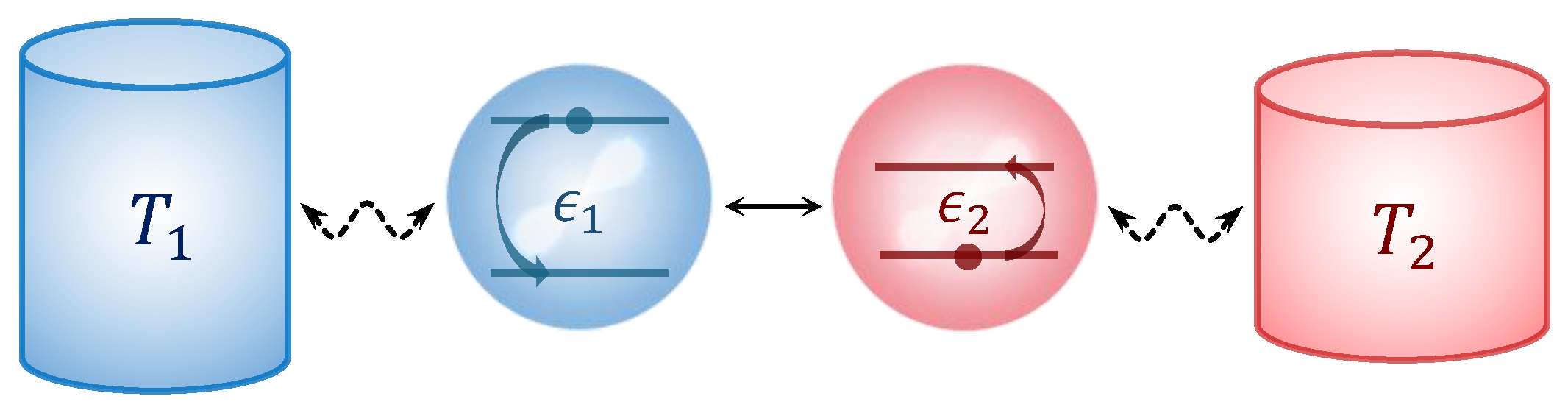
Let us consider two coupled two-level atoms (TLAs) interacting with a distinct thermal reservoir, respectively, as shown in Figure 1. The model has been widely studied in various cases [57,58,59,60]. The total Hamiltonian of the system and the reservoirs is
where
with , and denoting the Pauli matrices, and g denoting the coupling strength of two qubits. For simplicity, we adopt natural units by setting the reduced Planck constant and the Boltzmann constant . and are the Hamiltonians of the two thermal reservoirs, which are characterized by a collection of independent harmonic oscillators, where
with the summation running over all discrete modes of the jth thermal reservoir. and are the interaction Hamiltonians between the system of interest and the reservoirs, where
with .
Figure 1.
The schematic illustration of our model, where the dashed line represents weak coupling, and the solid line represents strong coupling. The temperatures of two heat reservoirs are and , the energy separation of two qubits are and .
To obtain the dynamics of the system, we would like to derive the master equation. Following the standard process [1,61], we would like to first give the eigensystems of as , where the eigenvectors read
and the eigenvalues are with
Thus, we can derive the eigenoperators with [1,61] as
with
and the corresponding eigenfrequencies as
Later we will use instead of since is independent of j in our model. Based on the eigenoperators, one can rewrite . Accordingly, the interaction Hamiltonian can also be rewritten as
With the previous preliminary knowledge, one can directly get the master equation, subject to the Born–Markov–Secular approximation, as
where is the density matrix of the TLAs, is the energy correction, i.e., the Lamb shift, and are the dissipators given by
Here is the Fourier transform of the reservoir correlation function , so one can have
where are the average photon number and
are the spectral densities of the heat reservoirs. In practical calculations, we typically replace the discrete sum over infinitely many delta-function-like modes with a continuous spectral density function. For instance, in this work, we consider an Ohmic-type thermal reservoir with a high-frequency cutoff , whose spectral density takes the conventional form [1,62]:
This Drude cutoff provides a physically meaningful extension of the standard Ohmic model by incorporating a frequency-dependent damping term, thereby offering a more accurate representation of the underlying physical processes. This regularization scheme modifies the spectral density through a Lorentzian damping factor, which naturally introduces a smooth high-frequency cutoff. The resulting spectral density remains finite across all frequencies, resolving the unphysical divergence that occurs in the simple Ohmic case. This regularization is essential for constructing realistic models of quantum dissipation, as it properly accounts for the finite response times of physical environments while maintaining the characteristic linear frequency dependence at low energies. The cutoff frequency parameter simultaneously determines both the high-frequency roll-off and the characteristic timescale of environmental correlations.
The Lamb shift in Equation (10) reads
where
and denotes the Cauchy principal value of the integral. The more detailed derivation is provided in Appendix A. Within our parameter range, we establish the following hierarchy of parameters:
Noting that the eigenfrequencies satisfy . This establishes a crucial relationship between two characteristic timescales. The system’s dynamical timescale is much shorter than the reservoir correlation time , which ensures the validity of the secular approximation. Therefore, the global master equation approach is rigorously justified in this parameter regime, providing a consistent description of the open quantum system dynamics while properly accounting for the system’s coherent evolution and dissipative processes.
3. Lamb Shift
Now, let us focus on the Lamb shift. Define
then the Lamb shift can be rewritten as
where
It is easy to deduce that the Lamb shift commutes with the system’s Hamiltonian . It acts as a modification to the energy levels of the system. This implies that the Lamb shift does not alter the fundamental structure of the Hamiltonian but rather fine-tunes the energy levels within the system, showcasing its role as a subtle yet pivotal adjustment factor in open quantum system dynamics. From the equations above, we can obtain the increments of the transition frequencies from and as
where
To evaluate the effect of the Lamb shift, the critical task is to determine the values of and . Fortunately, these values can be determined using the definition of the Cauchy principal value integral
Applying the residue theorem, we have
where
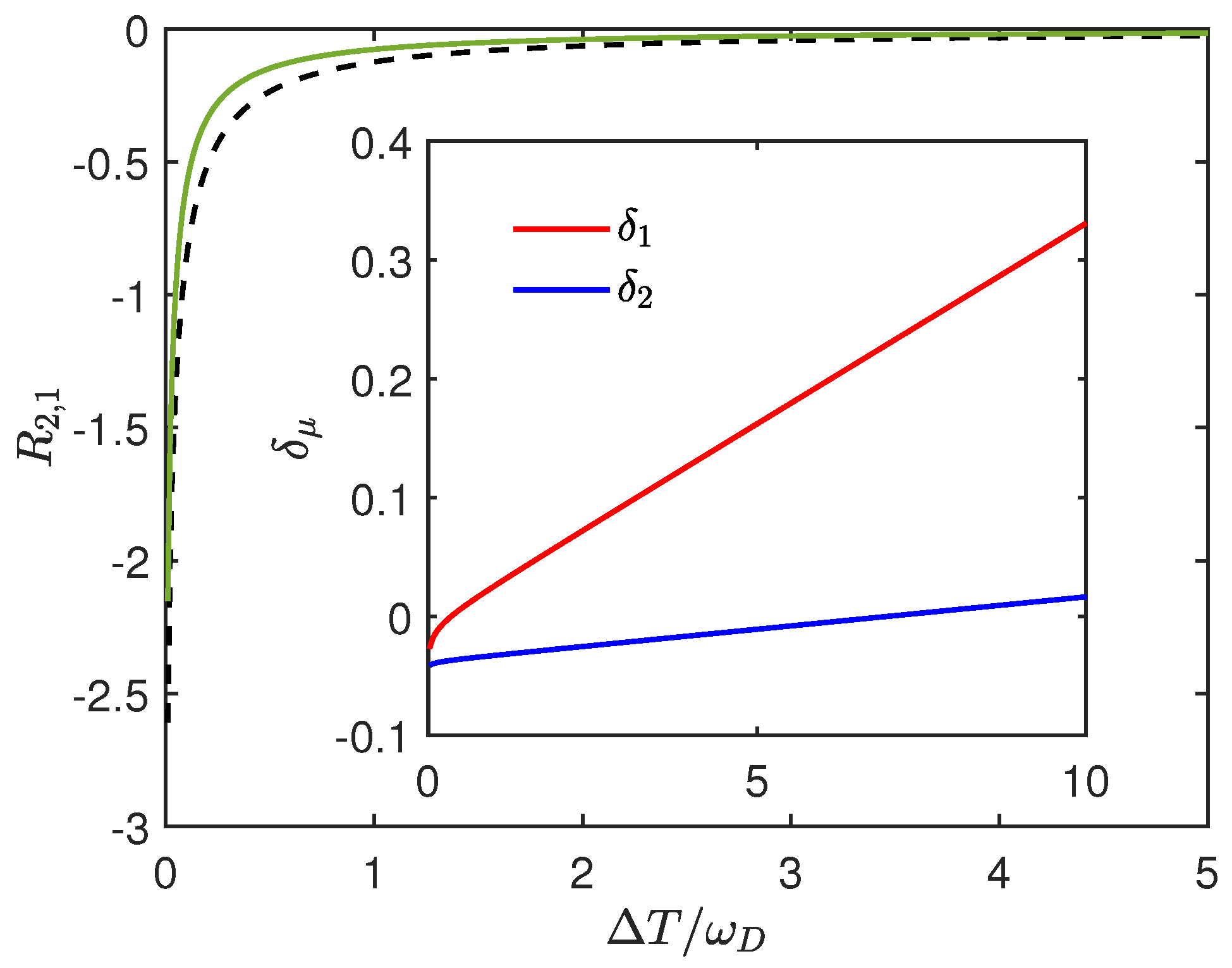
is a series with respect to , and is the Matsubara frequency. Using the Euler–Maclaurin formula, we can obtain an estimation as
The error of this estimation is clearly illustrated in Figure 2, and we can observe a constant increasing as the temperature increases from the inset. A more detailed discussion on this is provided in Appendix B. Note that the negative initial value of suggests the Lamb shift’s effect on heat current from reducing to enhancing contributions with increasing temperature difference.
Figure 2.
and its estimation vs. the relative temperature difference . Here we set . The green line represents the estimation of , and the dashed black line represents the exact value of . For the inset, the red line represents and the blue line represents vs the relative temperature difference in the same regime.
4. Heat Currents
We have obtained all the analytic expressions of the Lamb shift and dissipators of the master Equation (10); hence, we can get the system’s dynamics. Here, we are interested in the steady-state behavior of the system. We have solved the density matrix of the system and found that only the diagonal entries do not vanish so that we can express the steady-state reduced density matrix as where [54]
with
One can find that the above steady-state density matrix is the same as the one without considering the Lamb shift. This is consistent with the usual understanding that the Lamb shift does not affect the system’s eigenstates but only the eigenvalues.
To get the effect of the Lamb shift, we begin to study the heat current, which is defined as [1,63]
One can easily check that ; hence, from the master Equation (10), we have
which further implies that the two heat currents satisfy the conservation relation . From Equation (36), we can give the explicit form of the heat current as
with
and is from Equations (28) and (29). We want to emphasize that in the heat current is the signature of the Lamb shift; corresponding to means that the Lamb shift is not considered. Thus, one can easily obtain the difference in heat currents with and without considering the Lamb shift as
Notice that is always negative when from Equation (A34), which is consistent with the second law of thermodynamics. There is no issue of the direction of heat current in this model because we are using the global approach for the master equation [64,65,66]. Next, we are only concerned with the magnitude of the heat currents, so the remainder of the discussion focuses on the absolute value of the heat currents.
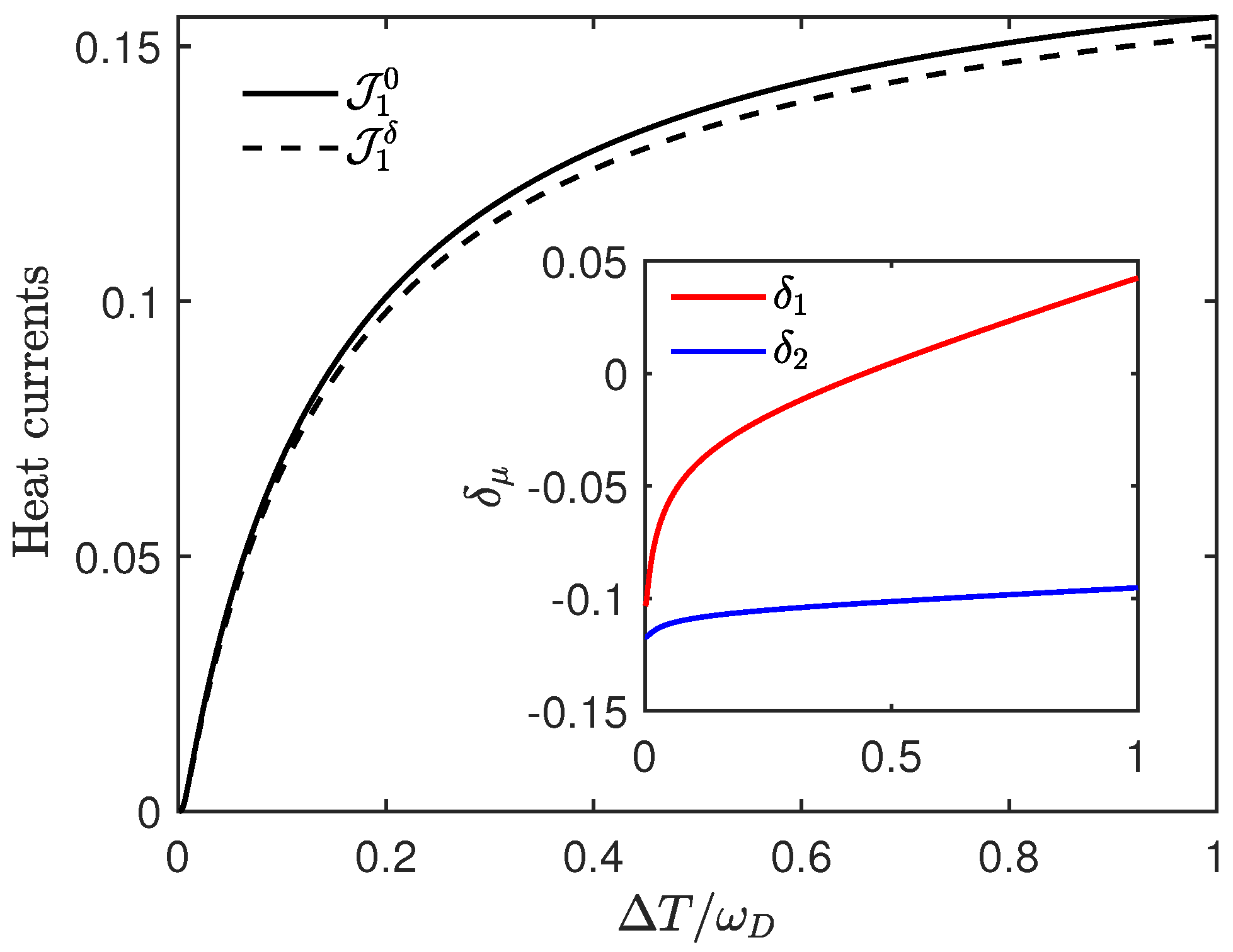
From Equation (41), it can be seen that when is negative, the Lamb shift has a suppressing effect on the heat current, as illustrated by Figure 3. Note that when , is already positive, but since the reduction effect of the terms with is greater, is still negative at this point. In fact, when the signs of are not the same, the size of will depend on the competition between terms with and .
Figure 3.
The heat currents vs. the relative temperature difference . Here we set . This figure illustrates the suppression of heat flow induced by the Lamb shift. For the inset, the red line represents and the blue line represents vs the relative temperature difference in the same regime.
From Equations (28), (29), (32) and (33), our analysis reveals that the value of omega exerts a substantial influence on delta. This can be attributed to the direct influence of the cutoff frequency on the Lamb shift, suggesting that the impact of the Lamb shift on the heat current is amplified with increasing cutoff frequency. Indeed, if the cutoff frequency tends to infinity, the Lamb shift will diverge.
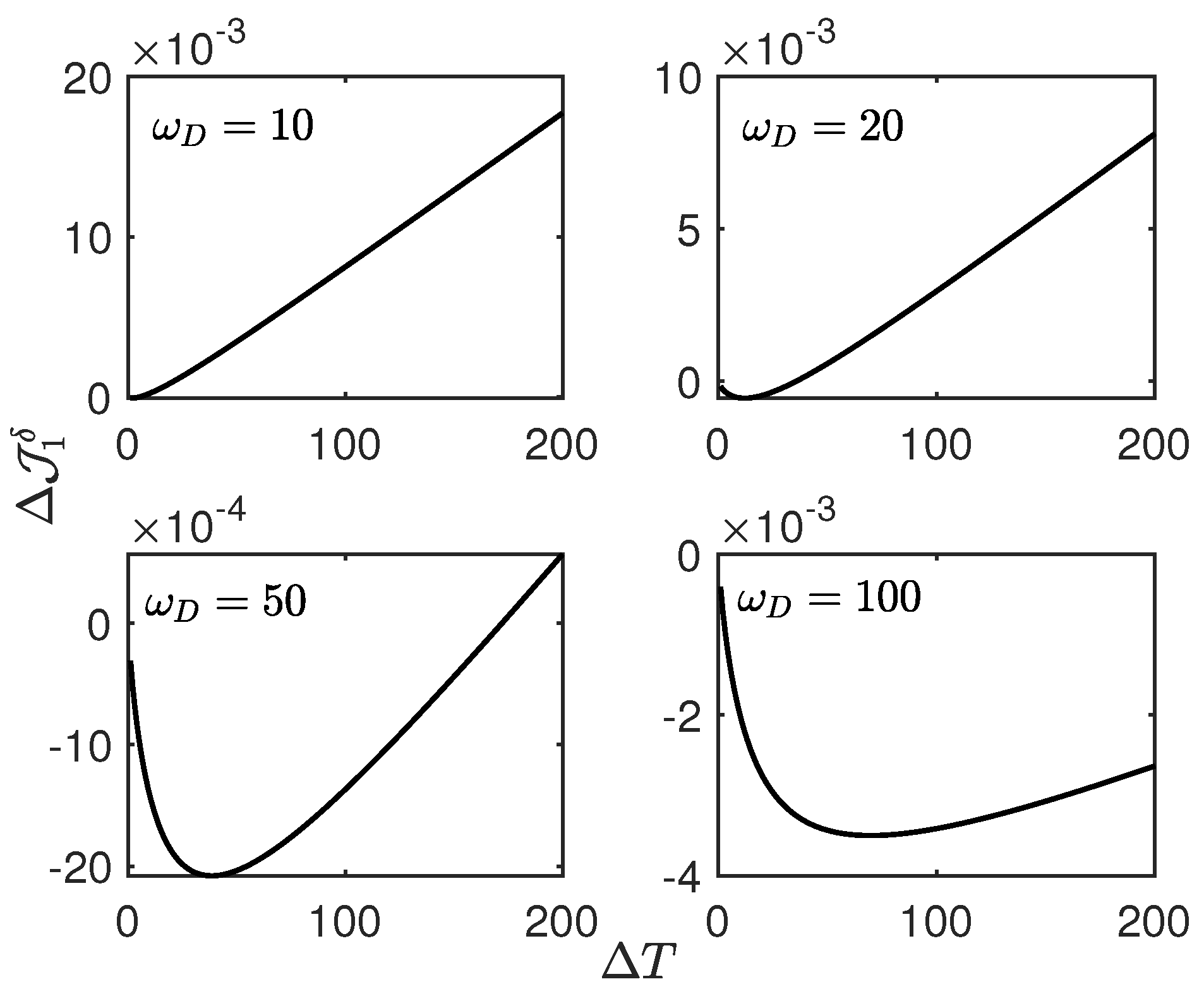
Our analysis reveals that exhibits a consistently developing linear dependence on large temperature differences, independent of the specific value of , as illustrated by Figure 4. Namely, when as the lower temperature is fixed, the heat current will approach an upper bound, but with the temperature increment . To show this, let us take the derivative of with respect to ; then we have
where
Both and are two constant positive quantities. Thus, one can easily obtain that is a monotonically increasing function of . However, simple calculations can show that
and from Equation (38) we have
which remains constant since the system’s parameters are fixed. Thus, Equation (47) serves as the supremum of . Namely, without considering the Lamb shift, the heat current has an upper bound with the temperature difference tending to infinity.
Figure 4.
The heat current difference vs. the temperature difference . Here we set , . For the insets, , respectively. It can be seen that as increases, the temperature difference corresponding to the point where changes from negative to positive becomes larger.
Now, let us turn to the case of the Lamb shift. Based on Equations (28), (29), (32) and (33), one finds that can be rewritten as
where
and
Substituting Equations (45), (46) and (48) into Equation (41), one can obtain
Considering Equations (34) and (35), we have
Substituting Equation (53) into Equation (52), we will arrive at
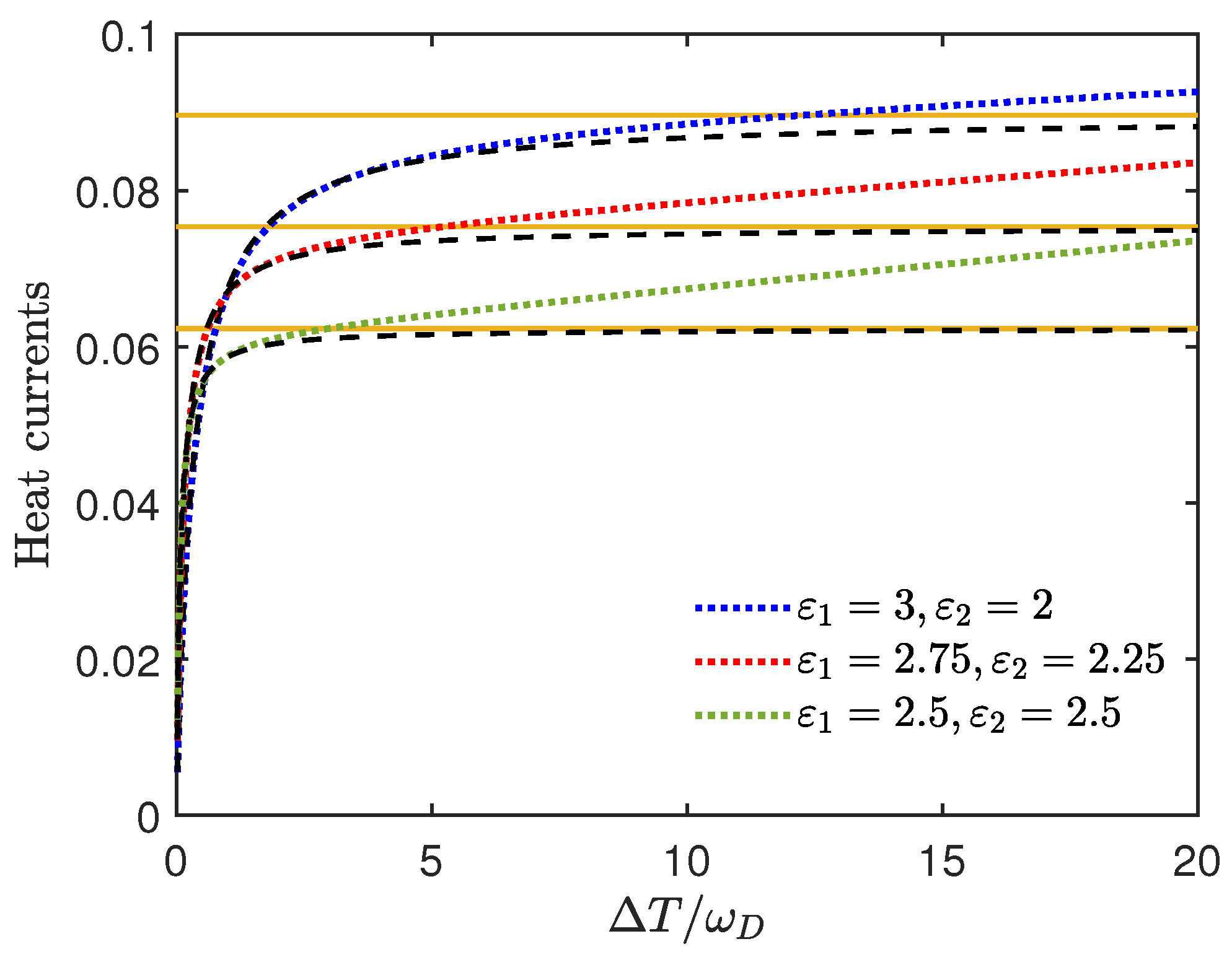
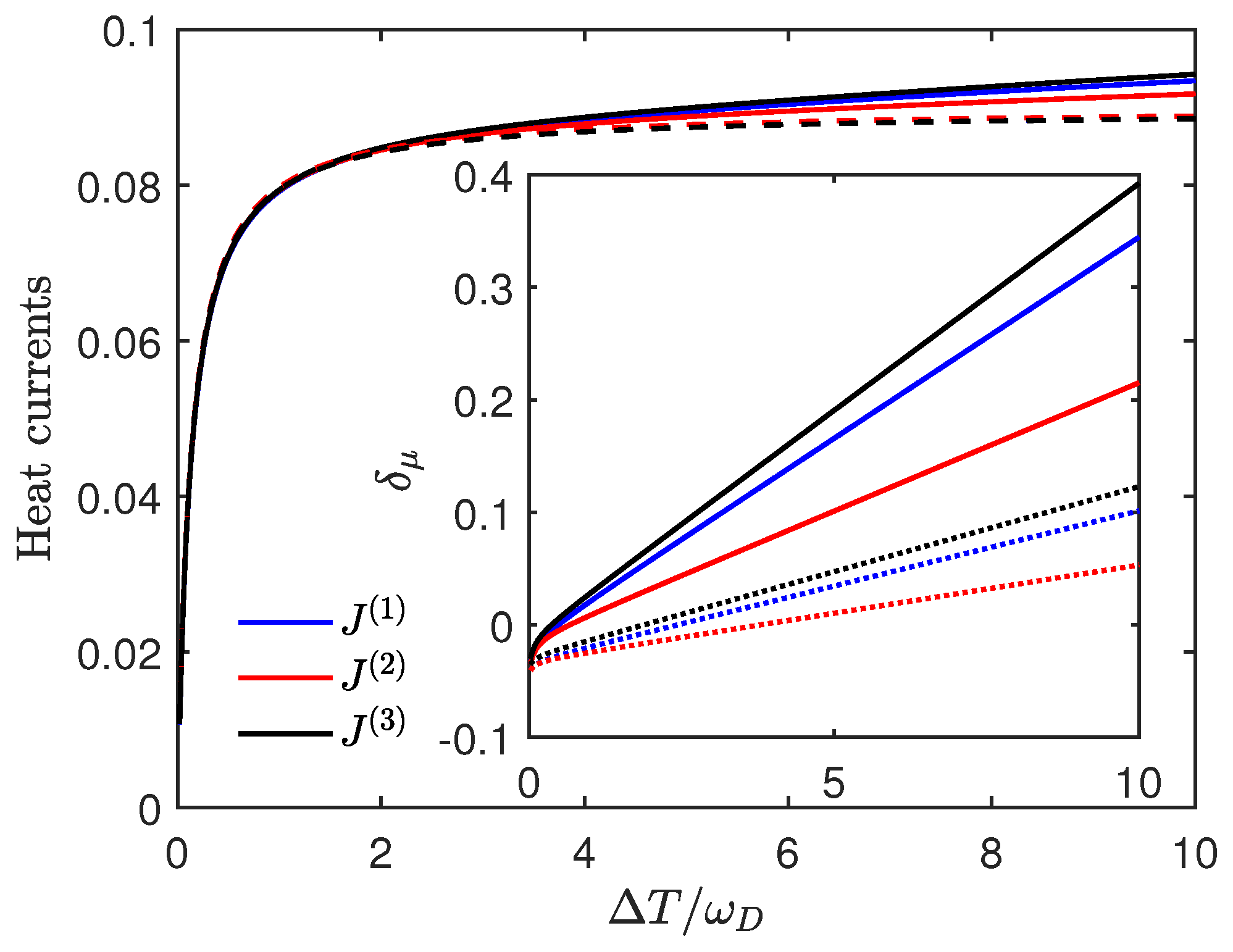
This indicates that the increases linearly with the temperature difference in the regime . That is, the heat current with the Lamb shift in the regime , the sum of and , can exceed the upper bound Equation (47) due to the linearly increasing . Such a result is also explicitly illustrated in Figure 5. It can be seen that at slight temperature differences, the dashed line is below the dotted line, but the difference is not significant. With the temperature increasing, all the dashed lines are tightly below the corresponding orange solid line. In contrast, the dotted lines increase linearly and exceed the supremum corresponding to the orange solid line. In addition, it can be observed that when is a constant, the smaller the is, the smaller the temperature difference is at which the heat current with the Lamb shift surpasses the supremum of the heat current corresponding to the orange solid line.
Figure 5.
The heat currents vs. the relative temperature difference . Here we set . For the blue dotted line, ; for the red dotted line, ; for the green dotted line, . The dashed black lines represent the heat currents of the same regime, but the Lamb shift is not taken into account, and the orange solid lines represent the supremum of .
We have chosen as the spectral density of the reservoirs in the previous study. We can also choose a simple, discontinuous cutoff as
or a cutoff for exponential decay as
Notice that all three represent the Ohmic-type heat reservoir. Furthermore, since and are equivalent infinitesimals of the same order . Therefore, the results obtained without the Lamb shift should be very similar, as indicated by the dashed lines in Figure 6. We can also see that, considering the Lamb shift, the influence of on the heat current lies between and , and the different Lamb shifts corresponding to these three spectral densities all lead to a linear increase in with the increasing temperature difference, eventually resulting in a linear increase in the heat current.
Figure 6.
The heat currents vs. the relative temperature difference . Here we set . For the blue line, for the red line, when , when for the black line, The dashed lines represent the heat currents of the same regime, but the Lamb shift is not considered. For the inset, the solid lines represent , and the dotted lines represent vs. the relative temperature difference in the same regime; The correspondence of colors remains consistent with the previous text.
5. Conclusions
We investigate the influence of the Lamb shift on heat transport in a two-qubit system coupled to thermal reservoirs at different temperatures. Our results demonstrate a dual role of the Lamb shift in regulating heat current:
- At small temperature differences, the Lamb shift suppresses the steady-state heat current;
- In contrast, for large temperature differences, the system exhibits distinct behavior—while the heat current saturates to an upper bound when neglecting the Lamb shift, its inclusion leads to a divergent heat current as the temperature gradient approaches infinity.
Our findings yield profound insights into the fundamental mechanisms of quantum heat transport, revealing how quantum coherence and system-reservoir interactions collectively govern heat current at the quantum level. It should be noted that the observed phenomenon tends to be less pronounced under small temperature differences. Future work could extend this investigation to the case with stronger temperature gradients, where the applicability of the master equation and the possible influence of non-Markovian effects may offer interesting avenues. The revealed modification of heat current induced by the Lamb shift suggests new strategies for controlling heat current through quantum engineering of system-environment interactions. This work lays the foundation for future studies of quantum heat engines, quantum batteries, and the development of quantum materials with tailored thermal properties. Furthermore, the broader interest of the Lamb shift could also be cast to quantum thermodynamics and open quantum systems, such as the quantum description of Otto cycles [67,68,69,70,71] and q-deformation in heat engines [72,73,74]. In addition, one could explore the implications of the Lamb shift in cavity quantum electrodynamics (QED) [75,76,77,78], particularly in micromaser systems. When a cavity mode repeatedly interacts with a stream of atomic ensembles, the Lamb shift could significantly influence the system’s dynamics, the onset of maser action, and the resulting photon statistics. A detailed investigation into this effect could provide deeper insight into the role of vacuum fluctuations and field-atom interactions in non-equilibrium quantum systems, thereby bridging our findings with ongoing experimental efforts in cavity-based quantum information processing.
Author Contributions
Writing—original draft, Z.Z.; Writing—review & editing, C.Y. All authors have read and agreed to the published version of the manuscript.
Funding
This work was supported by the National Natural Science Foundation of China under Grants Nos. 12575009 and 12175029.
Data Availability Statement
The original contributions presented in this study are included in the article. Further inquiries can be directed to the corresponding author.
Conflicts of Interest
The authors declare no conflicts of interest.
Appendix A. The Derivation of the Master Equation
In the interaction picture, the dynamic evolution of the von Neumann equation describes the whole system plus the environment.
where denotes the total density matrix. With the standard procedure of Born– Markov–Secular approximation, we can get the evolution of the reduced density matrix as
where
is the forward Fourier transform of the reservoir correlation function . Actually, only the terms are not zero, because
so we can obtain that
Using the Kramers–Kronig relations,
and by the properties of the delta function
we finally arrived at
where the denotes the Cauchy principal value. So we have got the real parts and imaginary parts of . Based on the same method, we can obtain the real parts and imaginary parts of as
Note that the frequency domain KMS condition is satisfied, i.e.,
Appendix B. Details of the Estimate of the Lamb Shift
The two most critical integrals for obtaining the Lamb Shift (23) in this paper are Equations (20) and (30), if we put
then has only one positive pole on the real axis, and has only one negative pole on the real axis. So the problem is to find the principal integrals of these two functions on the positive real axis. Using the residue theorem (and lots of contours), we find that
and
that is
and
Here is the module of the poles on the imaginary axis.
Thus we have
contains the cotangent function, where an apparent divergence emerges as approaches certain critical values. Contrary to initial indications, however, such a divergence is eliminated due to a precise cancellation of divergent terms within the series in . This behavior is attributed to the convergence of a movable pole toward a stationary pole . At these specific values of , the coincidence of the two poles results in the formation of a second-order pole. In other words, as a function of both and , remains continuous. This continuity also aligns with physical intuition: the Lamb shift, as a correction to the system’s energy levels, does not exhibit divergence as the temperature and the cutoff frequency undergo continuous variations. This fact can also be clarified using the Mittag–Leffler expansion of the cotangent function,
substituting this into (A18), we arrive at
More directly, if we only care about in Equations (28) and (29), we only need to calculate
Using the Mittag–Leffler expansion of the hyperbolic cotangent function
with the residue theorem, we have
Thus,
which is consistent with Equation (A20).
In order to estimate the residual term , we set
Notice that the here is not the same as the in the main text, using the Euler–Maclaurin formula
where is the th Bernoulli number, letting n approach infinity, we get
that is,
Thus, we can conclude that this estimate is relatively accurate for large and small or more directly, .
Appendix C. Consistency with the Second Law of Thermodynamics
In fact, one can find that could be negative when and are very small. Thus one could suspect that could be negative, which would lead to the violation of the second law of thermodynamics. However, we can show that is always positive. From Equation (35), we get that Based on Equations (49)–(51), we can obtain
Therefore, one can estimate as
which ensures consistency with the second law of thermodynamics.
References
- Breuer, H.P.; Petruccione, F. The Theory of Open Quantum Systems; Oxford University Press on Demand: Oxford, UK, 2002. [Google Scholar]
- Rivas, A.; Plato, A.D.K.; Huelga, S.F.; Plenio, M.B. Markovian master equations: A critical study. New J. Phys. 2010, 12, 113032. [Google Scholar] [CrossRef]
- Carmichael, H.J. Statistical Methods in Quantum Optics 1: Master Equations and Fokker-Planck Equations; Springer Science & Business Media: Berlin/Heidelberg, Germany, 2013. [Google Scholar]
- Redfield, A. The Theory of Relaxation Processes. In Advances in Magnetic and Optical Resonance; Waugh, J.S., Ed.; Academic Press: Cambridge, MA, USA, 1965; Volume 1, pp. 1–32. [Google Scholar] [CrossRef]
- Lindblad, G. On the generators of quantum dynamical semigroups. Commun. Math. Phys. 1976, 48, 119–130. [Google Scholar] [CrossRef]
- Gorini, V.; Kossakowski, A.; Sudarshan, E.C.G. Completely positive dynamical semigroups of N-level systems. J. Math. Phys. 1976, 17, 821–825. [Google Scholar] [CrossRef]
- Gemmer, J.; Michel, M.; Mahler, G. Quantum Thermodynamics: Emergence of Thermodynamic Behavior Within Composite Quantum Systems; Springer: Berlin/Heidelberg, Germany, 2009; Volume 784. [Google Scholar]
- Alicki, R.; Lidar, D.A.; Zanardi, P. Internal consistency of fault-tolerant quantum error correction in light of rigorous derivations of the quantum Markovian limit. Phys. Rev. A 2006, 73, 052311. [Google Scholar] [CrossRef]
- Ptaszyński, K.; Esposito, M. Thermodynamics of Quantum Information Flows. Phys. Rev. Lett. 2019, 122, 150603. [Google Scholar] [CrossRef]
- Albash, T.; Boixo, S.; Lidar, D.A.; Zanardi, P. Quantum adiabatic Markovian master equations. New J. Phys. 2012, 14, 123016. [Google Scholar] [CrossRef]
- Yang, Y.j.; Liu, Y.q.; Liu, Z.; Yu, C.s. Singular transport in non-equilibrium strongly internal-coupled 1D tilted field spin-1/2 chain. J. Chem. Phys. 2025, 162, 194308. [Google Scholar] [CrossRef] [PubMed]
- Wang, S.Y.; Yang, Q.; Zhang, F.L. Thermodynamically consistent master equation based on subsystem eigenstates. Phys. Rev. E 2023, 107, 014108. [Google Scholar] [CrossRef] [PubMed]
- Mozgunov, E.; Lidar, D. Completely positive master equation for arbitrary driving and small level spacing. Quantum 2020, 4, 227. [Google Scholar] [CrossRef]
- Nathan, F.; Rudner, M.S. Universal Lindblad equation for open quantum systems. Phys. Rev. B 2020, 102, 115109. [Google Scholar] [CrossRef]
- Davidović, D. Geometric-arithmetic master equation in large and fast open quantum systems. J. Phys. A Math. Theor. 2022, 55, 455301. [Google Scholar] [CrossRef]
- Davidović, D. Completely Positive, Simple, and Possibly Highly Accurate Approximation of the Redfield Equation. Quantum 2020, 4, 326. [Google Scholar] [CrossRef]
- Lidar, D.A. Lecture notes on the theory of open quantum systems. arXiv 2019, arXiv:1902.00967. [Google Scholar]
- Tupkary, D.; Dhar, A.; Kulkarni, M.; Purkayastha, A. Fundamental limitations in Lindblad descriptions of systems weakly coupled to baths. Phys. Rev. A 2022, 105, 032208. [Google Scholar] [CrossRef]
- Hartmann, R.; Strunz, W.T. Accuracy assessment of perturbative master equations: Embracing nonpositivity. Phys. Rev. A 2020, 101, 012103. [Google Scholar] [CrossRef]
- Ghoshal, A.; Sen, U. Heat current and entropy production rate in local non-Markovian quantum dynamics of global Markovian evolution. Phys. Rev. A 2022, 105, 022424. [Google Scholar] [CrossRef]
- D’Abbruzzo, A.; Rossini, D. Self-consistent microscopic derivation of Markovian master equations for open quadratic quantum systems. Phys. Rev. A 2021, 103, 052209. [Google Scholar] [CrossRef]
- Ridolfo, A.; Leib, M.; Savasta, S.; Hartmann, M.J. Photon Blockade in the Ultrastrong Coupling Regime. Phys. Rev. Lett. 2012, 109, 193602. [Google Scholar] [CrossRef]
- Stassi, R.; Ridolfo, A.; Di Stefano, O.; Hartmann, M.J.; Savasta, S. Spontaneous Conversion from Virtual to Real Photons in the Ultrastrong-Coupling Regime. Phys. Rev. Lett. 2013, 110, 243601. [Google Scholar] [CrossRef]
- Ridolfo, A.; Vilardi, R.; Di Stefano, O.; Portolan, S.; Savasta, S. All Optical Switch of Vacuum Rabi Oscillations: The Ultrafast Quantum Eraser. Phys. Rev. Lett. 2011, 106, 013601. [Google Scholar] [CrossRef]
- Sarandy, M.S.; Lidar, D.A. Adiabatic Quantum Computation in Open Systems. Phys. Rev. Lett. 2005, 95, 250503. [Google Scholar] [CrossRef]
- Childs, A.M.; Farhi, E.; Preskill, J. Robustness of adiabatic quantum computation. Phys. Rev. A 2001, 65, 012322. [Google Scholar] [CrossRef]
- Guimarães, J.D.; Lim, J.; Vasilevskiy, M.I.; Huelga, S.F.; Plenio, M.B. Noise-Assisted Digital Quantum Simulation of Open Systems Using Partial Probabilistic Error Cancellation. PRX Quantum 2023, 4, 040329. [Google Scholar] [CrossRef]
- Lanka, A.; Brun, T. Improving a quantum-dot-based single-photon source with continuous measurements. Phys. Rev. A 2023, 108, 053711. [Google Scholar] [CrossRef]
- Joulain, K.; Drevillon, J.; Ezzahri, Y.; Ordonez-Miranda, J. Quantum Thermal Transistor. Phys. Rev. Lett. 2016, 116, 200601. [Google Scholar] [CrossRef] [PubMed]
- Balachandran, V.; Benenti, G.; Pereira, E.; Casati, G.; Poletti, D. Perfect Diode in Quantum Spin Chains. Phys. Rev. Lett. 2018, 120, 200603. [Google Scholar] [CrossRef] [PubMed]
- Tajima, H.; Funo, K. Superconducting-like Heat Current: Effective Cancellation of Current-Dissipation Trade-Off by Quantum Coherence. Phys. Rev. Lett. 2021, 127, 190604. [Google Scholar] [CrossRef]
- Guo, B.Q.; Liu, T.; Yu, C.S. Quantum thermal transistor based on qubit-qutrit coupling. Phys. Rev. E 2018, 98, 022118. [Google Scholar] [CrossRef]
- Naseem, M.T.; Xuereb, A.; Müstecaplıoğlu, O.E. Thermodynamic consistency of the optomechanical master equation. Phys. Rev. A 2018, 98, 052123. [Google Scholar] [CrossRef]
- Ordonez-Miranda, J.; Ezzahri, Y.; Joulain, K. Quantum thermal diode based on two interacting spinlike systems under different excitations. Phys. Rev. E 2017, 95, 022128. [Google Scholar] [CrossRef]
- Konar, T.K.; Ghosh, S.; Pal, A.K.; Sen, A. Designing refrigerators in higher dimensions using quantum spin models. Phys. Rev. A 2023, 107, 032602. [Google Scholar] [CrossRef]
- Mandarino, A.; Joulain, K.; Gómez, M.D.; Bellomo, B. Thermal Transistor Effect in Quantum Systems. Phys. Rev. Appl. 2021, 16, 034026. [Google Scholar] [CrossRef]
- Tabesh, F.T.; Kamin, F.H.; Salimi, S. Environment-mediated charging process of quantum batteries. Phys. Rev. A 2020, 102, 052223. [Google Scholar] [CrossRef]
- Farina, D.; Andolina, G.M.; Mari, A.; Polini, M.; Giovannetti, V. Charger-mediated energy transfer for quantum batteries: An open-system approach. Phys. Rev. B 2019, 99, 035421. [Google Scholar] [CrossRef]
- Zhao, F.; Dou, F.Q.; Zhao, Q. Quantum battery of interacting spins with environmental noise. Phys. Rev. A 2021, 103, 033715. [Google Scholar] [CrossRef]
- Morrone, D.; Rossi, M.A.; Smirne, A.; Genoni, M.G. Charging a quantum battery in a non-Markovian environment: A collisional model approach. Quantum Sci. Technol. 2023, 8, 035007. [Google Scholar] [CrossRef]
- Fasihi, M.A.; Jafarzadeh Bahrbeig, R.; Mojaveri, B.; Haji Mohammadzadeh, R. Fast stable adiabatic charging of open quantum batteries. Phys. Rev. E 2025, 112, 024117. [Google Scholar] [CrossRef]
- Trushechkin, A. Unified Gorini-Kossakowski-Lindblad-Sudarshan quantum master equation beyond the secular approximation. Phys. Rev. A 2021, 103, 062226. [Google Scholar] [CrossRef]
- Vadimov, V.; Tuorila, J.; Orell, T.; Stockburger, J.; Ala-Nissila, T.; Ankerhold, J.; Möttönen, M. Validity of Born-Markov master equations for single- and two-qubit systems. Phys. Rev. B 2021, 103, 214308. [Google Scholar] [CrossRef]
- Wen, P.Y.; Lin, K.T.; Kockum, A.F.; Suri, B.; Ian, H.; Chen, J.C.; Mao, S.Y.; Chiu, C.C.; Delsing, P.; Nori, F.; et al. Large Collective Lamb Shift of Two Distant Superconducting Artificial Atoms. Phys. Rev. Lett. 2019, 123, 233602. [Google Scholar] [CrossRef]
- Frisk Kockum, A.; Delsing, P.; Johansson, G. Designing frequency-dependent relaxation rates and Lamb shifts for a giant artificial atom. Phys. Rev. A 2014, 90, 013837. [Google Scholar] [CrossRef]
- Fragner, A.; Göppl, M.; Fink, J.M.; Baur, M.; Bianchetti, R.; Leek, P.J.; Blais, A.; Wallraff, A. Resolving Vacuum Fluctuations in an Electrical Circuit by Measuring the Lamb Shift. Science 2008, 322, 1357–1360. [Google Scholar] [CrossRef]
- Gramich, V.; Solinas, P.; Möttönen, M.; Pekola, J.P.; Ankerhold, J. Measurement scheme for the Lamb shift in a superconducting circuit with broadband environment. Phys. Rev. A 2011, 84, 052103. [Google Scholar] [CrossRef]
- Linden, N.; Popescu, S.; Skrzypczyk, P. How Small Can Thermal Machines Be? The Smallest Possible Refrigerator. Phys. Rev. Lett. 2010, 105, 130401. [Google Scholar] [CrossRef]
- Yu, C.S.; Zhu, Q.Y. Re-examining the self-contained quantum refrigerator in the strong-coupling regime. Phys. Rev. E 2014, 90, 052142. [Google Scholar] [CrossRef]
- Thierschmann, H.; Sánchez, R.; Sothmann, B.; Arnold, F.; Heyn, C.; Hansen, W.; Buhmann, H.; Molenkamp, L.W. Three-terminal energy harvester with coupled quantum dots. Nat. Nanotechnol. 2015, 10, 854–858. [Google Scholar] [CrossRef]
- Kannan, B.; Ruckriegel, M.J.; Campbell, D.L.; Frisk Kockum, A.; Braumüller, J.; Kim, D.K.; Kjaergaard, M.; Krantz, P.; Melville, A.; Niedzielski, B.M.; et al. Waveguide quantum electrodynamics with superconducting artificial giant atoms. Nature 2020, 583, 775–779. [Google Scholar] [CrossRef]
- Glatthard, J.; Aznar-Menargues, G.; Palao, J.P.; Alonso, D.; Correa, L.A. Accurate heat currents via reorganized master equation. Phys. Rev. E 2025, 112, 024109. [Google Scholar] [CrossRef] [PubMed]
- Quiroga, L.; Rodriguez, F.J.; Ramirez, M.E.; Paris, R. Nonequilibrium thermal entanglement. Phys. Rev. A 2007, 75, 032308. [Google Scholar] [CrossRef]
- Sinaysky, I.; Petruccione, F.; Burgarth, D. Dynamics of nonequilibrium thermal entanglement. Phys. Rev. A 2008, 78, 062301. [Google Scholar] [CrossRef]
- Hu, L.Z.; Man, Z.X.; Xia, Y.J. Steady-state entanglement and thermalization of coupled qubits in two common heat baths. Quantum Inf. Process. 2018, 17, 45. [Google Scholar] [CrossRef]
- Yang, Y.J.; Liu, Y.Q.; Yu, C.S. Heat transfer in transversely coupled qubits: Optically controlled thermal modulator with common reservoirs. J. Phys. A Math. Theor. 2022, 55, 395303. [Google Scholar] [CrossRef]
- Segal, D. Single Mode Heat Rectifier: Controlling Energy Flow Between Electronic Conductors. Phys. Rev. Lett. 2008, 100, 105901. [Google Scholar] [CrossRef]
- Terraneo, M.; Peyrard, M.; Casati, G. Controlling the Energy Flow in Nonlinear Lattices: A Model for a Thermal Rectifier. Phys. Rev. Lett. 2002, 88, 094302. [Google Scholar] [CrossRef]
- Pereira, E. Sufficient conditions for thermal rectification in general graded materials. Phys. Rev. E 2011, 83, 031106. [Google Scholar] [CrossRef]
- Yang, J.; Elouard, C.; Splettstoesser, J.; Sothmann, B.; Sánchez, R.; Jordan, A.N. Thermal transistor and thermometer based on Coulomb-coupled conductors. Phys. Rev. B 2019, 100, 045418. [Google Scholar] [CrossRef]
- Schaller, G. Non-Equilibrium Master Equations; Lecture Notes; TU Berlin: Berlin, Germany, 2014. [Google Scholar]
- Weiss, U. Quantum Dissipative Systems; World Scientific: Singapore, 2012. [Google Scholar]
- Kosloff, R. Quantum Thermodynamics: A Dynamical Viewpoint. Entropy 2013, 15, 2100–2128. [Google Scholar] [CrossRef]
- Levy, A.; Kosloff, R. The local approach to quantum transport may violate the second law of thermodynamics. Europhys. Lett. 2014, 107, 20004. [Google Scholar] [CrossRef]
- Trushechkin, A.S.; Volovich, I.V. Perturbative treatment of inter-site couplings in the local description of open quantum networks. Europhys. Lett. 2016, 113, 30005. [Google Scholar] [CrossRef]
- Hofer, P.P.; Perarnau-Llobet, M.; Miranda, L.D.M.; Haack, G.; Silva, R.; Brask, J.B.; Brunner, N. Markovian master equations for quantum thermal machines: Local versus global approach. New J. Phys. 2017, 19, 123037. [Google Scholar] [CrossRef]
- Thomas, G.; Johal, R.S. Coupled quantum Otto cycle. Phys. Rev. E—Stat. Nonlinear Soft Matter Phys. 2011, 83, 031135. [Google Scholar] [CrossRef]
- Kosloff, R.; Rezek, Y. The quantum harmonic Otto cycle. Entropy 2017, 19, 136. [Google Scholar] [CrossRef]
- Sonkar, S.; Johal, R.S. Spin-based quantum Otto engines and majorization. Phys. Rev. A 2023, 107, 032220. [Google Scholar] [CrossRef]
- Dann, R.; Kosloff, R.; Salamon, P. Quantum Finite-Time Thermodynamics: Insight from a Single Qubit Engine. Entropy 2020, 22, 1255. [Google Scholar] [CrossRef]
- Kloc, M.; Cejnar, P.; Schaller, G. Collective performance of a finite-time quantum Otto cycle. Phys. Rev. E 2019, 100, 042126. [Google Scholar] [CrossRef]
- Ozaydin, F.; Müstecaplıoğlu, Ö.E.; Hakioğlu, T. Powering quantum Otto engines only with q-deformation of the working substance. Phys. Rev. E 2023, 108, 054103. [Google Scholar] [CrossRef] [PubMed]
- Güvenilir, E.; Ozaydin, F.; Müstecaplıoğlu, Ö.E.; Hakioğlu, T. Work harvesting by q-deformed statistical mutations in an Otto engine. arXiv 2022, arXiv:2208.08565. [Google Scholar]
- Xiao, Y.; Li, K.; He, J.; Wang, J. Performance of quantum heat engines enhanced by adiabatic deformation of trapping potential. Entropy 2023, 25, 484. [Google Scholar] [CrossRef] [PubMed]
- González-Tudela, A.; Paulisch, V.; Kimble, H.J.; Cirac, J.I. Efficient Multiphoton Generation in Waveguide Quantum Electrodynamics. Phys. Rev. Lett. 2017, 118, 213601. [Google Scholar] [CrossRef] [PubMed]
- Ladd, T.D.; van Loock, P.; Nemoto, K.; Munro, W.J.; Yamamoto, Y. Hybrid quantum repeater based on dispersive CQED interactions between matter qubits and bright coherent light. New J. Phys. 2006, 8, 184. [Google Scholar] [CrossRef]
- Agarwal, G.; Zhu, Y. Photon trapping in cavity quantum electrodynamics. Phys. Rev. A 2015, 92, 023824. [Google Scholar] [CrossRef]
- Ghulinyan, M.; Manzano, F.R.; Prtljaga, N.; Bernard, M.; Pavesi, L.; Pucker, G.; Carusotto, I. Intermode reactive coupling induced by waveguide-resonator interaction. Phys. Rev. A 2014, 90, 053811. [Google Scholar] [CrossRef]
Disclaimer/Publisher’s Note: The statements, opinions and data contained in all publications are solely those of the individual author(s) and contributor(s) and not of MDPI and/or the editor(s). MDPI and/or the editor(s) disclaim responsibility for any injury to people or property resulting from any ideas, methods, instructions or products referred to in the content. |
© 2025 by the authors. Licensee MDPI, Basel, Switzerland. This article is an open access article distributed under the terms and conditions of the Creative Commons Attribution (CC BY) license (https://creativecommons.org/licenses/by/4.0/).