Article

Species Richness Net Primary Productivity and the Water Balance Problem

1
Department of Physics, Wright State University, Dayton, OH 45435, USA
2
Mork Family Department of Chemical Engineering and Materials Science, University of Southern California, Los Angeles, CA 90089, USA
3
Department of Integrative Biology, University of Texas at Austin, Austin, TX 78712, USA
*
Author to whom correspondence should be addressed.
Entropy 2024, 26(8), 641; https://doi.org/10.3390/e26080641
Submission received: 11 April 2024 / Revised: 20 July 2024 / Accepted: 24 July 2024 / Published: 28 July 2024
(This article belongs to the Special Issue 180th Anniversary of Ludwig Boltzmann)

Abstract

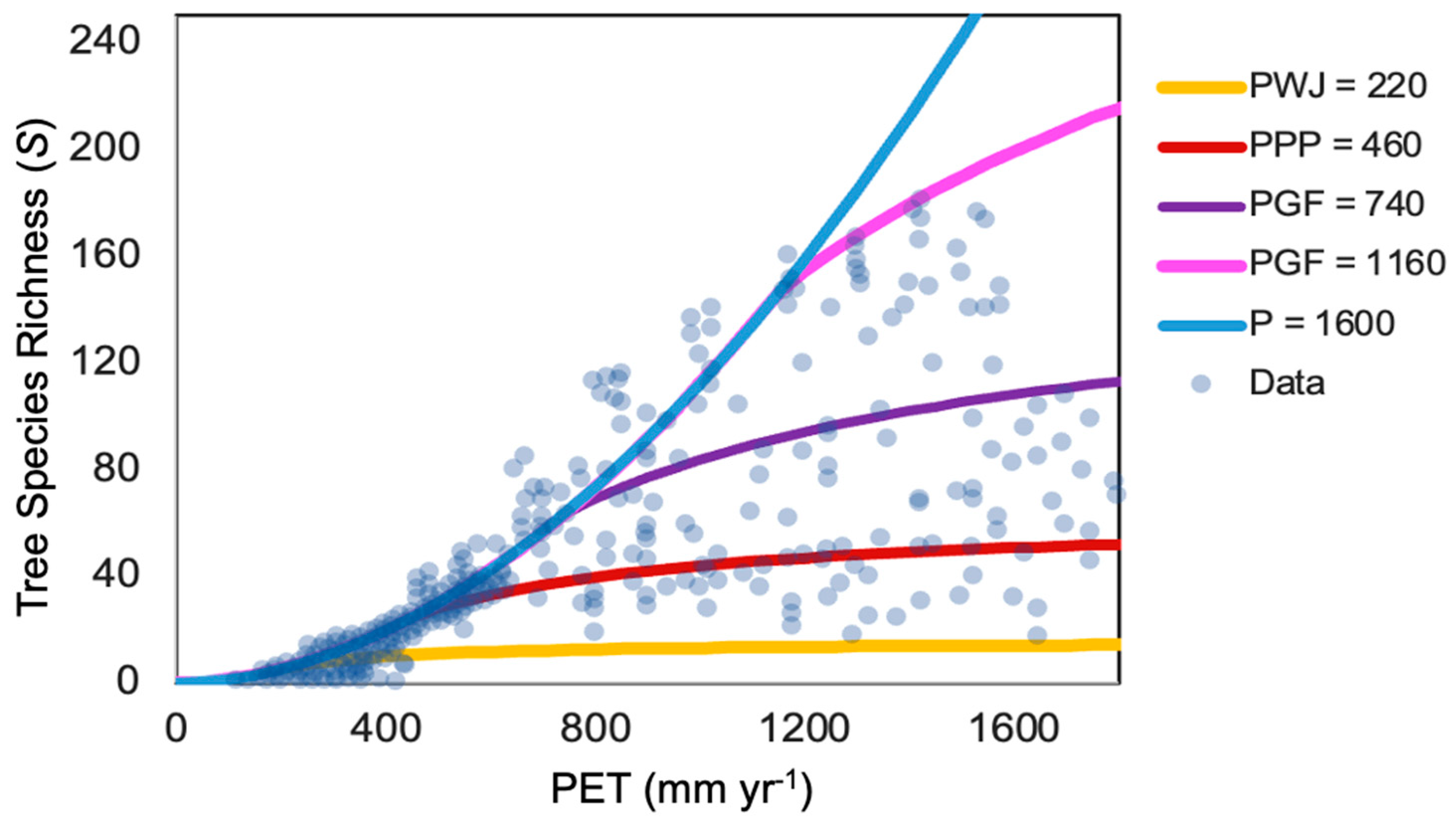
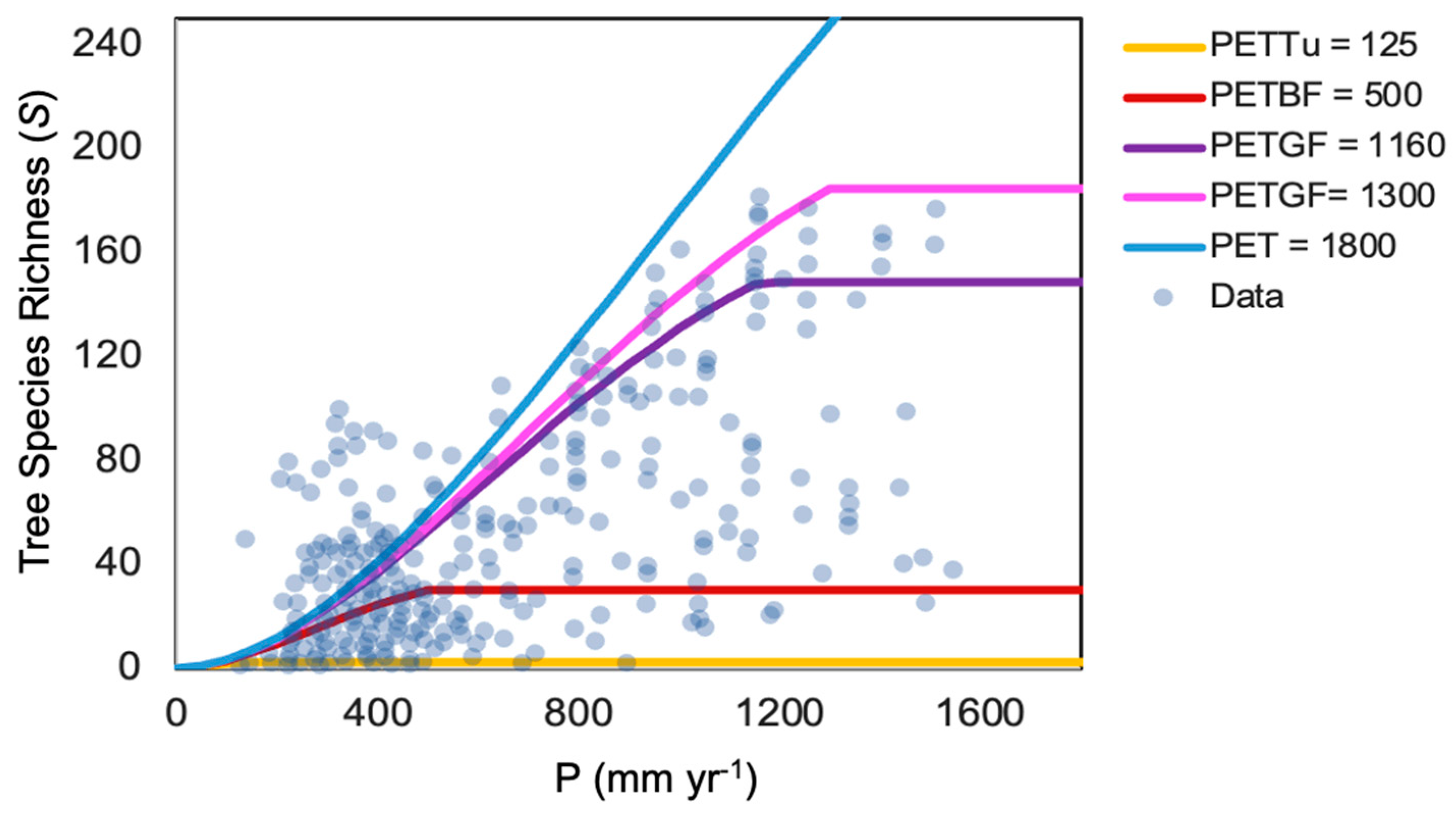
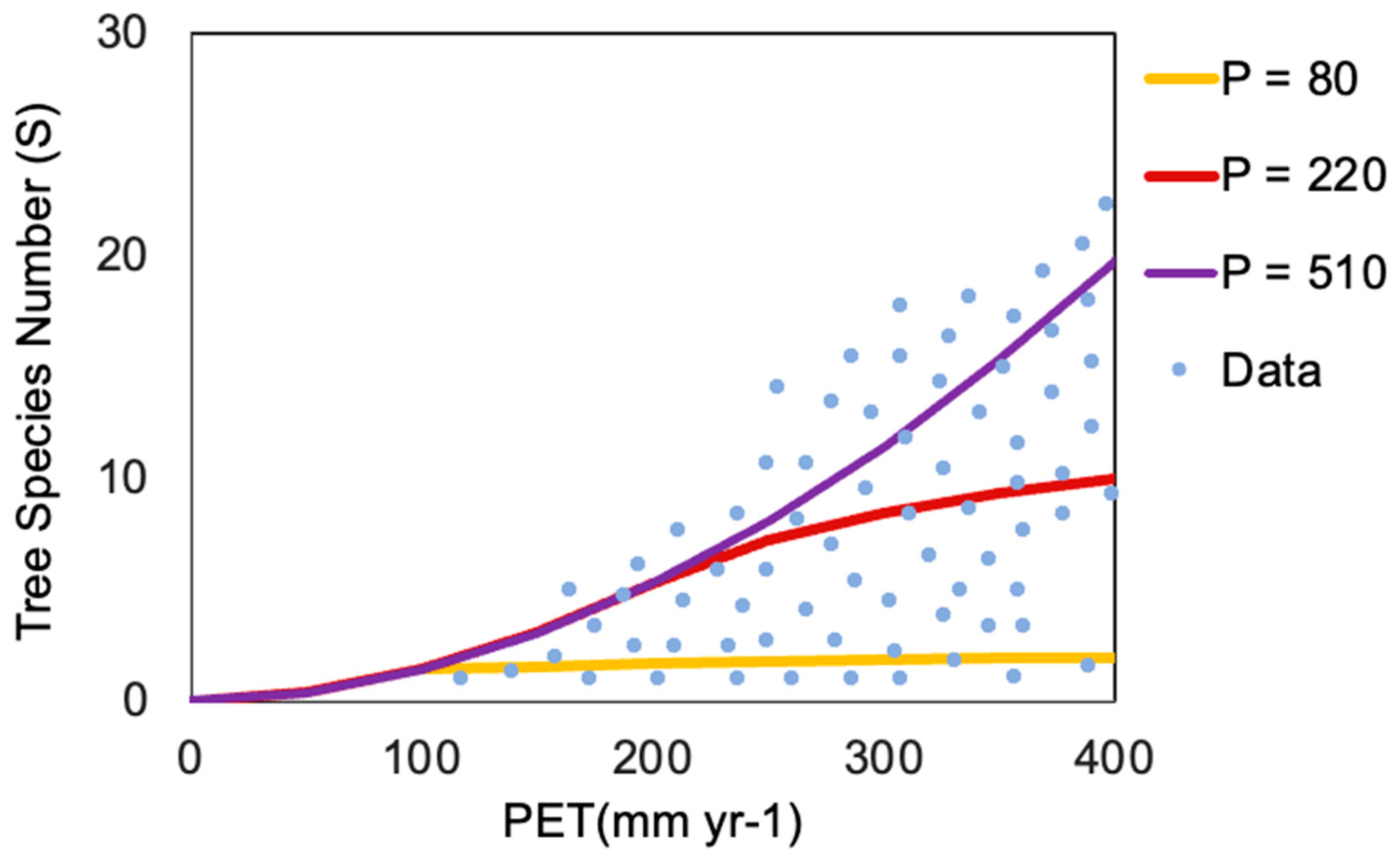
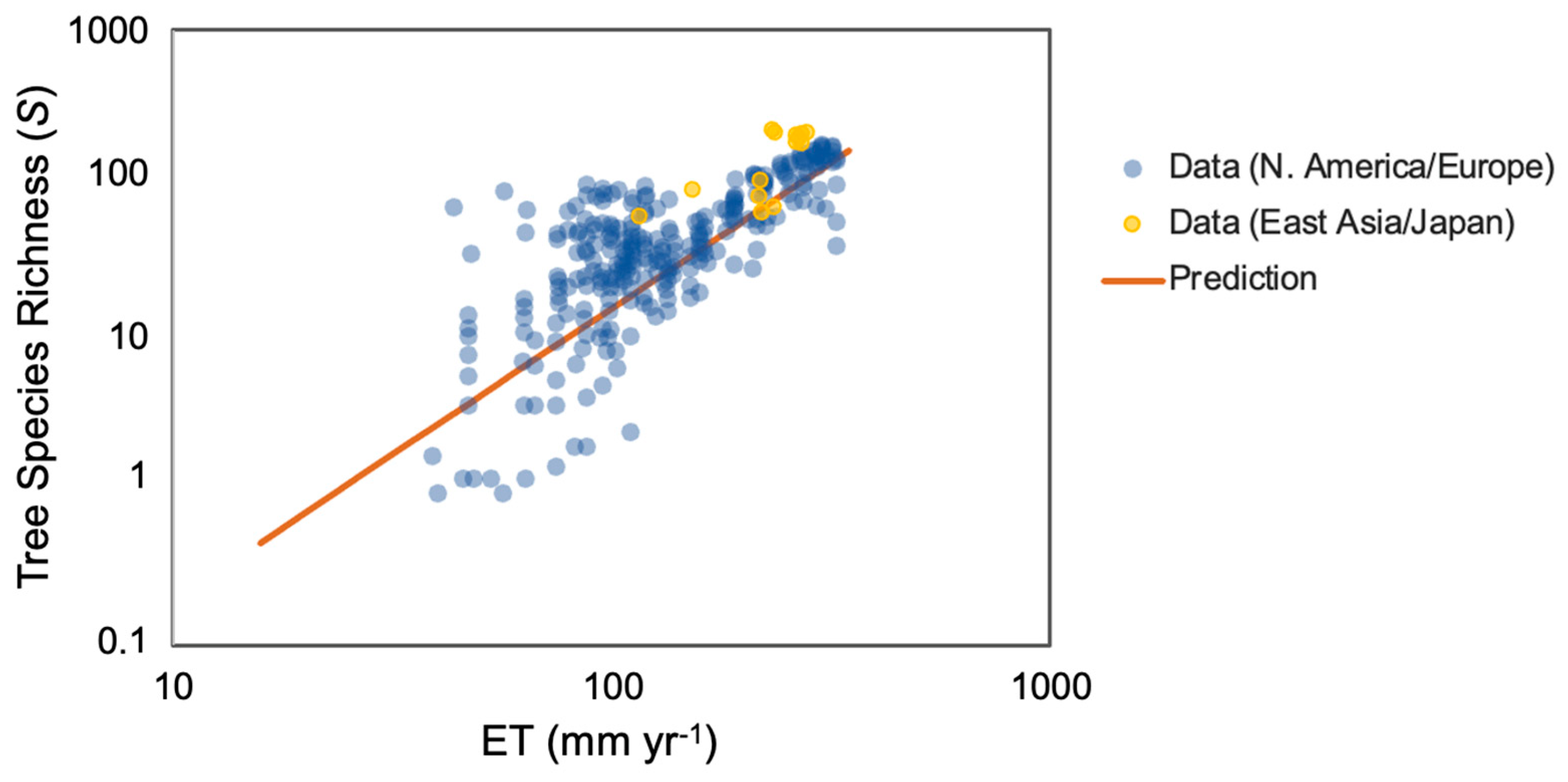
Species energy theory suggests that, because of limitations on reproduction efficiency, a minimum density of plant individuals per viable species exists and that this minimum correlates the total number of plant individuals N with the number of species S. The simplest assumption is that the mean energy input per individual plant is independent of the number of individuals, making N, and thus S as well, proportional to the total energy input into the system. The primary energy input to a plant-dominated ecosystem is estimated as its Net Primary Productivity (NPP). Thus, species energy theory draws a direct correspondence from NPP to S. Although investigations have verified a strong connection between S and NPP, strong influences of other factors, such as topography, ecological processes such as competition, and historical contingencies, are also at play. The lack of a simple model of NPP expressed in terms of the principal climate variables, precipitation P, and potential evapotranspiration, PET, introduces unnecessary uncertainty to the understanding of species richness across scales. Recent research combines percolation theory with the principle of ecological optimality to derive an expression for NPP(P, PET). Consistent with assuming S is proportional to NPP, we show here that the new expression for NPP(P, PET) predicts the number of plant species S in an ecosystem as a function of P and PET. As already demonstrated elsewhere, the results are consistent with some additional variation due to non-climatic inputs. We suggest that it may be easier to infer specific deviations from species energy predictions with increased accuracy and generality of the prediction of NPP(P, PET).
Keywords: ecology; percolation theory; net primary productivity; species energy theory ecology; percolation theory; net primary productivity; species energy theory