The Intensity of Heat Exchange between Rock and Flowing Gas in Terms of Gas-Geodynamic Phenomena


Abstract
1. Introduction
2. Energy Balance
- is the energy of the gas during decompression from the rock [J];
- is the work required to disintegrate the rock [J];
- is the work required to transport the rock into the working space [J].
2.1. Work of Disintegration
- is the work done in breaking a sample in the Brazilian test [J/m3];
- is the fracture surface area of the sample [m2];
- is the surface area corresponding to a unit volume of rock (1 m3) after its disintegration into grains of the size classes identified in examination of the outburst material [m2/m3].
2.2. Work of Transporting the Rock Along the Working Space
- is the rock density [kg/m3];
- is acceleration due to gravity [m/s2];
- is the coefficient of kinetic friction [−];
- is the distance travelled by the outburst material [m].
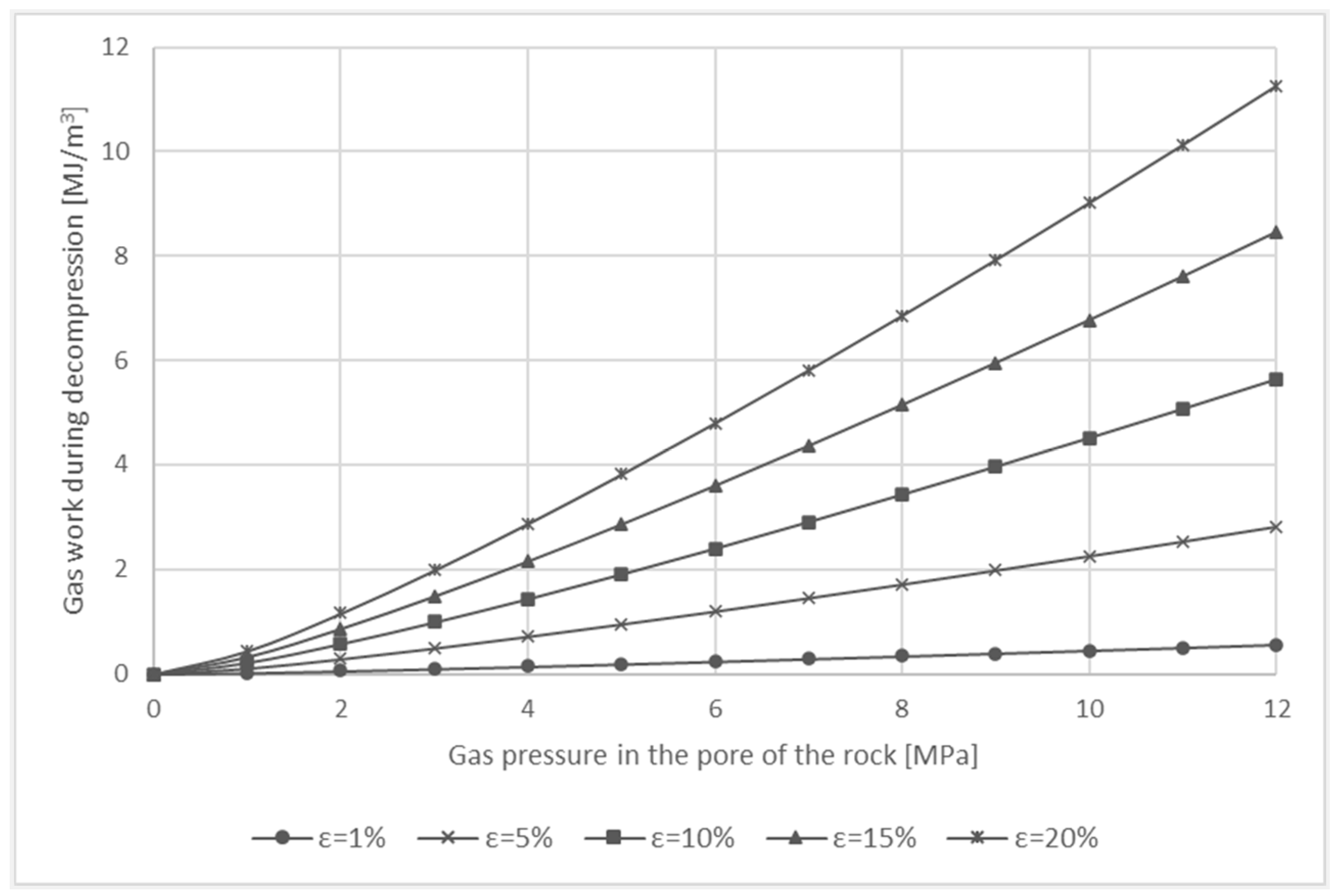
3. Energy of the Gas
3.1. Isothermal Transformation
- is the gas pressure in the pore in the rock bed;
- is the pressure in the mine working space (0.11 MPa);
- is the volume of gas at pressure ;
- is the volume of gas after transformation.
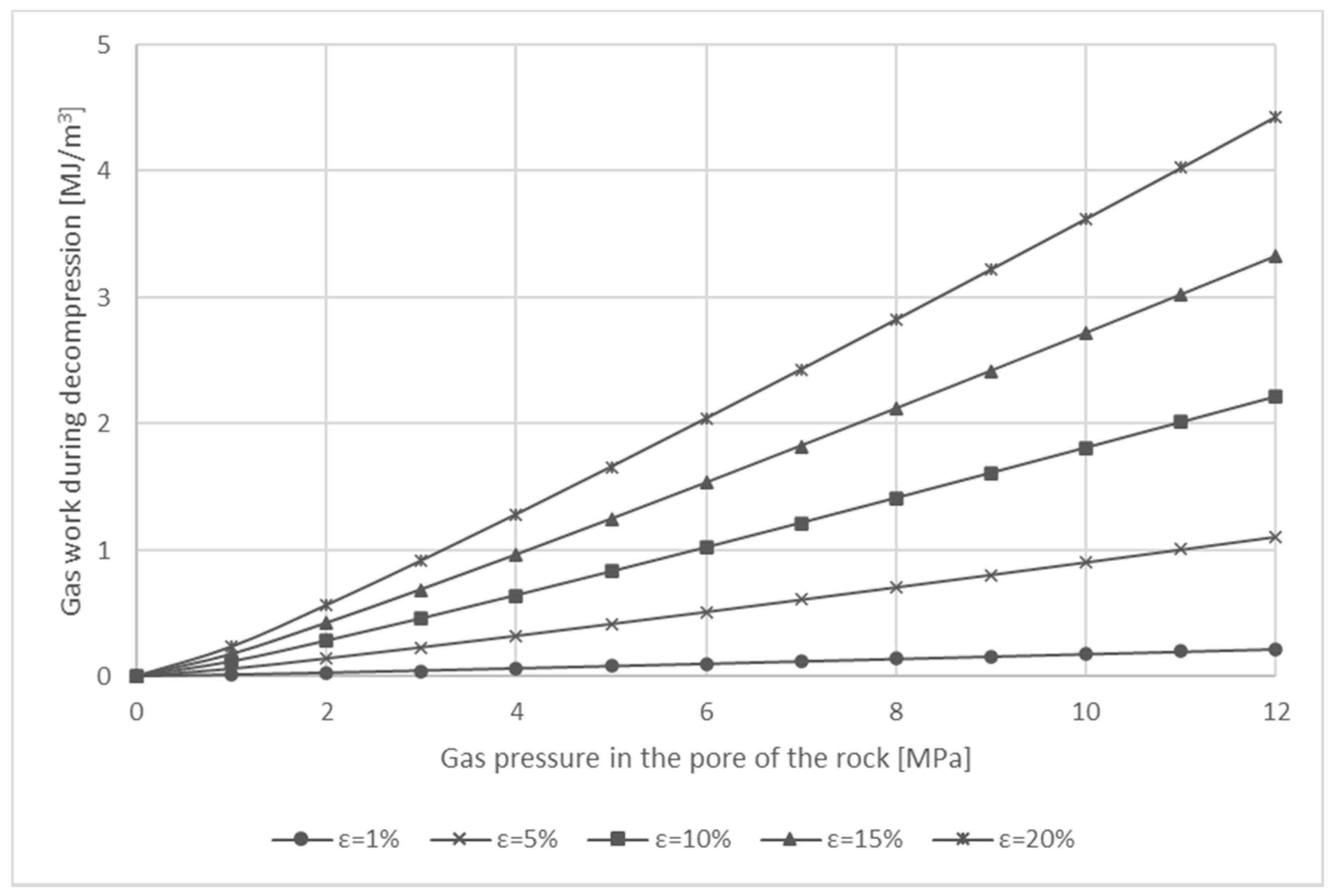
3.2. Adiabatic Transformation
- = 1.4 is the adiabatic index.
4. Experimental Methodology
4.1. Specific Heat
- is the mass of the calorimeter [kg];
- is the mass of water [kg];
- is the specific heat of water [J/kg*K];
- is the specific heat of the calorimeter [J/kg*K];
- is the temperature of the water and of the calorimeter [K];
- is the stabilised temperature [K].
- is the mass of heated dolomite [kg];
- is the specific heat of dolomite [J/kg*K];
- is the temperature to which the dolomite was heated [K].
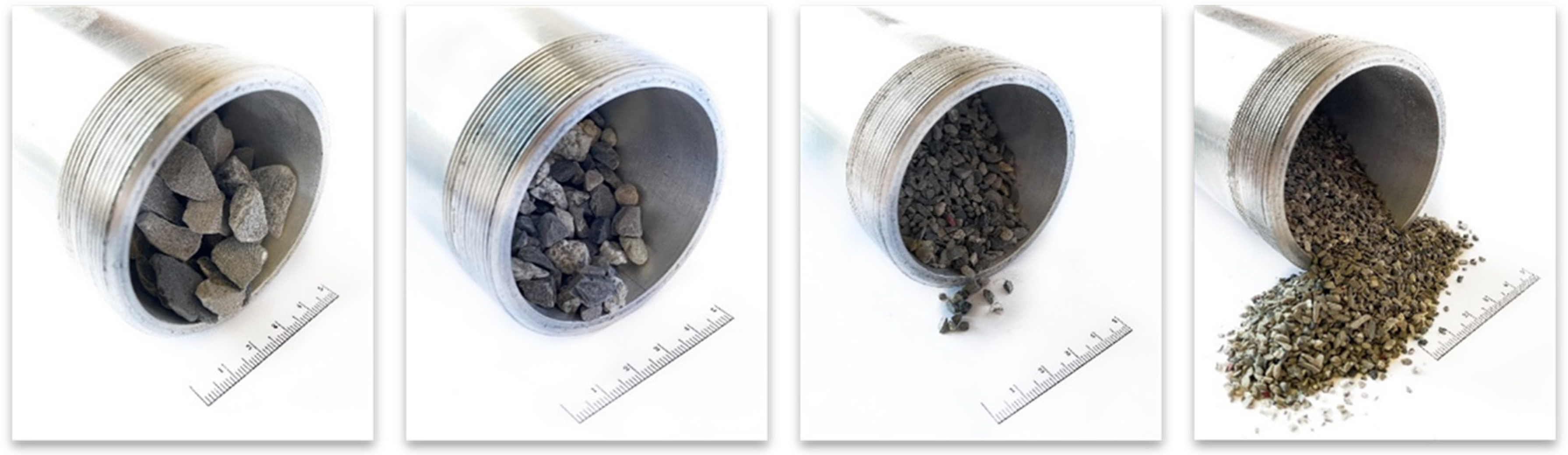
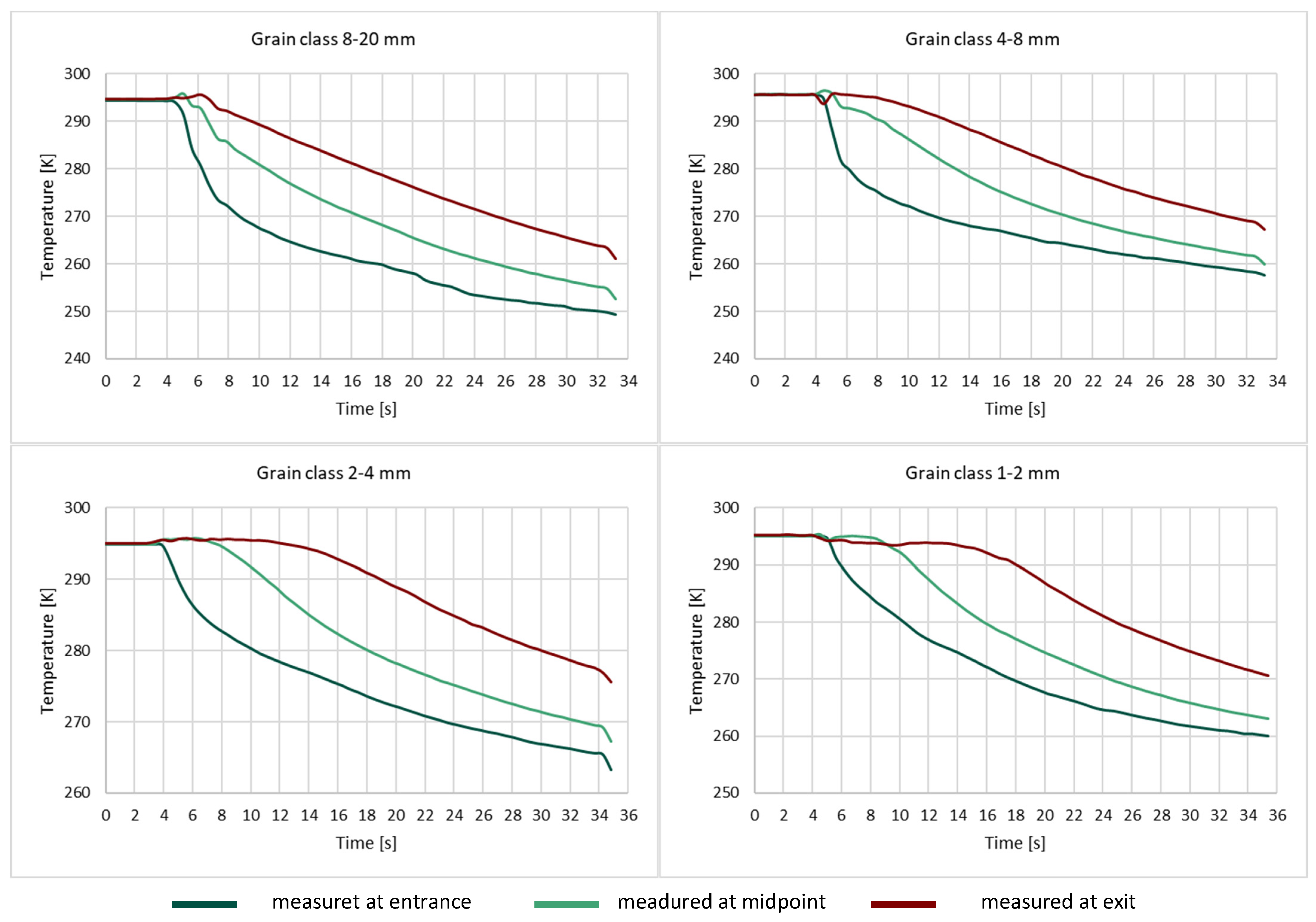
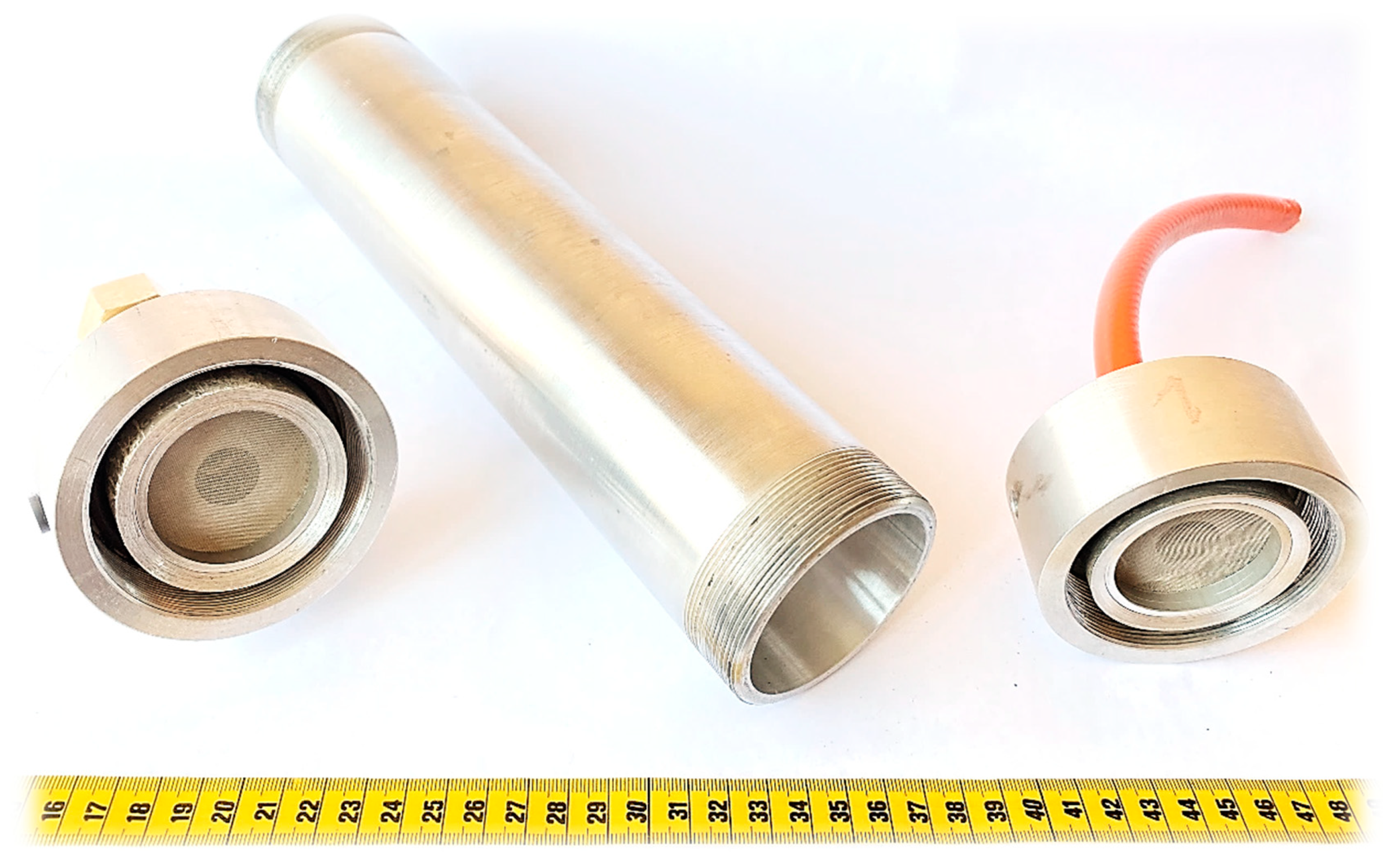
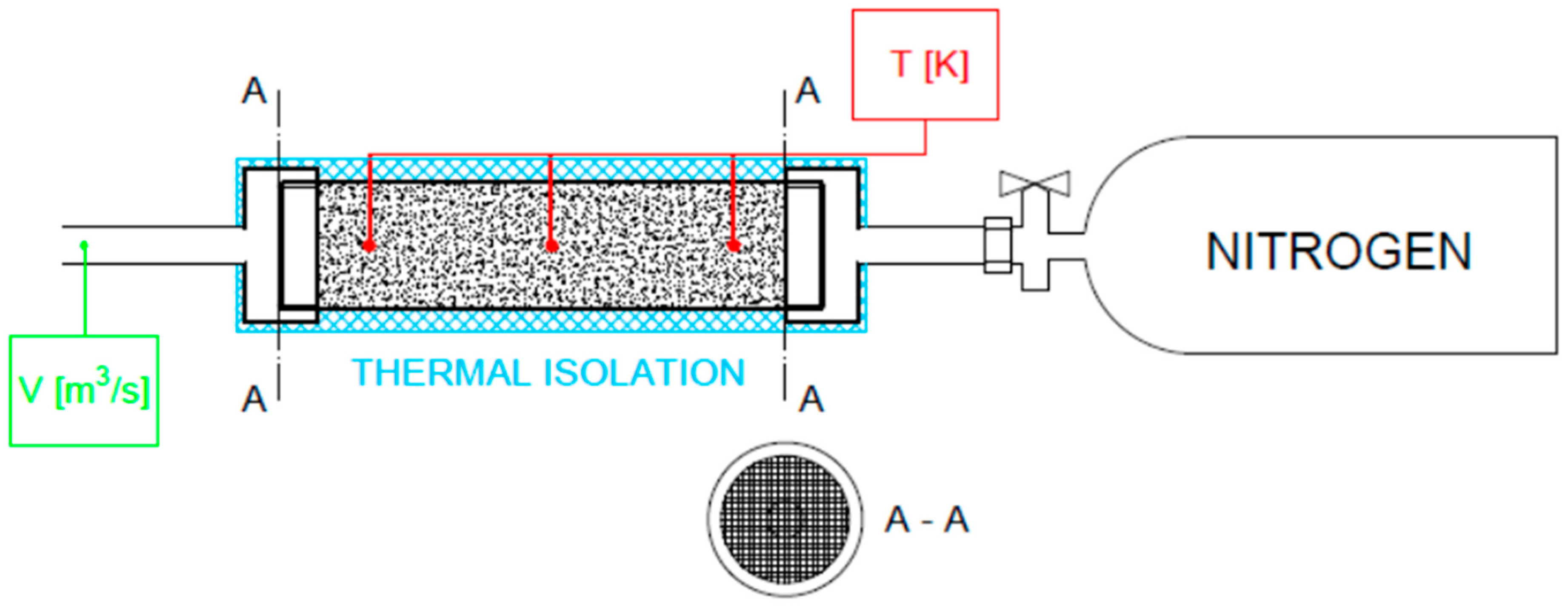
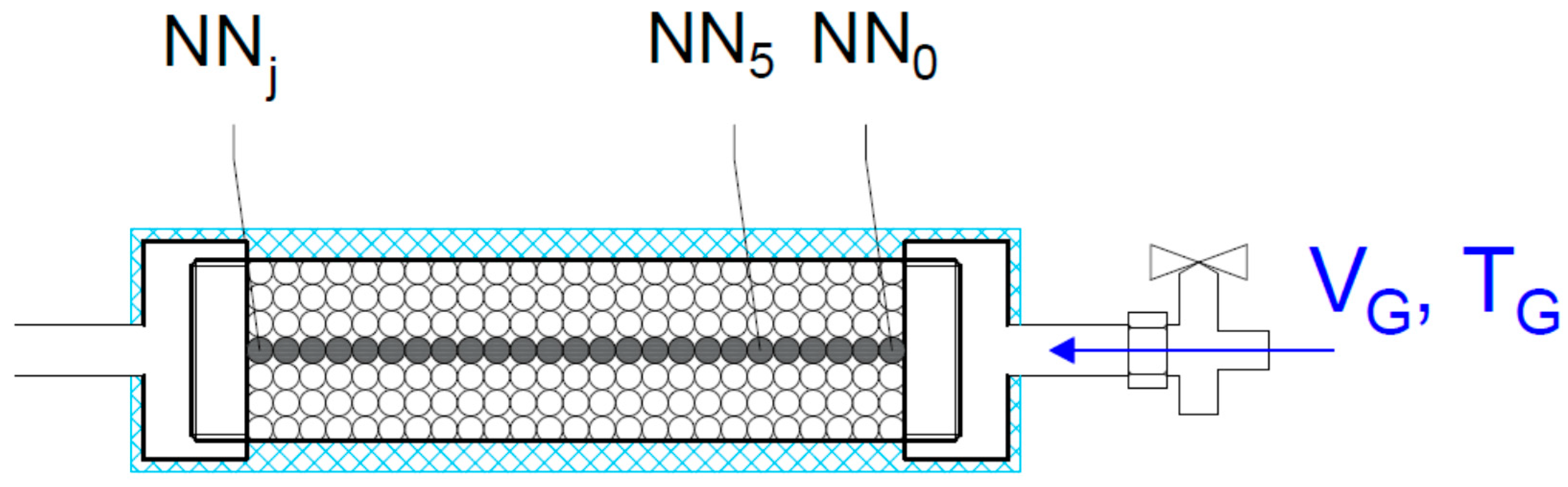
4.2. Heat Exchange during Gas Flow through a Bed
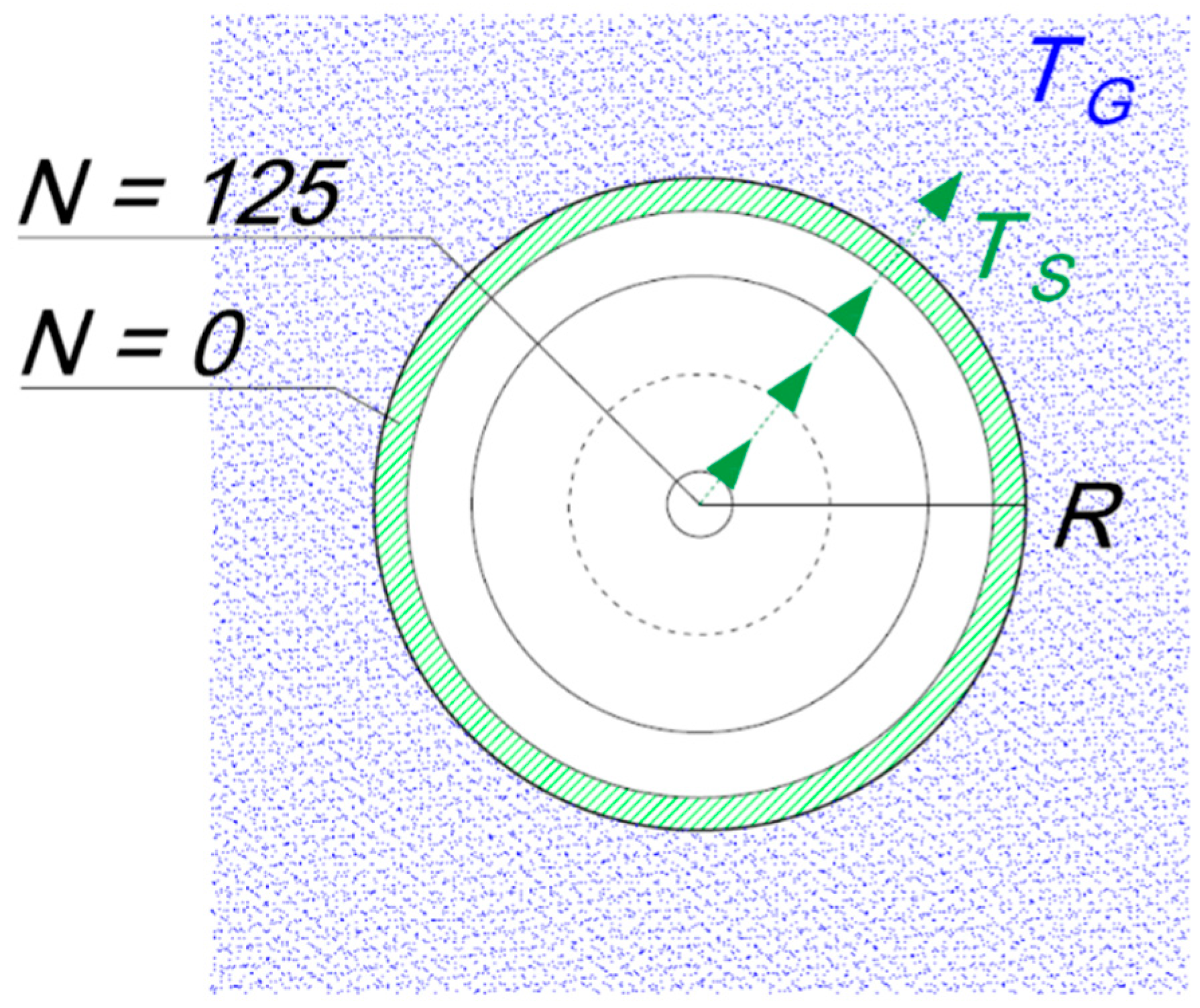
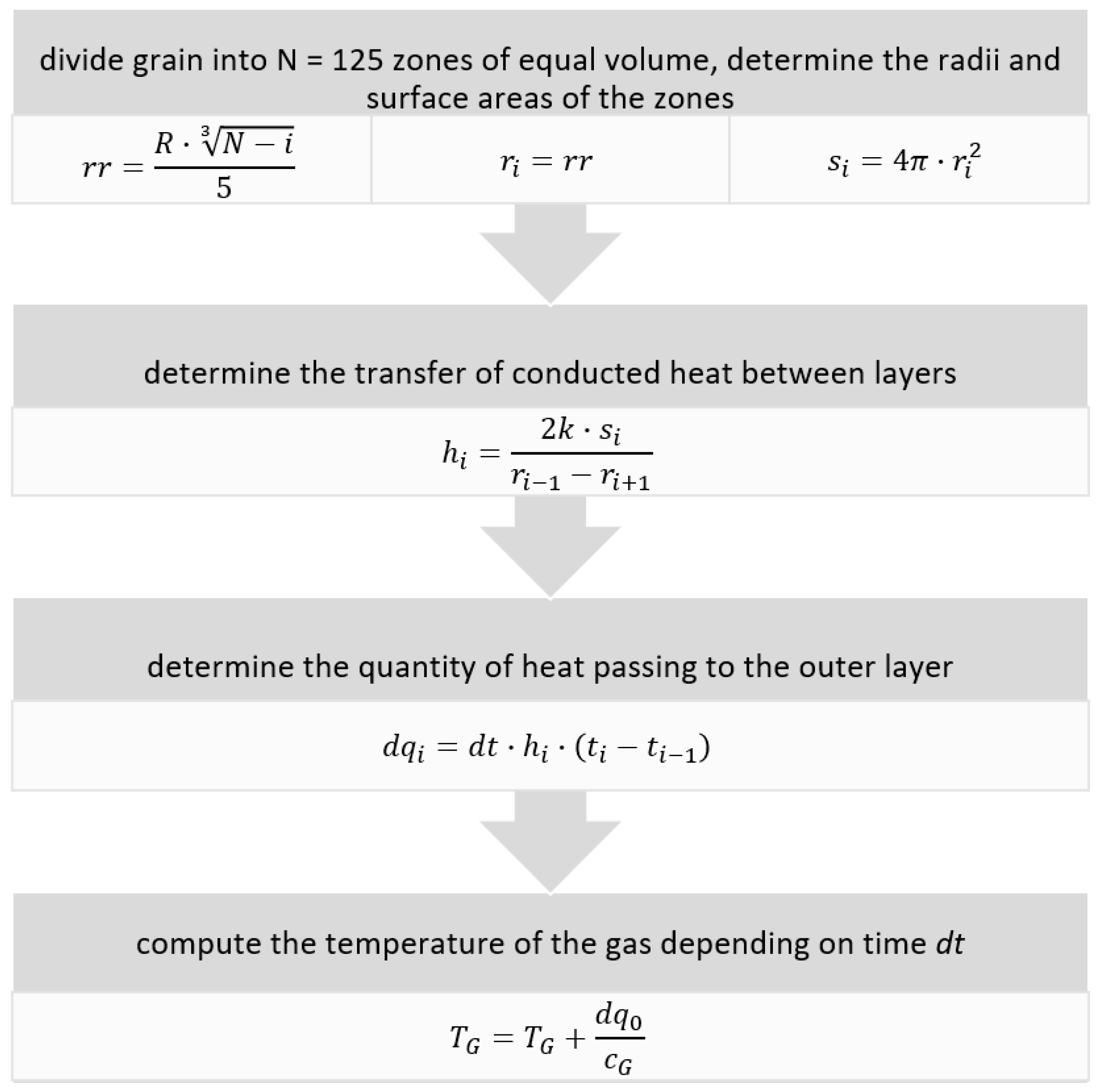
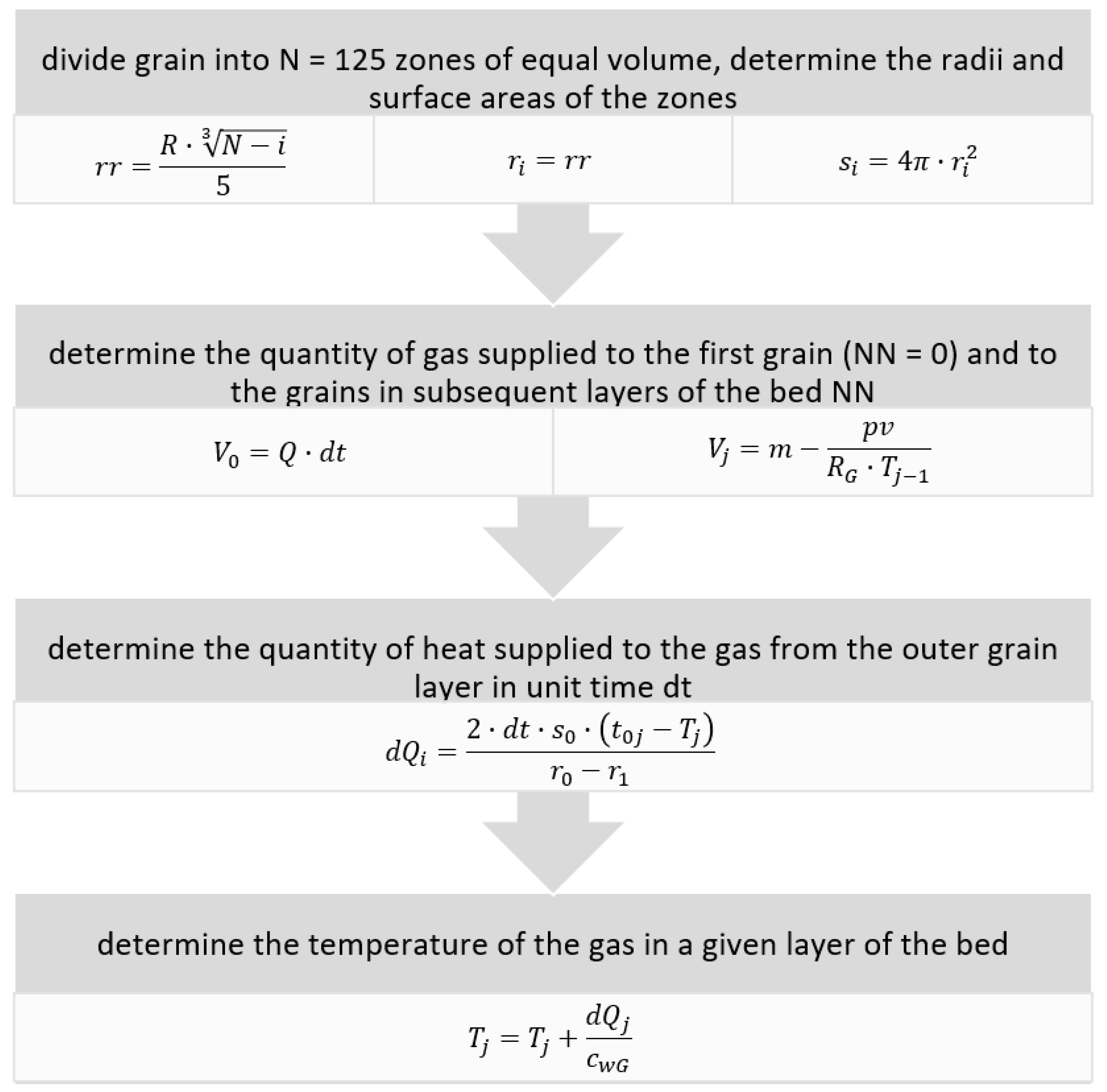
4.3. Model Study
- is the number of layers in the grain;
- is the index of a layer;
- is the grain radius [5 × 10⁻³ m];
- is the radius of the i-th layer;
- is the surface area of the i-th layer;
- is the transfer of conducted heat;
- is the thermal conductivity of the rock;
- is the quantity of heat flowing to the outer layer from the i-th layer;
- is the time step [1 × 10⁻⁹ s];
- is the temperature of the i-th layer;
- is the temperature of the gas depending on the number of time steps dt;
- is the heat capacity of the gas.
- is the portion of gas supplied to layer 0 of the bed;
- is the portion of gas passing to layer NNj;
- is the rate of inflow of the gas;
- is the quantity of gas surrounding the sample together with the supplied gas;
- is the pore pressure;
- is the grain volume;
- is the universal gas constant;
- is the temperature of the gas in the j-th layer.
5. Results
5.1. Experimental Determination of Specific Heat of the Rock
5.2. Experimental Determination of Heat Exchange during Gas Flow through the Bed
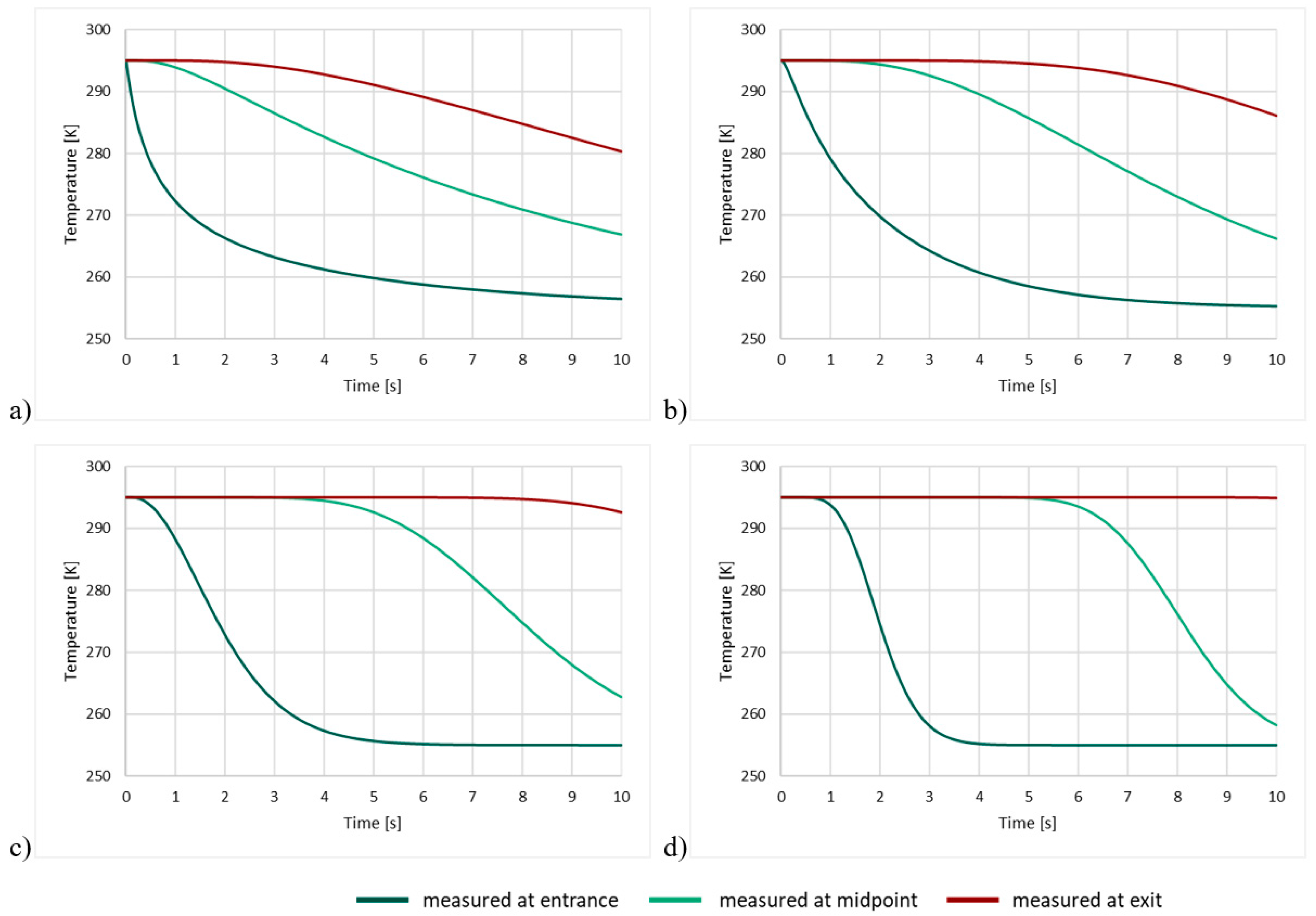
5.3. Model Investigation
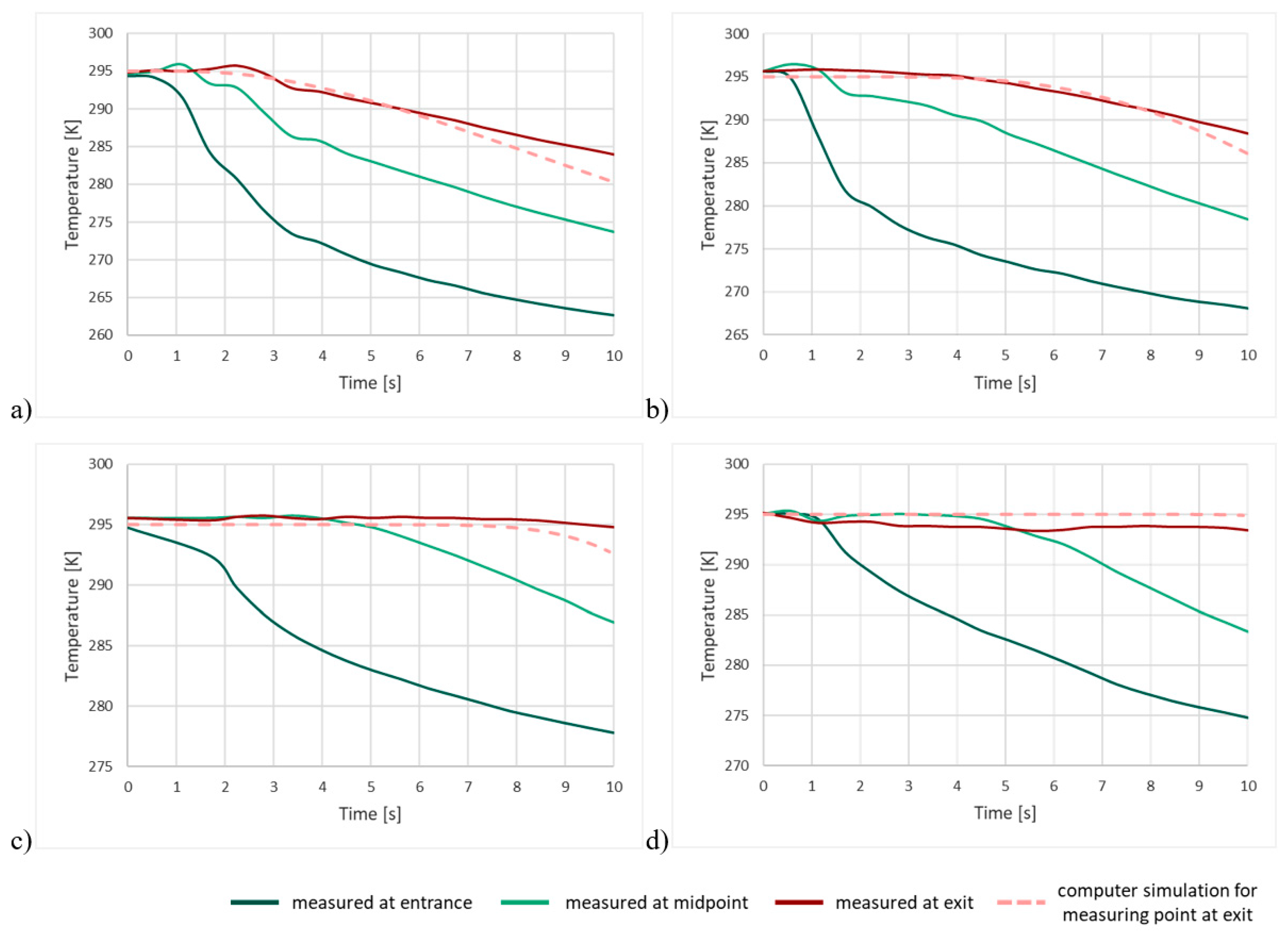
5.4. Comparison of Experiment and Model
6. Conclusions
Author Contributions
Funding
Institutional Review Board Statement
Informed Consent Statement
Data Availability Statement
Acknowledgments
Conflicts of Interest
References
- Black, D.J. Review of coal and gas outburst in Australian underground coal mines. Int. J. Min. Sci. Technol. 2019, 29, 815–824. [Google Scholar] [CrossRef] [Scilit]
- Wierzbicki, M.; Skoczylas, N. The Outburst Risk as a Function of the Methane Capacity and Firmness of a Coal Seam. Arch. Min. Sci. 2014, 59, 1023–1031. [Google Scholar] [CrossRef] [Scilit]
- Zhi, S.; Elsworth, D. The role of gas desorption on gas outbursts in underground mining of coal. Geomech. Geophys. Geo-Energy Geo-Resour. 2016, 2, 151–171. [Google Scholar] [CrossRef] [Scilit]
- Jin, K.; Cheng, Y.; Ren, T.; Zhao, W.; Tu, Q.; Dong, J.; Wang, Z.; Hu, B. Experimental investigation on the formation and transport mechanism of outburst coal-gas flow: Implications for the role of gas desorption in the development stage of outburst. Int. J. Coal Geol. 2018, 194, 45–58. [Google Scholar] [CrossRef] [Scilit]
- Topolnicki, J. Wyrzuty Skalno-Gazowe w Świetle Badań Laboratoryjnych i Modelowych; Wydawnictwo Instytut Gospodarki Surowcami Mineralnymi i Energią PAN: Kraków, Poland, 1999. [Google Scholar]
- An, F.; Yuan, Y.; Chen, X.; Li, Z.; Li, L. Expansion energy of coal gas for the initiation of coal and gas outbursts. Fuel 2019, 235, 551–557. [Google Scholar] [CrossRef] [Scilit]
- Skoczylas, N. Laboratory study of the phenomenon of methane and coal outburst. Int. J. Rock Mech. Min. Sci. 2012, 55, 102–107. [Google Scholar] [CrossRef] [Scilit]
- Skoczylas, N. Estimating Gas and Rock Outburst Risk on the Basis of Knowledge and Experience—the Expert System Based on Fuzzy Logic. Arch. Min. Sci. 2014, 59, 41–52. [Google Scholar] [CrossRef] [Scilit]
- Wang, L.; Lu, Z.; Chen, D.; Liu, Q.; Chu, P.; Shu, L.; Ullah, B.; Wen, Z.-J. Safe strategy for coal and gas outburst prevention in deep-and-thick coal seams using a soft rock protective layer mining. Saf. Sci. 2020, 129, 104800. [Google Scholar] [CrossRef] [Scilit]
- Chlebowski, D.; Burtan, Z.; Zorychta, A. Evaluation of rockburst hazard under abandoned mine workings. Arch. Min. Sci. 2018, 63, 687–699. [Google Scholar]
- Hedlund, F.H. The extreme carbon dioxide outburst at the Menzengraben potash mine 7 July 1953. Saf. Sci. 2012, 50, 537–553. [Google Scholar] [CrossRef] [Scilit]
- Hedlund, F.H. Past explosive outbursts of entrapped carbon dioxide in salt mines provide a new perspective on the hazards of carbon dioxide. In Proceedings of the 4th International Conference on Risk Analysis and Crisis Response (RACR2013), Istanbul, Turkey, 27–29 August 2013. [Google Scholar]
- Butt, S.D.; Frempong, P.K.; Mukherjee, C.; Upshamm, J. Characterization of the permeability and acoustic properties of an outburst-prone sandstone. J. Appl. Geophys. 2006, 58, 1–12. [Google Scholar] [CrossRef] [Scilit]
- Kudasik, M.; Skoczylas, N. Balancing the amount and composition of gas contained in the pore space of cupriferous rocks. Environ. Earth Sci. 2018, 77, 135. [Google Scholar] [CrossRef] [Scilit]
- Wierzbicki, M.; Młynarczuk, M. Structural aspects of gas and dolomite outburst in Rudna copper mine, Poland. Int. J. Rock Mech. Min. Sci. 2013, 57, 113–118. [Google Scholar] [CrossRef] [Scilit]
- Mirek, A.; Laskowski, M.; Respondek, A.; Hryciuk, A. Wyrzut gazów i skał z O/ZG “Rudna”—Incydent czy tendencja? In Prace Naukowe GIG. Górnictwo i Środowisko; Główny Instytut Górnictwa: Katowice, Poland, 2010; Volume 3, pp. 275–288. [Google Scholar]
- Mirek, A.; Laskowski, M.; Hryciuk, A.; Półtorak, M. Zagrożenie wyrzutami gazów i skał w KGHM Polska Miedź S.A. Doświadczenia O/ZG “Rudna” w zakresie jego rozpoznawania i podejmowanych działań profilaktycznych przy prowadzeniu wyrobisk przygotowawczych. Prace Naukowe GIG. Górnictwo Sr. 2011, 2, 305–313. [Google Scholar]
- Kozieł, K.; Skoczylas, N.; Soroko, K.; Gola, S. Gas and Dolomite Outbursts in Ore Mines—Analysis of the Phenomenon and the Energy Balance. Energies 2020, 13, 2999. [Google Scholar] [CrossRef] [Scilit]
- Topolnicki, J.; Wierzbicki, M. Transport sedymentacyjny mas powyrzutowych. Pr. Inst. Mech. Górotworu PAN 2016, 18, 67–73. [Google Scholar]
- Gontarz, J.; Podgórski, J. Wyznaczanie wytrzymałości na rozciąganie betonu i skał metodą “brazylijską” w konfrontacji z zastosowanym kryterium zniszczenia materiału. Bud. Archit. 2014, 13, 191–200. [Google Scholar] [CrossRef] [Scilit]
- Rittinger, P.R. Lehrbuch der Aufbereitungskunde; Ernst and Korn: Berlin, Germany, 1867. [Google Scholar]
- Topolnicki, J.; Wierzbicki, M.; Skoczylas, N. Wyrzuty skalno-gazowe w świetle badań laboratoryjnych i pomiarów kopalnianych. Arch. Min. Sci. 2004, 49, 99–116. [Google Scholar]
- WUG. Ocena Stanu Bezpieczeństwa Pracy, Ratownictwa Górniczego Oraz Bezpieczeństwa Powszechnego w Związku z Działalnością Górniczo-Geologiczną w 2019 Roku. WUG: Katowice, Poland, 2019. [Google Scholar]
- Krzak, M.; Panajew, P. Qualitative description of metal ore deposits parameters based on selected fuzzy logic operators on the example of a kghm polish copper s.a. copper-silver mine. Arch. Min. Sci. 2019, 64, 261–277. [Google Scholar]
- Elwell, D.; Pointon, A.J. Termodynamika Klasyczna; WNT: Warszawa, Poland, 1976. [Google Scholar]
- Krauze, E. Impact of Geological and Gas Determinants on the Formation of Rock and Gas Outburst Hazard in the Upper Silesian Coal Basin. Research Reports Mining and Environment. 2007, Volume 2. Available online: http://yadda.icm.edu.pl/yadda/element/bwmeta1.element.baztech-article-BSL8-0023-0018 (accessed on 28 April 2021).
- Voorn, M.; Exner, U.; Barnhoorn, A.; Baud, P.; Reuschlé, T. Porosity, permeability and 3D fracture network characterisation of dolomite reservoir rock samples. J. Pet. Sci. Eng. 2015, 127, 270–285. [Google Scholar] [CrossRef] [Scilit]
- Kozieł, K.; Pajdak, A. Evaluation of structural parameters of dolomites from copper ore mines using densimetric and porosimetric methods. Pr. Inst. Mech. Górotworu PAN 2018, 20, 327–333. [Google Scholar]
- Pajdak, A.; Kudasik, M. Structural and textural characteristic of selected copper-bearing rocks as one of the elements aiding in the assessment of gasogeodynamic hazard. Studia Geotech. Mech. 2017, 39, 51–59. [Google Scholar] [CrossRef] [Scilit]
- Turkiewicz, W.; Gajosiński, S.; Nowysz, M.; Kondratowicz, G.; Fidos, A. Analiza i Bieżąca Profilaktyka Prowadzenia Robót Górniczych w Warunkach Możliwości Wystąpienia Zagrożenia Gazowego i Zjawisk Gazodynamicznych W Rejonach Udostępnienia Złoża Rud Miedzi, Etap I; Cuprum: Wrocław, Poland, 2010. [Google Scholar]
- Kudasik, M.; Pajdak, A.; Skoczylas, N. The validation process of the method of balancing gas contained in the pore space of rocks via rock comminution. Arch. Min. Sci. 2018, 63, 989–1005. [Google Scholar]
- Kudasik, M.; Skoczylas, N. Analyzer for measuring gas contained in the pore space of rocks. Meas. Sci. Technol. 2017, 28, 105901. [Google Scholar] [CrossRef] [Scilit]
- Resnick, R.; Halliday, D. Fizyka; Wydawnictwa Naukowe PWN: Warszawa, Poland, 2001; Volume I. [Google Scholar]
- Klemczak, B.; Knoppik-Wróbel, A. Influence of Chosen Material and Technological Factors on Concrete Temperatures in Massive Foundation Slab. In Proceedings of the VII Konferencja DNI BETONU, Wisła, Poland, 11–13 October 2021; pp. 291–301. [Google Scholar]
- Xiaoqing, S.; Ming, J.; Peiwen, X. Analysis of the thermophysical properties and influencing factors of various rock types from the guizhou province. In Proceedings of the E3S Web of Conferences, Guilin, China, 10–12 August 2018; p. 03059. [Google Scholar] [CrossRef] [Scilit]
- Fuchs, S.; Balling, N.; Förster, A. Calculation of thermal conductivity, thermal diffusivity and specific heat capacity of sedimentary rocks using petrophysical well logs. Geophys. J. Int. 2015, 203, 1977–2000. [Google Scholar] [CrossRef] [Scilit]
- Merriman, J.D.; Hofmeister, A.M.; Roy, D.J.; Whittington, A.G. Temperature-dependent thermal transport properties of carbonate minerals and rocks. Geosphere 2018, 14, 1961–1987. [Google Scholar] [CrossRef] [Scilit]
- Arafin, S. Thermophysical properties of reservoir rocks. J. Phys. Chem. Solids 2019, 129, 99–110. [Google Scholar] [CrossRef] [Scilit]
- Pajdak, A.; Godyń, K.; Kudasik, M.; Murzyn, T. The use of selected research methods to describe the pore space of dolomite from copper ore mine. Poland. Environ. Earth Sci. 2017, 76, 03059. [Google Scholar] [CrossRef] [Scilit]



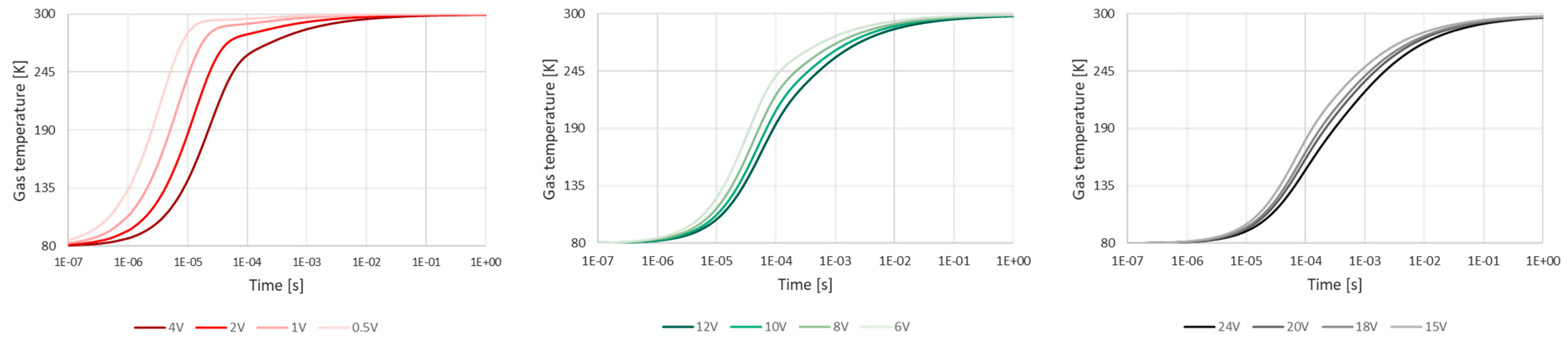

| Gas Volume in Terms of Grain Volume | Example Porosity | Example Pressure |
|---|---|---|
| % | MPa | |
| 0.5 V | 5 | 1 |
| 1 V | 5 | 2 |
| 2 V | 10 | 2 |
| 4 V | 10 | 4 |
| 6 V | 10 | 6 |
| 8 V | 20 | 4 |
| 10 V | 10 | 10 |
| 12 V | 15 | 8 |
| 15 V | 15 | 10 |
| 18 V | 15 | 12 |
| 20 V | 20 | 10 |
| 24 V | 20 | 12 |
| Experiment No. | Specific Heat of Dolomite |
|---|---|
| J/kg·K | |
| 1 | 911.25 |
| 2 | 924.23 |
| 3 | 945.01 |
| 4 | 876.41 |
| 5 | 985.74 |
| 6 | 931.38 |
| 7 | 912.34 |
| 8 | 978.29 |
| 9 | 966.89 |
| 10 | 895.88 |
| mean: | 932.74 |
| standard deviation: | 34.18 |
Publisher’s Note: MDPI stays neutral with regard to jurisdictional claims in published maps and institutional affiliations. |
© 2021 by the authors. Licensee MDPI, Basel, Switzerland. This article is an open access article distributed under the terms and conditions of the Creative Commons Attribution (CC BY) license (https://creativecommons.org/licenses/by/4.0/).
Share and Cite
Kozieł, K.; Topolnicki, J.; Skoczylas, N. The Intensity of Heat Exchange between Rock and Flowing Gas in Terms of Gas-Geodynamic Phenomena. Entropy 2021, 23, 556. https://doi.org/10.3390/e23050556
Kozieł K, Topolnicki J, Skoczylas N. The Intensity of Heat Exchange between Rock and Flowing Gas in Terms of Gas-Geodynamic Phenomena. Entropy. 2021; 23(5):556. https://doi.org/10.3390/e23050556
Chicago/Turabian StyleKozieł, Katarzyna, Juliusz Topolnicki, and Norbert Skoczylas. 2021. "The Intensity of Heat Exchange between Rock and Flowing Gas in Terms of Gas-Geodynamic Phenomena" Entropy 23, no. 5: 556. https://doi.org/10.3390/e23050556
APA StyleKozieł, K., Topolnicki, J., & Skoczylas, N. (2021). The Intensity of Heat Exchange between Rock and Flowing Gas in Terms of Gas-Geodynamic Phenomena. Entropy, 23(5), 556. https://doi.org/10.3390/e23050556