

An Ultrametric Random Walk Model for Disease Spread Taking into Account Social Clustering of the Population



Abstract
1. Introduction
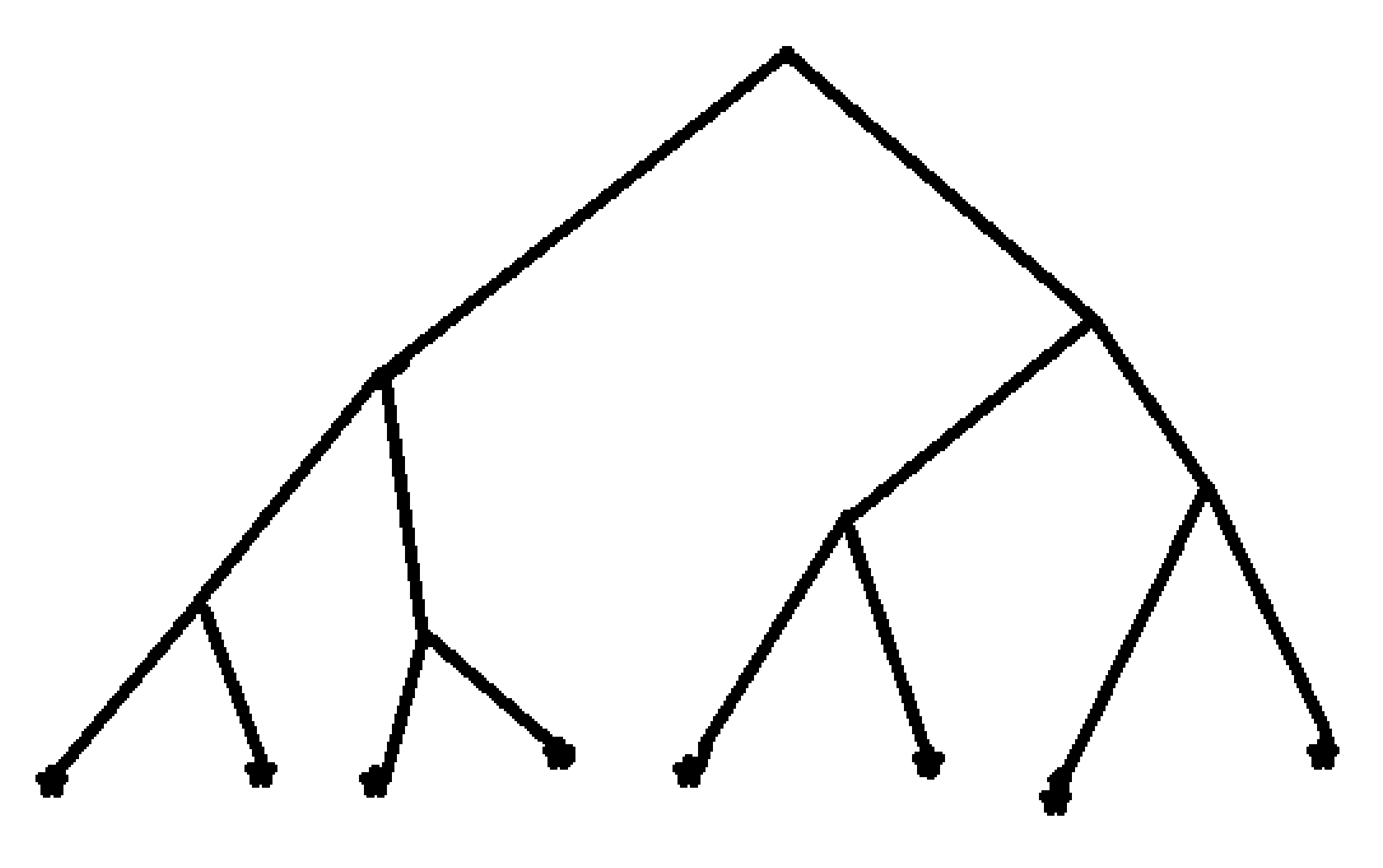
2. Social Trees
3. Probability to Become Infected from the Virus—Random Walk in a Hierarchic Tree of Social Clusters
- Virions can live on various surfaces;
- The COVID-19 epidemic demonstrated the crucial role of superspreaders—super-powerful sources COVID-19 virions [45] (see Appendix B).
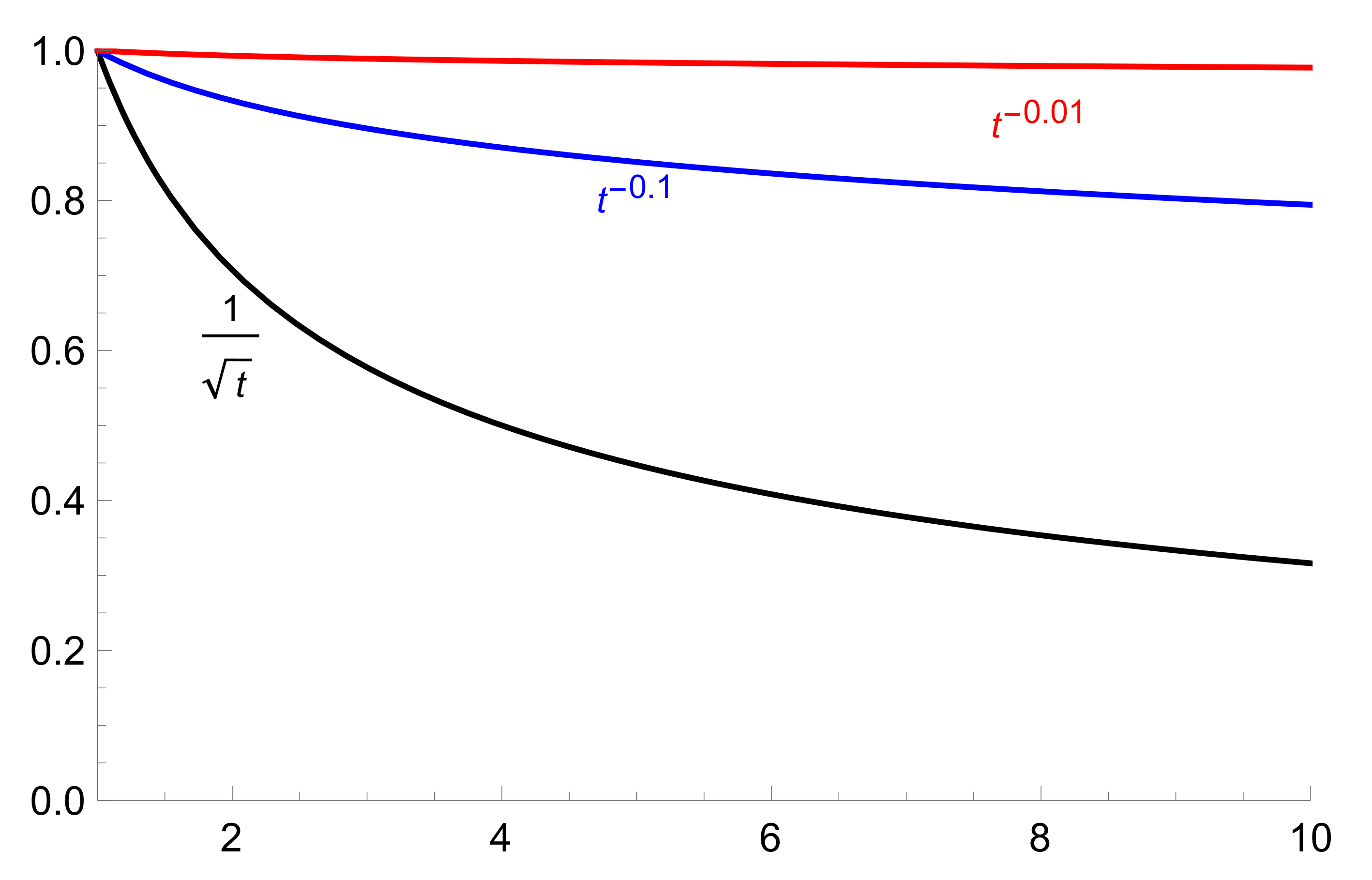
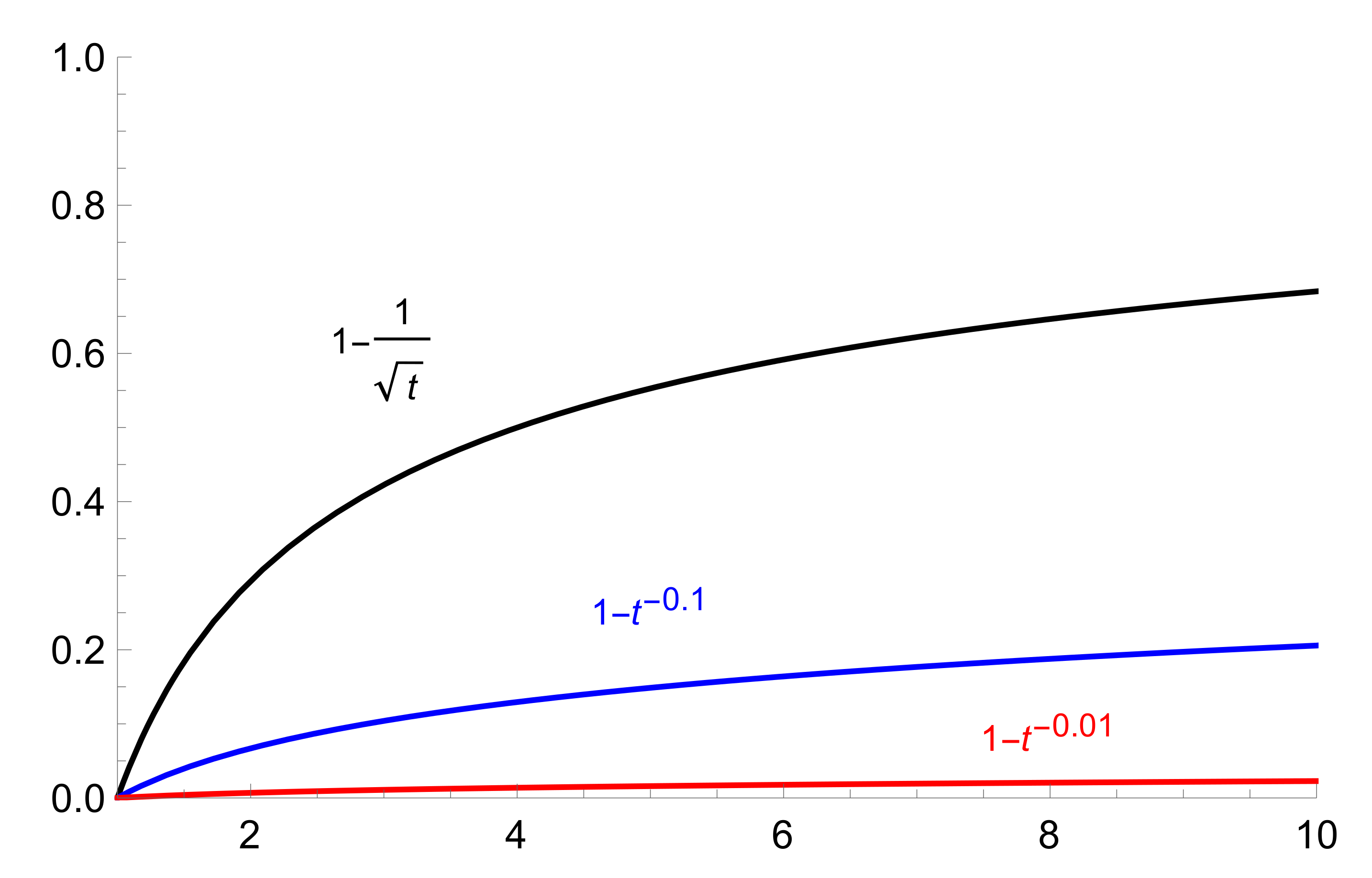
4. Dynamics of the Probability to Become Infected
5. Average Social Distance Traveled by Disease Spreader
6. Concluding Remarks
Author Contributions
Funding
Conflicts of Interest
Appendix A. Social Cluster Structure of Spread of Covid-19
“At a clinic in Corona, a working-class neighborhood in Queens, more than 68 percent of people tested positive for antibodies to the new coronavirus. At another clinic in Jackson Heights, Queens, that number was 56 percent. But at a clinic in Cobble Hill, a mostly white and wealthy neighborhood in Brooklyn, only 13 percent of people tested positive for antibodies. As it has swept through New York, the coronavirus has exposed stark inequalities in nearly every aspect of city life, from who has been most affected to how the health care system cared for those patients. Many lower-income neighborhoods, where Black and Latino residents make up a large part of the population, were hard hit, while many wealthy neighborhoods suffered much less.”
“We show that population heterogeneity can significantly impact disease-induced immunity as the proportion infected in groups with the highest contact rates is greater than in groups with low contact rates.”
“No realistic model will depict human populations as homogenous, there are many heterogeneities in human societies that will influence virus transmission. Here, we illustrate how population heterogeneity can cause significant heterogeneity among the people infected during the course of an infectious disease outbreak… One of the simplest of all epidemic models is to assume a homogeneously mixing population in which all individuals are equally susceptible, and equally infectious if they become infected. … To this simple model we add two important features known to play an important role in disease spreading. The first is to include age structure by dividing the community into different age cohorts, with heterogeneous mixing between the different age cohorts. … The second population structure element categorizes individuals according to their social activity level.”
Appendix B. Superspeaders as Powerful Sources of Virions
“For COVID-19, this means 80% of new transmissions are caused by fewer than 20% of the carriers—the vast majority of people infect very few others or none at all, and it is a select minority of individuals who are aggressively spreading the virus. A recent preprint looking at transmission in Hong Kong supports those figures, while another looking at transmission in Shenzhen, China, pegs the numbers closer to 80/10. Lots of outbreaks around the world have been linked to single events where a superspreader likely infected dozens of people. For example, a choir practice in Washington State infected about 52 people; a megachurch in Seoul was linked to the majority of initial infections in South Korea; and a wedding in Jordan with about 350 guests led to 76 confirmed infections.”
References
- Anderson, R.M.; May, R.M. Infectious Diseases of Humans: Dynamics and Control; Oxford University Press: Oxford, UK, 1991. [Google Scholar]
- Andersson, H.; Britton, T. Stochastic Epidemic Models and Their Statistical Analysis; Springer: Berlin, Germany, 2000. [Google Scholar]
- Diekmann, O.; Heesterbeek, H.; Britton, T. Mathematical Tools for Understanding Infectious Disease Dynamics; Princeton University Press: Princeton, NJ, USA, 2013. [Google Scholar]
- Smith, D.; Moore, L. The SIR Model for Spread of Disease—The Differential Equation Model. Available online: https://www.maa.org/press/periodicals/loci/joma/the-sir-model-for-spread-of-disease-the-differential-equation-model (accessed on 22 September 2016).
- Flaxman, S.; Mishra, S.; Gandy, A.; Unwin, H.J.T.; Coupland, H.; Mellan, T.A.; Zhu, H.; Berah, T.; Eaton, J.W.; Guzman, P.N.P.; et al. Report 13: Estimating the Number of Infections and the Impact of Non-Pharmaceutical Interventions on COVID-19 in 11 European Countries; Imperial College London: London, UK, 2020. [Google Scholar] [CrossRef]
- Ferguson, N.M.; Laydon, D.; Nedjati-Gilani, G.; Imai, N.; Ainslie, K.; Baguelin, M.; Bhatia, S.; Boonyasiri, A.; Cucunubá, Z.; Cuomo-Dannenburg, G.G.; et al. Report 9: Impact of Non-Pharmaceutical Interventions (NPIs) to Reduce COVID-19 Mortality and Healthcare Demand; Imperial College London: London, UK, 2020. [Google Scholar]
- Britton, T. Basic estimation-prediction techniques for Covid-19, and a prediction for Stockholm. medRxiv 2020. [Google Scholar] [CrossRef]
- Britton, T.; Trapman, P.; Ball, F.G. The disease-induced herd immunity level for Covid-19 is substantially lower than the classical herd immunity level. arXiv 2020, arXiv:2005.03085. [Google Scholar]
- Bock, W.; Adamik, B.; Bawiec, M.; Bezborodov, V.; Bodych, M.; Burgard, J.P.; Goetz, T.; Krueger, T.; Migalska, A.; Pabjan, B.; et al. Mitigation and herd immunity strategy for COVID-19 is likely to fail. medRxiv 2020. [Google Scholar] [CrossRef]
- Salje, H.; Kiem, C.T.; Lefrancq, N.; Courtejoie, N.; Bosetti, P.; Paireau, J.; Andronico, A.; Hozé, N.; Richet, J.; Dubost, C.-L.; et al. Estimating the burden of SARS-CoV-2 in France. Science 2020, 369, 208–211. [Google Scholar] [CrossRef] [PubMed]
- Ogielski, A.T. Dynamics on Ultrametric Spaces. Phys. Rev. Lett. 1985, 55. [Google Scholar] [CrossRef] [PubMed]
- Khrennikov, A. Ultrametric model for covid-19 dynamics: An attempt to explain slow approaching herd immunity in Sweden. Available online: https://www.preprints.org/manuscript/202007.0037/v1 (accessed on 3 July 2020).
- Mezard, M.; Parisi, G.; Sourlas, N.; Toulouse, G.; Virasoro, M. Nature of the Spin-Glass Phase. Phys. Rev. Lett. 1984, 52, 1156. [Google Scholar] [CrossRef]
- Palmer, R.G. Broken ergodicity. Adv. Phys. 1983, 31, 66a. [Google Scholar] [CrossRef]
- Ansari, A.; Berendzen, J.; Bowne, S.F.; Frauenfelder, H.; Iben, I.E.T.; Sauke, T.B.; Shyamsunder, E.; Young, R.D. Protein states and proteinquakes. Proc. Natl. Acad. Sci. USA 1985, 82, 5000. [Google Scholar] [CrossRef]
- Palmer, R.G.; Stein, D.L.; Abrahams, E.; Anderson, P.W. Models of Hierarchically Constrained Dynamics for Glassy Relaxation. Phys. Rev. Lett. 1984, 53, 958. [Google Scholar] [CrossRef]
- Huberman, B.A.; Kerszberg, M. Ultradiffusion: The relaxation of hierarchical systems. J. Phys. A 1985, 18, L331. [Google Scholar] [CrossRef]
- Parisi, D. Infinite Number of Order Parameters for Spin-Glasses. Phys. Rev. Lett. 1979, 43, 1754. [Google Scholar] [CrossRef]
- Khrennikov, A. Human subconscious as a p-adic dynamical system. J. Theor. Biol. 1998, 193, 179–196. [Google Scholar] [CrossRef] [PubMed]
- Albeverio, S.; Khrennikov, A.; Kloeden, P.E. Memory retrieval as a p-adic dynamical system. Biosystems 1999, 49, 105–115. [Google Scholar] [CrossRef]
- Dubischar, D.; Gundlach, V.M.; Steinkamp, O.; Khrennikov, A. A p-Adic Model for the Process of Thinking Disturbed by Physiological and Information Noise. J. Theor. Biol. 1999, 197, 451–467. [Google Scholar] [CrossRef]
- Khrennikov, A. Information Dynamics in Cognitive, Psychological, Social, and Anomalous Phenomena; Springer: Dordrecht, The Netherlands, 2004. [Google Scholar]
- Khrennikov, A. Probabilistic pathway representation of cognitive information. J. Theor. Biol. 2004, 231, 597–613. [Google Scholar] [CrossRef]
- Khrennikov, A. Toward an adequate mathematical model of mental space: Conscious/unconscious dynamics on m-adic trees. Biosystems 2007, 90, 656–675. [Google Scholar] [CrossRef][Green Version]
- Britton, T.; Ball, F.; Trapman, P. A mathematical model reveals the influence of population heterogeneity on herd immunity to SARS-CoV-2. Science 2020, 369, 846–849. [Google Scholar] [CrossRef]
- Public Health Institute of Sweden. Estimates of the Peak-Day and the Number of Infected Individuals during the Covid-19 Outbreak in the Stockholm Region, Sweden February–April 2020 [In Swedish]. Available online: www.folkhalsomyndigheten.se/contentassets/2da059f90b90458d8454a04955d1697f/skattning-peakdag-antal-infekterade-covid-19-utbrottet-stockholms-lan-februari-april-2020.pdf (accessed on 15 April 2020).
- Public Health Institute of Sweden. Antikroppstester Avviker fran Prognoserna – Matematikern “ser tva förklaringar”. Available online: https://www.svt.se/nyheter/inrikes/antikroppstester (accessed on 21 March 2020).
- Public Health Institute of Sweden: Yngre Personer har högre Andel Antikroppar. Available online: https://sverigesradio.se/sida/artikel.aspx?programid=83artikel=7487102 (accessed on 2 June 2020).
- Tegnell: “Vi får Oroande Rapporter om Utelivet”. Available online: https://www.svt.se/nyheter/inrikes/tegnell-vi-far-oroande-rapporter-om-utelivet (accessed on 20 April 2020).
- Häkkinen, L. Se hur matematikprofessorn räknar ut när Stockholm uppnar flockimmunitet. SVT Nyhetter. Available online: https://www.svt.se/nyheter/inrikes/matematikprofessorn-ungefar-30-procent-i-stockholm-ar-smittade (accessed on 20 April 2020).
- Holm, G. Hoppfulla Teorin: Sa når vi flockimmunitet redan i juni. Available online: https://www.expressen.se/nyheter/coronaviruset/hoppfulla-teorin-sa-nar-vi-flockimmunitet-redan-i-juni/ (accessed on 10 May 2020).
- Obminska, A. Det här vet vi om coronaviruset. Available online: https://www.nyteknik.se/samhalle/det-har-vet-vi-om-coronaviruset-6985117 (accessed on 30 June 2020).
- Public Health Institute of Sweden. Available online: https://www.folkhalsomyndigheten.se/nyheter-och-press/nyhetsarkiv/2020/juni/forsta-resultaten-om-antikroppar-efter-genomgangen-covid-19-hos-blodgivare/ (accessed on 18 June 2020).
- Kochubei, A.N. Parabolic Equations over the Field of p-Adic Numbers. Math. USSR Izv. 1992, 39, 1263–1280. [Google Scholar] [CrossRef]
- Albeverio, S.; Zhao, X. Measure-valued branching processes associated with random walks on p-adics. Ann. Probab. 2000, 28, 1680–1710. [Google Scholar] [CrossRef]
- Avetisov, V.A.; Bikulov, A.H.; Kozyrev, S.V.; Osipov, V.A. p-adic models of ultrametric diffusion constrained by hierarchical energy landscapes. J. Phys. A Math. Gen. 2002, 35, 177–190. [Google Scholar] [CrossRef]
- Kochubei, A.N. Pseudo-Differential Equations and Stochastics over Non-Archimedean Field; CRC Press: New York, NY, USA, 2001. [Google Scholar]
- Kozyrev, S.V. Ultrametric dynamics as a model of interbasin kinetics. J. Comput. Math. Anal. 2006, 41, 38–48. [Google Scholar]
- Kozyrev, S.V. Ultrametric analysis and interbasin kinetics. AIP Conf. Proc. 2006, 826, 121–128. [Google Scholar]
- Casas-Sanchez, O.F.; Zuniga-Galindo, W.A. P-adic elliptic quadratic forms, parabolic-type pseudodifferential equations with variable coefficients and Markov processes. P-Adic Numbers Ultrametr. Anal. Appl. 2014, 6, 120–139. [Google Scholar] [CrossRef]
- Khrennikov, A.; Oleschko, K.; López, M.J.C. Application of p-adic wavelets to model reaction-diffusion dynamics in random porous media. J. Fourier Anal. Appl. 2016, 22, 809–822. [Google Scholar] [CrossRef]
- Khrennikov, A.; Oleschko, K.; López, M.J.C. Modeling fluid’s dynamics with master equations in ultrametric spaces representing the treelike structure of capillary networks. Entropy 2016, 18, 249. [Google Scholar] [CrossRef]
- Khrennikov, A.; Oleschko, K.; Correa Lopez, M.J. p-Adic analog of Navier-Stokes equations: Dynamics of fluid’s flow in percolation networks (from discrete dynamics with hierarchic interactions to continuous universal scaling model). Entropy 2017, 19, 161. [Google Scholar]
- Demetrius, L.A.; Gundlach, V.M. Directionality Theory and the Entropic Principle of Natural Selection. Entropy 2014, 16, 5428–5522. [Google Scholar] [CrossRef]
- Patel, N.V. What’s a coronavirus superspreader? MIT Technology Review. Available online: https://www.technologyreview.com/2020/06/15/1003576/whats-a-coronavirus-superspreader (accessed on 15 June 2020).
- Wallinga, J.; Teunis, P.; Kretzschmar, M. Using data on social contacts to estimate age-specific transmission parameters for respiratory-spread infectious agents. Am. J. Epidemiol. 2006, 164, 936–944. [Google Scholar] [CrossRef]
- Pastor-Satorras, R.; Vespignani, A. Epidemic spreading in scale-free networks. Phys. Rev. Lett. 2001, 86, 3200–3203. [Google Scholar] [CrossRef]
- Ferrari, M.J.; Bansal, S.; Meyers, L.A.; Bjørnstad, O.N. Network frailty and the geometry of herd immunity. Proc. Biol. Sci. 2006, 273, 2743–2748. [Google Scholar] [CrossRef]
- Gu, A.; Kloeden, P.E. Asymptotic Behavior of a nonautonomous p-Laplacian lattice system. Int. J. Bifur. Chaos 2016, 26, 1650174. [Google Scholar] [CrossRef]
- Han, X.; Kloeden, P.E. Non-autonomous lattice systems with switching effects and delayed recovery. J. Diff. Equ. 2016, 261, 2986–3009. [Google Scholar] [CrossRef]
- Goldstein, J. 68% Have Antibodies in This Clinic. Can a Neighborhood Beat a Next Wave? Available online: https://www.nytimes.com/2020/07/09/nyregion/nyc-coronavirus-antibodies.html (accessed on 9 July 2020).
© 2020 by the authors. Licensee MDPI, Basel, Switzerland. This article is an open access article distributed under the terms and conditions of the Creative Commons Attribution (CC BY) license (http://creativecommons.org/licenses/by/4.0/).
Share and Cite
Khrennikov, A.; Oleschko, K. An Ultrametric Random Walk Model for Disease Spread Taking into Account Social Clustering of the Population. Entropy 2020, 22, 931. https://doi.org/10.3390/e22090931
Khrennikov A, Oleschko K. An Ultrametric Random Walk Model for Disease Spread Taking into Account Social Clustering of the Population. Entropy. 2020; 22(9):931. https://doi.org/10.3390/e22090931
Chicago/Turabian StyleKhrennikov, Andrei, and Klaudia Oleschko. 2020. "An Ultrametric Random Walk Model for Disease Spread Taking into Account Social Clustering of the Population" Entropy 22, no. 9: 931. https://doi.org/10.3390/e22090931
APA StyleKhrennikov, A., & Oleschko, K. (2020). An Ultrametric Random Walk Model for Disease Spread Taking into Account Social Clustering of the Population. Entropy, 22(9), 931. https://doi.org/10.3390/e22090931

