


Abstract
In this article, we introduce the Skellam process of order k and its running average. We also discuss the time-changed Skellam process of order k. In particular, we discuss the space-fractional Skellam process and tempered space-fractional Skellam process via time changes in Skellam process by independent stable subordinator and tempered stable subordinator, respectively. We derive the marginal probabilities, Lévy measures, governing difference-differential equations of the introduced processes. Our results generalize the Skellam process and running average of Poisson process in several directions.
1. Introduction
The Skellam distribution is obtained by taking the difference between two independent Poisson distributed random variables, which was introduced for the case of different intensities by (see [1]) and for equal means in [2]. For large values of , the distribution can be approximated by the normal distribution and if is very close to 0, then the distribution tends to a Poisson distribution with intensity . Similarly, if tends to 0, the distribution tends to a Poisson distribution with non-positive integer values. The Skellam random variable is infinitely divisible, since it is the difference of two infinitely divisible random variables (see Proposition in [3]). Therefore, one can define a continuous time Lévy process for Skellam distribution, which is called Skellam process.
The Skellam process is an integer valued Lévy process and it can also be obtained by taking the difference of two independent Poisson processes. Its marginal probability mass function (pmf) involves the modified Bessel function of the first kind. The Skellam process has various applications in different areas, such as to model the intensity difference of pixels in cameras (see [4]) and for modeling the difference of the number of goals of two competing teams in a football game [5]. The model based on the difference of two point processes is proposed in (see [6,7,8,9]).
Recently, the time-fractional Skellam process has been studied in [10], which is obtained by time-changing the Skellam process with an inverse stable subordinator. Further, they provided the application of time-fractional Skellam process in modeling of arrivals of jumps in high frequency trading data. It is shown that the inter-arrival times between the positive and negative jumps follow a Mittag–Leffler distribution rather then the exponential distribution. Similar observations are observed in the case of Danish fire insurance data (see [11]). Buchak and Sakhno, in [12], have also proposed the governing equations for time-fractional Skellam processes. Recently, [13] introduced time-changed Poisson process of order k, which is obtained by time changing the Poisson process of order k (see [14]) by general subordinators.
In this paper, we introduce Skellam process of order k and its running average. We also discuss the time-changed Skellam process of order k. In particular, we discuss space-fractional Skellam process and tempered space-fractional Skellam process via time changes in Skellam process by independent stable subordinator and tempered stable subordinator, respectively. We obtain closed form expressions for the marginal distributions of the considered processes and other important properties. Skellam process is used to model the difference between the number of goals between two teams in a football match. At the beginning, both teams have scores 0 each and at time t the team 1 score is , which is the cumulative sum of arrivals (goals) of size 1 until time t with exponential inter-arrival times. Similarly for team 2, the score is at time The difference between the number of goals can be modeled using at time t. Similarly, the Skellam process of order k can be used to model the difference between the number of points scored by two competing teams in a basketball match where Note that, in a basketball game, a free throw is count as one point, any basket from a shot taken from inside the three-point line counts for two points and any basket from a shot taken from outside the three-point line is considered as three points. Thus, a jump in the score of any team may be of size one, two, or three. Hence, a Skellam process of order 3 can be used to model the difference between the points scored.
In [10], it is shown that the fractional Skellam process is a better model then the Skellam process for modeling the arrivals of the up and down jumps for the tick-by-tick financial data. Equivalently, it is shown that the Mittag–Leffler distribution is a better model than the exponential distribution for the inter-arrival times between the up and down jumps. However, it is evident from Figure 3 of [10] that the fractional Skellam process is also not perfectly fitting the arrivals of positive and negative jumps. We hope that a more flexible class of processes like time-changed Skellam process of order k (see Section 6) and the introduced tempered space-fractional Skellam process (see Section 7) would be better model for arrivals of jumps. Additionally, see [8] for applications of integer-valued Lévy processes in financial econometrics. Moreover, distributions of order k are interesting for reliability theory [15]. The Fisher dispersion index is a widely used measure for quantifying the departure of any univariate count distribution from the equi-dispersed Poisson model [16,17,18]. The introduced processes in this article can be useful in modeling of over-dispersed and under-dispersed data. Further, in (49), we present probabilistic solutions of some fractional equations.
The remainder of this paper proceeds, as follows: in Section 2, we introduce all the relevant definitions and results. We also derive the Lévy density for space- and tempered space-fractional Poisson processes. In Section 3, we introduce and study running average of Poisson process of order k. Section 4 is dedicated to Skellam process of order k. Section 5 deals with running average of Skellam process of order k. In Section 6, we discuss the time-changed Skellam process of order k. In Section 7, we determine the marginal pmf, governing equations for marginal pmf, Lévy densities, and moment generating functions for space-fractional Skellam process and tempered space-fractional Skellam process.
2. Preliminaries
In this section, we collect relevant definitions and some results on Skellam process, subordinators, space-fractional Poisson process, and tempered space-fractional Poisson process. These results will be used to define the space-fractional Skellam processes and tempered space-fractional Skellam processes.
2.1. Skellam Process
In this section, we revisit the Skellam process and also provide a characterization of it. Let be a Skellam process, such that
where and are two independent homogeneous Poisson processes with intensity and respectively. The Skellam process is defined in [8] and the distribution has been introduced and studied in [1], see also [2]. This process is only symmetric when . The pmf of is given by (see e.g., [1,10])
where is modified Bessel function of first kind (see [19], p. 375),
The pmf satisfies the following differential difference equation (see [10])
with initial conditions and . For a real-valued Lévy process the characteristic function admits the form
where the function is called characteristic exponent and it admits the following Lévy-Khintchine representation (see [20])
Here, and is a Lévy measure. If for some function , then is called the Lévy density of the process The Skellam process is a Lévy process, its Lévy density is a linear combination of two Dirac delta functions, and the corresponding characteristic exponent is given by
The moment generating function (mgf) of Skellam process is
With the help of mgf, one can easily find the moments of Skellam process. In the next result, we give a characterization of Skellam process, which is not available in literature as per our knowledge. For a function h, we write if
Theorem 1.
Suppose that an arrival process has the independent and stationary increments and it also satisfies the following incremental condition, then the process is Skellam.
Proof.
Consider the interval [0,t], which is discretized with n sub-intervals of size each, such that For , we have
by taking The result follows now by using the definition of modified Bessel function of first kind . Similarly, it can be proved for □
2.2. Poisson Process of Order k
In this section, we recall the definition and some important properties of Poisson process of order k (PPoK). Kostadinova and Minkova (see [14]) introduced and studied the PPoK. Let be non-negative integers and and
Additionally, let represent the PPoK with rate parameter , then probability mass function (pmf) is given by
The pmf of satisfies the following differential-difference equations (see [14])
with initial condition and and . The characteristic function of PPoK
where . The process PPoK is Lévy, so it is infinite divisible i.e., The Lévy density for PPoK is easy to derive and it is given by
where is the Dirac delta function concentrated at j. The transition probability of the PPoK is also given by Kostadinova and Minkova [14],
The probability generating function (pgf) is given by (see [14])
The mean, variance and covariance function of the PPoK are given by
2.3. Subordinators
Let be a real valued Lévy process with non-decreasing sample paths and its Laplace transform has the form
where
is the integral representation of Bernstein functions (see [21]). The Bernstein functions are , non-negative and such that for [21]. Here, denote the non-negative Lévy measure on the positive half line, such that
and b is the drift coefficient. The right continuous inverse is the inverse and first exist time of , which is non-Markovian with non-stationary and non-independent increments. Next, we analyze some special cases of Lévy subordinators with drift coefficient b = 0,
It is worth noting that, among the subordinators given in (14), all of the integer order moments of -stable subordinators are infinite and others subordinators have all finite moments.
2.4. The Space-Fractional Poisson Process
In this section, we discuss the main properties of a space-fractional Poisson process (SFPP). We also provide the Lévy density for SFPP, which is not discussed in the literature. The SFPP was introduced by (see [22]), as follows
where is an -stable subordinator, which is independent of the homogeneous Poisson process .
The probability generating function (pgf) of this process is
The pmf of SFPP is
where is the Fox Wright function (see formula in [23]). It was shown in [22] that the pmf of the SFPP satisfies the following fractional differential-difference equations
with initial conditions
where is the Kronecker delta function, given by
The fractional difference operator
is defined in [24], where B is the backward shift operator. The characteristic function of SFPP is
Proposition 1.
The Lévy density of SFPP is given by
Proof.
We use Lévy-Khintchine formula (see [20]),
which is the characteristic exponent of SFPP from Equation (23). □
2.5. Tempered Space-Fractional Poisson Process
The tempered space-fractional Poisson process (TSFPP) can be obtained by subordinating the homogeneous Poisson process with the independent tempered stable subordinator (see [25])
This process has finite integer order moments due to the tempered -stable subordinator. The pmf of TSFPP is given by (see [25])
The governing difference-differential equation is given by
The characteristic function of TSFPP,
While using a standard conditioning argument, the mean and variance of TSFPP are given by
Proposition 2.
The Lévy density of TSFPP is
Proof.
Using (28), the characteristic exponent of TSFPP is given by . We find the Lévy density with the help of Lévy-Khintchine formula (see [20]),
hence proved. □
Definition 1.
A stochastic process is over-dispersed, equi-dispersed or under-dispersed [18], if the Fisher index of dispersion, given by (see e.g., [17])
is more than 1, equal to 1, or smaller than 1, respectively, for all .
Remark 1.
Using (29), we have i.e. TSFPP is over-dispersed.
3. Running Average of PPoK
In this section, we first introduced the running average of PPoK and their main properties. These results will be used further to discuss the running average of SPoK.
Definition 2
(Running average of PPoK). We define the running average process by taking time-scaled integral of the path of the PPoK (see [26]),
We can write the differential equation with initial condition ,
Which shows that it has continuous sample paths of bounded total variation. We explored the compound Poisson representation and distribution properties of running average of PPoK. The characteristic of is obtained using the Lemma 1 of [26]. We recall Lemma 1 from [26] for ease of reference.
Lemma 1.
If is a Lévy process and its Riemann integral is defined by
then the characteristic functions of Y satisfies
Proposition 3.
The characteristic function of is given by
Proposition 4.
The running average process has a compound Poisson representation, such that
where are independent, identically distributed (iid) copies of X random variables, independent of and is a Poisson process with intensity . Subsequently,
Further, the random variable X has the following pdf
where follows discrete uniform distribution over and follows continuous uniform distribution over
Proof.
Using the definition
the first two moments for random variable X given in Proposition (4) are and . Further, using the mean, variance, and covariance of compound Poisson process, we have
Corollary 1.
Putting , the running average of PPoK reduces to the running average of standard Poisson process (see Appendix in [26]).
Corollary 2.
The mean and variance of PPoK and running average of PPoK satisfy, and .
Remark 2.
The Fisher index of dispersion for running average of PPoK is given by If the process is under-dispersed and for it is over-dispersed.
Next we discuss the long-range dependence (LRD) property of running average of PPoK. We recall the definition of LRD for a non-stationary process.
Definition 3
(Long range dependence (LRD)). Let be a stochastic process that has a correlation function for for fixed s, that satisfies,
for large t, , and . For the particular case when , the above equation reduced to
We say that, if , then X(t) has the LRD property and if it has short-range dependence (SRD) property [27].
Proposition 5.
The running average of PPoK has LRD property.
Proof.
Let , then the correlation function for running average of PPoK is
Subsequently, for , it follows
□
4. Skellam Process of Order k (SPoK)
In this section, we introduce and study the Skellam process of order k (SPoK).
Definition 4
(SPoK). Let and be two independent PPoK with intensities and . The stochastic process
is called a Skellam process of order k (SPoK).
Proposition 6.
The marginal distribution of SPoK is given by
Proof.
Proposition 7.
The Lévy density for SPoK is
Proof.
The proof follows by using the independence of two PPoK used in the definition of SPoK. □
Remark 3.
SPoK as a Pure Birth and Death Process
In this section, we provide the transition probabilities of SPoK at time , given that we started at time t. Over such a short interval of length , it is nearly impossible to observe more than k event; in fact, the probability to see more than k event is .
Proposition 8.
The transition probabilities of SPoK are given by
Basically, at most k events can occur in a very small interval of time δ. Additionally, even though the probability for more than k event is non-zero, it is negligible.
Proof.
Note that . We call as the first process and as the second process. For , we have
Similarly, for , we have
Further,
□
Remark 4.
The pmf of SPoK satisfies the following difference differential equation
with initial condition and for . Let B be the backward shift operator defined in (22) and F be the forward shift operator defined by , such that . Multiplying by and summing for all m in (42), we obtain the following differential equation for the pgf
The mean, variance and covariance of SPoK can be easily calculated by using the pgf,
Remark 5.
For the SPoK, when , which implies that and hence exhibits over-dispersion. For , the process is under-dispersed.
Next, we show the LRD property for SPoK.
Proposition 9.
The SPoK has LRD property defined in Definition 3.
Proof.
The correlation function of SPoK satisfies
Hence, SPoK exhibits the LRD property. □
5. Running Average of SPoK
In this section, we introduce and study the new stochastic Lévy process, which is the running average of SPoK.
Definition 5.
The following stochastic process defined by taking the time-scaled integral of the path of the SPoK,
is called the running average of SPoK.
Next, we provide the compound Poisson representation of running average of SPoK.
Proposition 10.
The characteristic function of is given by
Proof.
By using the Lemma to Equation (40) after scaling by . □
Remark 6.
It is easily observable that Equation (43) has removable singularity at . To remove that singularity, we can define .
Proposition 11.
Let be a compound Poisson process
where is a Poisson process with rate parameter and are iid random variables with mixed double uniform distribution function , which are independent of . Subsequently,
Proof.
Rearranging the ,
The random variable being a mixed double uniformly distributed has density
where follows discrete uniform distribution over with pmf and be doubly uniform distributed random variables with density
Further, is a weight parameter and is the indicator function. Here, we obtained the characteristic of using the Fourier transform of (45),
The characteristic function of is
putting the characteristic function in the above expression yields the characteristic function of , which completes the proof. □
Remark 7.
The q-th order moments of can be calculated using (37) and also using Taylor series expansion of the characteristic , around 0, such that
We have and . Further, the mean, variance, and covariance of running average of SPoK are
Corollary 3.
For the running average of SPoK is same as the running average of PPoK, i.e.,
Corollary 4.
For this process behave like the running average of Skellam process.
Corollary 5.
The ratio of mean and variance of SPoK and running average of SPoK are and , respectively.
Remark 8.
For running average of SPoK, when and , the process is over-dispersed. Otherwise, it exhibits under-dispersion.
6. Time-Changed Skellam Process of Order k
We consider time-changed SPoK, which can be obtained by subordinating SPoK with the independent Lévy subordinator satisfying for all . The time-changed SPoK is defined by
Note that the stable subordinator does not satisfy the condition . The mgf of time-changed SPoK is given by
Theorem 2.
The pmf of time-changed SPoK is given by
Proof.
Let be the probability density function of Lévy subordinator. Using conditional argument
□
The mean and covariance of time changed SPoK are given by,
7. Space Fractional Skellam Process and Tempered Space Fractional Skellam Process
In this section, we introduce time-changed Skellam processes where time-change are stable subordinator and tempered stable subordinator. These processes give the space-fractional version of the Skellam process similar to the time-fractional version of the Skellam process introduced in [10].
7.1. The Space-Fractional Skellam Process
In this section, we introduce space-fractional Skellam processes (SFSP). Further, for introduced processes, we study main results, such as state probabilities and governing difference-differential equations of marginal pmf.
Definition 6
(SFSP). Let and be two independent homogeneous Poison processes with intensities and , respectively. Let and be two independent stable subordinators with indices and , respectively. These subordinators are independent of the Poisson processes and . The subordinated stochastic process
is called a SFSP.
Next, we derive the mgf of SFSP. We use the expression for marginal (pmf) of SFPP that is given in (17) to obtain the marginal pmf of SFSP.
In the next result, we obtain the state probabilities of the SFSP.
Theorem 3.
The pmf of SFSP is given by
for .
Proof.
Note that and are independent, hence
Using (17), the result follows. □
In the next theorem, we discuss the governing differential-difference equation of the marginal pmf of SFSP.
Theorem 4.
The marginal distribution of SFSP satisfies the following differential difference equations
with initial conditions and for
Proof.
The proof follows by using pgf. □
Remark 9.
The mgf of the SFSP solves the differential equation
Proposition 12.
The Lévy density of SFSP is given by
Proof.
Substituting the Lévy density and of and , respectively, from the Equation (24), we obtain
which gives the desired result. □
7.2. Tempered Space-Fractional Skellam Process (TSFSP)
In this section, we present the tempered space-fractional Skellam process (TSFSP). We discuss the corresponding fractional difference-differential equations, marginal pmfs, and moments of this process.
Definition 7
(TSFSP). The TSFSP is obtained by taking the difference of two independent tempered space fractional Poisson processes. Let , be two independent TSS (see [28]) and be two independent Poisson processes that are independent of TSS. Subsequently, the stochastic process
is called the TSFSP.
Theorem 5.
The PMF is given by
when and similarly for ,
Proof.
Because and are independent,
which gives the marginal pmf of TSFPP using (26). □
Remark 10.
We use this expression to calculate the marginal distribution of TSFSP. The mgf is obtained using the conditioning argument. Let be the density function of . Subsequently,
Using (54), the mgf of TSFSP is
Remark 11.
We have Further, the covariance of TSFSP can be obtained by using (29) and
Proposition 13.
The Lévy density of TSFSP is given by
Proof.
By adding Lévy density and of and , respectively, from Equation (30), which leads to
□
7.3. Simulation of SFSP and TSFSP
We present the algorithm to simulate the sample trajectories for SFSP and TSFSP. We use Python 3.7 and its libraries Numpy and Matplotlib for the simulation purpose. It is worth mentioning that Python is an open source and freely available software.
Simulation of SFSP: fix the values of the parameters , , and
- Step-1: generate independent and uniformly distributed random vectors U, V of size 1000 each in the interval ;
- Step-2: generate the increments of the -stable subordinator (see [29]) with pdf , while using the relationship , where
- Step-3: generate the increments of Poisson distributed rvs with parameter ;
- Step-4: cumulative sum of increments gives the space fractional Poisson process sample trajectories; and,
- Step-5: similarly generate and subtract these to obtain the SFSP .
We next present the algorithm for generating the sample trajectories of TSFSP.
Simulation of TSFSP: fix the values of the parameters , , , , and
Use the first two steps of previous algorithm for generating the increments of -stable subordinator .
- Step-3: for generating the increments of TSS with pdf , we use the following steps, called “acceptance-rejection method”;
- (a)
- generate the stable random variable ;
- (b)
- generate uniform rv W (independent from );
- (c)
- if , then (“accept"); otherwise, go back to (a) (“reject"). Note that, here we used that which implies for and the ratio is bounded between 0 and 1;
- Step-4: generate Poisson distributed rv with parameter
- Step-5: cumulative sum of increments gives the tempered space fractional Poisson process sample trajectories; and,
- Step-6: similarly generate , then take difference of these to get the sample paths of the TSFSP.
The tail probability of -stable subordinator behaves asymptotically as (see e.g., [30])
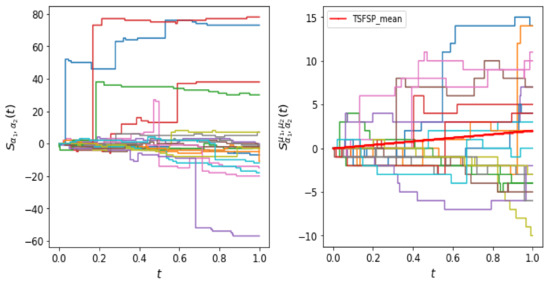
For and and fixed t, it is more probable that the value of the rv is higher than the rv . Thus, for same intensity parameter for Poisson process the process will have generally more arrivals than the process until time t. This is evident from the trajectories of the SFSP in Figure 1, because the trajectories are biased towards positive side. The TSFPP is a finite mean process, however SFPP is an infinite mean process and hence SFSP paths are expected to have large jumps, since there could be a large number of arrivals in any interval.
Figure 1.
The left hand figure shows the sample trajectories of SFSP with parameters , , and . The sample trajectories of TSFSP are shown in the right figure with parameters , , , , and .
Author Contributions
Conceptualization, N.G., A.K. and N.L.; Methodology, A.K. and N.L.; Simulation, N.G.; Writing-Original Draft Preparation, N.G., A.K. and N.L.; Writing-Review & Editing, N.G., A.K. and N.L. All authors have read and agreed to the published version of the manuscript.
Funding
N.G. would like to thank Council of Scientific and Industrial Research (CSIR), India for supporting her research under the fellowship award number 09/1005(0021)2018-EMR-I. Further, A.K. would like to express his gratitude to Science and Engineering Research Board (SERB), India for the financial support under the MATRICS research grant MTR/2019/000286.
Acknowledgments
N.G. would like to thank Council of Scientific and Industrial Research(CSIR), India, for the award of a research fellowship.
Conflicts of Interest
The authors declare no conflict of interest.
References
- Skellam, J.G. The frequency distribution of the difference between two Poisson variables belonging to different populations. J. Roy. Statist. Soc. Ser. A 1946, 109, 296. [Google Scholar] [CrossRef] [Scilit]
- Irwin, J.O. The frequency distribution of the difference between two independent variates following the same Poisson distribution. J. Roy. Statist. Soc. Ser. A 1937, 100, 415–416. [Google Scholar] [CrossRef] [Scilit]
- Steutel, F.W.; Van Harn, K. Infinite Divisibility of Probability Distributions on the Real Line; Marcel Dekker: New York, NY, USA, 2004. [Google Scholar]
- Hwang, Y.; Kim, J.; Kweon, I. Sensor noise modeling using the Skellam distribution: Application to the color edge detection. In Proceedings of the 2007 IEEE Conference on Computer Vision and Pattern Recognition, Minneapolis, MN, USA, 17–22 June 2007; pp. 1–8. [Google Scholar]
- Karlis, D.; Ntzoufras, I. Bayesian modeling of football outcomes: Using the Skellam’s distribution for the goal difference. IMA J. Manag. Math. 2008, 20, 133–145. [Google Scholar] [CrossRef] [Scilit]
- Bacry, E.; Delattre, M.; Hoffman, M.; Muzy, J. Modeling microstructure noise with mutually exciting point processes. Quant. Finance 2013, 13, 65–77. [Google Scholar] [CrossRef] [Scilit]
- Bacry, E.; Delattre, M.; Hoffman, M.; Muzy, J. Some limit theorems for Hawkes processes and applications to financial statistics. Stoch. Proc. Appl. 2013, 123, 2475–2499. [Google Scholar] [CrossRef] [Scilit]
- Barndorff-Nielsen, O.E.; Pollard, D.; Shephard, N. Integer-valued Lévy processes and low latency financial econometrics. Quant. Financ. 2011, 12, 587–605. [Google Scholar] [CrossRef] [Scilit]
- Carr, P. Semi-static hedging of barrier options under Poisson jumps. Int. J. Theor. Appl. Financ. 2011, 14, 1091–1111. [Google Scholar] [CrossRef] [Scilit]
- Kerss, A.; Leonenko, N.N.; Sikorskii, A. Fractional Skellam processes with applications to finance. Fract. Calc. Appl. Anal. 2014, 17, 532–551. [Google Scholar] [CrossRef] [Scilit]
- Kumar, A.; Leonenko, N.N.; Pichler, A. Fractional risk process in insurance. Math. Financ. Econ. 2019, 529, 121–539. [Google Scholar]
- Buchak, K.V.; Sakhno, L.M. On the governing equations for Poisson and Skellam processes time-changed by inverse subordinators. Theory Probab. Math. Statist. 2018, 98, 87–99. [Google Scholar] [CrossRef] [Scilit]
- Sengar, A.S.; Maheshwari, A.; Upadhye, N.S. Time-changed Poisson processes of order k. Stoch. Anal. Appl. 2020, 38, 124–148. [Google Scholar] [CrossRef] [Scilit]
- Kostadinova, K.Y.; Minkova, L.D. On the Poisson –process of order k. Pliska Stud. Math. Bulgar. 2012, 22, 117–128. [Google Scholar]
- Philippou, A.N. Distributions and Fibonacci polynomials of order k, longest runs, and reliability of consecutive k-out-of-n:F systems. In Fibonacci Numbers and Their Applications; Philippou, A.N., Ed.; D. Reidel: Dordrecht, The Netherlands, 1986; pp. 203–227. [Google Scholar]
- Fisher, R.A. The effects of methods of ascertainment upon the estimation of frequencies. Ann. Eugen. 1934, 6, 13–15. [Google Scholar] [CrossRef] [Scilit]
- Cox, D.R.; Lewis, P.A.W. The Statistical Analysis of Series of Events; Wiley: New York, NY, USA, 1966. [Google Scholar]
- Beghin, L.; Macci, C. Fractional discrete processes: Compound and mixed Poisson representations. J. Appl. Probab. 2014, 51, 9–36. [Google Scholar] [CrossRef] [Scilit]
- Abramowitz, M.; Stegun, I.A. Handbook of Mathematical Functions; Dover: New York, NY, USA, 1974. [Google Scholar]
- Sato, K.I. Lévy Processes and Infinitely Divisible Distributions; Cambridge University Press: Cambridge, UK, 1999. [Google Scholar]
- Schilling, R.L.; Song, R.; Vondracek, Z. Bernstein Functions: Theory and Applications; De Gruyter: Berlin, Germany, 2012. [Google Scholar]
- Orsingher, E.; Polito, F. The space-fractional Poisson process. Statist. Probab. Lett. 2012, 82, 852–858. [Google Scholar] [CrossRef] [Scilit]
- Kilbas, A.; Srivastava, H.; Trujillo, J. Theory and Applications of Fractional Differential Equations; Elsevier: Amsterdam, The Netherlands, 2006. [Google Scholar]
- Beran, J. Statistics for Long-Memory Processes; Chapman & Hall: New York, NY, USA, 1994. [Google Scholar]
- Gupta, N.; Kumar, A.; Leonenko, N. Tempered Fractional Poisson Processes and Fractional Equations with Z-Transform. Stoch. Anal. Appl. 2020, 38, 939–957. [Google Scholar] [CrossRef] [Scilit]
- Xia, W. On the distribution of running average of Skellam process. Int. J. Pure Appl. Math. 2018, 119, 461–473. [Google Scholar]
- Maheshwari, A.; Vellaisamy, P. On the long-range dependence of fractional Poisson and negative binomial processes. J. Appl. Probab. 2016, 53, 989–1000. [Google Scholar] [CrossRef] [Scilit]
- Rosiński, J. Tempering stable processes. Stochastic. Process. Appl. 2007, 117, 677–707. [Google Scholar] [CrossRef] [Scilit]
- Cahoy, D.; Uchaikin, V.; Woyczynski, A. Parameter estimation from fractional Poisson process. J. Statist. Plann. Inference 2013, 140, 3106–3120. [Google Scholar] [CrossRef] [Scilit]
- Samorodnitsky, G.; Taqqu, M.S. Stable Non-Gaussian Random Processes; Chapman and Hall: Boca Raton, FL, USA, 1994. [Google Scholar]
Publisher’s Note: MDPI stays neutral with regard to jurisdictional claims in published maps and institutional affiliations. |
© 2020 by the authors. Licensee MDPI, Basel, Switzerland. This article is an open access article distributed under the terms and conditions of the Creative Commons Attribution (CC BY) license (http://creativecommons.org/licenses/by/4.0/).