

Abstract
The capacity to randomly pick a unitary across the whole unitary group is a powerful tool across physics and quantum information. A unitary t-design is designed to tackle this challenge in an efficient way, yet constructions to date rely on heavy constraints. In particular, they are composed of ensembles of unitaries which, for technical reasons, must contain inverses and whose entries are algebraic. In this work, we reduce the requirements for generating an -approximate unitary t-design. To do so, we first construct a specific n-qubit random quantum circuit composed of a sequence of randomly chosen 2-qubit gates, chosen from a set of unitaries which is approximately universal on , yet need not contain unitaries and their inverses nor are in general composed of unitaries whose entries are algebraic; dubbed seed. We then show that this relaxed seed, when used as a basis for our construction, gives rise to an -approximate unitary t-design efficiently, where the depth of our random circuit scales as , thereby overcoming the two requirements which limited previous constructions. We suspect the result found here is not optimal and can be improved; particularly because the number of gates in the relaxed seeds introduced here grows with n and t. We conjecture that constant sized seeds such as those which are usually present in the literature are sufficient.
1. Introduction and Summary of the Results
1.1. Unitary t-Designs
A unitary t-design is an ensemble of unitaries, which, when sampled, mimic sampling from the ‘truly random’ Haar measure which chooses a unitary at random from the full continuous unitary group [1]. The usefulness of a t-design is that it is much simpler and more efficient to produce than sampling from the Haar measure (polynomial compared to exponential cost, respectively, [2] and [3]), yet it retains many of the useful applications. These include, but are not limited to, randomized benchmarking [4], estimating noise [5], private channels [6], photonics [7], quantum metrology [8], modeling thermalization [9], black hole physics [10], and recently demonstrations of quantum computational advantage [11,12,13].
More precisely, one can distinguish between two types of unitary t-designs, exact unitary t-designs and approximate unitary t-designs [14]. An exact unitary t-design on the n-qubit unitary group is a set of couples (we will refer to this set of couples frequently as a random unitary ensemble) , where D is a positive integer and each is chosen with probability (). An exact unitary t-design satisfies
where denotes the Haar measure on the n-qubit unitary group , and is polynomial of degree exactly t in the matrix elements of U, and of degree exactly t in the complex conjugates of these matrix elements. It can be shown that an exact unitary t-design is also an exact unitary design [15] (Note that this property also holds for approximate t-designs). Although exact unitary t-designs exist for any t and any dimension of the unitary group [16], the search for exact unitary t-designs on when and appears to be a highly nontrivial task [17]. Therefore, a natural step further is to consider a relaxation of the ’exact’ requirement and replace it with an ’approximate’ version, a so-called -approximate unitary t-design [2,14]. More explicitly, the definition of -approximate unitary t-design (or -approximate t-design for simplicity) is as follows.
Definition 1.
[2] Letbe the n-qubit Hilbert space. A random unitary ensemblewithis said to be an ε-approximate t-design if the following holds:
for all, wheredenotes the Haar measure on. For positive semidefinite matrices A and B,meansis positive semidefinite, ε is a positive real, and t is a positive integer (This definition is referred to as the strong definition of an ε-approximate t-design. Other definitions of ε-approximate t-designs exist, which are dependent on the application in mind, see for example [18] for an overview of these definitions.).
Note that when , one recovers a definition of an exact unitary t-design which is equivalent to the definition in Equation (1) [19]. Moreover, most of the applications of exact unitary t-designs can be adapted to use -approximate unitary t-designs, while retaining their efficiency [5,6,8,9,11,13,14]. Finally, efficient explicit constructions of -approximate unitary t-designs for any t are well-established both in the circuit model [2,20] as well the measurement-based model of quantum computing [11,21,22]. For these reasons, in this work, we will focus on -approximate t-designs.
Due to the broad applications of unitary t-designs, one is interested in finding more efficient, and in other ways ‘better’, -approximate t-designs—for example, limiting the unitary set according to the proposed use or implementation [21]. A limiting factor in doing so is the rigid proof structure that generally follows the proof of an -approximate t-design. It is thus of high interest to be able to reduce the technical requirements involved in such a proof, which is the main topic of this work. Indeed, such technical breakthroughs will likely have application beyond t-designs.
1.2. Comparison with Previous Work
In the seminal work of [2], it was shown that qubit random quantum circuits composed of layers of nearest neighbor unitaries drawn uniformly at random from a seed (As mentioned in the abstract, a finite set of unitaries which is approximately universal in will be referred to as a seed.), sampled from an -approximate unitary t-design [14] efficiently in depth. However, their proof relied on the following properties of the seed:
- Requirement (i): every has an inverse .
- Requirement (ii): the unitaries are composed entirely of algebraic entries.
The authors [2] also conjectured that the algebraic entry requirement is a technical issue (due mostly to using a result of [23]), and therefore could be dropped. Later on, in [11], it was shown that these requirements can be reduced to seeds composed partially of a seed made up of unitaries with algebraic entries and inverses in ; and its complement in , denoted as , which need not necessarily contain unitaries and their inverses nor be composed of algebraic entries (see also [12,20]).
In this work, we completely remove the requirements (i) and (ii) by giving examples of seeds in which every unitary in these seeds does not in general have an inverse in these seeds, nor are the unitaries in these seeds composed of algebraic entries in general, and yet converge efficiently to -approximate t-designs in a particular random circuit model which we will define explicitly below, thereby proving the conjecture proposed in [2]. We will refer to these seeds as relaxed throughout this work. However, it is to be noted that we do not mean relaxed in the sense that the unitaries making up these seeds are chosen from the Haar measure on . Indeed, because our proofs are based on the partially invertible universal sets of [11], this endows the unitaries composing the relaxed seeds with some structure which makes them different from Haar distributed unitaries.
1.3. Main Results
The notation we will use here is the same as that in [11], but we will restate it here for the sake of using it in our proofs.
The seed is a set composed of a seed , which contains unitaries and their inverses, and is composed of unitaries with algebraic entries; and its complement, the seed , which is not in general composed of unitaries and inverses, nor unitaries with algebraic entries. Define the random unitary ensemble
Denote the k-fold concatenation of B by
where , is a function acting on resulting in a set , where , the can be identical. There are such functions and the k-fold concatenation includes all of them. is the set of all unitaries of the form , with . Define (This definition of is for even n, the odd n case follows straightforwardly.)
where , and . Let be the L-fold concatenation of , defined as
where is also as defined previously and . Finally, let
The following theorem (Theorem 1), which holds for the above defined partially invertible universal set , was one of the main results of [11], saying basically that one can obtain efficient approximate unitary t-designs efficiently from partially invertible universal sets in .
Theorem 1.
[11] For any, and for some, if
and
where
and, then, formed from partially invertible universal set, is anapproximate t-design on, for any t.
Here, denotes the floor function. Define
to be the seed consisting of unitaries of the form
where for all , , and such that ∃ and . k is as defined in Equation (8) in Theorem (1). in Equation (11) is the relaxed seed we will consider in this work.
We will first show that, in general, truly is relaxed by proving the following theorem, which is the first main result of this work.
Theorem 2.
For a given value of k, there is a choice of the seedsuch thatdoes not verify requirementand completely violates requirement.
What is meant by requirement is that, for a choice of , every unitary in does not have an inverse in . Then, as promised, we will show that a particular random quantum circuit with seed converges to an -approximate t-design efficiently in depth. But first, define the random unitary ensemble
It is straightforward to see that
since
and by looking at Equation (11). is the set formed of unitaries of the form
where , ∀, and k is as defined in Equation (8). The random quantum circuits considered will be random unitaries in defined for the random unitary ensemble (Equation (12)) in the exact same way as in Equation (6) is defined for the random unitary ensemble in Equation (4), and for the exact value of k as in Equation (8). We will show that is an -approximate t-design, first by showing that (This is defined for of Equation (12), in the exact same way as of Equation (5) is defined for the random unitary ensemble in Equation (4)) is an -tensor product expander (TPE) [24,25], which is defined as follows:
Definition 2.
[24,25] A random unitary ensembleis said to be an-TPE if the following holds,
where,, where μ is the probability measure (As shown in [26] one can shift between a probability distribution over a discrete ensembleand a continuous distribution by defining the measure.) over the set, which results in choosingwith probability,, andis the complex conjugate of U.andare called moment superoperators.
Then, we will use the following proposition [20] to translate our TPE result into a result about t-designs
Proposition 1.
[11,20] Ifis an-TPE [24,25], then the L-fold concatenation of:is an ε-approximate t-design in the strong sense (Definition 1) when
is as defined previously in Equation (4).
We now state the three theorems which establish that relaxed seeds can give rise to efficient approximate t designs—and are the second, third, and fourth main results of this work.
Theorem 3.
is anwith
Theorem (3) holds, as Theorem (1), when and , , and k, are exactly as defined in Theorem (1). a is as defined in Equation (7).
Theorem 4.
∀t, ∃such that ∀,
Theorem 5.
Note that Theorem (5) means, as Theorem (1), that one can obtain efficient approximate t-designs efficiently from relaxed seeds .
The intuition behind why Theorems (3)–(5) are true is quite straightforward. was shown in [11] to be an -TPE [24,25]. An overwhelmingly large fraction of random unitaries (tending to one in the limit, see Equation (13)) in are also contained in . Therefore, one should expect to be an -TPE.
As a final remark in this section, note that Equations (13) and (8) tell us that the number of unitaries in the relaxed seed (Equation (11)) grows with n and t. This technical issue is due to us using the results on sets [11] in our proofs. This is in contrast with the seeds used in [2] and [11] where these seeds were finite and were composed of a number of elements. We believe the results presented here are not optimal, and that finite -sized sets not verifying requirement and completely violating requirement are sufficient to give approximate unitary t-designs in a random quantum circuit model efficiently in depth.
1.4. Example: Implementation of Our Construction as a Random Quantum Circuit
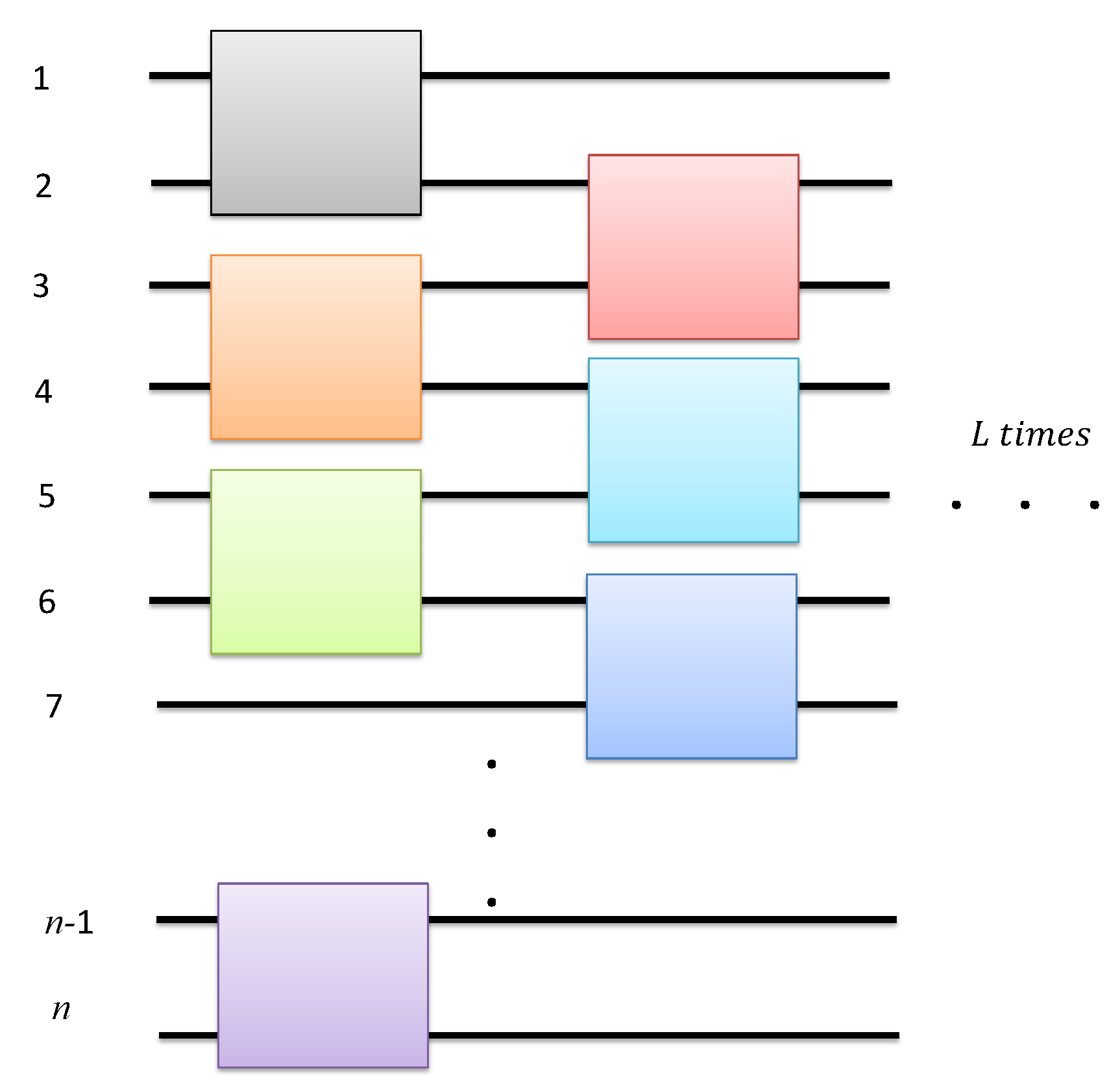
In the previous subsection, we presented the main results of this work, Theorems (2)–(5), which show a mathematical construction of an -approximate unitary t-design, , from relaxed seeds. In practice, one can design a random quantum circuit which samples from this -approximate unitary t-design. An example of such a construction sampling from is shown in Figure 1. This construction is similar to the random circuit construction in [11]. In this example, L is the depth of this circuit, whereas k controls the number of elements of the relaxed seed, which depends on the number of inputs n of the circuit as well as the order t of the design. One could also think of a translation to a measurement-based version of this random quantum circuit along the lines of work done in [11].
Figure 1.
Part of the random quantum circuit sampling from the random unitary ensemble . The horizontal black lines numbered from 1 to n represent the n input qubits of the random quantum circuit. The colored boxes touching two horizontal lines each represent a two-qubit unitary which is chosen with uniform probability from (Equation (11)). These two-qubit unitaries act nontrivially only on the horizontal lines (qubits) they touch. The order in which these unitaries are applied is from left to right. Unitaries (boxes) aligned on the same vertical level are applied simultaneously (depth-one). The depth-two unitary shown in this figure is sampled from . In order to sample from , the -approximate t-design, the random circuit shown in this figure is repeated L times, with L given by Equation (17) (see also Theorem (5)). This figure is for n-even, the odd n case follows straightforwardly.
An important point to consider is the dependence of the circuit depth of our random circuit construction on the figure of merit a, defined in Equation (7). For fixed t and n, the value of (Equation (18)) increases as a increases, meaning that the depth L of our construction increases with increasing a, from Equation (17). However, for large values of t or n, approaches unity, meaning that scales asymptotically (for large t or n) as (see Equation (18)). Therefore, in the limit of large t and n, the depth L of our random circuit construction is practically independent of a. (Although the value of k in Equation (8), which determines the cardinality of , will still depend on a, but only up to a constant factor (see Equation (8)).) The extremal values of a (i.e., and ) are not applicable to our construction since, when , the lower bound on k (Equation (8)) is not defined, whereas when , is the empty set. However, it should be noted that when , Theorem (1) of [11], which is the basis of the construction in this work, gives a lower bound which is in line with the lower bound on the circuit depth of the construction of approximate t-designs in [2] (see Theorem (1)). (The lower bound of Theorem (1) however is not as tight as that shown in [2], where the dependence on n in their result is linear, whereas that in Theorem (1) is cubic. Indeed, one of the open questions in [11] was whether this cubic lower bound on n could be reduced to a linear lower bound, which is the best one can hope to achieve for 1D random quantum circuits [2,18].)
In the next section, we present the proofs of Theorems (2)–(5).
2. Proofs
2.1. Proof of Theorem (2)
Proving requirement which is not verified by is straightforward. By our definition of the relaxed seed (Equation (11)), any unitary can be written as a product of k unitaries in (with k defined in Equation (8)), with at least one ; and since in general contains unitaries with nonalgebraic entries, then the unitaries are in general composed of nonalgebraic entries. To see this more clearly, let k be odd, and consider for example
where for and is a unitary with nonalgebraic entries.
Then,
and is thus composed of nonalgebraic entries.
We will now prove that is completely violated in general by , this proof will be done by contradiction. Suppose, by contradiction, that ∀ choices of and for a fixed choice of , ∃ such that
Without loss of generality, we can write
where , and for ; and where with and , ∀, ∀, and such that ∃ and such that . Equations (20)–(22) imply
Now, we will prove that Equation (23) does not hold for a general choice of , thereby establishing a contradiction. We will consider all the possible cases as follows.
- Case 1: ∀ in Equation (23).Without loss of generality, let and , with ; and let . Fix , and list all the possible relations of the form of the right-hand side of Equation (23), where , , and , , . Since there are many relations of the form of the right-hand side of Equation (23) (and many choices of .), choose such that it is not equal to any of the listed relations of the right-hand side of Equation (23). Therefore, Equation (23) does not hold in general in Case 1.
- Case 2: ∃ such that in Equation (23).Here, it will be convenient to rewrite Equation (23) aswhere again we take that , , and are fixed (as in Case 1). is a mapWe consider the two following subcases
- Case 2a:,Equation (24) becomes, in this case,
- Case 2b: ∃ such that .Equation (24) can be rewritten in this case asSince , and these unitaries are fixed, Equation (26) therefore cannot hold for a general choice of .In order to complete the proof of Theorem (2), we should show that a exists which simultaneously violates the relations imposed in Case 1 and Case 2. For a given fixed integer k and fixed , there is only a finite number of unitaries satisfying Equation (23) in Case 1. Unitaries satisfying Equations (25) and (26) (Case 2a and 2b) also satisfy the relationUsing the analysis of [27], the set of unitaries satisfying relations of the form Equation (27) has zero Haar measure on U(4). This follows from the fact that one can show that there is a one-to-one mapping between these (nonidentically zero) polynomial equations in the matrix elements of , and the intersection (Corresponding to partitioning the determinant into real and imaginary parts, each of which can be expressed as a trigonometric function of 16 real valued angles in parametrizing [27].) of the zero sets of two real analytic functions on . Each such zero set has a Lebesgue measure zero, therefore, their intersection (which is a subset of the two) also has Lebesgue measure zero (see [27] for more details). Therefore, the set of unitaries generated by relations of the form of Equation (27) has Haar measure zero [27]. The number of possible relations of the form of Equation (27) is countable (for fixed k and fixed ), thus the Haar measure of the set of unitaries satisfying Equations (25) or (26) is also zero, as the countable union of measure zero sets is also measure zero. This means that we can choose to be outside a measure zero set (which is the set of unitaries satisfying Equations (23) in Case 1, (25), and (26)), and we would therefore have that simultaneously violates the relations imposed by Case 1 and Case 2. This completes the proof of Theorem (2).
2.2. Proof of Theorem (3)
Define the moment superoperators
where ; and
where . Let
where . Note that is the complement of in . Straightforward calculation using Equation (13) leads to the following relation
Recalling from [11] that is an -TPE if [24,25]
where and is the Haar measure on ; using Equation (31) and a triangle inequality for norms we get
Thus, is an with
From a result in [11],
where and are as defined in Theorem (1). In addition, because is approximately universal on (because it is composed of unitaries which are approximately universal on ), then by a result of [26],
2.3. Proof of Theorem (4)
The proof of Theorem (4) will also proceed by contradiction.
Suppose ∃, such that ∀,
Notice that
with a and k as given in Equations (8) and (7), and t replaced by . Thus, for large enough n, and by using Equation (38), Equation (37) reduces to
Equation (39) leads to a contradiction, since by Theorem (1), , ∀t. This concludes the proof of Theorem (4).
2.4. Proof of Theorem (5)
The proof of Theorem (5) follows directly from applying Theorems (3) and (4) in Proposition (1).
3. Conclusions
In this work, we have shown that one can obtain efficient approximate unitary t-designs from random quantum circuits with support over families of seeds which are relaxed in the sense that any unitary in the seed need not in general have its inverse in the seed, nor are the seed unitaries composed entirely of algebraic entries. This result proves and extends the scope of a conjecture proposed in [2]. The relaxed seeds presented here have a cardinality which increases with n and t (see Equation (13)). These seeds, we believe, are not optimal, and we conjecture that relaxed seeds with a constant number of elements as in [2,11] suffice to get efficient t-designs.
Such relaxations have natural importance when the choice of the seed is not free for various reasons; for example, in the measurement-based approach to implementing t-designs [11,21,22] (see also [12,13]). There, the random selection of the unitary in the ensemble is made via a measurement—that is, relying on quantum randomness, not classical randomness. This has several potential advantages, including nonadaptivity of the setup, true randomness (which may even be beyond efficient classical randomness [28]), as well as the potential for verification [29,30] and integration to broader quantum information tasks through the graph state approach [31]. A difficulty in proofs in this approach is that the strict restrictions of previous approaches [2] heavily limited the allowed measurement-based structures. Indeed, this is what motivated previous works in this direction [11,12,22]. To this end, we expect that our relaxations will allow for more diverse constructions of t-designs, broadening their potential implementability and integrability into quantum information networks. Furthermore, given the natural use of graph states [32] for error correction and fault tolerance [33,34], this approach may lead to much better designs of quantum advantage tolerant to noise.
Another possible application to our result is making progress towards an inverse-free version of the Solovay–Kitaev (SK) theorem [35]. Indeed, there are already hints at relations between the SK construction and unitary t-designs [36] (We are grateful to Michał Oszmaniec for pointing us to this result.), and our construction is the first (to our knowledge (A work which is expected to appear shortly by Oszmaniec, Horodecki, and Sawicki also manages to remove the need for inverses and algebraic entries in the seed.)) to remove the need for inverses in the base set generating the t-design (see technical draft for details [11]).
Author Contributions
Conceptualization, R.M. and D.M.; Investigation, R.M. and D.M.; Methodology, R.M. and D.M.; Project administration, D.M. and J.G.; Software, J.G. and J.D.; Validation, R.M. and D.M.; Writing—original draft, R.M.; Writing—review & editing, R.M., J.G., and D.M. All authors have read and agreed to the published version of the manuscript.
Funding
The authors would like to acknowledge the National Council for Scientific Research of Lebanon (CNRS-L) and the Lebanese University (LU) for granting a doctoral fellowship to R. Mezher. We acknowledge support of the ANR through the ANR-17-CE24-0035 VanQute project.
Acknowledgments
We thank Michał Oszmaniec, Francesco Arzani, and Robert Booth for fruitful discussions. We thank the anonymous referees whose comments helped improve the presentation of this manuscript.
Conflicts of Interest
The authors declare no conflict of interest.
References
- Chiffre, M.D.D. The Haar measure. Ph.D. Thesis, Department of Mathematical Sciences, University of Copenhagen, Copenhagen, Denmark, 2011. [Google Scholar]
- Brandão, F.G.S.L.; Harrow, A.W.; Horodecki, M. Local Random Quantum Circuits are Approximate Polynomial-Designs. Commun. Math. Phys. 2016, 346, 397–434. [Google Scholar] [CrossRef]
- Knill, E. Approximation by quantum circuits. arXiv 1995, arXiv:quant-ph/9508006. [Google Scholar]
- Epstein, J.; Cross, A.W.; Magesan, E.; Gambetta, J.M. Investigating the limits of randomized benchmarking protocols. Phys. Rev. A 2014, 89, 012304. [Google Scholar] [CrossRef]
- Emerson, J.; Weinstein, Y.S.; Saraceno, M.; Lloyd, S.; Cory, D.G. Pseudo-random unitary operators for quantum information processing. Science 2003, 302, 2098–2100. [Google Scholar] [CrossRef]
- Hayden, P.; Leung, D.; Shor, P.W.; Winter, A. Randomizing quantum states: Constructions and applications. Commun. Math. Phys. 2004, 250, 371–391. [Google Scholar] [CrossRef]
- Matthews, J.C.F.; Whittaker, R.; O’Brien, J.L.; Turner, P. Testing randomness with photons by direct characterization of optical t-designs. Phys. Rev. A 2015, 91, 020301. [Google Scholar] [CrossRef]
- Oszmaniec, M.; Augusiak, R.; Gogolin, C.; Kołodynski, J.; Acin, A.; Lewenstein, M. Random bosonic states for robust quantum metrology. Phys. Rev. X 2016, 6, 041044. [Google Scholar] [CrossRef]
- Muller, M.; Adlam, E.; Masanes, L.; Wiebe, N. Thermalization and canonical typicality in translation-invariant quantum lattice systems. Commun. Math. Phys. 2015, 340, 499–561. [Google Scholar] [CrossRef]
- Hayden, P.; Preskill, J. Black holes as mirrors: Quantum information in random subsystems. J. High Energy Phys. 2007, 120. [Google Scholar] [CrossRef]
- Mezher, R.; Ghalbouni, J.; Dgheim, J.; Markham, D. Efficient approximate unitary t-designs from partially invertible universal sets and their application to quantum speedup. arXiv 2019, arXiv:1905.01504v3. [Google Scholar]
- Haferkamp, J.; Hangleiter, D.; Bouland, A.; Fefferman, B.; Eisert, J.; Bermejo-Vega, J. Closing gaps of a quantum advantage with short-time Hamiltonian dynamics. arXiv 2019, arXiv:1908.08069. [Google Scholar]
- Bermejo-Vega, J.; Hangleiter, D.; Schwarz, M.; Raussendorf, R.; Eisert, J. Architectures for quantum simulation showing a quantum speedup. Phys. Rev. X 2018, 8, 021010. [Google Scholar] [CrossRef]
- Dankert, C.; Cleve, R.; Emerson, J.; Livine, E. Exact and approximate unitary 2-designs and their application to fidelity estimation. Phys. Rev. A 2009, 80, 012304. [Google Scholar] [CrossRef]
- Roy, A.; Scott, A.J. Unitary designs and codes. Codes Cryptogr. 2009, 53, 13–31. [Google Scholar] [CrossRef]
- Seymour, P.D.; Zaslavsky, T. Averaging sets: A generalization of mean values and spherical designs. Adv. Math. 1984, 52, 213–240. [Google Scholar] [CrossRef]
- Bannai, E.; Nakahara, M.; Zhao, D.; Zhu, Y. On the explicit constructions of certain unitary t-designs. arXiv 2019, arXiv:1906.04583. [Google Scholar] [CrossRef]
- Harrow, A.; Mehraban, S. Approximate unitary t-designs by short random quantum circuits using nearest-neighbor and long-range gates. arXiv 2018, arXiv:1809.06957. [Google Scholar]
- Kaznatcheev, A. Structure of Exact and Approximate Unitary t-Designs. Available online: https://www.cs.mcgill.ca/~akazna/kaznatcheev20100509.pdf (accessed on 5 September 2019).
- Nakata, Y.; Hirche, C.; Koashi, M.; Winter, A. Efficient quantum pseudorandomness with nearly time-independent Hamiltonian dynamics. Phys. Rev. X 2017, 7, 021006. [Google Scholar] [CrossRef]
- Turner, P.; Markham, D. Derandomizing Quantum Circuits with Measurement-Based Unitary Designs. Phys. Rev. Lett. 2016, 116, 200501. [Google Scholar] [CrossRef]
- Mezher, R.; Ghalbouni, J.; Dgheim, J.; Markham, D. Efficient quantum pseudorandomness with simple graph states. Phys. Rev. A 2018, 97, 022333. [Google Scholar] [CrossRef]
- Bourgain Gamburd, J. A spectral gap theorem in SU(d). arXiv 2011, arXiv:1108.6264. [Google Scholar] [CrossRef]
- Hastings, M.B.; Harrow, A.W.H. Classical and quantum tensor product expanders. arXiv 2008, arXiv:0804.0011. [Google Scholar]
- Hastings, M.B. Random unitaries give quantum expanders. Phys. Rev. A 2007, 76, 032315. [Google Scholar] [CrossRef]
- Harrow, A.; Low, R.A. Random quantum circuits are approximate 2-designs. Commun. Math. Phys. 2009, 291, 257–302. [Google Scholar] [CrossRef]
- Farzani, F.; Ferrini, G.; Grosshans, F.; Markham, D. Random coding for sharing bosonic quantum secrets. Phys. Rev. 2019, 022303. [Google Scholar] [CrossRef]
- Hoban, M.J.; Wallman, J.J.; Anwar, H.; Usher, N.; Raussendorf, R.; Browne, D.E. Measurement-based classical computation. Phys. Rev. Lett. 2014, 112, 140505. [Google Scholar] [CrossRef]
- Markham, D.; Krause, A. A simple protocol for certifying graph states and applications in quantum networks. arXiv 2018, arXiv:1801.05057. [Google Scholar]
- Takeuchi, Y.; Mantri, A.; Morimae, T.; Mizutani, A.; Fitzsimons, J.F. Resource-efficient verification of quantum computing using Serfling’s bound. NPJ Quant. Inf. 2019, 5, 27. [Google Scholar] [CrossRef]
- Markham, D. Quantum Computing. Ercim News 2018, 112, 19. [Google Scholar]
- Bell, B.A.; Tame, M.S.; Markham, D.; Wadsworth, W.J.; Rarity, J.G. Experimental demonstration of graph-state quantum secret sharing. Nat. Commun. 2014, 5, 5480. [Google Scholar] [CrossRef]
- Raussendorf, R.; Harrington, J.; Goyal, K. Topological fault-tolerance in cluster state quantum computation. Ann. Phys. 2006, 321, 2242–2270. [Google Scholar] [CrossRef]
- Nielsen, M.A.; Dawson, C.M. Fault-tolerant quantum computation with cluster states. Phys. Rev. A 2005, 71, 042323. [Google Scholar] [CrossRef]
- Dawson, C.M.; Nielsen, M.A. The solovay-kitaev algorithm. arXiv 2005, arXiv:quant-ph/0505030. [Google Scholar]
- Varjú, P.P. Random walks in compact groups. Doc. Math. 2013, 18, 1137–1175. [Google Scholar]
© 2020 by the authors. Licensee MDPI, Basel, Switzerland. This article is an open access article distributed under the terms and conditions of the Creative Commons Attribution (CC BY) license (http://creativecommons.org/licenses/by/4.0/).


